




GATE 2022 Humanities and Social Sciences - Philosophy (XH-C4) Question Paper with Solutions PDF is available for download. GATE 2022 XH- C4 (Philosophy) paper was conducted on February 6, 2022 in the Afternoon Session. The exam was successfully organized by IIT Kharagpur. GATE 2022 XH- Philosophy question paper comprised a total of 65 questions with 39 MCQs, 2 NATs and 24 MSQs. The question was divided into three sections- Section GA (General Aptitude), Section B1 (Reasoning Comprehension) and Section XH- C4 (Philosophy).
GATE 2022 Humanities and Social Sciences - Philosophy (XH-C4) Question Paper with Solutions
| GATE 2022 Humanities and Social Sciences - Philosophy (XH-C4) Question Paper |  Download Download |
Check Solutions |
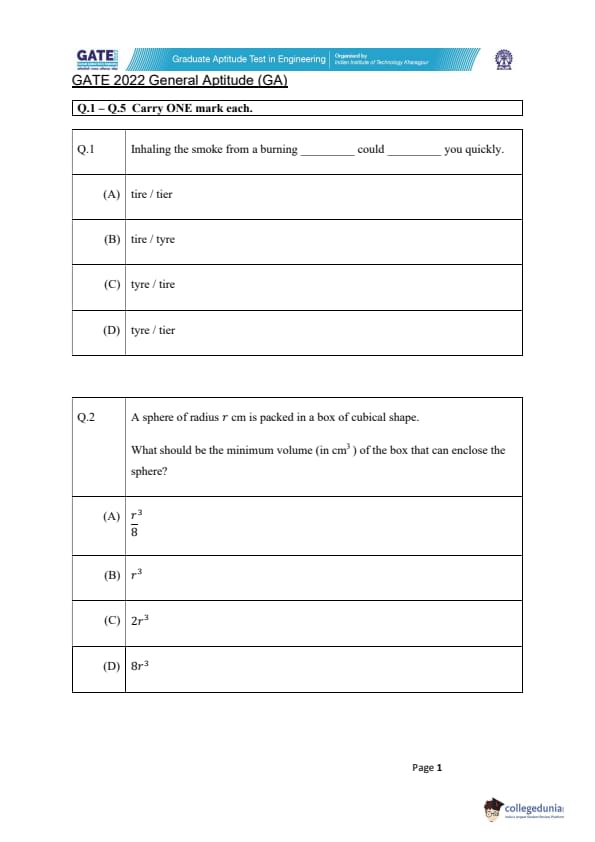
Inhaling the smoke from a burning __________ could __________ you quickly.
A sphere of radius \(r\) cm is packed in a box of cubical shape.
What should be the minimum volume (in cm\(^3\)) of the box that can enclose the sphere?
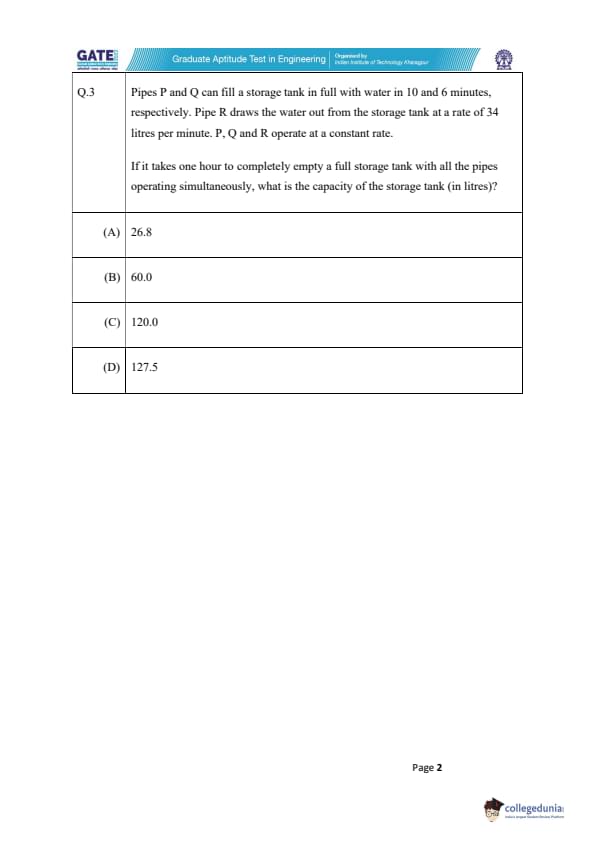
Pipes P and Q can fill a storage tank in full with water in 10 and 6 minutes, respectively. Pipe R draws the water out from the storage tank at a rate of 34 litres per minute. P, Q and R operate at a constant rate.
If it takes one hour to completely empty a full storage tank with all the pipes operating simultaneously, what is the capacity of the storage tank (in litres)?
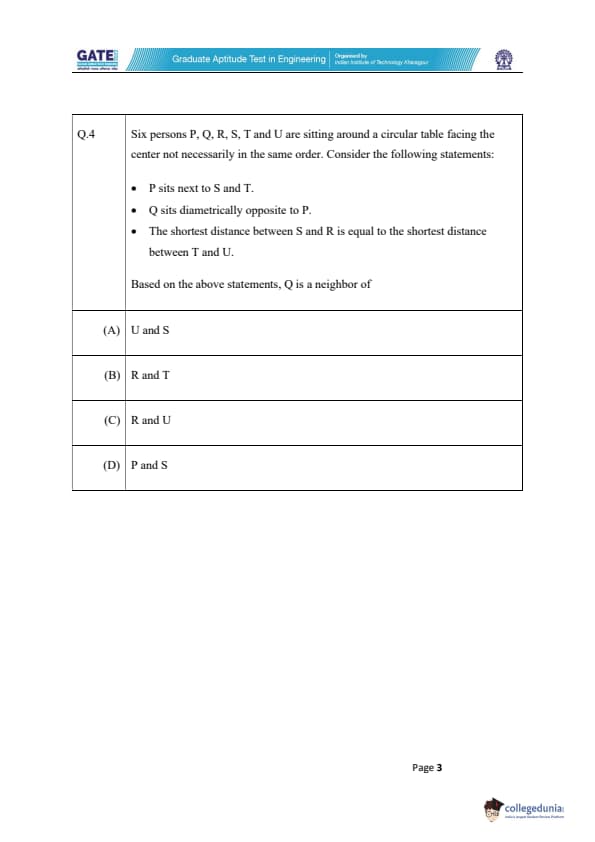
Six persons P, Q, R, S, T, and U are sitting around a circular table facing the center not necessarily in the same order. Consider the following statements:
P sits next to S and T.
Q sits diametrically opposite to P.
The shortest distance between S and R is equal to the shortest distance between T and U.
Based on the above statements, Q is a neighbor of
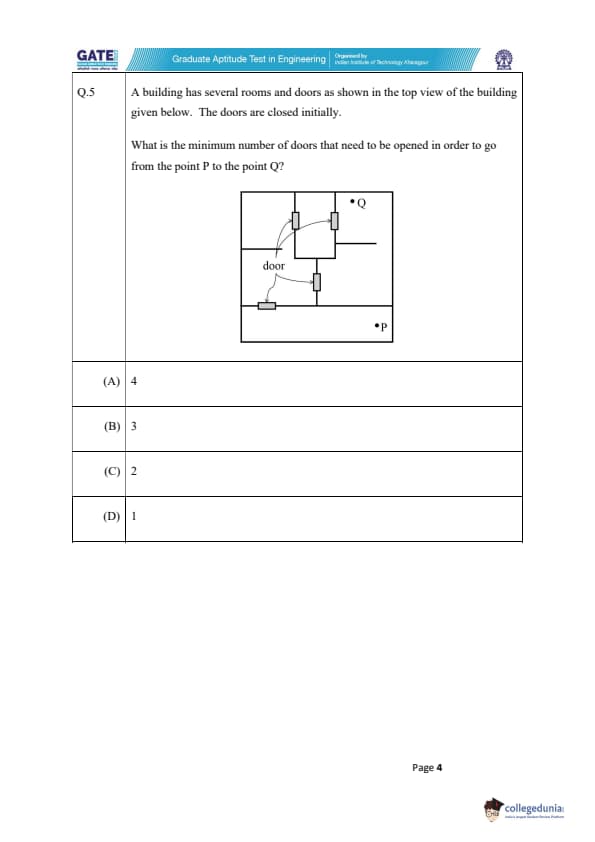
A building has several rooms and doors as shown in the top view of the building given below. The doors are closed initially.
What is the minimum number of doors that need to be opened in order to go from the point P to the point Q?

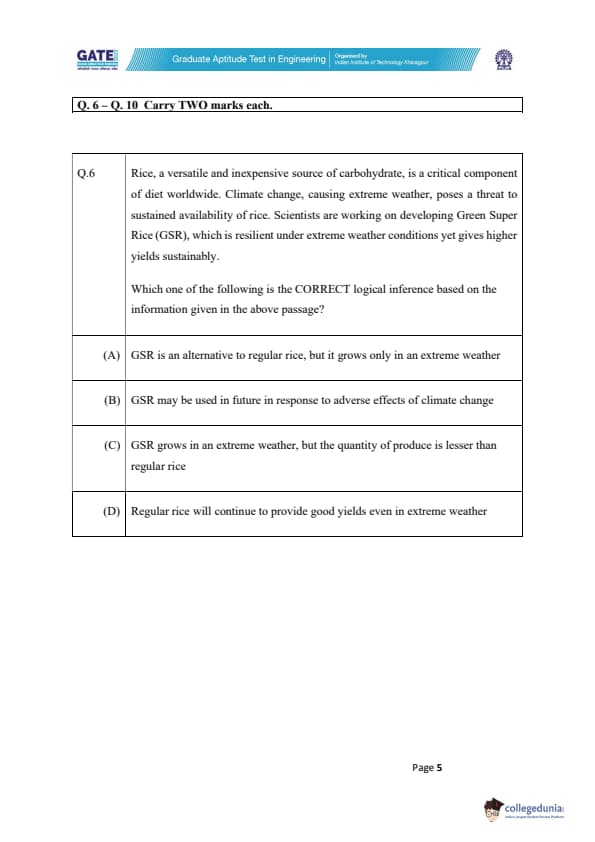
Rice, a versatile and inexpensive source of carbohydrate, is a critical component of diet worldwide. Climate change, causing extreme weather, poses a threat to sustained availability of rice. Scientists are working on developing Green Super Rice (GSR), which is resilient under extreme weather conditions yet gives higher yields sustainably.
Which one of the following is the CORRECT logical inference based on the information given in the above passage?
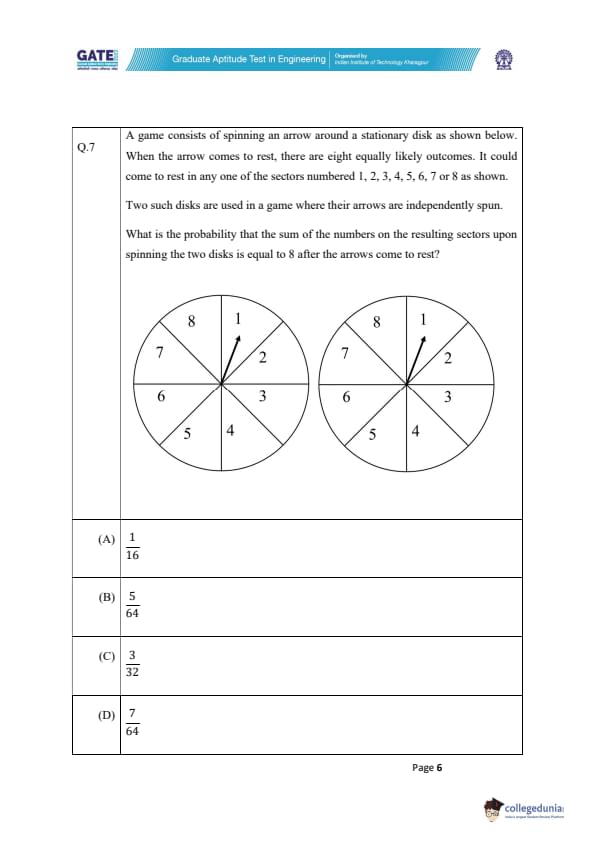
A game consists of spinning an arrow around a stationary disk as shown below.
When the arrow comes to rest, there are eight equally likely outcomes. It could come to rest in any one of the sectors numbered 1, 2, 3, 4, 5, 6, 7, or 8 as shown.
Two such disks are used in a game where their arrows are independently spun.
What is the probability that the sum of the numbers on the resulting sectors upon spinning the two disks is equal to 8 after the arrows come to rest?

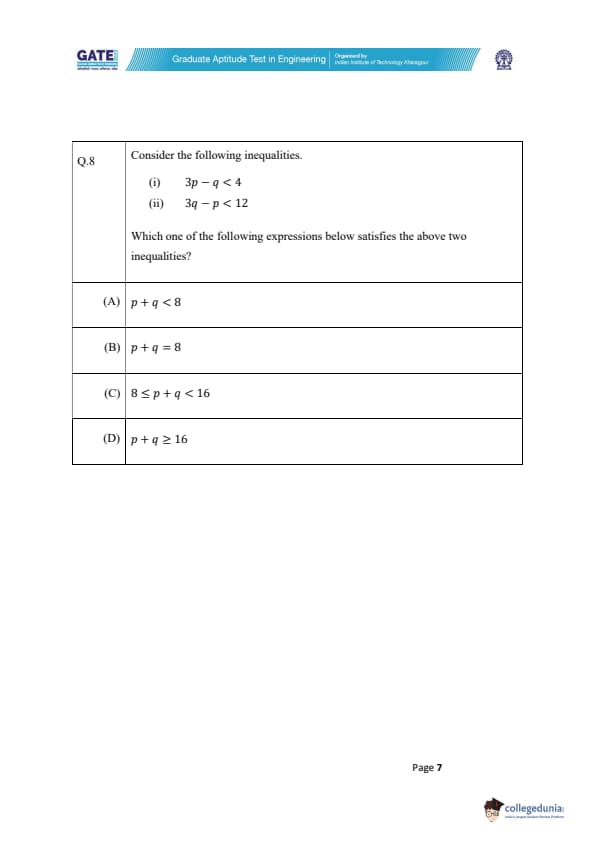
Consider the following inequalities.
(i) \( 3p - q < 4 \)
(ii) \( 3q - p < 12 \)
Which one of the following expressions below satisfies the above two inequalities?
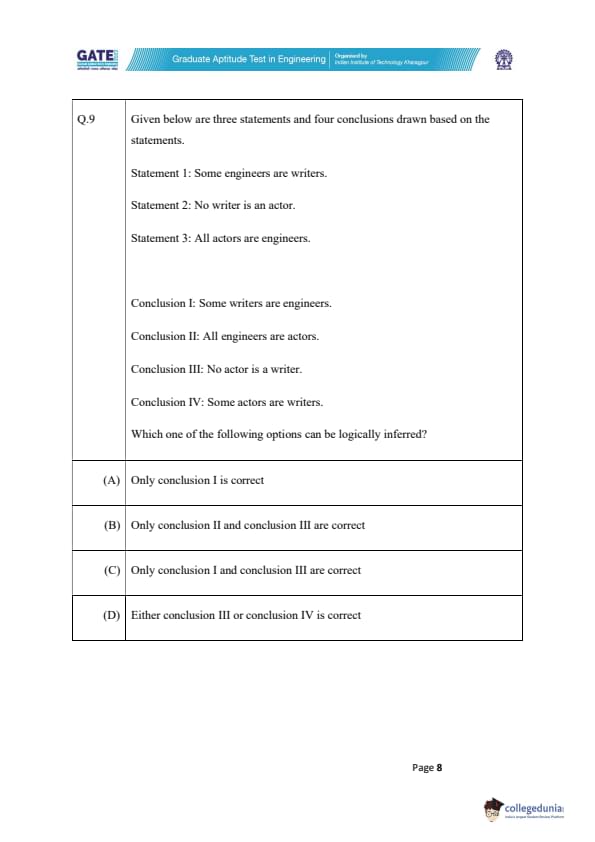
Given below are three statements and four conclusions drawn based on the statements.
Statement 1: Some engineers are writers.
Statement 2: No writer is an actor.
Statement 3: All actors are engineers.
Conclusion I: Some writers are engineers.
Conclusion II: All engineers are actors.
Conclusion III: No actor is a writer.
Conclusion IV: Some actors are writers.
Which one of the following options can be logically inferred?
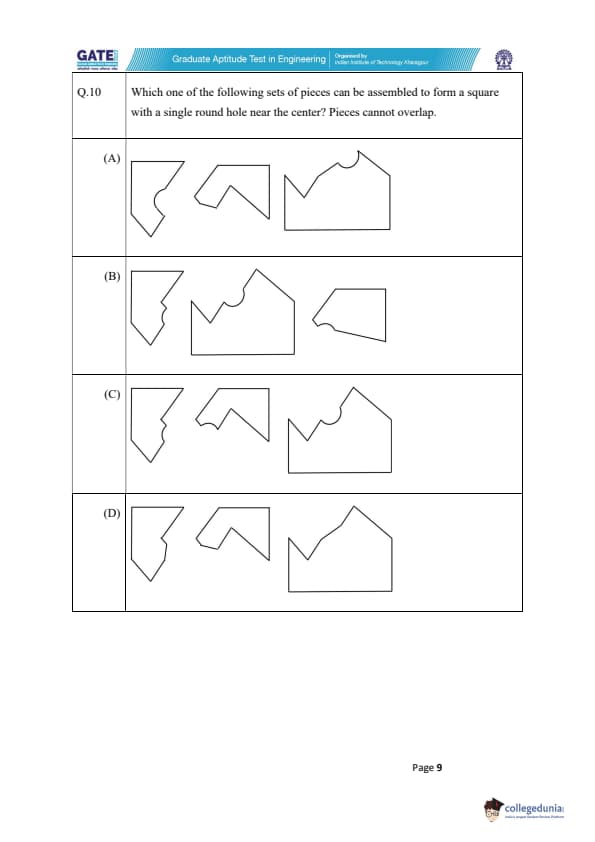
Which one of the following sets of pieces can be assembled to form a square with a single round hole near the center? Pieces cannot overlap.

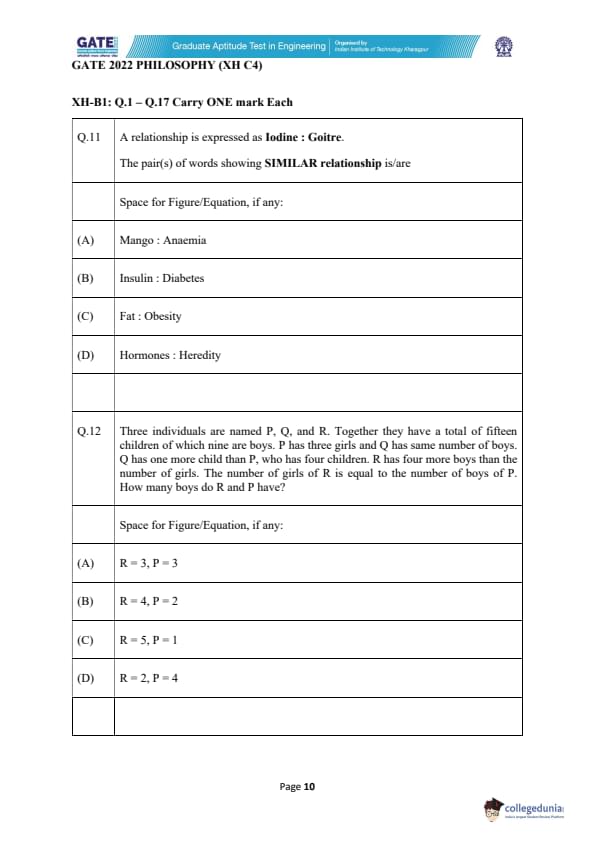
A relationship is expressed as Iodine : Goitre.
The pair(s) of words showing SIMILAR relationship is/are
Three individuals are named P, Q, and R. Together they have a total of fifteen children, of which nine are boys. P has three girls and Q has the same number of boys. Q has one more child than P, who has four children. R has four more boys than the number of girls of P. The number of girls of R is equal to the number of boys of P. How many boys do R and P have?
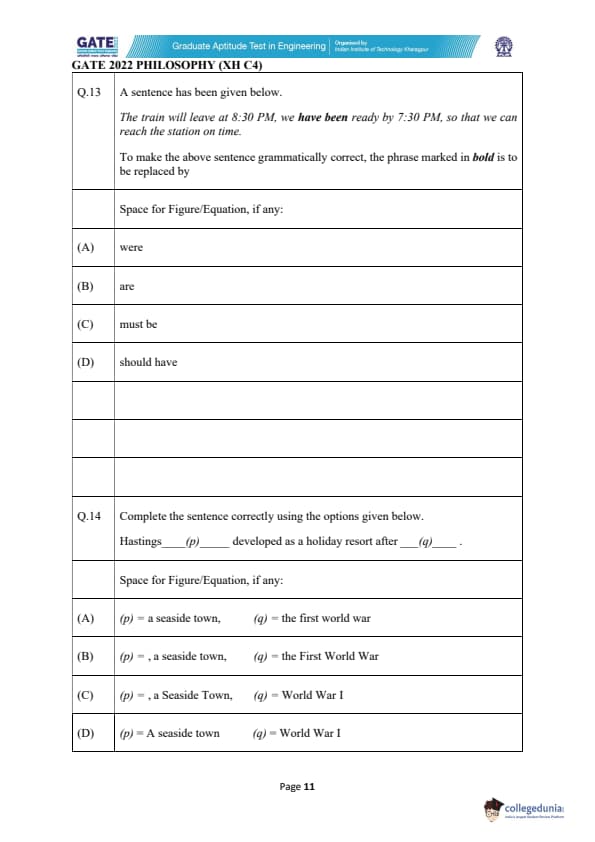
A sentence has been given below.
The train will leave at 8:30 PM, we \underline{have been ready by 7:30 PM, so that we can reach the station on time.
To make the above sentence grammatically correct, the phrase marked in bold is to be replaced by
Complete the sentence correctly using the options given below.
Hastings (p) (q) developed as a holiday resort after (q).
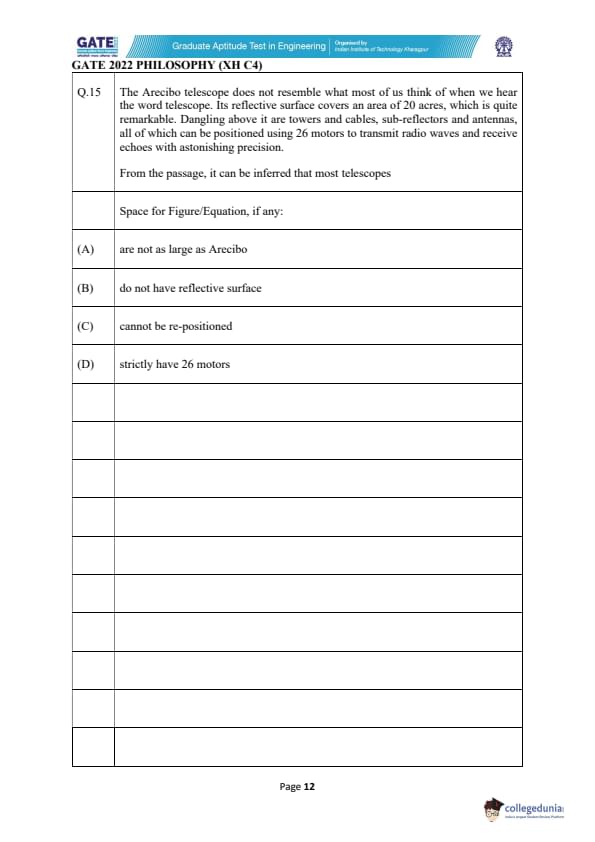
The Arecibo telescope does not resemble what most of us think of when we hear the word telescope. Its reflective surface covers an area of 20 acres, which is quite remarkable. Dangling above it are towers and cables, sub-reflectors and antennas, all of which can be positioned using 26 motors to transmit radio waves and receive echoes with astonishing precision.
From the passage, it can be inferred that most telescopes
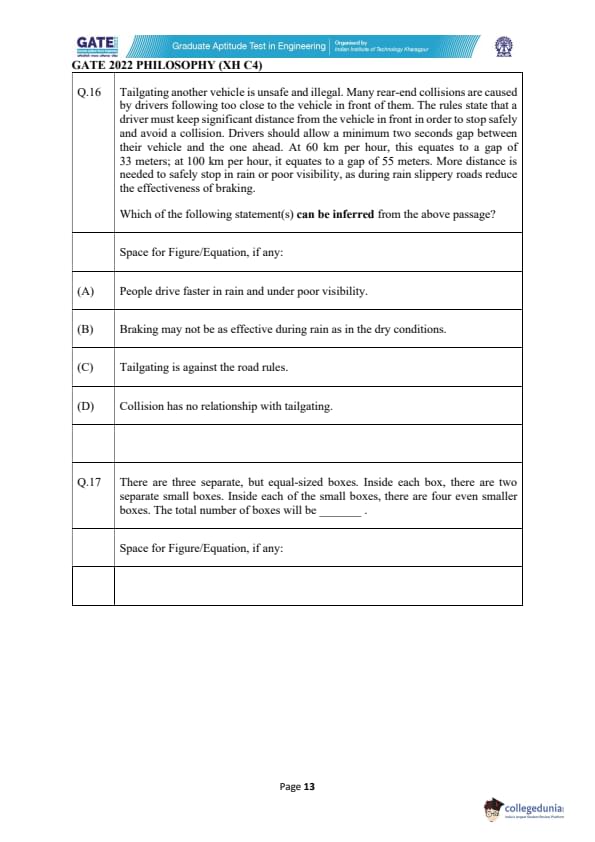
Tailgating another vehicle is unsafe and illegal. Many rear-end collisions are caused by drivers following too closely to the vehicle in front of them. The rules state that a driver must keep significant distance from the vehicle in front in order to stop safely and avoid a collision. Drivers should allow a minimum two seconds gap between their vehicle and the one ahead. At 60 km per hour, this equates to a gap of 33 meters; at 100 km per hour, it equates to a gap of 55 meters. More distance is needed to safely stop in rain or poor visibility, as during rain slippery roads reduce the effectiveness of braking.
Which of the following statement(s) can be inferred from the above passage?
There are three separate, but equal-sized boxes. Inside each box, there are two separate small boxes. Inside each of the small boxes, there are four even smaller boxes. The total number of boxes will be _________.
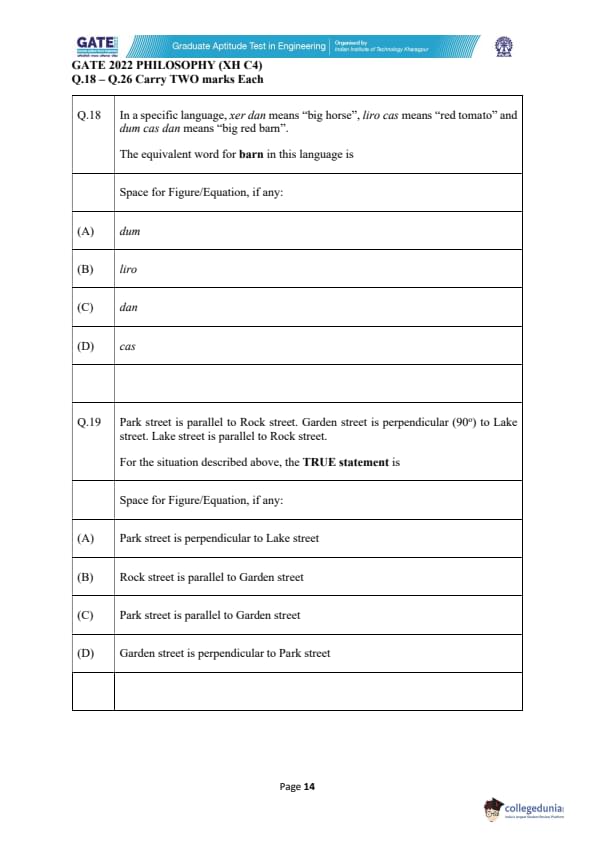
In a specific language, \( xer dan \) means "big horse", \( liro cas \) means "red tomato", and \( dum cas dan \) means "big red barn".
The equivalent word for \textit{barn in this language is
Park street is parallel to Rock street. Garden street is perpendicular (90°) to Lake street. Lake street is parallel to Rock street. For the situation described above, the TRUE statement is
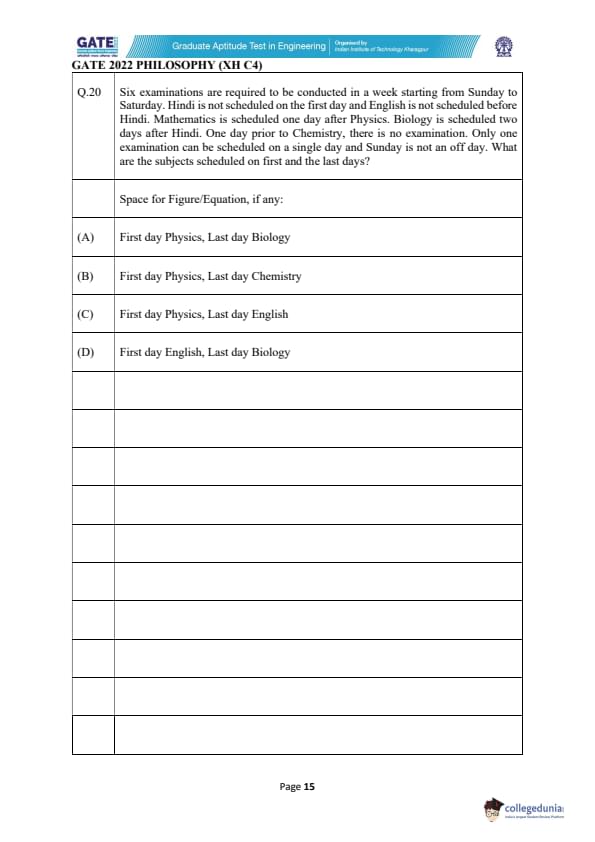
Six examinations are required to be conducted in a week starting from Sunday to Saturday. Hindi is not scheduled on the first day and English is not scheduled before Hindi. Mathematics is scheduled one day after Physics. Biology is scheduled two days after Hindi. One day prior to Chemistry, there is no examination. Only one examination can be scheduled on a single day and Sunday is not an off day. What are the subjects scheduled on first and the last days?
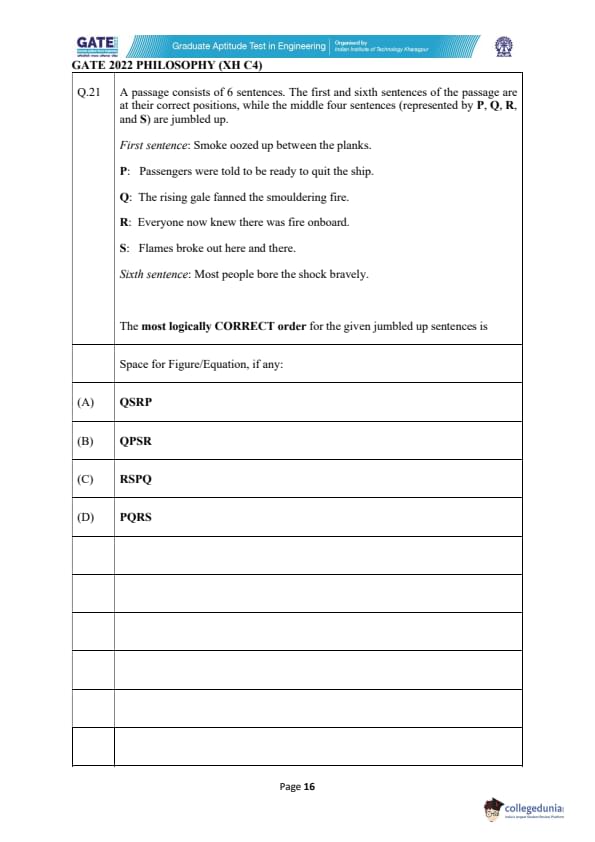
A passage consists of 6 sentences. The first and sixth sentences of the passage are at their correct positions, while the middle four sentences (represented by P, Q, R, and S) are jumbled up.
First sentence: Smoke oozed up between the planks.
P: Passengers were told to be ready to quit the ship.
Q: The rising gale fanned the smouldering fire.
R: Everyone now knew there was fire onboard.
S: Flames broke out here and there.
Sixth sentence: Most people bore the shock bravely.
The most logically CORRECT order for the given jumbled up sentences is
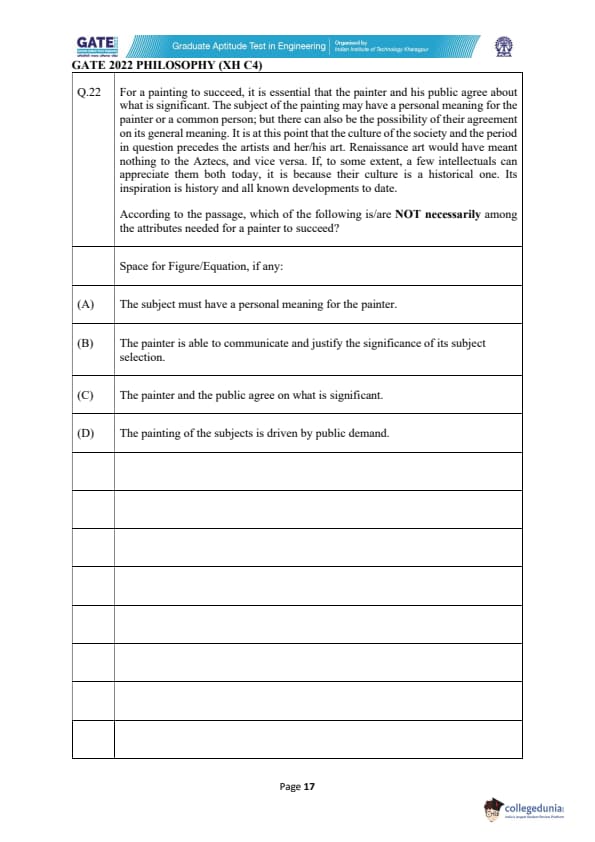
For a painting to succeed, it is essential that the painter and his public agree about what is significant. The subject of the painting may have a personal meaning for the painter or a common person; but there can also be the possibility of their agreement on its general meaning. It is at this point that the culture of the society and the period in question precedes the artists and her/his art. Renaissance art would have meant nothing to the Aztecs, and vice versa. If, to some extent, a few intellectuals can appreciate them both today, it is because their culture is a historical one. Its inspiration is history and all known developments to date.
According to the passage, which of the following is/are NOT necessarily among the attributes needed for a painter to succeed?
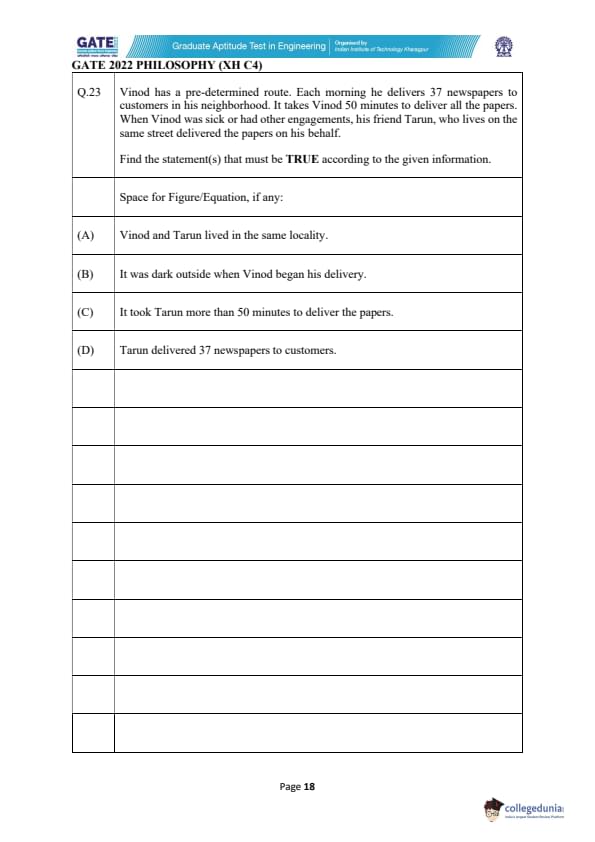
Vinod has a pre-determined route. Each morning he delivers 37 newspapers to customers in his neighborhood. It takes Vinod 50 minutes to deliver all the papers. When Vinod was sick or had other engagements, his friend Tarun, who lives on the same street delivered the papers on his behalf.
Find the statement(s) that must be TRUE according to the given information.
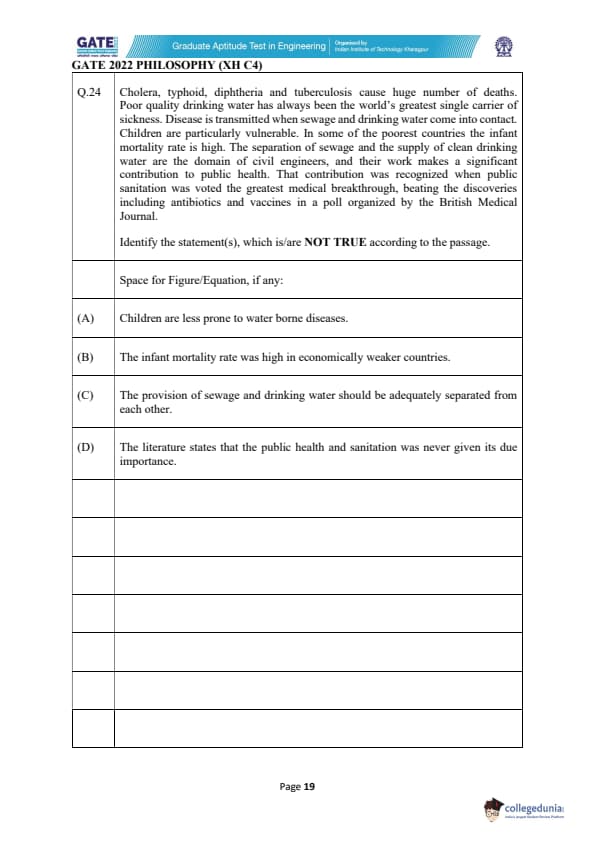
Cholera, typhoid, diphtheria and tuberculosis cause huge number of deaths. Poor quality drinking water has always been the world’s greatest single carrier of sickness. Disease is transmitted when sewage and drinking water come into contact. Children are particularly vulnerable. In some of the poorest countries the infant mortality rate is high. The separation of sewage and the supply of clean drinking water are the domain of civil engineers, and their work makes a significant contribution to public health. That contribution was recognized when public sanitation was voted the greatest medical breakthrough, beating the discoveries including antibiotics and vaccines in a poll organized by the British Medical Journal.
Identify the statement(s), which is/are NOT TRUE according to the passage.
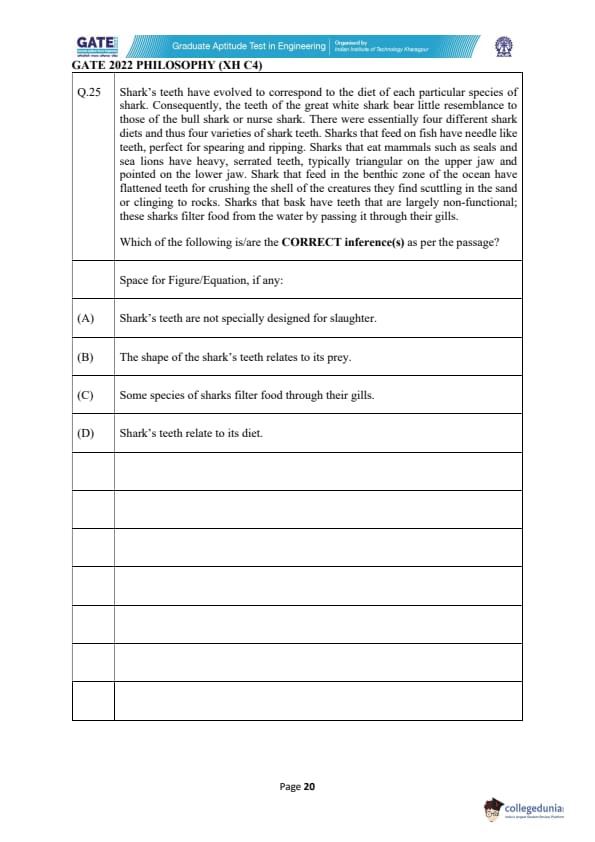
Shark’s teeth have evolved to correspond to the diet of each particular species of shark. Consequently, the teeth of the great white shark bear little resemblance to those of the bull shark or nurse shark. There were essentially four different shark diets and thus four varieties of shark teeth. Sharks that feed on fish have needle-like teeth, perfect for spearing and ripping. Sharks that eat mammals such as seals and sea lions have heavy, serrated teeth, typically triangular on the upper jaw and pointed on the lower jaw. Shark that feed in the benthic zone of the ocean have flattened teeth for crushing the shell of the creatures they find scuttling in the sand or clinging to rocks. Sharks that bask have teeth that are largely non-functional; these sharks filter food from the water by passing it through their gills.
Which of the following is/are the CORRECT inference(s) as per the passage?
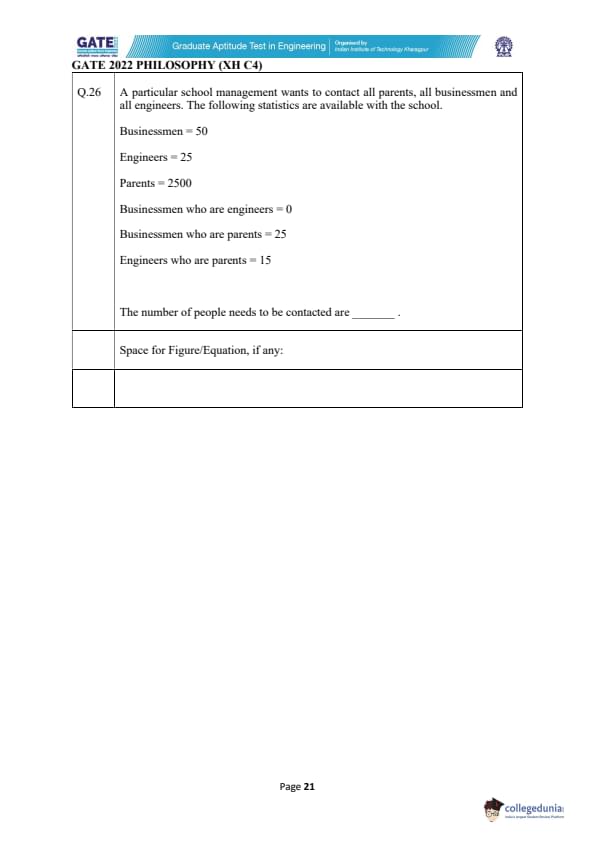
A particular school management wants to contact all parents, all businessmen and all engineers. The following statistics are available with the school.
Businessmen = 50
Engineers = 25
Parents = 2500
Businessmen who are engineers = 0
Businessmen who are parents = 25
Engineers who are parents = 15
The number of people who need to be contacted are _________.
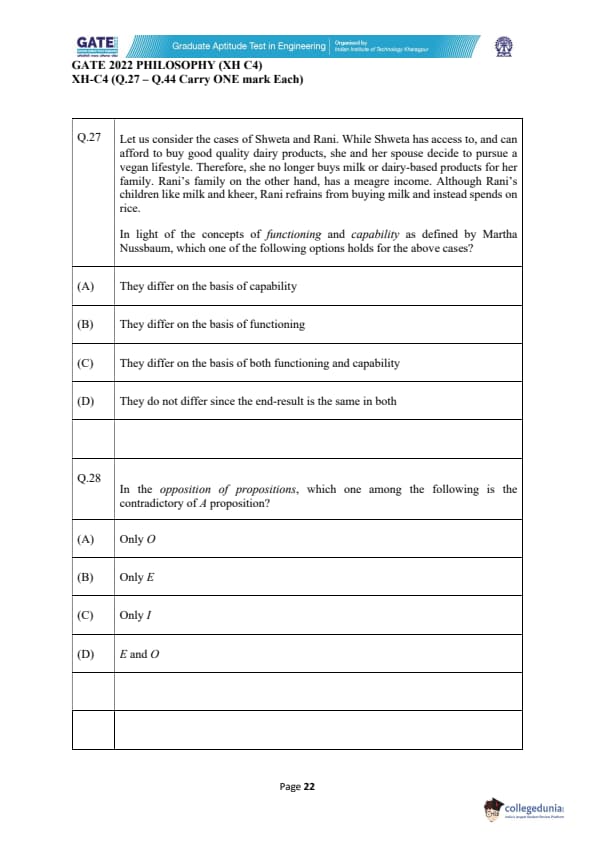
Let us consider the cases of Shweta and Rani. While Shweta has access to, and can afford to buy good quality dairy products, she and her spouse decide to pursue a vegan lifestyle. Therefore, she no longer buys milk or dairy-based products for her family. Rani’s family on the other hand, has a meagre income. Although Rani’s children like milk and kheer, Rani refrains from buying milk and instead spends on rice.
In light of the concepts of functioning and capability as defined by Martha Nussbaum, which one of the following options holds for the above cases?
In the opposition of propositions, which one among the following is the contradictory of A proposition?
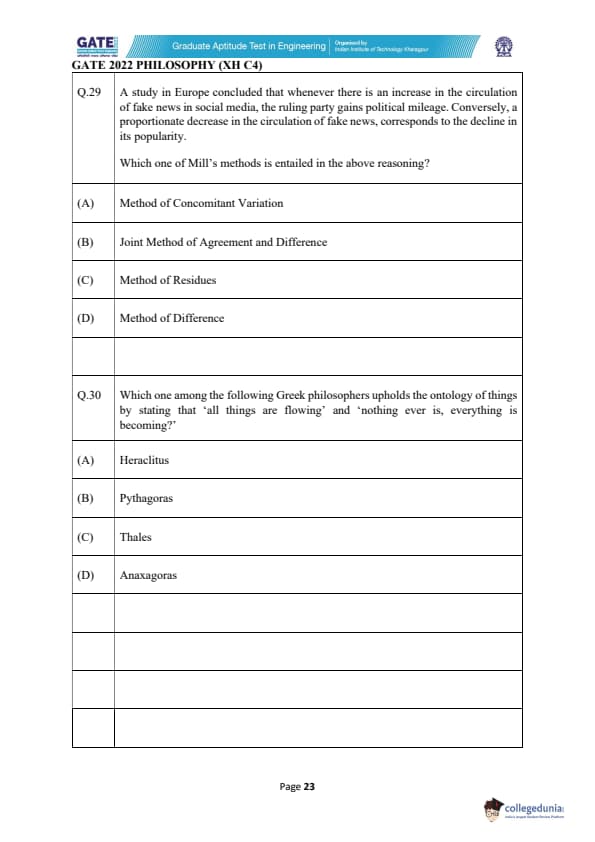
A study in Europe concluded that whenever there is an increase in the circulation of fake news in social media, the ruling party gains political mileage. Conversely, a proportionate decrease in the circulation of fake news corresponds to the decline in its popularity.
Which one of Mill’s methods is entailed in the above reasoning?
Which one among the following Greek philosophers upholds the ontology of things by stating that ‘all things are flowing’ and ‘nothing ever is, everything is becoming’?
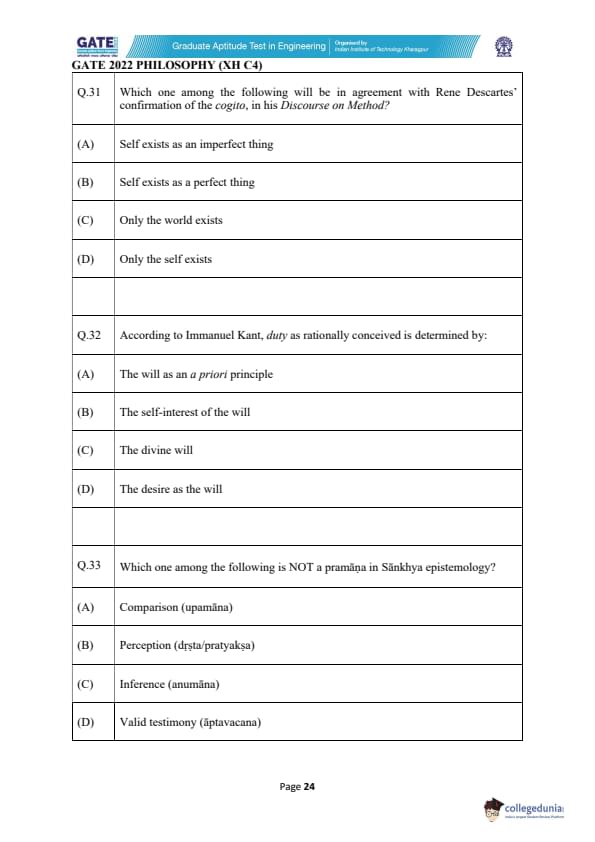
Which one among the following will be in agreement with Rene Descartes’ confirmation of the cogito, in his Discourse on Method?
According to Immanuel Kant, duty as rationally conceived is determined by:
Which one among the following is NOT a pramāṇa in Sāṅkhya epistemology?
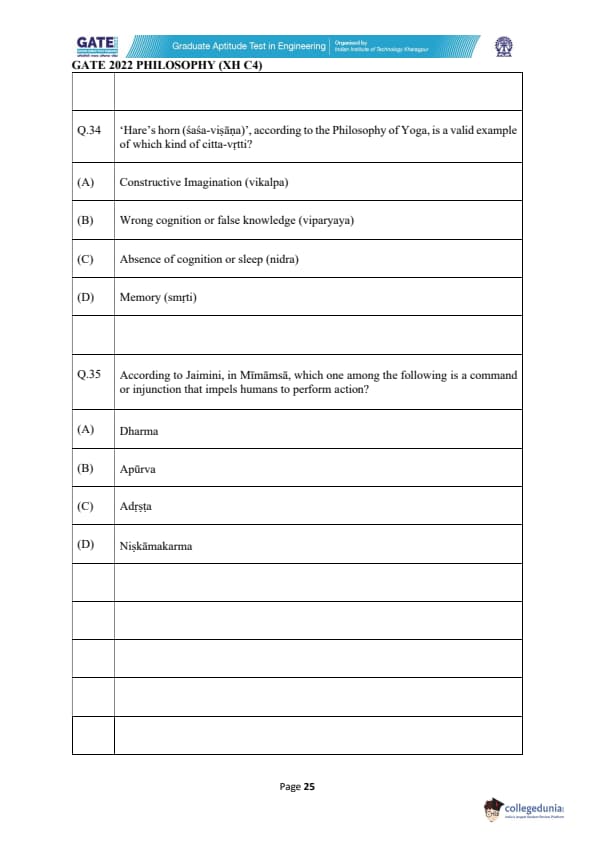
‘Hare’s horn (śāśa-viṣāṇa)’, according to the Philosophy of Yoga, is a valid example of which kind of citta-vṛtti?
According to Jaimini, in Mīmāṃsā, which one among the following is a command or injunction that impels humans to perform action?
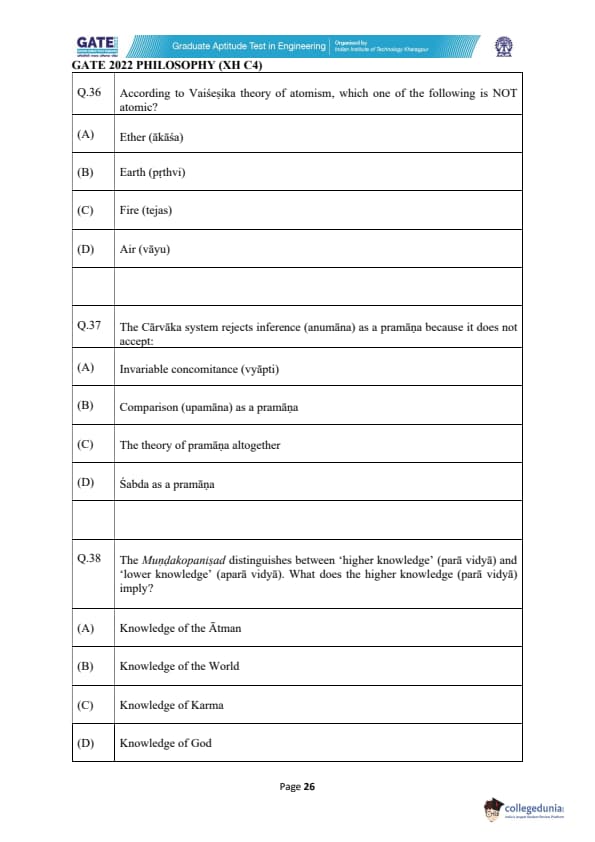
According to Vaiśeṣika theory of atomism, which one of the following is NOT atomic?
The Cārvāka system rejects inference (anumāna) as a pramāṇa because it does not accept:
The Muṇḍakopaniṣad distinguishes between ‘higher knowledge’ (parā vidyā) and ‘lower knowledge’ (aparā vidyā). What does the higher knowledge (parā vidyā) imply?
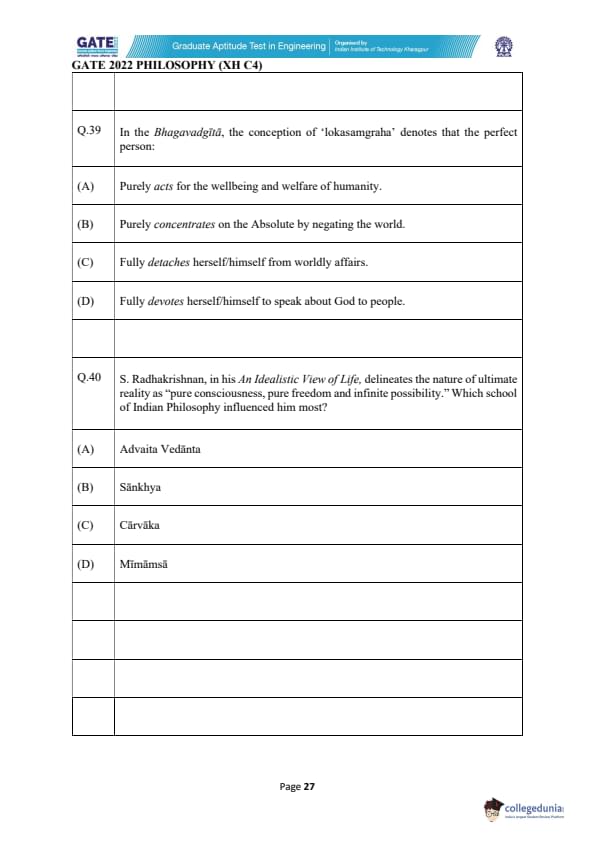
In the Bhagavadgītā, the conception of ‘lokasamgraha’ denotes that the perfect person:
S. Radhakrishnan, in his An Idealistic View of Life, delineates the nature of ultimate reality as “pure consciousness, pure freedom and infinite possibility.” Which school of Indian Philosophy influenced him most?
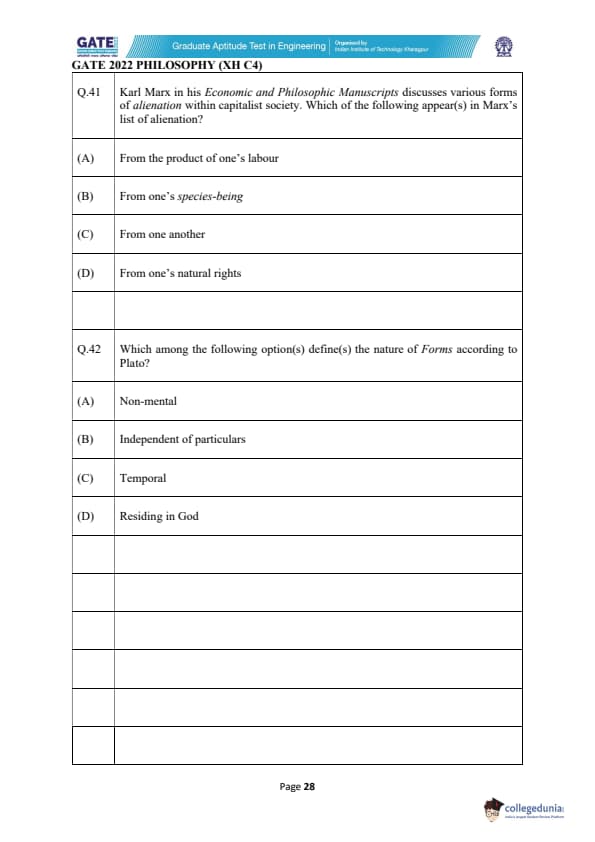
Karl Marx in his Economic and Philosophic Manuscripts discusses various forms of alienation within capitalist society. Which of the following appear(s) in Marx’s list of alienation?
Which among the following option(s) define(s) the nature of Forms according to Plato?
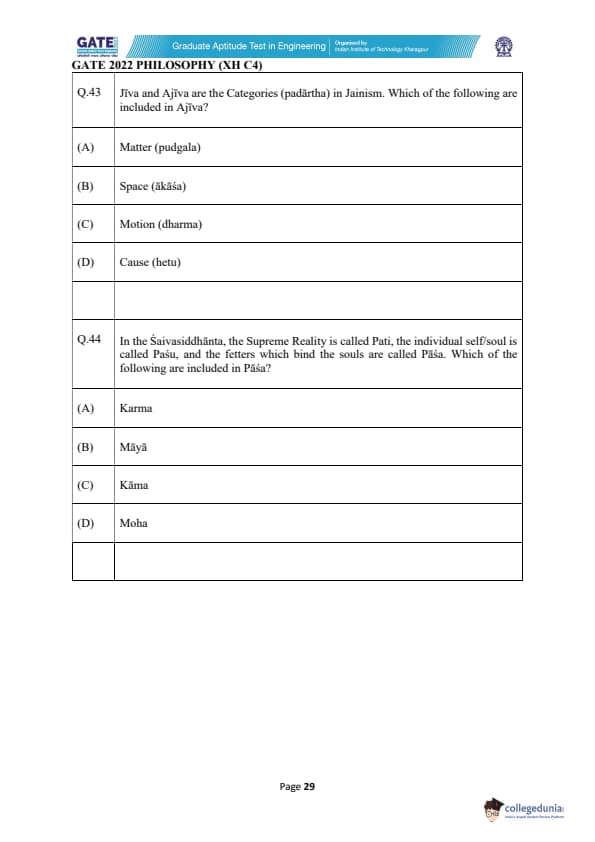
Jīva and Ajīva are the Categories (padārtha) in Jainism. Which of the following are included in Ajīva?
In the Śaivasiddhānta, the Supreme Reality is called Pati, the individual self/soul is called Paśu, and the fetters which bind the souls are called Paśa. Which of the following are included in Paśa?
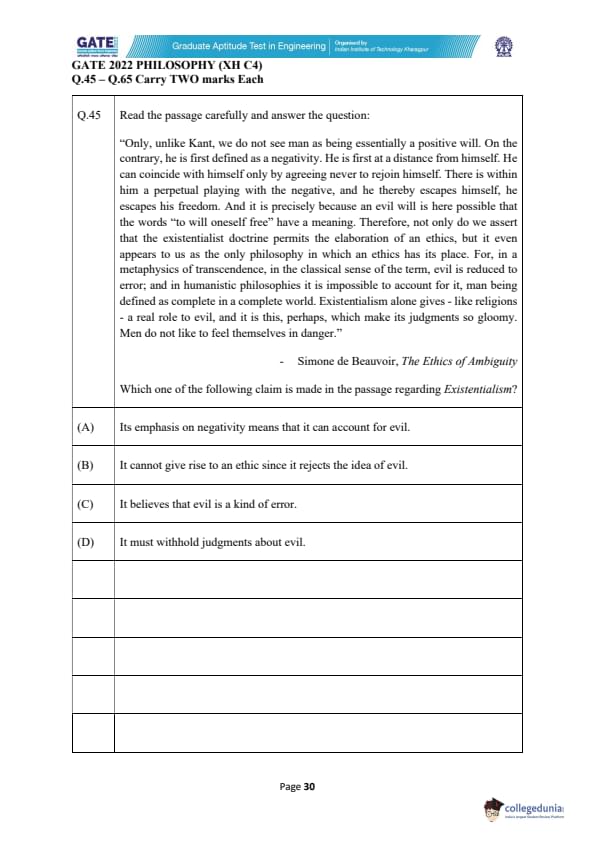
Read the passage carefully and answer the question:
“Only, unlike Kant, we do not see man as being essentially a positive will. On the contrary, he is first defined as a negativity. He is first at a distance from himself. He can coincide with himself only by agreeing never to rejoin himself. There is within him a perpetual playing with the negative, and he thereby escapes himself, he escapes his freedom. And it is precisely because an evil will is here possible that the words “to will oneself free” have a meaning. Therefore, not only do we assert that the existentialist doctrine permits the elaboration of an ethics, but it even appears to us as the only philosophy in which an ethics has its place. For, in a metaphysics of transcendence, in the classical sense of the term, evil is reduced to error; and in humanistic philosophies it is impossible to account for it, man being defined as complete in a complete world. Existentialism alone gives - like religions - a real role to evil, and it is this, perhaps, which make its judgments so gloomy. Men do not like to feel themselves in danger.”
- Simone de Beauvoir, \textit{The Ethics of Ambiguity
Which one of the following claim is made in the passage regarding Existentialism?
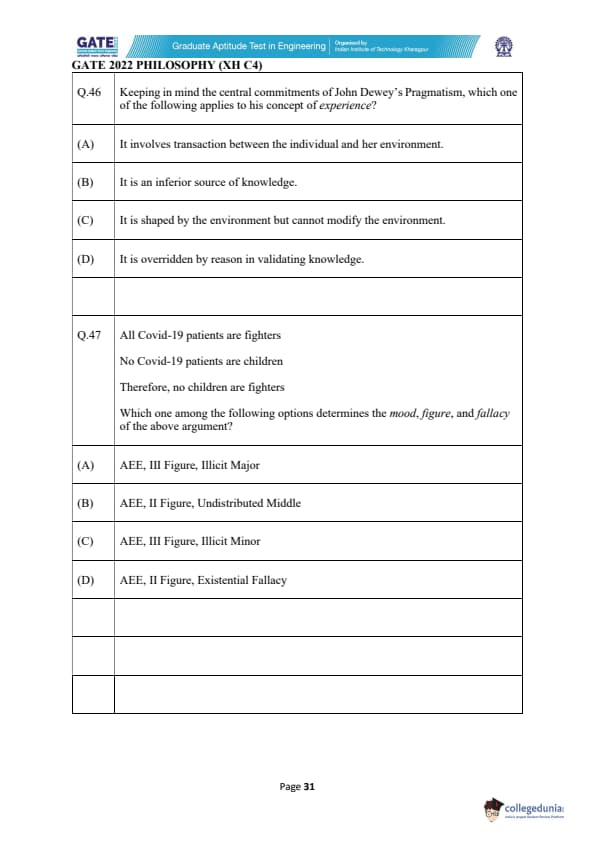
Keeping in mind the central commitments of John Dewey’s Pragmatism, which one of the following applies to his concept of experience?
All Covid-19 patients are fighters
No Covid-19 patients are children
Therefore, no children are fighters
Which one among the following options determines the mood, figure, and fallacy of the above argument?
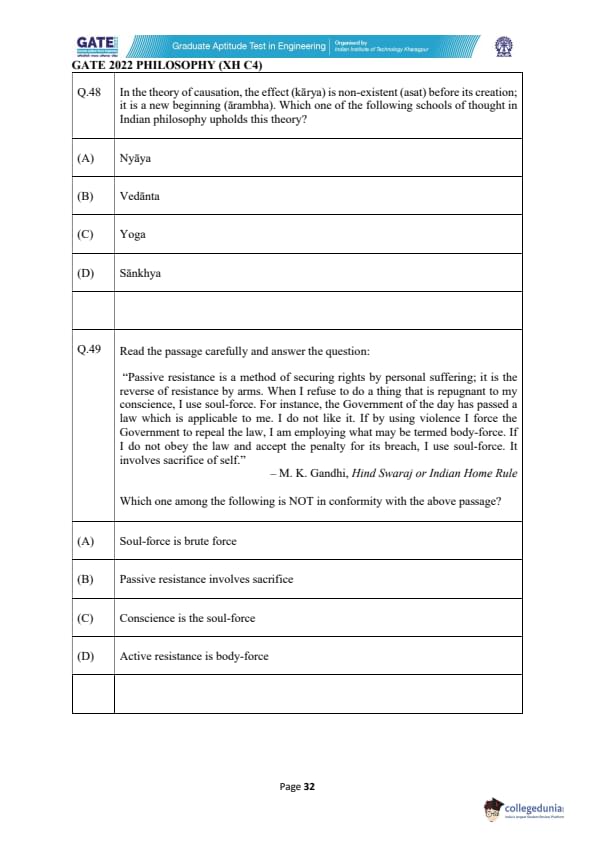
In the theory of causation, the effect (kārya) is non-existent (asat) before its creation; it is a new beginning (ārambha). Which one of the following schools of thought in Indian philosophy upholds this theory?
Read the passage carefully and answer the question:
“Passive resistance is a method of securing rights by personal suffering; it is the reverse of resistance by arms. When I refuse to do a thing that is repugnant to my conscience, I use soul-force. For instance, the Government of the day has passed a law which is applicable to me. I do not like it. If by using violence I force the Government to repeal the law, I am employing what may be termed body-force. If I do not obey the law and accept the penalty for its breach, I use soul-force. It involves sacrifice of self.”
– M. K. Gandhi, Hind Swaraj or Indian Home Rule
Which one among the following is NOT in conformity with the above passage?
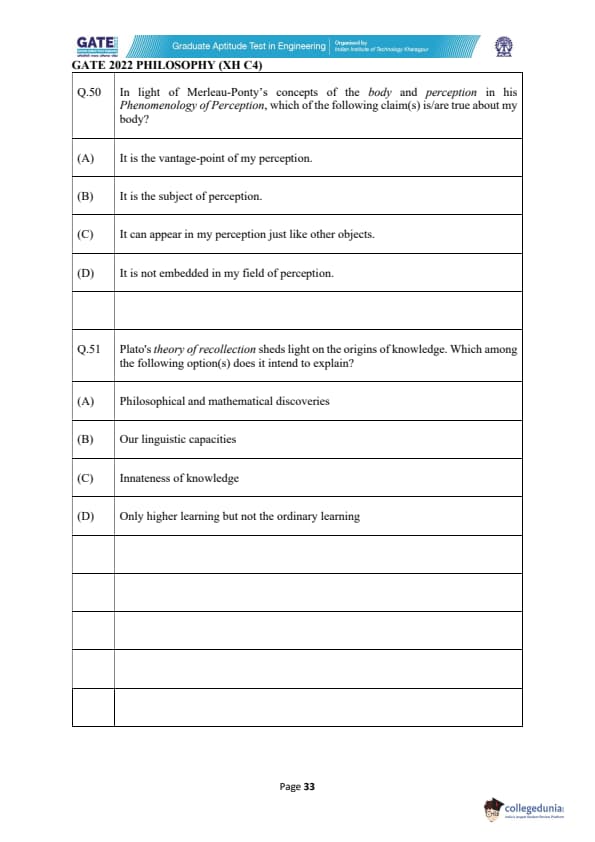
In light of Merleau-Ponty’s concepts of the body and perception in his Phenomenology of Perception, which of the following claim(s) is/are true about my body?
Plato's theory of recollection sheds light on the origins of knowledge. Which among the following option(s) does it intend to explain?
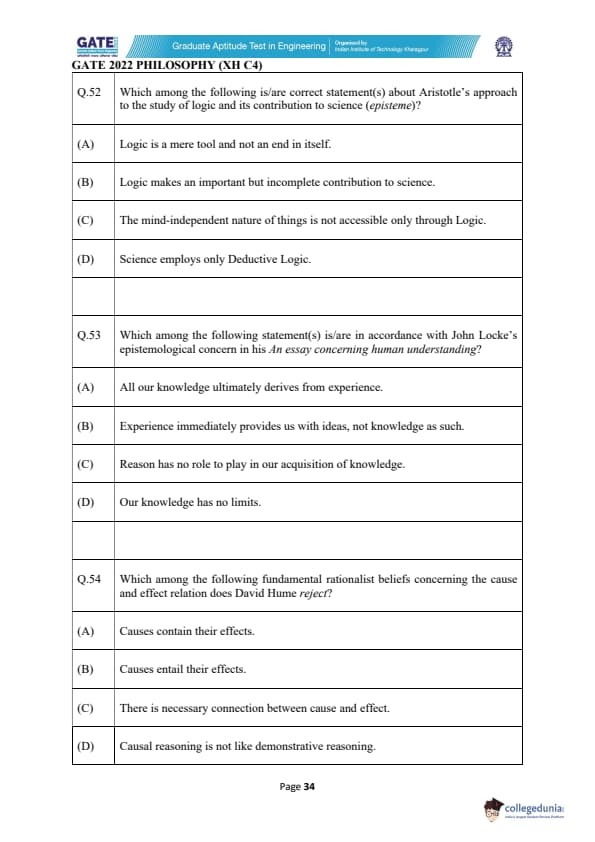
Which among the following is/are correct statement(s) about Aristotle’s approach to the study of logic and its contribution to science (episteme)?
Which among the following statement(s) is/are in accordance with John Locke’s epistemological concern in his An essay concerning human understanding?
Which among the following fundamental rationalist beliefs concerning the cause and effect relation does David Hume reject?
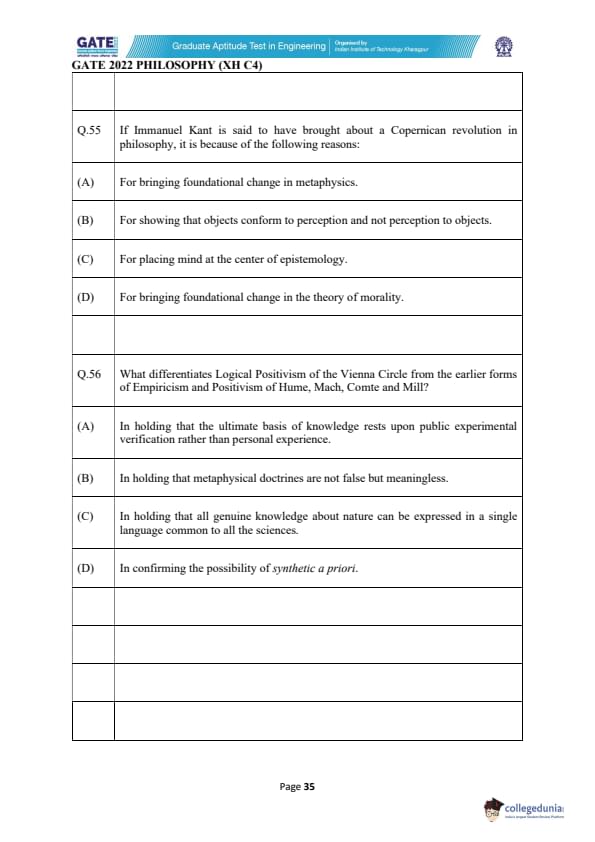
If Immanuel Kant is said to have brought about a Copernican revolution in philosophy, it is because of the following reasons:
What differentiates Logical Positivism of the Vienna Circle from the earlier forms of Empiricism and Positivism of Hume, Mach, Comte and Mill?
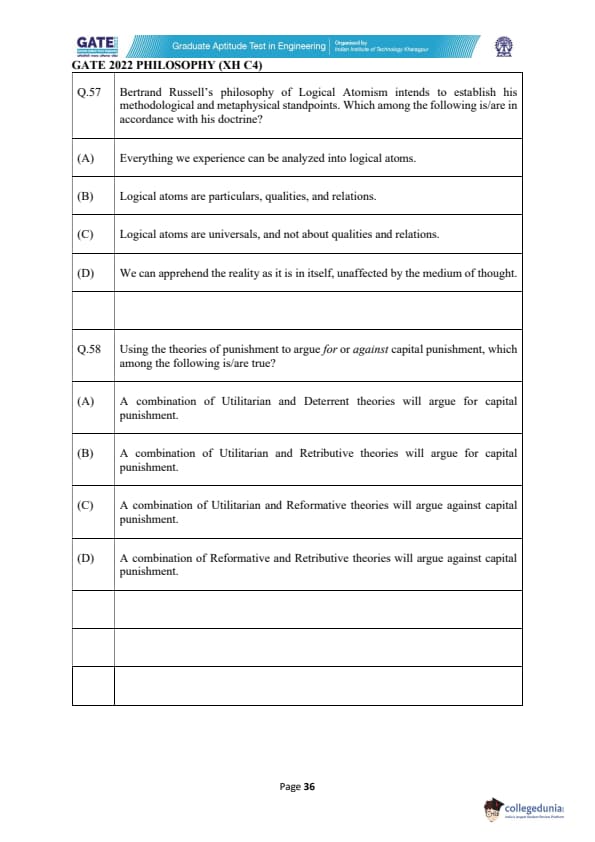
Bertrand Russell’s philosophy of Logical Atomism intends to establish his methodological and metaphysical standpoints. Which among the following is/are in accordance with his doctrine?
Using the theories of punishment to argue for or against capital punishment, which among the following is/are true?
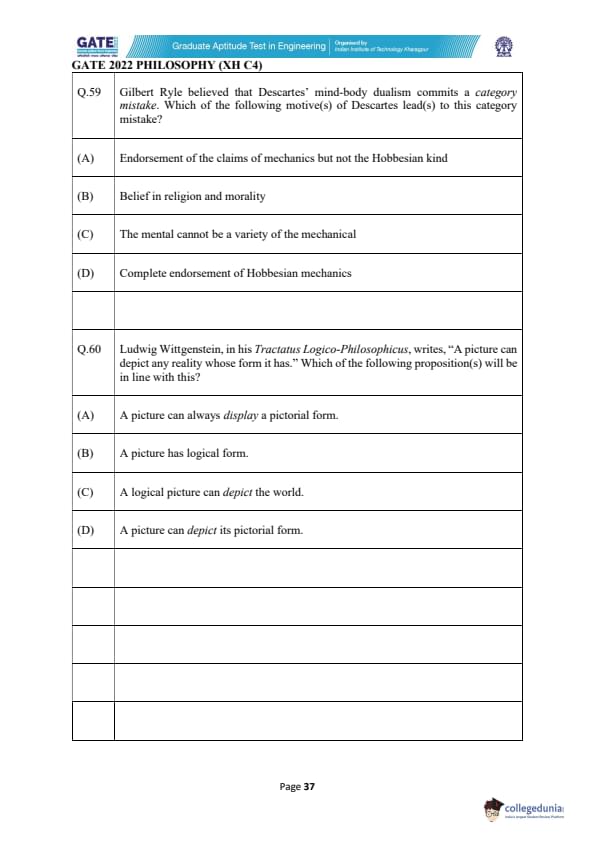
Gilbert Ryle believed that Descartes’ mind-body dualism commits a category mistake. Which of the following motive(s) of Descartes lead(s) to this category mistake?
Ludwig Wittgenstein, in his Tractatus Logico-Philosophicus, writes, “A picture can depict any reality whose form it has.” Which of the following proposition(s) will be in line with this?
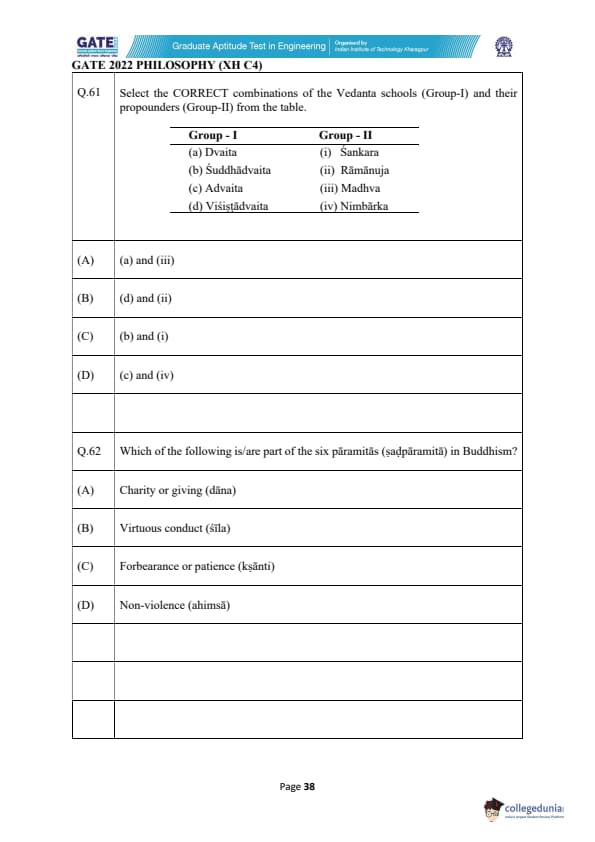
Select the CORRECT combinations of the Vedanta schools (Group-I) and their proponents (Group-II) from the table.

Which of the following is/are part of the six pāramitās (ṣaṭpāramitā) in Buddhism?
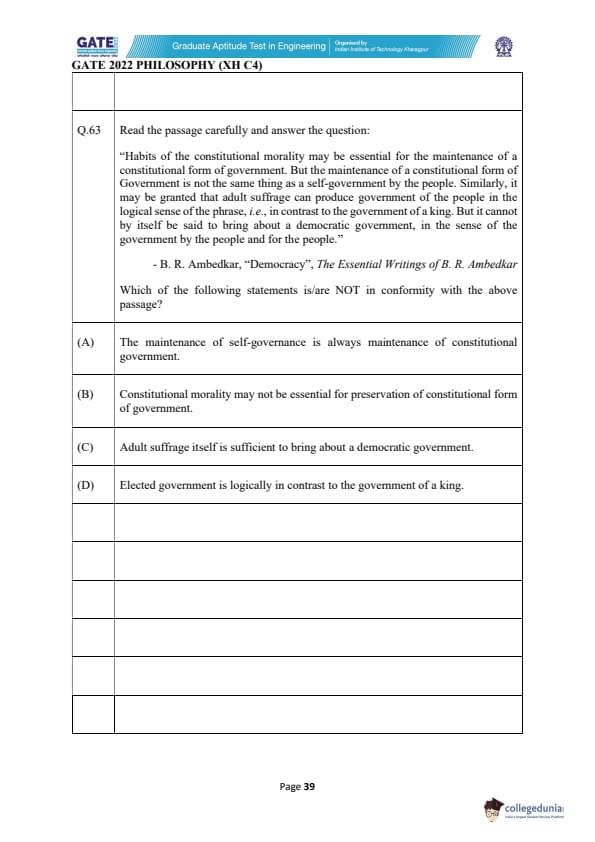
Read the passage carefully and answer the question:
“Habits of the constitutional morality may be essential for the maintenance of a constitutional form of government. But the maintenance of a constitutional form of Government is not the same thing as a self-government by the people. Similarly, it may be granted that adult suffrage can produce government of the people in the logical sense of the phrase, i.e., in contrast to the government of a king. But it cannot by itself be said to bring about a democratic government, in the sense of the government by the people and for the people.”
- B. R. Ambedkar, “Democracy”, The Essential Writings of B. R. Ambedkar
Which of the following statements is/are NOT in conformity with the above passage?
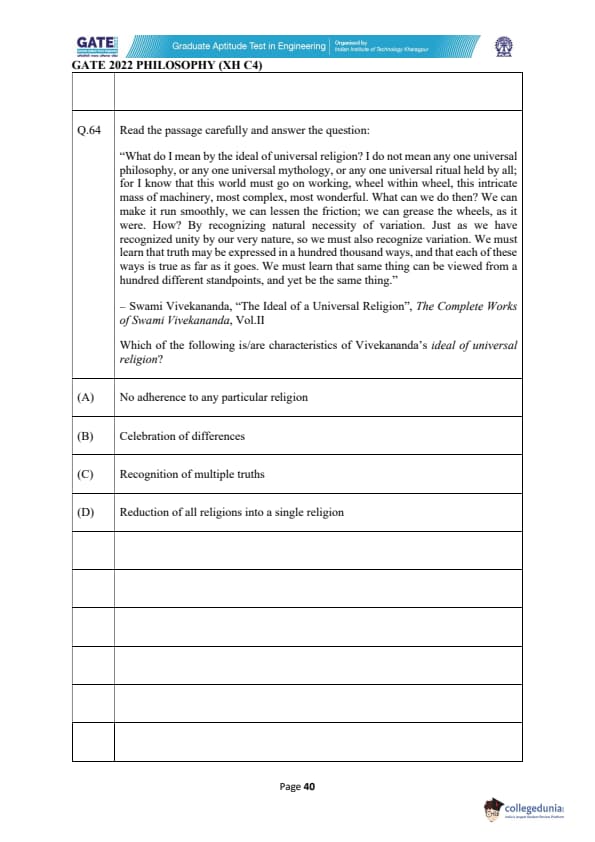
Read the passage carefully and answer the question:
"What do I mean by the ideal of universal religion? I do not mean any one universal philosophy, or any one universal mythology, or any one universal ritual held by all; for I know that this world must go on working, wheel within wheel, this intricate mass of machinery, most complex, most wonderful. What can we do then? We can make it run smoothly, we can lessen the friction; we can grease the wheels, as it were. How? By recognizing natural necessity of variation. Just as we have recognized unity by our very nature, so we must also recognize variation. We must learn that truth may be expressed in a hundred thousand ways, and that each of these ways is true as far as it goes. We must learn that same thing can be viewed from a hundred different standpoints, and yet be the same thing."
– Swami Vivekananda, "The Ideal of a Universal Religion", The Complete Works of Swami Vivekananda, Vol. II
Which of the following is/are characteristics of Vivekananda’s ideal of universal religion?
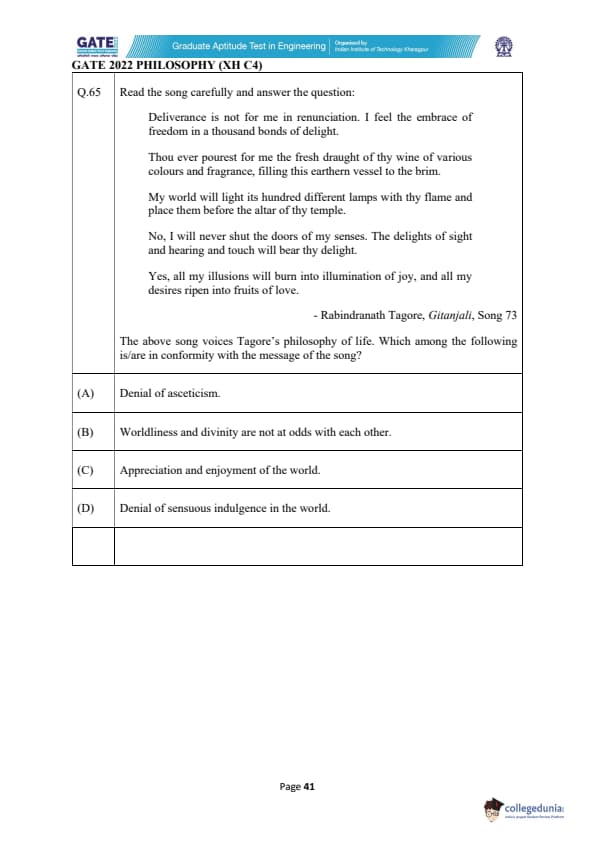
Read the song carefully and answer the question:
Deliverance is not for me in renunciation. I feel the embrace of freedom in a thousand bonds of delight.
Thou ever pourest for me the fresh draught of thy wine of various colours and fragrance, filling this earthen vessel to the brim.
My world will light its hundred different lamps with thy flame and place them before the altar of thy temple.
No, I will never shut the doors of my senses. The delights of sight and hearing and touch will bear thy delight.
Yes, all my illusions will burn into illumination of joy, and all my desires ripen into fruits of love.
- Rabindranath Tagore, Gitanjali, Song 73
The above song voices Tagore’s philosophy of life. Which among the following is/are in conformity with the message of the song?
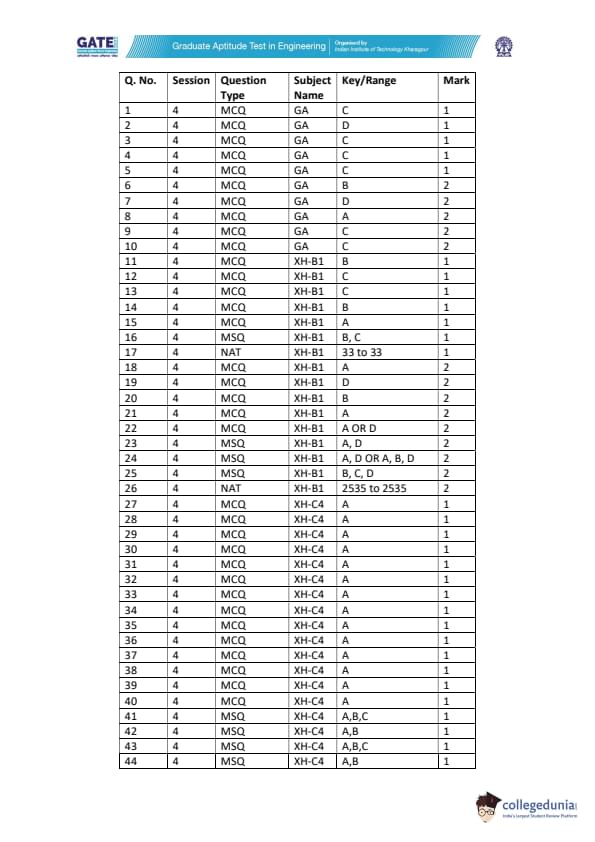
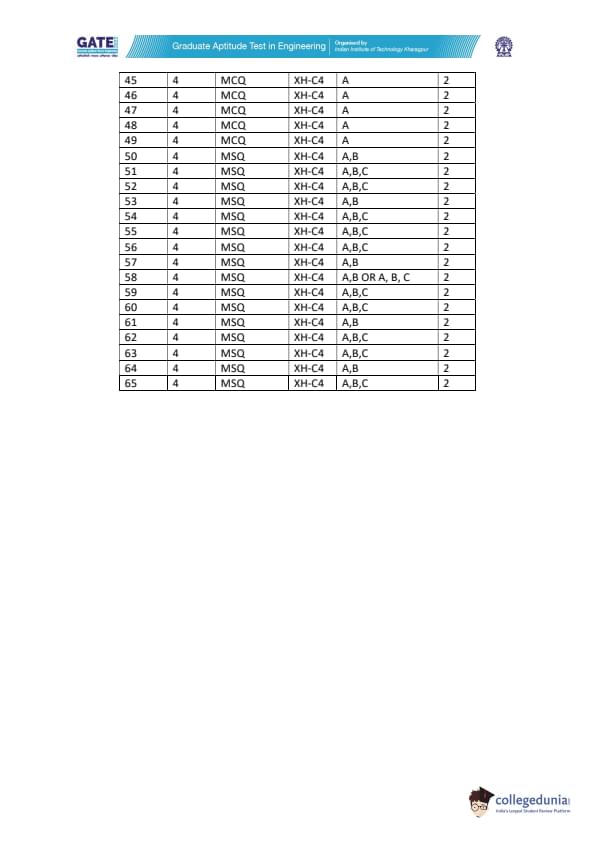
GATE 2022 XH-C4 Philosophy Question Paper: Paper Analysis
Section GA and B1 in GATE 2022 XH- Philosophy Question Paper was the same as the other five papers for GATE XH paper. The table below shows the number of 1 mark and 2 marks questions in GATE 2022 XH- Philosophy Question Paper:
| Type of Questions | General Aptitude (GA) | Reasoning Comprehension (B1) | Philosophy (XH- C4) | |||
|---|---|---|---|---|---|---|
| Number of Questions | Marks | Number of Questions | Marks | Number of Questions | Marks | |
| No. of 1 mark MCQs | 5 | 5 | 5 | 5 | 14 | 14 |
| No. of 2 marks MCQs | 5 | 10 | 5 | 10 | 5 | 10 |
| No. of 1 mark NATs | 0 | 0 | 1 | 1 | 0 | 0 |
| No. of 2 marks NATs | 0 | 0 | 1 | 2 | 0 | 0 |
| No. of 1 mark MSQs | 0 | 0 | 1 | 1 | 4 | 4 |
| No. of 2 marks MSQs | 0 | 0 | 3 | 6 | 16 | 32 |
GATE Previous Year Question Papers:
Candidates may examine their performance levels by solving prior year's examination papers. Candidates are encouraged to answer GATE Question Papers on a regular basis to improve their correctness. GATE ME 2019 question paper is one of the most important aspects of effective test preparation. Including past year's question papers in your study schedule can help you get a better grade. Test candidates may examine prior year question papers to determine the level of questions asked in the exam. The following are links to GATE 2019 question papers with answer key PDFs:
| GATE 2022 Question Papers | GATE 2021 Question Papers | GATE 2020 Question Papers |
| GATE 2019 Question Papers | GATE 2018 Question Papers | GATE 2017 Question Papers |




Comments