




GATE 2023 Aerospace Engineering Question Paper PDF is available here for download. IIT Kanpur conducted GATE 2023 Aerospace Engineering exam on February 11, 2023 in the Afternoon Session from 02:30 PM to 05:30 PM. Students have to answer 65 questions in GATE 2023 Aerospace Engineering Question Paper carrying a total weightage of 100 marks. 10 questions are from the General Aptitude section and 55 questions are from Engineering Mathematics and Core Discipline.
GATE 2023 Aerospace Engineering Question Paper with Answer Key PDF
| GATE 2023 Aerospace Engineering Question Paper with Answer Key PDF | Download PDF | Check Solutions |
GATE 2023 Aerospace Engineering Question Paper with Solutions
“You are delaying the completion of the task. Send _____ contributions at the earliest.”
References : _____ : Guidelines : Implement (By word meaning)
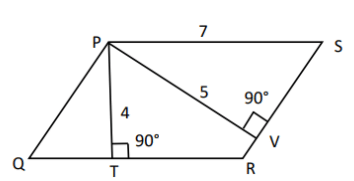
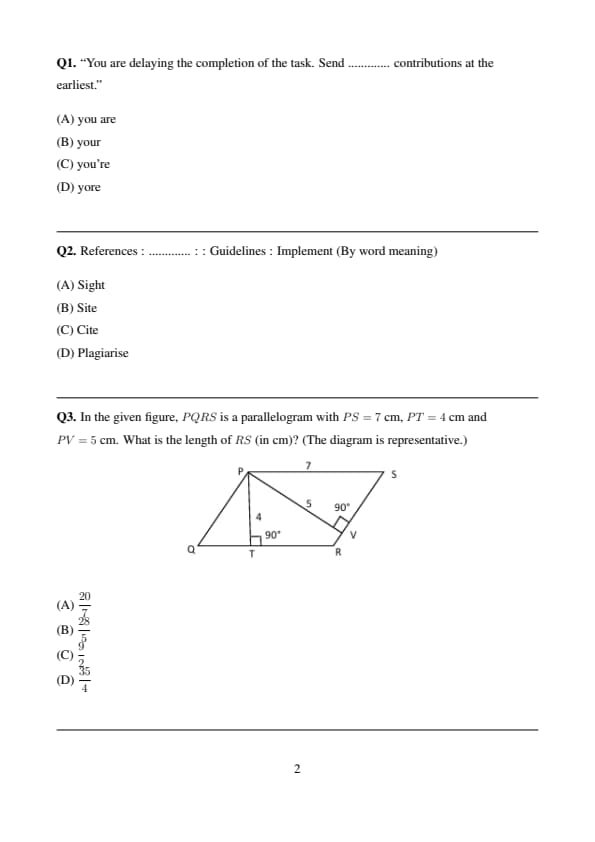
In the given figure, PQRS is a parallelogram with \(PS=7\) cm, \(PT=4\) cm and \(PV=5\) cm. What is the length of \(RS\) in cm? (The diagram is representative.)
In 2022, June Huh was awarded the Fields medal, which is the highest prize in Mathematics. When he was younger, he was also a poet. He did not win any medals in the International Mathematics Olympiads. He dropped out of college. Based only on the above information, which one of the following statements can be logically inferred with certainty?
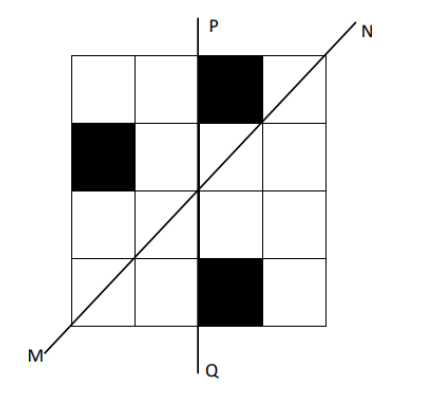
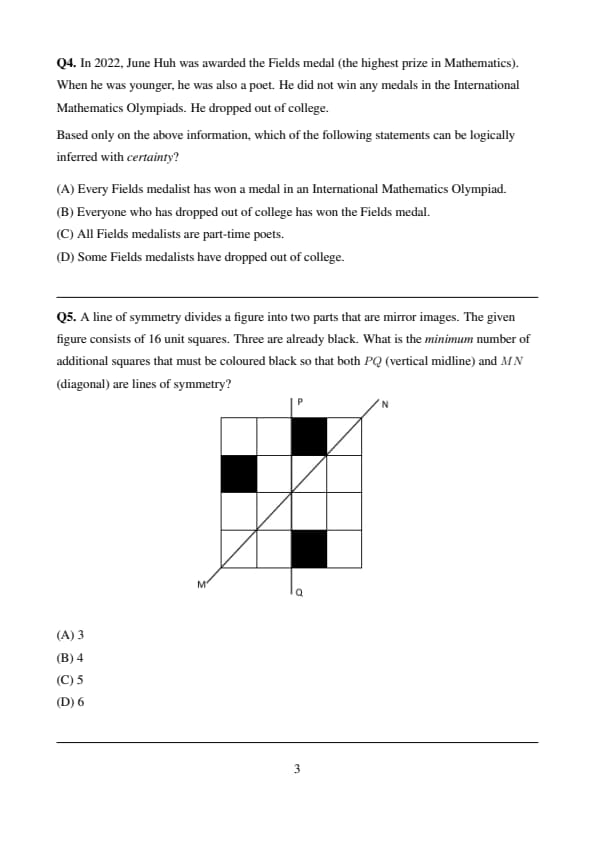
A line of symmetry is defined as a line that divides a figure into two parts in a way such that each part is a mirror image of the other part about that line. The given figure consists of 16 unit squares arranged as shown. In addition to the three black squares, what is the minimu M number of squares that must be coloured black, such that both \(PQ\) (vertical) and \(MN\) (the bottom-left to top-right diagonal) form lines of symmetry? (The figure is representative)
Human beings are one among many creatures that inhabit an imagined world. In this imagined world, some creatures are cruel. If in this imagined world, it is given that the statement “Some human beings are not cruel creatures” is FALSE, then which of the following set of statement(s) can be logically inferred with certainty?
To construct a wall, sand and cement are mixed in the ratio of 3:1. The cost of sand and that of cement are in the ratio of 1:2.
If the total cost of sand and cement to construct the wall is 1000 rupees, then what is the cost (in rupees) of cement used?
The World Bank has declared that it does not plan to offer new financing to Sri Lanka, which is battling its worst economic crisis in decades, until the country has an adequate macroeconomic policy framework in place. In a statement, the World Bank said Sri Lanka needed to adopt structural reforms that focus on economic stabilisation and tackle the root causes of its crisis. The latter has starved it of foreign exchange and led to shortages of food, fuel, and medicines. The bank is repurposing resources under existing loans to help alleviate shortages of essential items such as medicine, cooking gas, fertiliser, meals for children, and cash for vulnerable households. Based only on the above passage, which one of the following statements can be inferred with certainty?
The coefficient of \(x^4\) in the polynomial \((x-1)^3(x-2)^3\) is equal to _____.
Which one of the following shapes can be used to tile (completely cover by repeating) a flat plane, extending to infinity in all directions, without leaving any empty spaces in between them? The copies of the shape used to tile are identical and are not allowed to overlap.
The direction in which a scalar field \(\phi(x,y,z)\) has the largest rate of change is along:
If a monotonic and continuous function \(y=f(x)\) has exactly one root in the interval \(x_1 < x < x_2\), then:
Consider the one–dimensional wave (advection) equation \[ \frac{\partial u}{\partial t}+\frac{\partial u}{\partial x}=0,\quad -\infty < x < \infty,\ t\ge 0. \]
For the initial condition \(u(x,0)=e^{-x^{2}}\), the solution at \(t=1\) is:
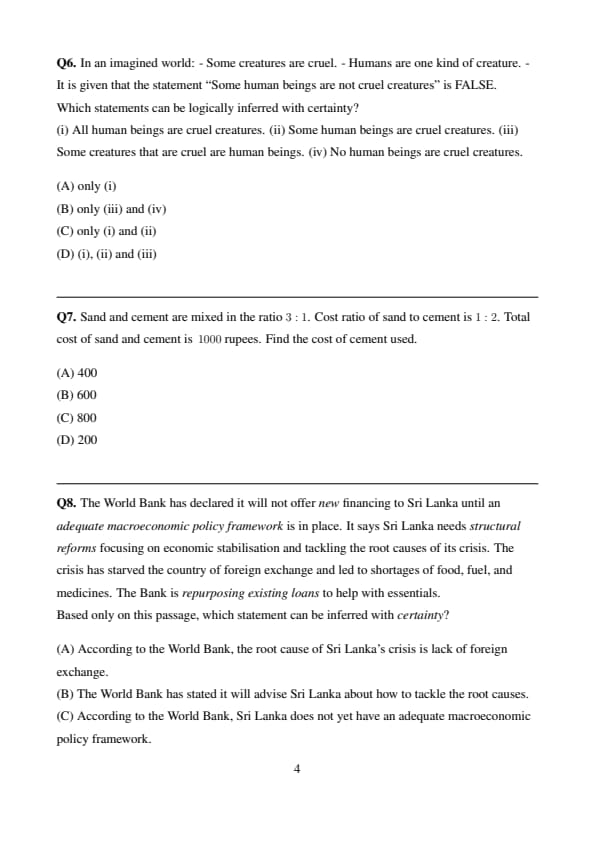
A two–dimensional potential–flow solution for flow past an airfoil has the streamline pattern shown. Which additional condition is required to satisfy the Kutta condition?

Consider the Blasius solution for the incompressible laminar flat–plate boundary layer. Among the options, select the correct relation for the development of the momentum thickness \(\theta\) with distance \(x\) from the leading edge along the plate.
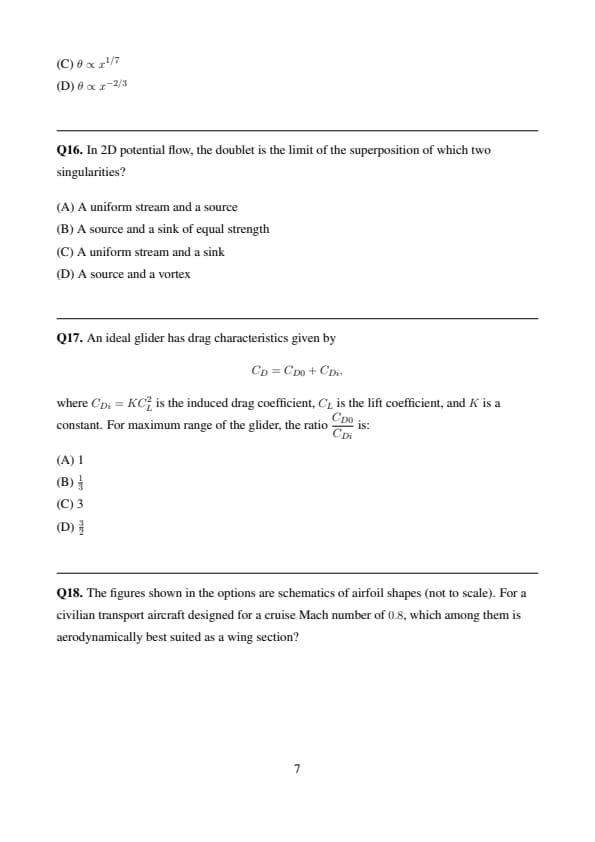
In 2D potential flow, the doublet is the limit of the superposition of which two singularities?
An ideal glider has drag characteristics given by \[ C_D = C_{D0} + C_{Di}, \]
where \(C_{Di} = K C_L^2\) is the induced drag coefficient, \(C_L\) is the lift coefficient, and \(K\) is a constant. For maximum range of the glider, the ratio \(\dfrac{C_{D0}}{C_{Di}}\) is:
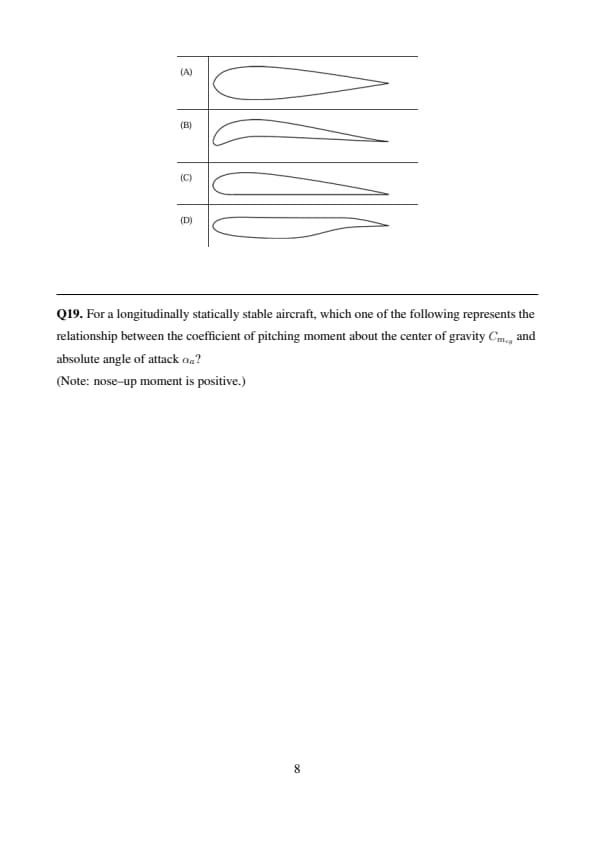
The figures shown in the options are schematics of airfoil shapes (not to scale). For a civilian transport aircraft designed for a cruise Mach number of \(0.8\), which among them is aerodynamically best suited as a wing section?

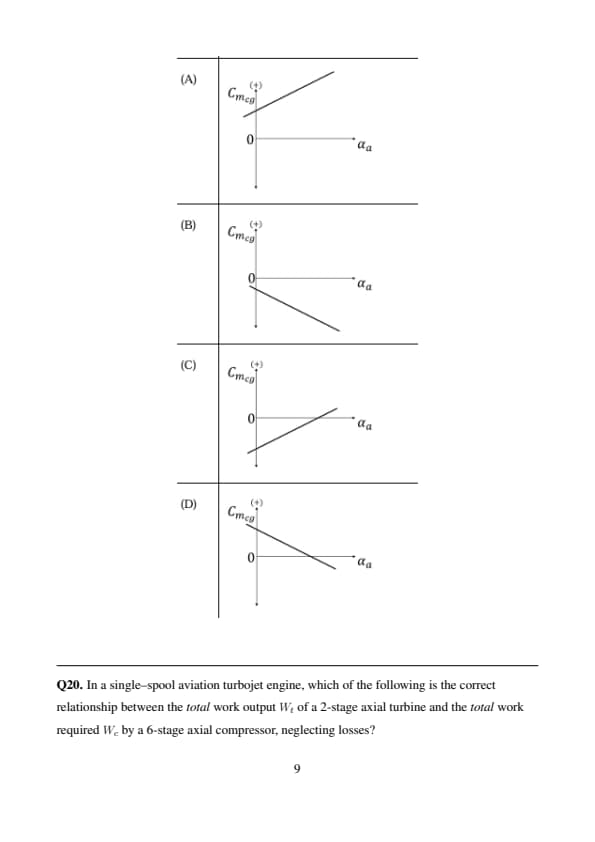
For a longitudinally statically stable aircraft, which one of the following represents the relationship between the coefficient of pitching moment about the center of gravity \(C_{m_{cg}}\) and absolute angle of attack \(\alpha_a\)?
(Note: nose–up moment is positive.)

In a single–spool aviation turbojet engine, which of the following is the correct relationship between the total work output \(W_t\) of a 2-stage axial turbine and the total work required \(W_c\) by a 6-stage axial compressor, neglecting losses?
For a stage of a \(50%\) reaction ideal axial-flow compressor (symmetrical blading), select the correct statement.
An aircraft is cruising with a forward speed \(V_a\) and the jet exhaust speed relative to the engine at the exit is \(V_j\). If \(V_j/V_a=2\), what is the propulsive efficiency?
Consider the four basic symmetrical flight loading conditions corresponding to the corners of a typical \(V\!-\!n\) diagram. For one condition it is observed that:
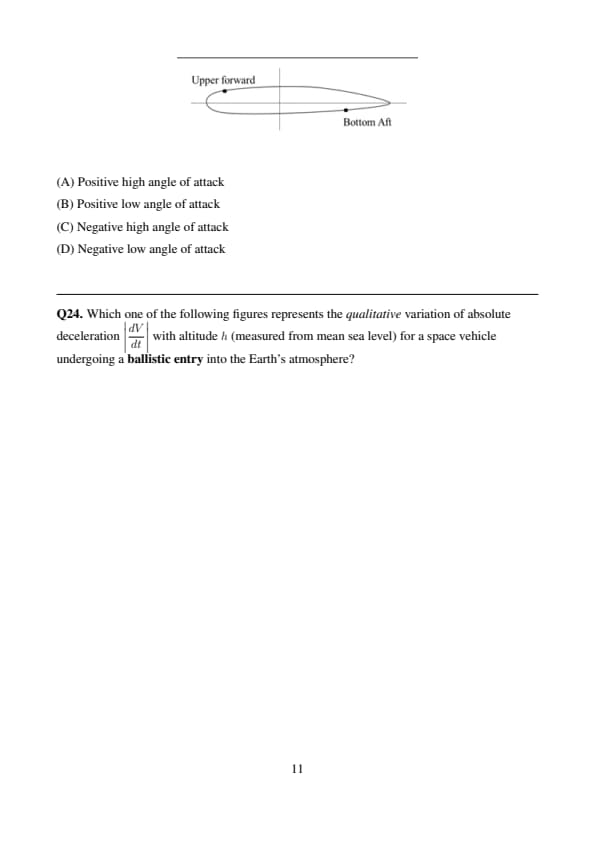
- (i) the compressive bending stresses are maximum in the \(\textbf{bottom aft}\) region of the wing cross-section; and
- (ii) the tensile bending stresses are maximum in the upper forward region of the wing cross-section (see figure).
-
![]()
(A) Positive high angle of attack
- (B) Positive low angle of attack
- (C) Negative high angle of attack
- (D) Negative low angle of attack

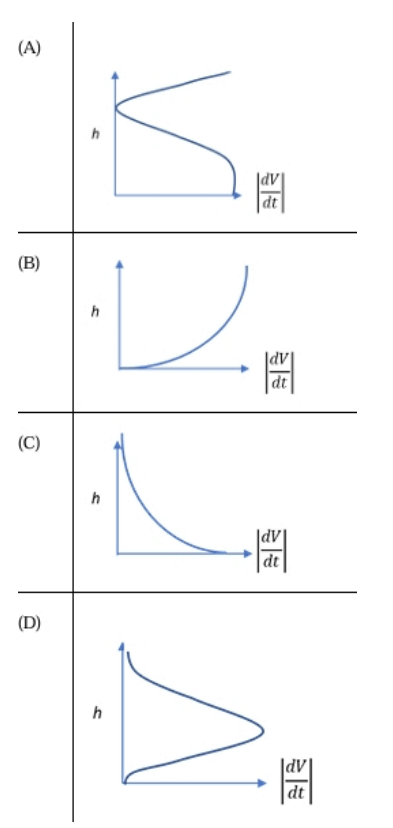
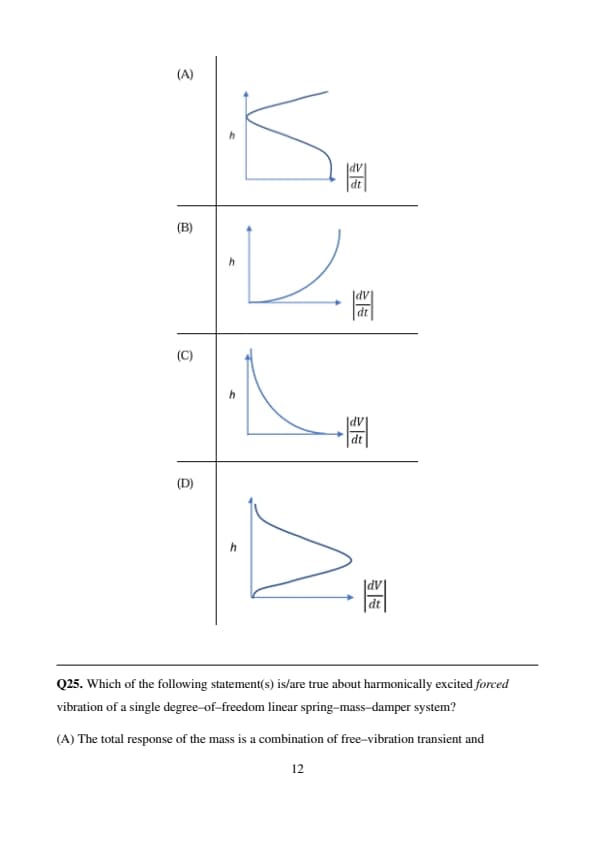
Which one of the following figures represents the qualitative variation of absolute deceleration \(\left|\dfrac{dV}{dt}\right|\) with altitude \(h\) (measured from mean sea level) for a space vehicle undergoing a ballistic entry into the Earth's atmosphere?
Which of the following statement(s) is/are true about harmonically excited forced vibration of a single degree–of–freedom linear spring–mass–damper system?
Which of the following statement(s) is/are true about the state of stress in a plane?
Which of the following statement(s) is/are true about the ribs of an airplane wing with semi–monocoque construction?
From the options given, select all that are true for turbofan engines with afterburners.
Which of the following statement(s) is/are true with respect to eigenvalues and eigenvectors of a matrix?
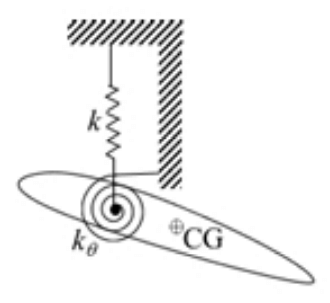
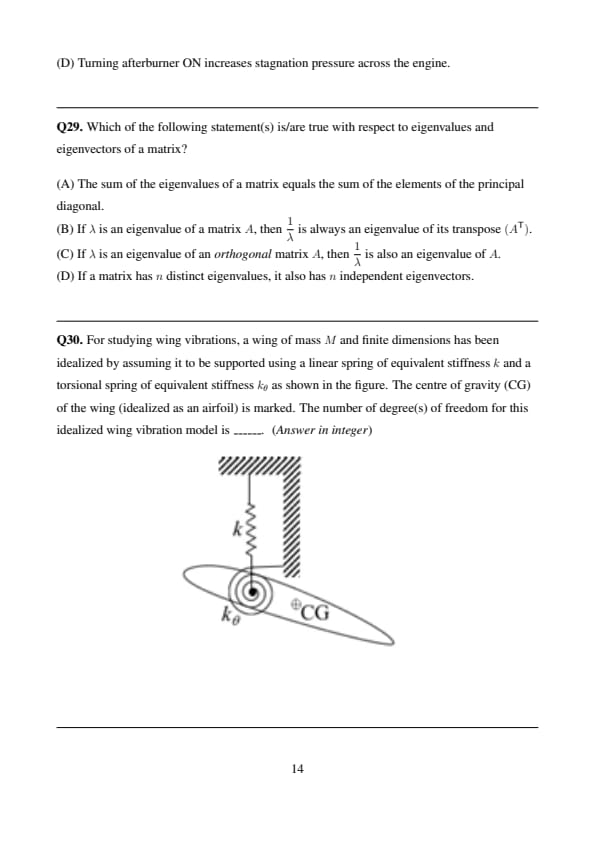
For studying wing vibrations, a wing of mass \(M\) and finite dimensions has been idealized by assuming it to be supported using a linear spring of equivalent stiffness \(k\) and a torsional spring of equivalent stiffness \(k_\theta\) as shown in the figure. The centre of gravity (CG) of the wing (idealized as an airfoil) is marked.
The number of degree(s) of freedom for this idealized wing vibration model is ______. (\(\textit{Answer in integer}\))
The system of equations

has a non-trivial solution for \(\alpha=\;\_\_\_\_\_\_\). (\(\textit{Answer in integer}\))
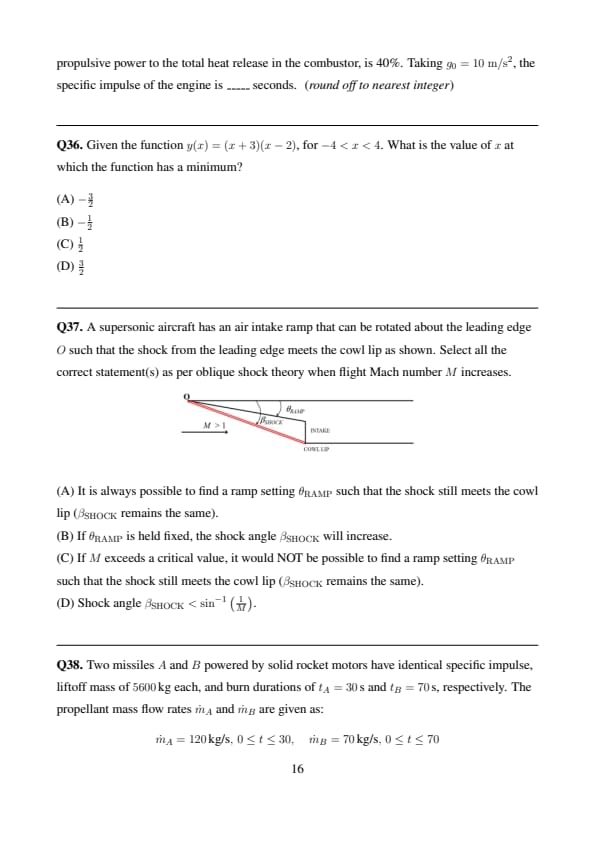
An airplane weighing \(40\ kN\) is landing on a horizontal runway and is retarded by an arresting cable. The tension in the arresting cable at a given instant is \(100\ kN\), and the cable makes \(10^\circ\) with the runway as shown. Assume engine thrust continues to balance airplane drag. The magnitude of the horizontal load factor is ______. ; (\(\textit{round off to one decimal place}\))

The ratio of the speed of sound in \(\mathrm{H_2}\) (molecular weight \(2~\mathrm{kg/kmol}\)) to that in \(\mathrm{N_2}\) (molecular weight \(28~\mathrm{kg/kmol}\)) at \(T=300~\mathrm{K}\) and \(p=2~\mathrm{bar}\) is ____. ; (\(\textit{round off to two decimal places}\))
Airplane A and Airplane B are cruising at altitudes of \(2~\mathrm{km}\) and \(4~\mathrm{km}\), respectively. The free–stream density and static pressure at \(2~\mathrm{km}\) are \(1.01~\mathrm{kg/m^3}\) and \(79.50~\mathrm{kPa}\); at \(4~\mathrm{km}\) they are \(0.82~\mathrm{kg/m^3}\) and \(61.70~\mathrm{kPa}\). The differential pressure reading from the pitot–static tubes is \(3~\mathrm{kPa}\) for both airplanes. Assuming incompressible flow, the ratio of cruise speeds \(V_A/V_B\) is ____. ; (\(\textit{round off to two decimal places}\))
A supersonic vehicle powered by a ramjet engine is cruising at \(1000~\mathrm{m/s}\). The ramjet engine burns hydrogen in a subsonic combustor to produce thrust. The heat of combustion of hydrogen is \(120~\mathrm{MJ/kg}\). The overall efficiency of the engine \(\eta_0\), defined as the ratio of propulsive power to the total heat release in the combustor, is 40%. Taking \(g_0=10~\mathrm{m/s^2}\), the specific impulse of the engine is _____ seconds. ; (\(\textit{round off to nearest integer}\))
Given the function \(y(x)=(x+3)(x-2)\), for \(-4< x < 4\). What is the value of \(x\) at which the function has a minimum?
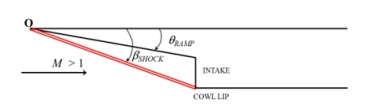
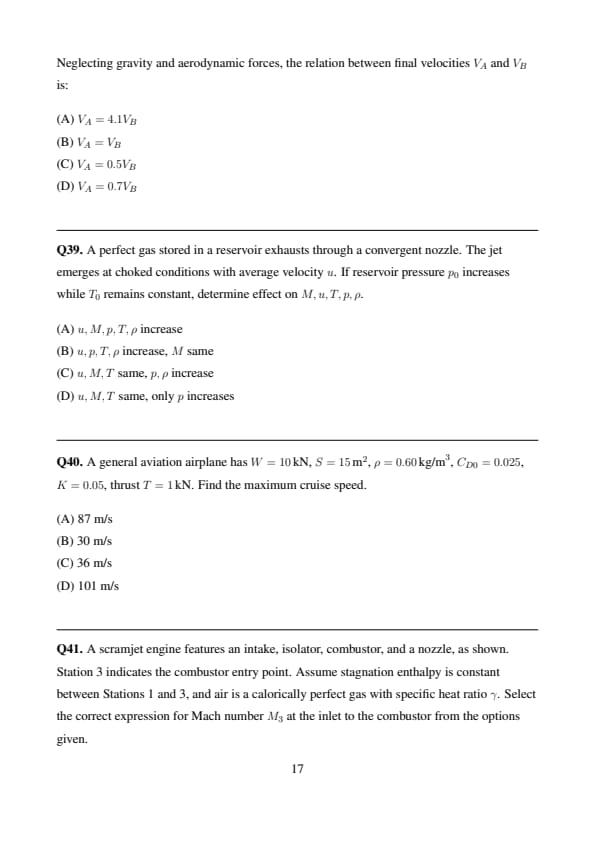
A supersonic aircraft has an air intake ramp that can be rotated about the leading edge \(O\) such that the shock from the leading edge meets the cowl lip as shown. Select all the correct statement(s) as per oblique shock theory when flight Mach number \(M\) increases.
Two missiles \(A\) and \(B\) powered by solid rocket motors have identical specific impulse, liftoff mass of \(5600 \,kg\) each, and burn durations of \(t_A = 30 \,s\) and \(t_B = 70 \,s\), respectively. The propellant mass flow rates \(\dot{m}_A\) and \(\dot{m}_B\) are given as: \[ \dot{m}_A = 120 \,kg/s, \, 0 \leq t \leq 30, \quad \dot{m}_B = 70 \,kg/s, \, 0 \leq t \leq 70 \]
Neglecting gravity and aerodynamic forces, the relation between final velocities \(V_A\) and \(V_B\) is:
A perfect gas stored in a reservoir exhausts through a convergent nozzle. The jet emerges at choked conditions with average velocity \(u\). If reservoir pressure \(p_0\) increases while \(T_0\) remains constant, determine effect on \(M, u, T, p, \rho\).
A general aviation airplane has \(W=10 \,kN\), \(S=15 \,m^2\), \(\rho=0.60 \,kg/m^3\), \(C_{D0}=0.025\), \(K=0.05\), thrust \(T=1 \,kN\). Find the maximum cruise speed.
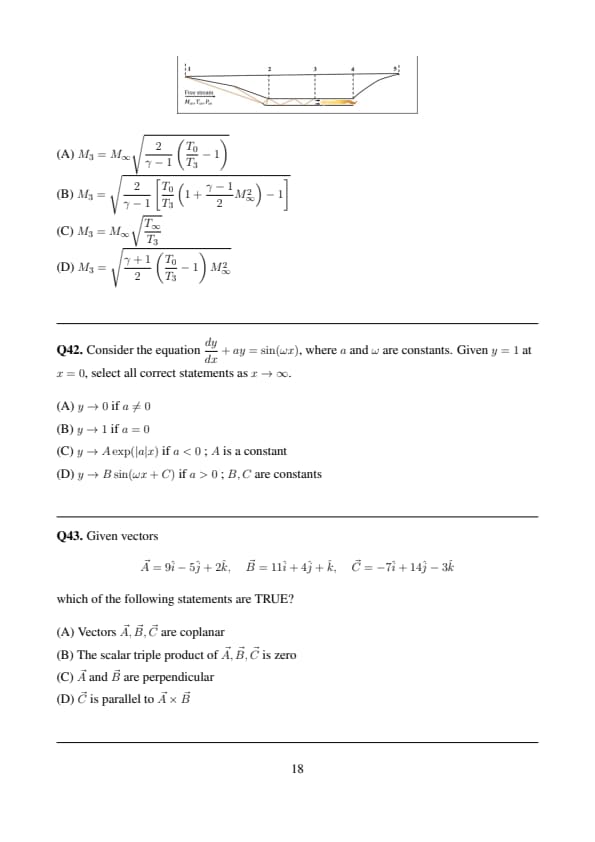
A scramjet engine features an intake, isolator, combustor, and a nozzle, as shown. Station 3 indicates the combustor entry point. Assume stagnation enthalpy is constant between Stations 1 and 3, and air is a calorically perfect gas with specific heat ratio \(\gamma\). Select the correct expression for Mach number \(M_3\) at the inlet to the combustor from the options given.

Consider the equation \(\dfrac{dy}{dx} + ay = \sin(\omega x)\), where \(a\) and \(\omega\) are constants. Given \(y=1\) at \(x=0\), select all correct statements as \(x \to \infty\).
Given vectors \[ \vec{A} = 9\hat{i} - 5\hat{j} + 2\hat{k}, \quad \vec{B} = 11\hat{i} + 4\hat{j} + \hat{k}, \quad \vec{C} = -7\hat{i} + 14\hat{j} - 3\hat{k} \]
which of the following statements are TRUE?
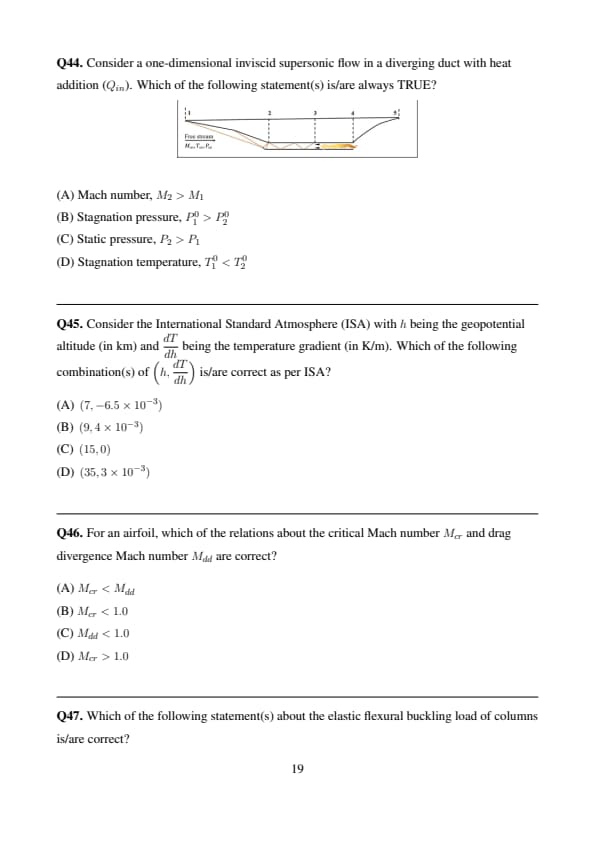
Consider a one-dimensional inviscid supersonic flow in a diverging duct with heat addition (\(Q_{in}\)). Which of the following statement(s) is/are always TRUE?

Consider the International Standard Atmosphere (ISA) with \(h\) being the geopotential altitude (in km) and \(\dfrac{dT}{dh}\) being the temperature gradient (in K/m).
Which of the following combination(s) of \(\Big(h, \dfrac{dT}{dh}\Big)\) is/are correct as per ISA?
For an airfoil, which of the relations about the critical Mach number \(M_{cr}\) and drag divergence Mach number \(M_{dd}\) are correct?
Which of the following statement(s) about the elastic flexural buckling load of columns is/are correct?
The thickness of a uniform hollow circular shaft is equal to the difference between the outer radius and the inner radius. The ratio of the inner diameter to outer diameter of the shaft is \(0.5\). For the shaft reacting to an applied torque, the ratio of the maximum shear stress \(\tau\) to the maximum shear stress \(\tau_{thin-wall}\) obtained using the thin-wall approximation is ............. (round off to one decimal place)
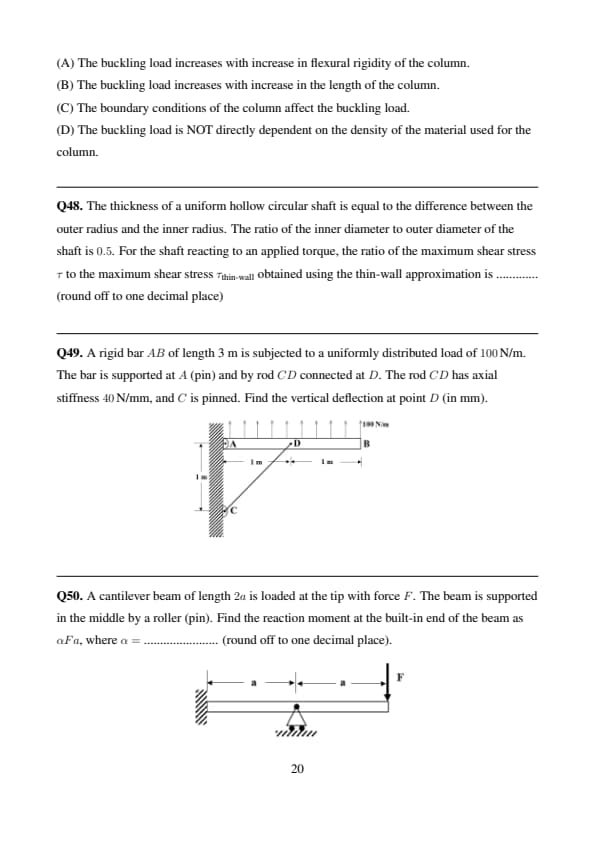
A rigid bar \(AB\) of length 3 m is subjected to a uniformly distributed load of \(100 \,N/m\). The bar is supported at \(A\) (pin) and by rod \(CD\) connected at \(D\). The rod \(CD\) has axial stiffness \(40 \,N/mm\), and \(C\) is pinned. Find the vertical deflection at point \(D\) (in mm).

A cantilever beam of length \(2a\) is loaded at the tip with force \(F\). The beam is supported in the middle by a roller (pin). Find the reaction moment at the built-in end of the beam as \(\alpha Fa\), where \(\alpha =\) ....................... (round off to one decimal place).

A single degree-of-freedom spring–mass–damper system has viscous damping ratio \(\zeta = 0.1\). The mass has initial displacement of \(10\) cm without velocity. After exactly two complete cycles of damped oscillation, find amplitude of displacement (in cm, round off to two decimals).
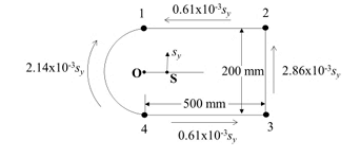
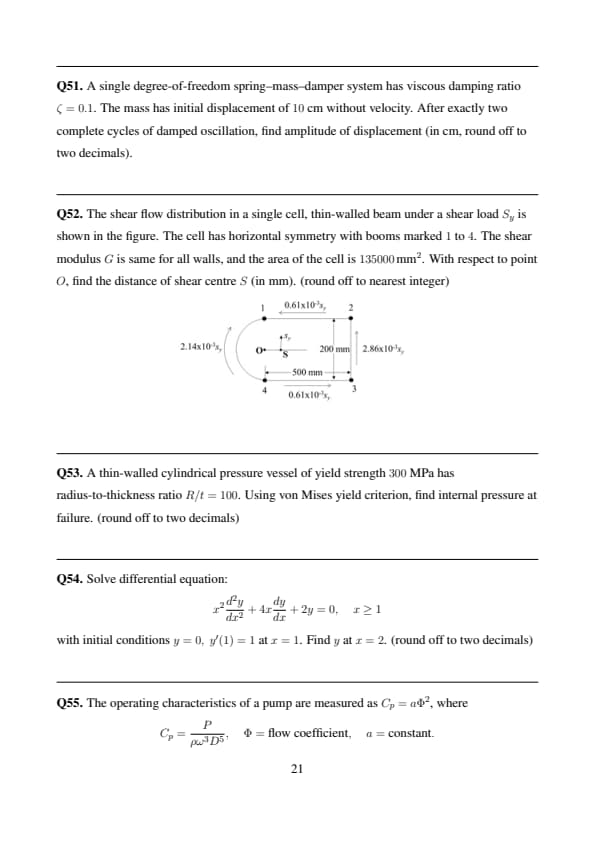
The shear flow distribution in a single cell, thin-walled beam under a shear load \(S_y\) is shown in the figure. The cell has horizontal symmetry with booms marked \(1\) to \(4\). The shear modulus \(G\) is same for all walls, and the area of the cell is \(135000 \,mm^2\). With respect to point \(O\), find the distance of shear centre \(S\) (in mm). (round off to nearest integer)
A thin-walled cylindrical pressure vessel of yield strength \(300\) MPa has radius-to-thickness ratio \(R/t = 100\). Using von Mises yield criterion, find internal pressure at failure. (round off to two decimals)
Solve differential equation: \[ x^2 \frac{d^2y}{dx^2} + 4x \frac{dy}{dx} + 2y = 0, \quad x \geq 1 \]
with initial conditions \(y=0, \; y'(1)=1\) at \(x=1\). Find \(y\) at \(x=2\). (round off to two decimals)
The operating characteristics of a pump are measured as \(C_p = a \Phi^2\), where \[ C_p = \frac{P}{\rho \omega^3 D^5}, \quad \Phi = flow coefficient, \quad a=constant. \]
If \(\omega\) increases by 25% (i.e. \(\omega \to 1.25\omega\)) and the flow coefficient \(\Phi\) is constant, determine \(\alpha\) such that \(P\) becomes \(\alpha P\). (round off to two decimal places)
A thin cambered airfoil has lift coefficient \(C_l=0\) at angle of attack \(\alpha=-1^\circ\). Estimate \(C_l\) at \(\alpha=4^\circ\), assuming stall occurs at much higher \(\alpha\). (round off to two decimal places)
In potential flow, a uniform stream of strength \(U\) flows along x-axis. Line sources of strength \(\pi/2, -\pi/3, \pi/4, -\pi/5\) are placed at \(x=0,1,2,3\) respectively. Find strength of an additional line source at \(x=4\) such that a closed streamline encircles all five sources. (round off to two decimal places)
Enstrophy is defined as square of magnitude of vorticity. For velocity field \[ \vec{V} = (4x - 1.5y + 2.5z)\hat{i} + (1.5x - 1.5y)\hat{j} + (0.7xy)\hat{k}, \]
find enstrophy at \((1,1,1)\). (round off to two decimal places)
An airplane with wing planform area \(S=20\,m^2\) and weight \(W=8\,kN\) is flying straight and level with a speed of \(V=100\,m/s\). The total drag coefficient is \(C_D=0.026\) and the air density is \(\rho=0.7\,kg/m^3\). The total thrust required to introduce a steady climb at angle \(\gamma=0.1\) radians is ............. N. (round off to the nearest integer)
The maximum permissible load factor and the maximum lift coefficient for an airplane are \(n_{\max}=7\) and \(C_{L,\max}=2\), respectively. For a wing loading \(W/S=6500\ N/m^2\) and air density \(\rho=1.23\ kg/m^3\), the speed yielding the highest possible turn rate in the vertical plane is .............. m/s. (round off to the nearest integer)
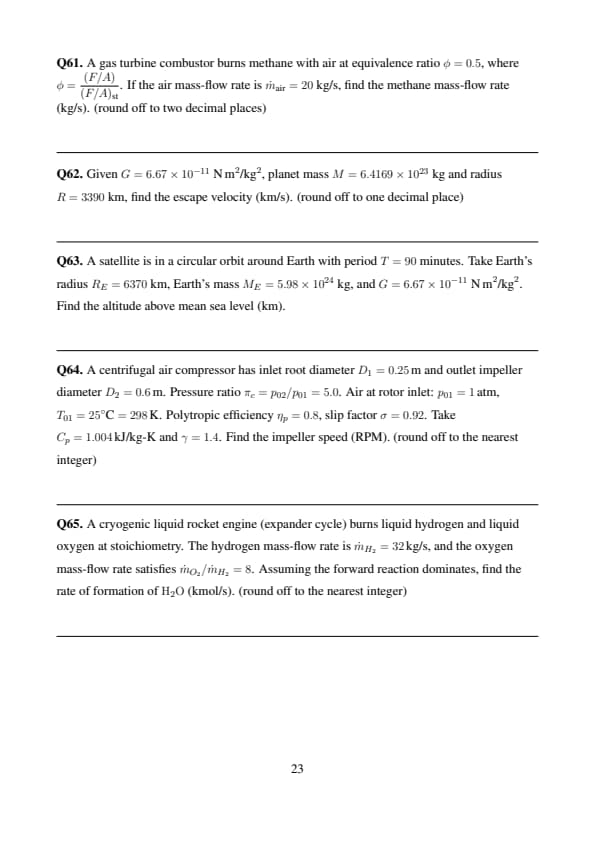
A gas turbine combustor burns methane with air at equivalence ratio \(\phi=0.5\), where \(\displaystyle \phi=\frac{(F/A)}{(F/A)_{st}}\). If the air mass-flow rate is \(\dot m_{air}=20\ kg/s\), find the methane mass-flow rate (kg/s). (round off to two decimal places)
Given \(G=6.67\times10^{-11}\ N\,m^2/kg^2\), planet mass \(M=6.4169\times10^{23}\) kg and radius \(R=3390\) km, find the escape velocity (km/s). (round off to one decimal place)
A satellite is in a circular orbit around Earth with period \(T=90\) minutes. Take Earth’s radius \(R_E=6370\) km, Earth’s mass \(M_E=5.98\times10^{24}\) kg, and \(G=6.67\times10^{-11}\ N\,m^2/kg^2\). Find the altitude above mean sea level (km).
A centrifugal air compressor has inlet root diameter \(D_1=0.25\,m\) and outlet impeller diameter \(D_2=0.6\,m\). Pressure ratio \(\pi_c=p_{02}/p_{01}=5.0\). Air at rotor inlet: \(p_{01}=1\,atm\), \(T_{01}=25^cir C=298\,K\). Polytropic efficiency \(\eta_p=0.8\), slip factor \(\sigma=0.92\). Take \(C_p=1.004\,kJ/kg-K\) and \(\gamma=1.4\). Find the impeller speed (RPM). (round off to the nearest integer)
A cryogenic liquid rocket engine (expander cycle) burns liquid hydrogen and liquid oxygen at stoichiometry. The hydrogen mass-flow rate is \(\dot m_{H_2}=32\,kg/s\), and the oxygen mass-flow rate satisfies \(\dot m_{O_2}/\dot m_{H_2}=8\). Assuming the forward reaction dominates, find the rate of formation of \(\mathrm{H_2O}\) (kmol/s). (round off to the nearest integer)





Comments