




GATE 2023 Architecture and Planning Question Paper PDF is available here for download. IIT Kanpur conducted GATE 2023 Architecture and Planning exam on February 4, 2023 in the Afternoon Session from 02:30 PM to 05:30 PM. Students have to answer 65 questions in GATE 2023 Architecture and Planning Question Paper carrying a total weightage of 100 marks. 10 questions are from the General Aptitude section and 55 questions are from Core Discipline.
GATE 2023 Architecture and Planning Question Paper with Solutions PDF
| GATE 2023 Architecture and Planning Question Paper with Answer Key PDF | Download PDF | Check Solutions |
He did not manage to fix the car himself, so he ______ in the garage.
Planting : Seed :: Raising : _____ (By word meaning)
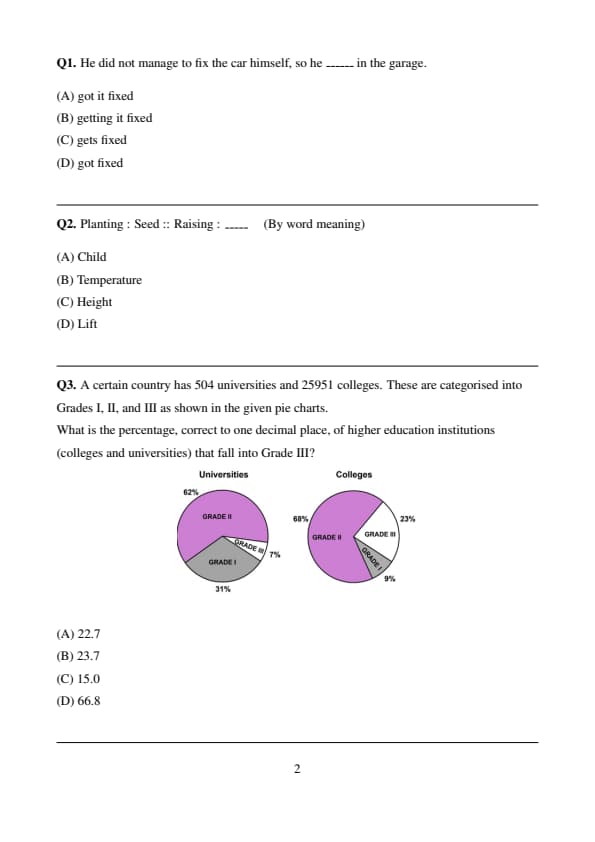
A certain country has 504 universities and 25951 colleges. These are categorised into Grades I, II, and III as shown in the given pie charts.
What is the percentage, correct to one decimal place, of higher education institutions (colleges and universities) that fall into Grade III?

The minute-hand and second-hand of a clock cross each other _____ times between 09:15:00 AM and 09:45:00 AM on a day.
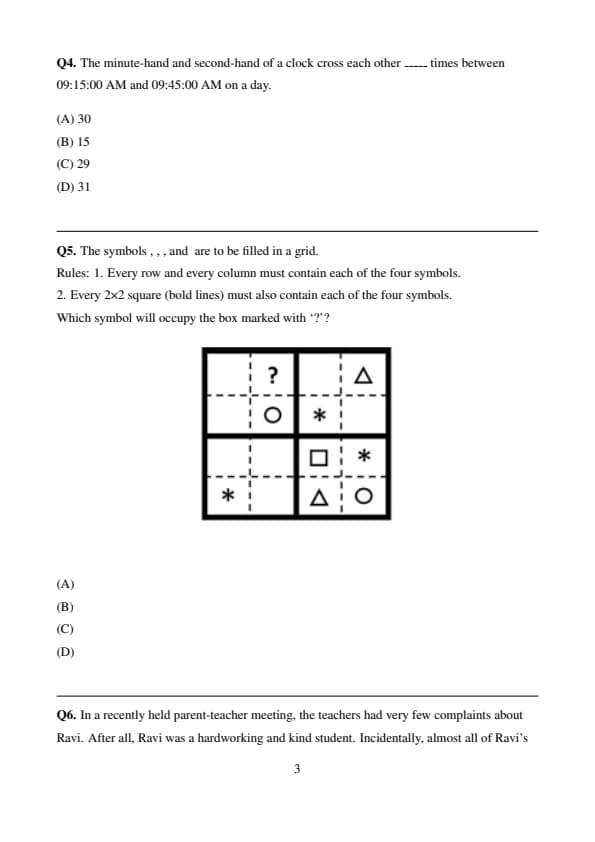
The symbols ○, ✶, △, and □ are to be filled in a grid.
Rules:
1. Every row and every column must contain each of the four symbols.
2. Every 2×2 square (bold lines) must also contain each of the four symbols.
Which symbol will occupy the box marked with ‘?’?

In a recently held parent-teacher meeting, the teachers had very few complaints about Ravi. After all, Ravi was a hardworking and kind student. Incidentally, almost all of Ravi’s friends at school were hardworking and kind too. But the teachers drew attention to Ravi’s complete lack of interest in sports. The teachers believed that, along with some of his friends who showed similar disinterest in sports, Ravi needed to engage in some sports for his overall development.
Based only on the information provided above, which one of the following statements can be logically inferred with certainty?
Consider the following inequalities: \[ p^2 - 4q < 4, \quad 3p + 2q < 6 \]
where \(p\) and \(q\) are positive integers.
The value of \((p+q)\) is _____.
Which one of the sentence sequences in the given options creates a coherent narrative?
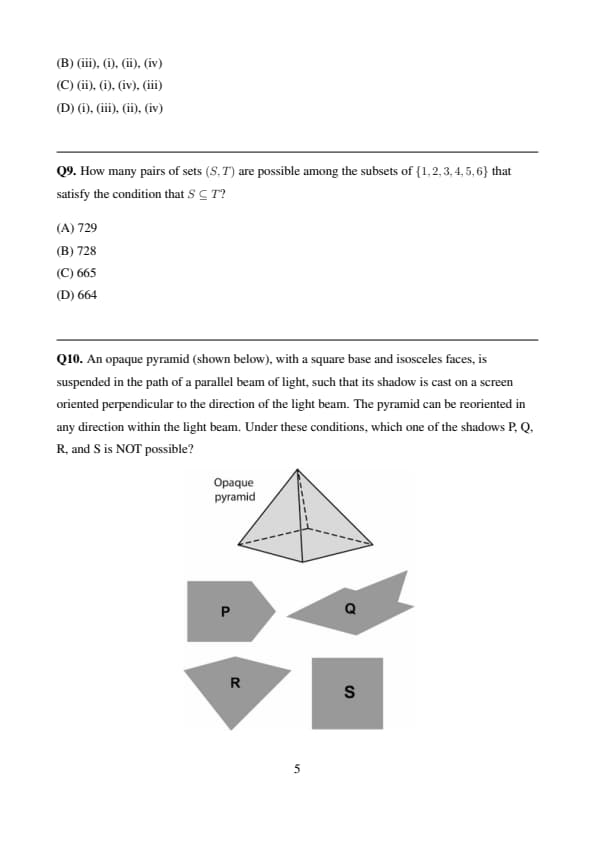
How many pairs of sets \((S, T)\) are possible among the subsets of \(\{1,2,3,4,5,6\}\) that satisfy the condition that \(S \subseteq T\)?
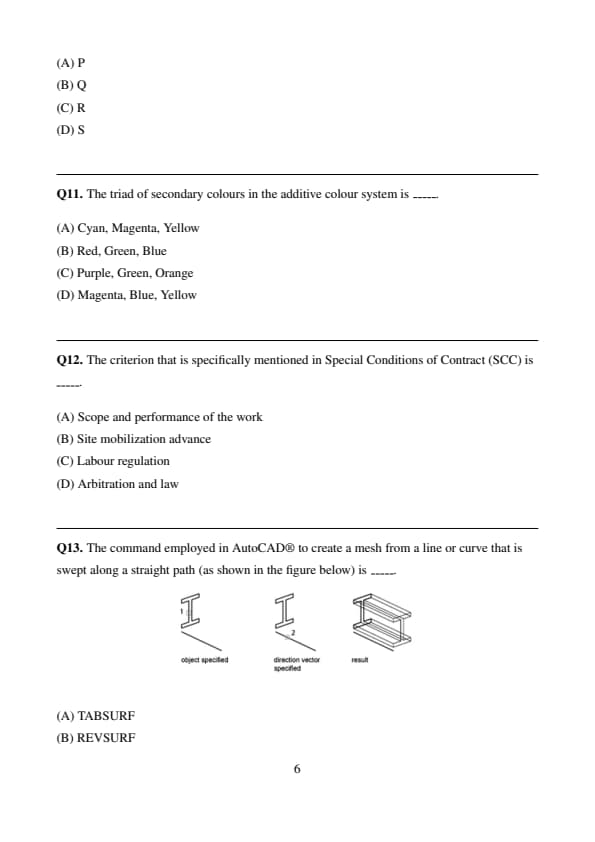
An opaque pyramid (shown below), with a square base and isosceles faces, is suspended in the path of a parallel beam of light, such that its shadow is cast on a screen oriented perpendicular to the direction of the light beam. The pyramid can be reoriented in any direction within the light beam. Under these conditions, which one of the shadows P, Q, R, and S is NOT possible?

The triad of secondary colours in the additive colour system is _____.
The criterion that is specifically mentioned in Special Conditions of Contract (SCC) is _____.
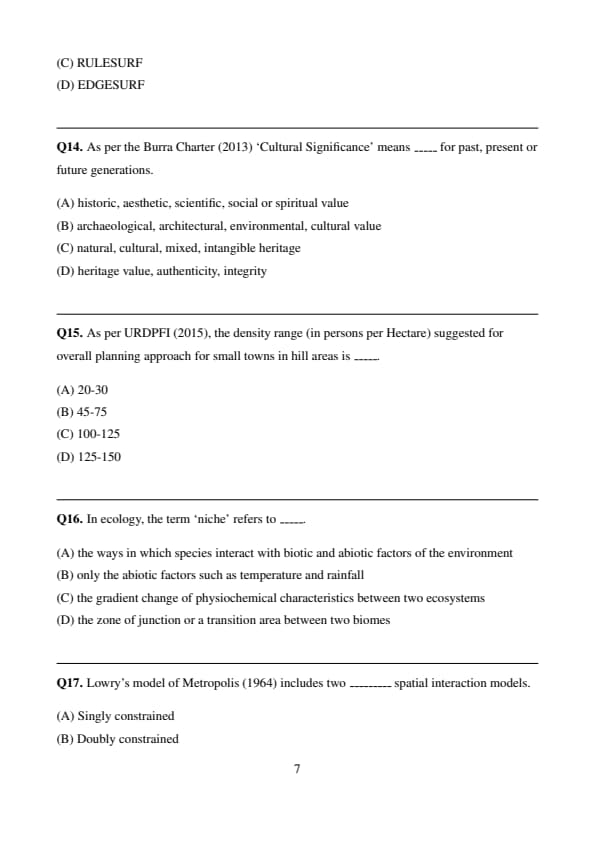
The command employed in AutoCAD® to create a mesh from a line or curve that is swept along a straight path (as shown in the figure below) is _____.

As per the Burra Charter (2013) ‘Cultural Significance’ means _____ for past, present or future generations.
As per URDPFI (2015), the density range (in persons per Hectare) suggested for overall planning approach for small towns in hill areas is _____.
In ecology, the term ‘niche’ refers to _____.
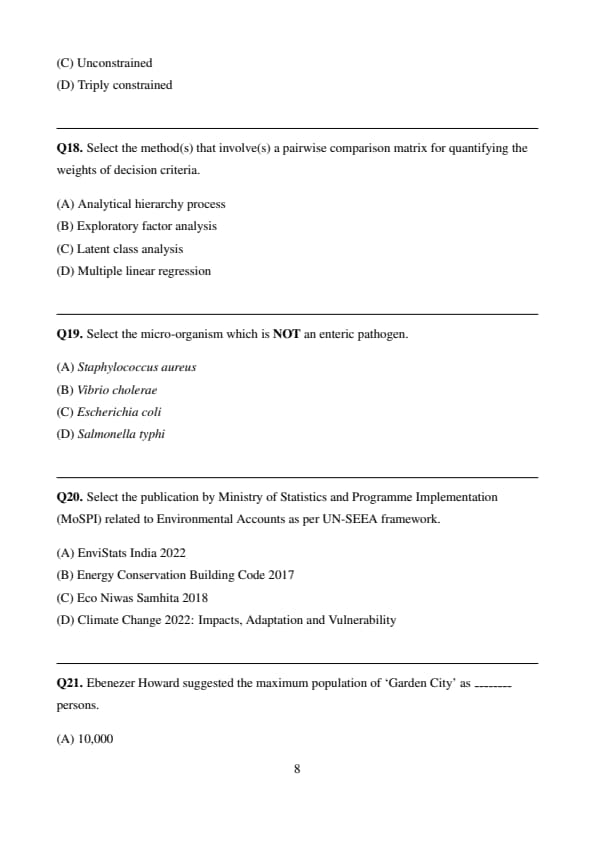
Lowry’s model of Metropolis (1964) includes two _________ spatial interaction models.
Select the method(s) that involve(s) a pairwise comparison matrix for quantifying the weights of decision criteria.
Select the micro-organism which is NOT an enteric pathogen.
Select the publication by Ministry of Statistics and Programme Implementation (MoSPI) related to Environmental Accounts as per UN-SEEA framework.
Ebenezer Howard suggested the maximum population of ‘Garden City’ as ________ persons.
In eighteenth century English gardens, ______ was used to eliminate visual boundaries between the garden and the landscape.
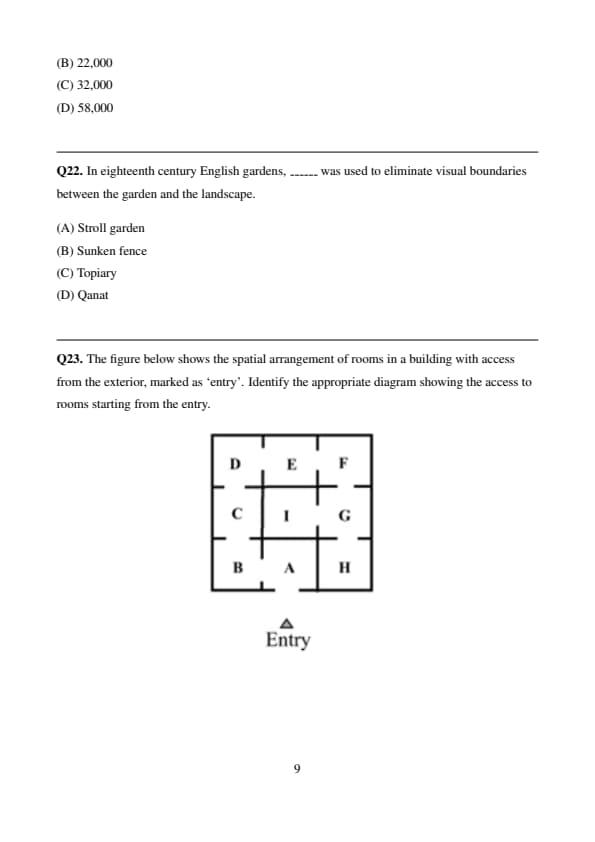
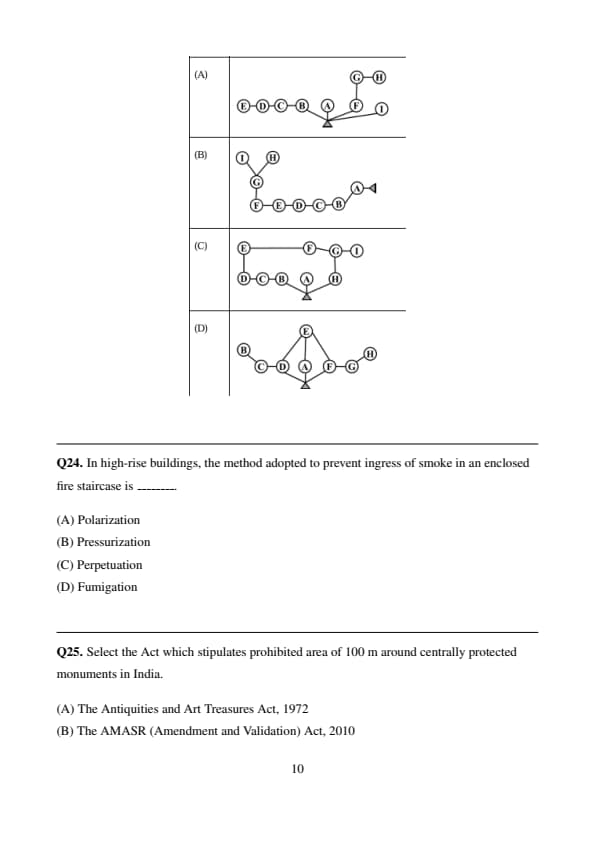
The figure below shows the spatial arrangement of rooms in a building with access from the exterior, marked as ‘entry’. Identify the appropriate diagram showing the access to rooms starting from the entry.


In high-rise buildings, the method adopted to prevent ingress of smoke in an enclosed fire staircase is ________.
Select the Act which stipulates prohibited area of 100 m around centrally protected monuments in India.
Select the option(s) which include(s) a pair of ‘Gestalt’ principles.
Select the option(s) which is/are NOT considered as primary air pollutant(s).
Select the Biosphere Reserve(s) in India which is/are listed in the ‘Man and the Biosphere’ program of UNESCO.
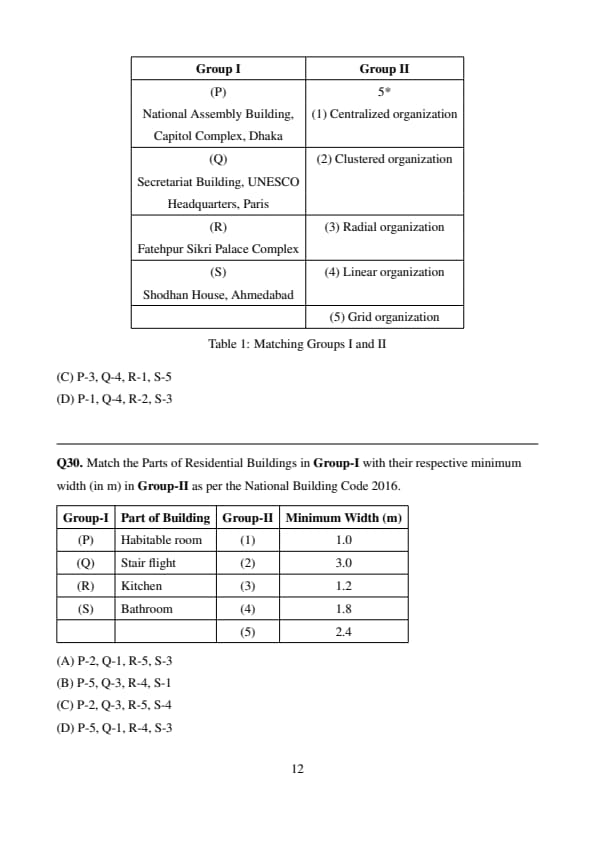
Match the buildings in Group I with their dominant spatial pattern in Group II.

Match the Parts of Residential Buildings in Group-I with their respective minimum width (in m) in Group-II as per the National Building Code 2016.

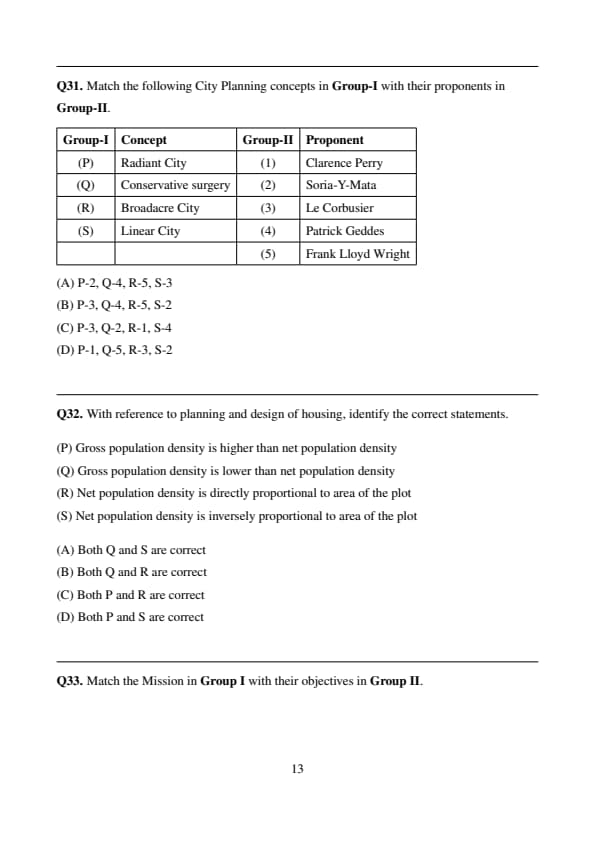
Match the following City Planning concepts in Group-I with their proponents in Group-II.

With reference to planning and design of housing, identify the correct statements.
Match the Mission in Group I with their objectives in Group II.
| Group I | Mission | Group II | Objective |
| (P) | National Mission on Enhanced Energy Efficiency | (1) | Gain better understanding of climate science, impacts, challenges by setting up climate research fund |
| (Q) | National Mission on Sustainable Habitat | (2) | Weather insurance mechanism and afforestation of 6 million hectares of degraded forest land |
| (R) | National Water Mission | (3) | Decrease energy consumption in large consuming industries |
| (S) | National Mission on Strategic Knowledge for Climate Change | (4) | 20% improvement of water use efficiency through pricing |
| (5) | Enforcement of automotive fuel economy standards using pricing measures |
Select the option(s) that is/are listed among the Sustainable Development Goals (SDGs) as articulated by the United Nations.
Select the statement(s) that are TRUE regarding ‘Building Security Services’.
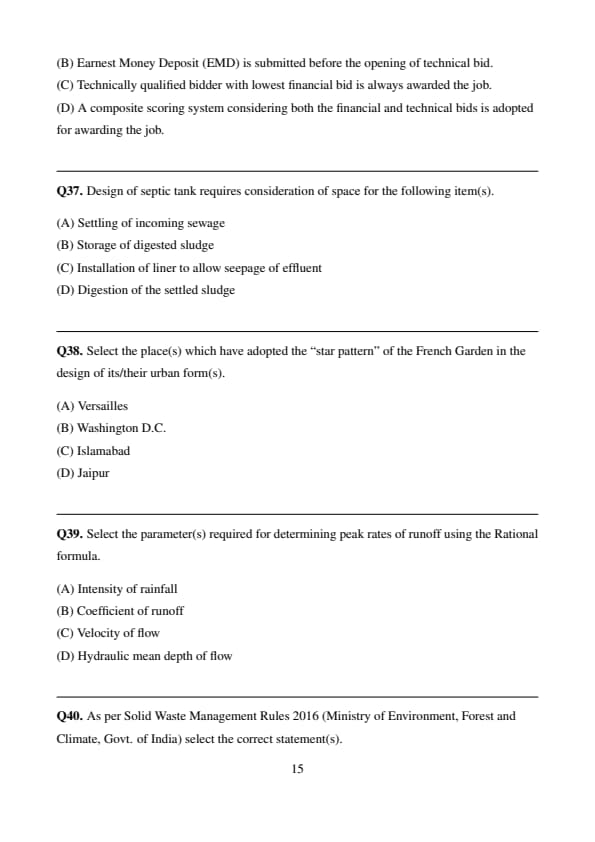
Select the statement(s) that are TRUE regarding ‘Quality and Cost-Based Selection (QCBS)’ system for tendering.
Design of septic tank requires consideration of space for the following item(s).
Select the place(s) which have adopted the “star pattern” of the French Garden in the design of its/their urban form(s).
Select the parameter(s) required for determining peak rates of runoff using the Rational formula.
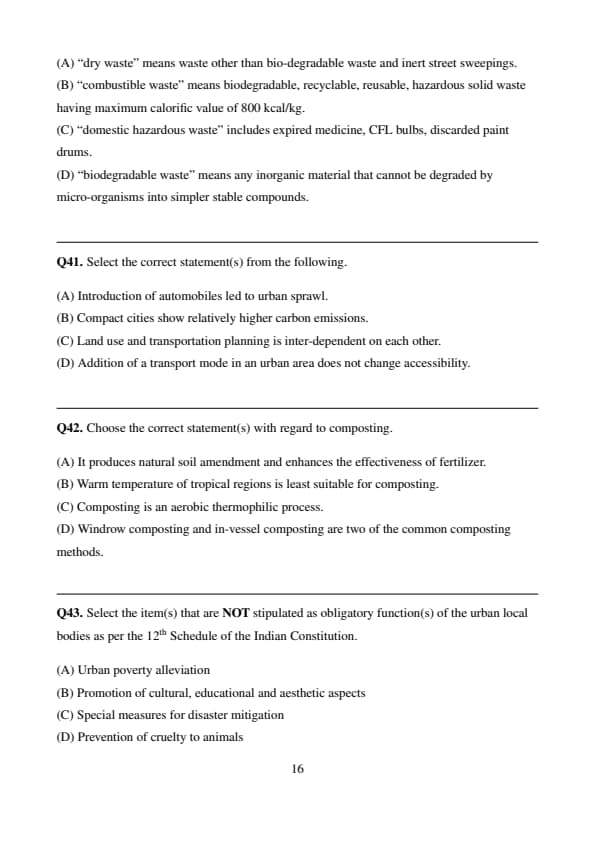
As per Solid Waste Management Rules 2016 (Ministry of Environment, Forest and Climate, Govt. of India) select the correct statement(s).
Select the correct statement(s) from the following.
Choose the correct statement(s) with regard to composting.
Select the item(s) that are NOT stipulated as obligatory function(s) of the urban local bodies as per the 12th Schedule of the Indian Constitution.
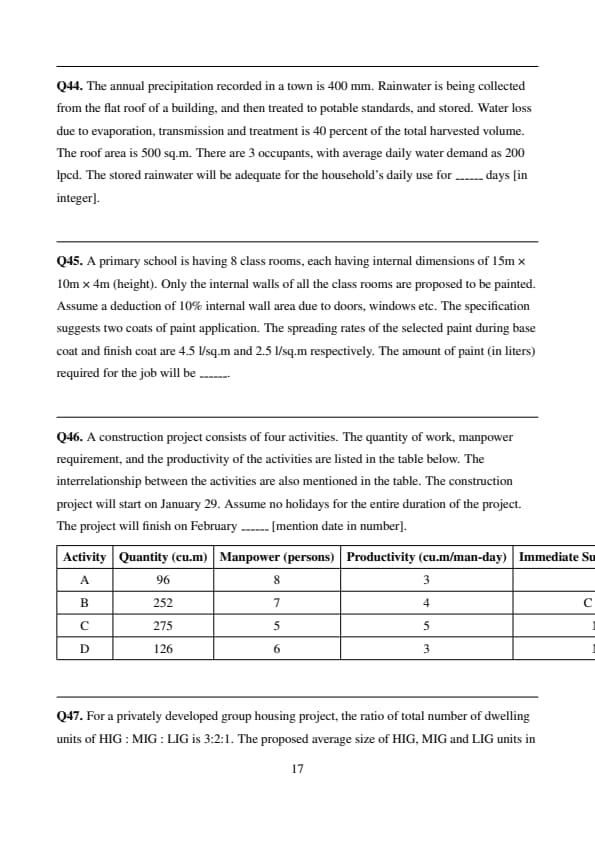
The annual precipitation recorded in a town is 400 mm. Rainwater is being collected from the flat roof of a building, and then treated to potable standards, and stored. Water loss due to evaporation, transmission and treatment is 40 percent of the total harvested volume. The roof area is 500 sq.m. There are 3 occupants, with average daily water demand as 200 lpcd. The stored rainwater will be adequate for the household’s daily use for ______ days [in integer].
A primary school is having 8 class rooms, each having internal dimensions of 15m × 10m × 4m (height). Only the internal walls of all the class rooms are proposed to be painted. Assume a deduction of 10% internal wall area due to doors, windows etc. The specification suggests two coats of paint application. The spreading rates of the selected paint during base coat and finish coat are 4.5 l/sq.m and 2.5 l/sq.m respectively. The amount of paint (in liters) required for the job will be ______.
A construction project consists of four activities. The quantity of work, manpower requirement, and the productivity of the activities are listed in the table below. The interrelationship between the activities are also mentioned in the table. The construction project will start on January 29. Assume no holidays for the entire duration of the project. The project will finish on February ______ [mention date in number].
| Activity | Quantity (cu.m) | Manpower (persons) | Productivity (cu.m/man-day) | Immediate Successor Activity |
| A | 96 | 8 | 3 | C |
| B | 252 | 7 | 4 | C&D |
| C | 275 | 5 | 5 | |
| D | 126 | 6 | 3 |
For a privately developed group housing project, the ratio of total number of dwelling units of HIG : MIG : LIG is 3:2:1. The proposed average size of HIG, MIG and LIG units in sq.m are 100, 60 and 30 respectively. The ratio of the total built up area between (MIG + LIG) to HIG will be 1: _____ [in integer].
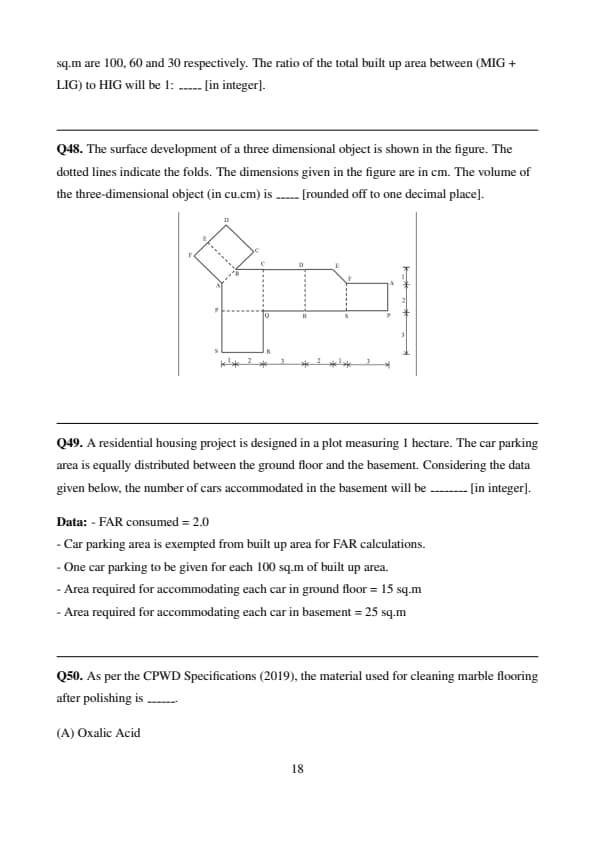
The surface development of a three dimensional object is shown in the figure. The dotted lines indicate the folds. The dimensions given in the figure are in cm. The volume of the three-dimensional object (in cu.cm) is _____ [rounded off to one decimal place].

A residential housing project is designed in a plot measuring 1 hectare. The car parking area is equally distributed between the ground floor and the basement. Considering the data given below, the number of cars accommodated in the basement will be ________ [in integer].
Data:
- FAR consumed = 2.0
- Car parking area is exempted from built up area for FAR calculations.
- One car parking to be given for each 100 sq.m of built up area.
- Area required for accommodating each car in ground floor = 15 sq.m
- Area required for accommodating each car in basement = 25 sq.m
As per the CPWD Specifications (2019), the material used for cleaning marble flooring after polishing is ______.
The proportion of the sides of a traditional Japanese tatami mat is ______.
As per IS:4954 – 1964, the acceptable noise level (in dB) for urban residential areas is ________.
Identify the Indian tribe that is associated with the vernacular dwelling illustrated in the image below.
Thermal diffusivity of a wall is influenced by the choice of building material. Identify the statement(s) that is/are correct.
Select the statement(s) which are NOT correct with respect to burnt clay bricks.
Select the example(s) of Art Nouveau architecture.
Match the buildings in Group I with their architectural feature in Group II.

Match the architects in Group I with their key architectural ideas in Group II.


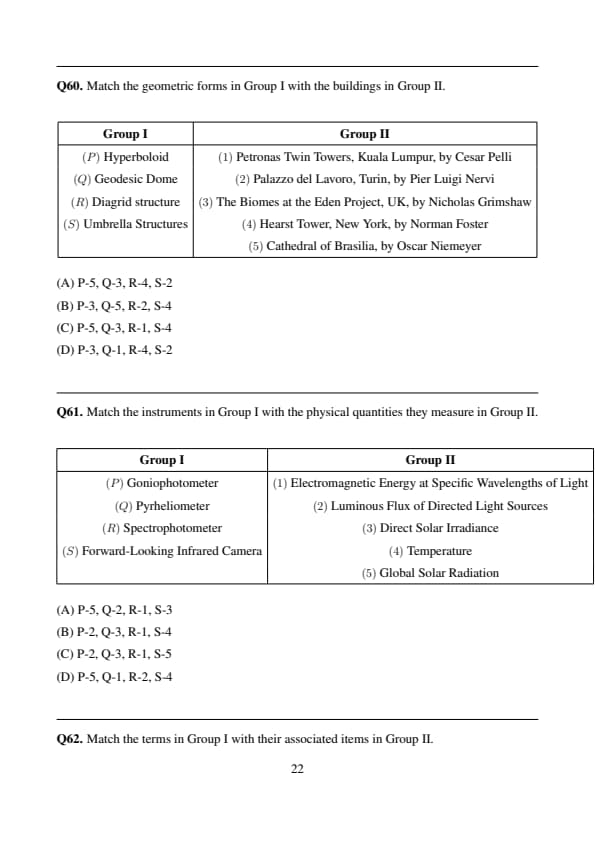
Match the instruments in Group I with the physical quantities they measure in Group II.


Choose the correct statement(s) from the following:
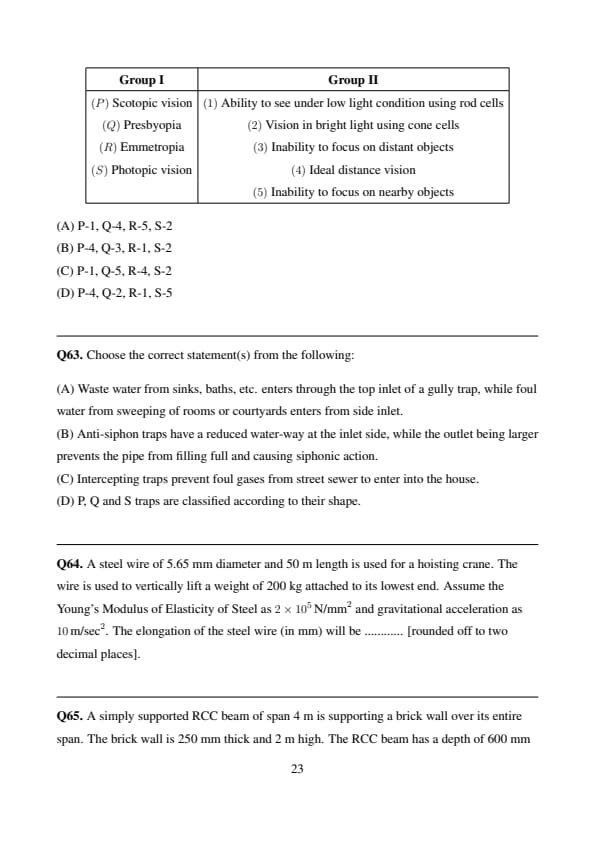
A steel wire of 5.65 mm diameter and 50 m length is used for a hoisting crane. The wire is used to vertically lift a weight of 200 kg attached to its lowest end. Assume the Young’s Modulus of Elasticity of Steel as \(2 \times 10^5 \, N/mm^2\) and gravitational acceleration as \(10 \, m/sec^2\). The elongation of the steel wire (in mm) will be ............ [rounded off to two decimal places].
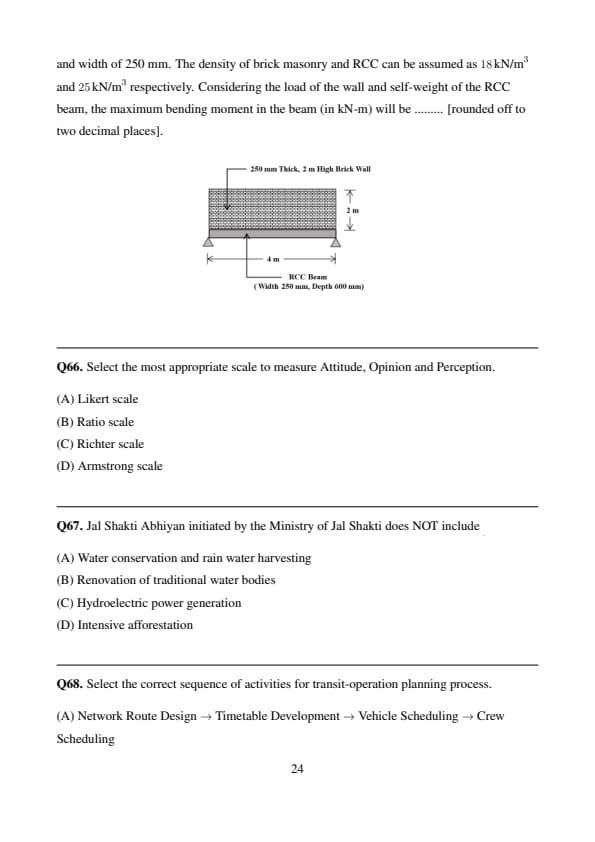
A simply supported RCC beam of span 4 m is supporting a brick wall over its entire span. The brick wall is 250 mm thick and 2 m high. The RCC beam has a depth of 600 mm and width of 250 mm. The density of brick masonry and RCC can be assumed as \(18 \, kN/m^3\) and \(25 \, kN/m^3\) respectively. Considering the load of the wall and self-weight of the RCC beam, the maximum bending moment in the beam (in kN-m) will be ......... [rounded off to two decimal places].

Select the most appropriate scale to measure Attitude, Opinion and Perception.
Jal Shakti Abhiyan initiated by the Ministry of Jal Shakti does NOT include _____.
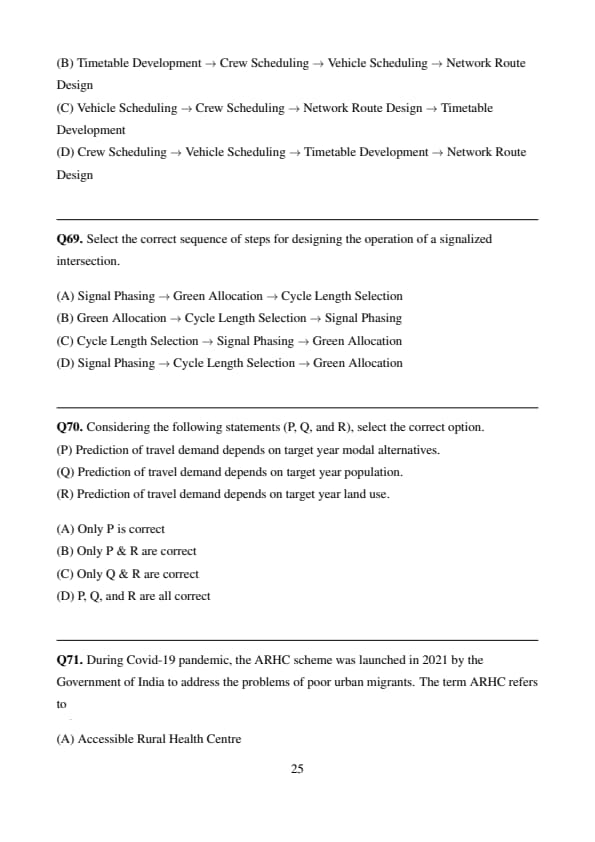
Select the correct sequence of activities for transit-operation planning process.
Select the correct sequence of steps for designing the operation of a signalized intersection.
Considering the following statements (P, Q, and R), select the correct option.
During Covid-19 pandemic, the ARHC scheme was launched in 2021 by the Government of India to address the problems of poor urban migrants. The term ARHC refers to ___________.
Choose the non-probability sampling method where the sample is taken from a group of people easy to contact or reach.
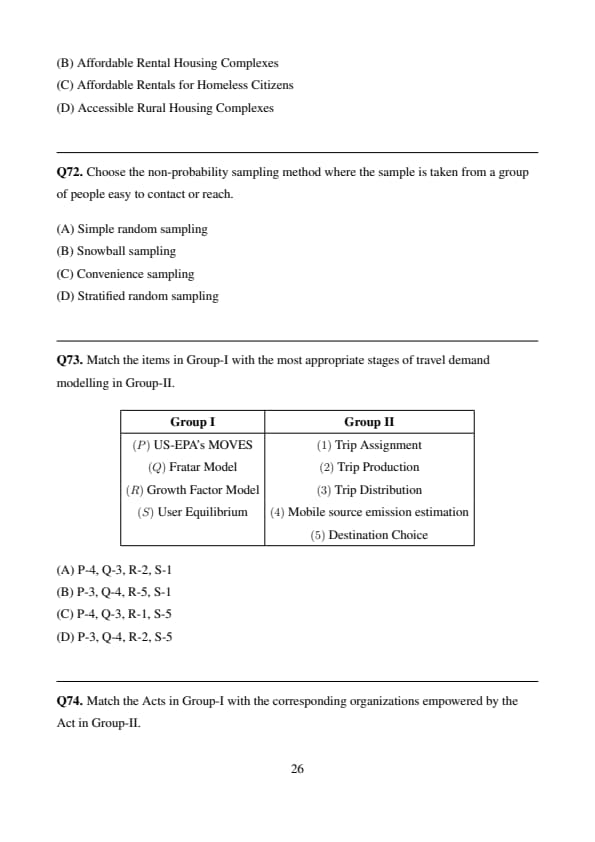
Match the items in Group-I with the most appropriate stages of travel demand modelling in Group-II.

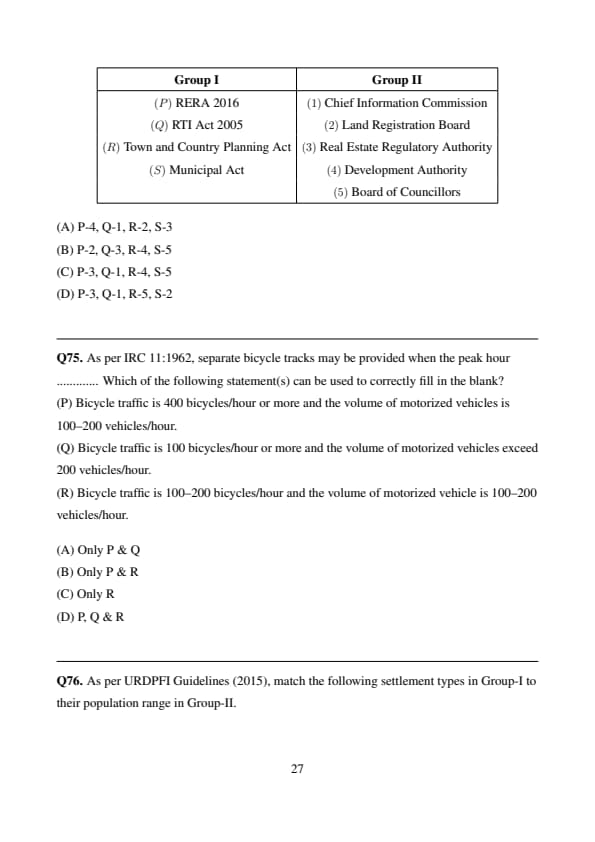
Match the Acts in Group-I with the corresponding organizations empowered by the Act in Group-II.

As per IRC 11:1962, separate bicycle tracks may be provided when the peak hour .............
Which of the following statement(s) can be used to correctly fill in the blank?
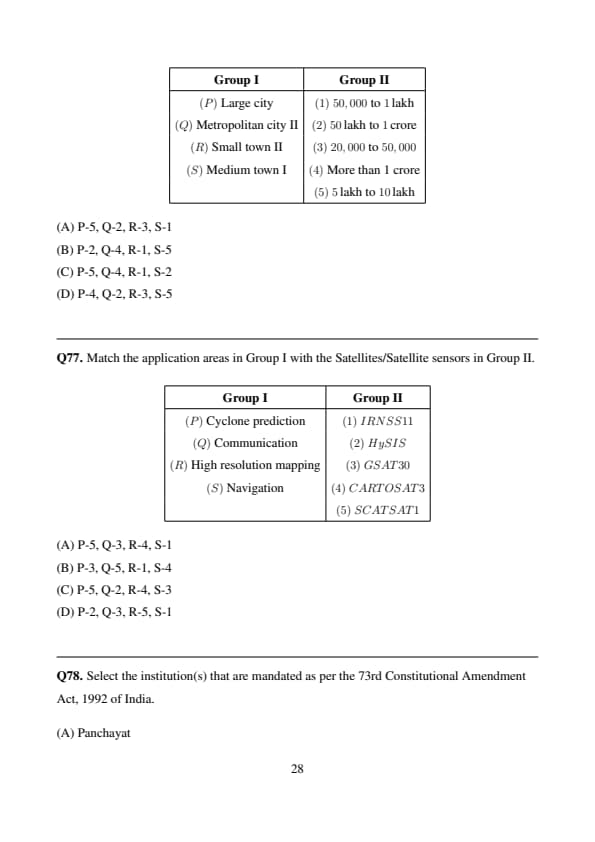
As per URDPFI Guidelines (2015), match the following settlement types in Group-I to their population range in Group-II.

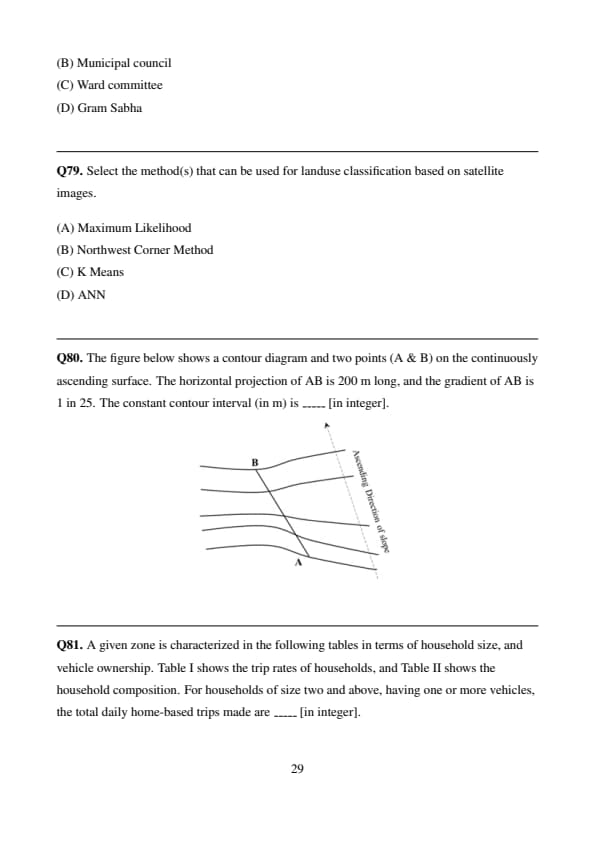
Match the application areas in Group I with the Satellites/Satellite sensors in Group II.

Select the institution(s) that are mandated as per the 73rd Constitutional Amendment Act, 1992 of India.
Select the method(s) that can be used for landuse classification based on satellite images.
The figure below shows a contour diagram and two points (A & B) on the continuously ascending surface. The horizontal projection of AB is 200 m long, and the gradient of AB is 1 in 25. The constant contour interval (in m) is _____ [in integer].

A given zone is characterized in the following tables in terms of household size, and vehicle ownership. Table I shows the trip rates of households, and Table II shows the household composition. For households of size two and above, having one or more vehicles, the total daily home-based trips made are _____ [in integer].






Comments