




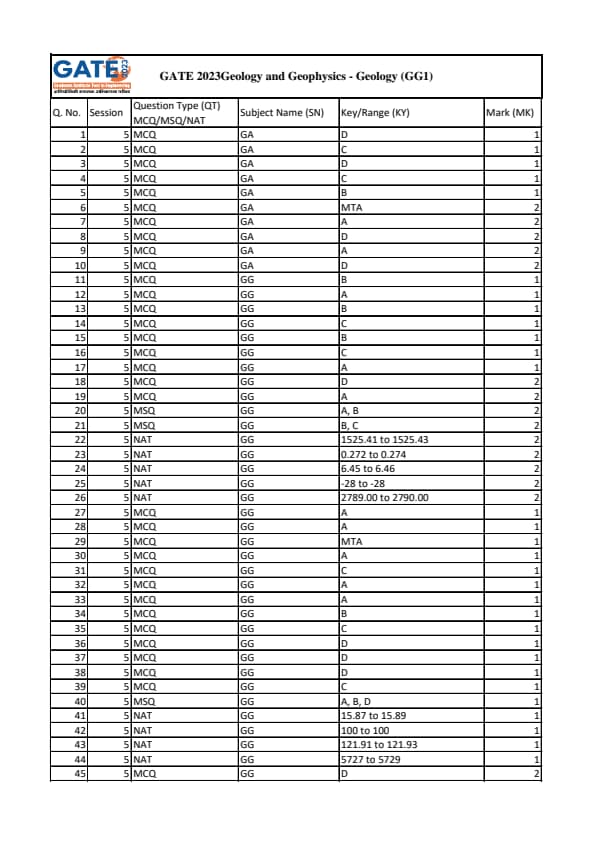
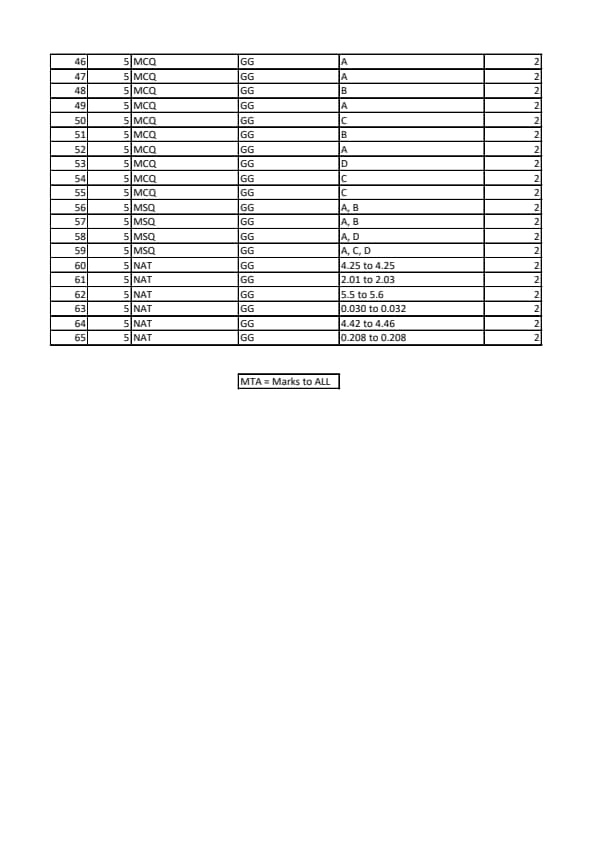
GATE 2023 Geology and Geophysics Question Paper PDF is available here for download. IIT Kanpur conducted GATE 2023 Geology and Geophysics exam on February 11, 2023 in the Forenoon Session from 09:30 AM to 12:30 PM. Students have to answer 65 questions in GATE 2023 Geology and Geophysics Question Paper carrying a total weightage of 100 marks. 10 questions are from the General Aptitude section and 55 questions are from Core Discipline.
GATE 2023 Geology and Geophysics Question Paper with Solutions PDF
| GATE 2023 Geology and Geophysics Question Paper with Solutions PDF |  Download Download |
Check Solutions |

The village was nestled in a green spot, _____ the ocean and the hills.
Disagree : Protest :: Agree : _____ \hspace{1cm (By word meaning)
A ‘frabjous’ number is defined as a 3-digit number with all digits odd, and no two adjacent digits being the same. For example, 137 is a frabjous number, while 133 is not. How many such frabjous numbers exist?
Which one among the following statements must be TRUE about the mean and the median of the scores of all candidates appearing for GATE 2023?
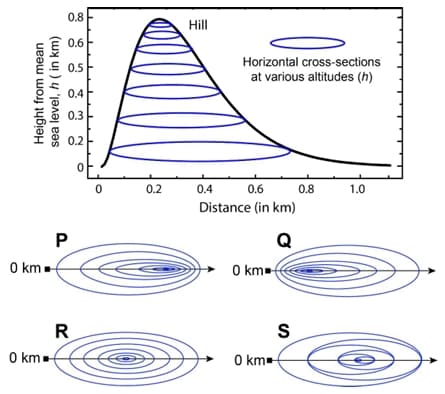
In the given diagram, ovals are marked at different heights \((h)\) of a hill. Which one of the following options P, Q, R, and S depicts the top view of the hill?
Residency is a famous housing complex with many well-established individuals among its residents. A recent survey conducted among the residents of the complex revealed that all of those residents who are well established in their respective fields happen to be academicians. The survey also revealed that most of these academicians are authors of some best-selling books.
Based only on the information provided above, which one of the following statements can be logically inferred with certainty?
Ankita has to climb 5 stairs starting at the ground, while respecting the following rules:
1. At any stage, Ankita can move either one or two stairs up.
2. At any stage, Ankita cannot move to a lower step.
Let \(F(N)\) denote the number of possible ways in which Ankita can reach the \(N^{th}\) stair. For example, \(F(1) = 1\), \(F(2) = 2\), \(F(3) = 3\).
The value of \(F(5)\) is ______.
The information contained in DNA is used to synthesize proteins that are necessary for the functioning of life. DNA is composed of four nucleotides: Adenine (A), Thymine (T), Cytosine (C), and Guanine (G). The information contained in DNA can then be thought of as a sequence of these four nucleotides: A, T, C, and G. DNA has coding and non-coding regions. Coding regions—where the sequence of these nucleotides are read in groups of three to produce individual amino acids—constitute only about 2% of human DNA.
Based only on the information provided above, which one of the following statements can be logically inferred with certainty?
(i) The majority of human DNA has no role in the synthesis of proteins.
(ii) The function of about 98% of human DNA is not understood.
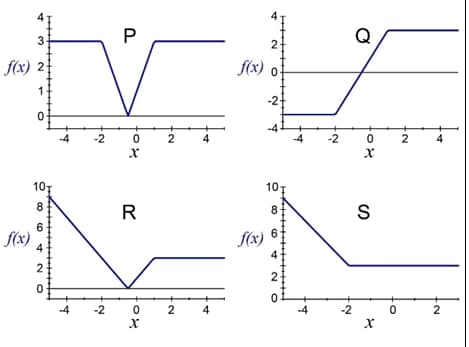
Which one of the given figures P, Q, R, and S represents the graph of the following function?
\[ f(x) = |\,|x+2| - |x-1|\,| \]
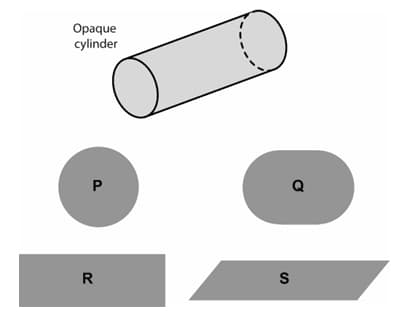
An opaque cylinder (shown below) is suspended in the path of a parallel beam of light, such that its shadow is cast on a screen oriented perpendicular to the direction of the light beam. The cylinder can be reoriented in any direction within the light beam. Under these conditions, which one of the shadows P, Q, R, and S is NOT possible?
Which of the following is a chronostratigraphic unit?
During contact metamorphism, with increasing temperature,
The dimension of dynamic viscosity is:
At a depth of about 400 km inside the Earth, which one of the following occurs?
Equatorial radius of which one of the following planets is closest to that of the Earth?
Variation of Bouguer anomaly obtained along a profile after applying all the necessary corrections is due to:
The heat production (\(Q_r\)) of a granitic rock due to decay of the radioactive elements U, Th and K having concentration \(C_U, C_{Th}, C_K\), respectively, is given by the expression:
\[ Q_r = \alpha C_U + \beta C_{Th} + \gamma C_K \]
Which one of the following correctly represents the relation between the magnitude of coefficients \(\alpha, \beta, \gamma\) (in \(\mu Wkg^{-1}\))?
Which one of the following Phanerozoic periods has the shortest duration of time?
Based on the given mineral proportions, which one of the following statements is CORRECT?
\[ \textbf{Rock X: } \, Olivine : Orthopyroxene : Clinopyroxene :: 50 : 30 : 20 \] \[ \textbf{Rock Y: } \, Plagioclase : Alkali feldspar : Quartz :: 25 : 45 : 30 \] \[ \textbf{Rock Z: } \, Biotite : Plagioclase : Alkali feldspar : Quartz :: 20 : 25 : 35 : 20 \]
The CORRECT sequence(s) of electromagnetic radiations in terms of increasing wavelength is/are:
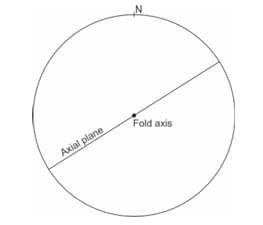
Which of the given folds is/are represented by the stereoplot?
The bulk density and water content of a soil are \(1800\ kg m^{-3}\) and \(18%\), respectively. Find the dry density of the soil. \([\,round off to 2 decimal places\,]\)
Two-layer Earth: \(\rho_1=2000\ kg m^{-3},\ V_1=1800\ m s^{-1}\) (upper), \(\rho_2=3000\ kg m^{-3},\ V_2=2100\ m s^{-1}\) (lower). Compute the normal-incidence P-wave reflection coefficient at the interface. \([\,round off to 3 decimals\,]\)
A rock is fully saturated with water of resistivity \(\rho_w=0.25\ Ωm\). The bulk resistivity is \(\rho=60\ Ωm\). Using Archie’s law with \(a=1\) (tortuosity factor) and \(m=2\) (cementation exponent), determine the porosity \(\phi\) in percent. \([\,round off to 2 decimals\,]\)
Wenner DC resistivity survey. The operator forgot to cancel self-potential (SP) between potential electrodes before injecting current. With equal current magnitude: measured \(\Delta V_1=+158\ mV\) for current \(C1\rightarrow C2\) and \(\Delta V_2=-214\ mV\) for reversed current \(C2\rightarrow C1\). Determine the SP (in mV, integer) that existed between potential electrodes before current injection.
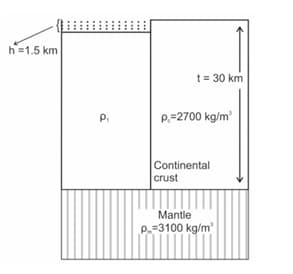
For the given figure, considering Pratt’s model of isostatic compensation at the crust–mantle boundary, the crustal density (\(\rho_1\)) that explains 1.5 km deep lake is \(\_\_\_\_\_\) kg/m\(^3\). (Consider density of water \(\rho_w = 1000\) kg/m\(^3\)) [round off to 2 decimal places]
Which one of the following mineral pairs shows solid solubility through coupled substitution of elements?
The behavior of trace elements in magmatic systems follows:
Choose the CORRECT statement regarding crystallization of a single feldspar of composition Or\(_{50}\)Ab\(_{50}\) in the Albite–Orthoclase system.
Given \(\Delta V_r\) and \(\Delta S_r\) are the volume and entropy of reaction, respectively, the most suitable conditions for the reaction to be used as a geothermometer are
In which one of the given mass extinction events, global cooling that resulted in glaciation and lowering of sea level, is considered as the major cause of extinction for more than 50% of marine fauna?
Processes of fossilization affecting an organism from its death to burial under sediments come under the study of:
The dip and dip direction of the lee side of a straight crested ripple on modern sediments are found to be 15\(^\circ\) and N10\(^\circ\)W, respectively. Considering unidirectional water movement, the flow direction is towards:
Rhodochrosite in hand specimen is most likely to be confused with certain varieties of:
Which of the following is NOT an essential property of a mineral?
The number of lattice points in a face-centered cubic (FCC) unit cell is:
All the faces of an octahedron can be collectively symbolized by:
Shallow-focus earthquakes with tensional focal mechanism are characteristic of:
90% of the bulk Earth is constituted of Fe, Si, O and:
Which of the following is/are slope stabilization method(s)?
The amount of Fe in a sample of 25 g of pyrrhotite (FeS) is \(\_\_\_\_\_\_\) g. (Atomic wt. of Fe = 55.85 and S = 32.06) [round off to 2 decimal places]
The rate of spreading about a symmetric spreading center at the middle of a 4000 km wide sea is 40 mm/year. The spreading began \(\_\_\_\_\_\) million years before present. [in integer]
A vertical aerial photograph is obtained over flat terrain with a 30 cm focal-length camera lens from an altitude of 18288 m. If the width of a dolerite dyke on this vertical photograph is 2 mm, its actual width on the terrain is \(\_\_\_\_\_\_\) m. [round off to 2 decimal places]
The decay constant of a radioactive isotope is \(1.21\times 10^{-4}\ year^{-1}\). The half-life of the isotope is \(\_\_\_\_\_\_\_\_\_\_\_\_\) years. [round off to nearest integer]
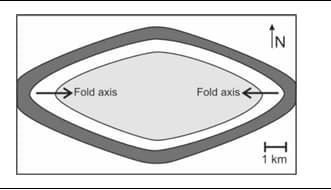
The given outcrop pattern on a flat topography represents:
Match the following fossil taxa in Group I with their corresponding features in Group II.
Group I & Group II
P. Bryozoa & 1. Denticles
Q. Ostracoda & 2. Chamber
R. Foraminifera & 3. Carapace
S. Conodont & 4. Zooid
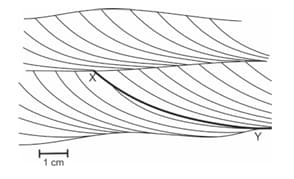
In the given schematic diagram, cross beds are exposed on a vertical rock face. The feature XY (bold line) represents a/an:
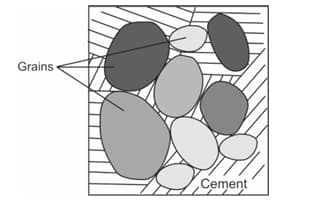
The schematic diagram represents thin section of a carbonate rock. The type of cement formed by large calcite crystals is known as:
Based on the three statements given below, choose the CORRECT option.
Statement I: Echinoids have water vascular system.
Statement II: Delthyrium and pedicle foramen are found in the brachial valve of brachiopods.
Statement III: Cardinal teeth, adductor muscles and chondrophore are found in bivalves.
The total number of symmetry elements in the crystal class represented by the point group 4/m3 2/m is:
The ratio of bridging to non-bridging oxygen atoms in the amphibole structure is:
Match the following basins in Group I with their corresponding formations in Group II.
\begin{tabular{p{0.35\linewidthp{0.35\linewidth
Group I & Group II
P. Cauvery & 1. Lohardih
Q. Damodar & 2. Tiratgarh
R. Chhattisgarh & 3. Raniganj
S. Indravati & 4. Kallamedu
Based on the three statements given below, choose the CORRECT option.
Statement I: Gigantopithecus is a genus of the family Hominidae.
Statement II: Equus is a living genus of the family Equidae.
Statement III: Gomphotherium is a genus belonging to the order Proboscidea.
In porphyry copper deposits, the order of alteration zones from the intrusive body outwards is:
Which is the CORRECT sequence of ore minerals in their increasing order of reflectance?
Which of the following stratigraphic successions is/are arranged in CORRECT chronological order?
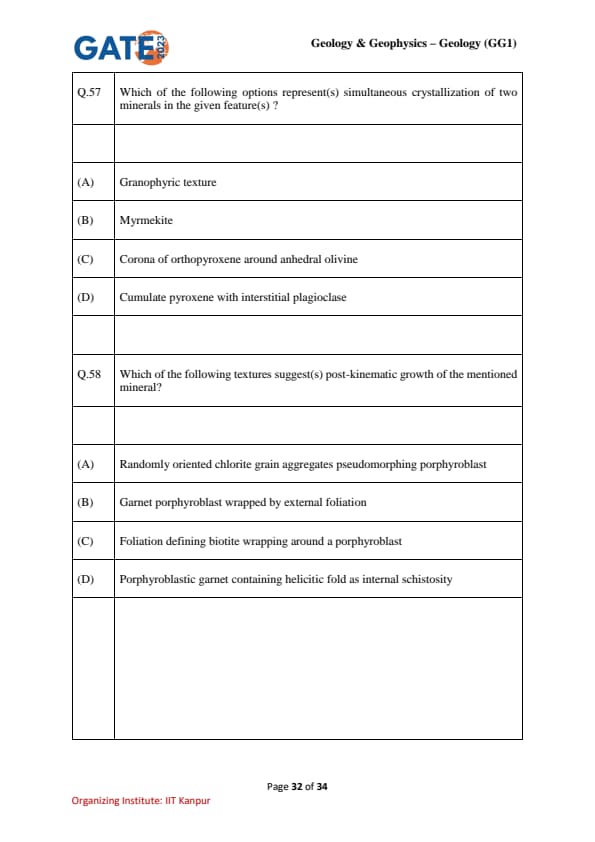
Which of the following options represent(s) simultaneous crystallization of two minerals in the given feature(s)?
Which of the following textures suggest(s) post-kinematic growth of the mentioned mineral?
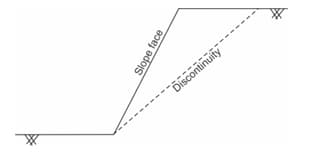
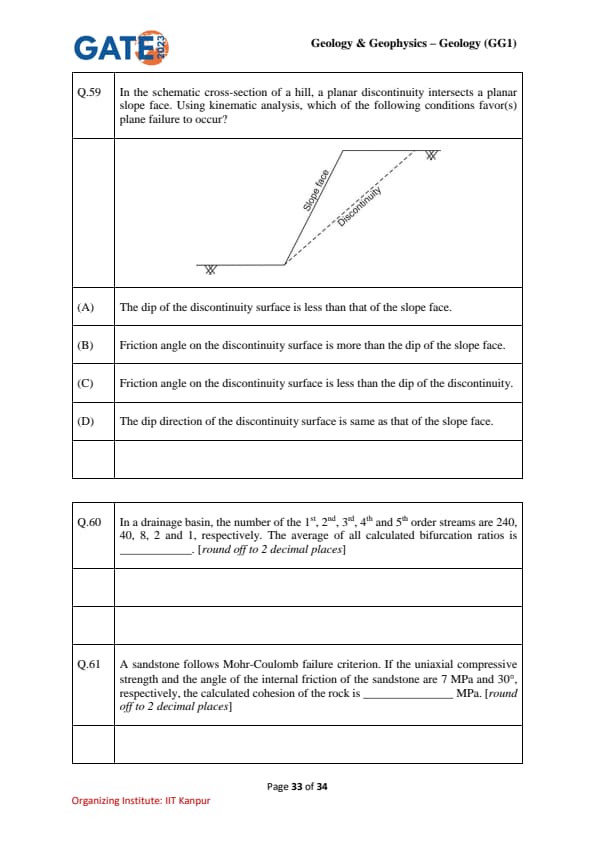
In the schematic cross-section of a hill, a planar discontinuity intersects a planar slope face. Using kinematic analysis, which of the following conditions favor(s) plane failure to occur?
In a drainage basin, the number of the 1st, 2nd, 3rd, 4th and 5th order streams are 240, 40, 8, 2 and 1, respectively. The average of all calculated bifurcation ratios is ............... [round off to 2 decimal places]
A sandstone follows Mohr-Coulomb failure criterion. If the uniaxial compressive strength and the angle of the internal friction of the sandstone are 7 MPa and \(30^\circ\), respectively, the calculated cohesion of the rock is ................ MPa. [round off to 2 decimal places]
At a certain depth in the crust, the maximum and minimum principal compressive stresses are 150 MPa and 75 MPa, respectively, which lead to normal faulting. If the average density of the crust is 2700 kg/m\(^3\), the crustal depth of fracture initiation according to Anderson’s theory of faulting is ................ km. (g = 10 m/s\(^2\)) [round off to one decimal place]
A cylindrical soil sample of 10 cm diameter is tested in a constant-head permeameter. A volume of 250 cm\(^3\) of water is collected in 5 minutes when the constant-head difference between tapping points 15 cm apart is 5 cm. Considering Darcy flow, the absolute value of coefficient of permeability in cm/s is .............. (\(\pi = 3.14\)) [round off to 3 decimal places]
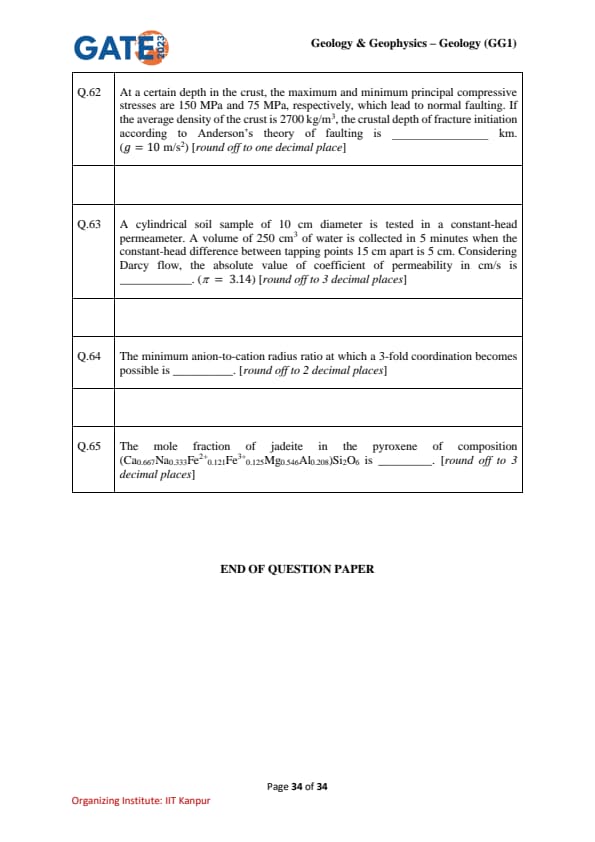
The minimum anion-to-cation radius ratio at which a 3-fold coordination becomes possible is ............. [round off to 2 decimal places]
The mole fraction of jadeite in the pyroxene of composition (Ca\(_{0.667}\)Na\(_{0.333}\)Fe\(^{2+}_{0.12}\)Fe\(^{3+}_{0.125}\)Mg\(_{0.546}\)Al\(_{0.208}\))Si\(_2\)O\(_6\) is .................. [round off to 3 decimal places]
Also Check:
| Previous Year GATE Geology and Geophysics Question Papers | GATE 2023 Geology and Geophysics Paper Analysis |
| GATE Geology and Geophysics Exam Pattern | GATE Geology and Geophysics Syllabus |





Comments