




GATE 2023 Humanities and Social Sciences – Economics (XH-C1) Question Paper PDF is available here for download. IIT Kanpur conducted GATE 2023 Humanities and Social Sciences – Economics (XH-C1) exam on February 5, 2023 in the Forenoon Session from 09:30 AM to 12:30 PM. Students have to answer 65 questions in GATE 2023 Humanities and Social Sciences – Economics (XH-C1)s Question Paper carrying a total weightage of 100 marks. 10 questions are from the General Aptitude section and 55 questions are from Core Discipline.
GATE 2023 Humanities and Social Sciences – Economics (XH-C1) Question Paper with Solutions PDF
| GATE 2023 Humanities and Social Sciences – Economics (XH-C1) Question Paper with Solutions |  Download Download |
Check Solutions |

Rafi told Mary, “I am thinking of watching a film this weekend.”
The following reports the above statement in indirect speech:
Rafi told Mary that he ______ of watching a film that weekend.
Permit : ______ :: Enforce : Relax \quad (By word meaning)
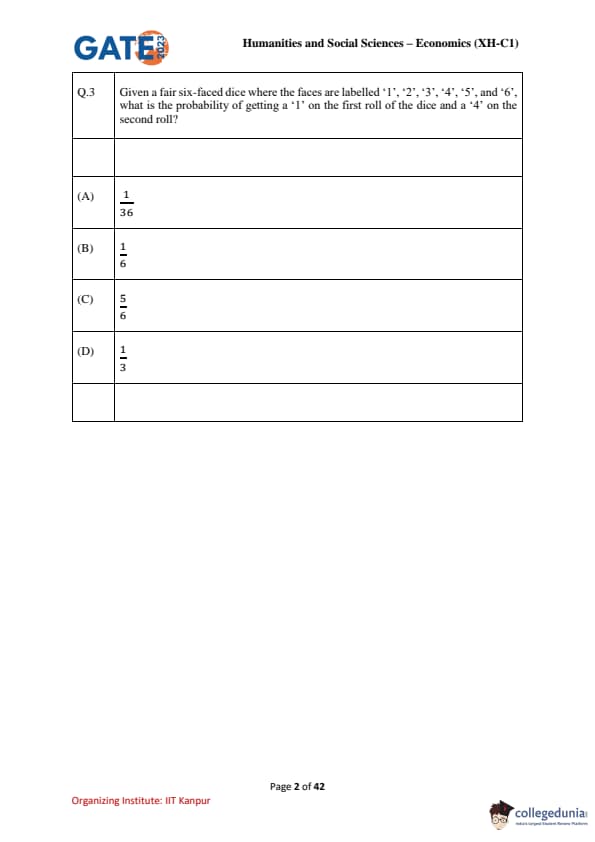
Given a fair six-faced dice where the faces are labelled ‘1’, ‘2’, ‘3’, ‘4’, ‘5’, and ‘6’, what is the probability of getting a ‘1’ on the first roll of the dice and a ‘4’ on the second roll?
A recent survey shows that 65% of tobacco users were advised to stop consuming tobacco. The survey also shows that 3 out of 10 tobacco users attempted to stop using tobacco.
Based only on the information in the above passage, which one of the following options can be logically inferred with certainty?
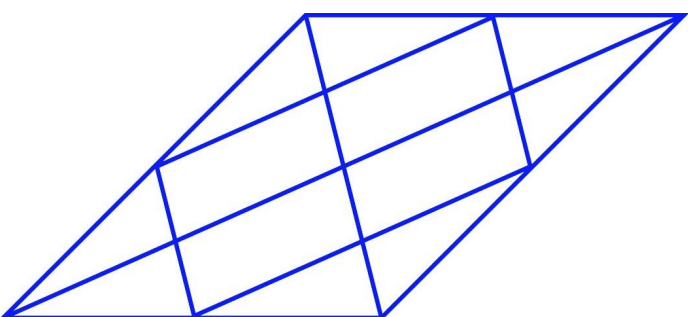
How many triangles are present in the given figure?
Students of all the departments of a college who have successfully completed the registration process are eligible to vote in the upcoming college elections. By the due date, \emph{none} of the students from the Department of Human Sciences had completed the registration process. Which set(s) of statements can be inferred with certainty?
(i) All those students who would not be eligible to vote would certainly belong to the Department of Human Sciences.
(ii) None of the students from departments other than Human Sciences failed to complete the registration process within the due time.
(iii) All the eligible voters would certainly be students who are not from the Department of Human Sciences.
Which one of the following options represents the given graph?
Which one of the options does NOT describe the passage below or follow from it?
Passage:
We tend to think of cancer as a ‘modern’ illness because its metaphors are so modern. It is a disease of overproduction, of sudden growth, a growth that is unstoppable, tipped into the abyss of no control. Modern cell biology encourages us to imagine the cell as a molecular machine. Cancer is that machine unable to quench its initial command (to grow) and thus transform into an indestructible, self-propelled automaton.
The digit in the unit’s place of the product \(3^{999}\times 7^{1000}\) is ______.
A square with sides of length \(6\,cm\) is given. The boundary of the shaded region is defined by two semi-circles whose diameters are the sides of the square, as shown. The area of the shaded region is ______ \(cm^2\).

Which word below best describes the idea of being both \emph{Spineless} and \emph{Cowardly}?
Choose the right preposition to fill up the blank:
The whole family got together ___ Diwali
Select the correct option to fill in all the blanks to complete the passage:
The (i)______ factor amid this turbulence has been the (ii)______ of high-octane, action-oriented films such as RRR, K.G.F: Chapter 2 and Pushpa from film industries in the south of the country. Traditionally, films made in the south have done well in their own (iii)______. But increasingly, their dubbed versions have performed well in the Hindi heartland, with collections (iv)______ those of their Bollywood counterparts.
The following passage consists of 6 sentences. The first and sixth sentences of the passage are at their correct positions, while the middle four sentences (represented by 2, 3, 4, and 5) are jumbled up.
Choose the correct sequence of the sentences so that they form a coherent paragraph:
1. Most obviously, mobility is taken to be a geographical as well as a social phenomenon.
2. Much of the social mobility literature regarded society as a uniform surface and failed to register the geographical intersections of region, city and place, with the social categories of class, gender and ethnicity.
3. The existing sociology of migration is incidentally far too limited in its concerns to be very useful here.
4. Further, I am concerned with the flows of people within, but especially beyond, the territory of each society, and how these flows may relate to many different desires, for work, housing, leisure, religion, family relationships, criminal gain, asylum seeking and so on.
5. Moreover, not only people are mobile but so too are many ‘objects’.
6. I show that sociology’s recent development of a ‘sociology of objects’ needs to be taken further and that the diverse flows of objects across societal borders and their intersections with the multiple flows of people are hugely significant.
The population of a country increased by 5% from 2020 to 2021. Then, the population decreased by 5% from 2021 to 2022. By what percentage did the population change from 2020 to 2022?
The words {Thin: Slim: Slender} are related in some way. Identify the correct option(s) that reflect(s) the same relationship:
A pandemic like situation hit the country last year, resulting in loss of human life and economic depression. To improve the condition of its citizens, the government made a series of emergency medical interventions and increased spending to revive the economy. In both these efforts, district administration authorities were actively involved.
Which of the following action(s) are plausible?
Six students, Arif (Ar), Balwinder (Bw), Chintu (Ct), David (Dv), Emon (Em) and Fulmoni (Fu) appeared in GATE–XH (2022).
Bw scores less than Ct in XH–B1, but more than Ar in XH–C1.
Dv scores more than Bw in XH–C1, and more than Ct in XH–B1.
Em scores less than Dv, but more than Fu in XH–B1.
Fu scores more than Dv in XH–C1.
Ar scores less than Em, but more than Fu in XH–B1.
Who scores highest in XH–B1?
Select the correct relation between \(E\) and \(F\). \quad \(E=\dfrac{x}{1+x}\) \; and \; \(F=\dfrac{-x}{\,1-x\,}\), \; with \(x>1\).
A code language is formulated thus:
Vowels in the original word are replaced by the next vowel from the list of vowels, A-E-I-O-U (For example, E is replaced by I and U is replaced by A). Consonants in the original word are replaced by the previous consonant (For example, T is replaced by S and V is replaced by T).
Then how does the word, GOODMORNING appear in the coded language?
The stranger is by nature no "owner of soil" -- soil not only in the physical, but also in the figurative sense of a life-substance, which is fixed, if not in a point in space, at least in an ideal point of the social environment. Although in more intimate relations, he may develop all kinds of charm and significance, as long as he is considered a stranger in the eyes of the other, he is not an "owner of soil." Restriction to intermediary trade, and often (as though sublimated from it) to pure finance, gives him the specific character of mobility. If mobility takes place within a closed group, it embodies that synthesis of nearness and distance which constitutes the formal position of the stranger. For, the fundamentally mobile person comes in contact, at one time or another, with every individual, but is not organically connected, through established ties of kinship, locality, and occupation, with any single one.
What assumptions can be made about the stranger from the passage above?
L is the only son of A and S. S has one sibling, B, who is married to L’s aunt, K. B is the only son of D. How are L and D related? Select the possible option(s):
The following segments of a sentence are given in jumbled order. The first and last segments (1 and 5) are in their correct positions, while the middle three segments (represented by 2, 3, and 4) are jumbled up. Choose the correct order of the segments so that they form a coherent sentence:
1. Consumed multitudes are jostling and shoving inside me
2. and guided only by the memory of a large white bedsheet with a roughly circular hole some seven inches in diameter cut into the center,
3. clutching at the dream of that holey, mutilated square of linen, which is my
talisman, my open-sesame,
4. I must commence the business of remaking my life from the point at which
it really began,
5. some thirty-two years before anything as obvious, as present, as my clockridden, crime-stained birth.
“I told you the truth,” I say yet again, “Memory’s truth, because memory has its own special kind. It selects, eliminates, alters, exaggerates, minimizes, glorifies, and vilifies also; but in the end it creates its own reality, its heterogeneous but usually coherent versions of events; and no sane human being ever trusts someone else’s version more than his own.”
What are the different ways in which ‘truth’ can be understood from the passage?
A firm needs both skilled labour and unskilled labour. Skilled wage = Rs. 40{,}000 per month; unskilled wage = Rs. 15{,}000 per month. The total wage bill for 100 labourers is Rs. 23{,}75{,}000 in a month. How many skilled labour are employed? \emph{(in Integer)}
Select the odd word and write the option number as answer:
An individual is endowed with income of Rs. 142 and has the utility function \(U(x_1,x_2)=x_2(x_1+1)\), where \(x_1\ge 0,\; x_2\ge 0\). The unit price of \(x_1\) is Rs. 2 and the unit price of \(x_2\) is Rs. 3. The utility maximizing bundle is
The International Monetary Fund (IMF) began operations in the year
According to the {Working Group on Money Supply: Analytics and Methodology of Compilation} (1998) constituted by the Reserve Bank of India (RBI), which of the following is NOT a component of the new monetary aggregate NM\textsubscript{1}?
Stagflation is a situation when
Consider the Keynesian consumption function \(C=\alpha+\beta Y\), where \(C\) is aggregate consumption, \(Y\) is aggregate income, \(\alpha>0\) is a constant, and \(\beta\) is the marginal propensity to consume \((0<\beta<1)\). Then, the average propensity to consume is
An analyst regressed \(Y\) on \(X_1\) and \(X_2\). If she later noticed that \(X_1=5X_2\), then which assumption of the classical linear regression model was violated?
Which of the following is NOT an example of non-tariff barriers?
Among the following, who first proposed that internal government debt does not create a burden for the future generation?
Which of the following is an example of direct tax?
In the context of endogenous growth theory, the Nobel laureate Paul Romer emphasized that “ideas” are
In the Human Development Index (HDI), the longevity is measured by
Which of the following statements is correct about the Fourteenth Finance Commission?
Many scholars consider the study conducted by Dandekar and Rath in the 1960s as the first systematic assessment of poverty in independent India. Which option from the following is NOT correct about the study?
Which of the following statements is/are correct about the Pradhan Mantri Kaushal Vikas Yojana (PMKVY)?
Which of the following is/are used for testing the assumption of normality?
Suppose Amar borrows Rs. 1000 from Ujala. After one year, Ujala wants Rs. 1100 back from Amar. The yield to maturity in percent (%) on this borrowing is (round off to one decimal place).
A 250 ml bottle of mango juice costs USD 4 in the United States. If the exchange rate is 0.02 USD per Rupee, then the cost of the same bottle of mango juice in Rupees would be ______ (in integer).
The following table provides population information for different age groups in 2010 and 2017. The percentage change in old-age dependency ratio from 2010 to 2017 is ______ (round off to two decimal places).
| Age group | Population in 2010 | Population in 2017 |
|---|---|---|
| 0 to 14 years | 201630 | 213609 |
| 15 to 64 years | 899210 | 847552 |
| 65 years and above | 232450 | 254474 |
A firm in perfect competition has \(TC(Q)=a+b(Q)\), where \(a\) is fixed cost and \(b(Q)\) is variable cost. What happens if the fixed cost increases?
The emission of greenhouse gases is an example of “bads” that are
Consider a closed-economy IS–LM model. The IS and LM equations are \[ Y=C(Y)+I(z)+\bar G,\qquad \frac{\bar M}{\bar P}=kY-l\,i, \]
where z\equiv i-\pi^{e. Suppose everyone suddenly expects higher future inflation (\uparrow \pi^{e). Assuming the LM curve remains unchanged, what happens in the short run?
Consider the following simultaneous equations model: \[ Y_t=\beta_1+\beta_2 X_t+\beta_3 X_{t-1}+\beta_4 Z_t+\mu_{1t}\quad (1),\qquad Z_t=\delta_1+\delta_2 Y_t+\delta_3 W_t+\mu_{2t}\quad (2) \]
Before estimating, identification tests (order and rank) show that equation (2) is \emph{overidentified}. Which method is appropriate to estimate equation (2)?
An income tax system is considered progressive if the average tax rate rises with income. Consider an income tax schedule: \(T=p+tY\), where \(T\) denotes the tax liability, \(p\) is a constant, \(t\) is the constant marginal tax rate, and \(Y\) is the income. For this tax schedule to be progressive, the value of \(p\)
Match the following (Demographic Transition Stage \(\rightarrow\) Feature):

Consider two countries, India and Bangladesh, and two goods, Glass Bottle and Ceramic Plate, with labour requirements (hours per unit) as below. Which of the following options is/are correct?

Suppose the own price elasticity of demand and income elasticity of demand are \(e_p\) and \(e_I\), respectively. Identify the correct statement(s).
Let \(\pi^e\) be the expected inflation rate, \(i\) be the nominal interest rate and \(r\) be the real interest rate. Which of the following statements is/are correct?
Which of the following models explain(s) the upward-sloping aggregate supply curve in the short-run?
In a Mundell–Fleming small open economy with perfect capital mobility and fixed price level \(\bar P\), the goods market is \(Y=C(Y)+I(r^\ast)+G+NX(e)\) and the money market is \(\dfrac{M}{\bar P}=kY-\ell r^\ast\). Which policies are \emph{ineffective (no impact on income) in the short run?
In the context of Balance of Payments accounting, which of the following transactions is/are NOT recorded under the Current Account?
The demand and supply functions for a commodity are \(D(p)=10-2p\) and \(S(p)=-2+p\), respectively (p in USD). If the government sets a price ceiling of USD 3 per unit, then the increase in consumer surplus (USD) is \hspace{2cm} (round off to two decimal places).
A duopoly faces inverse demand \(p=120-Q\) (Rs.), with total output \(Q=q_A+q_B\). Firm A’s constant marginal cost is Rs.\ 20, which is exactly half of Firm B’s constant marginal cost. There are no fixed costs. If a Cournot–Nash equilibrium exists, \(Q\) is \underline{\hspace{2cm (in integer).
Consider the short-run cost function \(C(q)=10q^{3}-80q^{2}+300q+50\). At the minimum average variable cost (AVC), the value of marginal cost (MC) is ______ (in integer).
In the Keynesian Cross (zero tax), government purchase rises from Rs. 100 to Rs. 125 and equilibrium income increases from Rs. 1300 to Rs. 1400. Using this, the marginal propensity to consume (round off to two decimals) is ______.
Using the Ordinary Least Squares (OLS) method, a researcher estimated the relationship between initial salary (\(S\)) of MBA graduates and their cumulative grade point average (CGPA) as \(\hat S_i=\hat\beta_0+\hat\beta_1\,CGPA_i,\ i=1,2,\ldots,100\), where \(\hat\beta_0=4543\) and \(\hat\beta_1=645.08\). The standard errors of \(\hat\beta_0\) and \(\hat\beta_1\) are \(921.79\) and \(70.01\), respectively. The \(t\)-statistic for testing the null hypothesis \(\beta_1=0\) is \underline{(round off to two decimal places).
Let \(X\) be a random variable with pdf \(f(x)=\dfrac{1}{2\sqrt{3}}\) for \(-\sqrt{3}
Suppose from the estimation of a linear regression model \(Y_i=\beta_0+\beta_1X_i+e_i\) the residual sum of squares and the total sum of squares are obtained as 44 and 80, respectively. The value of coefficient of determination is ______ (round off to two decimal places).
A labour-augmenting production function is \(Y = K^{0.33}(AL)^{0.67}\). Given growth rates: \(g_L=1.2%\), \(g_K=3%\), \(g_A=1.5%\). Using growth accounting, the growth rate of \(Y\) per annum is ______ (round off to two decimal places).
A monopolist faces \(Q=\dfrac{100}{(P-1)}\) with \(P>1\). Average variable cost is \(AVC=\dfrac{4}{\sqrt{Q}}\) and fixed cost is \(10\). Find the profit–maximizing price (integer).



Also Check:
| Previous Year GATE Humanities & Social Sciences Question Papers | GATE 2023 Humanities & Social Sciences Paper Analysis |



Comments