




GATE 2023 Mathematics (MA) Question Paper PDF is available here for download. IIT Kanpur conducted GATE 2023 Mathematics exam on February 11, 2023 in the Forenoon Session from 09:30 AM to 12:30 PM. Students have to answer 65 questions in GATE 2023 Mathematics Question Paper carrying a total weightage of 100 marks. 10 questions are from the General Aptitude section and 55 questions are from Core Discipline.
GATE 2023 Mathematics (MA) Question Paper with Solutions PDF
| GATE 2023 Mathematics (MA) Question Paper with Solutions |  Download Download |
Check Solutions |

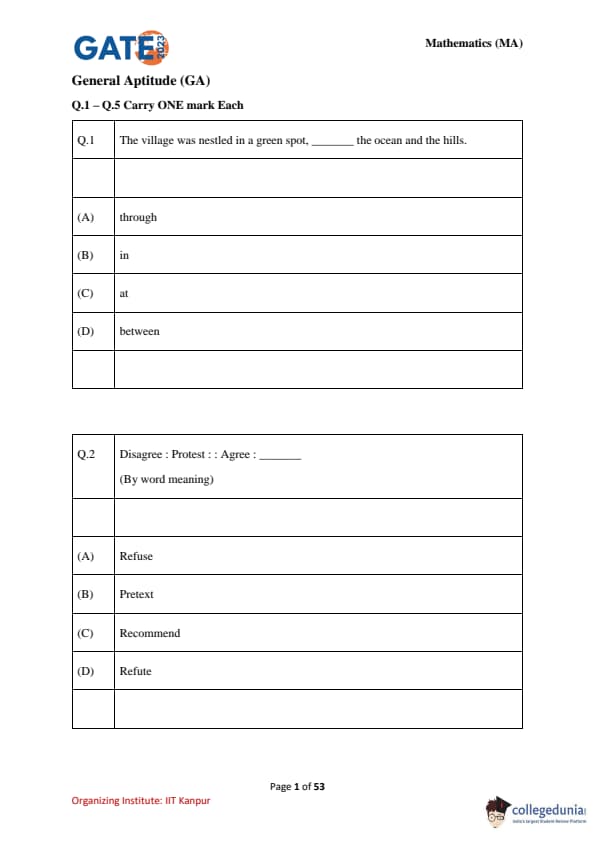
The village was nestled in a green spot, _______ the ocean and the hills.
Disagree : Protest :: Agree : ________
(By word meaning)
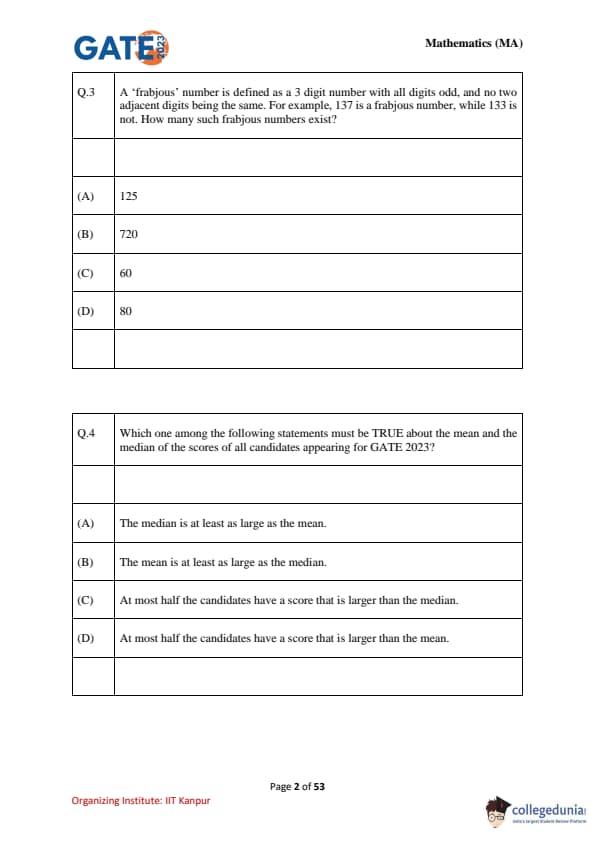
A 'frabjous' number is defined as a 3 digit number with all digits odd, and no two adjacent digits being the same. For example, 137 is a frabjous number, while 133 is not. How many such frabjous numbers exist?
Which one among the following statements must be TRUE about the mean and the median of the scores of all candidates appearing for GATE 2023?
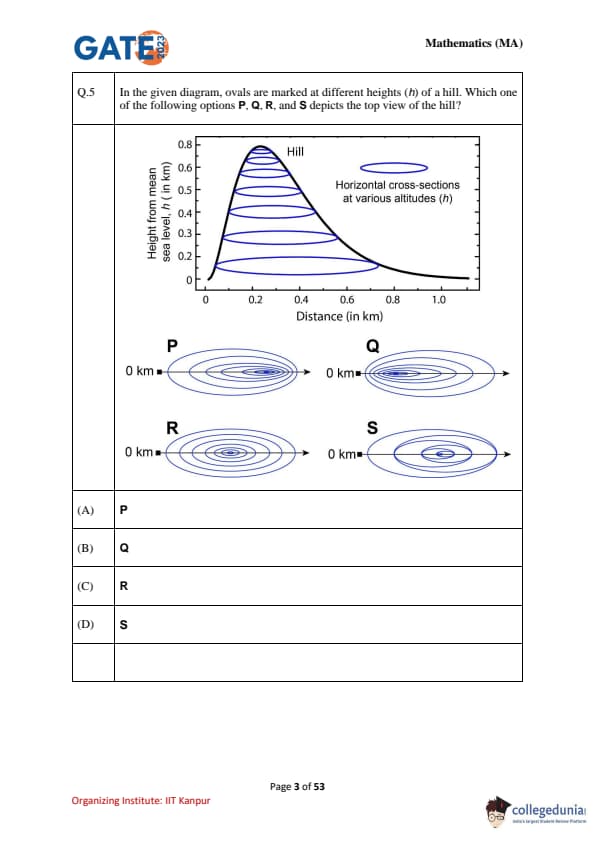
In the given diagram, ovals are marked at different heights (h) of a hill. Which one of the following options P, Q, R, and S depicts the top view of the hill?
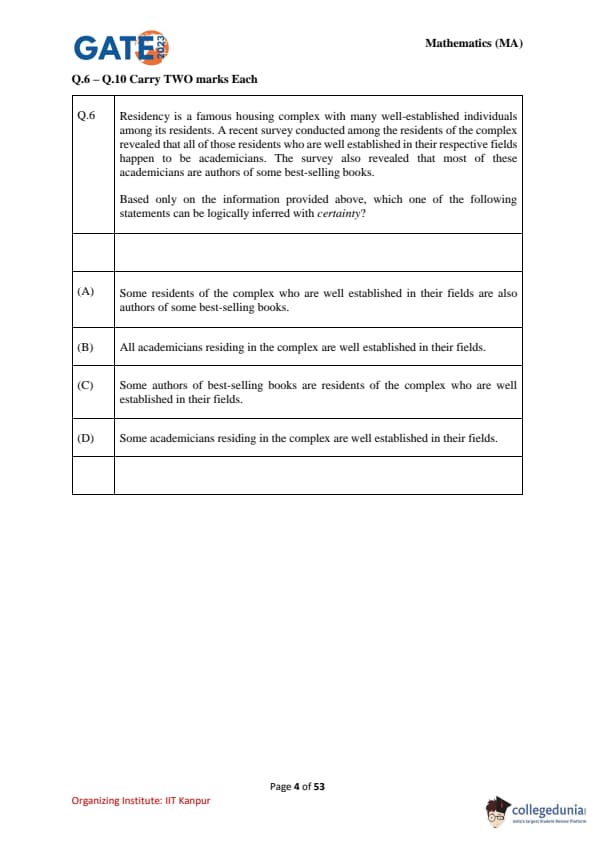
Residency is a famous housing complex with many well-established individuals among its residents. A recent survey conducted among the residents of the complex revealed that all of those residents who are well established in their respective fields happen to be academicians. The survey also revealed that most of these academicians are authors of some best-selling books.
Based only on the information provided above, which one of the following statements can be logically inferred with certainty?
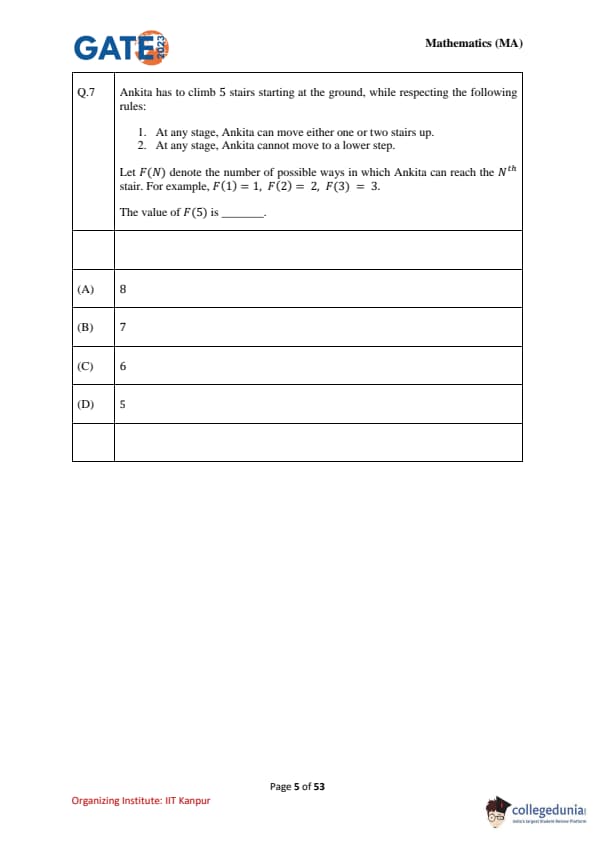
Ankita has to climb 5 stairs starting at the ground, while respecting the following rules:
1. At any stage, Ankita can move either one or two stairs up.
2. At any stage, Ankita cannot move to a lower step.
Let F(N) denote the number of possible ways in which Ankita can reach the Nth stair. For example, F(1) = 1, F(2) = 2, F(3) = 3.
The value of F(5) is ________.
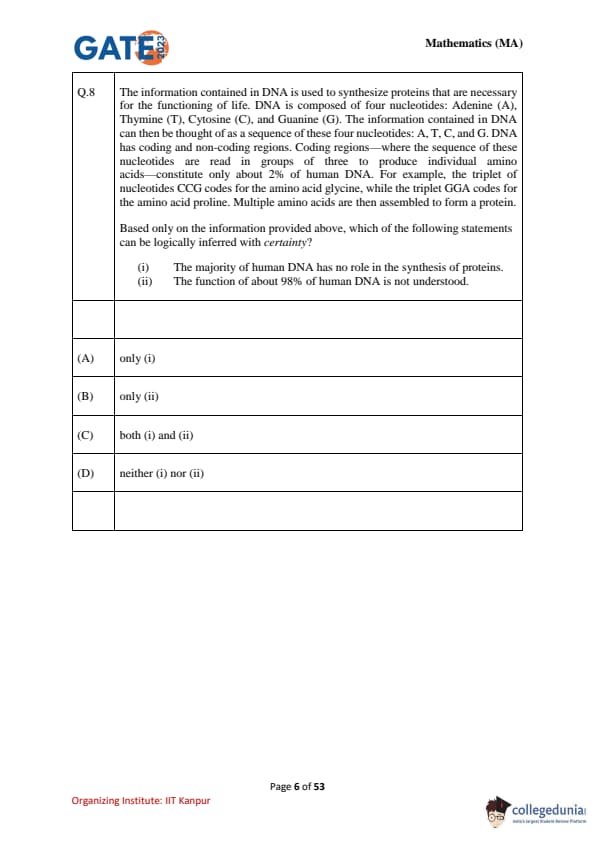
The information contained in DNA is used to synthesize proteins that are necessary for the functioning of life. DNA is composed of four nucleotides: Adenine (A), Thymine (T), Cytosine (C), and Guanine (G). The information contained in DNA can then be thought of as a sequence of these four nucleotides: A, T, C, and G. DNA has coding and non-coding regions. Coding regions—where the sequence of these nucleotides are read in groups of three to produce individual amino acids—constitute only about 2% of human DNA. For example, the triplet of nucleotides CCG codes for the amino acid glycine, while the triplet GGA codes for the amino acid proline. Multiple amino acids are then assembled to form a protein.
Based only on the information provided above, which of the following statements can be logically inferred with certainty?
(i) The majority of human DNA has no role in the synthesis of proteins.
(ii) The function of about 98% of human DNA is not understood.
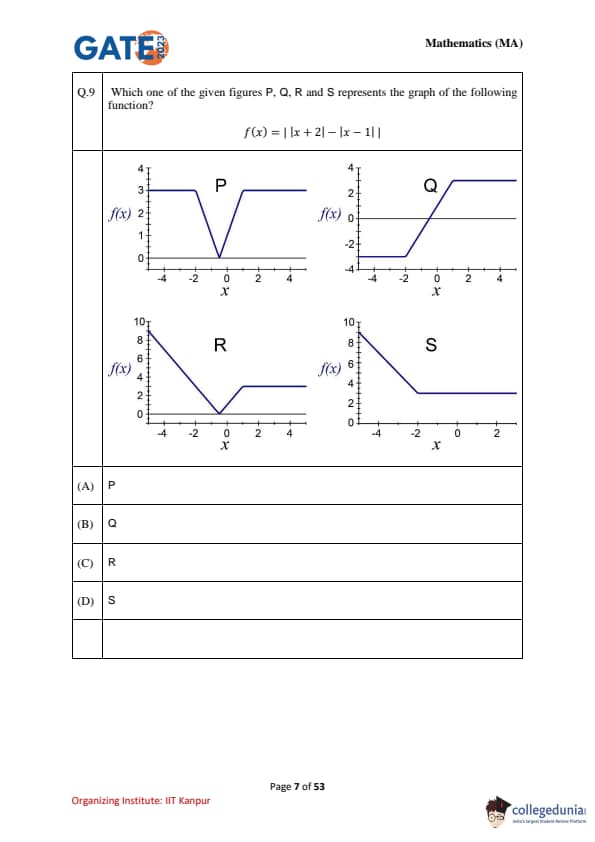
Which one of the given figures P, Q, R and S represents the graph of the following function?
\( f(x) = | |x + 2| - |x - 1| | \)
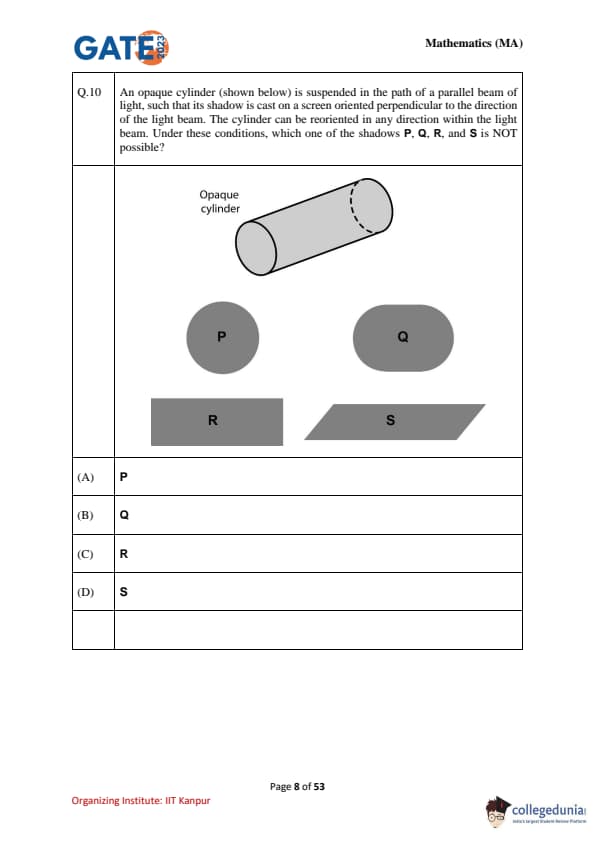
An opaque cylinder (shown below) is suspended in the path of a parallel beam of light, such that its shadow is cast on a screen oriented perpendicular to the direction of the light beam. The cylinder can be reoriented in any direction within the light beam. Under these conditions, which one of the shadows P, Q, R, and S is NOT possible?
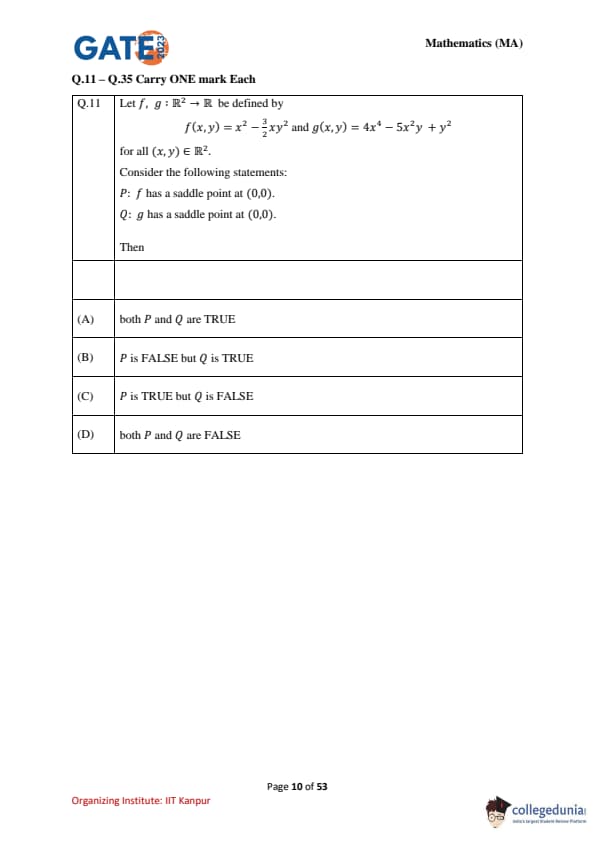
Let \(f, g: \mathbb{R}^2 \to \mathbb{R}\) be defined by \[ f(x, y) = x^2 - \frac{3}{2}xy^2 \quad and \quad g(x, y) = 4x^4 - 5x^2y + y^2 \]
for all \((x, y) \in \mathbb{R}^2\).
Consider the following statements:
P: \(f\) has a saddle point at (0,0).
Q: \(g\) has a saddle point at (0,0).
Then
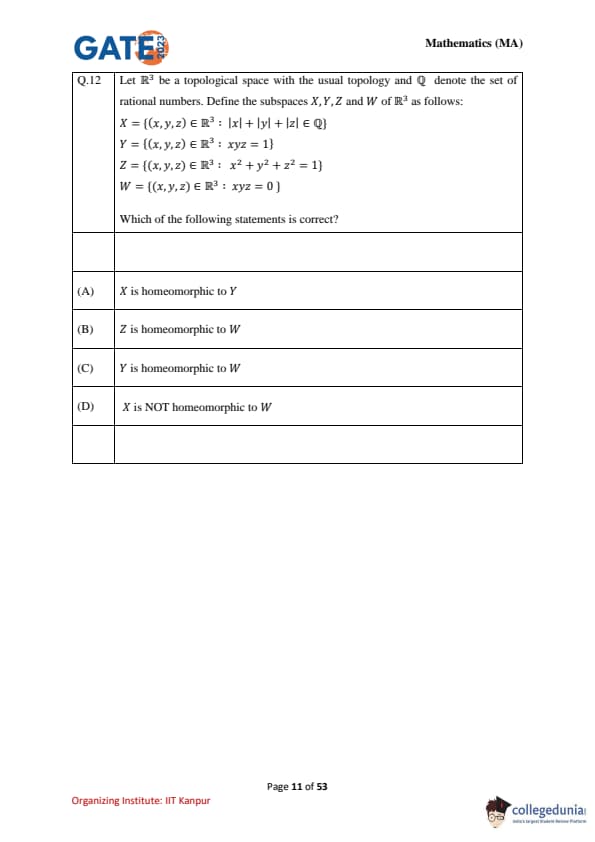
Let \(\mathbb{R}^3\) be a topological space with the usual topology and \(\mathbb{Q}\) denote the set of rational numbers. Define the subspaces X, Y, Z and W of \(\mathbb{R}^3\) as follows:
\(X = \{(x, y, z) \in \mathbb{R}^3 : |x| + |y| + |z| \in \mathbb{Q}\}\)
\(Y = \{(x, y, z) \in \mathbb{R}^3 : xyz = 1\}\)
\(Z = \{(x, y, z) \in \mathbb{R}^3 : x^2 + y^2 + z^2 = 1\}\)
\(W = \{(x, y, z) \in \mathbb{R}^3 : xyz = 0\}\)
Which of the following statements is correct?
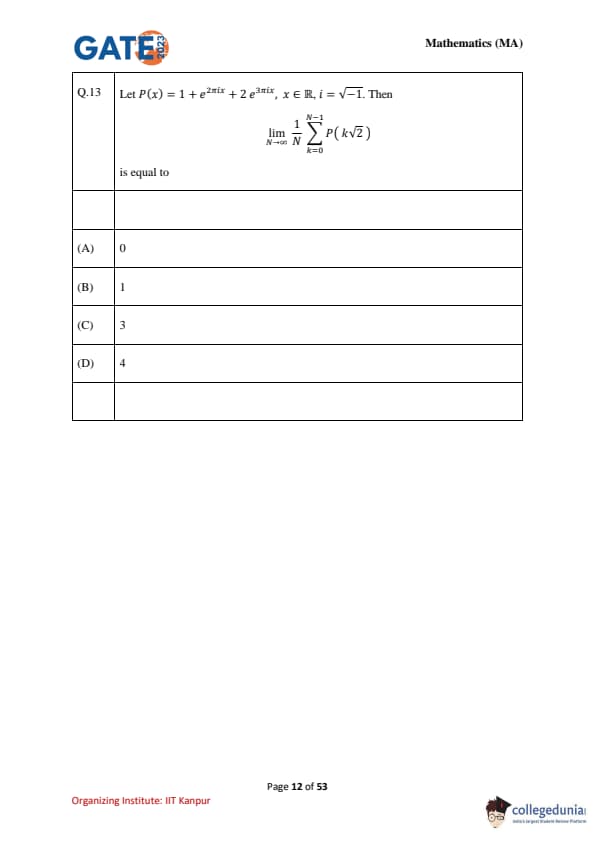
Let \(P(x) = 1 + e^{2\pi ix} + 2e^{3\pi ix}\), \(x \in \mathbb{R}\), \(i = \sqrt{-1}\). Then \[ \lim_{N\to\infty} \frac{1}{N} \sum_{k=0}^{N-1} P(k\sqrt{2}) \]
is equal to
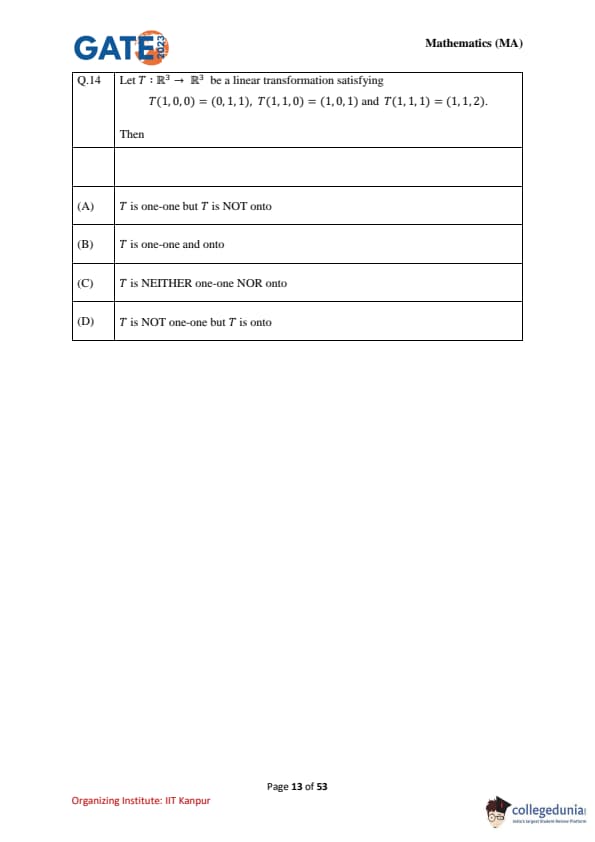
Let \(T: \mathbb{R}^3 \to \mathbb{R}^3\) be a linear transformation satisfying
\(T(1, 0, 0) = (0, 1, 1)\), \(T(1, 1, 0) = (1, 0, 1)\) and \(T(1, 1, 1) = (1, 1, 2)\).
Then
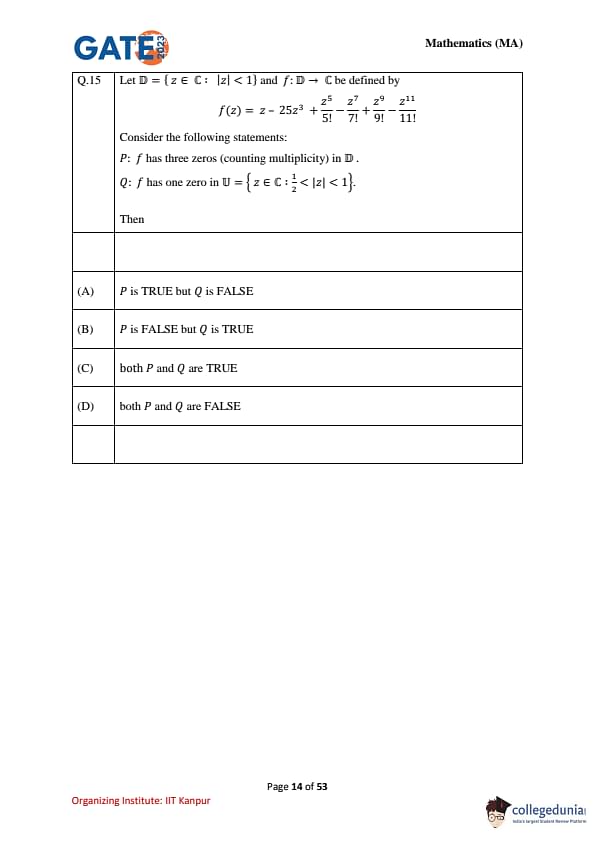
Let \(D = \{z \in \mathbb{C} : |z| < 1\}\) and \(f: D \to \mathbb{C}\) be defined by \[ f(z) = z - 25z^3 + \frac{z^5}{5!} - \frac{z^7}{7!} + \frac{z^9}{9!} - \frac{z^{11}}{11!} \]
Consider the following statements:
P: \(f\) has three zeros (counting multiplicity) in D.
Q: \(f\) has one zero in \(U = \{z \in \mathbb{C} : \frac{1}{2} < |z| < 1\}\).
Then
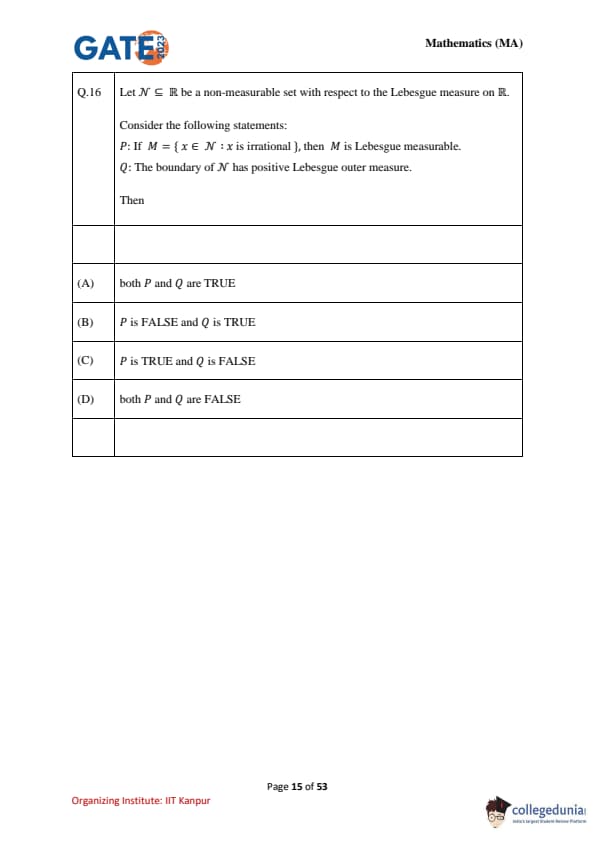
Let \(N \subseteq \mathbb{R}\) be a non-measurable set with respect to the Lebesgue measure on \(\mathbb{R}\).
Consider the following statements:
P: If \(M = \{x \in N : x is irrational\}\), then \(M\) is Lebesgue measurable.
Q: The boundary of \(N\) has positive Lebesgue outer measure.
Then
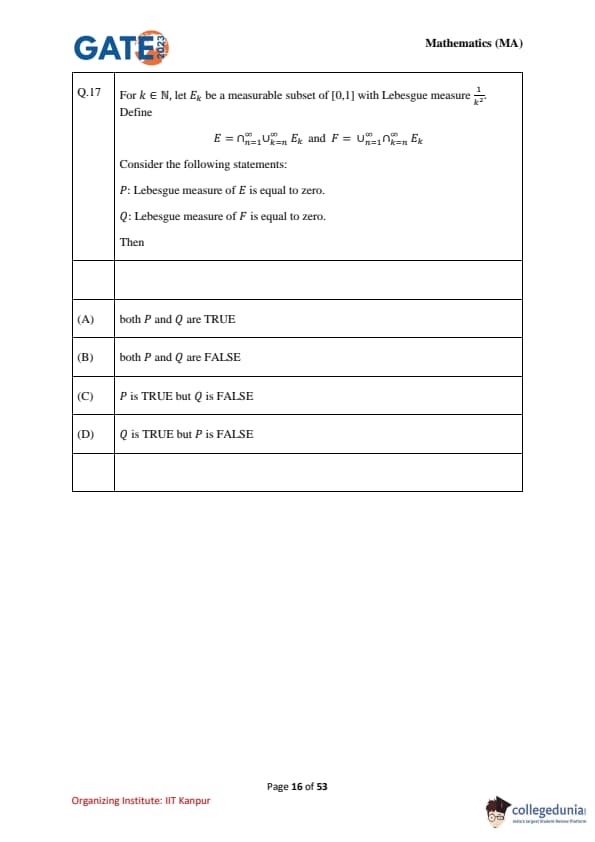
For \(k \in \mathbb{N}\), let \(E_k\) be a measurable subset of \([0,1]\) with Lebesgue measure \(\frac{1}{k^2}\).
Define \[ E = \bigcap_{n=1}^{\infty} \bigcup_{k=n}^{\infty} E_k \quad and \quad F = \bigcup_{n=1}^{\infty} \bigcap_{k=n}^{\infty} E_k \]
Consider the following statements:
P: Lebesgue measure of \(E\) is equal to zero.
Q: Lebesgue measure of \(F\) is equal to zero.
Then
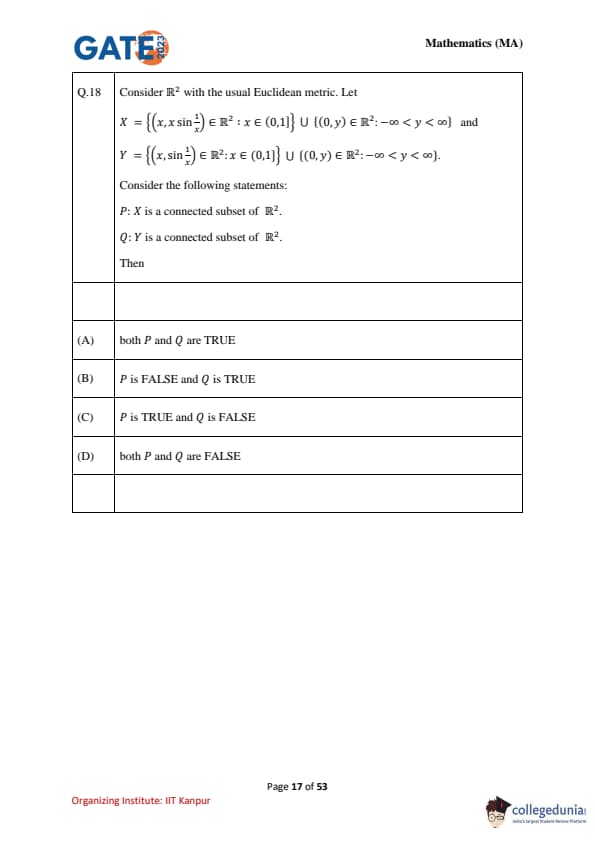
Consider \(\mathbb{R}^2\) with the usual Euclidean metric. Let \[ X = \left\{\left(x, x \sin\frac{1}{x}\right) \in \mathbb{R}^2 : x \in (0,1]\right\} \cup \{(0, y) \in \mathbb{R}^2 : -\infty < y < \infty\} \quad and \] \[ Y = \left\{\left(x, \sin\frac{1}{x}\right) \in \mathbb{R}^2 : x \in (0,1]\right\} \cup \{(0, y) \in \mathbb{R}^2 : -\infty < y < \infty\}. \]
Consider the following statements:
P: \(X\) is a connected subset of \(\mathbb{R}^2\).
Q: \(Y\) is a connected subset of \(\mathbb{R}^2\).
Then
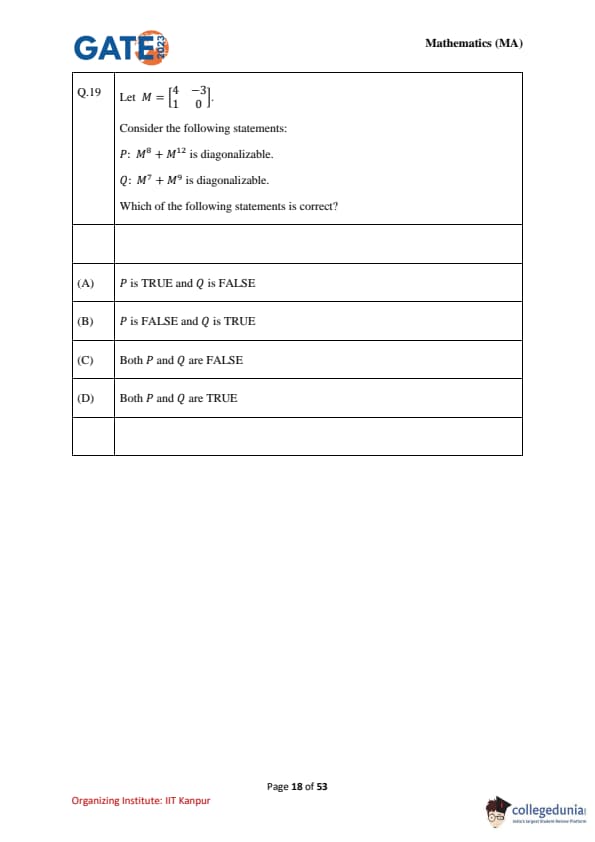
Let \( M = \begin{bmatrix} 4 & -3
1 & 0 \end{bmatrix} \).
Consider the following statements:
P: \(M^8 + M^{12}\) is diagonalizable.
Q: \(M^7 + M^9\) is diagonalizable.
Which of the following statements is correct?
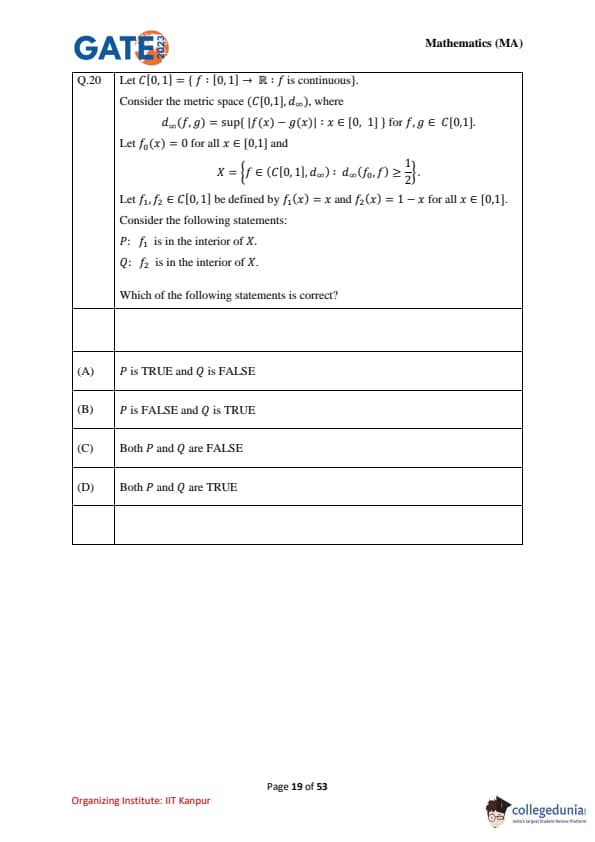
Let \(C[0, 1] = \{ f : [0, 1] \to \mathbb{R} : f is continuous\}\).
Consider the metric space \((C[0,1], d_\infty)\), where \[ d_\infty(f, g) = \sup\{ |f(x) - g(x)| : x \in [0, 1] \} for f, g \in C[0,1]. \]
Let \(f_0(x) = 0\) for all \(x \in [0,1]\) and \[ X = \{f \in (C[0, 1], d_\infty) : d_\infty(f_0, f) \ge \frac{1}{2}\}. \]
Let \(f_1, f_2 \in C[0, 1]\) be defined by \(f_1(x) = x\) and \(f_2(x) = 1-x\) for all \(x \in [0,1]\).
Consider the following statements:
P: \(f_1\) is in the interior of X.
Q: \(f_2\) is in the interior of X.
Which of the following statements is correct?
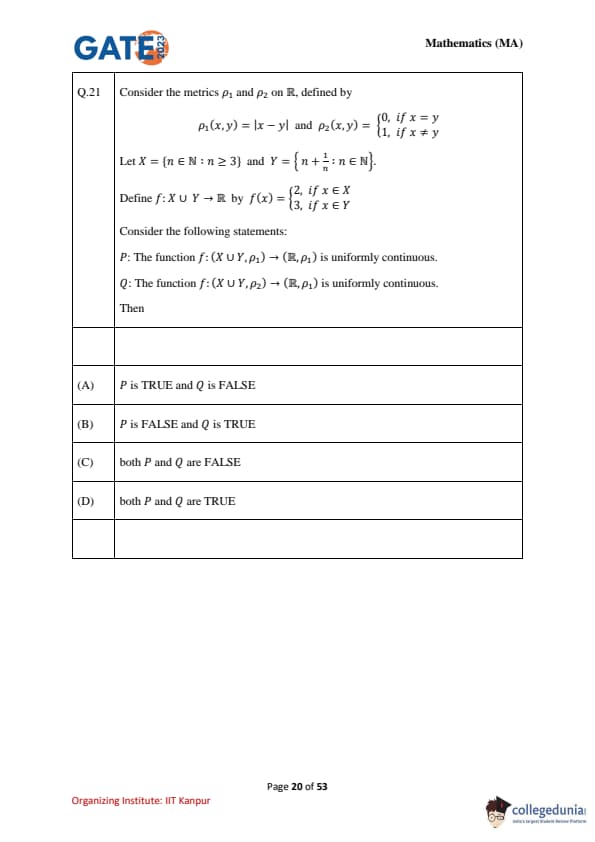
Consider the metrics \(\rho_1\) and \(\rho_2\) on \(\mathbb{R}\), defined by \[ \rho_1(x, y) = |x-y| \quad and \quad \rho_2(x, y) = \begin{cases} 0, & if x = y
1, & if x \neq y \end{cases} \]
Let \(X = \{n \in \mathbb{N} : n \ge 3\}\) and \(Y = \{n + \frac{1}{n} : n \in \mathbb{N}\}\).
Define \(f: X \cup Y \to \mathbb{R}\) by \(f(x) = \begin{cases} 2, & if x \in X
3, & if x \in Y \end{cases}\)
Consider the following statements:
P: The function \(f: (X \cup Y, \rho_1) \to (\mathbb{R}, \rho_1)\) is uniformly continuous.
Q: The function \(f: (X \cup Y, \rho_2) \to (\mathbb{R}, \rho_1)\) is uniformly continuous.
Then
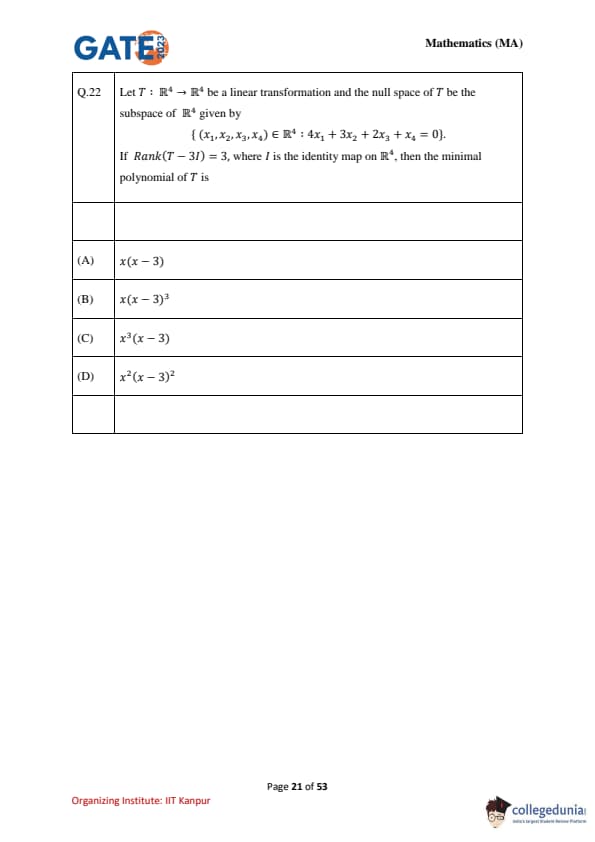
Let \(T: \mathbb{R}^4 \to \mathbb{R}^4\) be a linear transformation and the null space of \(T\) be the subspace of \(\mathbb{R}^4\) given by \[ \{ (x_1, x_2, x_3, x_4) \in \mathbb{R}^4 : 4x_1 + 3x_2 + 2x_3 + x_4 = 0 \}. \]
If \(Rank(T - 3I) = 3\), where \(I\) is the identity map on \(\mathbb{R}^4\), then the minimal polynomial of \(T\) is
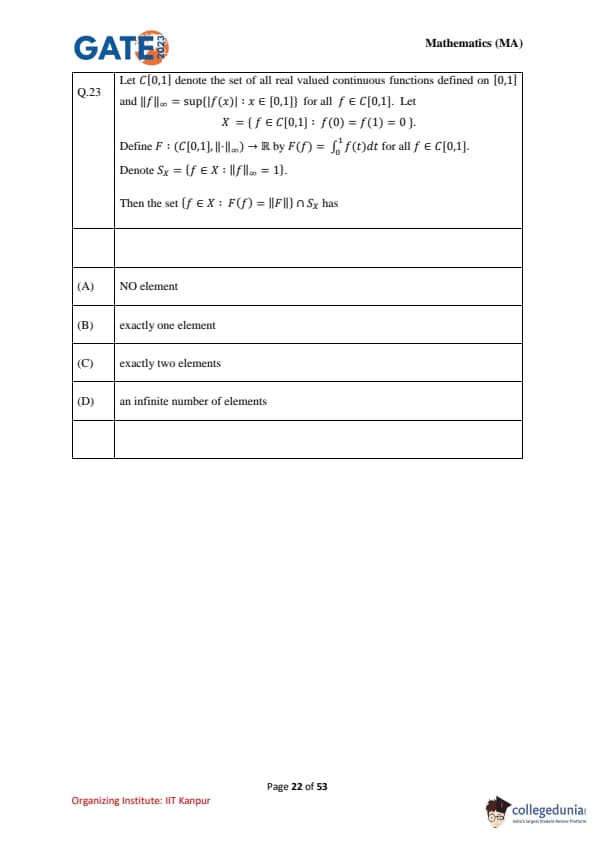
Let C[0,1] denote the set of all real valued continuous functions defined on [0,1] and \(||f||_\infty = \sup\{|f(x)| : x \in [0,1]\}\) for all \(f \in C[0,1]\). Let \[ X = \{ f \in C[0,1] : f(0) = f(1) = 0 \}. \]
Define \(F : (C[0,1], ||\cdot||_\infty) \to \mathbb{R}\) by \(F(f) = \int_0^1 f(t)dt\) for all \(f \in C[0,1]\).
Denote \(S_X = \{f \in X : ||f||_\infty = 1\}\).
Then the set \(\{f \in X : F(f) = ||F||\} \cap S_X\) has
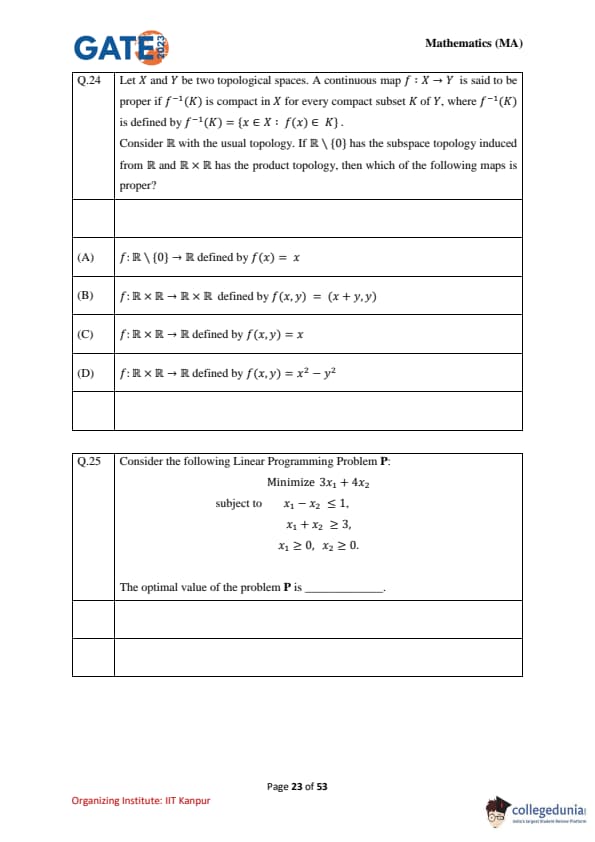
Let X and Y be two topological spaces. A continuous map \(f: X \to Y\) is said to be proper if \(f^{-1}(K)\) is compact in X for every compact subset K of Y, where \(f^{-1}(K)\) is defined by \(f^{-1}(K) = \{x \in X : f(x) \in K\}\).
Consider \(\mathbb{R}\) with the usual topology. If \(\mathbb{R} \setminus \{0\}\) has the subspace topology induced from \(\mathbb{R}\) and \(\mathbb{R} \times \mathbb{R}\) has the product topology, then which of the following maps is proper?
Consider the following Linear Programming Problem P:
Minimize \(3x_1 + 4x_2\)
subject to \[ x_1 - x_2 \le 1, \] \[ x_1 + x_2 \ge 3, \] \[ x_1 \ge 0, x_2 \ge 0. \]
The optimal value of the problem P is _______________________.
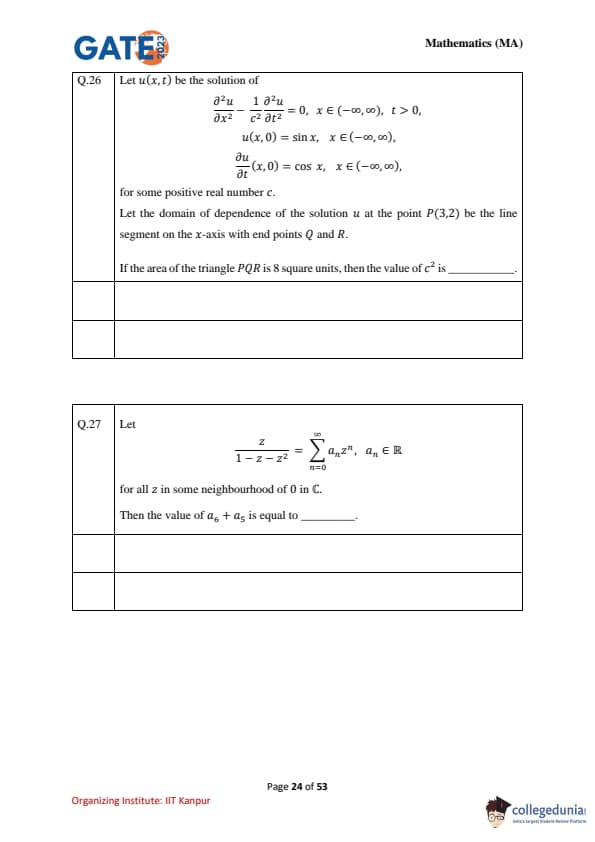
Let \(u(x, t)\) be the solution of \[ \frac{\partial^2 u}{\partial x^2} - \frac{1}{c^2} \frac{\partial^2 u}{\partial t^2} = 0, \quad x \in (-\infty, \infty), t > 0, \] \[ u(x, 0) = \sin x, \quad x \in (-\infty, \infty), \] \[ \frac{\partial u}{\partial t}(x, 0) = \cos x, \quad x \in (-\infty, \infty), \]
for some positive real number c.
Let the domain of dependence of the solution u at the point P(3,2) be the line segment on the x-axis with end points Q and R.
If the area of the triangle PQR is 8 square units, then the value of \(c^2\) is ________________.
Let \[ \frac{z}{1 - z - z^2} = \sum_{n=0}^{\infty} a_n z^n, \quad a_n \in \mathbb{R} \]
for all z in some neighbourhood of 0 in \(\mathbb{C}\).
Then the value of \(a_6 + a_5\) is equal to ____________________.
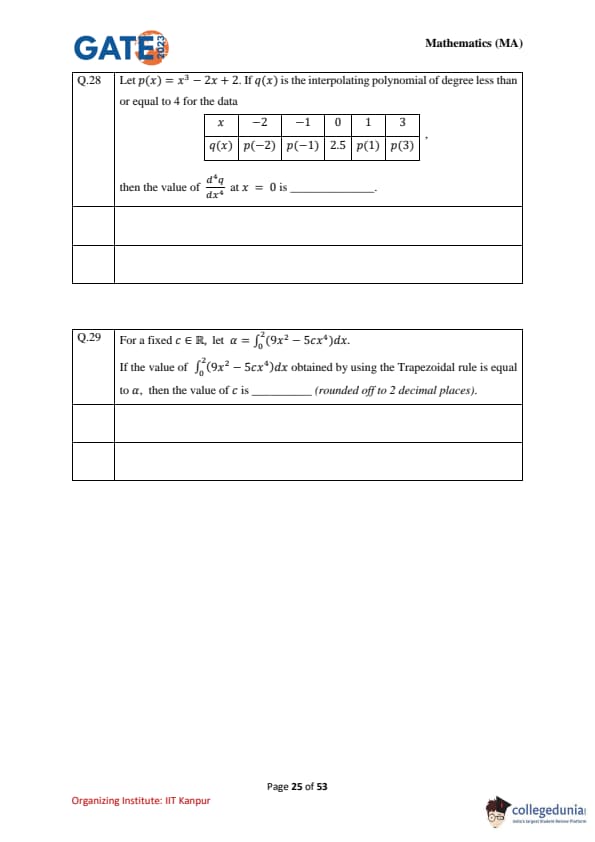
Let \(p(x) = x^3 - 2x + 2\). If \(q(x)\) is the interpolating polynomial of degree less than or equal to 4 for the data
\begin{tabular{|c|c|c|c|c|c|
\hline \(x\) & -2 & -1 & 0 & 1 & 3
\hline \(q(x)\) & p(-2) & p(-1) & 2.5 & p(1) & p(3)
\hline
\end{tabular
then the value of \(\frac{d^4q}{dx^4}\) at \(x=0\) is ________________.
For a fixed \(c \in \mathbb{R}\), let \(\alpha = \int_0^c (9x^2 - 5cx^4)dx\).
If the value of \(\int_0^c (9x^2 - 5cx^4)dx\) obtained by using the Trapezoidal rule is equal to \(\alpha\), then the value of c is ____________________ (rounded off to 2 decimal places).
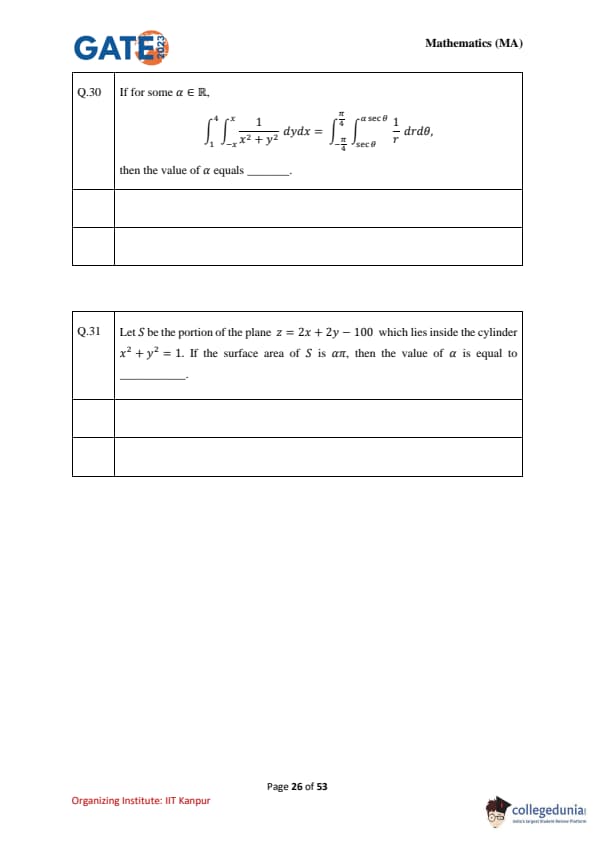
If for some \(a \in \mathbb{R}\), \[ \int_1^4 \int_{-x}^x \frac{1}{x^2 + y^2} dydx = \int_{-\pi/4}^{\pi/4} \int_{\sec\theta}^{a \sec\theta} \frac{1}{r} drd\theta, \]
then the value of \(a\) equals ____________________.
Let S be the portion of the plane \(z = 2x + 2y - 100\) which lies inside the cylinder \(x^2 + y^2 = 1\). If the surface area of S is \(a\pi\), then the value of a is equal to ________________.
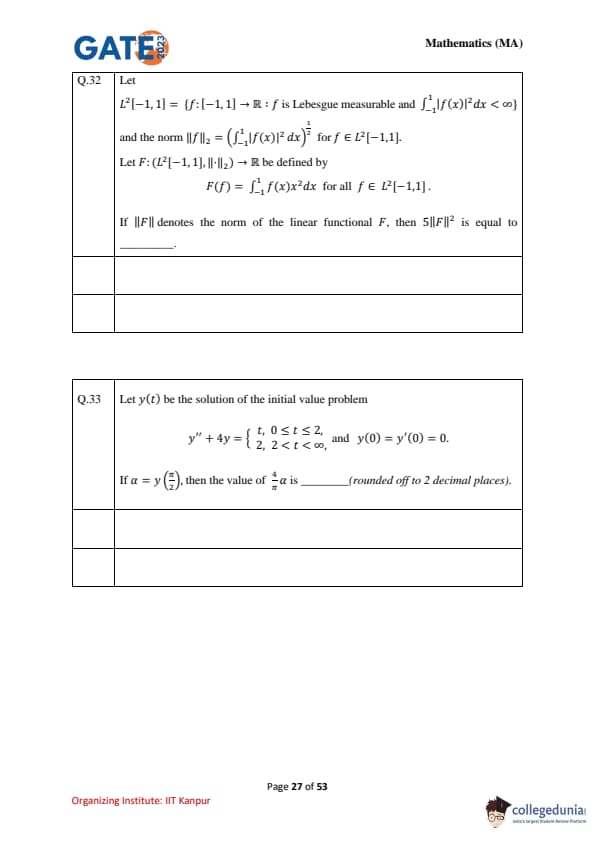
Let \(L^2[-1, 1] = \{f: [-1,1] \to \mathbb{R} : f is Lebesgue measurable and \int_{-1}^1 |f(x)|^2dx < \infty\}\) and the norm \(||f||_2 = \left(\int_{-1}^1 |f(x)|^2 dx\right)^{1/2}\) for \(f \in L^2[-1,1]\).
Let \(F: (L^2[-1,1], ||\cdot||_2) \to \mathbb{R}\) be defined by \[ F(f) = \int_{-1}^1 f(x)x^2dx \quad for all f \in L^2[-1,1]. \]
If \(||F||\) denotes the norm of the linear functional F, then \(5||F||^2\) is equal to ______________.
Let \(y(t)\) be the solution of the initial value problem \[ y'' + 4y = \begin{cases} t, & 0 \le t \le 2,
2, & 2 < t < \infty, \end{cases} \quad and \quad y(0) = y'(0) = 0. \]
If \(\alpha = y(\pi/2)\), then the value of \(\frac{4}{\pi}\alpha\) is _____________________ (rounded off to 2 decimal places).
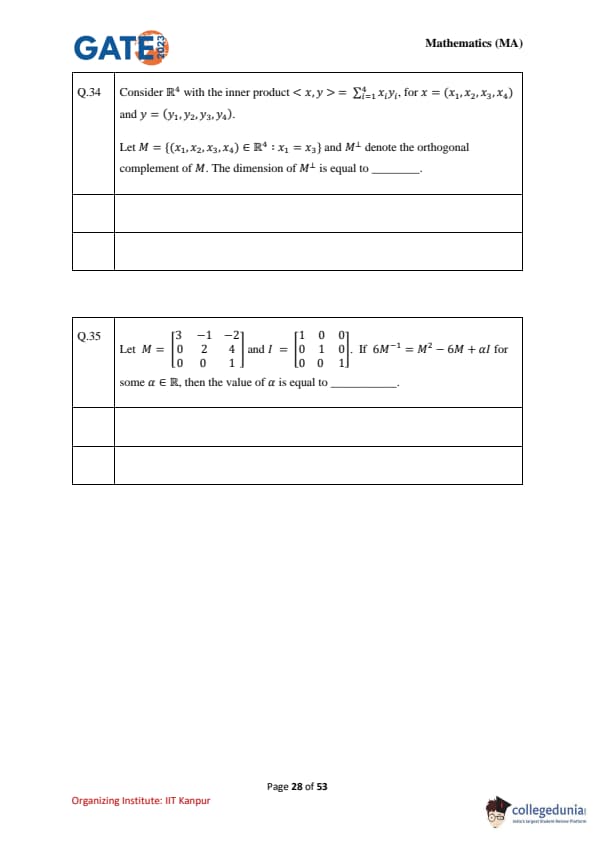
Consider \(\mathbb{R}^4\) with the inner product \(\langle x, y \rangle = \sum_{i=1}^4 x_i y_i\), for \(x = (x_1, x_2, x_3, x_4)\) and \(y = (y_1, y_2, y_3, y_4)\).
Let \(M = \{(x_1, x_2, x_3, x_4) \in \mathbb{R}^4 : x_1 = x_3\}\) and \(M^\perp\) denote the orthogonal complement of M. The dimension of \(M^\perp\) is equal to ________________.
Let \( M = \begin{bmatrix} 3 & -1 & -2
0 & 2 & 4
0 & 0 & 1 \end{bmatrix} \) and \( I = \begin{bmatrix} 1 & 0 & 0
0 & 1 & 0
0 & 0 & 1 \end{bmatrix} \). If \(6M^{-1} = M^2 - 6M + \alpha I\) for some \(\alpha \in \mathbb{R}\), then the value of \(\alpha\) is equal to _______________.
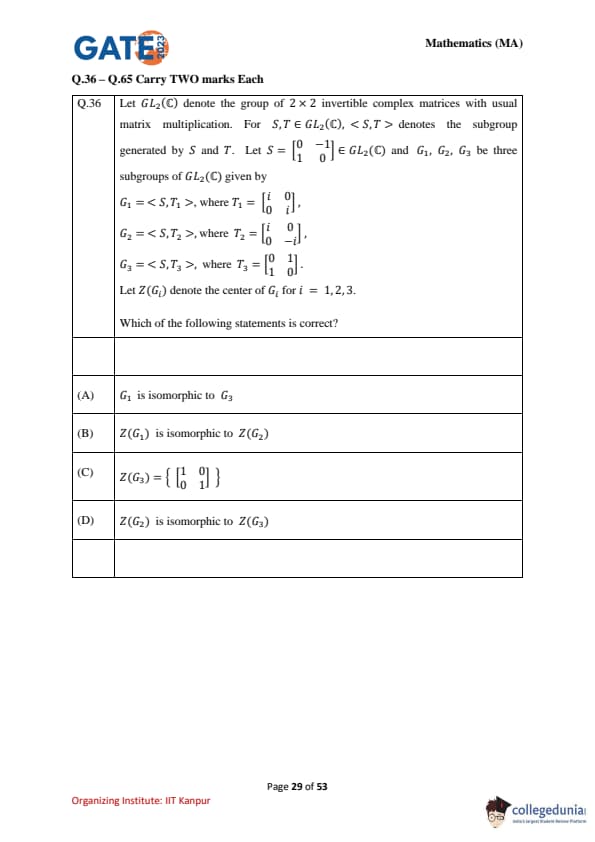
Let \(GL_2(\mathbb{C})\) denote the group of \(2 \times 2\) invertible complex matrices with usual matrix multiplication. For \(S, T \in GL_2(\mathbb{C})\), \(\langle S, T \rangle\) denotes the subgroup generated by S and T. Let \(S = \begin{pmatrix} 0 & -1
1 & 0 \end{pmatrix} \in GL_2(\mathbb{C})\) and \(G_1, G_2, G_3\) be three subgroups of \(GL_2(\mathbb{C})\) given by \[ G_1 = \langle S, T_1 \rangle, where T_1 = \begin{pmatrix} i & 0
0 & i \end{pmatrix}, \] \[ G_2 = \langle S, T_2 \rangle, where T_2 = \begin{pmatrix} i & 0
0 & -i \end{pmatrix}, \] \[ G_3 = \langle S, T_3 \rangle, where T_3 = \begin{pmatrix} 0 & 1
1 & 0 \end{pmatrix}. \]
Let \(Z(G_i)\) denote the center of \(G_i\) for i = 1, 2, 3.
Which of the following statements is correct?
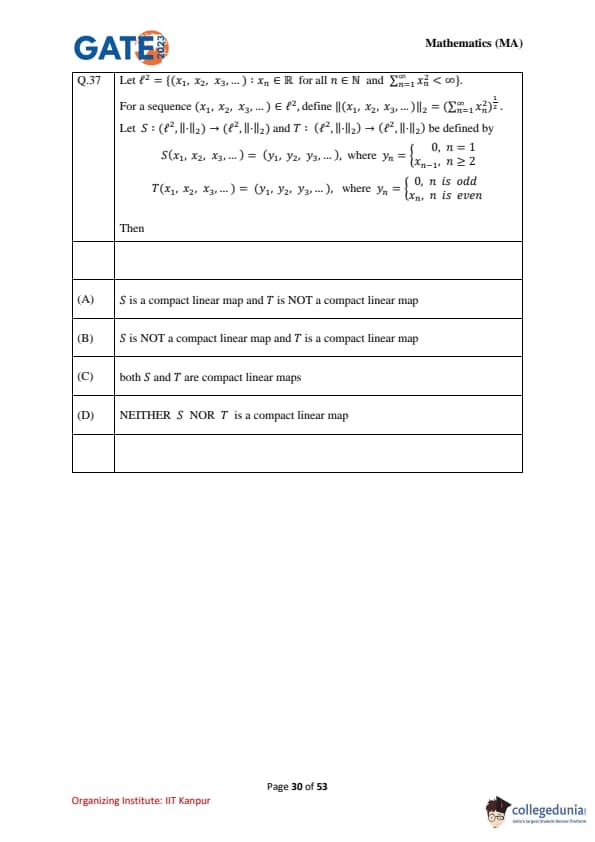
Let \(\ell^2 = \{(x_1, x_2, x_3, \dots) : x_n \in \mathbb{R} for all n \in \mathbb{N} and \sum_{n=1}^\infty x_n^2 < \infty\}\).
For a sequence \((x_1, x_2, x_3, \dots) \in \ell^2\), define \(||(x_1, x_2, x_3, \dots)||_2 = \left(\sum_{n=1}^\infty x_n^2\right)^{1/2}\).
Let \(S: (\ell^2, ||\cdot||_2) \to (\ell^2, ||\cdot||_2)\) and \(T: (\ell^2, ||\cdot||_2) \to (\ell^2, ||\cdot||_2)\) be defined by \[ S(x_1, x_2, x_3, \dots) = (y_1, y_2, y_3, \dots), where y_n = \begin{cases} 0, & n=1
x_{n-1}, & n \ge 2 \end{cases} \] \[ T(x_1, x_2, x_3, \dots) = (y_1, y_2, y_3, \dots), where y_n = \begin{cases} 0, & n is odd
x_n, & n is even \end{cases} \]
Then
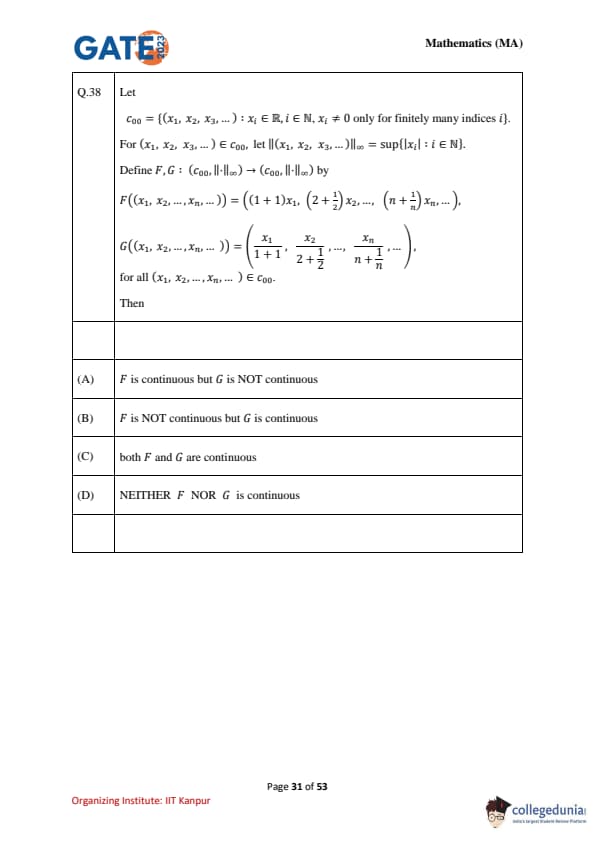
Let \(c_{00} = \{(x_1, x_2, x_3, \dots) : x_i \in \mathbb{R}, i \in \mathbb{N}, x_i \neq 0 only for finitely many indices i\}\).
For \((x_1, x_2, x_3, \dots) \in c_{00}\), let \(||(x_1, x_2, x_3, \dots)||_\infty = \sup\{|x_i| : i \in \mathbb{N}\}\).
Define \(F, G: (c_{00}, ||\cdot||_\infty) \to (c_{00}, ||\cdot||_\infty)\) by \[ F((x_1, x_2, \dots, x_n, \dots)) = ((1+1)x_1, (2+\frac{1}{2})x_2, \dots, (n+\frac{1}{n})x_n, \dots), \] \[ G((x_1, x_2, \dots, x_n, \dots)) = \left(\frac{x_1}{1+1}, \frac{x_2}{2+\frac{1}{2}}, \dots, \frac{x_n}{n+\frac{1}{n}}, \dots\right). \]
for all \((x_1, x_2, \dots, x_n, \dots) \in c_{00}\).
Then
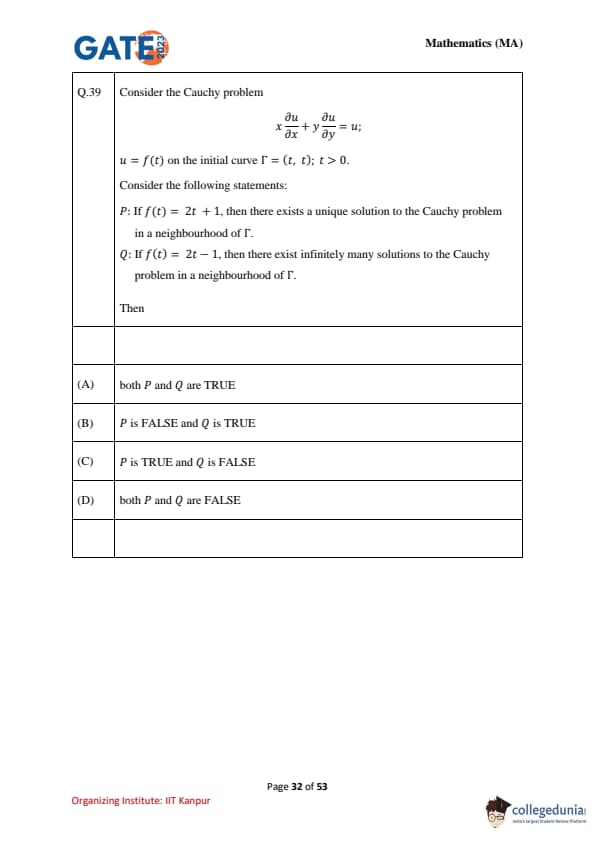
Consider the Cauchy problem \[ x \frac{\partial u}{\partial x} + y \frac{\partial u}{\partial y} = u; \] \[ u = f(t) on the initial curve \Gamma = (t, t); t > 0. \]
Consider the following statements:
P: If \(f(t) = 2t + 1\), then there exists a unique solution to the Cauchy problem in a neighbourhood of \(\Gamma\).
Q: If \(f(t) = 2t - 1\), then there exist infinitely many solutions to the Cauchy problem in a neighbourhood of \(\Gamma\).
Then
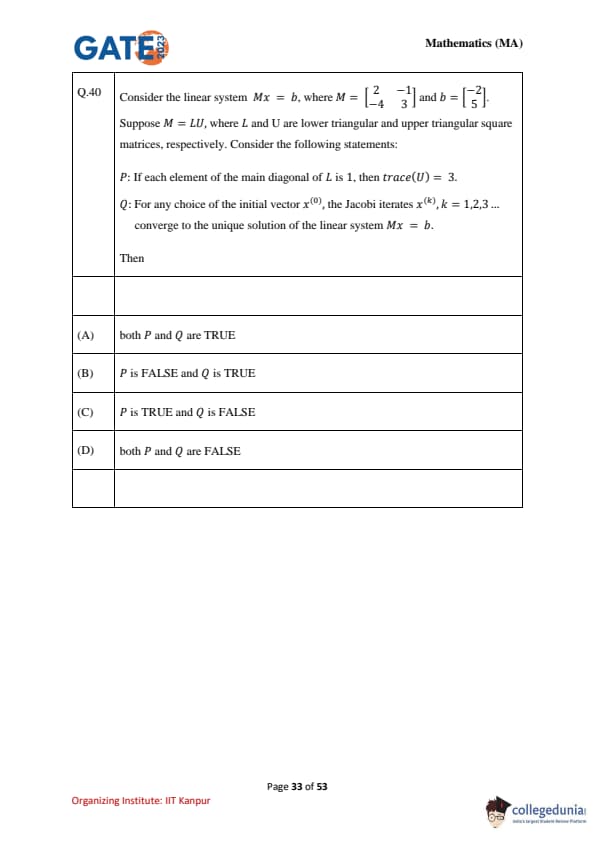
Consider the linear system \(Mx = b\), where \(M = \begin{pmatrix} 2 & -1
-4 & 3 \end{pmatrix}\) and \(b = \begin{pmatrix} -2
5 \end{pmatrix}\).
Suppose \(M = LU\), where L and U are lower triangular and upper triangular square matrices, respectively. Consider the following statements:
P: If each element of the main diagonal of L is 1, then \(trace(U) = 3\).
Q: For any choice of the initial vector \(x^{(0)}\), the Jacobi iterates \(x^{(k)}\), k = 1,2,3... converge to the unique solution of the linear system \(Mx = b\).
Then
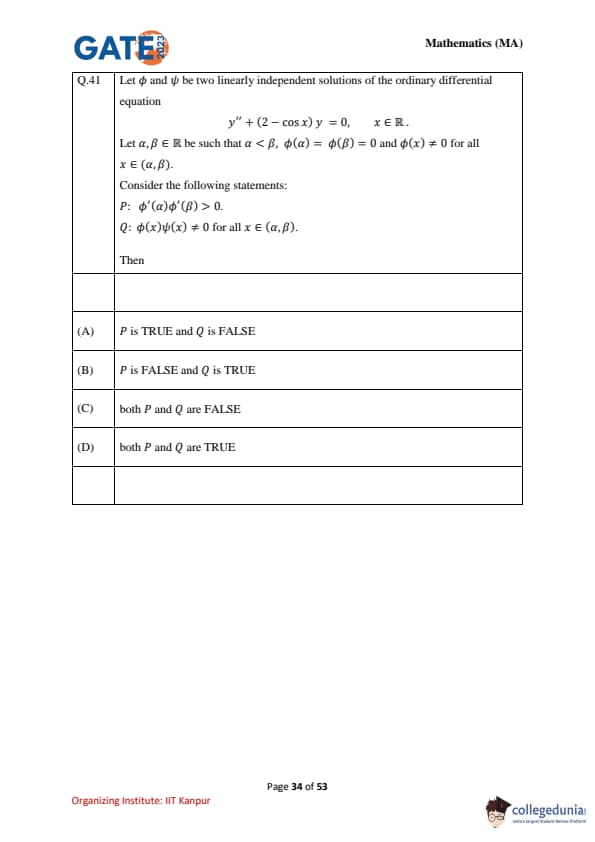
Let \(\phi\) and \(\psi\) be two linearly independent solutions of the ordinary differential equation \[ y'' + (2 - \cos x) y = 0, \quad x \in \mathbb{R}. \]
Let \(\alpha, \beta \in \mathbb{R}\) be such that \(\alpha < \beta\), \(\phi(\alpha) = \phi(\beta) = 0\) and \(\phi(x) \neq 0\) for all \(x \in (\alpha, \beta)\).
Consider the following statements:
P: \(\phi'(\alpha)\phi'(\beta) > 0\).
Q: \(\psi(x) \neq 0\) for all \(x \in (\alpha, \beta)\).
Then
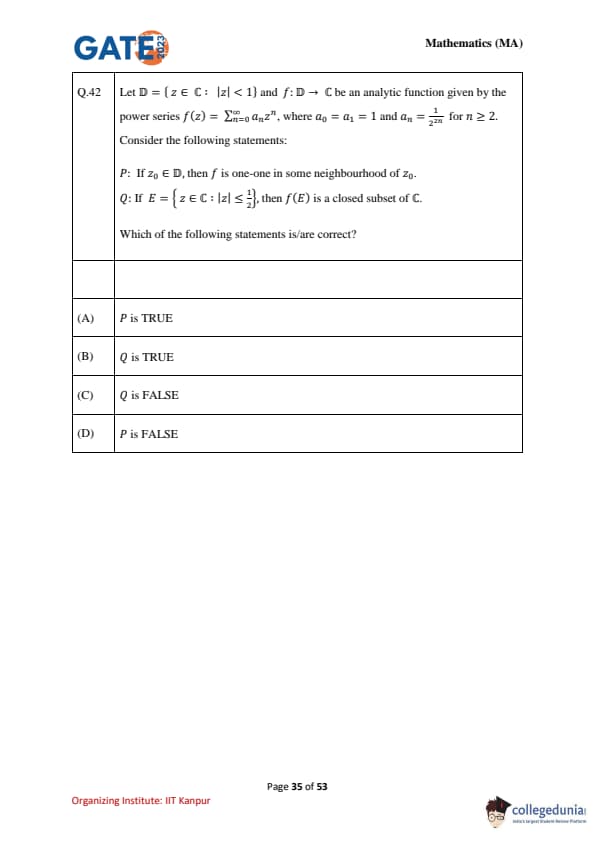
Let \(D = \{z \in \mathbb{C} : |z| < 1\}\) and \(f: D \to \mathbb{C}\) be an analytic function given by the power series \(f(z) = \sum_{n=0}^{\infty} a_n z^n\), where \(a_0 = a_1 = 1\) and \(a_n = \frac{1}{2^{2n}}\) for \(n \ge 2\).
Consider the following statements:
P: If \(z_0 \in D\), then f is one-one in some neighbourhood of \(z_0\).
Q: If \(E = \{z \in \mathbb{C} : |z| \le \frac{1}{2}\}\), then \(f(E)\) is a closed subset of \(\mathbb{C}\).
Which of the following statements is/are correct?
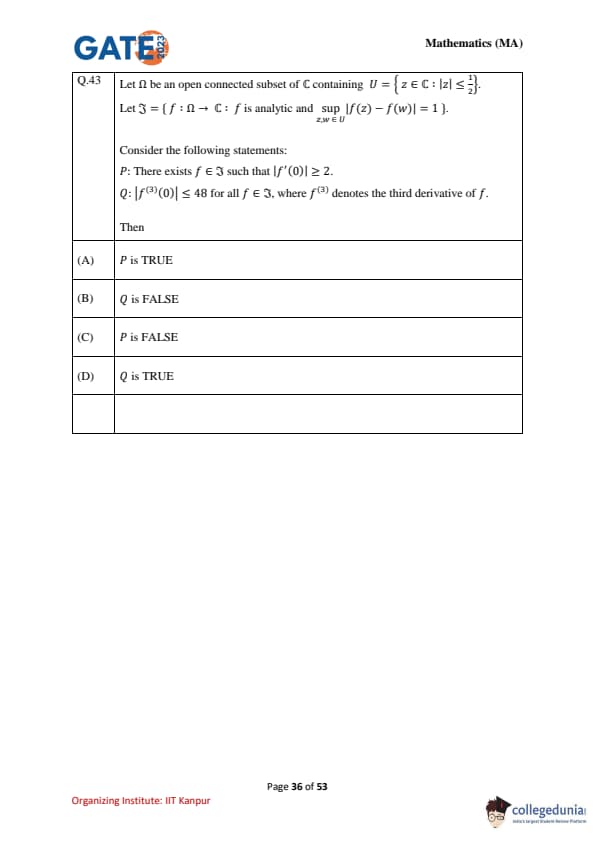
Let \(\Omega\) be an open connected subset of \(\mathbb{C}\) containing \(U = \{z \in \mathbb{C} : |z| \le \frac{1}{2}\}\).
Let \(\mathcal{F} = \{ f : \Omega \to \mathbb{C} : f is analytic and \sup_{z,w \in U} |f(z) - f(w)| = 1 \}\).
Consider the following statements:
P: There exists \(f \in \mathcal{F}\) such that \(|f'(0)| \ge 2\).
Q: \(|f^{(3)}(0)| \le 48\) for all \(f \in \mathcal{F}\), where \(f^{(3)}\) denotes the third derivative of f.
Then
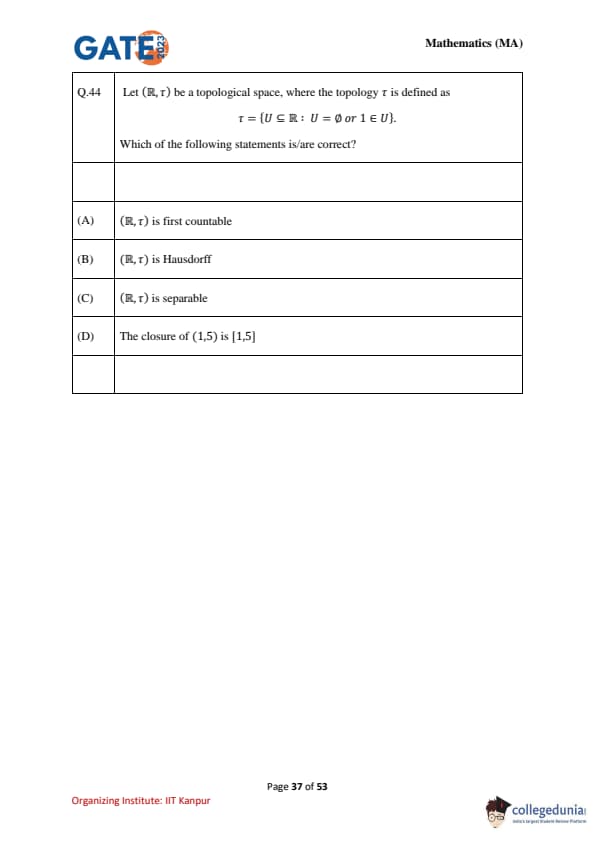
Let \((\mathbb{R}, \tau)\) be a topological space, where the topology \(\tau\) is defined as \[ \tau = \{U \subseteq \mathbb{R} : U = \emptyset or 1 \in U\}. \]
Which of the following statements is/are correct?
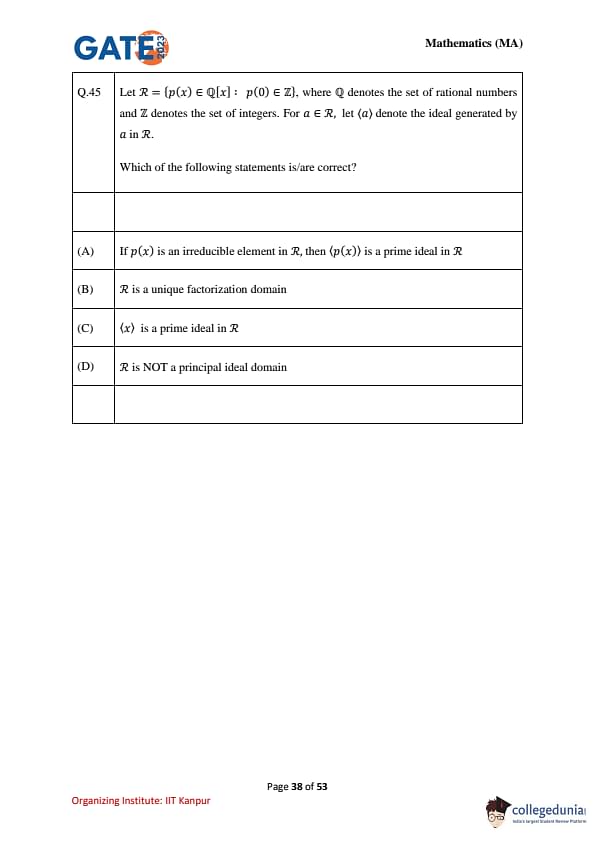
Let \(\mathcal{R} = \{p(x) \in \mathbb{Q}[x] : p(0) \in \mathbb{Z}\}\), where \(\mathbb{Q}\) denotes the set of rational numbers and \(\mathbb{Z}\) denotes the set of integers. For \(a \in \mathcal{R}\), let \(\langle a \rangle\) denote the ideal generated by a in \(\mathcal{R}\).
Which of the following statements is/are correct?
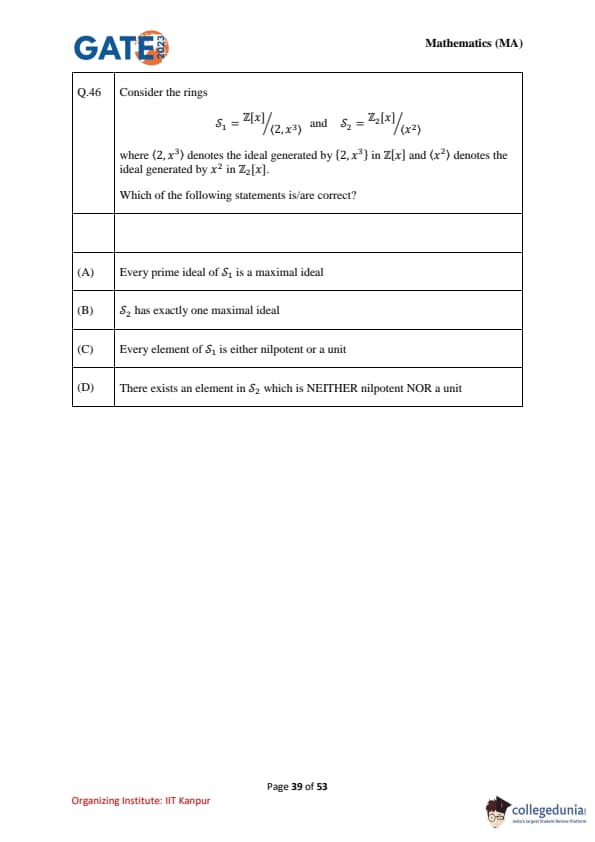
Consider the rings \[ S_1 = \mathbb{Z}[x]/\langle 2, x^3 \rangle \quad and \quad S_2 = \mathbb{Z}_2[x]/\langle x^2 \rangle \]
where \(\langle 2, x^3 \rangle\) denotes the ideal generated by \(\{2, x^3\}\) in \(\mathbb{Z}[x]\) and \(\langle x^2 \rangle\) denotes the ideal generated by \(x^2\) in \(\mathbb{Z}_2[x]\).
Which of the following statements is/are correct?
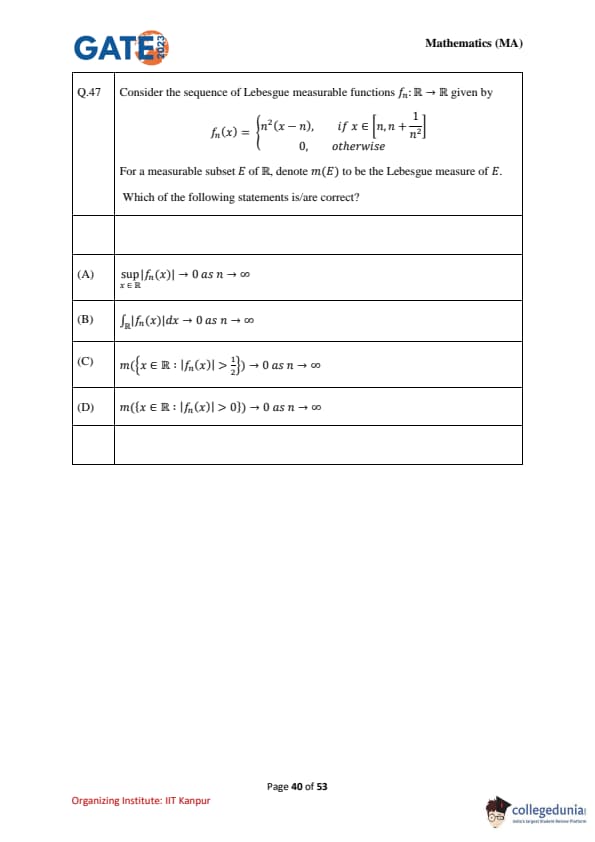
Consider the sequence of Lebesgue measurable functions \(f_n: \mathbb{R} \to \mathbb{R}\) given by \[ f_n(x) = \begin{cases} n^2(x-n), & if x \in [n, n + \frac{1}{n^2}]
0, & otherwise \end{cases} \]
For a measurable subset E of \(\mathbb{R}\), denote m(E) to be the Lebesgue measure of E.
Which of the following statements is/are correct?
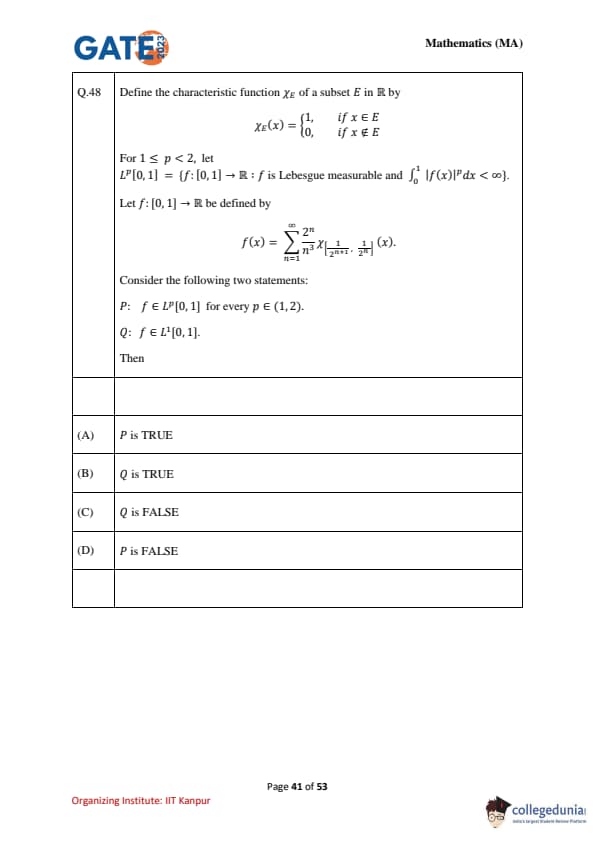
Define the characteristic function \(\chi_E\) of a subset E in \(\mathbb{R}\) by \[ \chi_E(x) = \begin{cases} 1, & if x \in E
0, & if x \notin E \end{cases} \]
For \(1 \le p < 2\), let \(L^p[0,1] = \{f: [0,1] \to \mathbb{R} : f is Lebesgue measurable and \int_0^1 |f(x)|^p dx < \infty\}\).
Let \(f: [0,1] \to \mathbb{R}\) be defined by \[ f(x) = \sum_{n=1}^\infty \frac{2^n}{n^3} \chi_{[\frac{1}{2^{n+1}}, \frac{1}{2^n}]}(x). \]
Consider the following two statements:
P: \(f \in L^p[0,1]\) for every \(p \in (1, 2)\).
Q: \(f \in L^1[0,1]\).
Then
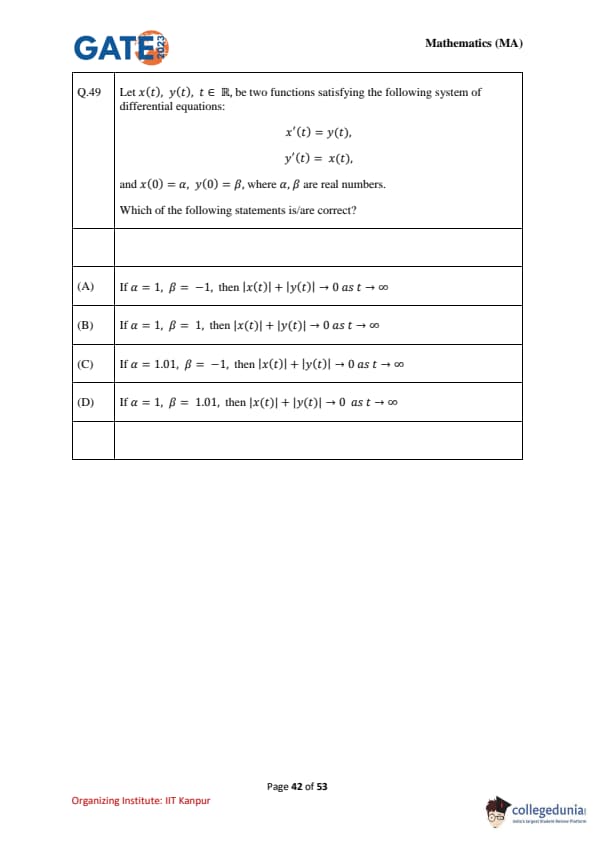
Let \(x(t), y(t), t \in \mathbb{R}\), be two functions satisfying the following system of differential equations: \[ x'(t) = y(t), \] \[ y'(t) = x(t), \]
and \(x(0) = \alpha, y(0) = \beta\), where \(\alpha, \beta\) are real numbers.
Which of the following statements is/are correct?
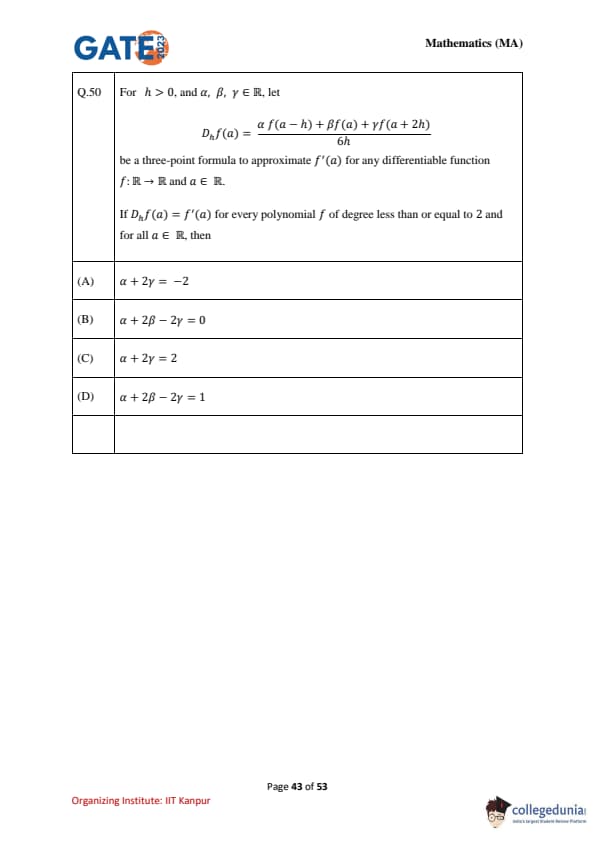
For \(h > 0\), and \(\alpha, \beta, \gamma \in \mathbb{R}\), let \[ D_h f(a) = \frac{\alpha f(a-h) + \beta f(a) + \gamma f(a+2h)}{6h} \]
be a three-point formula to approximate \(f'(a)\) for any differentiable function \(f: \mathbb{R} \to \mathbb{R}\) and \(a \in \mathbb{R}\).
If \(D_h f(a) = f'(a)\) for every polynomial f of degree less than or equal to 2 and for all \(a \in \mathbb{R}\), then
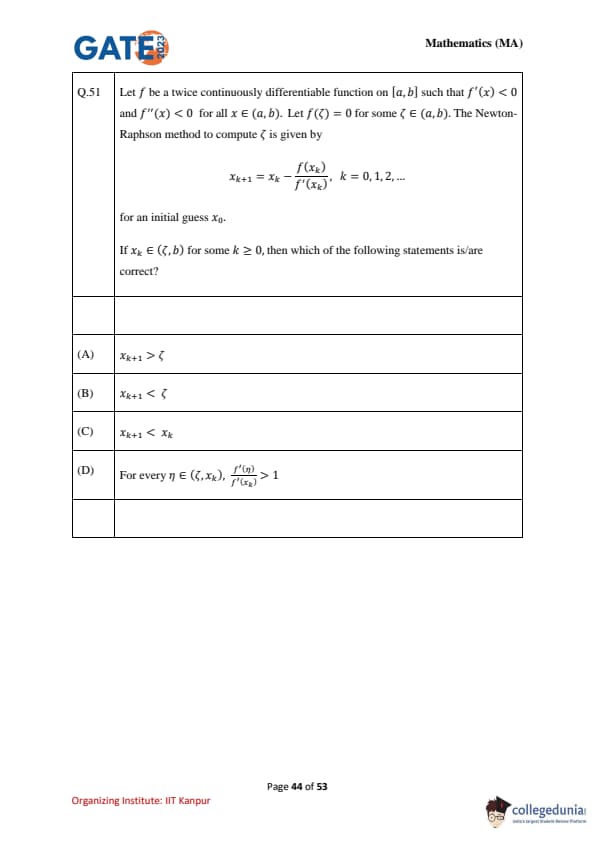
Let \( f \) be a twice continuously differentiable function on \( [a, b] \) such that \( f'(x) < 0 \) and \( f''(x) < 0 \) for all \( x \in (a, b) \). Let \( f(\zeta) = 0 \) for some \( \zeta \in (a, b) \). The Newton-Raphson method to compute \( \zeta \) is given by \[ x_{k+1} = x_k - \frac{f(x_k)}{f'(x_k)}, \quad k = 0, 1, 2, \dots \]
for an initial guess \( x_0 \).
If \( x_k \in (\zeta, b) \) for some \( k \geq 0 \), then which of the following statements is/are correct?
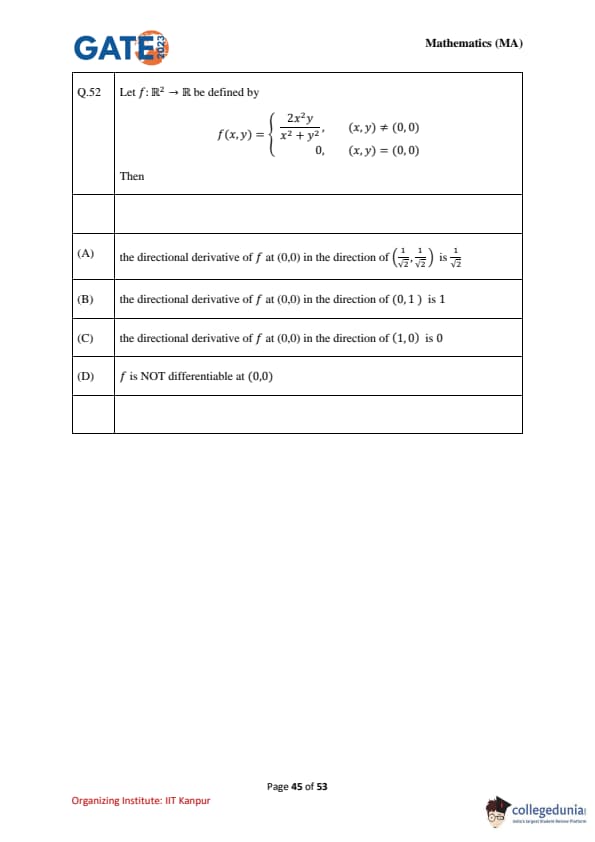
Let \( f: \mathbb{R}^2 \to \mathbb{R} \) be defined by \[ f(x, y) = \begin{cases} \frac{2x^2y}{x^2 + y^2}, & (x, y) \neq (0,0)
0, & (x, y) = (0,0) \end{cases} \]
Then
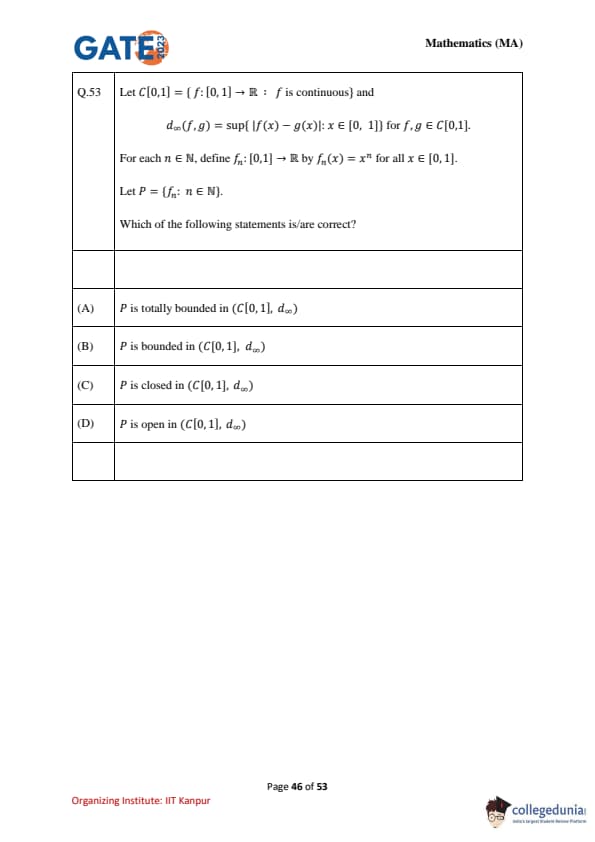
Let \( C[0,1] = \{ f: [0,1] \to \mathbb{R} : f is continuous\} \) and \[ d_\infty(f,g) = \sup\{ |f(x) - g(x)|: x \in [0, 1]\} for f, g \in C[0,1]. \]
For each \( n \in \mathbb{N} \), define \( f_n: [0,1] \to \mathbb{R} \) by \( f_n(x) = x^n \) for all \( x \in [0,1] \).
Let \( P = \{f_n: n \in \mathbb{N}\} \).
Which of the following statements is/are correct?
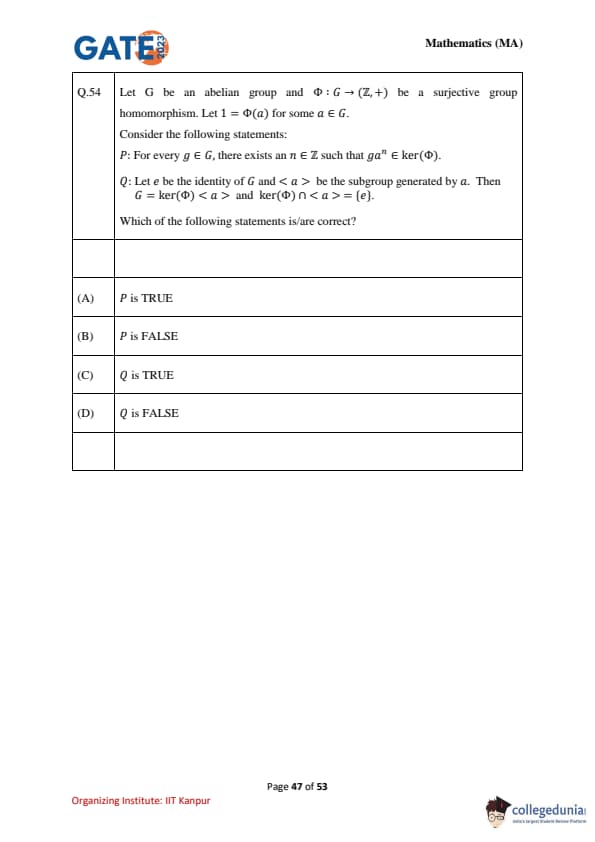
Let \( G \) be an abelian group and \( \Phi: G \to (\mathbb{Z},+) \) be a surjective group homomorphism. Let \( 1 = \Phi(a) \) for some \( a \in G \).
Consider the following statements:
\( P \): For every \( g \in G \), there exists an \( n \in \mathbb{Z} \) such that \( g a^n \in \ker(\Phi) \).
\( Q \): Let \( e \) be the identity of G and \( \langle a \rangle \) be the subgroup generated by \( a \). Then \( G = \ker(\Phi) \langle a \rangle \) and \( \ker(\Phi) \cap \langle a \rangle = \{e\} \).
Which of the following statements is/are correct?
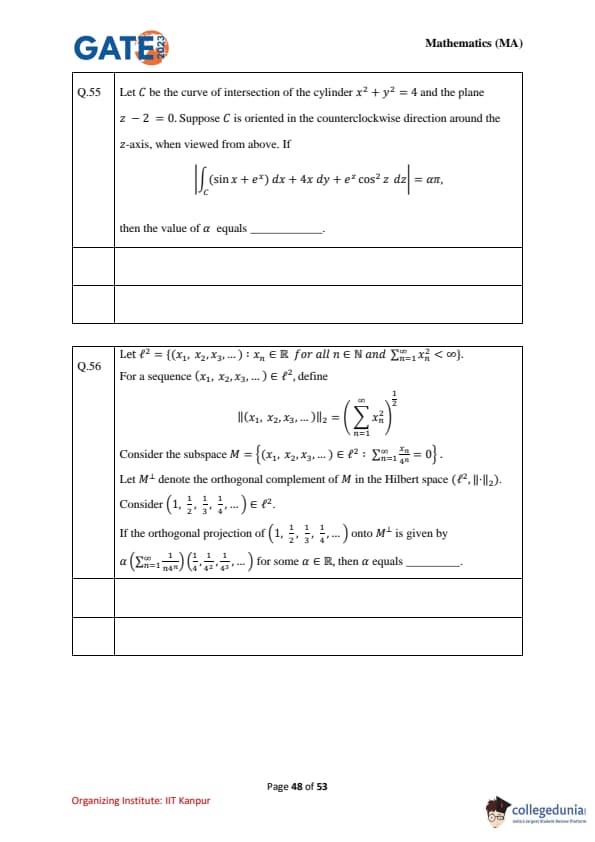
Let C be the curve of intersection of the cylinder \( x^2 + y^2 = 4 \) and the plane \( z - 2 = 0 \). Suppose C is oriented in the counterclockwise direction around the z-axis, when viewed from above. If \[ \int_C ( \sin x + e^x ) dx + 4x dy + e^z \cos^2 z dz = \alpha\pi, \]
then the value of \( \alpha \) equals _______.
Let \( l^2 = \{(x_1, x_2, x_3, \dots) : x_n \in \mathbb{R} for all n \in \mathbb{N} and \sum_{n=1}^\infty x_n^2 < \infty\} \).
For a sequence \( (x_1, x_2, x_3, \dots) \in l^2 \), define \( \|(x_1, x_2, x_3, \dots)\|_2 = \left( \sum_{n=1}^\infty x_n^2 \right)^{1/2} \).
Consider the subspace \( M = \{(x_1, x_2, x_3, \dots) \in l^2 : \sum_{n=1}^\infty \frac{x_n}{4^n} = 0\} \).
Let \( M^\perp \) denote the orthogonal complement of \( M \) in the Hilbert space \( (l^2, \|\cdot\|_2) \).
Consider \( \left(1, \frac{1}{2}, \frac{1}{3}, \frac{1}{4}, \dots\right) \in l^2 \).
If the orthogonal projection of \( \left(1, \frac{1}{2}, \frac{1}{3}, \frac{1}{4}, \dots\right) \) onto \( M^\perp \) is given by \( \alpha \left(\frac{1}{4}, \frac{1}{4^2}, \frac{1}{4^3}, \dots\right) \) for some \( \alpha \in \mathbb{R} \), then \( \alpha \) equals _______.
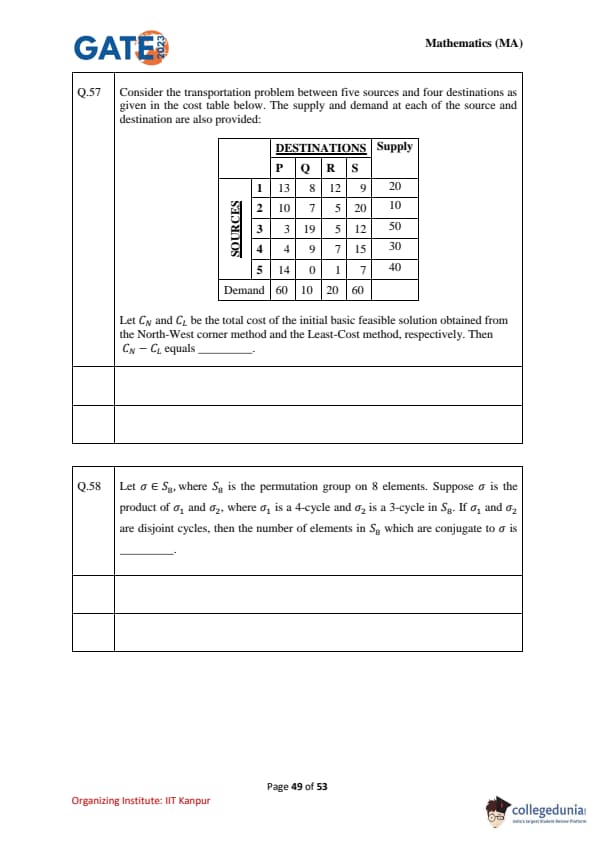
Consider the transportation problem between five sources and four destinations as given in the cost table below. The supply and demand at each of the source and destination are also provided:
\begin{tabular{|c|c|c|c|c|c|c|
\cline{3-7
\multicolumn{2{c|{ & \multicolumn{4{c|{DESTINATIONS & Supply
\cline{3-7
\multicolumn{2{c|{ & P & Q & R & S &
\hline
\multirow{5{*{\rotatebox[origin=c]{90{SOURCES & 1 & 13 & 8 & 12 & 9 & 20
\cline{2-7
& 2 & 10 & 7 & 5 & 20 & 10
\cline{2-7
& 3 & 3 & 19 & 5 & 12 & 50
\cline{2-7
& 4 & 4 & 9 & 7 & 15 & 30
\cline{2-7
& 5 & 14 & 0 & 1 & 7 & 40
\hline
\multicolumn{2{|c|{Demand & 60 & 10 & 20 & 60 &
\hline
\end{tabular
Let \(C_N\) and \(C_L\) be the total cost of the initial basic feasible solution obtained from the North-West corner method and the Least-Cost method, respectively. Then \(C_N - C_L\) equals ____________.
Let \(\sigma \in S_8\), where \(S_8\) is the permutation group on 8 elements. Suppose \(\sigma\) is the product of \(\sigma_1\) and \(\sigma_2\), where \(\sigma_1\) is a 4-cycle and \(\sigma_2\) is a 3-cycle in \(S_8\). If \(\sigma_1\) and \(\sigma_2\) are disjoint cycles, then the number of elements in \(S_8\) which are conjugate to \(\sigma\) is ____________.
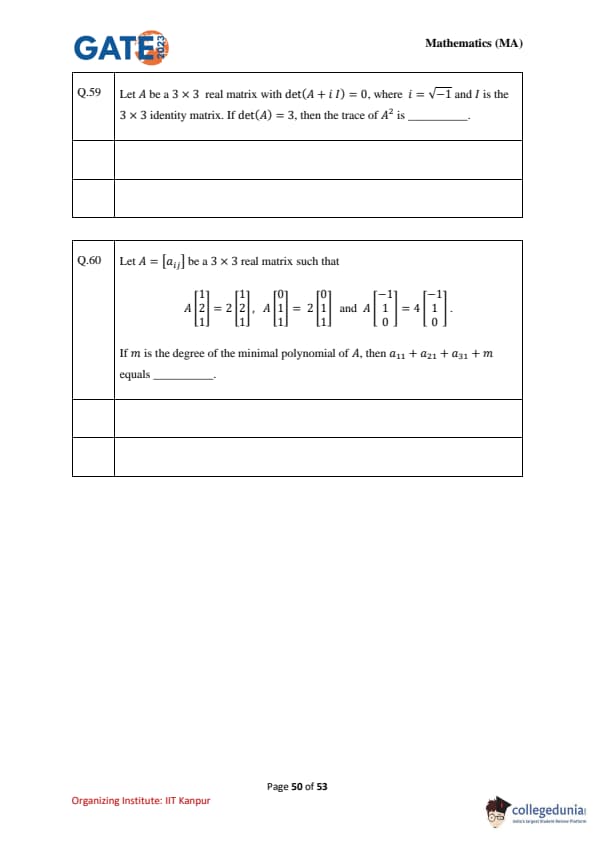
Let A be a \(3 \times 3\) real matrix with det(\(A + i I\)) = 0, where \(i = \sqrt{-1}\) and I is the \(3 \times 3\) identity matrix. If det(A) = 3, then the trace of \(A^2\) is ____________.
Let A = \([a_{ij}]\) be a \(3 \times 3\) real matrix such that
\[ A \begin{bmatrix} 1
2
1 \end{bmatrix} = 2 \begin{bmatrix} 1
2
1 \end{bmatrix}, \quad A \begin{bmatrix} 0
1
1 \end{bmatrix} = 2 \begin{bmatrix} 0
1
1 \end{bmatrix} \quad and \quad A \begin{bmatrix} -1
1
0 \end{bmatrix} = 4 \begin{bmatrix} -1
1
0 \end{bmatrix}. \]
If m is the degree of the minimal polynomial of A, then \(a_{11} + a_{21} + a_{31} + m\) equals ____________.
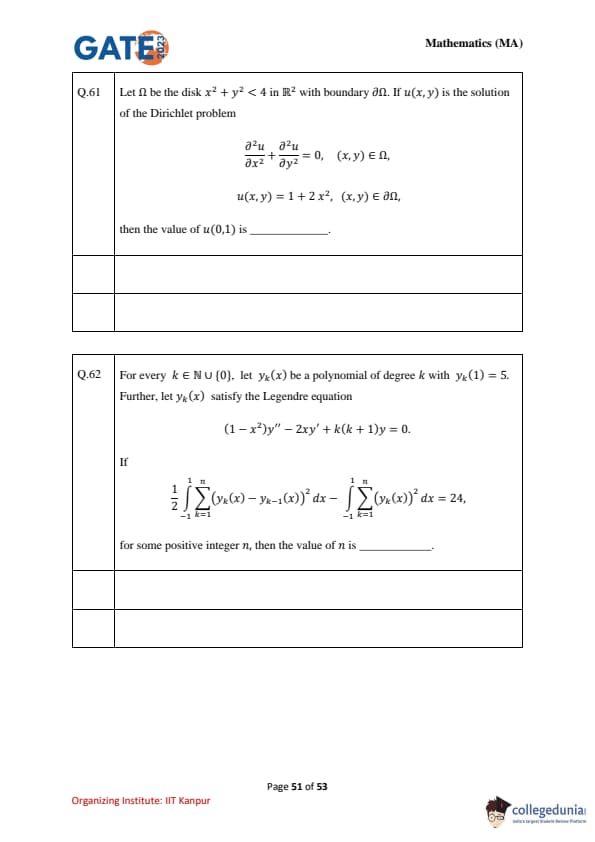
Let \(\Omega\) be the disk \(x^2 + y^2 < 4\) in \(\mathbb{R}^2\) with boundary \(\partial\Omega\). If \(u(x, y)\) is the solution of the Dirichlet problem \[ \frac{\partial^2 u}{\partial x^2} + \frac{\partial^2 u}{\partial y^2} = 0, \quad (x, y) \in \Omega, \] \[ u(x, y) = 1 + 2x^2, \quad (x, y) \in \partial\Omega, \]
then the value of \(u(0,1)\) is ____________.
For every \(k \in \mathbb{N} \cup \{0\}\), let \(y_k(x)\) be a polynomial of degree k with \(y_k(1) = 5\). Further, let \(y_k(x)\) satisfy the Legendre equation \[ (1-x^2)y'' - 2xy' + k(k+1)y = 0. \]
If \[ \frac{1}{2} \sum_{k=1}^{n} \int_{-1}^{1} (y_k(x) - y_{k-1}(x))^2 dx - \sum_{k=1}^{n} \int_{-1}^{1} (y_k(x))^2 dx = 24, \]
for some positive integer n, then the value of n is ____________.
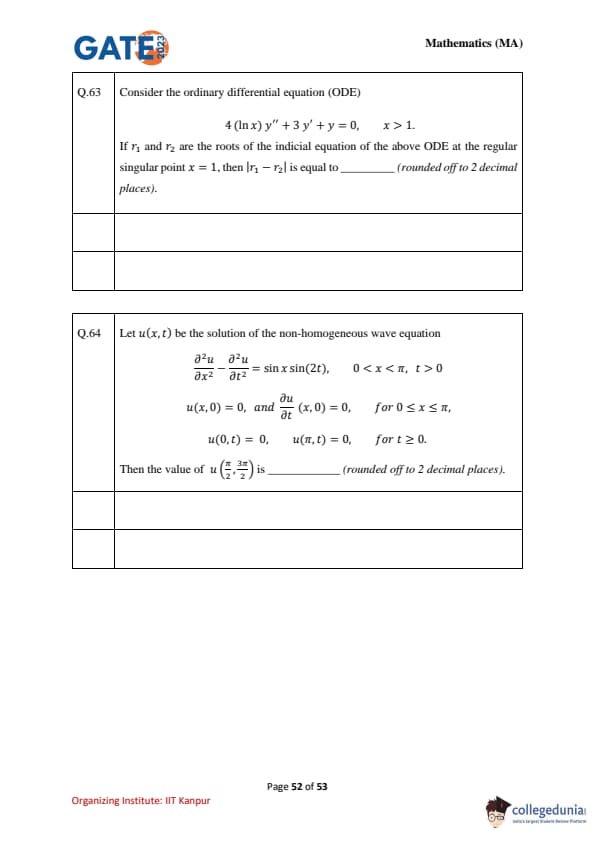
Consider the ordinary differential equation (ODE) \[ 4 (\ln x) y'' + 3 y' + y = 0, \quad x > 1. \]
If \(r_1\) and \(r_2\) are the roots of the indicial equation of the above ODE at the regular singular point \(x=1\), then \(|r_1 - r_2|\) is equal to ____________ (rounded off to 2 decimal places).
Let \(u(x, t)\) be the solution of the non-homogeneous wave equation \[ \frac{\partial^2 u}{\partial x^2} - \frac{\partial^2 u}{\partial t^2} = \sin x \sin(2t), \quad 0 < x < \pi, \ t > 0 \] \[ u(x, 0) = 0, and \frac{\partial u}{\partial t}(x, 0) = 0, \quad for 0 \le x \le \pi, \] \[ u(0, t) = 0, \quad u(\pi, t) = 0, \quad for t \ge 0. \]
Then the value of \( u \left( \frac{\pi}{2}, \frac{3\pi}{2} \right) \) is ____________ (rounded off to 2 decimal places).
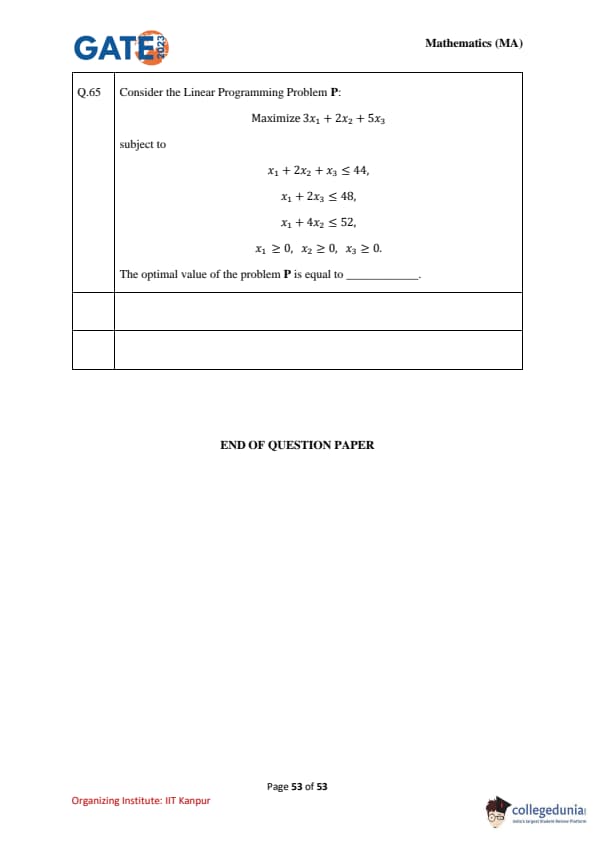
Consider the Linear Programming Problem P: \[ Maximize 3x_1 + 2x_2 + 5x_3 \]
subject to
\begin{align* x_1 + 2x_2 + x_3 &\le 44,
x_1 + 2x_3 &\le 48,
x_1 + 4x_2 &\le 52,
x_1 \ge 0, x_2 \ge 0, x_3 &\ge 0. \end{align*
The optimal value of the problem P is equal to ____________.
To know about the Previous Years’ Question Paper and Exam Analysis:
- GATE Question Paper (Available): Check Previous Year Question Paper with Solution PDF
- GATE Question Paper 2025 (Soon): Check Previous Year Question Paper with Solution PDF
- GATE Question Paper 2024 (Available): Check Previous Year Question Paper with Solution PDF
- GATE Paper Analysis, Difficulty Level, Branch-wise Question Paper Analysis, Weightage of Topics
Also Check:
| Previous Year GATE Mathematics Question Papers | GATE 2023 Mathematics Paper Analysis |
| GATE Mathematics Exam Pattern | GATE Mathematics Syllabus |



Comments