




GATE 2024 Aerospace Engineering Question Paper PDF is available here. IISc Banglore conducted GATE 2024 Aerospace Engineering exam on February 10 in the Forenoon Session from 9:30 AM to 12:30 PM. Students have to answer 65 questions in GATE 2024 Aerospace Engineering Question Paper carrying a total weightage of 100 marks. 10 questions are from the General Aptitude section and 55 questions are from Engineering Mathematics and Core Discipline.
GATE 2024 Aerospace Engineering Question Paper with Solutions PDF
| GATE 2024 Aerospace Engineering Question Paper with Solutions PDF | Download | Check Solutions |
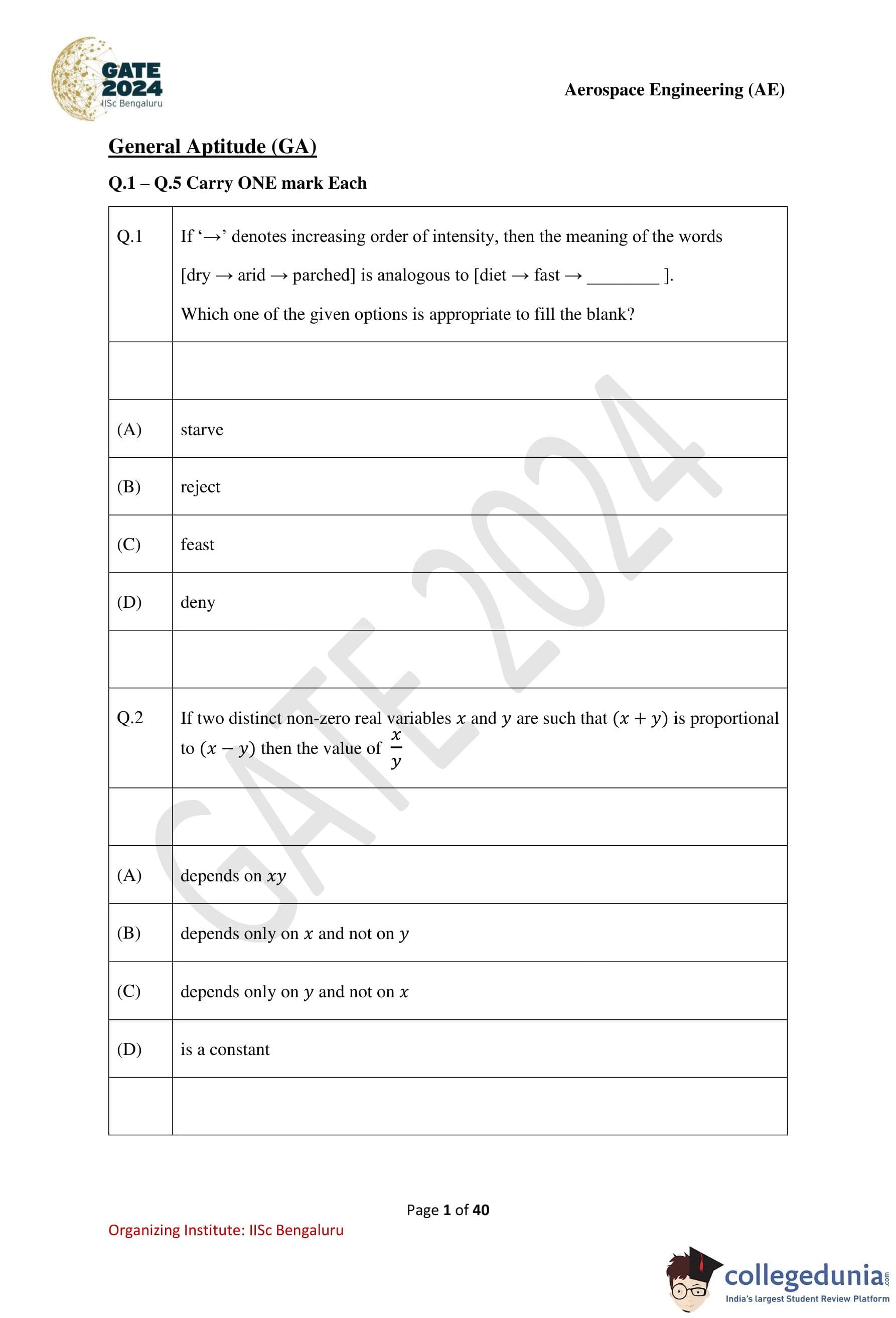
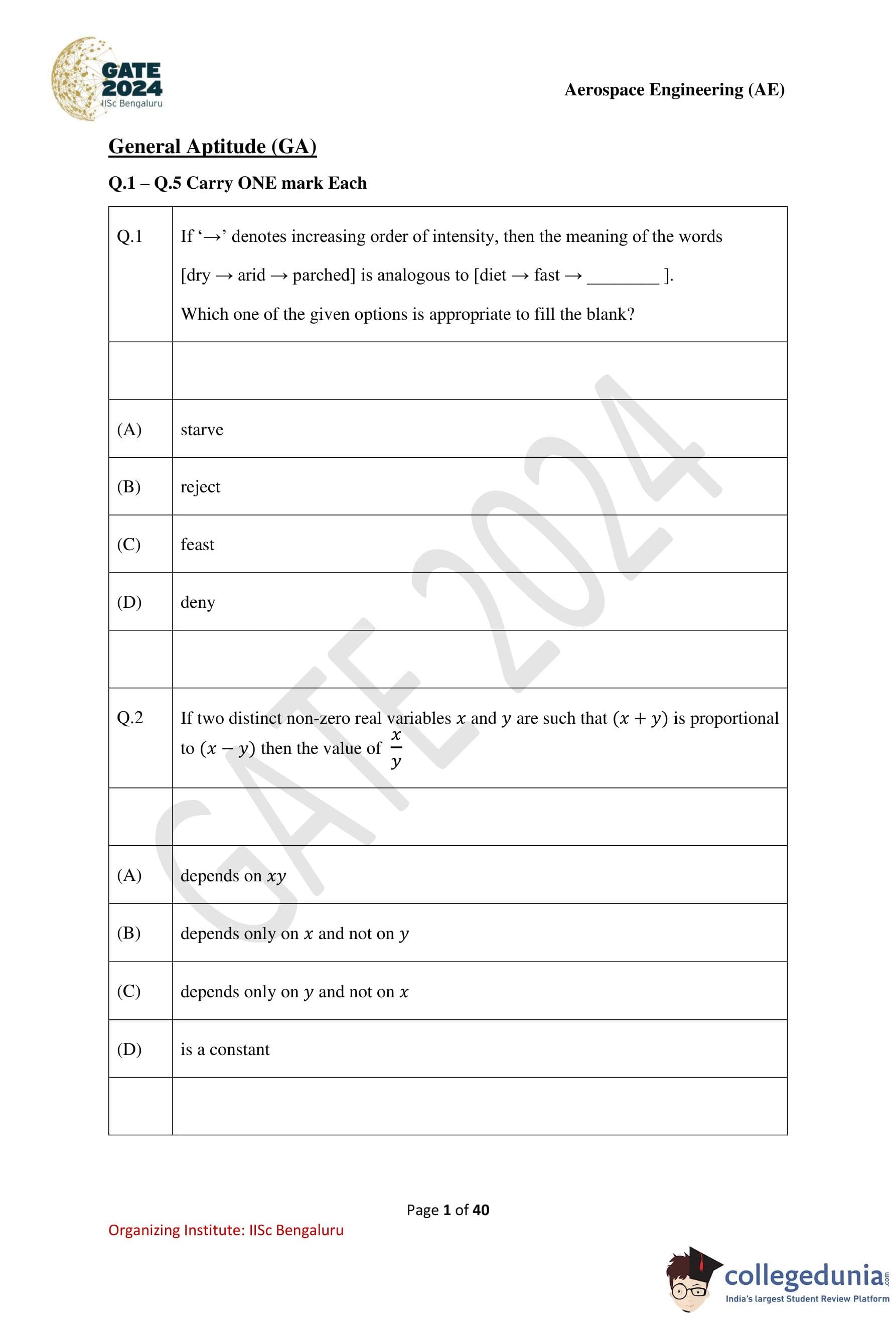
If ‘\(\rightarrow\)’ denotes increasing order of intensity, then the meaning of the words
[dry \(\rightarrow\) arid \(\rightarrow\) parched] is analogous to
[diet \(\rightarrow\) fast \(\rightarrow\) \rule{1.5cm{0.15mm ].
Which one of the given options is appropriate to fill the blank?
If two distinct non-zero real variables \(x\) and \(y\) are such that \((x+y)\) is proportional to \((x-y)\), then the value of \(\dfrac{x}{y}\)
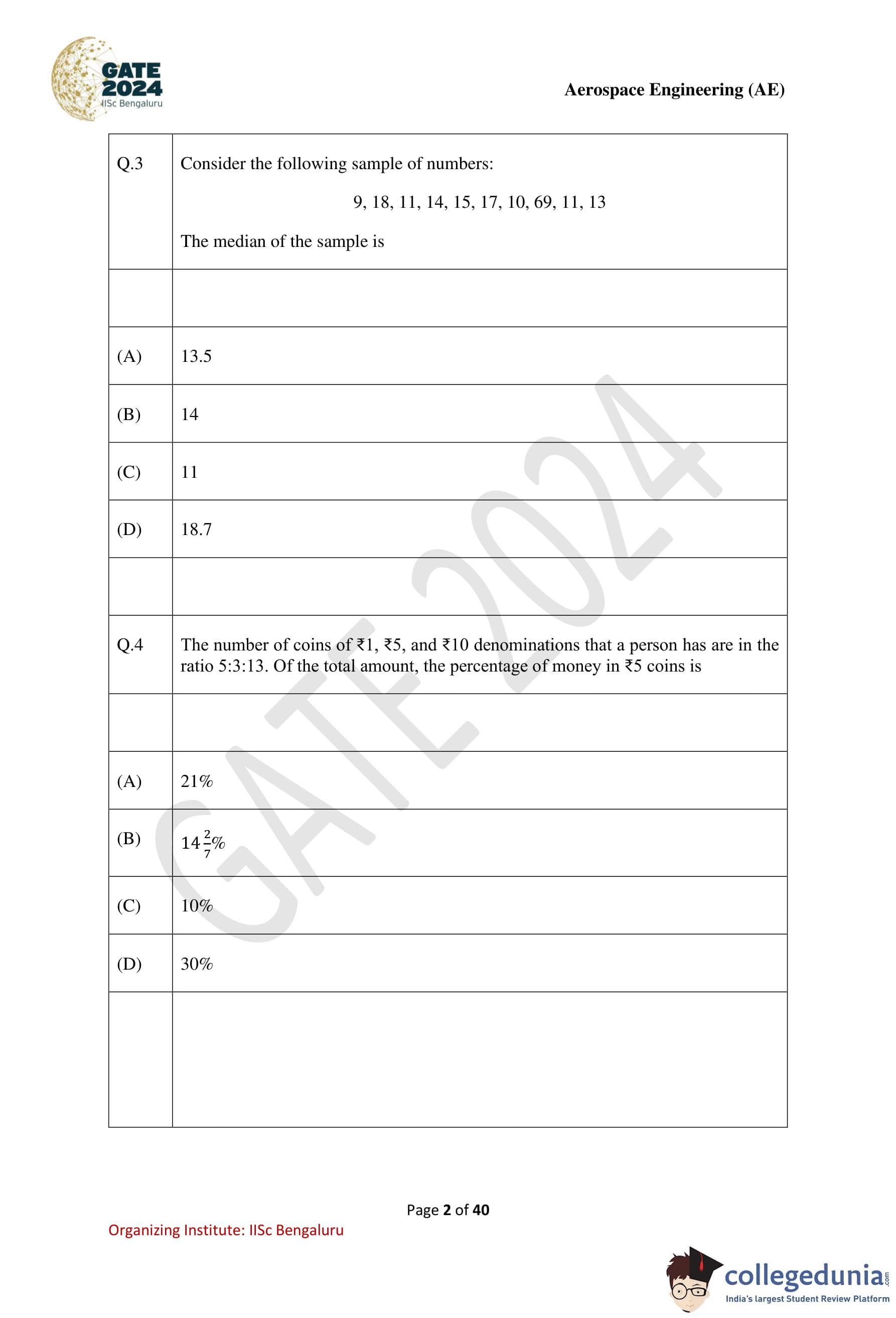
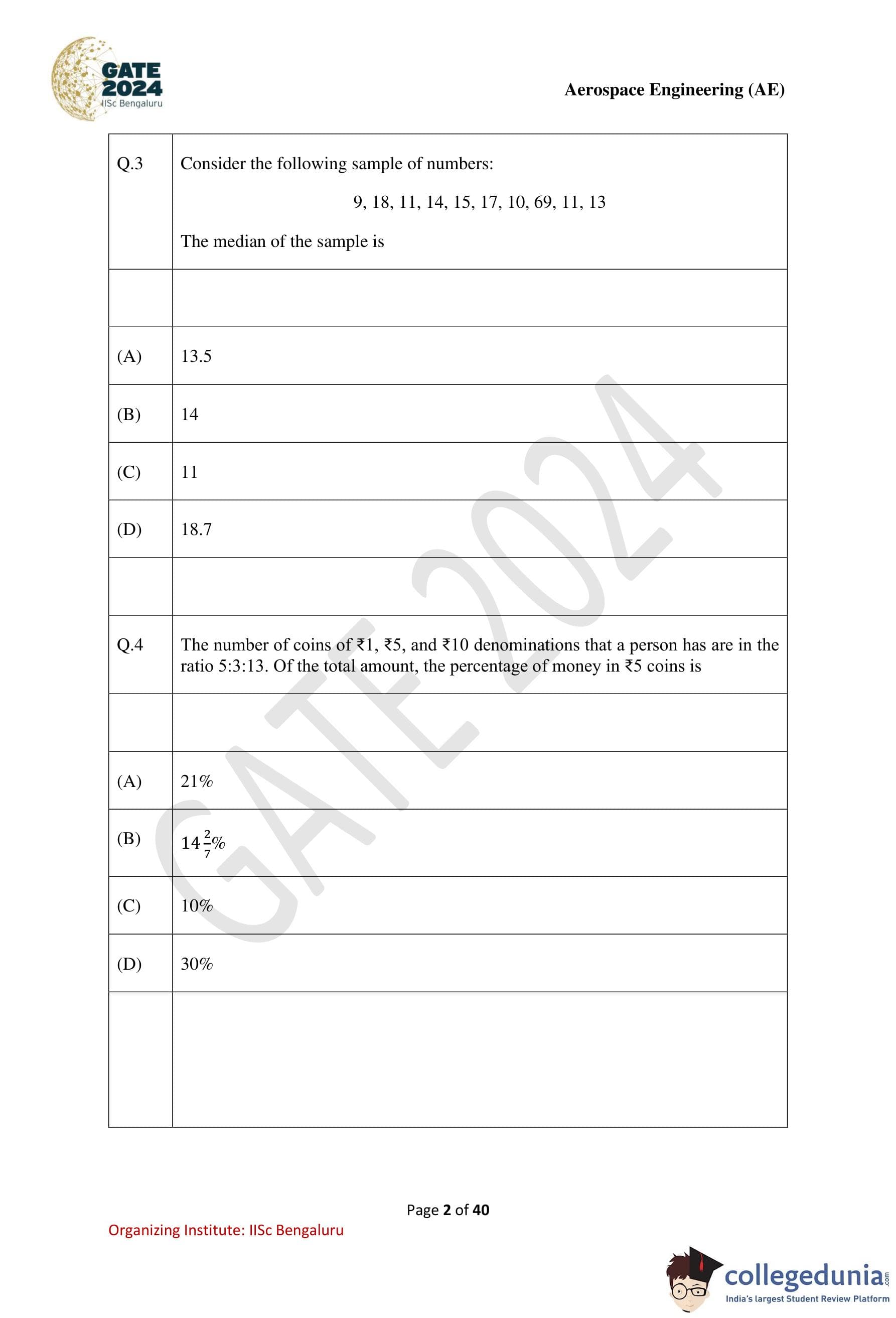
Consider the following sample of numbers: \[ 9,\; 18,\; 11,\; 14,\; 15,\; 17,\; 10,\; 69,\; 11,\; 13 \]
The median of the sample is
The number of coins of \₹1, \₹5, and \₹10 denominations that a person has are in the ratio \(5:3:13\).
Of the total amount, the percentage of money in \₹5 coins is
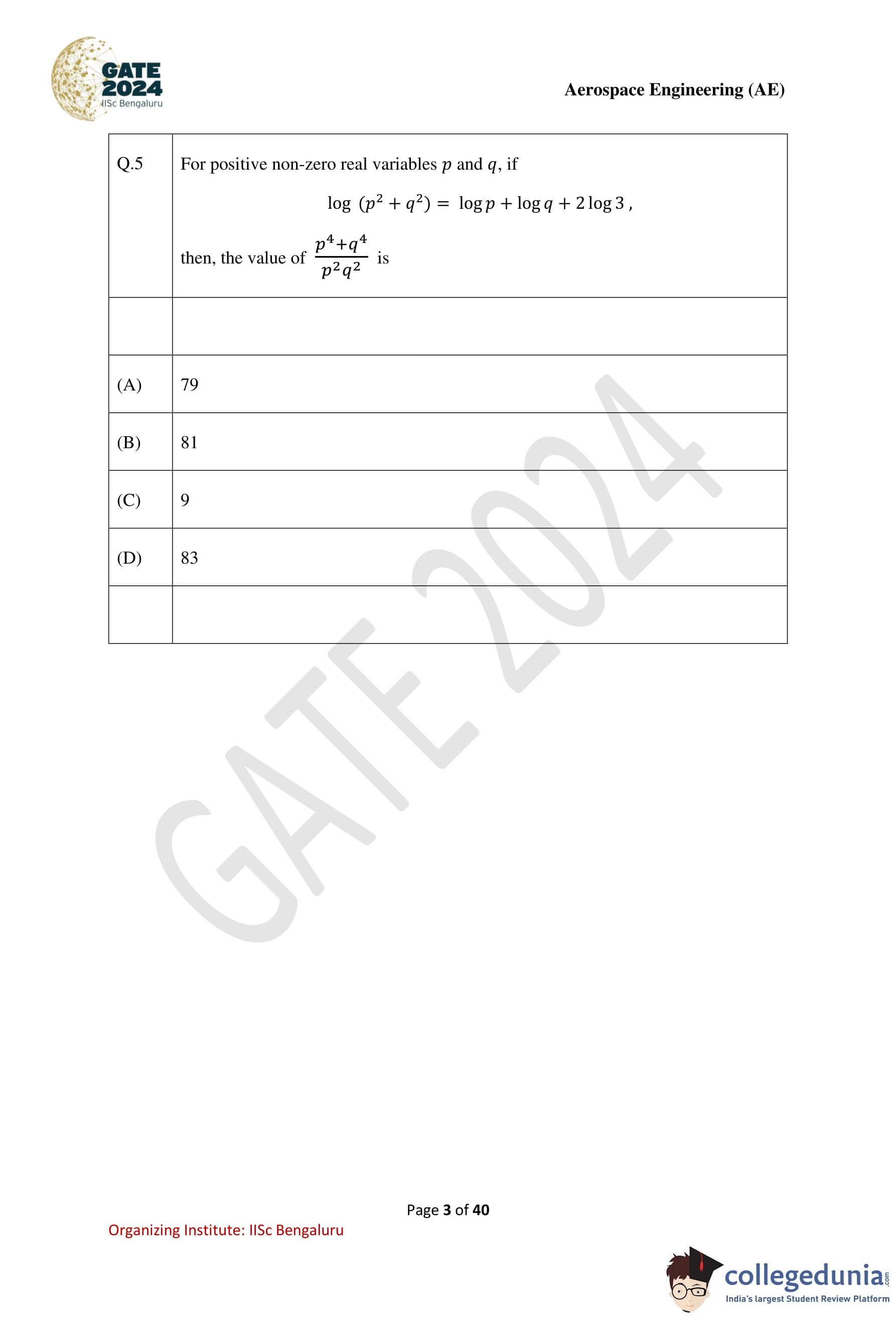
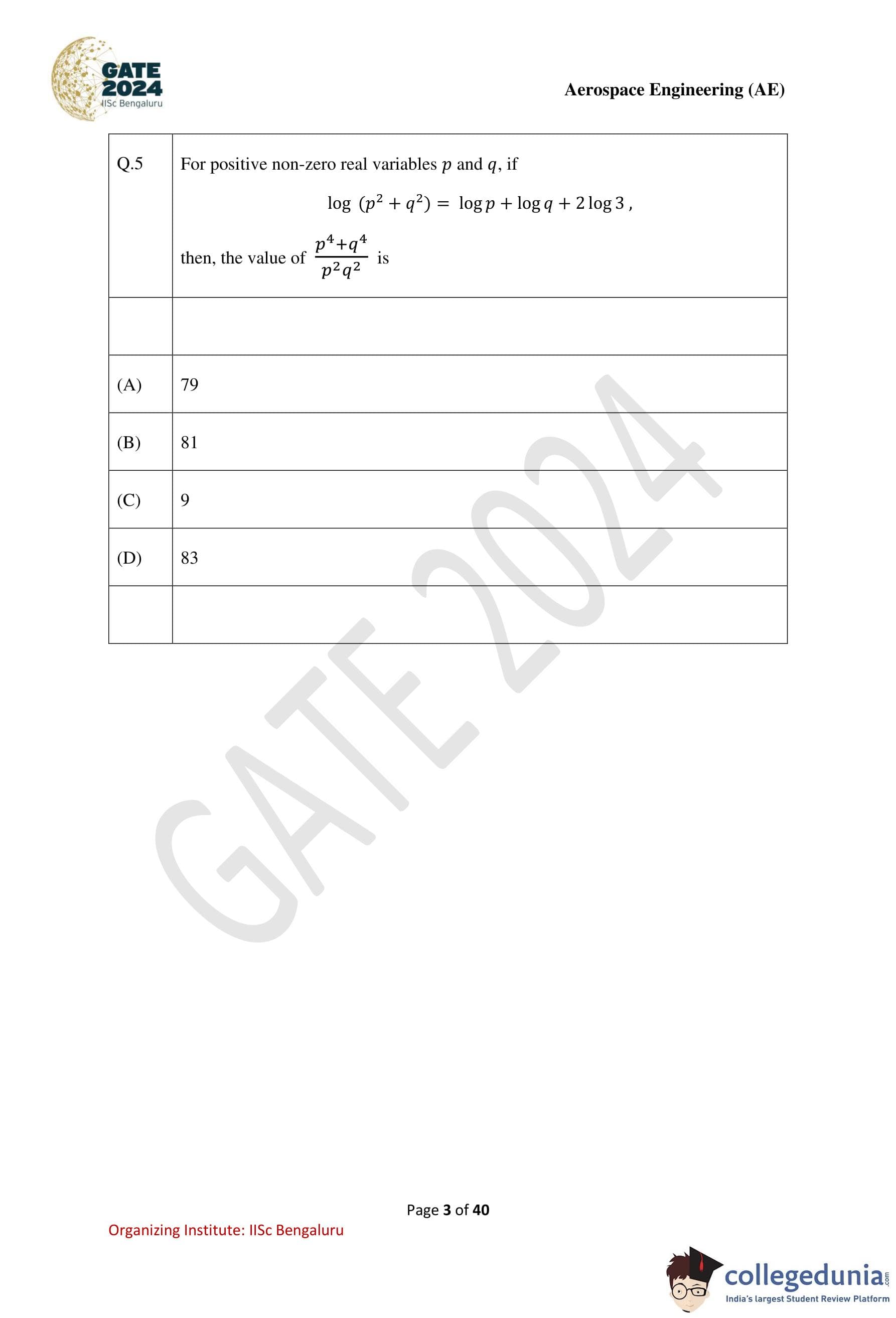
For positive non-zero real variables \(p\) and \(q\), if \[ \log (p^2 + q^2) = \log p + \log q + 2 \log 3, \]
then, the value of \[ \frac{p^4 + q^4}{p^2 q^2} \]
is
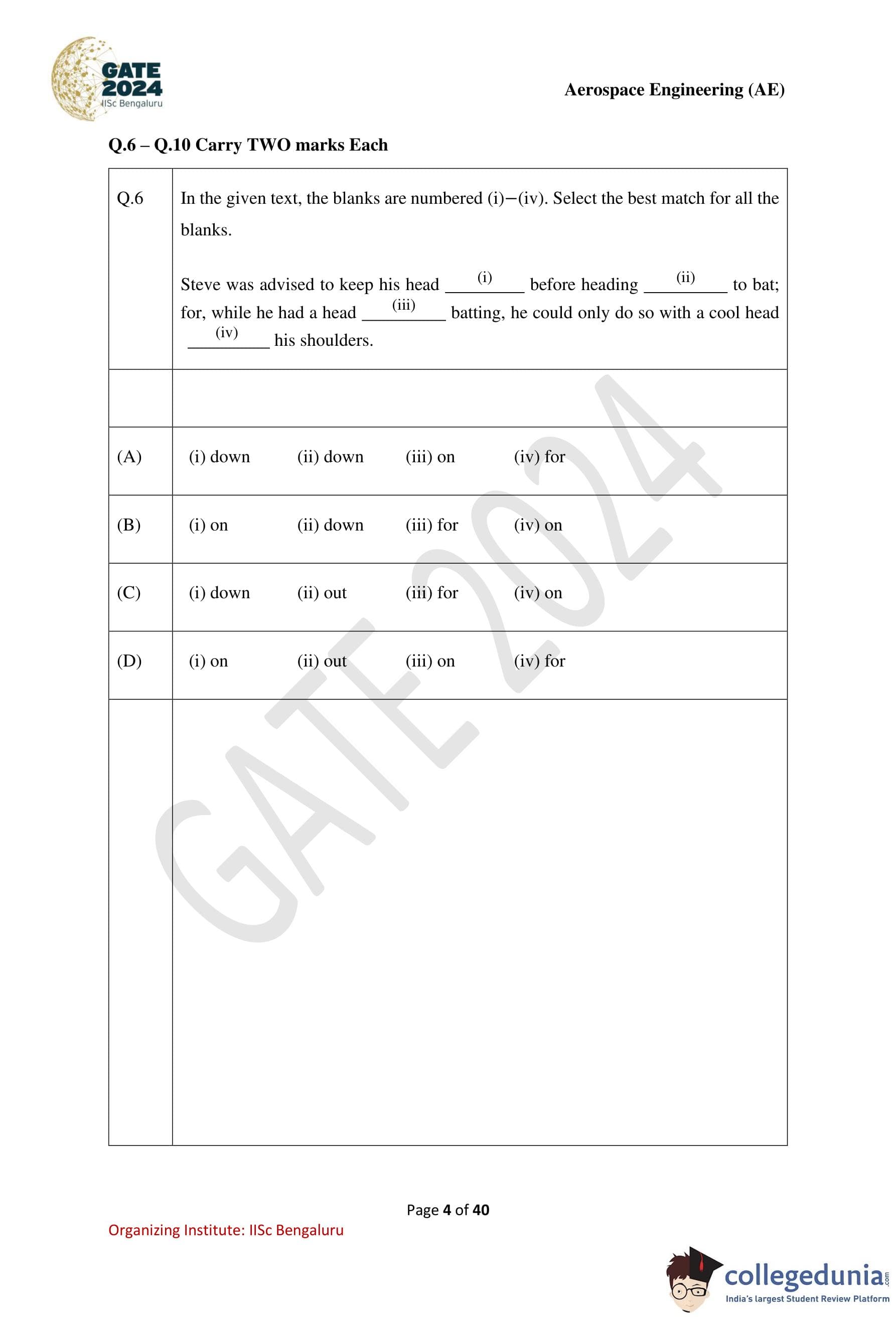
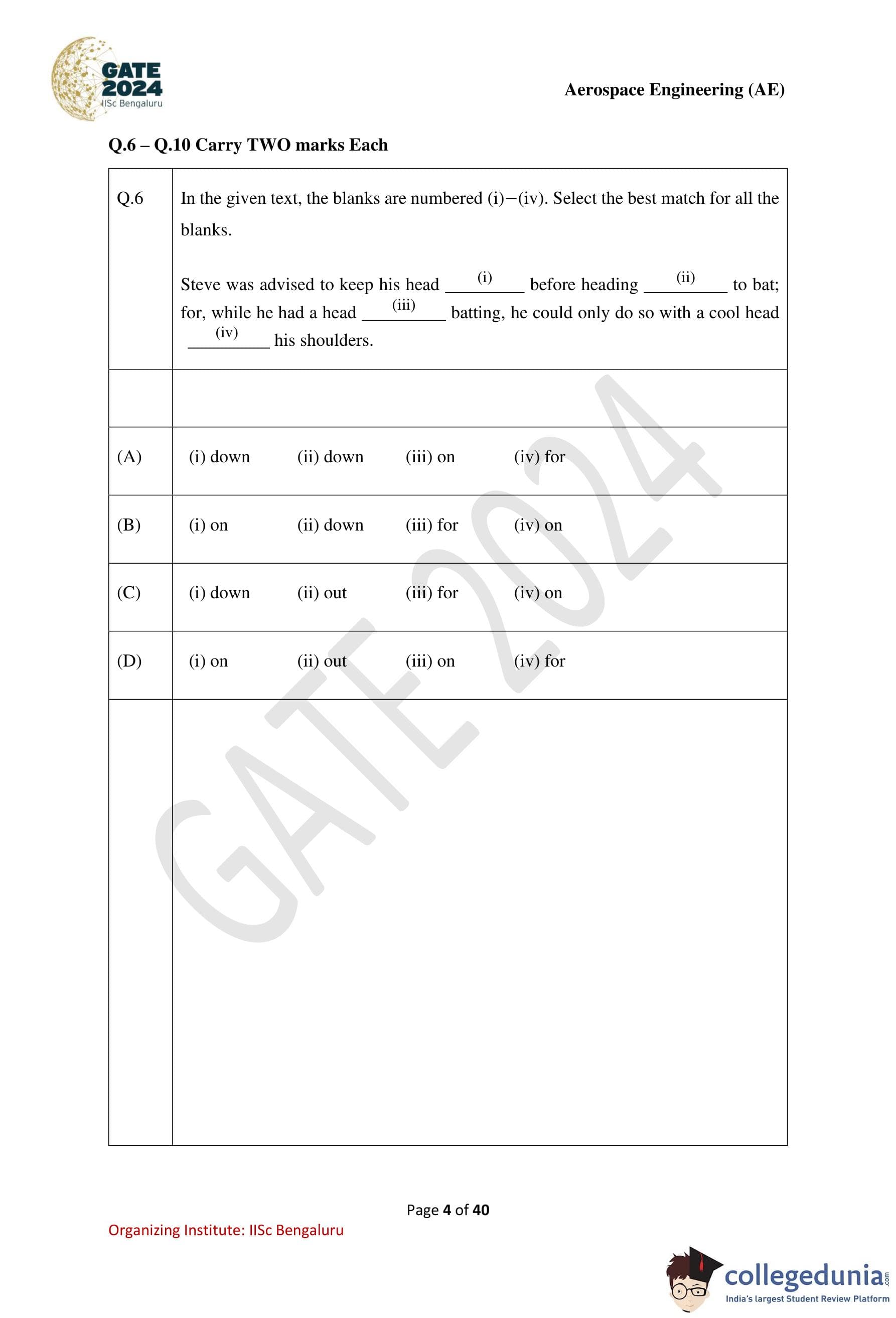
In the given text, the blanks are numbered (i)--(iv). Select the best match for all the blanks.
Steve was advised to keep his head ............... before heading ............... to bat;
for, while he had a head ............... batting, he could only do so with a cool head
............... his shoulders.
A rectangular paper sheet of dimensions \(54 cm \times 4 cm\) is taken.
The two longer edges of the sheet are joined together to create a cylindrical tube.
A cube whose surface area is equal to the area of the sheet is also taken.
Then, the ratio of the volume of the cylindrical tube to the volume of the cube is
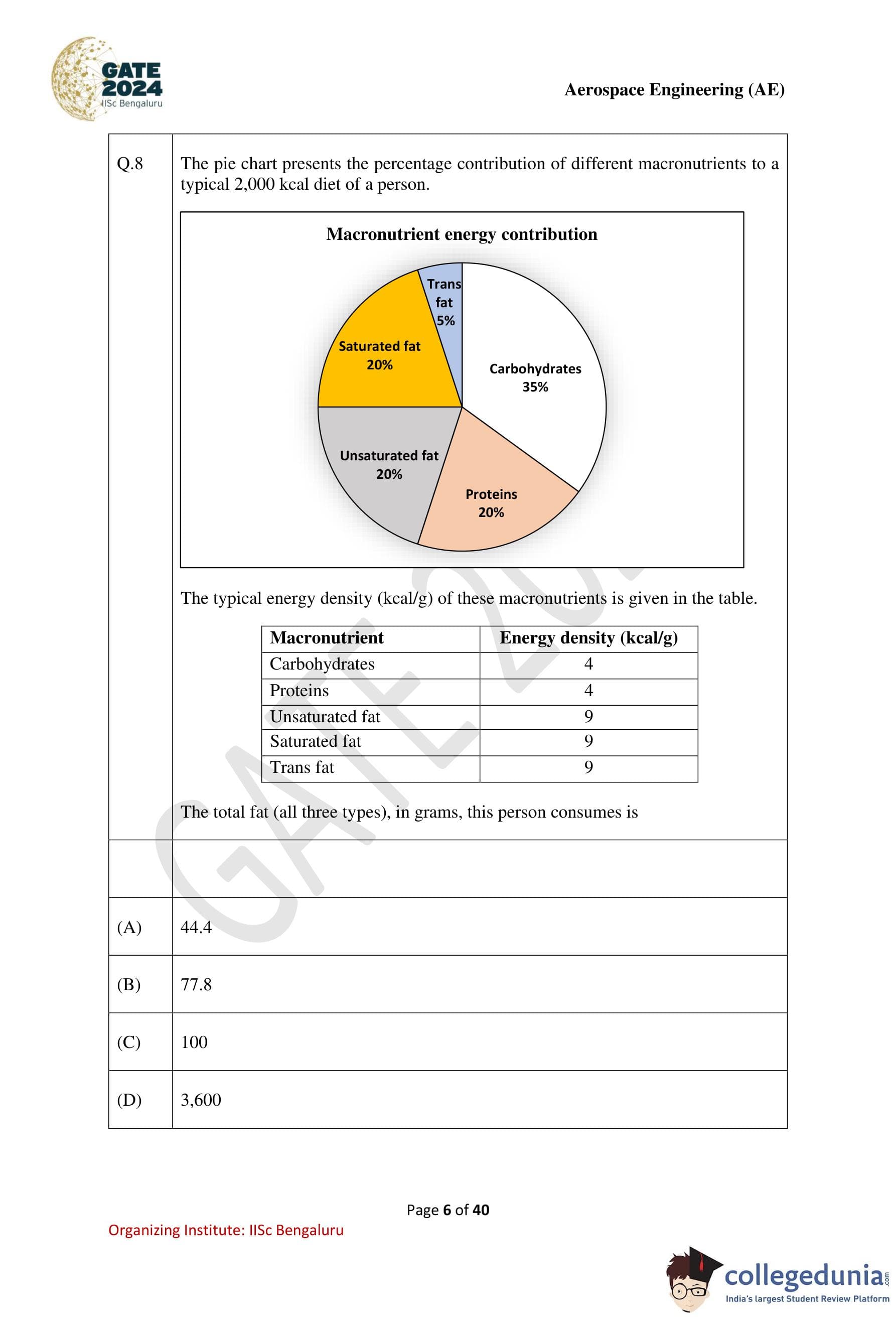
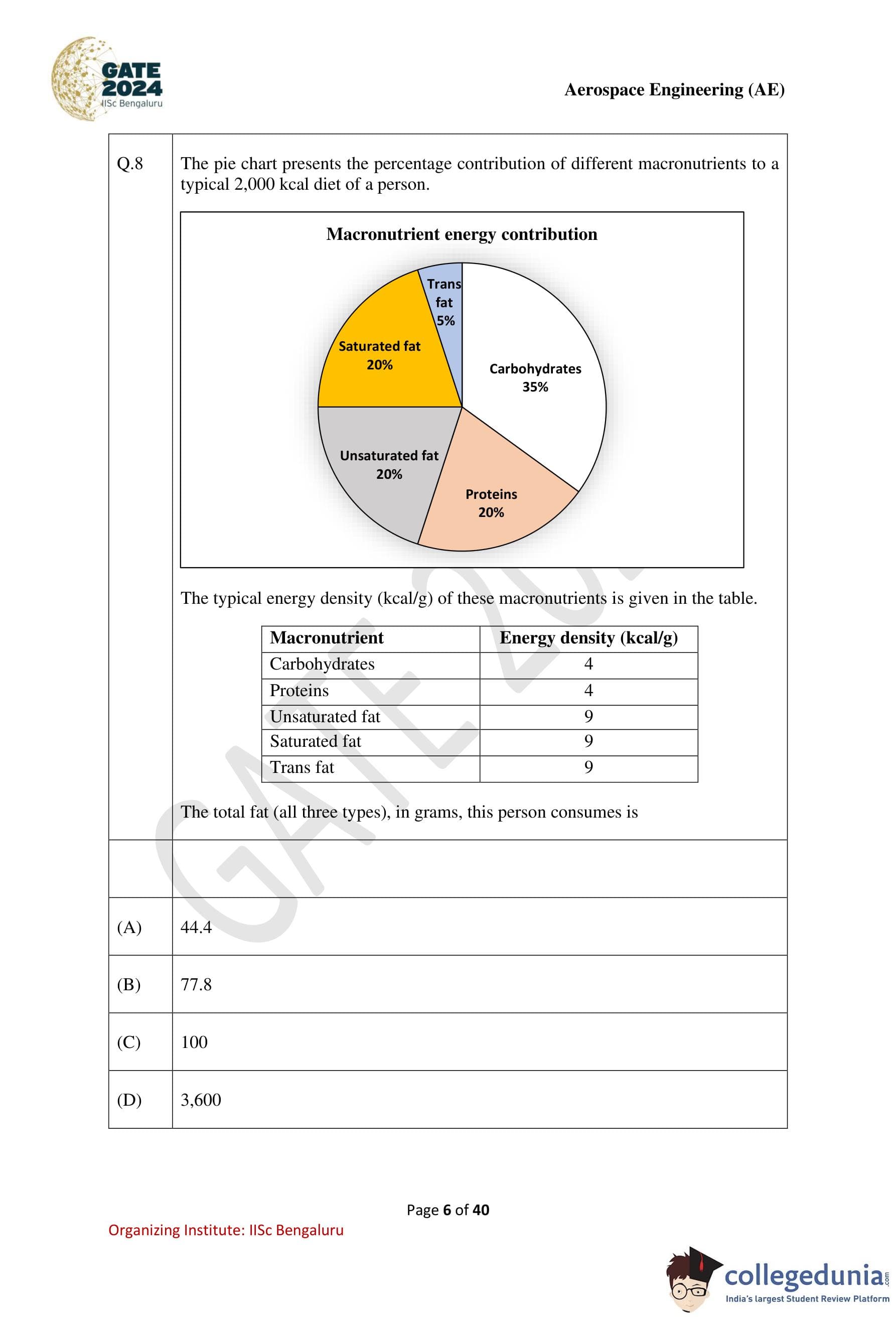
The pie chart presents the percentage contribution of different macronutrients to a typical \(2000\) kcal diet of a person.

The typical energy density (kcal/g) of these macronutrients is given in the table below.

The total fat (all three types), in grams, this person consumes is
A rectangular paper of \(20\) cm \(\times\) \(8\) cm is folded \(3\) times.
Each fold is made along the line of symmetry, which is perpendicular to its long edge.
The perimeter of the final folded sheet (in cm) is
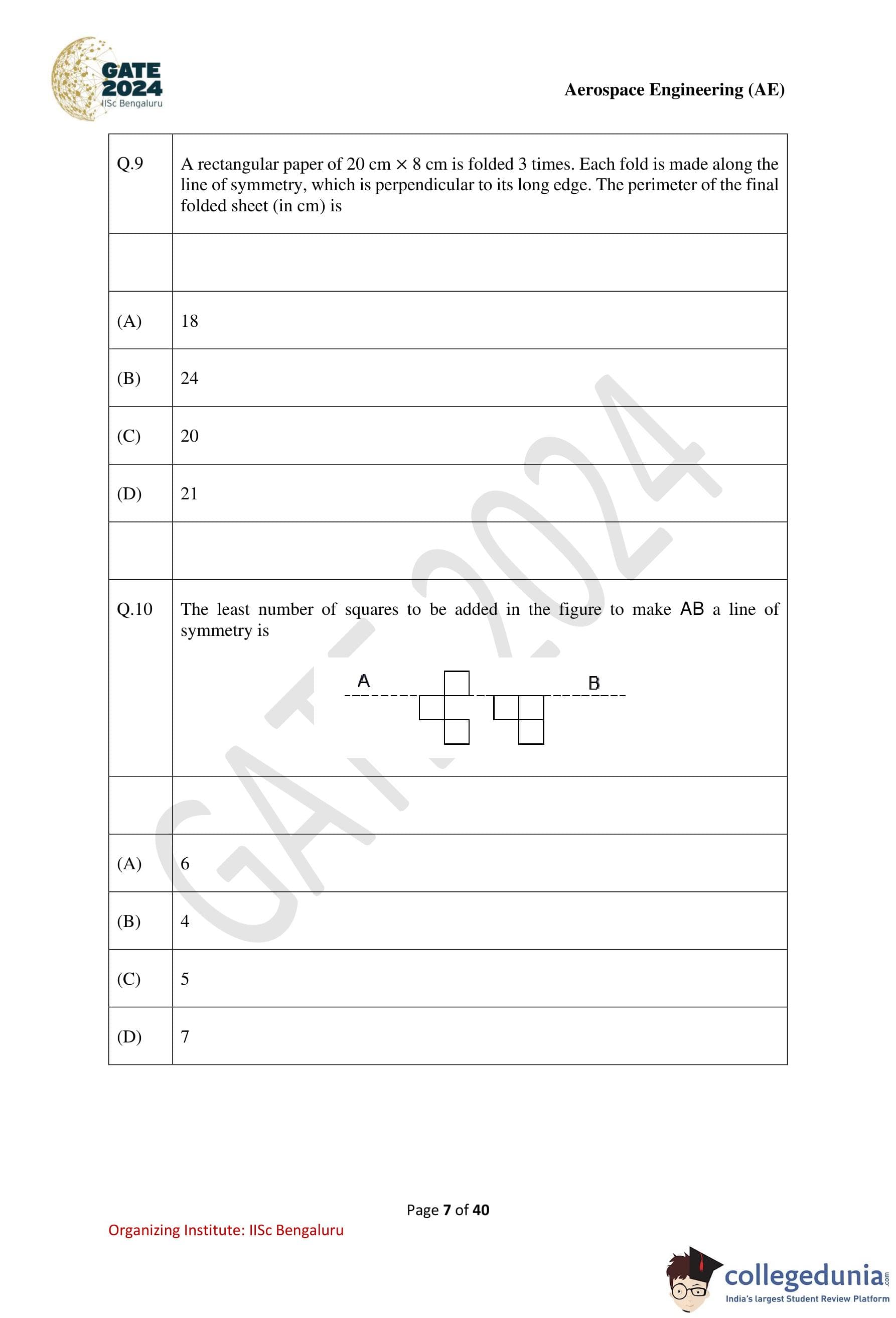
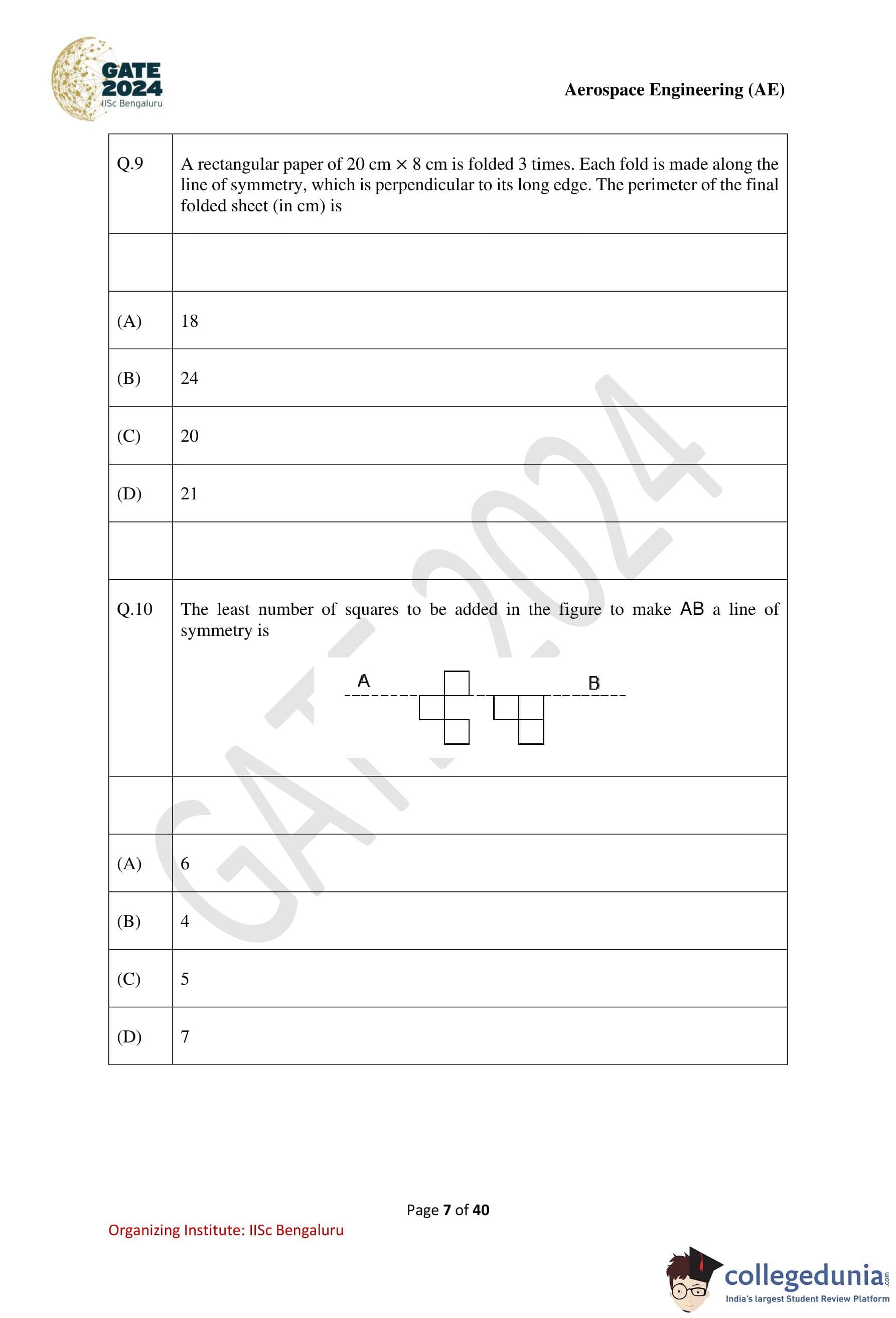
The least number of squares to be added in the figure to make \(AB\) a line of symmetry is

The following system of linear equations \[ \begin{aligned} 7x - 3y + z &= 0
3x - y + z &= 0
x - y - z &= 0 \end{aligned} \]
has:
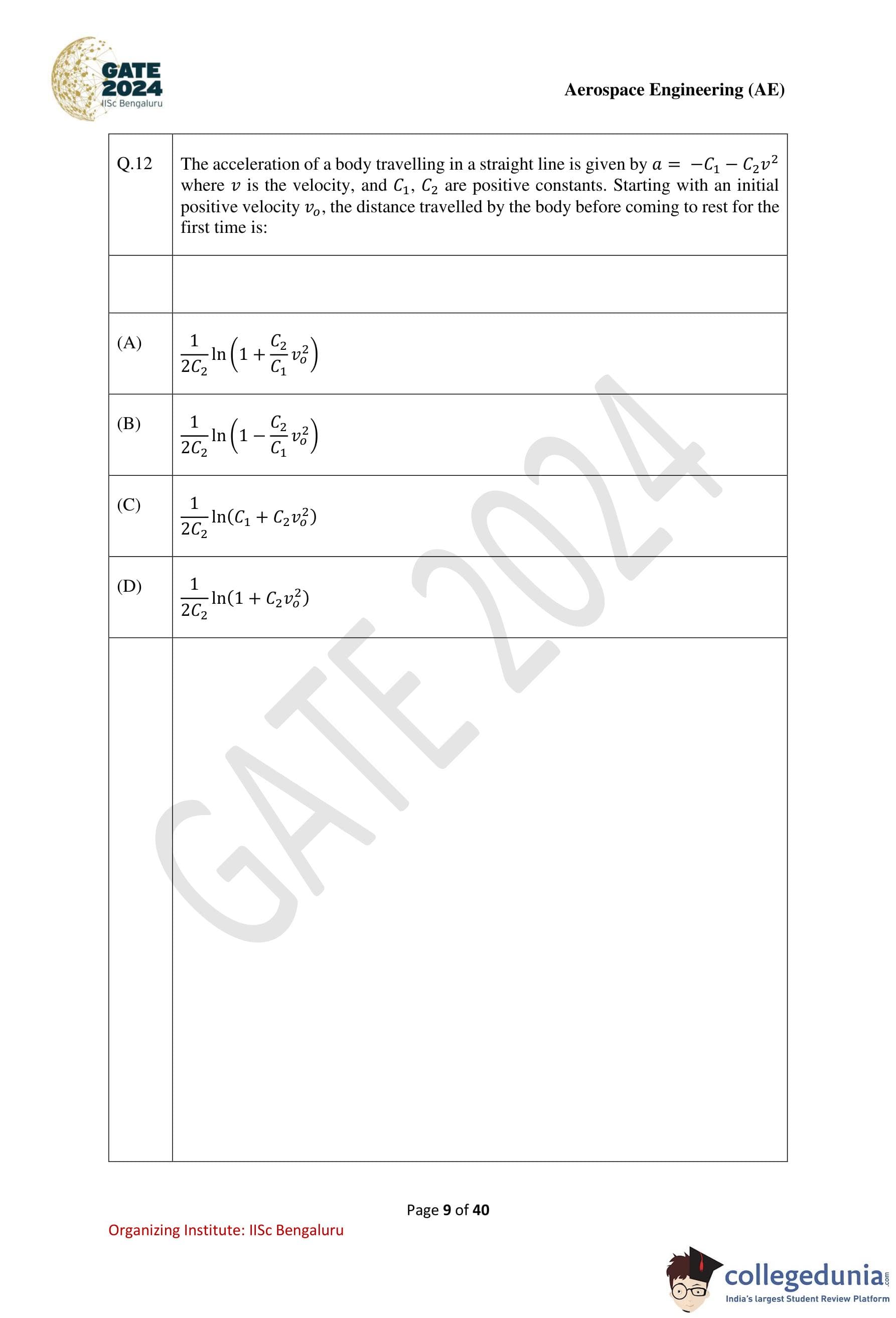
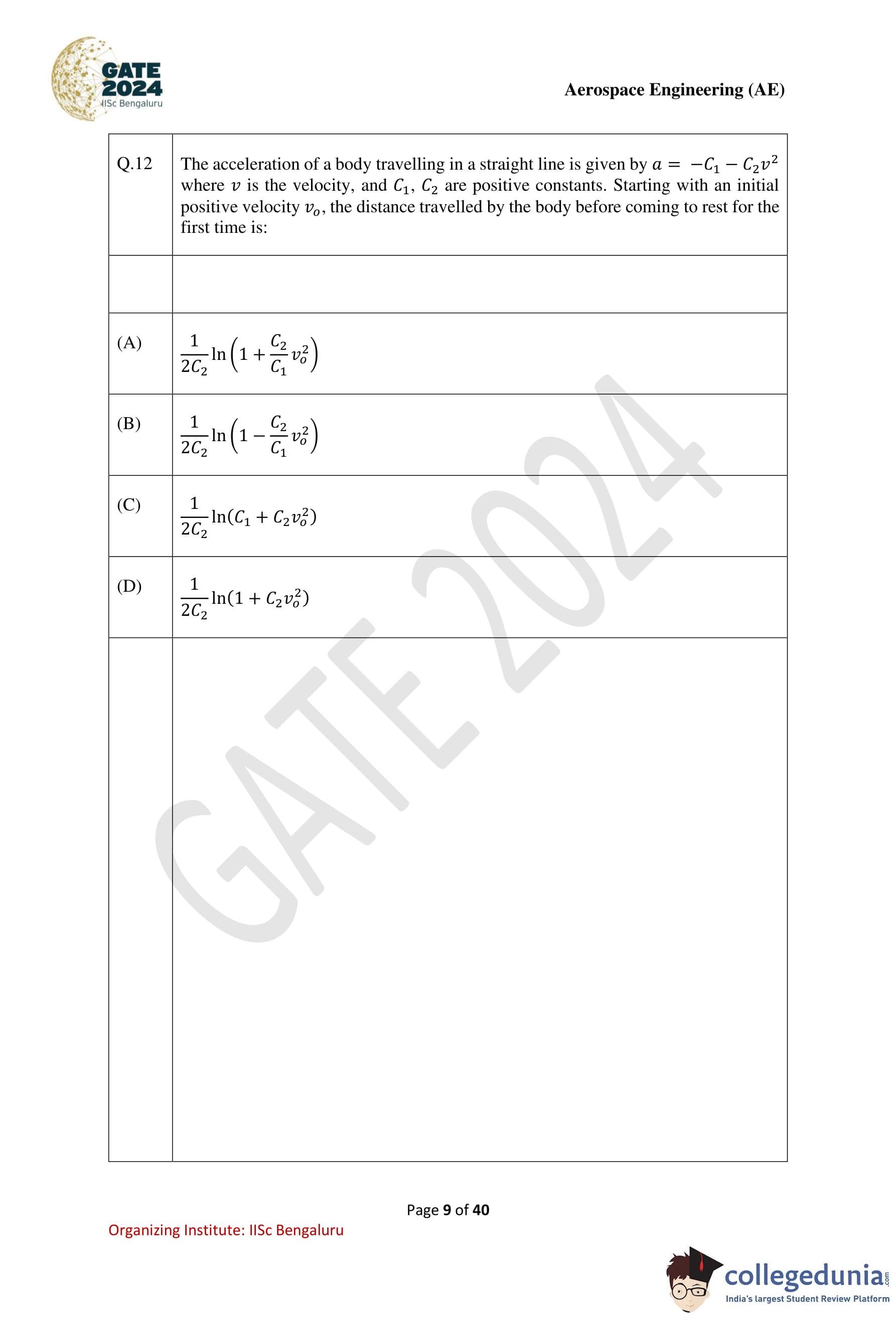
The acceleration of a body travelling in a straight line is given by \[ a = -C_1 - C_2 v^2 \]
where \(v\) is the velocity, and \(C_1, C_2\) are positive constants.
Starting with an initial positive velocity \(v_0\), the distance travelled by the body before coming to rest for the first time is:
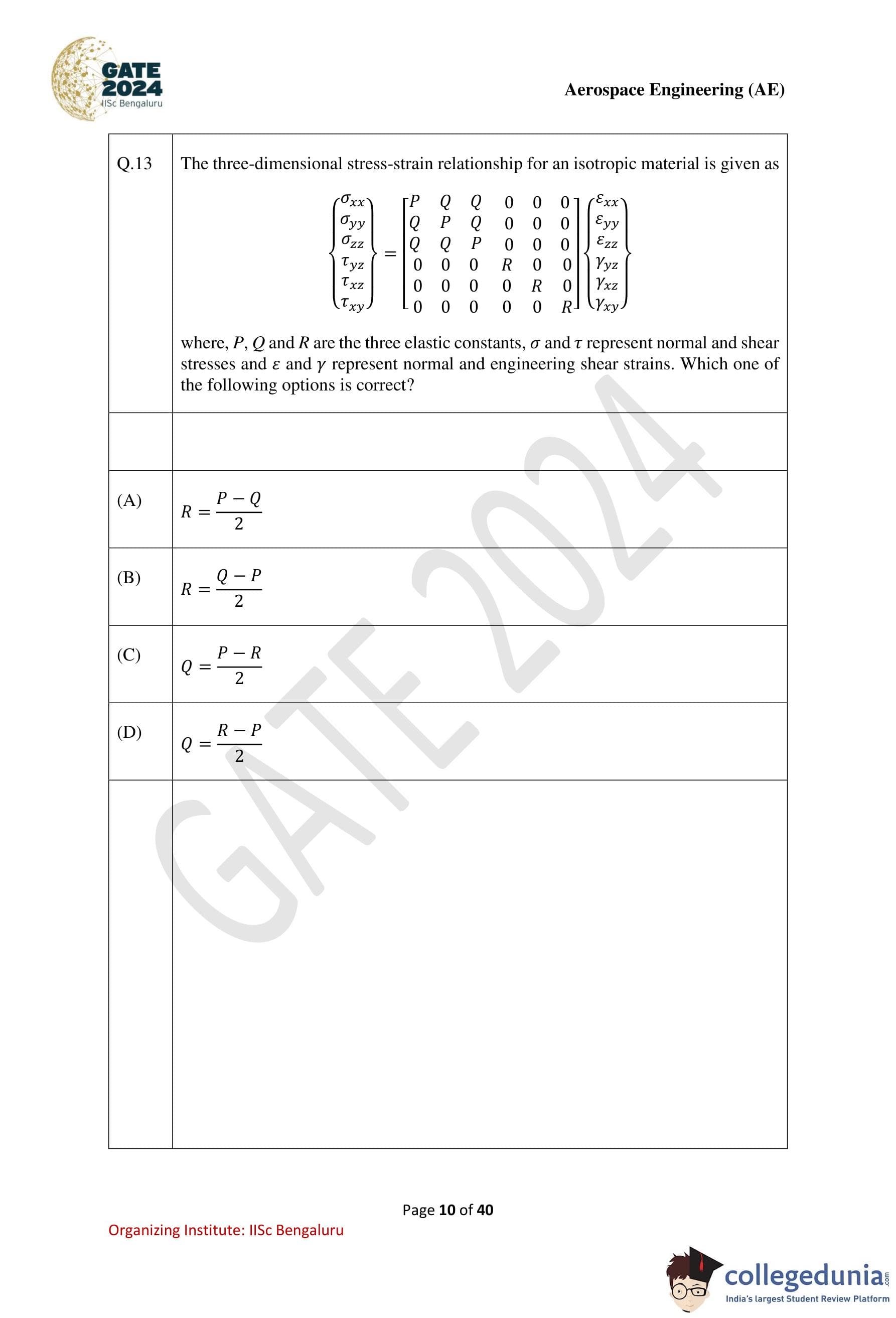
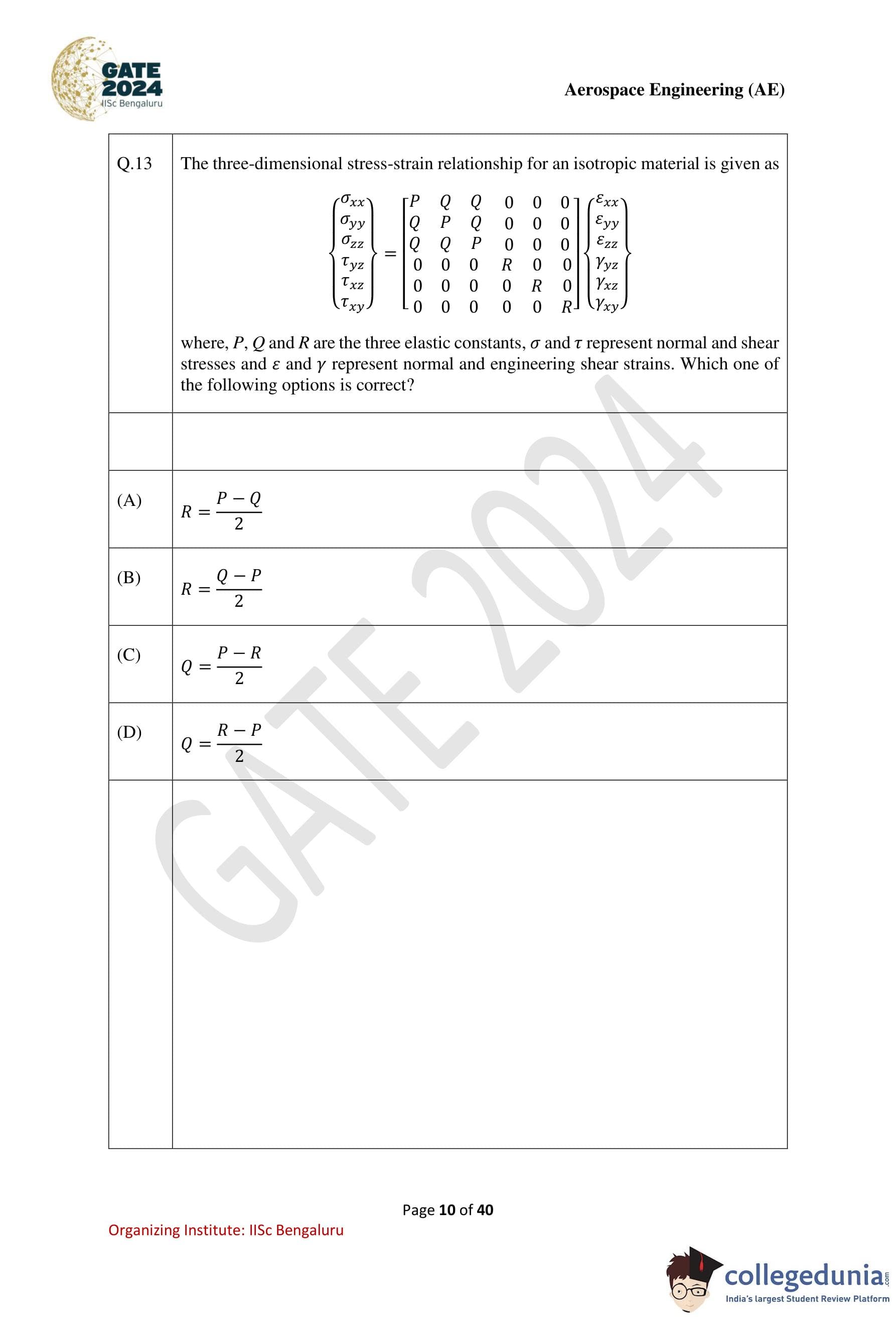
The three-dimensional stress--strain relationship for an isotropic material is given as \[ \begin{Bmatrix} \sigma_{xx}
\sigma_{yy}
\sigma_{zz}
\tau_{yz}
\tau_{xz}
\tau_{xy} \end{Bmatrix} = \begin{bmatrix} P & Q & Q & 0 & 0 & 0
Q & P & Q & 0 & 0 & 0
Q & Q & P & 0 & 0 & 0
0 & 0 & 0 & R & 0 & 0
0 & 0 & 0 & 0 & R & 0
0 & 0 & 0 & 0 & 0 & R \end{bmatrix} \begin{Bmatrix} \varepsilon_{xx}
\varepsilon_{yy}
\varepsilon_{zz}
\gamma_{yz}
\gamma_{xz}
\gamma_{xy} \end{Bmatrix} \]
where \(P\), \(Q\), and \(R\) are elastic constants. Which one of the following options is correct?
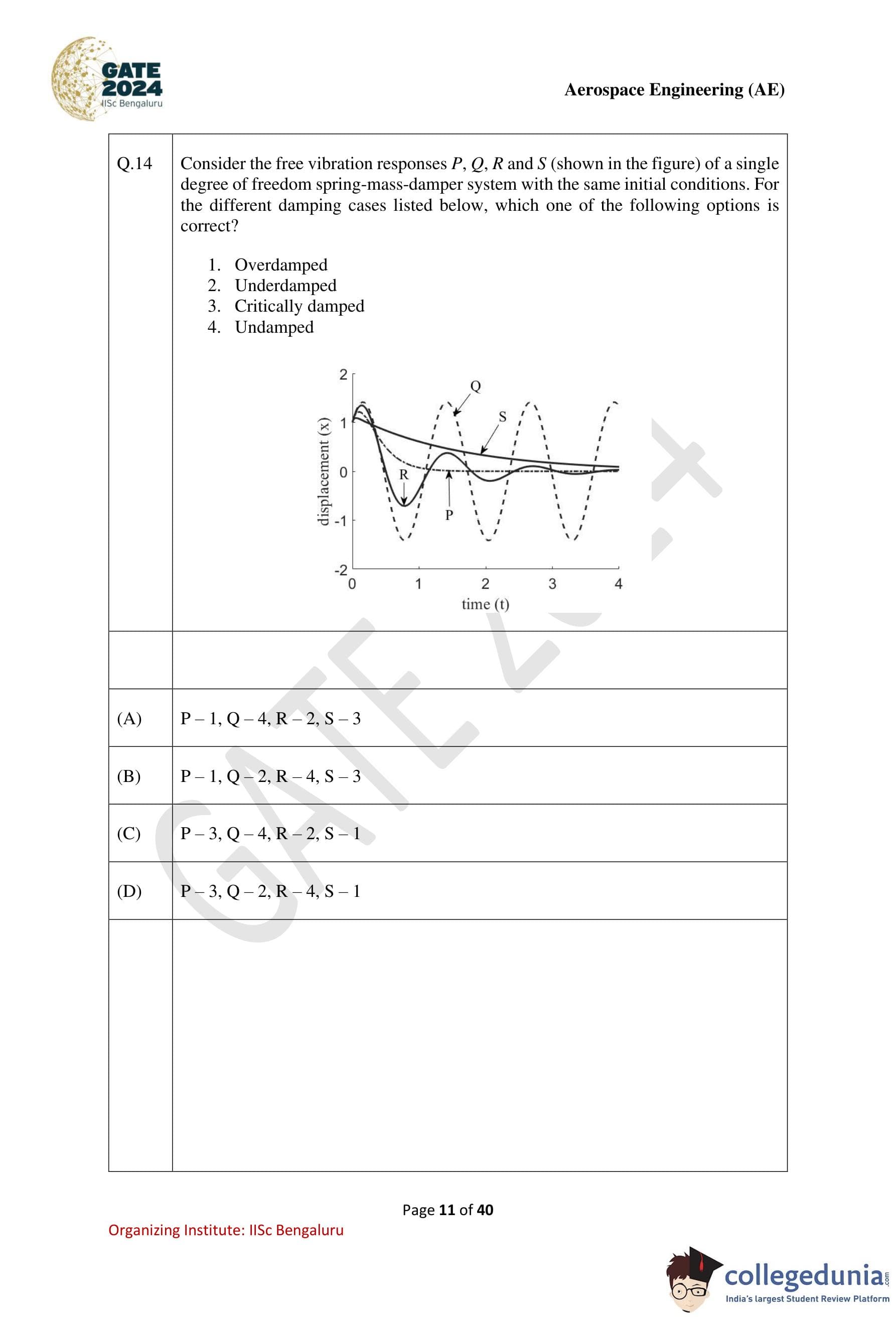
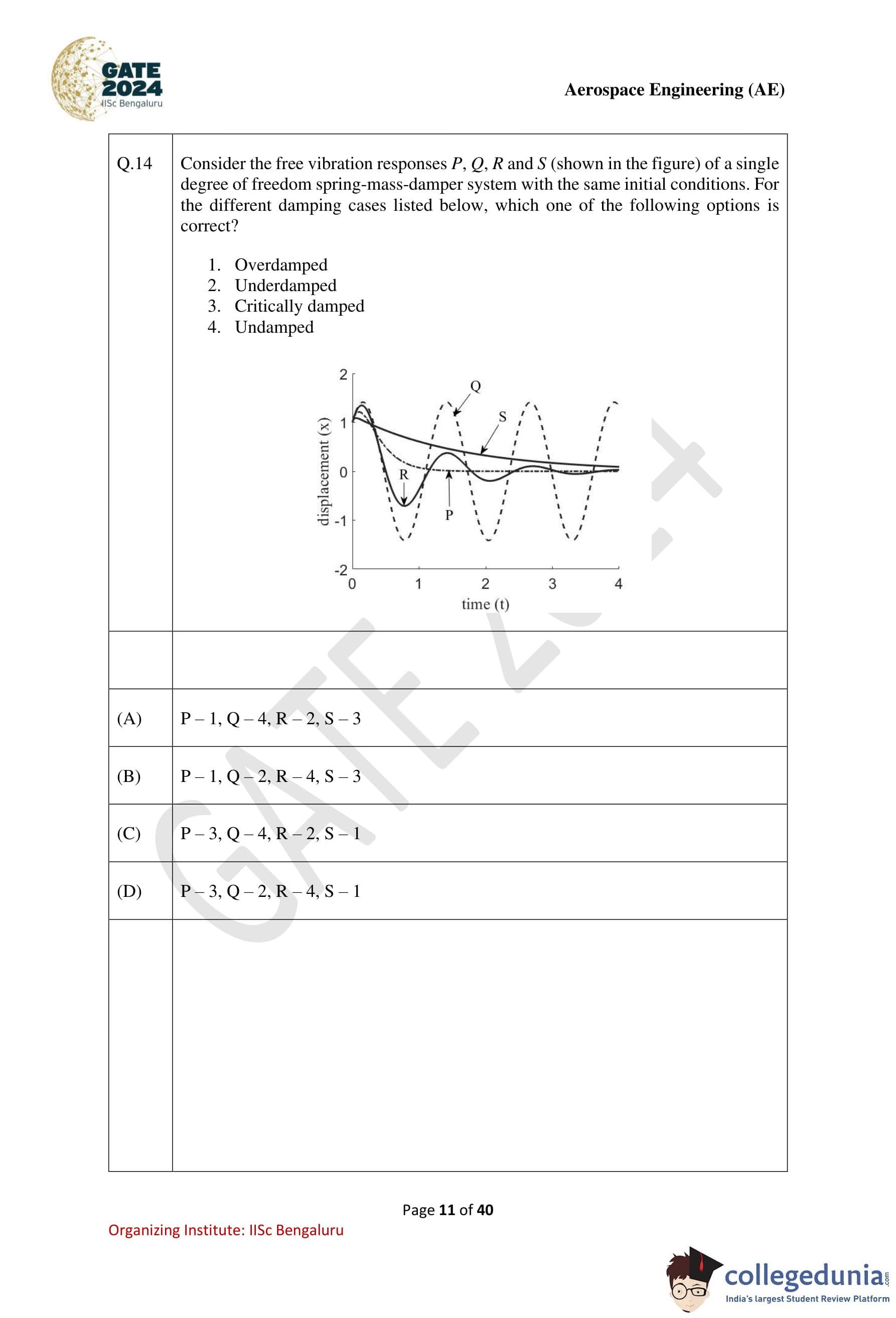
Consider the free vibration responses \(P\), \(Q\), \(R\), and \(S\) (shown in the figure) of a single degree of freedom spring--mass--damper system with the same initial conditions.
For the different damping cases listed below, which one of the following options is correct?
Overdamped
Underdamped
Critically damped
Undamped

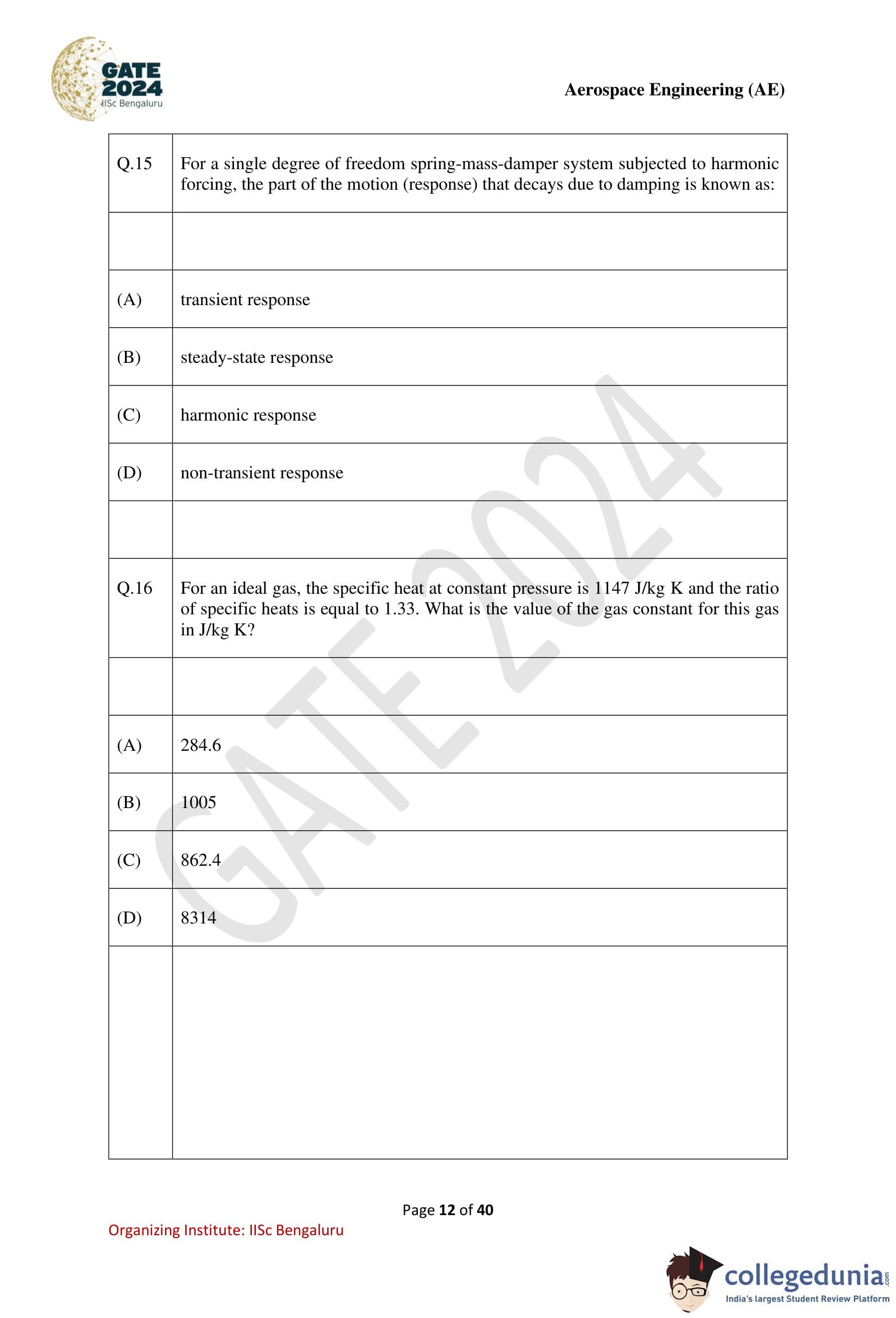
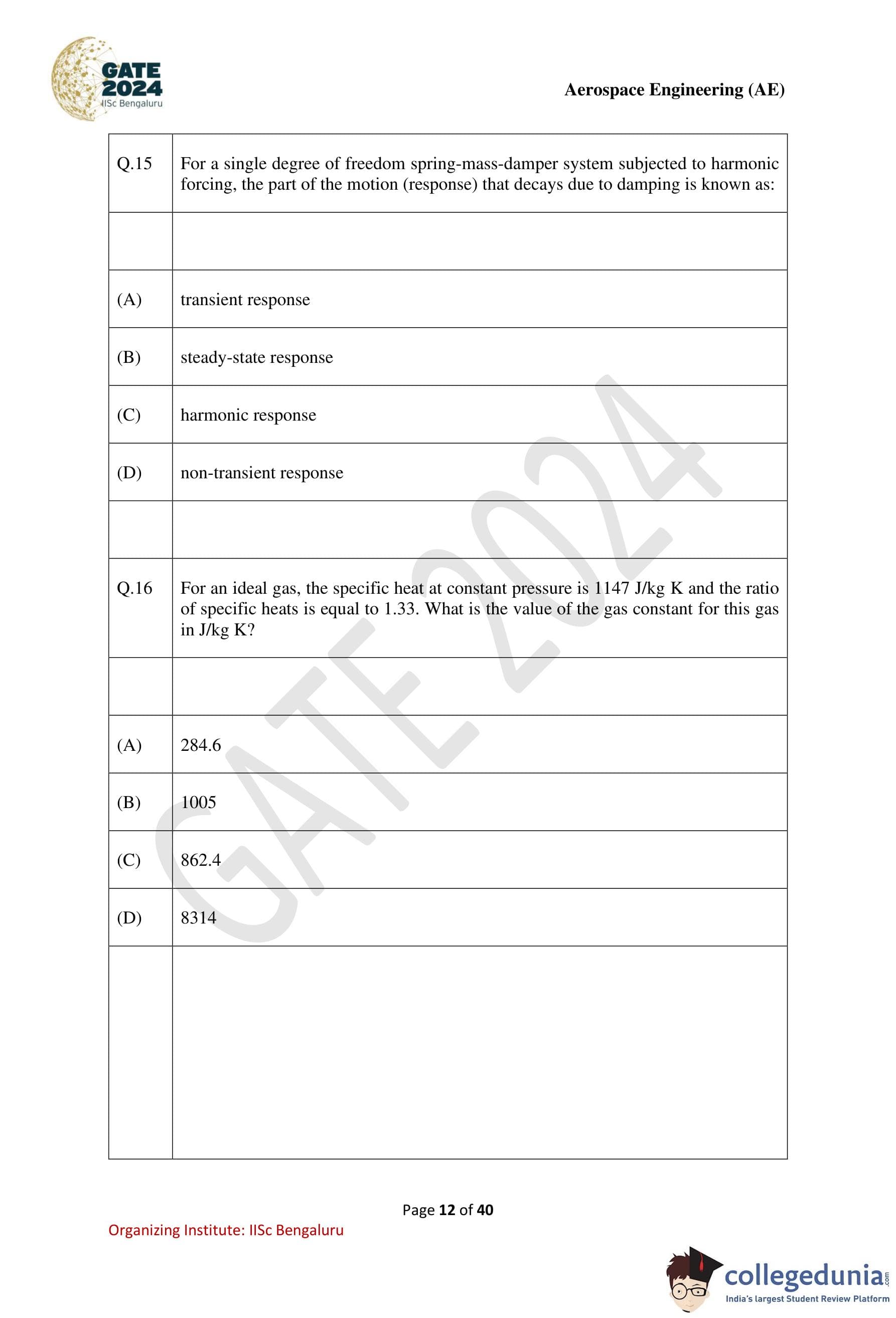
For a single degree of freedom spring--mass--damper system subjected to harmonic forcing,
the part of the motion (response) that decays due to damping is known as:
For an ideal gas, the specific heat at constant pressure is \(1147\) J/kg K and the ratio of specific heats is \(1.33\).
What is the value of the gas constant for this gas (in J/kg K)?
A surrogate liquid hydrocarbon fuel, approximated as \(C_{10}H_{12}\), is being burned in a land-based gas turbine combustor with dry air (\(79%\) \(N_2\) and \(21%\) \(O_2\) by volume).
How many moles of dry air are required for the stoichiometric combustion of the surrogate fuel with dry air at atmospheric temperature and pressure?
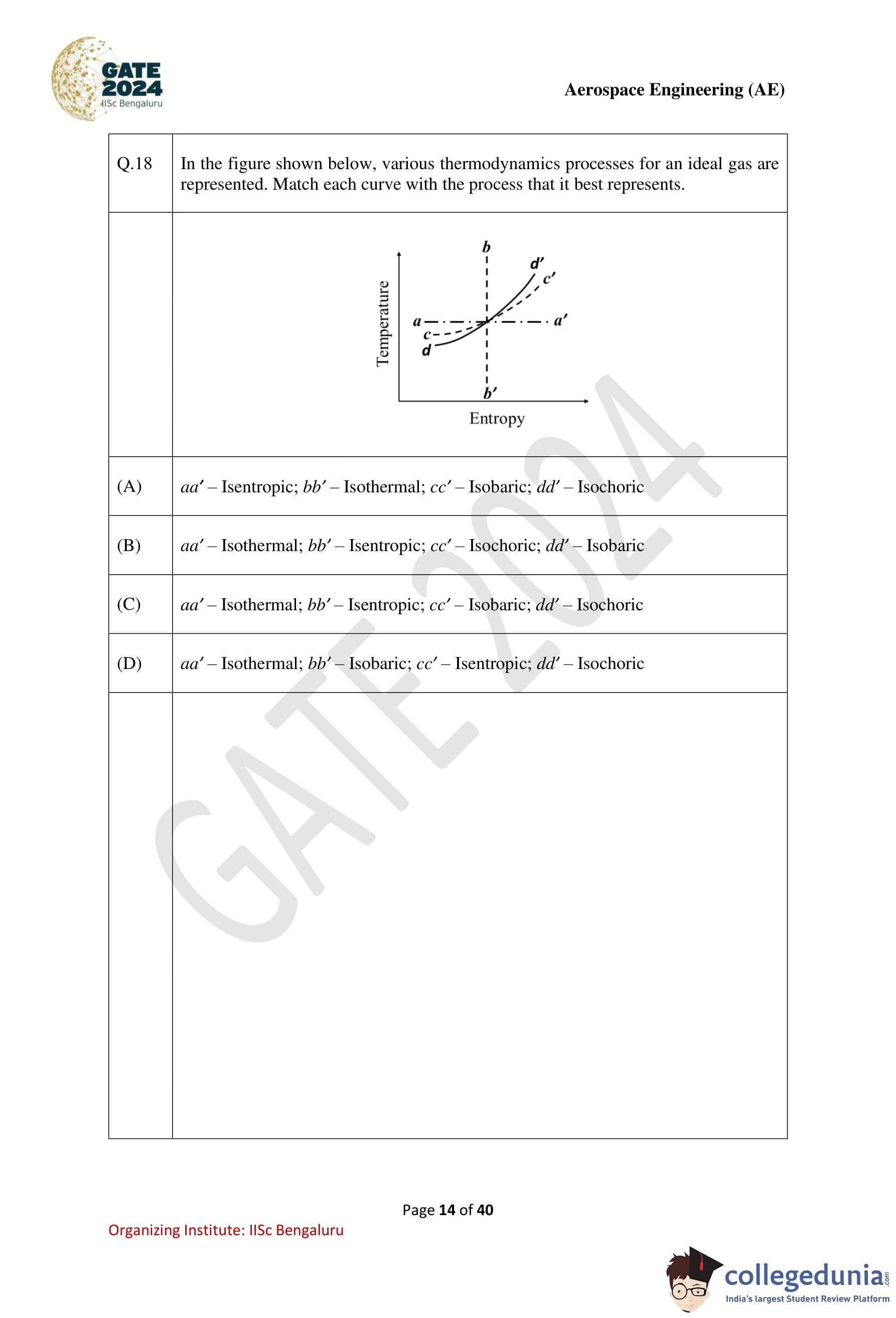
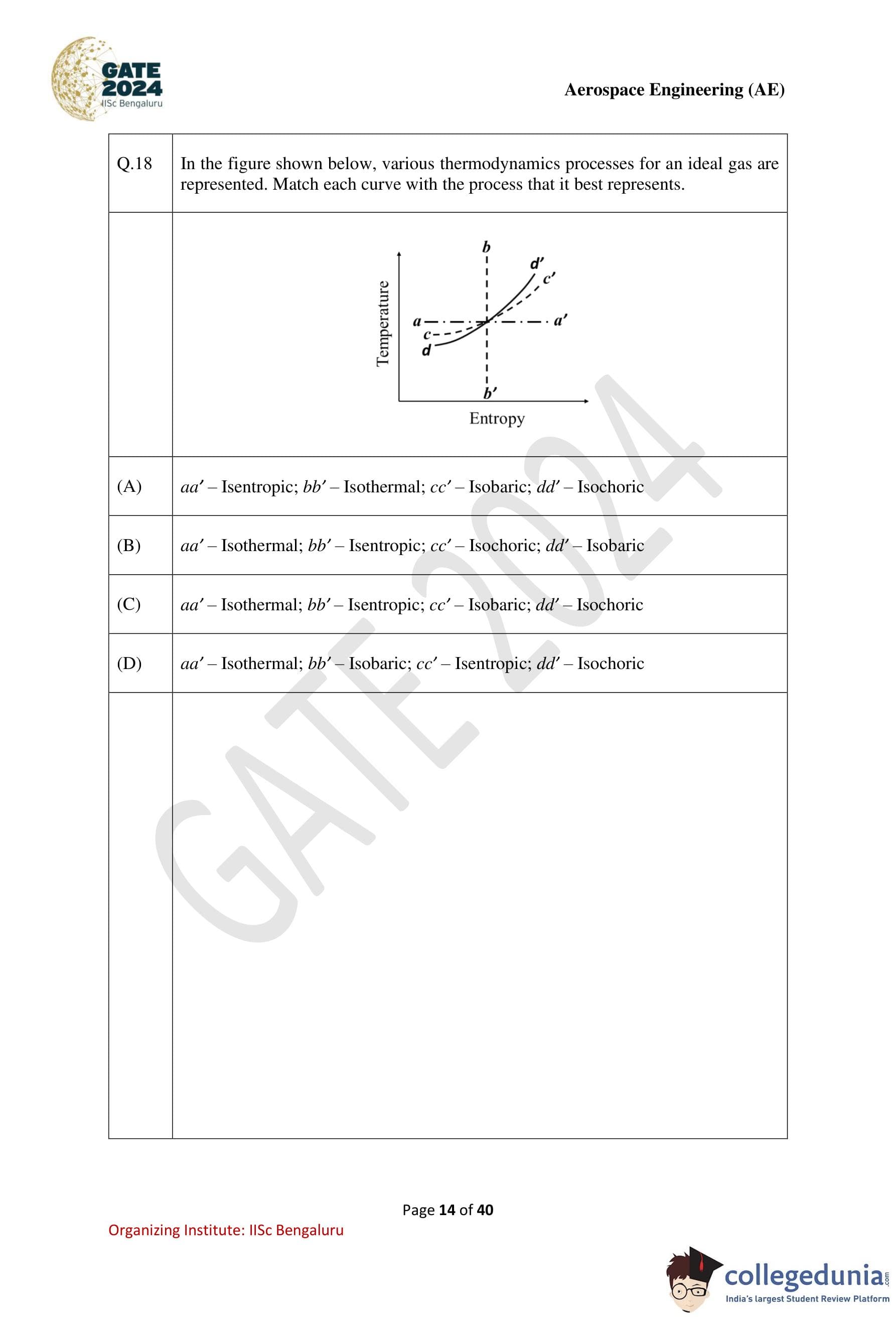
In the figure shown below, various thermodynamic processes for an ideal gas are represented.
Match each curve with the process that it best represents.

In an airbreathing gas turbine engine, the combustor inlet temperature is \(600\) K.
The heating value of the fuel is \(43.4 \times 10^{6}\) J/kg.
Assume \(C_p = 1100\) J/kg K for air and burned gases, and fuel--air ratio \(f \ll 1.0\).
Neglect kinetic energy at the inlet and exit of the combustor and assume \(100%\) burner efficiency.
What is the fuel--air ratio required to achieve \(1300\) K temperature at the combustor exit?
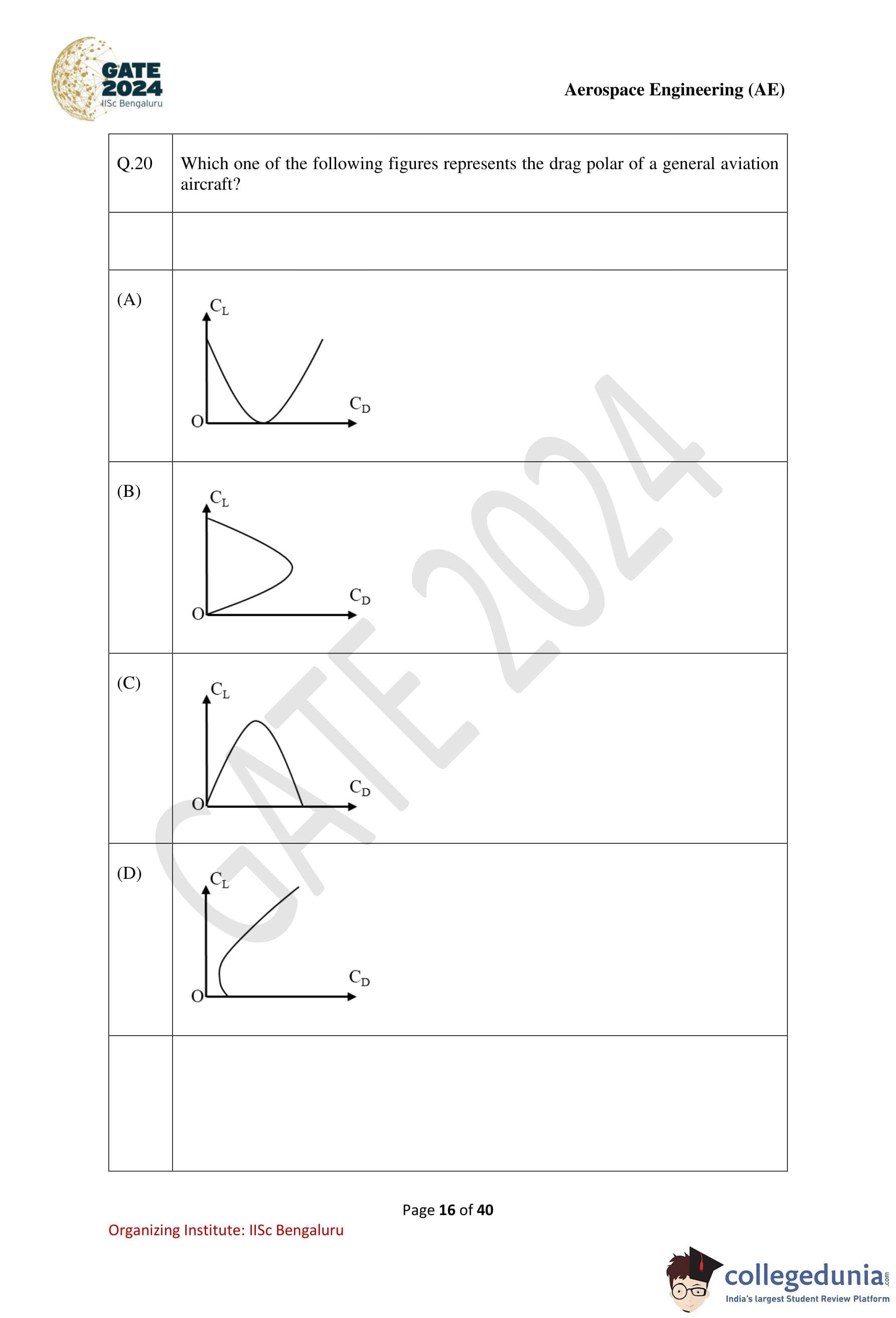
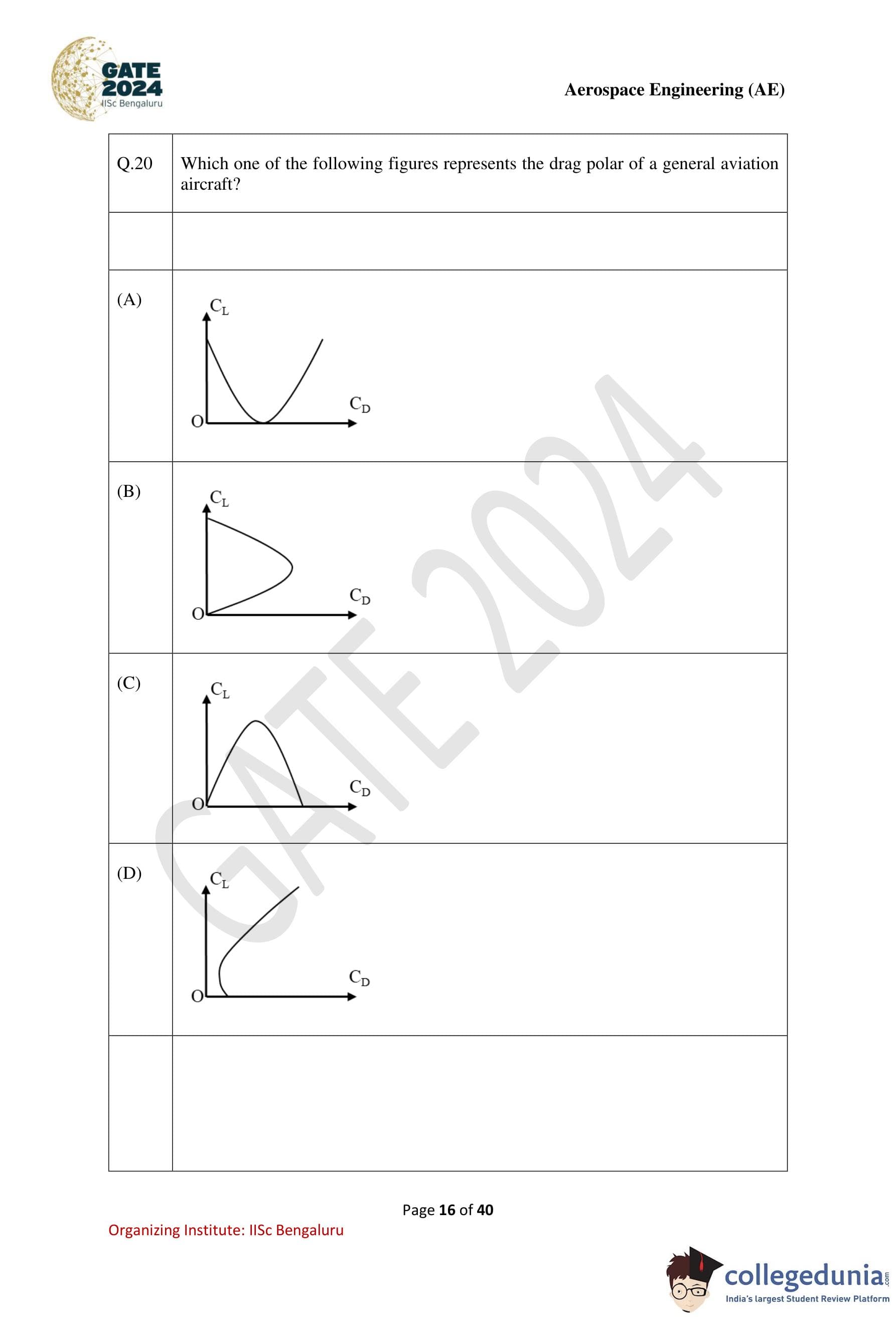
Which one of the following figures represents the drag polar of a general aviation aircraft?

In the context of steady, inviscid, incompressible flows, consider the superposition of a uniform flow with speed \(U\) along the positive \(x\)-axis (from left to right), and a source of strength \(A\) located at the origin.
Which one of the following statements is \emph{NOT true regarding the location of the stagnation point of the resulting flow?
On Day 1, an aircraft flies with a speed of \(V_1\) m/s at an altitude where the temperature is \(T_1\) K.
On Day 2, the same aircraft flies with a speed of \(\sqrt{1.2}\,V_1\) m/s at an altitude where the temperature is \(1.2\,T_1\) K.
How does the Mach number \(M_2\) on Day 2 compare with the Mach number \(M_1\) on Day 1?
Assume ideal gas behavior for air. Also assume the ratio of specific heats and molecular weight of air to be the same on both days.
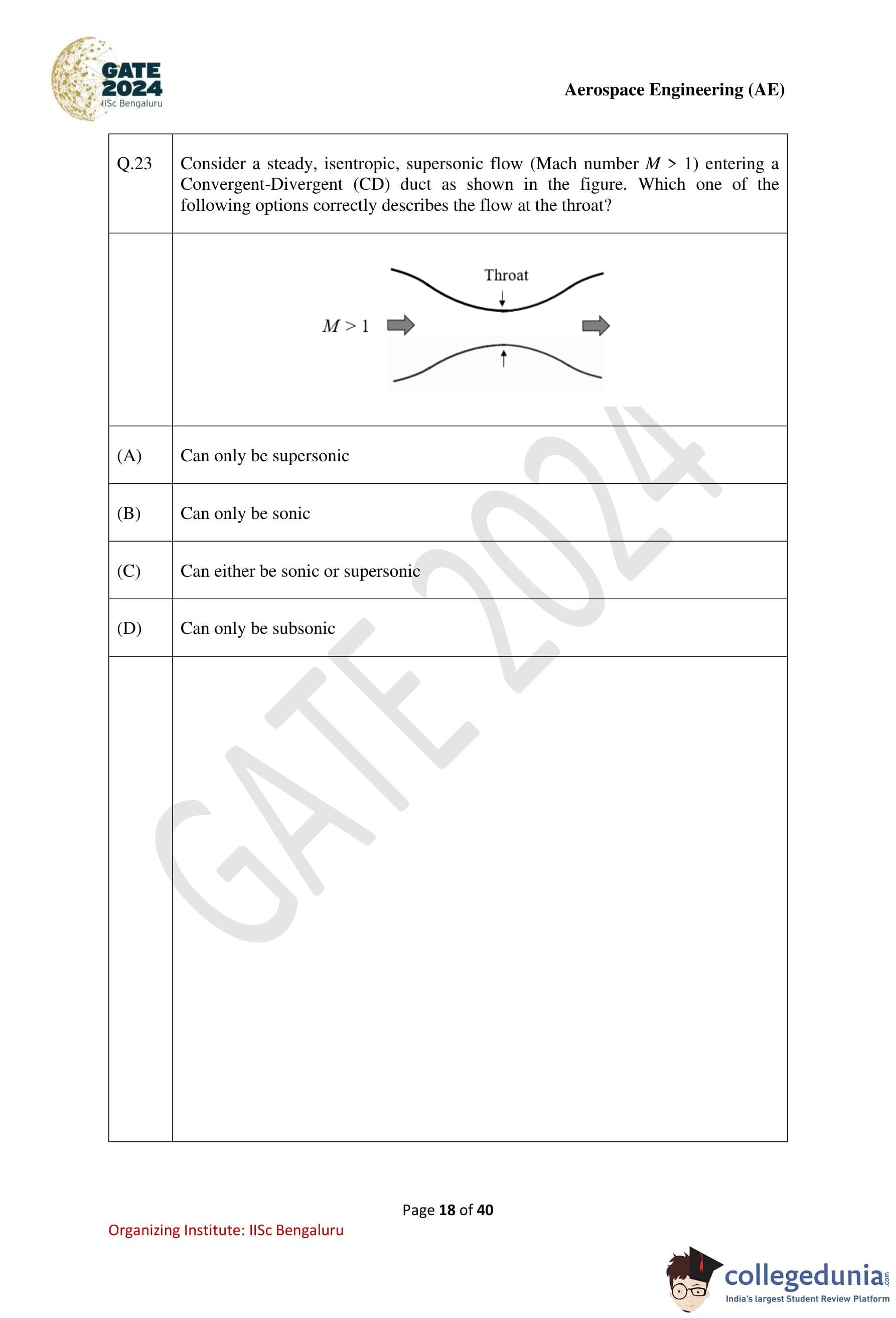
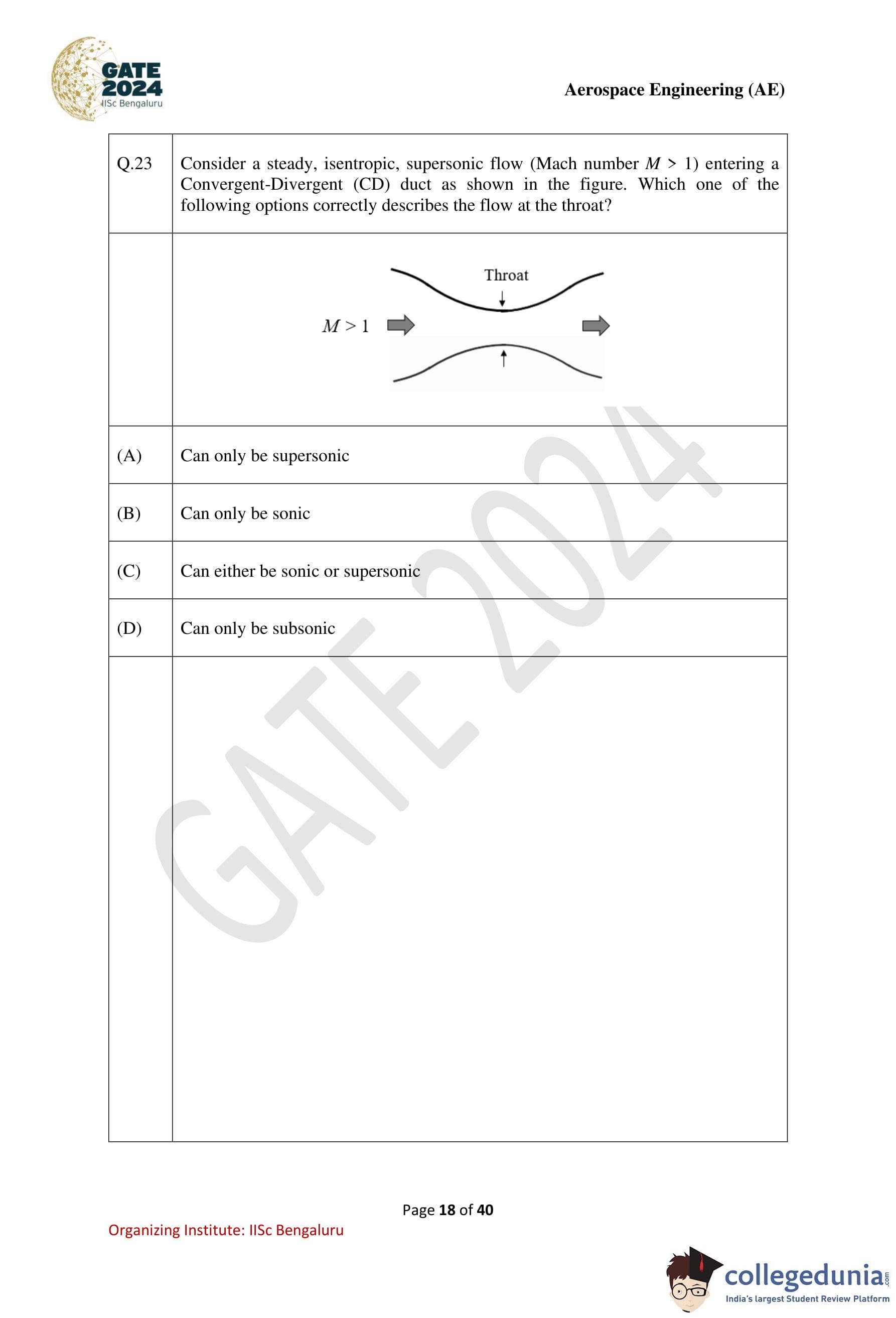
Consider a steady, isentropic, supersonic flow (Mach number \(M>1\)) entering a Convergent--Divergent (CD) duct as shown in the figure.
Which one of the following options correctly describes the flow at the throat?

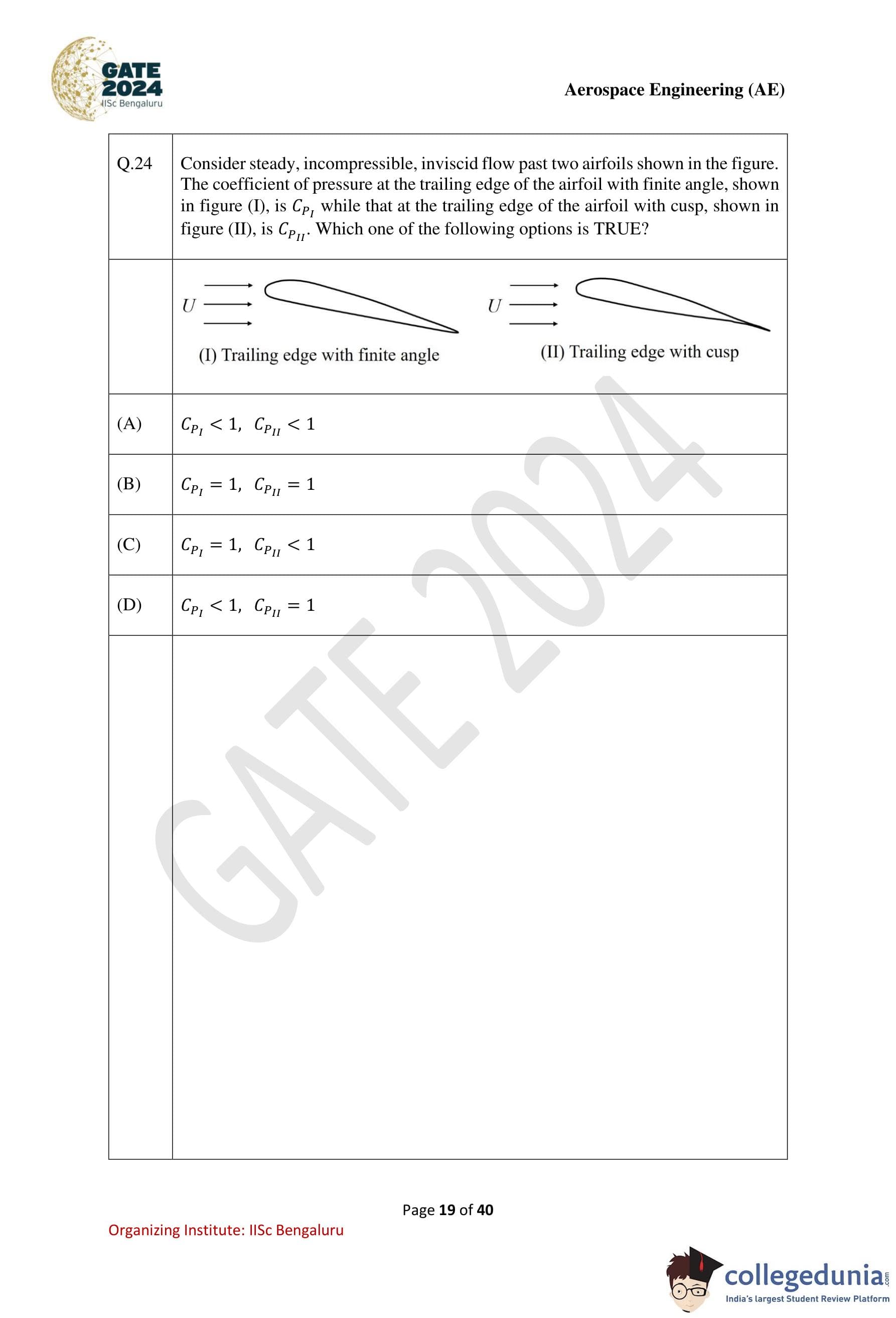
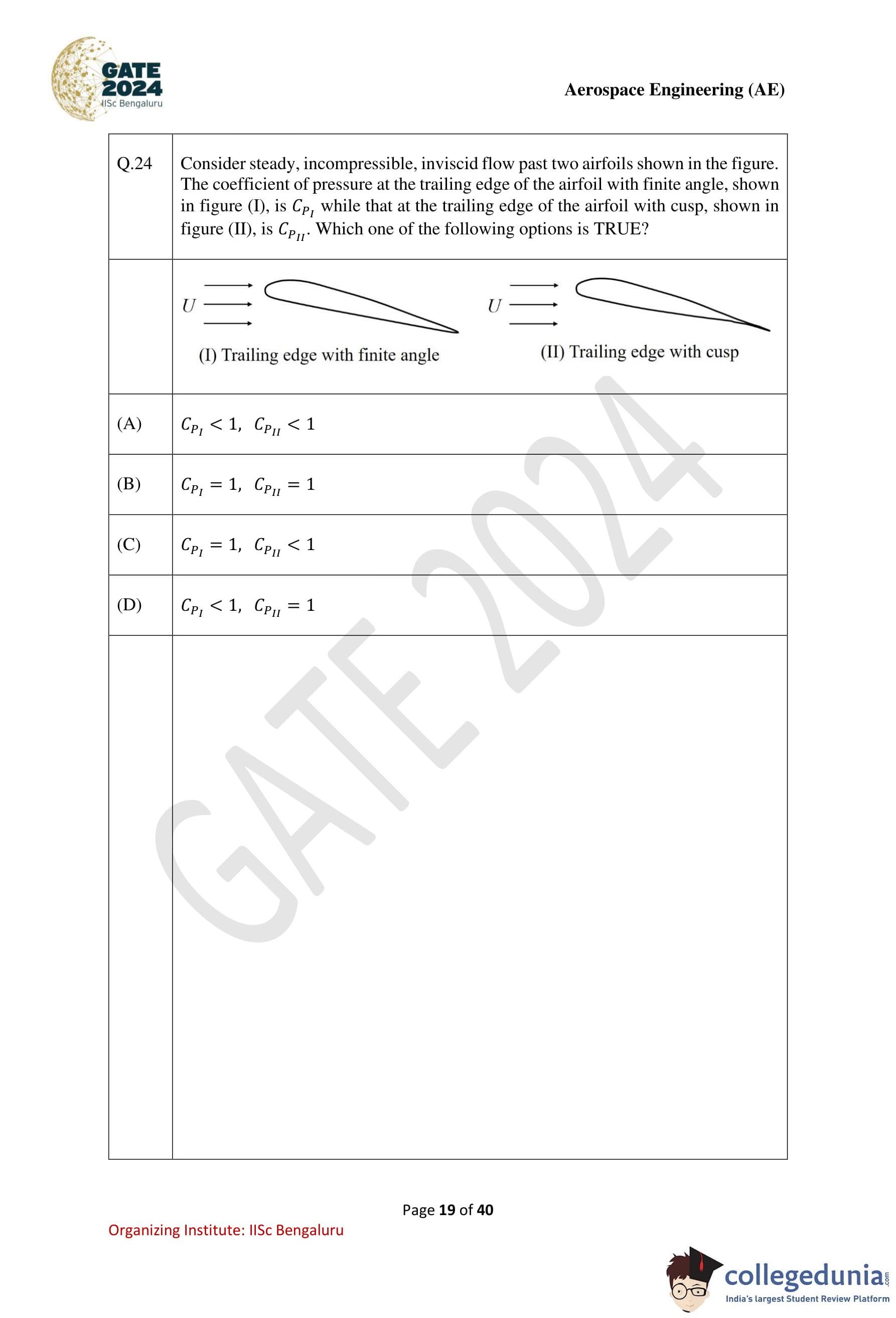
Consider steady, incompressible, inviscid flow past two airfoils shown in the figure.
The coefficient of pressure at the trailing edge of the airfoil with finite angle, shown in figure (I), is \(C_{p_I}\),
while that at the trailing edge of the airfoil with cusp, shown in figure (II), is \(C_{p_{II}}\).
Which one of the following options is TRUE?

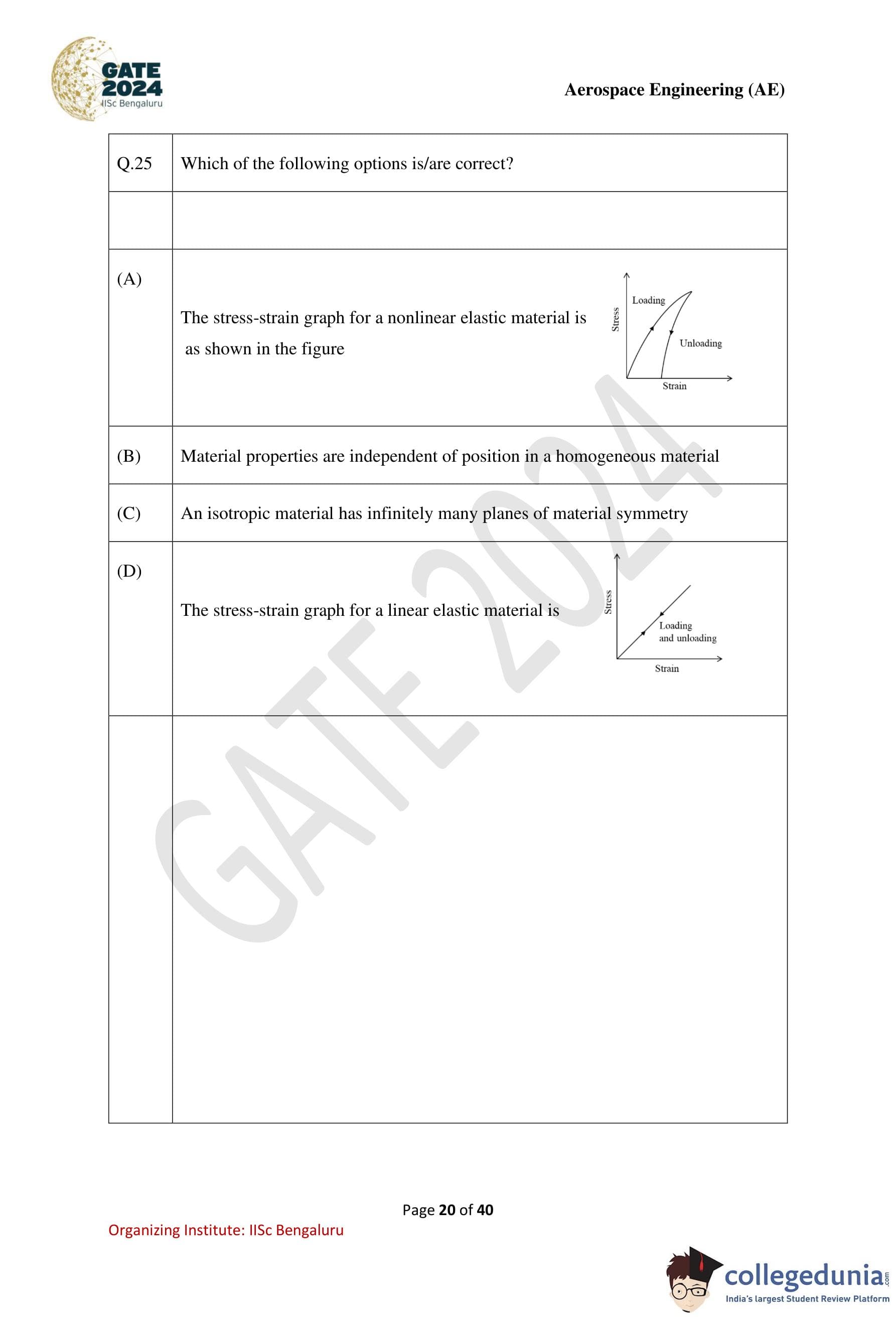
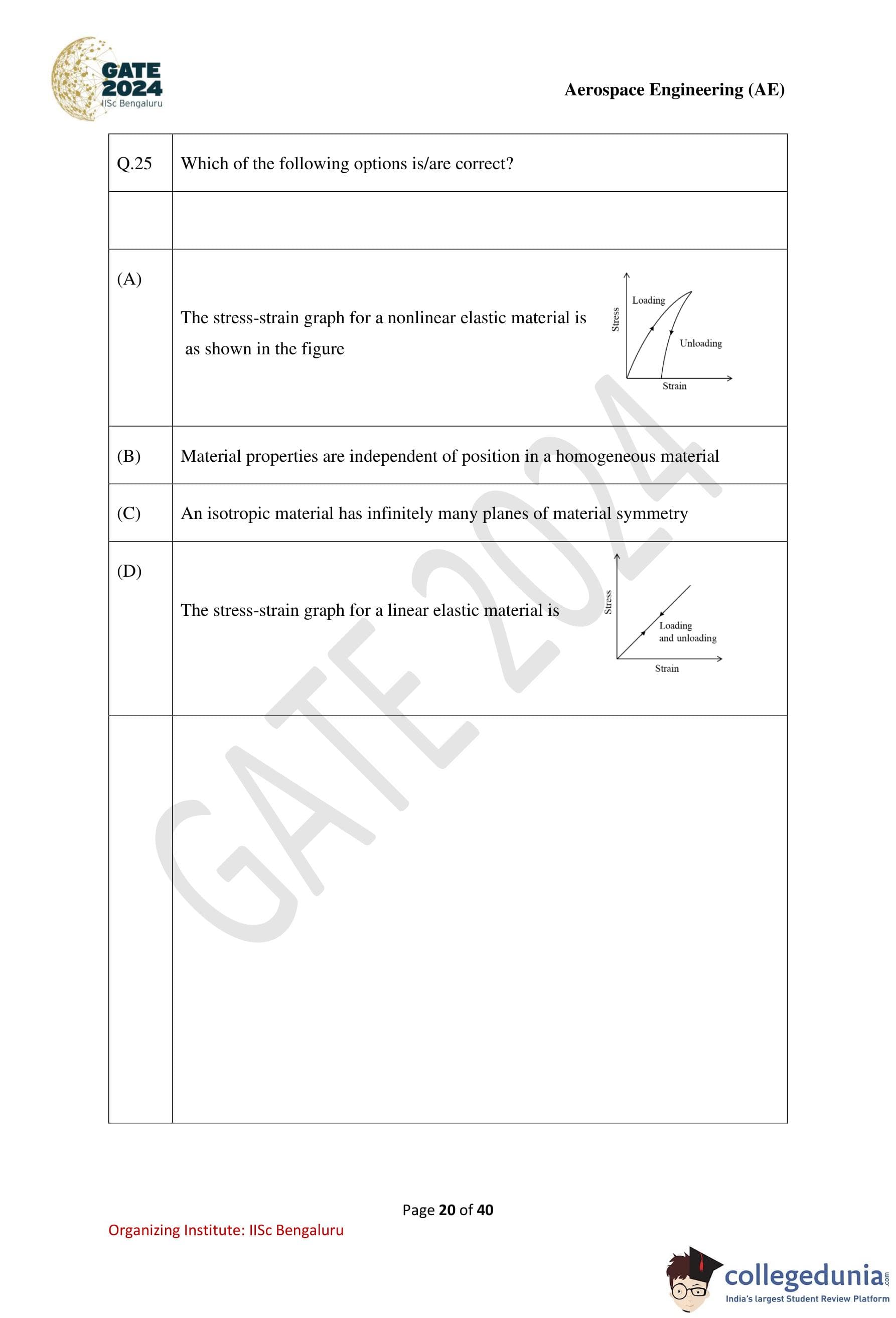
Which of the following options is/are correct?
- (A) The stress--strain graph for a nonlinear elastic material is as shown in the figure
![]()
- (B) Material properties are independent of position in a homogeneous material
- (C) An isotropic material has infinitely many planes of material symmetry
- (D) The stress--strain graph for a linear elastic material is as shown in the figure
![]()


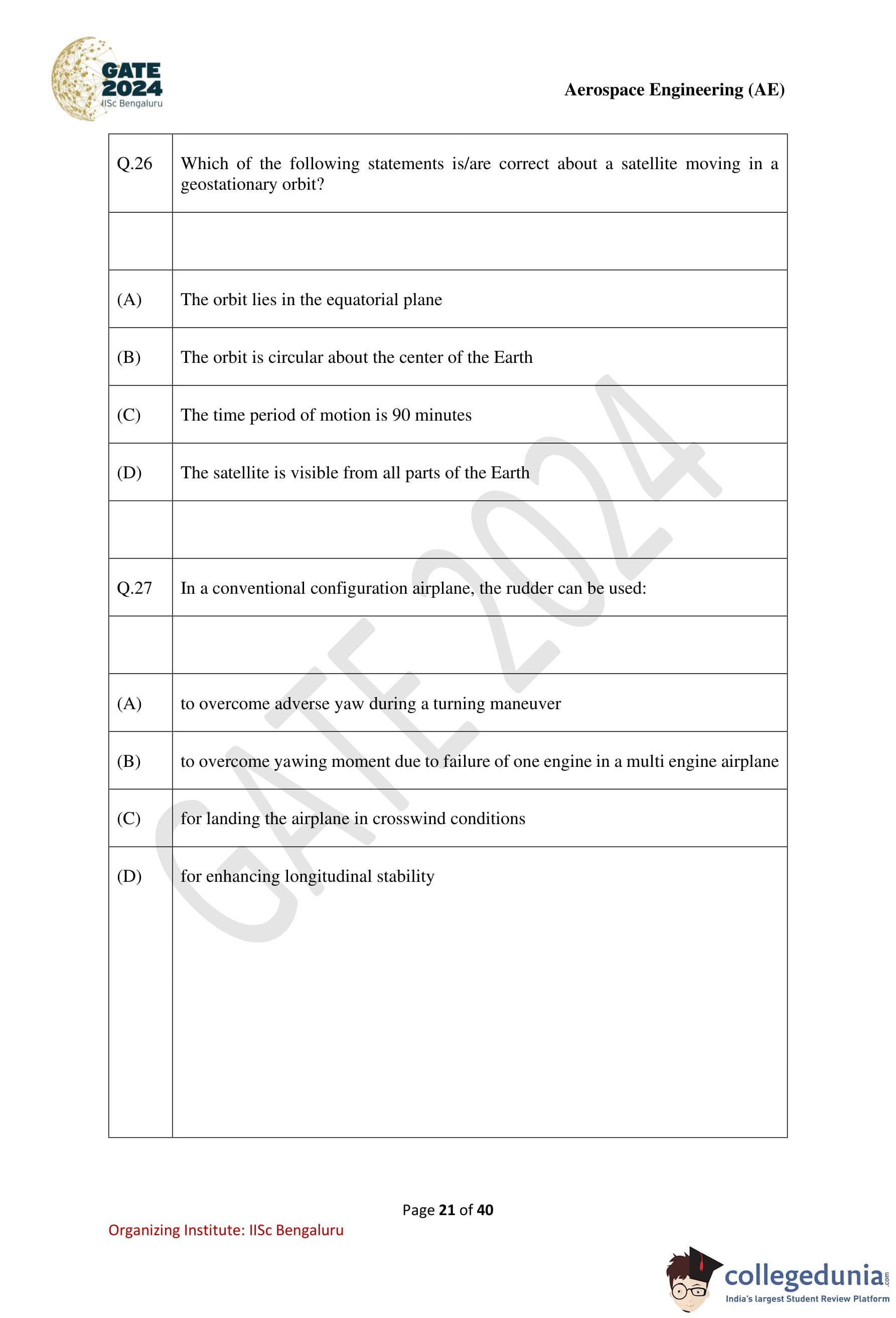
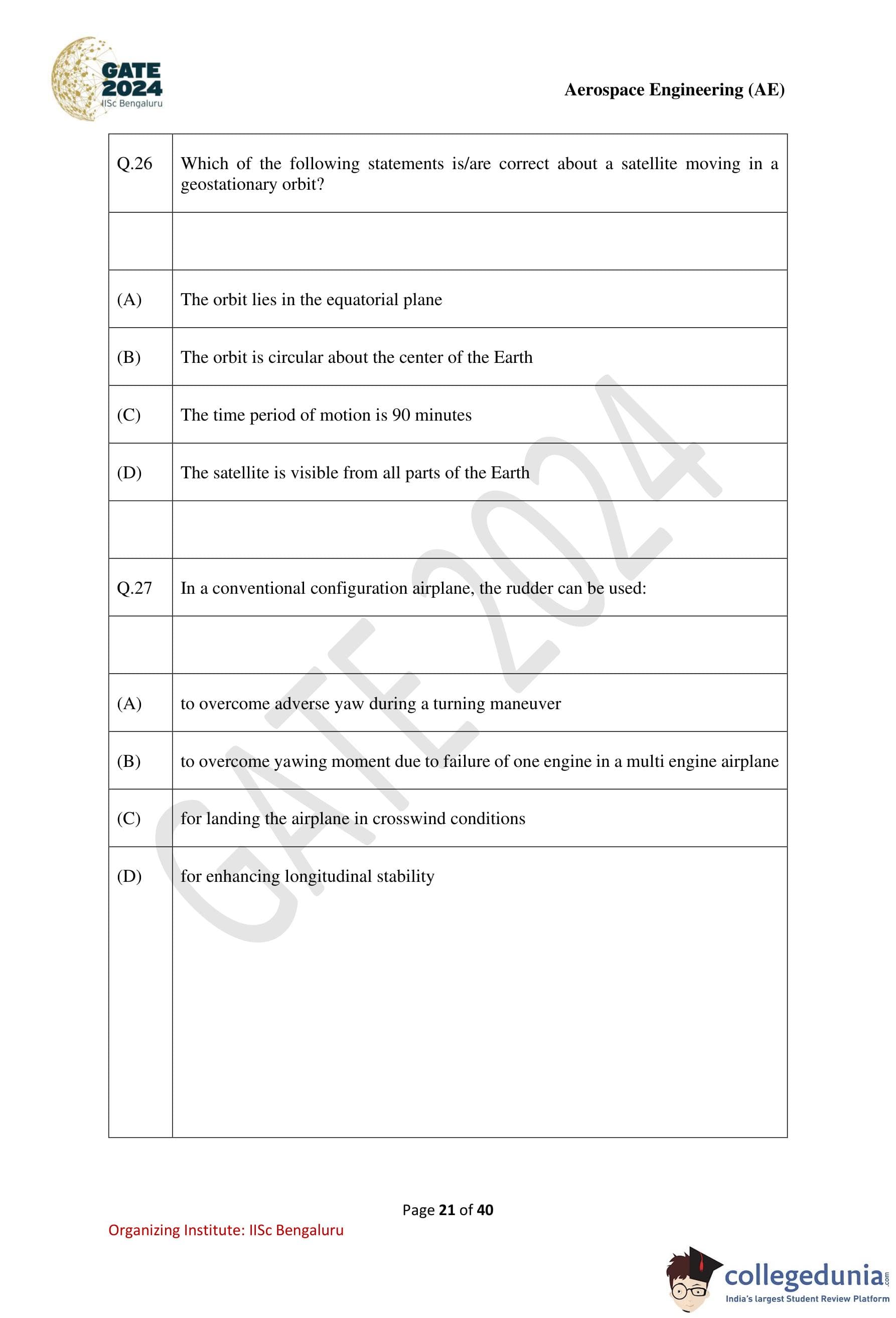
Which of the following statements is/are correct about a satellite moving in a geostationary orbit?
In a conventional configuration airplane, the rudder can be used:
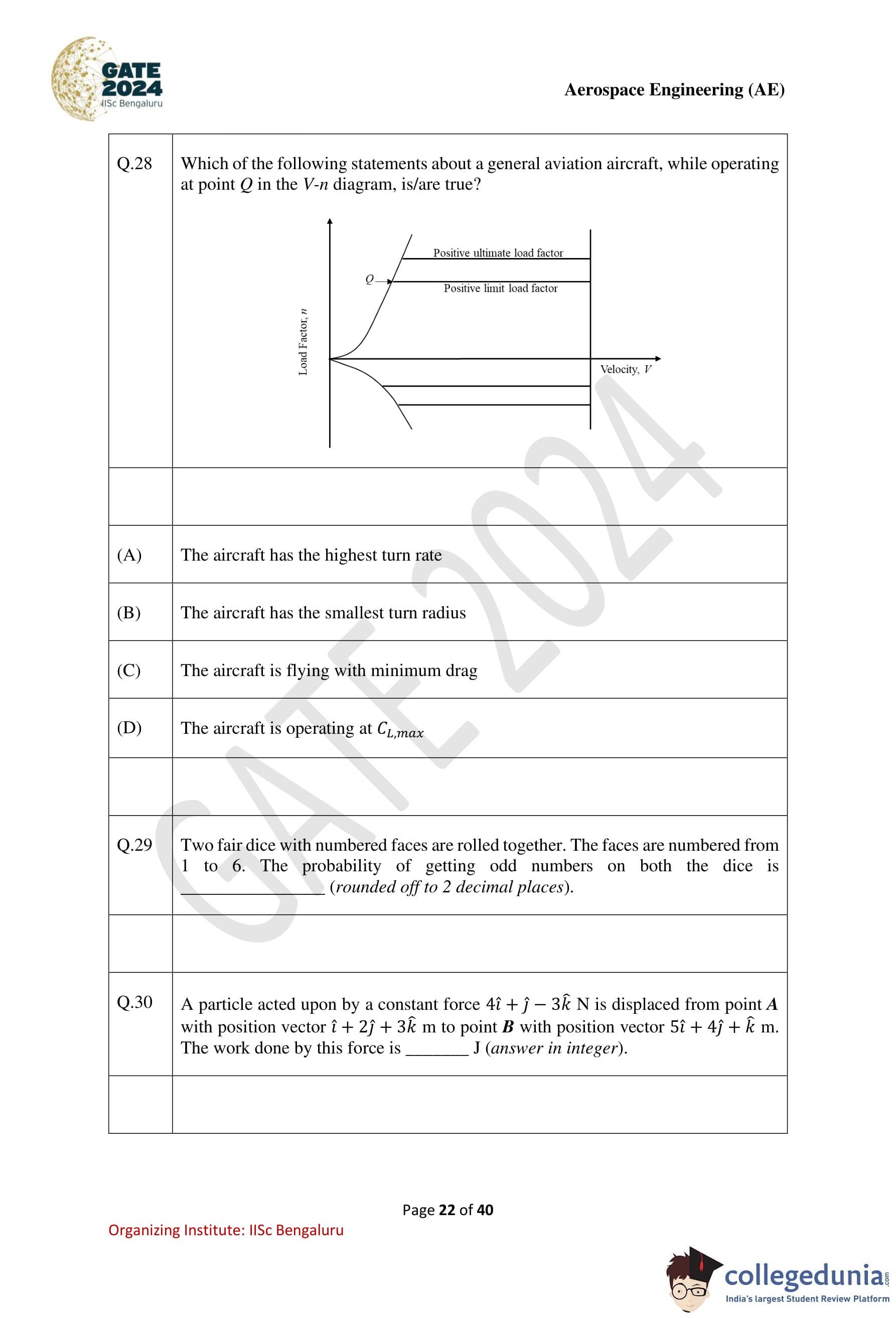
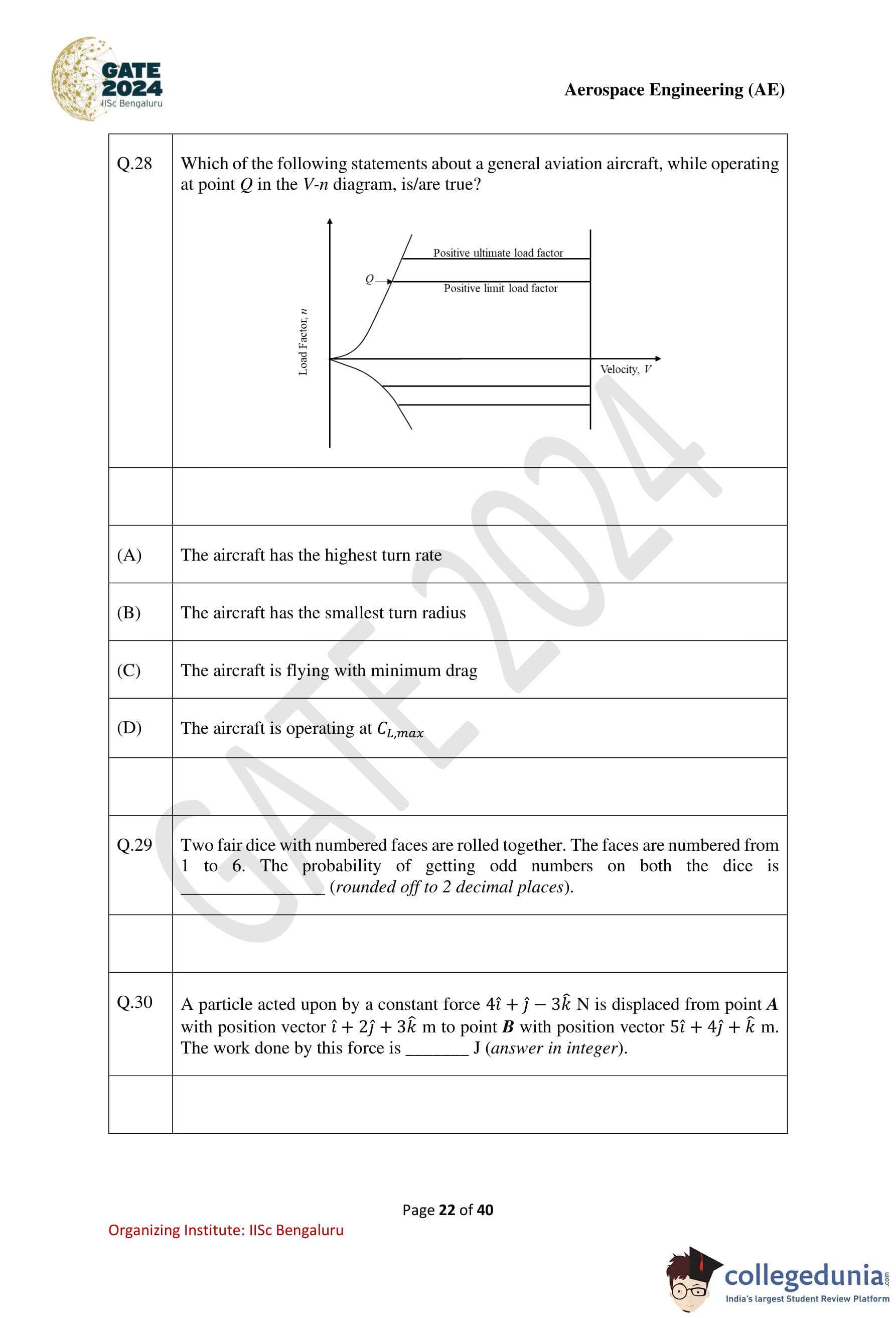
Which of the following statements about a general aviation aircraft, while operating at point \(Q\) in the \(V\)--\(n\) diagram, is/are true?

Two fair dice with numbered faces are rolled together. The faces are numbered from \(1\) to \(6\).
The probability of getting odd numbers on both the dice is (rounded off to \(2\) decimal places).
A particle acted upon by a constant force \(\vec{F} = 4\hat{i} + \hat{j} - 3\hat{k}\ N\)
is displaced from point \(A\) with position vector \(\hat{i} + 2\hat{j} + 3\hat{k}\ m\)
to point \(B\) with position vector \(5\hat{i} + 4\hat{j} + \hat{k}\ m\).
The work done by this force is \rule{1.5cm{0.15mm J (answer in integer).
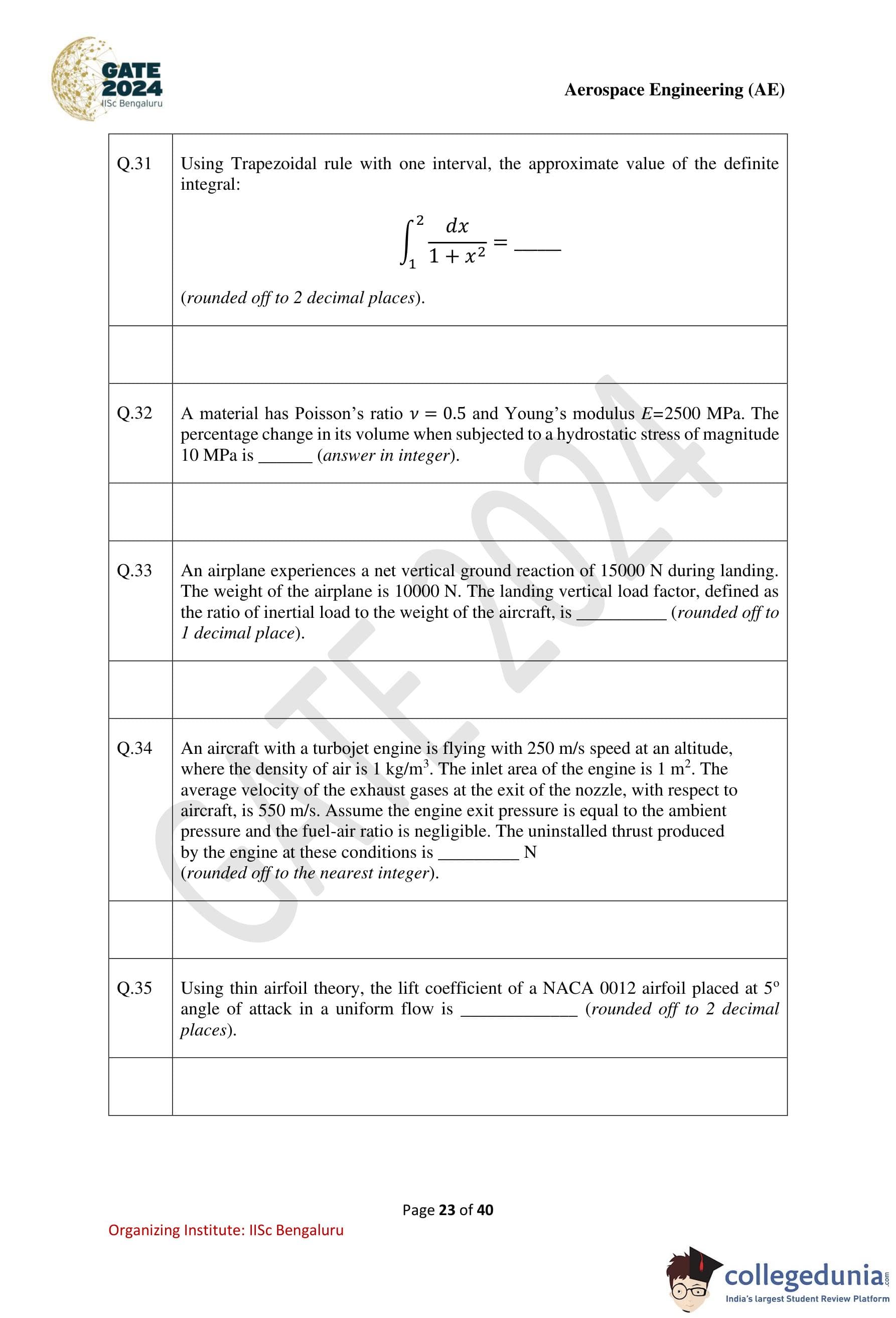
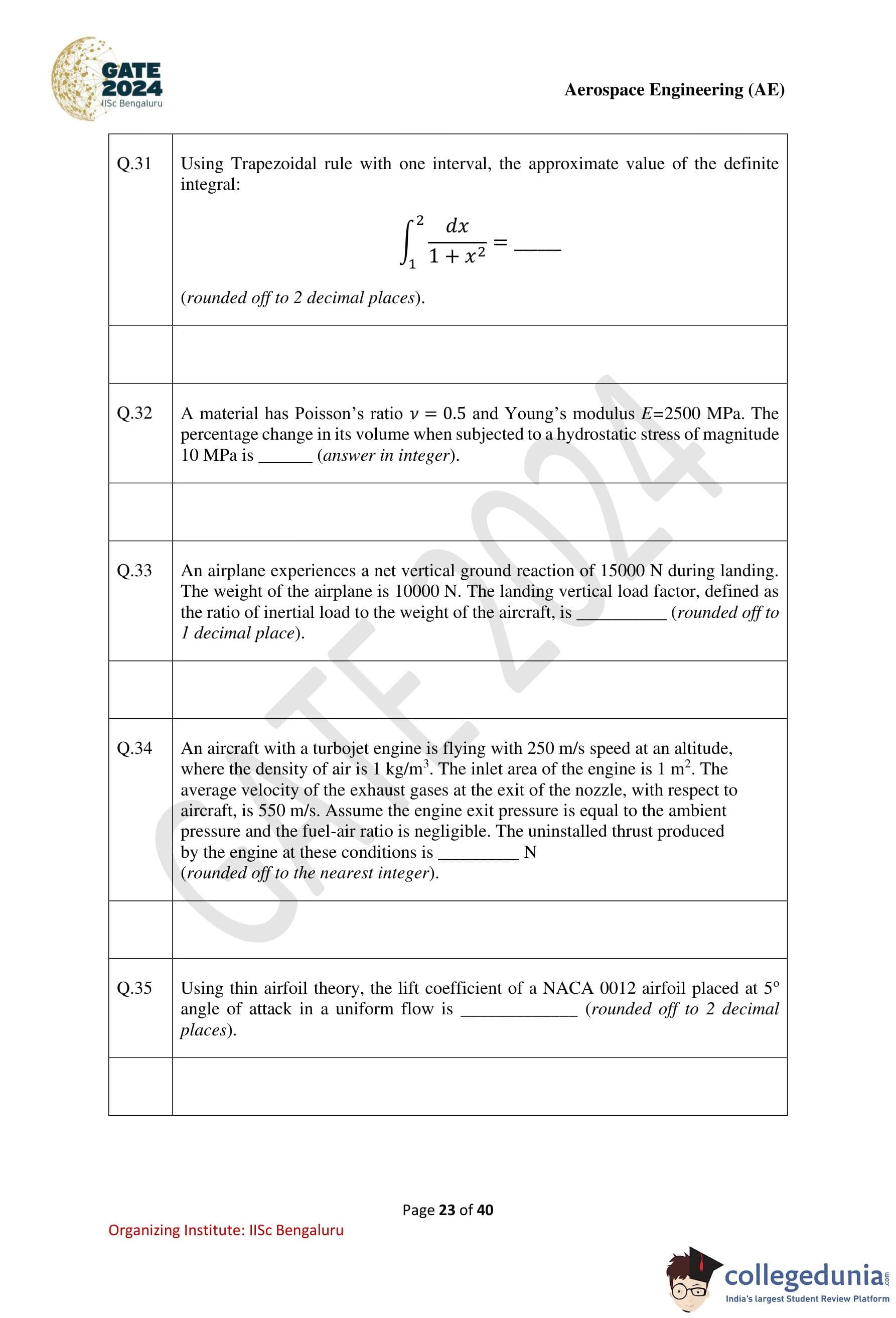
Using the Trapezoidal rule with one interval, the approximate value of the definite integral \[ \int_{1}^{2} \frac{dx}{1+x^2} = \rule{1.5cm}{0.15mm} \]
(rounded off to \(2\) decimal places).
A material has Poisson’s ratio \(\nu = 0.5\) and Young’s modulus \(E = 2500\) MPa.
The percentage change in its volume when subjected to a hydrostatic stress of magnitude \(10\) MPa is \rule{1.5cm{0.15mm
(answer in integer).
An airplane experiences a net vertical ground reaction of \(15000\) N during landing.
The weight of the airplane is \(10000\) N.
The landing vertical load factor, defined as the ratio of inertial load to the weight of the aircraft, is \rule{1.5cm{0.15mm
(rounded off to \(1\) decimal place).
An aircraft with a turbojet engine is flying with \(250\) m/s speed at an altitude where the density of air is \(1\) kg/m\(^3\).
The inlet area of the engine is \(1\) m\(^2\).
The average velocity of the exhaust gases at the exit of the nozzle, with respect to the aircraft, is \(550\) m/s.
Assume the engine exit pressure is equal to the ambient pressure and the fuel--air ratio is negligible.
The uninstalled thrust produced by the engine at these conditions is \rule{1.5cm{0.15mm N
(rounded off to the nearest integer).
Using thin airfoil theory, the lift coefficient of a NACA 0012 airfoil placed at \(5^\circ\) angle of attack in a uniform flow is \rule{1.5cm{0.15mm
(rounded off to \(2\) decimal places).
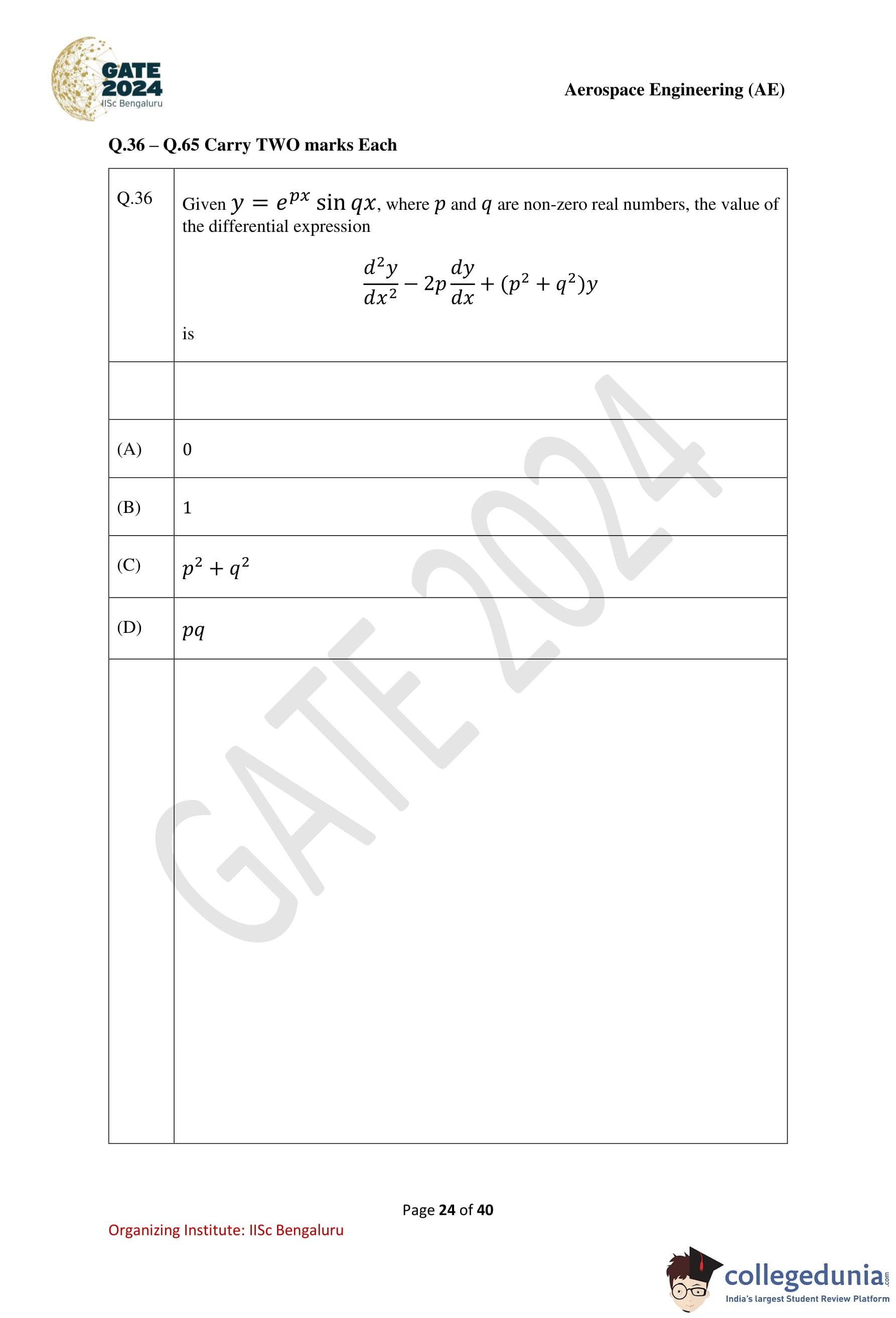
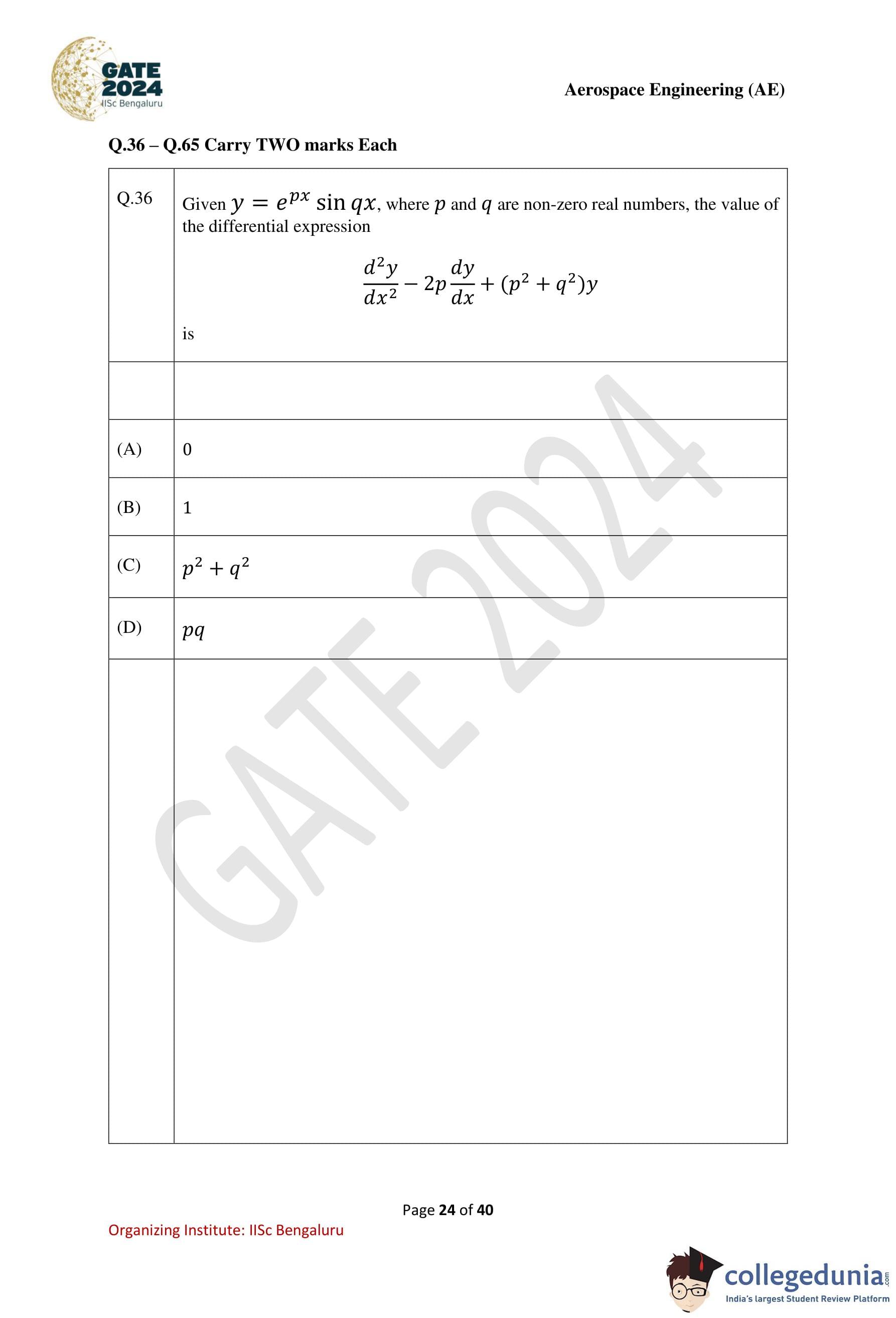
Given \(y = e^{px}\sin qx\), where \(p\) and \(q\) are non-zero real numbers, the value of the differential expression \[ \frac{d^2 y}{dx^2} - 2p\frac{dy}{dx} + (p^2 + q^2)y \]
is
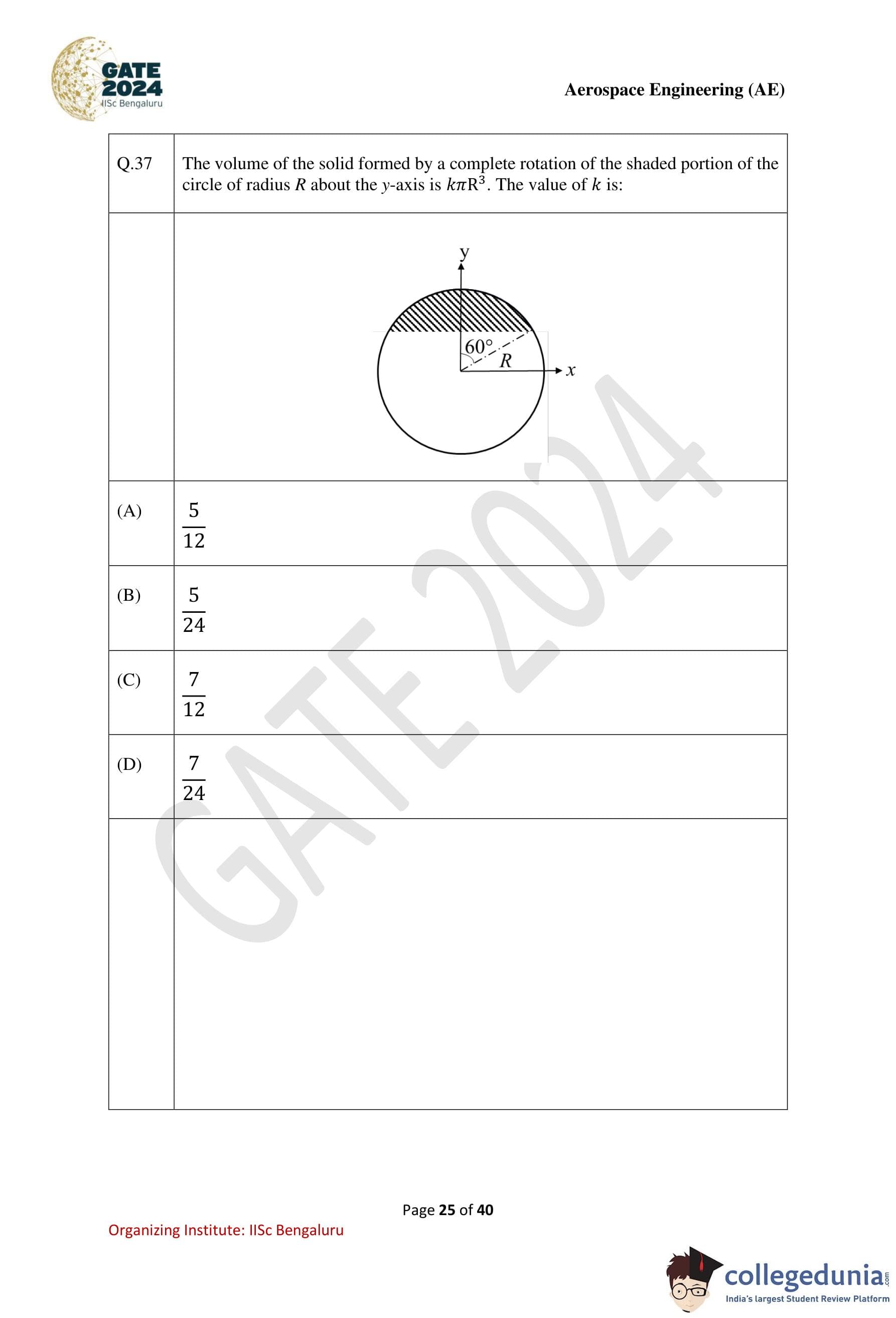
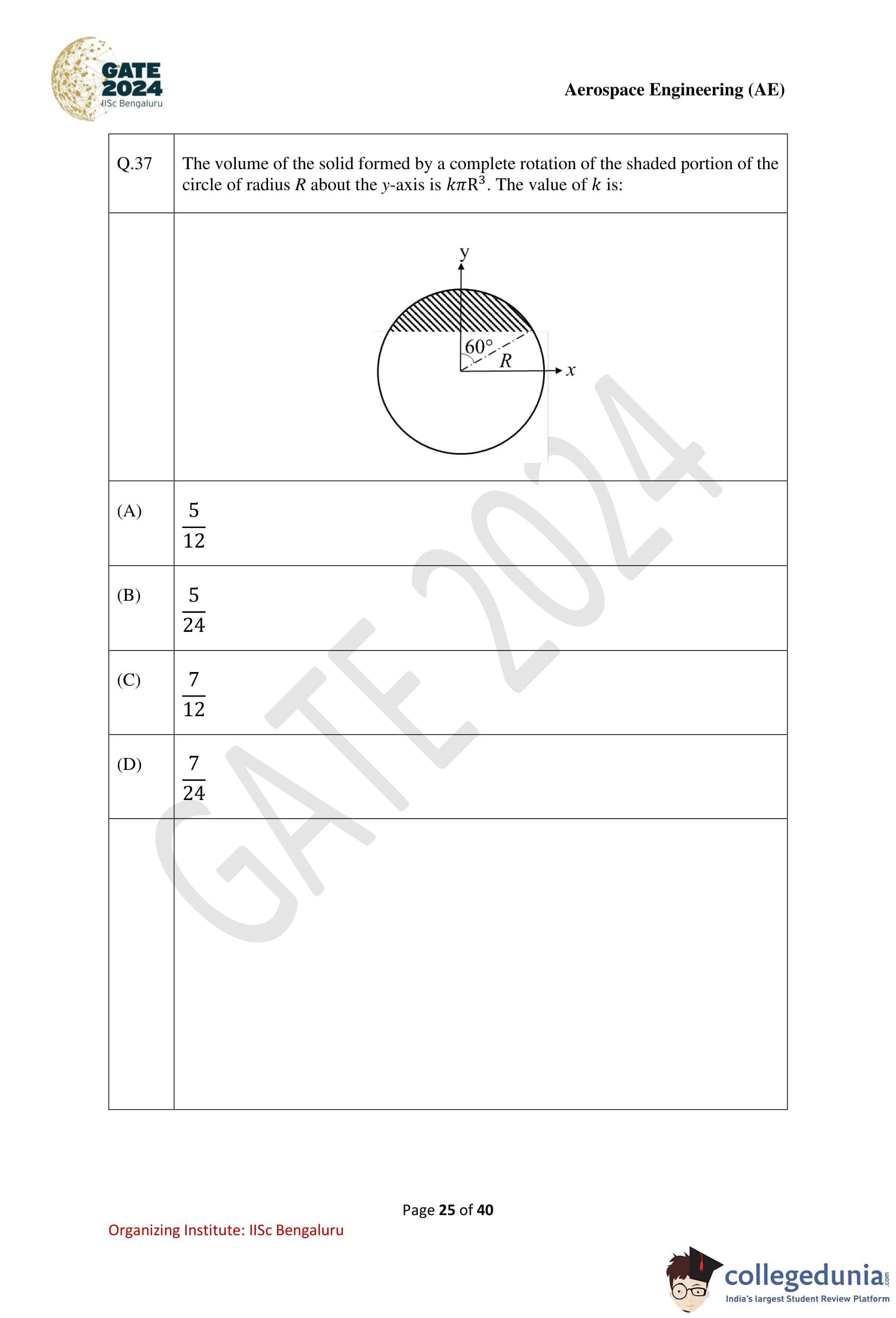
The volume of the solid formed by a complete rotation of the shaded portion of the circle of radius \(R\) about the \(y\)-axis is \(k\pi R^3\).
The value of \(k\) is:

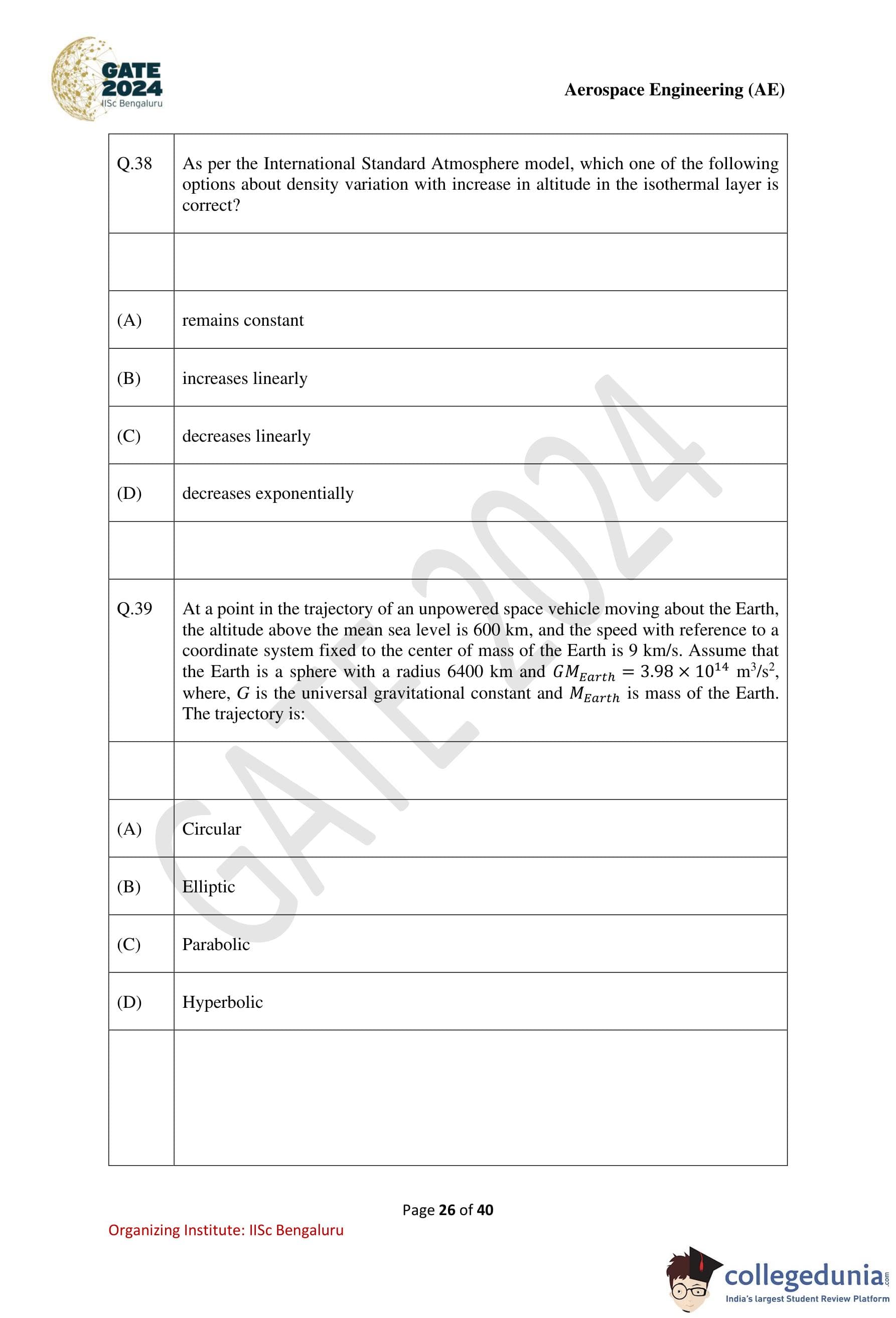
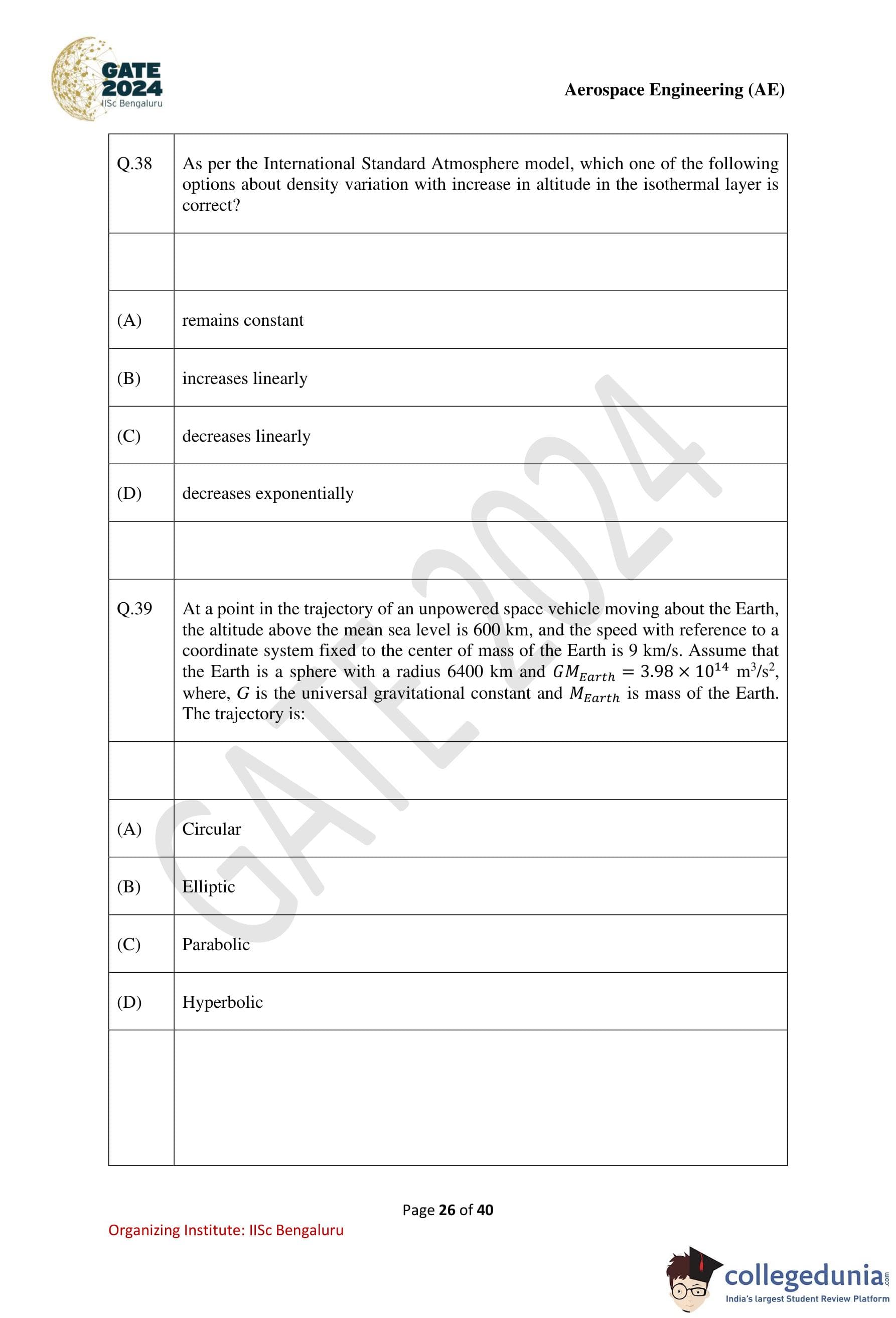
As per the International Standard Atmosphere (ISA) model, which one of the following options about density variation with increase in altitude in the \emph{isothermal layer} is correct?
At a point in the trajectory of an unpowered space vehicle moving about Earth, the altitude above mean sea level is \(600\) km, and the speed with reference to a coordinate system fixed to the center of mass of the Earth is \(9\) km/s.
Assume that the Earth is a sphere with a radius \(6400\) km and \(GM_{Earth} = 3.98\times10^{14}\) m\(^3\)/s\(^2\), where \(G\) is the universal gravitational constant and \(M_{Earth}\) is the mass of the Earth.
The trajectory is:
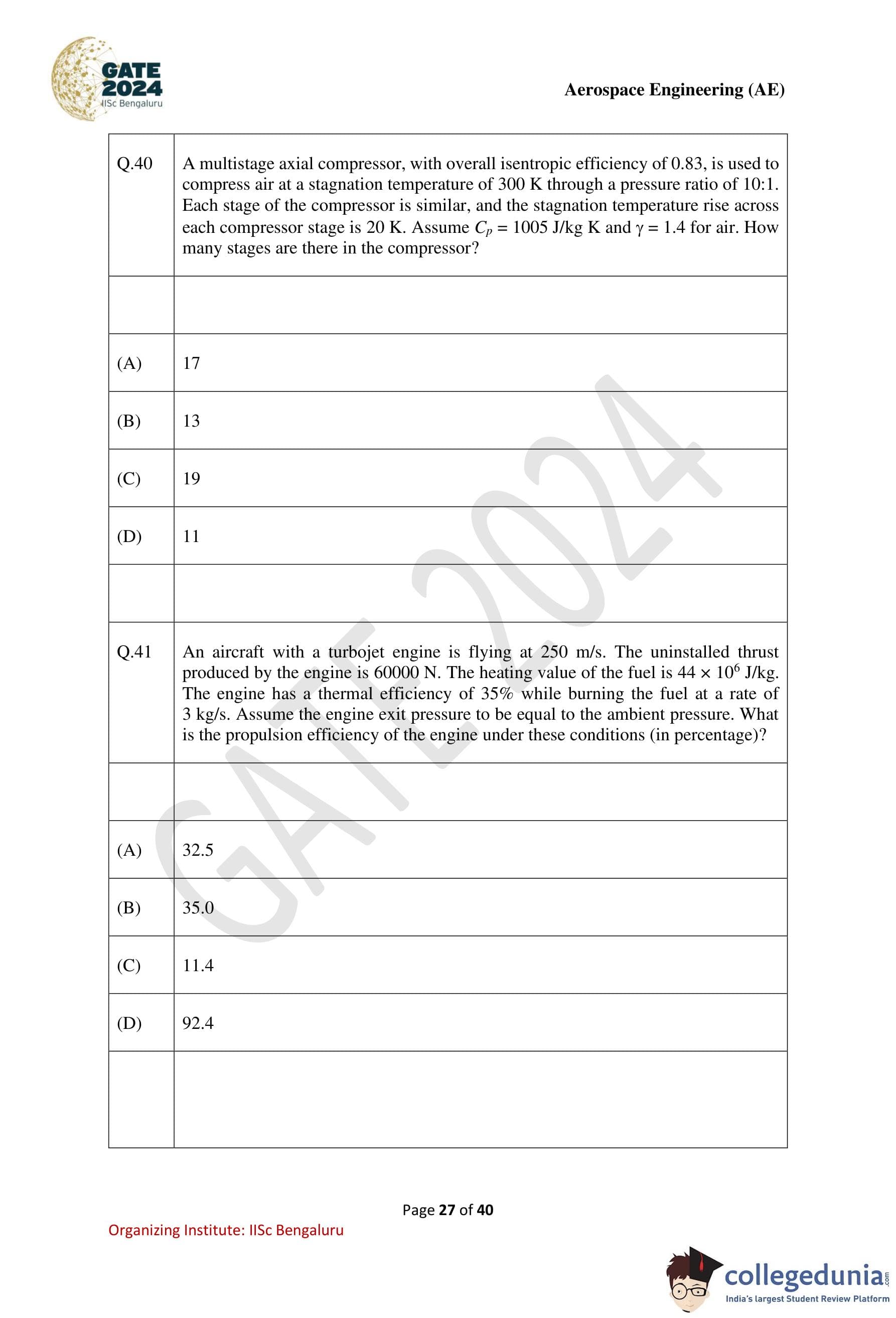
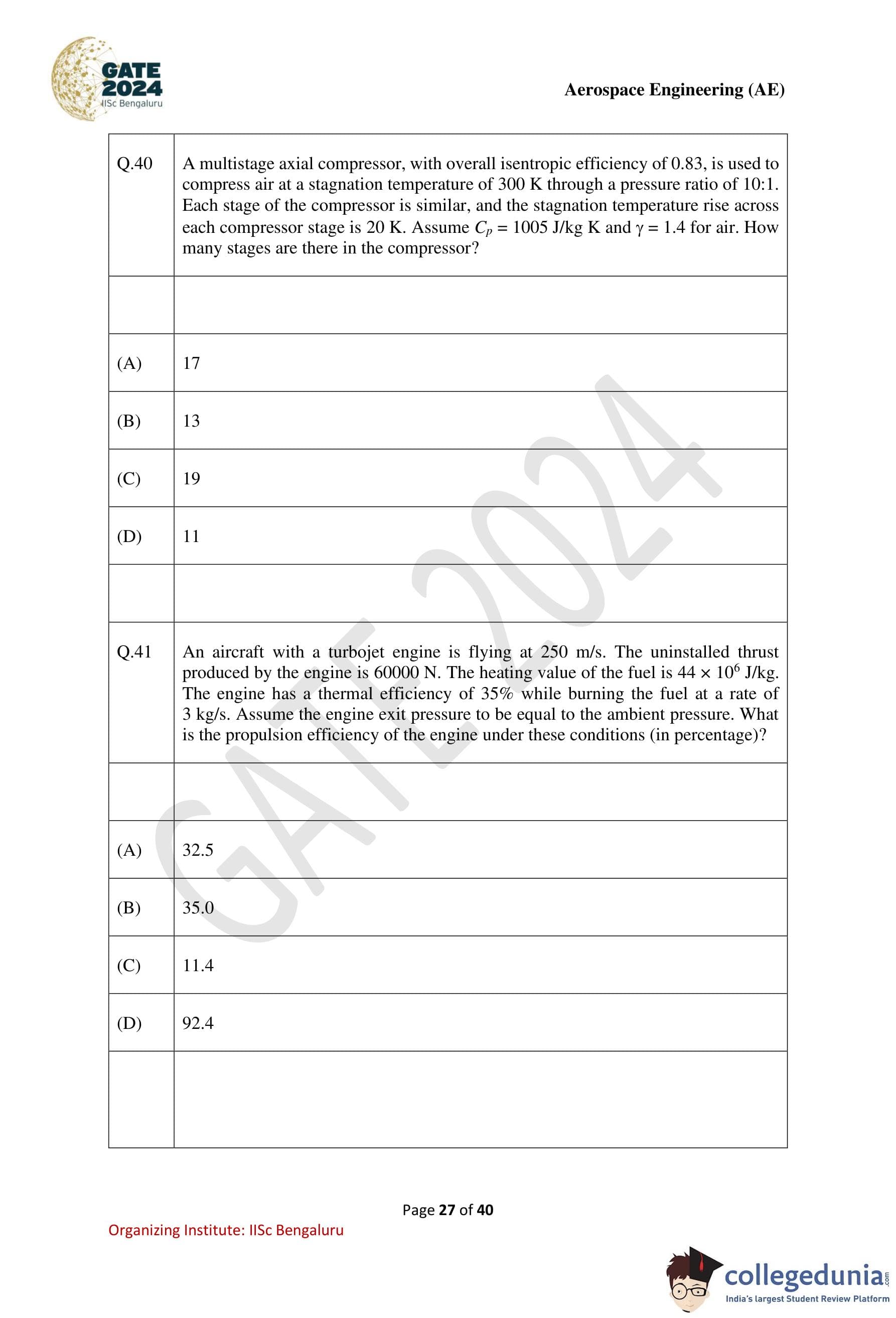
A multistage axial compressor, with overall isentropic efficiency of \(0.83\), is used to compress air at a stagnation temperature of \(300\) K through a pressure ratio of \(10{:}1\).
Each stage of the compressor is similar and the stagnation temperature rise across each compressor stage is \(20\) K.
Assume \(C_p = 1005\) J/kg K and \(\gamma = 1.4\) for air.
How many stages are there in the compressor?
An aircraft with a turbojet engine is flying at \(250\) m/s.
The uninstalled thrust produced by the engine is \(60000\) N.
The heating value of the fuel is \(44\times10^6\) J/kg.
The engine has a thermal efficiency of \(35%\) while burning fuel at a rate of \(3\) kg/s.
Assume the engine exit pressure to be equal to the ambient pressure.
What is the propulsion efficiency of the engine under these conditions (in percentage)?
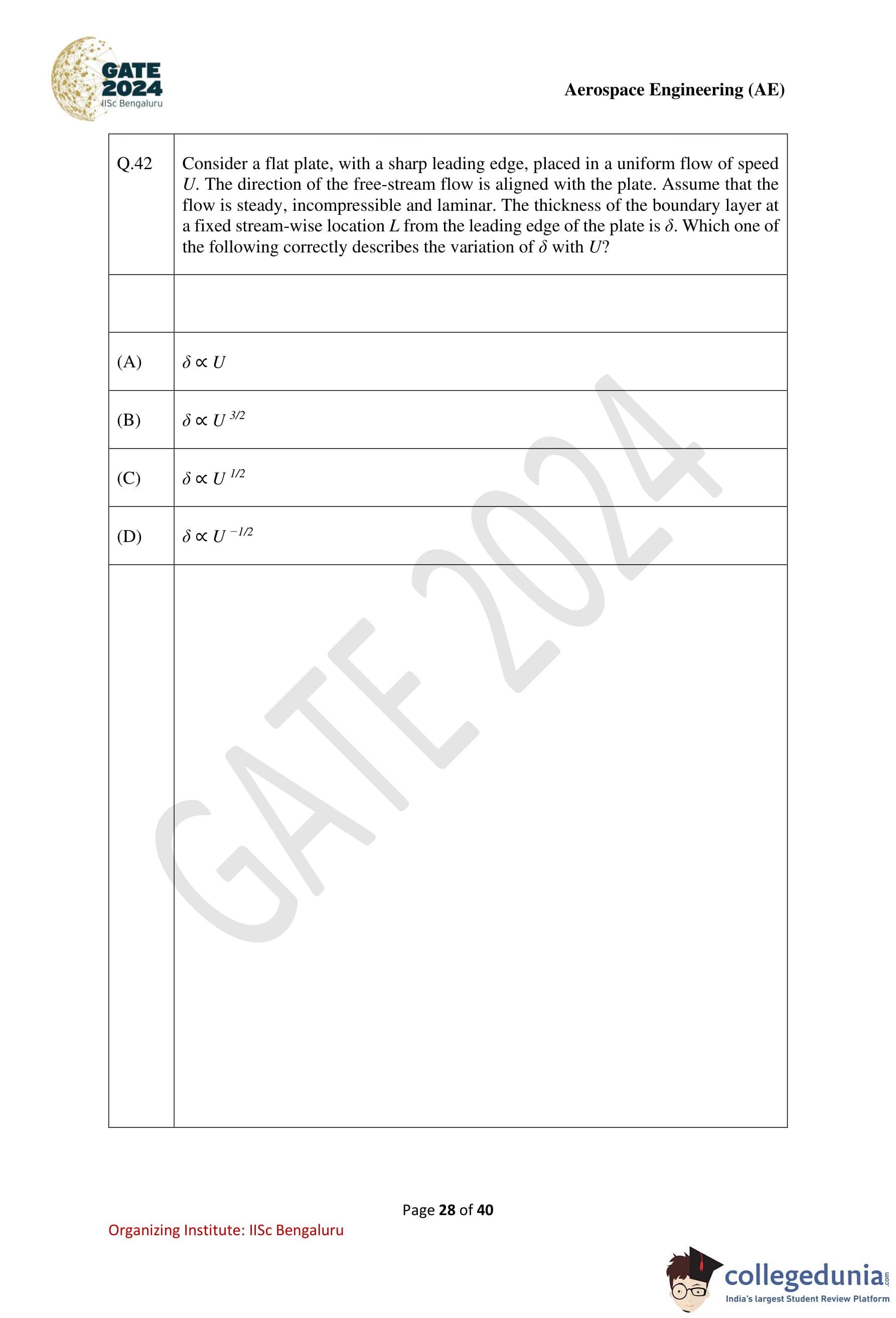
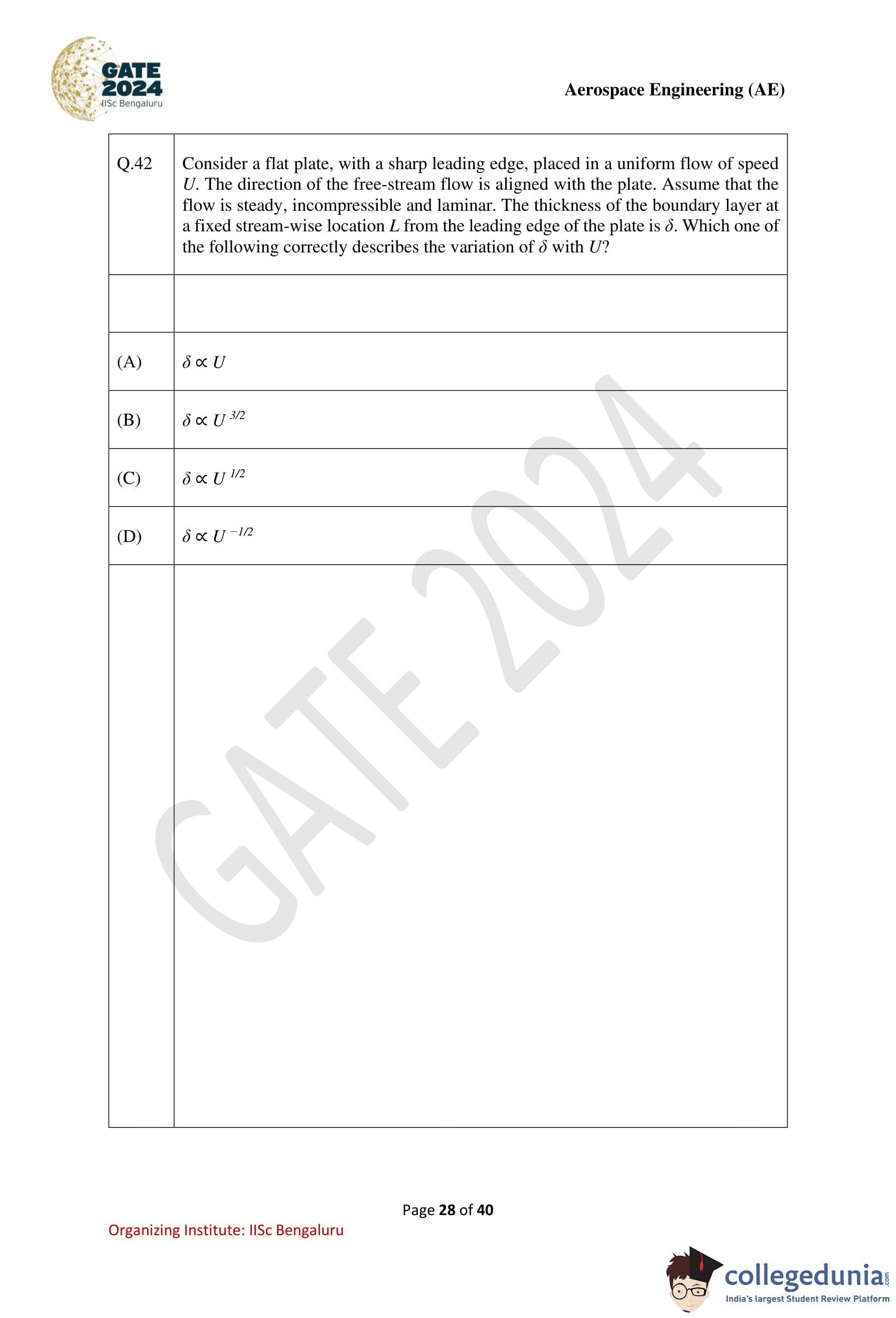
Consider a flat plate, with a sharp leading edge, placed in a uniform flow of speed \(U\).
The direction of the free-stream flow is aligned with the plate.
Assume that the flow is steady, incompressible and laminar.
The thickness of the boundary layer at a fixed stream-wise location \(L\) from the leading edge of the plate is \(\delta\).
Which one of the following correctly describes the variation of \(\delta\) with \(U\)?
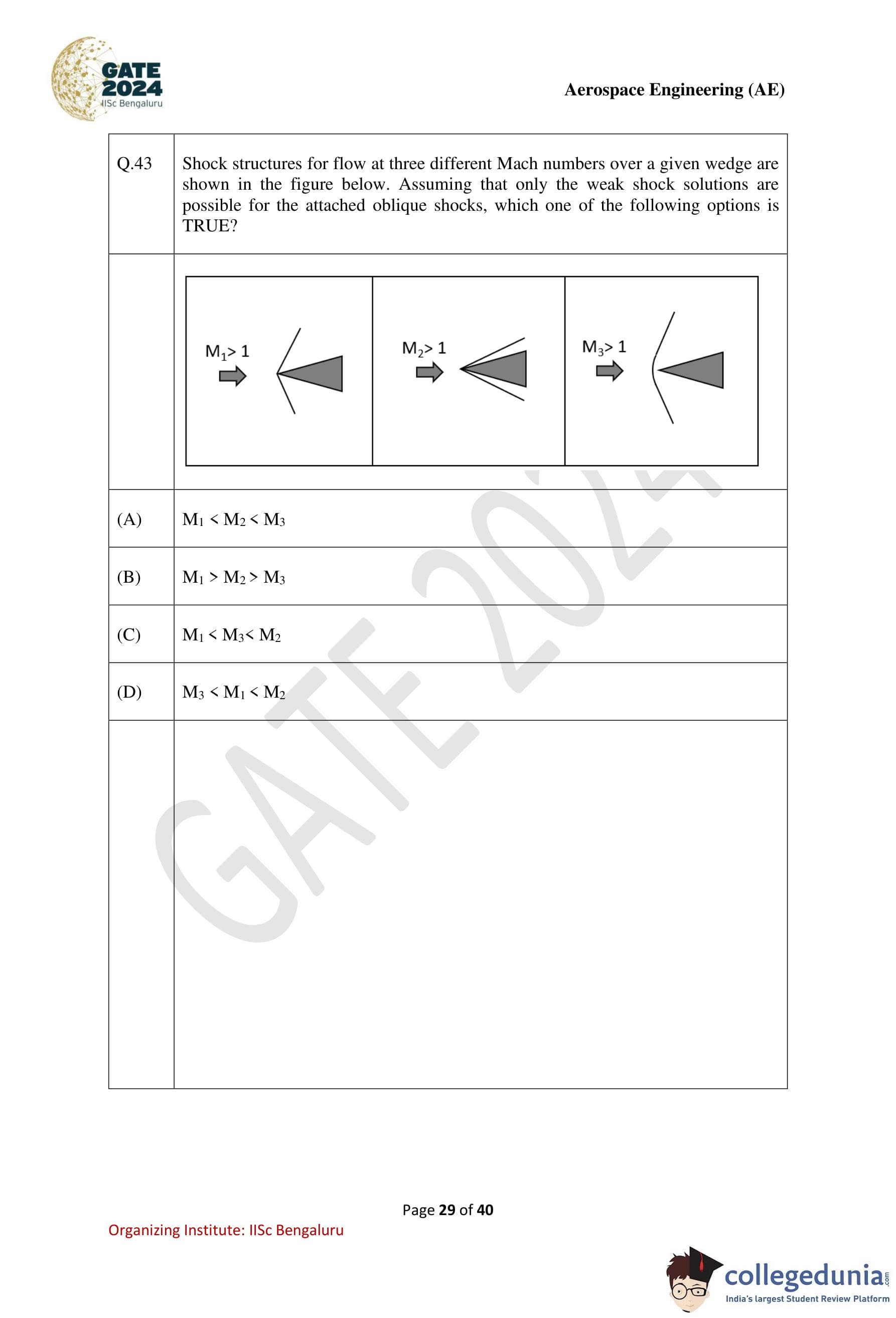
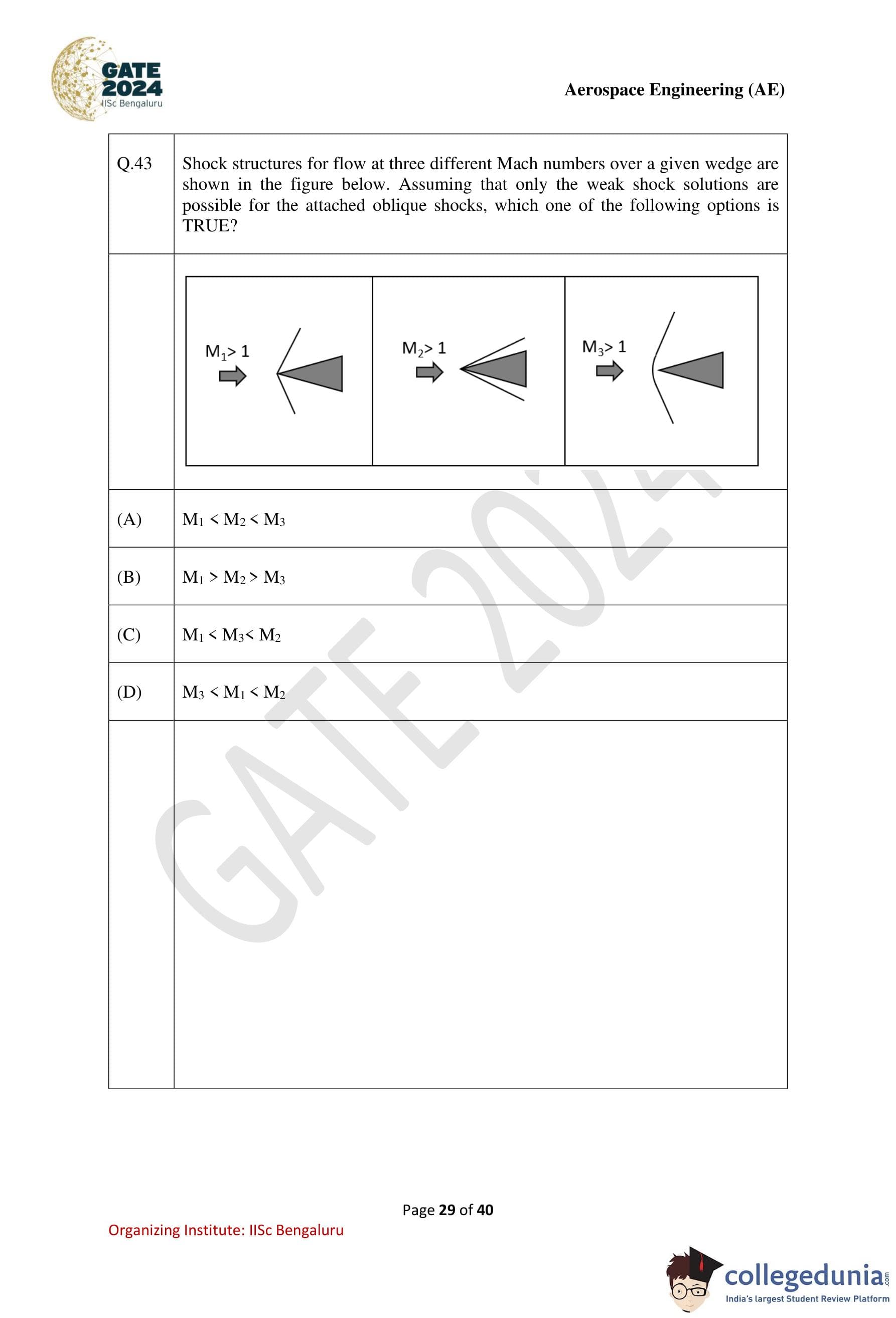
Shock structures for flow at three different Mach numbers over a given wedge are shown in the figure below.
Assuming that only weak shock solutions are possible for the attached oblique shocks, which one of the following options is TRUE?

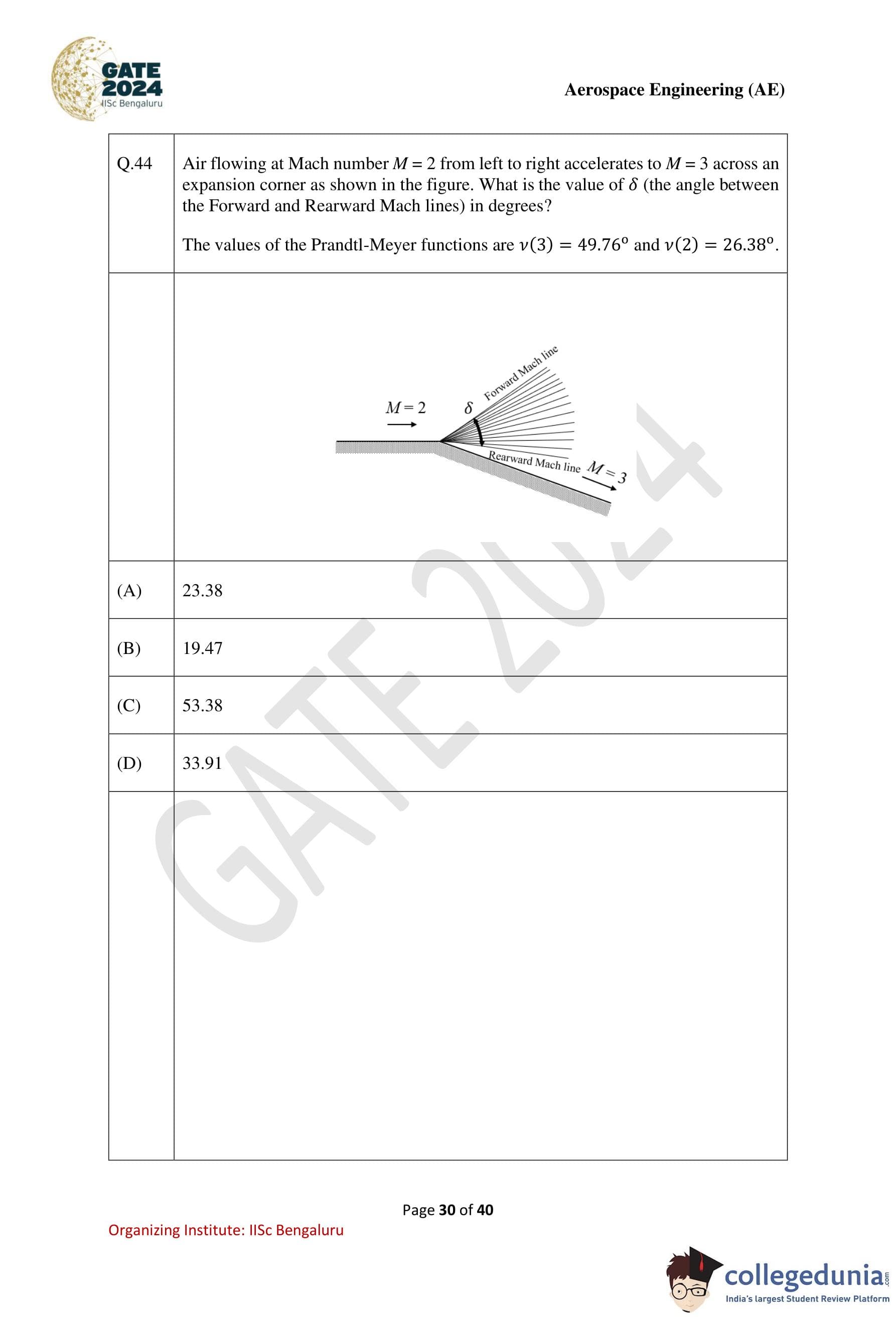
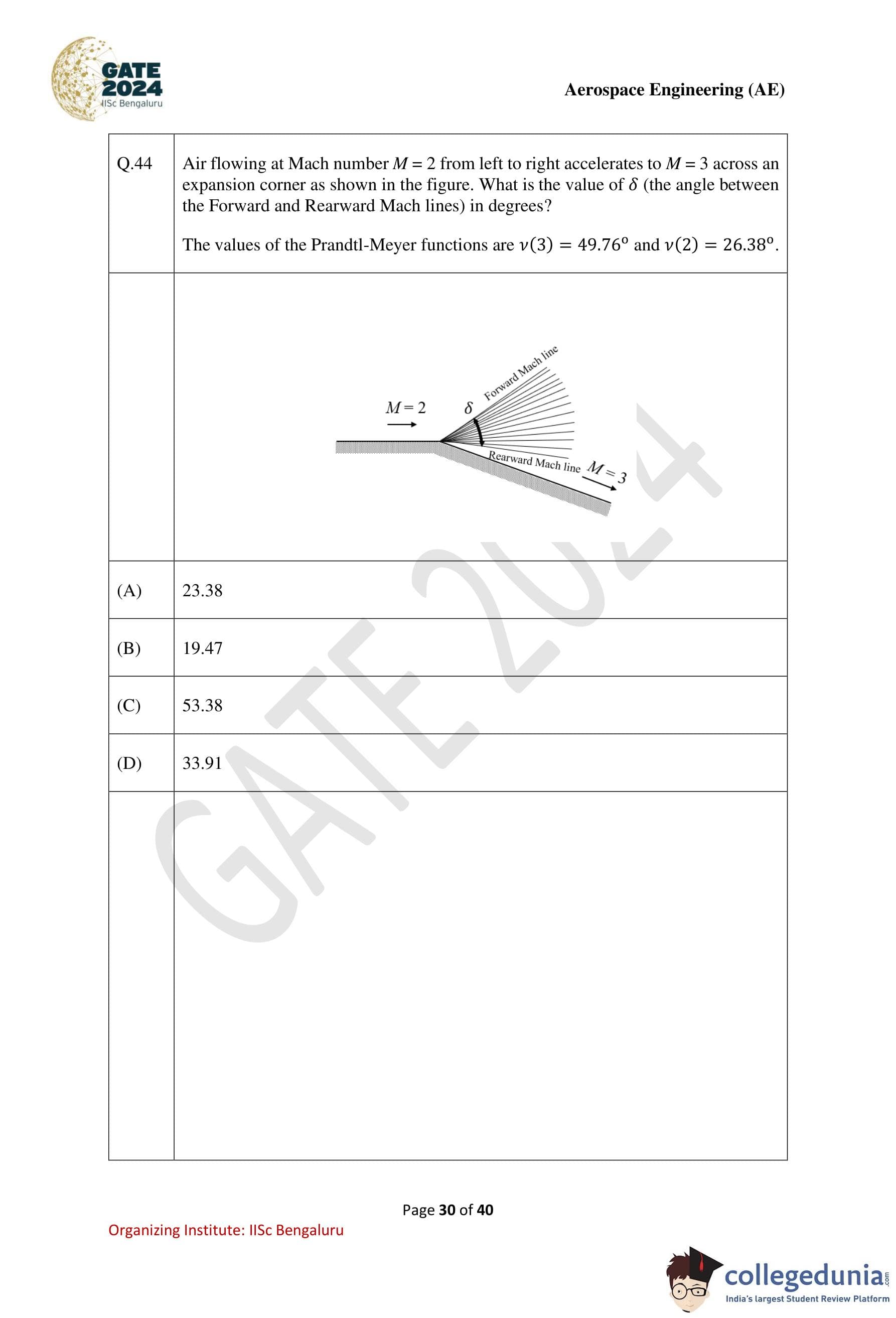
Air flowing at Mach number \(M=2\) from left to right accelerates to \(M=3\) across an expansion corner as shown in the figure.
What is the value of \(\delta\) (the angle between the forward and rearward Mach lines) in degrees?
The values of the Prandtl--Meyer function are: \[ \nu(3) = 49.76^\circ \quad and \quad \nu(2) = 26.38^\circ \]

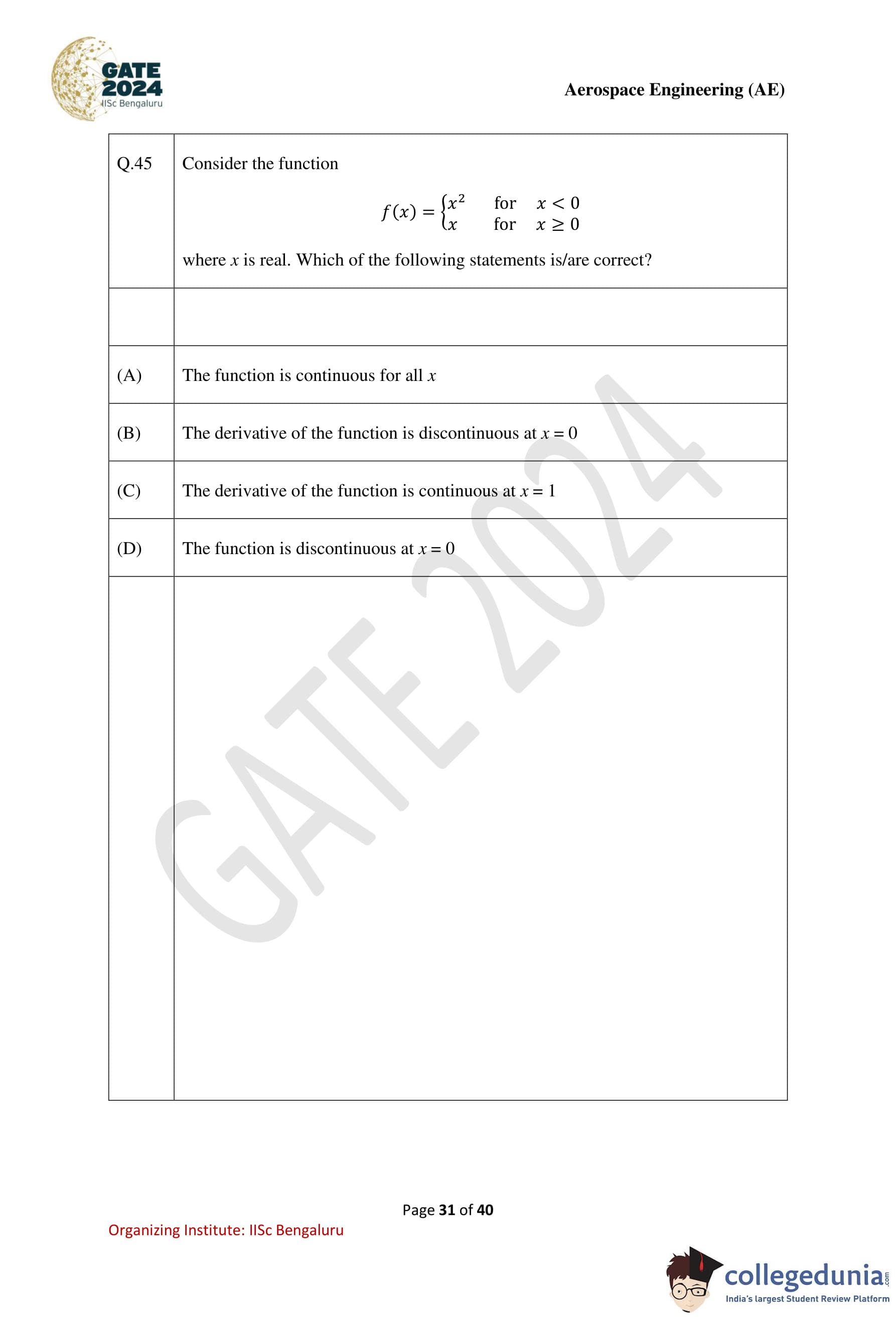
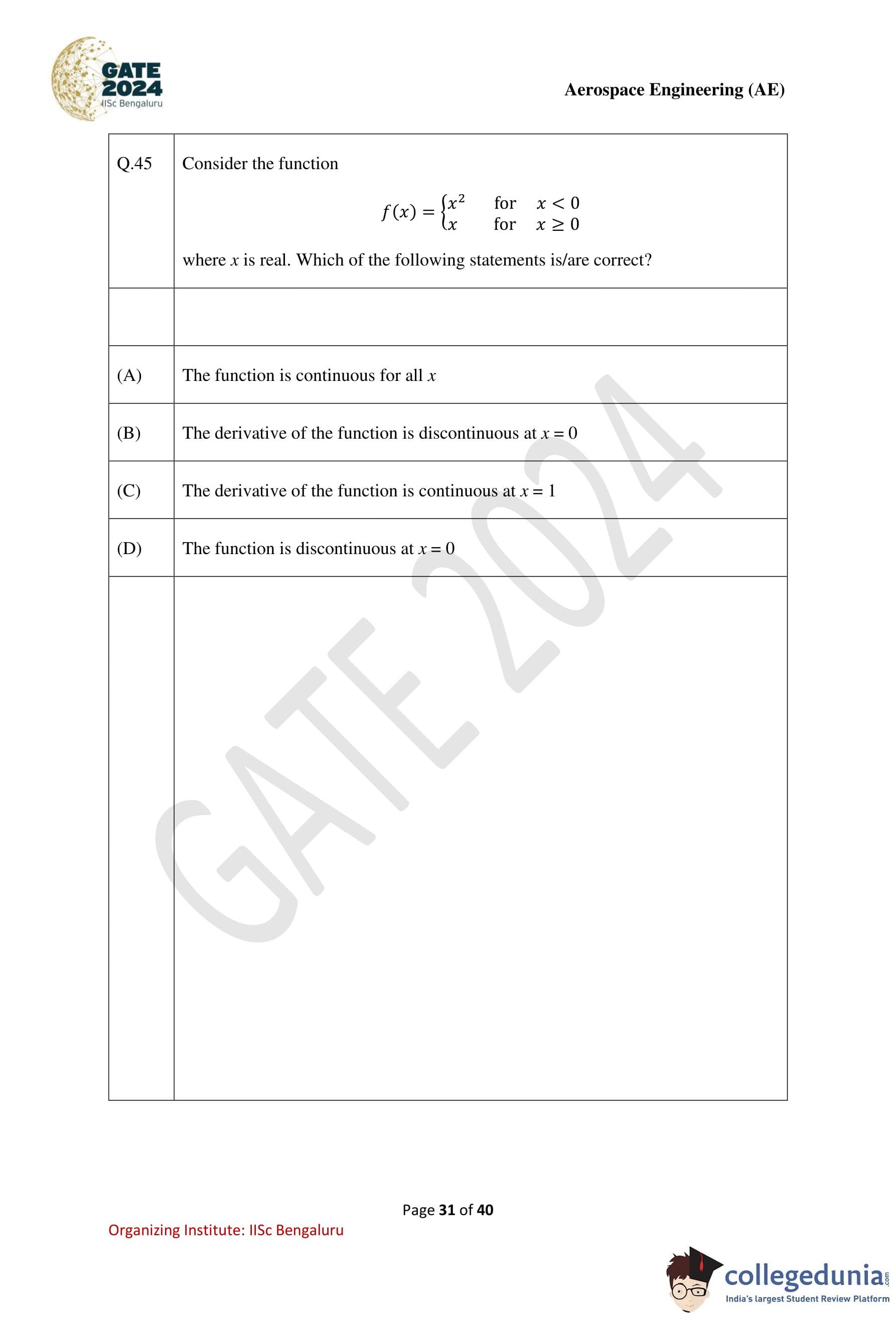
Consider the function \[ f(x)= \begin{cases} x^2, & x<0
x, & x\ge 0 \end{cases} \]
where \(x\) is real. Which of the following statements is/are correct?
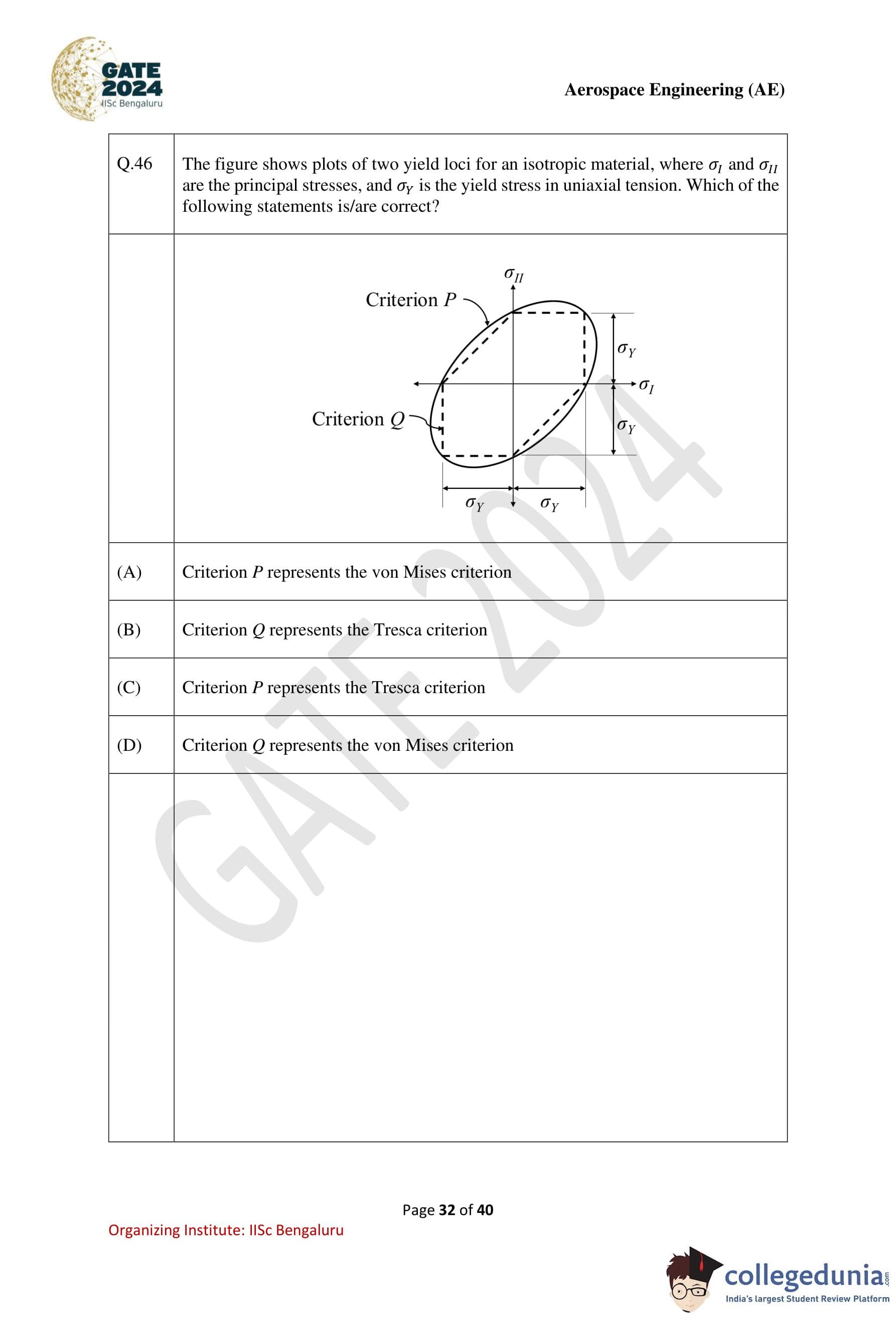
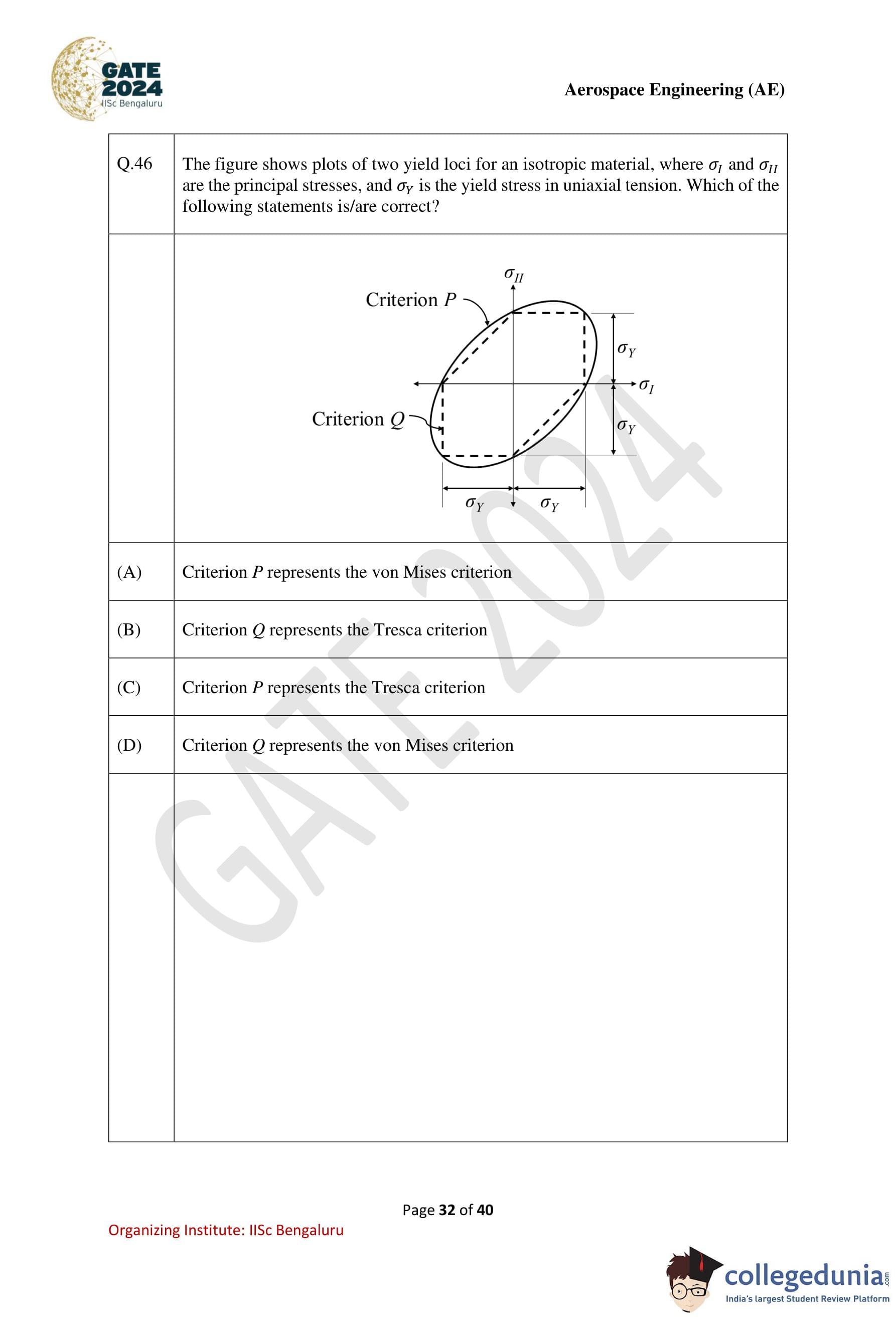
The figure shows plots of two yield loci for an isotropic material, where \(\sigma_I\) and \(\sigma_{II}\) are the principal stresses, and \(\sigma_y\) is the yield stress in uniaxial tension.
Which of the following statements is/are correct?

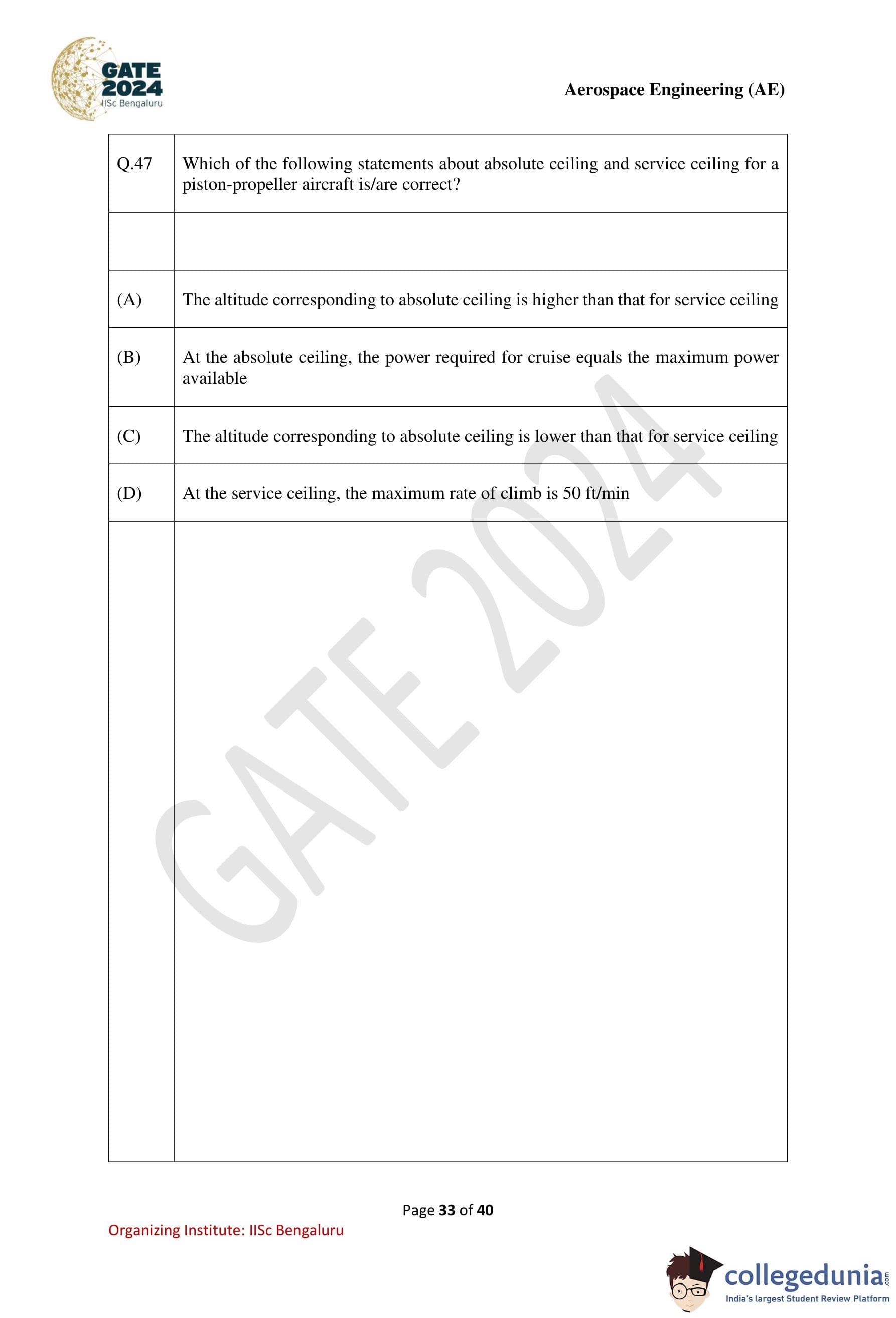
Which of the following statements about absolute ceiling and service ceiling for a piston--propeller aircraft is/are correct?
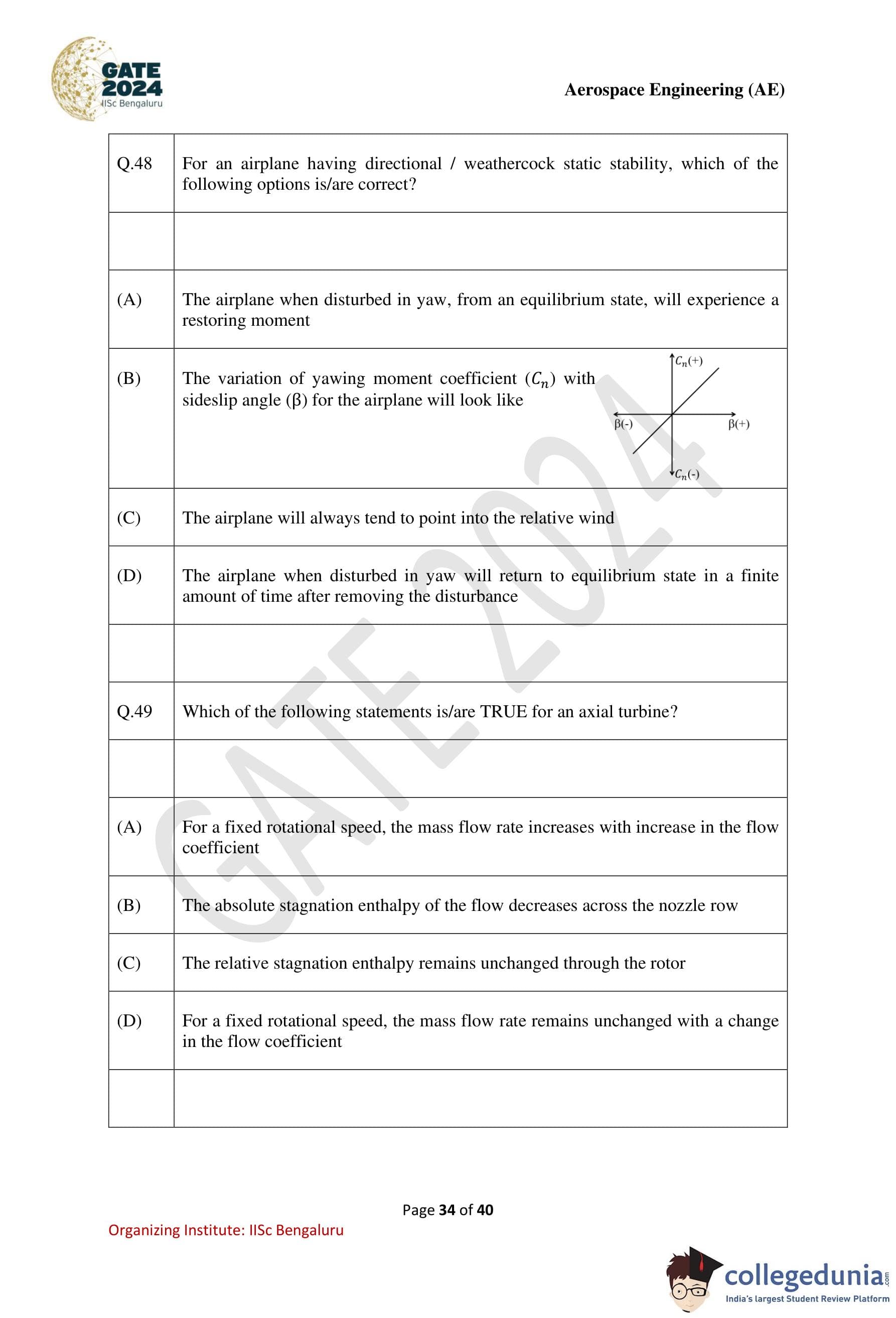
For an airplane having directional / weathercock static stability, which of the following options is/are correct?
- (A) The airplane, when disturbed in yaw from an equilibrium state, will experience a restoring moment
- (B) The variation of yawing moment coefficient (\(C_n\)) with sideslip angle (\(\beta\)) for the airplane will look like the figure shown
![]()
- (C) The airplane will always tend to point into the relative wind
- (D) The airplane, when disturbed in yaw, will return to equilibrium state in a finite amount of time after removing the disturbance

Which of the following statements is/are TRUE for an axial turbine?
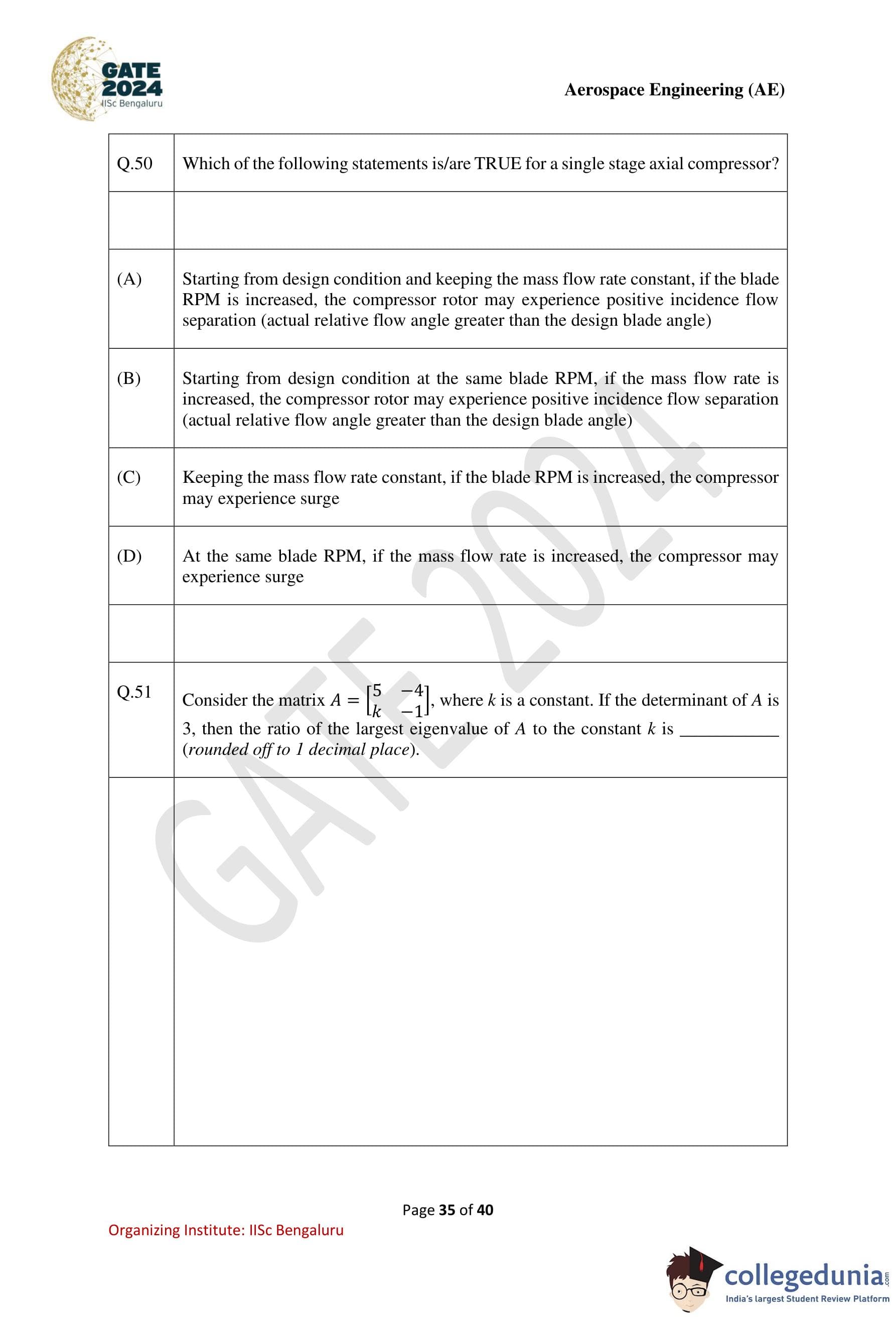
Which of the following statements is/are TRUE for a single stage axial compressor?
Consider the matrix \[ A = \begin{pmatrix} 5 & -4
k & -1 \end{pmatrix} \]
where \(k\) is a constant. If the determinant of \(A\) is \(3\), then the ratio of the largest eigenvalue of \(A\) to the constant \(k\) is \rule{1.5cm{0.15mm
(rounded off to \(1\) decimal place).
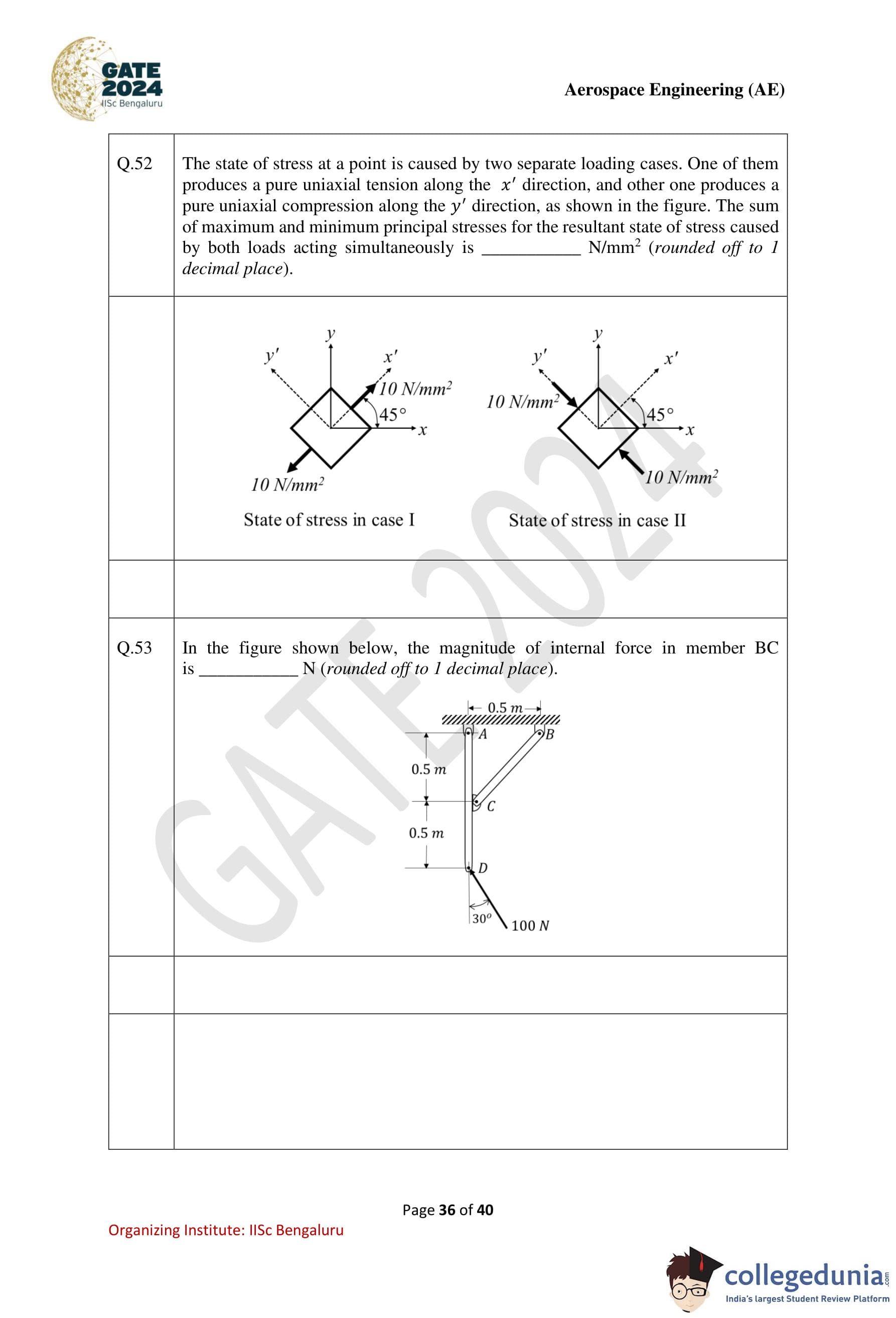
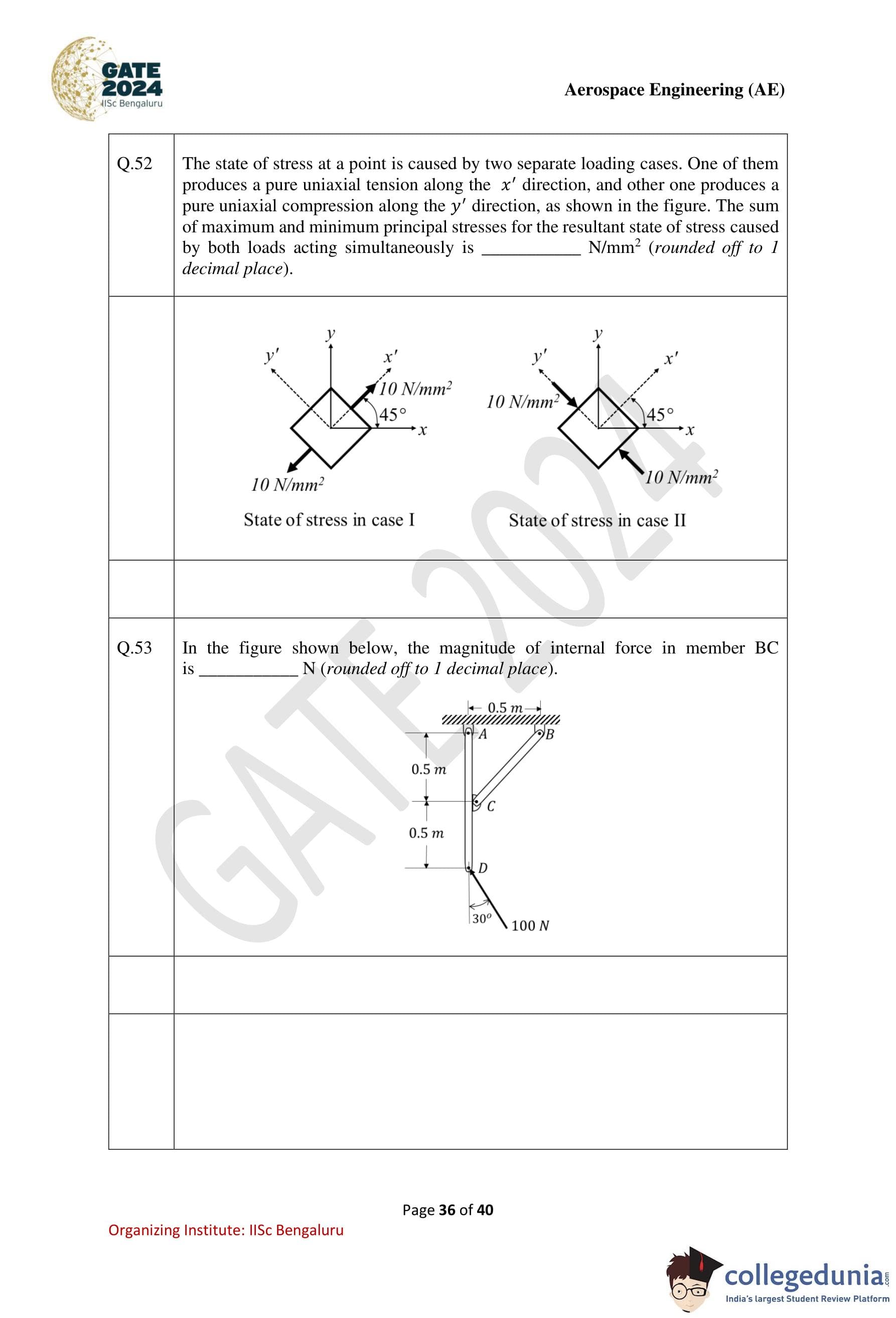
The state of stress at a point is caused by two separate loading cases. One of them produces a pure uniaxial tension along the \(x'\) direction, and the other produces a pure uniaxial compression along the \(y'\) direction, as shown in the figure.
The sum of maximum and minimum principal stresses for the resultant state of stress caused by both loads acting simultaneously is \rule{1.5cm{0.15mm N/mm\(^2\)
(rounded off to \(1\) decimal place).

In the figure shown below, the magnitude of internal force in member \(BC\) is \rule{1.5cm{0.15mm N
(rounded off to \(1\) decimal place).

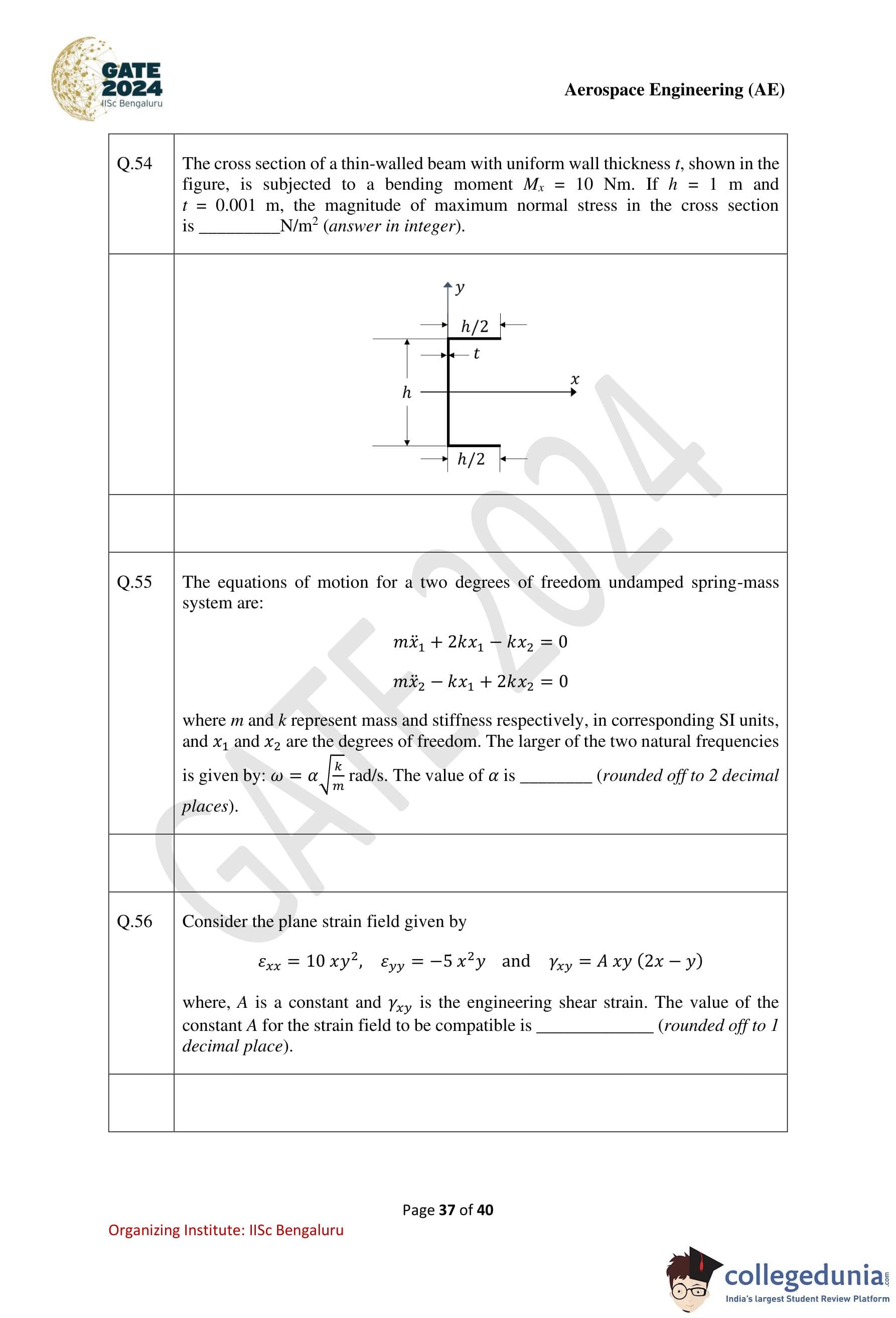
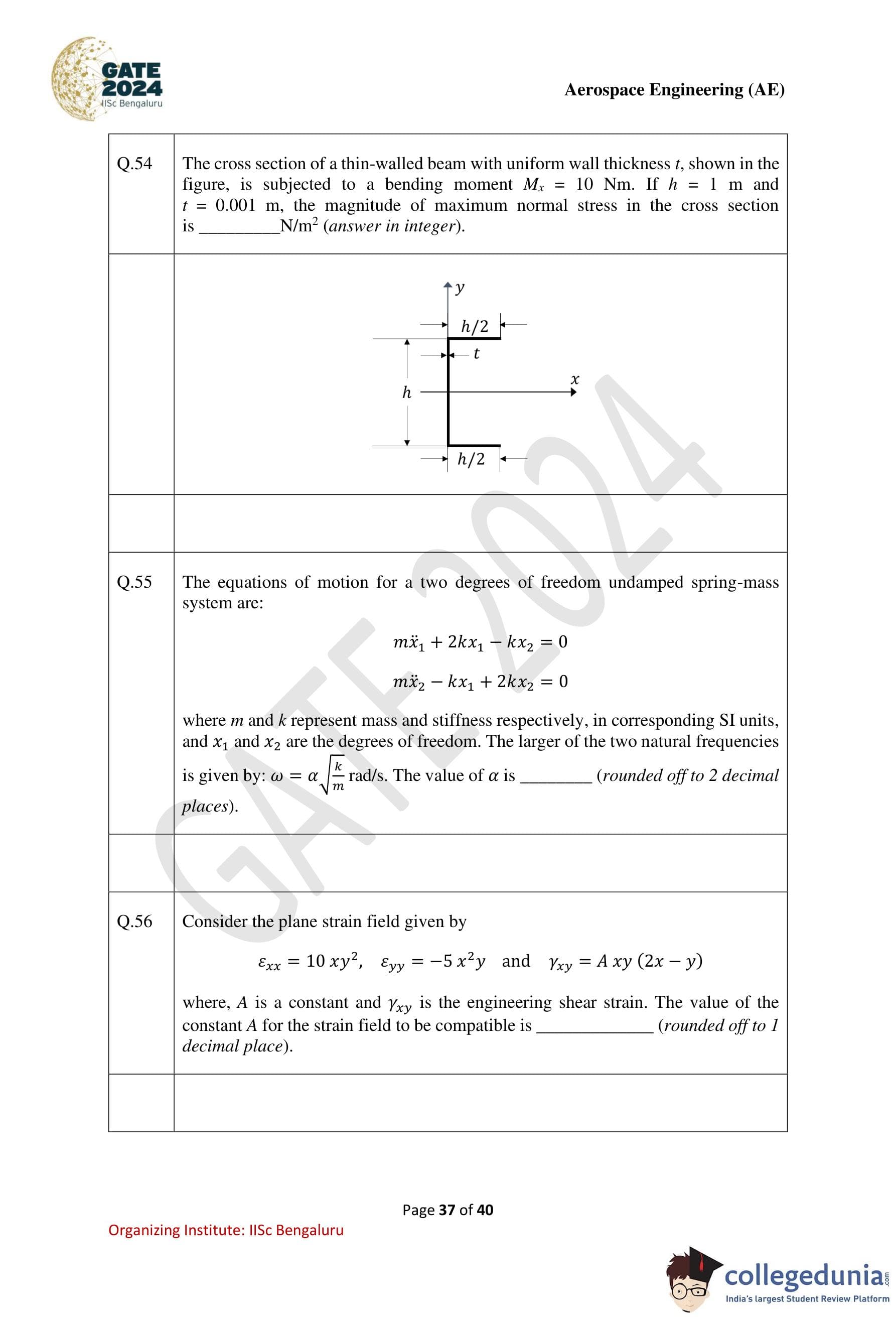
The cross section of a thin-walled beam with uniform wall thickness \(t\), shown in the figure, is subjected to a bending moment \(M_x = 10\) Nm.
If \(h = 1\) m and \(t = 0.001\) m, the magnitude of maximum normal stress in the cross section is \rule{1.5cm{0.15mm N/m\(^2\)
(answer in integer).

The equations of motion for a two degrees of freedom undamped spring--mass system are: \[ m\ddot{x}_1 + 2k x_1 - k x_2 = 0 \] \[ m\ddot{x}_2 - k x_1 + 2k x_2 = 0 \]
where \(m\) and \(k\) represent mass and stiffness respectively, in corresponding SI units, and \(x_1\) and \(x_2\) are degrees of freedom.
The larger of the two natural frequencies is given by \(\omega = \alpha\sqrt{\tfrac{k}{m}}\) rad/s.
The value of \(\alpha\) is \rule{1.5cm{0.15mm (rounded off to \(2\) decimal places).
Consider the plane strain field given by \[ \varepsilon_{xx} = 10xy^2, \qquad \varepsilon_{yy} = -5x^2y, \qquad \gamma_{xy} = Axy(2x - y) \]
where \(A\) is a constant and \(\gamma_{xy}\) is the engineering shear strain.
The value of the constant \(A\) for the strain field to be compatible is \rule{1.5cm{0.15mm
(rounded off to \(1\) decimal place).
A chemical rocket with an ideally expanded flow through the nozzle produces \(5\times10^{6}\) N thrust at sea level.
The specific impulse of the rocket is \(200\) s and acceleration due to gravity at sea level is \(9.8\) m/s\(^2\).
The propellant mass flow rate out of the rocket nozzle is \rule{1.5cm{0.15mm kg/s
(rounded off to the nearest integer).
A centrifugal compressor is designed to operate with air.
At the leading edge of the tip of the inducer eye of the impeller, the blade angle is \(45^\circ\), and the relative Mach number is \(1.0\).
The stagnation temperature of the incoming air is \(300\) K.
Consider \(\gamma = 1.4\).
Neglect pre-whirl and slip.
The inducer tip speed is \rule{1.5cm{0.15mm m/s
(rounded off to the nearest integer).
Consider the following Fanno flow problem:
Flow enters a constant area duct at a temperature of \(273\) K and a Mach number of \(2\) and eventually reaches sonic condition (Mach number \(=1\)) due to friction.
Assume \(\gamma = 1.4\).
The static temperature at the location where sonic condition is reached is \rule{1.5cm{0.15mm K
(rounded off to \(2\) decimal places).
Consider an artificial satellite moving around the Moon in an elliptic orbit.
The altitude of the satellite from the Moon’s surface at the perigee is \(25\) km and that at the apogee is \(134\) km.
Assume the Moon to be spherical with a radius of \(1737\) km.
The trajectory is considered with reference to a coordinate system fixed to the center of mass of the Moon.
The ratio of the speed of the satellite at the perigee to that at the apogee is \rule{1.5cm{0.15mm
(rounded off to \(2\) decimal places).
For an aircraft moving at \(4\) km altitude above mean sea level at a Mach number of \(0.2\), the ratio of equivalent air speed to true air speed is \rule{1.5cm{0.15mm
(rounded off to \(2\) decimal places).
The density of air at mean sea level is \(1.225\) kg/m\(^3\) and at \(4\) km altitude is \(0.819\) kg/m\(^3\).
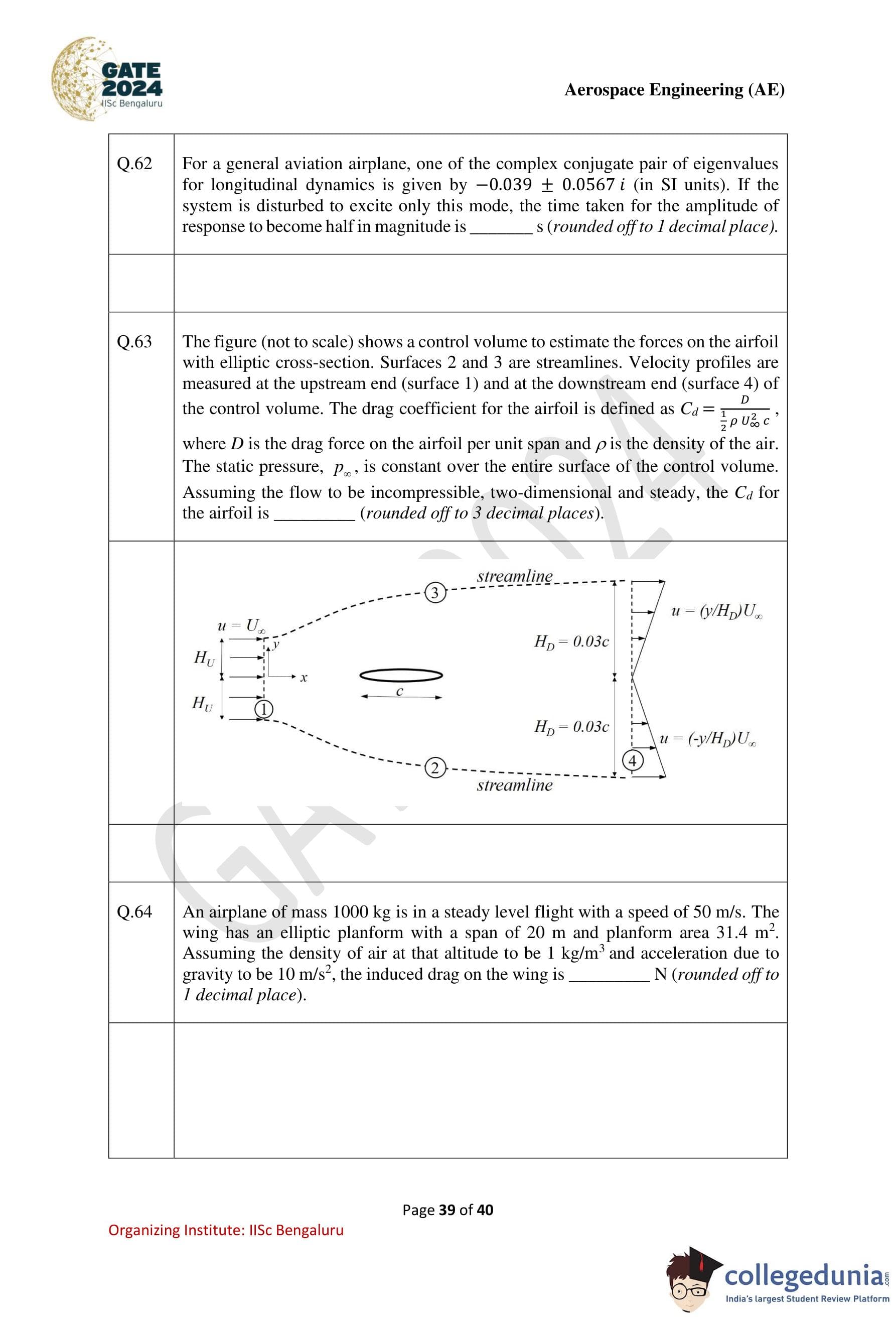
For a general aviation airplane, one of the complex conjugate pair of eigenvalues for longitudinal dynamics is given by \(-0.039 \pm 0.0567i\) (in SI units).
If the system is disturbed to excite only this mode, the time taken for the amplitude of response to become half in magnitude is \rule{1.5cm{0.15mm s
(rounded off to \(1\) decimal place).
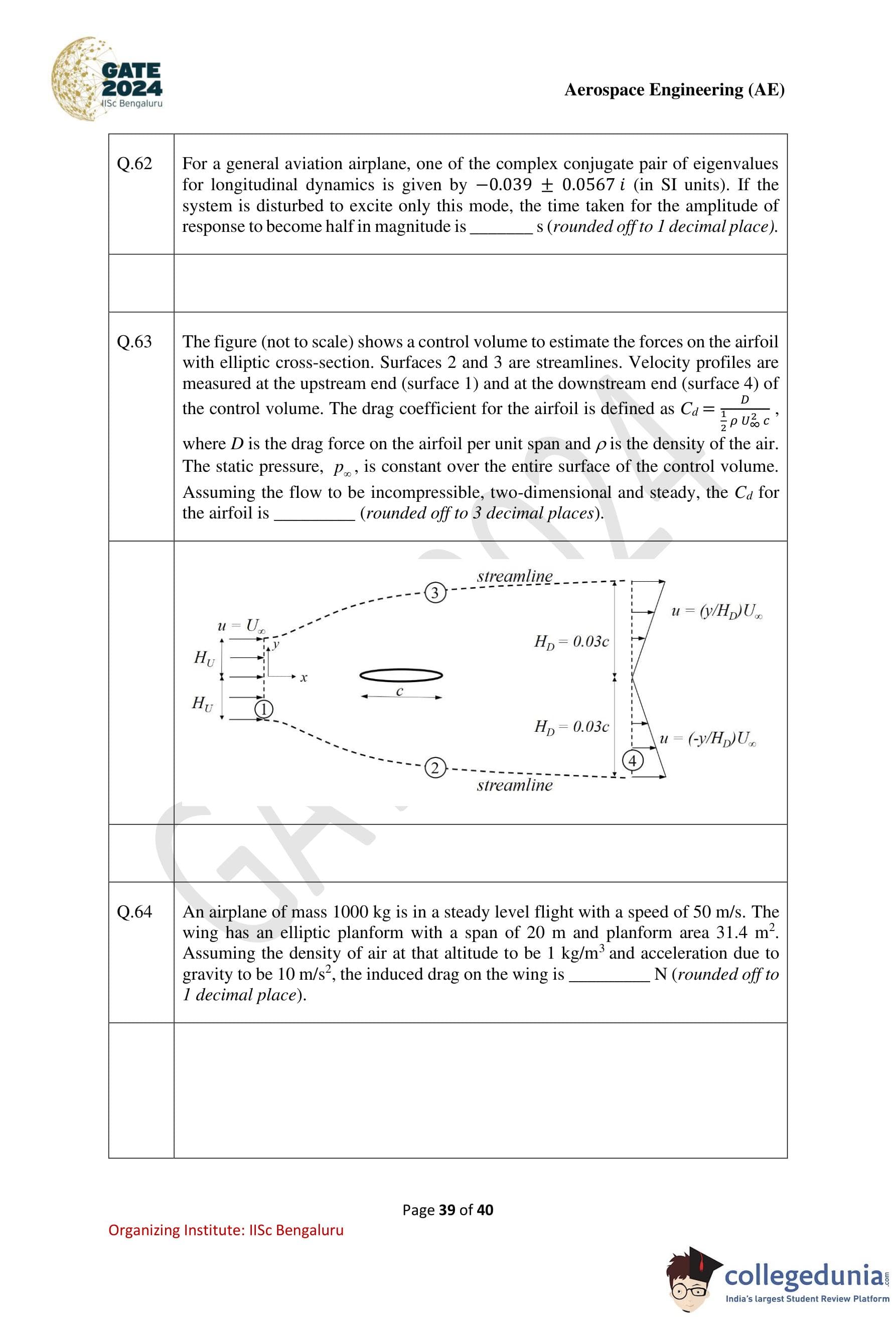
The figure (not to scale) shows a control volume to estimate the forces on an airfoil with elliptic cross-section.
Surfaces 2 and 3 are streamlines. Velocity profiles are measured at the upstream end (surface 1) and at the downstream end (surface 4) of the control volume.
The drag coefficient for the airfoil is defined as \(C_d = \dfrac{D}{\tfrac{1}{2}\rho U_\infty^2 c}\), where \(D\) is the drag force on the airfoil per unit span and \(\rho\) is the density of air.
The static pressure, \(p_\infty\), is constant over the entire surface of the control volume.
Assuming flow to be incompressible, two-dimensional and steady, the \(C_d\) for the airfoil is \rule{1.8cm{0.15mm
(rounded off to \(3\) decimal places).

An airplane of mass \(1000\) kg is in steady level flight with a speed of \(50\) m/s.
The wingspan is \(20\) m and the planform area is \(31.4\) m\(^2\).
Assuming an elliptic lift distribution, air density \(\rho = 1.0\) kg/m\(^3\) and acceleration due to gravity \(g = 10\) m/s\(^2\),
the induced drag on the wing is \rule{1.8cm{0.15mm N
(rounded off to \(1\) decimal place).
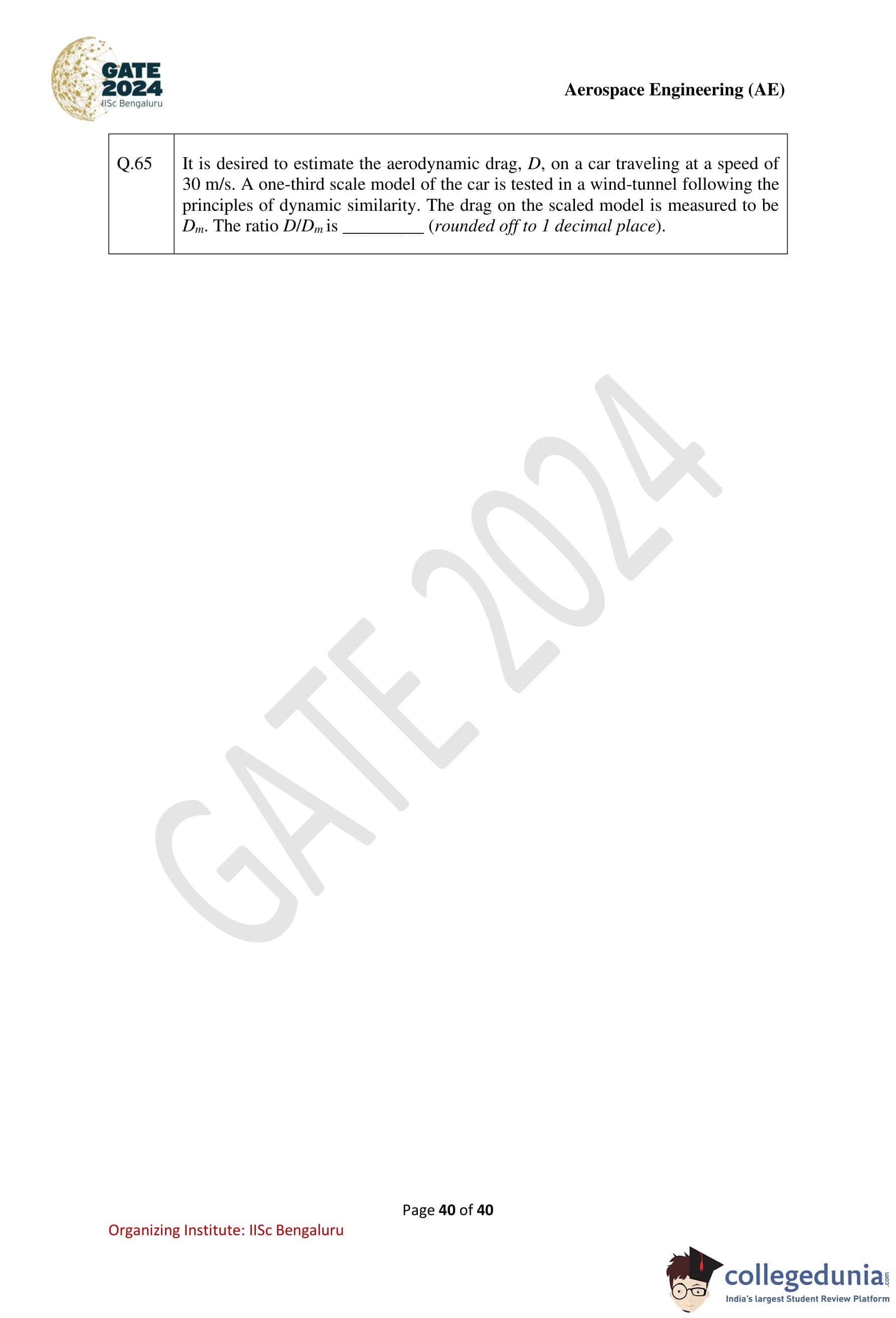
It is desired to estimate the aerodynamic drag, \(D\), on a car travelling at a speed of \(30\) m/s.
A one-third scale model of the car is tested in a wind tunnel following the principles of dynamic similarity.
The drag on the scaled model is measured to be \(D_m\).
The ratio \(D/D_m\) is \rule{1.5cm{0.15mm
(rounded off to \(1\) decimal place).


Also Check:
| Previous Year GATE Aerospace Engineering Question Papers | GATE 2024 Aerospace Engineering Paper Analysis |





Comments