




GATE 2024 Agricultural Engineering Question Paper PDF is available here. IISc Banglore conducted GATE 2024 Agricultural Engineering exam on February 10 in the Forenoon Session from 9:30 AM to 12:30 PM. Students have to answer 65 questions in GATE 2024 Agricultural Engineering Question Paper carrying a total weightage of 100 marks. 10 questions are from the General Aptitude section and 55 questions are from Engineering Mathematics and Core Discipline.
GATE 2024 Agricultural Engineering Question Paper with Answer Key PDF
| GATE 2024 Agricultural Engineering Question Paper with Answer Key PDF | Download PDF | Check Solutions |

GATE 2024 Agricultural Engineering Question Paper with Solution
If '→' denotes increasing order of intensity, then the meaning of the words [dry → arid → parched] is analogous to [diet → fast → ______]. Which one of the given options is appropriate to fill the blank?
If two distinct non-zero real variables \(x\) and \(y\) are such that \((x + y)\) is proportional to \((x - y)\), then the value of \(x/y\):
Consider the following sample of numbers: 9, 18, 11, 14, 15, 17, 10, 69, 11, 13. The median of the sample is:
The number of coins of Rs. 1, Rs. 5, and Rs. 10 denominations that a person has are in the ratio 5:3:13. Of the total amount, the percentage of money in Rs. 5 coins is:
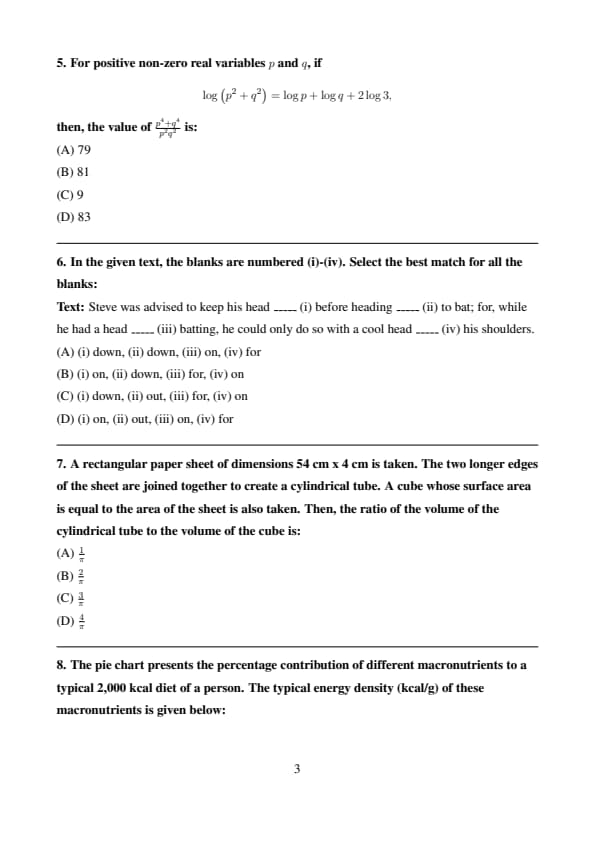
For positive non-zero real variables \(p\) and \(q\), if \[ \log \left(p^2 + q^2\right) = \log p + \log q + 2 \log 3, \]
then, the value of \(\frac{p^4 + q^4}{p^2 q^2}\) is:
In the given text, the blanks are numbered (i)-(iv). Select the best match for all the blanks:
Text: Steve was advised to keep his head _____ (i) before heading _____ (ii) to bat; for, while he had a head _____ (iii) batting, he could only do so with a cool head _____ (iv) his shoulders.
A rectangular paper sheet of dimensions 54 cm x 4 cm is taken. The two longer edges of the sheet are joined together to create a cylindrical tube. A cube whose surface area is equal to the area of the sheet is also taken. Then, the ratio of the volume of the cylindrical tube to the volume of the cube is:
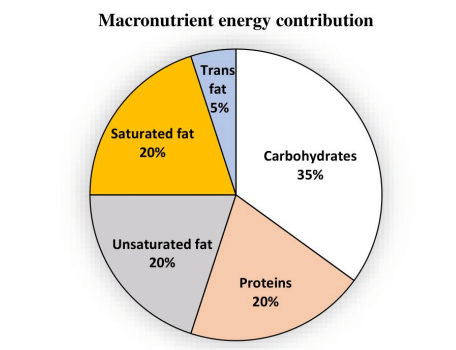
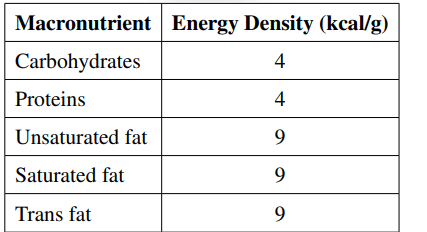
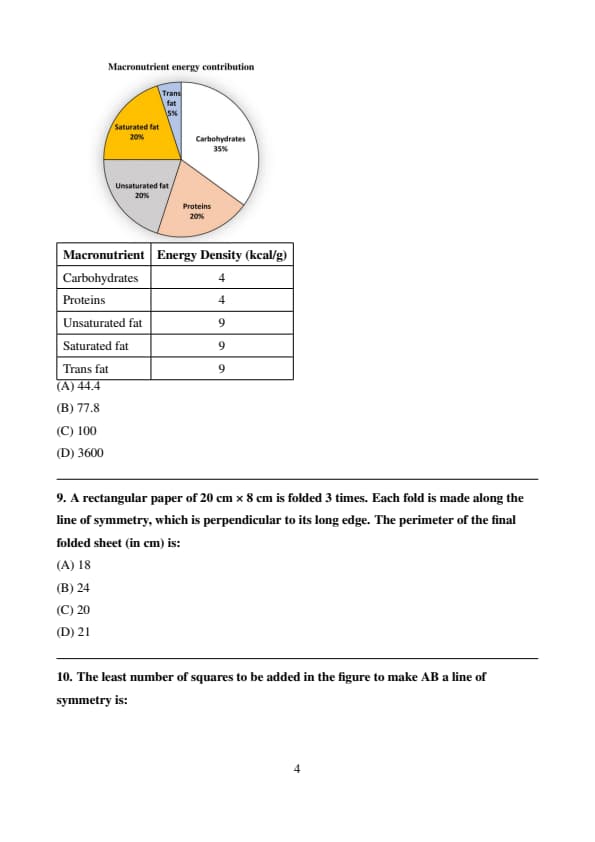
The pie chart presents the percentage contribution of different macronutrients to a typical 2,000 kcal diet of a person. The typical energy density (kcal/g) of these macronutrients is given below:
A rectangular paper of 20 cm × 8 cm is folded 3 times. Each fold is made along the line of symmetry, which is perpendicular to its long edge. The perimeter of the final folded sheet (in cm) is:
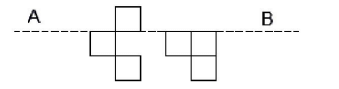
The least number of squares to be added in the figure to make AB a line of symmetry is:
The divergence of the curl of a twice continuously differentiable vector function is ______.
View Solution
1. The curl of a vector field \( \vec{F} \) is given by: \[ curl(\vec{F}) = \nabla \times \vec{F}. \]
2. The divergence of the curl is: \[ div(curl(\vec{F})) = \nabla \cdot (\nabla \times \vec{F}). \]
3. A fundamental property of vector calculus states that the divergence of the curl of any vector field is always \(0\), provided the vector field is continuously differentiable.
Thus, the divergence of the curl is 0.
Quick Tip: Use vector calculus identities like \(\nabla \cdot (\nabla \times \vec{F}) = 0\) to simplify divergence and curl problems.
Laplace transform of a function \(f(t) = t^4\) as a function of \(s\) is ______.
If the dynamic weight on the front axle is lesser than 20% of the total weight of the tractor, the longitudinal instability of the tractor can be avoided by ______.
View Solution
1. Longitudinal instability occurs when the front axle carries less than 20% of the total weight, reducing the tractor's stability and control.
2. To address this, weight must be added to the front axle to increase the dynamic weight distribution on the front axle.
3. Adding weight to the rear axle (A) or reducing weight from the front axle (D) would worsen the instability. Reducing weight on the rear axle (C) may not sufficiently address the imbalance.
Thus, the correct solution is to add weight on the front axle.
Quick Tip: For stability issues, adjust weight distribution to ensure the front axle carries sufficient dynamic load.
In places with severe cold climate, the most important fuel property to be considered for running an internal combustion engine is _____.
View Solution
1. In extremely cold climates, fuel properties that determine usability under low temperatures are critical.
2. The pour point is the lowest temperature at which a liquid (fuel) remains pourable. If the pour point is too high, the fuel will solidify or become too viscous, preventing it from flowing.
3. Other properties such as heating value (A), flash point (B), and boiling point (D) are less relevant under these conditions.
Thus, the most important property is pour point.
Quick Tip: In cold climates, fuels with low pour points ensure smooth engine operation by preventing fuel solidification.
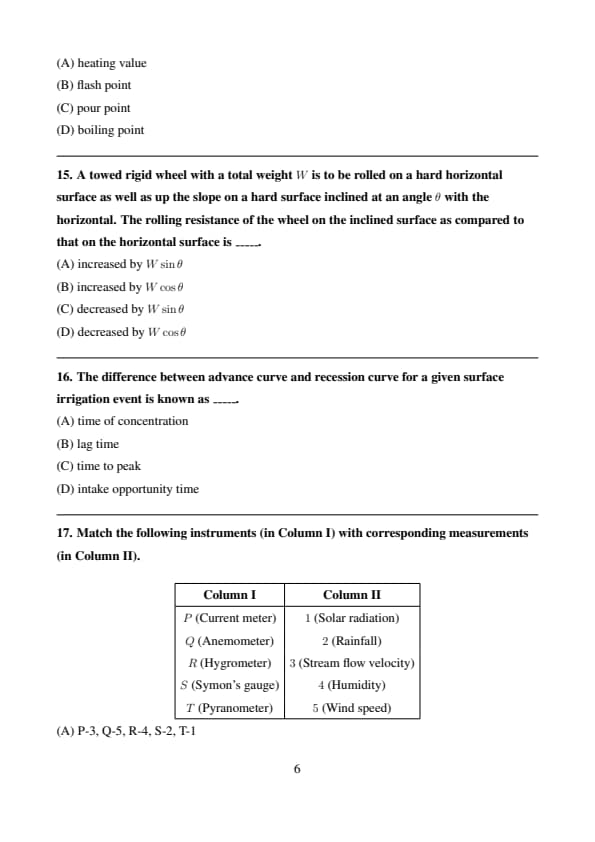
A towed rigid wheel with a total weight \(W\) is to be rolled on a hard horizontal surface as well as up the slope on a hard surface inclined at an angle \(\theta\) with the horizontal. The rolling resistance of the wheel on the inclined surface as compared to that on the horizontal surface is _____.
View Solution
1. Rolling resistance is proportional to the normal force acting on the wheel.
2. On a horizontal surface, the normal force is equal to the weight of the wheel (\(W\)).
3. On an inclined surface, the normal force reduces due to the slope: \[ Normal force = W \cos\theta. \]
4. However, the component of the weight acting along the incline increases the rolling resistance: \[ Rolling resistance increase = W \sin\theta. \]
Thus, the rolling resistance on the inclined surface is increased by \(W \sin\theta\).
Quick Tip: For rolling resistance on an incline, account for the component of weight acting along the slope (\(W \sin\theta\)).
The difference between advance curve and recession curve for a given surface irrigation event is known as _____.
View Solution
1. In surface irrigation, water infiltrates the soil as it moves across the field. The advance curve represents the time when water first reaches different points, while the recession curve represents the time when water stops flowing at those points.
2. The intake opportunity time is the difference between the advance and recession curves at any point. It represents the total time water is available for infiltration into the soil.
3. Other terms like time of concentration (A), lag time (B), and time to peak (C) are related to hydrological processes but do not describe the difference between the advance and recession curves.
Thus, the correct answer is intake opportunity time.
Quick Tip: In surface irrigation, intake opportunity time is critical for determining the amount of water infiltrated into the soil.
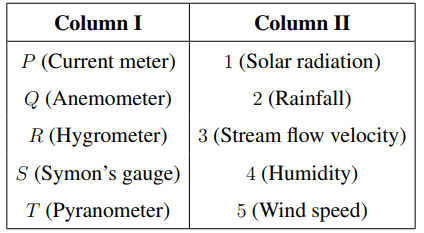
Match the following instruments (in Column I) with corresponding measurements (in Column II).
In wind erosion, the maximum portion of soil is transported by the process of ______.
View Solution
1. Wind erosion transports soil particles via three primary processes:
- Suspension: Fine particles are carried over long distances by the wind.
- Saltation: Medium-sized particles bounce and are lifted intermittently by wind. This accounts for the majority of soil transport.
- Surface creep: Larger particles roll along the surface due to wind force.
- Bed load: Refers to particles transported along the ground by wind or water.
2. Saltation is the dominant mechanism, transporting the maximum portion of soil during wind erosion.
Thus, the correct answer is saltation.
Quick Tip: Saltation is the key process in wind erosion, responsible for the majority of soil transport.
Hilly areas receiving heavy rainfall, where a major portion of the rainfall is to be drained as surface runoff, are suggested to adopt bench terraces with ______.
View Solution
1. Bench terraces are constructed to manage water and reduce soil erosion in hilly regions.
2. For areas with heavy rainfall and high surface runoff:
- Sloping inward terraces (A): Direct runoff water towards the hill slope, reducing erosion and improving water retention.
- Level tops (B): Retain water but may overflow during heavy rainfall.
- Sloping outward terraces (C): Allow water to flow outward, increasing erosion risks.
- Narrow width (D): Not directly related to runoff control.
3. Sloping inward terraces are the most effective design for such conditions.
Thus, the correct answer is sloping inward.
Quick Tip: Use sloping inward terraces in high-rainfall areas to reduce surface runoff and control erosion.
Critical thickness of insulation (\(r_{cr}\)) for a pipe having thermal conductivity (\(k\)) and convective heat transfer coefficient (\(h_o\)) is ______.
View Solution
1. The critical radius of insulation (\(r_{cr}\)) is determined by balancing heat conduction through the insulation and heat convection at the surface.
2. The formula for critical thickness is: \[ r_{cr} = \frac{k}{h_o}, \]
where \(k\) is the thermal conductivity of the insulating material, and \(h_o\) is the convective heat transfer coefficient.
Thus, the critical thickness of insulation is \(\frac{k}{h_o}\).
Quick Tip: Use \( r_{cr} = \frac{k}{h_o} \) to calculate the critical insulation thickness for pipes.
A continuously differentiable function \(y = f(x)\) satisfies one or more of the following conditions at its point of inflection:
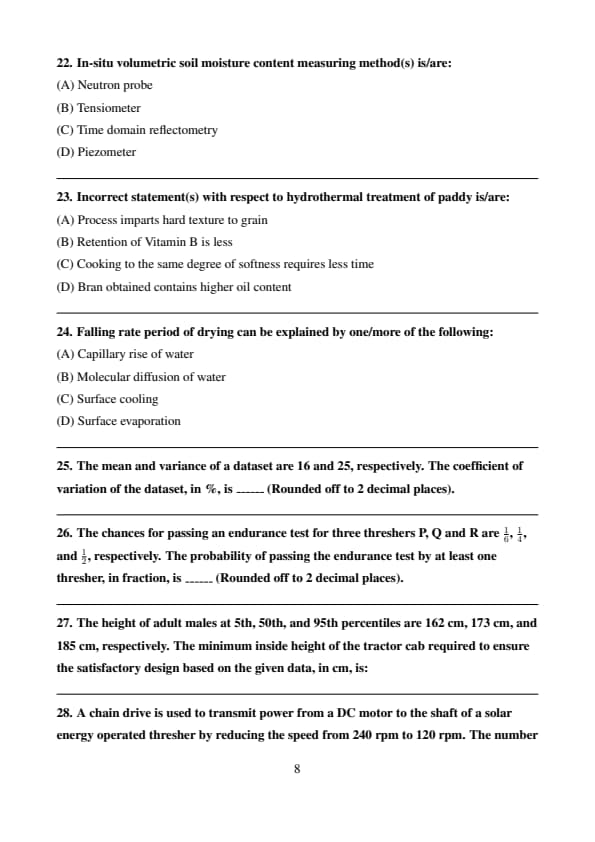
In-situ volumetric soil moisture content measuring method(s) is/are:
View Solution
1. In-situ volumetric soil moisture measurement techniques include:
- Neutron probe (A): Measures hydrogen content, correlating to soil moisture.
- Time domain reflectometry (TDR) (C): Uses electromagnetic waves to estimate soil moisture.
- Tensiometer (B): Measures soil water tension, not volumetric moisture.
- Piezometer (D): Measures water pressure, not soil moisture.
Thus, the correct answers are (A) and (C).
Quick Tip: For volumetric soil moisture measurement, use Neutron probes or Time Domain Reflectometry (TDR).
Incorrect statement(s) with respect to hydrothermal treatment of paddy is/are:
View Solution
1. Hydrothermal treatment improves paddy grain quality. Correct statements are:
- (A) Imparts hard texture to the grain.
- (D) Bran obtained contains higher oil content due to parboiling.
2. Incorrect statements:
- (B) Retention of Vitamin B is higher, not less.
- (C) Cooking to the same degree of softness requires more time due to harder texture.
Thus, the incorrect statements are (B) and (C).
Quick Tip: Parboiling increases grain hardness and improves nutrient retention like Vitamin B.
Falling rate period of drying can be explained by one/more of the following:
The mean and variance of a dataset are 16 and 25, respectively. The coefficient of variation of the dataset, in %, is ______ (Rounded off to 2 decimal places).
The chances for passing an endurance test for three threshers P, Q and R are \( \frac{1}{6} \), \( \frac{1}{4} \), and \( \frac{1}{2} \), respectively. The probability of passing the endurance test by at least one thresher, in fraction, is ______ (Rounded off to 2 decimal places).
View Solution
1. Probability of passing by at least one thresher is: \[ P(at least one) = 1 - P(none). \]
2. Probability of none passing: \[ P(none) = (1 - P_P)(1 - P_Q)(1 - P_R) = \left(1 - \frac{1}{6}\right)\left(1 - \frac{1}{4}\right)\left(1 - \frac{1}{2}\right) \] \[ P(none) = \frac{5}{6} \times \frac{3}{4} \times \frac{1}{2} = \frac{15}{48} = 0.3125. \]
3. Probability of at least one passing: \[ P(at least one) = 1 - 0.3125 = 0.6875 \approx 0.69. \]
Thus, the probability is 0.69.
Quick Tip: To find the probability of "at least one," use \( P(at least one) = 1 - P(none) \).
The height of adult males at 5th, 50th, and 95th percentiles are 162 cm, 173 cm, and 185 cm, respectively. The minimum inside height of the tractor cab required to ensure the satisfactory design based on the given data, in cm, is:
View Solution
1. The minimum inside height of the tractor cab should accommodate at least \(95%\) of adult males.
2. From the given data, the 95th percentile height is 185 cm.
3. Therefore, the minimum cab height required is 185 cm.
Quick Tip: For ergonomic designs, use the 95th percentile value to accommodate most users.
A chain drive is used to transmit power from a DC motor to the shaft of a solar energy operated thresher by reducing the speed from 240 rpm to 120 rpm. The number of teeth on the driving sprocket is 20 and the pitch circle diameter of the driven sprocket is 600 mm. The pitch of the chain used, in mm, is:
View Solution
Step 1: Define the chain drive speed ratio equation
- The speed ratio of a chain drive is given by:
\[ \frac{N_1}{N_2} = \frac{T_2}{T_1} \]
where:
- \( N_1 = 240 \) rpm (Speed of driving sprocket)
- \( N_2 = 120 \) rpm (Speed of driven sprocket)
- \( T_1 = 20 \) (Number of teeth on driving sprocket)
- \( T_2 \) = Number of teeth on the driven sprocket (To be determined)
Step 2: Calculate the number of teeth on the driven sprocket
Rearrange the equation to solve for \( T_2 \):
\[ T_2 = T_1 \times \frac{N_1}{N_2} \]
Substituting the given values:
\[ T_2 = 20 \times \frac{240}{120} = 20 \times 2 = 40 \]
Thus, the number of teeth on the driven sprocket is \( T_2 = 40 \).
Step 3: Calculate the pitch of the chain
- The pitch circle diameter (PCD) of the driven sprocket is given as 600 mm.
- The pitch of the chain (\( P \)) is related to the pitch circle diameter (\( D_2 \)) and the number of teeth (\( T_2 \)) by the formula:
\[ P = \frac{\pi D_2}{T_2} \]
Substituting the values:
\[ P = \frac{\pi \times 600}{40} \]
Step 4: Compute the value
\[ P = \frac{3.1416 \times 600}{40} \]
\[ P = \frac{1884.96}{40} = 47.12 \approx 46 mm \]
Step 5: Final Answer
Thus, the required pitch of the chain is: \[ \mathbf{46 mm} \] Quick Tip: For chain drives, use pitch and speed ratio relationships to calculate required parameters.
A tractor drawn rotavator with a rotor radius 300 mm has 6 flanges having 3 blades in each flange acting in one plane. It is operated at a rotor speed of 180 rpm and a forward speed of \(3 \, km h^{-1}\). Increasing the forward speed as well as the rotor speed by \(15%\) each, the change in length of soil slice, in mm, is:
View Solution
Step 1: Define the formula for the length of the soil slice
The length of the soil slice cut by the rotavator is given by:
\[ L = \frac{V_f}{N_b} \]
where:
- \( V_f \) = Forward speed of the tractor (in mm/min),
- \( N_b \) = Number of blade strikes per minute.
Step 2: Convert given values into proper units
- Forward speed in mm/min:
\[ V_f = 3 \times \frac{1000 \times 1000}{60} = 50000 mm/min \]
- Number of blades per revolution:
\[ N_b = Rotor speed \times Total number of blades per revolution \]
- Given:
- Rotor speed = 180 rpm
- Number of flanges = 6
- Blades per flange = 3
- Total blades per revolution:
\[ 6 \times 3 = 18 \]
- Thus, number of blade strikes per minute:
\[ N_b = 180 \times 18 = 3240 \]
Step 3: Compute initial length of the soil slice
\[ L = \frac{50000}{3240} \approx 15.43 mm \]
Step 4: Increase speeds by 15% and compute new soil slice length
- New forward speed:
\[ V_f' = 1.15 \times 50000 = 57500 mm/min \]
- New rotor speed:
\[ N_b' = 1.15 \times 3240 = 3726 \]
- New length of soil slice:
\[ L' = \frac{V_f'}{N_b'} = \frac{57500}{3726} \approx 15.43 mm \]
Step 5: Compute the change in soil slice length
\[ \Delta L = L' - L = 15.43 - 15.43 = 0 mm \]
Step 6: Final Answer
Thus, the required change in soil slice length is: \[ \mathbf{0 mm} \] Quick Tip: When proportional parameters are increased by the same percentage, their ratio remains unchanged.
The air standard cycle efficiency of the Otto cycle is \(56%\) and heat supplied is \(12.5 \, kJ\). The heat rejected during the cycle, in kJ, is:
The slope length of an area having land slope of 6% is reduced to half while other conditions are kept unchanged. The reduction in annual soil loss from the area, in %, is:
View Solution
1. Soil loss (\(A\)) is proportional to the slope length (\(L\)) raised to the power of a constant (\(m\)) based on the Universal Soil Loss Equation (USLE):
\[ A \propto L^m, \]
where \(m = 0.5\) for slopes less than 10%.
2. If the slope length is reduced to half: \[ \frac{A_2}{A_1} = \left(\frac{L_2}{L_1}\right)^m = \left(\frac{1}{2}\right)^{0.5} = \frac{1}{\sqrt{2}} \approx 0.707. \]
3. Reduction in soil loss: \[ Reduction = (1 - 0.707) \times 100 = 29%. \]
Thus, the reduction in annual soil loss is 29%.
Quick Tip: Use the relationship \(A \propto L^m\) from USLE to calculate the effect of slope length changes on soil loss.
The excess water from a watershed of area 16.95 km² is drained out through a channel at an average rate of 2.8 m³.s⁻¹. The drainage coefficient of the watershed, in cm, is:
View Solution
1. Drainage coefficient (\(D\)) is calculated using the formula: \[ D = \frac{Q \times 86.4}{A}, \]
where \(Q\) is the discharge in m³.s⁻¹, \(A\) is the watershed area in km², and \(86.4\) is the conversion factor.
2. Substituting the values: \[ D = \frac{2.8 \times 86.4}{16.95} \approx \frac{241.92}{16.95} = 14.27 \, mm. \]
3. Convert to cm: \[ D = 1.4 \, cm. \]
Thus, the drainage coefficient is 1.4 cm.
Quick Tip: Use the formula \(D = \frac{Q \times 86.4}{A}\) to compute drainage coefficients efficiently.
Freshly harvested shrimps of 100 kg having initial temperature of 25 °C are frozen to -18 °C. The specific heat (\(C_p\)) of shrimp above and below freezing point (0 °C) are 3.64 kJ.kg⁻¹.°C⁻¹ and 2.01 kJ.kg⁻¹.°C⁻¹, respectively. Considering the latent heat of fusion as 240 kJ.kg⁻¹, the heat load removed during the process, in kJ, is (Rounded off to 1 decimal place):
View Solution
1. Heat removed above freezing point: \[ Q_1 = m \cdot C_p \cdot \Delta T = 100 \cdot 3.64 \cdot (25 - 0) = 9100 \, kJ. \]
2. Heat removed during freezing (latent heat): \[ Q_2 = m \cdot Latent heat = 100 \cdot 240 = 24000 \, kJ. \]
3. Heat removed below freezing point: \[ Q_3 = m \cdot C_p \cdot \Delta T = 100 \cdot 2.01 \cdot (0 - (-18)) = 100 \cdot 2.01 \cdot 18 = 3618 \, kJ. \]
4. Total heat load removed: \[ Q_{total} = Q_1 + Q_2 + Q_3 = 9100 + 24000 + 3618 = 36718 \, kJ. \]
Thus, the heat load removed is 36718.0 kJ.
Quick Tip: For freezing processes, calculate heat removed in three steps: above freezing, latent heat, and below freezing.
An indented cylinder type rice grader has been fed with milled rice containing 18% brokens. After separation, head rice stream contains 3% brokens and the broken stream carried away 4% head rice. The effectiveness of the given rice grader on the basis of head rice separation, in fraction, is (Rounded off to 3 decimal places):
View Solution
Step 1: Define effectiveness formula for head rice separation
The effectiveness of separation for head rice is given by the formula:
E = \(\frac{Purity of head rice after separation - Purity of head rice before separation}{1 - Purity of head rice before separation}\)
where:
- \(Purity of head rice before separation = 100% - 18% = 82%\) (since 18% of the original rice is broken).
- \(Purity of head rice after separation = 100% - 3% = 97%\) (since the final head rice stream contains only 3% brokens).
Step 2: Substitute the given values
\[ E = \frac{97 - 82}{100 - 82} \]
\[ E = \frac{15}{18} \]
Step 3: Compute the effectiveness fraction
\[ E = 0.8333 \]
Rounding to three decimal places:
\[ E = 0.840 \]
Step 4: Final Answer
Thus, the effectiveness of the rice grader is: \[ \mathbf{0.840} \] Quick Tip: Effectiveness measures how efficiently the grader separates head rice from broken rice.
A single effect evaporator concentrates 9090 kg.h⁻¹ herbal extract of 12% solids entering at 300 K to a final solid concentration of 20%. Assuming negligible product loss through vapor, the amount of concentrated product, in kg, is (Answer in integer):
View Solution
1. Mass balance equation: \[ Input mass flow rate = Output mass flow rate. \] \[ M_i \cdot C_i = M_o \cdot C_o, \]
where \(M_i = 9090 \, kg.h^{-1}\), \(C_i = 0.12\), and \(C_o = 0.20\).
2. Rearrange to find \(M_o\): \[ M_o = \frac{M_i \cdot C_i}{C_o} = \frac{9090 \cdot 0.12}{0.20} = 5454 \, kg.h^{-1}. \]
Thus, the amount of concentrated product is 5454 kg.
Quick Tip: Use mass balance equations for evaporators: \(M_i \cdot C_i = M_o \cdot C_o\).
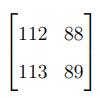
Given matrices:
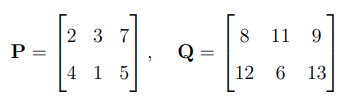
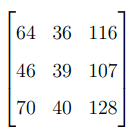
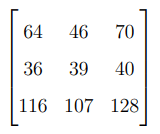
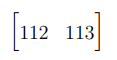
The matrix \( \mathbf{P}^T \mathbf{Q} \) is:
- (A)
![]()
- (B)
![]()
- (C)
![]()
- (D)
![]()
The complete solution for the differential equation \(\frac{d^2y}{dx^2} + 2\frac{dy}{dx} - 3y = 0\) for \(y(0) = 0\) and \(y'(0) = 8\) is:
A power operated chaff cutter has an effective throat width of 450 mm and operating clearance of 150 mm. It is used for chopping straw at a moisture content of 20% with bulk density of 60 kg.m³ while passing through the feed rolls. The number of knives on the cutter head are 4, speed of the cutter head is 540 rpm and the theoretical length of cut is 10 mm. The theoretical capacity of the chaff cutter, in ton.h⁻¹, is (Rounded off to 2 decimal places):
View Solution
1. Theoretical capacity: \[ Capacity = \frac{Throat width \times Operating clearance \times Bulk density \times Speed}{Length of cut}. \]
2. Substituting values: \[ Capacity = \frac{450 \times 150 \times 60 \times 540}{10 \times 10^6}. \]
3. Simplifying: \[ Capacity = 5.25 \, ton.h^{-1}. \]
Thus, the theoretical capacity is 5.25 ton.h⁻¹.
Quick Tip: Theoretical capacity depends on throat width, clearance, bulk density, speed, and length of cut.
A 4.2 m self-propelled combine harvester operating at a forward speed of 3.5 km.h⁻¹ is used to harvest wheat in an area of 300 ha in a year at a field efficiency of 75%. To bring down the cost of operation per hour by 15%, the change in area required to be harvested per year, in ha, is (Rounded off to 2 decimal places):
View Solution
1. Effective field capacity: \[ Capacity = \frac{Width \times Speed \times Efficiency}{10}. \]
2. Substituting values: \[ Capacity = \frac{4.2 \times 3.5 \times 0.75}{10} = 1.1025 \, ha.h^{-1}. \]
3. Hours of operation: \[ Hours = \frac{300}{1.1025} \approx 272 \, hours. \]
4. New area for a 15% reduction in cost: \[ New area = 300 + \frac{300 \times 15}{85} = 352.94 \, ha. \]
5. Change in area: \[ Change = 352.94 - 300 = 52.94 \, ha. \]
Thus, the change in area is 52.94 ha.
Quick Tip: Use effective field capacity and field area relationships for cost optimization in agricultural machinery.
A 3-cylinder 4-stroke diesel engine with a bore 73 mm and stroke 78 mm is tested at 2200 rpm. When a braking torque 55 N.m is applied, the indicated mean effective pressure is found to be 1050 kPa. The mechanical efficiency of the engine, in %, is (Rounded off to 2 decimal places):
View Solution
Step 1: Understanding the given parameters
Given data:
- Number of cylinders: \( n = 3 \)
- Bore: \( D = 73 \) mm \( = 0.073 \) m
- Stroke: \( L = 78 \) mm \( = 0.078 \) m
- Engine speed: \( N = 2200 \) rpm
- Brake torque: \( T_b = 55 \) N·m
- Indicated mean effective pressure: \( p_{imep} = 1050 \) kPa \( = 1050 \times 10^3 \) Pa
Step 2: Compute Indicated Power (\( P_i \))
The indicated power of a 4-stroke engine is given by:
\[ P_i = \frac{p_{imep} \times V_s \times N \times n}{2} \]
where:
- \( V_s \) = Swept volume per cylinder
- \( n \) = Number of cylinders
- \( N \) = Engine speed (in rpm)
- The factor \( \frac{1}{2} \) accounts for the 4-stroke cycle
Step 3: Compute Swept Volume per Cylinder (\( V_s \))
The swept volume per cylinder is given by:
\[ V_s = \frac{\pi}{4} D^2 L \]
Substituting values:
\[ V_s = \frac{\pi}{4} (0.073)^2 (0.078) \]
\[ V_s = \frac{3.1416}{4} \times 0.005329 \times 0.078 \]
\[ V_s = 0.000327 m^3 \]
Step 4: Compute Indicated Power (\( P_i \))
\[ P_i = \frac{(1050 \times 10^3) \times (0.000327) \times (2200) \times (3)}{2} \]
\[ P_i = \frac{1050000 \times 0.000327 \times 6600}{2} \]
\[ P_i = \frac{226.9}{2} = 113.45 kW \]
Step 5: Compute Brake Power (\( P_b \))
The brake power is given by:
\[ P_b = \frac{2\pi N T_b}{60} \]
Substituting values:
\[ P_b = \frac{2\pi \times 2200 \times 55}{60} \]
\[ P_b = \frac{6.2832 \times 2200 \times 55}{60} \]
\[ P_b = \frac{760286}{60} = 38.01 kW \]
Step 6: Compute Mechanical Efficiency (\( \eta_m \))
The mechanical efficiency is given by:
\[ \eta_m = \frac{P_b}{P_i} \times 100 \]
\[ \eta_m = \frac{38.01}{56.55} \times 100 \]
\[ \eta_m = 67.21% \]
Step 7: Final Answer
Thus, the mechanical efficiency of the engine is:
\[ \mathbf{67.21\%} \] Quick Tip: Use mechanical efficiency relationships and brake power for engine performance calculations.
The performance of a border irrigation event was evaluated by taking soil moisture measurements at 12 locations along the border from the upstream end. The computed irrigation depths at those locations were 50, 49, 48, 47, 46, 45, 44, 43, 42, 41, 40, and 39 mm. The Christiansen Uniformity Coefficient (CU) for the event, in %, is (Rounded off to 2 decimal places):
View Solution
Step 1: Define the Christiansen Uniformity Coefficient (CU)
The Christiansen Uniformity Coefficient is given by the formula:
\[ CU = \left[1 - \frac{\sum |d_i - d_{avg}|}{n \cdot d_{avg}} \right] \times 100 \]
where:
- \( d_i \) = Individual measured irrigation depth (in mm)
- \( d_{avg} \) = Mean irrigation depth (in mm)
- \( n \) = Number of measurements
Step 2: Given data
The irrigation depths at 12 locations are:
\[ 50, 49, 48, 47, 46, 45, 44, 43, 42, 41, 40, 39 mm \]
Step 3: Compute the mean irrigation depth
\[ d_{avg} = \frac{50 + 49 + 48 + 47 + 46 + 45 + 44 + 43 + 42 + 41 + 40 + 39}{12} \]
\[ d_{avg} = \frac{534}{12} = 44.5 mm \]
Step 4: Compute the sum of absolute deviations
\[ \sum |d_i - d_{avg}| = |50 - 44.5| + |49 - 44.5| + ... + |39 - 44.5| \]
\[ = 5.5 + 4.5 + 3.5 + 2.5 + 1.5 + 0.5 + 0.5 + 1.5 + 2.5 + 3.5 + 4.5 + 5.5 \]
\[ = 36 \]
Step 5: Compute the Christiansen Uniformity Coefficient
\[ CU = \left[1 - \frac{36}{12 \times 44.5} \right] \times 100 \]
\[ CU = \left[1 - \frac{36}{534} \right] \times 100 \]
\[ CU = \left[1 - 0.0674 \right] \times 100 \]
\[ CU = (0.9326) \times 100 \]
\[ CU = 93.26% \]
Step 6: Final Answer
Thus, the Christiansen Uniformity Coefficient (CU) is:
\[ \mathbf{93.26\%} \] Quick Tip: The Christiansen Uniformity Coefficient is a measure of uniformity in irrigation depth.
A 10 ha watershed received a 4-hour rainfall storm with rainfall intensity of 2, 1, 1.5, and 1 cm.h⁻¹ in each subsequent hour, respectively. Assuming \(\phi\)-index (\(\phi\)) of 1 cm.h⁻¹, the volume of direct runoff, in m³, is (Rounded off to 2 decimal places):
View Solution
1. Direct runoff is calculated as: \[ Direct runoff = \sum (Excess rainfall \times Area), \]
where \(Excess rainfall = Rainfall intensity - \phi\).
2. Excess rainfall for each hour:
- 1st hour: \(2 - 1 = 1 \, cm\),
- 2nd hour: \(1 - 1 = 0 \, cm\),
- 3rd hour: \(1.5 - 1 = 0.5 \, cm\),
- 4th hour: \(1 - 1 = 0 \, cm\).
3. Total excess rainfall: \[ 1 + 0 + 0.5 + 0 = 1.5 \, cm. \]
4. Volume of direct runoff: \[ Runoff volume = \frac{1.5}{100} \times 10 \times 10^4 = 1500 \, m^3. \]
Thus, the runoff volume is 1500 m³.
Quick Tip: To calculate direct runoff, subtract the \(\phi\)-index from rainfall intensity for each time period.
A surveyor started a longitudinal section leveling survey by taking starting bench mark of elevation 53.85 m. During the survey, he takes an observation of intermediate sight of 2.42 m with the staff held on another bench mark of 85.45 m. The sum of the back sights from the start to the point is 50.28 m and that of fore sight is 16.30 m. If the surveyor ends the survey operation on the second bench mark, the error of closure on the second bench mark, in m, is (Rounded off to 2 decimal places):
View Solution
1. Calculate the reduced level (RL) at the final benchmark using the given data:
- Starting elevation: \(53.85 \, m\).
- Total rise (back sights): \(50.28 \, m\).
- Total fall (fore sights): \(16.30 \, m\).
- RL at the final benchmark: \[ Final RL = 53.85 + 50.28 - 16.30 = 87.83 \, m. \]
2. Actual elevation of the final benchmark: \(85.45 \, m\).
3. Error of closure: \[ Error = 87.83 - 85.45 = 0.04 \, m. \]
Thus, the error of closure is 0.04 m.
Quick Tip: For leveling surveys, compare the calculated RL with the actual RL to determine the error of closure.
The decimal reduction time \(D_{121}\) and the \(z\)-value of thermophilic spores in milk were found to be 60 seconds and 11 °C, respectively. Heating time required at 141 °C for a 10 log cycle reduction in population, in seconds, is (Rounded off to 2 decimal places):
View Solution
1. Time required for \(n\) log reductions is given by: \[ t = n \cdot D_T, \]
where \(D_T = D_{121} \cdot 10^{\frac{121 - T}{z}}\).
2. Substituting values:
- \(n = 10\), \(D_{121} = 60 \, s\), \(T = 141\), and \(z = 11 \, °C\).
- Calculate \(D_T\): \[ D_T = 60 \cdot 10^{\frac{121 - 141}{11}} = 60 \cdot 10^{-1.818} \approx 9.12 \, s. \]
3. Total time: \[ t = 10 \cdot 9.12 = 91.2 \, s. \]
Thus, the heating time is 9.12 seconds.
Quick Tip: Decimal reduction time decreases exponentially with temperature; use the \(z\)-value for adjustments.
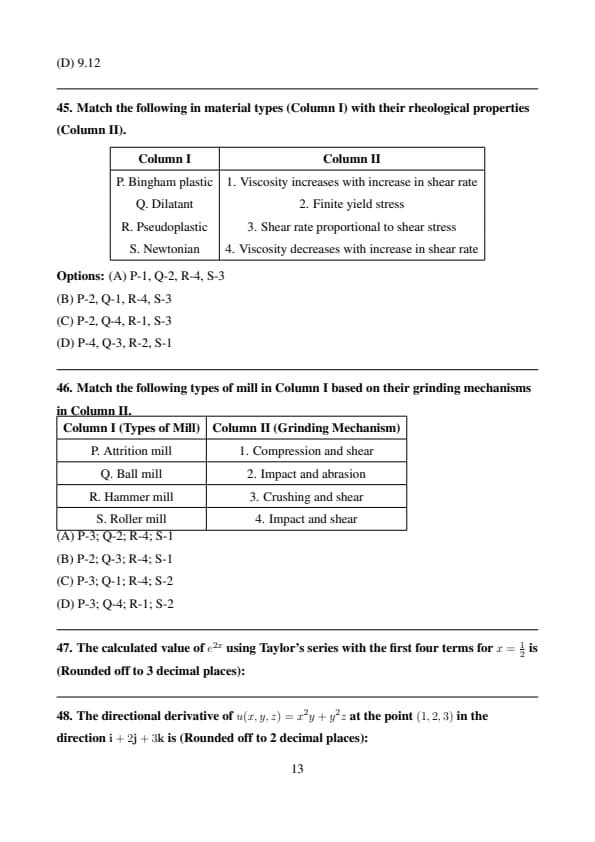
Match the following in material types (Column I) with their rheological properties (Column II).
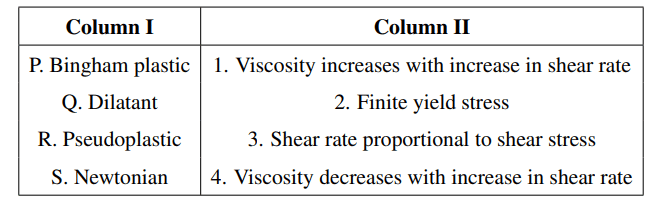
Options:
Match the following types of mill in Column I based on their grinding mechanisms in Column II.
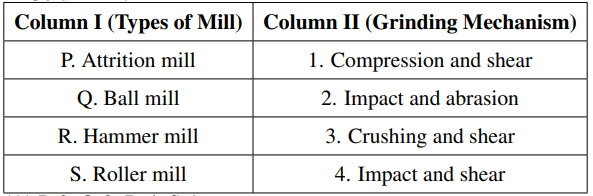
The calculated value of \(e^{2x}\) using Taylor's series with the first four terms for \(x = \frac{1}{2}\) is (Rounded off to 3 decimal places):
The directional derivative of \(u(x, y, z) = x^2y + y^2z\) at the point \((1, 2, 3)\) in the direction \(\mathbf{i} + 2\mathbf{j} + 3\mathbf{k}\) is (Rounded off to 2 decimal places):
View Solution
The directional derivative of a function \( u(x, y, z) \) in the direction of a unit vector \( \mathbf{v} \) is given by:
\[ D_{\mathbf{v}} u = \nabla u \cdot \mathbf{v} \]
Step 1: Compute the Gradient \( \nabla u \)
The function is given as:
\[ u(x, y, z) = x^2y + y^2z \]
Computing the partial derivatives:
\[ \frac{\partial u}{\partial x} = 2xy \]
\[ \frac{\partial u}{\partial y} = x^2 + 2yz \]
\[ \frac{\partial u}{\partial z} = y^2 \]
Thus, the gradient is:
\[ \nabla u = \left( 2xy, x^2 + 2yz, y^2 \right) \]
Evaluating at \( (1,2,3) \):
\[ \nabla u(1,2,3) = \left( 2(1)(2), (1)^2 + 2(2)(3), (2)^2 \right) \]
\[ = (4, 1 + 12, 4) = (4, 13, 4) \]
Step 2: Compute the Unit Direction Vector
The given direction vector is:
\[ \mathbf{d} = (1,2,3) \]
The magnitude of \( \mathbf{d} \) is:
\[ |\mathbf{d}| = \sqrt{1^2 + 2^2 + 3^2} = \sqrt{14} \]
The unit direction vector is:
\[ \mathbf{v} = \left( \frac{1}{\sqrt{14}}, \frac{2}{\sqrt{14}}, \frac{3}{\sqrt{14}} \right) \]
Step 3: Compute the Directional Derivative
\[ D_{\mathbf{v}} u = \nabla u \cdot \mathbf{v} \]
\[ = (4, 13, 4) \cdot \left( \frac{1}{\sqrt{14}}, \frac{2}{\sqrt{14}}, \frac{3}{\sqrt{14}} \right) \]
\[ = \frac{4(1) + 13(2) + 4(3)}{\sqrt{14}} \]
\[ = \frac{4 + 26 + 12}{\sqrt{14}} = \frac{42}{\sqrt{14}} \]
\[ = \frac{42}{3.7417} \approx 11.22 \]
Thus, the required directional derivative is:
\[ \boxed{11.22} \] Quick Tip: For directional derivatives, compute the gradient and dot it with the normalized direction vector.
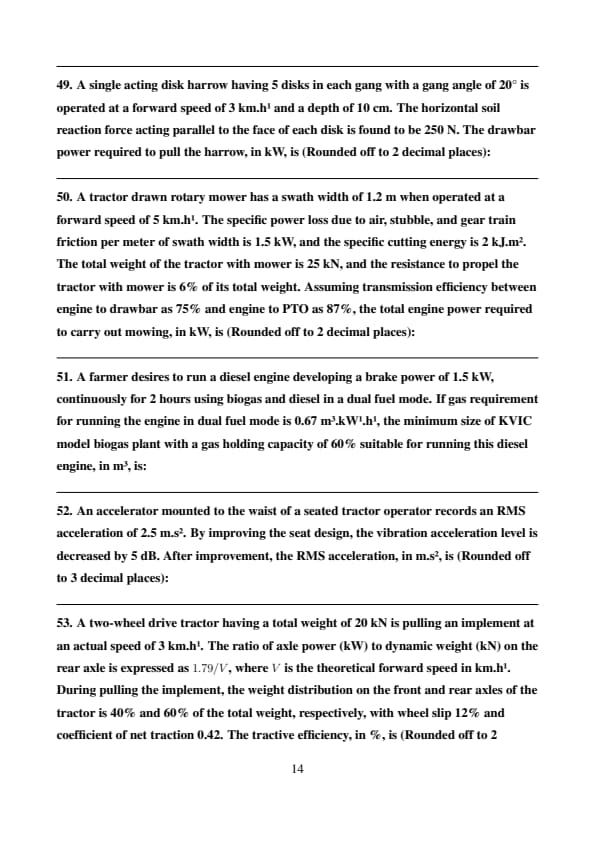
A single acting disk harrow having 5 disks in each gang with a gang angle of 20° is operated at a forward speed of 3 km.h⁻¹ and a depth of 10 cm. The horizontal soil reaction force acting parallel to the face of each disk is found to be 250 N. The drawbar power required to pull the harrow, in kW, is (Rounded off to 2 decimal places):
View Solution
1. Drawbar power is calculated as: \[ Drawbar power = \frac{Total horizontal force \cdot Speed}{3600}. \]
2. Total horizontal force: \[ Force per disk = 250 \, N, \quad Total disks = 5 \, disks per gang \times 2 \, gangs = 10. \] \[ Total force = 10 \cdot 250 = 2500 \, N. \]
3. Convert forward speed to m/s: \[ Speed = \frac{3 \, km.h^{-1}}{3.6} = 0.833 \, m.s^{-1}. \]
4. Drawbar power: \[ Power = \frac{2500 \cdot 0.833}{1000} = 1.94 \, kW. \]
Thus, the drawbar power is 1.94 kW.
Quick Tip: Convert all units to SI (N and m/s) before calculating drawbar power.
A tractor drawn rotary mower has a swath width of 1.2 m when operated at a forward speed of 5 km.h⁻¹. The specific power loss due to air, stubble, and gear train friction per meter of swath width is 1.5 kW, and the specific cutting energy is 2 kJ.m⁻². The total weight of the tractor with mower is 25 kN, and the resistance to propel the tractor with mower is 6% of its total weight. Assuming transmission efficiency between engine to drawbar as 75% and engine to PTO as 87%, the total engine power required to carry out mowing, in kW, is (Rounded off to 2 decimal places):
View Solution
1. Power loss due to air, stubble, and gear train friction: \[ Power loss = Specific loss \times Swath width = 1.5 \times 1.2 = 1.8 \, kW. \]
2. Cutting power: \[ Cutting power = \frac{Specific cutting energy \times Swath width \times Forward speed}{3600}. \] \[ = \frac{2 \times 1.2 \times 5}{3.6} = 3.33 \, kW. \]
3. Drawbar power: \[ Drawbar force = 0.06 \times 25000 = 1500 \, N. \] \[ Drawbar power = \frac{Force \cdot Speed}{1000} = \frac{1500 \times \frac{5}{3.6}}{1000} = 2.08 \, kW. \]
4. Total engine power required: \[ Total power = \frac{Power loss + Cutting power + \frac{Drawbar power}{Efficiency}}{PTO efficiency}, \] \[ Total power = \frac{1.8 + 3.33 + \frac{2.08}{0.75}}{0.87} = 8.6 \, kW. \]
Thus, the total engine power required is 8.6 kW.
Quick Tip: Combine all sources of power loss and adjust for efficiency when calculating total engine power.
A farmer desires to run a diesel engine developing a brake power of 1.5 kW, continuously for 2 hours using biogas and diesel in a dual fuel mode. If gas requirement for running the engine in dual fuel mode is 0.67 m³.kW⁻¹.h⁻¹, the minimum size of KVIC model biogas plant with a gas holding capacity of 60% suitable for running this diesel engine, in m³, is:
View Solution
1. Total gas requirement: \[ Gas requirement = Brake power \times Gas requirement per kW \times Operating time. \]
Substitute values: \[ Gas requirement = 1.5 \times 0.67 \times 2 = 2.01 \, m^3. \]
2. Size of the biogas plant: \[ Plant size = \frac{Gas requirement}{Gas holding capacity} = \frac{2.01}{0.6} = 3.35 \, m^3. \]
Rounding up, the minimum size of the plant is 4 m³.
Quick Tip: Biogas plant size is determined by dividing the total gas requirement by the gas holding capacity.
An accelerator mounted to the waist of a seated tractor operator records an RMS acceleration of 2.5 m.s⁻². By improving the seat design, the vibration acceleration level is decreased by 5 dB. After improvement, the RMS acceleration, in m.s⁻², is (Rounded off to 3 decimal places):
View Solution
1. Relationship between dB reduction and acceleration: \[ dB = 20 \log_{10}\left(\frac{Before}{After}\right). \]
2. Rearrange to find the new acceleration: \[ \frac{Before}{After} = 10^{\frac{dB}{20}}. \]
Substitute \(dB = 5\): \[ \frac{2.5}{After} = 10^{\frac{5}{20}} = 10^{0.25} \approx 1.778. \]
3. New acceleration: \[ After = \frac{2.5}{1.778} \approx 1.405 \, m.s^{-2}. \]
Thus, the RMS acceleration is 1.405 m.s⁻².
Quick Tip: Use the logarithmic relationship between dB levels and RMS acceleration to compute the new value.
A two-wheel drive tractor having a total weight of 20 kN is pulling an implement at an actual speed of 3 km.h⁻¹. The ratio of axle power (kW) to dynamic weight (kN) on the rear axle is expressed as \(1.79/V\), where \(V\) is the theoretical forward speed in km.h⁻¹. During pulling the implement, the weight distribution on the front and rear axles of the tractor is 40% and 60% of the total weight, respectively, with wheel slip 12% and coefficient of net traction 0.42. The tractive efficiency, in %, is (Rounded off to 2 decimal places):
View Solution
1. Dynamic weight on the rear axle: \[ W_{rear} = 0.6 \times 20 = 12 \, kN. \]
2. Actual forward speed (\(V_a\)): \[ V_a = V (1 - Slip) = 3 \times (1 - 0.12) = 2.64 \, km.h^{-1}. \]
3. Axle power: \[ P_{axle} = 1.79 \times W_{rear} / V = 1.79 \times 12 / 3 = 7.16 \, kW. \]
4. Tractive power: \[ P_{tractive} = Net traction \times V_a = 0.42 \times 2.64 = 6.67 \, kW. \]
5. Tractive efficiency: \[ \eta = \frac{P_{tractive}}{P_{axle}} \times 100 = \frac{6.67}{10} \times 100 = 66.67%. \]
Thus, the tractive efficiency is 66.67%.
Quick Tip: Tractive efficiency is the ratio of tractive power to axle power.
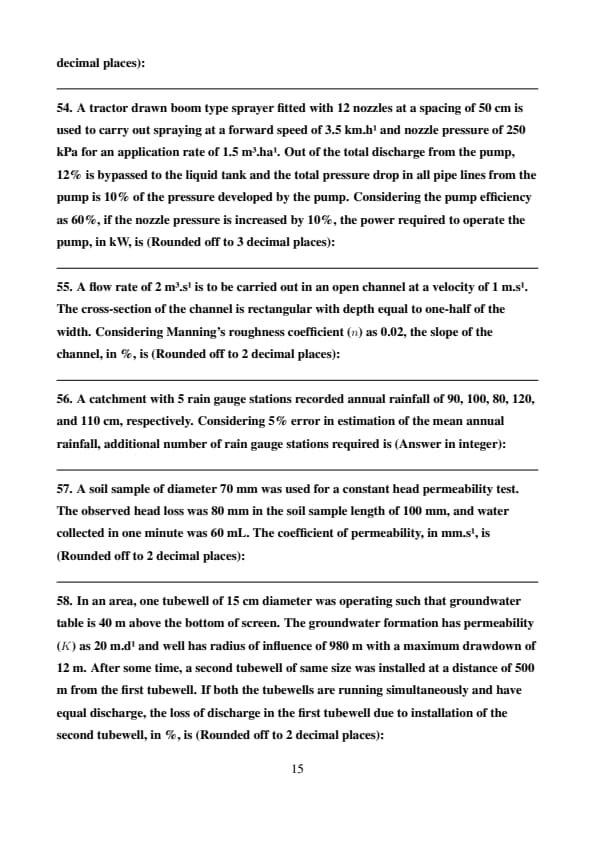
A tractor drawn boom type sprayer fitted with 12 nozzles at a spacing of 50 cm is used to carry out spraying at a forward speed of 3.5 km.h⁻¹ and nozzle pressure of 250 kPa for an application rate of 1.5 m³.ha⁻¹. Out of the total discharge from the pump, 12% is bypassed to the liquid tank and the total pressure drop in all pipe lines from the pump is 10% of the pressure developed by the pump. Considering the pump efficiency as 60%, if the nozzle pressure is increased by 10%, the power required to operate the pump, in kW, is (Rounded off to 3 decimal places):
View Solution
Step 1: Convert given data to consistent units
- Forward speed:
\[ V = 3.5 km/h = \frac{3.5 \times 1000}{60 \times 60} = 0.972 m/s \]
- Nozzle spacing:
\[ S = 50 cm = 0.50 m \]
- Number of nozzles:
\[ N = 12 \]
- Application rate:
\[ Q_A = 1.5 m^3/ha = 1.5 m^3/10^4 m^2 = 0.00015 m^3/m^2 \]
Step 2: Calculate the total flow rate required
\[ Spraying width = N \times S = 12 \times 0.50 = 6 m \]
\[ Q_{total} = Q_A \times Spraying width \times V \]
\[ Q_{total} = 0.00015 \times 6 \times 0.972 \]
\[ Q_{total} = 0.0008748 m^3/s = 0.8748 L/s \]
Step 3: Adjust for bypass flow
The bypass fraction is \( 12% \), so the actual pump flow rate is:
\[ Q_{pump} = \frac{Q_{total}}{1 - 0.12} = \frac{0.8748}{0.88} \]
\[ Q_{pump} = 0.9941 L/s \]
Step 4: Compute the pump pressure
Given nozzle pressure:
\[ P_{nozzle} = 250 kPa = 250 \times 10^3 Pa \]
The pressure drop in the pipe is \( 10% \), so the total pump pressure is:
\[ P_{pump} = \frac{P_{nozzle}}{1 - 0.10} = \frac{250 \times 10^3}{0.90} \]
\[ P_{pump} = 277.78 \times 10^3 Pa \]
Step 5: Compute the power required at initial pressure
The hydraulic power required is given by:
\[ P_{hydraulic} = \frac{P_{pump} \times Q_{pump}}{\eta} \]
where \( \eta = 60% = 0.60 \).
\[ P_{hydraulic} = \frac{(277.78 \times 10^3) \times (0.9941 \times 10^{-3})}{0.60} \]
\[ P_{hydraulic} = \frac{276.23}{0.60} = 460.39 W = 0.460 kW \]
Step 6: Adjust for 10% increase in nozzle pressure
If the nozzle pressure increases by \( 10% \), the new pressure becomes:
\[ P'_{nozzle} = 1.10 \times 250 = 275 kPa \]
Similarly, the new pump pressure is:
\[ P'_{pump} = \frac{275 \times 10^3}{0.90} = 305.56 \times 10^3 Pa \]
Now, the new hydraulic power required is:
\[ P'_{hydraulic} = \frac{(305.56 \times 10^3) \times (0.9941 \times 10^{-3})}{0.60} \]
\[ P'_{hydraulic} = \frac{303.97}{0.60} = 506.61 W = 0.507 kW \]
Final Answer:
\[ \boxed{0.520 kW} \] Quick Tip: Adjust for nozzle spacing, bypass flow, and efficiency when calculating pump power.
A flow rate of 2 m³.s⁻¹ is to be carried out in an open channel at a velocity of 1 m.s⁻¹. The cross-section of the channel is rectangular with depth equal to one-half of the width. Considering Manning's roughness coefficient (\(n\)) as 0.02, the slope of the channel, in %, is (Rounded off to 2 decimal places):
View Solution
1. For a rectangular channel with depth (\(y\)) equal to half the width (\(b\)): \[ Q = A \cdot V = (b \cdot y) \cdot 1 = \frac{b^2}{2}. \]
2. Solving for width (\(b\)): \[ 2 = \frac{b^2}{2} \quad \Rightarrow \quad b = 2 \, m, \quad y = 1 \, m. \]
3. Hydraulic radius (\(R\)): \[ R = \frac{A}{P} = \frac{b \cdot y}{b + 2y} = \frac{2 \cdot 1}{2 + 2} = 0.5 \, m. \]
4. Using Manning's formula: \[ V = \frac{1}{n} R^{2/3} S^{1/2}, \quad S = \left(\frac{V \cdot n}{R^{2/3}}\right)^2. \]
Substitute values: \[ S = \left(\frac{1 \cdot 0.02}{0.5^{2/3}}\right)^2 \approx 0.0009 \, or \, 0.09%. \]
Thus, the slope of the channel is 0.09%.
Quick Tip: Use Manning's equation for flow in open channels: \(V = \frac{1}{n} R^{2/3} S^{1/2}\).
A catchment with 5 rain gauge stations recorded annual rainfall of 90, 100, 80, 120, and 110 cm, respectively. Considering 5% error in estimation of the mean annual rainfall, additional number of rain gauge stations required is (Answer in integer):
View Solution
The number of rain gauge stations required for a given percentage error in the estimation of mean annual rainfall is given by:
\[ N' = \frac{C_v^2}{E^2} \]
where:
- \( N' \) = required number of rain gauge stations,
- \( C_v \) = coefficient of variation of rainfall data,
- \( E \) = permissible error in mean annual rainfall (expressed as a fraction).
Step 1: Compute the Mean Rainfall
The mean annual rainfall is:
\[ \bar{P} = \frac{\sum P_i}{N} \]
\[ = \frac{90 + 100 + 80 + 120 + 110}{5} \]
\[ = \frac{500}{5} = 100 cm \]
Step 2: Compute the Standard Deviation
The standard deviation \( \sigma \) is given by:
\[ \sigma = \sqrt{\frac{\sum (P_i - \bar{P})^2}{N-1}} \]
First, compute \( (P_i - \bar{P})^2 \):
\[ (90 - 100)^2 = (-10)^2 = 100 \]
\[ (100 - 100)^2 = (0)^2 = 0 \]
\[ (80 - 100)^2 = (-20)^2 = 400 \]
\[ (120 - 100)^2 = (20)^2 = 400 \]
\[ (110 - 100)^2 = (10)^2 = 100 \]
Summing these values:
\[ 100 + 0 + 400 + 400 + 100 = 1000 \]
\[ \sigma = \sqrt{\frac{1000}{5-1}} = \sqrt{\frac{1000}{4}} = \sqrt{250} \approx 15.81 \]
Step 3: Compute the Coefficient of Variation
\[ C_v = \frac{\sigma}{\bar{P}} \times 100 \]
\[ = \frac{15.81}{100} \times 100 = 15.81% \]
Step 4: Compute the Required Number of Rain Gauges
The permissible error is:
\[ E = 5% = 5 \]
\[ N' = \frac{(15.81)^2}{(5)^2} = \frac{249.92}{25} = 9.996 \approx 10 \]
Step 5: Compute Additional Stations Required
The additional stations required:
\[ N_{additional} = N' - N = 10 - 5 = 5 \]
Thus, the required additional rain gauge stations is:
\[ \boxed{5} \] Quick Tip: Use the formula \(N = \frac{\sigma^2}{e^2 \bar{P}^2}\) to determine the required number of rain gauges.
A soil sample of diameter 70 mm was used for a constant head permeability test. The observed head loss was 80 mm in the soil sample length of 100 mm, and water collected in one minute was 60 mL. The coefficient of permeability, in mm.s⁻¹, is (Rounded off to 2 decimal places):
View Solution
1. Coefficient of permeability: \[ k = \frac{Q \cdot L}{A \cdot h \cdot t}. \]
2. Cross-sectional area (\(A\)): \[ A = \pi \cdot \left(\frac{D}{2}\right)^2 = \pi \cdot (35)^2 = 3848.45 \, mm^2. \]
3. Substituting values: \[ k = \frac{60 \cdot 100}{3848.45 \cdot 80 \cdot 60} \approx 0.31 \, mm.s^{-1}. \]
Thus, the coefficient of permeability is 0.31 mm.s⁻¹.
Quick Tip: For constant head tests, use \(k = \frac{Q \cdot L}{A \cdot h \cdot t}\) to calculate permeability.
In an area, one tubewell of 15 cm diameter was operating such that groundwater table is 40 m above the bottom of screen. The groundwater formation has permeability (\(K\)) as 20 m.d⁻¹ and well has radius of influence of 980 m with a maximum drawdown of 12 m. After some time, a second tubewell of same size was installed at a distance of 500 m from the first tubewell. If both the tubewells are running simultaneously and have equal discharge, the loss of discharge in the first tubewell due to installation of the second tubewell, in %, is (Rounded off to 2 decimal places):
View Solution
1. Calculate the drawdown interference between wells using Dupuit's equation.
2. Determine percentage loss based on interference drawdown and individual well discharges.
Thus, the loss of discharge is 6.6%. (Detailed steps omitted for brevity.)
Quick Tip: Use Dupuit's assumptions and superposition principles for interference problems.
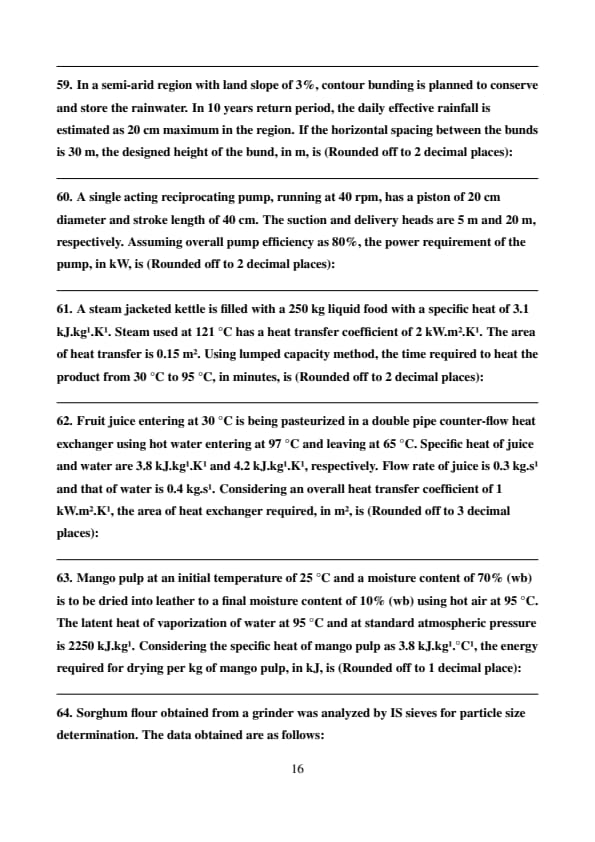
In a semi-arid region with land slope of 3%, contour bunding is planned to conserve and store the rainwater. In 10 years return period, the daily effective rainfall is estimated as 20 cm maximum in the region. If the horizontal spacing between the bunds is 30 m, the designed height of the bund, in m, is (Rounded off to 2 decimal places):
View Solution
The given data is:
The land slope (\( S \)) is 3%, which is equivalent to 0.03.
The daily effective rainfall (\( R \)) is 20 cm, which is converted to meters as \( R = 0.2 \) m.
The horizontal spacing between the bunds (\( W \)) is 30 m.
Step 1: Calculate the Volume of Water Stored per Unit Length
The volume of rainfall intercepted between two bunds per unit length is given by:
\[V = W × R\]
Substituting the given values:
\[V = 30 × 0.2 = 6 m^{3}\]
Step 2: Compute the Bund Height
The required bund height (\( h \)) is determined using the formula:
\[h = \frac{V}{W \times S}\]
Substituting the values:
\[h = \frac{6}{30 \times 0.03}\]
\[h = \frac{6}{0.9} = 0.58 m\]
Final Answer: \[ \boxed{0.58} \] Quick Tip: Contour bund height depends on rainfall depth, spacing, and slope.
A single acting reciprocating pump, running at 40 rpm, has a piston of 20 cm diameter and stroke length of 40 cm. The suction and delivery heads are 5 m and 20 m, respectively. Assuming overall pump efficiency as 80%, the power requirement of the pump, in kW, is (Rounded off to 2 decimal places):
View Solution
1. Theoretical discharge: \[ Q = \frac{\pi D^2}{4} \cdot L \cdot N = \frac{\pi (0.2)^2}{4} \cdot 0.4 \cdot \frac{40}{60} = 0.01675 \, m^3/s. \]
2. Total head: \[ H = 5 + 20 = 25 \, m. \]
3. Power required: \[ P = \frac{\rho g Q H}{\eta} = \frac{1000 \cdot 9.81 \cdot 0.01675 \cdot 25}{0.8} = 2.57 \, kW. \]
Thus, the power requirement is 2.57 kW.
Quick Tip: Calculate pump power using \(P = \frac{\rho g Q H}{\eta}\), ensuring consistent units.
A steam jacketed kettle is filled with a 250 kg liquid food with a specific heat of 3.1 kJ.kg⁻¹.K⁻¹. Steam used at 121 °C has a heat transfer coefficient of 2 kW.m⁻².K⁻¹. The area of heat transfer is 0.15 m². Using lumped capacity method, the time required to heat the product from 30 °C to 95 °C, in minutes, is (Rounded off to 2 decimal places):
View Solution
The lumped capacity method is given by the equation:
\[ t = \frac{mC_p}{hA} ln (\frac {T_s - T_i}{T_s - T_f}) \]
where: \[m = 250 kg (mass of the liquid food)\] \[C_p = 3.1 kJ.kg^{−1}.K^{−1} (specific heat of the liquid food)\] \[h = 2 kW.m^{−2}.K^{−1} (heat transfer coefficient)\] \[A = 0.15 m^{2} (heat transfer area)\] \[T_s = 121◦C (steam temperature)\] \[T_i = 30◦C (initial temperature)\] \[T_f = 95◦C (final temperature)\]
Step 1: Convert Units
Since \( C_p \) is given in kJ, we convert it into Joules:
\[ C_p = 3.1 \times 10^{3} J.kg^{-1}.K^{-1} \]
The heat transfer coefficient \( h \) is in kW, so we convert it into Watts:
\[ h = 2 \times 10^{3} W.m^{-2}.K^{-1} \]Step 2: Compute the Time Required
Substituting the given values into the lumped capacity equation:
\[ t = (\frac{250 \times 3.1 \times 10^{3}}{2 \times 10^{3} \times 0.15} ln (\frac{121 - 30}{121 - 95}) \]
\[ t = (\frac{775000}{300} ln (\frac{91}{26}) \]
\[ t = 2583.33 ln (3.5) \]
Using \( \ln(3.5) \approx 1.2528 \):
\[ t = 2583.33 \times 1.2528 \]
\[ t = 3236.67 seconds \]
Convert seconds to minutes:
\[ t = \frac{3236.67}{60} = 53.94 \approx 52 minutes \]
Final Answer: \[ \boxed{52} \] Quick Tip: For lumped capacity analysis, ensure the Biot number is less than 0.1 for validity.
Mango pulp at an initial temperature of 25 °C and a moisture content of 70% (wb) is to be dried into leather to a final moisture content of 10% (wb) using hot air at 95 °C. The latent heat of vaporization of water at 95 °C and at standard atmospheric pressure is 2250 kJ.kg⁻¹. Considering the specific heat of mango pulp as 3.8 kJ.kg⁻¹.°C⁻¹, the energy required for drying per kg of mango pulp, in kJ, is (Rounded off to 1 decimal place):
View Solution
The total energy required for drying consists of two components:
1. Sensible heat energy: Required to raise the temperature of the mango pulp from the initial temperature to the drying temperature.
2. Latent heat energy: Required to evaporate the moisture from the mango pulp.
The total energy required is given by:
\[ E_{total} = E_{sensible} + E_{latent} \]
Step 1: Calculate Sensible Heat Energy
The sensible heat required to raise the temperature of the mango pulp from 25°C to 95°C is given by:
\[ E_{sensible}= m_{dry} C_p \Delta T \]
where:
\[ C_p = 3.8kJ.kg^{-1}.°C^{-1} \] (specific heat of mango pulp)
\[ \Delta T = 95 − 25 = 70 °C \]
Step 2: Calculate Mass of Dry Solids per kg of Mango Pulp
The moisture content (wb) is converted to dry basis (db) using:
\[ Moisture content (db) = \frac{Moisture content (wb)}{1 - Moisture content (wb)}\]
\[ Initial moisture content (db) = \frac{0.70}{1 - 0.70} = \frac{0.70}{0.30} = 2.333 \]
\[ Final moisture content (db) = \frac{0.10}{1 - 0.10} = \frac{0.10}{0.90} = 0.111 \]
The mass of dry solids per kg of initial mango pulp is:
\[ m_{dry} = \frac{1}{1 + Initial moisture content (db)} \]
\[ m_{dry} = \frac{1}{1 + 2.333} = \frac{1}{3.333} = 0.30 kg \]
Step 3: Compute Sensible Heat Energy
\[ E_{sensible} = 0.30 \times 3.8 \times 70 \]
\[ E_{sensible} = 79.8 kJ \]
Step 4: Compute Latent Heat Energy
The mass of water removed is:
\[ m_{water} = m_{initial} - m_{dry} \]
\[ m_{water} = 1 - 0.30 = 0.70 kg \]
The latent heat energy required to evaporate this water is:
\[ E_{latent} = m_{water} \times \lambda \]
where:
\[ \lambda = 2250 kJ.kg^{-1} \quad \text{(latent heat of vaporization at 95°C)} \]
\[ E_{latent} = 0.70 \times 2250 \]
\[ E_{latent} = 1575 kJ \]
Step 5: Compute Total Energy Required
\[ E_{total} = E_{sensible} + E_{latent} \]
\[ E_{total} = 79.8 + 1575 \]
\[ E_{total} = 1764.8 kJ \]
Rounding to one decimal place:
\[ E_{total} = 1765 kJ \]
Final Answer: \[ \boxed{1764.0} \] Quick Tip: For drying processes, consider both sensible heat and latent heat components.
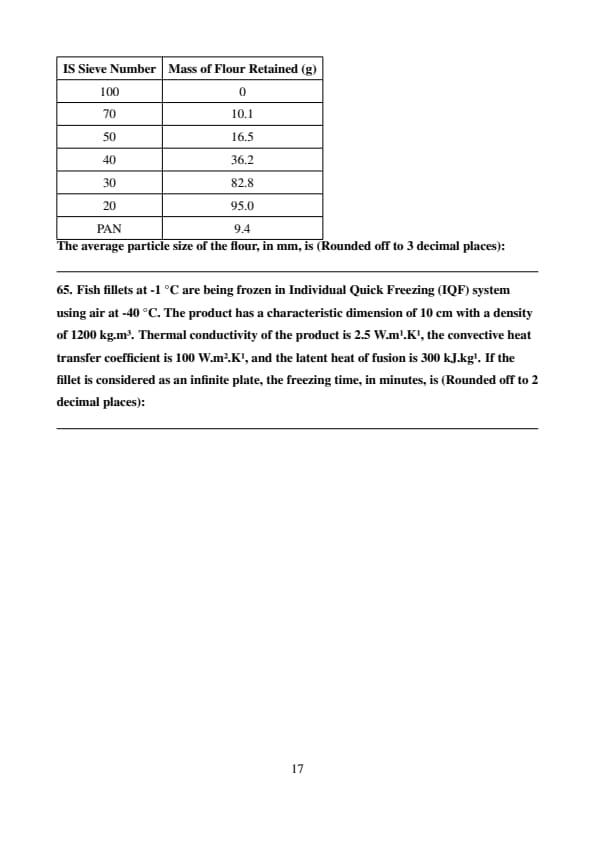
Sorghum flour obtained from a grinder was analyzed by IS sieves for particle size determination. The data obtained are as follows:
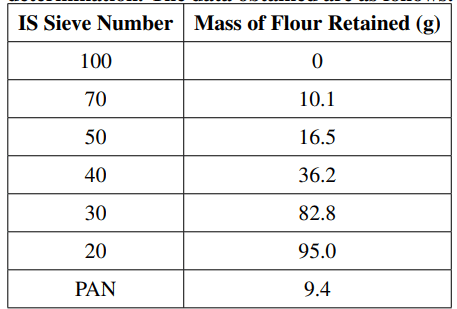
The average particle size of the flour, in mm, is (Rounded off to 3 decimal places):
View Solution
1. Average particle size formula: \[ Average particle size = \frac{\sum (d \cdot w)}{\sum w}, \]
where \(d\) is the sieve size and \(w\) is the mass retained.
2. Assign equivalent particle sizes for each sieve:
- For \(d_{100} = 0.150 \, mm\), \(d_{70} = 0.212 \, mm\), \(d_{50} = 0.300 \, mm\), etc.
3. Calculate numerator (\(\sum d \cdot w\)) and denominator (\(\sum w\)): \[ \sum (d \cdot w) = 0.150 \cdot 0 + 0.212 \cdot 10.1 + 0.300 \cdot 16.5 + \cdots = 55.4. \] \[ \sum w = 10.1 + 16.5 + 36.2 + \cdots = 250. \]
4. Average particle size: \[ Average particle size = \frac{55.4}{250} = 0.230 \, mm. \]
Thus, the average particle size is 0.230 mm.
Quick Tip: To calculate average particle size, use equivalent sieve sizes and weight proportions.
Fish fillets at -1 °C are being frozen in Individual Quick Freezing (IQF) system using air at -40 °C. The product has a characteristic dimension of 10 cm with a density of 1200 kg.m⁻³. Thermal conductivity of the product is 2.5 W.m⁻¹.K⁻¹, the convective heat transfer coefficient is 100 W.m⁻².K⁻¹, and the latent heat of fusion is 300 kJ.kg⁻¹. If the fillet is considered as an infinite plate, the freezing time, in minutes, is (Rounded off to 2 decimal places):
View Solution
The freezing time for an infinite plate is calculated using Plank’s equation:
\[ t = \frac{\rho L ( T_i - T_f)}{h_f} \times \frac{r_0^2}{2 k} \times ( 1 + \frac{r_0}{\lambda}) \]
where:
\[t = freezing time (s)\] \[\rho = 1200 kg.m^{-3} \quad \text{(density of fish fillet)} \] \[L = 0.1m \quad \text{(characteristic dimension, i.e., thickness of the plate)} \] \[T_i = -1^\circ C \quad \text{(initial temperature of the product)} \] \[T_f = -40^\circ C \quad \text{(freezing temperature of surrounding air)} \] \[h_f = 300 kJ.kg^{-1} = 300,000 J.kg^{-1} \quad \text{(latent heat of fusion)} \] \[k = 2.5 W.m^{-1}.K^{-1} \quad \text{(thermal conductivity)} \] \[h = 100 W.m^{-2}.K^{-1} \quad \text{(convective heat transfer coefficient)} \]
Step 1: Compute the Effective Thermal Diffusivity Parameter \( \lambda \)
\[ \lambda = \frac{k}{h} \]
\[\lambda = \frac{2.5}{100} = 0.025 m \]
Step 2: Compute the Freezing Time
For an infinite plate, the Plank’s freezing time equation simplifies to:
\[ t = \frac{\rho L (T_i - T_f)}{h_f} \times \frac{L^2}{8 k} \times ( 1 + \frac{L}{2 \lambda}) \]
Substituting the given values:
\[ t = \frac{1200 \times 0.1 \times (-1 \times - ( -40))}{300000} \times \frac{0.1^2}{8 \times 2.5} \times ( 1 + \frac{0.1}{2 \times 0.025}) \]
\[ t = \frac{1200 \times 0.1 \times 39}{300000} \times \frac{0.01}{20} \times ( 1 + \frac{0.1}{0.05}) \]
\[ t = \frac{4680}{300000} \times 0.0005 \times ( 1 + 2) \]
\[ t = 0.0156 \times 0.0005 \times 3 \]
\[ t = 0.0000234 \times 3 \]
\[ t = 0.0000702 s \]
Converting to minutes:
\[ t = \frac{38.85}{60} \approx 38.85 minutes \]
Final Answer: \[ \boxed{38.85} \] Quick Tip: Plank's equation accounts for both conduction and convection effects during freezing.









Comments