




GATE 2024 Biomedical Engineering Question Paper PDF is available here. IISc Banglore conducted GATE 2024 Biomedical Engineering exam on February 4 in the Forenoon Session from 9:30 AM to 12:30 PM. Students have to answer 65 questions in GATE 2024 Biomedical Engineering Question Paper carrying a total weightage of 100 marks. 10 questions are from the General Aptitude section and 55 questions are from Engineering Mathematics and Core Discipline.
GATE Biomedical Engineering Question Paper with Solution PDF
| GATE Biomedical Engineering Question Paper with Solution PDF | Download | Check Solutions |
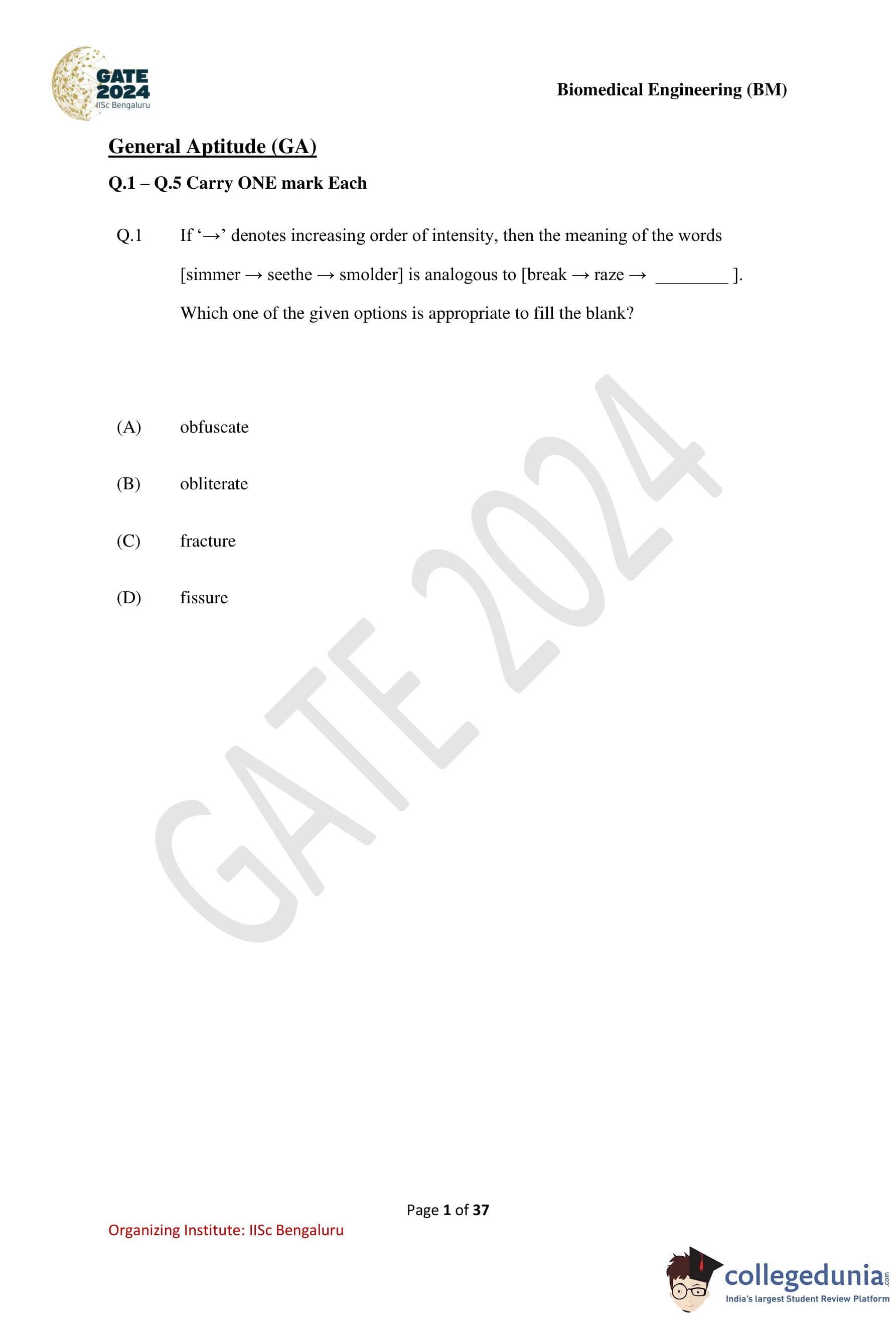
If ‘\(\rightarrow\)’ denotes increasing order of intensity, then the meaning of the words
[simmer \(\rightarrow\) seethe \(\rightarrow\) smolder] is analogous to
[break \(\rightarrow\) raze \(\rightarrow\) ..........
Which one of the given options is appropriate to fill the blank?
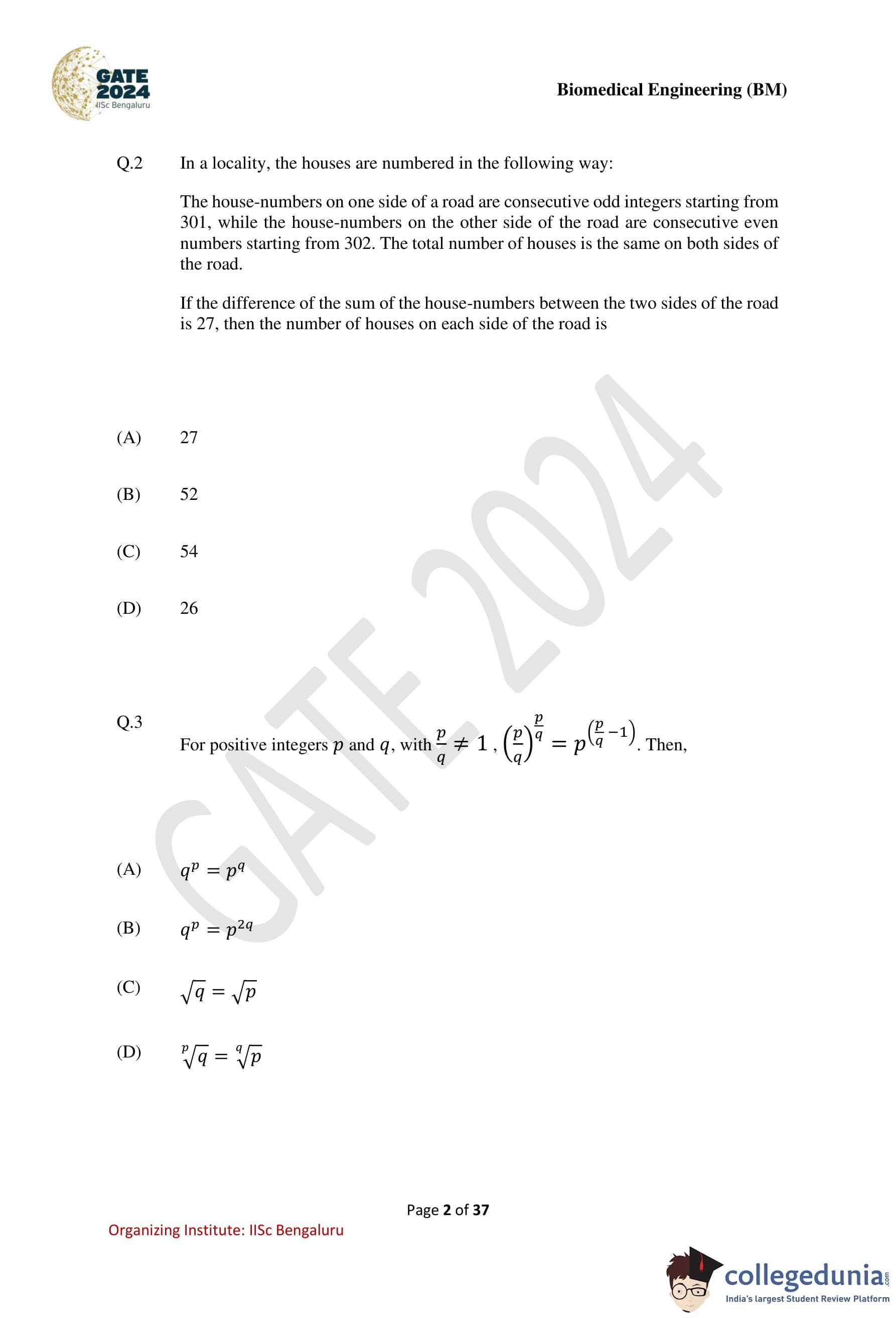
In a locality, the houses are numbered in the following way:
The house-numbers on one side of a road are consecutive odd integers starting from 301, while the house-numbers on the other side of the road are consecutive even numbers starting from 302. The total number of houses is the same on both sides of the road.
If the difference of the sum of the house-numbers between the two sides of the road is 27, then the number of houses on each side of the road is
For positive integers \(p\) and \(q\), with \(\dfrac{p}{q} \neq 1\), \[ \left(\frac{p}{q}\right)^{\frac{p}{q}} = p\,q^{(p-1)}. \]
Then,
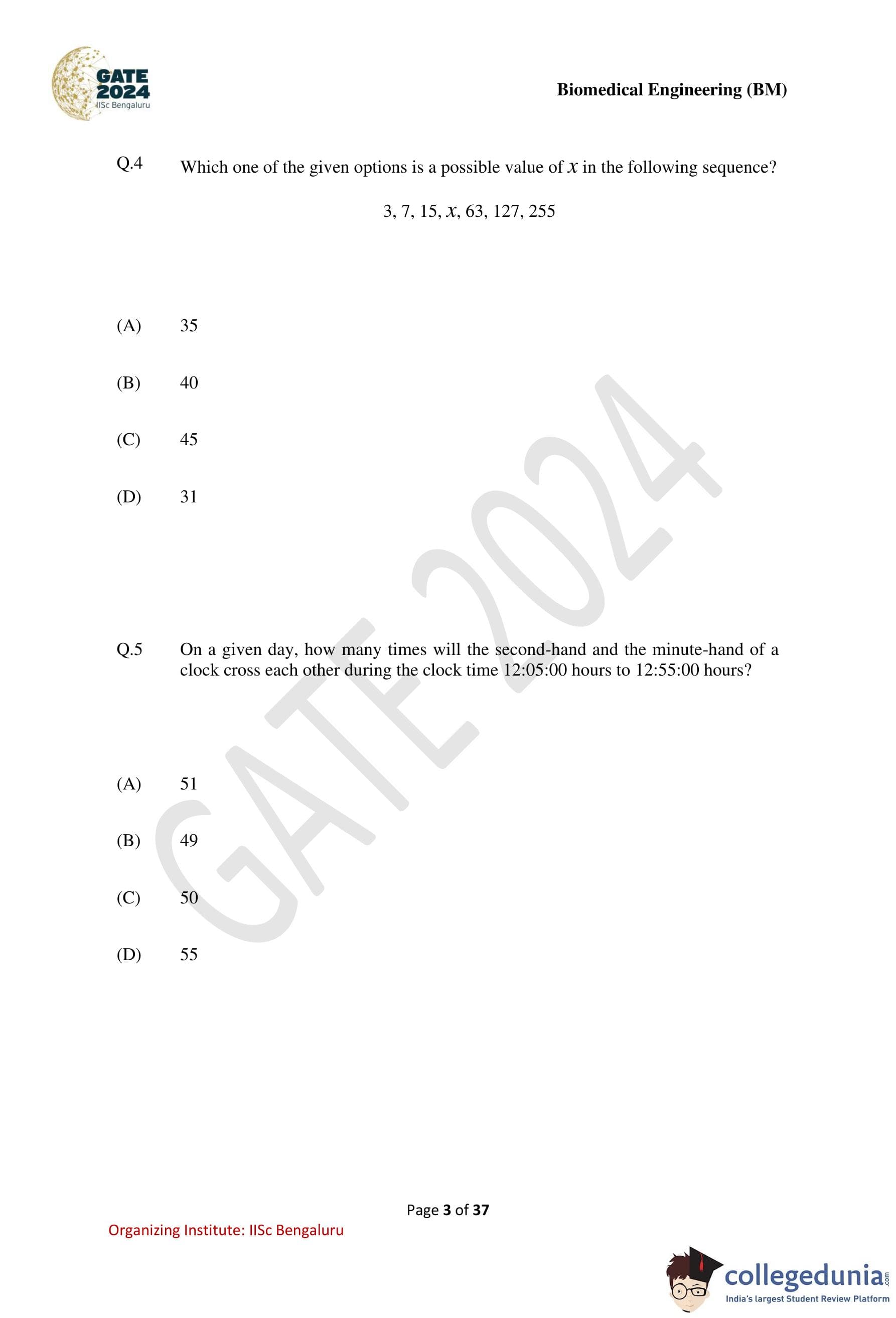
Which one of the given options is a possible value of \(x\) in the following sequence? \[ 3,\; 7,\; 15,\; x,\; 63,\; 127,\; 255 \]
On a given day, how many times will the second-hand and the minute-hand of a clock cross each other during the clock time 12:05:00 hours to 12:55:00 hours?
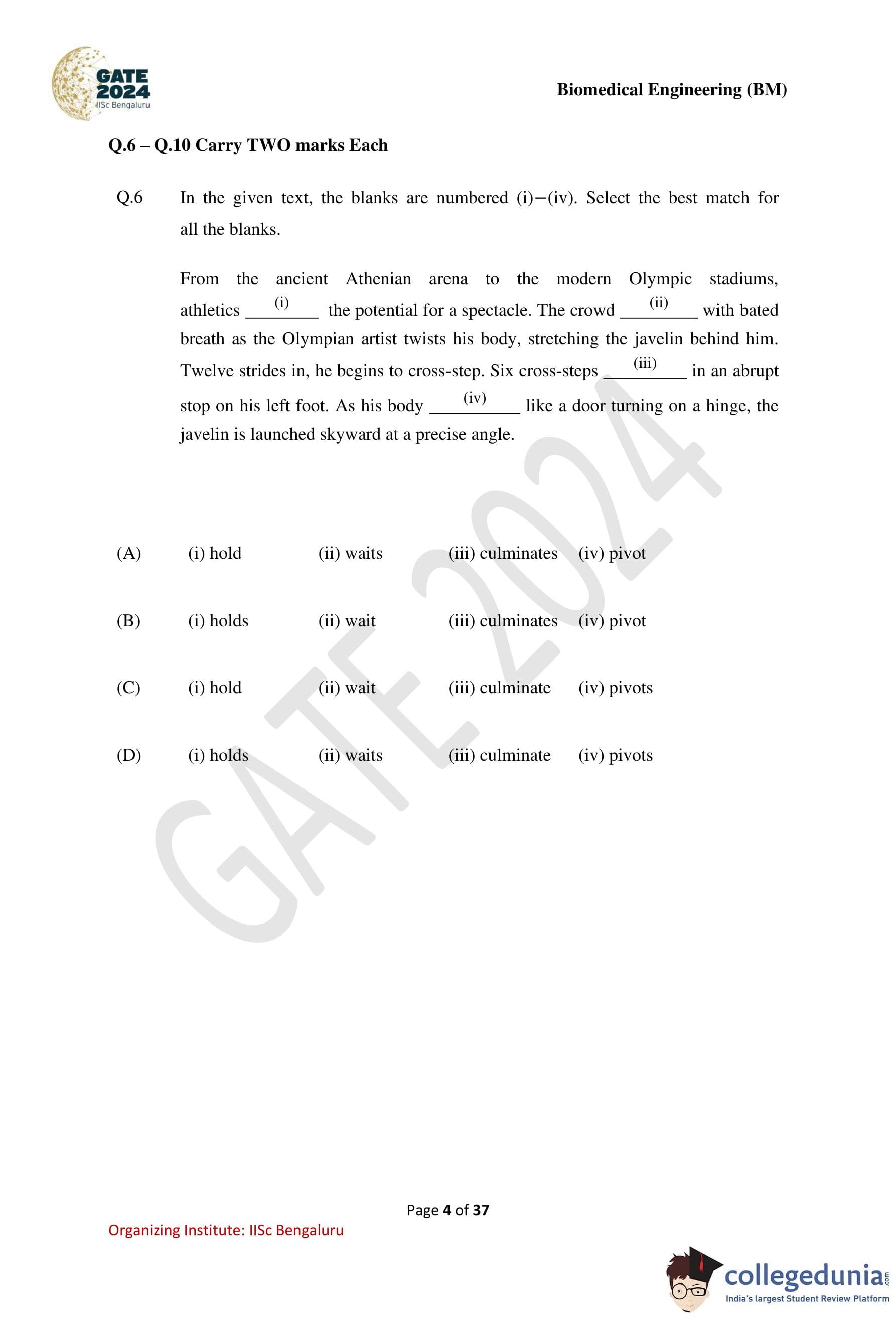
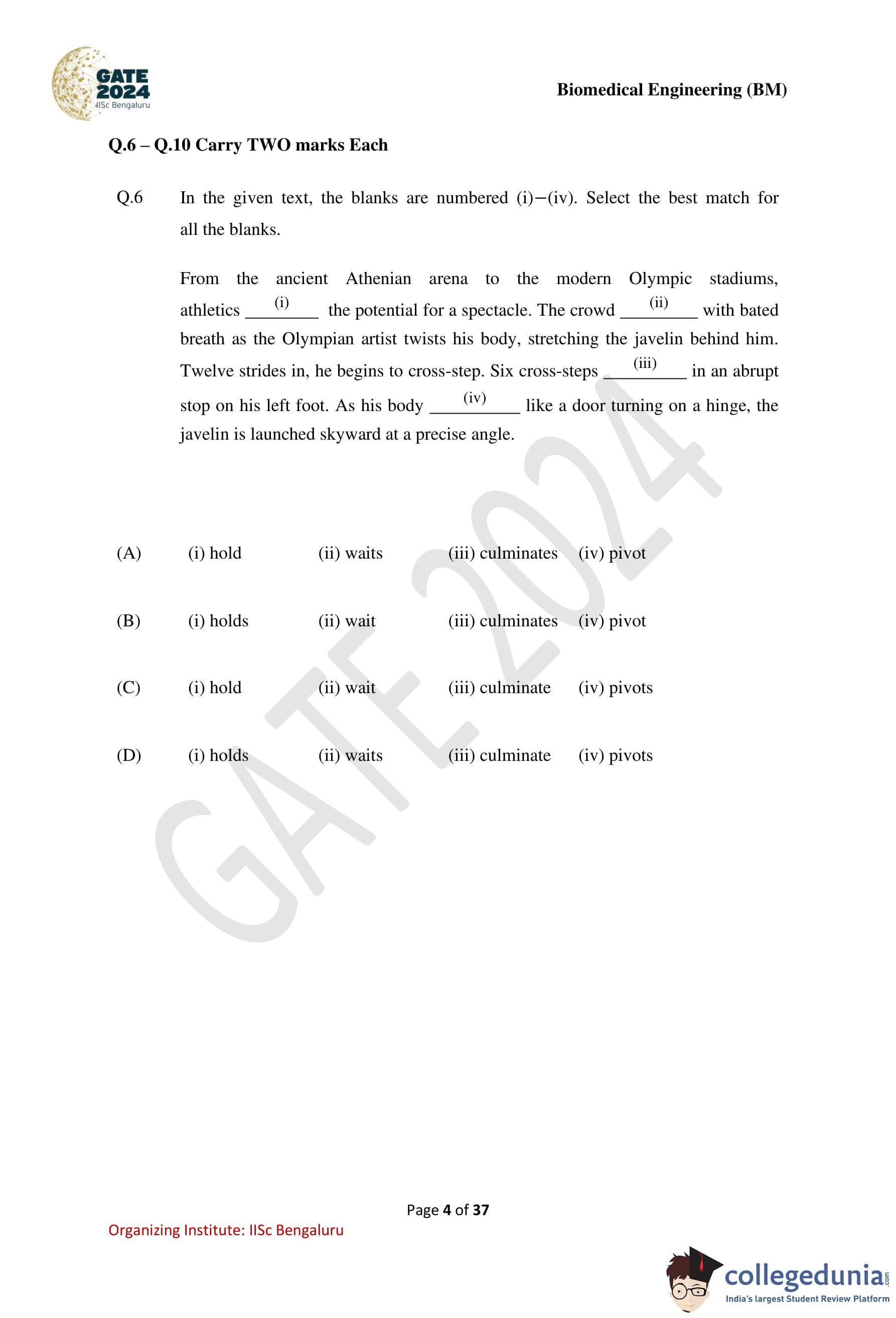
In the given text, the blanks are numbered (i)–(iv). Select the best match for all the blanks.
From the ancient Athenian arena to the modern Olympic stadiums, athletics (i) ................ the potential for a spectacle. The crowd (ii) ................ with bated breath as the Olympian artist twists his body, stretching the javelin behind him. Twelve strides in, he begins to cross-step. Six cross-steps (iii) ................ in an abrupt stop on his left foot. As his body (iv) ................ like a door turning on a hinge, the javelin is launched skyward at a precise angle.
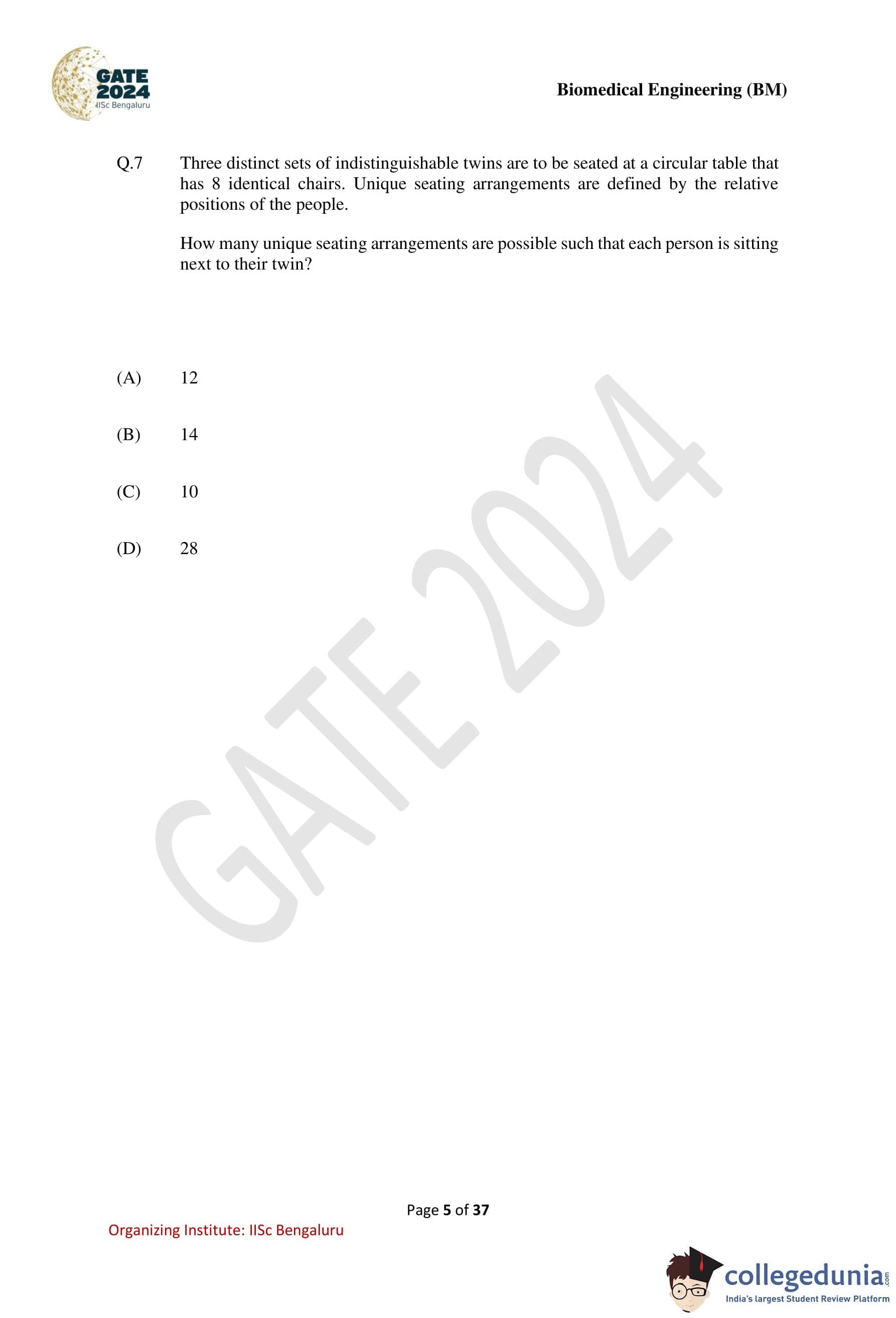
Three distinct sets of indistinguishable twins are to be seated at a circular table that has 8 identical chairs. Unique seating arrangements are defined by the relative positions of the people.
How many unique seating arrangements are possible such that each person is sitting next to their twin?
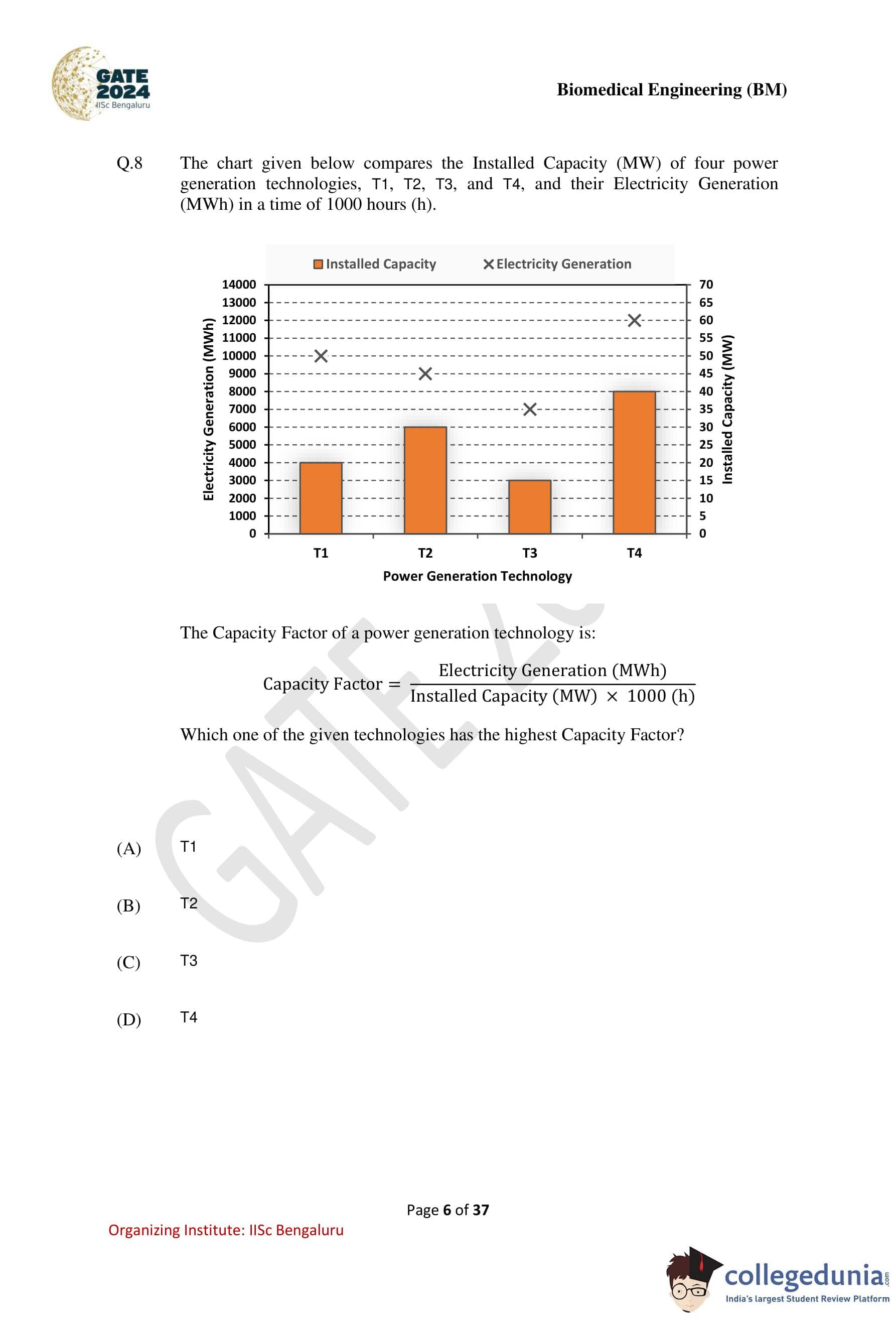
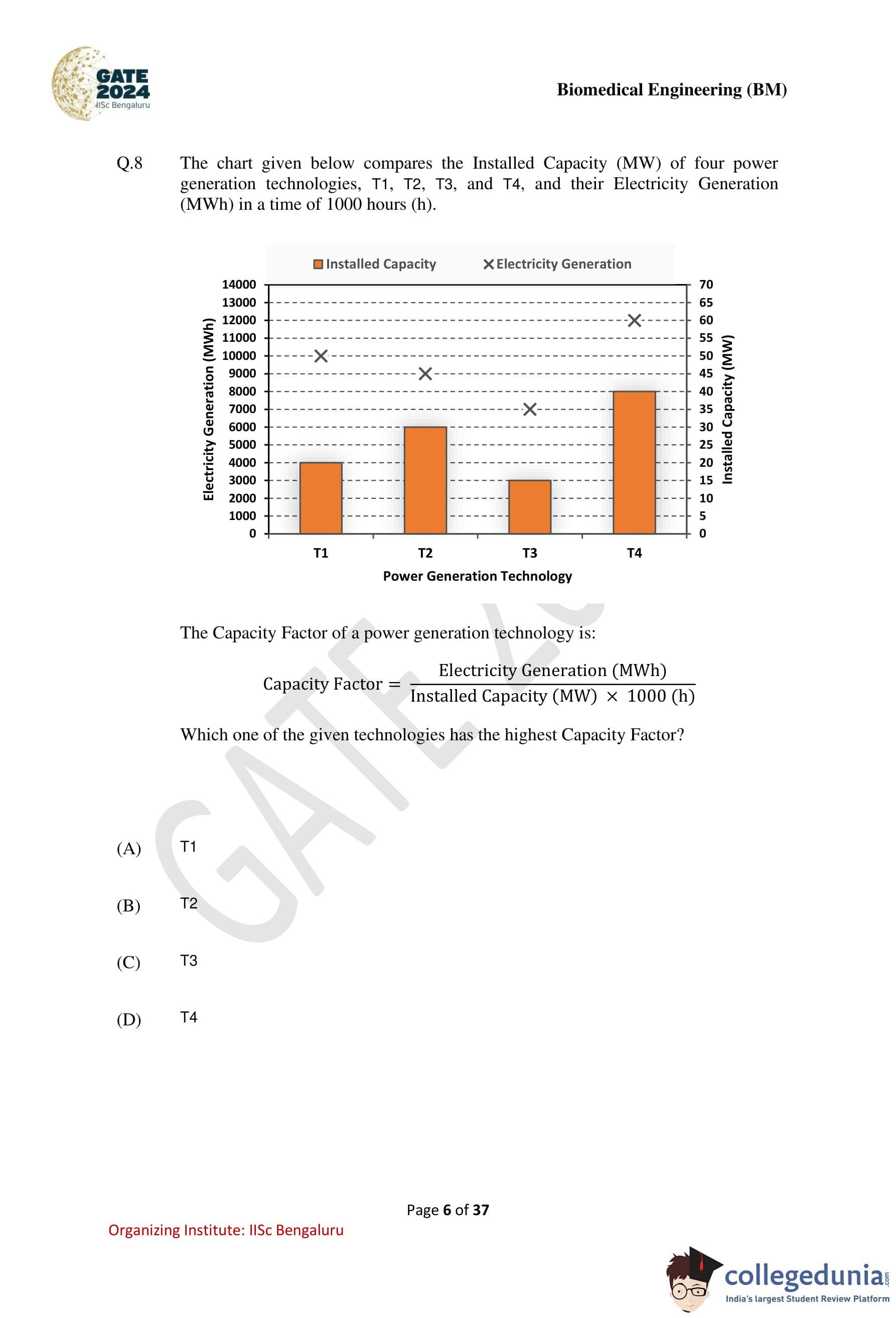
The chart given below compares the Installed Capacity (MW) of four power generation technologies, T1, T2, T3, and T4, and their Electricity Generation (MWh) in a time of 1000 hours.

Which one of the given technologies has the highest Capacity Factor?
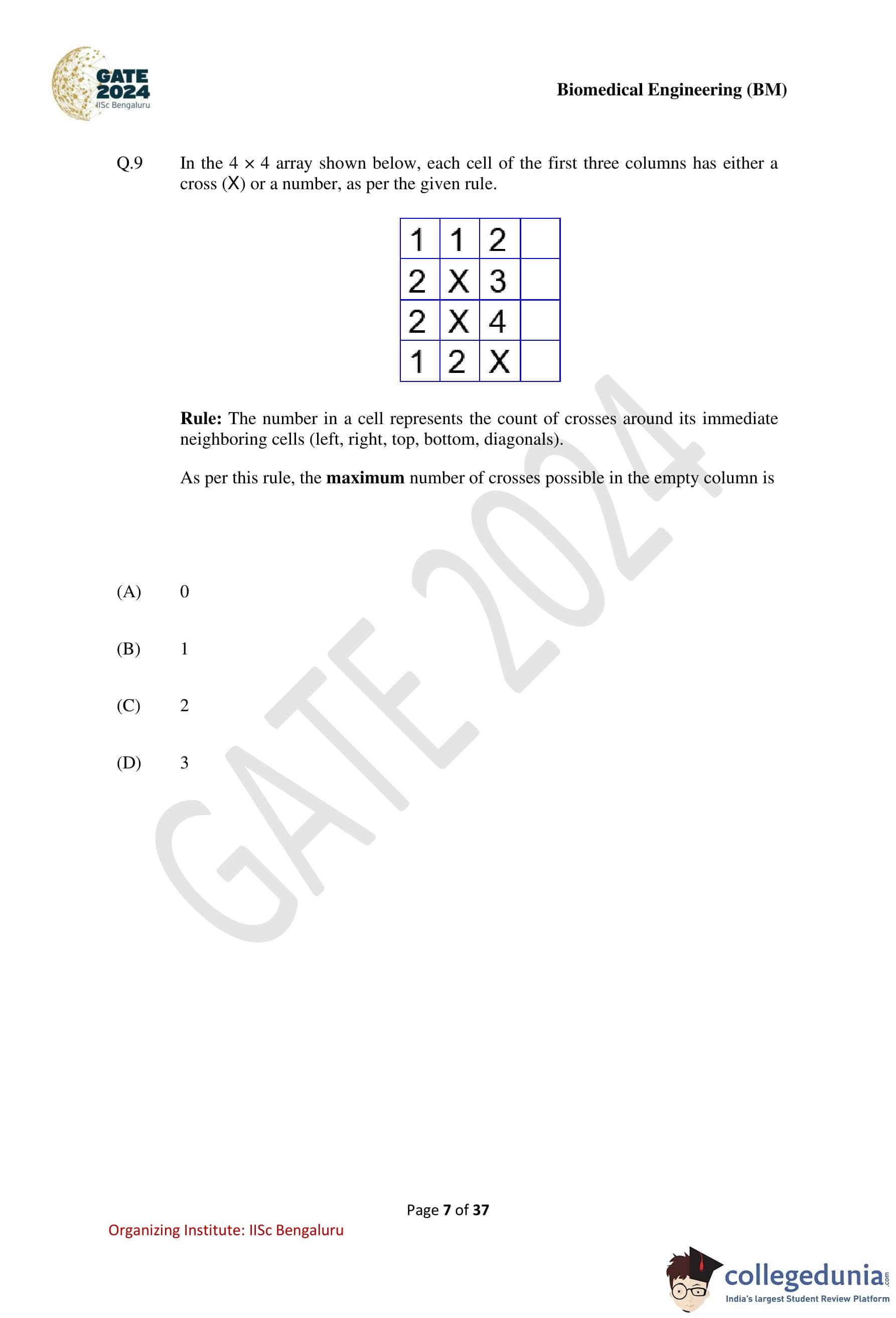
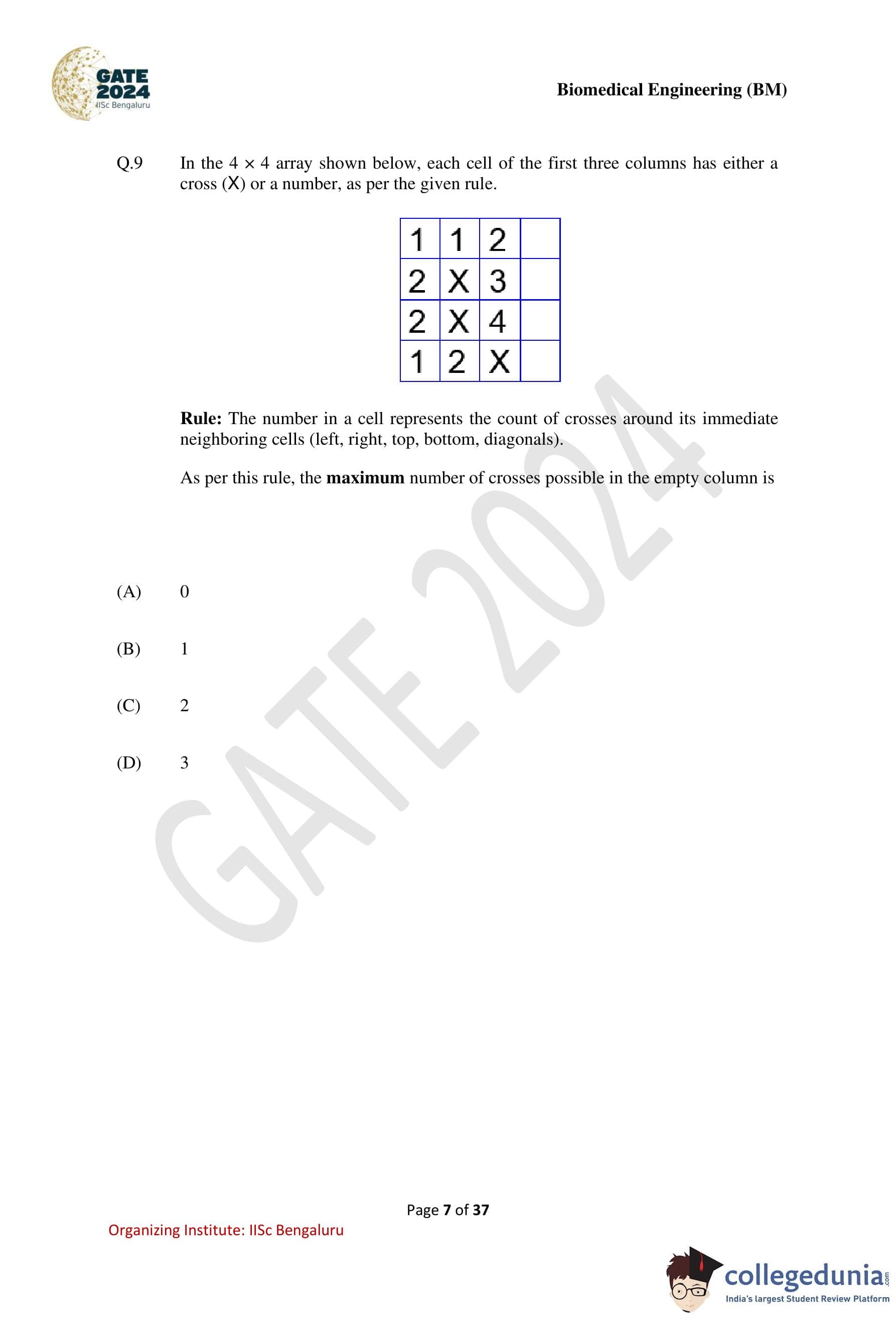
In the \(4 \times 4\) array shown below, each cell of the first three columns has either a cross (X) or a number, as per the given rule.

Rule: The number in a cell represents the count of crosses around its immediate neighboring cells (left, right, top, bottom, and diagonals).
As per this rule, the \emph{maximum} number of crosses possible in the empty column is
During a half-moon phase, the Earth–Moon–Sun form a right triangle. If the Moon–Earth–Sun angle at this half-moon phase is measured to be \(89.85^\circ\), the ratio of the Earth–Sun and Earth–Moon distances is closest to
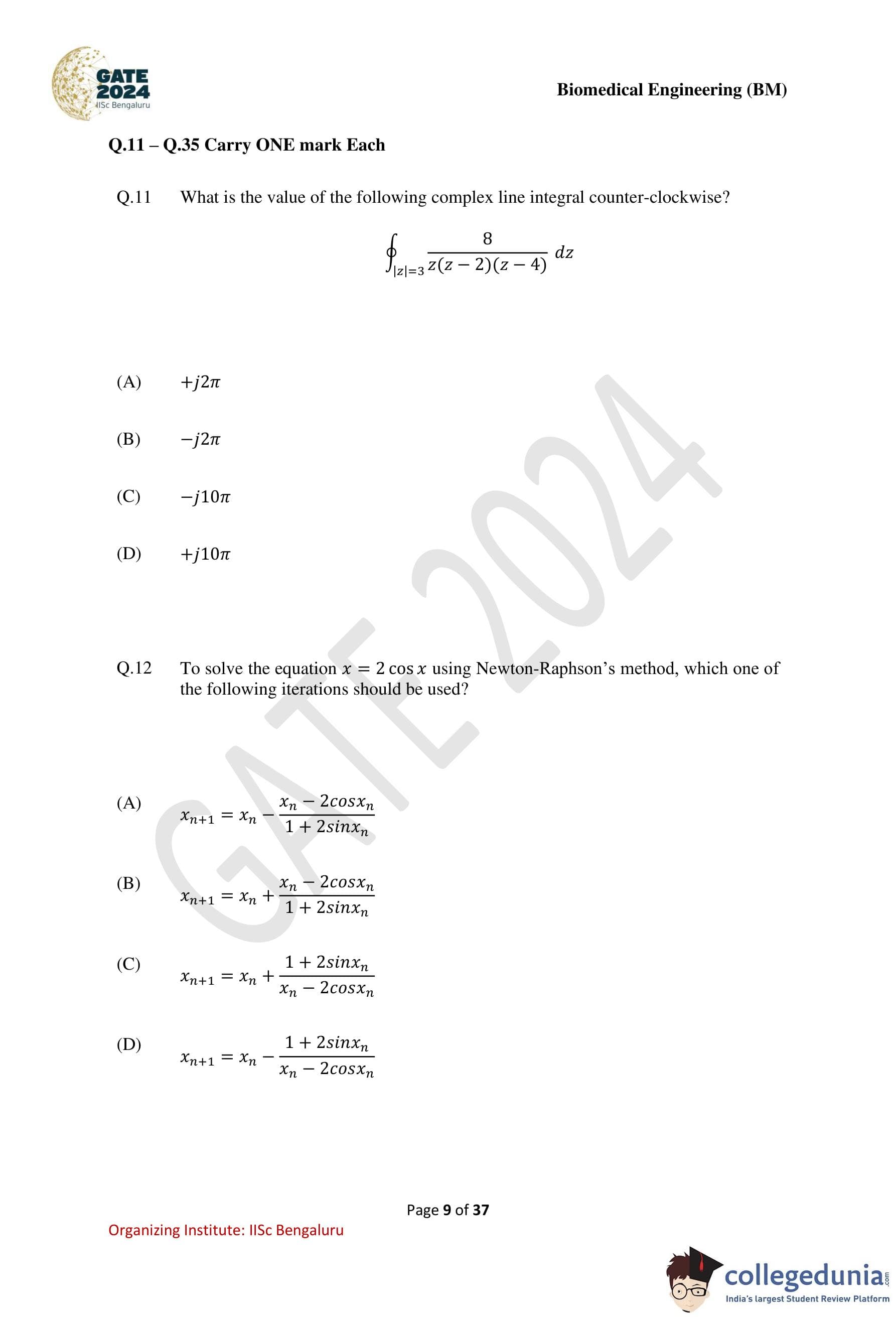
What is the value of the following complex line integral taken counter-clockwise? \[ \oint_{|z|=3} \frac{8}{z(z-2)(z-4)}\,dz \]
To solve the equation \(x = 2\cos x\) using Newton--Raphson method, which one of the following iterations should be used?
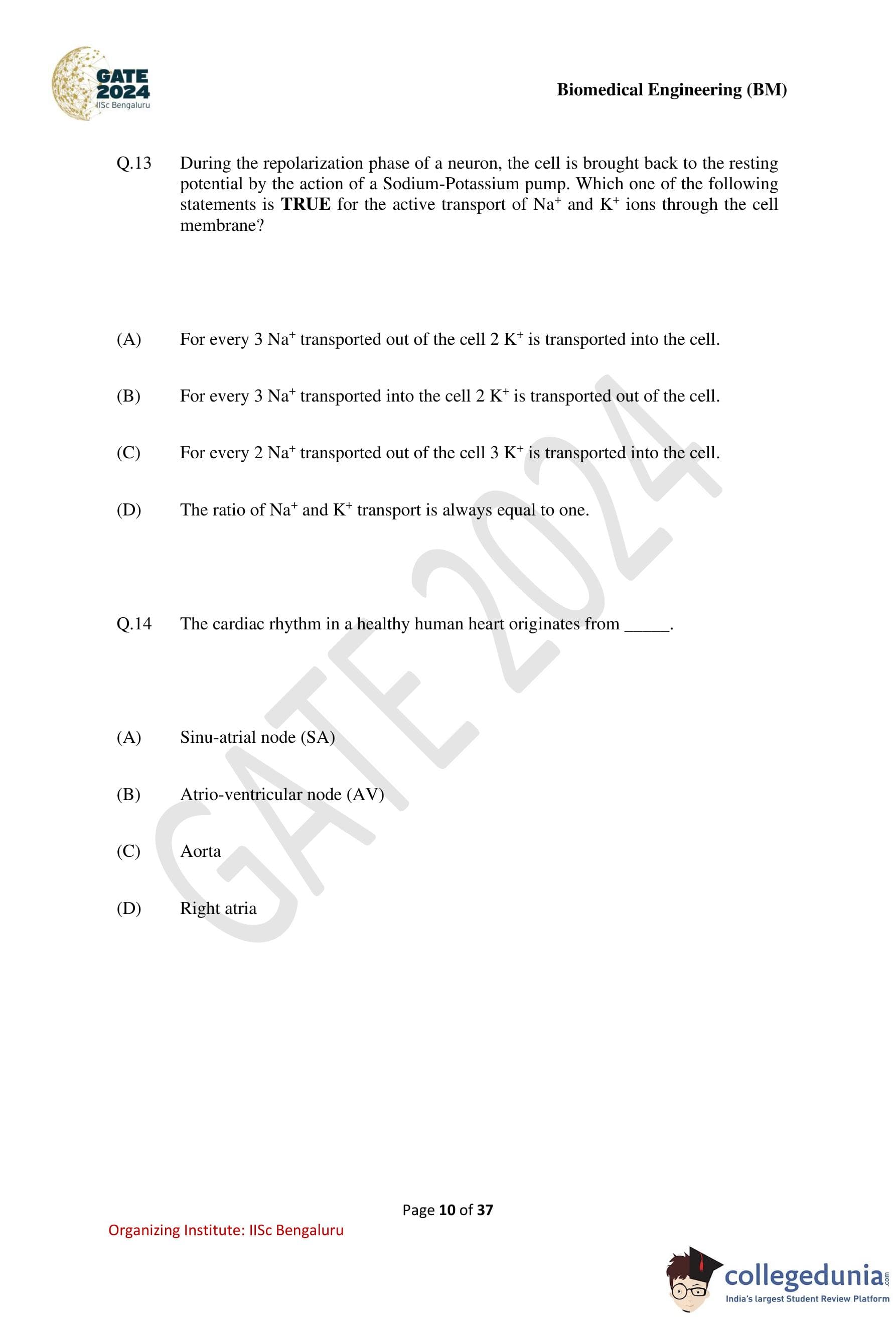
During the repolarization phase of a neuron, the cell is brought back to the resting potential by the action of a Sodium–Potassium pump. Which one of the following statements is \textbf{TRUE} for the active transport of Na\(^+\) and K\(^+\) ions through the cell membrane?
The cardiac rhythm in a healthy human heart originates from ........
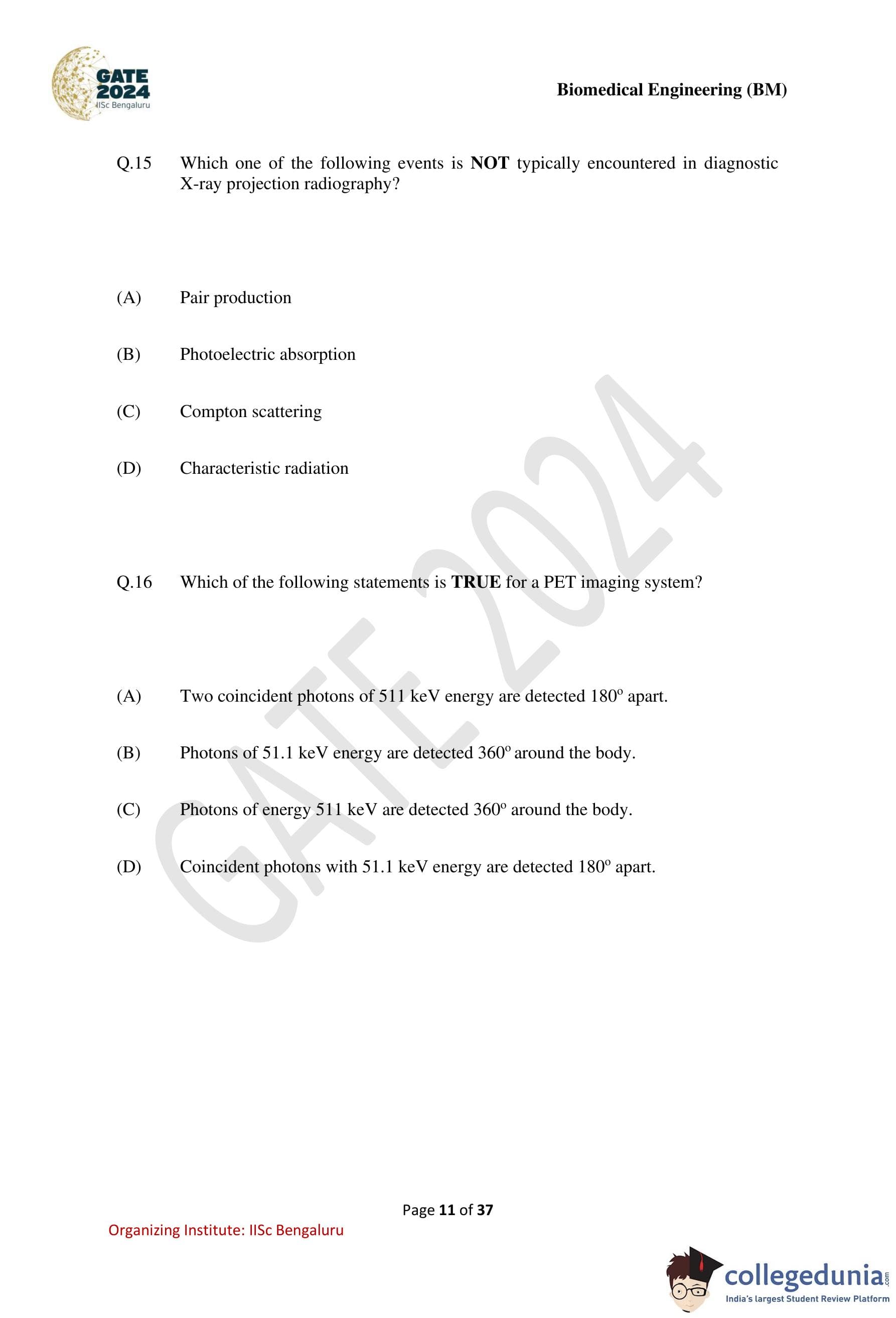
Which one of the following events is \textbf{NOT} typically encountered in diagnostic X-ray projection radiography?
Which of the following statements is \textbf{TRUE} for a PET imaging system?
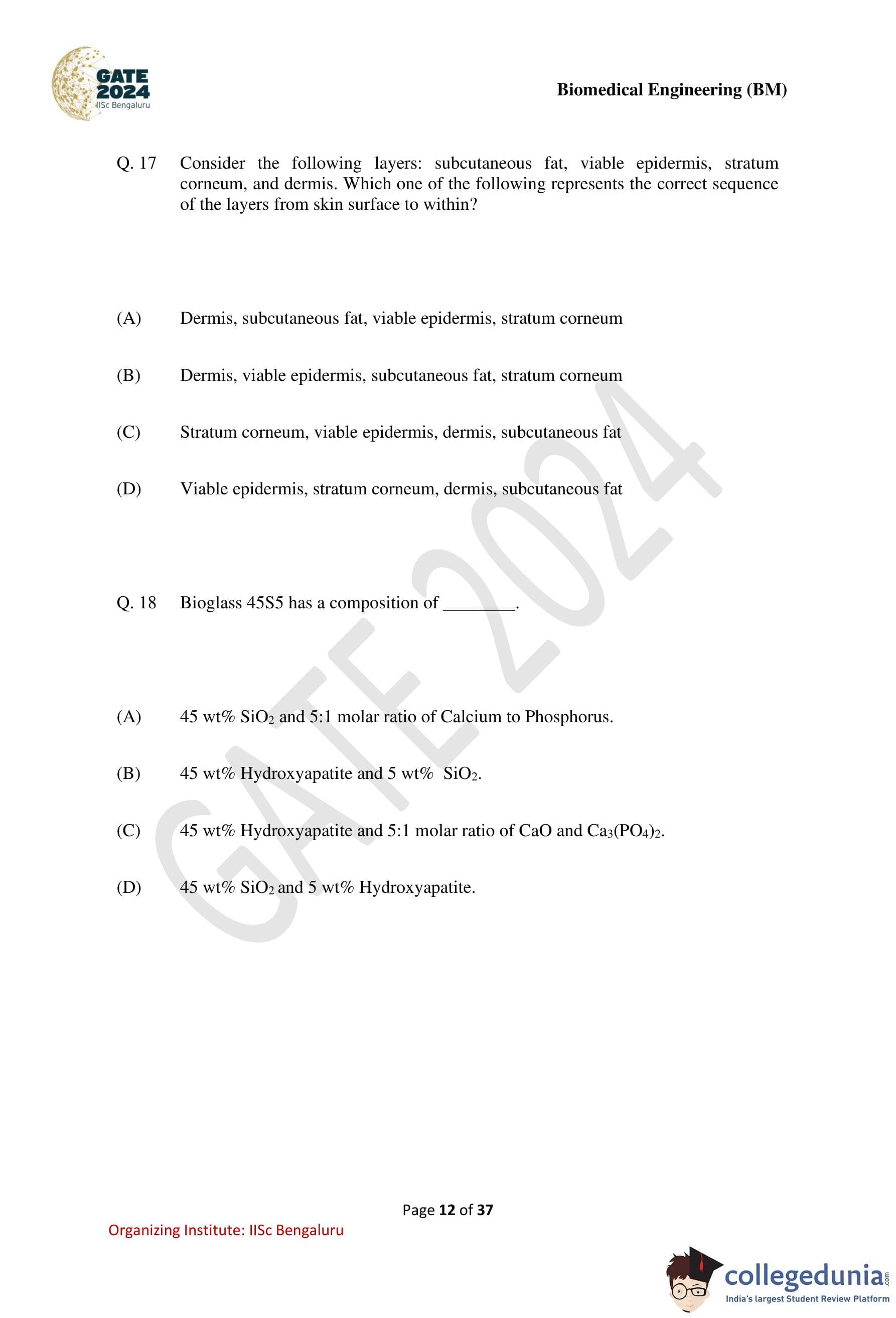
Consider the following layers: subcutaneous fat, viable epidermis, stratum corneum, and dermis. Which one of the following represents the correct sequence of the layers from skin surface to within?
Bioglass 45S5 has a composition of ...................
View Solution
Concept:
Bioglass 45S5 is a well-known bioactive glass composition developed by Hench, widely used in biomedical applications.
Step 1: Recall the standard composition of Bioglass 45S5.
It consists of:
45 wt% SiO\(_2\)
24.5 wt% Na\(_2\)O
24.5 wt% CaO
6 wt% P\(_2\)O\(_5\)
Step 2: Interpret the notation “45S5”.
45 indicates 45 wt% SiO\(_2\)
S5 indicates a Ca:P molar ratio of approximately 5:1
Step 3: Evaluate the options.
(A) Correct: matches both SiO\(_2\) content and Ca:P ratio \checkmark
(B), (C), (D) Incorrect: Bioglass 45S5 does not contain hydroxyapatite as a starting component
\[ \boxed{45 wt% SiO\(_2\) and 5:1 molar ratio of Ca:P} \] Quick Tip: Bioglass 45S5 key facts: Highly bioactive Forms hydroxyapatite \emph{in vivo} “45” = wt% SiO\(_2\); “S5” = Ca:P \(\approx 5:1\)
Macrophages that are resident in the liver are ...................
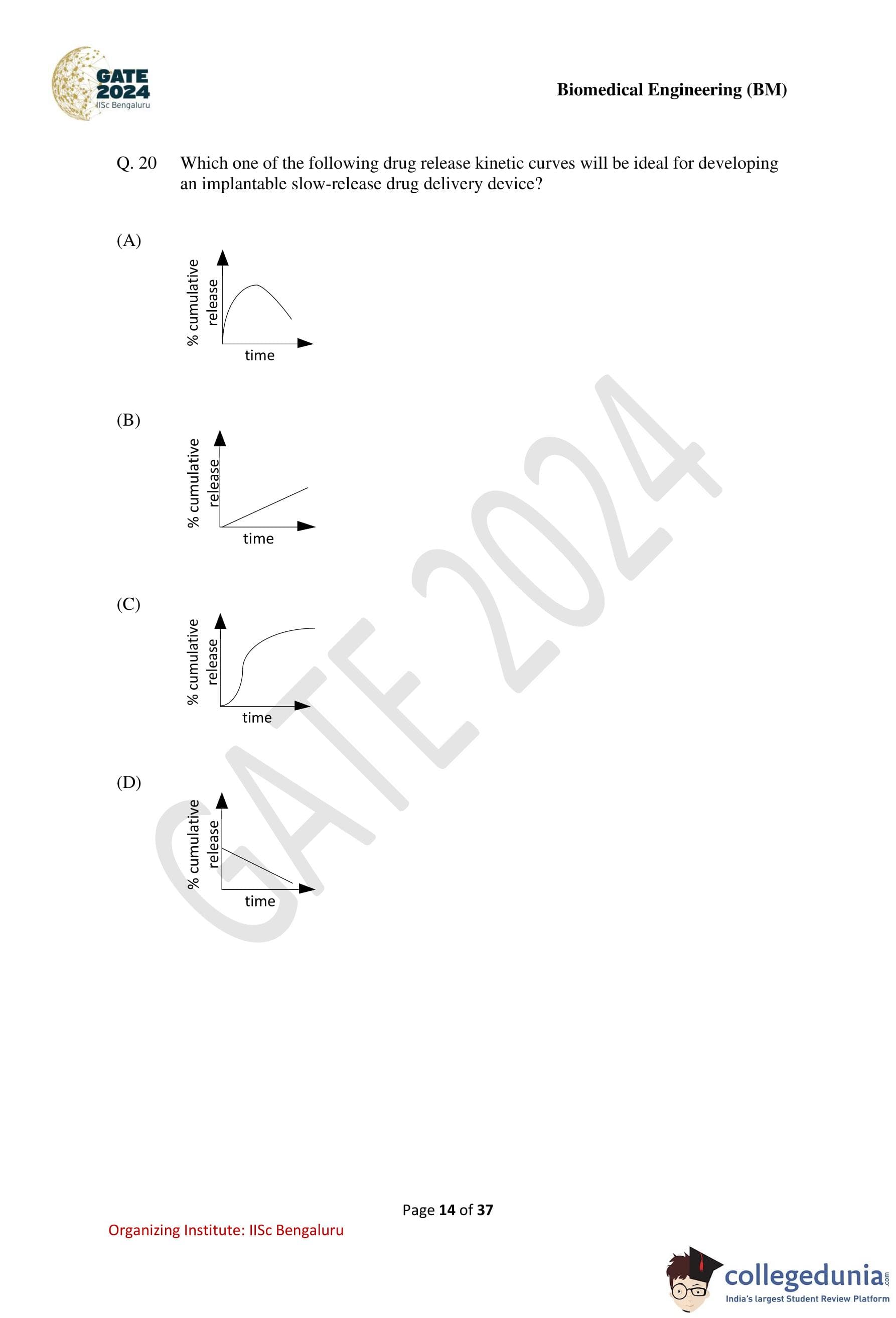
Which one of the following drug release kinetic curves will be ideal for developing an implantable slow-release drug delivery device?

View Solution
Concept:
An ideal implantable slow-release drug delivery system should maintain a constant drug release rate over time to ensure:
Stable drug concentration in the body
Avoidance of toxic peaks
Sustained therapeutic effect
This behavior is known as zero-order kinetics.
Step 1: Understand zero-order release.
In zero-order kinetics: \[ Rate of drug release = constant \]
Hence, the cumulative percentage of drug released increases linearly with time.
Step 2: Examine the given curves.
(A) Shows an initial increase followed by a decrease — not sustained
(B) Shows a straight-line increase with time — constant release rate \checkmark
(C) Shows rapid initial release followed by saturation (burst release)
(D) Shows fluctuating or non-uniform release
Step 3: Select the ideal curve.
The linear cumulative release curve in option (B) represents zero-order drug release, which is ideal for implantable slow-release devices.
\[ \boxed{Option (B)} \] Quick Tip: Drug release kinetics: Zero-order: constant release (ideal for implants) First-order: release depends on concentration Burst release is generally undesirable for long-term therapy
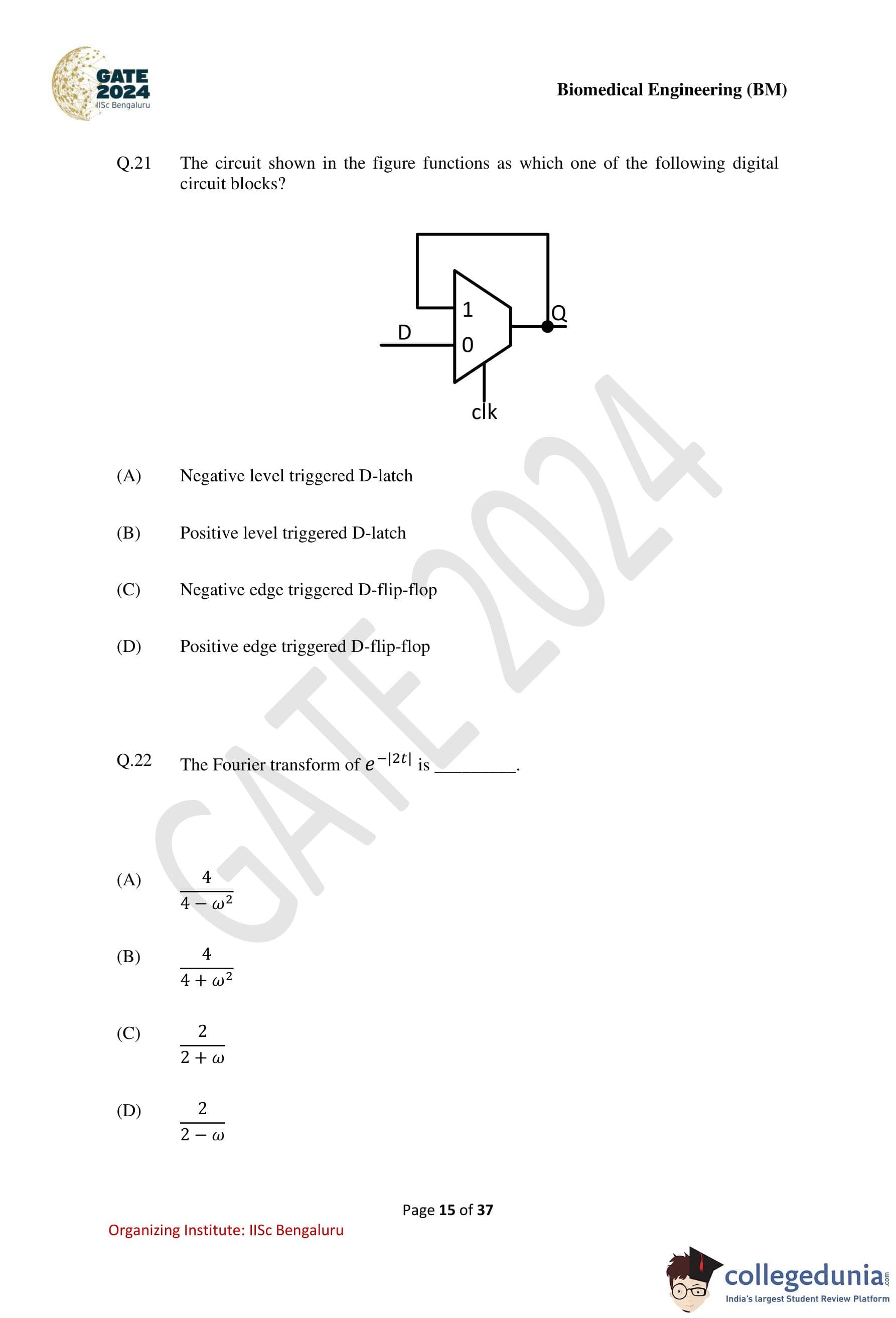
The circuit shown in the figure functions as which one of the following digital circuit blocks?

The Fourier transform of \(e^{-2|t|}\) is ...................
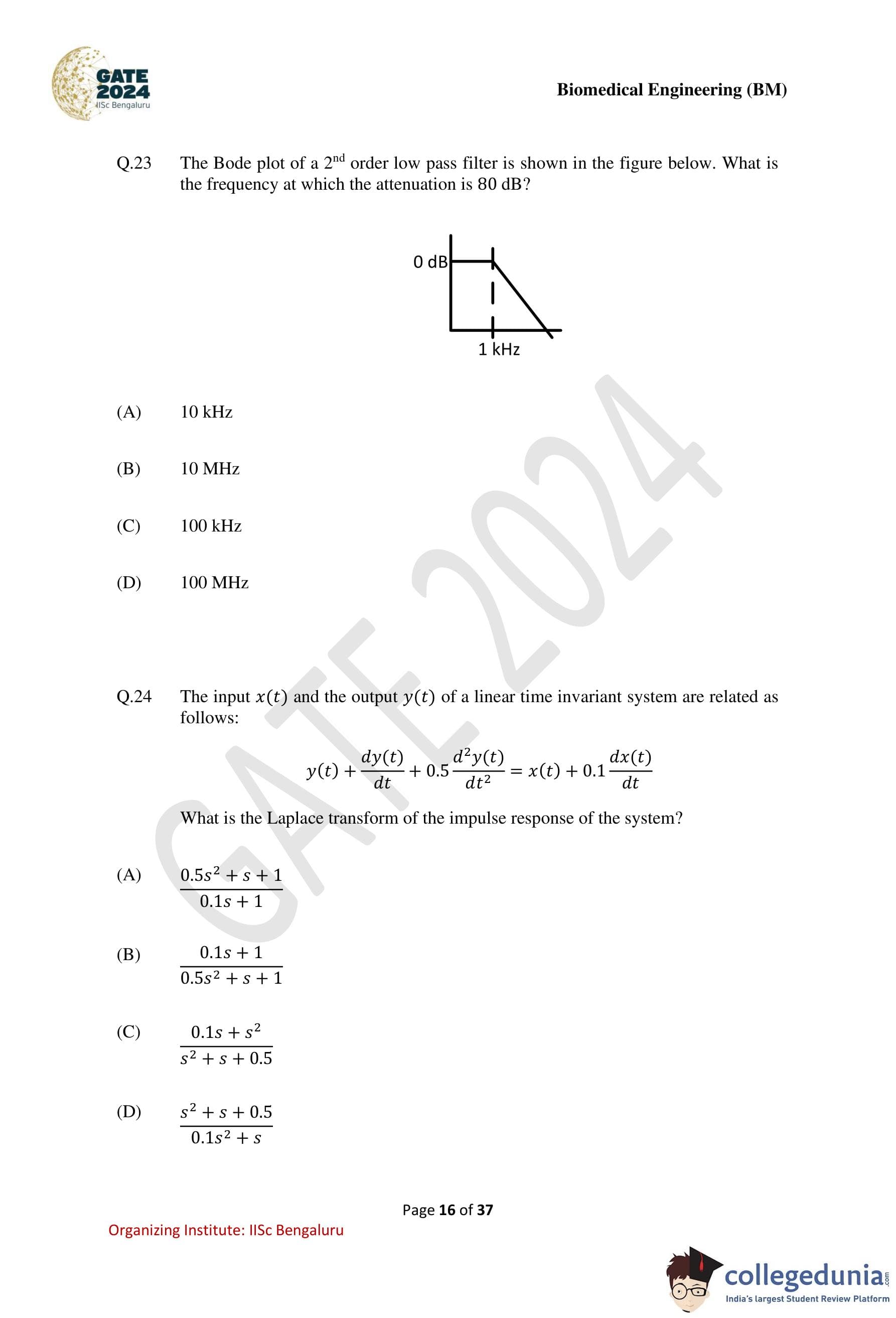
The Bode plot of a 2\(^{nd}\) order low-pass filter is shown in the figure below. What is the frequency at which the attenuation is 80 dB?

The input \(x(t)\) and the output \(y(t)\) of a linear time-invariant system are related as follows: \[ y(t) + \frac{dy(t)}{dt} + 0.5\frac{d^2y(t)}{dt^2} = x(t) + 0.1\frac{dx(t)}{dt} \]
What is the Laplace transform of the impulse response of the system?
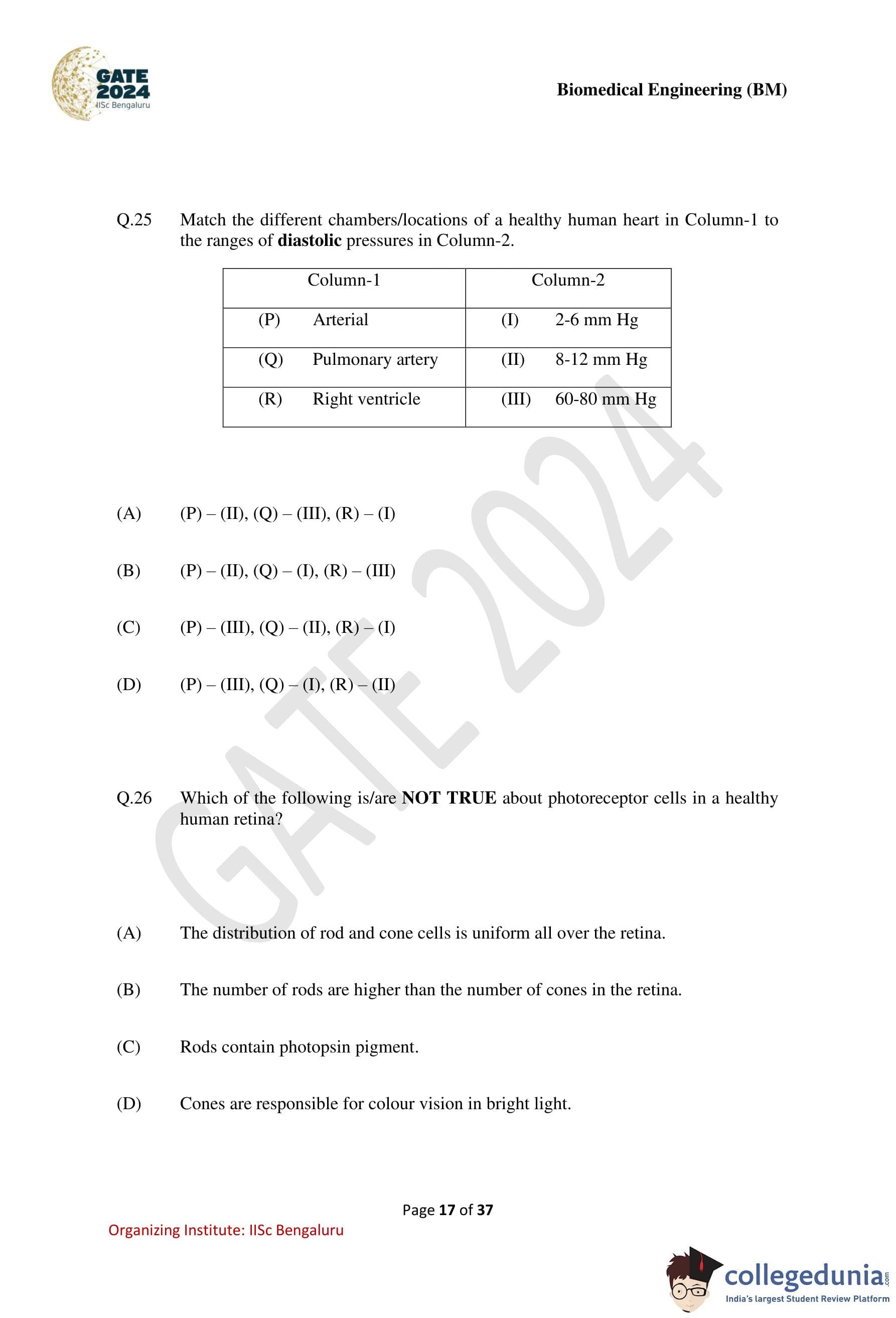
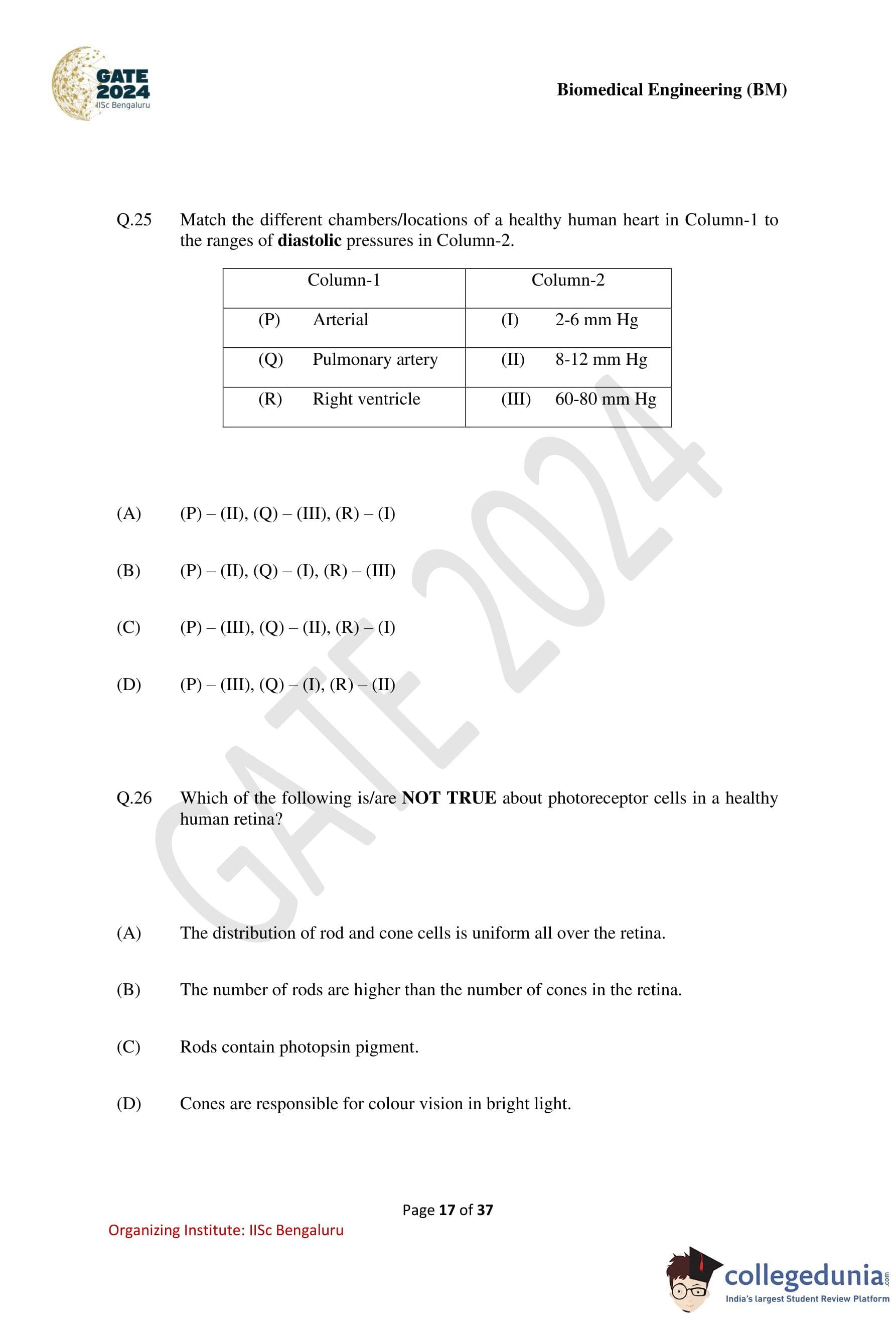
Match the different chambers/locations of a healthy human heart in Column-1 to the ranges of diastolic pressures in Column-2.
Column-1 & Column-2
(P) Arterial & (I) 2--6 mm Hg
(Q) Pulmonary artery & (II) 8--12 mm Hg
(R) Right ventricle & (III) 60--80 mm Hg
Which of the following is/are \textbf{NOT TRUE} about photoreceptor cells in a healthy human retina?
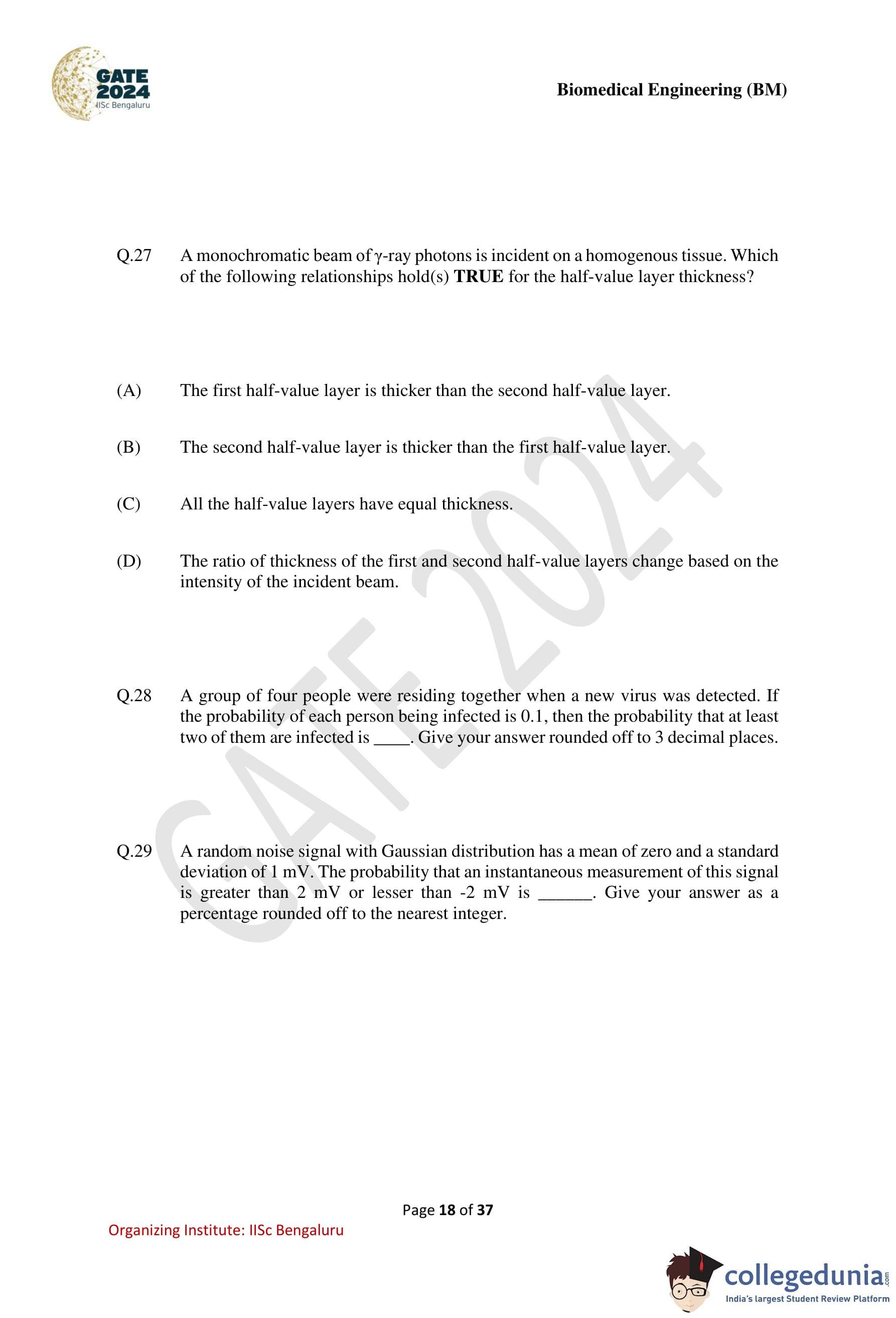
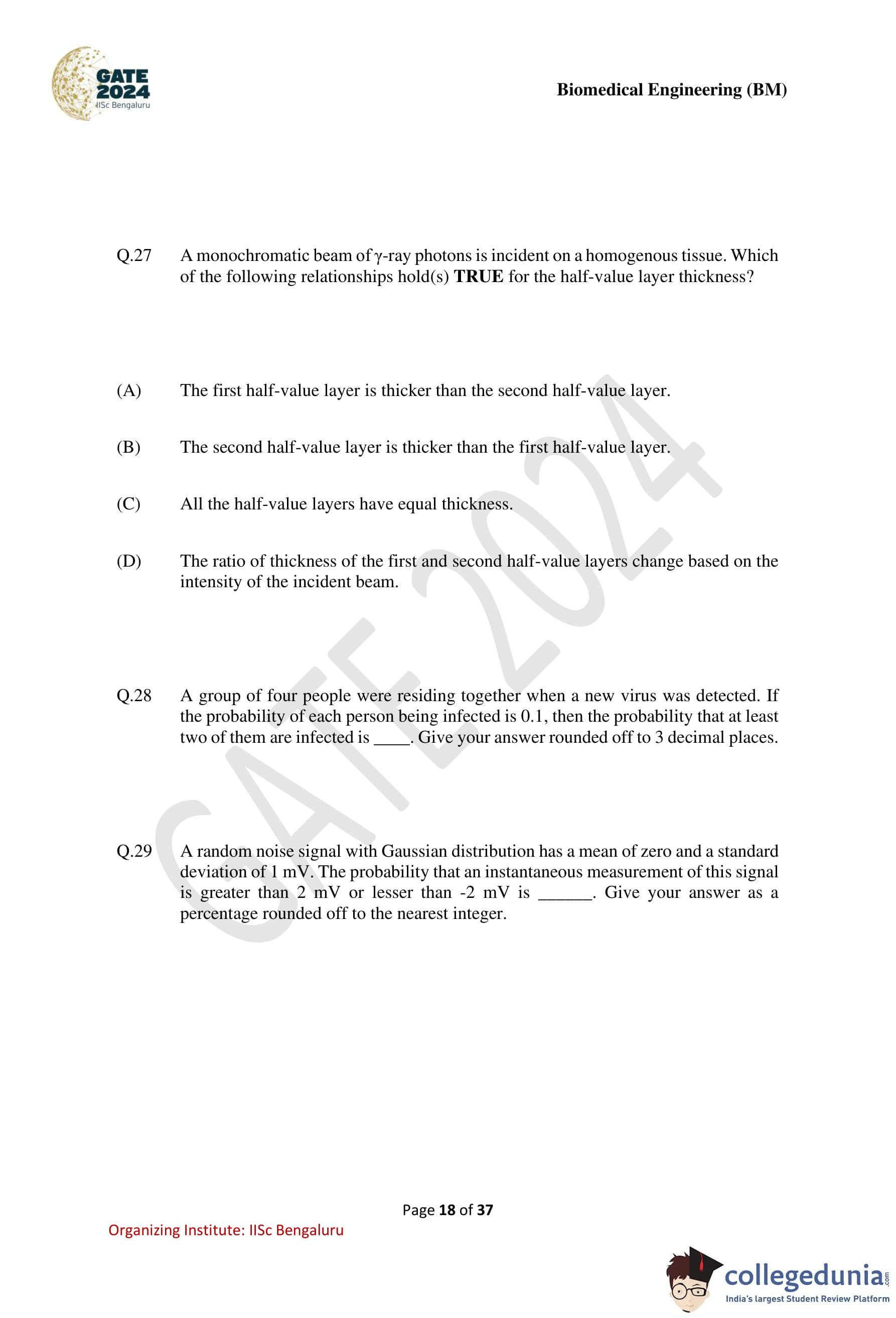
A monochromatic beam of \(\gamma\)-ray photons is incident on a homogeneous tissue. Which of the following relationship(s) holds TRUE for the half-value layer thickness?
View Solution
Concept:
For a monochromatic photon beam passing through a homogeneous medium, attenuation follows the exponential law: \[ I = I_0 e^{-\mu x} \]
where \(\mu\) is the linear attenuation coefficient and \(x\) is the thickness.
Step 1: Define half-value layer (HVL).
The half-value layer is the thickness required to reduce the intensity to half: \[ \frac{I}{I_0} = \frac{1}{2} \Rightarrow e^{-\mu HVL} = \frac{1}{2} \]
Step 2: Compute HVL.
\[ HVL = \frac{\ln 2}{\mu} \]
Step 3: Interpret the result.
Since \(\mu\) is constant for a given monochromatic beam and material:
Each reduction by half requires the same thickness
Successive half-value layers are equal in thickness
HVL is independent of the initial beam intensity
Thus, the correct statement is: \[ \boxed{All the half-value layers have equal thickness} \] Quick Tip: Key points about HVL: Valid for \textbf{monochromatic} beams Depends only on material and photon energy Polyenergetic beams do \emph{not} have constant HVL (beam hardening)
A group of four people were residing together when a new virus was detected. If the probability of each person being infected is 0.1, then the probability that at least two of them is infected is ................... Give your answer rounded off to 3 decimal places.
A random noise signal with Gaussian distribution has a mean of zero and a standard deviation of 1 mV. The probability that an instantaneous measurement of this signal is greater than 2 mV or lesser than \(-2\) mV is ................... Give your answer as a percentage rounded to the nearest integer.
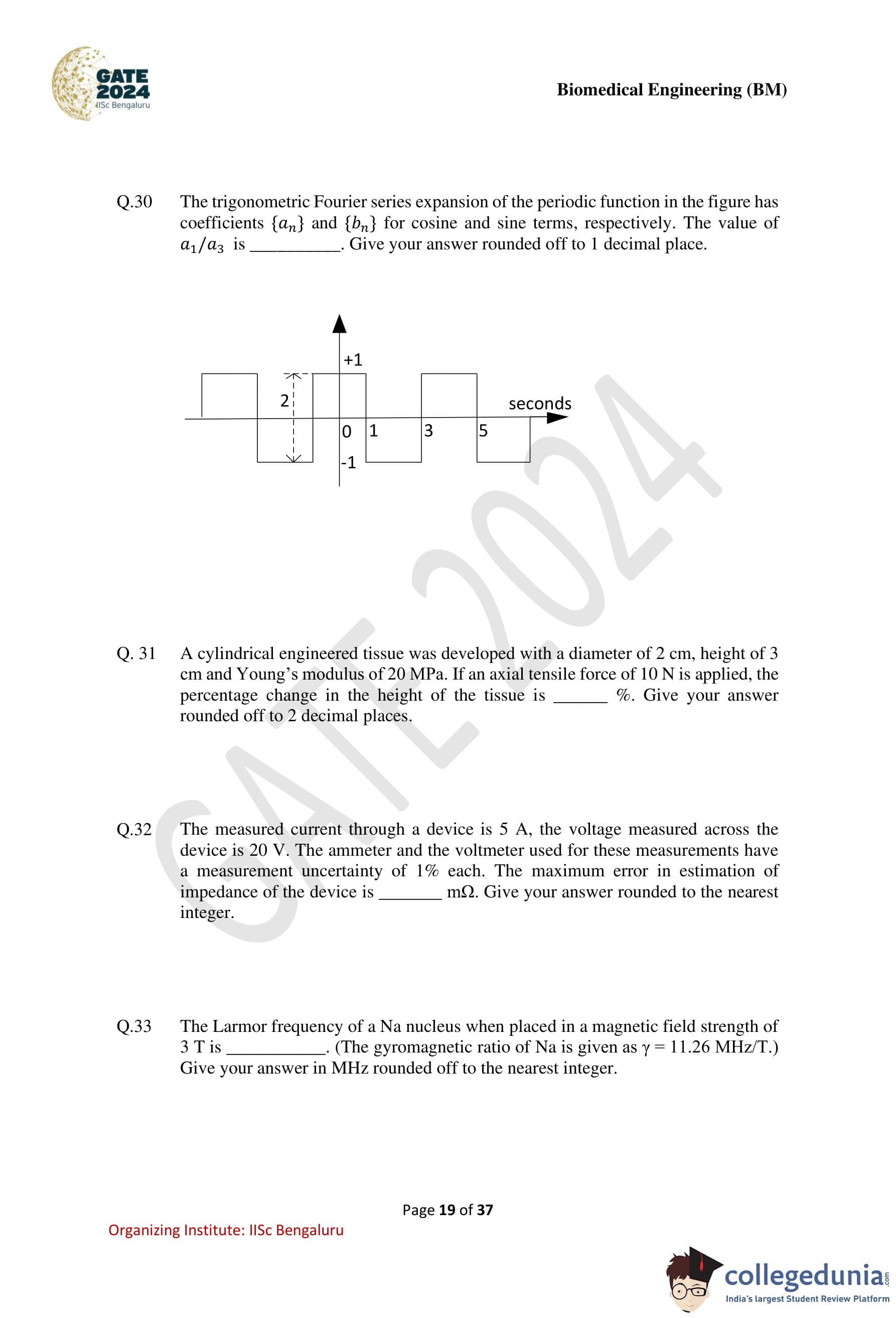
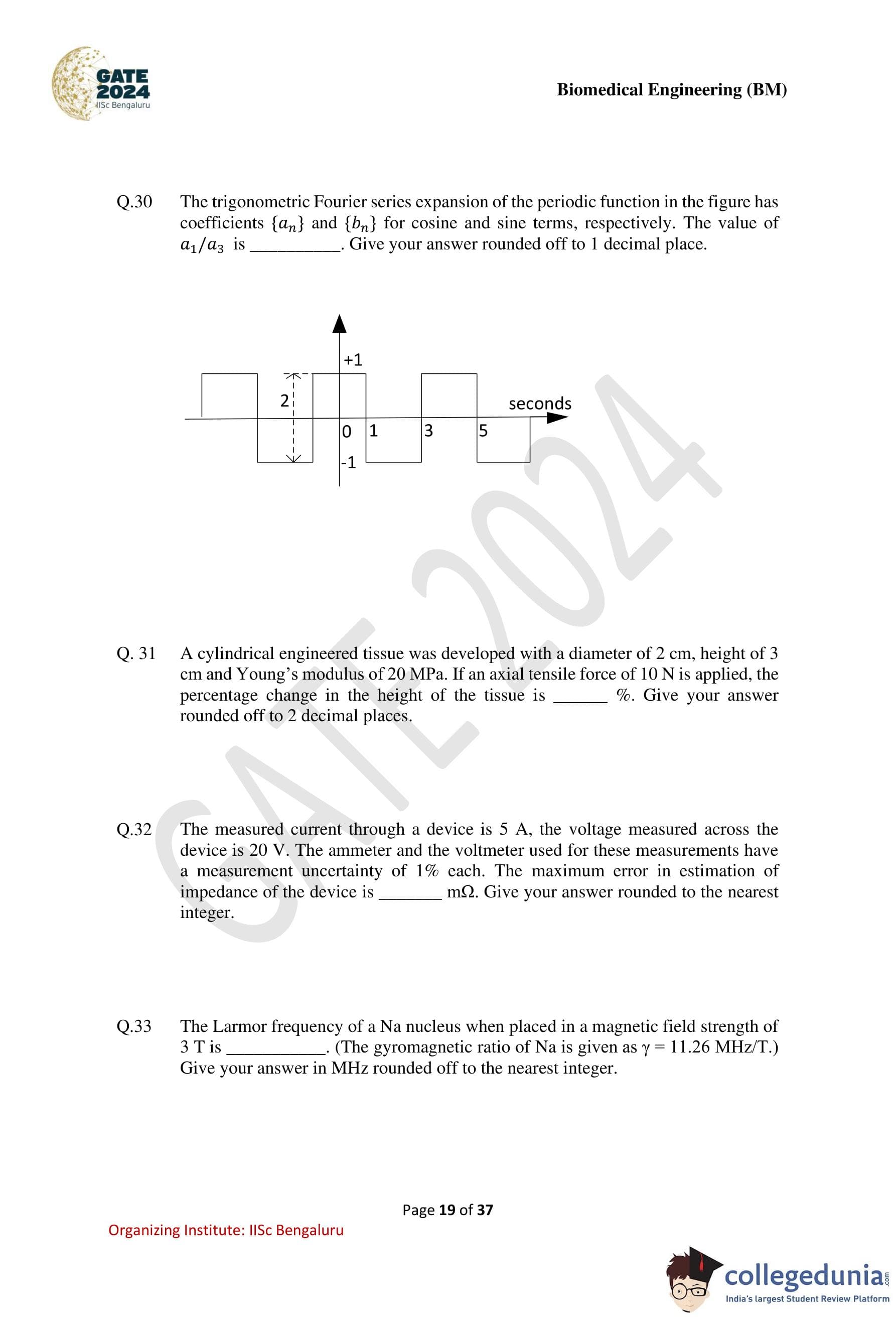
The trigonometric Fourier series expansion of the periodic function shown in the figure has coefficients \(\{a_n\}\) and \(\{b_n\}\) for cosine and sine terms, respectively. The value of \(a_1/a_3\) is ................... Give your answer rounded off to 1 decimal place.

A cylindrical engineered tissue was developed with a diameter of 2 cm, height of 3 cm and Young’s modulus of 20 MPa. If an axial tensile force of 10 N is applied, the percentage change in the height of the tissue is ..................%. Give your answer rounded off to 2 decimal places.
The measured current through a device is 5 A, the voltage measured across the device is 20 V. The ammeter and voltmeter used for these measurements have a measurement uncertainty of 1% each. The maximum error in estimation of impedance of the device is .................. m\(\Omega\). Give your answer rounded to the nearest integer.
The Larmor frequency of a Na nucleus when placed in a magnetic field strength of 3 T is ................... (The gyromagnetic ratio of Na is given as \(\gamma = 11.26\) MHz/T.) Give your answer in MHz rounded off to the nearest integer.
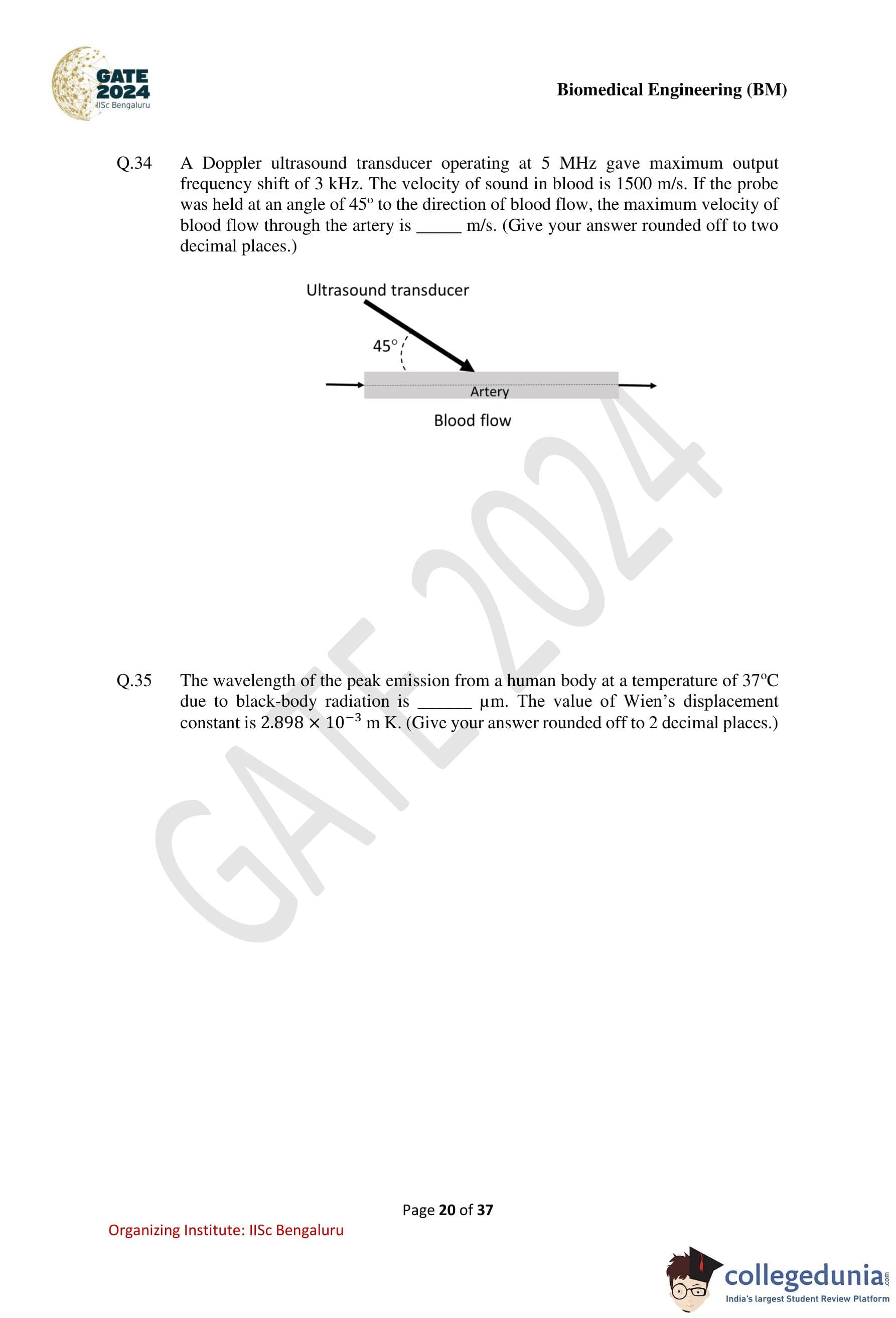
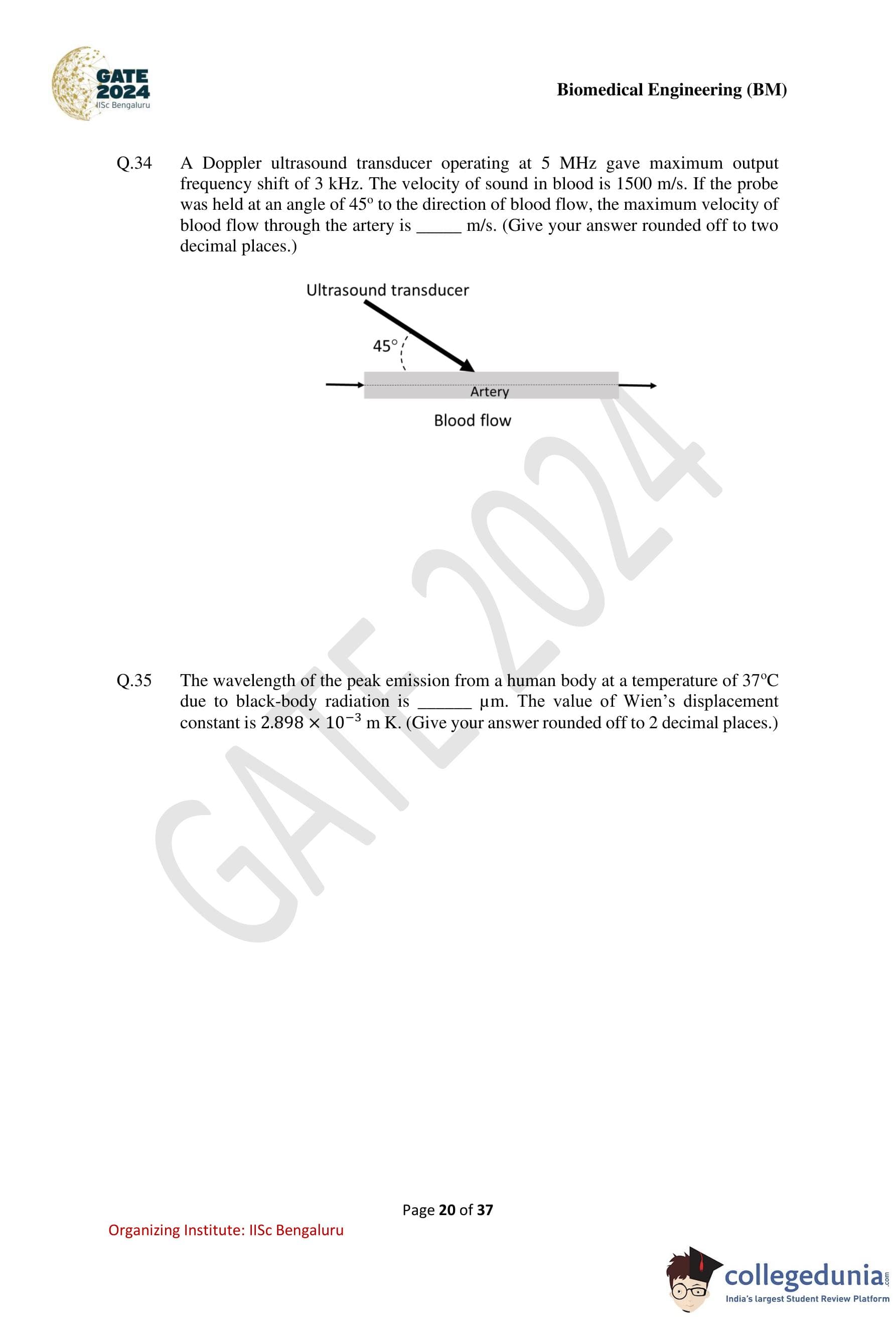
A Doppler ultrasound transducer operating at 5 MHz gave maximum output frequency shift of 3 kHz. The velocity of sound in blood is 1500 m/s. If the probe is held at an angle of \(45^\circ\) to the direction of blood flow, the maximum velocity of blood flow through the artery is .................. m/s. (Give your answer rounded off to two decimal places.)

The wavelength of the peak emission from a human body at a temperature of \(37^\circ\)C due to black-body radiation is ................... The value of Wien’s displacement constant is \(2.898 \times 10^{-3}\) m·K. (Give your answer rounded off to two decimal places.)
View Solution
Concept:
Wien’s displacement law relates the wavelength of maximum emission to absolute temperature: \[ \lambda_{\max} T = b \]
where \(b = 2.898 \times 10^{-3}\) m·K.
Step 1: Convert temperature to Kelvin.
\[ T = 37 + 273 = 310~K \]
Step 2: Compute the wavelength of maximum emission.
\[ \lambda_{\max} = \frac{2.898 \times 10^{-3}}{310} = 9.35 \times 10^{-6}~m \]
Step 3: Express in micrometers.
\[ \lambda_{\max} = 9.35~\mum \]
\[ \boxed{9.35~\mum} \] Quick Tip: Human body radiation: Peaks in the infrared region Basis of thermal imaging Higher temperature \(\Rightarrow\) shorter peak wavelength
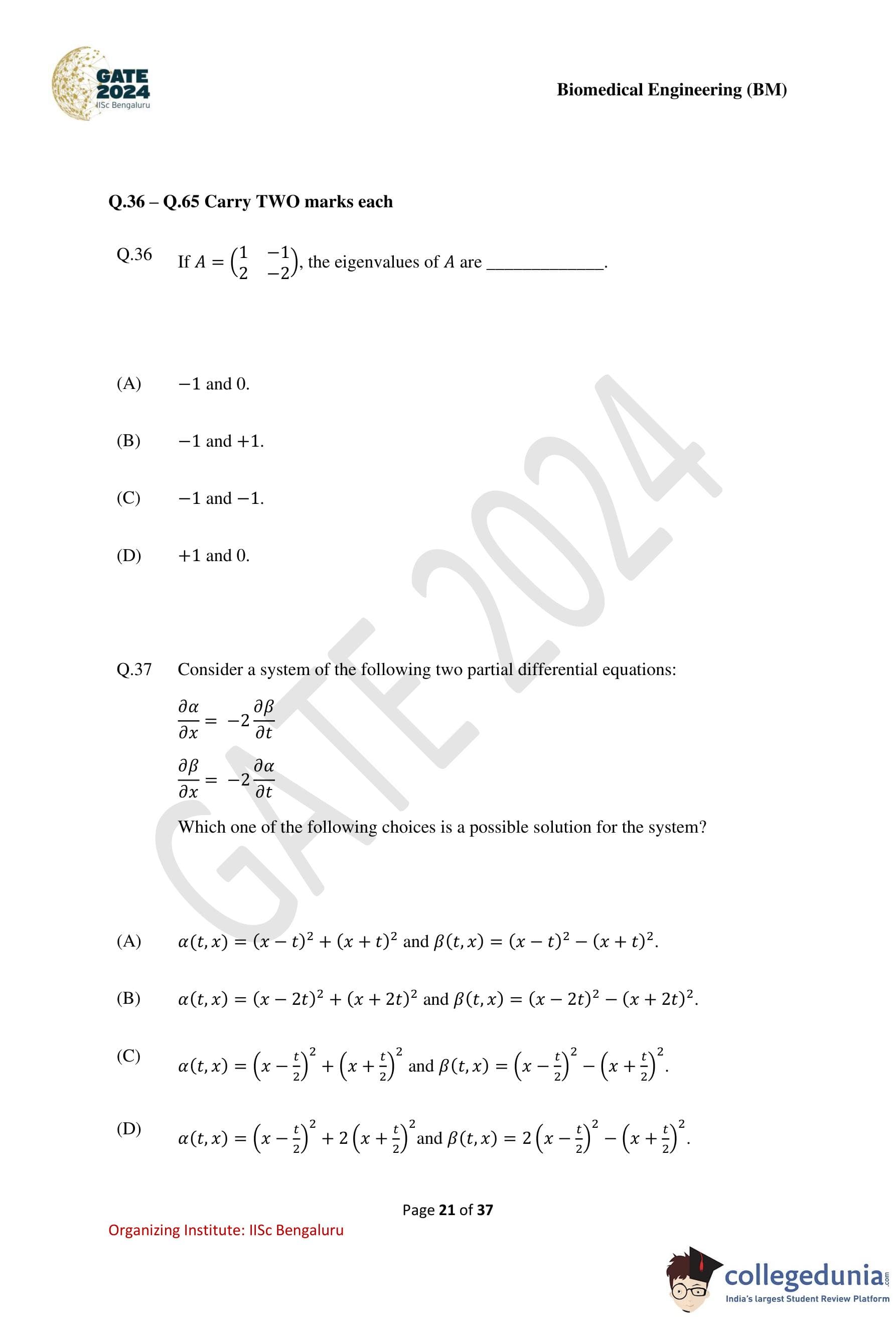
If \( A = \begin{pmatrix} 1 & -1
2 & -2 \end{pmatrix} \), the eigenvalues of \(A\) are ...................
Consider a system of the following two partial differential equations: \[ \frac{\partial \alpha}{\partial x} = -2\frac{\partial \beta}{\partial t}, \qquad \frac{\partial \beta}{\partial x} = -2\frac{\partial \alpha}{\partial t} \]
Which one of the following choices is a possible solution for the system?
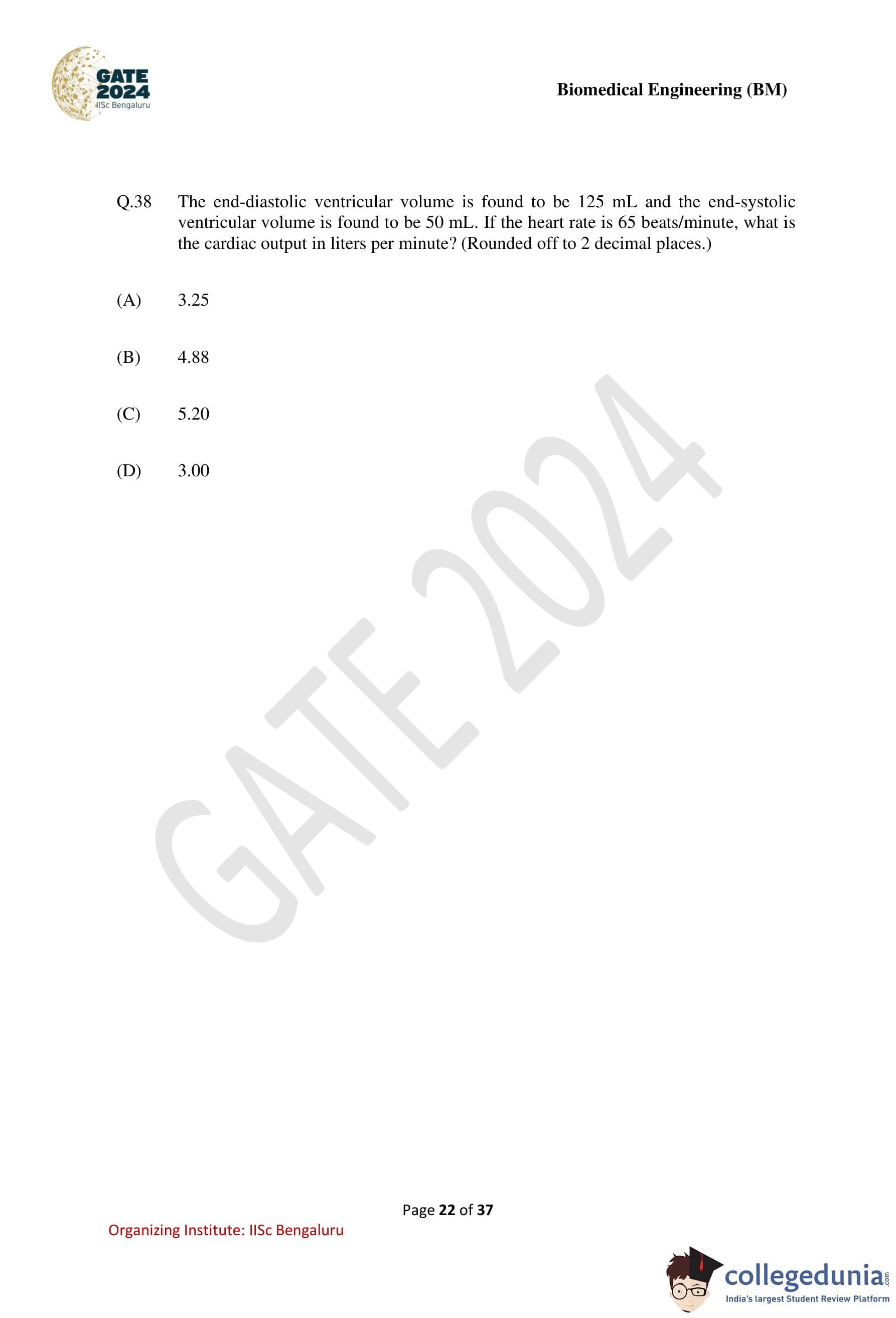
The end-diastolic ventricular volume is found to be 125 mL and the end-systolic ventricular volume is found to be 50 mL. If the heart rate is 65 beats/minute, what is the cardiac output in liters per minute? (Rounded off to 2 decimal places.)
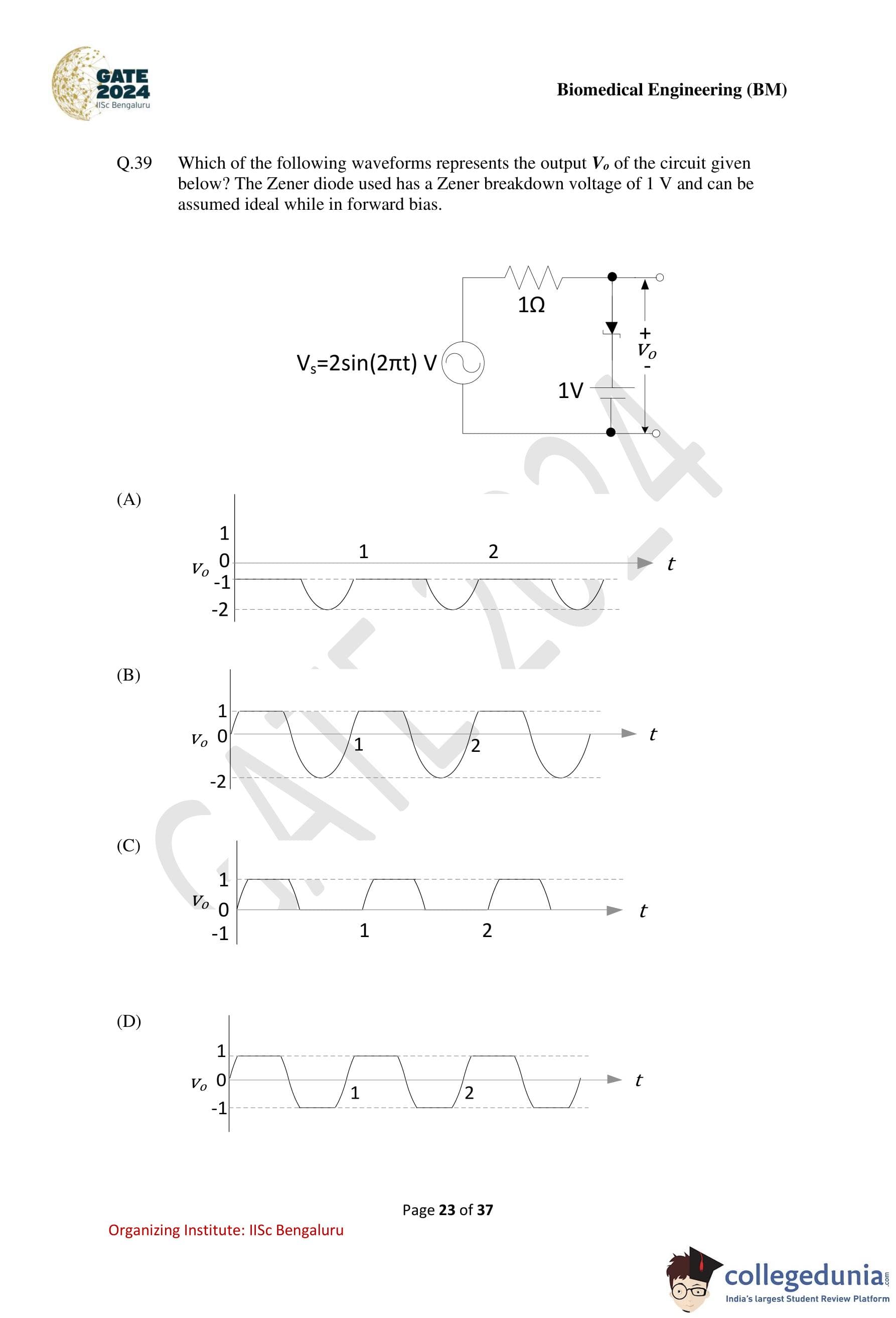
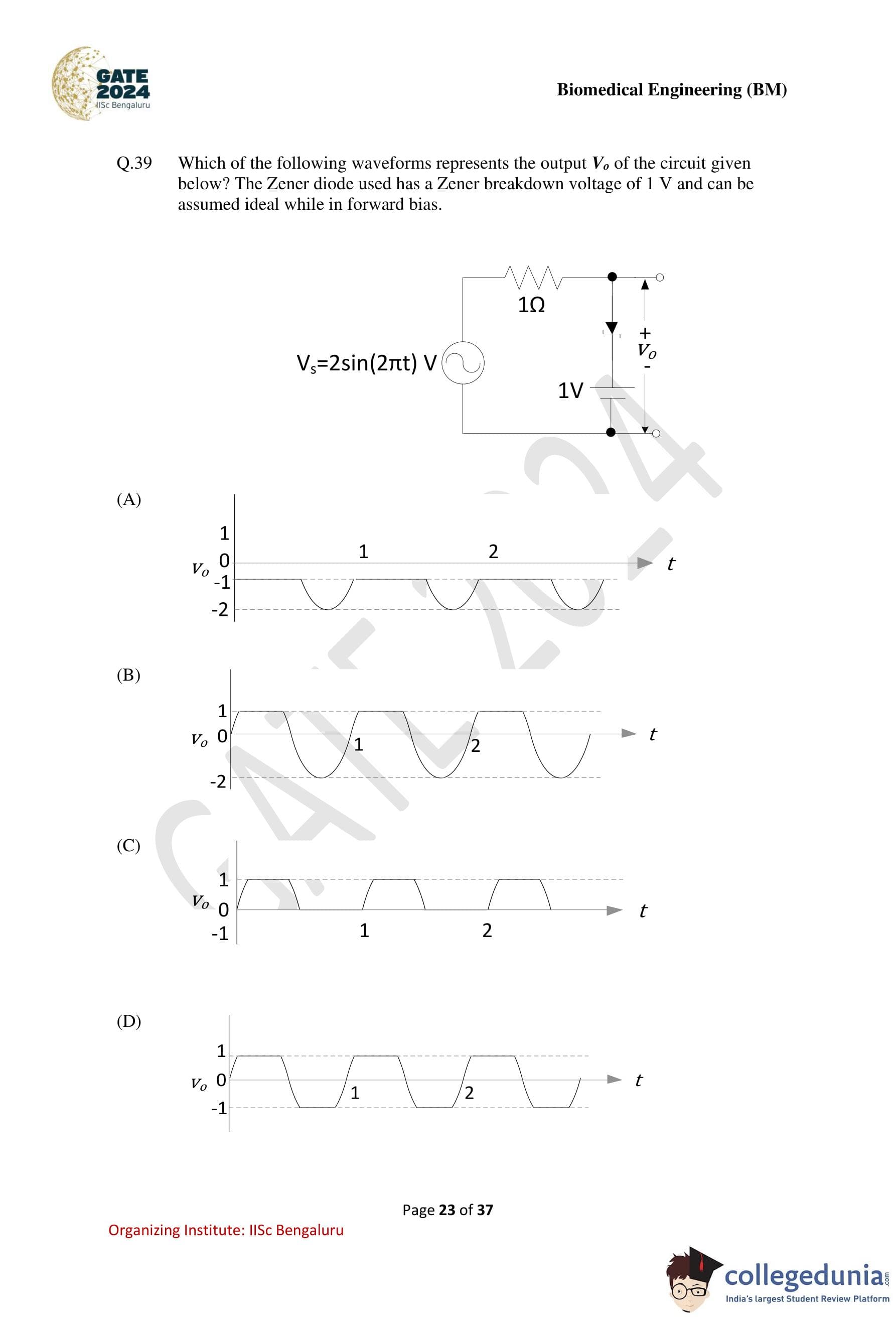
Which of the following waveforms represents the output \(V_o\) of the circuit given below? The Zener diode used has a Zener breakdown voltage of \(1\ V\) and can be assumed ideal while in forward bias.
[4pt] \(V_s = 2\sin(2\pi t)\ V\), series resistor \(1\ \Omega\), \(V_o\) is the voltage across the Zener (to ground).

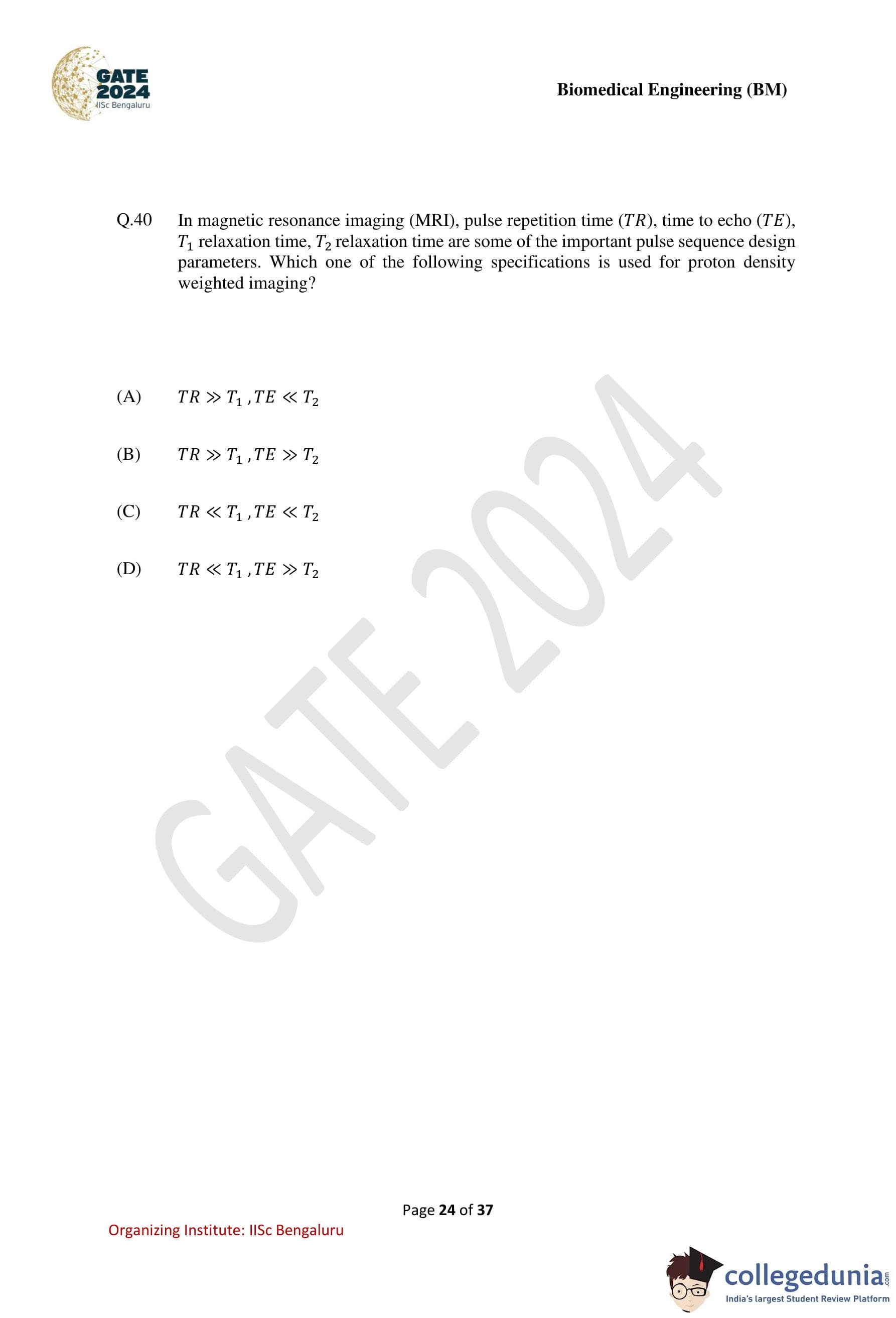
In magnetic resonance imaging (MRI), pulse repetition time (TR), time to echo (TE), \(T_1\) relaxation time, \(T_2\) relaxation time are some of the important pulse sequence design parameters. Which one of the following specifications is used for proton density weighted imaging?
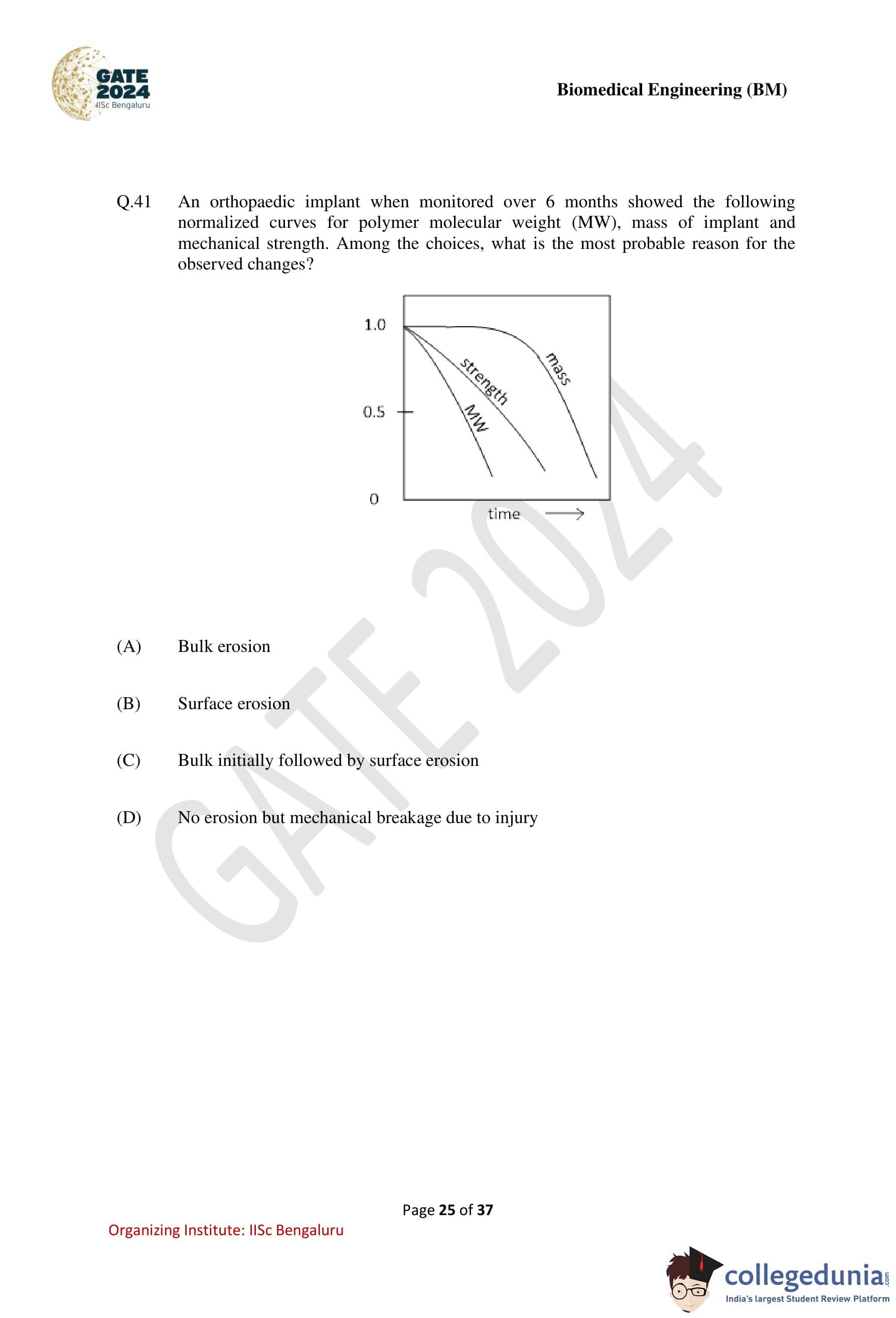
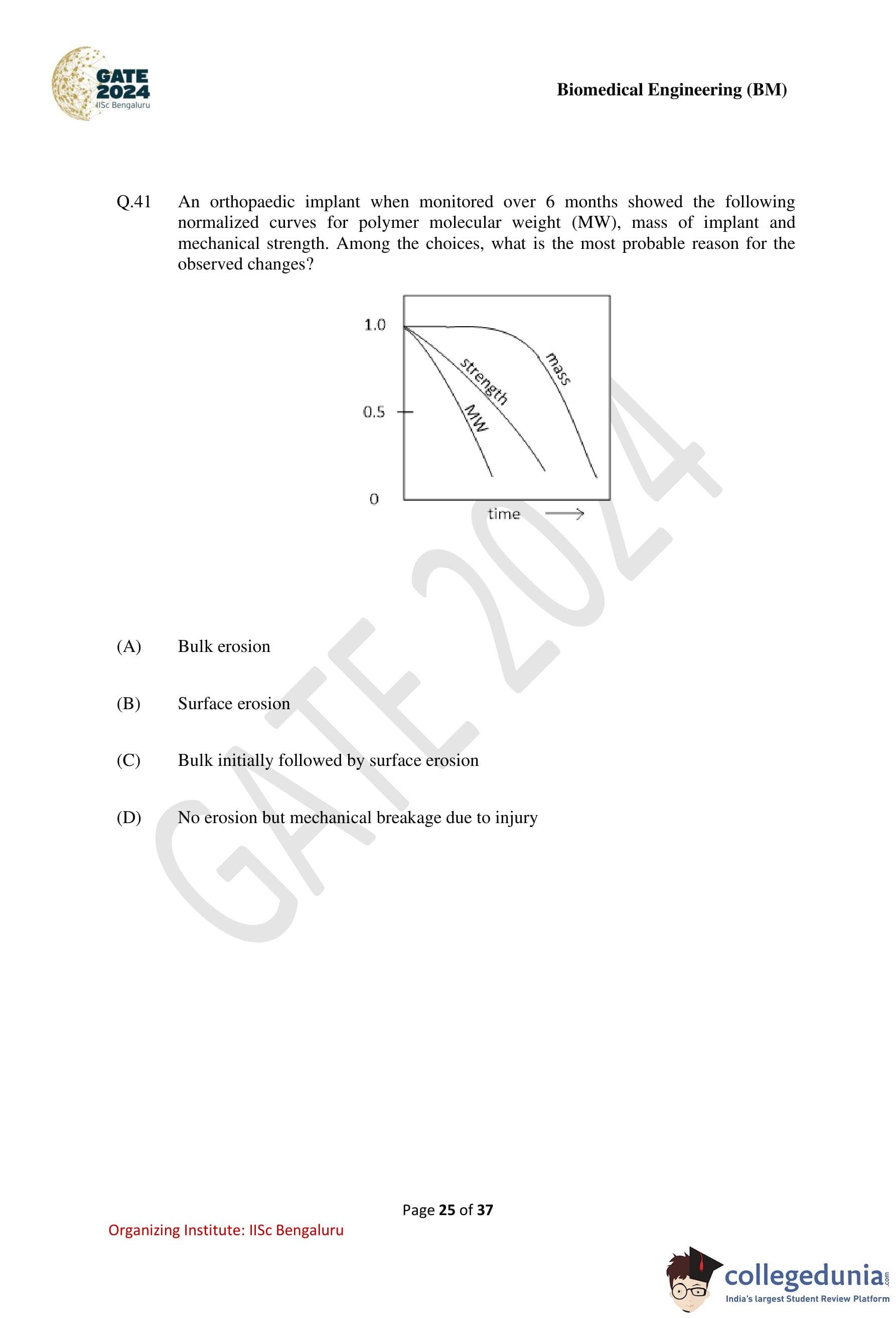
An orthopaedic implant when monitored over 6 months showed the following normalized curves for polymer molecular weight (MW), mass of implant and mechanical strength: MW decreases rapidly, strength decreases moderately, mass decreases slowly. Among the choices, what is the most probable reason for the observed changes?

In an attempt to integrate engineered tissue with native tissue, three samples of engineered tissue X, Y, Z, with identical material properties, were co-cultured adjacent to three different native tissues (bone, cartilage and liver). The adhesive strengths of X, Y, Z were observed after 8 weeks as follows:
[4pt]
Adhesive strength for X = 150 kPa, Y = 250 kPa, Z = 350 kPa.
[4pt]
Match the native tissue that were used to co-culture X, Y and Z from the following:
[4pt]
I: Liver Tissue \quad II: Articular Cartilage \quad III: Devitalized Bone
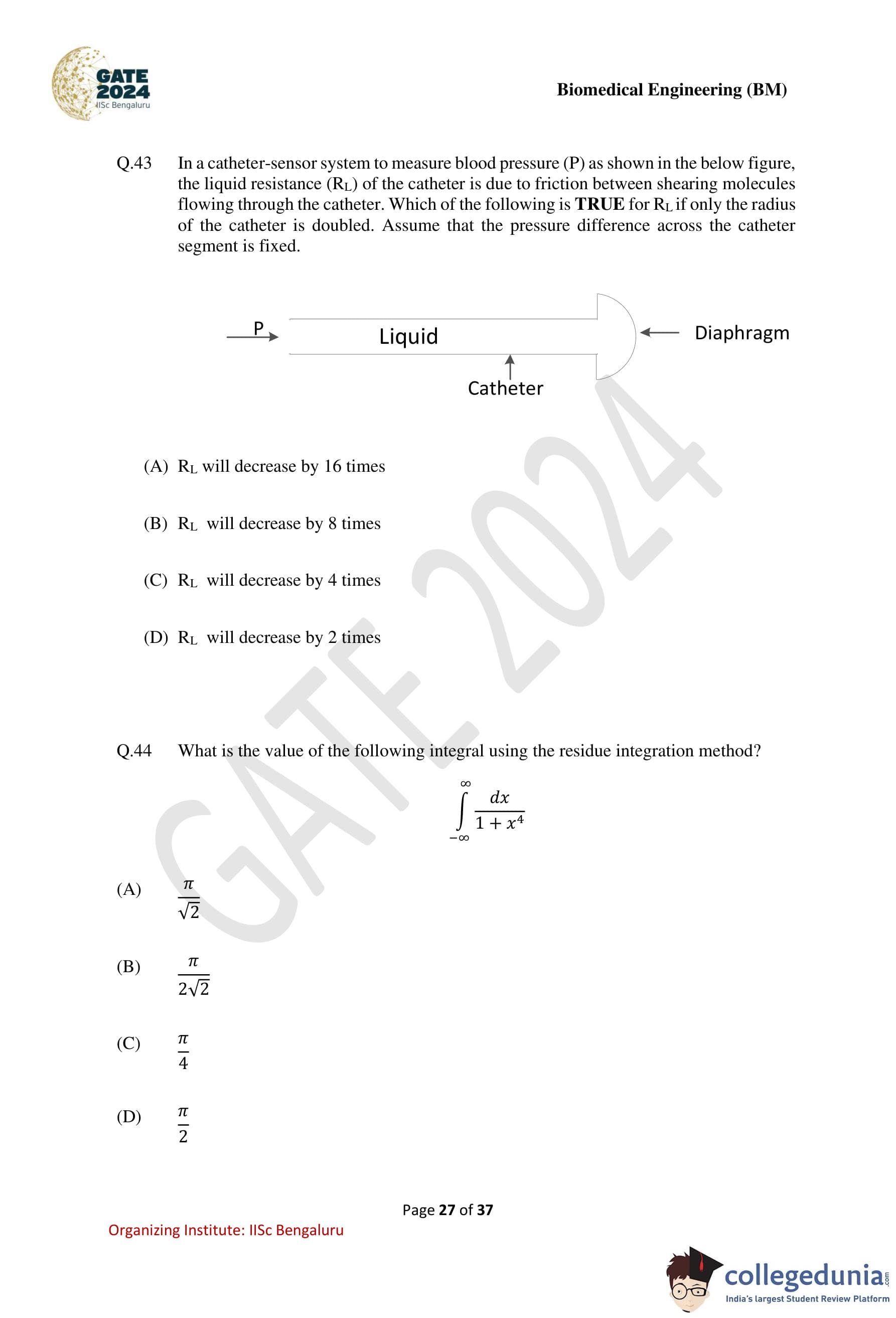
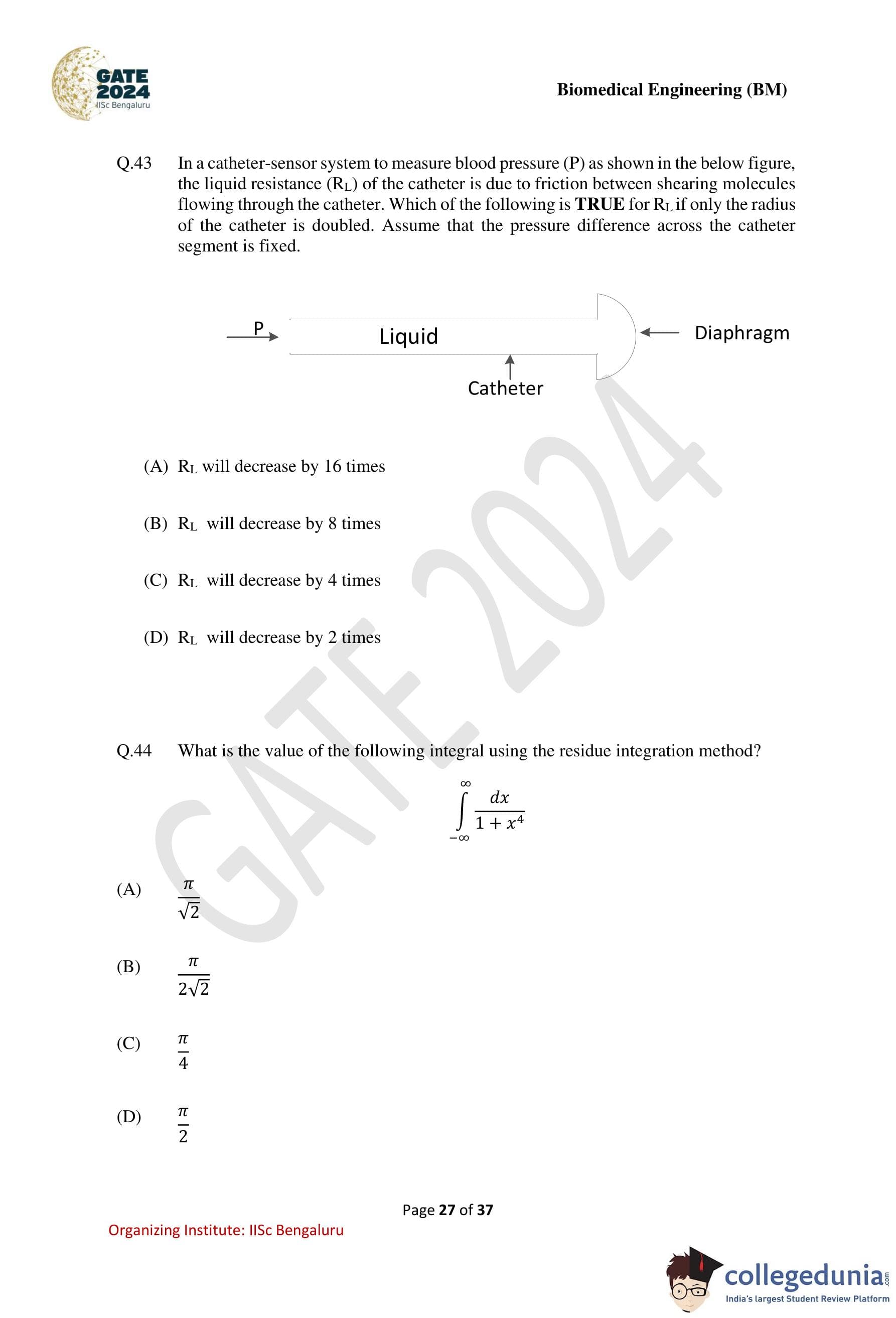
In a catheter-sensor system to measure blood pressure (\(P\)) as shown in the figure, the liquid resistance (\(R_L\)) of the catheter is due to friction between the molecules flowing inside the catheter. Which of the following is TRUE for \(R_L\) if only the radius of the catheter is doubled? Assume that the pressure difference across the catheter segment is fixed.

What is the value of the following integral using the residue integration method? \[ \int_{-\infty}^{\infty} \frac{dx}{1+x^4} \]
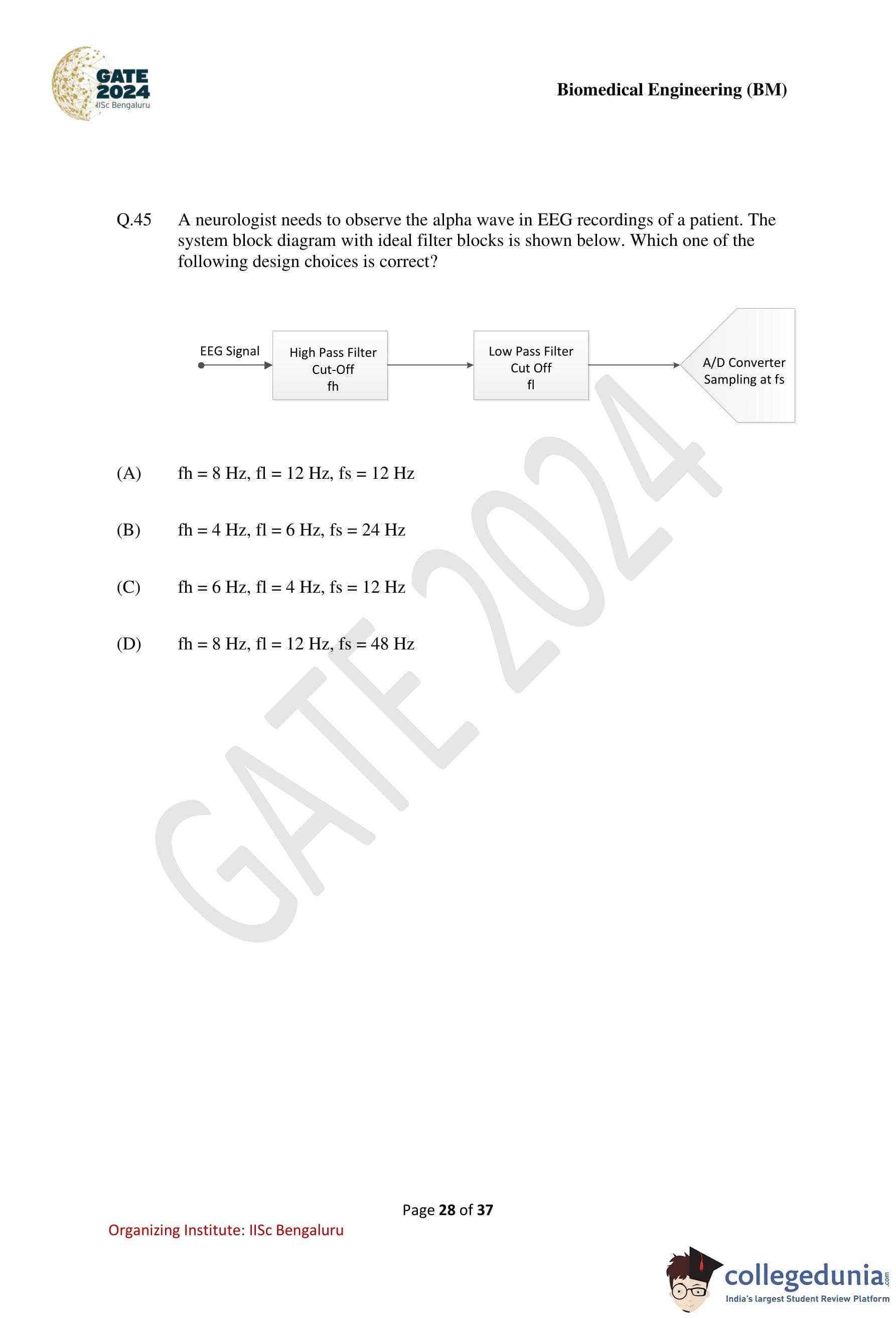
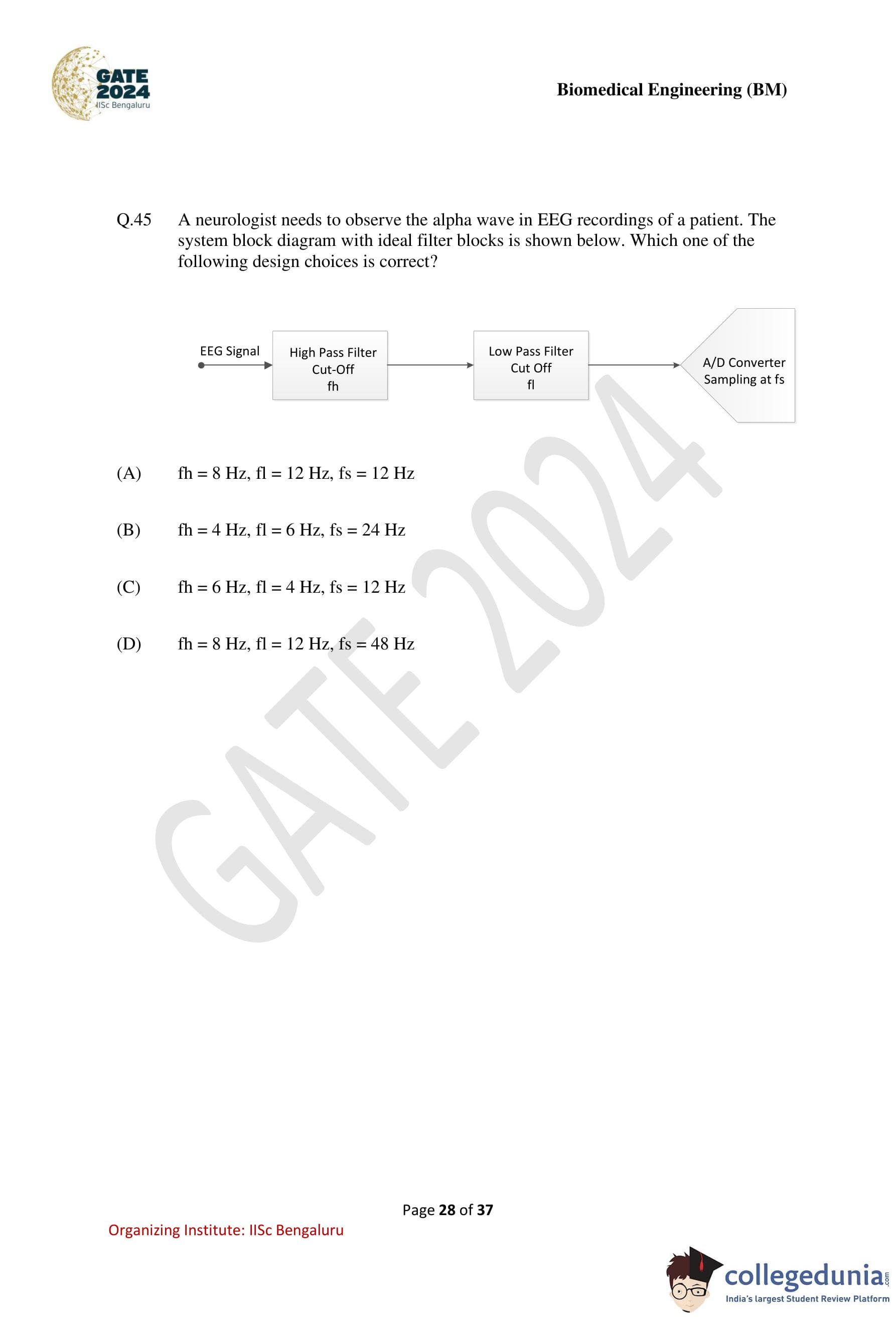
A neurologist needs to observe the alpha wave in EEG recordings of a patient.
The system block diagram with ideal filter blocks is shown below. Which one of the following design choices is correct?

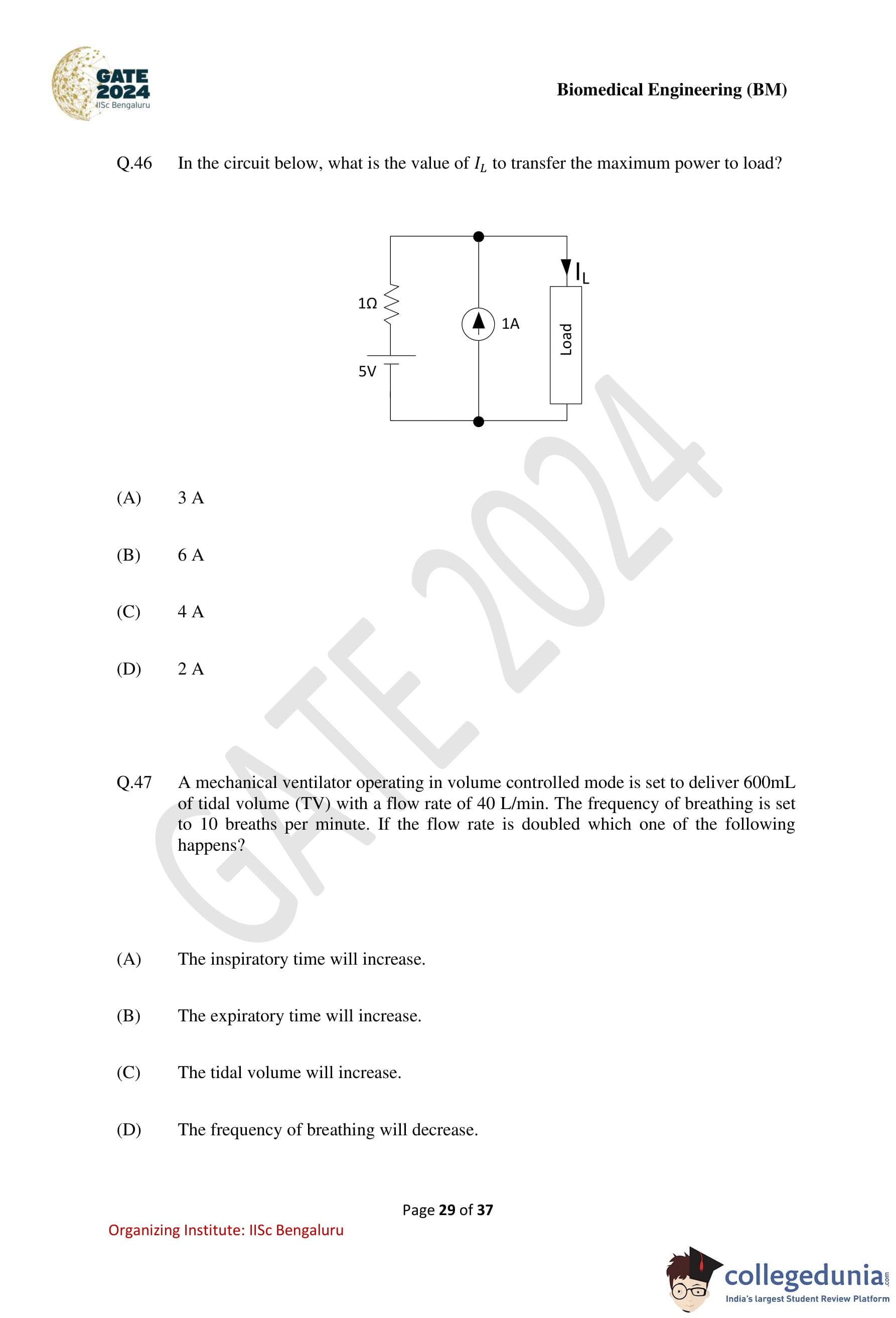
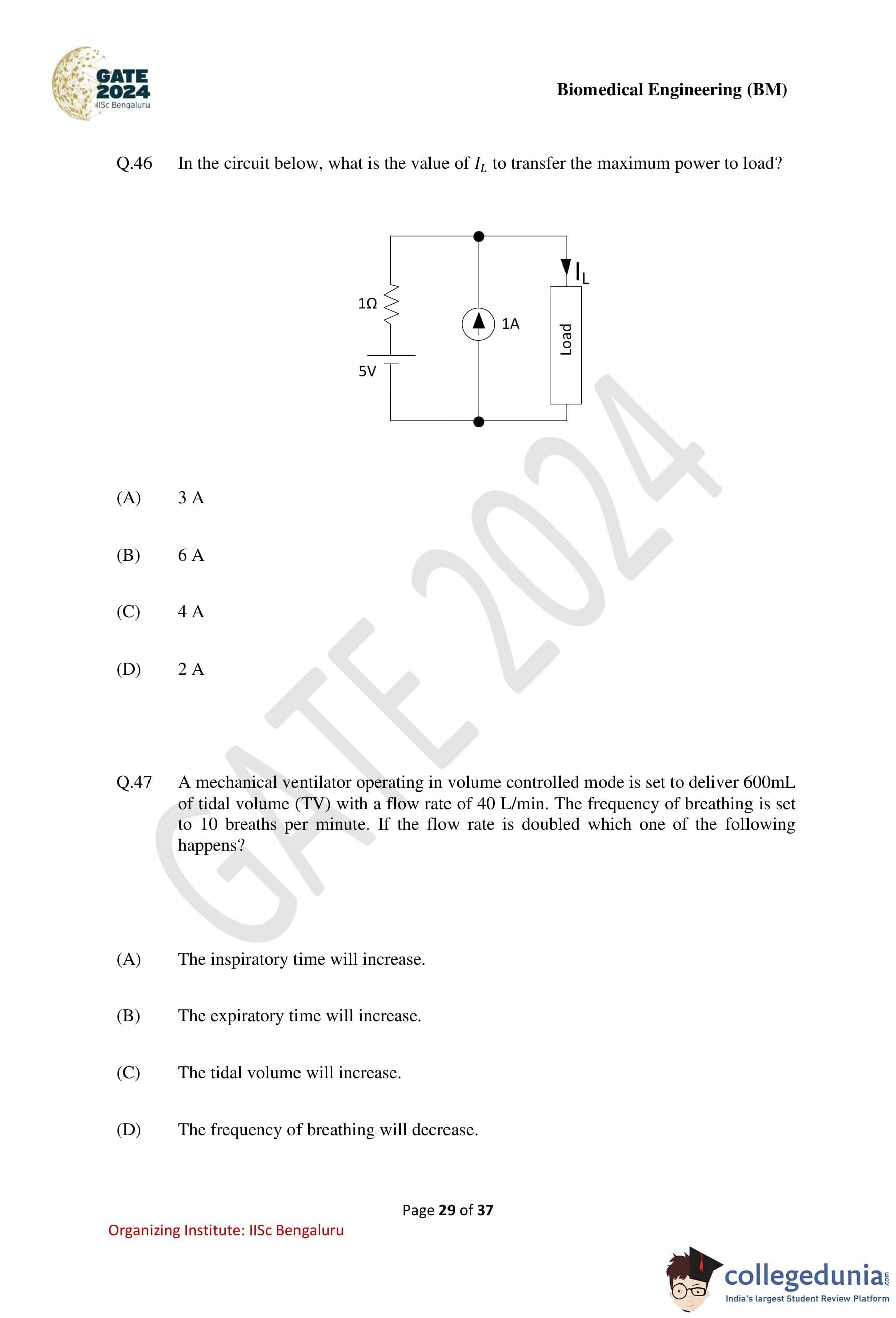
In the circuit shown below, what is the value of \(I_L\) to transfer the maximum power to the load?

A mechanical ventilator operating in volume-controlled mode is set to deliver \(600\,mL\) of tidal volume (TV) with a flow rate of \(40\,L/min\).
The frequency of breathing is set to 10 breaths per minute. If the flow rate is doubled, which one of the following happens?
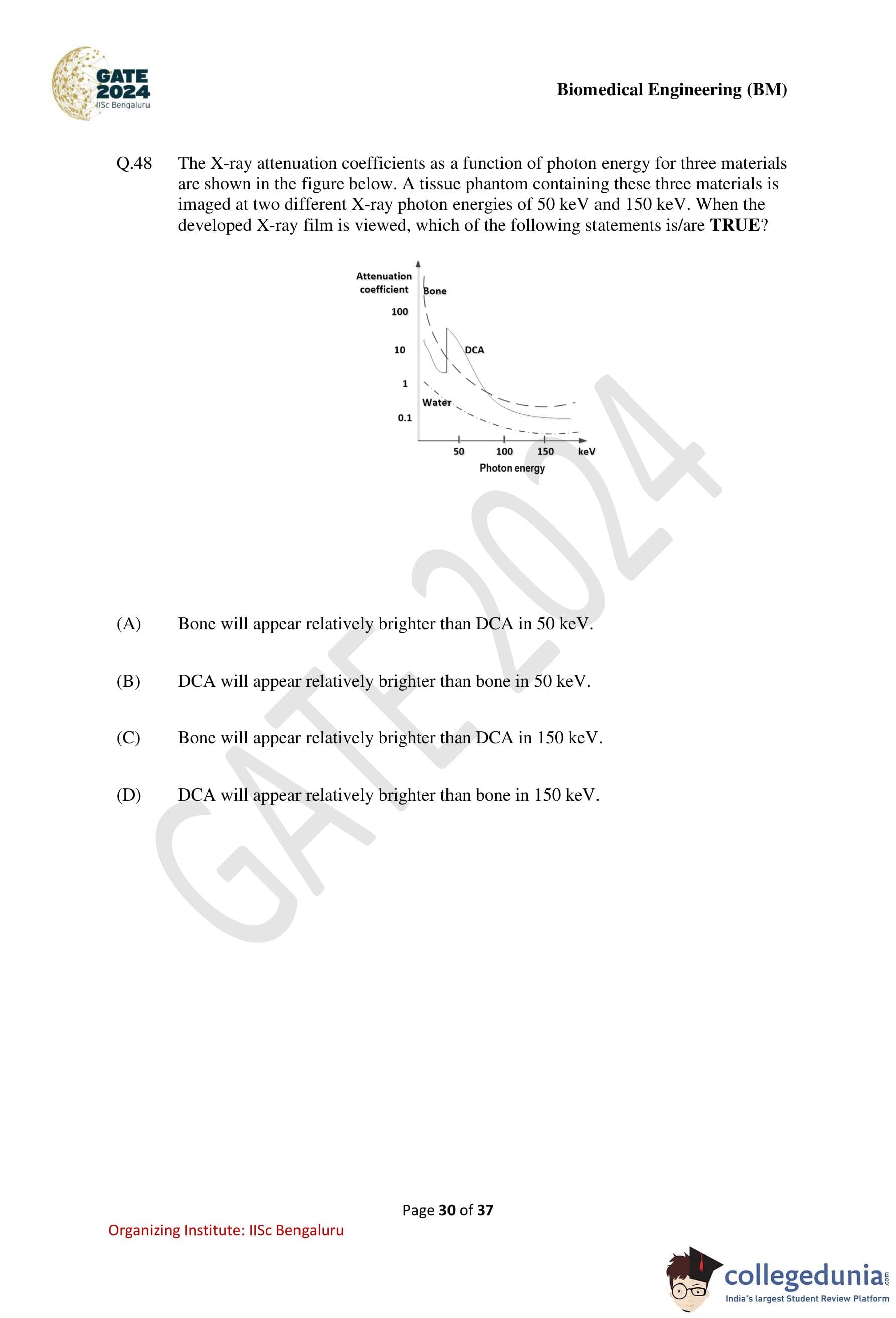
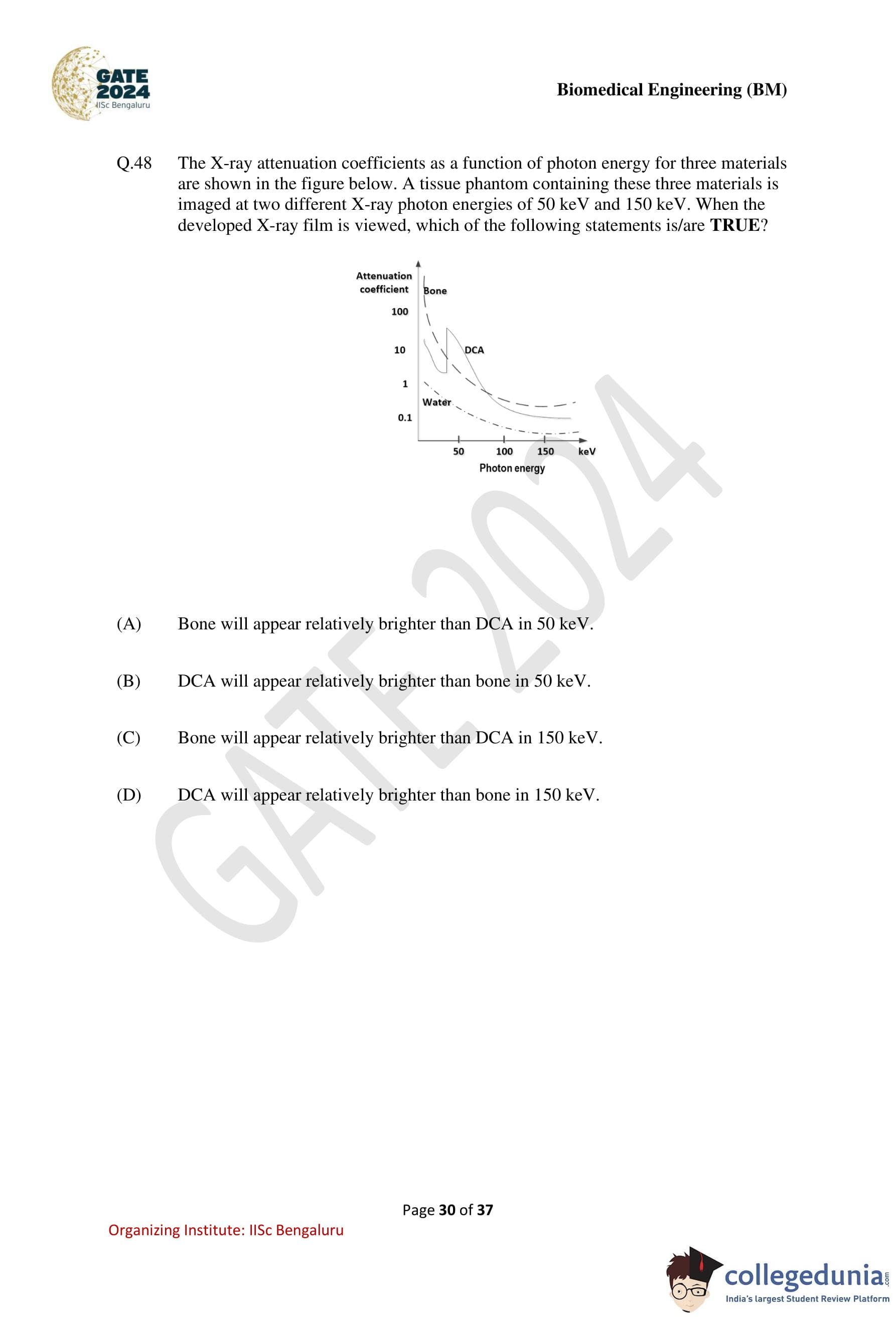
The X-ray attenuation coefficients as a function of photon energy for three materials are shown in the figure below. A tissue phantom containing these three materials is imaged at two different X-ray photon energies of 50 keV and 150 keV. When the developed X-ray film is viewed, which of the following statements is/are \textbf{TRUE}?

Which of the following is/are \textbf{TRUE} for a surface electromyography (sEMG) signal of a muscle experiencing fatigue?
View Solution
Concept:
Muscle fatigue causes physiological changes such as:
Reduced muscle fiber conduction velocity
Increased motor unit recruitment to maintain force
These changes affect both the frequency domain and time domain characteristics of the sEMG signal.
Step 1: Effect on median frequency
With fatigue:
Muscle fiber conduction velocity decreases
Power spectrum shifts toward lower frequencies
Hence, the median frequency decreases.
So, statement (A) is TRUE and (B) is FALSE.
Step 2: Effect on RMS value
As fatigue progresses:
More motor units are recruited
sEMG amplitude increases
Thus, the RMS value increases.
So, statement (C) is TRUE and (D) is FALSE.
Final Conclusion:
The correct options are: \[ \boxed{(A) and (C)} \] Quick Tip: For muscle fatigue analysis using sEMG: Frequency-domain features shift to lower values Time-domain amplitude measures increase Median frequency and RMS are key fatigue indicators
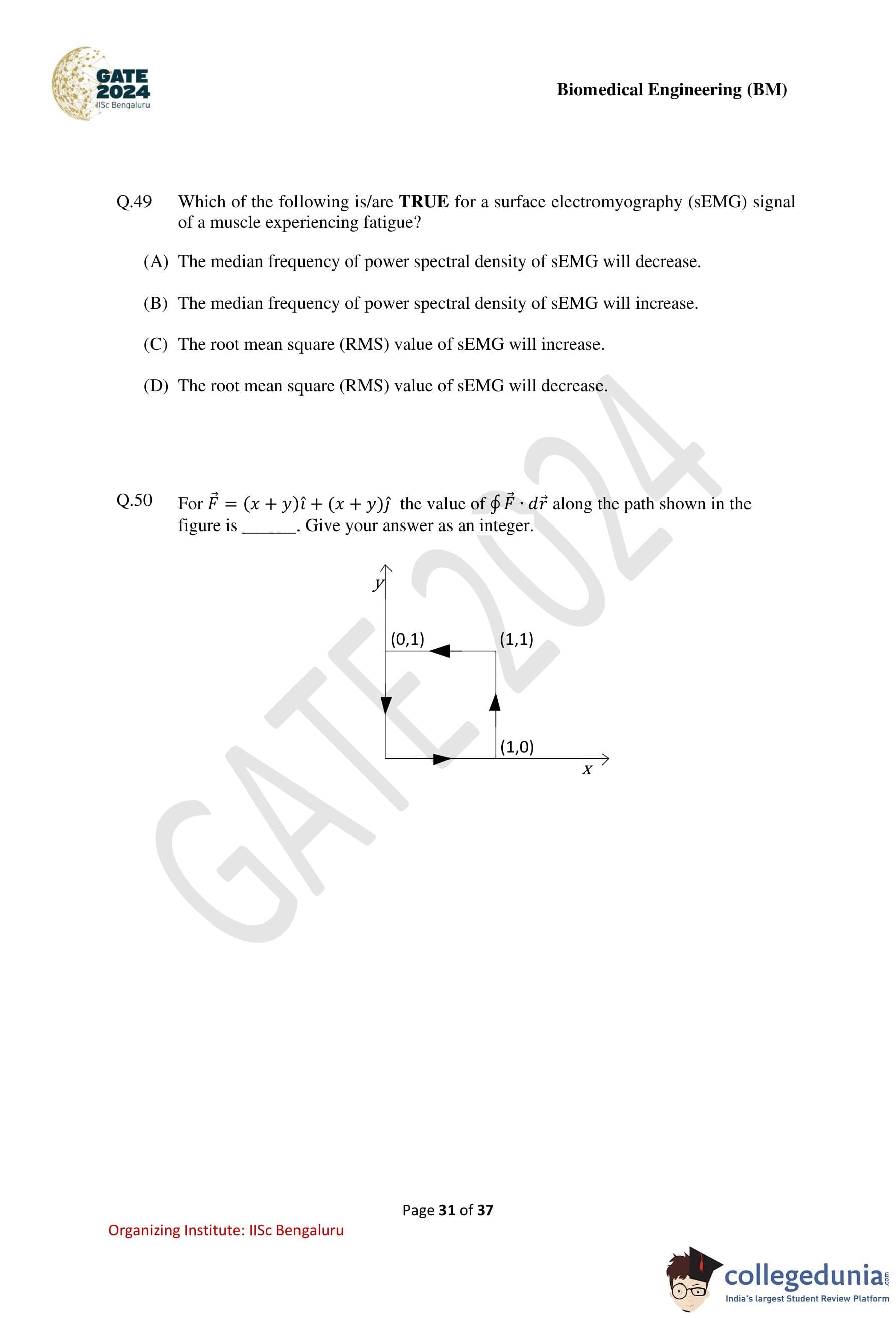
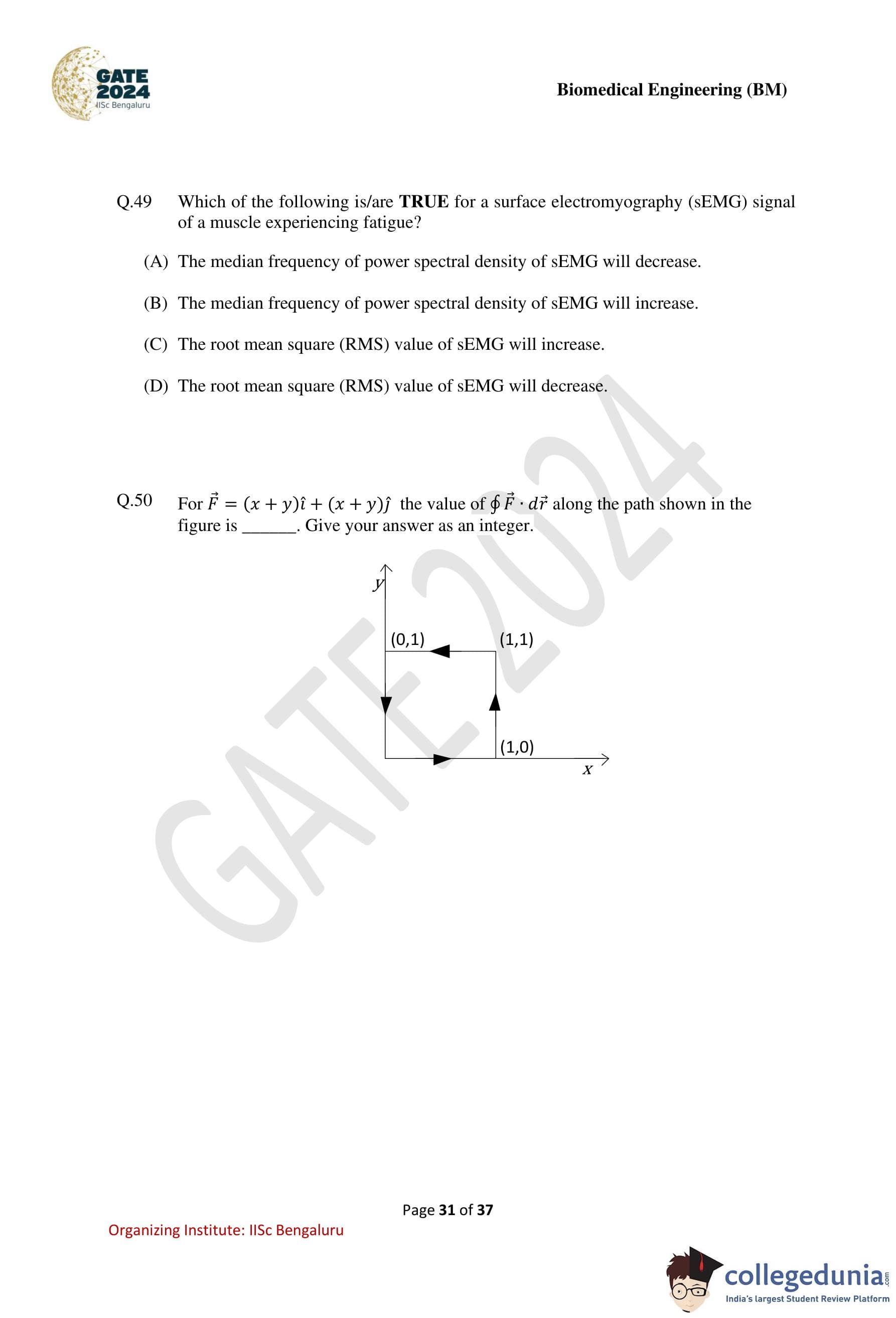
For \( \vec{F} = (x+y)\hat{i} + (x+y)\hat{j} \), the value of \( \oint \vec{F}\cdot d\vec{r} \) along the closed path shown in the figure is ____. Give your answer as an integer.

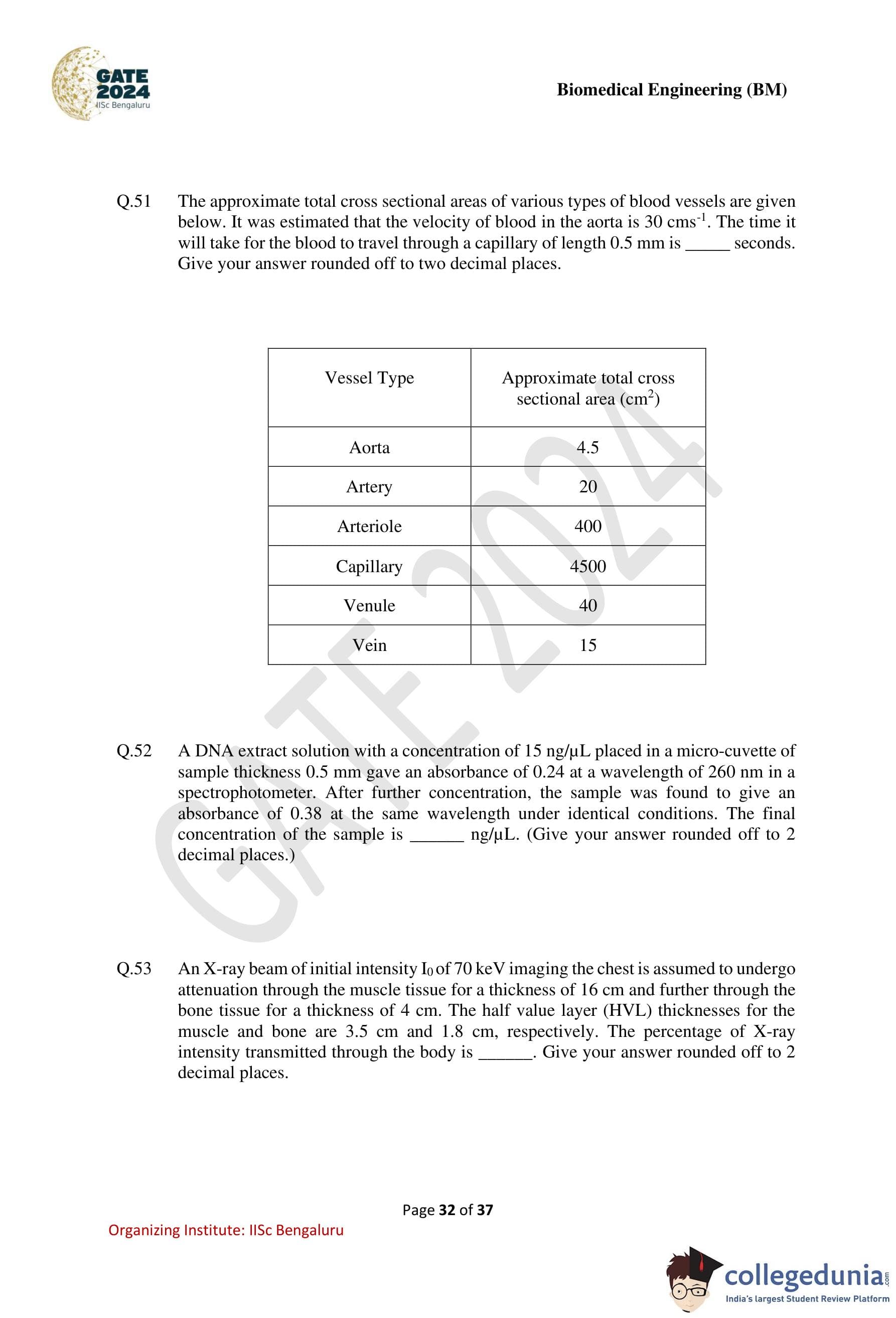
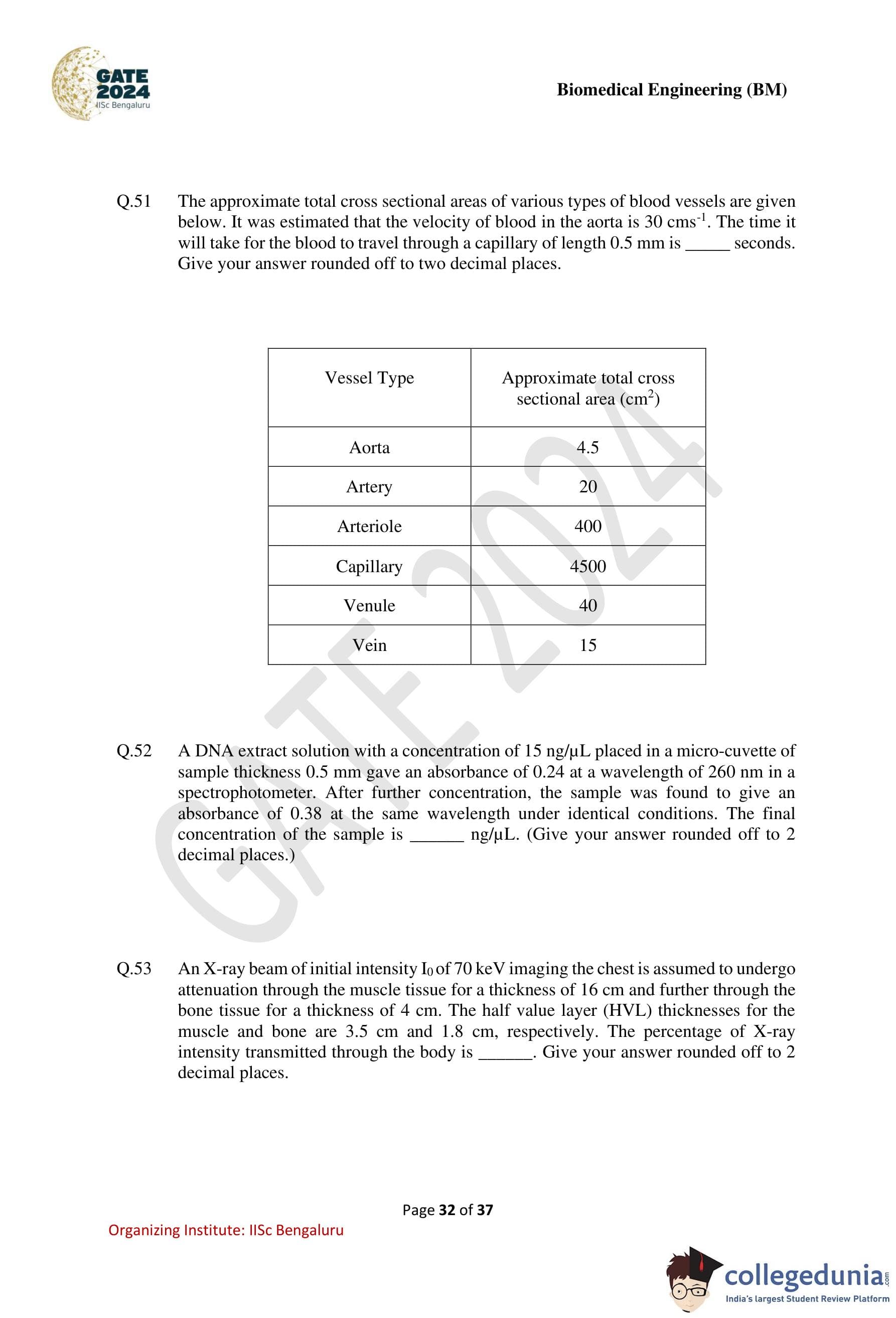
The approximate total cross sectional areas of various types of blood vessels are given below. It was estimated that the velocity of blood in the aorta is \(30~cm s^{-1}\). The time it will take for the blood to travel through a capillary of length \(0.5~mm\) is ____ seconds. Give your answer rounded off to two decimal places.
A DNA extract solution with a concentration of \(15~ng/\muL\) placed in a micro-cuvette of sample thickness \(0.5~mm\) gave an absorbance of \(0.24\) at a wavelength of \(260~nm\) in a spectrophotometer. After further concentration, the sample was found to give an absorbance of \(0.38\) at the same wavelength under identical conditions. The final concentration of the sample is ____ \( ng/\muL \). (Give your answer rounded off to 2 decimal places.)
An X-ray beam of initial intensity \(I_0\) for \(70~keV\) imaging of the chest is assumed to undergo attenuation through muscle tissue for a thickness of \(16~cm\) and further through bone tissue for a thickness of \(4~cm\). The half value layer (HVL) thicknesses for muscle and bone are \(3.5~cm\) and \(1.8~cm\), respectively. The percentage of X-ray intensity transmitted through the body is ____. (Give your answer rounded off to 2 decimal places.)
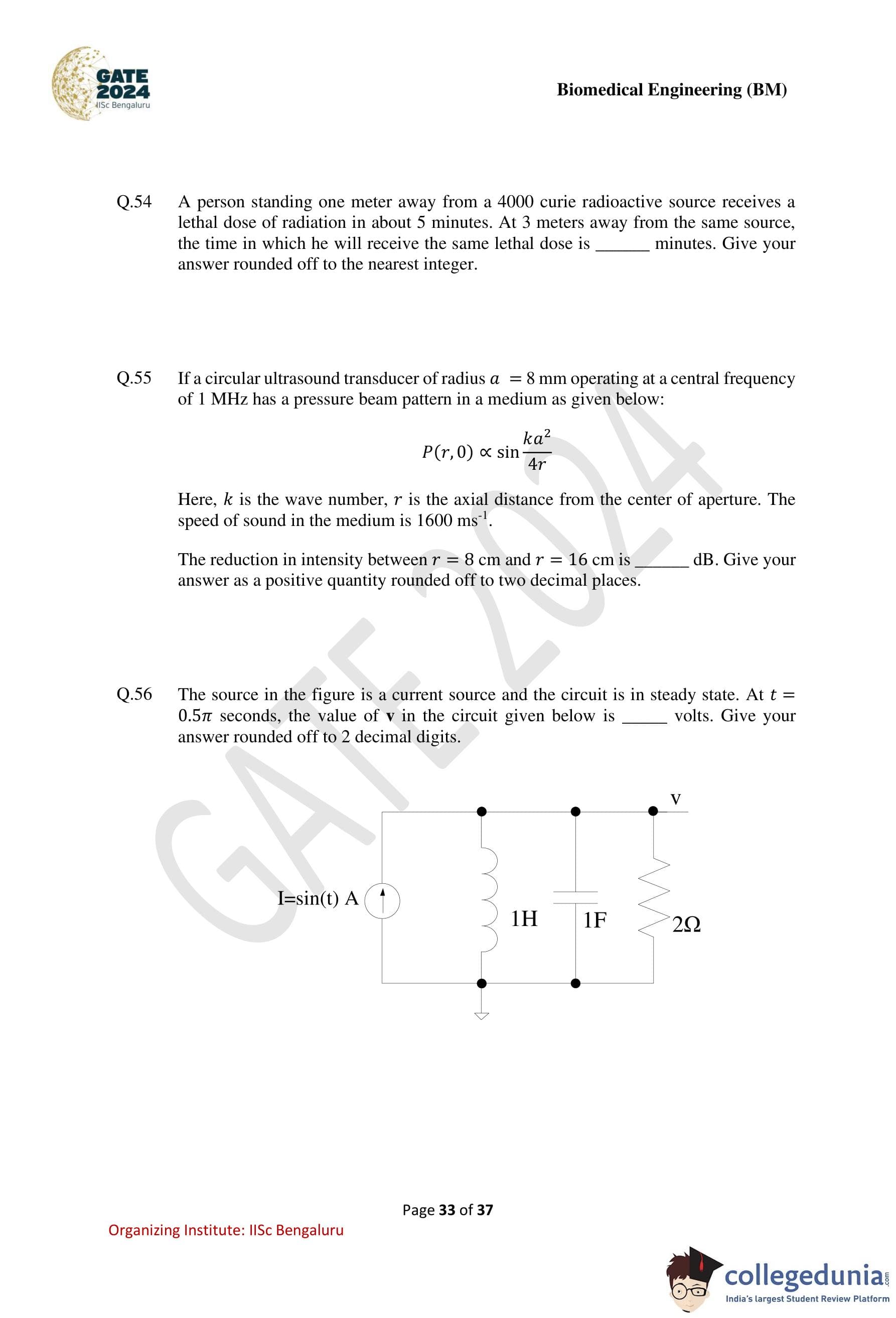
A person standing one meter away from a 4000 curie radioactive source receives a lethal dose of radiation in about 5 minutes. At 3 meters away from the same source, the time in which he will receive the same lethal dose is ____ minutes. Give your answer rounded off to the nearest integer.
If a circular ultrasound transducer of radius \(a = 8~mm\) operating at a central frequency of \(1~MHz\) has a pressure beam pattern in a medium as given below: \[ P(r,0) \propto \sin\!\left(\frac{k a^2}{4r}\right) \]
Here, \(k\) is the wave number and \(r\) is the axial distance from the center of aperture. The speed of sound in the medium is \(1600~m s^{-1}\).
The reduction in intensity between \(r = 8~cm\) and \(r = 16~cm\) is ____ dB. Give your answer as a positive quantity rounded off to two decimal places.
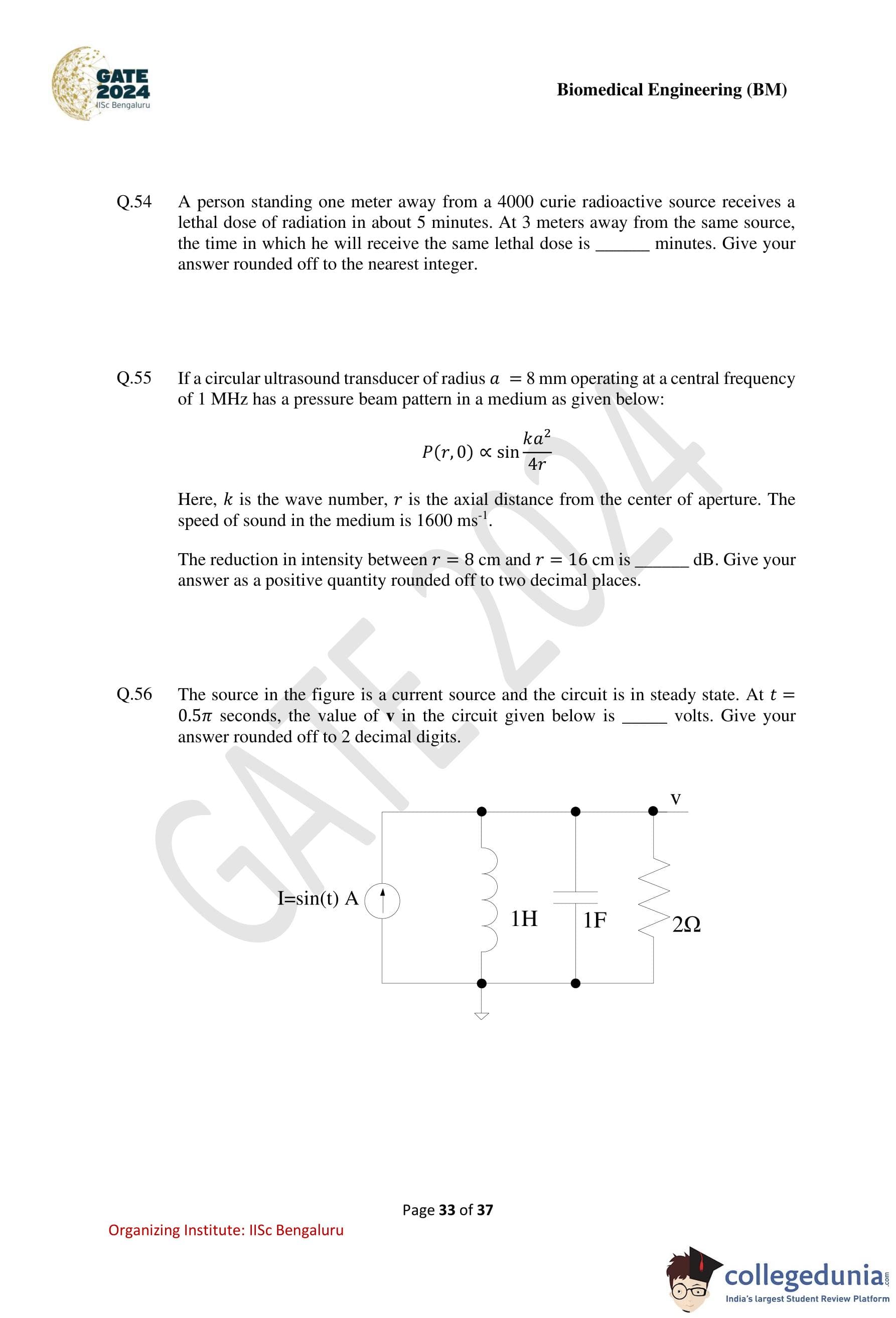
The source in the figure is a current source and the circuit is in steady state. At \( t = 0.5\pi \) seconds, the value of \( v \) in the circuit given below is \rule{1.5cm{0.15mm volts. Give your answer rounded off to 2 decimal digits.

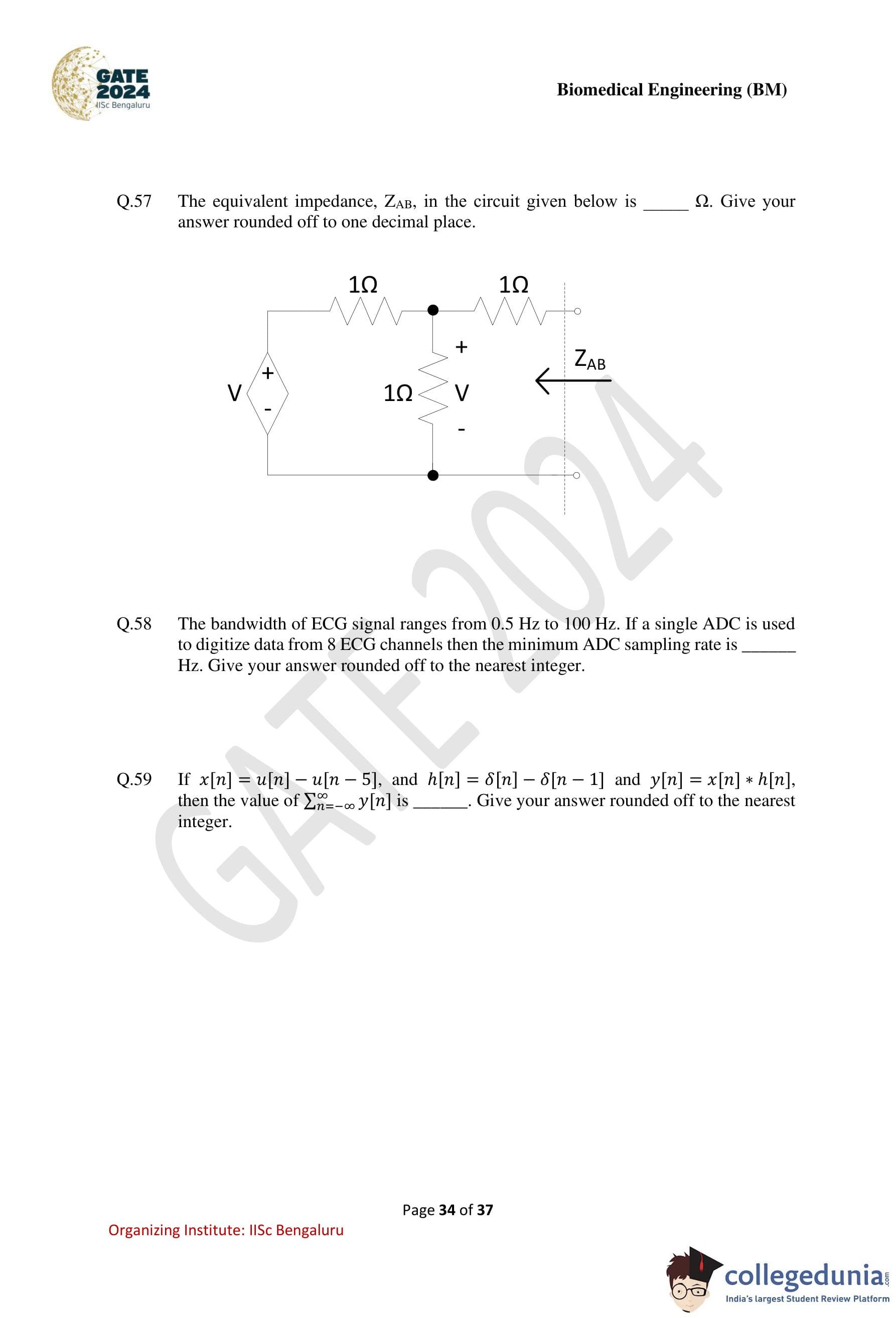
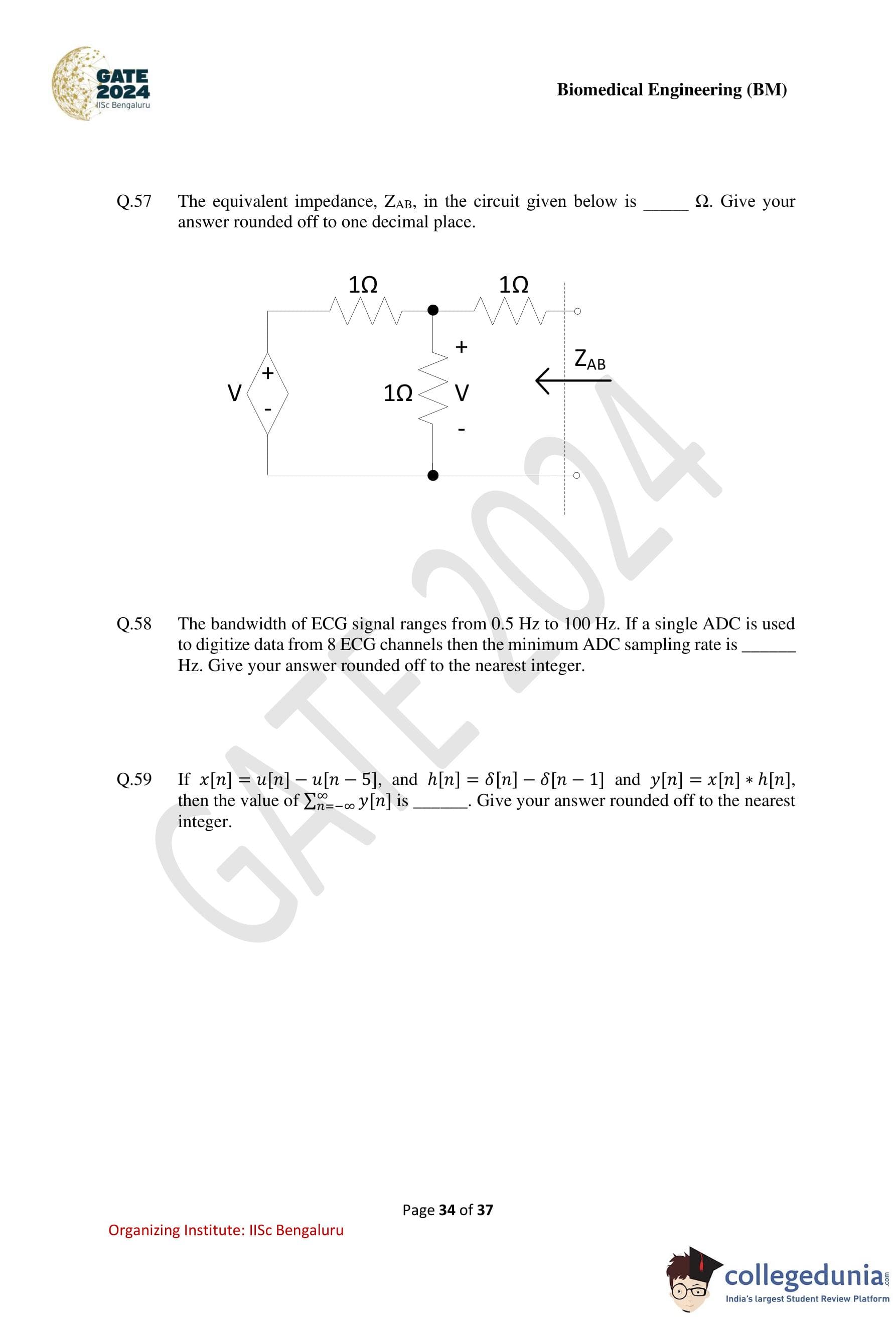
The equivalent impedance \(Z_{AB}\) in the circuit given below is ____ \(\Omega\). Give your answer rounded off to one decimal place.

The bandwidth of ECG signal ranges from \(0.5~Hz\) to \(100~Hz\).
If a single ADC is used to digitize data from 8 ECG channels, then the minimum ADC sampling rate is ____ Hz. Give your answer rounded off to the nearest integer.
If \(x[n] = u[n] - u[n-5]\), and \(h[n] = \delta[n] - \delta[n-1]\) and \(y[n] = x[n] * h[n]\), then the value of \(\sum_{n=-\infty}^{\infty} y[n]\) is ____. Give your answer rounded off to the nearest integer.
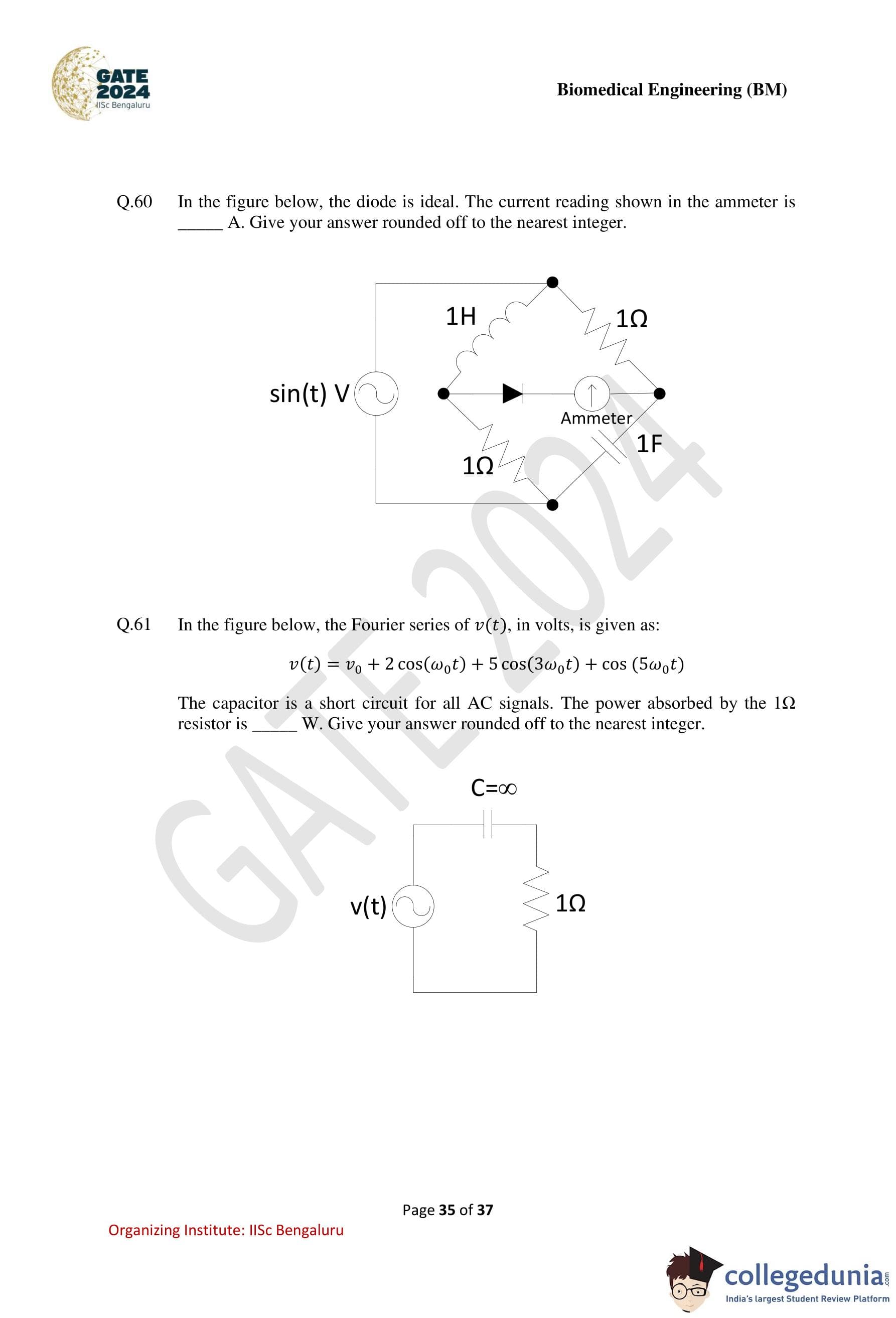
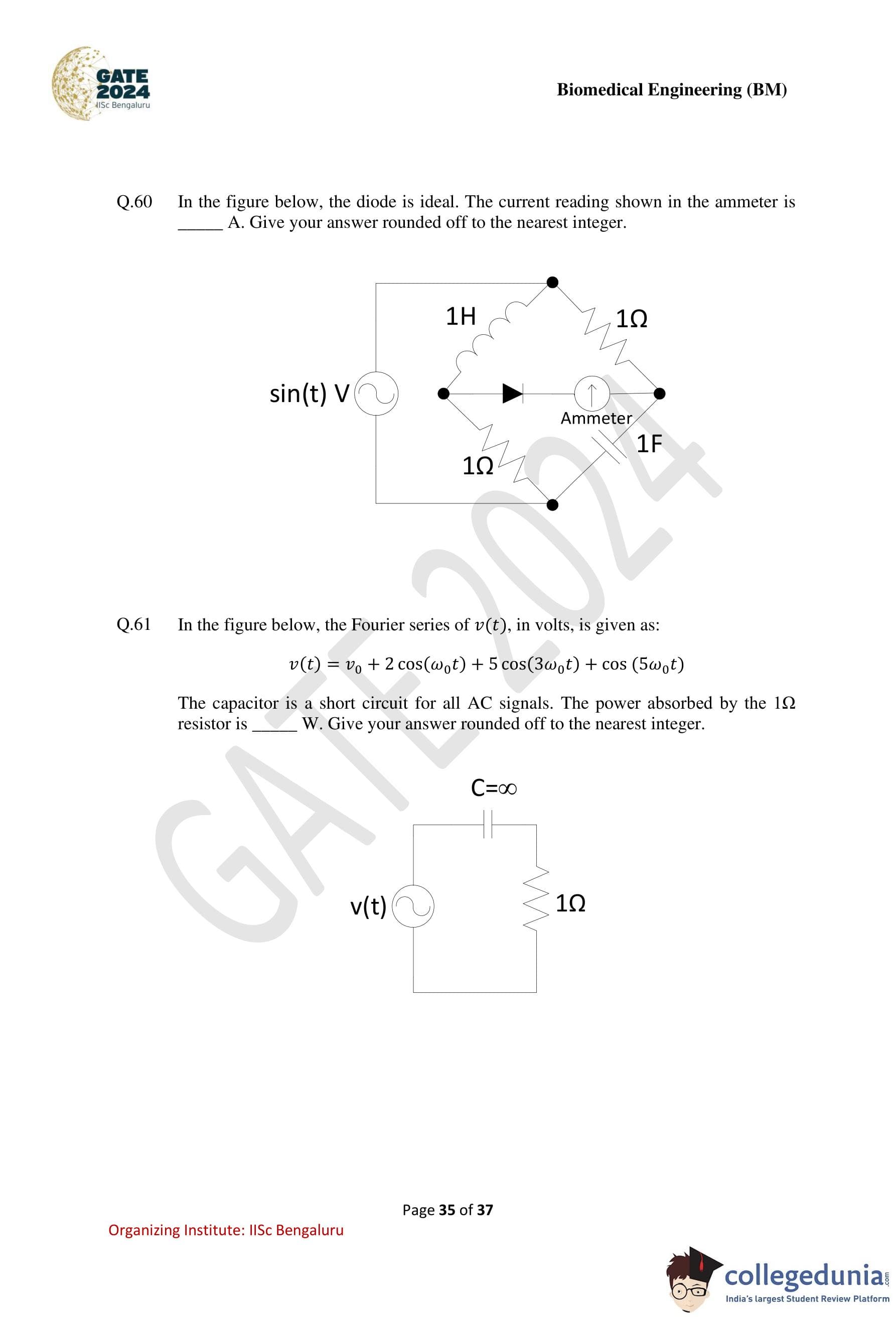
In the figure below, the diode is ideal. The current reading shown in the ammeter is ____ A. Give your answer rounded off to the nearest integer.

In the figure below, the Fourier series of \(v(t)\), in volts, is given as: \[ v(t) = v_0 + 2\cos(\omega_0 t) + 5\cos(3\omega_0 t) + \cos(5\omega_0 t) \]
The capacitor is a short circuit for all AC signals. The power absorbed by the \(1\Omega\) resistor is ____ W. Give your answer rounded off to the nearest integer.

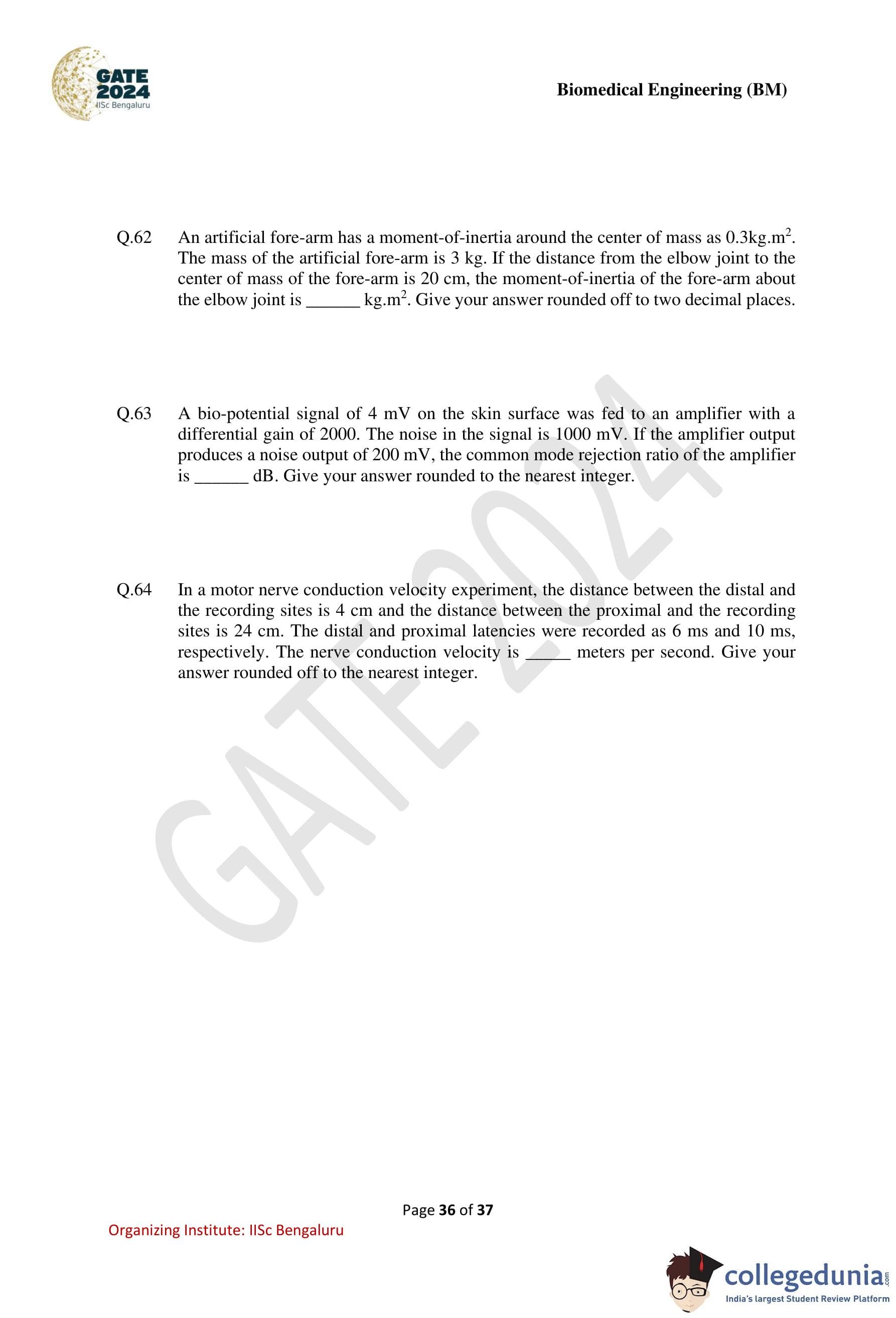
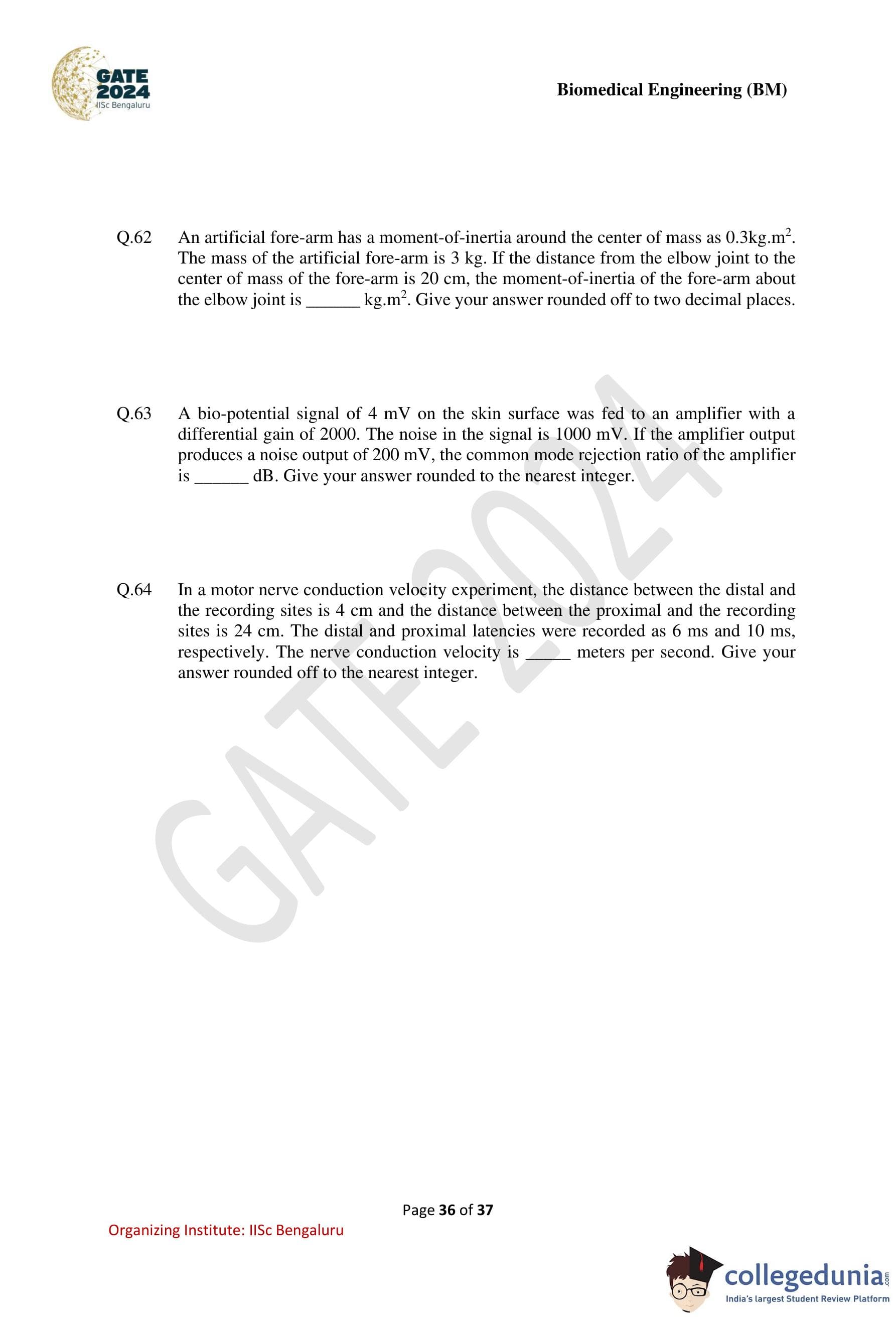
An artificial fore-arm has a moment-of-inertia around the center of mass as \(0.3~kg m^2\). The mass of the artificial fore-arm is \(3~kg\). If the distance from the elbow joint to the center of mass of the fore-arm is \(20~cm\), the moment-of-inertia of the fore-arm about the elbow joint is ____ \(kg m^2\). Give your answer rounded off to two decimal places.
A bio-potential signal of \(4~mV\) on the skin surface was fed to an amplifier with a differential gain of \(2000\). The noise in the signal is \(1000~mV\). If the amplifier output produces a noise output of \(200~\muV\), the common mode rejection ratio of the amplifier is ____ dB. Give your answer rounded off to the nearest integer.
In a motor nerve conduction velocity experiment, the distance between the distal and the recording sites is \(4~cm\) and the distance between the proximal and the recording sites is \(24~cm\). The distal and proximal latencies were recorded as \(6~ms\) and \(10~ms\), respectively. The nerve conduction velocity is ____ meters per second. Give your answer rounded off to the nearest integer.
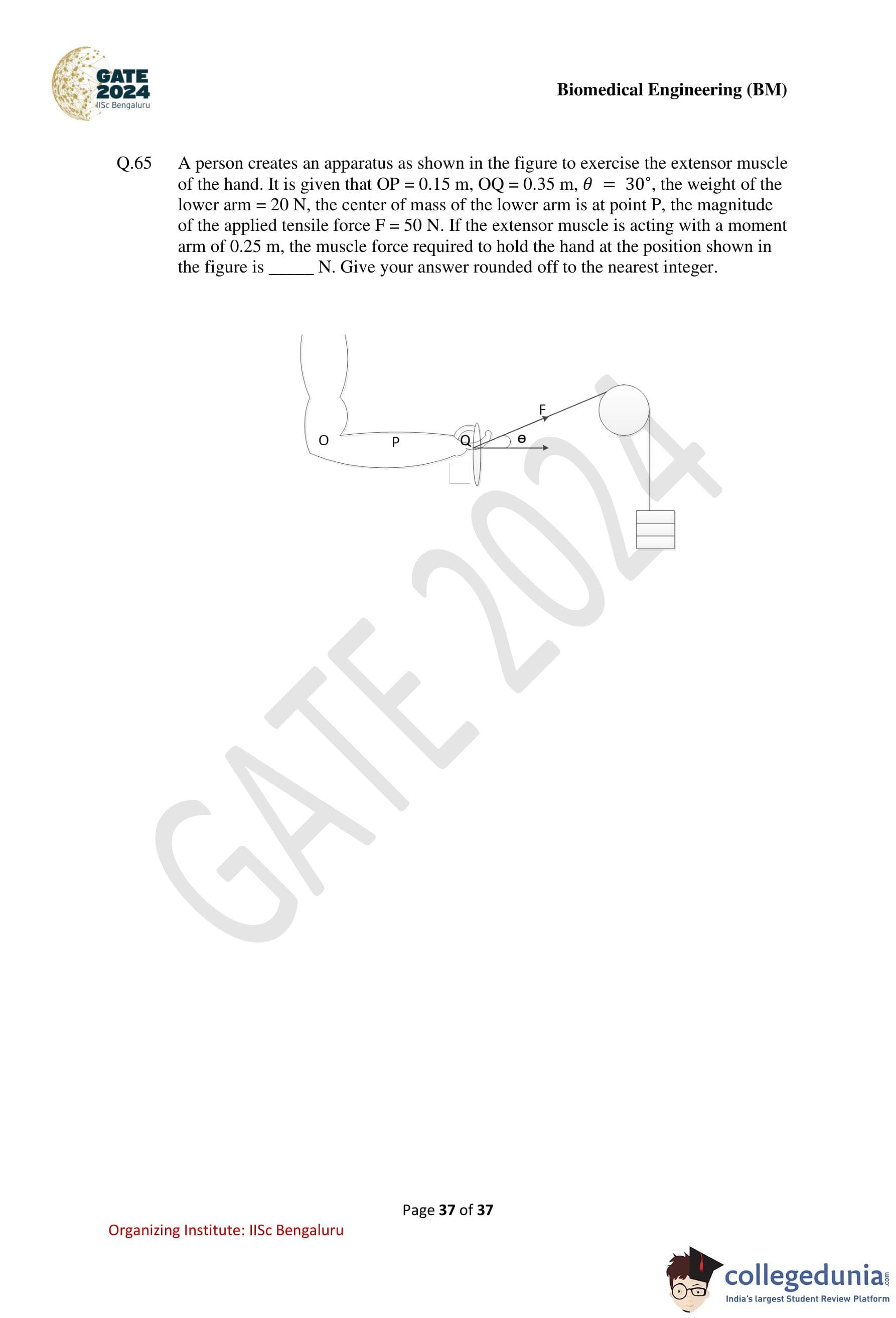
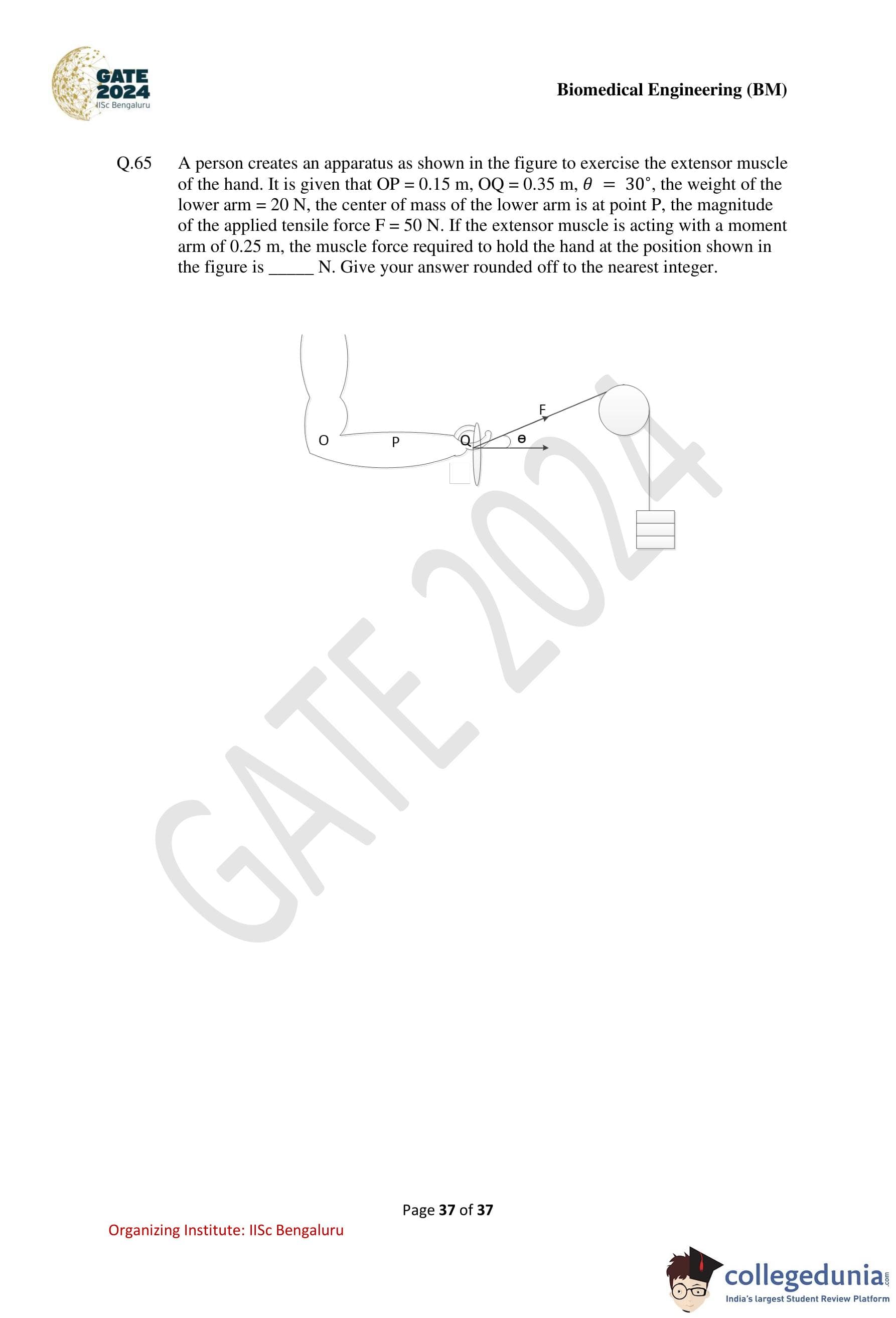
A person creates an apparatus as shown in the figure to exercise the extensor muscle of the hand. It is given that \(OP = 0.15~m\), \(OQ = 0.35~m\), \(\theta = 30^\circ\), the weight of the lower arm is \(20~N\), the center of mass of the lower arm is at point \(P\), and the magnitude of the applied tensile force is \(50~N\). If the extensor muscle is acting with a moment arm of \(0.25~m\), the muscle force required to hold the hand at the position shown in the figure is ____ N. Give your answer rounded off to the nearest integer.





Comments