




GATE 2024 Biotechnology Question Paper PDF is available here. IISc Banglore conducted GATE 2024 Biotechnology exam on February 10 in the Forenoon Session from 9:30 AM to 12:30 PM. Students have to answer 65 questions in GATE 2024 Biotechnology Question Paper carrying a total weightage of 100 marks. 10 questions are from the General Aptitude section and 55 questions are from Engineering Mathematics and Core Discipline.
Also Check
- GATE Question Paper (Available): Check Previous Year Question Paper with Solution PDF
- GATE Question Paper 2025 (Soon): Check Previous Year Question Paper with Solution PDF
- GATE Question Paper 2024 (Available): Check Previous Year Question Paper with Solution PDF
- GATE Paper Analysis, Difficulty Level, Branch-wise Question Paper Analysis, Weightage of Topics
GATE 2024 Biotechnology Question Paper with Solution PDF
| GATE 2024 Biotechnology Question Paper with Solution PDF |  Download Download |
Check Solutions |
Question 1:
If '→' denotes increasing order of intensity, then the meaning of the words [dry → arid → parched] is analogous to [diet → fast → _____]. Which one of the given options is appropriate to fill the blank?
View Solution
Solution: The relationship described in the first analogy is based on increasing intensity:
dry → arid → parched.
This progression moves from mild dryness (dry) to extreme dryness (parched). Similarly, in the second analogy:
diet → fast → ______
Step 1: Analyze the terms.
"Diet" refers to controlled eating, "fast” indicates abstaining from food for a period, and the next step, representing extreme intensity, would be "starve,” meaning complete deprivation of food.
Step 2: Eliminate incorrect options.
(1) "reject" and (4) "deny" do not align with the progression of increasing food deprivation.
(2) "feast" represents the opposite context of eating. Hence, (1) "starve” fits the progression.
Final Answer:
starve
Question 2:
If two distinct non-zero real variables x and y are such that (x + y) is proportional to (x - y), then the value of x⁄y:
View Solution
Solution: The given condition states that:
(x + y) ∝ (x - y).
Let the proportionality constant be k, so:
x + y = k(x - y).
Step 1: Simplify the equation. Expanding and rearranging:
x + y = kx - ky.
x - kx = -ky – y.
x(1 − k) = −y(1 + k).
Step 2: Express x⁄y. Dividing both sides by y(1 – k):
x⁄y = -(1 + k)⁄(1 - k)
Step 3: Analyze the result. The value of x⁄y is a function of the constant k and does not depend on the specific values of x and y. Hence, x⁄y is a constant.
Question 3:
Consider the following sample of numbers: 9, 18, 11, 14, 15, 17, 10, 69, 11, 13. The median of the sample is:
View Solution
Solution: The median is the middle value of a data set when arranged in ascending order. For an even number of observations, it is the average of the two middle values.
Step 1: Arrange the data in ascending order. The given numbers are:
9, 18, 11, 14, 15, 17, 10, 69, 11, 13.
Arranging in ascending order:
9, 10, 11, 11, 13, 14, 15, 17, 18, 69.
Step 2: Identify the middle values. Since there are 10 observations (even number), the two middle values are the 5th and 6th values:
13 and 14.
Step 3: Calculate the median. The median is the average of the two middle values:
Median = 13 + 14⁄2 = 13.5.
Question 4:
The number of coins of 1, 5, and 10 denominations that a person has are in the ratio 5:3:13. Of the total amount, the percentage of money in 5 coins is:
View Solution
Solution: The total amount of money is calculated based on the given ratio of coins and their denominations.
Step 1: Represent the number of coins in terms of a variable. Let the number of coins of 1, 5, and 10 denominations be 5x, 3x, and 13x, respectively.
Step 2: Calculate the total amount for each denomination.
Amount in 1 coins = 5x * 1 = 5x.
Amount in 5 coins = 3x * 5 = 15x.
Amount in 10 coins = 13x * 10 = 130x.
Step 3: Calculate the total amount. The total amount is:
Total Amount = 5x + 15x + 130x = 150x.
Step 4: Calculate the percentage of money in 5 coins. The percentage of money in 5 coins is:
Percentage = Amount in 5 coins⁄Total Amount * 100.
Substitute the values:
Percentage = 15x⁄150x * 100 = 10%.
Question 5:
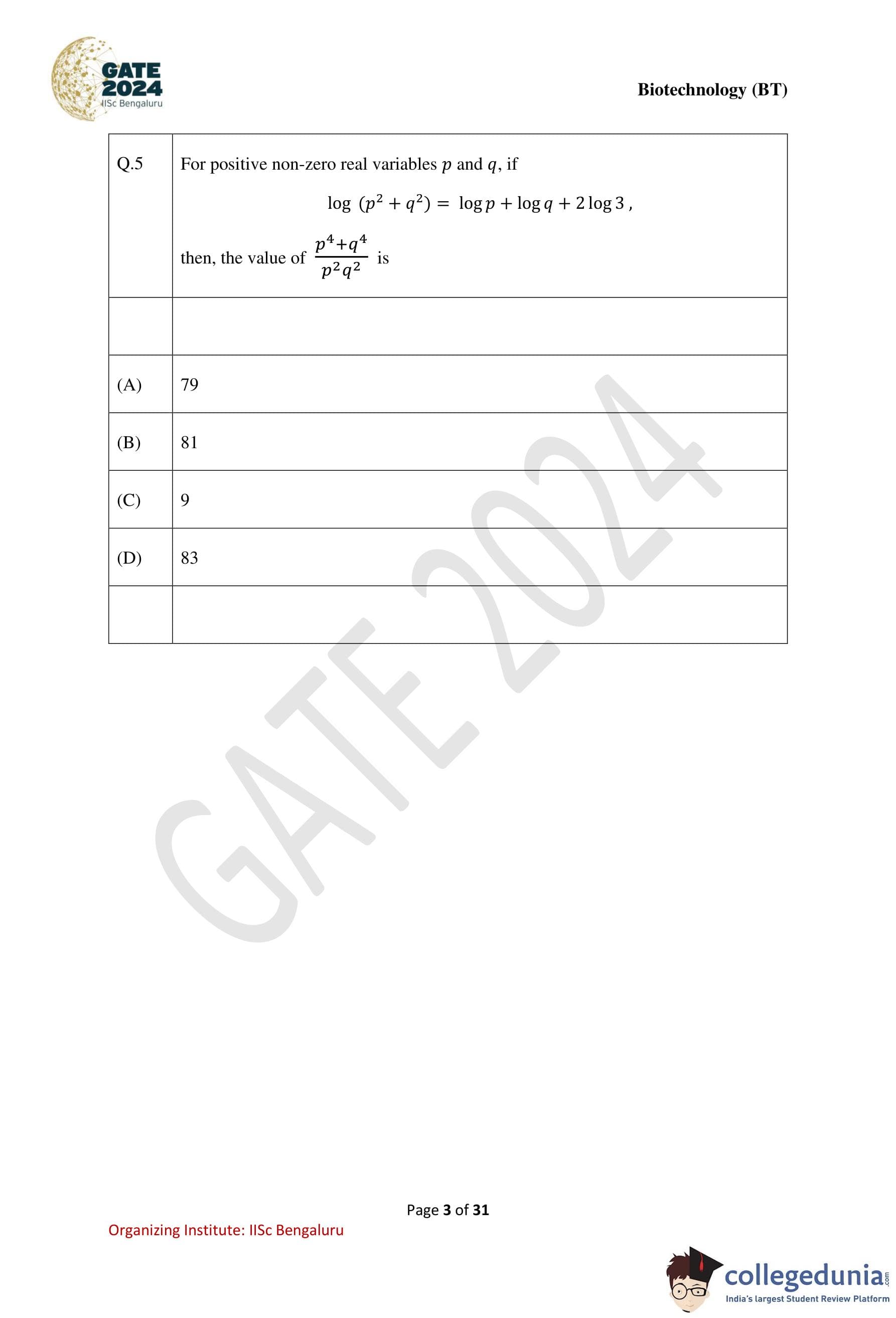
For positive non-zero real variables p and q, if log(p² + q²) = log p + log q + 2 log 3, then the value of p4 + q4⁄p2q2 is:
View Solution
Solution:
Step 1: Expand the logarithmic equation. The given equation is:
log(p² + q²) = log p + log q + 2 log 3.
Using the logarithmic properties:
log (p² + q²) = log(pq) + log 9.
This simplifies to:
log (p² + q²) = log (9pq).
Step 2: Equating the arguments. Since the logarithmic functions are equal, their arguments must also be equal:
p² + q² = 9pq.
Step 3: Solve for p4 + q4⁄p2q2 . Using the given expression:
p4 + q4⁄p2q2 = (p² + q2)2 - 2p2q2⁄p2q2
Substitute p² + q² = 9pq:
p4 + q4⁄p2q2 = (9pq)2 - 2p2q2⁄p2q2
Simplify:
p4 + q4⁄p2q2 = 81p2q2 - 2p2q2⁄p2q2
p4 + q4⁄p2q2 = 79p2q2⁄p2q2
p4 + q4⁄p2q2 = 79.
Question 6:
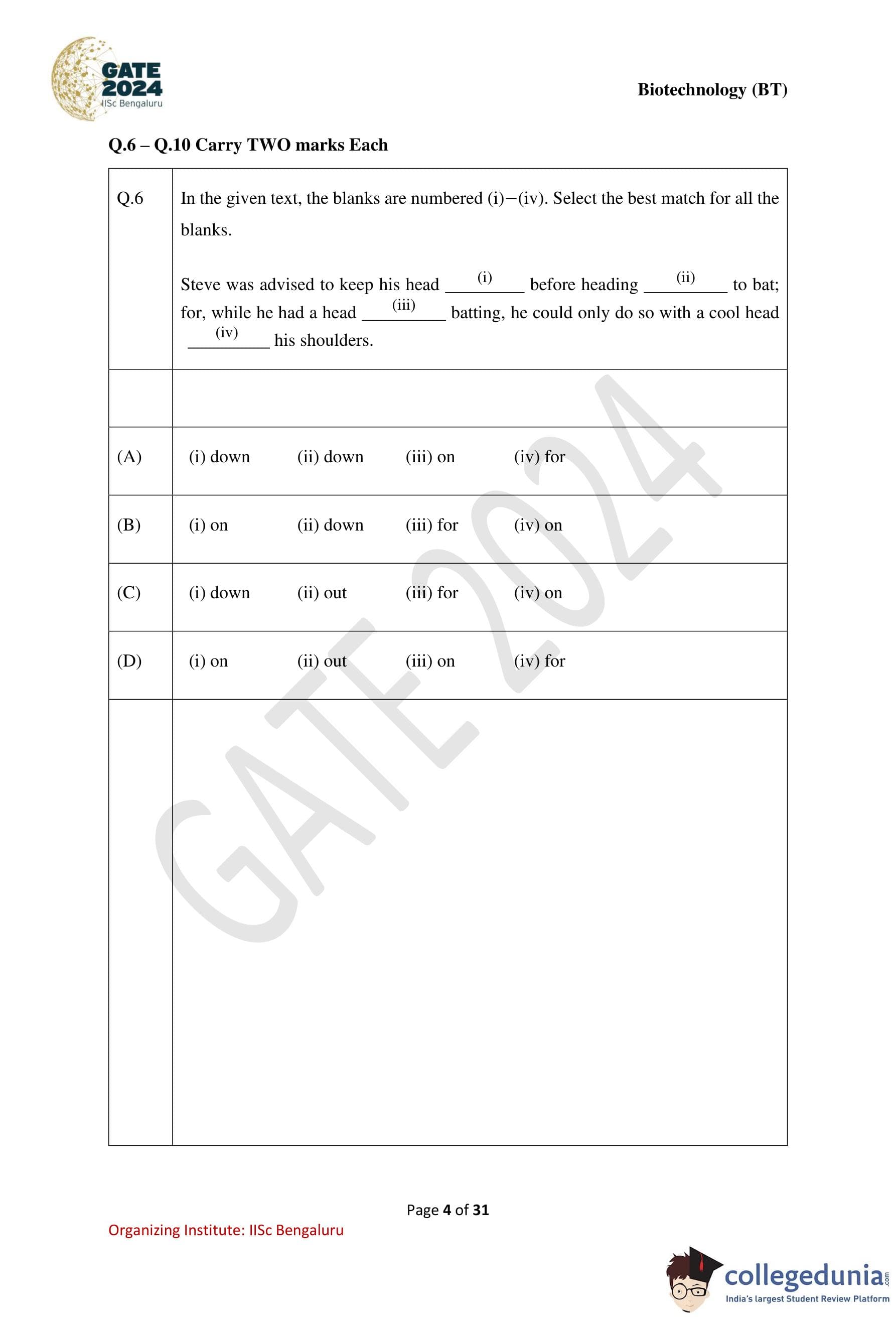
In the given text, the blanks are numbered (i)–(iv). Select the best match for all the blanks.
Steve was advised to keep his head _____ (i) before heading _____ (ii) to bat; for, while he had a head _____ (iii) batting, he could only do so with a cool head _____ (iv) his shoulders.
View Solution
Solution:
The sentence requires appropriate prepositions and phrasal verbs that fit both the context and meaning:
Step 1: Analyze the blanks.
• Blank (i): "Steve was advised to keep his head _____." The phrase "keep his head down" is a common idiom meaning to remain calm or avoid attracting attention. Hence, (i) should be "down."
• Blank (ii): "before heading _____ to bat." The phrase "heading out to bat" is commonly used in cricket terminology. Hence, (ii) should be "out."
• Blank (iii): "for, while he had a head _____ batting." The phrase "had a head for batting" indicates an aptitude or skill. Hence, (iii) should be "for."
• Blank (iv): "he could only do so with a cool head _____ his shoulders." The correct phrase is "on his shoulders,” which implies maintaining composure. Hence, (iv) should be "on."
Step 2: Verify the selected option. Option (C) matches all the blanks correctly:
(i) down, (ii) out, (iii) for, (iv) on.
Final Answer: (C)
Question 7:
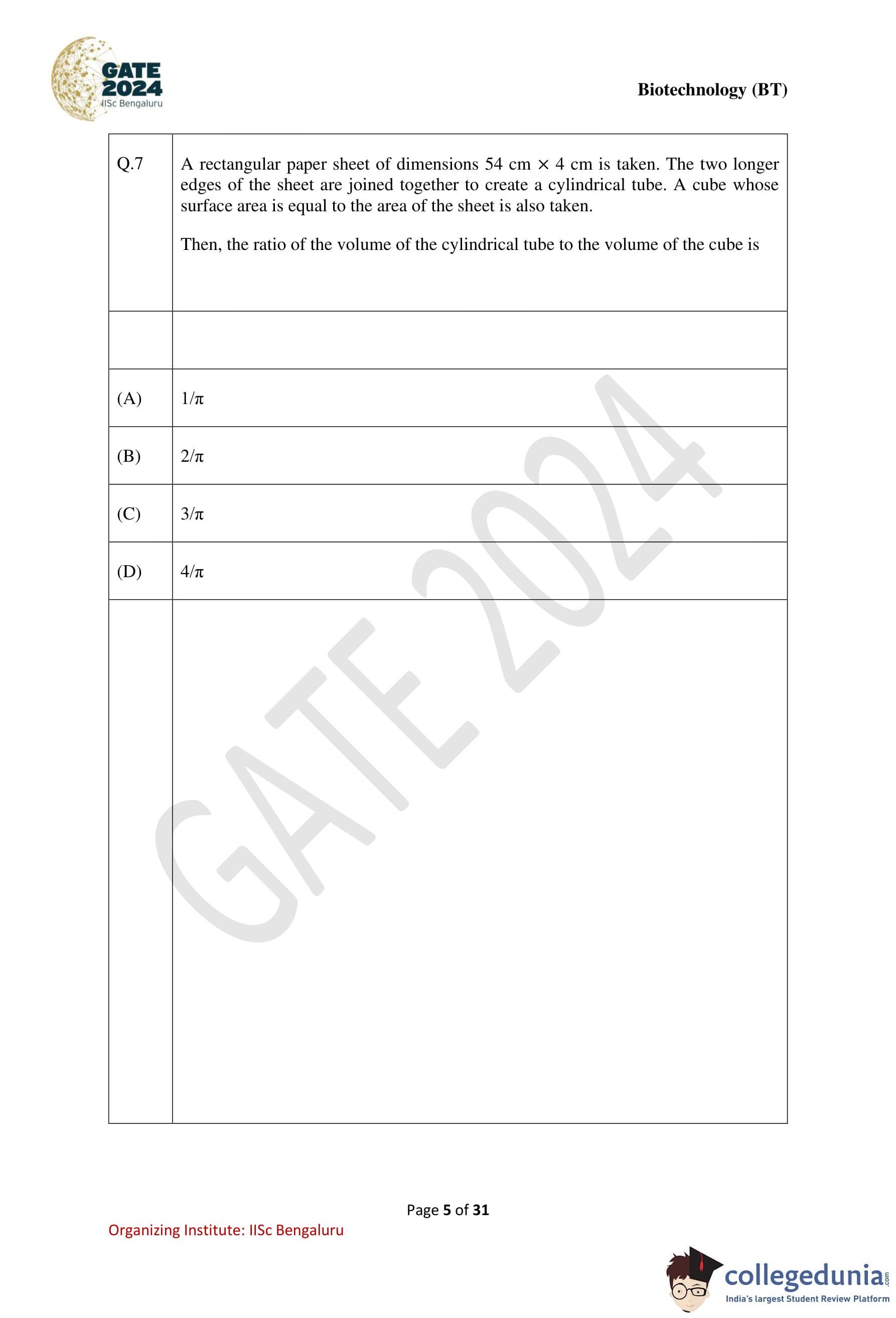
A rectangular paper sheet of dimensions 54 cm × 4 cm is taken. The two longer edges of the sheet are joined together to create a cylindrical tube. A cube whose surface area is equal to the area of the sheet is also taken. Then, the ratio of the volume of the cylindrical tube to the volume of the cube is:
View Solution
Solution:
Step 1: Calculate the area of the paper sheet. The area of the rectangular sheet is:
Area = Length × Breadth = 54 cm × 4 cm = 216 cm².
Step 2: Calculate the dimensions of the cylindrical tube. When the longer edges of the sheet are joined, the circumference of the base of the cylinder is 54 cm, and the height is 4 cm. The radius of the base is:
Radius = Circumference⁄2π = 54⁄2π = 27⁄π cm.
The volume of the cylindrical tube is:
Volume (Cylinder) = πr²h = π(27⁄π)² * 4 = 216⁄π cm³.
Step 3: Calculate the volume of the cube. The surface area of the cube is equal to the area of the sheet, 216 cm². The surface area of a cube is given by:
Surface Area (Cube) = 6a²,
where a is the side length of the cube. Solving for a:
6a² = 216 => a² = 36 => a = 6 cm.
The volume of the cube is:
Volume (Cube) = a³ = 6³ = 216 cm³.
Step 4: Calculate the ratio of the volumes. The ratio of the volume of the cylindrical tube to the volume of the cube is:
Ratio = Volume (Cylinder)⁄Volume (Cube) = 216⁄π/216 = 1⁄π
Final Answer:
1⁄π
Question 8:
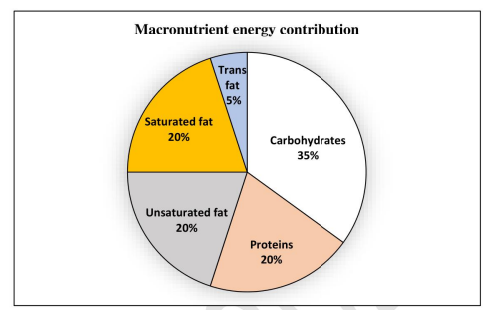
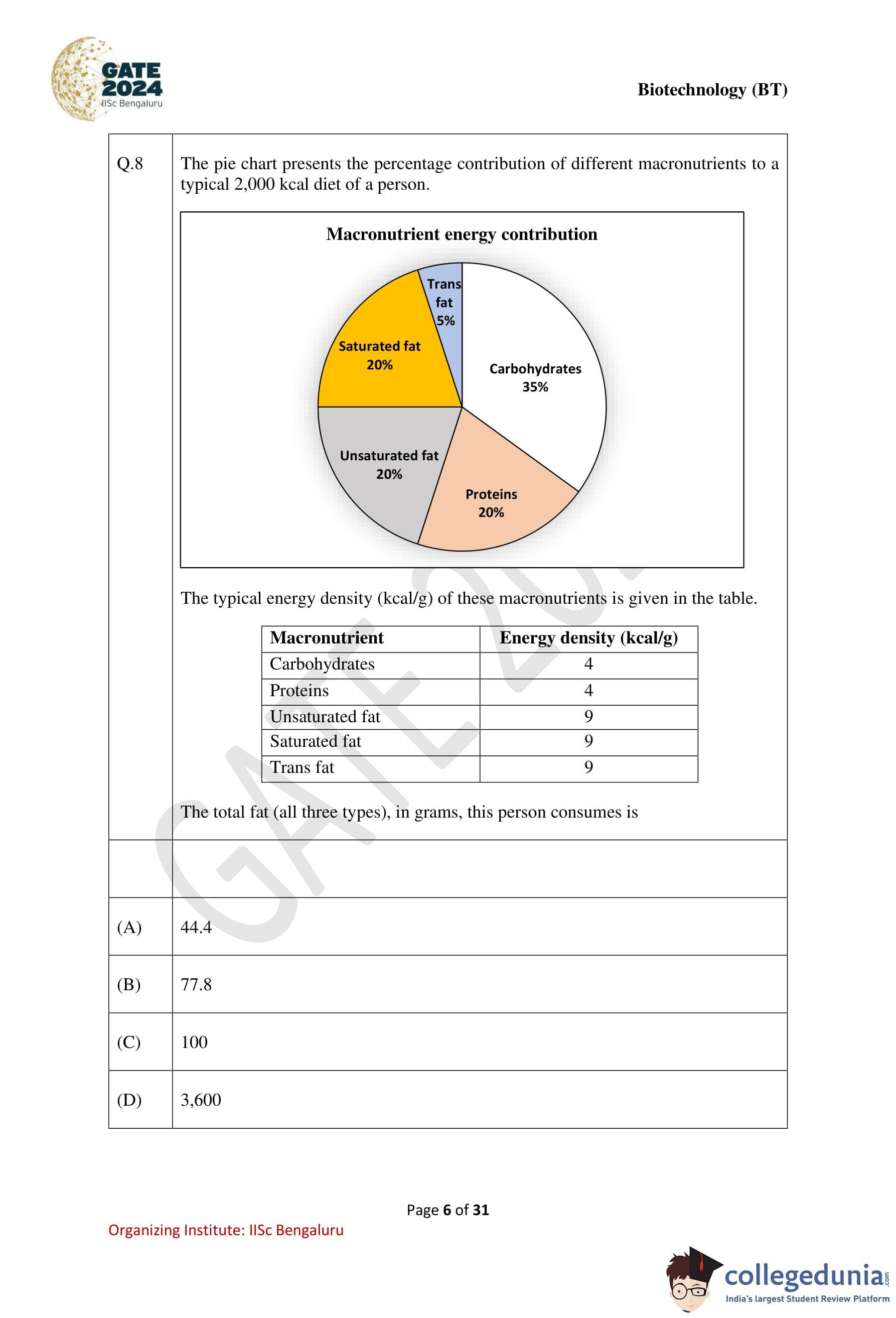
The pie chart presents the percentage contribution of different macronutrients to a typical 2,000 kcal diet of a person. The typical energy density (kcal/g) of these macronutrients is given in the table. The total fat (all three types), in grams, this person consumes is:
| Macronutrient | Energy density (kcal/g) |
|---|---|
| Carbohydrates | 4 |
| Proteins | 4 |
| Unsaturated fat | 9 |
| Saturated fat | 9 |
| Trans fat | 9 |
View Solution
Solution:
The total daily caloric intake is 2,000 kcal. From the pie chart, the percentages of fats are:
• Unsaturated fat: 20%.
• Saturated fat: 20%.
• Trans fat: 5%.
The total fat percentage is:
Total Fat = 20% + 20% + 5% = 45%.
Step 1: Calculate the caloric contribution of fats. The total caloric contribution of fats is:
Calories from Fat = 45⁄100 * 2,000 = 900 kcal.
Step 2: Convert calories to grams. From the table, the energy density of fats (all types) is 9 kcal/g. The total fat in grams is:
Total Fat (g) = Calories from Fat⁄Energy Density = 900⁄9 = 100 g.
Final Answer:
100
Question 9:
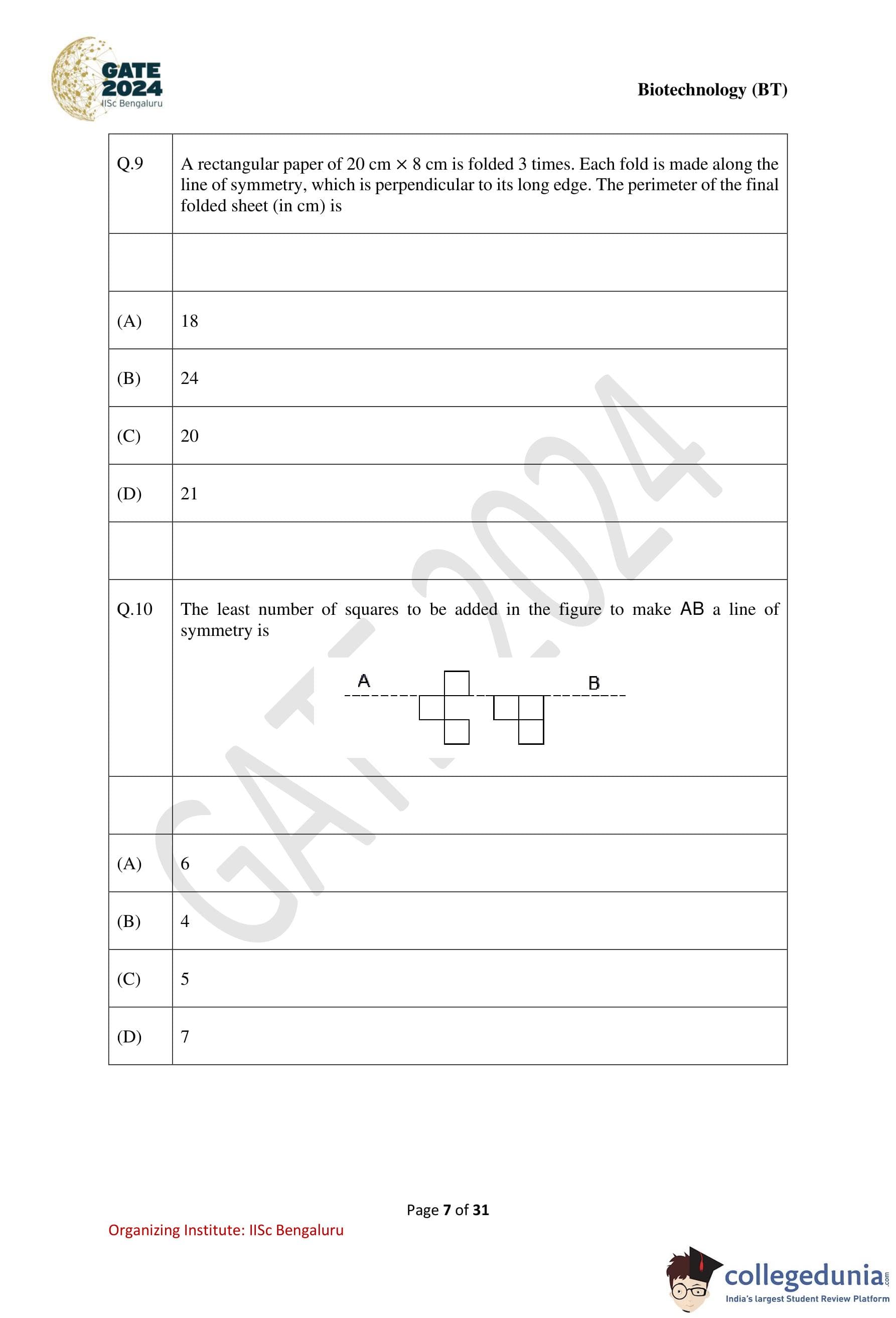
A rectangular paper of 20 cm × 8 cm is folded 3 times. Each fold is made along the line of symmetry, which is perpendicular to its long edge. The perimeter of the final folded sheet (in cm) is:
View Solution
Solution:
The dimensions of the rectangular paper are 20cm × 8cm. Each fold is along the line of symmetry, perpendicular to the long edge.
Step 1: Calculate the dimensions after each fold. After the first fold, the long edge is halved:
Dimensions after 1st fold: 10 cm × 8 cm.
After the second fold, the new long edge is halved again:
Dimensions after 2nd fold: 10 cm x 4 cm.
After the third fold, the new long edge is halved once more:
Dimensions after 3rd fold: 5cm × 4cm.
Step 2: Calculate the perimeter of the folded sheet. The perimeter of a rectangle is given by:
Perimeter = 2 × (Length + Breadth).
Substitute the final dimensions:
Perimeter = 2 × (5 + 4) = 2 × 9 = 18 cm.
Final Answer:
18
Question 10:
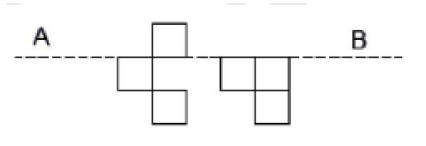
The least number of squares to be added in the figure to make AB a line of symmetry is:
View Solution
Solution:
To make AB a line of symmetry, the figure must be identical on both sides of the line AB. We need to analyze the asymmetry in the current arrangement and add the minimum number of squares required to balance the figure.
Step 1: Analyze the given figure. The figure currently has squares arranged asymmetrically across AB. To achieve symmetry:
• Identify the missing mirror-image squares for each part of the figure above and below AB.
• Count the number of additional squares required to complete the reflection.
Step 2: Count the squares to be added. Through visual analysis:
• The missing squares above AB and below AB collectively amount to 6 additional squares.
• These squares balance the figure and make AB a line of symmetry.
Final Answer:
6
Question 11:
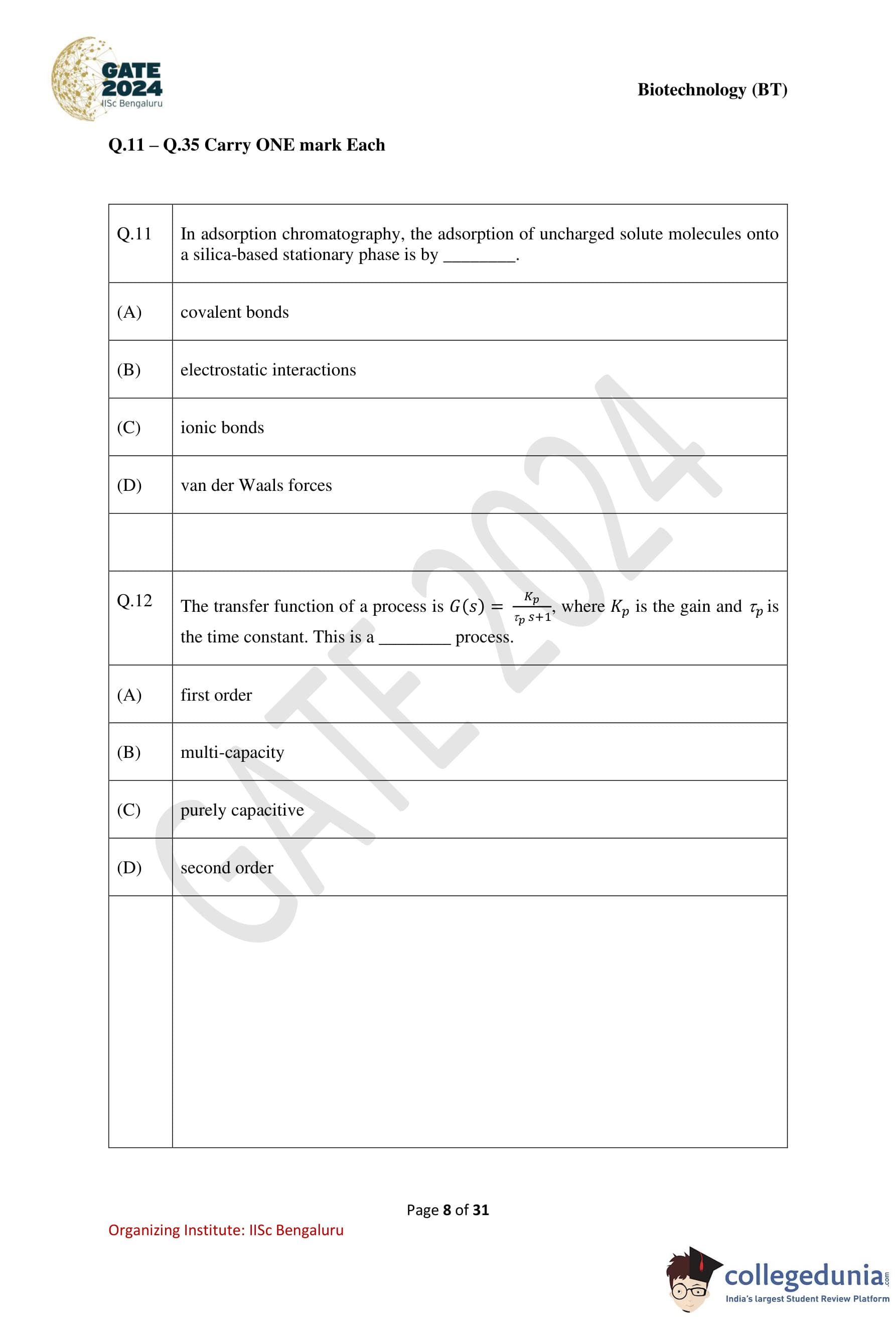
In adsorption chromatography, the adsorption of uncharged solute molecules onto a silica-based stationary phase is by _____
View Solution
Solution:
Adsorption chromatography involves the separation of molecules based on their interaction with the stationary phase. Silica, a common stationary phase, interacts with uncharged molecules through weak physical forces such as van der Waals forces.
Step 1: Identify the interaction mechanism. Silica-based stationary phases primarily rely on van der Waals forces for adsorption of uncharged molecules. These forces are weak intermolecular attractions that do not involve covalent or ionic bonding.
Step 2: Eliminate incorrect options.
• (A) Covalent bonds: These are strong chemical bonds, not involved in adsorption chromatography for uncharged molecules.
• (B) Electrostatic interactions: These are relevant for charged species, not uncharged molecules.
• (C) Ionic bonds: These are also related to charged species, not uncharged molecules.
• (D) van der Waals forces: Correct, as they govern the adsorption of uncharged molecules onto silica.
Final Answer:
van der Waals forces
Question 12:
The transfer function of a process is Kp⁄τps + 1, where Kp is the gain and τp is the time constant. This is a _______ process.
View Solution
Solution:
The given transfer function is:
G(s) = Kp⁄τps + 1.
Step 1: Identify the structure of the transfer function. The denominator of the transfer function is τps + 1, which is a first-order polynomial in s. A first-order process has a transfer function of the general form:
G(s) = K⁄τs + 1
where K is the gain, and τ is the time constant.
Step 2: Eliminate incorrect options.
• (A) First order: Correct, as the given transfer function matches the general form of a first-order system.
• (B) Multi-capacity: Incorrect, as multi-capacity processes involve higher-order transfer functions or multiple time constants.
• (C) Purely capacitive: Incorrect, as purely capacitive systems lack resistive components, which are present in this transfer function.
• (D) Second order: Incorrect, as a second-order process would have a quadratic term in the denominator.
Final Answer:
first order
Question 13:
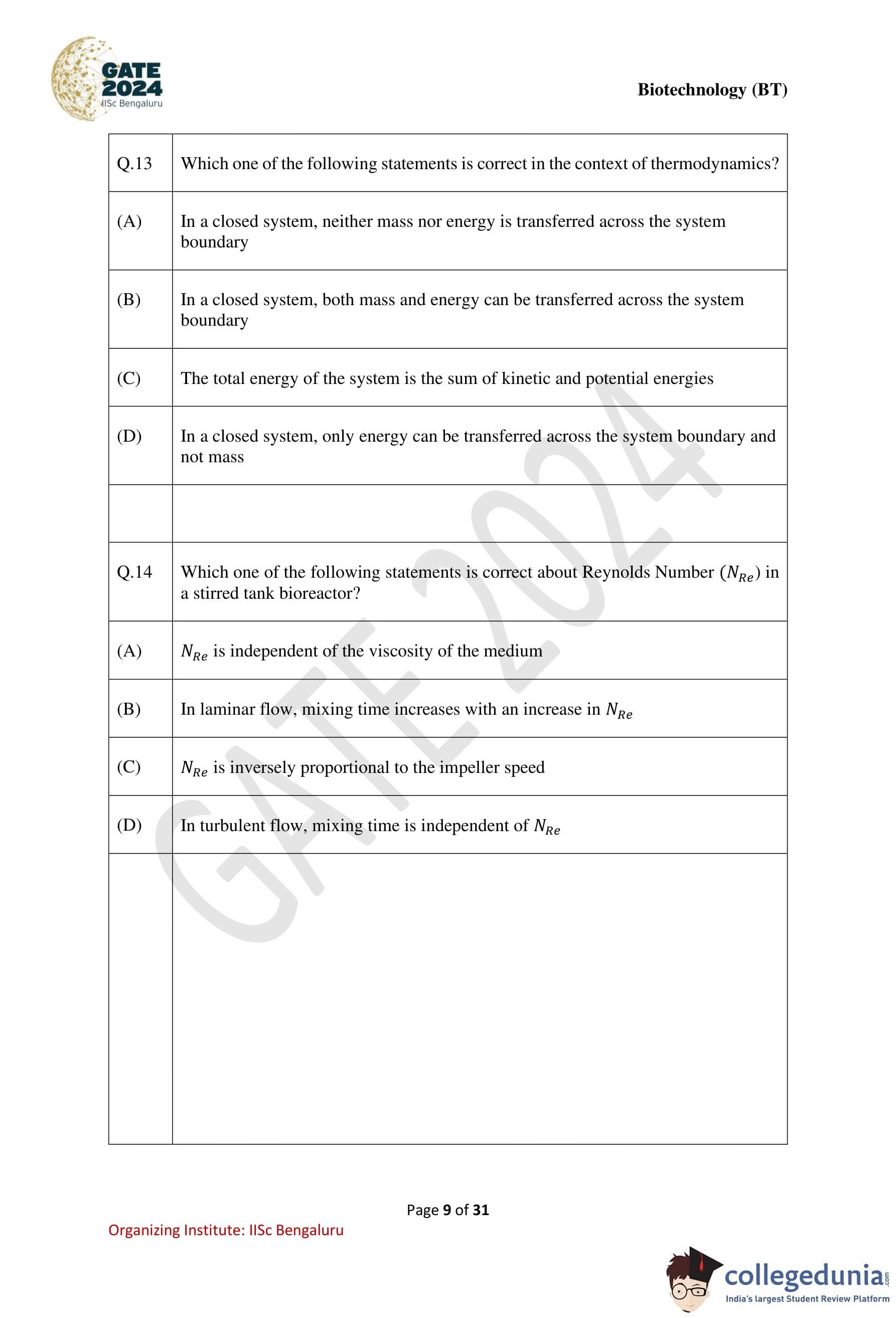
Which one of the following statements is correct in the context of thermodynamics?
View Solution
Solution:
In thermodynamics, systems are classified based on the transfer of mass and energy across their boundaries. A closed system is defined as a system where:
• Energy (in the form of heat or work) can be transferred across the boundary.
• Mass cannot be transferred across the boundary.
Step 1: Analyze the options.
• (A) Incorrect: In a closed system, energy can be transferred, so the statement that "neither mass nor energy is transferred” is wrong.
• (B) Incorrect: Mass cannot be transferred in a closed system, so the statement that "both mass and energy can be transferred” is wrong.
• (C) Incorrect: While the total energy of a system can include kinetic and potential energy, this statement does not describe the defining feature of a closed system.
• (D) Correct: This accurately describes a closed system where only energy can cross the boundary but not mass.
Final Answer:
In a closed system, only energy can be transferred across the system boundary and not mass.
Question 14:
Which one of the following statements is correct about Reynolds Number (NRe) in a stirred tank bioreactor?
View Solution
Solution:
The Reynolds Number (NRe) is a dimensionless quantity that characterizes the flow regime (laminar or turbulent) in a fluid system. It is defined as:
NRe = ρND²⁄μ ,
where:
• ρ is the density of the fluid,
• N is the impeller speed,
• D is the impeller diameter,
• μ is the viscosity of the fluid.
Step 1: Analyze the options.
• (A) Incorrect: NRe depends on the viscosity µ, as seen in the formula.
• (B) Incorrect: In laminar flow, mixing time increases with a decrease in NRe, not an increase.
• (C) Incorrect: NRe is directly proportional to the impeller speed N, not inversely.
• (D) Correct: In turbulent flow, mixing time becomes independent of NRe, as turbulence ensures uniform mixing regardless of further increases in NRe.
Final Answer:
In turbulent flow, mixing time is independent of NRe.
Question 15:
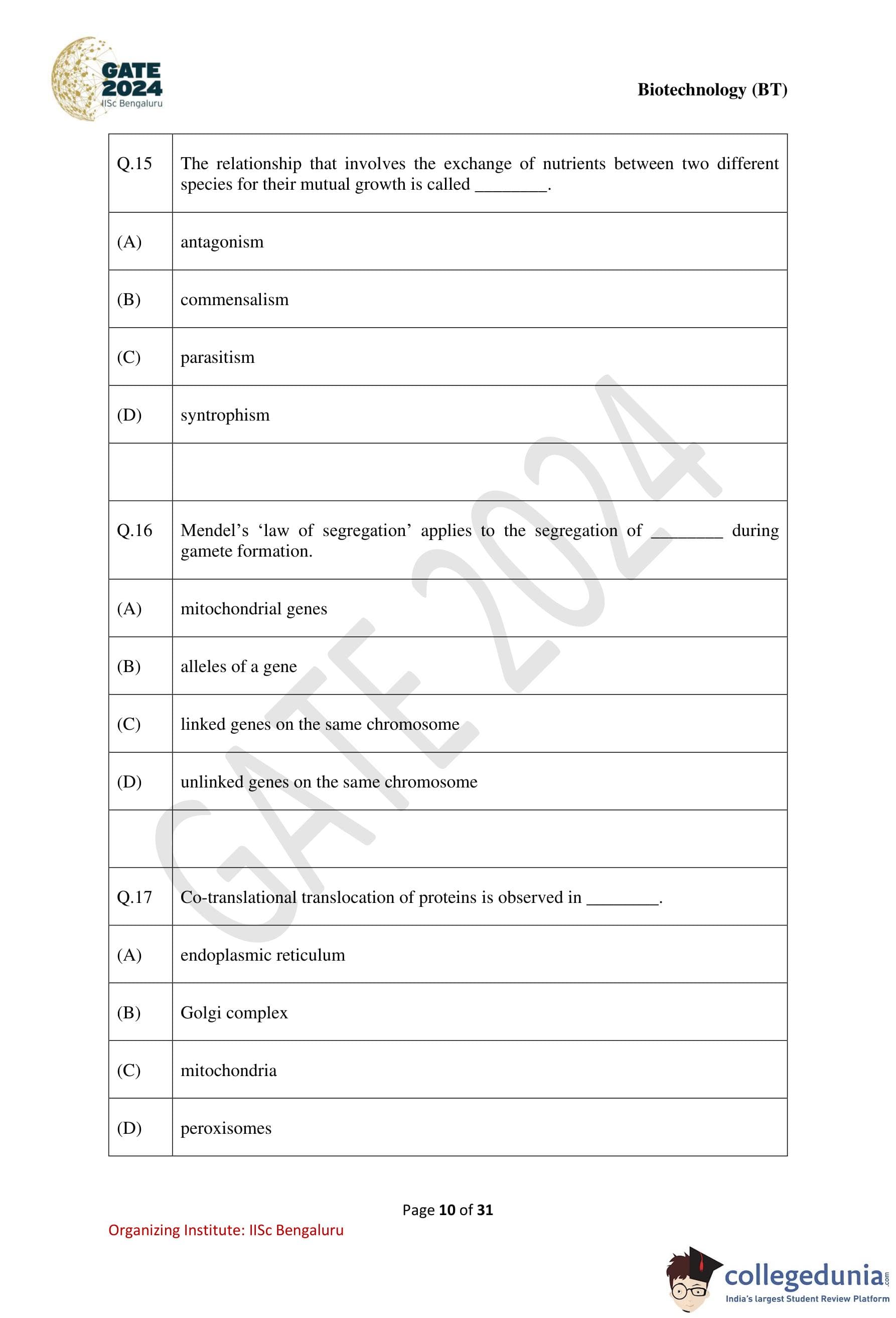
The relationship that involves the exchange of nutrients between two different species for their mutual growth is called _______.
View Solution
Solution:
Syntrophism is a biological interaction where two or more species exchange nutrients or metabolic products to facilitate mutual growth and survival. It is a cooperative relationship essential in ecosystems and bioreactors.
Step 1: Analyze the definitions.
• (A) Antagonism: Refers to a harmful interaction where one organism inhibits the growth of another. Not applicable here.
• (B) Commensalism: A relationship where one organism benefits while the other is unaffected. This does not involve mutual nutrient exchange.
• (C) Parasitism: A relationship where one organism benefits at the expense of the other. This is not mutual.
• (D) Syntrophism: The correct answer, as it involves mutual nutrient exchange for the benefit of both species.
Final Answer:
syntrophism
Question 16:
Mendel's ‘law of segregation' applies to the segregation of _____ during gamete formation.
View Solution
Solution:
Mendel's law of segregation states that the two alleles for a gene segregate during gamete formation, and each gamete receives only one allele. This law applies specifically to alleles of the same gene.
Step 1: Analyze the options.
• (A) Mitochondrial genes: Incorrect, as they are inherited maternally and do not segregate during gamete formation.
• (B) Alleles of a gene: Correct, as the law of segregation describes the separation of alleles.
• (C) Linked genes on the same chromosome: Incorrect, as linked genes do not segregate independently due to their physical proximity.
• (D) Unlinked genes on the same chromosome: Incorrect, as unlinked genes are not part of the segregation described by this law.
Final Answer:
alleles of a gene
Question 17:
Co-translational translocation of proteins is observed in _________.
View Solution
Solution:
Co-translational translocation is a process where proteins are translocated into the endoplasmic reticulum (ER) while they are being synthesized on ribosomes. This process is facilitated by a signal recognition particle (SRP) that directs the ribosome-protein complex to the ER membrane.
Step 1: Analyze the options.
• (A) Endoplasmic reticulum: Correct, as co-translational translocation is a key mechanism for protein sorting in the ER.
• (B) Golgi complex: Incorrect, as protein modifications occur in the Golgi, but not co-translational translocation.
• (C) Mitochondria: Incorrect, as protein import into mitochondria occurs post-translationally.
• (D) Peroxisomes: Incorrect, as protein targeting to peroxisomes is also a post-translational process.
Final Answer:
endoplasmic reticulum
Question 18:
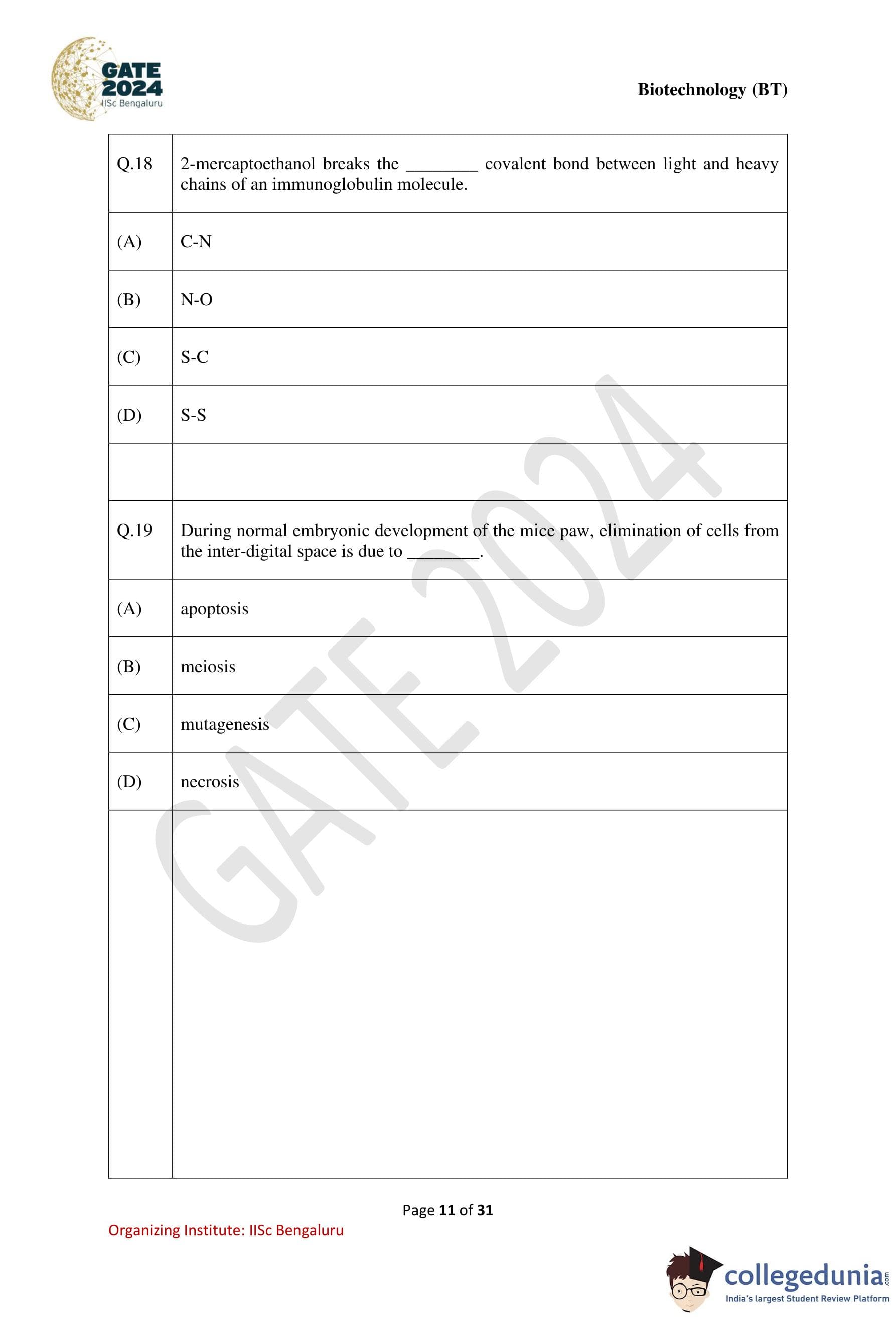
2-mercaptoethanol breaks the ________ covalent bond between light and heavy chains of an immunoglobulin molecule.
View Solution
Solution:
2-mercaptoethanol is a reducing agent that specifically breaks disulfide (S – S) bonds. These covalent bonds stabilize the structure of immunoglobulin molecules by linking their light and heavy chains.
Step 1: Analyze the types of covalent bonds.
• (A) C-N: These bonds are present in peptide backbones, not in disulfide linkages.
• (B) N-O: These are not found in immunoglobulin covalent structures.
• (C) S-C: These are not relevant to light and heavy chain linkage.
• (D) S-S: Correct, as these bonds link the light and heavy chains in immunoglobulins.
Final Answer:
S-S
Question 19:
During normal embryonic development of the mice paw, elimination of cells from the inter-digital space is due to _________.
View Solution
Solution:
Apoptosis, or programmed cell death, is a crucial process during embryonic development. It ensures the removal of unnecessary cells, such as those in the inter-digital regions of developing mice paws, to shape proper structures.
Step 1: Analyze the processes.
• (A) Apoptosis: Correct, as it involves controlled cell elimination during development.
• (B) Meiosis: Incorrect, as it is a process of cell division to produce gametes.
• (C) Mutagenesis: Incorrect, as it involves changes in the genetic material, not cell elimination.
• (D) Necrosis: Incorrect, as it is uncontrolled cell death often caused by injury, not a programmed developmental process.
Final Answer:
apoptosis
Question 20:
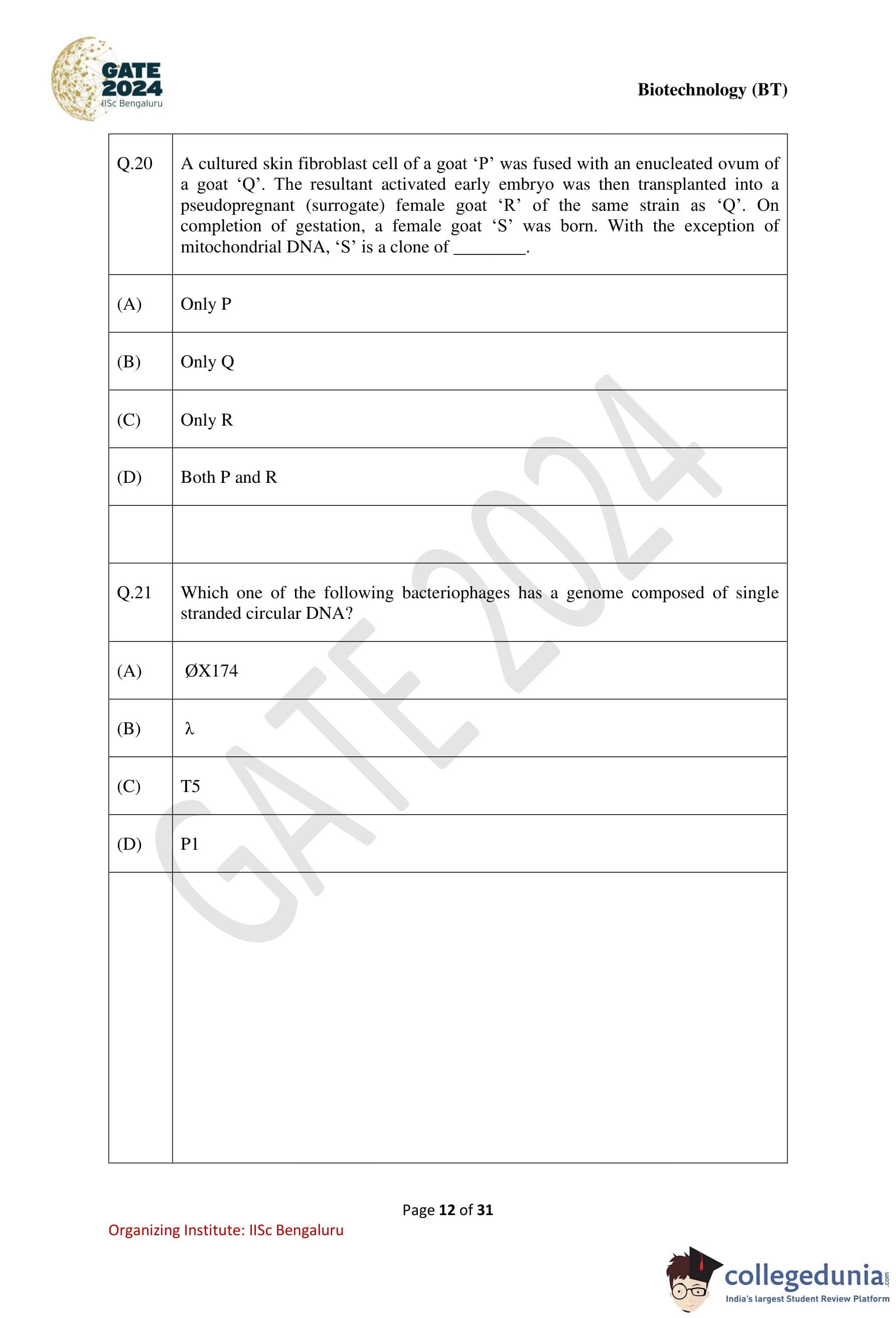
A cultured skin fibroblast cell of a goat ‘P' was fused with an enucleated ovum of a goat 'Q'. The resultant activated early embryo was then transplanted into a pseudopregnant (surrogate) female goat ‘R' of the same strain as 'Q'. On completion of gestation, a female goat ‘S' was born. With the exception of mitochondrial DNA, ‘S' is a clone of _________.
View Solution
Solution:
In cloning, the genetic material of the offspring is identical to that of the donor from which the nucleus was obtained. In this case:
• The nucleus was taken from the skin fibroblast cell of goat 'P'.
• The enucleated ovum from goat 'Q' provides the cytoplasm but does not contribute nuclear DNA.
• The surrogate goat 'R' does not contribute genetic material; it only supports gestation.
Therefore, goat 'S' is a clone of goat 'P', except for mitochondrial DNA, which comes from goat 'Q'.
Final Answer:
Only P
Question 21:
Which one of the following bacteriophages has a genome composed of single-stranded circular DNA?
View Solution
Solution:
Bacteriophage φX174 has a genome composed of single-stranded circular DNA. This unique property differentiates it from other bacteriophages:
• φX174: Single-stranded circular DNA (Correct).
• λ: Double-stranded linear DNA.
• T5: Double-stranded linear DNA.
• P1: Double-stranded linear DNA.
Final Answer:
φX174
Question 22:
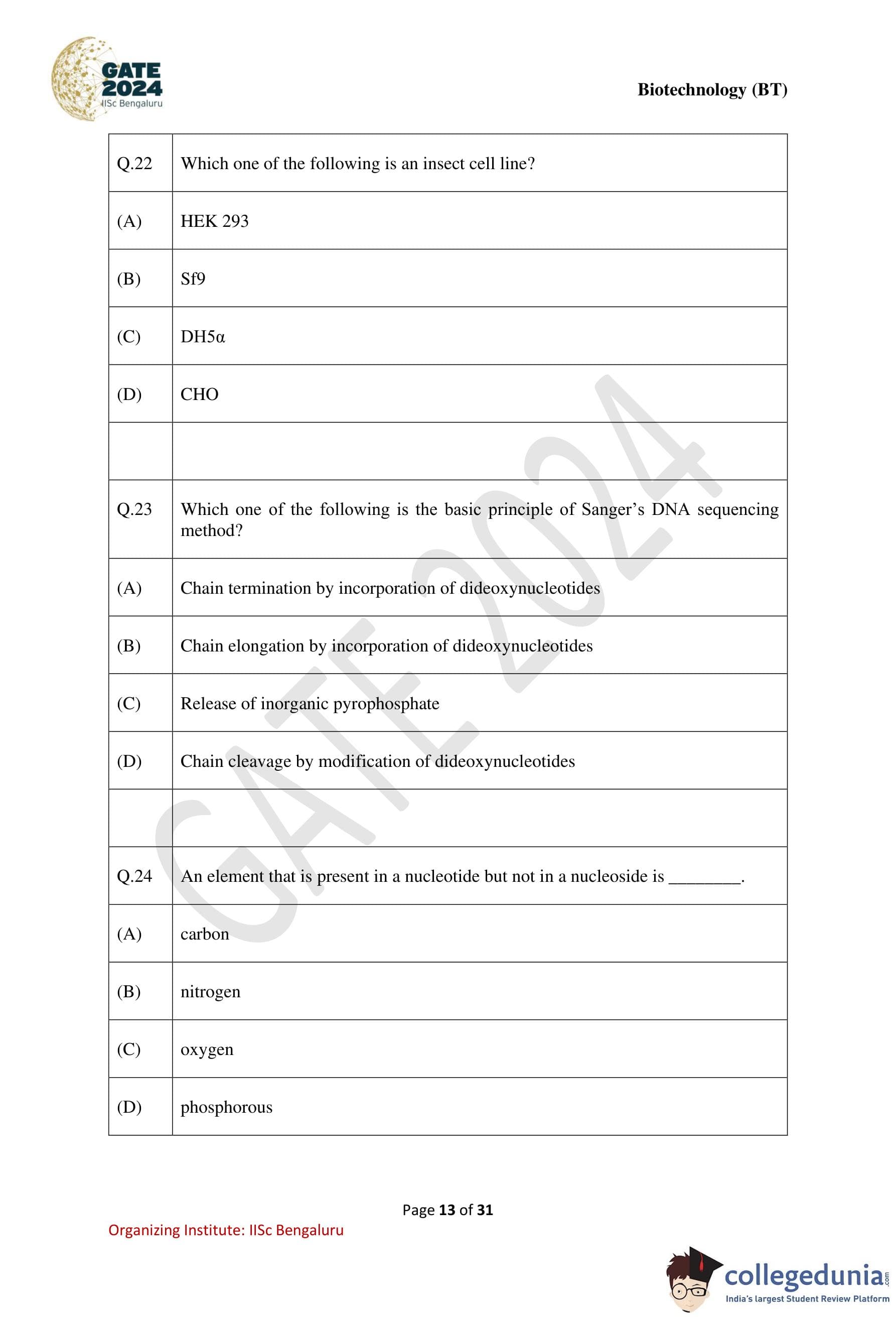
Which one of the following is an insect cell line?
View Solution
Solution:
Sf9 is a widely used insect cell line derived from the ovarian tissue of the fall armyworm, Spodoptera frugiperda. It is commonly utilized in the baculovirus expression system for protein production.
Step 1: Analyze the options.
• (A) HEK 293: Incorrect, as it is a human embryonic kidney cell line.
• (B) Sf9: Correct, as it is an insect cell line.
• (C) DH5α: Incorrect, as it is an E. coli bacterial strain used for cloning.
• (D) CHO: Incorrect, as it is a Chinese hamster ovary cell line, not an insect cell line.
Final Answer:
Sf9
Question 23:
Which one of the following is the basic principle of Sanger's DNA sequencing method?
View Solution
Solution:
Sanger's DNA sequencing method relies on the incorporation of dideoxynucleotides (ddNTPs) into the growing DNA strand. These ddNTPs lack a 3'-OH group, causing chain termination when incorporated.
Step 1: Analyze the process.
• Dideoxynucleotides (ddNTPs) act as chain terminators.
• When a ddNTP is incorporated, no further elongation occurs, creating DNA fragments of varying lengths.
• These fragments are analyzed to determine the DNA sequence.
Final Answer:
Chain termination by incorporation of dideoxynucleotides
Question 24:
An element that is present in a nucleotide but not in a nucleoside is _________.
View Solution
Solution:
Nucleotides consist of three components: a nitrogenous base, a sugar, and a phosphate group. In contrast, nucleosides lack the phosphate group, and therefore, they do not contain phosphorus.
Step 1: Analyze the components.
• (A) Carbon: Present in both nucleosides and nucleotides as part of the sugar and base.
• (B) Nitrogen: Present in both as part of the nitrogenous base.
• (C) Oxygen: Present in both as part of the sugar and phosphate group.
• (D) Phosphorus: Correct, as it is part of the phosphate group found only in nucleotides.
Final Answer:
phosphorus
Question 25:
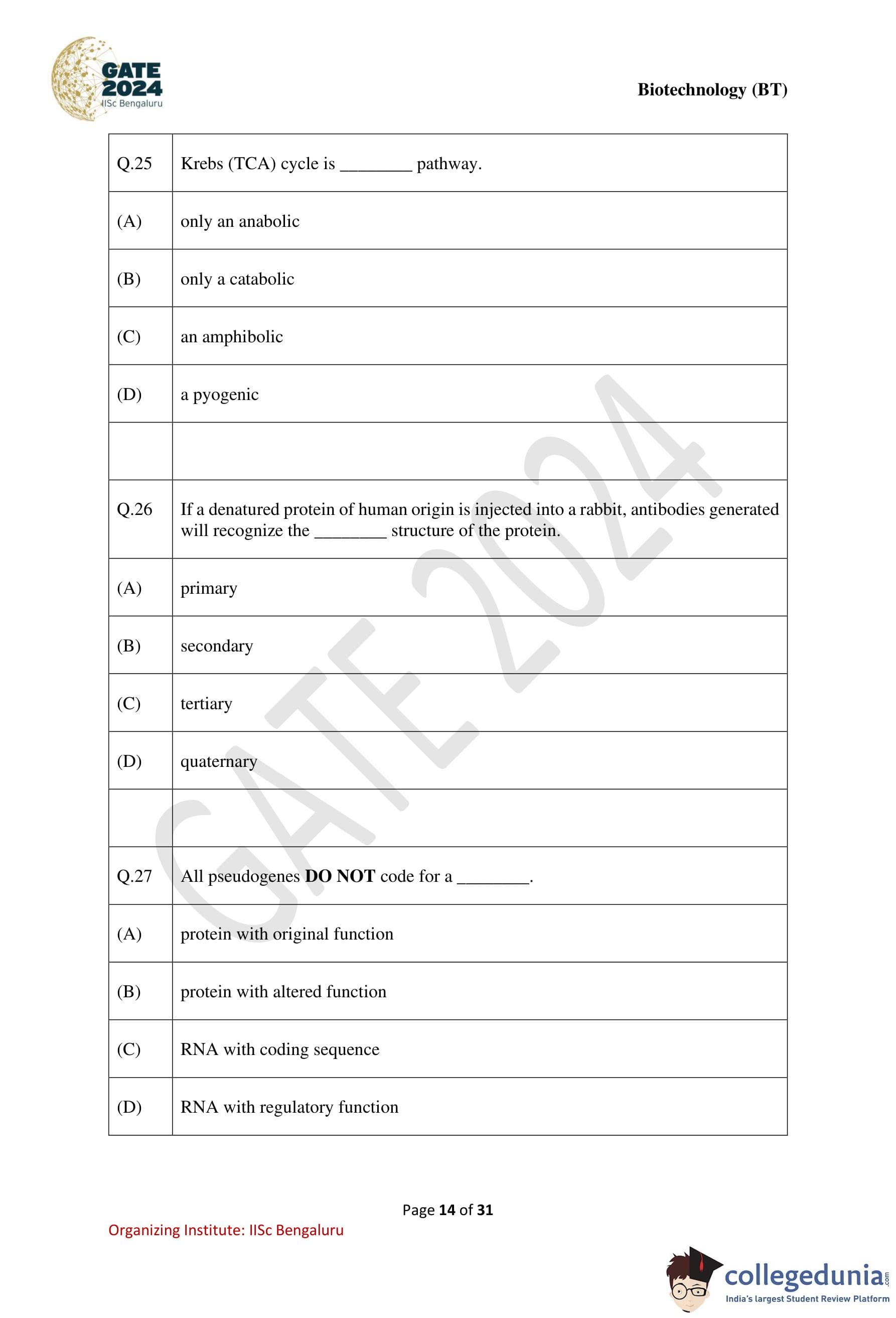
Krebs (TCA) cycle is _________ pathway.
View Solution
Solution:
The Krebs cycle is termed an amphibolic pathway because it plays a dual role:
• Catabolic: It oxidizes acetyl-CoA to produce energy in the form of ATP, NADH, and FADH2.
• Anabolic: It provides intermediates for biosynthetic pathways, such as amino acid and nucleotide synthesis.
Final Answer:
an amphibolic
Question 26:
If a denatured protein of human origin is injected into a rabbit, antibodies generated will recognize the _________ structure of the protein.
View Solution
Solution:
Denatured proteins lose their secondary, tertiary, and quaternary structures but retain their primary structure (amino acid sequence). Antibodies generated against the denatured protein recognize epitopes based on the primary structure.
Step 1: Analyze the structural levels.
• (A) Primary: Correct, as the amino acid sequence remains intact after denaturation.
• (B) Secondary: Incorrect, as secondary structures like alpha-helices and beta-sheets are lost.
• (C) Tertiary: Incorrect, as the three-dimensional folding is disrupted.
• (D) Quaternary: Incorrect, as the interaction between subunits is also lost.
Final Answer:
primary
Question 27:
All pseudogenes DO NOT code for a _________.
View Solution
Solution:
Pseudogenes are non-functional sequences of DNA that resemble functional genes but have lost the ability to code for a protein with its original function. They may have mutations, deletions, or insertions that disrupt their coding potential.
Step 1: Analyze the options.
• (A) Protein with original function: Correct, as pseudogenes cannot produce functional proteins.
• (B) Protein with altered function: Incorrect, as pseudogenes typically do not produce proteins.
• (C) RNA with coding sequence: Incorrect, as pseudogenes may not be transcribed into RNA with coding potential.
• (D) RNA with regulatory function: Incorrect, as some pseudogenes may have regulatory roles, such as acting as RNA decoys.
Final Answer:
protein with original function
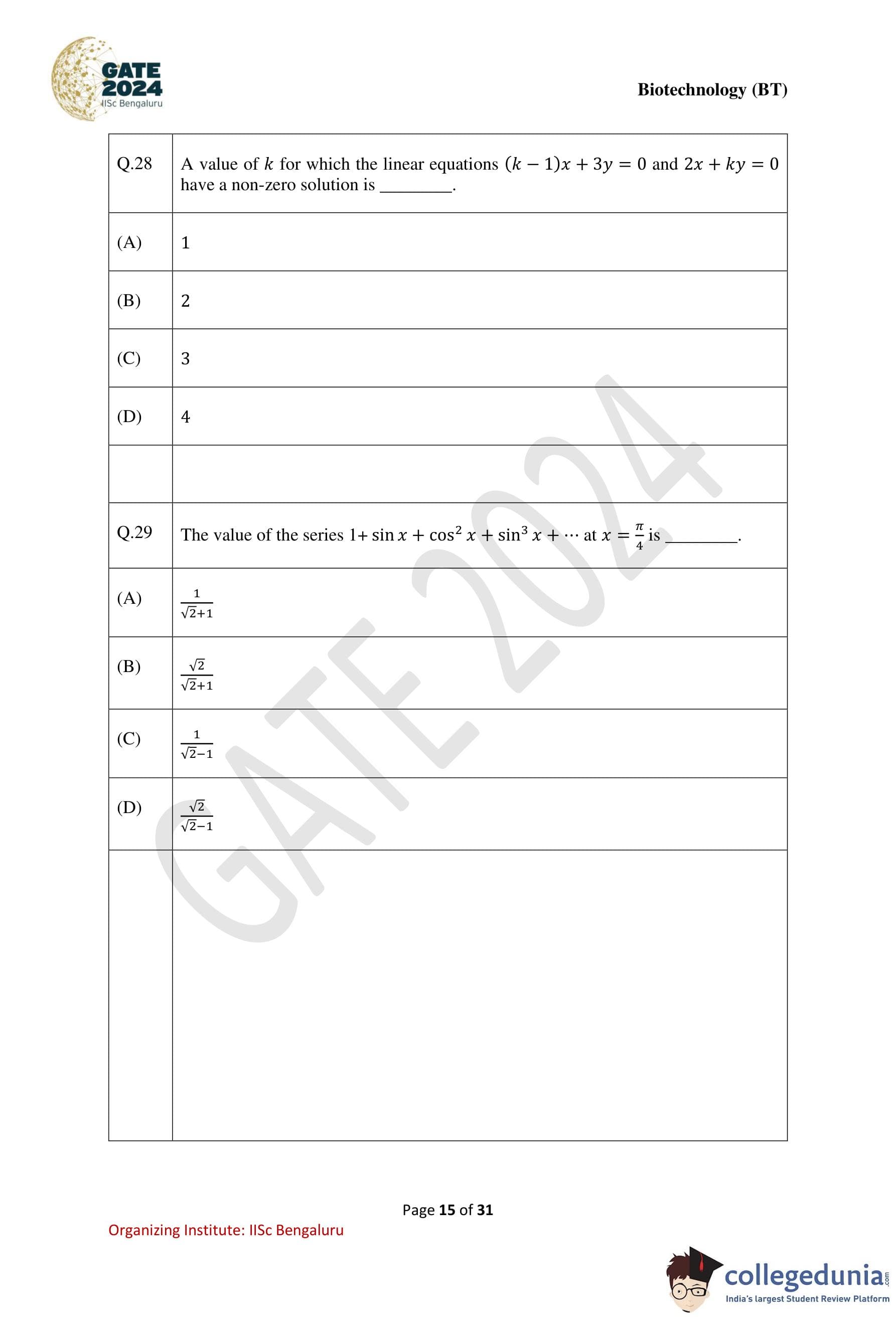
Question 28:
A value of k for which the linear equations (k − 1)x + 3y = 0 and 2x + ky = 0 have a non-zero solution is ________.
View Solution
Solution:
The given equations are:
(k − 1)x + 3y = 0 (1)
2x + ky = 0 (2).
For the system of linear equations to have a non-zero solution, the determinant of the coefficient matrix must be zero:
Determinant = k - 1 3⁄2 k = 0.
Compute the determinant:
(k-1)(k) – (2)(3) = 0.
k²- k-6 = 0.
k² − k − 6 = (k − 3)(k + 2) = 0.
Therefore, k = 3 or k = -2. Since the problem asks for a positive value of k, the correct answer is:
k = 3.
Final Answer:
3
Question 29:
The value of the series 1 + sin x + cos² x + sin³ x + … at x = π⁄4 is _________.
View Solution
Solution:
The given series is:
S = 1 + sin x + cos² x + sin³ x + ...
At x = π⁄4:
sin π⁄4 = cos π⁄4 = 1⁄√2
Substitute sin x = cos x = 1⁄√2 into the series:
S = 1 + 1⁄√2 + (1⁄√2)² + (1⁄√2)³+ ....
This is an infinite geometric series with the first term a = 1 and common ratio r = 1⁄√2.
S = a⁄1 - r
Substituting the values:
S = 1⁄1 - 1⁄√2 = 1⁄(√2 - 1⁄√2) = √2⁄√2 - 1
Final Answer:
√2⁄√2 - 1
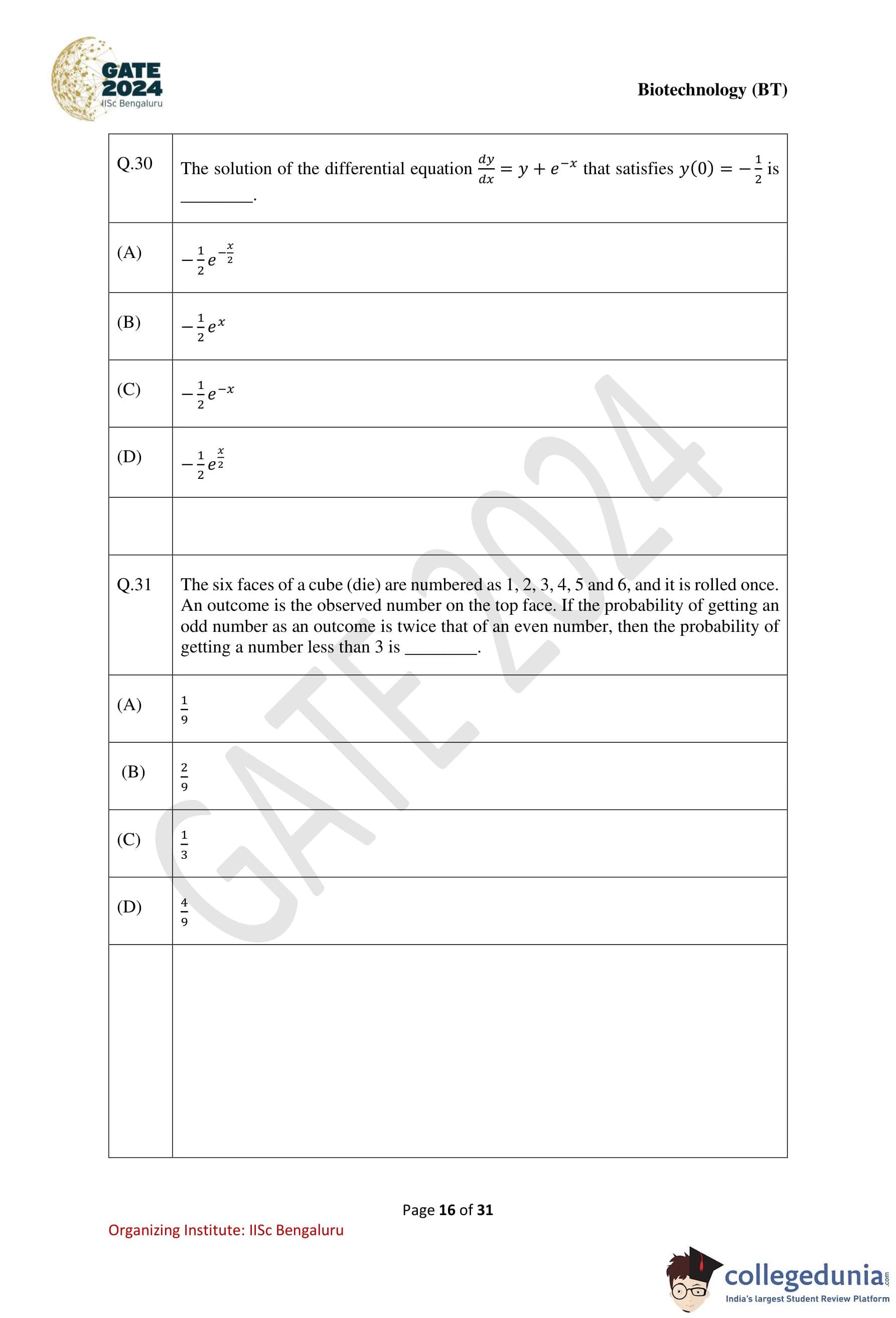
Question 30:
The solution of the differential equation dy⁄dx = y + e-x that satisfies y(0) = -1⁄2 is _________.
View Solution
Solution:
The given differential equation is:
dy⁄dx = y + e-x
This is a first-order linear differential equation. Rewrite it as:
dy⁄dx - y = e-x.
The integrating factor (IF) is:
e∫ -1 dx = e-x.
Multiply through by the integrating factor:
e-x dy⁄dx - e-xy = e-2x
Simplify:
d⁄dx(ye-x) = e-2x
Integrate both sides:
ye-x = ∫ e-2x dx = -1⁄2e-2x + C
where C is the constant of integration. Solve for y:
y = -1⁄2e-x + Cex.
Use the initial condition y(0) = -1⁄2 to find C:
-1⁄2 = -1⁄2 + C * 1 => C = 0.
Thus, the solution is:
y = -1⁄2e-x
Final Answer:
-1⁄2 e-x
Question 31:
The six faces of a cube (die) are numbered as 1, 2, 3, 4, 5, and 6, and it is rolled once. An outcome is the observed number on the top face. If the probability of getting an odd number as an outcome is twice that of an even number, then the probability of getting a number less than 3 is _________.
View Solution
Solution:
The die has 3 odd numbers (1, 3, 5) and 3 even numbers (2, 4, 6). Let the probability of an even number be p. Then, the probability of an odd number is 2p. Since the total probability must equal 1:
p + 2p = 1 => 3p = 1 => p = 1⁄3
Thus:
Probability of an even number = 1⁄3 .
Probability of an odd number = 2⁄3.
The numbers less than 3 are 1 and 2:
• Probability of rolling a 1 (odd): 2⁄3 * 1⁄3 = 2⁄9.
• Probability of rolling a 2 (even): 1⁄3 * 1⁄3 = 1⁄9.
Add these probabilities:
Probability of getting a number less than 3 = 2⁄9 + 1⁄9 = 3⁄9 = 1⁄3
Final Answer:
1⁄3
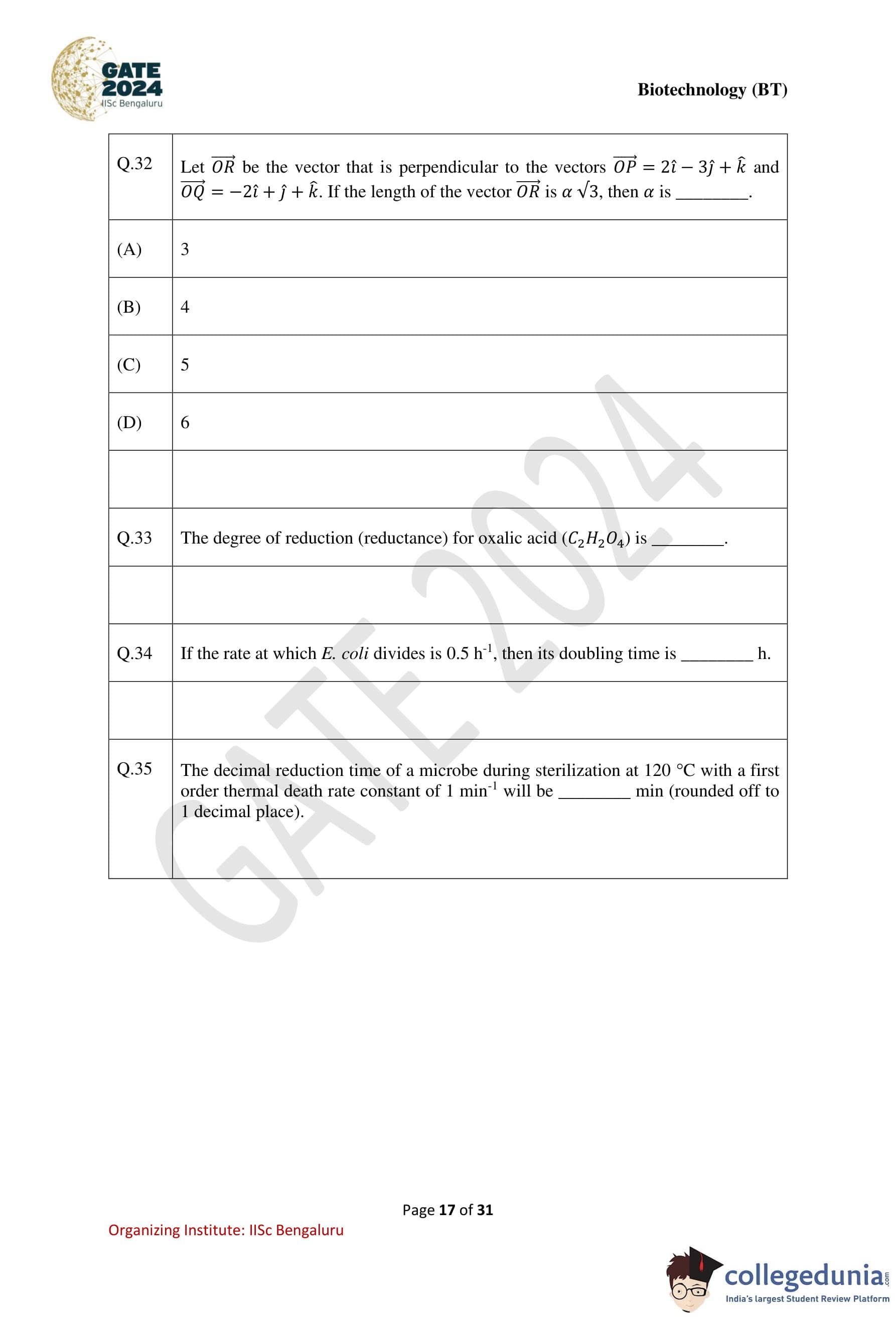
Question 32:
Let →OP be the vector that is perpendicular to the vectors →OP = 2i - 3j + k and →OQ = -2i + j + k. If the length of the vector →OR is α√3, then α is _________.
View Solution
Solution:
To find a vector perpendicular to both →OP and →OQ, take their cross product:
→OP × →OQ = i j k⁄ 2 -3 1
-2 1 1
Expanding the determinant:
→OP × →OQ = i((-3)(1) – (1)(1)) – j((2)(1) – (-2)(1)) + k((2)(1) – (-3)(-2)),
→OP × →OQ = −4i – 4j – 4k.
The magnitude of this vector is:
||→OP × →OQ|| = √((-4)² + (-4)² + (-4)²) = 4√3.
Since the length of →OR is α√3, equating:
α√3 = 4√3 => α = 4.
Final Answer:
4
Question 33:
The degree of reduction (reductance) for oxalic acid (C₂H₂O₄) is _________.
View Solution
Solution:
The degree of reduction (reductance) is calculated based on the oxidation state of carbon in the molecule. For oxalic acid (C₂H₂O₄):
• Carbon has an oxidation state of +3.
• The reductance is determined as the ratio of hydrogen to carbon or calculated based on the reduction potential.
Final Answer:
1
Question 34:
If the rate at which E. coli divides is 0.5 h-1, then its doubling time is _________.
View Solution
Solution:
Step 1: The doubling time (td) is calculated using the formula:
td = 1⁄Rate of Division
Step 2: Substitute the given rate of division (0.5 h-1) into the formula:
td = 1⁄0.5
Step 3: Solve the expression:
td = 2h
Final Answer:
2 h
Question 35:
The decimal reduction time of a microbe during sterilization at 120°C with a first-order thermal death rate constant of 1 min-1 will be _______ min (rounded off to 1 decimal place).
View Solution
Solution:
Decimal reduction time (D) is related to the rate constant (k) by:
D = loge10⁄k
Substitute k = 1 min-1:
D = loge10⁄1 = 2.302 min.
Rounded to one decimal place, the decimal reduction time is 2.3 min.
Final Answer:
2.3
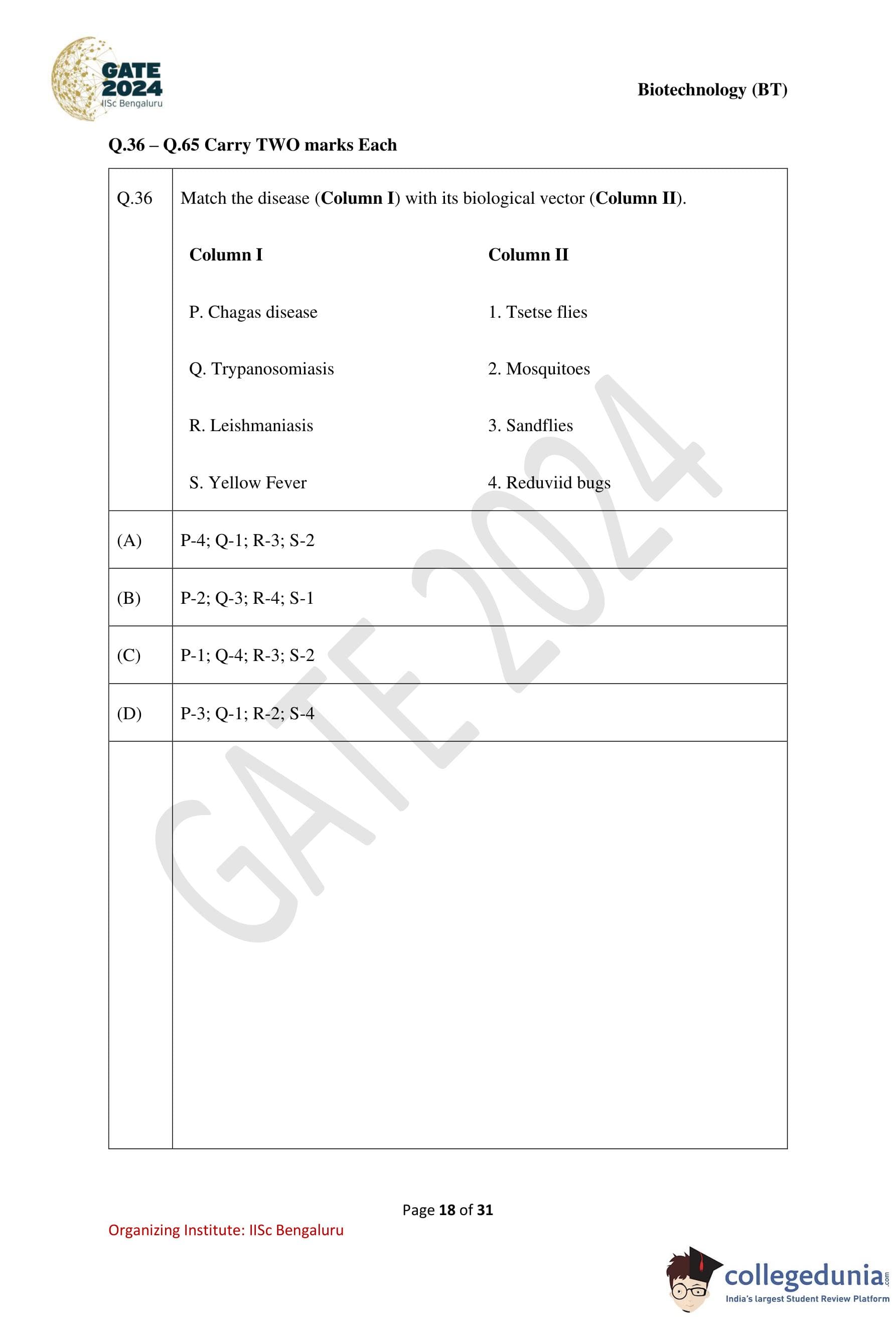
Question 36:
Match the disease (Column I) with its biological vector (Column II).
| Column I | Column II |
|---|---|
| P. Chagas disease | 1. Tsetse flies |
| Q. Trypanosomiasis | 2. Mosquitoes |
| R. Leishmaniasis | 3. Sandflies |
| S. Yellow Fever | 4. Reduviid bugs |
View Solution
Solution:
Match the diseases with their respective biological vectors:
• Chagas disease (P): Transmitted by Reduviid bugs (4).
• Trypanosomiasis (Q): Transmitted by Tsetse flies (1).
• Leishmaniasis (R): Transmitted by Sandflies (3).
• Yellow Fever (S): Transmitted by Mosquitoes (2).
The correct matching is:
P - 4; Q - 1; R – 3; S – 2.
Final Answer:
(A) P-4; Q-1; R-3; S-2
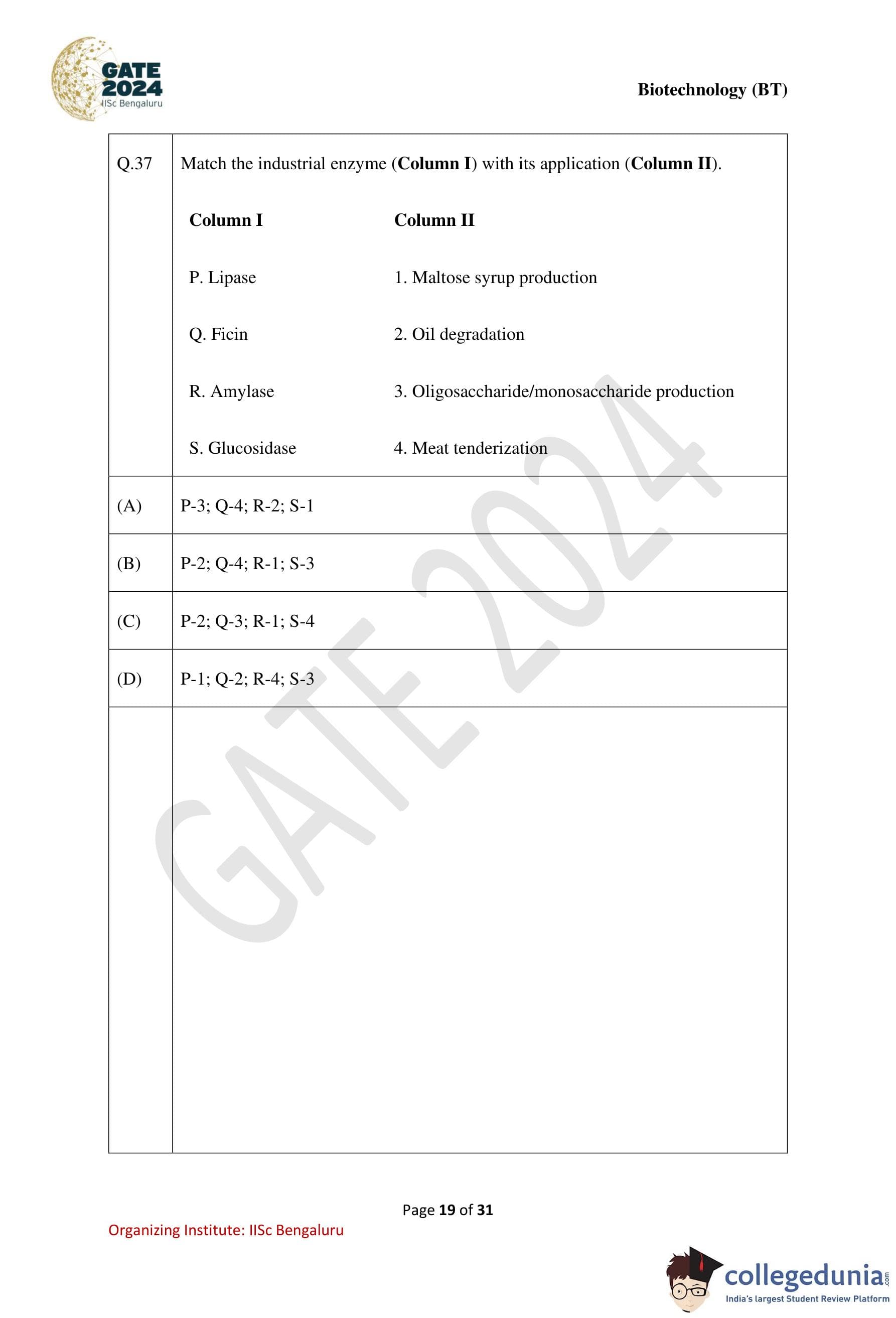
Question 37:
Match the industrial enzyme (Column I) with its application (Column II).
| Column I | Column II |
|---|---|
| P. Lipase | 1. Maltose syrup production |
| Q. Ficin | 2. Oil degradation |
| R. Amylase | 3. Oligosaccharide/monosaccharide production |
| S. Glucosidase | 4. Meat tenderization |
View Solution
Solution:
Match the industrial enzymes with their applications:
• Lipase (P): Used in oil degradation (2).
• Ficin (Q): Used in meat tenderization (4).
• Amylase (R): Used in maltose syrup production (1).
• Glucosidase (S): Used in oligosaccharide/monosaccharide production (3).
The correct matching is:
P – 2; Q – 4; R – 1; S – 3.
Final Answer:
(B) P-2; Q-4; R-1; S-3
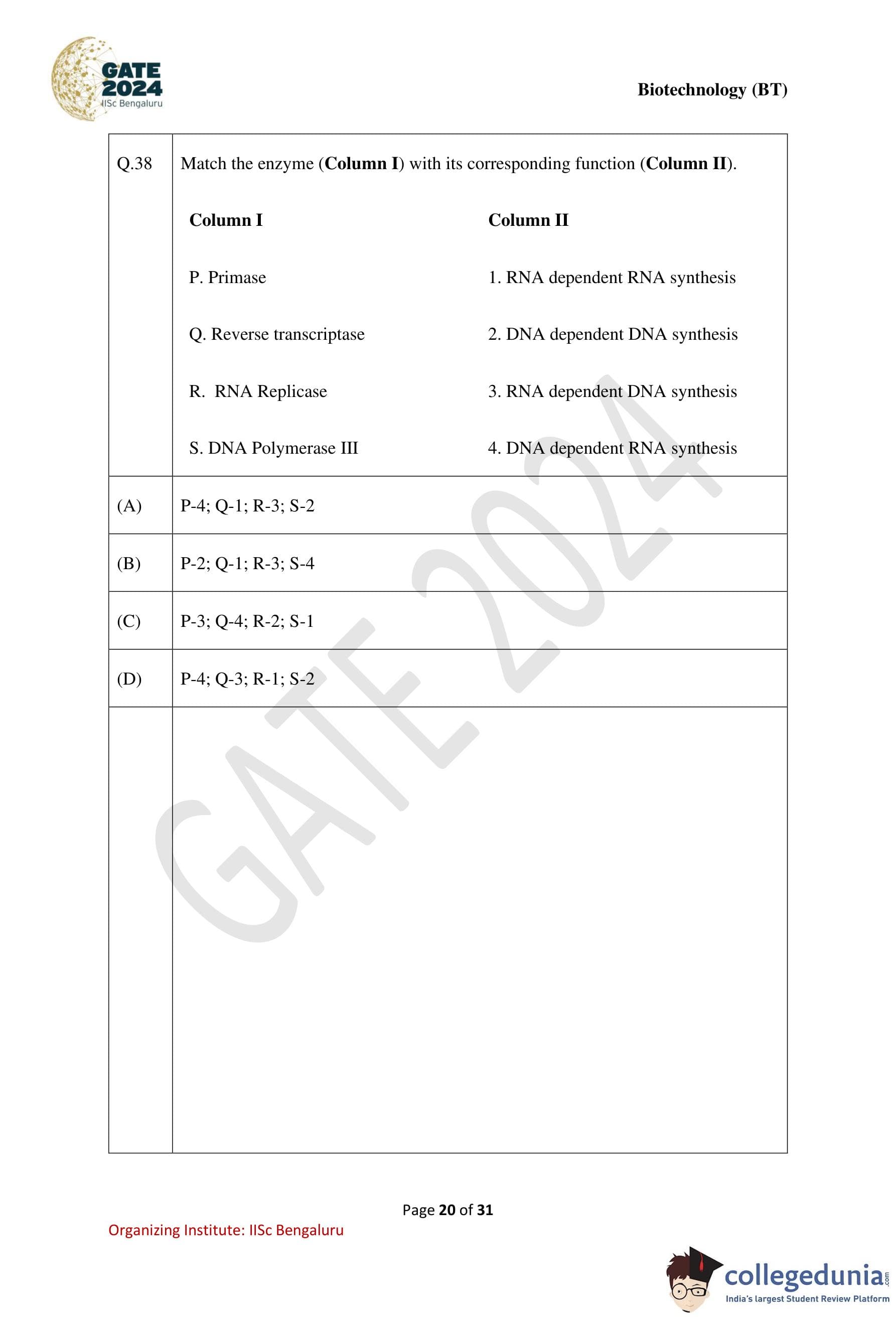
Question 38:
Match the enzyme (Column I) with its corresponding function (Column II).
| Column I | Column II |
|---|---|
| P. Primase | 1. RNA dependent RNA synthesis |
| Q. Reverse transcriptase | 2. DNA dependent DNA synthesis |
| R. RNA Replicase | 3. RNA dependent DNA synthesis |
| S. DNA Polymerase III | 4. DNA dependent RNA synthesis |
View Solution
Solution:
Match the enzymes with their corresponding functions:
• Primase (P): Performs DNA dependent RNA synthesis (4).
• Reverse Transcriptase (Q): Performs RNA dependent DNA synthesis (3).
• RNA Replicase (R): Performs RNA dependent RNA synthesis (1).
• DNA Polymerase III (S): Performs DNA dependent DNA synthesis (2).
The correct matching is:
P – 4; Q – 3; R – 1; S – 2.
Final Answer:
(D) P-4; Q-3; R-1; S-2
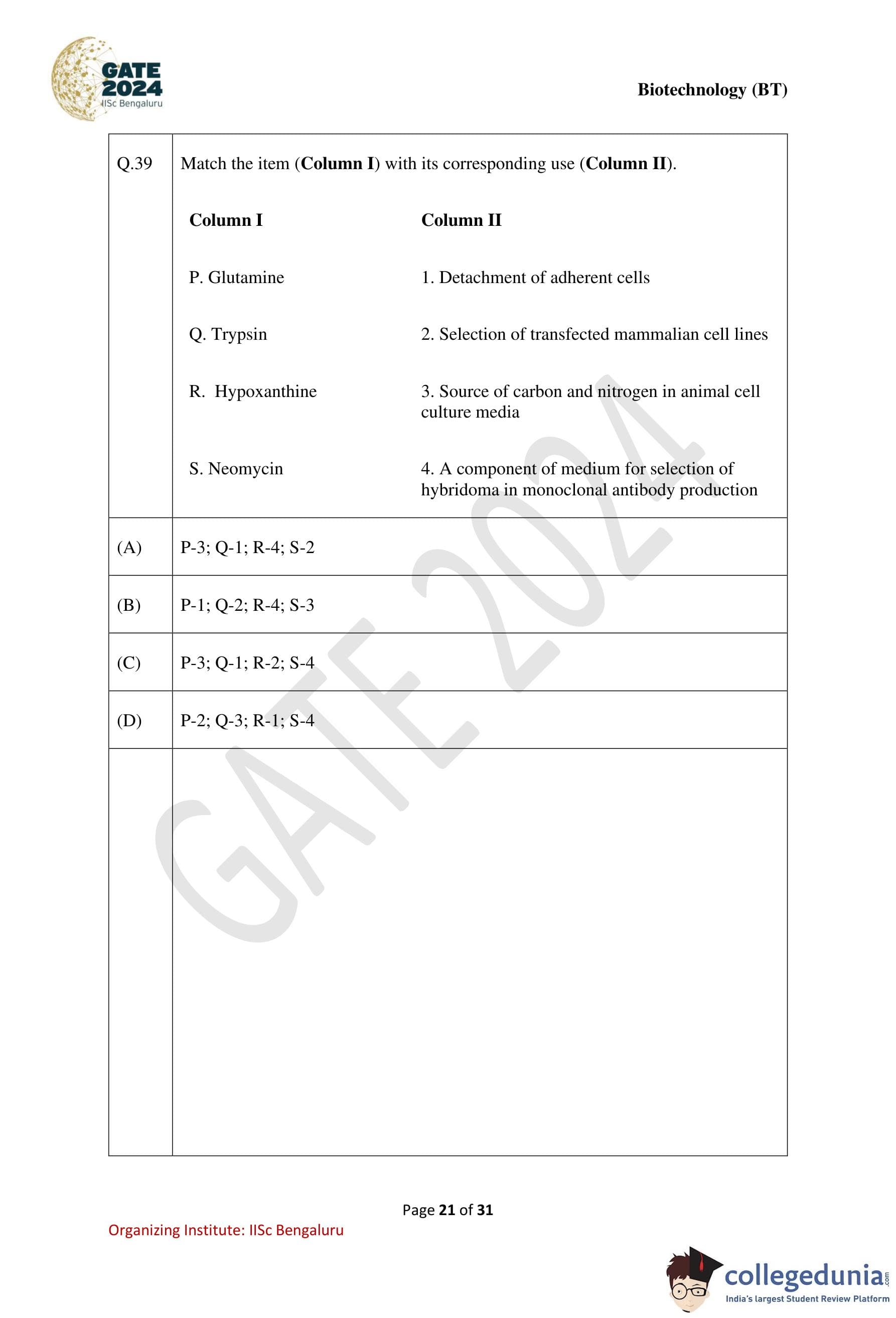
Question 39:
Match the item (Column I) with its corresponding use (Column II).
| Column I | Column II |
|---|---|
| P. Glutamine | 1. Detachment of adherent cells |
| Q. Trypsin | 2. Selection of transfected mammalian cell lines |
| R. Hypoxanthine | 3. Source of carbon and nitrogen in animal cell culture media |
| S. Neomycin | 4. A component of medium for selection of hybridoma in monoclonal antibody production |
View Solution
Solution:
Match the items with their corresponding uses:
• Glutamine (P): A source of carbon and nitrogen in animal cell culture media (3).
• Trypsin (Q): Facilitates the detachment of adherent cells (1).
• Hypoxanthine (R): A component of the medium for the selection of hybridoma in monoclonal antibody production (4).
• Neomycin (S): Used for the selection of transfected mammalian cell lines (2).
The correct matching is:
P – 3; Q – 1; R – 4; S − 2.
Final Answer:
(A) P-3; Q-1; R-4; S-2
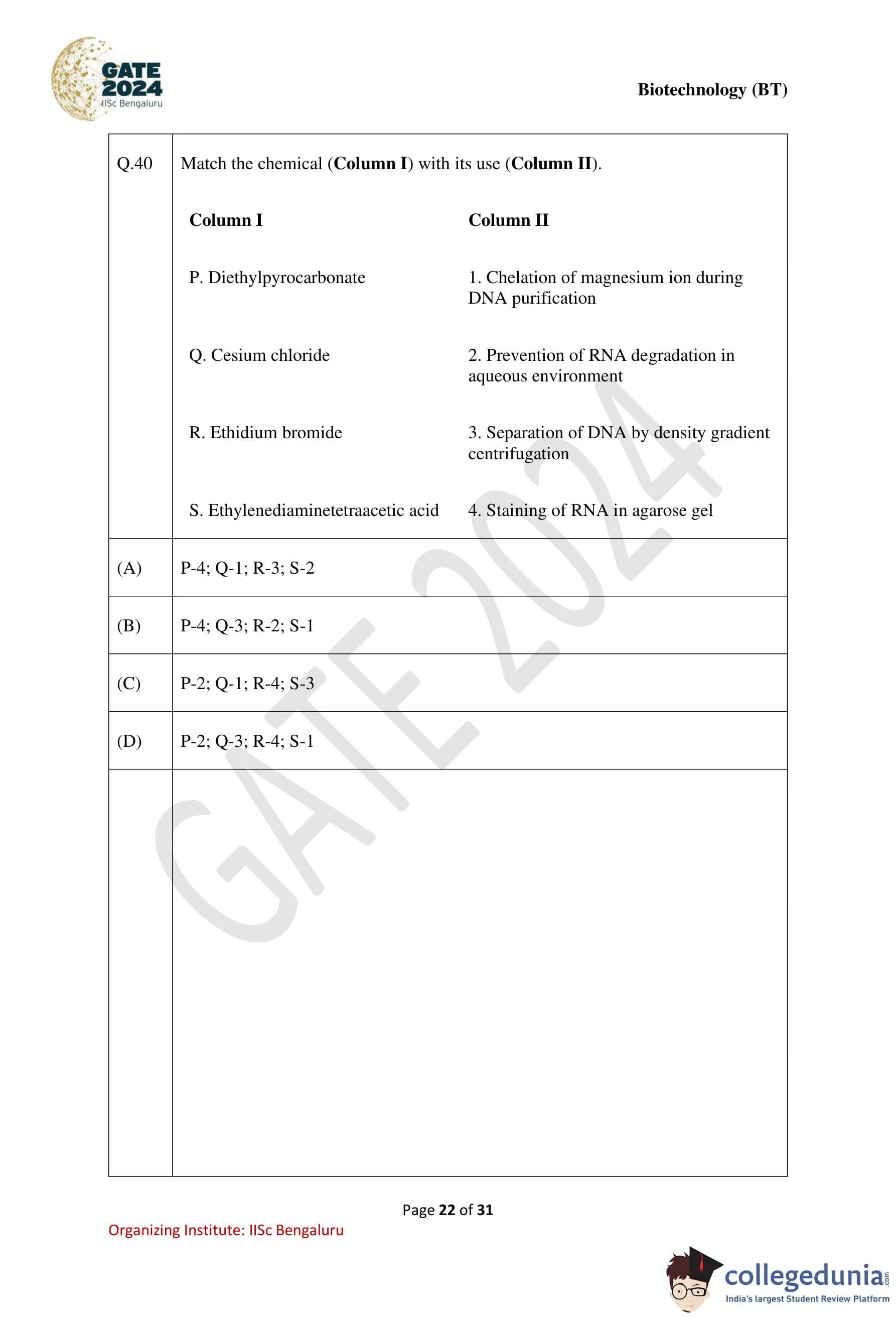
Question 40:
Match the chemical (Column I) with its use (Column II).
| Column I | Column II |
|---|---|
| P. Diethylpyrocarbonate | 1. Chelation of magnesium ion during DNA purification |
| Q. Cesium chloride | 2. Prevention of RNA degradation in aqueous environment |
| R. Ethidium bromide | 3. Separation of DNA by density gradient centrifugation |
| S. Ethylenediaminetetraacetic acid | 4. Staining of RNA in agarose gel |
View Solution
Solution:
Step 1: Match each chemical with its specific use based on their properties:
• Diethylpyrocarbonate (P): Prevents RNA degradation in aqueous environments (2).
• Cesium chloride (Q): Used for separation of DNA by density gradient centrifugation (3).
• Ethidium bromide (R): Stains RNA in agarose gel (4).
• Ethylenediaminetetraacetic acid (S): Chelates magnesium ions during DNA purification (1).
Step 2: Assign the correct matches:
P-2, Q-3, R-4, S-1
Final Answer:
(D)
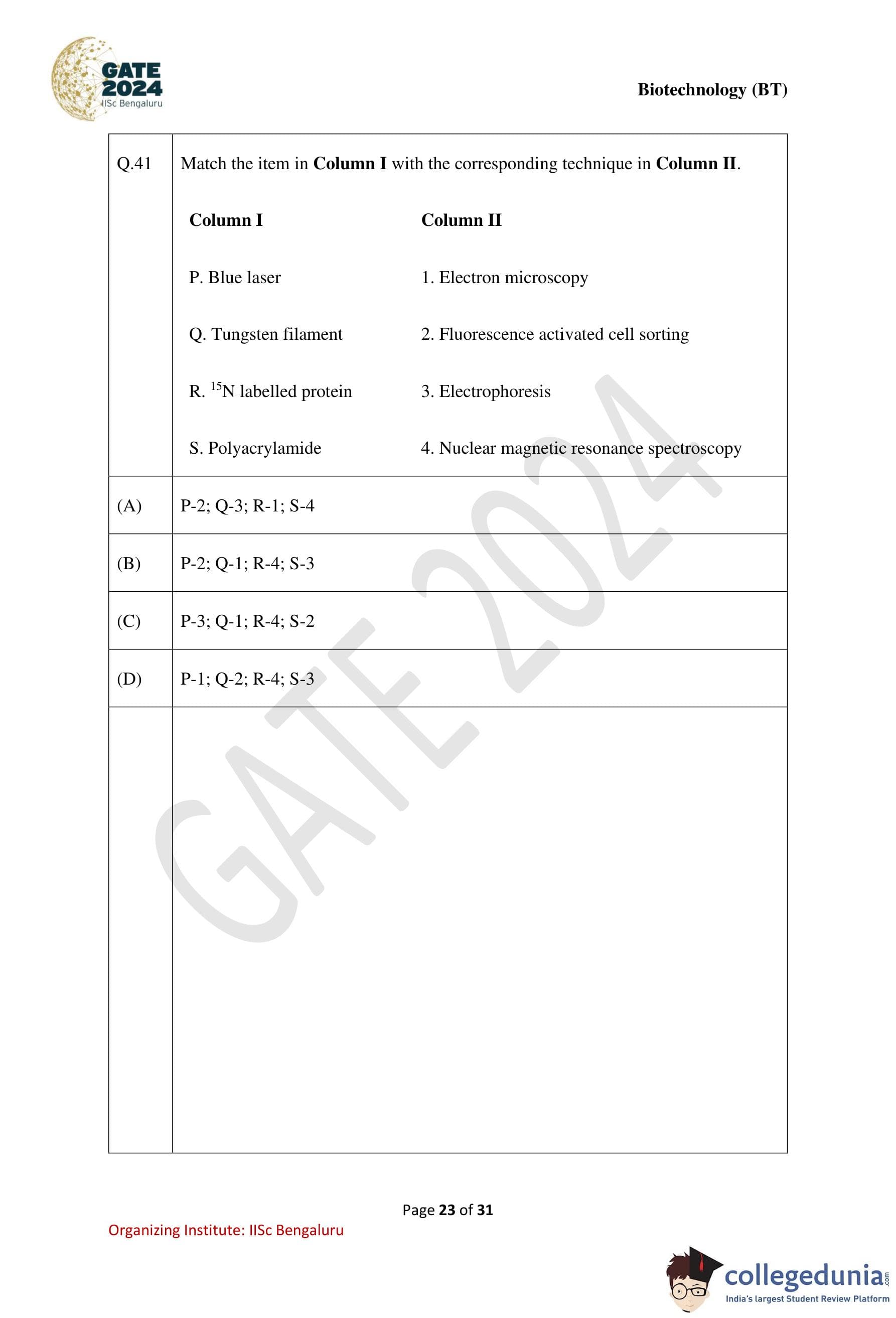
Question 41:
Match the item in Column I with the corresponding technique in Column II.
| Column I | Column II |
|---|---|
| P. Blue laser | 1. Electron microscopy |
| Q. Tungsten filament | 2. Fluorescence activated cell sorting |
| R. 15N labelled protein | 3. Electrophoresis |
| S. Polyacrylamide | 4. Nuclear magnetic resonance spectroscopy |
View Solution
Solution:
Step 1: Match each item in Column I with its corresponding technique in Column II:
• Blue laser (P): Used in fluorescence activated cell sorting (2).
• Tungsten filament (Q): Used in electron microscopy (1).
• 15N labelled protein (R): Used in nuclear magnetic resonance spectroscopy (4).
• Polyacrylamide (S): Used in electrophoresis (3).
Step 2: Assign the correct matches:
P-2, Q-1, R-4, S-3
Final Answer:
(B)
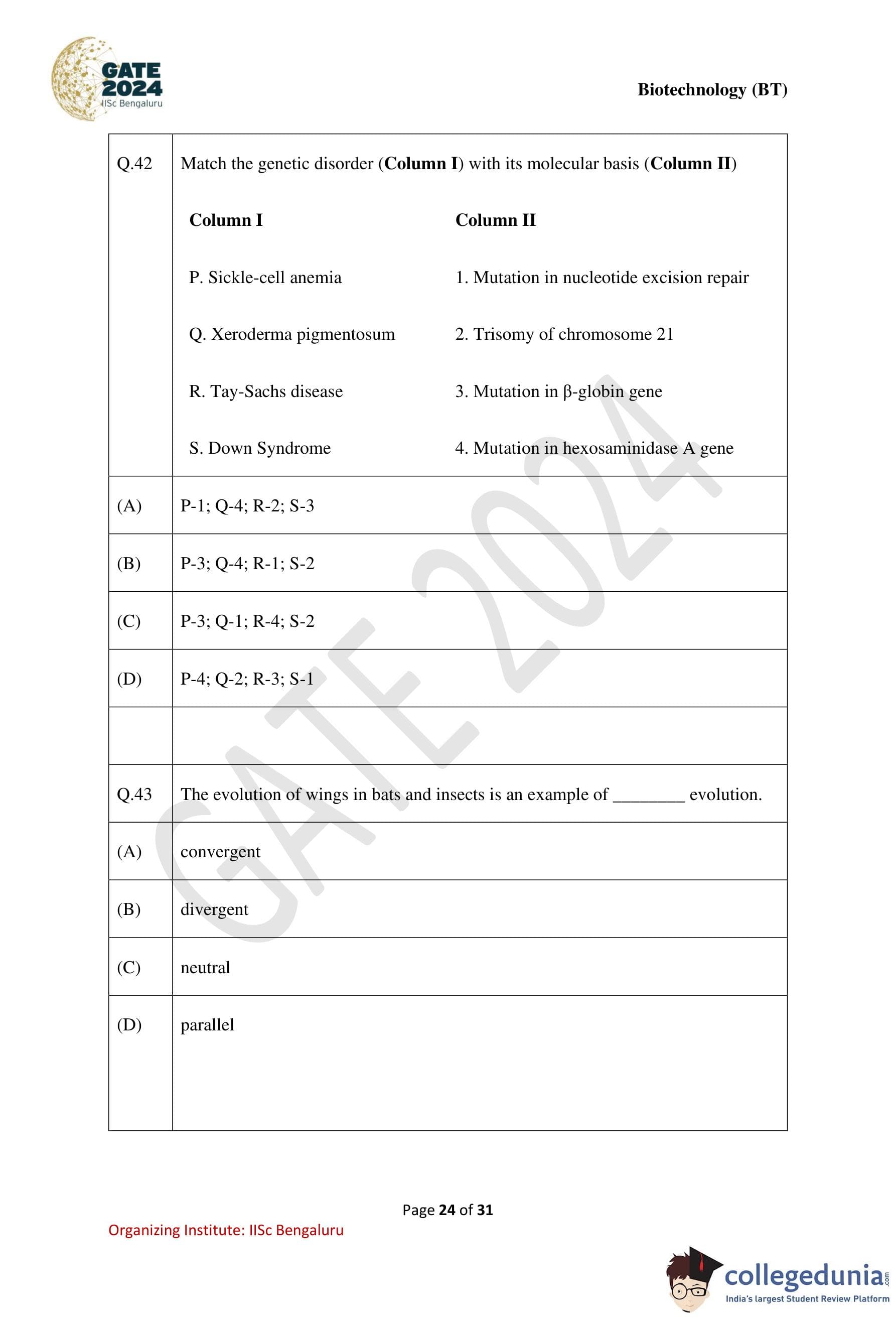
Question 42:
Match the genetic disorder (Column I) with its molecular basis (Column II).
| Column I | Column II |
|---|---|
| P. Sickle-cell anemia | 1. Mutation in nucleotide excision repair |
| Q. Xeroderma pigmentosum | 2. Trisomy of chromosome 21 |
| R. Tay-Sachs disease | 3. Mutation in β-globin gene |
| S. Down Syndrome | 4. Mutation in hexosaminidase A gene |
View Solution
Solution:
Step 1: Match each genetic disorder with its molecular basis:
• Sickle-cell anemia (P): Caused by a mutation in the β-globin gene (3).
• Xeroderma pigmentosum (Q): Caused by a mutation in nucleotide excision repair (1).
• Tay-Sachs disease (R): Caused by a mutation in hexosaminidase A gene (4).
• Down Syndrome (S): Caused by trisomy of chromosome 21 (2).
Step 2: Assign the correct matches:
P-3, Q-1, R-4, S-2
Final Answer:
(C)
Question 43:
The evolution of wings in bats and insects is an example of ....... evolution.
View Solution
Solution:
The evolution of wings in bats and insects is classified as convergent evolution because:
• Both evolved wings independently for flight.
• Their wings are analogous structures (different origin, similar function).
Final Answer:
(A) convergent
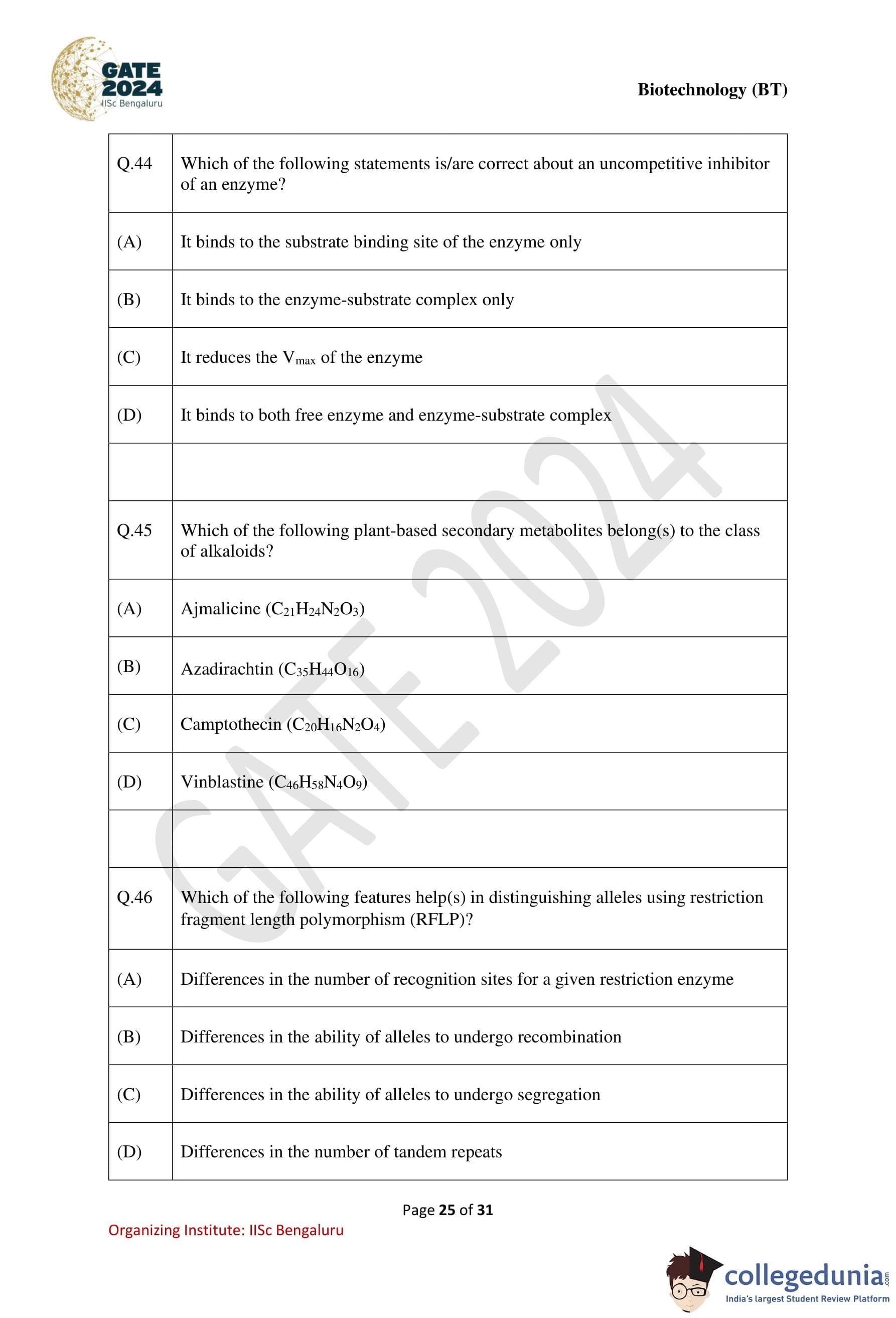
Question 44:
Which of the following statements is/are correct about an uncompetitive inhibitor of an enzyme?
View Solution
Solution:
Uncompetitive inhibitors:
• Bind only to the enzyme-substrate complex, not to the free enzyme.
• Reduce the Vmax, the maximum rate of the reaction, by stabilizing the enzyme-substrate complex.
• Do not interfere with substrate binding directly, as they do not bind to the active site.
Final Answer:
(B, C)
Question 45:
Which of the following plant-based secondary metabolites belong(s) to the class of alkaloids?
View Solution
Solution:
Alkaloids are secondary metabolites that contain nitrogen and exhibit biological activity. From the given options:
• Ajmalicine (A): An indole alkaloid used as an antihypertensive.
• Camptothecin (C): A quinoline alkaloid with anticancer properties.
• Vinblastine (D): A vinca alkaloid used in chemotherapy.
• Azadirachtin (B): Though biologically active, it is classified as a limonoid, not an alkaloid.
Final Answer:
(A, C, D)
Question 46:
Which of the following features help(s) in distinguishing alleles using restriction fragment length polymorphism (RFLP)?
View Solution
Solution:
RFLP helps in distinguishing alleles based on:
• Number of recognition sites (A): Different alleles may have variations in restriction sites, producing fragments of varying lengths.
• Tandem repeats (D): Differences in the number of repeats alter the size of the restriction fragments.
• Recombination (B) and segregation (C) do not directly influence RFLP as they are unrelated to restriction fragment patterns.
Final Answer:
(A, D)
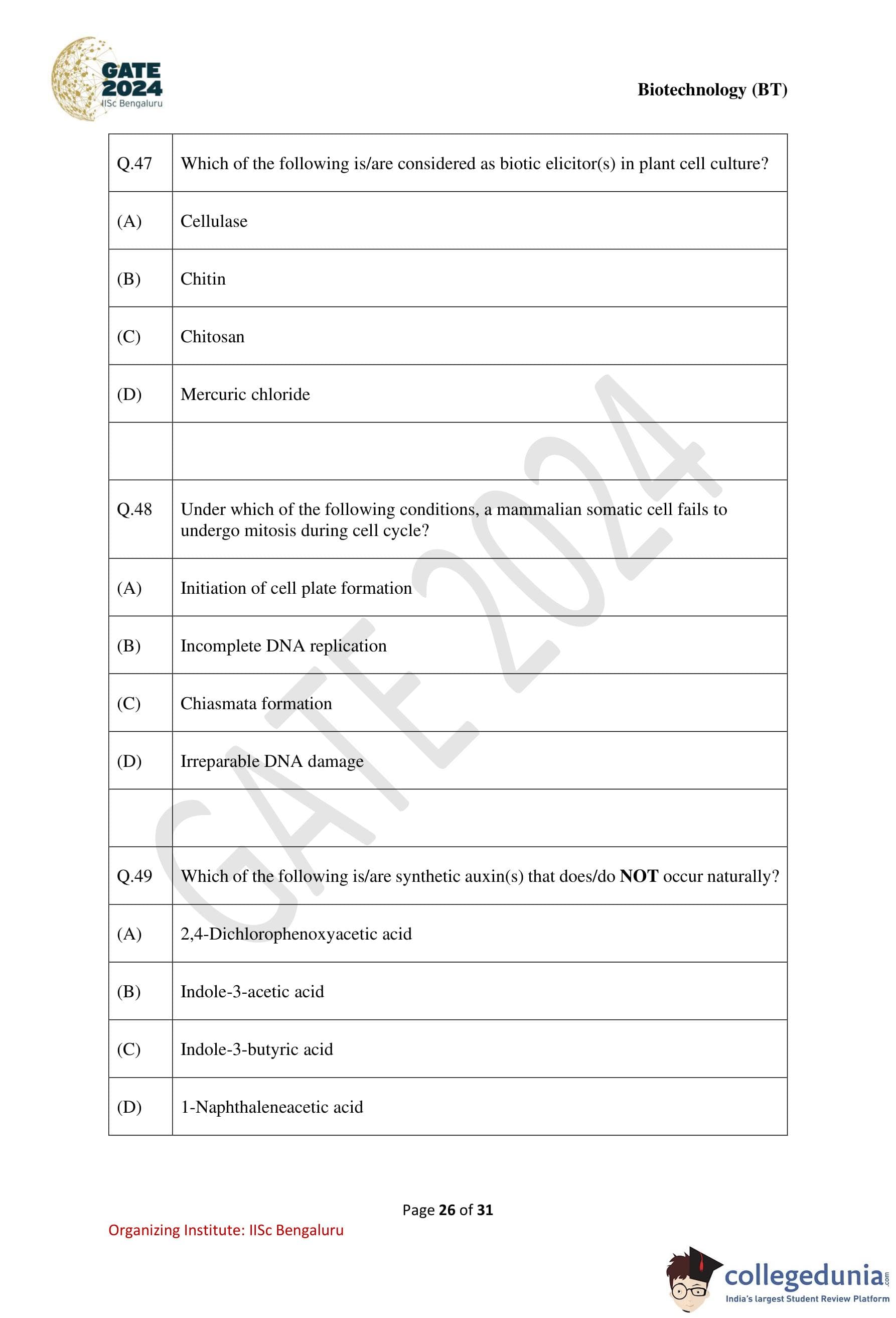
Question 47:
Which of the following is/are considered as biotic elicitor(s) in plant cell culture?
View Solution
Solution:
Biotic elicitors in plant cell culture are compounds derived from biological sources that induce a response in plant cells:
• Cellulase (A): An enzyme that breaks down cellulose and acts as a biotic elicitor.
• Chitin (B): A polymer of N-acetylglucosamine derived from fungal cell walls, inducing plant defense responses.
• Chitosan (C): A derivative of chitin with similar elicitor activity.
• Mercuric chloride (D): A chemical compound, not a biotic elicitor, as it is abiotic and toxic to cells.
Final Answer:
(A, B, C)
Question 48:
Under which of the following conditions, a mammalian somatic cell fails to undergo mitosis during cell cycle?
View Solution
Solution:
Mammalian somatic cells fail to undergo mitosis under the following conditions:
• Incomplete DNA replication (B): The cell cannot proceed past the G2 checkpoint.
• Irreparable DNA damage (D): Activates cell cycle arrest or apoptosis.
• Initiation of cell plate formation (A): Specific to plant cells and not relevant here.
• Chiasmata formation (C): Occurs during meiosis, not mitosis.
Final Answer:
(B, D)
Question 49:
Which of the following is/are synthetic auxin(s) that does/do NOT occur naturally?
View Solution
Solution:
Synthetic auxins mimic the action of natural auxins but do not occur naturally:
• 2,4-Dichlorophenoxyacetic acid (A): A synthetic auxin used as a herbicide.
• 1-Naphthaleneacetic acid (D): A synthetic auxin used for rooting.
• Indole-3-acetic acid (B): A naturally occurring auxin.
• Indole-3-butyric acid (C): Though naturally derived, it has synthetic applications but does occur in plants.
Final Answer:
(A, D)
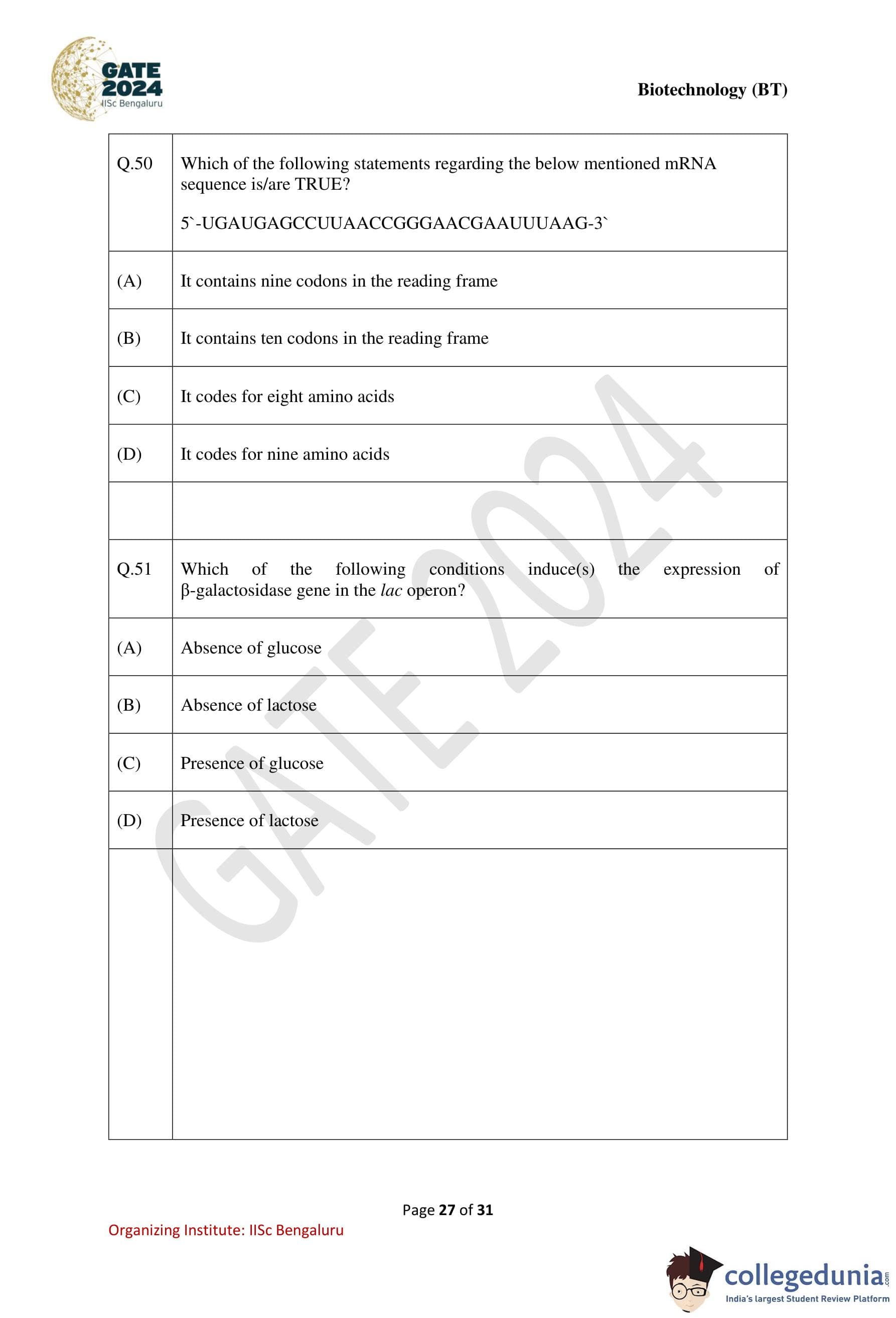
Question 50:
Which of the following statements regarding the below mentioned mRNA sequence is/are TRUE?
5' – UGAUGAGCCCUU AACCGGGAACGAAUUU AAAG – 3'
View Solution
Solution:
To determine the codons and amino acids:
• The reading frame starts from the first AUG (start codon).
• From the sequence, the codons are: AUG, AGC, CCU, UAA (stop codon), CCG, GGA, ACG, AAU, UUA.
• This makes a total of nine codons in the reading frame (A is correct).
• UAA is a stop codon, so it does not code for an amino acid. Hence, there are eight amino acids coded by this sequence (C is correct).
Final Answer:
(A, C)
Question 51:
Which of the following conditions induce(s) the expression of β-galactosidase gene in the lac operon?
View Solution
Solution:
For the lac operon to express β-galactosidase:
• Absence of glucose (A): Enables activation of the cAMP-CAP complex, promoting transcription of the lac operon.
• Presence of lactose (D): Lactose acts as an inducer by binding to the repressor, preventing it from inhibiting the operon.
• The absence of lactose (B) or presence of glucose (C) represses the lac operon and inhibits expression.
Final Answer:
(A, D)
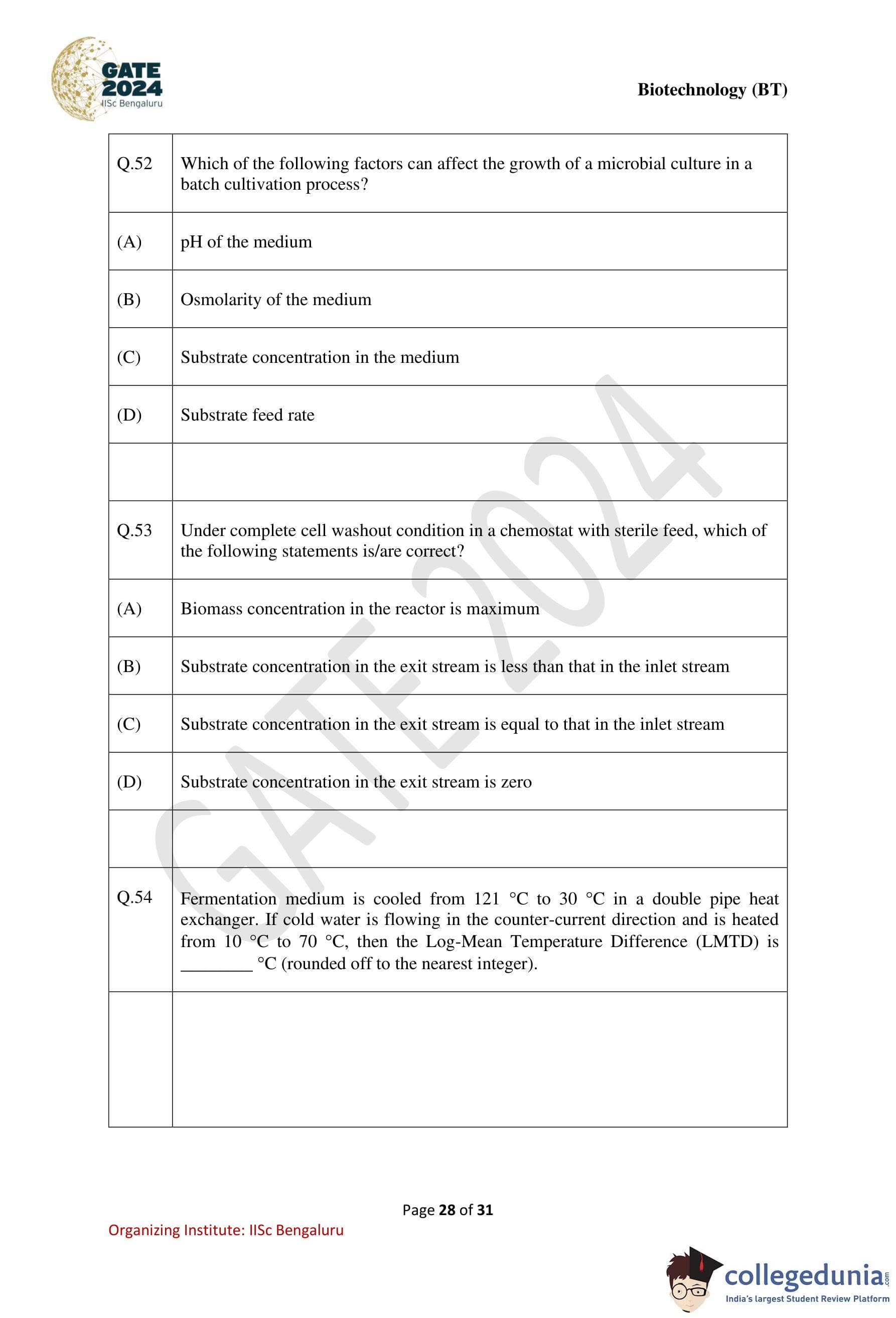
Question 52:
Which of the following factors can affect the growth of a microbial culture in a batch cultivation process?
View Solution
Solution:
The growth of microbial cultures in batch cultivation is influenced by several environmental and nutrient-related factors:
• pH of the medium (A): Affects enzyme activity and cellular processes.
• Osmolarity of the medium (B): Impacts water movement and cell integrity.
• Substrate concentration in the medium (C): Provides nutrients and energy sources essential for growth.
• Substrate feed rate (D): Irrelevant in batch processes as feed is constant and not added continuously.
Final Answer:
(A, B, C)
Question 53:
Under complete cell washout condition in a chemostat with sterile feed, which of the following statements is/are correct?
View Solution
Solution:
In a chemostat under complete cell washout:
• Biomass concentration (A): It is negligible as no cells remain in the reactor.
• Substrate concentration in the exit stream (C): It equals the inlet stream concentration because no biomass is present to consume the substrate.
• Substrate concentration being zero (D): Is incorrect under these conditions.
Final Answer:
(C)
Question 54:
Fermentation medium is cooled from 121 °C to 30 °C in a double pipe heat exchanger. If cold water is flowing in the counter-current direction and is heated from 10 °C to 70 °C, then the Log-Mean Temperature Difference (LMTD) is _______ °C (rounded off to the nearest integer).
View Solution
Solution:
The LMTD is calculated using the formula:
LMTD = (T1 - t2) - (T2 - t1)⁄ln(T1 - t2⁄T2 - t1) ,
where:
• T₁ = 121 °C, T₂ = 30 °C (hot fluid temperatures).
• t₁ = 10 °C, t₂ = 70 °C (cold fluid temperatures).
Substituting the values:
LMTD = (121 - 70) - (30 - 10)⁄ln(121 - 70⁄30 - 10) = 51 - 20⁄ln(51⁄20) = 31⁄0.916 ≈ 33.8 °C.
Rounded off to the nearest integer, the LMTD is 34 °C.
Final Answer:
33 to 35 C
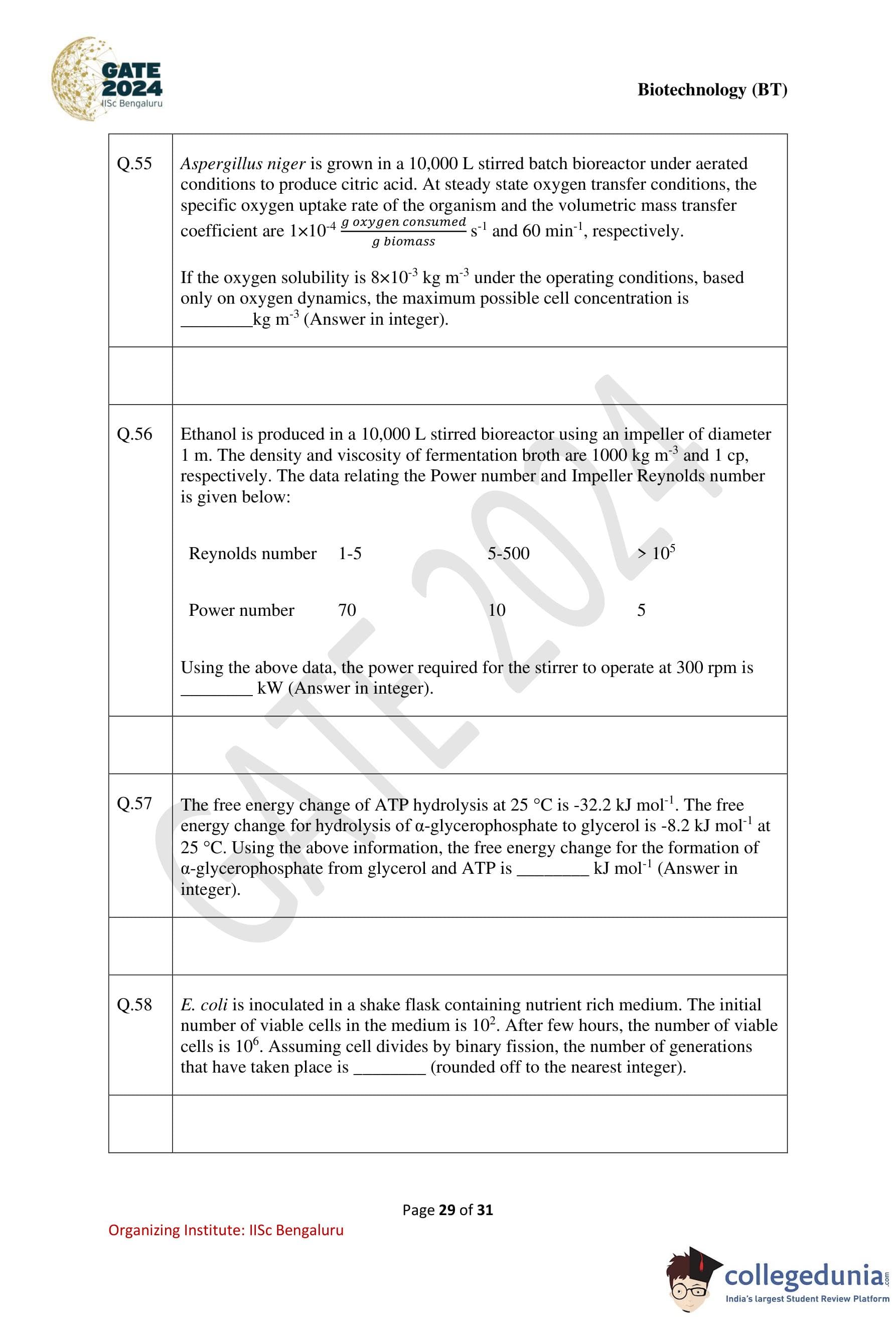
Question 55:
Aspergillus niger is grown in a 10,000 L stirred batch bioreactor under aerated conditions to produce citric acid. At steady state oxygen transfer conditions, the specific oxygen uptake rate of the organism and the volumetric mass transfer coefficient are 1 × 10⁻⁴ g oxygen consumed g biomass-1 s-1 and 60 min-1, respectively. If the oxygen solubility is 8 × 10⁻³ kg m-3, based only on oxygen dynamics, the maximum possible cell concentration is ... kg m-3 (Answer in integer).
View Solution
Solution:
Using the relationship:
Cx = kLa * C*⁄qo
where:
• kLa = 60 min-1 = 1 s-1,
• C*= 8 × 10⁻³ kg m-3,
• qo = 1×10⁻⁴ g oxygen consumed g biomass-1 s-1 = 1×10⁻⁴ kg oxygen kg biomass-1 s-1.
Substituting the values:
Cx = 8 × 10⁻³⁄1 × 10-4 = 80 kg m-3.
Final Answer:
80 kg m-3
Question 56:
Ethanol is produced in a 10,000 L stirred bioreactor using an impeller of diameter 1 m. The density and viscosity of fermentation broth are 1000 kg m-3 and 1 cp, respectively. The data relating the Power number and Impeller Reynolds number is given below:
| Reynolds number | Power number |
|---|---|
| 1-5 | 70 |
| 5-500 | 10 |
| > 105 | 5 |
Using the above data, the power required for the stirrer to operate at 300 rpm is _______ kW (Answer in integer).
View Solution
Solution:
Step 1: Calculate the Reynolds number using the formula:
Re = ρND2⁄μ ,
where:
• ρ = 1000 kg/m³ (density),
• N = 300 rpm = 300⁄60 rps = 5 rps (rotation speed),
• D = 1 m (impeller diameter),
• μ = 1 cp = 0.001 Pa.s (viscosity).
Substitute the values:
Re = 1000 * 5 * (1)²⁄0.001 = 5 × 10⁶.
Step 2: From the table, for Re > 105, the Power number (Po) is 5.
Step 3: Use the formula for power calculation:
P = Po • ρ • N³ • D5
Substitute the known values:
P = 5 * 1000 * (5)³ * (1)5
P = 5 * 1000 * 125 = 625,000 W.
Step 4: Convert power to kilowatts:
P = 625,000⁄1000 = 625 kW
Final Answer:
625 kW
Question 57:
The free energy change of ATP hydrolysis at 25°C is -32.2 kJ mol-1. The free energy change for hydrolysis of α-glycerophosphate to glycerol is -8.2 kJ mol-1. Using the above information, the free energy change for the formation of α-glycerophosphate from glycerol and ATP is _______ kJ mol-1 (Answer in integer).
View Solution
Solution:
Using the relationship:
ΔG = ΔGATP hydrolysis - ΔGα-glycerophosphate hydrolysis.
Substituting the values:
ΔG = -32.2 - (-8.2) = -24.0 kJ mol-1
Final Answer:
-24 kJ mol-1
Question 58:
E. coli is inoculated in a shake flask containing nutrient-rich medium. The initial number of viable cells in the medium is 10². After four hours, the number of viable cells is 106. Assuming cell division by binary fission, the number of generations that have taken place is _________ (rounded off to the nearest integer).
View Solution
Solution:
The number of generations n is calculated using:
n = log2(Nf/Ni),
where:
• Nf = 106 (final number of cells),
• Ni = 10² (initial number of cells).
Substituting the values:
n = log2(106/10²) = log2(104) = 13.32 generations.
Final Answer:
13.32 generations
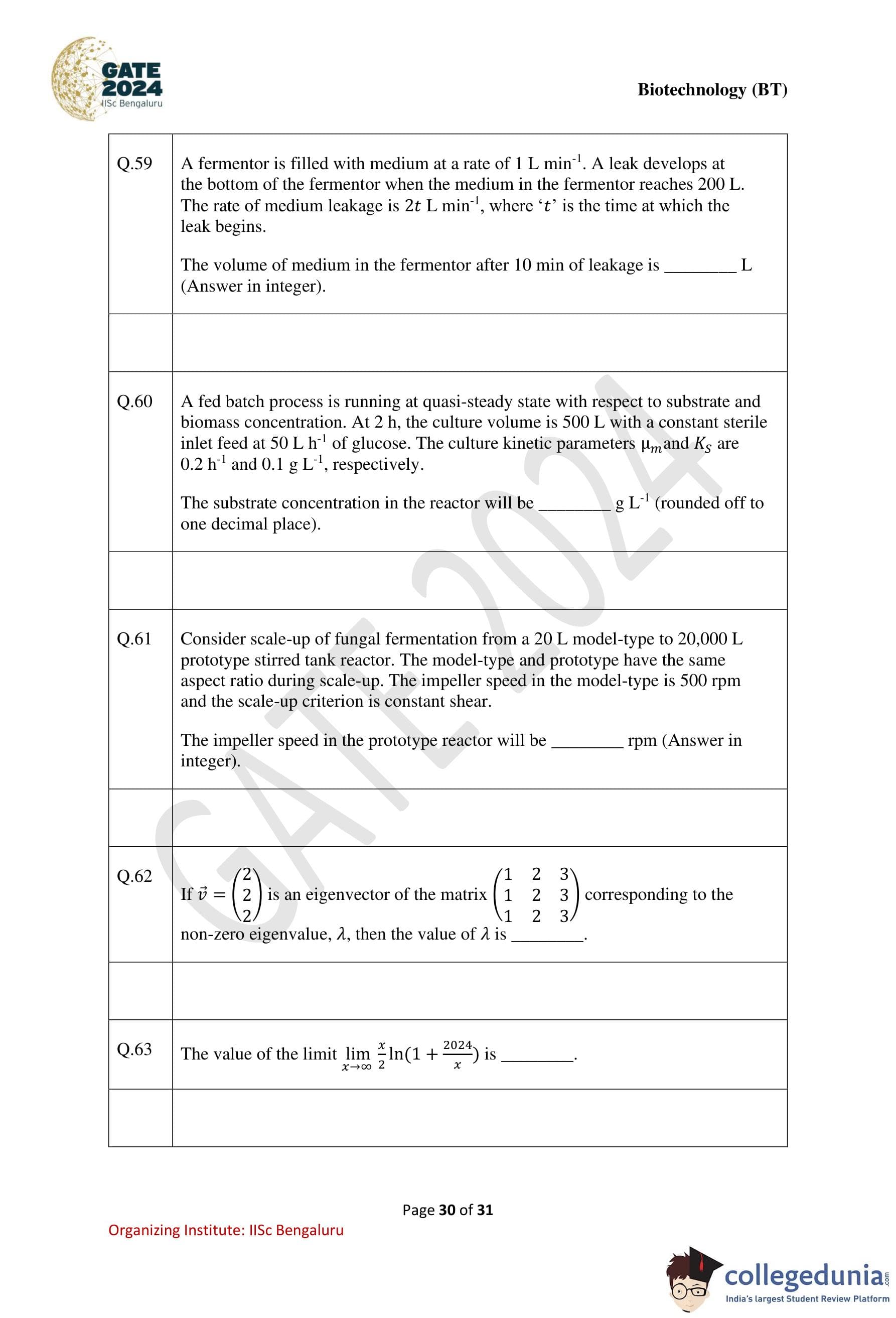
Question 59:
A fermentor is filled with medium at a rate of 1 L min-1. A leak develops at the bottom of the fermentor when the medium in the fermentor reaches 200 L. The rate of medium leakage is 2t L min-1, where t is the time at which the leak begins. The volume of medium in the fermentor after 10 min of leakage is _______ L (Answer in integer).
View Solution
Solution:
The rate of inflow of the medium is:
Qin = 1 L min-1.
The rate of leakage (outflow) is:
Qout = 2t L min-1.
The differential volume of the fermentor at any time t is:
dV⁄dt = Qin - Qout = 1 - 2t.
Integrating from t = 0 to 10:
V(t) = ∫010(1 - 2t)dt
Evaluating:
V(t) = [t - t²]100 = (10 - 100) - (0 - 0) = -90.
Since the fermentor starts with 200 L:
Vfinal = 200 - 90 = 110 L.
Question 60:
A fed batch process is running at quasi-steady state with respect to substrate and biomass concentration. At 2 h, the culture volume is 500 L with a constant sterile inlet feed at 50 L h-1 of glucose. The culture kinetic parameters μm and Ks are 0.2 h-1 and 0.1 g L-1, respectively.
The substrate concentration in the reactor will be ________ g L-1 (rounded off to one decimal place).
View Solution
Solution:
Step 1: For a quasi-steady state in a fed-batch reactor, the substrate concentration is determined by the Monod equation:
μ = μm S⁄Ks + S
where:
• μm = 0.2h-1 (maximum specific growth rate),
• Ks = 0.1 g L-1 (substrate concentration at half-maximum growth rate),
• μ = D = F⁄V, the dilution rate.
Step 2: Calculate the dilution rate (D):
D = F⁄V = 50⁄500= 0.1 h-1
Step 3: Substitute D and other values into the Monod equation:
0.1 = 0.2 * S⁄0.1 + S
Step 4: Solve for S (substrate concentration):
0.1 (0.1 + S) = 0.2 * S
0.01 + 0.1S = 0.2S
0.01 = 0.1S
S = 0.1 g L-1
Final Answer:
0.1 g L-1
Question 61:
Consider scale-up of fungal fermentation from a 20 L model-type to 20,000 L prototype stirred tank reactor. The model-type and prototype have the same aspect ratio during scale-up. The impeller speed in the model-type is 500 rpm and the scale-up criterion is constant shear. The impeller speed in the prototype reactor will be _______ rpm (Answer in integer).
View Solution
Solution:
Using the constant shear criterion:
N1D1 = N2D2,
where:
• N1 = 500 rpm (model impeller speed),
• D1 = √20 (model diameter),
• D2 = √20000 (prototype diameter).
N2 = N1 D1⁄D2
Substituting:
N2 = 500 * √20⁄√20000 = 50 rpm.
Final Answer:
50
Question 62:
If →v = 2⁄22⁄2 is an eigenvector of the matrix 1 2 3⁄1 2 31 2 3⁄1 2 3 corresponding to the non-zero eigenvalue, λ, then the value of λ is _______.
View Solution
Solution:
Step 1: Recall the eigenvector equation:
A→v = λ→v
where A is the matrix, →v is the eigenvector, and λ is the eigenvalue.
Step 2: Compute A→v:
A = 1 2 3⁄1 2 31 2 3⁄1 2 3 , →v = 2⁄22⁄2
A→v = 1 2 3⁄1 2 3 1 2 3⁄1 2 3 2⁄22⁄2 = 1(2) + 2(2) + 3(2)⁄1(2) + 2(2) + 3(2) 1(2) + 2(2) + 3(2)⁄1(2) + 2(2) + 3(2)= 12⁄12 12⁄12
Step 3: Find λ by dividing A→v by →v:
λ→v = 12⁄1212⁄12 , λ 2⁄22⁄2 = 12⁄1212⁄12 λ = 12⁄2 = 6
Final Answer:
6
Question 63:
The value of the limit limx→∞ x⁄2 ln(1 + 2024⁄x) is _________.
View Solution
Solution:
Step 1: Rewrite the given limit:
L = limx→∞ x⁄2 ln(1 + 2024⁄x)
Step 2: Use the approximation ln(1 + z) ≈ z for small z, where z = 2024⁄x.
L ≈ limx→∞ x⁄2 * 2024⁄x
Step 3: Simplify the expression:
L = limx→∞ 2024⁄2= 1012
Final Answer:
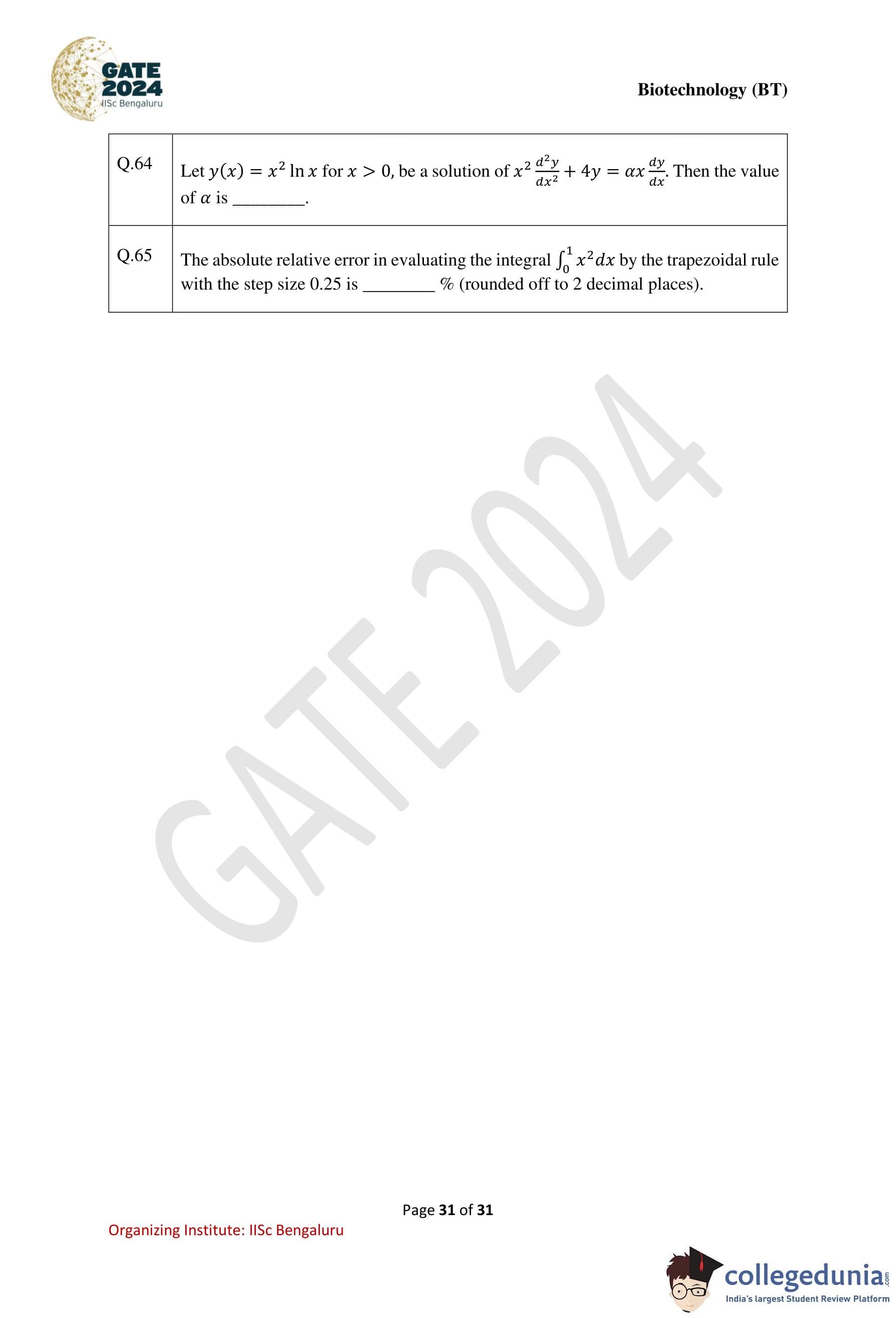
1012
Question 64:
Let y(x) = x2 ln x for x > 0, be a solution of x² d²y⁄dx² + 4y dy⁄dx = αx2. Then the value of α is _________.
View Solution
Solution:
Step 1: Compute the first derivative of y(x) = x² ln x:
dy⁄dx = d⁄dx (x² ln x) = x²*1⁄x + 2x ln x = x + 2x ln x
Step 2: Compute the second derivative:
d²y⁄dx² = d⁄dx (x + 2x ln x) = 1 + 2 + 2 ln x 1⁄x= 1 + 2 ln x + 2⁄x
Step 3: Substitute y(x), dy⁄dx , and d²y⁄dx² into the given equation:
x²(1⁄x + 2 + 2 ln x ) + 4(x² ln x) = αx (x + 2x ln x)
Step 4: Simplify each term:
x + 2x + 2x² ln x + 4x² ln x = αx² + 2αx² ln x
x + 2x + 6x² ln x = αx² + 2αx² ln x
Step 5: Compare coefficients of x² and x² ln x:
• Coefficient of x²: 1 = α
• Coefficient of x² ln x: 6 = 2α => α = 3
Final Answer:
3
Question 65:
The absolute relative error in evaluating the integral ∫01 x²dx by the trapezoidal rule with the step size 0.25 is _______% (rounded off to 2 decimal places).
View Solution
Solution:
1. Exact value of the integral:
∫01 x² dx = 1⁄3 ≈ 0.33333.
2. Trapezoidal rule approximation with h = 0.25:
∫01 x² dx ≈ 0.34375.
3. Calculate the absolute relative error:
Error = |0.34375 - 0.33333|⁄0.33333 * 100 ≈ 3.11%.
Final Answer:
3.11





Comments