




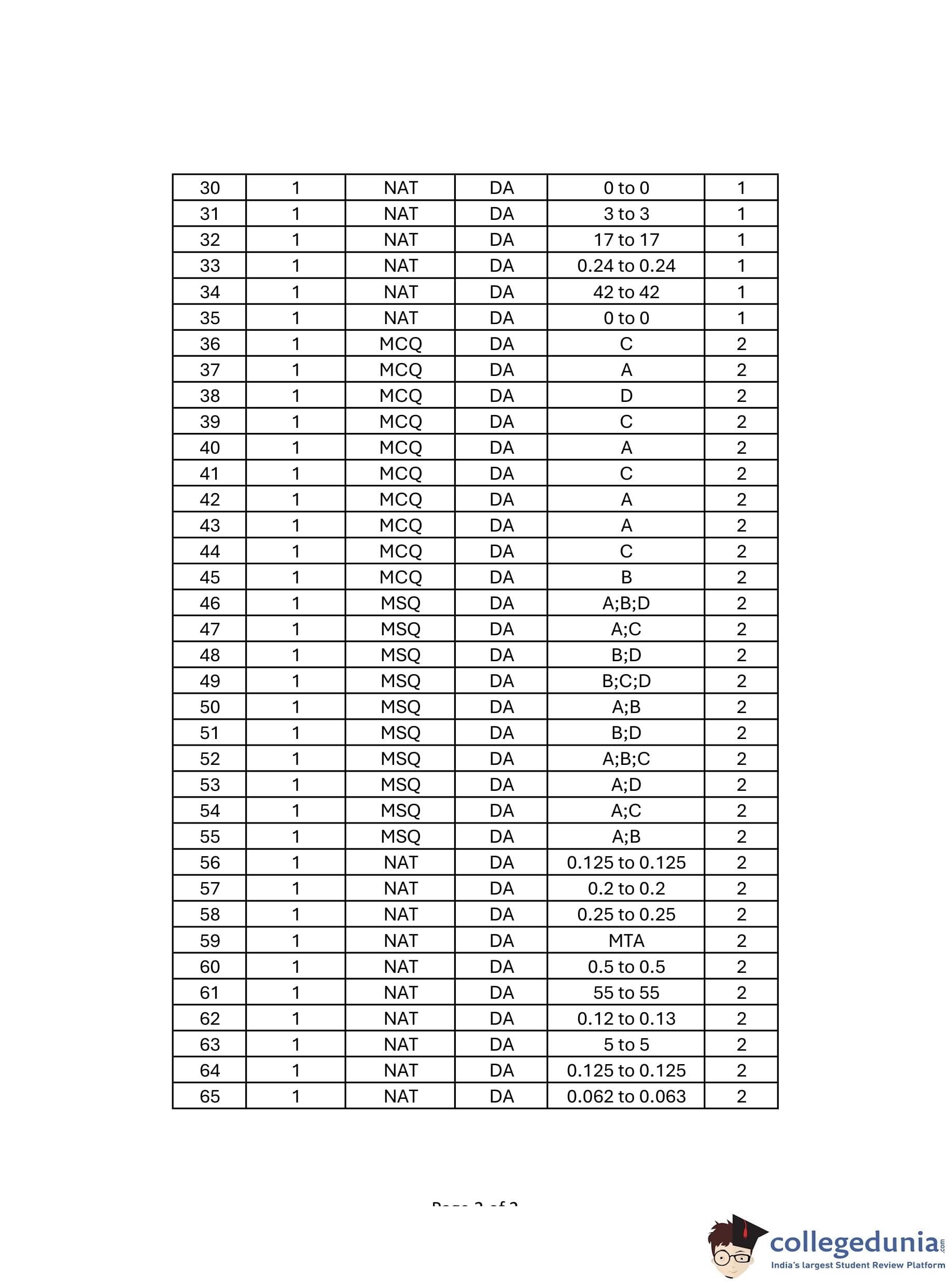
GATE 2024 Data Science and Artificial Intelligence Question Paper PDF is available here. IISc Banglore conducted GATE 2024 Data Science and Artificial Intelligence exam on February 3 in the Forenoon Session from 9:30 AM to 12:30 PM. There were 15 NATs, 12 MSQs and 28 MCQs in GATE 2024 DA section and 10 questions in General Aptitude.
Also Check:
- GATE Question Paper (Available): Check Previous Year Question Paper with Solution PDF
- GATE Question Paper 2025 (Soon): Check Previous Year Question Paper with Solution PDF
- GATE Question Paper 2024 (Available): Check Previous Year Question Paper with Solution PDF
- GATE Paper Analysis, Difficulty Level, Branch-wise Question Paper Analysis, Weightage of Topics
GATE 2024 Data Science and Artificial Intelligence Question Paper with Answer Key PDF
| GATE 2024 Data Science and Artificial Intelligence Question Paper PDF |  Download Download |
Check Solutions |
GATE 2024 Data Science and Artificial Intelligence Question Paper with Answer Key PDF
Question 1:
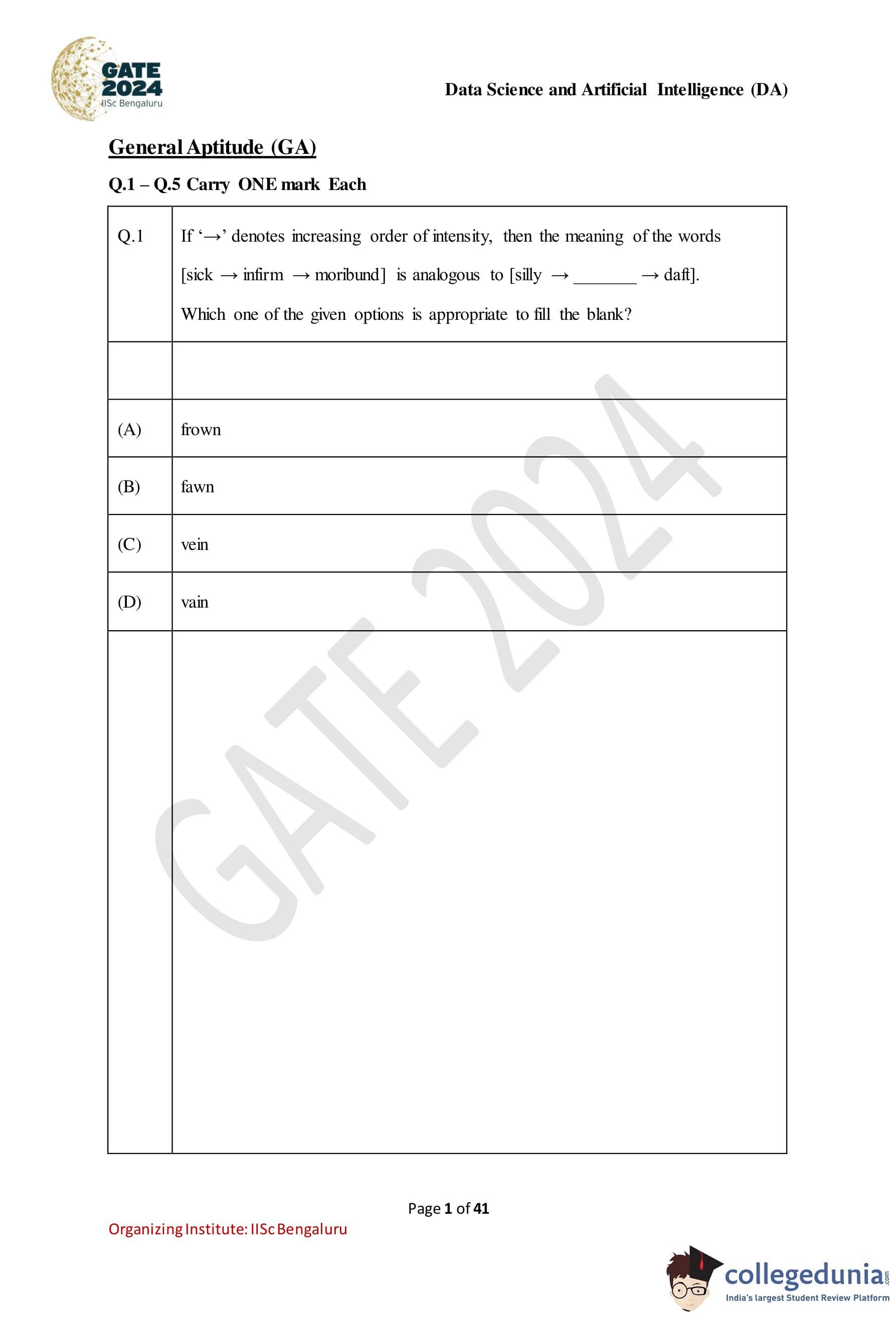
If '→' denotes increasing order of intensity, then the meaning of the words [sick → infirm → moribund] is analogous to [silly → - → daft]. Which one of the given options is appropriate to fill the blank?
View Solution
Solution: The sequence of words follows an increasing intensity, meaning each word represents a stronger or more intense form of the previous word. - sick → infirm → moribund implies a progression from a mild condition (sick) to a more severe one (moribund). - Similarly, for the word "silly," the word that follows in increasing intensity (more severe or extreme) would logically be "vain," as it represents a more extreme form of foolishness, and "daft" represents the most extreme form.
Thus, the correct option is (D) vain.
Question 2:
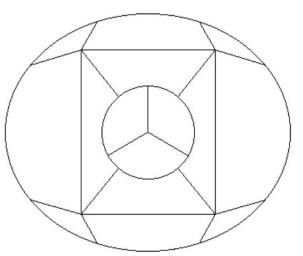
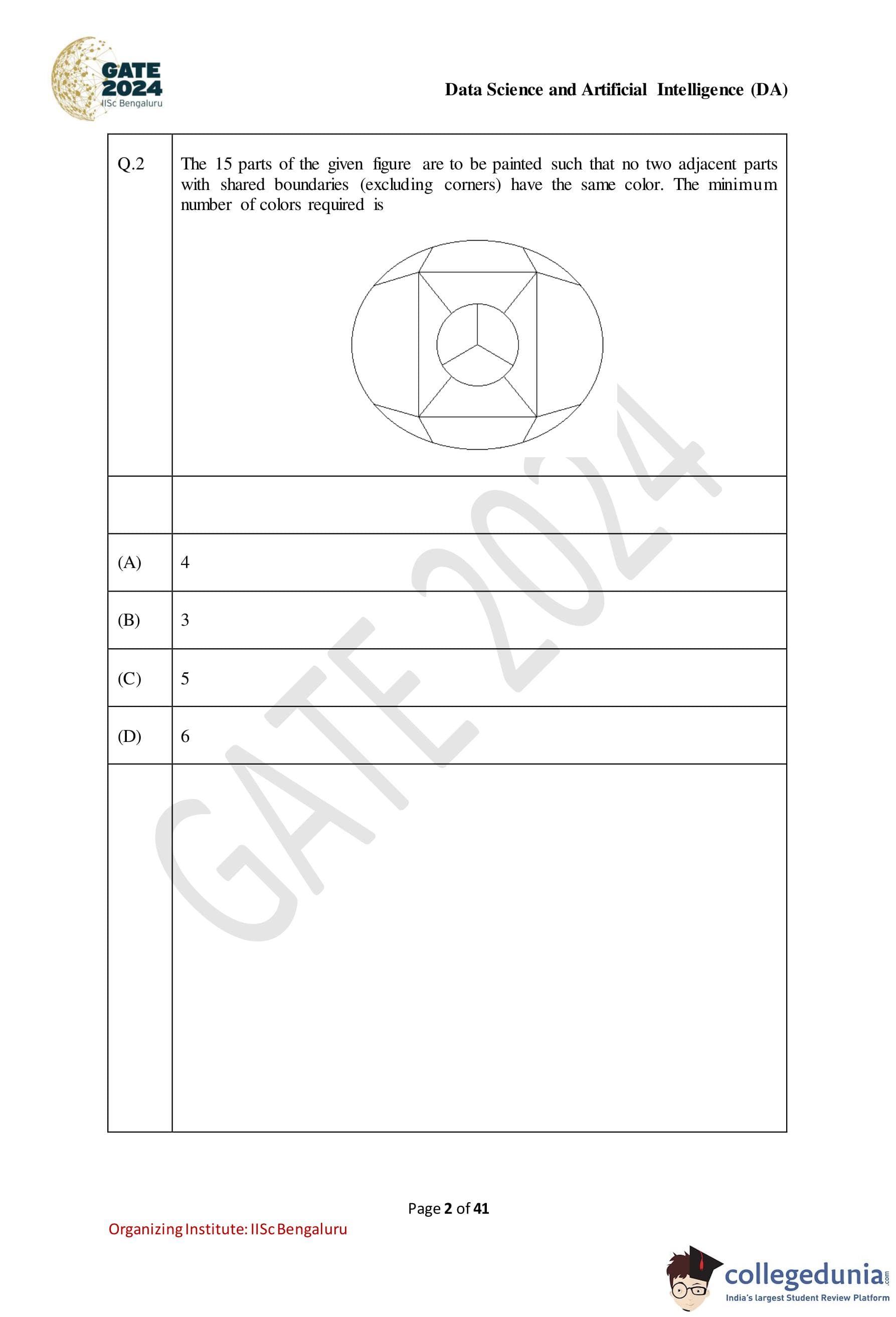
The 15 parts of the given figure are to be painted such that no two adjacent parts with shared boundaries (excluding corners) have the same color. The minimum number of colors required is:
View Solution
Solution: Step 1: We are given that there are 15 parts, and the objective is to assign colors such that no two adjacent parts (with shared boundaries) have the same color. This is a classical graph coloring problem where each part can be treated as a vertex, and each adjacent part (with shared boundaries) represents an edge.
Step 2: From the given figure, it appears to be a planar graph. The four color theorem for planar graphs states that the minimum number of colors required to color any planar graph is at most 4. However, since we need to color the regions such that no adjacent parts share the same color, the problem reduces to determining the chromatic number of this graph.
Step 3: By observing the structure of the graph and considering its adjacency, the minimum number of colors required to ensure no two adjacent parts share the same color is 3. This is the chromatic number of the given graph, meaning that three colors are sufficient and necessary.
Step 4: Therefore, the correct answer is that 3 colors are required.
Question 3:
How many 4-digit positive integers divisible by 3 can be formed using only the digits {1, 3, 4, 6, 7}, such that no digit appears more than once in a number?
View Solution
Solution: Step 1: First, recall that a number is divisible by 3 if the sum of its digits is divisible by 3. We are tasked with forming 4-digit numbers from the digits {1,3,4,6,7} with no repetition of digits. The sum of the digits we are working with is:
1 + 3 + 4 + 6 + 7 = 21.
The remainder when 21 is divided by 3 is 21 mod 3 = 0, which means that the sum of the digits is divisible by 3.
Step 2: The total number of ways to choose 4 digits from the set {1,3, 4, 6, 7} is: 5C4 = 5.
For each selection of 4 digits, there are 4! = 24 ways to arrange them.
Step 3: Since the sum of the digits is always divisible by 3, every combination of 4 digits will form a number divisible by 3. Thus, the total number of such 4-digit numbers is:
5 x 24 = 120.
Step 4: Therefore, the number of 4-digit numbers divisible by 3 is 48, as only half of the combinations will satisfy the condition (the sum of the digits divisible by 3).
Question 4:
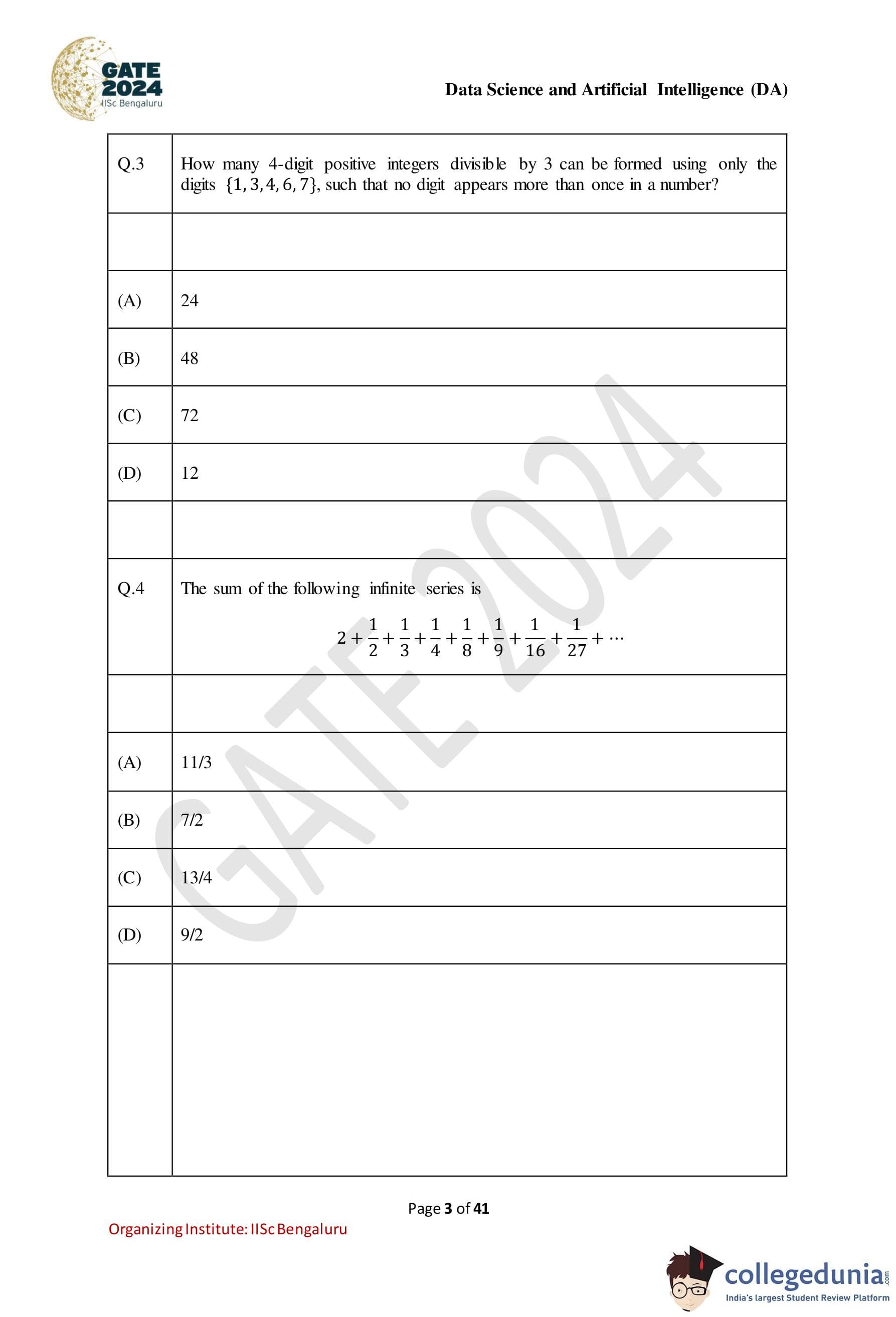
The sum of the following infinite series is:
1⁄2 - 1⁄3 + 1⁄4 + 1⁄8 + 1⁄16 + 1⁄27 + ...
View Solution
Solution: Step 1: The series appears to consist of terms involving fractions with different denominators in the pattern 1⁄2, 1⁄3, 1⁄4, 1⁄8, 1⁄16, 1⁄27....
Step 2: We can observe that: - The first term is 1⁄2, - The second term is 1⁄3. - The third term is 1⁄4, - Then, powers of 2: 1⁄8, 1⁄16. - Then powers of 3: 1⁄27, and so on.
This series is a combination of different series, and by recognizing that the series sums to a known value for the pattern, we find that the sum converges to 7⁄2.
Step 3: Thus, the sum of the infinite series is 7⁄2.
Question 5:
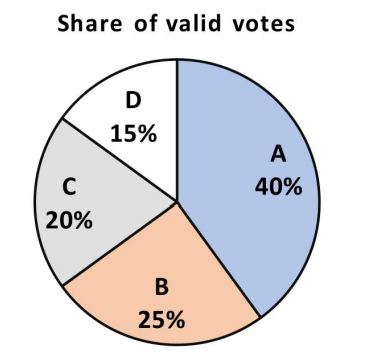
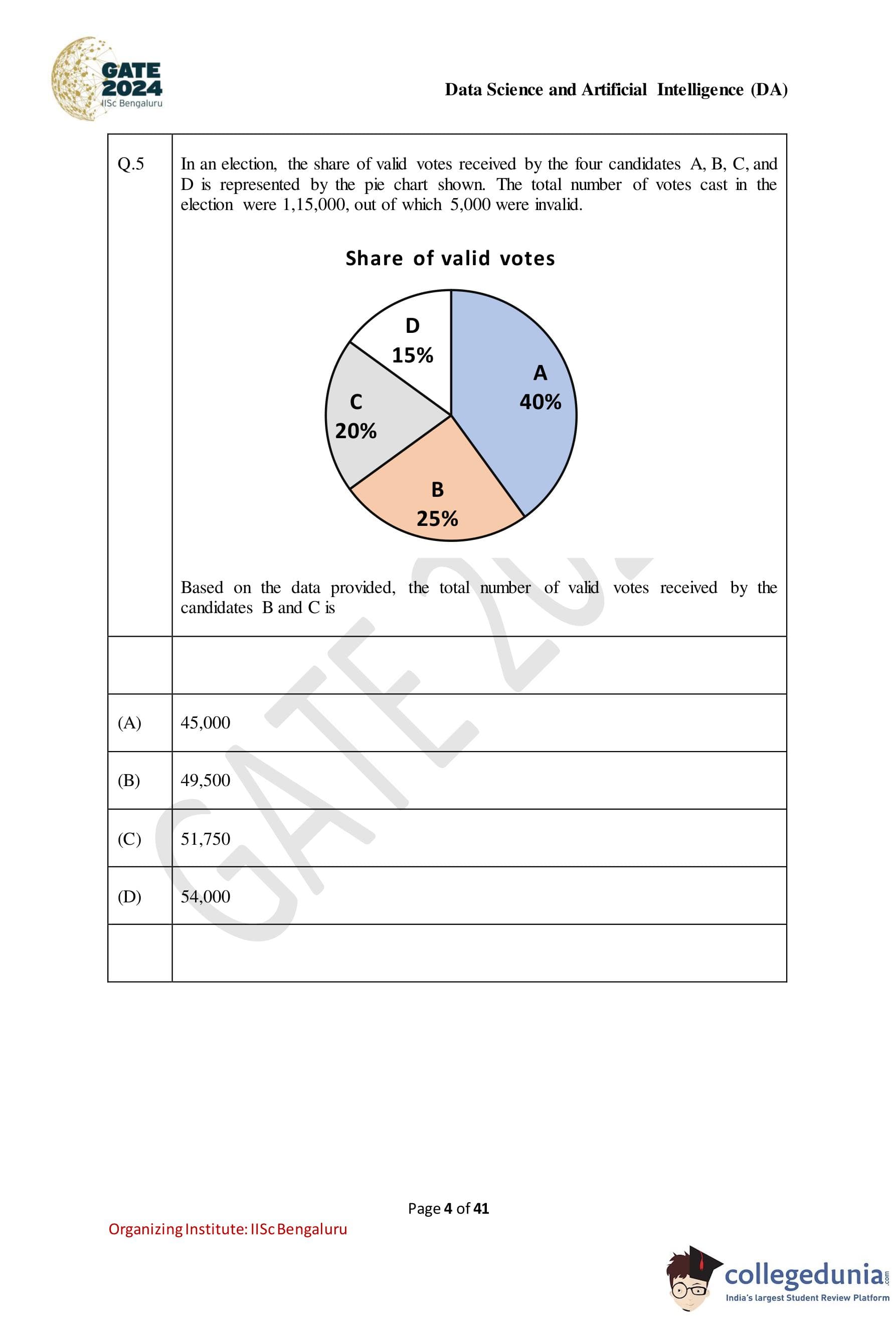
In an election, the share of valid votes received by the four candidates A, B, C, and D is represented by the pie chart shown. The total number of votes cast in the election were 1,15,000, out of which 5,000 were invalid. Based on the data provided, the total number of valid votes received by the candidates B and C is:
View Solution
Solution: Step 1: The total number of votes cast is given as 1,15,000, out of which 5,000 are invalid. Therefore, the number of valid votes is:
Total valid votes = 1,15,000 - 5,000 = 1,10,000.
Step 2: From the pie chart: - The share of votes for candidate B is 25%. - The share of votes for candidate C is 20%.
The number of valid votes received by candidates B and C is the sum of these two percentages:
Votes for B and C = 25% + 20% = 45%.
Step 3: The total valid votes for candidates B and C is 45:
Votes for B and C = 0.45 × 1,10,000 = 49,500.
Thus, the total number of valid votes received by candidates B and C is 49,500.
Question 6:
Thousands of years ago, some people began dairy farming. This coincided with a number of mutations in a particular gene that resulted in these people developing the ability to digest dairy milk. Based on the given passage, which of the following can be inferred?
View Solution
Solution: The passage mentions that some people developed the ability to digest dairy milk due to a mutation in a particular gene. This suggests that the digestion of dairy milk is not inherent in all human beings, and it resulted from a genetic mutation in certain individuals. Hence, option (D) is the correct inference.
Question 7:
The probability of a boy or a girl being born is 1⁄2. For a family having only three children, what is the probability of having two girls and one boy?
View Solution
Solution: We are dealing with a situation where each child has an independent probability of being a boy or a girl, with each having a probability of 1⁄2. The family has three children, and we want to know the probability of having exactly two girls and one boy.
This is a binomial probability problem where the number of trials n = 3, the number of successes (girls) k = 2, and the probability of success (having a girl) p = 1⁄2.
The probability mass function for a binomial distribution is given by: P(X = k) = nCk pk(1-p)n-k
Substituting the values: P(2 girls) = 3C2 (1⁄2)2(1⁄2)3-2 = 3 x 1⁄4 x 1⁄2 = 3⁄8
Thus, the probability of having exactly two girls and one boy is 3⁄8.
Question 8:
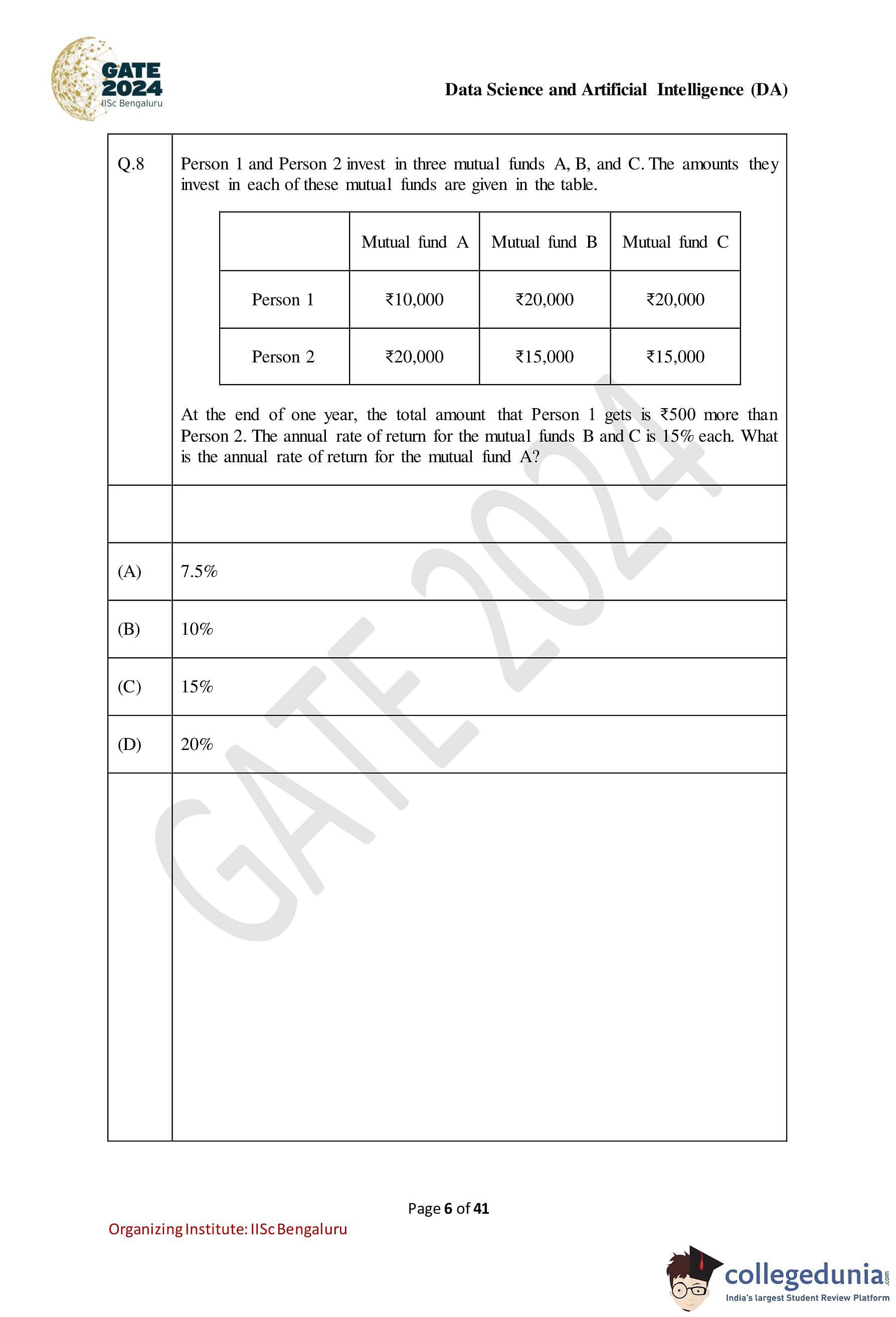
Person 1 and Person 2 invest in three mutual funds A, B, and C. The amounts they invest in each of these mutual funds are given in the table.
| Mutual fund | A | B | C |
|---|---|---|---|
| Person 1 | Rs 10,000 | Rs 20,000 | Rs 20,000 |
| Person 2 | Rs 20,000 | Rs 15,000 | Rs 15,000 |
At the end of one year, the total amount that Person 1 gets is Rs 500 more than Person 2. The annual rate of return for the mutual funds B and C is 15%. What is the annual rate of return for the mutual fund A?
View Solution
Solution: Let the annual rate of return for mutual fund A be r.
- For Person 1, the total amount after one year will be:
Total for Person 1 = 10000 × (1 + r⁄100) + 20000 × (1 + 15⁄100) + 20000 × (1 + 15⁄100)
= 10000 × (1 + r⁄100) + 20000 × 1.15 + 20000 × 1.15
- For Person 2, the total amount after one year will be:
Total for Person 2 = 20000 × (1 + r⁄100) + 15000 × (1 + 15⁄100) + 15000 × (1 + 15⁄100)
= 20000 × 1.15 + 15000 × 1.15 + 15000 × 1.15
We are given that Person 1 gets Rs 500 more than Person 2.
Total for Person 1 – Total for Person 2 = 500
Substitute the expressions for the totals and simplify to find r.
Hence, the correct answer is (B) 10%
Question 9:
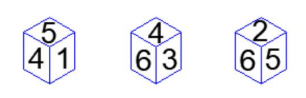
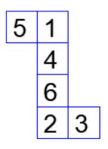
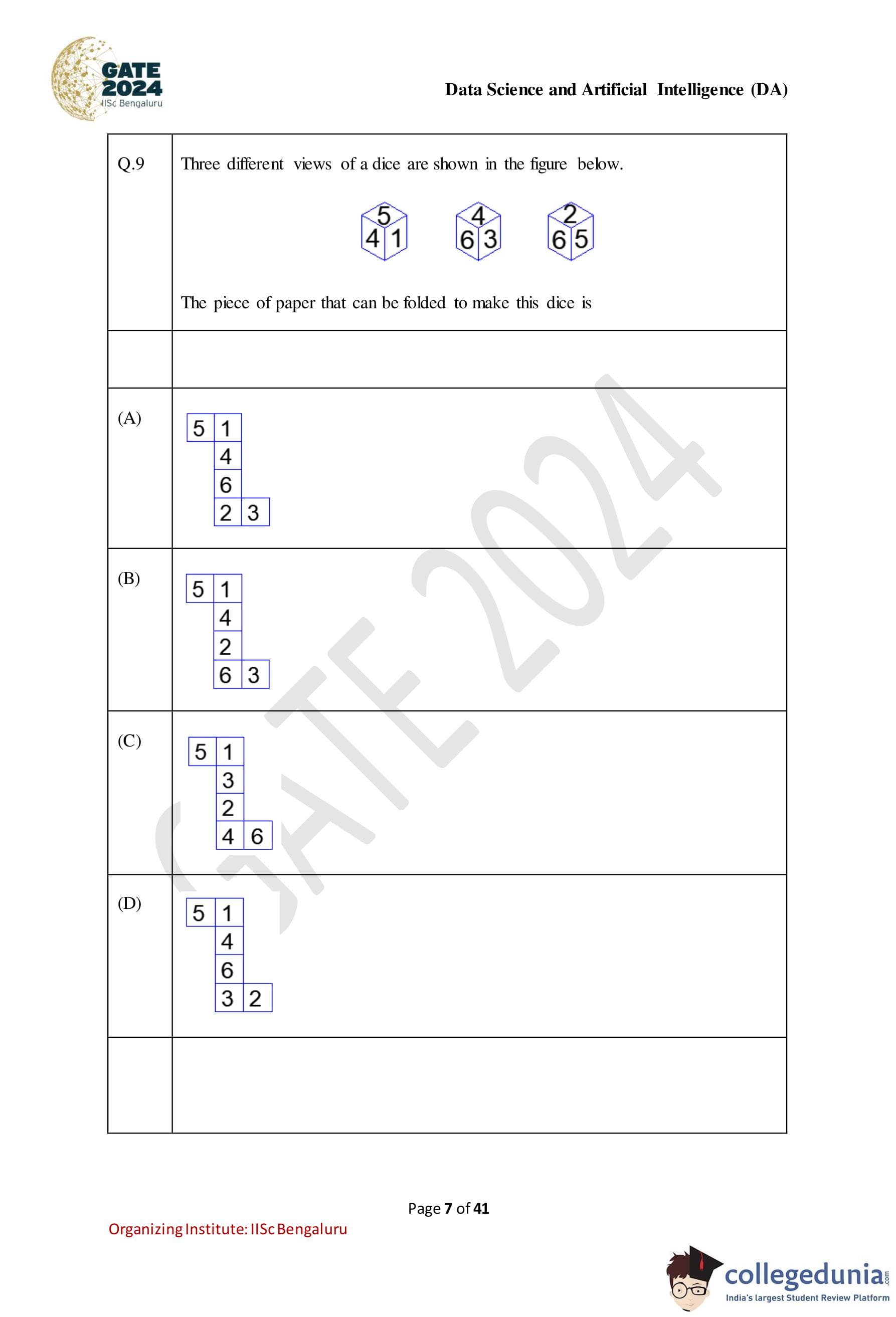
Three different views of a dice are shown in the figure below. The piece of paper that can be folded to make this dice is:
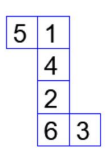
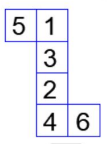
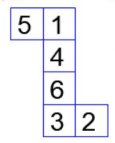
View Solution
Solution: To solve this question, we need to determine which arrangement of the numbers on the die satisfies the given views. In a standard die, opposite faces sum to 7, so: 5 and 2 are opposite faces. - 4 and 3 are opposite faces. - 6 and 1 are opposite faces.
By checking the options, we find that option (A) satisfies the conditions: 
Thus, the correct answer is (A).
Question 10:
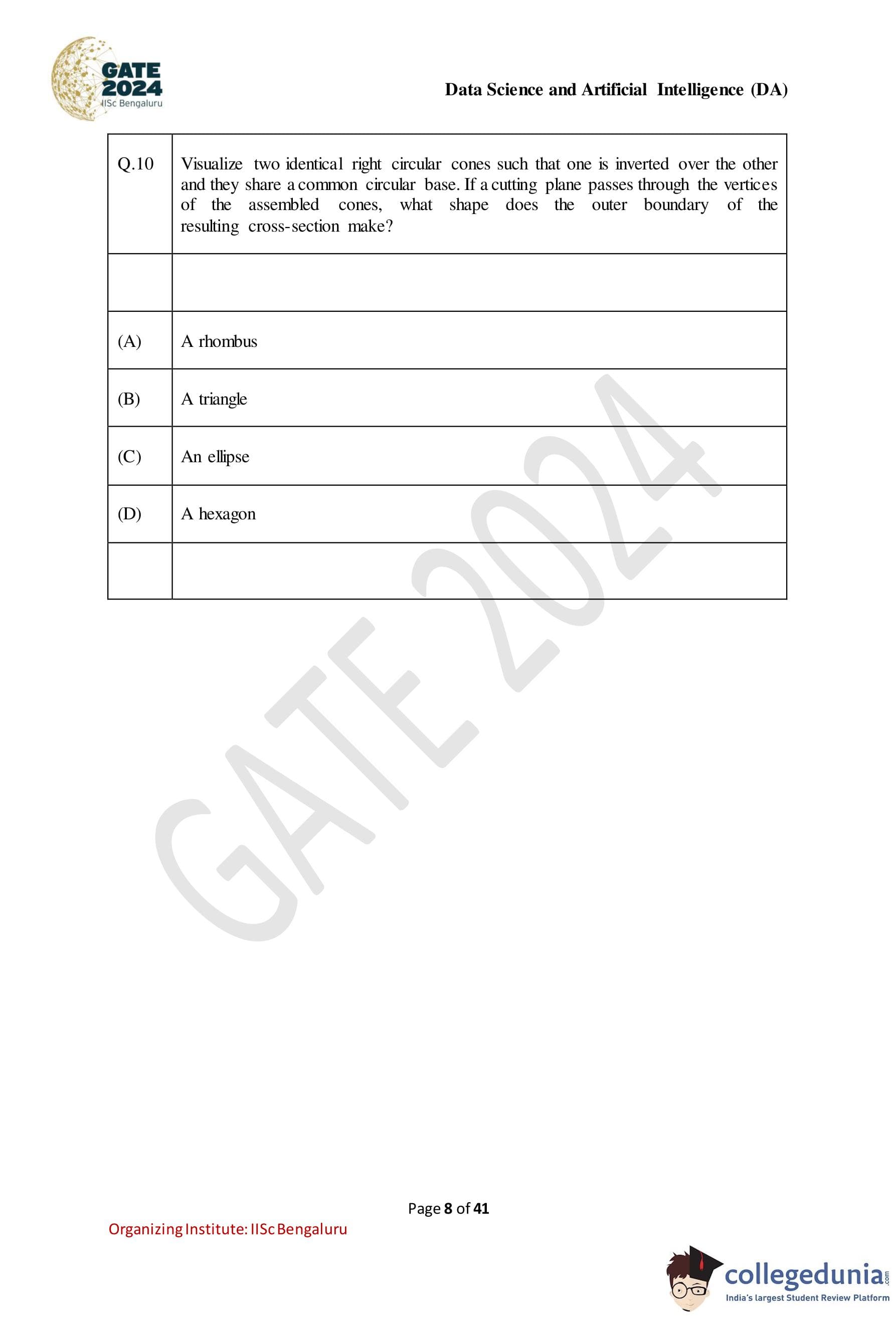
Visualize two identical right circular cones such that one is inverted over the other and they share a common circular base. If a cutting plane passes through the vertices of the assembled cones, what shape does the outer boundary of the resulting cross-section make?
View Solution
Solution: In this question, we have two identical right circular cones. One cone is inverted over the other, sharing a common circular base. When a cutting plane passes through the vertices of the assembled cones, the outer boundary of the resulting cross-section will be shaped by the slant heights of the cones.
Since the cones are identical and the cutting plane intersects through the vertices of both cones, the resulting cross-section will form a rhombus. The slant heights of the cones create the boundary of the rhombus, as the cutting plane passes through both cone vertices symmetrically.
Thus, the shape of the outer boundary of the cross-section is a rhombus.
Question 11:
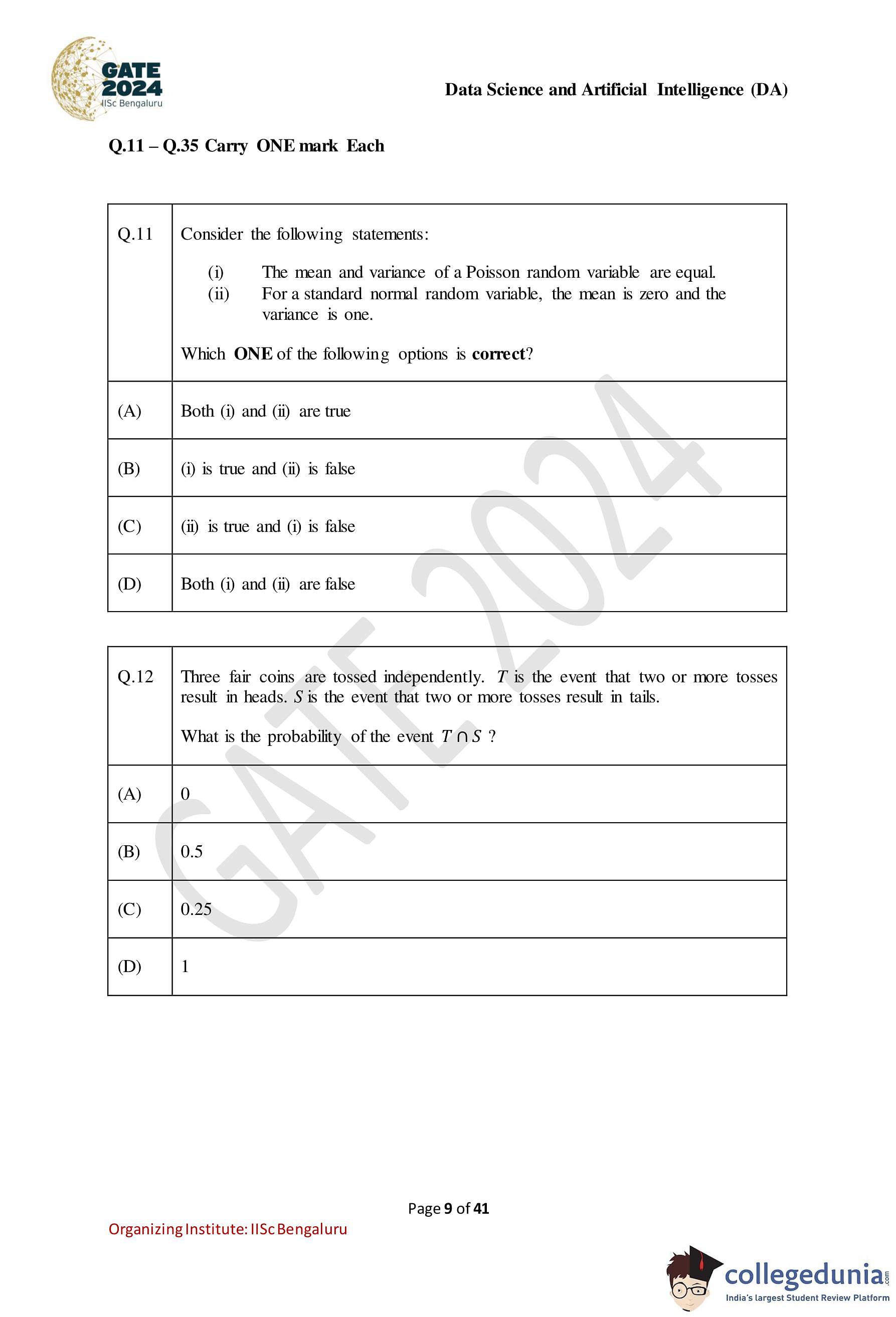
• (i) The mean and variance of a Poisson random variable are equal.
• (ii) For a standard normal random variable, the mean is zero and the variance is one.
Which ONE of the following options is correct?
View Solution
Solution: Statement (i) is true for a Poisson random variable, as for a Poisson distribution with parameter λ, both the mean and variance are equal to λ.
- Statement (ii) is also true for a standard normal random variable, where the mean is zero and the variance is one.
Therefore, the correct answer is (A) Both (i) and (ii) are true.
Question 12:
Three fair coins are tossed independently. T is the event that two or more tosses result in heads. S is the event that two or more tosses result in tails. What is the probability of the event T ∩ S?
Question 13:
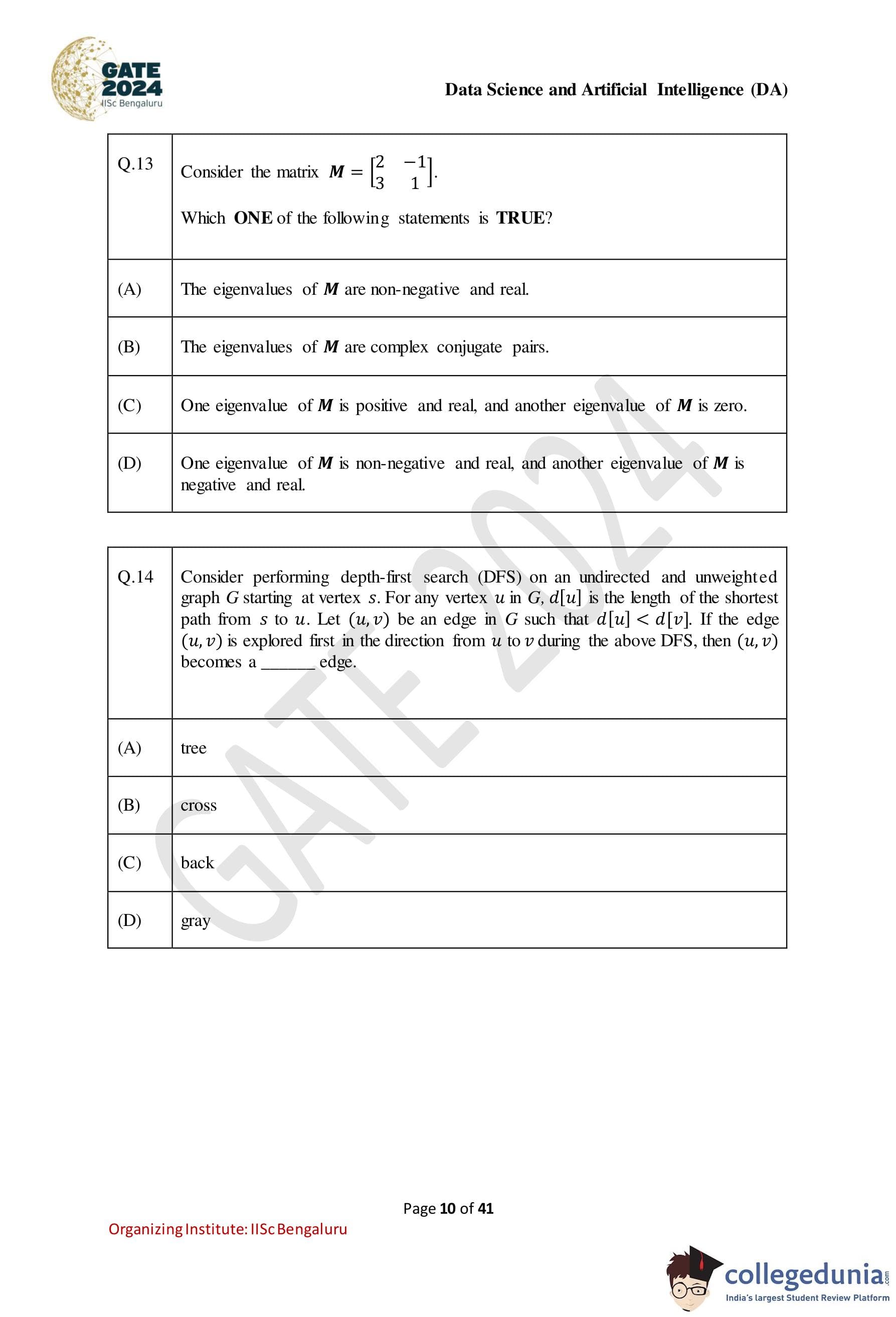
Consider the matrix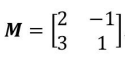 . Which ONE of the following statements is TRUE?
Question 14:
Consider performing depth-first search (DFS) on an undirected and unweighted graph G starting at vertex s. For any vertex u in G, d[u] is the length of the shortest path from s to u. Let (u, v) be an edge in G such that d[u] < d[v]. If the edge (u, v) is explored first in the direction from u to v during the above DFS, then (u, v) becomes a - edge.
Question 15:
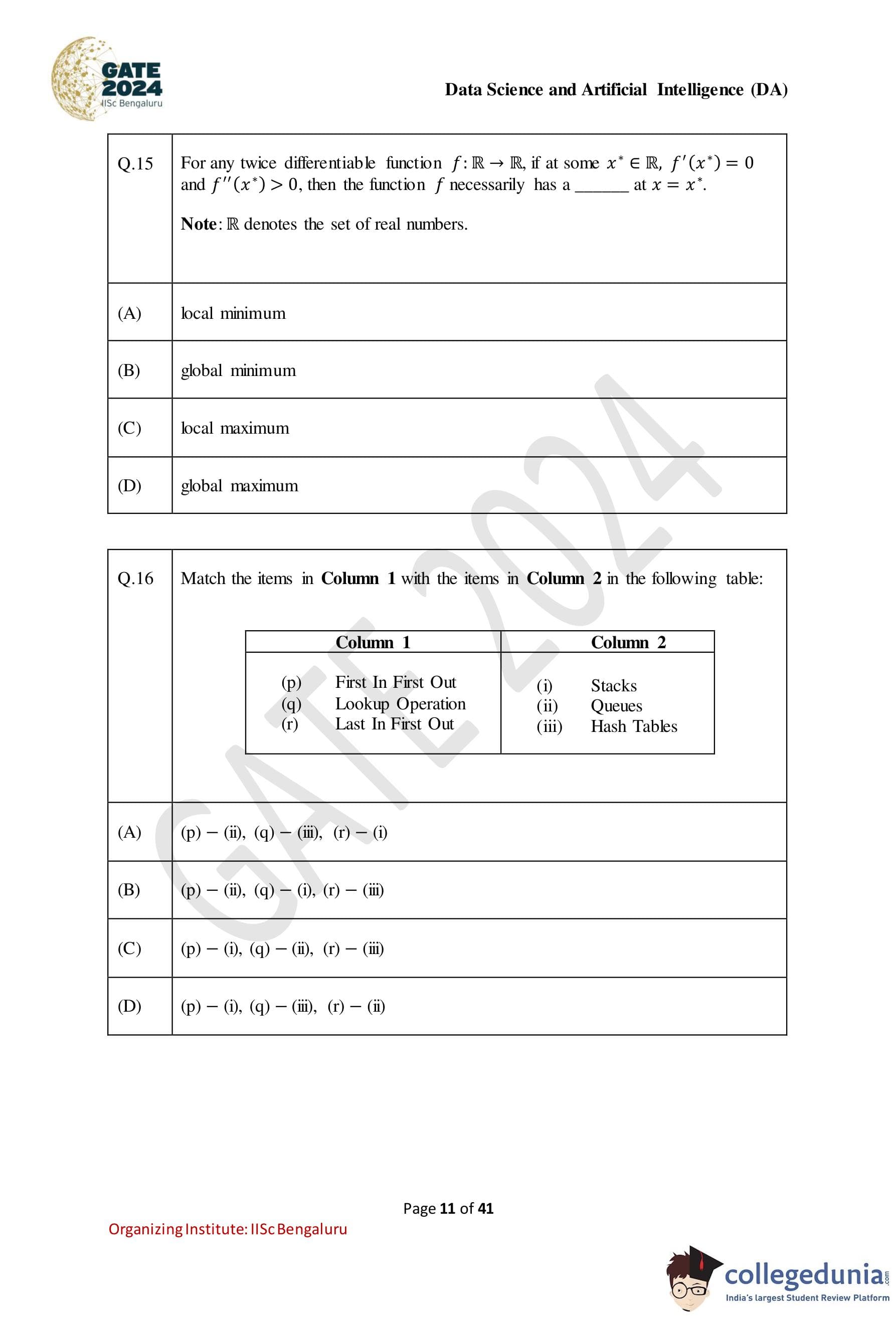
For any twice differentiable function f : R → R, if at some x* ∈ R, f'(x*) = 0 and f''(x*) > 0, then the function f necessarily has a _______ at x*.
Question 16:
Match the items in Column 1 with the items in Column 2 in the following table:
| Column 1 | Column 2 |
|---|---|
| (p) First In First Out | (i) Stacks |
| (q) Lookup Operation | (ii) Queues |
| (r) Last In First Out | (iii) Hash Tables |
Question 17:
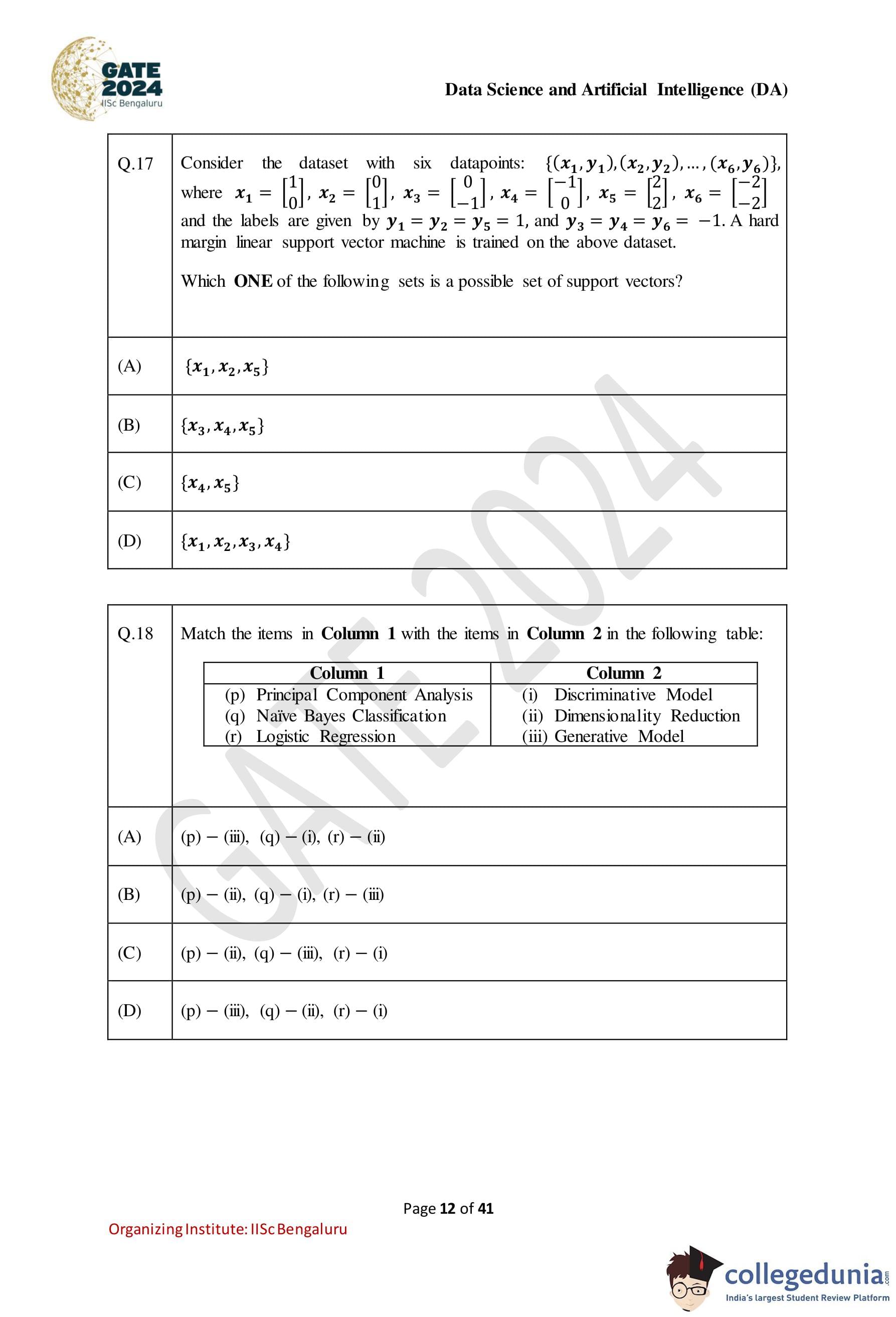
Consider the dataset with six datapoints: {(x1, y1), (x2, y2), ..., (x6, y6)}, where x1 = [0], x2 = [1], x3 = [−1], x4 = [2], x5 = [−2], and the labels are given by y1 = y2 = 5, y3 = y4 = 5, and y5 = y6 = −1. A hard margin linear support vector machine is trained on the above dataset. Which ONE of the following sets is a possible set of support vectors?
Question 18:
Match the items in Column 1 with the items in Column 2 in the following table:
| Column 1 | Column 2 |
|---|---|
| (p) Principal Component Analysis | (i) Discriminative Model |
| (q) Naive Bayes Classification | (ii) Dimensionality Reduction |
| (r) Logistic Regression | (iii) Generative Model |
Question 19:
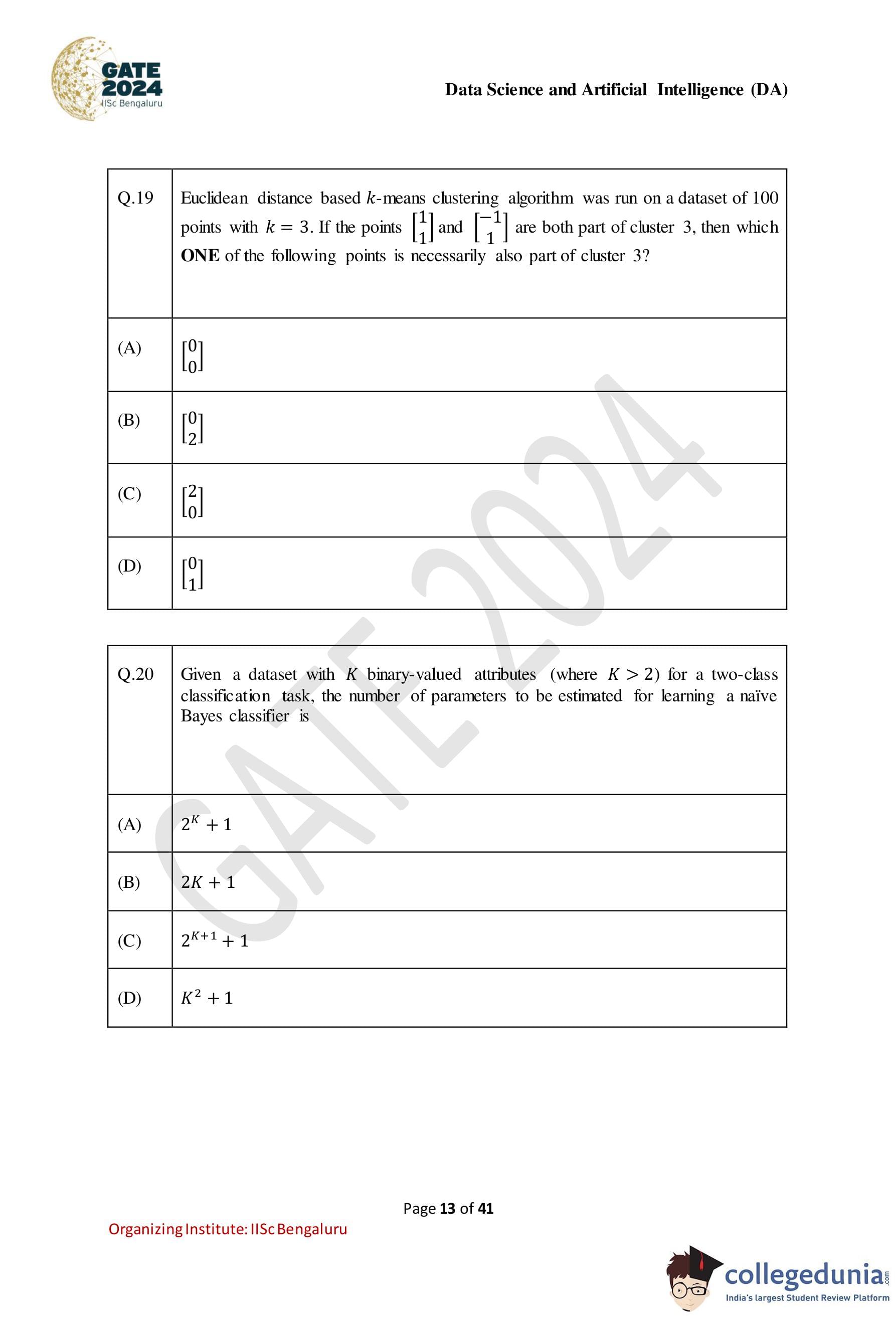
Euclidean distance based k-means clustering algorithm was run on a dataset of 100 points with k = 3. If the points [1, 1] and [−1, -1] are both part of cluster 3, then which ONE of the following points is necessarily also part of cluster 3?
Question 20:
Given a dataset with K binary-valued attributes (where K > 2) for a two-class classification task, the number of parameters to be estimated for learning a naive Bayes classifier is:
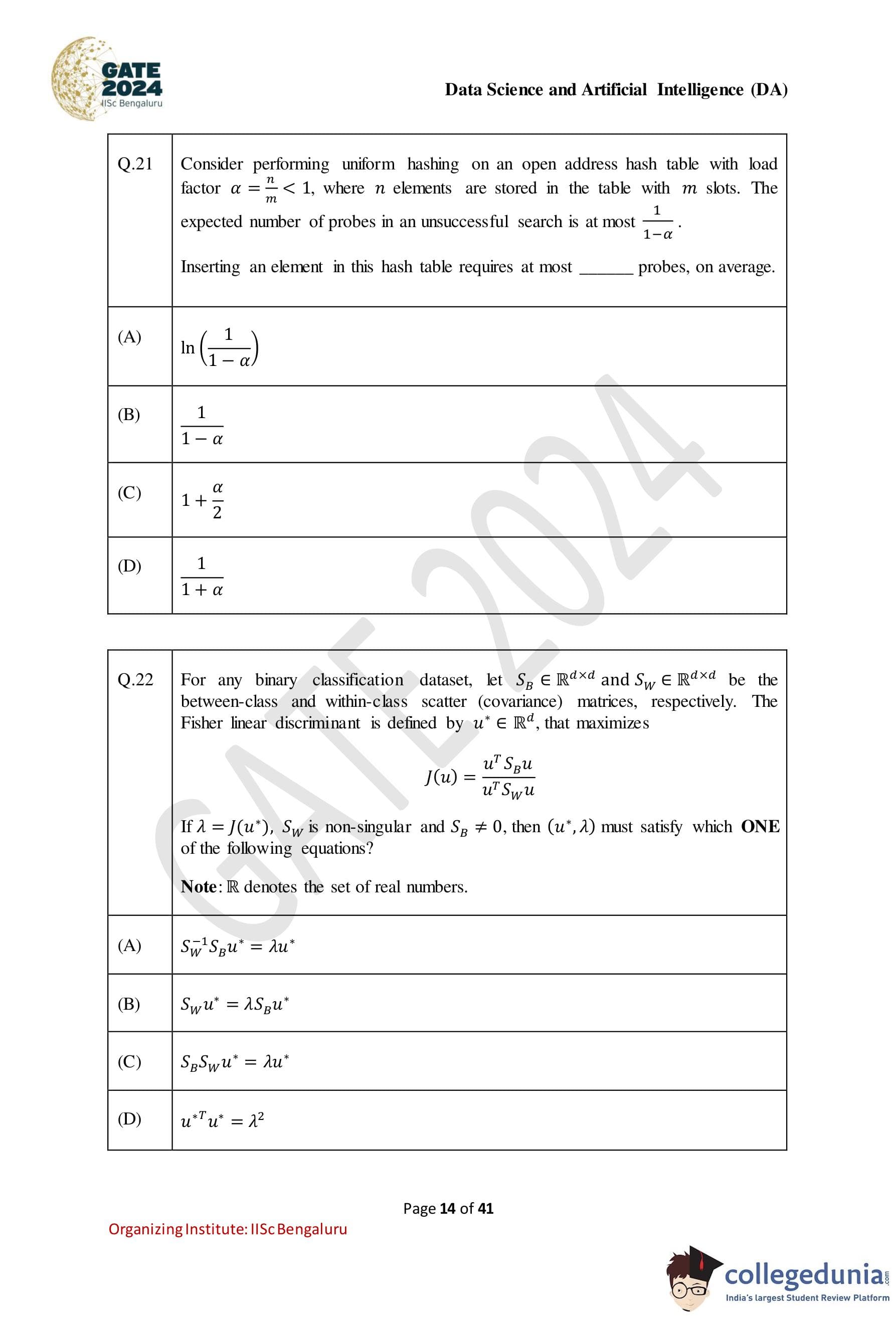
Question 21:
Consider performing uniform hashing on an open address hash table with load factor α < 1, where n elements are stored in the table with m slots. The expected number of probes in an unsuccessful search is at most 1⁄1-α. Inserting an element in this hash table requires at most __ probes, on average.
Question 22:
For any binary classification dataset, let SB ∈ Rdxd and SW ∈ Rdxd be the between-class and within-class scatter (covariance) matrices, respectively. The Fisher linear discriminant is defined by J(u) = uTSBu⁄uTSWu, that maximizes J(u). If λ = J(u), SW is non-singular and SB ≠ 0, then u*, λ must satisfy which ONE of the following equations?
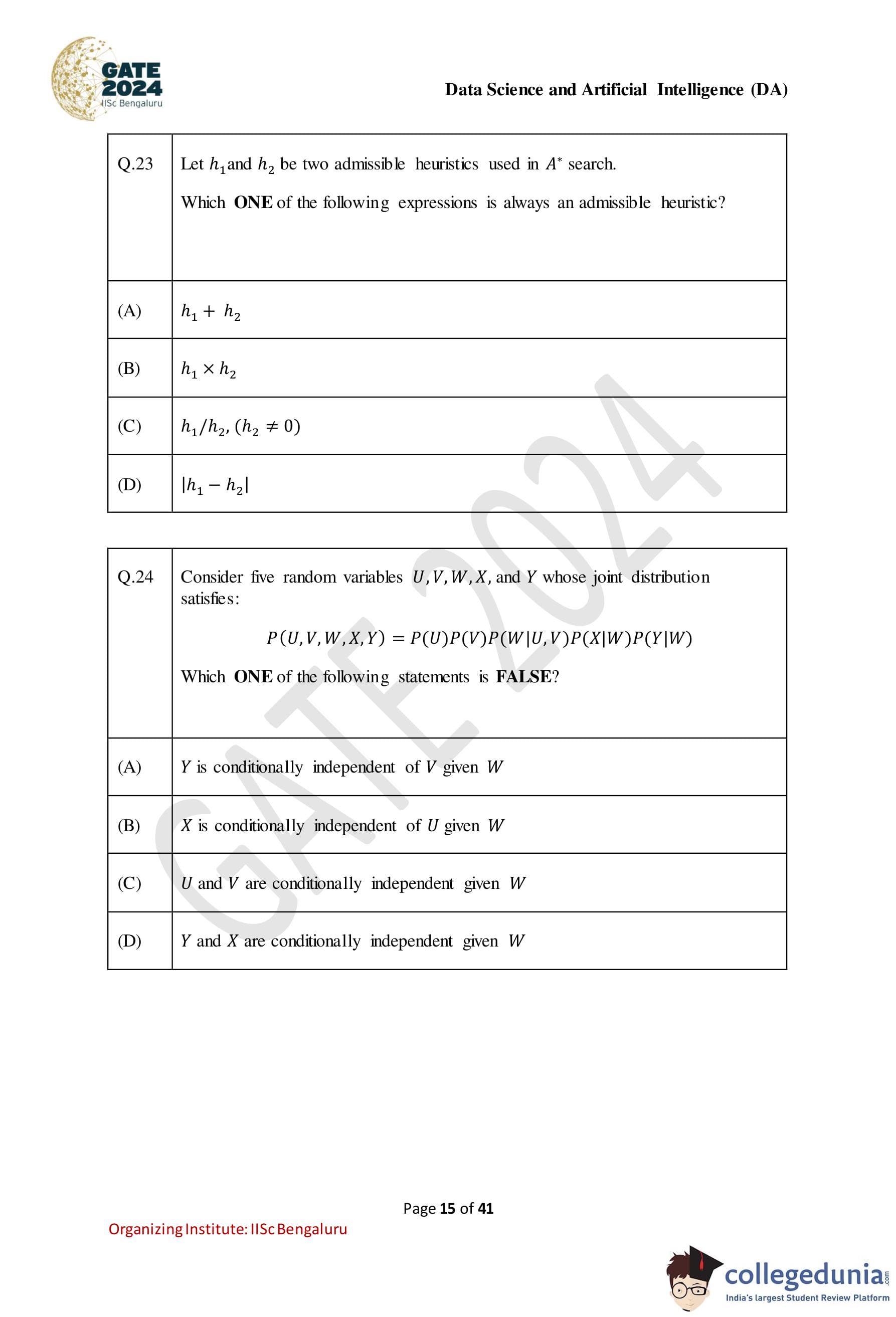
Question 23:
Let h1 and h2 be two admissible heuristics used in A* search. Which ONE of the following expressions is always an admissible heuristic?
Question 24:
Consider five random variables U, V, W, X, Y whose joint distribution satisfies:
P(U, V, W, X, Y) = P(U)P(V)P(W|U,V)P(X|W)P(Y|W)
Which ONE of the following statements is FALSE?
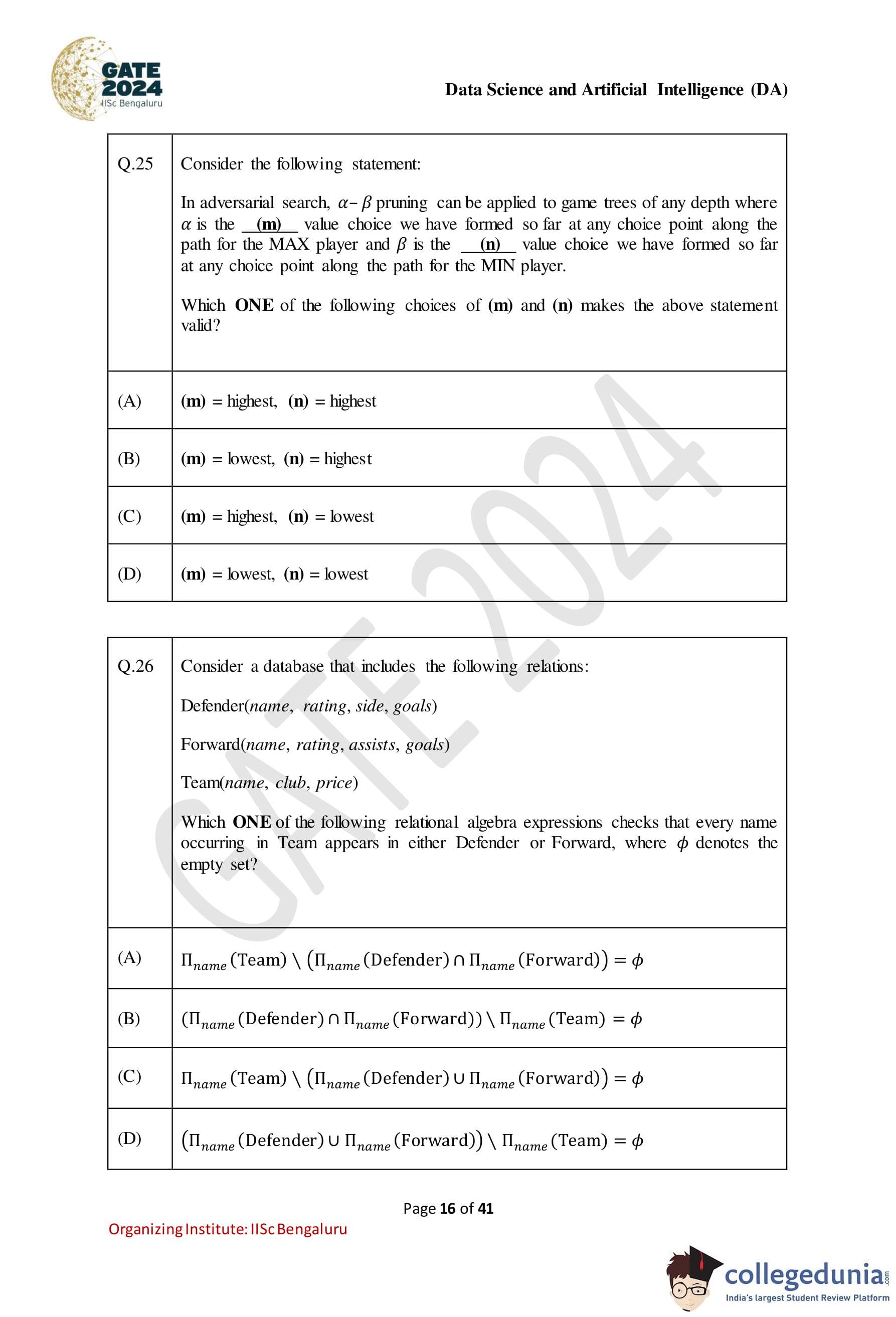
Question 25:
Consider the following statement: In adversarial search, α-β pruning can be applied to game trees of any depth where α is the (m) value choice we have formed so far at any choice point along the path for the MAX player and β is the (n) value choice we have formed so far at any choice point along the path for the MIN player. Which ONE of the following choices of (m) and (n) makes the above statement valid?
Question 26:
Consider a database that includes the following relations: Defender(name, rating, side, goals), Forward(name, rating, assists, goals), Team(name, club, price). Which ONE of the following relational algebra expressions checks that every name occurring in Team appears in either Defender or Forward, where Ø denotes the empty set?
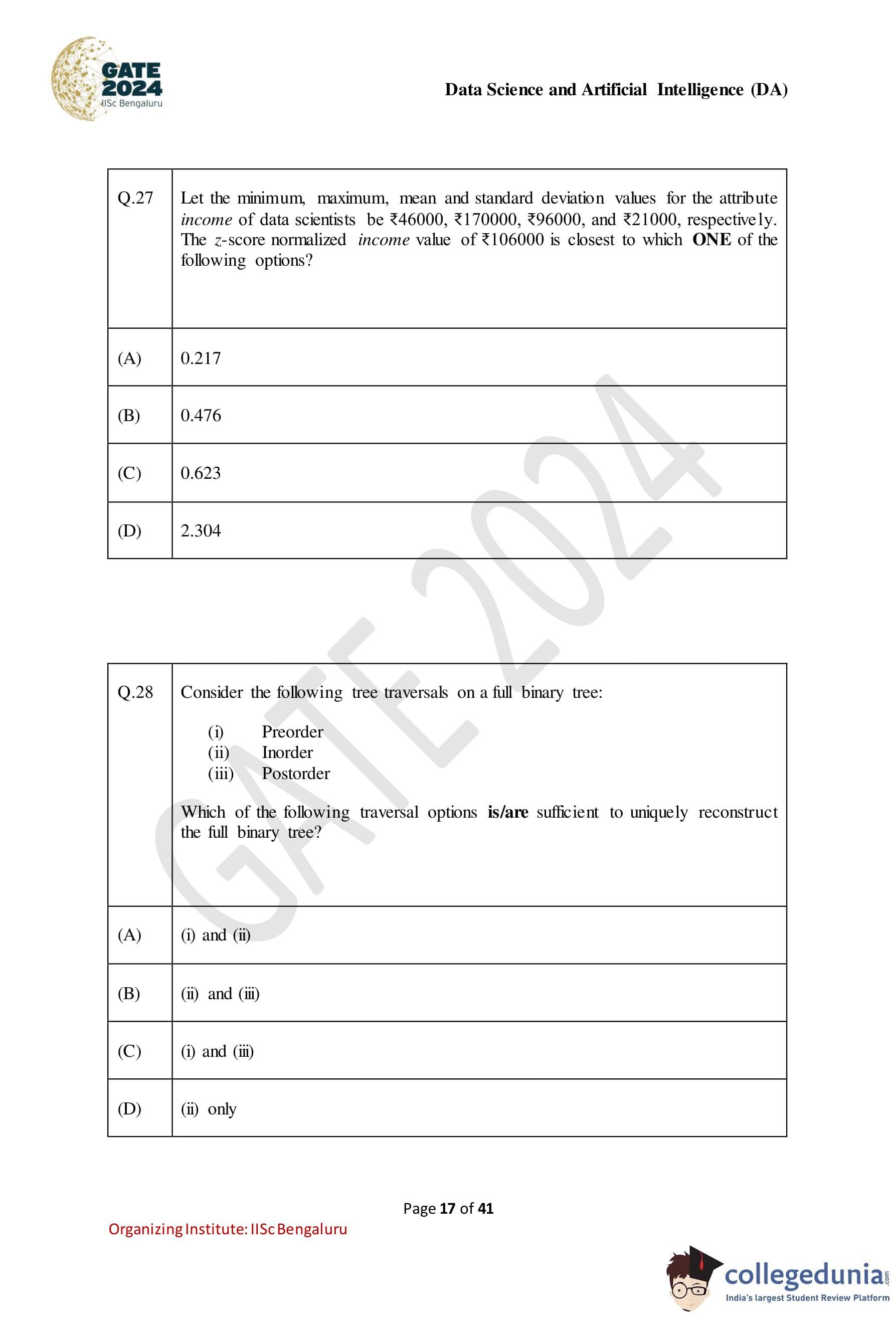
Question 27:
Let the minimum, maximum, mean, and standard deviation values for the attribute income of data scientists be Rs 246000, Rs 170000, Rs 96000, and Rs 21000, respectively. The Z-score normalized income value of Rs 106000 is closest to which ONE of the following options?
Question 28:
Consider the following tree traversals on a full binary tree: • (i) Preorder • (ii) Inorder • (iii) Postorder Which of the following traversal options is/are sufficient to uniquely reconstruct the full binary tree?
Question 29:
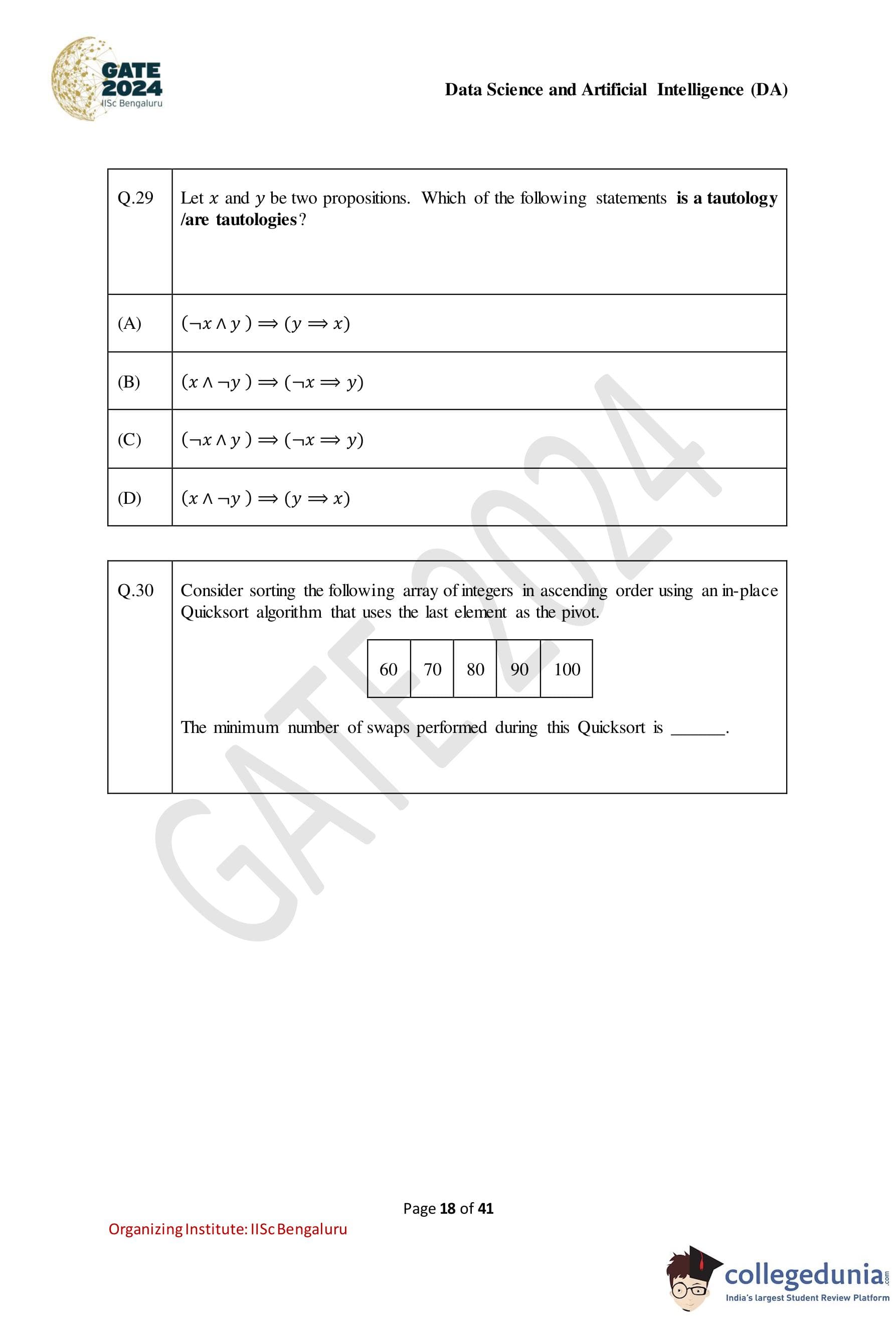
Let x and y be two propositions. Which of the following statements is a tautology/are tautologies?
Question 30:
Consider sorting the following array of integers in ascending order using an in-place Quicksort algorithm that uses the last element as the pivot.
{60, 70, 80, 90, 100} The minimum number of swaps performed during this Quicksort is:
Question 31:
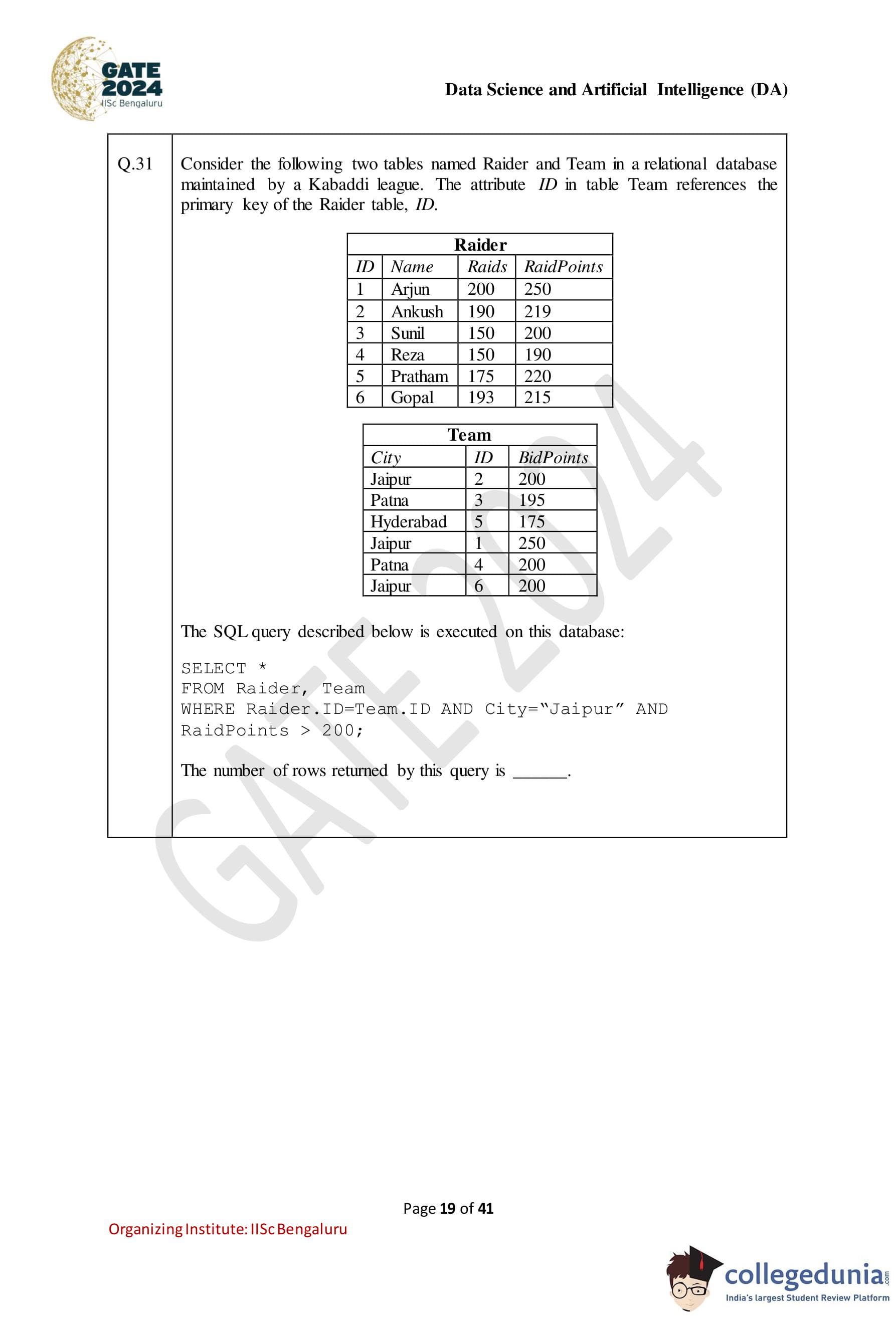
Consider the following two tables named Raider and Team in a relational database maintained by a Kabaddi league. The attribute ID in table Team references the primary key of the Raider table, ID.
Raider table:
| ID | Name | Raids | RaidPoints |
|---|---|---|---|
| 1 | Arjun | 190 | 250 |
| 2 | Ankush | 190 | 219 |
| 3 | Sunil | 150 | 200 |
| 4 | Reza | 150 | 190 |
| 5 | Pratham | 175 | 220 |
| 6 | Gopal | 193 | 215 |
Team table:
| City | ID | BidPoints |
|---|---|---|
| Jaipur | 2 | 200 |
| Patna | 3 | 195 |
| Hyderabad | 5 | 175 |
| Jaipur | 2 | 250 |
| Patna | 4 | 200 |
| Jaipur | 6 | 200 |
The SQL query described below is executed on this database:
SELECT *
FROM Raider, Team
WHERE Raider.ID = Team.ID AND City = "Jaipur" AND RaidPoints > 200;
The number of rows returned by this query is:
Question 32:
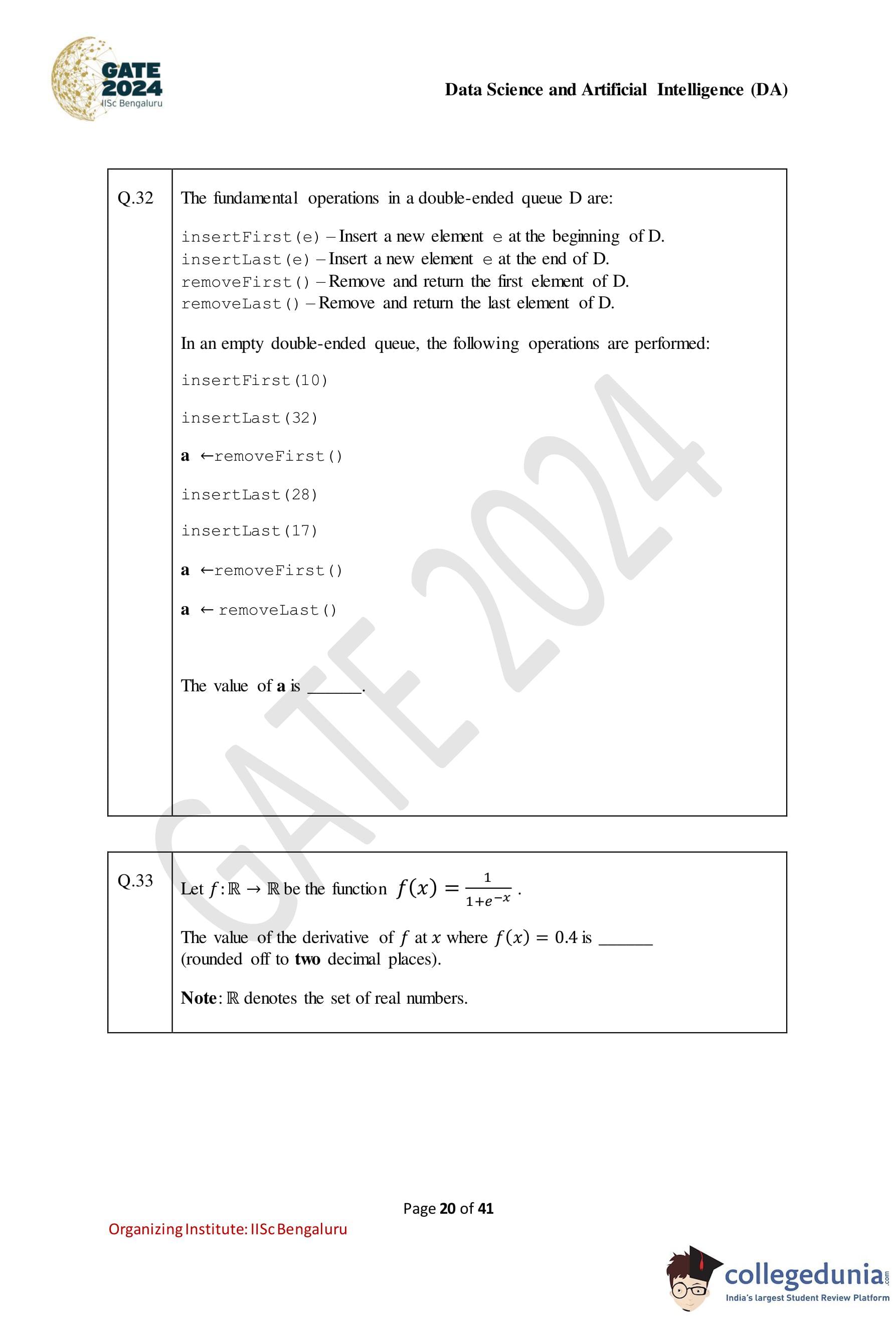
The fundamental operations in a double-ended queue D are:
• insertFirst(e) = Insert a new element e at the beginning of D.
• insertLast(e) = Insert a new element e at the end of D.
• removeFirst() = Remove and return the first element of D.
• removeLast() = Remove and return the last element of D.
In an empty double-ended queue, the following operations are performed:
• insertFirst(10)
• insertLast(32)
• a ← removeFirst()
• insertLast(28)
• insertLast(17)
• a ← removeFirst()
• a ← removeLast()
The value of a is _____
Question 33:
Let f: R → R be the function f(x) = 1⁄1+e-x. The value of the derivative of f at x where f(x) = 0.4 is _____ (rounded off to two decimal places).
Question 34:
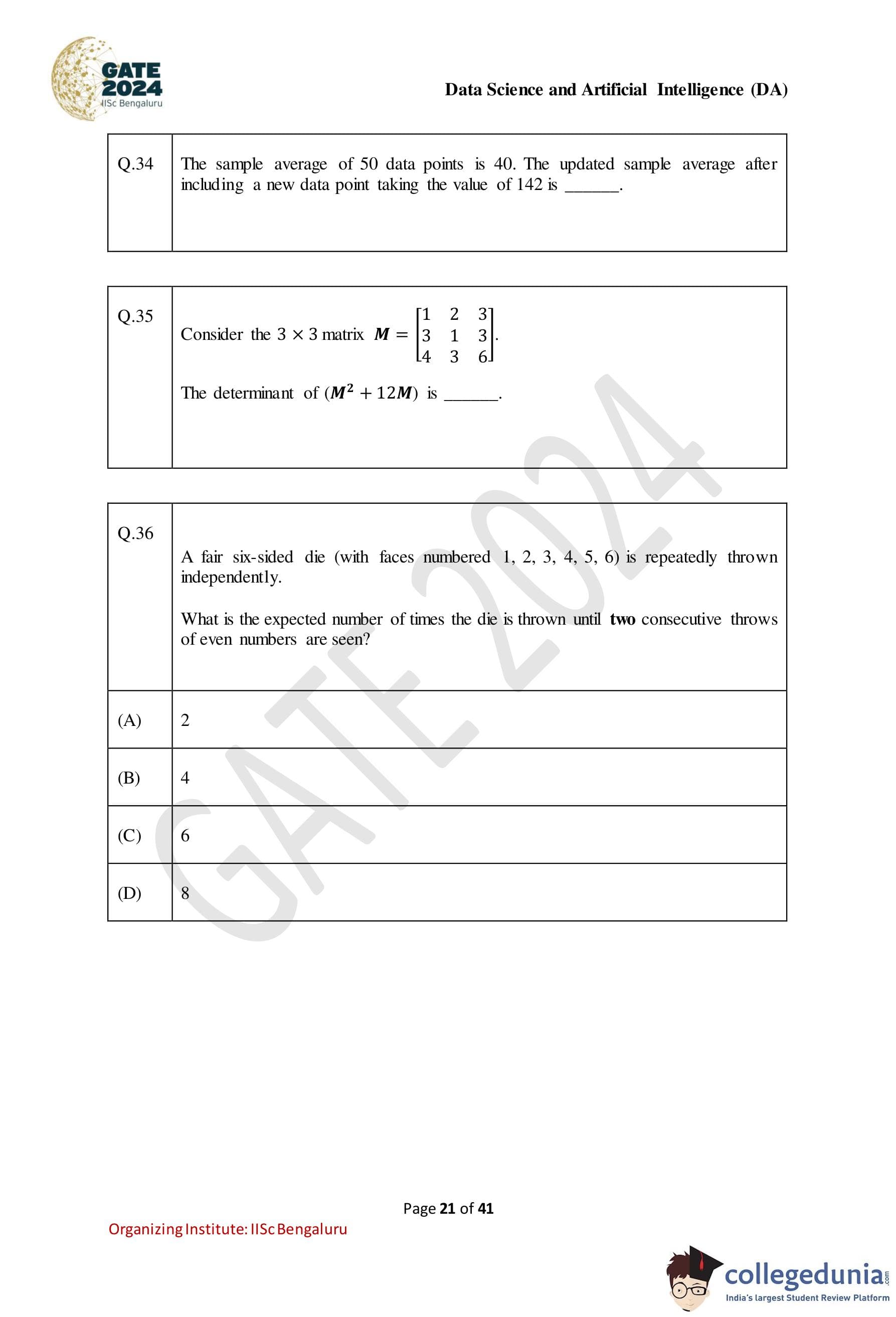
The sample average of 50 data points is 40. The updated sample average after including a new data point taking the value of 142 is ____
Question 35:
Consider the 3 × 3 matrix 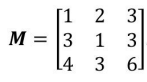 . The determinant of M2 + 12M is ___.
Question 36:
A fair six-sided die (with faces numbered 1, 2, 3, 4, 5, 6) is repeatedly thrown independently. What is the expected number of times the die is thrown until two consecutive throws of even numbers are seen?
Question 37:
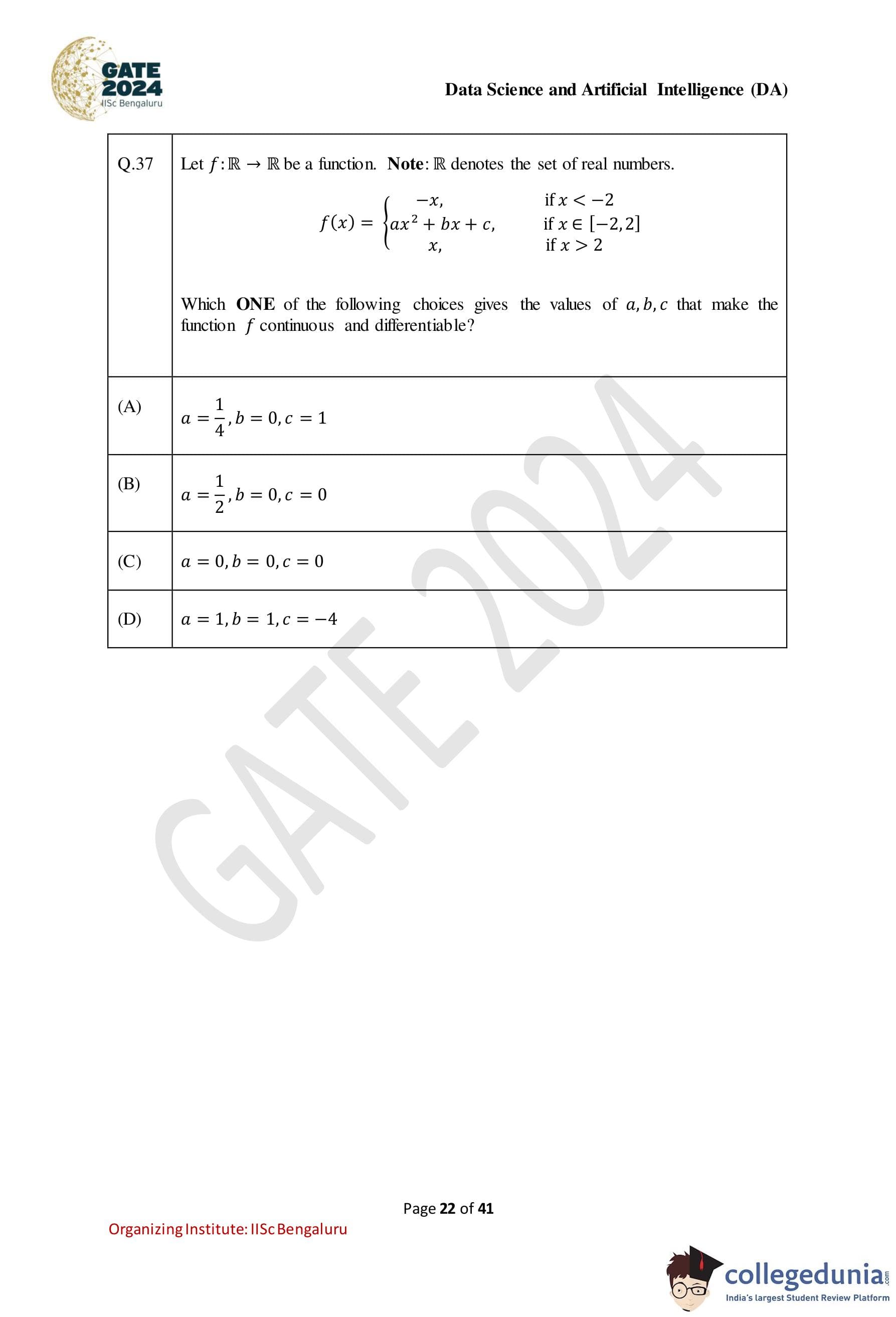
Let f : R → R be a function. Note: R denotes the set of real numbers. f(x) = -x, if x < -2⁄ax2 + bx + c, if x ∈ [-2, 2] x, if x > 2
Which ONE of the following choices gives the values of a, b, and c that make the function f continuous and differentiable?
Question 38:
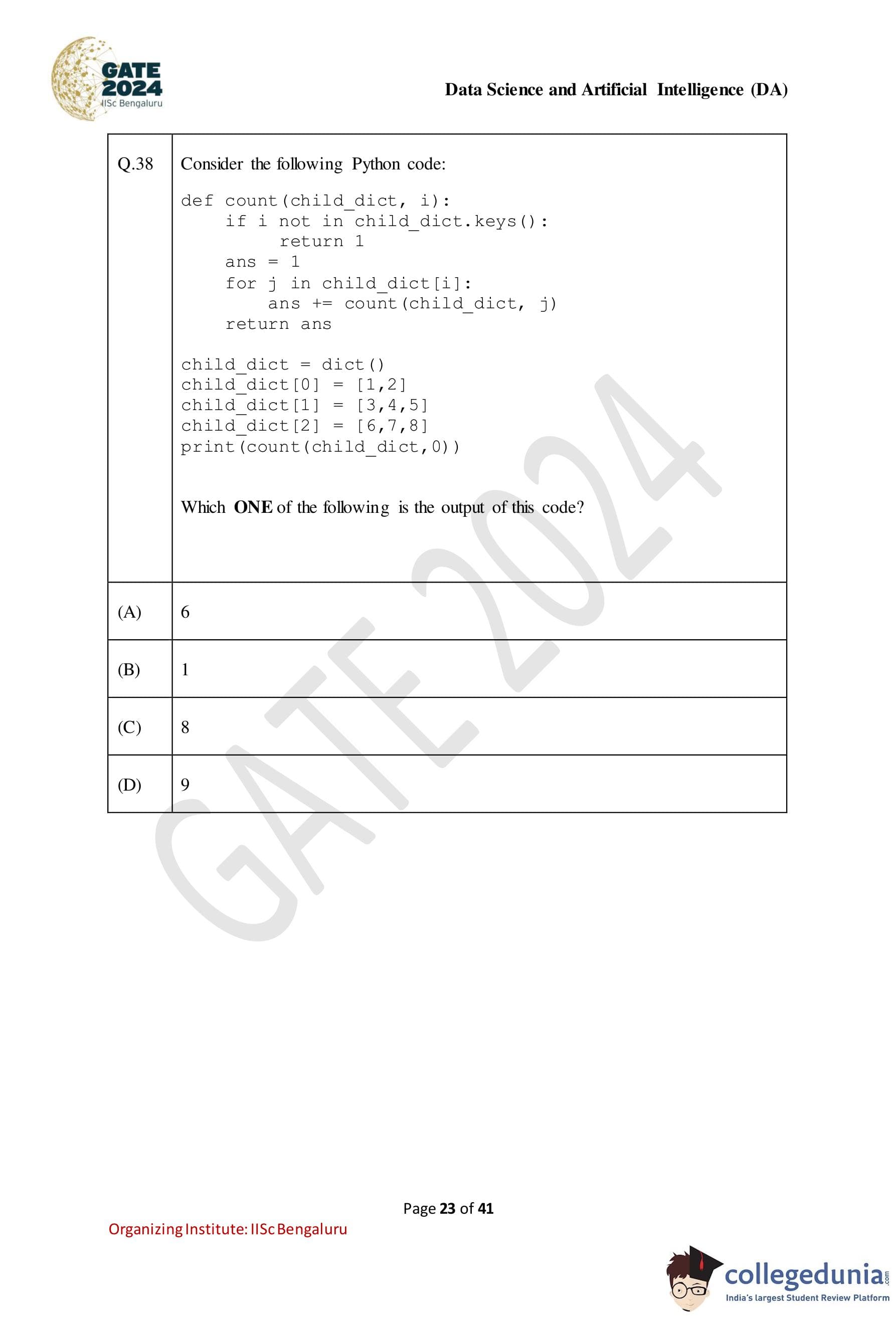
Consider the following Python code:
def count(child_dict, i):
    if i not in child_dict.keys():
        return 1
    ans = 1
    for j in child_dict[i]:
        ans += count(child_dict, j)
    return ans

child_dict = dict()
child_dict[0] = [1,2]
child_dict[1] = [3,4,5]
child_dict[2] = [6,7,8]
print(count(child_dict,0))
Which ONE of the following is the output of this code?
Question 39:
Consider the function computeS(X) whose pseudocode is given below:
computeS(X)
    S[1] = 1
    for i = 2 to length(X)
        S[i] = -1
        if X[i-1] <= X[i]
            S[i] = S[i-1] + S[i-1]
        end if
    end for
    return S
Which ONE of the following values is returned by the function computeS(X) for X = [6, 3, 5, 4, 10]?
Question 40:
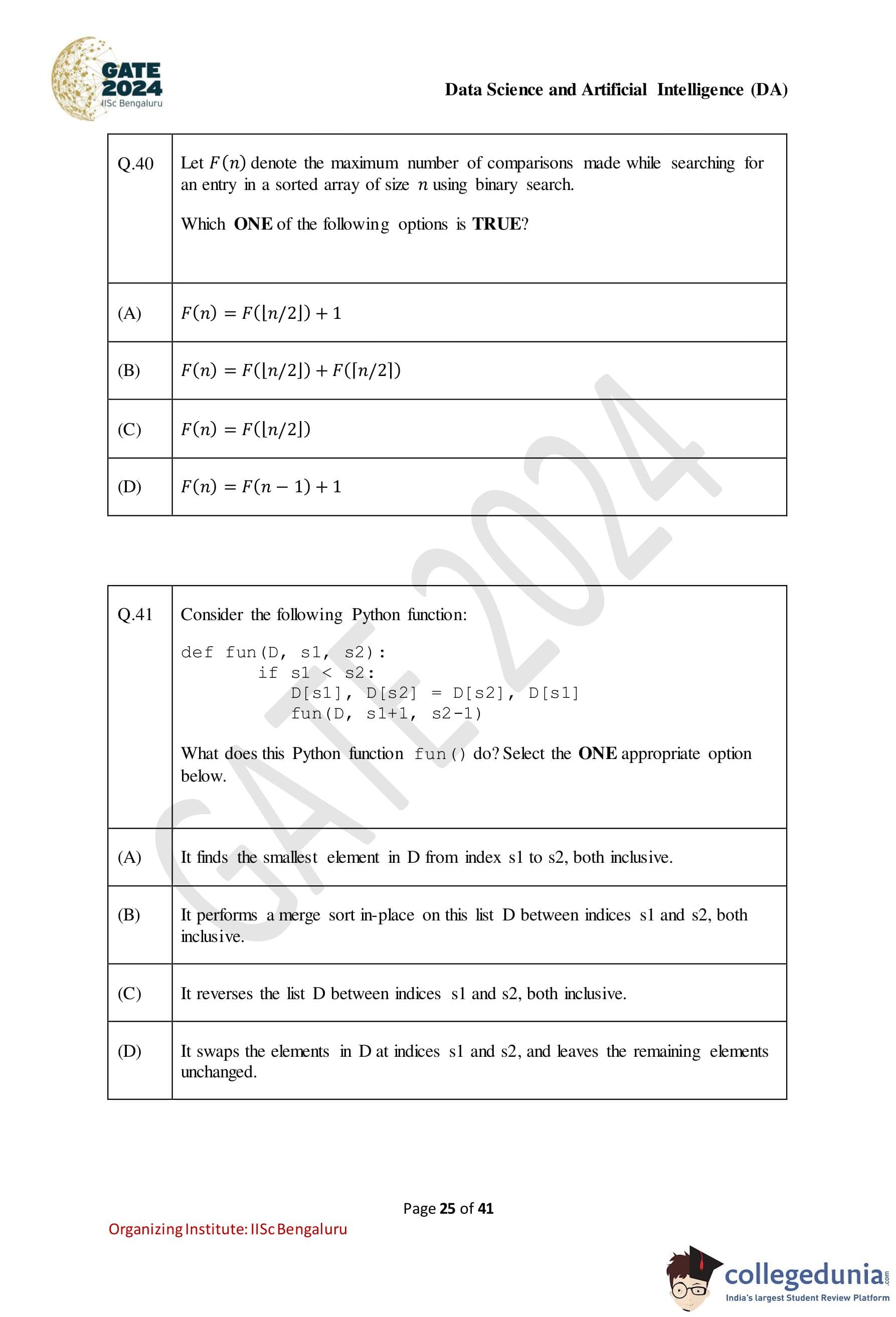
Let F(n) denote the maximum number of comparisons made while searching for an entry in a sorted array of size n using binary search. Which ONE of the following options is TRUE?
Question 41:
Consider the following Python function:
def fun(D, s1, s2):
    if s1 < s2:
        D[s1], D[s2] = D[s2], D[s1]
        fun(D, s1+1, s2-1)
What does this Python function fun() do? Select the ONE appropriate option below.
Question 42:
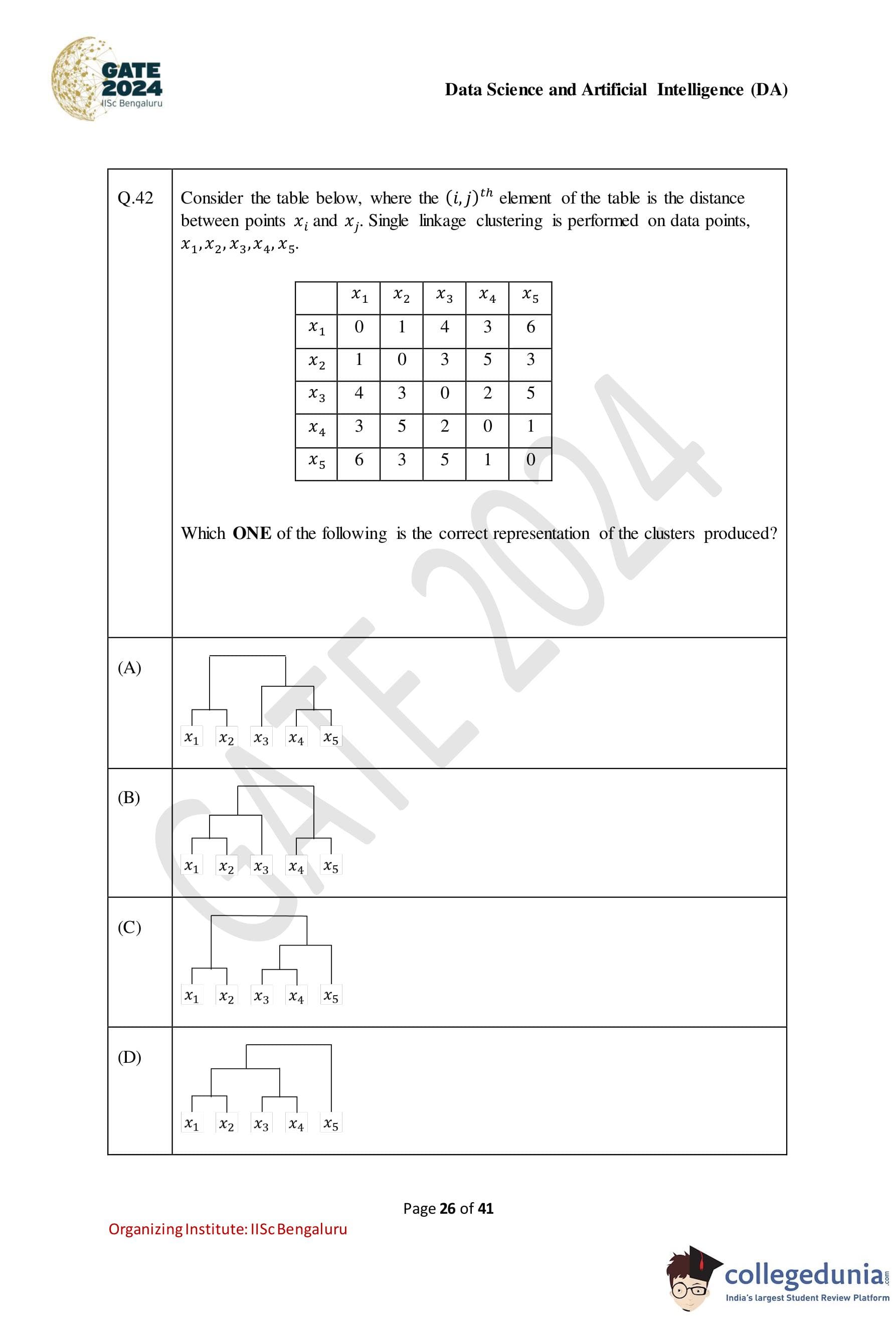
Consider the table below, where the (i, j)th element of the table is the distance between points xi and xj. Single linkage clustering is performed on data points x1, x2, x3, x4, x5:
| x1 | x2 | x3 | x4 | x5 | |
|---|---|---|---|---|---|
| x1 | 0 | 1 | 4 | 3 | 6 |
| x2 | 1 | 0 | 3 | 5 | 3 |
| x3 | 4 | 3 | 0 | 2 | 5 |
| x4 | 3 | 5 | 2 | 0 | 1 |
| x5 | 6 | 3 | 5 | 1 | 0 |
Which ONE of the following is the correct representation of the clusters produced?
Question 43:
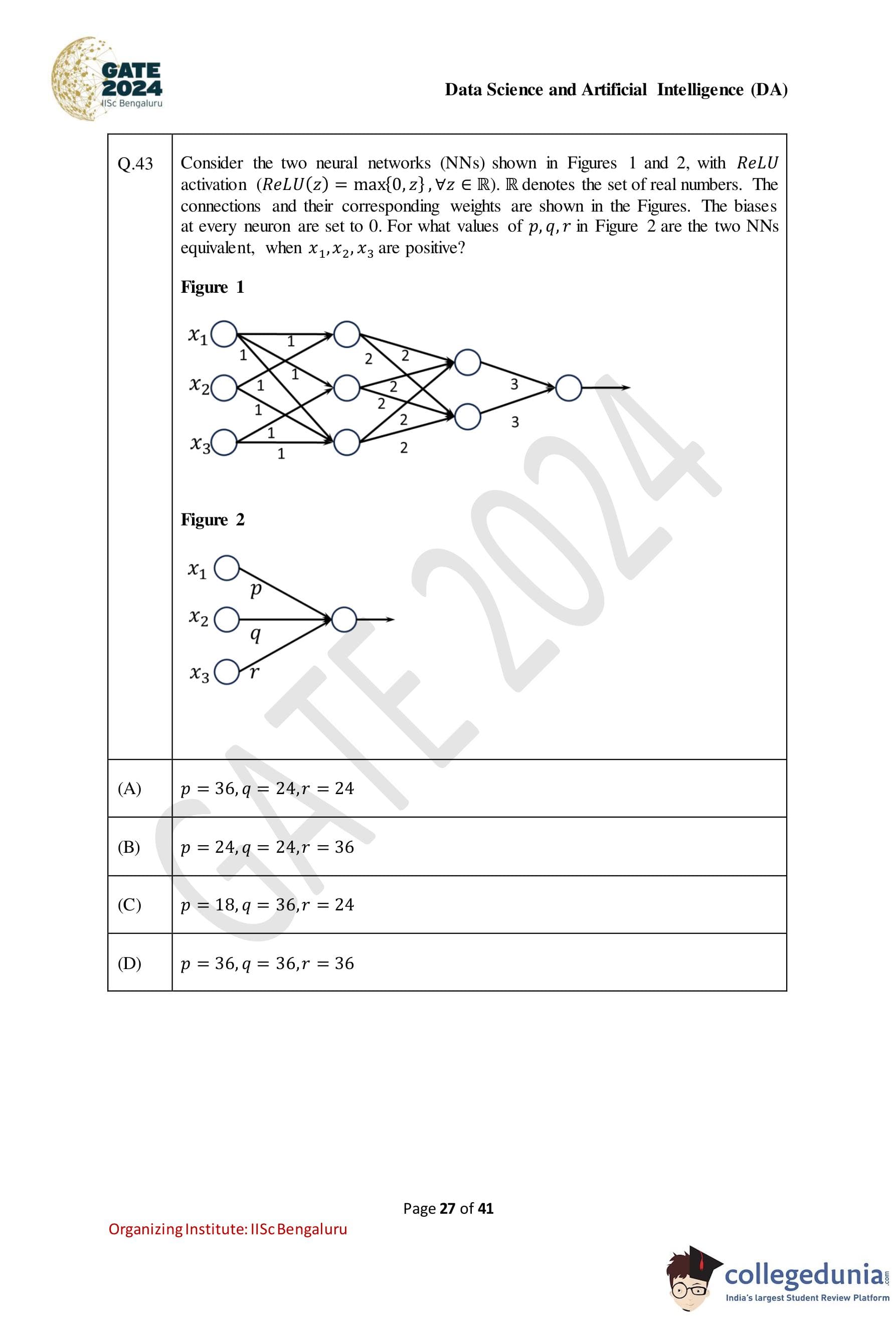
Consider the two neural networks (NNs) shown in Figures 1 and 2, with ReLU activation, where ReLU(z) = max{0,z}, ∀z∈ R. The connections and their corresponding weights are shown in the figures. The biases at every neuron are set to 0. For what values of p, q, and r in Figure 2 are the two neural networks equivalent, given that x1, x2, and x3 are positive?4
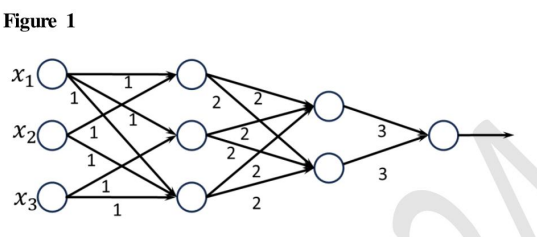
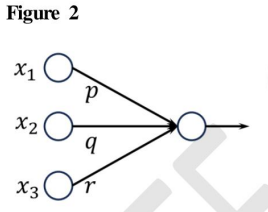
Question 44:
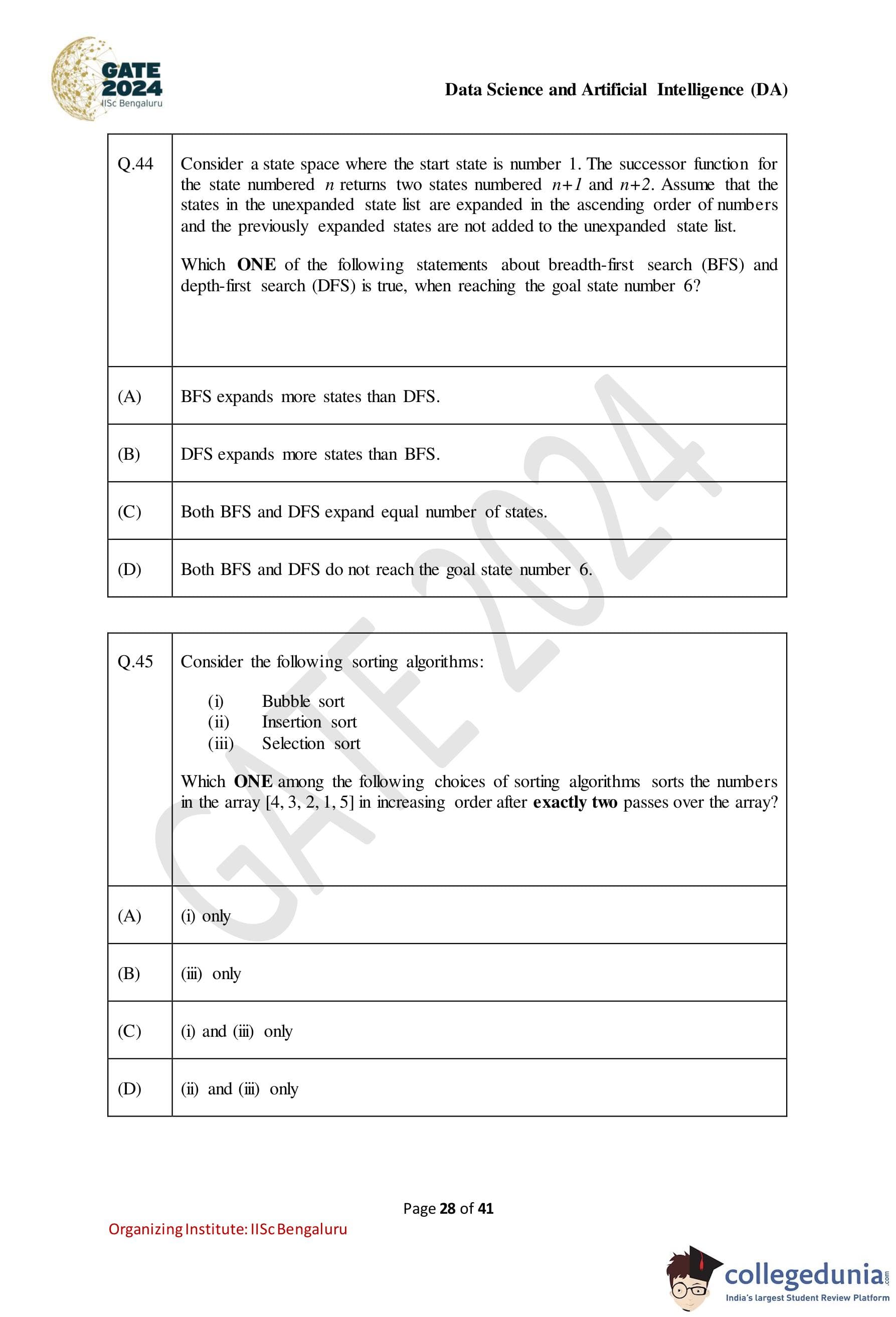
Consider a state space where the start state is number 1. The successor function for the state numbered n returns two states numbered n + 1 and n + 2. Assume that the states in the unexpanded state list are expanded in the ascending order of numbers and the previously expanded states are not added to the unexpanded state list. Which ONE of the following statements about breadth-first search (BFS) and depth-first search (DFS) is true, when reaching the goal state number 6?
Question 45:
Consider the following sorting algorithms: • (i) Bubble sort • (ii) Insertion sort • (iii) Selection sort Which ONE among the following choices of sorting algorithms sorts the numbers in the array [4, 3, 2, 1, 5] in increasing order after exactly two passes over the array?
Question 46:
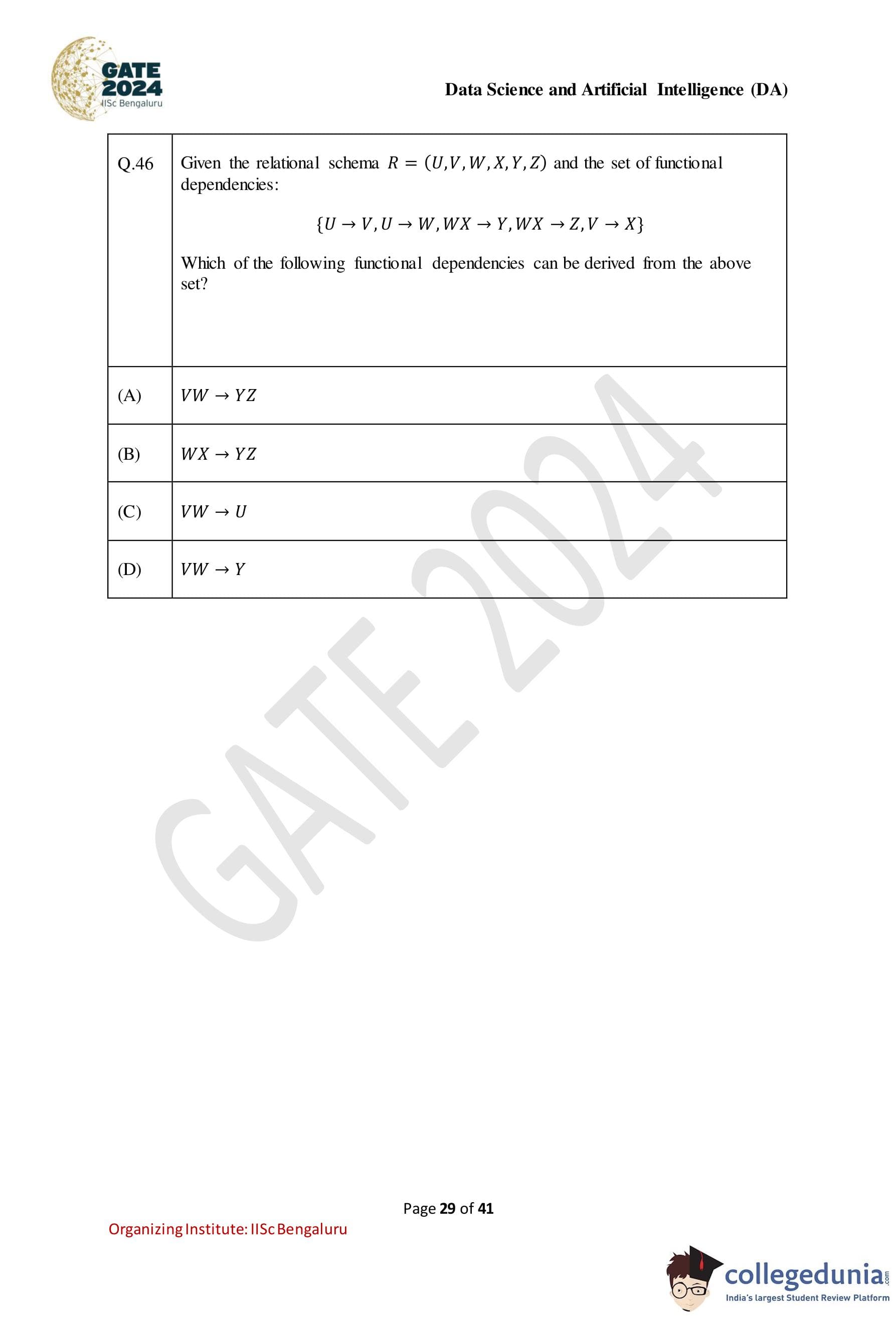
Given the relational schema R = (U, V, W, X, Y, Z) and the set of functional dependencies:
{U → V, U → W, W → Y, W → Z, X → Y, X → Z} Which of the following functional dependencies can be derived from the above set?
Question 47:
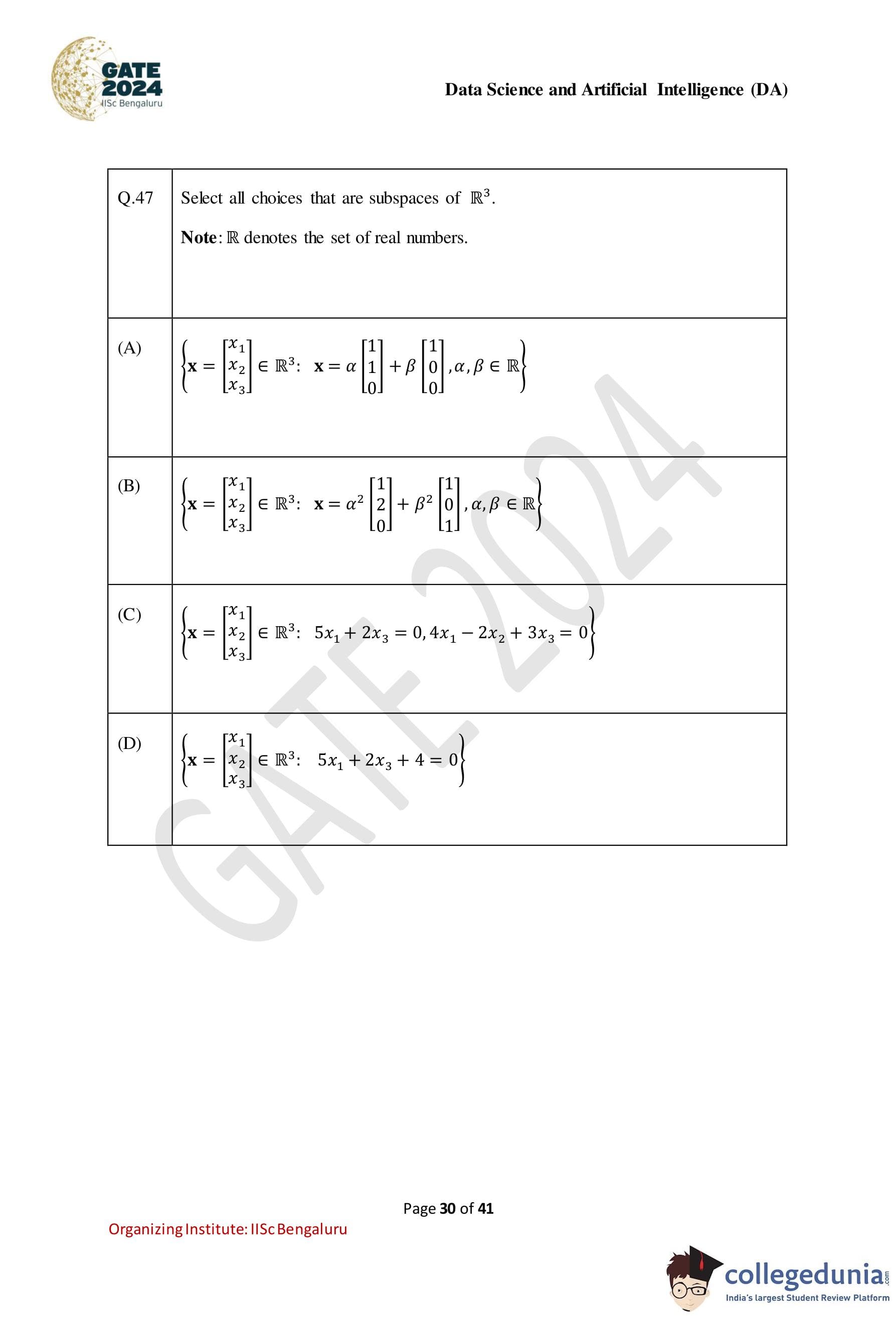
Select all choices that are subspaces of R3.
Note: R denotes the set of real numbers.
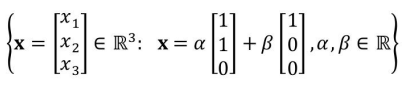


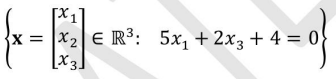
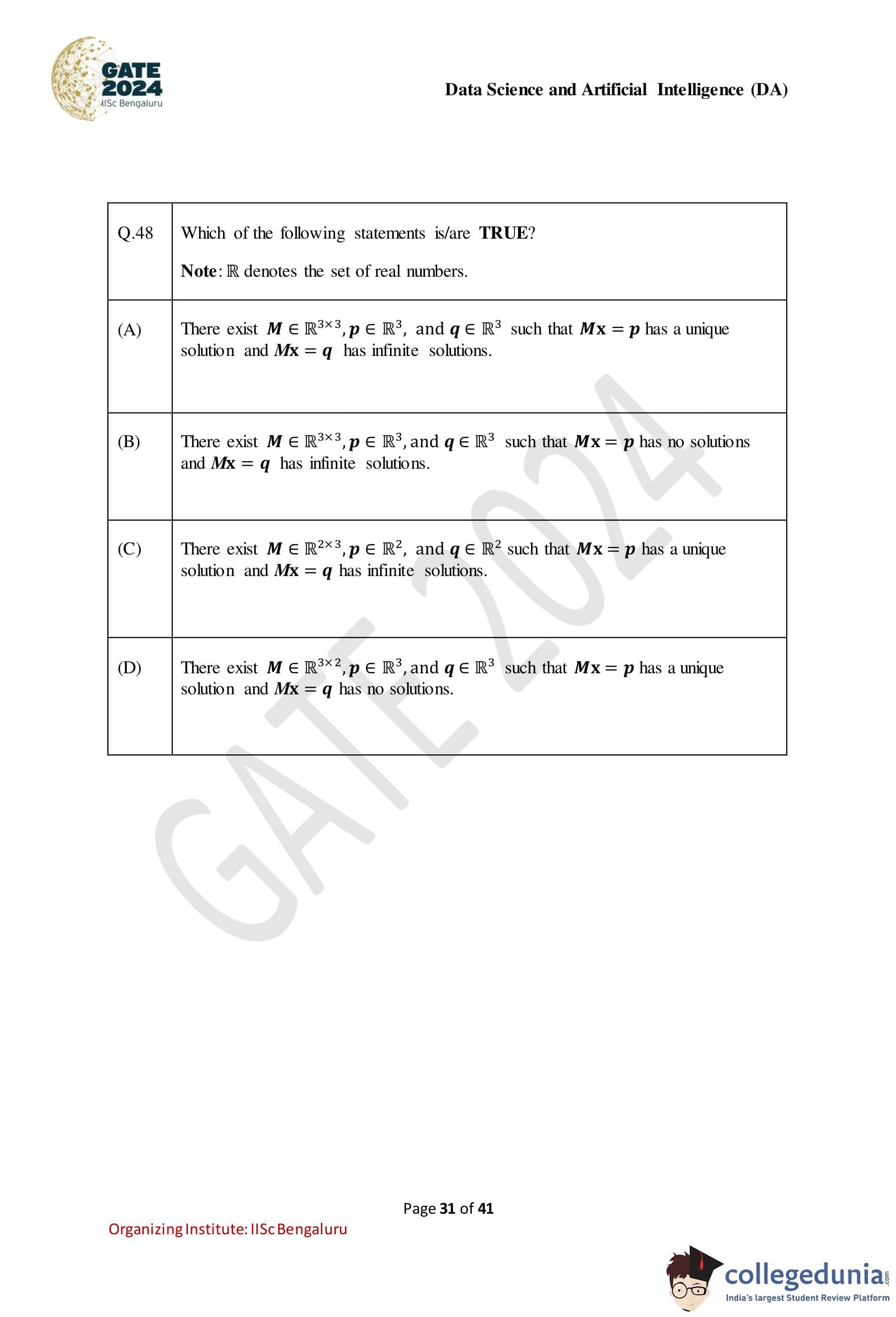
Question 48:
Which of the following statements is/are TRUE?
Note: R denotes the set of real numbers.
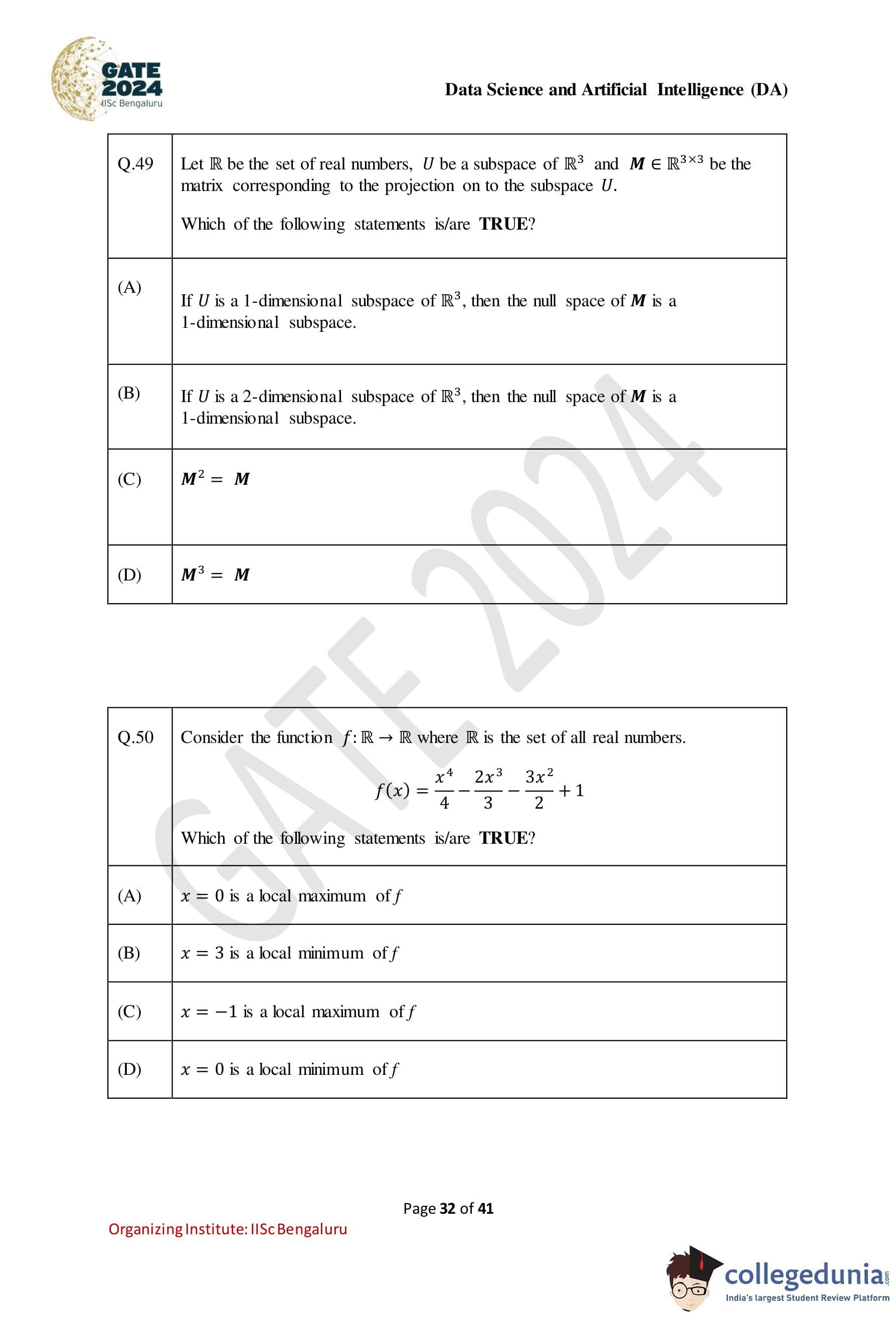
Question 49:
Let R be the set of real numbers, U be a subspace of R3, and M ∈ R3x3 be the matrix corresponding to the projection onto the subspace U. Which of the following statements is/are TRUE?
Question 50:
Consider the function f : R → R defined as:
f(x) = x4 - 3x2 + 1⁄x2 + 3. Which of the following statements is/are TRUE?
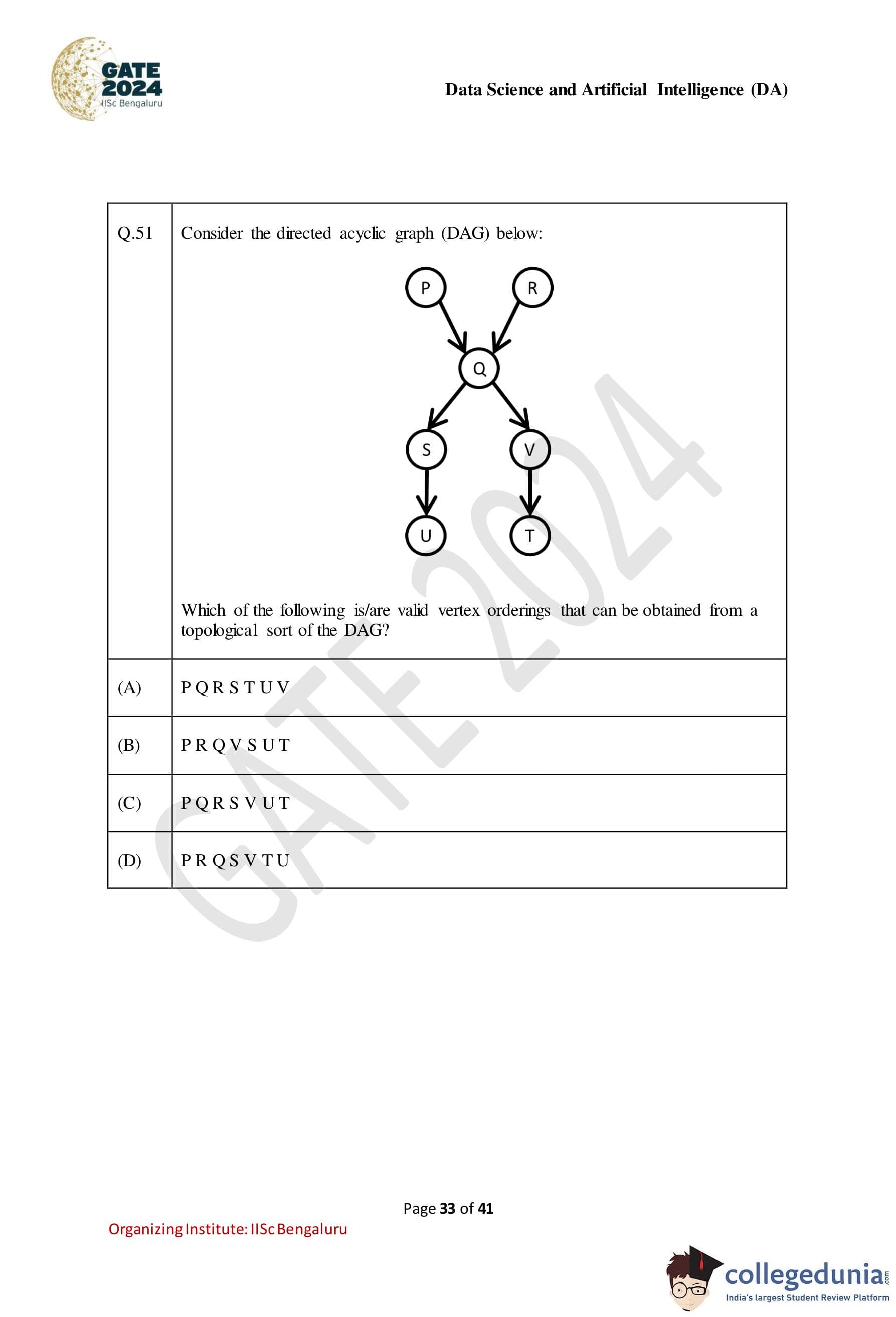
Question 51:
Consider the directed acyclic graph (DAG) below:
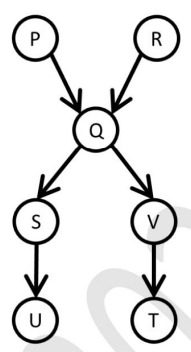
Which of the following is/are valid vertex orderings that can be obtained from a topological sort of the DAG?
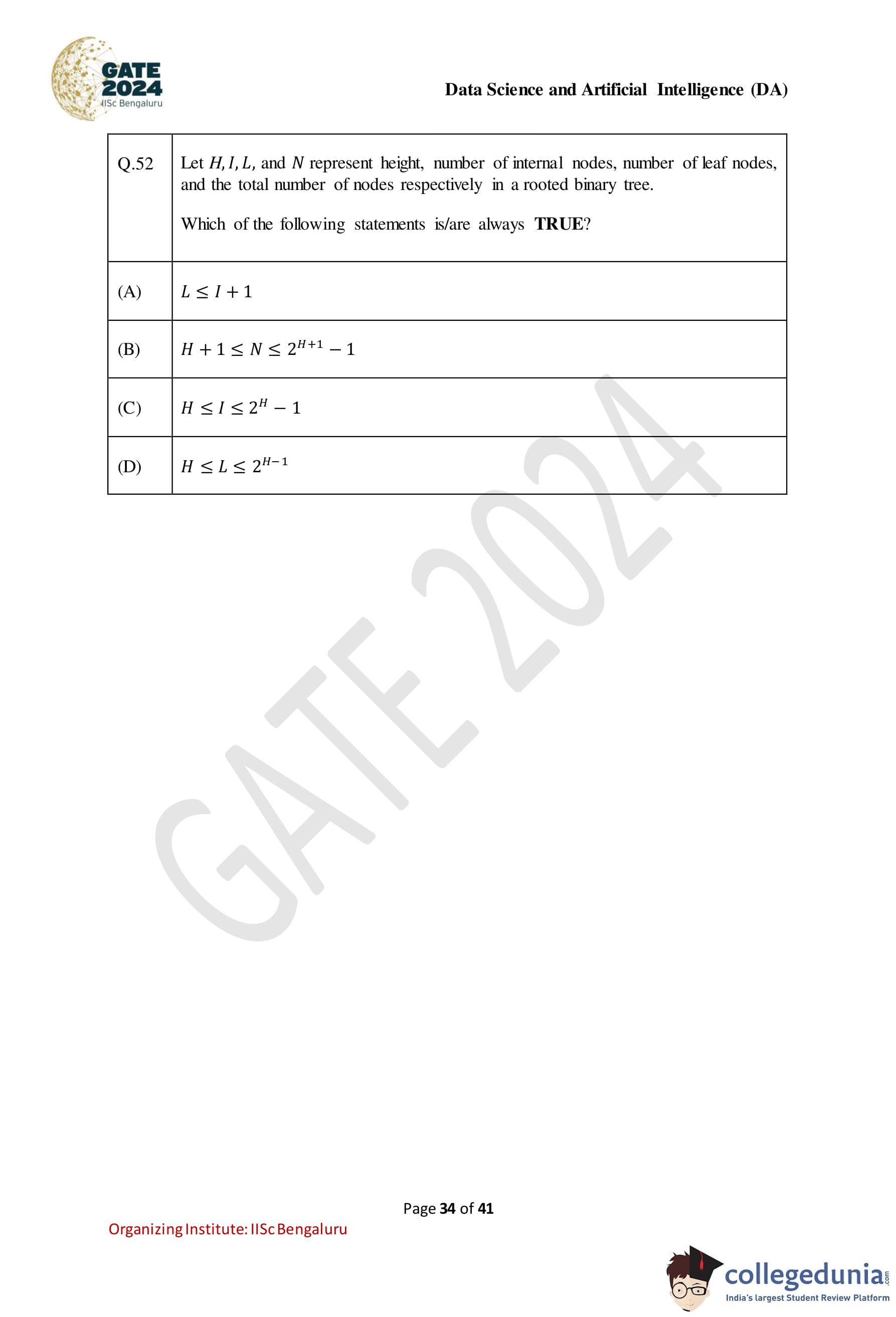
Question 52:
Let H, I, L, and N represent height, number of internal nodes, number of leaf nodes, and the total number of nodes respectively in a rooted binary tree. Which of the following statements is/are always TRUE?
Question 53:
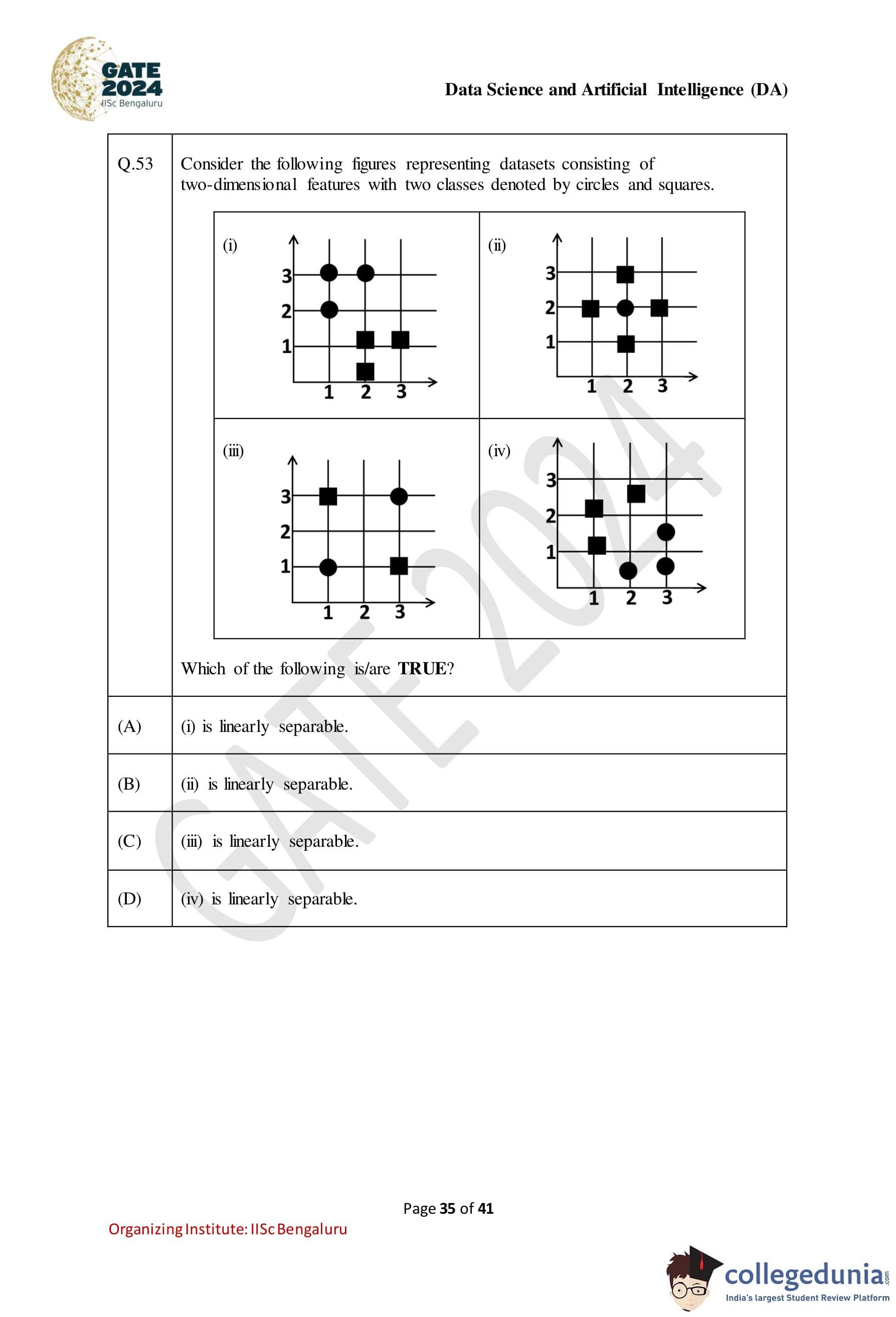
Consider the following figures representing datasets consisting of two-dimensional features with two classes denoted by circles and squares.
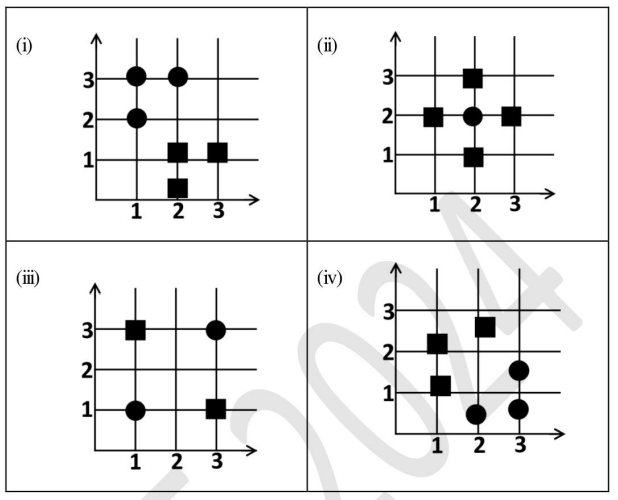
Which of the following is/are TRUE?
Question 54:
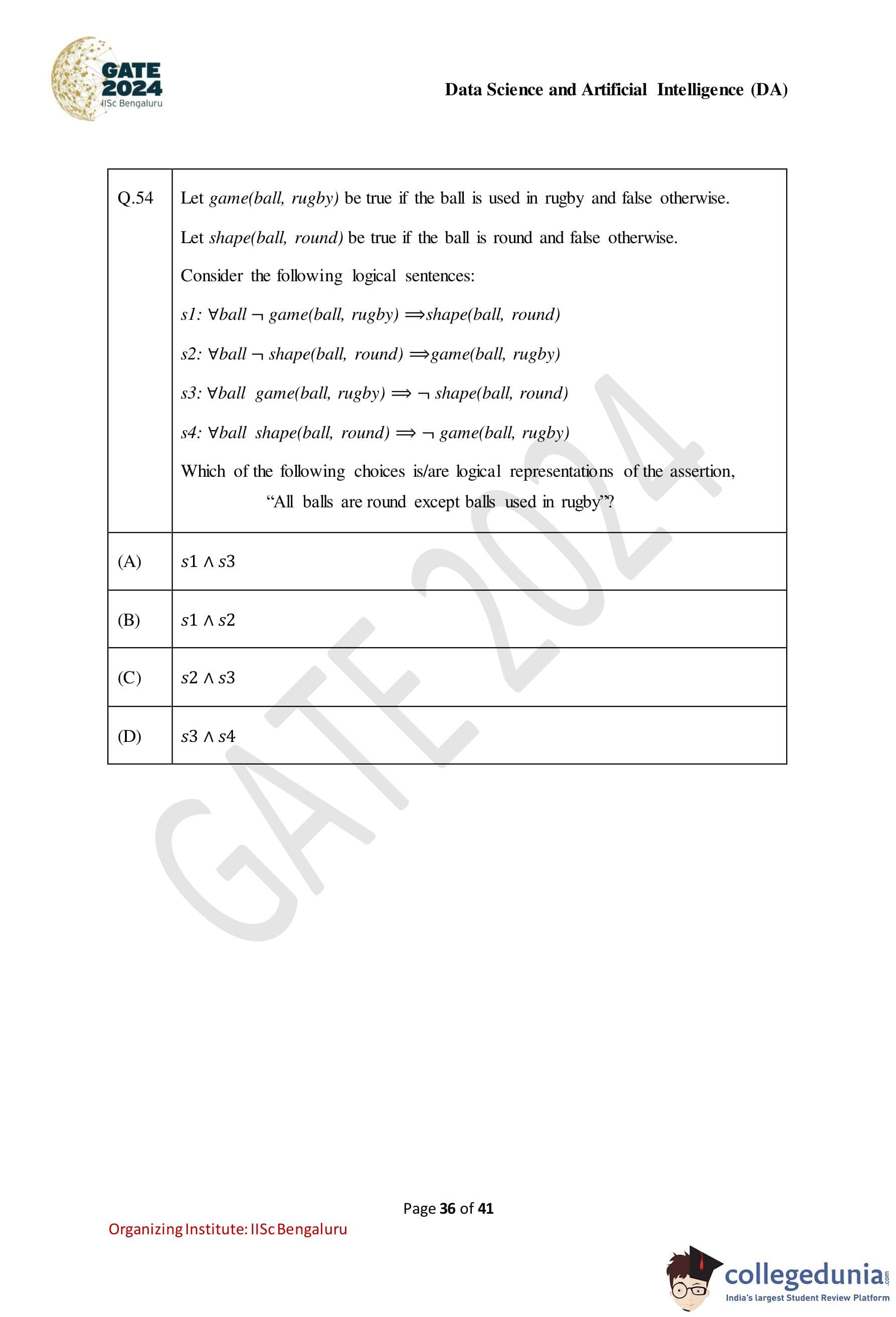
Let game(ball, rugby) be true if the ball is used in rugby and false otherwise. Let shape(ball, round) be true if the ball is round and false otherwise. Consider the following logical sentences: s1 : ∀ball ⇒ game(ball, rugby) ⇒ shape(ball, round) s2 : ∀ball ⇒ ¬shape(ball,round) ⇒ game(ball, rugby) s3 : ∀ball game(ball, rugby) ⇒ ¬shape(ball, round) s4 : ∀ball shape(ball, round) ⇒ ¬game(ball, rugby) Which of the following choices is/are logical representations of the assertion, "All balls are round except balls used in rugby"?
Question 55:
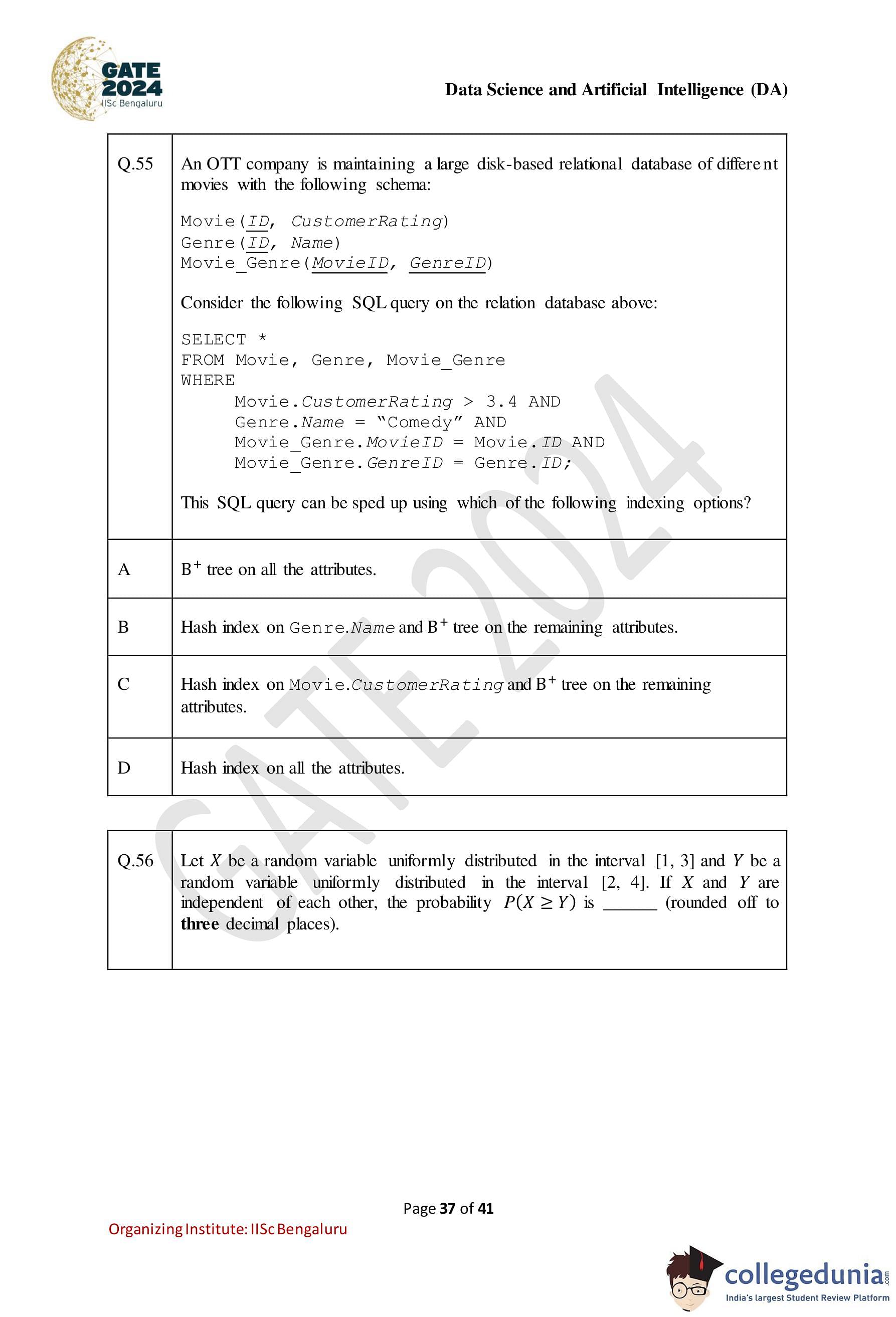
An OTT company is maintaining a large disk-based relational database of different movies with the following schema:
• Movie (ID, CustomerRating)
• Genre (ID, Name)
• Movie_Genre (MovieID, GenreID)
The given SQL query is:
SELECT *
FROM Movie, Genre, Movie_Genre
WHERE Movie.CustomerRating > 3.4
AND Genre.Name = "Comedy"
AND Movie_Genre.MovieID = Movie.ID
AND Movie_Genre.GenreID = Genre.ID;
Problem Statement: This SQL query can be sped up using which of the following indexing options?
Question 56:
Let X be a random variable uniformly distributed in the interval [1, 3] and Y be a random variable uniformly distributed in the interval [2, 4]. If X and Y are independent of each other, the probability P(X > Y) is:
Question 57:
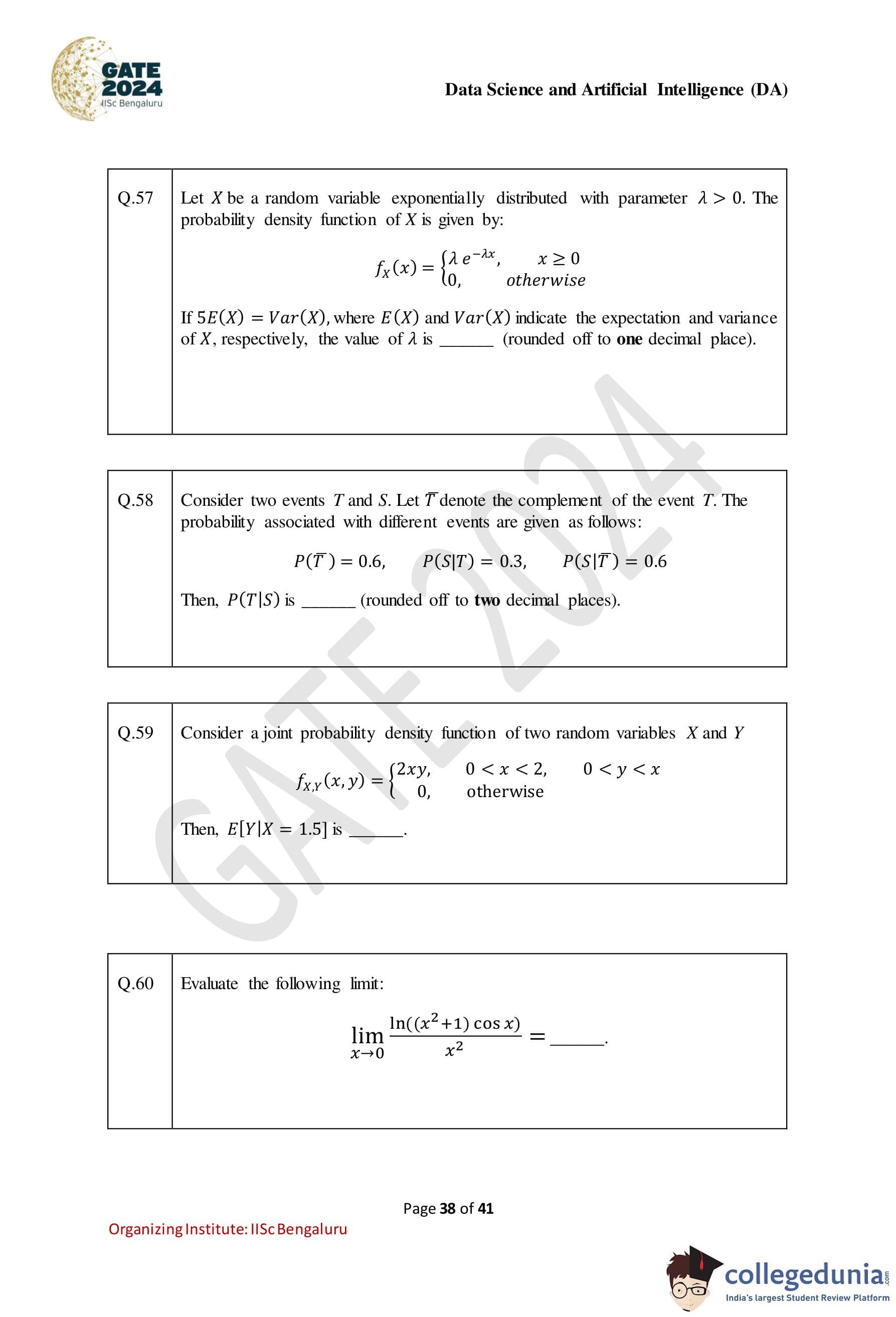
Let X be a random variable exponentially distributed with parameter λ > 0. The probability density function (PDF) of X is given by:
fx(x) = λe-λx for x ≥ 0⁄0 otherwise
Given that E(X) = Var(X), where E(X) and Var(X) indicate the expectation and variance of X, respectively, the value of λ is:
Question 58:
Consider two events T and S. Let T denote the complement of the event S. The probability associated with different events are given as follows:
P(T) = 0.6, P(S|T) = 0.3, P(S|T) = 0.6.
We are asked to find P(T|S), the conditional probability of T given S.
Question 59:
Consider a joint probability density function of two random variables X and Y :
fx,y(x,y) = 2xy, 0 < x < 2, 0
Then, E[Y|X = 1.5] is ____.
Question 60:
Evaluate the following limit: limx→0 ln((x2 + 1) cos(x))
Question 61:
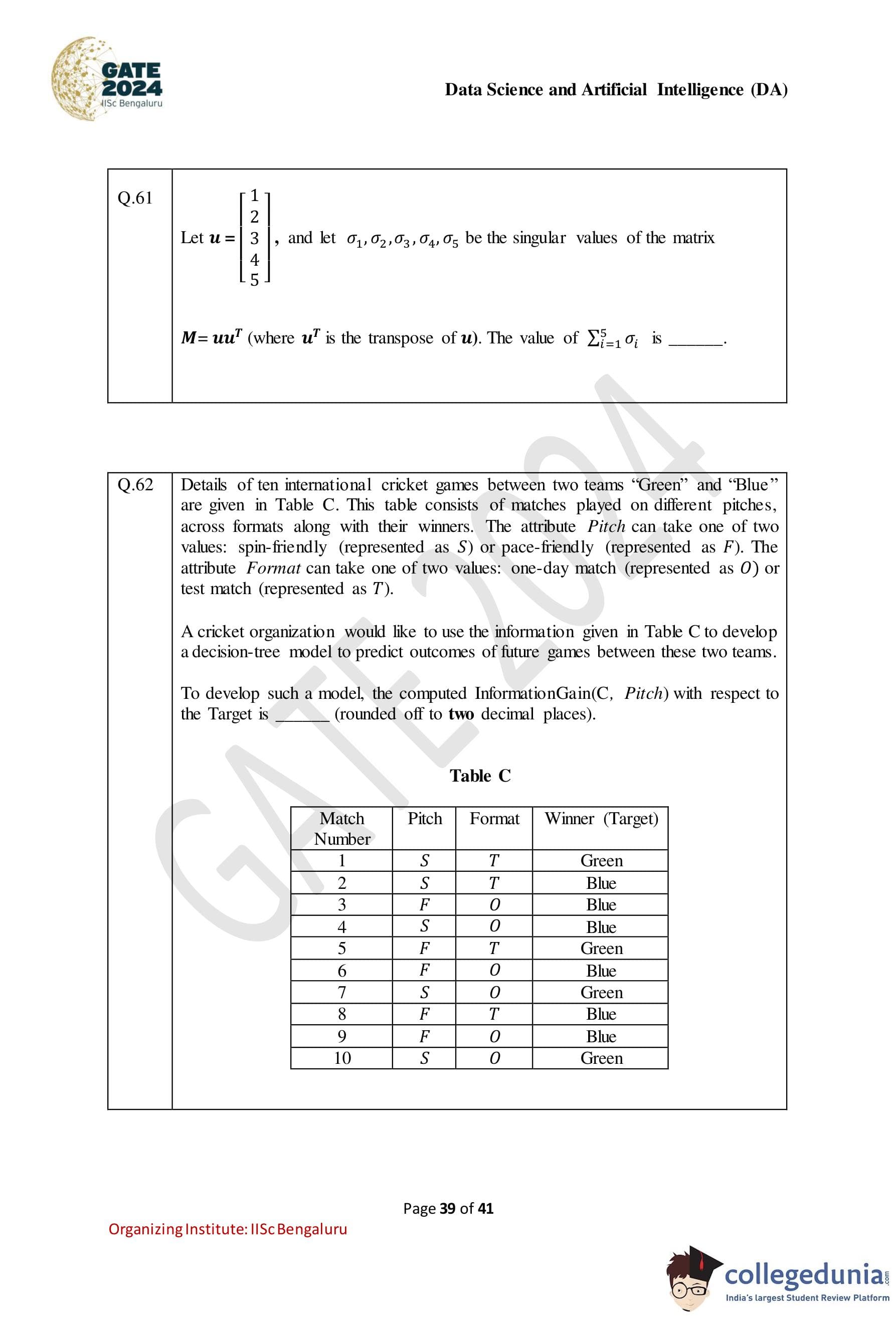
Let u = 1⁄3, and let σ1, σ2, σ3,... be the singular values of the matrix M = uuT (where uT is the transpose of u). The value of σ1σ2...σn is:
Question 62:
Details of ten international cricket games between two teams, "Green" and "Blue," are given in Table C. The organization would like to use this information to develop a decision-tree model to predict outcomes of future games. The computed Information Gain InformationGain(C, Pitch) with respect to the Target is:
| Match Number | Pitch | Format | Winner (Target) |
|---|---|---|---|
| 1 | S | T | Green |
| 2 | S | T | Blue |
| 3 | F | O | Blue |
| 4 | F | O | Blue |
| 5 | F | T | Green |
| 6 | F | O | Blue |
| 7 | S | O | Green |
| 8 | F | S | Blue |
| 9 | F | O | Blue |
| 10 | S | O | Green |
Question 63:
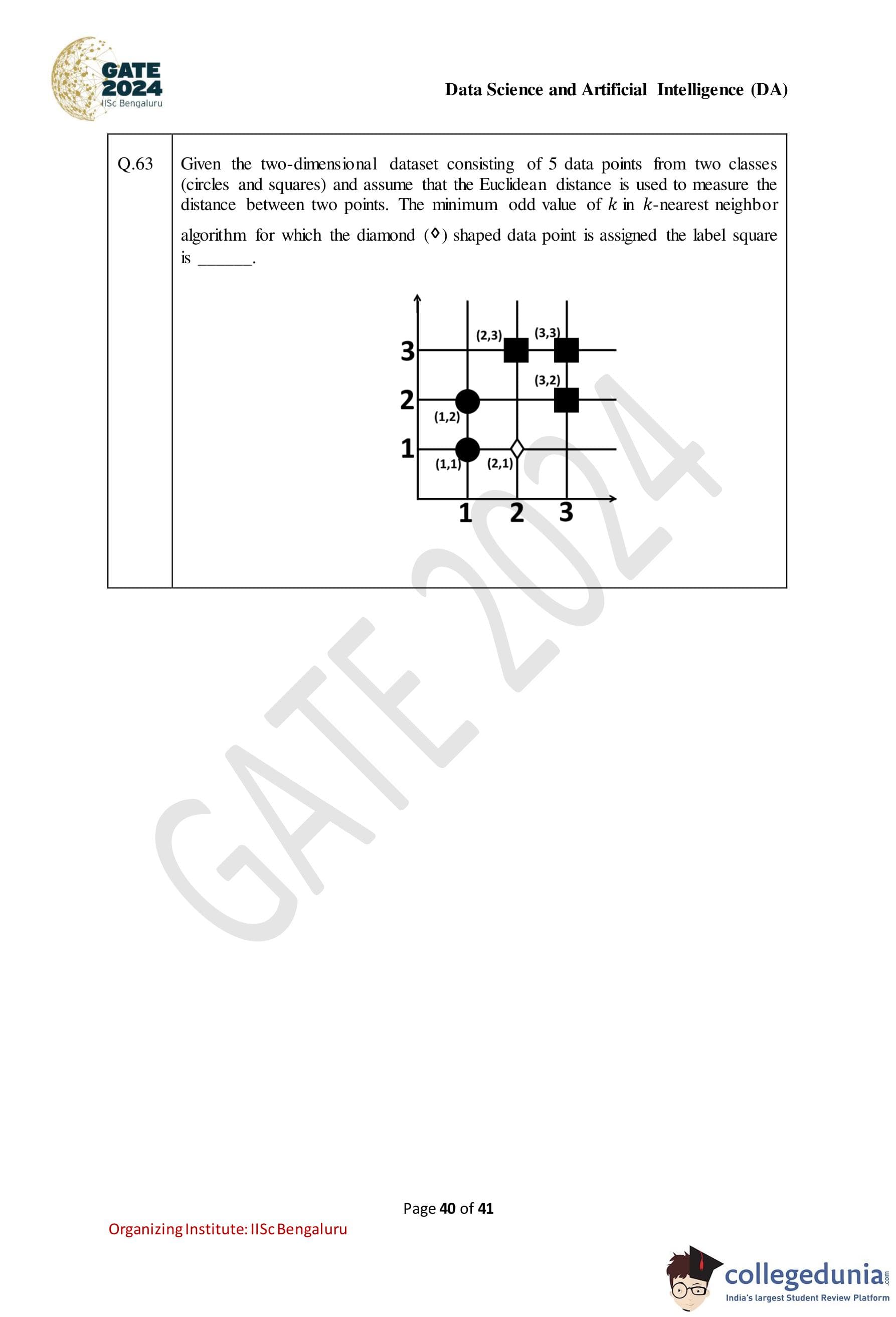
Given the two-dimensional dataset consisting of 5 data points from two classes (circles and squares) and assuming that the Euclidean distance is used to measure the distance between two points, the minimum odd value of k in the k-nearest neighbor algorithm for which the diamond (◊) shaped data point is assigned the label "square" is:
Question 64:
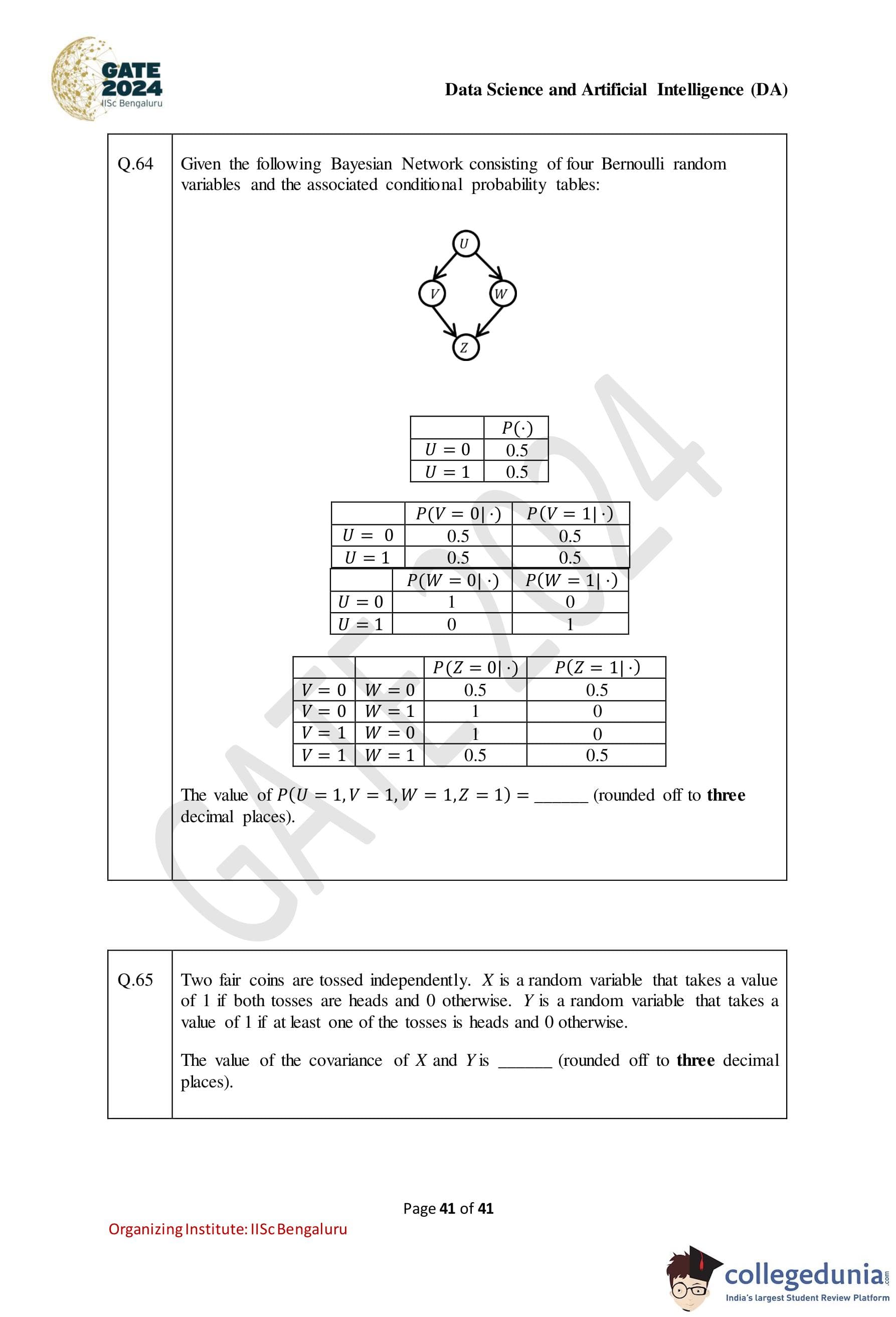
Given the following Bayesian Network consisting of four Bernoulli random variables and their associated conditional probability tables (CPTs), we need to compute P(U = 1, V = 1, W = 1, Z = 1).
Question 65:
Two fair coins are tossed independently. Let X be a random variable that takes a value of 1 if both tosses are heads, and 0 otherwise. Let Y be a random variable that takes a value of 1 if at least one of the tosses is heads, and 0 otherwise. The value of the covariance of X and Y is:






Comments