




GATE 2024 Ecology and Evolution Question Paper PDF is available here. IISc Banglore conducted GATE 2024 Ecology and Evolution exam on February 4 in the Forenoon Session from 9:30 AM to 12:30 PM. Students have to answer 65 questions in GATE 2024 Ecology and Evolution Question Paper carrying a total weightage of 100 marks. 10 questions are from the General Aptitude section and 55 questions are from Core Discipline.
GATE 2024 Ecology and Evolution Question Paper with Answer Key PDF
| GATE 2024 Ecology and Evolution Question Paper with Answer Key PDF | Download PDF | Check Solutions |

GATE 2024 Ecology and Evolution Question Paper with Answer Key PDF
If '\(\rightarrow\)' denotes increasing order of intensity, then the meaning of the words
[\(\textit{simmer \(\rightarrow\) seethe \(\rightarrow\) smolder}\)] is analogous to [\(\textit{break \(\rightarrow\) raze \(\rightarrow\) ______}\)].
Which one of the given options is appropriate to fill the blank?
In a locality, the houses are numbered in the following way:The house-numbers on one side of a road are consecutive odd integers starting from \(301\), while the house-numbers on the other side of the road are consecutive even numbers starting from \(302\). The total number of houses is the same on both sides of the road.
If the difference of the sum of the house-numbers between the two sides of the road is \(27\), then the number of houses on each side of the road is:
For positive integers \( p \) and \( q \), with \( \frac{p}{q} \neq 1 \), \( \left( \frac{p}{q} \right)^q = p^{q-1} \). Then, which of the following is true?
Which one of the given options is a possible value of \(x\) in the following sequence?
3, 7, 15, x, 63, 127, 255
On a given day, how many times will the second-hand and the minute-hand of a clock cross each other during the clock time 12:05:00 hours to 12:55:00 hours?
In the given text, the blanks are numbered (i)–(iv). Select the best match for all the blanks.
Text:
From the ancient Athenian arena to the modern Olympic stadiums, athletics ____ (i) the potential for a spectacle. The crowd ____ (ii) with bated breath as the Olympian artist twists his body, stretching the javelin behind him. Twelve strides in, he begins to cross-step. Six cross-steps ____ (iii) in an abrupt stop on his left foot. As his body ____ (iv) like a door turning on a hinge, the javelin is launched skyward at a precise angle.
Three distinct sets of indistinguishable twins are to be seated at a circular table that has 8 identical chairs. Unique seating arrangements are defined by the relative positions of the people. How many unique seating arrangements are possible such that each person is sitting next to their twin?
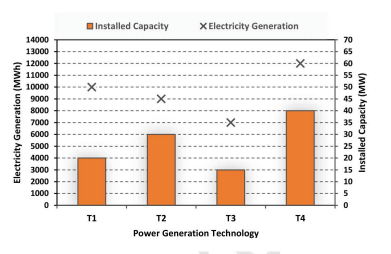
The chart given below compares the Installed Capacity (MW) of four power generation technologies, T1, T2, T3, and T4, and their Electricity Generation (MWh) in a time of 1000 hours (h). The Capacity Factor of a power generation technology is: \[ Capacity Factor = \frac{Electricity Generation (MWh)}{Installed Capacity (MW) \times 1000 \, (h)} \] Which one of the given technologies has the highest Capacity Factor?
In the 4 × 4 array shown below, each cell of the first three columns has either a cross (X) or a number, as per the given rule.
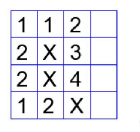
Rule: The number in a cell represents the count of crosses around its immediate neighboring cells (left, right, top, bottom, diagonals).
As per this rule, the maximum number of crosses possible in the empty column is:
During a half-moon phase, the Earth-Moon-Sun form a right triangle. If the Moon-Earth-Sun angle at this half-moon phase is measured to be \(89.85^\circ\), the ratio of the Earth-Sun and Earth-Moon distances is closest to:
The molecular clock model assumes that mutation rates are:
The intermediate disturbance hypothesis was proposed to explain patterns of:
A few years ago, a very small population of zebrafish became isolated by a newly built dam. As a result, which statement is most likely to be true about this population of zebrafish now?
A researcher measures the heights of 200 randomly selected individuals of a tree species in a forest. Which one of the following is NOT a measure of variability in the sample?
Individual lizards were repeatedly presented with a predator model. Over successive trials, they showed a reduction in the duration of their alarm response. Which one of the following is this an example of?
Among the following vertebrate classes, biparental care is most common in:
Based on paleontological evidence, eukaryotic organisms are estimated to have first evolved:
In a population, there are two morphs, A and B, which reproduce at equal rates. A mutates to B with probability \(p_1\), and B mutates to A with probability \(p_2\) such that \(p_1 \gg p_2\) (that is, \(p_1\) is much greater than \(p_2\)). Over time, which one of the following statements would be true about this population?
Terrestrial plants conduct gas exchange through stomata. Having only few stomata on the leaf surface is a common adaptation to which one of the following conditions?
Which one of the following is a result of antagonistic coevolution?
A classical metapopulation at equilibrium is made up of local populations with:
Which one of the following theories is supported by the distribution patterns of extinct flora such as Glossopteris across South America, Africa, and Australia, and extant marsupial mammals across South America and Australia?
In linear regression, mean squared regression (effect variance) divided by mean squared error (error variance) is called the:
The figure shows the time-series of atmospheric CO\(_2\) concentration on Earth (graph not-to-scale).
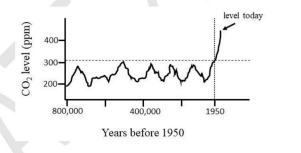
Which one of the factors given is the primary reason for the sudden increase in atmospheric CO\(_2\) concentration after 1950?
The population size at which net recruitment is the highest is also when the greatest amount can be harvested, while ensuring the long-term survival of the population. The amount harvested at this population size is known as:
The variance in male mating success is \(V_m\) and that of females is \(V_f\). Assuming that the sex ratio is 1:1, in which one of the following mating systems is \(V_m/V_f\) expected to be the greatest?
Some air-breathing marine vertebrates such as whales, seals, and marine turtles possess adaptations for long, deep dives. Which one or more of the following is/are examples of such adaptations?
Which one or more of the following statements about evolution is/are true?
Which one or more of the following mammal species is/are endemic to India?
Under which one or more of the following conditions can altruism evolve in animal societies?
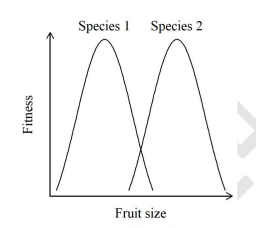
Two species of fruit bats (Species 1 and Species 2) eat fruits of varying sizes. The curves shown represent the ecological niche for these two species. If the curves for both species were to completely overlap, which one or more of the statements given would be correct?
During the process of succession in a community, species that are good colonizers are gradually replaced by species that are good competitors. Which one or more of the following statements is/are consistent with this pattern?
An ornamental shrub species was brought from Japan in the early 1800s to India, where it was planted frequently in gardens and parks. The species persisted for many decades without spreading and then began to spread invasively fifty years ago. Which one or more of the following processes could have led to it becoming invasive?
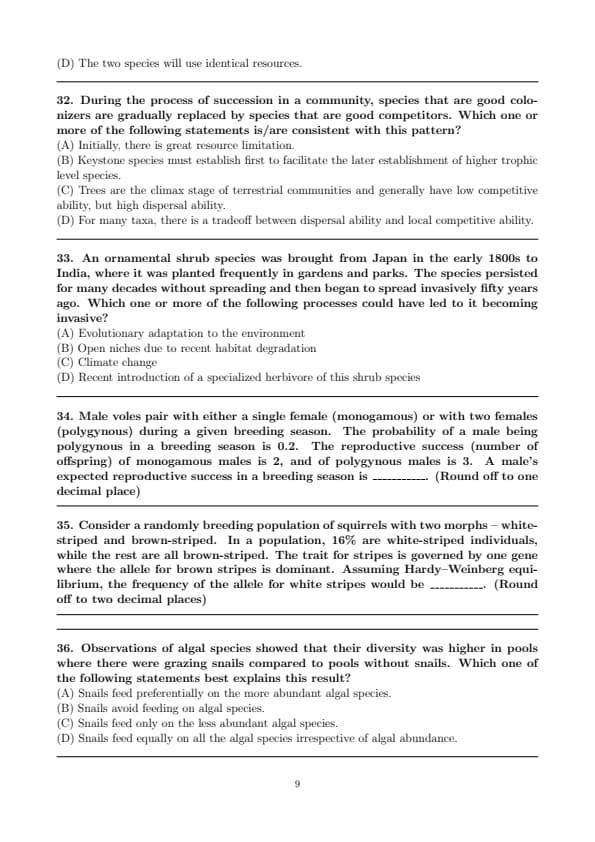
Male voles pair with either a single female (monogamous) or with two females (polygynous) during a given breeding season. The probability of a male being polygynous in a breeding season is 0.2. The reproductive success (number of offspring) of monogamous males is 2, and of polygynous males is 3. A male’s expected reproductive success in a breeding season is ___________. (Round off to one decimal place)
Consider a randomly breeding population of squirrels with two morphs – white-striped and brown-striped. In a population, 16% are white-striped individuals, while the rest are all brown-striped. The trait for stripes is governed by one gene where the allele for brown stripes is dominant. Assuming Hardy–Weinberg equilibrium, the frequency of the allele for white stripes would be ___________. (Round off to two decimal places)
Observations of algal species showed that their diversity was higher in pools where there were grazing snails compared to pools without snails. Which one of the following statements best explains this result?
Which two of the following processes can result in a decline in heterozygosity in populations?
I) Inbreeding; II) Genetic drift; III) Mutation; IV) Random mating
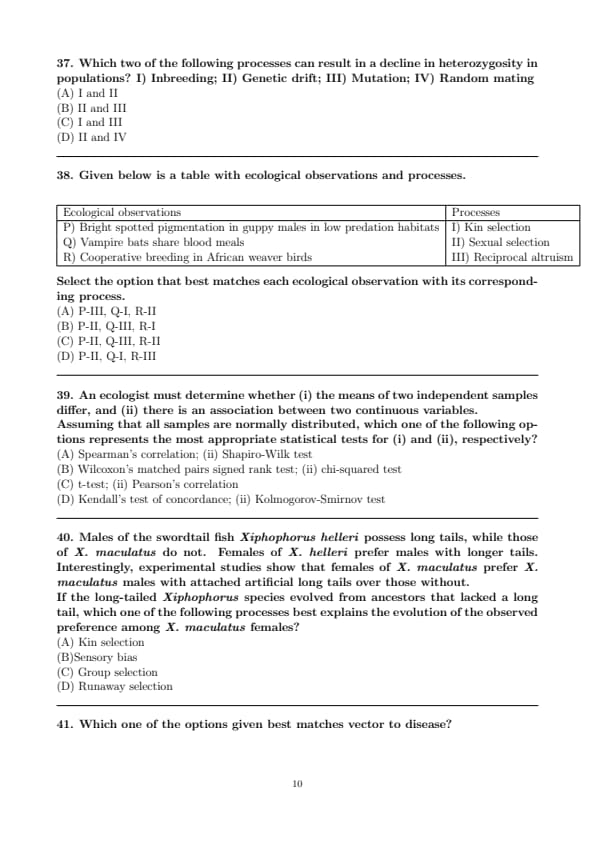
Given below is a table with ecological observations and processes.

Select the option that best matches each ecological observation with its corresponding process.
An ecologist must determine whether
(i) the means of two independent samples differ, and
(ii) there is an association between two continuous variables.
Assuming that all samples are normally distributed, which one of the following options represents the most appropriate statistical tests for (i) and (ii), respectively?
Males of the swordtail fish Xiphophorus helleri possess long tails, while those of X. maculatus do not. Females of X. helleri prefer males with longer tails. Interestingly, experimental studies show that females of X. maculatus prefer X. maculatus males with attached artificial long tails over those without.
If the long-tailed Xiphophorus species evolved from ancestors that lacked a long tail, which one of the following processes best explains the evolution of the observed preference among X. maculatus females?

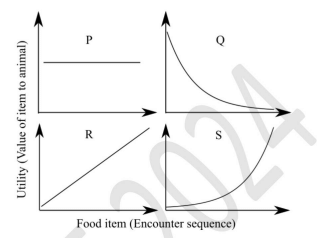
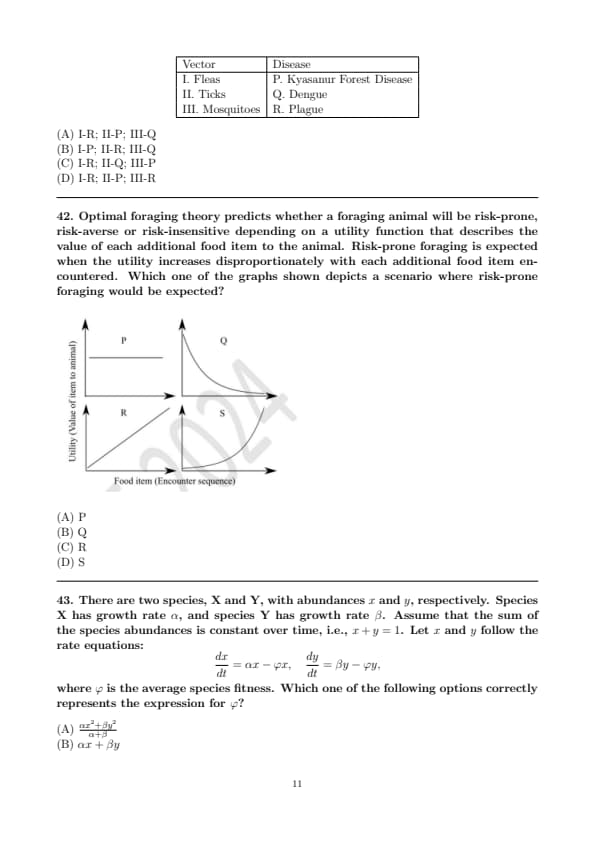
Optimal foraging theory predicts whether a foraging animal will be risk-prone, risk-averse or risk-insensitive depending on a utility function that describes the value of each additional food item to the animal. Risk-prone foraging is expected when the utility increases disproportionately with each additional food item encountered. Which one of the graphs shown depicts a scenario where risk-prone foraging would be expected?
There are two species, X and Y, with abundances \(x\) and \(y\), respectively. Species X has growth rate \(\alpha\), and species Y has growth rate \(\beta\). Assume that the sum of the species abundances is constant over time, i.e., \(x + y = 1\). Let \(x\) and \(y\) follow the rate equations: \[ \frac{dx}{dt} = \alpha x - \varphi x, \quad \frac{dy}{dt} = \beta y - \varphi y, \]
where \(\varphi\) is the average species fitness. Which one of the following options correctly represents the expression for \(\varphi\)?
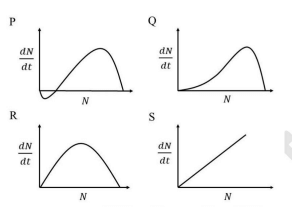
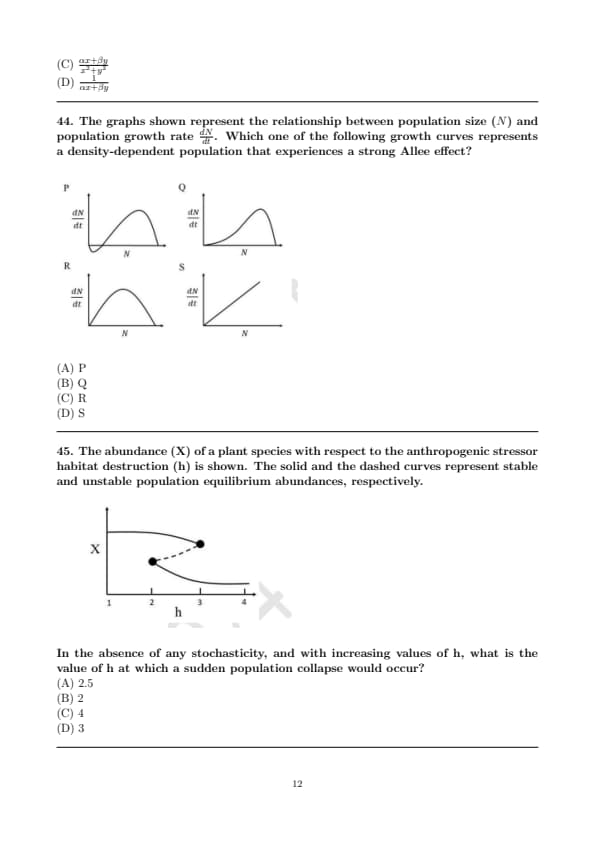
The graphs shown represent the relationship between population size (\(N\)) and population growth rate \(\frac{dN}{dt}\). Which one of the following growth curves represents a density-dependent population that experiences a strong Allee effect?
The abundance (X) of a plant species with respect to the anthropogenic stressor habitat destruction (h) is shown. The solid and the dashed curves represent stable and unstable population equilibrium abundances, respectively.
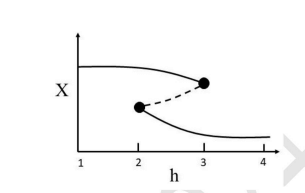
In the absence of any stochasticity, and with increasing values of h, what is the value of h at which a sudden population collapse would occur?
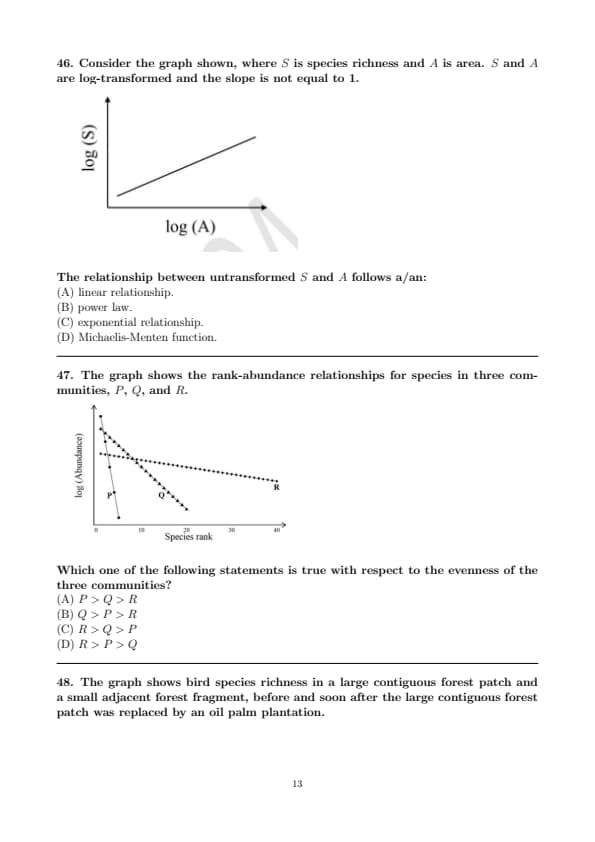
Consider the graph shown, where \(S\) is species richness and \(A\) is area. \(S\) and \(A\) are log-transformed and the slope is not equal to 1.
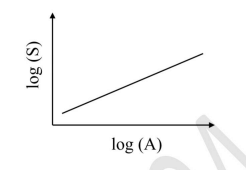
The relationship between untransformed \(S\) and \(A\) follows a/an:
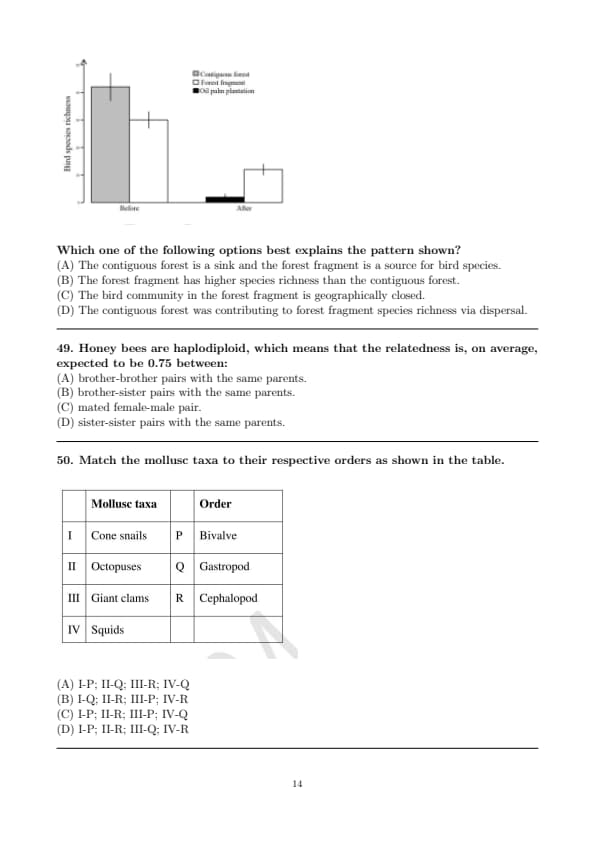
The graph shows the rank-abundance relationships for species in three communities, \(P\), \(Q\), and \(R\).
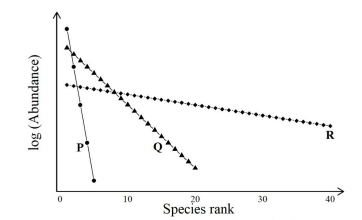
Which one of the following statements is true with respect to the evenness of the three communities?
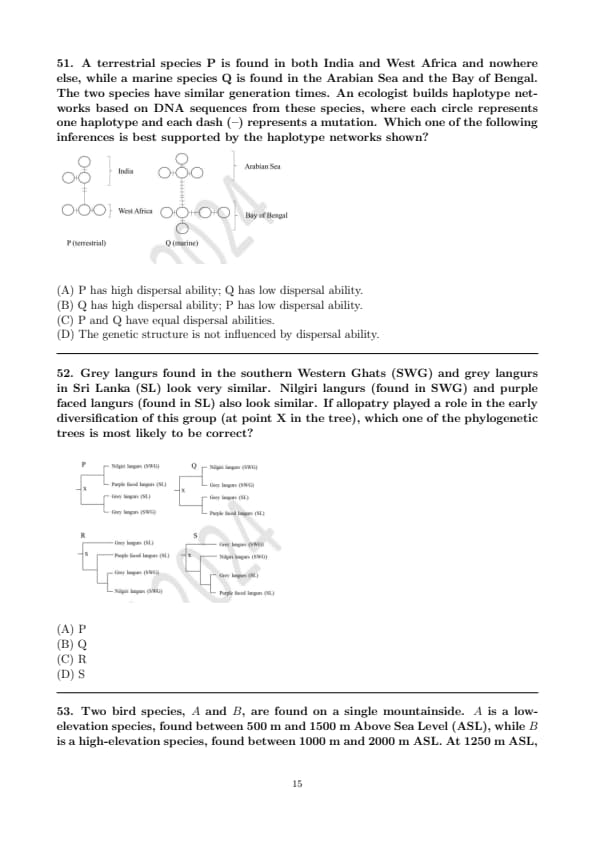
The graph shows bird species richness in a large contiguous forest patch and a small adjacent forest fragment, before and soon after the large contiguous forest patch was replaced by an oil palm plantation.
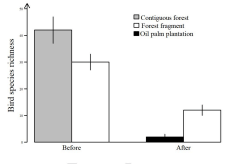
Which one of the following options best explains the pattern shown?
Honey bees are haplodiploid, which means that the relatedness is, on average, expected to be 0.75 between:
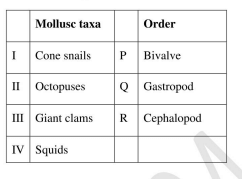
Match the mollusc taxa to their respective orders as shown in the table.
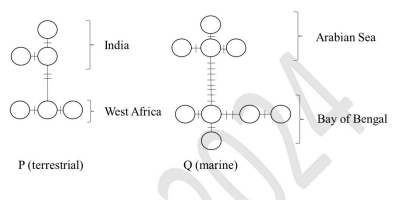
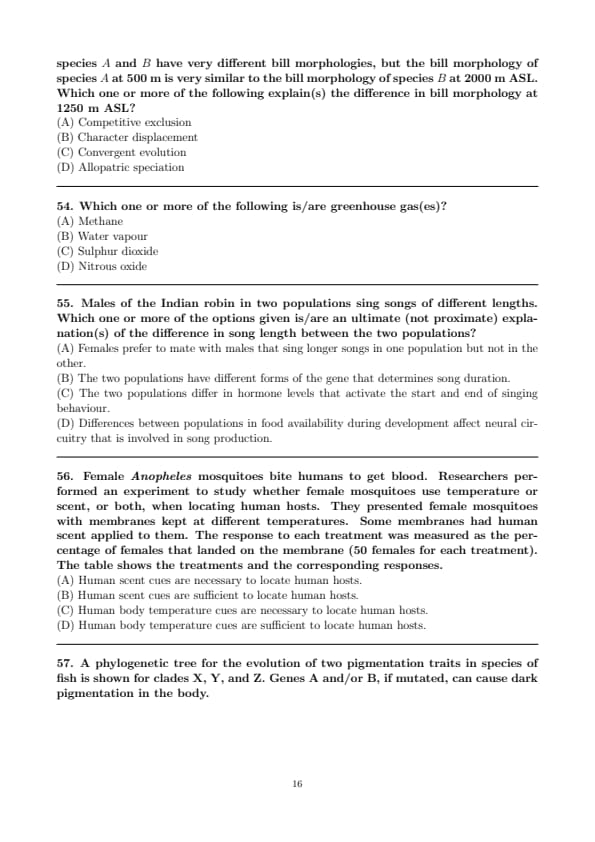
A terrestrial species P is found in both India and West Africa and nowhere else, while a marine species Q is found in the Arabian Sea and the Bay of Bengal. The two species have similar generation times. An ecologist builds haplotype networks based on DNA sequences from these species, where each circle represents one haplotype and each dash (--) represents a mutation. Which one of the following inferences is best supported by the haplotype networks shown?
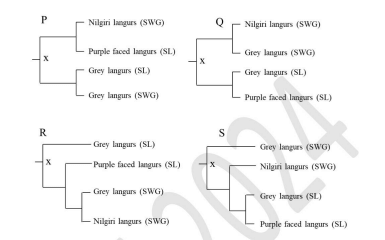
Grey langurs found in the southern Western Ghats (SWG) and grey langurs in Sri Lanka (SL) look very similar. Nilgiri langurs (found in SWG) and purple faced langurs (found in SL) also look similar. If allopatry played a role in the early diversification of this group (at point X in the tree), which one of the phylogenetic trees is most likely to be correct?
Two bird species, \(A\) and \(B\), are found on a single mountainside. \(A\) is a low-elevation species, found between 500 m and 1500 m Above Sea Level (ASL), while \(B\) is a high-elevation species, found between 1000 m and 2000 m ASL. At 1250 m ASL, species \(A\) and \(B\) have very different bill morphologies, but the bill morphology of species \(A\) at 500 m is very similar to the bill morphology of species \(B\) at 2000 m ASL. Which one or more of the following explain(s) the difference in bill morphology at 1250 m ASL?
Which one or more of the following is/are greenhouse gas(es)?
Males of the Indian robin in two populations sing songs of different lengths. Which one or more of the options given is/are an ultimate (not proximate) explanation(s) of the difference in song length between the two populations?
Female Anopheles mosquitoes bite humans to get blood. Researchers performed an experiment to study whether female mosquitoes use temperature or scent, or both, when locating human hosts. They presented female mosquitoes with membranes kept at different temperatures. Some membranes had human scent applied to them. The response to each treatment was measured as the percentage of females that landed on the membrane (50 females for each treatment). The table shows the treatments and the corresponding responses.
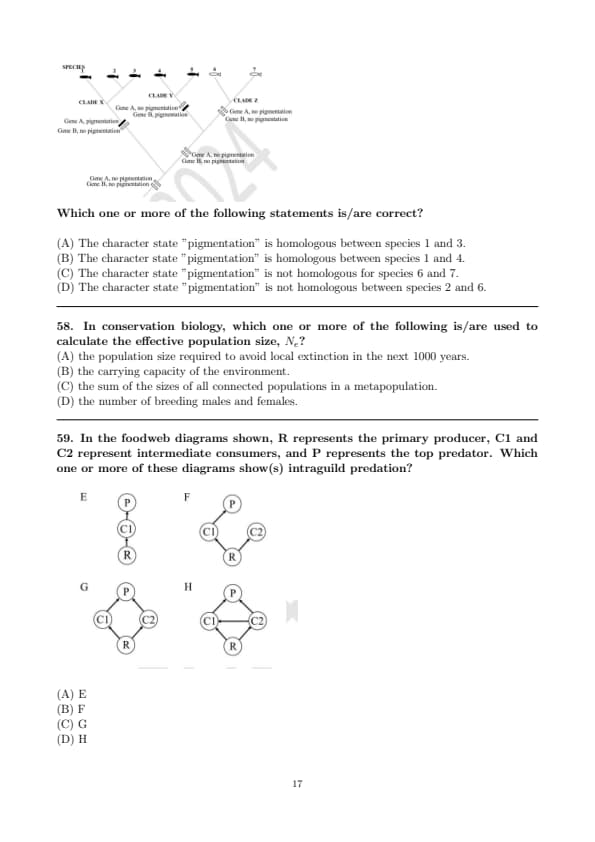
A phylogenetic tree for the evolution of two pigmentation traits in species of fish is shown for clades X, Y, and Z. Genes A and/or B, if mutated, can cause dark pigmentation in the body.
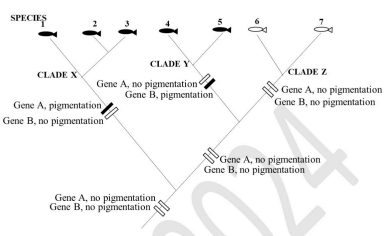
Which one or more of the following statements is/are correct?
In conservation biology, which one or more of the following is/are used to calculate the effective population size, \( N_e \)?
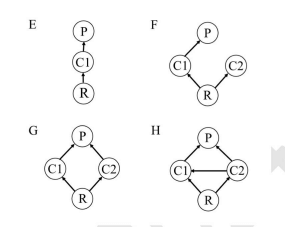
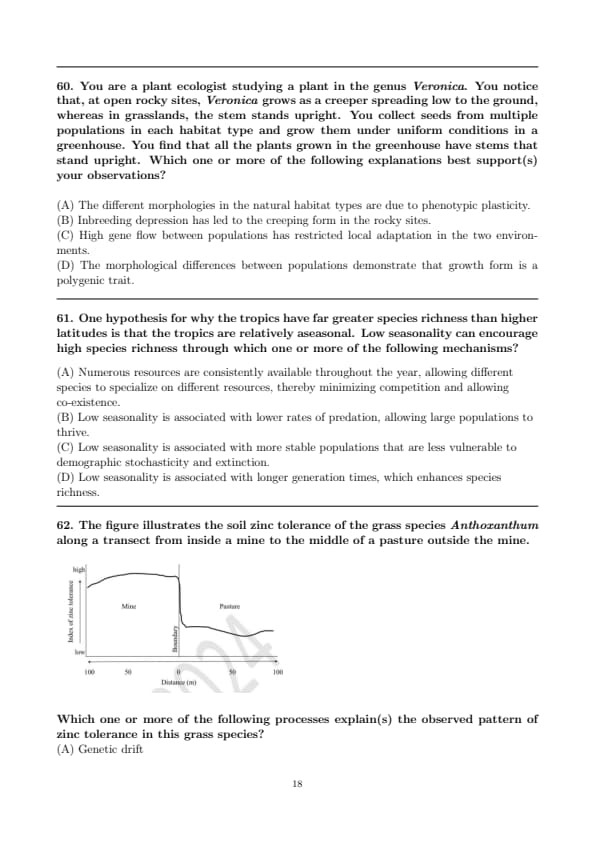
In the foodweb diagrams shown, R represents the primary producer, C1 and C2 represent intermediate consumers, and P represents the top predator. Which one or more of these diagrams show(s) intraguild predation?
You are a plant ecologist studying a plant in the genus Veronica. You notice that, at open rocky sites, Veronica grows as a creeper spreading low to the ground, whereas in grasslands, the stem stands upright. You collect seeds from multiple populations in each habitat type and grow them under uniform conditions in a greenhouse. You find that all the plants grown in the greenhouse have stems that stand upright. Which one or more of the following explanations best support(s) your observations?
One hypothesis for why the tropics have far greater species richness than higher latitudes is that the tropics are relatively aseasonal. Low seasonality can encourage high species richness through which one or more of the following mechanisms?
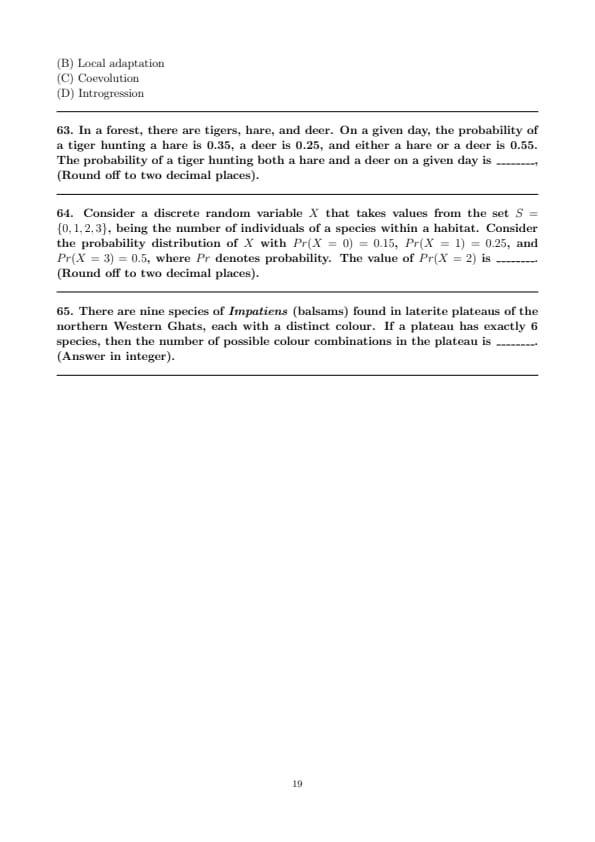
The figure illustrates the soil zinc tolerance of the grass species Anthoxanthum along a transect from inside a mine to the middle of a pasture outside the mine.
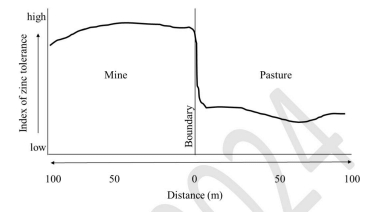
Which one or more of the following processes explain(s) the observed pattern of zinc tolerance in this grass species?
In a forest, there are tigers, hare, and deer. On a given day, the probability of a tiger hunting a hare is 0.35, a deer is 0.25, and either a hare or a deer is 0.55. The probability of a tiger hunting both a hare and a deer on a given day is ________, (Round off to two decimal places).
Consider a discrete random variable \( X \) that takes values from the set \( S = \{0, 1, 2, 3\} \), being the number of individuals of a species within a habitat. Consider the probability distribution of \( X \) with \( Pr(X = 0) = 0.15 \), \( Pr(X = 1) = 0.25 \), and \( Pr(X = 3) = 0.5 \), where \( Pr \) denotes probability. The value of \( Pr(X = 2) \) is ________. (Round off to two decimal places).
There are nine species of Impatiens (balsams) found in laterite plateaus of the northern Western Ghats, each with a distinct colour. If a plateau has exactly 6 species, then the number of possible colour combinations in the plateau is ________. (Answer in integer).




Comments