




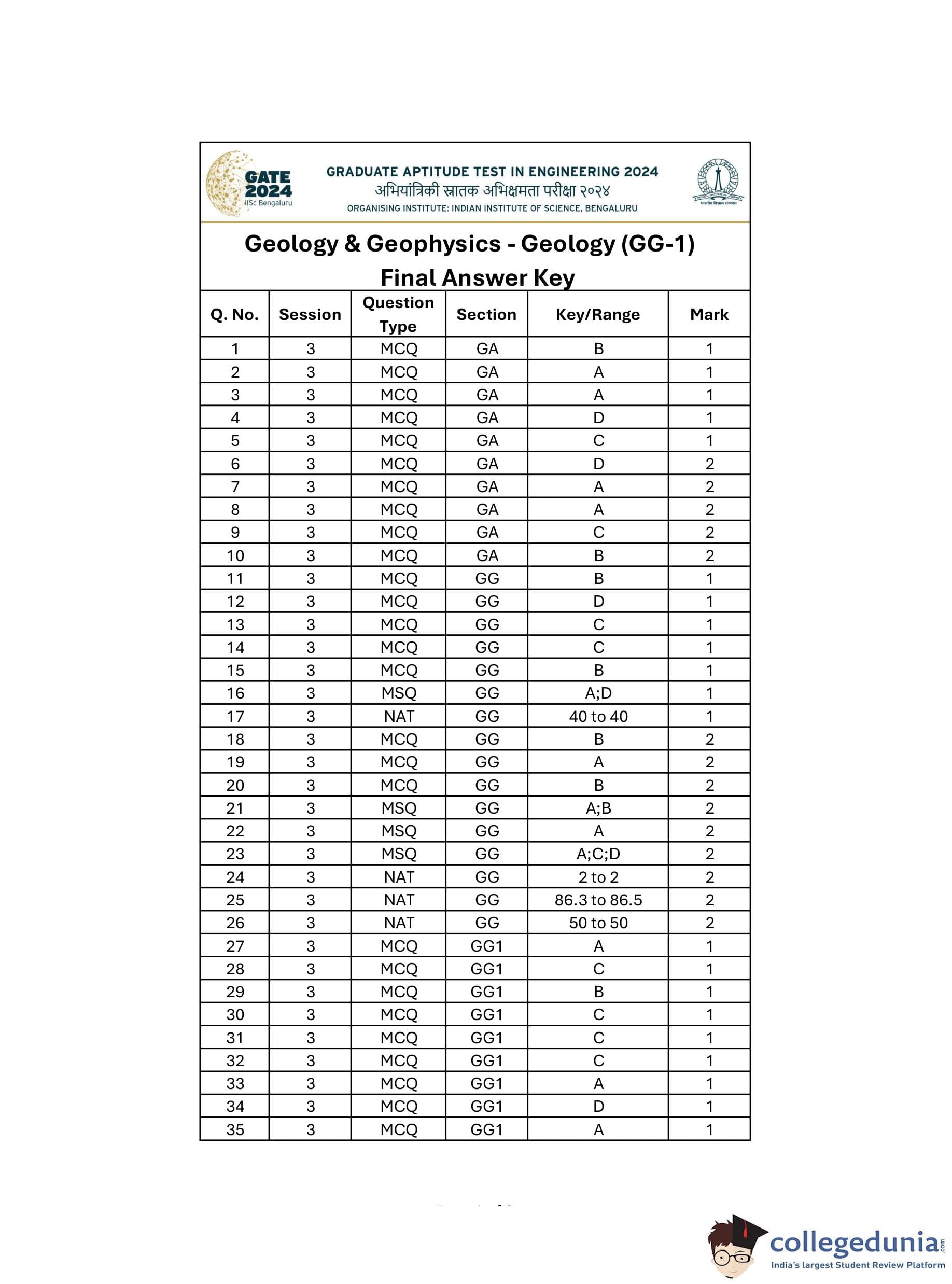
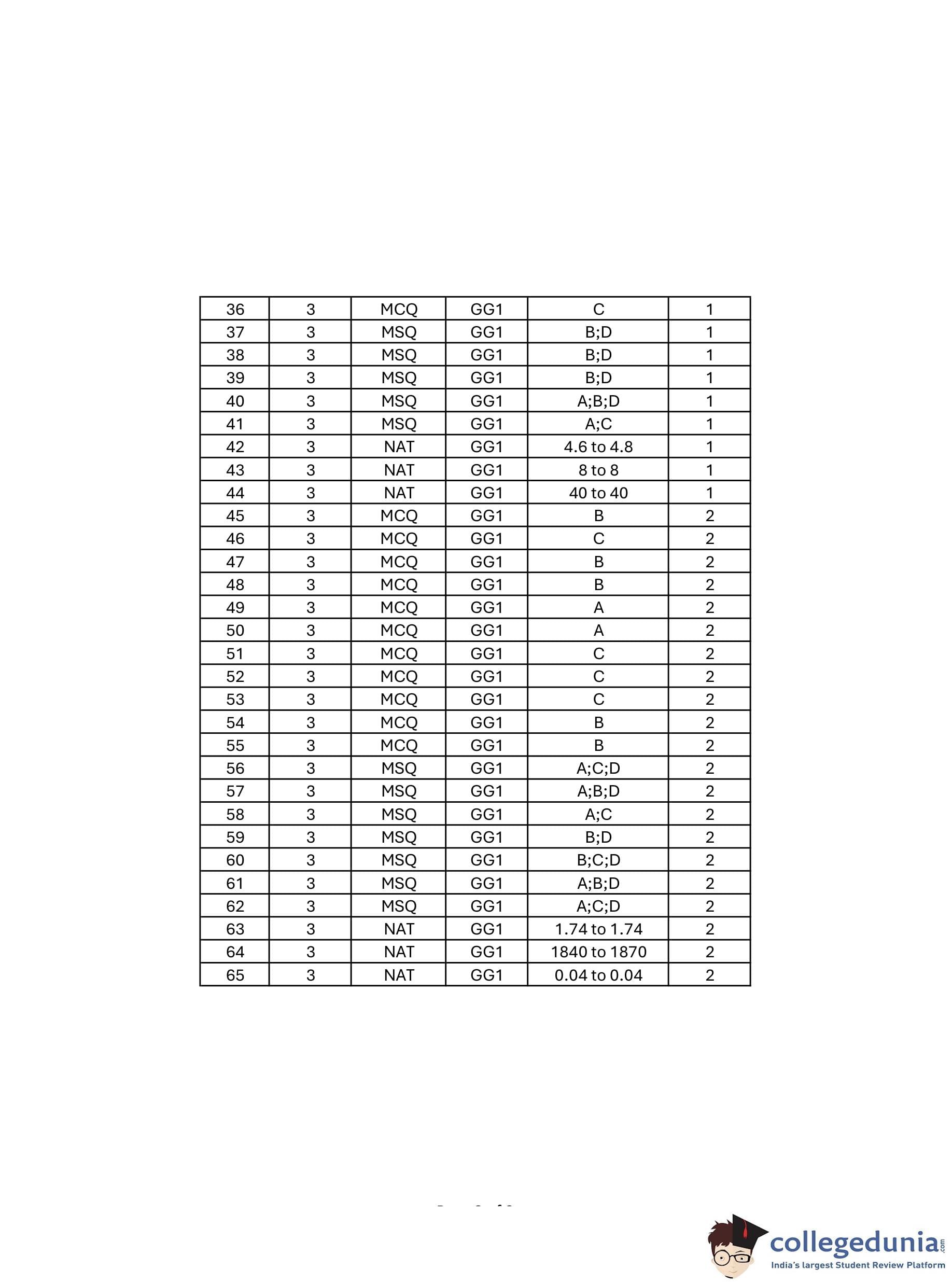
GATE 2024 Geology Question Paper PDF is available here. IISc Banglore conducted GATE 2024 Geology exam on February 4 in the Forenoon Session from 9:30 AM to 12:30 PM. Students have to answer 65 questions in GATE 2024 Geology Question Paper carrying a total weightage of 100 marks. 10 questions are from the General Aptitude section and 55 questions are from Core Discipline.
GATE 2024 Geology & Geophysics - Geology (GG1) Solutions PDF
| GATE 2024 Geology & Geophysics - Geology (GG1) Solutions PDF | Download | Check Solutions |
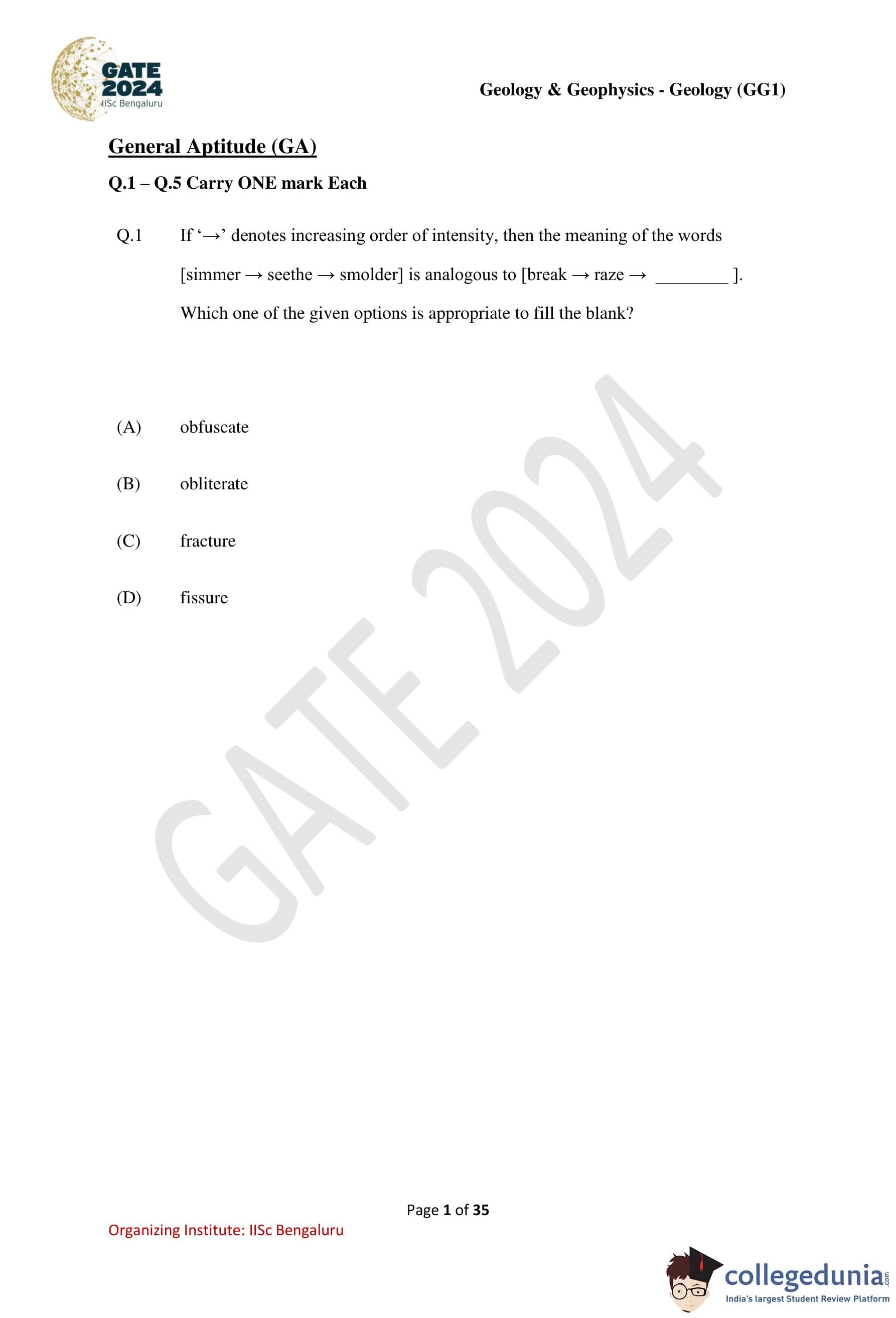
If ‘\(\rightarrow\)’ denotes increasing order of intensity, then the meaning of the words \([ simmer \rightarrow seethe \rightarrow smolder ]\) is analogous to \([ break \rightarrow raze \rightarrow \hspace{1.5cm} ]\).
Which one of the given options is appropriate to fill the blank?
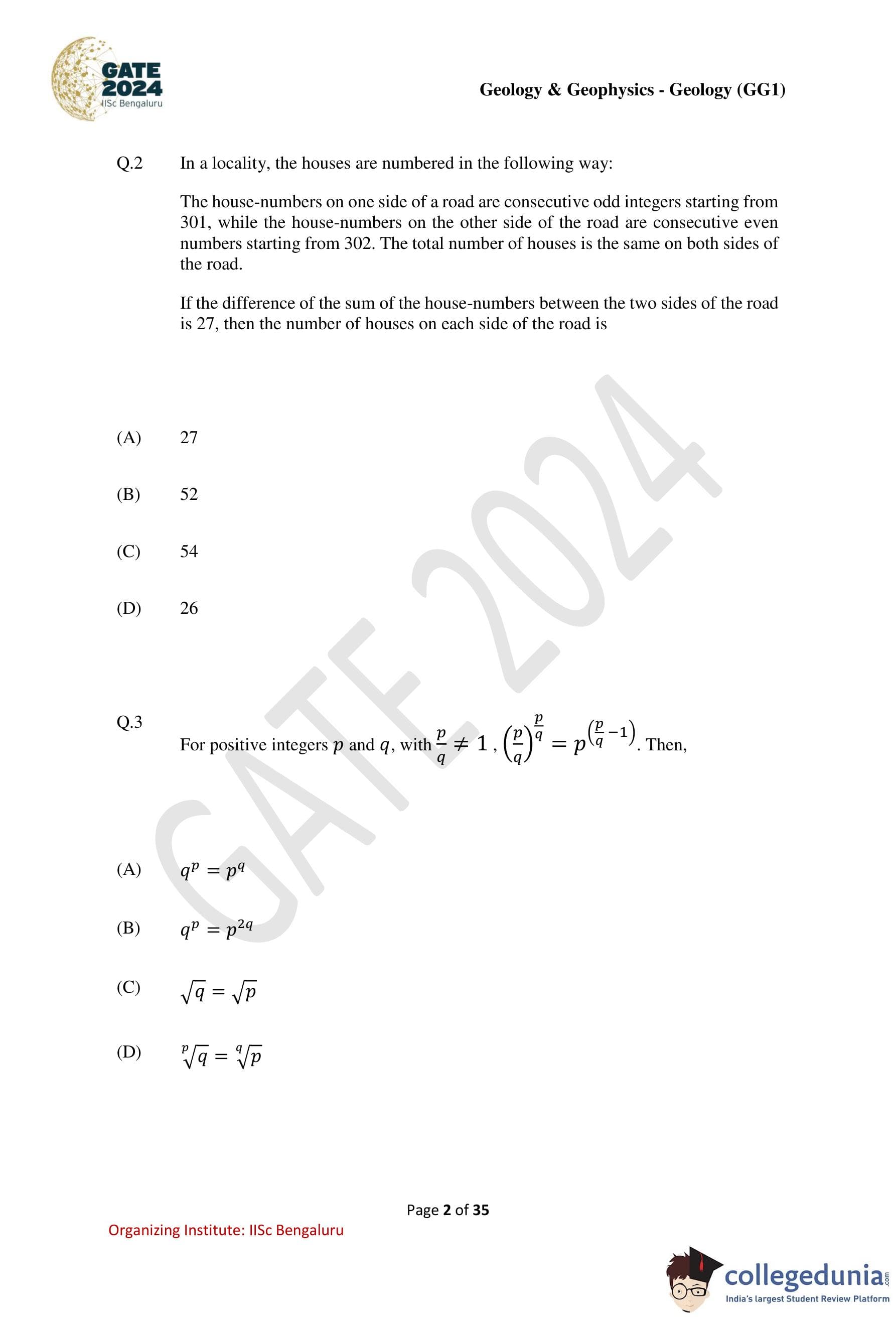
In a locality, the houses are numbered in the following way:
The house-numbers on one side of a road are consecutive odd integers starting from \(301\), while the house-numbers on the other side of the road are consecutive even numbers starting from \(302\). The total number of houses is the same on both sides of the road.
If the difference of the sum of the house-numbers between the two sides of the road is \(27\), then the number of houses on each side of the road is
For positive integers \(p\) and \(q\), with \( \dfrac{p}{q} \neq 1 \), \[ \left(\frac{p}{q}\right)^{\frac{p}{q}} = p^{\left(\frac{p-1}{q}\right)}. \]
Then,
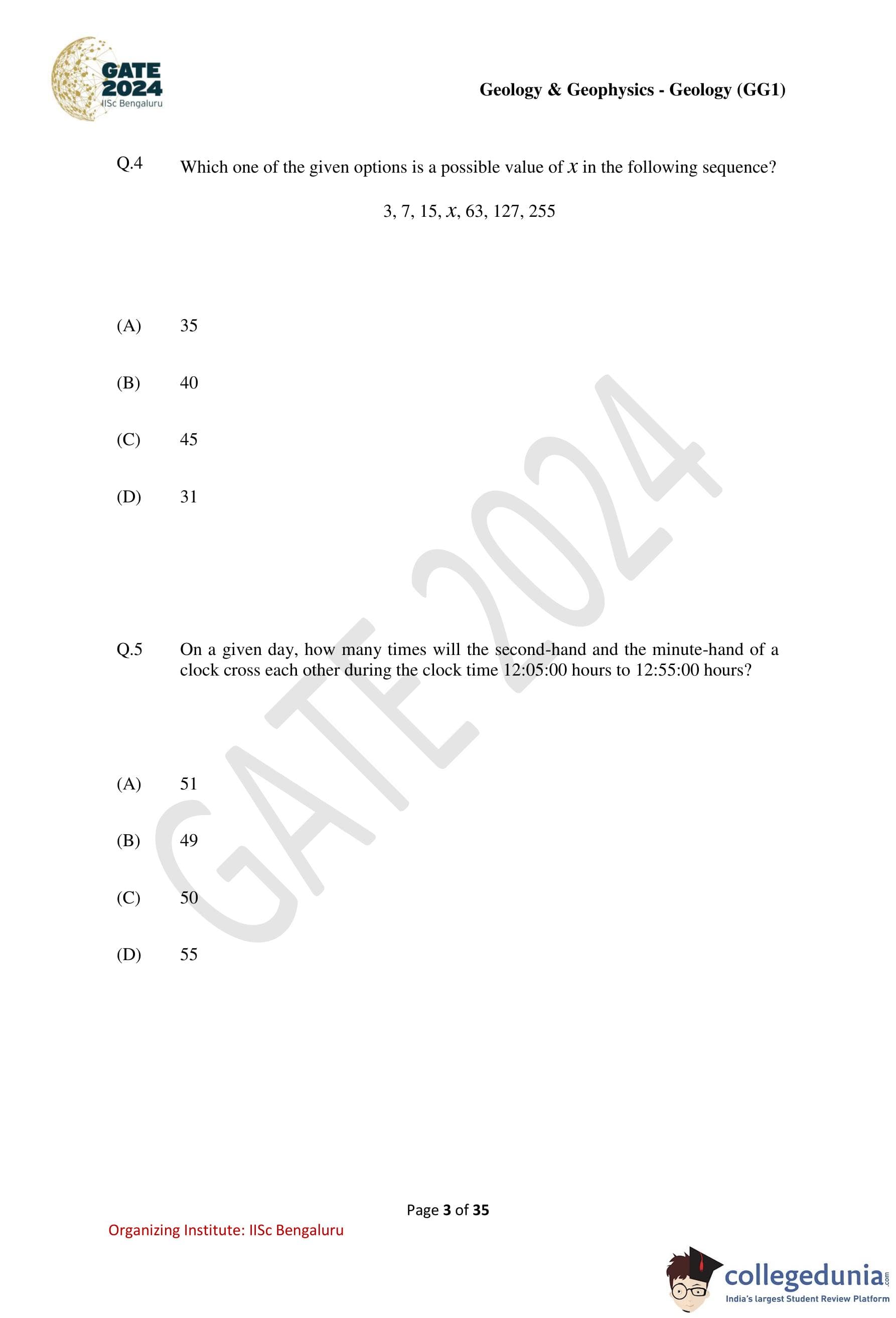
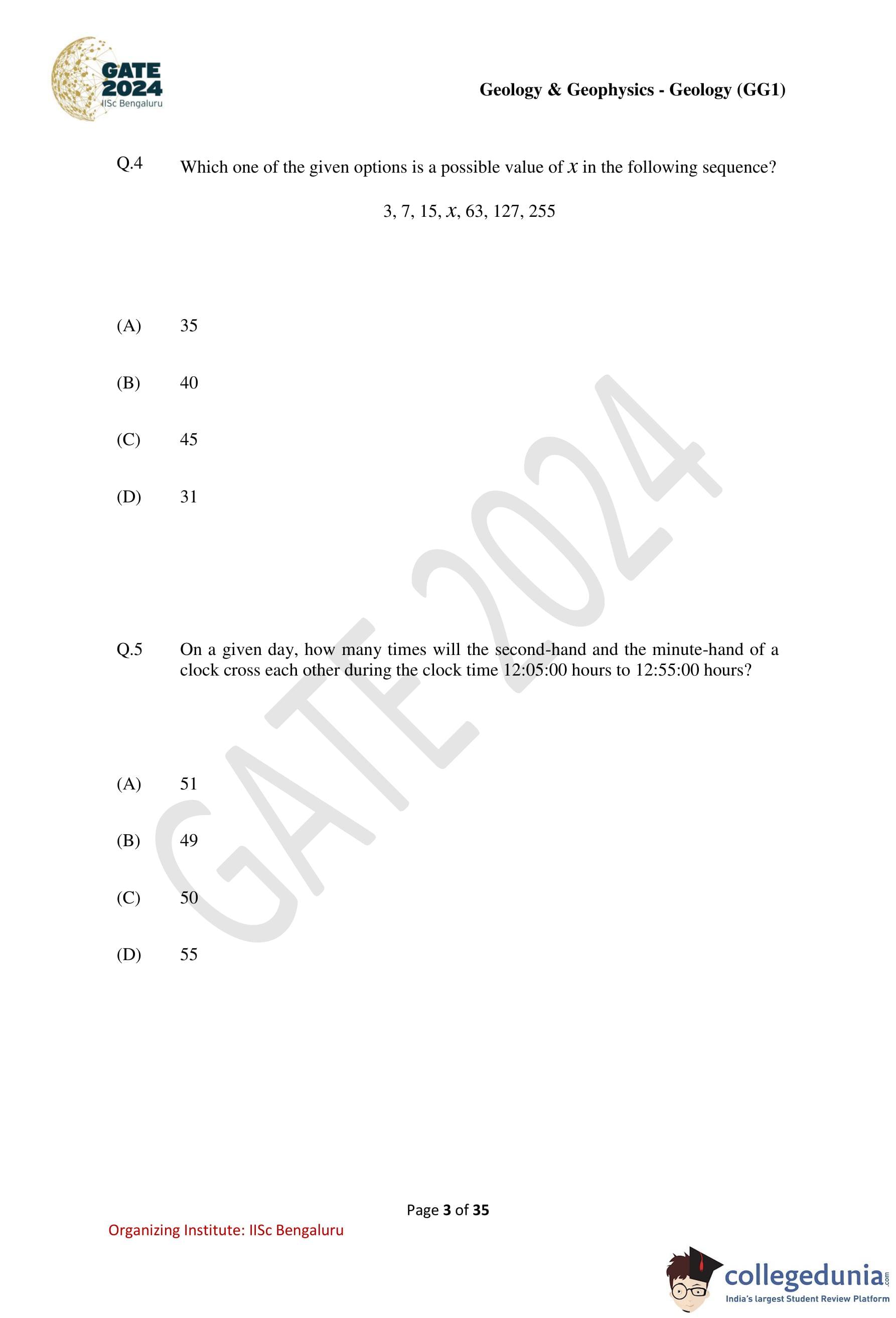
Which one of the given options is a possible value of \(x\) in the following sequence? \[ 3,\; 7,\; 15,\; x,\; 63,\; 127,\; 255 \]
On a given day, how many times will the second-hand and the minute-hand of a clock cross each other during the clock time 12:05:00 hours to 12:55:00 hours?
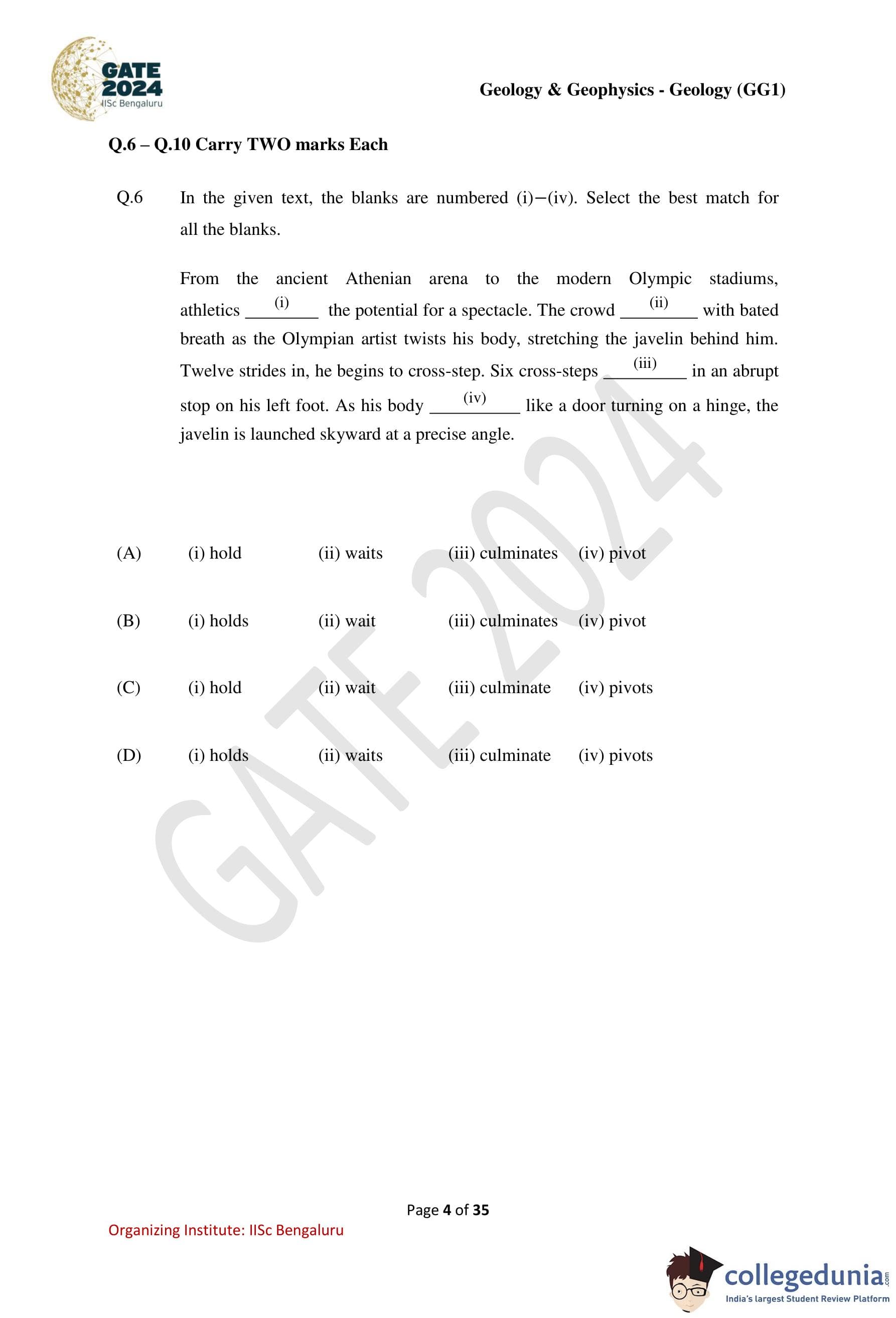
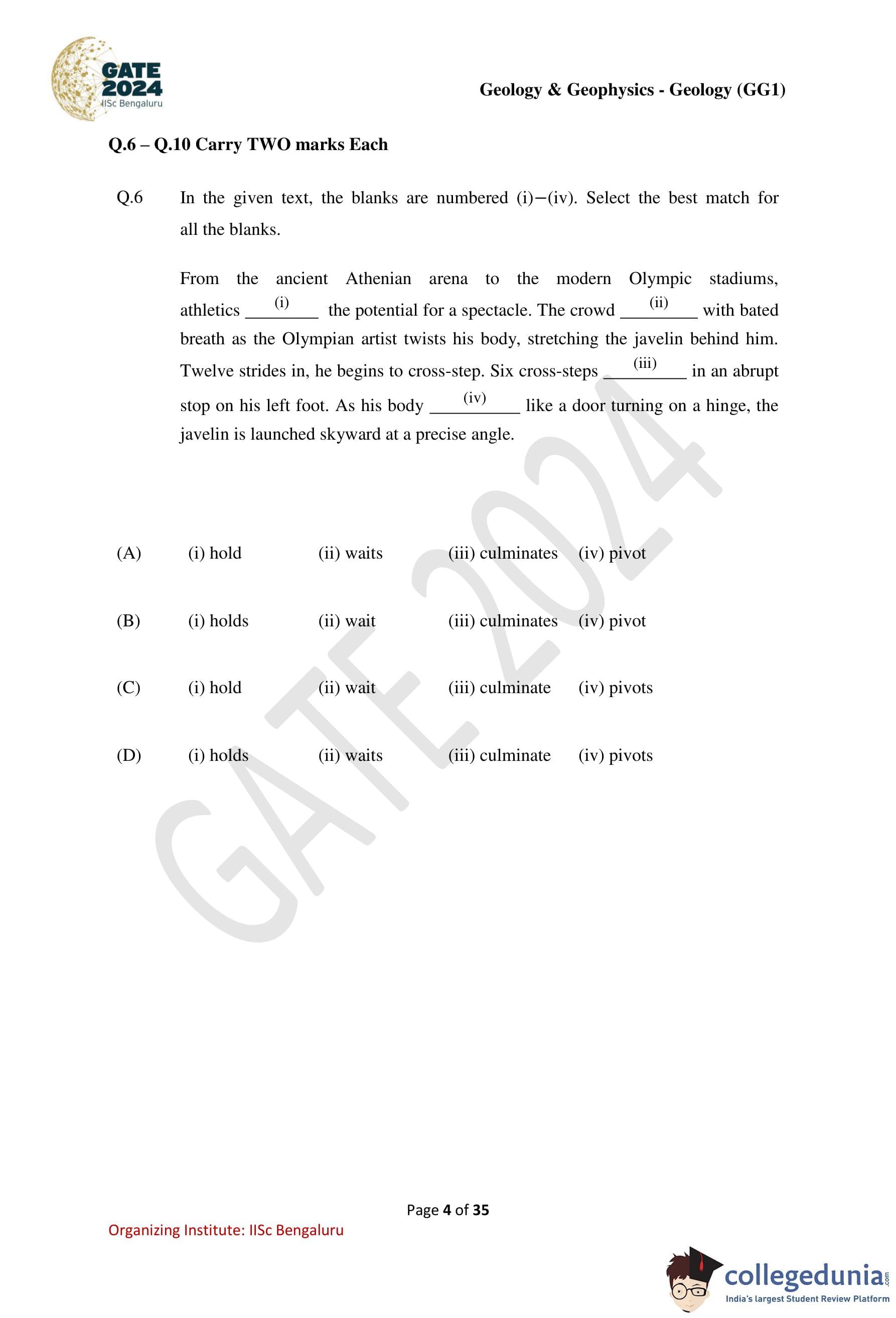
In the given text, the blanks are numbered (i)–(iv). Select the best match for all the blanks.
From the ancient Athenian arena to the modern Olympic stadiums, athletics \hspace{0.8cm} (i) the potential for a spectacle. The crowd \hspace{0.8cm} (ii) with bated breath as the Olympian artist twists his body, stretching the javelin behind him. Twelve strides in, he begins to cross-step. Six cross-steps \hspace{0.8cm} (iii) in an abrupt stop on his left foot. As his body \hspace{0.8cm} (iv) like a door turning on a hinge, the javelin is launched skyward at a precise angle.
Three distinct sets of indistinguishable twins are to be seated at a circular table that has 8 identical chairs. Unique seating arrangements are defined by the relative positions of the people.
How many unique seating arrangements are possible such that each person is sitting next to their twin?
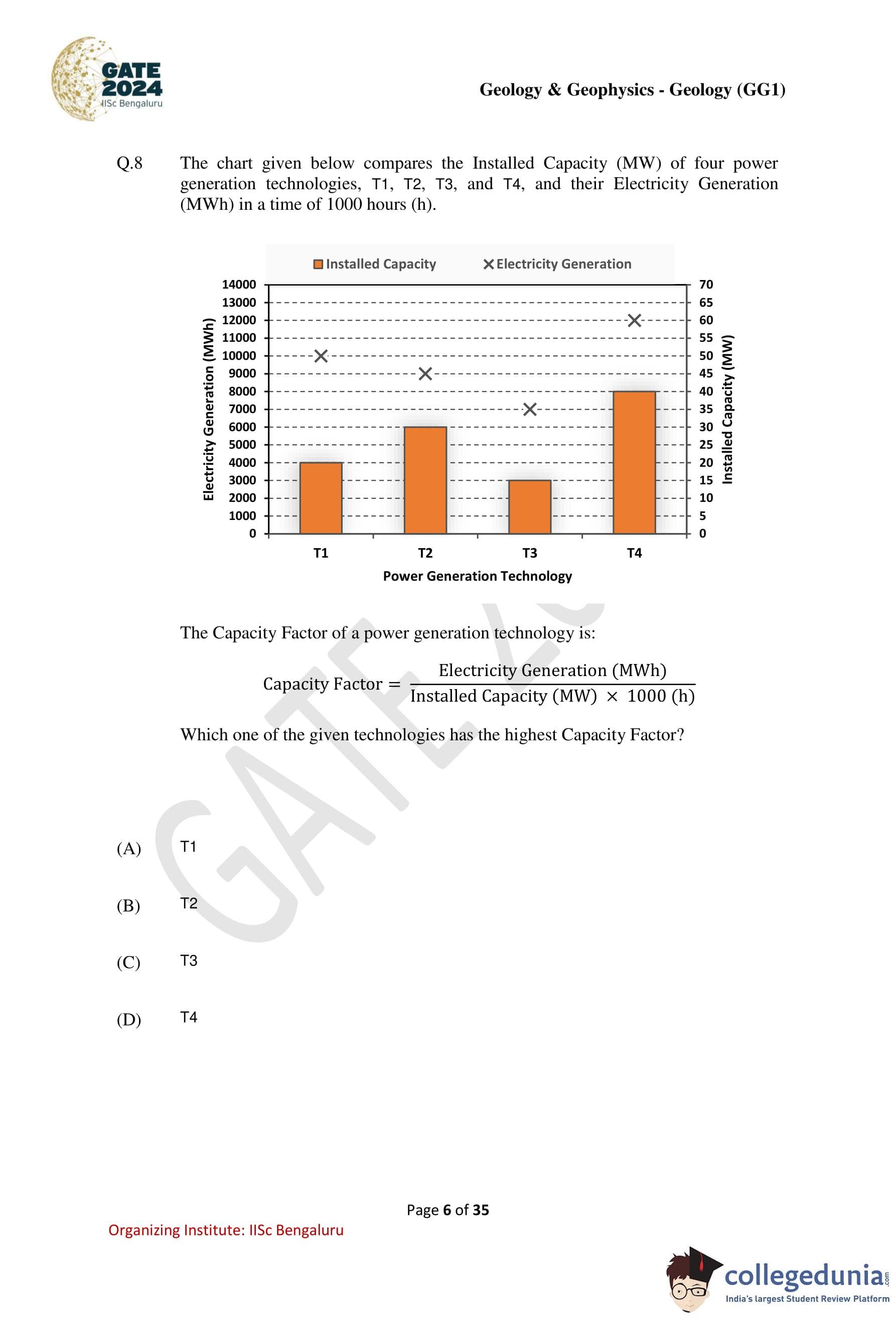
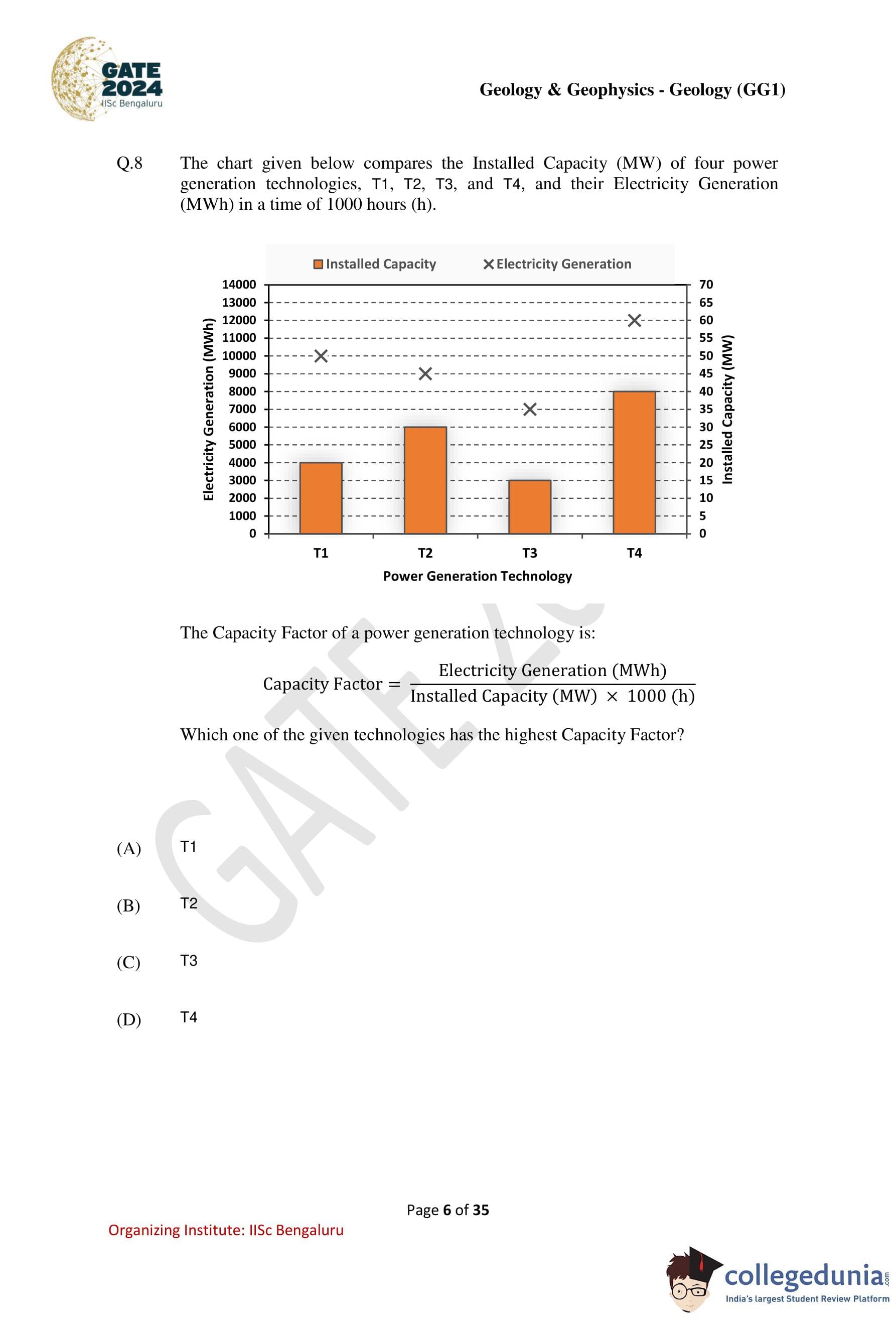
The chart given below compares the Installed Capacity (MW) of four power generation technologies, T1, T2, T3, and T4, and their Electricity Generation (MWh) in a time of 1000 hours (h).

The Capacity Factor of a power generation technology is: \[ Capacity Factor = \frac{Electricity Generation (MWh)}{Installed Capacity (MW) \times 1000\ (h)} \]
Which one of the given technologies has the highest Capacity Factor?
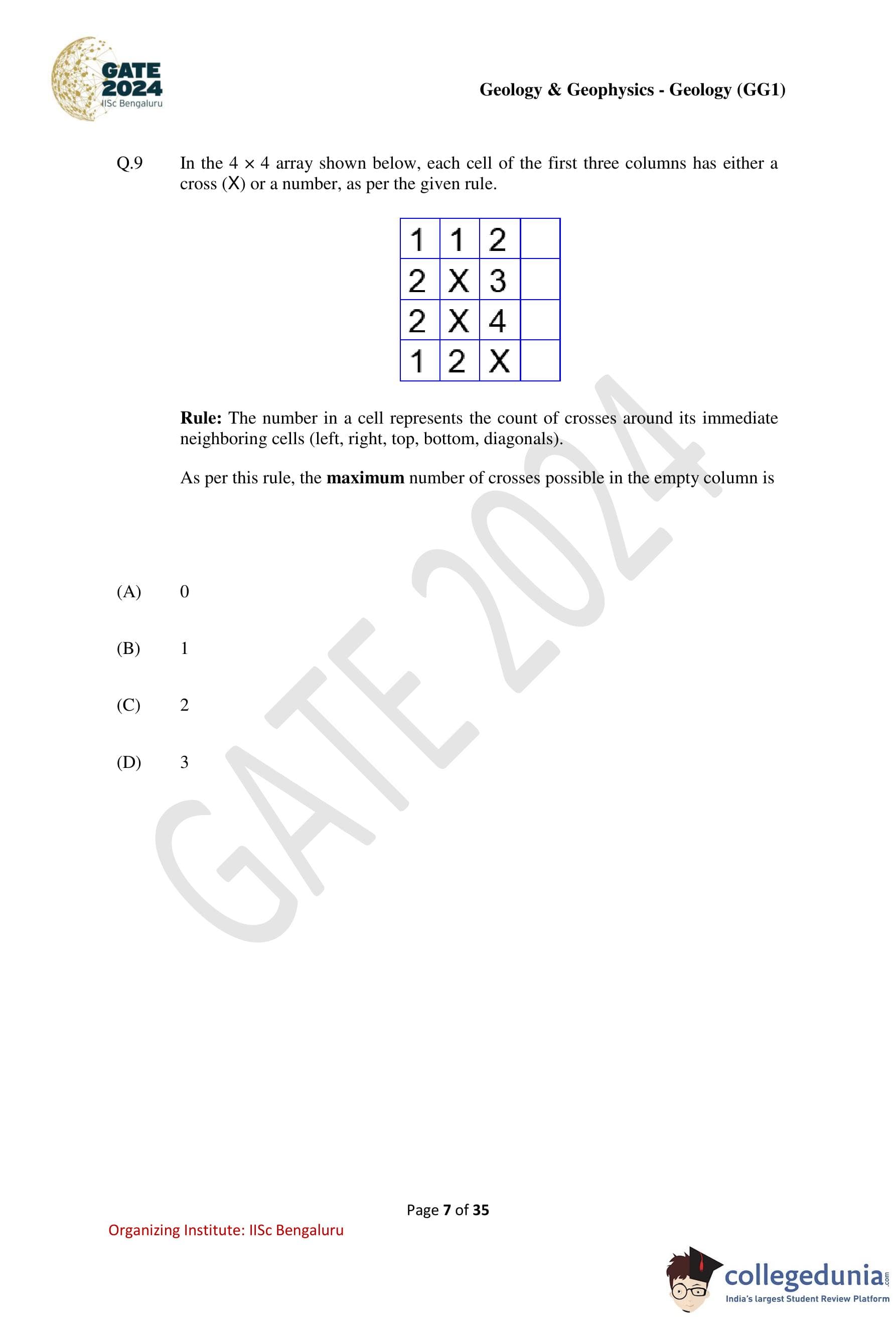
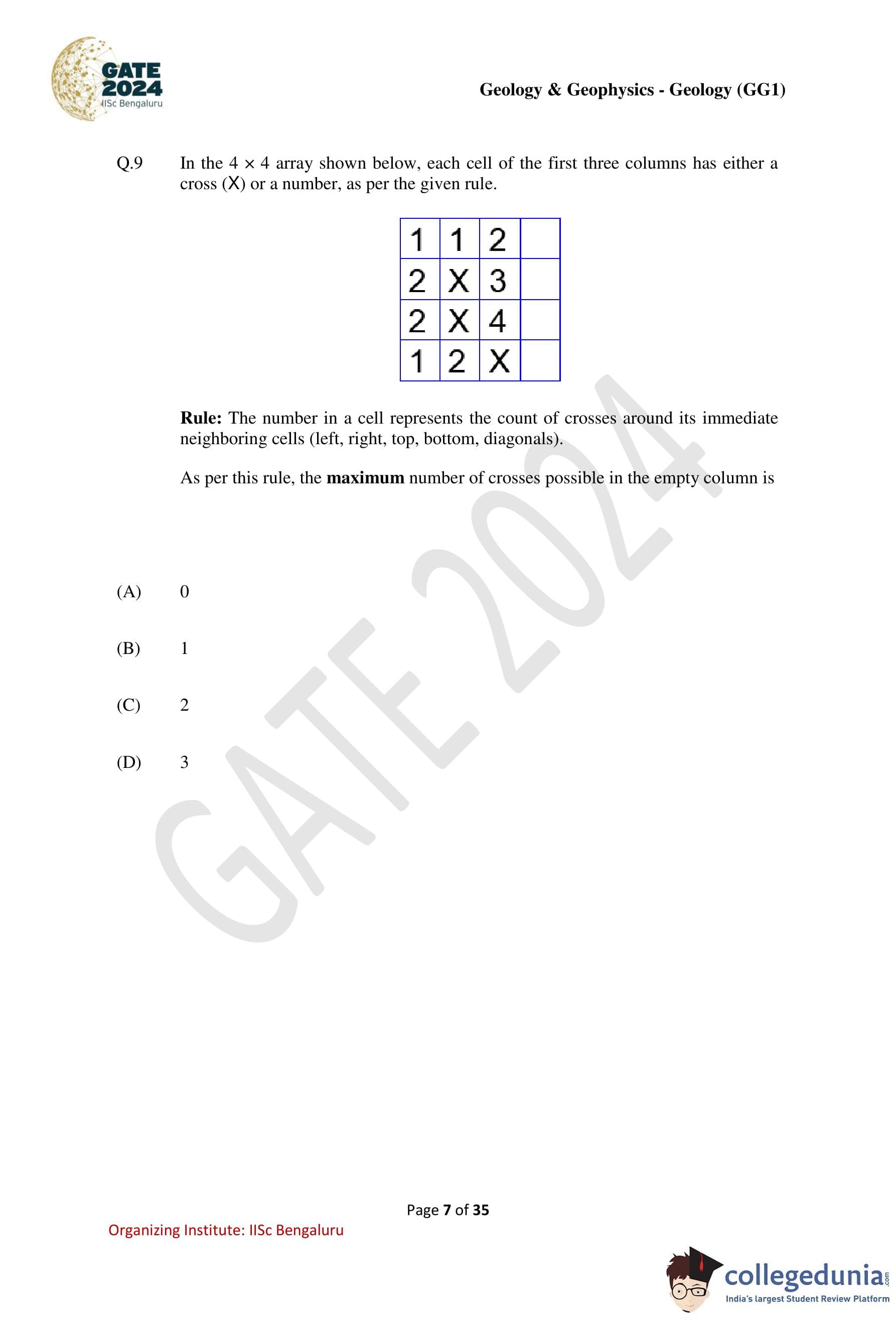
In the \(4 \times 4\) array shown below, each cell of the first three columns has either a cross (X) or a number, as per the given rule.

Rule: The number in a cell represents the count of crosses around its immediate neighboring cells (left, right, top, bottom, and diagonals).
As per this rule, the maximum number of crosses possible in the empty column is
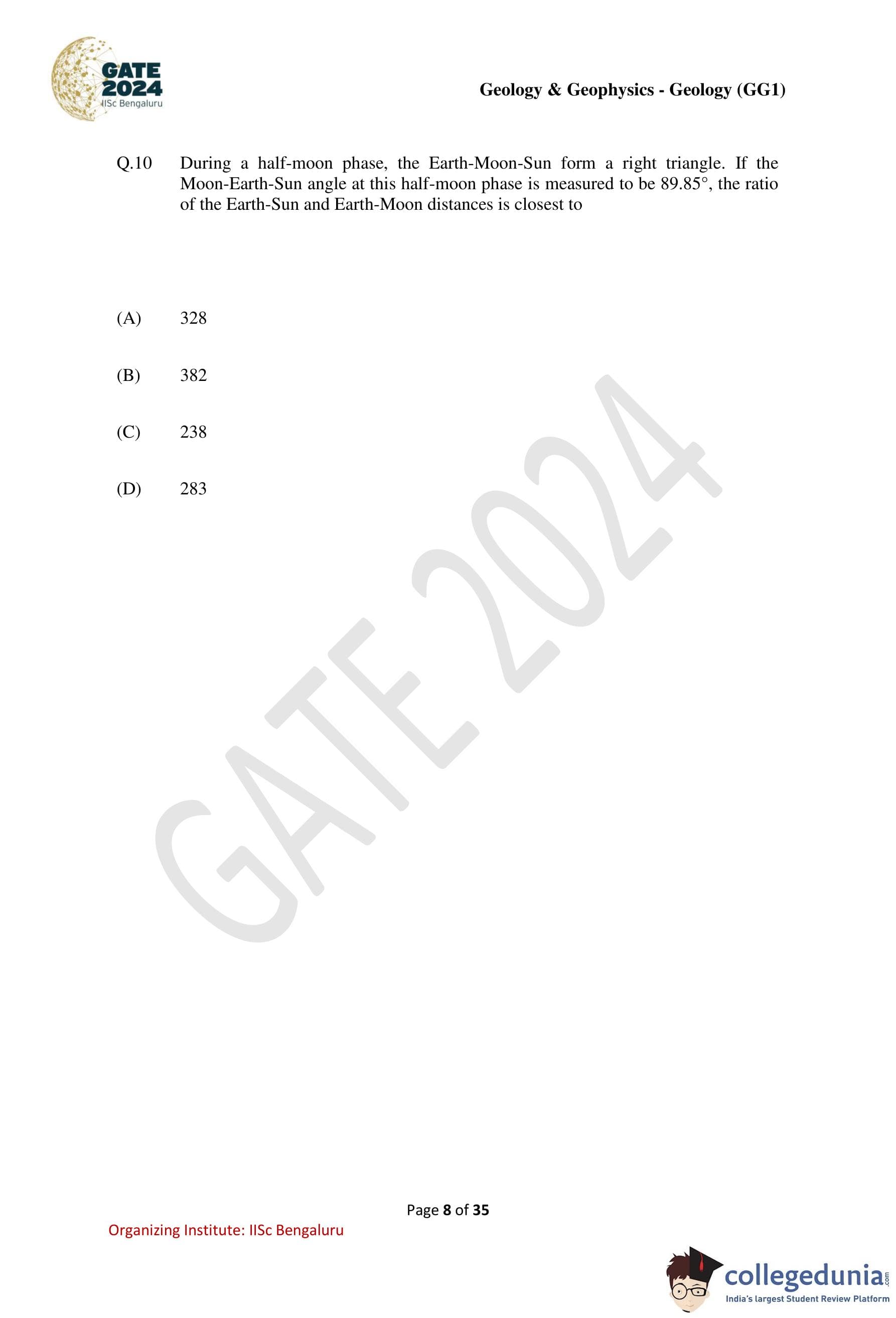
During a half-moon phase, the Earth–Moon–Sun form a right triangle. If the Moon–Earth–Sun angle at this half-moon phase is measured to be \(89.85^\circ\), the ratio of the Earth–Sun and Earth–Moon distances is closest to
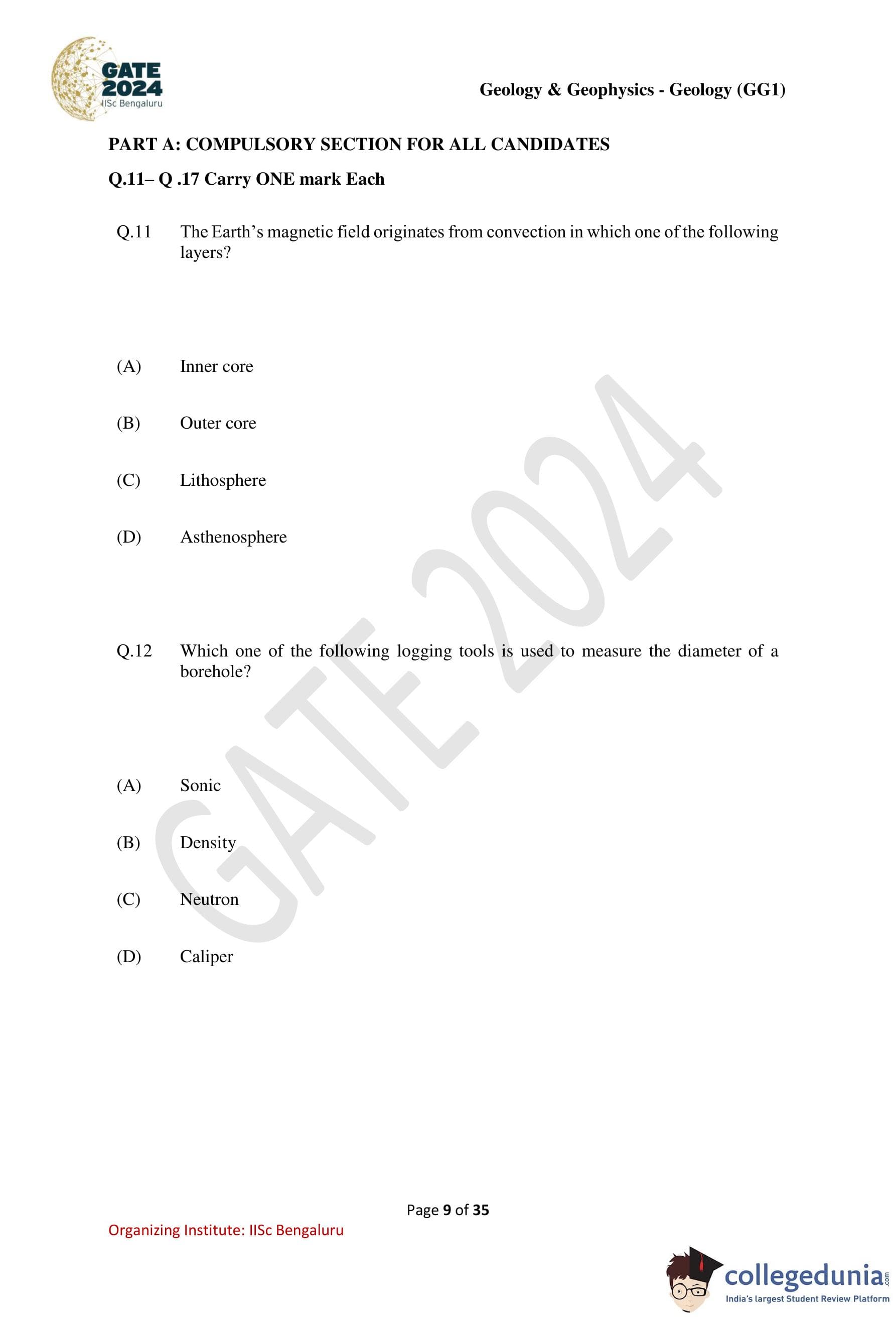
The Earth’s magnetic field originates from convection in which one of the following layers?
Which one of the following logging tools is used to measure the diameter of a borehole?
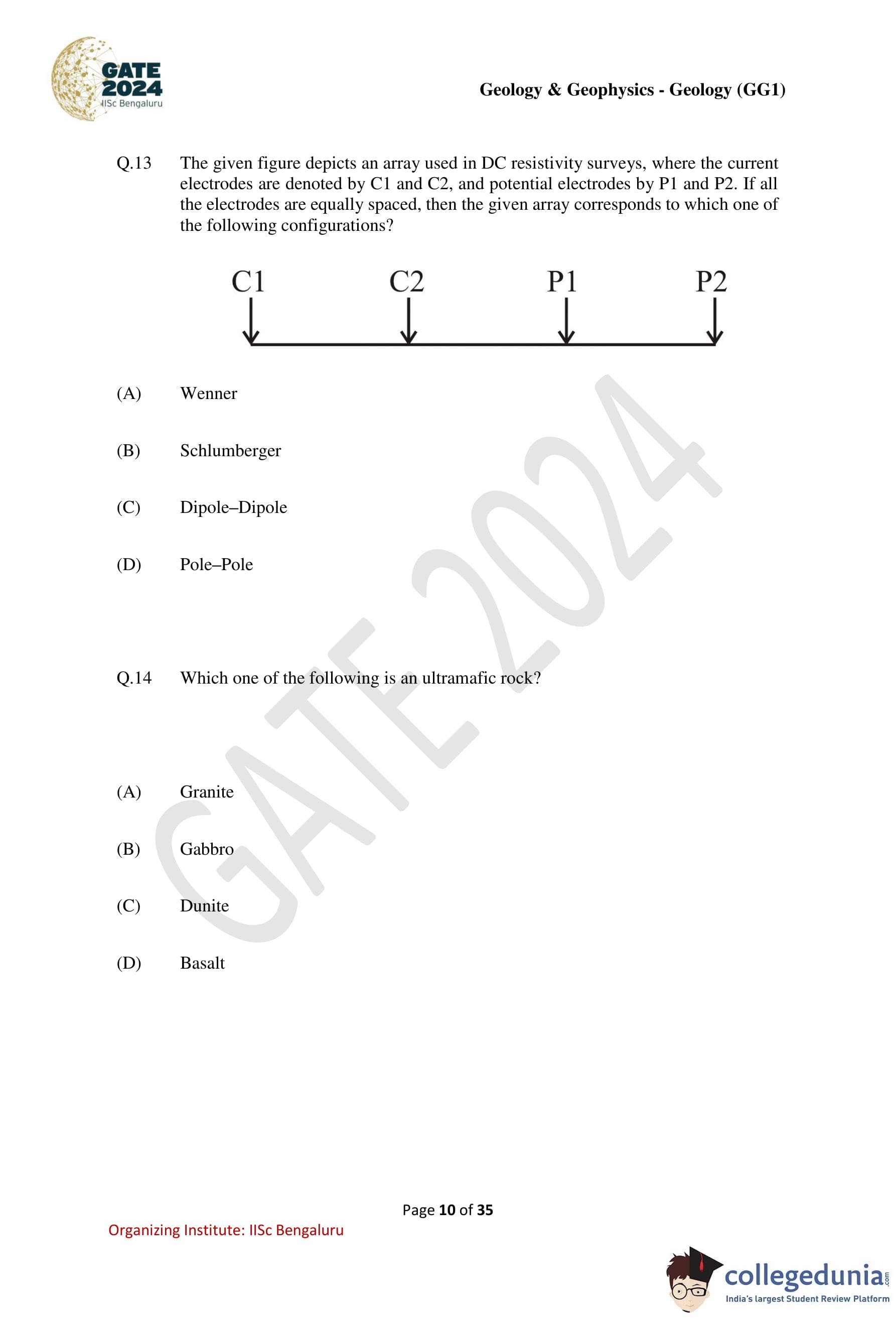
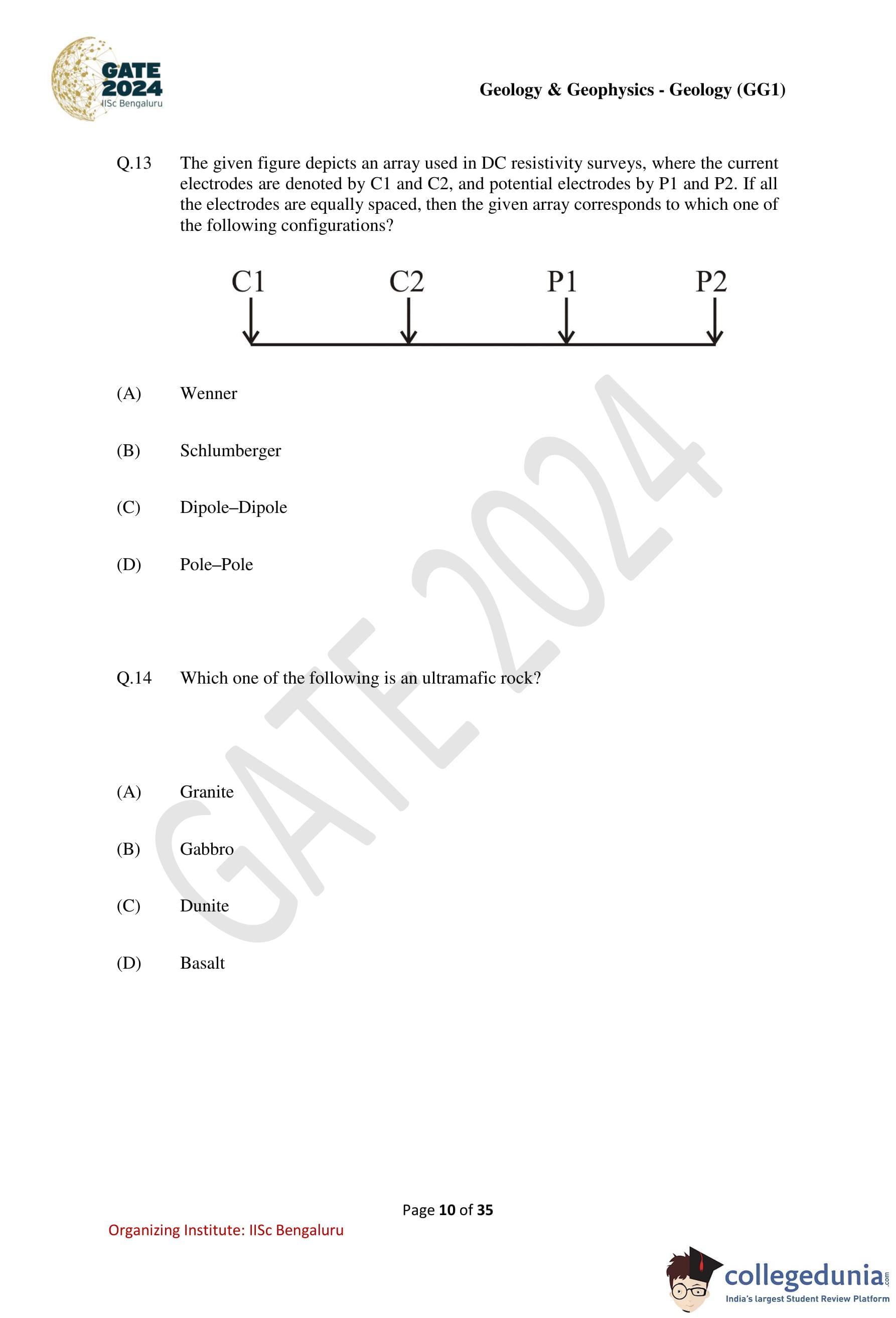
The given figure depicts an array used in DC resistivity surveys, where the current electrodes are denoted by C1 and C2, and potential electrodes by P1 and P2. If all the electrodes are equally spaced, then the given array corresponds to which one of the following configurations?

Which one of the following is an ultramafic rock?
Gold is being produced from which one of the following mines in India?
Which of the following hydrocarbon fields is/are located in the western offshore of India?
A cylindrical sample of granite (diameter = \(54.7\) mm; length = \(137\) mm) shows a linear relationship between axial stress and axial strain under uniaxial compression up to the peak stress level at which the specimen fails. If the uniaxial compressive strength of this sample is \(200\) MPa and the axial strain corresponding to this peak stress is \(0.005\), the Young’s modulus of the sample in GPa is ................ (in integer).
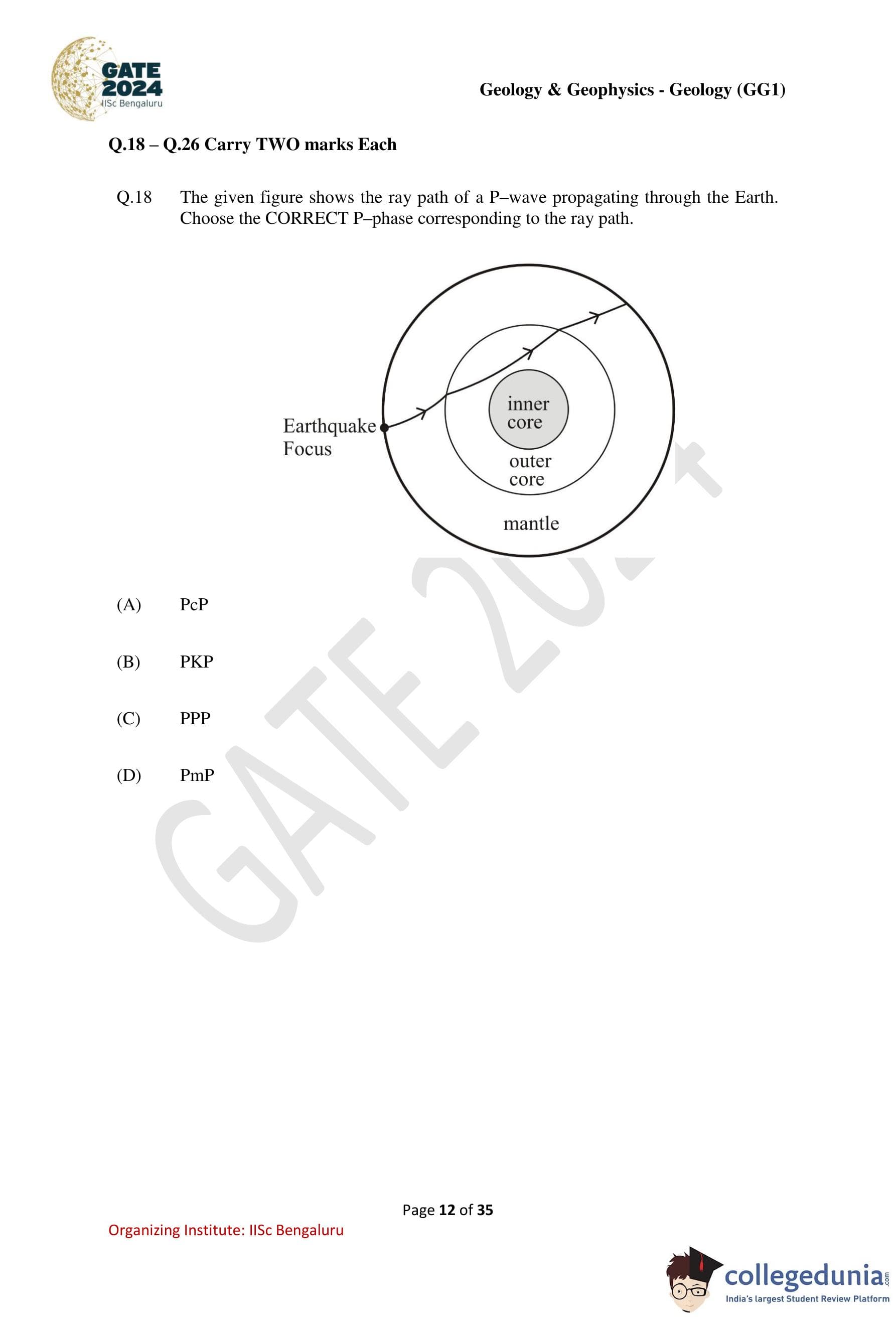
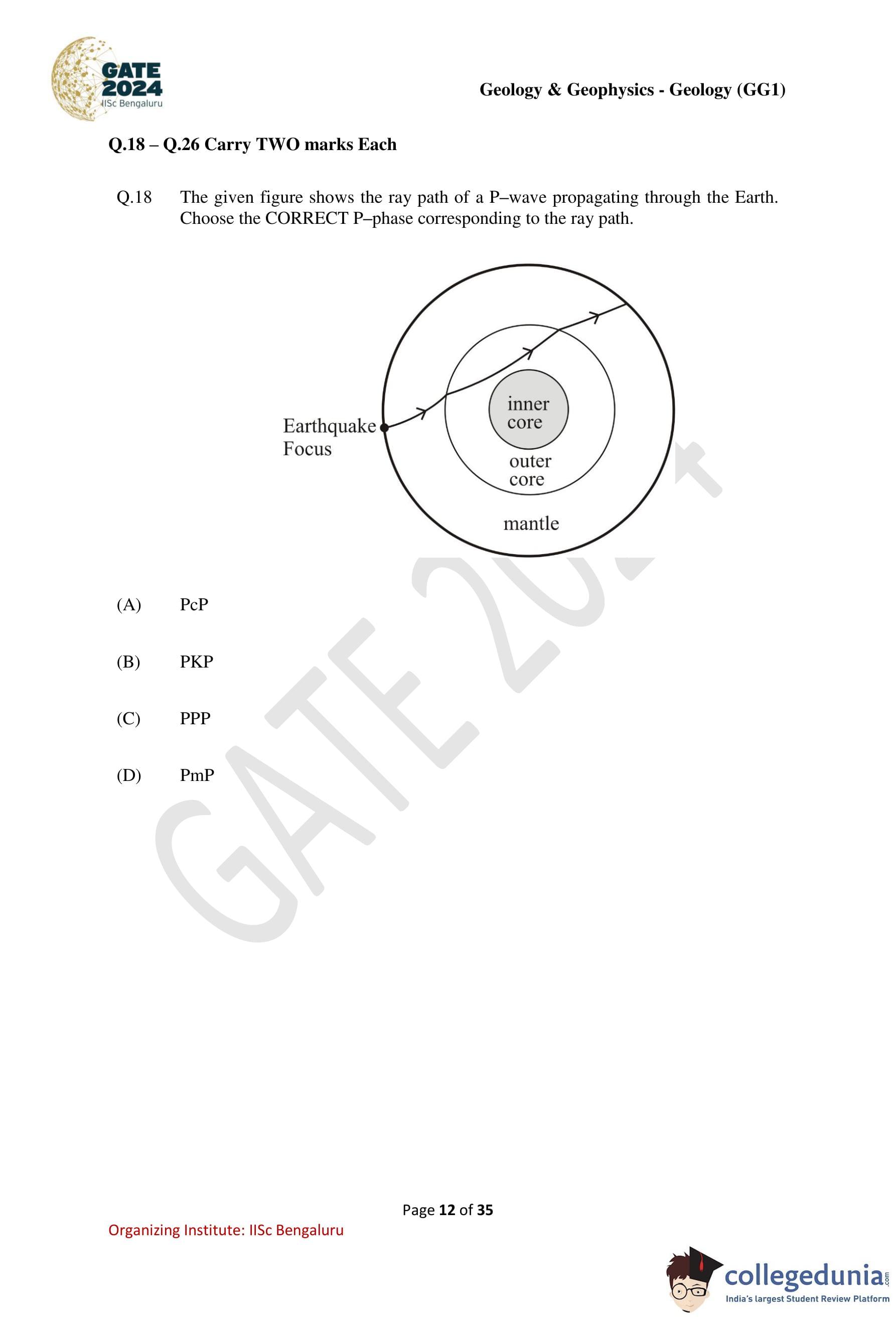
The given figure shows the ray path of a P-wave propagating through the Earth. Choose the \textbf{CORRECT} P-phase corresponding to the ray path.

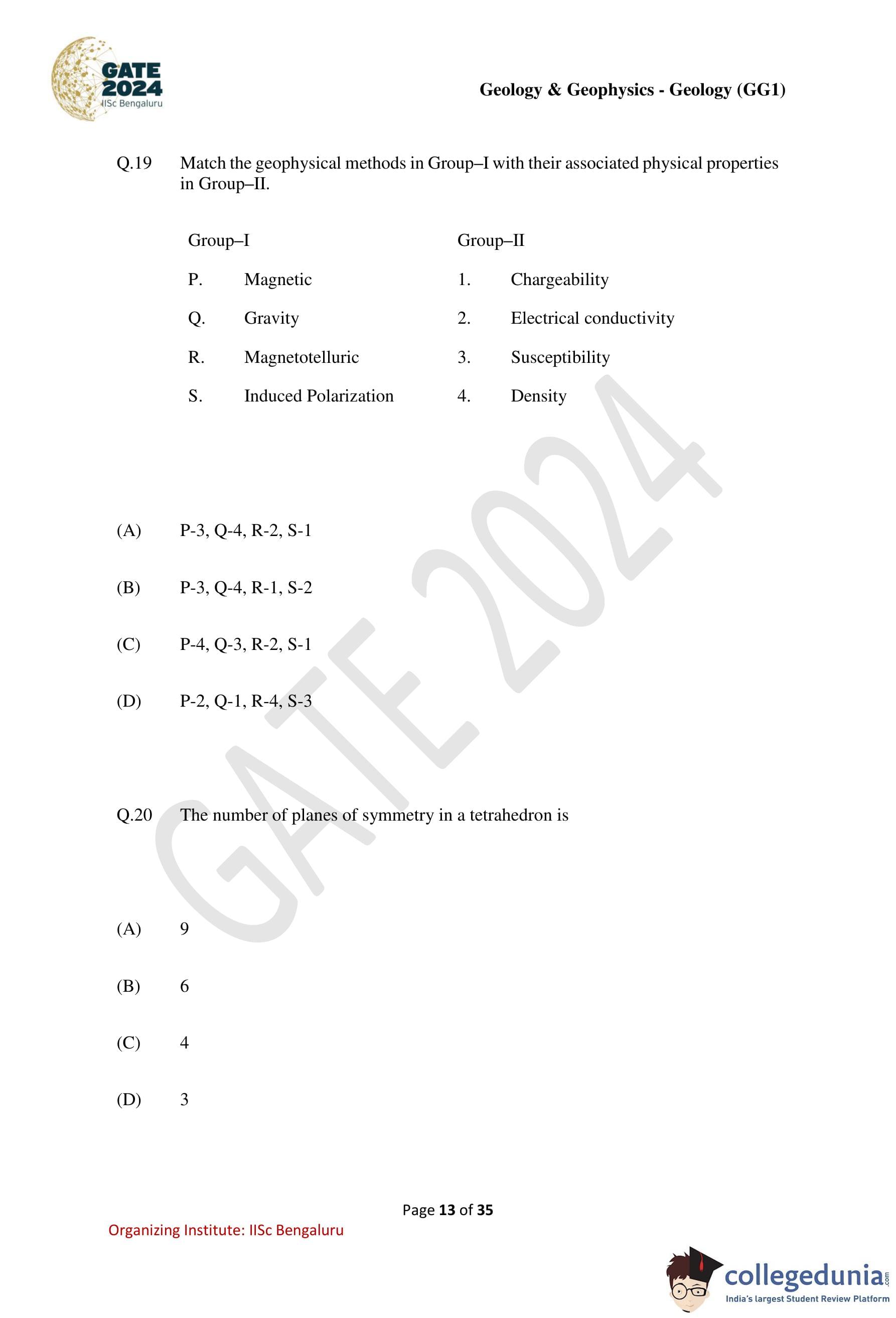
Match the geophysical methods in Group–I with their associated physical properties in Group–II.
Group–I & Group–II
P. Magnetic & 1. Chargeability
Q. Gravity & 2. Electrical conductivity
R. Magnetotelluric & 3. Susceptibility
S. Induced Polarization & 4. Density
The number of planes of symmetry in a tetrahedron is
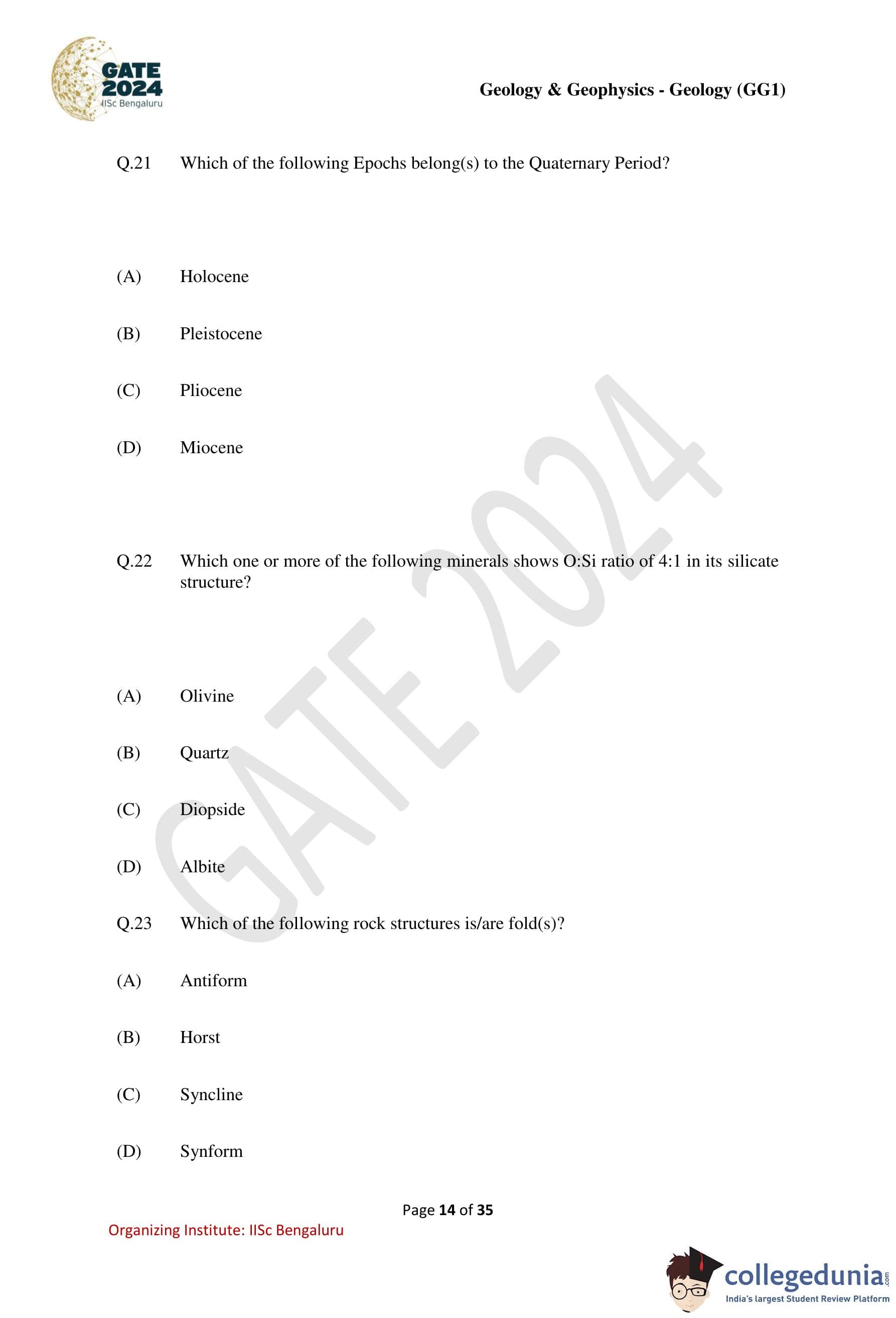
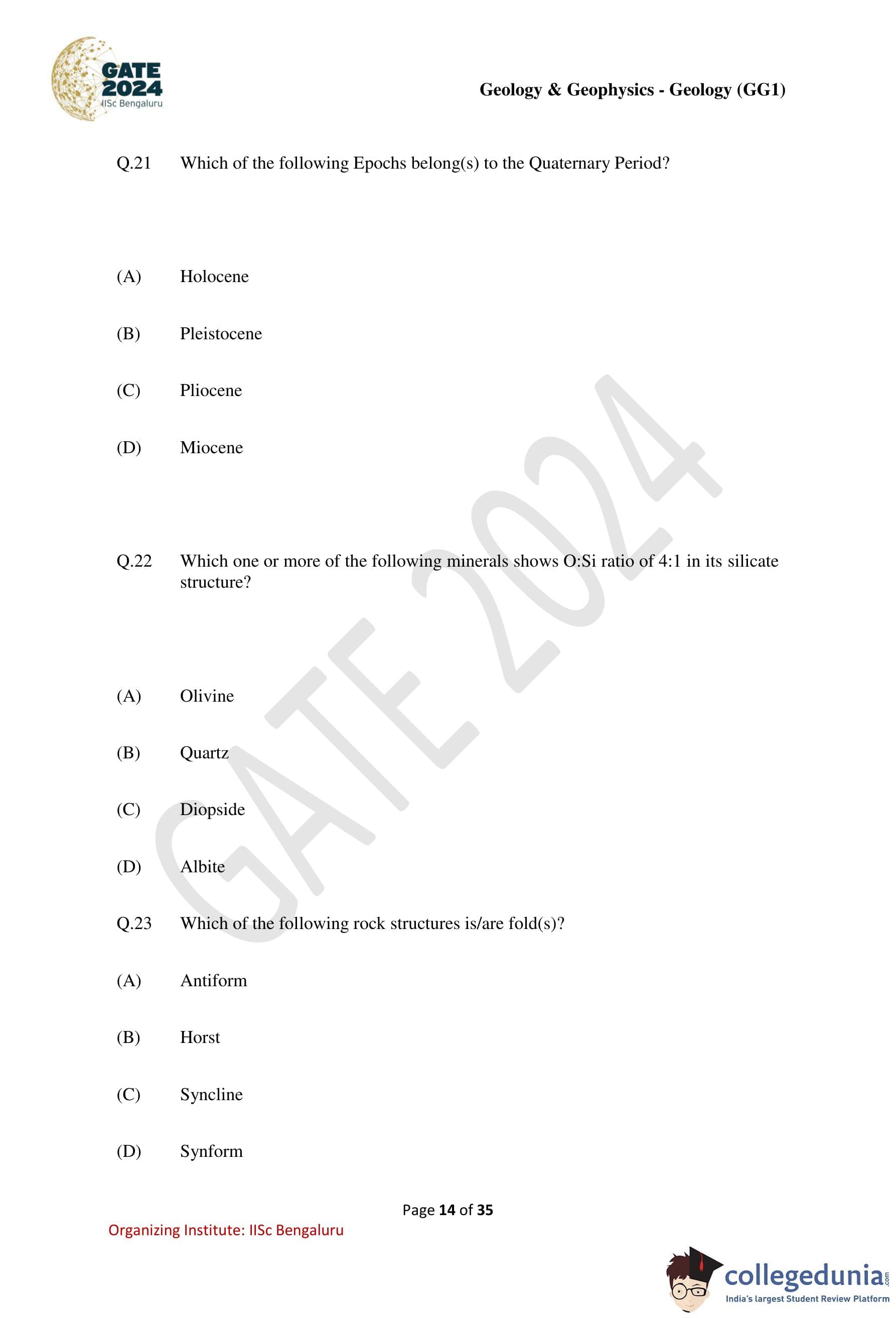
Which of the following Epochs belong(s) to the Quaternary Period?
Which one or more of the following minerals shows O:Si ratio of \(4:1\) in its silicate structure?
Which of the following rock structures is/are fold(s)?
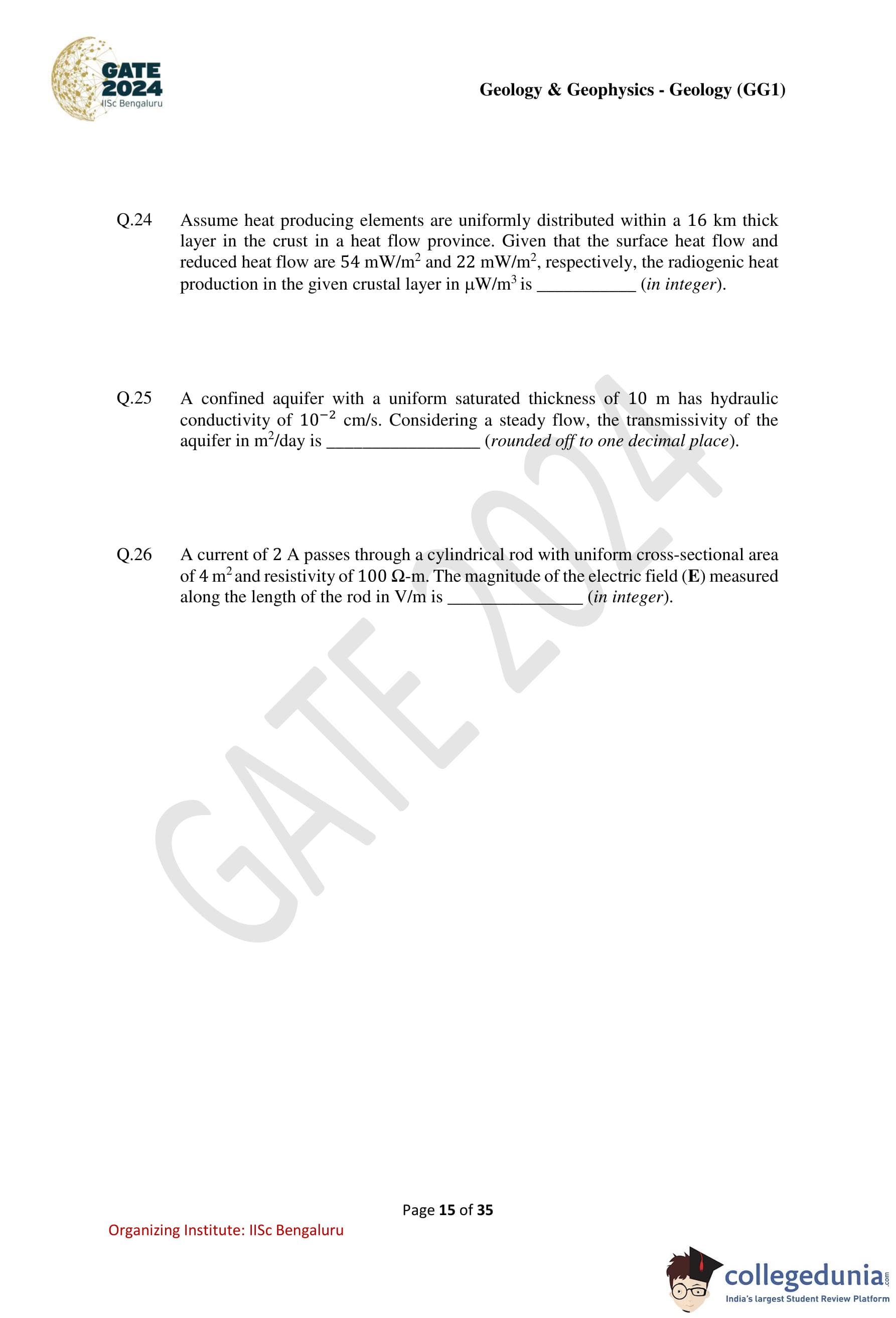
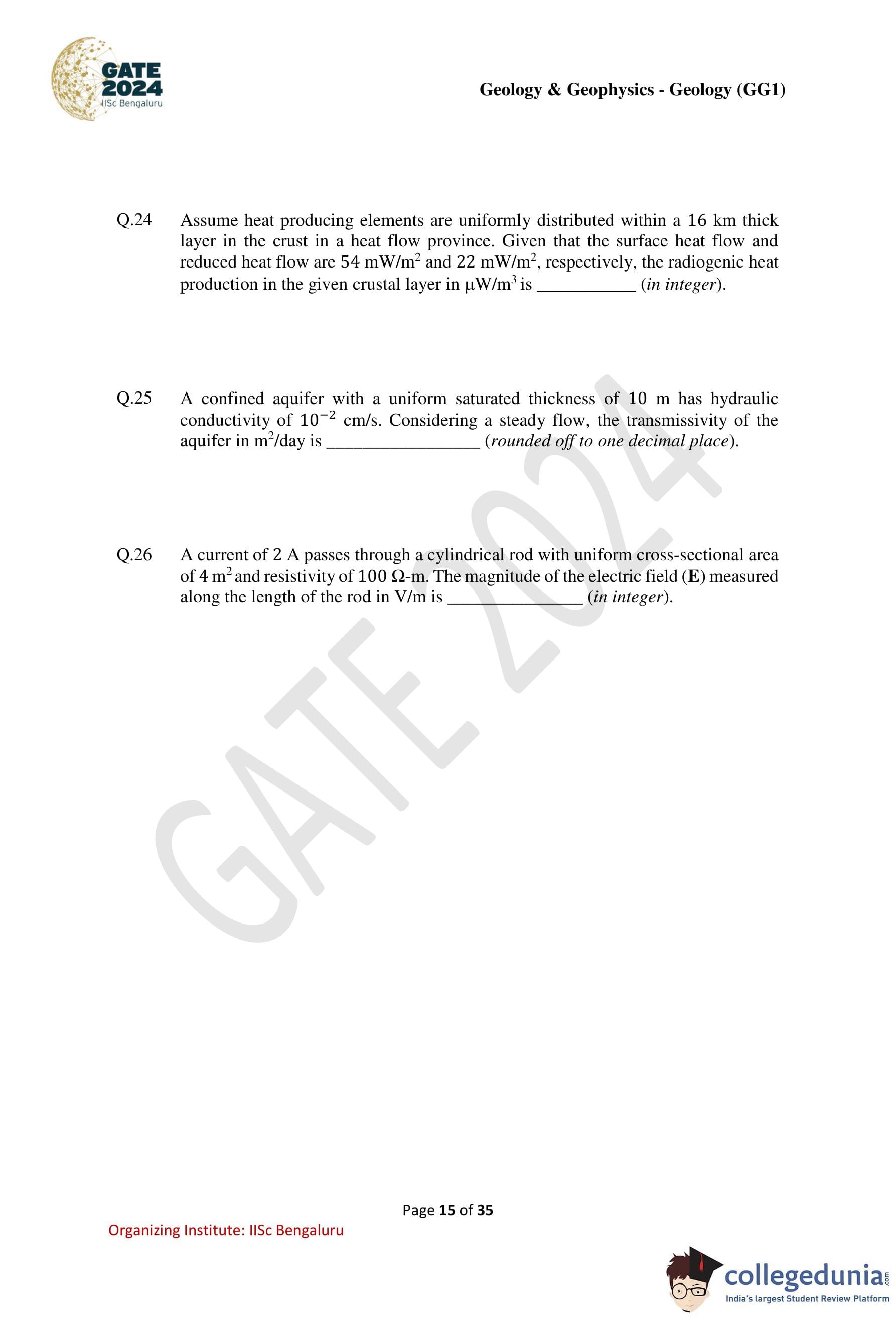
Assume heat-producing elements are uniformly distributed within a \(16\) km thick layer in the crust in a heat flow province. Given that the surface heat flow and reduced heat flow are \(54\ \mathrm{mW/m^2}\) and \(22\ \mathrm{mW/m^2}\), respectively, the radiogenic heat production in the given crustal layer in \(\mu\mathrm{W/m^3}\) is ................ (in integer).
A confined aquifer with a uniform saturated thickness of \(10\) m has hydraulic conductivity of \(10^{-2}\ \mathrm{cm/s}\). Considering a steady flow, the transmissivity of the aquifer in \(\mathrm{m^2/day}\) is ................ (rounded off to one decimal place).
A current of \(2\) A passes through a cylindrical rod with uniform cross-sectional area of \(4\ \mathrm{m^2}\) and resistivity of \(100\ \Omega\cdot\mathrm{m}\). The magnitude of the electric field (\(E\)) measured along the length of the rod in \(\mathrm{V/m}\) is ................ (in integer).
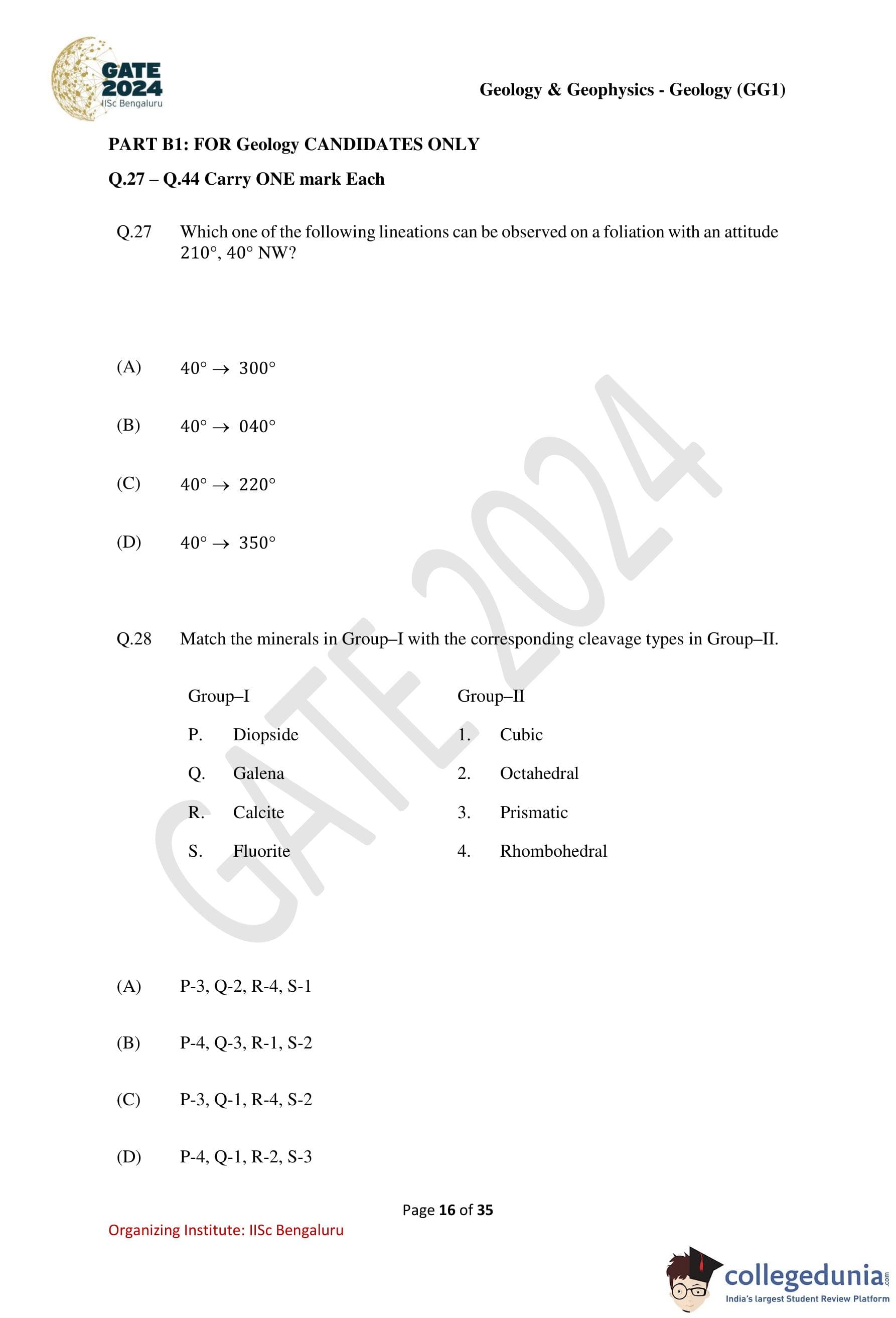
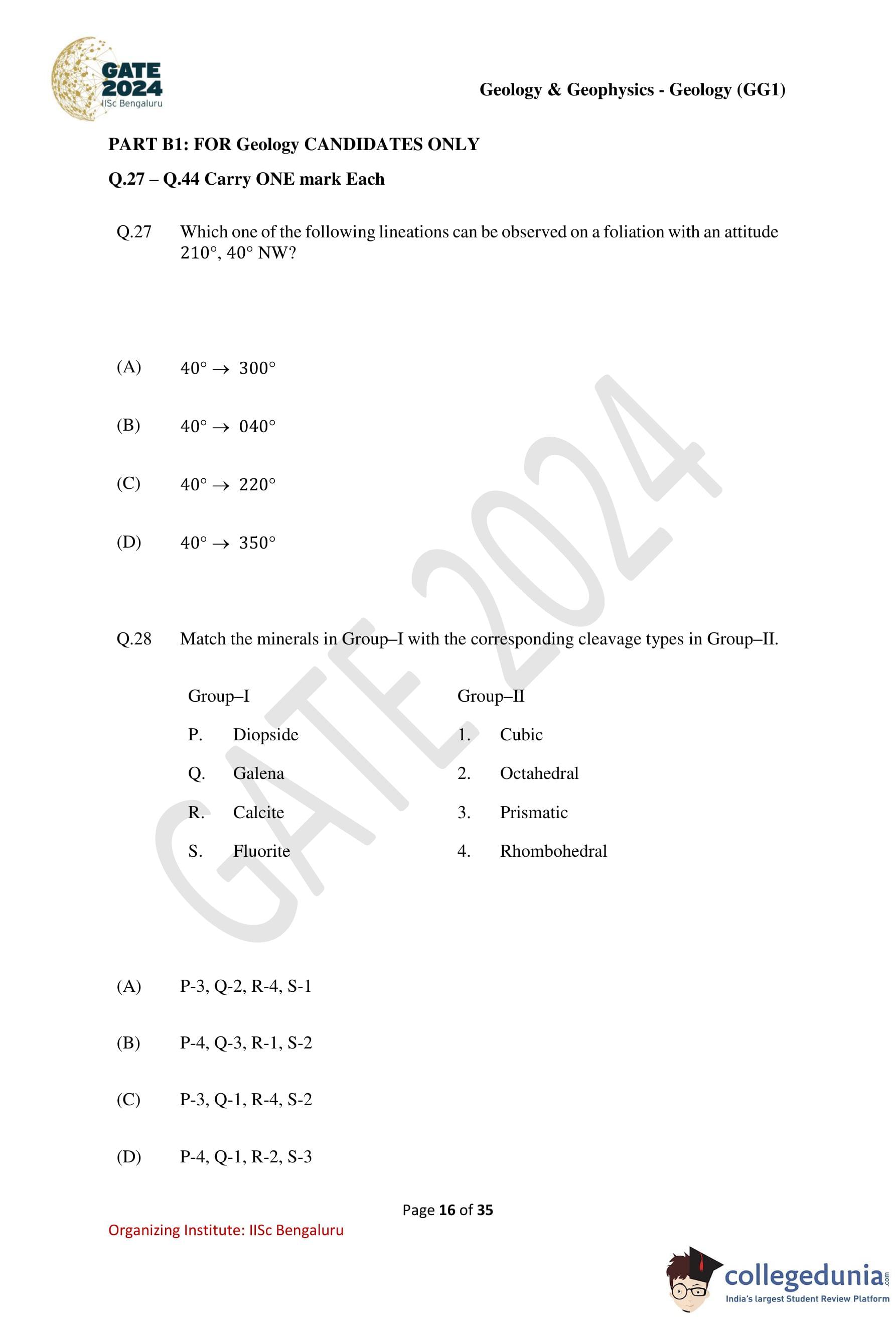
Which one of the following lineations can be observed on a foliation with an attitude \(210^\circ, 40^\circ\ NW\)?
View Solution
Concept:
A lineation observed on a foliation surface must lie within the foliation plane.
Thus, the trend of the lineation must be consistent with the dip direction of the foliation.
Step 1: Interpret the given foliation attitude.
The foliation is given as: \[ 210^\circ,\ 40^\circ\ NW \]
This implies:
Strike \(= 210^\circ\)
Dip \(= 40^\circ\)
Dip direction \(=\) NW, i.e. approximately \(300^\circ\)
Step 2: Condition for a valid lineation.
A lineation on the foliation:
Must plunge \emph{within the foliation plane
Can plunge in the dip direction or along strike, but here plunge equals dip (\(40^\circ\))
Thus, the trend must be close to the dip direction \(300^\circ\).
Step 3: Check the options.
(A) \(40^\circ \rightarrow 300^\circ\) \checkmark\ (along dip direction)
(B) \(40^\circ \rightarrow 040^\circ\) (NE, opposite to dip)
(C) \(40^\circ \rightarrow 220^\circ\) (SW, oblique to plane)
(D) \(40^\circ \rightarrow 350^\circ\) (nearly N, not in plane)
Hence, the correct answer is: \[ \boxed{40^\circ \rightarrow 300^\circ} \] Quick Tip: For lineations on foliation: Lineation must lie \textbf{within the foliation plane} Plunge direction commonly aligns with the \textbf{dip direction}
Match the minerals in Group–I with the corresponding cleavage types in Group–II.
Group–I & Group–II
P. Diopside & 1. Cubic
Q. Galena & 2. Octahedral
R. Calcite & 3. Prismatic
S. Fluorite & 4. Rhombohedral
View Solution
Concept:
Cleavage in minerals reflects their crystal structure and bonding arrangement.
Step 1: Recall cleavage characteristics of each mineral.
Diopside: two cleavages at nearly \(90^\circ\) \(\Rightarrow\) prismatic
Galena: three cleavages at \(90^\circ\) \(\Rightarrow\) cubic
Calcite: three cleavages not at \(90^\circ\) \(\Rightarrow\) rhombohedral
Fluorite: four cleavages \(\Rightarrow\) octahedral
Step 2: Write the correct matching.
\[ \begin{aligned} P &\rightarrow 3
Q &\rightarrow 1
R &\rightarrow 4
S &\rightarrow 2 \end{aligned} \]
Thus, the correct combination is: \[ \boxed{P-3, Q-1, R-4, S-2} \] Quick Tip: High-yield mineral–cleavage pairs: Galena \(\rightarrow\) Cubic Calcite \(\rightarrow\) Rhombohedral Fluorite \(\rightarrow\) Octahedral Pyroxenes \(\rightarrow\) Prismatic
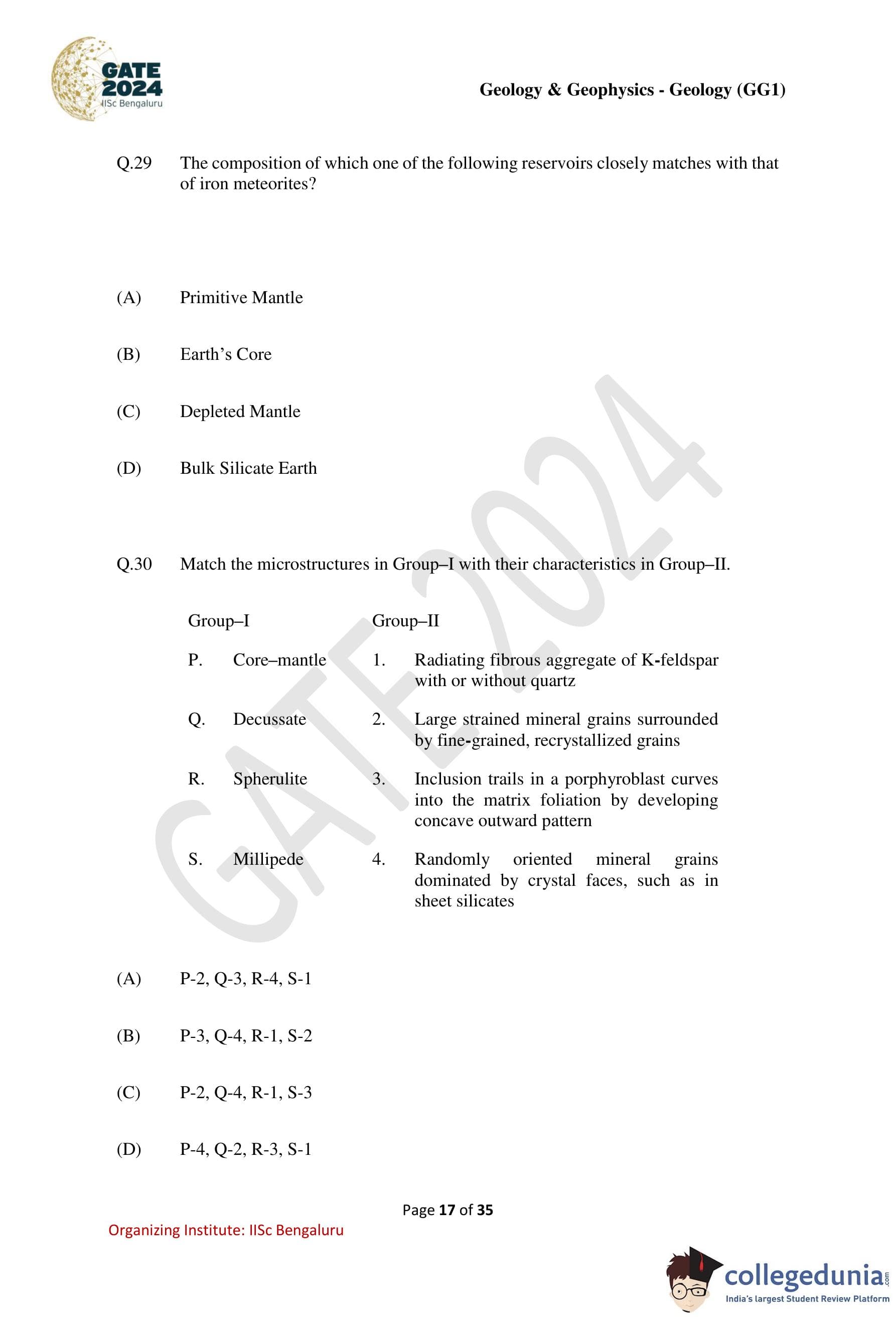
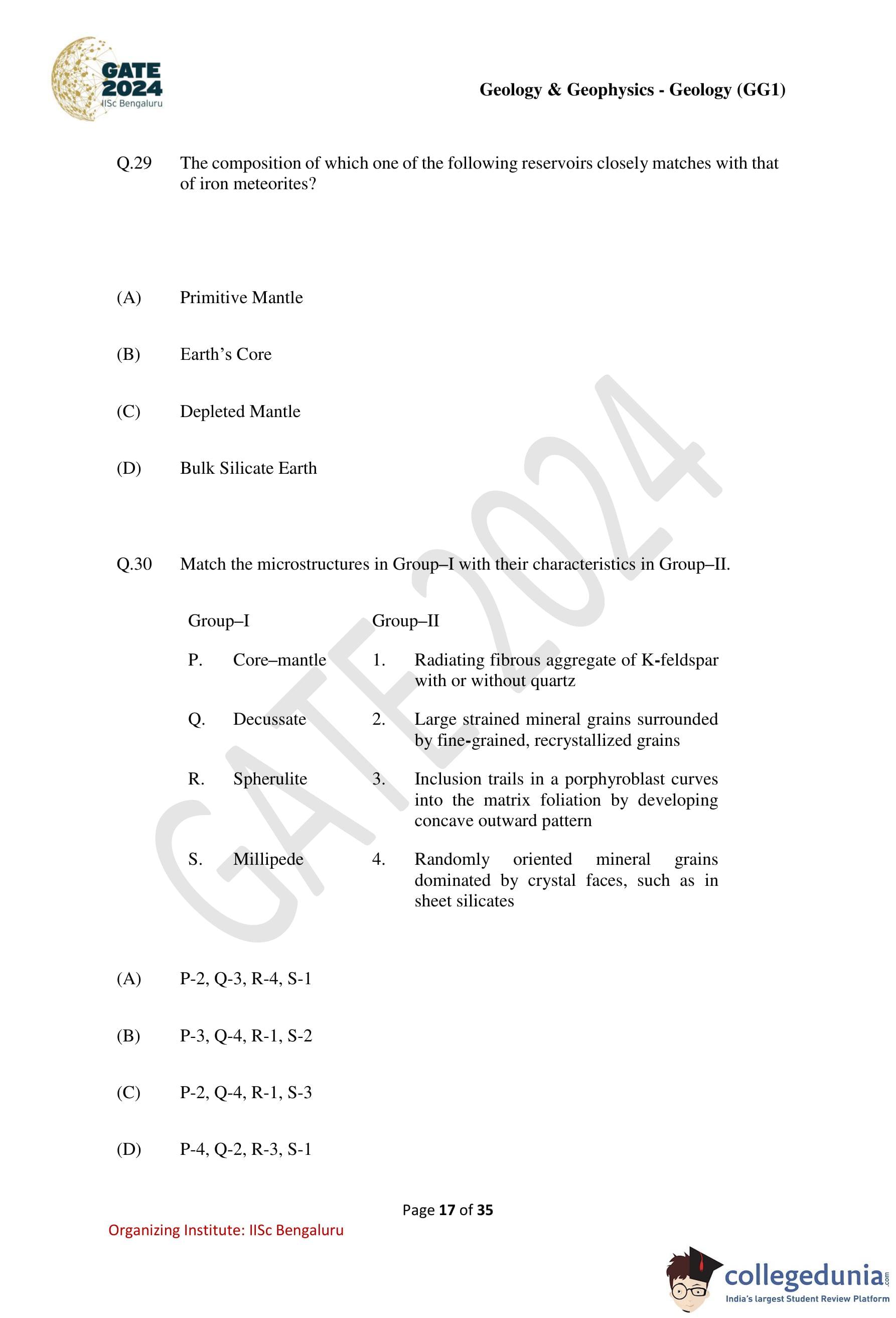
The composition of which one of the following reservoirs closely matches with that of iron meteorites?
View Solution
Concept:
Iron meteorites are primarily composed of iron–nickel alloys and are believed to represent the metallic cores of differentiated planetary bodies.
Step 1: Examine the composition of iron meteorites.
Iron meteorites:
Are rich in Fe and Ni
Represent core material of early differentiated planetesimals
Step 2: Compare with Earth reservoirs.
Earth’s core: dominated by Fe–Ni alloy \checkmark
Primitive mantle / Depleted mantle: silicate-rich
Bulk Silicate Earth: excludes the core by definition
Thus, the reservoir whose composition most closely matches iron meteorites is: \[ \boxed{Earth’s Core} \] Quick Tip: Key analogy: \[ Iron meteorites \;\approx\; Planetary cores (Fe–Ni) \] Bulk Silicate Earth always excludes the core.
Match the microstructures in Group–I with their characteristics in Group–II.

View Solution
Concept:
Metamorphic microstructures reflect deformation mechanisms, growth history, and recrystallization processes in rocks.
Step 1: Identify each microstructure.
Core–mantle: large strained porphyroclasts surrounded by fine recrystallized grains
Decussate: randomly oriented crystals, commonly seen in contact metamorphism
Spherulite: radiating fibrous aggregates, often of K-feldspar \(\pm\) quartz
Millipede: curved inclusion trails in porphyroblasts forming concave outward patterns
Step 2: Match with Group–II.
\[ \begin{aligned} P\ (Core–mantle) &\rightarrow 2
Q\ (Decussate) &\rightarrow 4
R\ (Spherulite) &\rightarrow 1
S\ (Millipede) &\rightarrow 3 \end{aligned} \]
Thus, the correct matching is: \[ \boxed{P-2, Q-4, R-1, S-3} \] Quick Tip: High-yield microstructure associations: Core–mantle \(\rightarrow\) dynamic recrystallization Spherulite \(\rightarrow\) radiating fibrous texture Decussate \(\rightarrow\) random crystal orientation Millipede \(\rightarrow\) curved inclusion trails
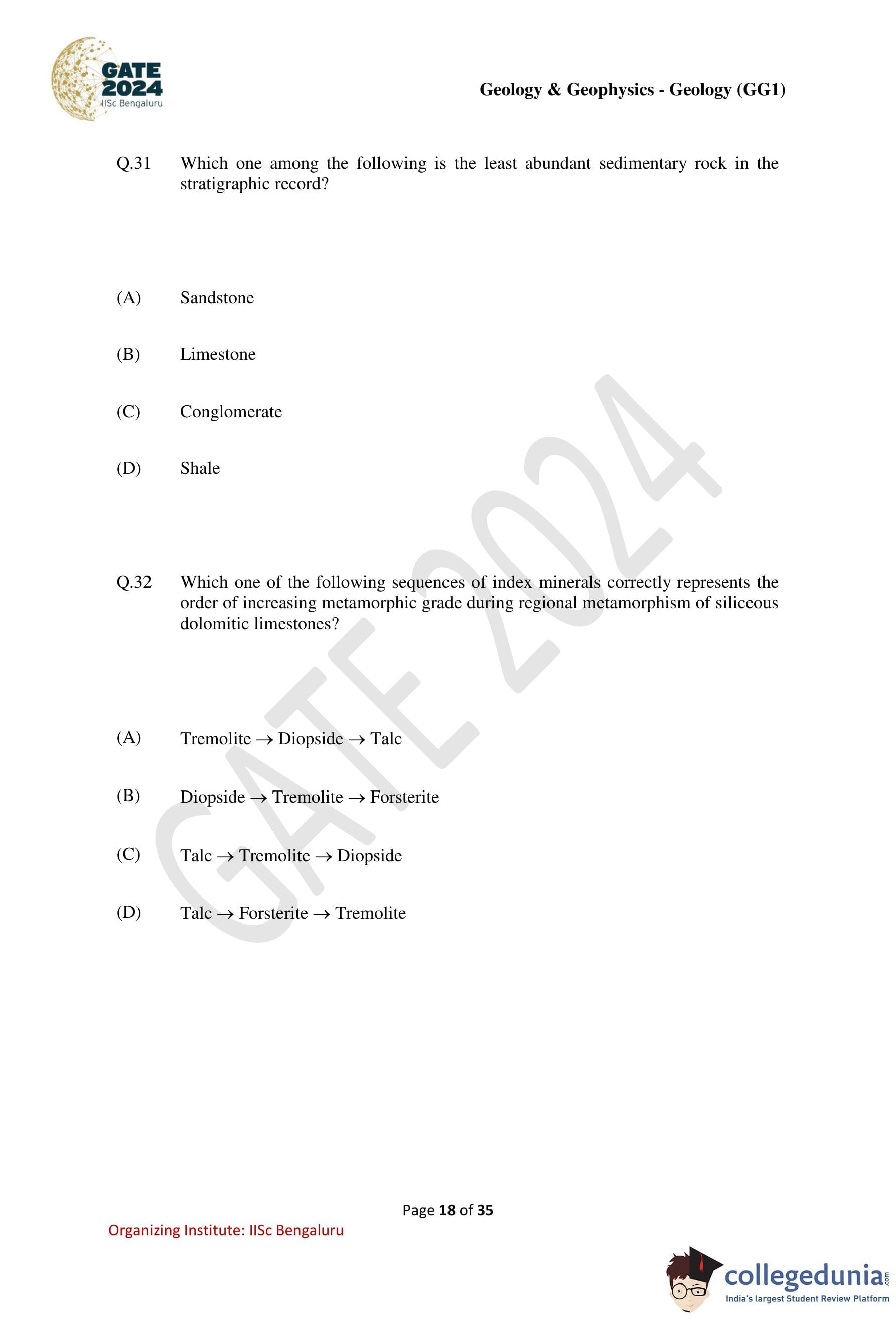
Which one among the following is the least abundant sedimentary rock in the stratigraphic record?
View Solution
Concept:
Sedimentary rocks occur in different proportions in the stratigraphic record depending on depositional environments and sediment supply.
Step 1: Recall relative abundances of sedimentary rocks.
Shale: most abundant (fine-grained, deposited widely in low-energy environments)
Sandstone: very common
Limestone: common, especially in marine settings
Conglomerate: relatively rare, requires high-energy conditions
Step 2: Identify the least abundant rock.
Conglomerates form only in localized, high-energy environments such as river channels and alluvial fans, making them least common in the stratigraphic record.
Therefore, the correct answer is: \[ \boxed{Conglomerate} \] Quick Tip: Relative abundance of sedimentary rocks (highest to lowest): \[ Shale > Sandstone > Limestone > Conglomerate \]
Which one of the following sequences of index minerals correctly represents the order of increasing metamorphic grade during regional metamorphism of siliceous dolomitic limestones?
View Solution
Concept:
In siliceous dolomitic limestones, increasing metamorphic grade leads to systematic changes in mineral assemblages due to dehydration and decarbonation reactions.
Step 1: Identify low-grade minerals.
Talc: forms at low metamorphic grades under hydrous conditions
Step 2: Identify intermediate-grade minerals.
Tremolite: amphibole stable at intermediate grades
Step 3: Identify high-grade minerals.
Diopside: clinopyroxene stable at higher temperatures
Step 4: Arrange in increasing metamorphic grade.
\[ Talc \;\rightarrow\; Tremolite \;\rightarrow\; Diopside \]
Hence, the correct sequence is: \[ \boxed{Talc \rightarrow Tremolite \rightarrow Diopside} \] Quick Tip: For siliceous dolomitic limestones (increasing grade): \[ Talc \rightarrow Tremolite \rightarrow Diopside \rightarrow Forsterite (very high grade) \]
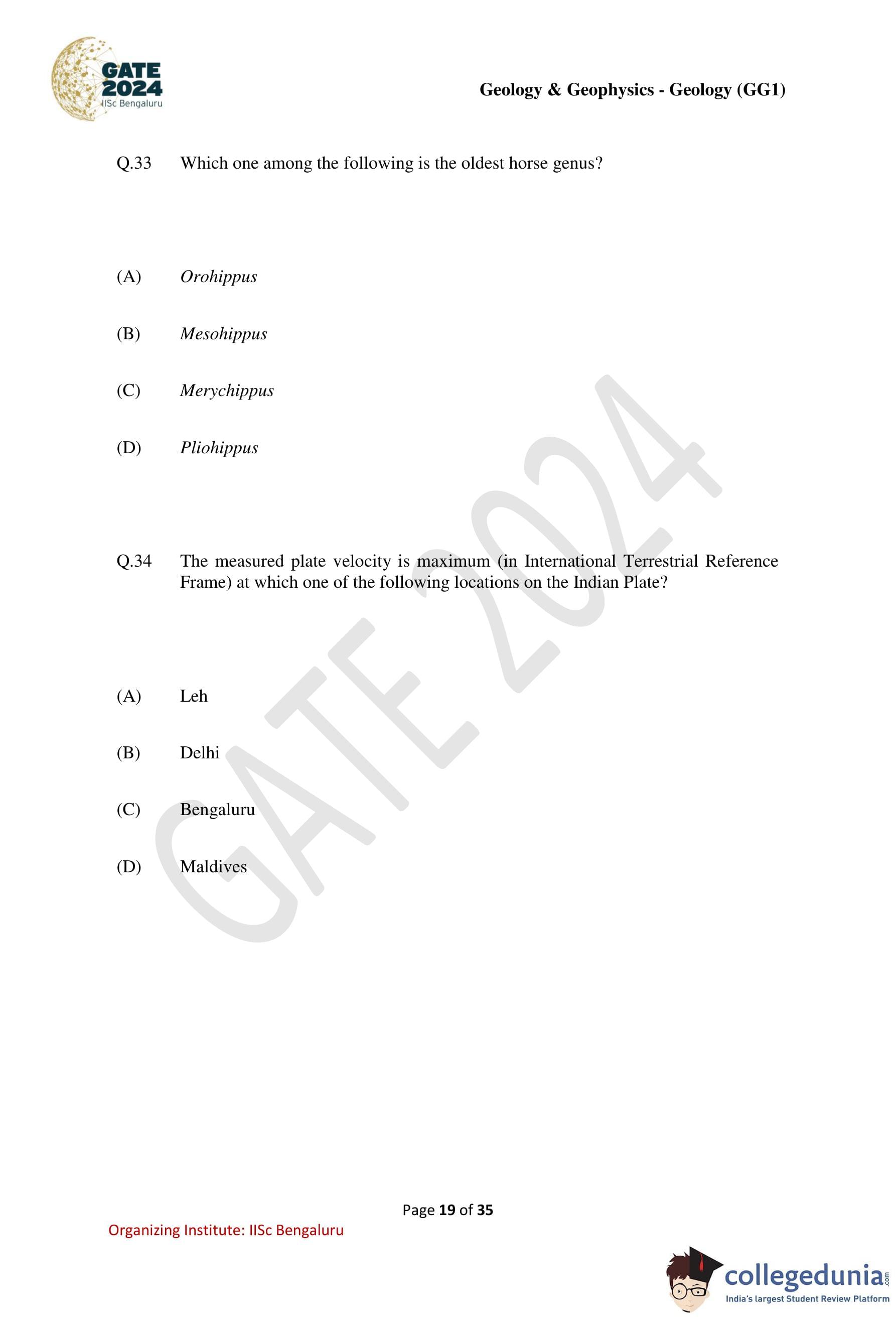
Which one among the following is the oldest horse genus?
View Solution
Concept:
Horse evolution shows a well-documented fossil sequence from small, multi-toed ancestors to the modern one-toed horse. The genera appear in a definite chronological order.
Step 1: Recall the evolutionary sequence of horses.
\[ Orohippus \rightarrow Mesohippus \rightarrow Merychippus \rightarrow Pliohippus \rightarrow Equus \]
Step 2: Identify the oldest genus.
Orohippus: Early Eocene (oldest)
Mesohippus: Oligocene
Merychippus: Miocene
Pliohippus: Late Miocene–Pliocene
Thus, the oldest horse genus among the given options is: \[ \boxed{Orohippus} \] Quick Tip: For horse evolution, remember: \[ Orohippus \rightarrow Mesohippus \rightarrow Merychippus \rightarrow Pliohippus \] Oldest forms are small, forest-dwelling, and multi-toed.
The measured plate velocity is maximum (in International Terrestrial Reference Frame) at which one of the following locations on the Indian Plate?
View Solution
Concept:
In a fixed reference frame such as the International Terrestrial Reference Frame (ITRF), plate motion is described as rotation about an Euler pole.
The linear velocity of a point on a plate increases with its distance from the Euler pole.
Step 1: Understand plate velocity distribution.
Velocity is minimum near the Euler pole
Velocity is maximum at locations farthest from the Euler pole
Step 2: Compare the given locations.
Leh, Delhi, Bengaluru: continental interior of the Indian Plate
Maldives: far south of the Indian Plate, near the plate edge and farthest from the Euler pole
Step 3: Identify the location with maximum velocity.
Because the Maldives are farthest from the Euler pole of the Indian Plate, they experience the highest linear plate velocity in the ITRF.
Therefore, the correct answer is: \[ \boxed{Maldives} \] Quick Tip: For plate motion questions: Velocity increases with distance from the Euler pole Plate margins often move faster than continental interiors
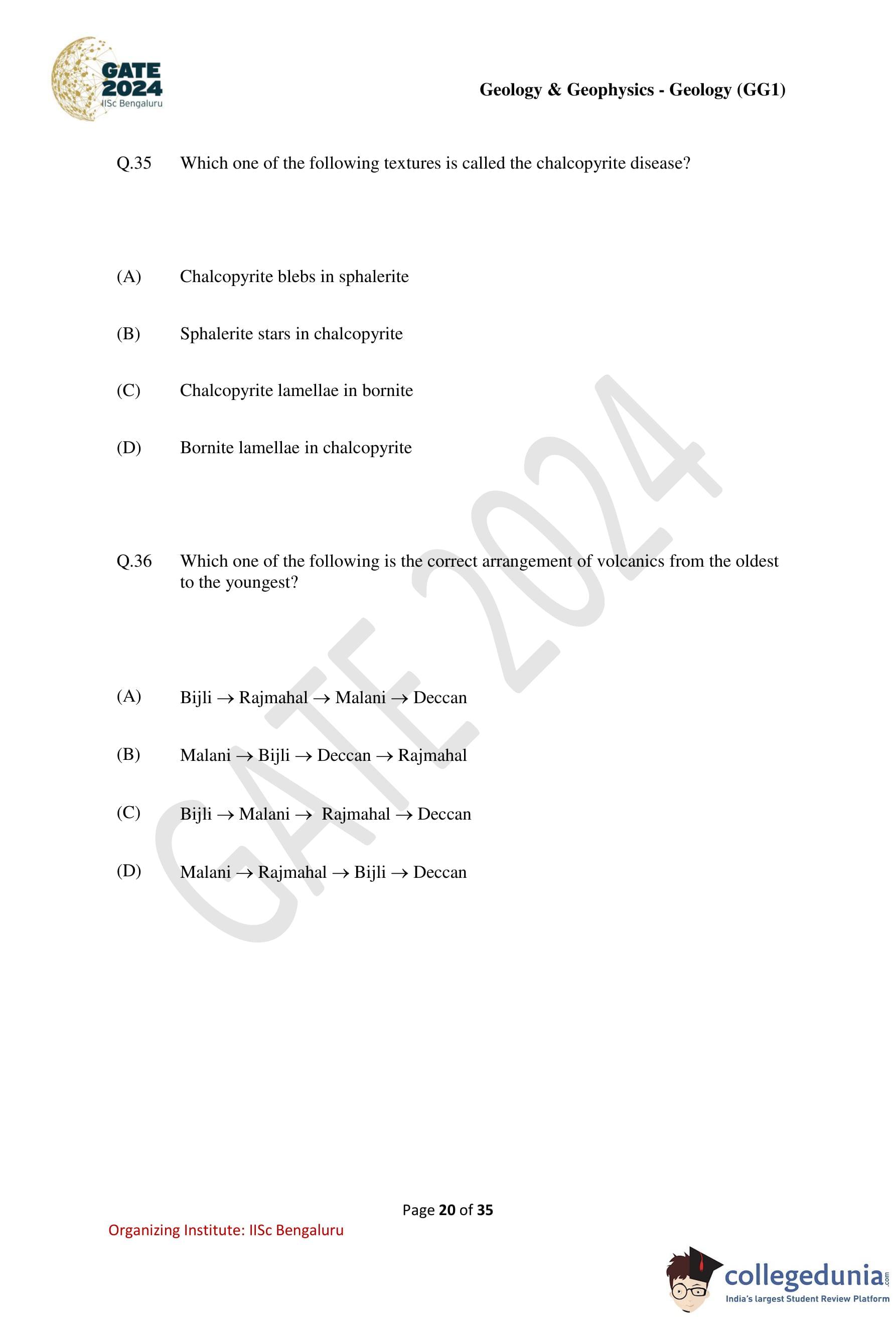
Which one of the following textures is called the chalcopyrite disease?
View Solution
Concept:
Chalcopyrite disease is a well-known ore microscopic texture observed in sulphide mineral assemblages, especially in Zn–Cu deposits.
Step 1: Understand chalcopyrite disease.
It refers to:
Fine blebs or inclusions of chalcopyrite
Disseminated within sphalerite
Formed due to exsolution or replacement processes
Step 2: Examine the given options.
Chalcopyrite blebs in sphalerite \checkmark
Other options describe different intergrowth or exsolution textures
Hence, the texture known as chalcopyrite disease is: \[ \boxed{Chalcopyrite blebs in sphalerite} \] Quick Tip: Ore microscopy keywords: Chalcopyrite disease \(\rightarrow\) chalcopyrite in sphalerite Graphic / lamellar textures \(\rightarrow\) exsolution features
Which one of the following is the correct arrangement of volcanics from the oldest to the youngest?
View Solution
Concept:
Major volcanic events in India occurred at different geological times and are well constrained geochronologically.
Step 1: Recall the ages of major Indian volcanics.
Bijli volcanics: Paleoproterozoic (oldest)
Malani volcanics: Neoproterozoic
Rajmahal traps: Jurassic–Early Cretaceous
Deccan traps: Late Cretaceous (youngest)
Step 2: Arrange from oldest to youngest.
\[ Bijli \;\rightarrow\; Malani \;\rightarrow\; Rajmahal \;\rightarrow\; Deccan \]
Thus, the correct sequence is: \[ \boxed{Bijli \rightarrow Malani \rightarrow Rajmahal \rightarrow Deccan} \] Quick Tip: Indian volcanics (old \(\rightarrow\) young): \[ Bijli \rightarrow Malani \rightarrow Rajmahal \rightarrow Deccan \] Always remember: Deccan Traps are the youngest large igneous province in India.
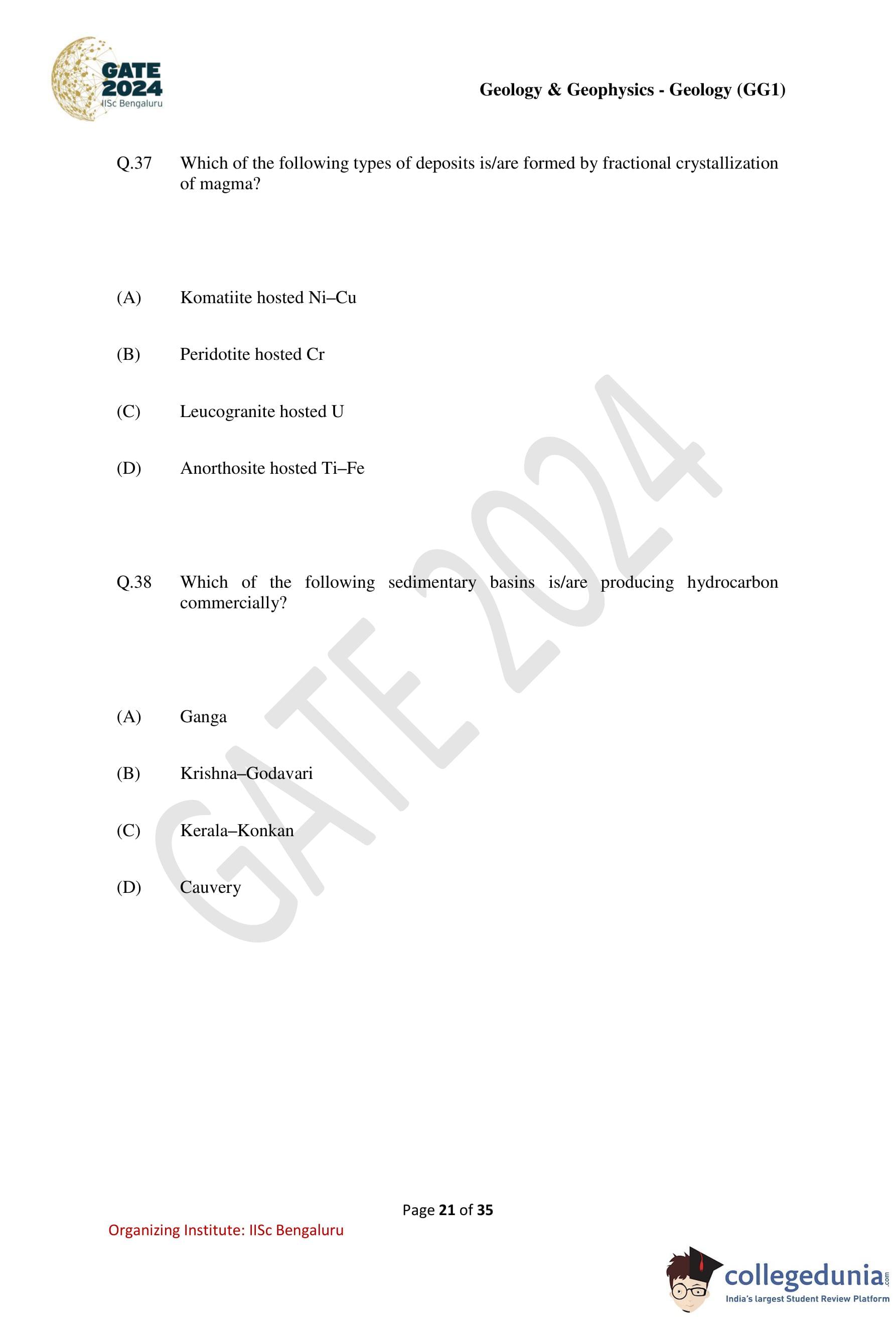
Which of the following types of deposits is/are formed by fractional crystallization of magma?
View Solution
Concept:
Fractional crystallization is a magmatic differentiation process in which early-formed minerals separate from the melt, leading to chemical layering and concentration of specific elements.
Step 1: Examine each deposit type.
Komatiite hosted Ni–Cu: formed mainly by sulphide immiscibility and lava channel processes, not classic fractional crystallization
Peridotite hosted Cr: chromite forms by crystal settling, but is more related to magma replenishment and mixing
Leucogranite hosted U: typically related to crustal melting and hydrothermal processes
Anorthosite hosted Ti–Fe: formed by fractional crystallization and crystal accumulation of Fe–Ti oxides (e.g., ilmenite, magnetite)
Step 2: Identify the correct process–deposit match.
Anorthosite complexes show layered igneous structures produced by fractional crystallization, concentrating Ti–Fe oxides.
Therefore, the correct answer is: \[ \boxed{Anorthosite hosted Ti–Fe} \] Quick Tip: Classic deposits formed by fractional crystallization: Layered intrusions Anorthosite–Ti–Fe oxide associations
Which of the following sedimentary basins is/are producing hydrocarbon commercially?
View Solution
Concept:
Commercial hydrocarbon production requires:
Proven source rocks
Reservoir rocks
Traps and seals
Successful drilling and production
Step 1: Evaluate each basin.
Ganga Basin: largely unexplored; no major commercial production
Krishna–Godavari Basin: major producing basin (gas and oil) \checkmark
Kerala–Konkan Basin: exploratory stage; no commercial production
Cauvery Basin: producing oil and gas fields (e.g., Narimanam) \checkmark
Step 2: Select commercially producing basins.
\[ \boxed{Krishna–Godavari and Cauvery} \] Quick Tip: Major hydrocarbon-producing basins in India: Western offshore (Mumbai High) Krishna–Godavari Cauvery Assam–Arakan
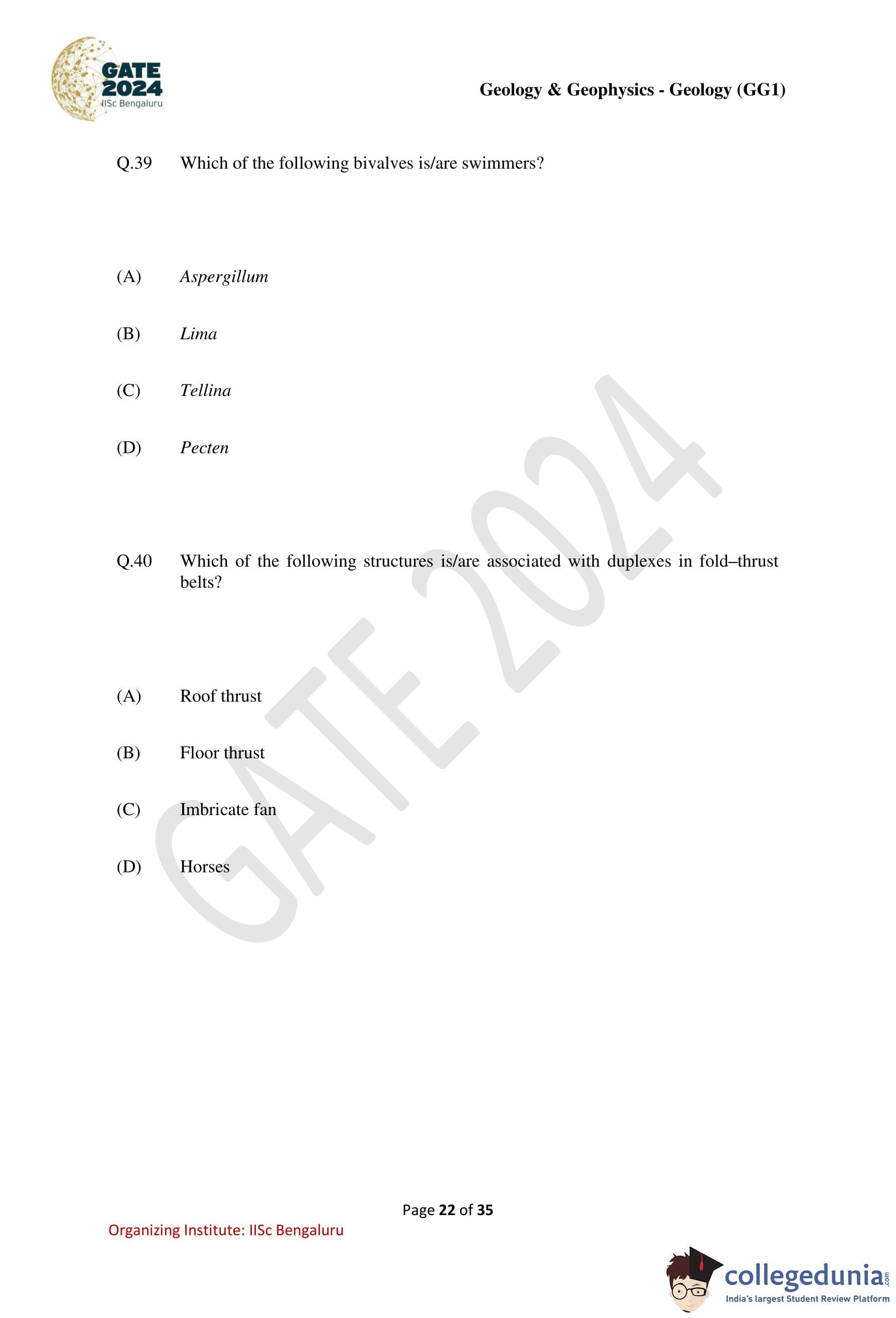
Which of the following bivalves is/are swimmers?
View Solution
Concept:
Some bivalves are capable of active swimming by rapidly clapping their valves together, producing jet propulsion. This behavior is typical of certain epifaunal bivalves with lightweight shells.
Step 1: Examine locomotion styles of the given bivalves.
Aspergillum: sessile, tube-dwelling bivalve (not a swimmer)
\textit{Lima: free-living bivalve capable of swimming by valve clapping \checkmark
\textit{Tellina: infaunal burrower, uses a foot for movement
\textit{Pecten: classic swimming bivalve (scallop) using valve clapping \checkmark
Step 2: Identify swimmers.
The bivalves that show active swimming behavior are: \[ \boxed{\textit{Lima and Pecten} \] Quick Tip: Swimming bivalves: Pecten (scallops) Lima Burrowers (e.g., Tellina) and cemented forms are non-swimmers.
Which of the following structures is/are associated with duplexes in fold--thrust belts?
View Solution
Concept:
A duplex in a fold--thrust belt is a structural assemblage formed by stacking of fault-bounded slices between two major thrust surfaces.
Step 1: Define the elements of a duplex.
A duplex consists of:
A floor thrust at the base
A roof thrust at the top
Internally stacked fault-bounded blocks called horses
Step 2: Evaluate the given options.
Roof thrust: upper bounding fault of a duplex \checkmark
Floor thrust: lower bounding fault of a duplex \checkmark
Imbricate fan: a thrust geometry, but not a defining element of a duplex
Horses: fault-bounded slices within a duplex \checkmark
Step 3: Select the correct structures.
Thus, structures associated with duplexes are: \[ \boxed{Roof thrust, Floor thrust, and Horses} \] Quick Tip: Duplex anatomy: Floor thrust (base) Roof thrust (top) Horses (internal slices) Imbricate fans may occur nearby but are distinct structures.
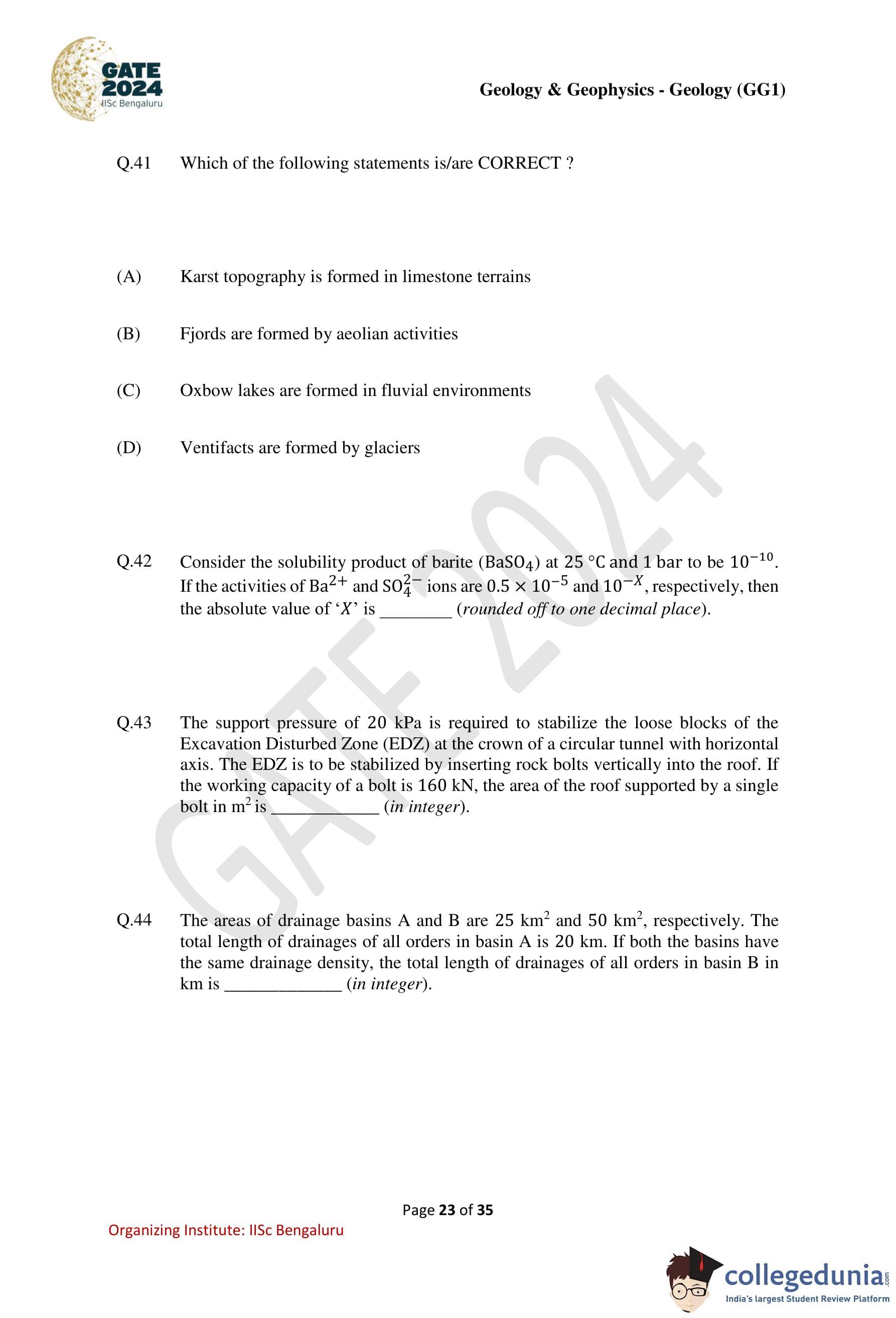
Which of the following statements is/are \textbf{CORRECT}?
View Solution
Concept:
Different geomorphic landforms are produced by different geomorphic agents such as running water, wind, ice, and chemical weathering.
Step 1: Evaluate statement (A).
Karst topography develops due to chemical dissolution of soluble rocks like limestone, dolomite, and gypsum. \[ \Rightarrow Statement (A) is correct. \]
Step 2: Evaluate statement (B).
Fjords are deep, narrow valleys carved by glaciers and later flooded by the sea, not by wind. \[ \Rightarrow Statement (B) is incorrect. \]
Step 3: Evaluate statement (C).
Oxbow lakes form when meanders of a river are cut off due to fluvial erosion and deposition. \[ \Rightarrow Statement (C) is correct. \]
Step 4: Evaluate statement (D).
Ventifacts are rocks shaped by wind abrasion (aeolian activity), not by glaciers. \[ \Rightarrow Statement (D) is incorrect. \]
Thus, the correct statements are: \[ \boxed{(A) and (C)} \] Quick Tip: Geomorphic agent associations: Karst \(\rightarrow\) Chemical weathering (limestone) Fjords \(\rightarrow\) Glacial erosion Oxbow lakes \(\rightarrow\) Fluvial processes Ventifacts \(\rightarrow\) Wind abrasion
Consider the solubility product of barite (\(\mathrm{BaSO_4}\)) at \(25^\circ\mathrm{C}\) and 1 bar to be \(10^{-10}\). If the activities of \(\mathrm{Ba^{2+}}\) and \(\mathrm{SO_4^{2-}}\) ions are \(0.5 \times 10^{-5}\) and \(10^{-X}\), respectively, then the absolute value of \(X\) is ................ (rounded off to one decimal place).
View Solution
Concept:
For a sparingly soluble salt: \[ K_{sp} = a_{\mathrm{Ba^{2+}}} \times a_{\mathrm{SO_4^{2-}}} \]
Step 1: Substitute the given values.
\[ 10^{-10} = (0.5 \times 10^{-5}) \times 10^{-X} \]
\[ 10^{-10} = 5 \times 10^{-6} \times 10^{-X} \]
Step 2: Solve for \(10^{-X}\).
\[ 10^{-X} = \frac{10^{-10}}{5 \times 10^{-6}} = 2 \times 10^{-5} \]
Step 3: Take logarithm.
\[ -X = \log_{10}(2 \times 10^{-5}) = \log_{10}2 - 5 \]
\[ -X = 0.3010 - 5 = -4.699 \]
\[ X = 4.7 \]
\[ \boxed{4.7} \] Quick Tip: Always express activities in powers of 10 before solving solubility product problems. Use \(\log_{10}2 \approx 0.301\).
The support pressure of \(20\ \mathrm{kPa}\) is required to stabilize the loose blocks of the Excavation Disturbed Zone (EDZ) at the crown of a circular tunnel with horizontal axis. The EDZ is to be stabilized by inserting rock bolts vertically into the roof. If the working capacity of a bolt is \(160\ \mathrm{kN}\), the area of the roof supported by a single bolt in \(\mathrm{m^2}\) is ................ (in integer).
View Solution
Concept:
Support pressure is the load supported per unit area: \[ P = \frac{F}{A} \]
Step 1: Convert pressure units.
\[ 20\ \mathrm{kPa} = 20\ \mathrm{kN/m^2} \]
Step 2: Compute supported area per bolt.
\[ A = \frac{F}{P} = \frac{160}{20} = 8\ \mathrm{m^2} \]
\[ \boxed{8} \] Quick Tip: Rock-bolt spacing problems often reduce to: \[ Area per bolt = \frac{Bolt capacity}{Required support pressure} \]
The areas of drainage basins A and B are \(25\ \mathrm{km^2}\) and \(50\ \mathrm{km^2}\), respectively. The total length of drainages of all orders in basin A is \(20\ \mathrm{km}\). If both basins have the same drainage density, the total length of drainages of all orders in basin B in km is ................ (in integer).
View Solution
Concept:
Drainage density (\(D_d\)) is defined as: \[ D_d = \frac{Total length of streams}{Basin area} \]
Step 1: Compute drainage density of basin A.
\[ D_d = \frac{20}{25} = 0.8\ \mathrm{km/km^2} \]
Step 2: Apply the same drainage density to basin B.
\[ Total length in B = 0.8 \times 50 = 40\ \mathrm{km} \]
\[ \boxed{40} \] Quick Tip: If drainage density is the same for two basins: \[ \frac{L_1}{A_1} = \frac{L_2}{A_2} \]
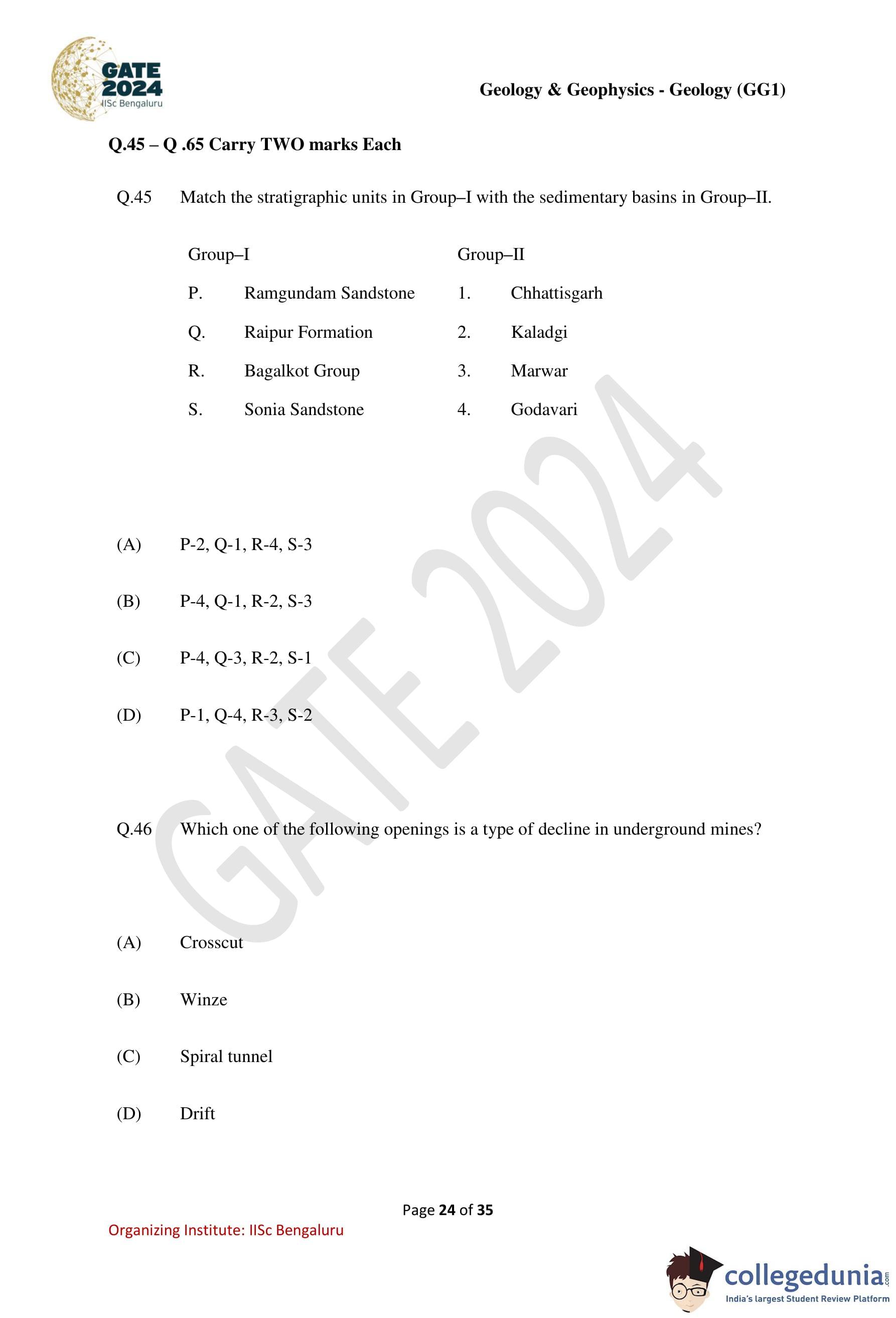
Match the stratigraphic units in Group–I with the sedimentary basins in Group–II.

View Solution
Concept:
Indian Proterozoic sedimentary successions are grouped into well-defined basins, each characterized by distinctive stratigraphic units.
Step 1: Identify the correct basin for each stratigraphic unit.
Ramgundam Sandstone: part of the Godavari Basin
Raipur Formation: belongs to the Chhattisgarh Basin
Bagalkot Group: occurs in the Kaladgi Basin
Sonia Sandstone: part of the Marwar Basin
Step 2: Write the correct matching.
\[ \begin{aligned} P &\rightarrow 4
Q &\rightarrow 1
R &\rightarrow 2
S &\rightarrow 3 \end{aligned} \]
Thus, the correct combination is: \[ \boxed{P-4, Q-1, R-2, S-3} \] Quick Tip: High-yield basin–unit pairs: Ramgundam Sandstone \(\rightarrow\) Godavari Basin Raipur Formation \(\rightarrow\) Chhattisgarh Basin Bagalkot Group \(\rightarrow\) Kaladgi Basin Sonia Sandstone \(\rightarrow\) Marwar Basin
Which one of the following openings is a type of decline in underground mines?
View Solution
Concept:
Underground mine openings are classified based on their orientation and function.
Step 1: Define a decline.
A decline is an inclined access opening driven from the surface to reach underground levels, commonly used for vehicle access.
Step 2: Examine the given options.
Crosscut: horizontal opening connecting drifts
Winze: vertical or steeply inclined opening driven downward from a level
Spiral tunnel: inclined, often helical opening used as a decline \checkmark
Drift: horizontal opening along the ore body
Step 3: Identify the correct opening.
Only a spiral tunnel functions as a decline.
Therefore, the correct answer is: \[ \boxed{Spiral tunnel} \] Quick Tip: Mine openings: Decline \(\rightarrow\) Inclined access (often spiral) Shaft/Winze \(\rightarrow\) Vertical Drift/Crosscut \(\rightarrow\) Horizontal
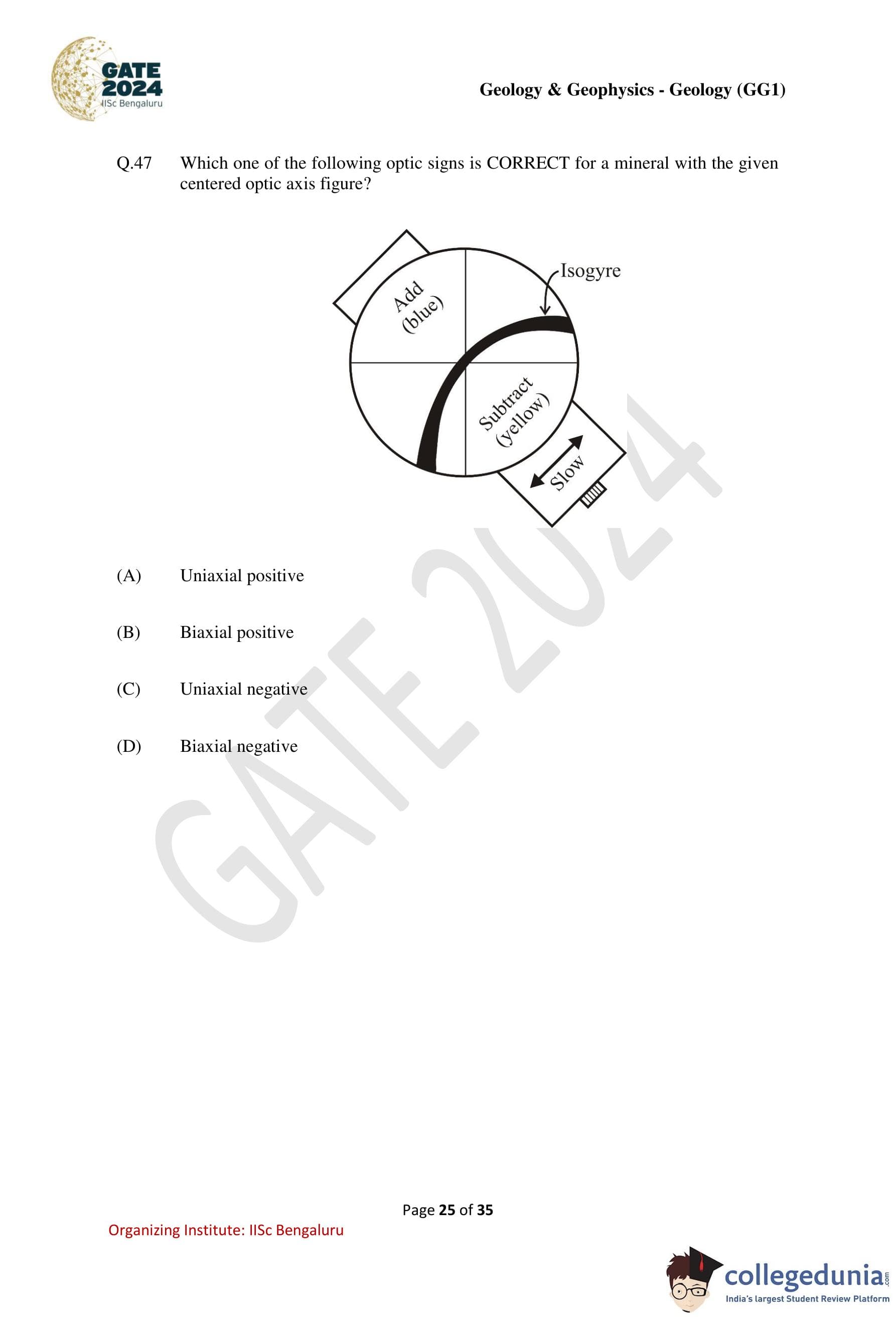
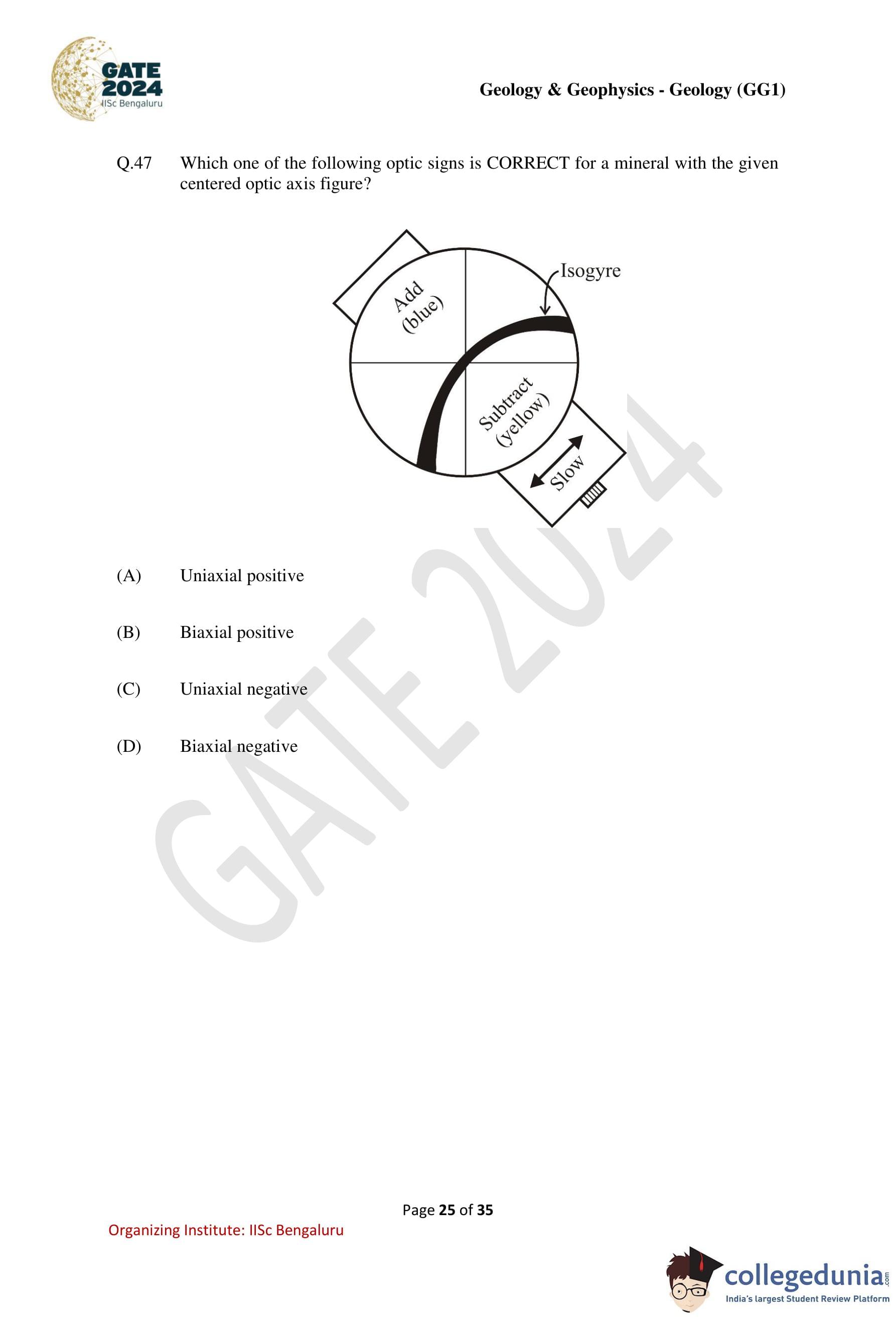
Which one of the following optic signs is \textbf{CORRECT} for a mineral with the given centered optic axis figure?

View Solution
Concept:
The optic sign of a mineral is determined from its optic axis figure by observing:
Whether the mineral is uniaxial or biaxial
The addition (blue) and subtraction (yellow) of interference colors
The orientation of the slow vibration direction
Step 1: Identify whether the mineral is uniaxial or biaxial.
The given figure shows:
A curved isogyre that does not form a symmetric cross
This is characteristic of a biaxial mineral.
Hence, options (A) and (C) are eliminated.
Step 2: Use color addition and subtraction.
From the figure:
Blue (addition) is observed in one quadrant
Yellow (subtraction) is observed in the opposite quadrant
The slow vibration direction is indicated
In biaxial minerals:
If addition (blue) occurs along the direction of the acute bisectrix = Z, the mineral is biaxial positive
If addition (blue) occurs along the direction of the acute bisectrix = X, the mineral is biaxial negative
Step 3: Determine the optic sign.
In the given figure, the addition (blue) corresponds to the fast direction, indicating that the acute bisectrix is X.
Therefore, the mineral is: \[ \boxed{Biaxial negative} \] Quick Tip: Optic sign rules to remember: Uniaxial: sign depends on whether \(n_e > n_o\) or vice versa Biaxial positive: acute bisectrix = \(Z\) Biaxial negative: acute bisectrix = \(X\) Blue = addition, Yellow = subtraction
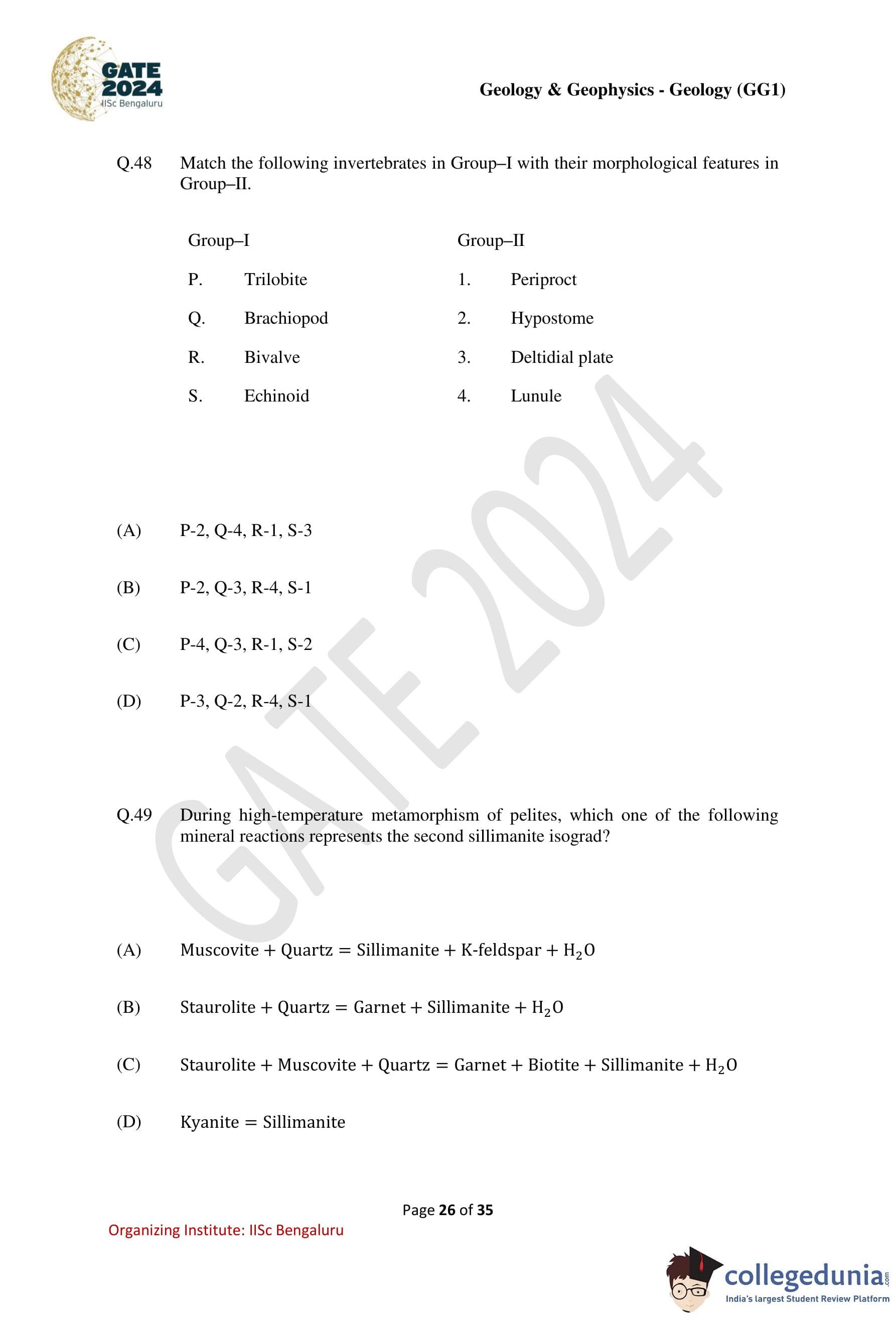
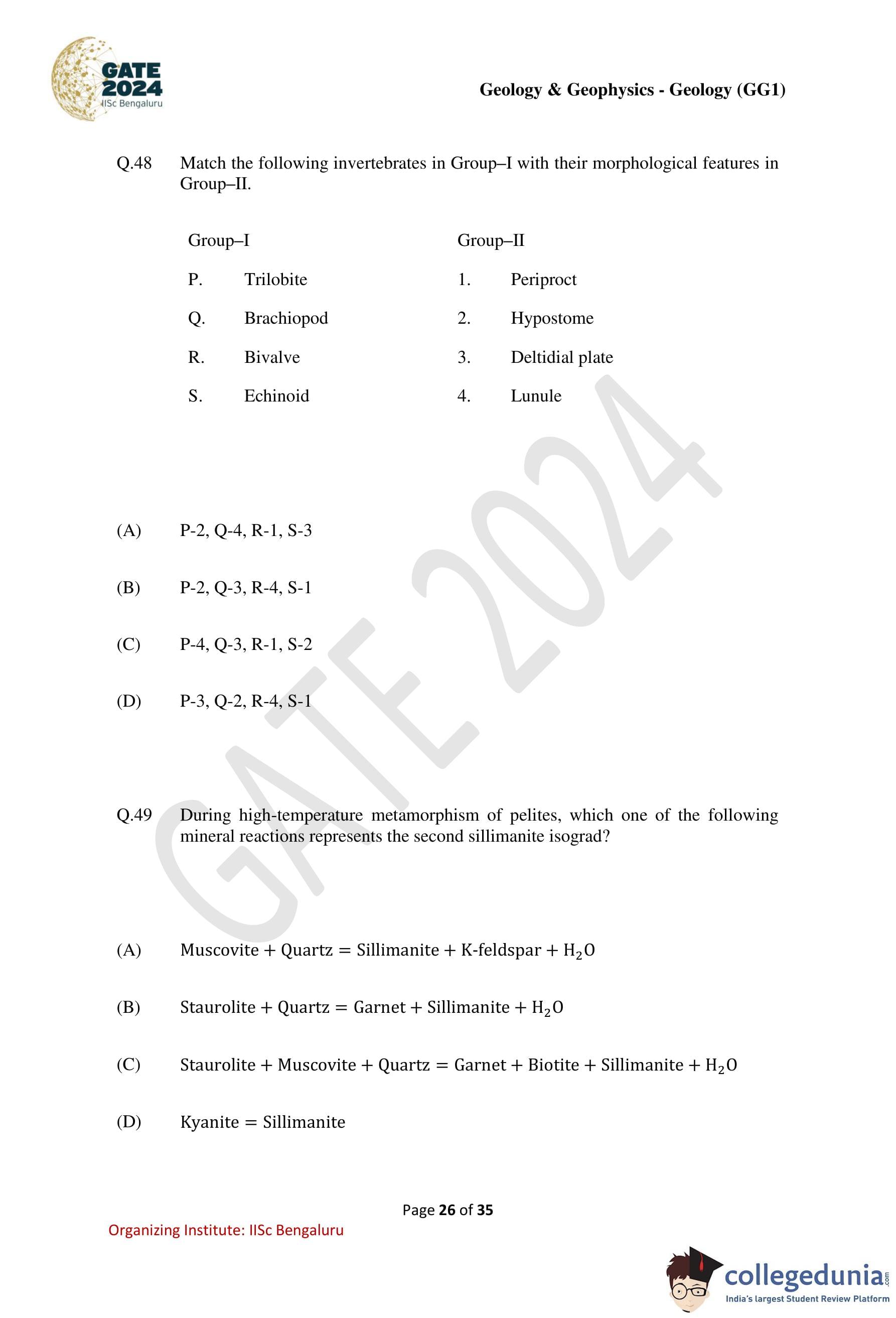
Match the following invertebrates in Group–I with their morphological features in Group–II.

View Solution
Concept:
Different invertebrate groups are characterized by distinct diagnostic morphological features used in taxonomy and fossil identification.
Step 1: Identify characteristic features.
Trilobite: possesses a hypostome, a ventral mouth plate
Brachiopod: shows a deltidial plate near the hinge
Bivalve: commonly has a lunule, a depressed area near the hinge
Echinoid: has a periproct, an opening for the anus
Step 2: Match Group–I with Group–II.
\[ \begin{aligned} P &\rightarrow 2
Q &\rightarrow 3
R &\rightarrow 4
S &\rightarrow 1 \end{aligned} \]
Thus, the correct combination is: \[ \boxed{P-2, Q-3, R-4, S-1} \] Quick Tip: High-yield fossil features: Trilobite \(\rightarrow\) Hypostome Brachiopod \(\rightarrow\) Deltidial plate Bivalve \(\rightarrow\) Lunule Echinoid \(\rightarrow\) Periproct
During high-temperature metamorphism of pelites, which one of the following mineral reactions represents the second sillimanite isograd?
View Solution
Concept:
In pelitic rocks, sillimanite appears in two stages during progressive metamorphism:
First sillimanite isograd: polymorphic transformation of kyanite to sillimanite
Second sillimanite isograd: breakdown of muscovite producing sillimanite and K-feldspar
Step 1: Identify the first sillimanite isograd.
\[ Kyanite \;=\; Sillimanite \]
This corresponds to option (D), which is the first sillimanite isograd.
Step 2: Identify the second sillimanite isograd.
At higher temperatures, muscovite breaks down as: \[ Muscovite + Quartz \;=\; Sillimanite + K-feldspar + \mathrm{H_2O} \]
Step 3: Select the correct option.
This reaction corresponds to option (A).
Therefore, the correct answer is: \[ \boxed{Muscovite + Quartz = Sillimanite + K-feldspar + \mathrm{H_2O}} \] Quick Tip: Pelitic sillimanite isograds: First: \( Kyanite \rightarrow Sillimanite \) Second: \( Muscovite + Quartz \rightarrow Sillimanite + Kfs \)
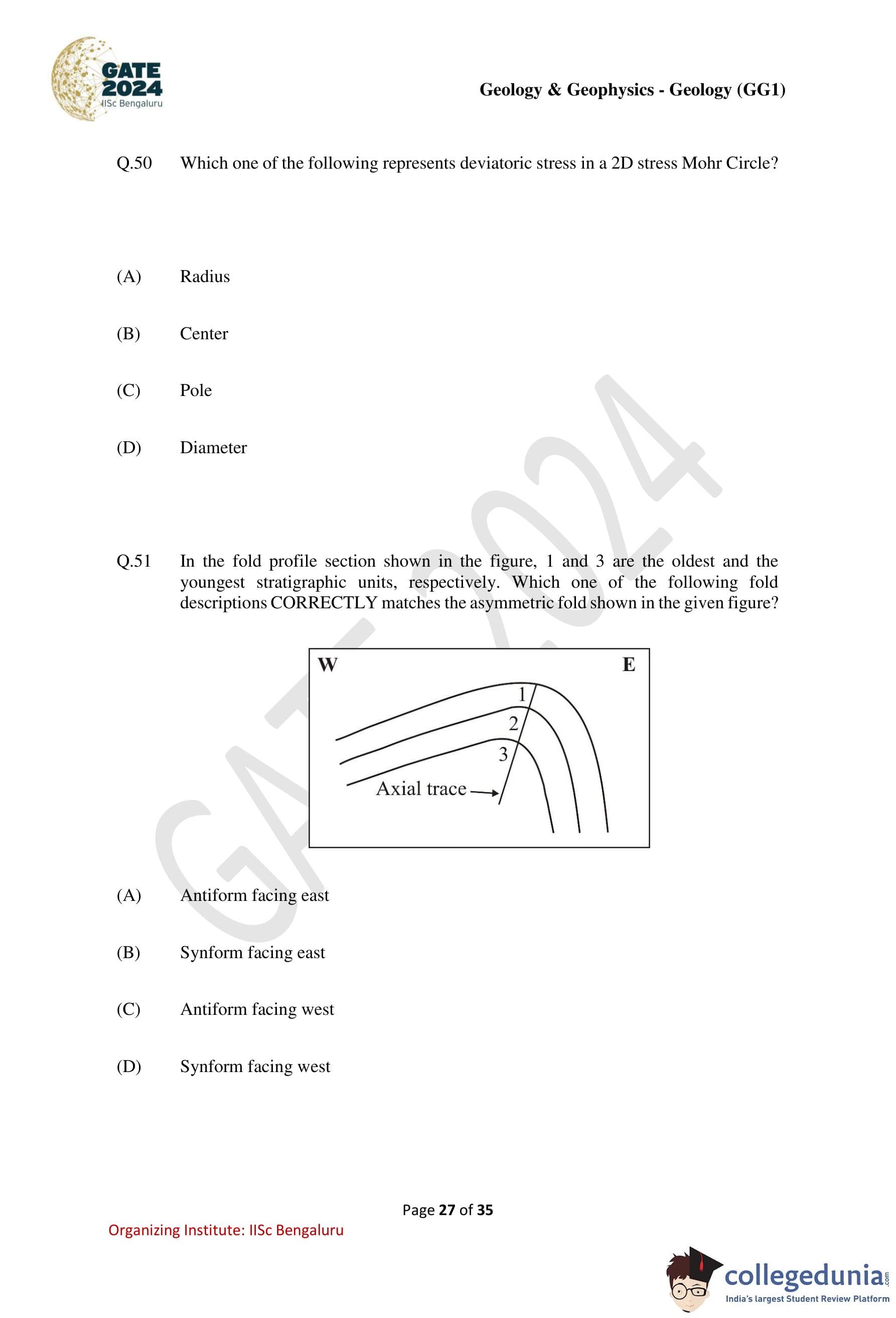
Which one of the following represents deviatoric stress in a 2D stress Mohr Circle?
View Solution
Concept:
In a 2D Mohr circle, the principal stresses are \(\sigma_1\) and \(\sigma_3\).
The deviatoric stress in 2D is defined as: \[ \sigma_d = \frac{\sigma_1 - \sigma_3}{2} \]
Step 1: Recall Mohr circle geometry.
Center of the circle \(= \dfrac{\sigma_1 + \sigma_3}{2}\)
Radius of the circle \(= \dfrac{\sigma_1 - \sigma_3}{2}\)
Step 2: Relate deviatoric stress to Mohr circle.
Since deviatoric stress depends on the difference between principal stresses, it is represented by the radius of the Mohr circle.
Therefore, the correct answer is: \[ \boxed{Radius} \] Quick Tip: Mohr circle essentials: Radius \(\rightarrow\) Deviatoric stress Center \(\rightarrow\) Mean normal stress
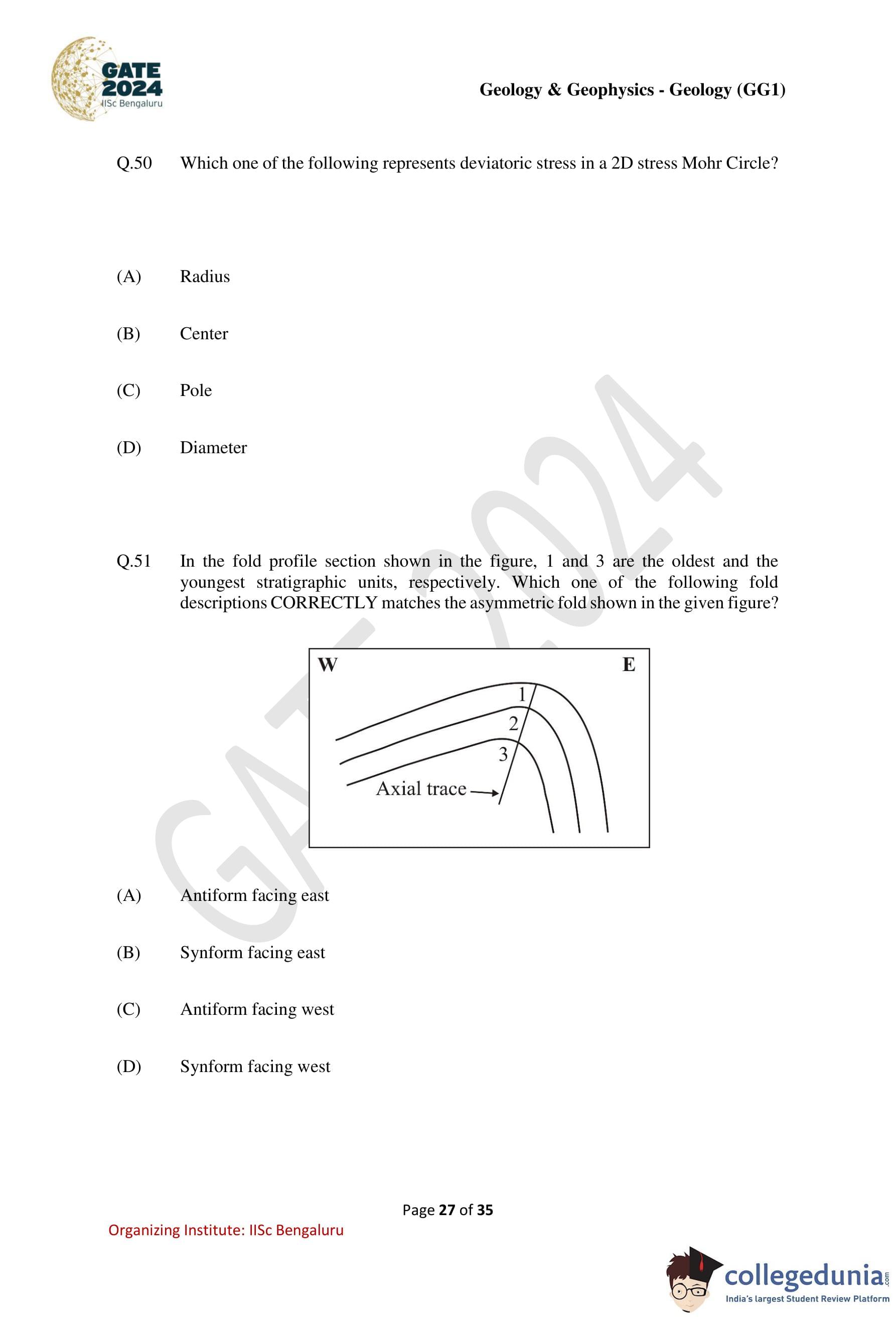
In the fold profile section shown in the figure, 1 and 3 are the oldest and the youngest stratigraphic units, respectively. Which one of the following fold descriptions \textbf{CORRECTLY} matches the asymmetric fold shown in the given figure?

View Solution
Concept:
Fold classification depends on:
Geometry: antiform (convex up) or synform (concave up)
Facing direction: direction in which beds get younger across the axial plane
Step 1: Identify fold type using stratigraphy.
Given:
Unit 1 = oldest
Unit 3 = youngest
In the figure, the youngest unit (3) occurs near the hinge/core of the fold.
\[ \Rightarrow Youngest at core \;\Rightarrow\; \textbf{Synform} \]
Step 2: Determine facing direction.
Facing is defined as the direction in which beds become younger across the axial plane.
From the figure:
Younging is toward the east
Step 3: Combine fold type and facing.
\[ Synform + Facing east \]
Therefore, the correct description is: \[ \boxed{Synform facing east} \] Quick Tip: Remember: Synform: youngest beds at the core Antiform: oldest beds at the core Facing direction = direction of younging across axial plane
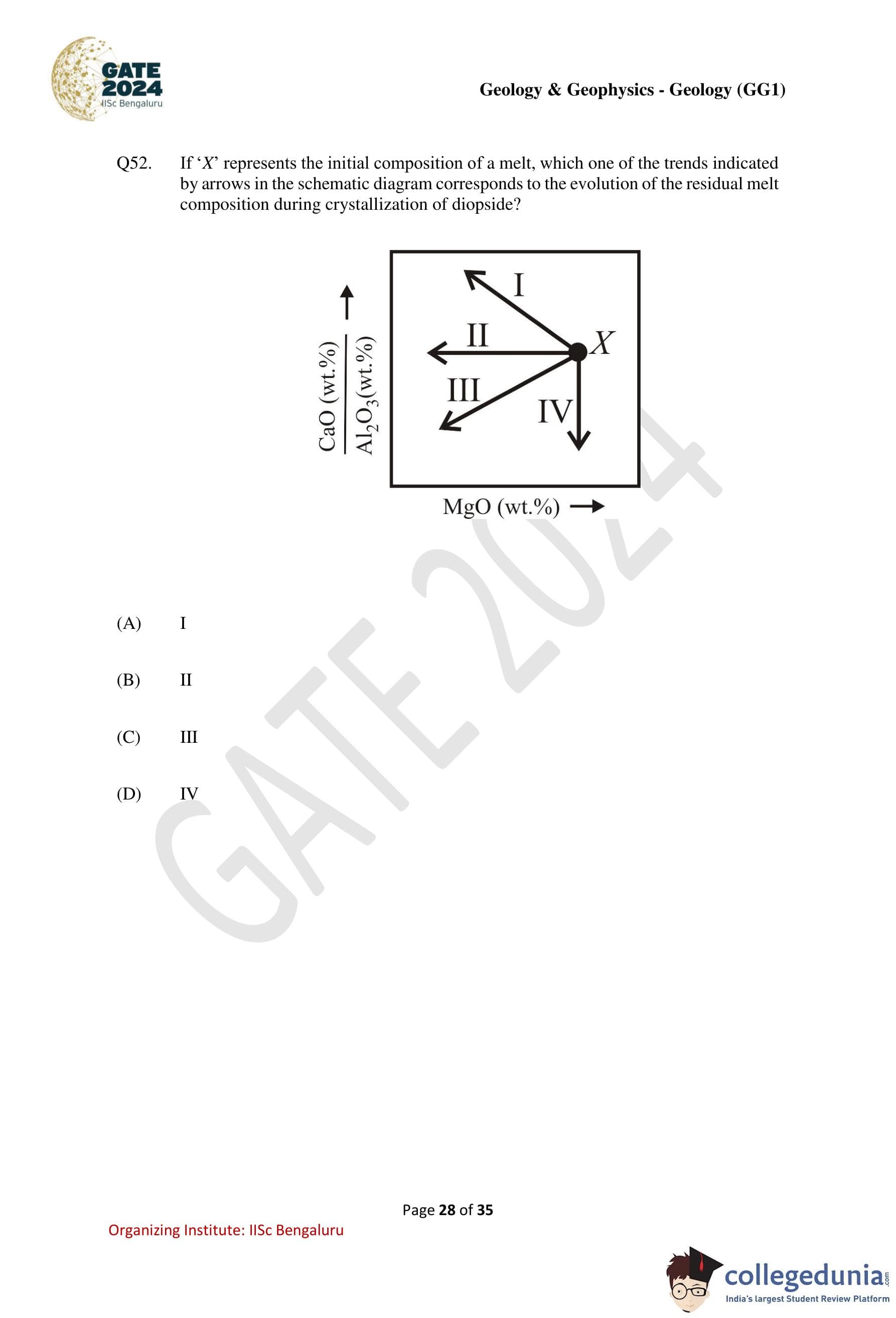
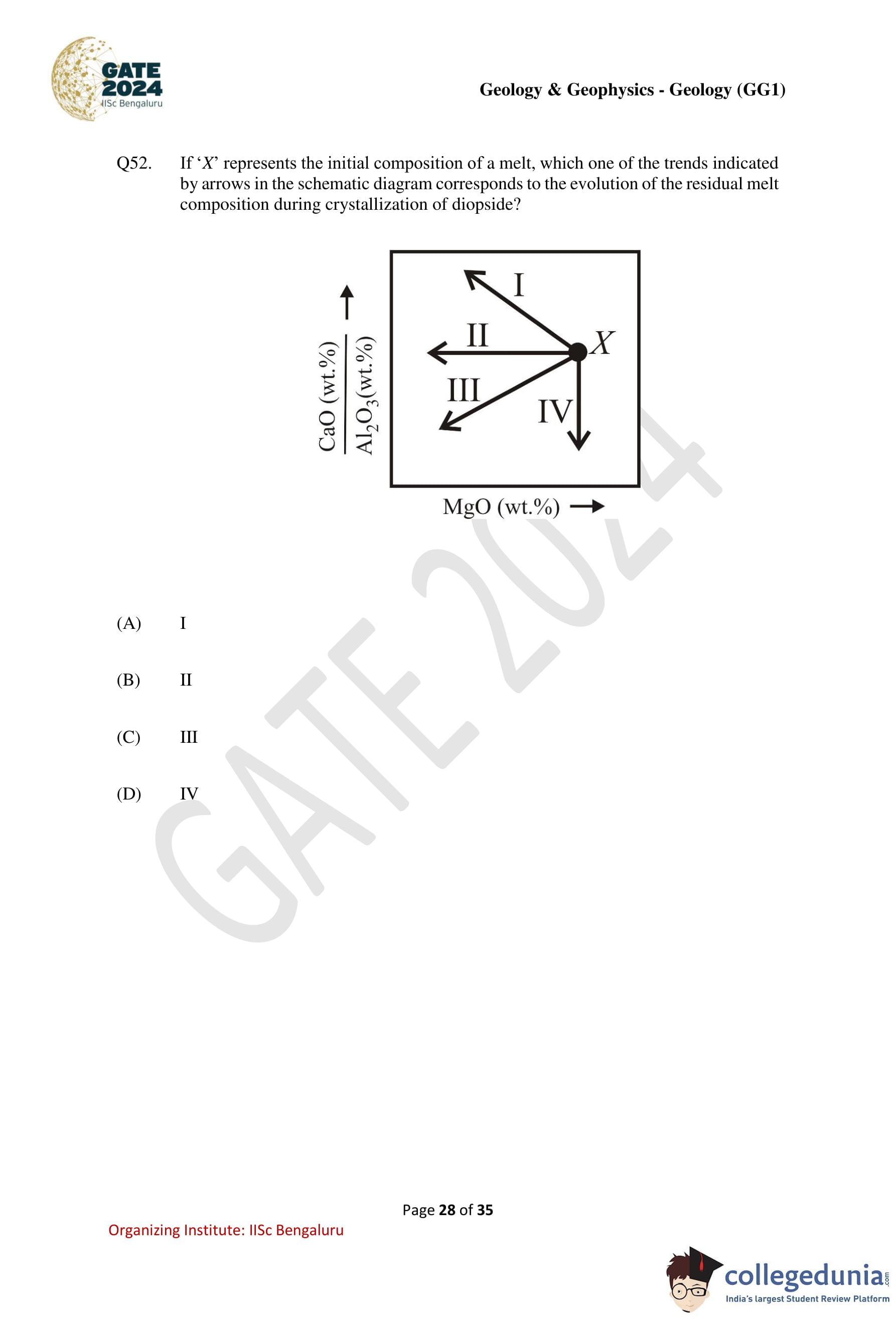
If ‘X’ represents the initial composition of a melt, which one of the trends indicated by arrows in the schematic diagram corresponds to the evolution of the residual melt composition during crystallization of diopside?

View Solution
Concept:
Diopside has the chemical composition: \[ \mathrm{CaMgSi_2O_6} \]
During crystallization of diopside from a melt:
CaO is removed from the melt
MgO is removed from the melt
Al\(_2\)O\(_3\) behaves incompatibly and therefore increases in the residual melt
Step 1: Interpret the axes in the diagram.
Horizontal axis: \(\mathrm{MgO}\) (wt.%) increasing to the right
Vertical axis: \(\mathrm{CaO}\) (wt.%) increasing upward and \(\mathrm{Al_2O_3}\) (wt.%) increasing downward
Step 2: Determine compositional changes in the residual melt.
With diopside crystallization:
MgO \(\downarrow\) \(\Rightarrow\) movement to the left
CaO \(\downarrow\) \(\Rightarrow\) movement downward
Al\(_2\)O\(_3\) \(\uparrow\) \(\Rightarrow\) also represented by downward movement
Step 3: Identify the correct arrow.
The trend that moves downward and to the left from point \(X\) is arrow III.
Therefore, the correct answer is: \[ \boxed{III} \] Quick Tip: During fractional crystallization: Elements entering early-formed minerals decrease in the melt Incompatible components (e.g., Al\(_2\)O\(_3\)) increase in the residual melt Always track directions carefully using axis labels
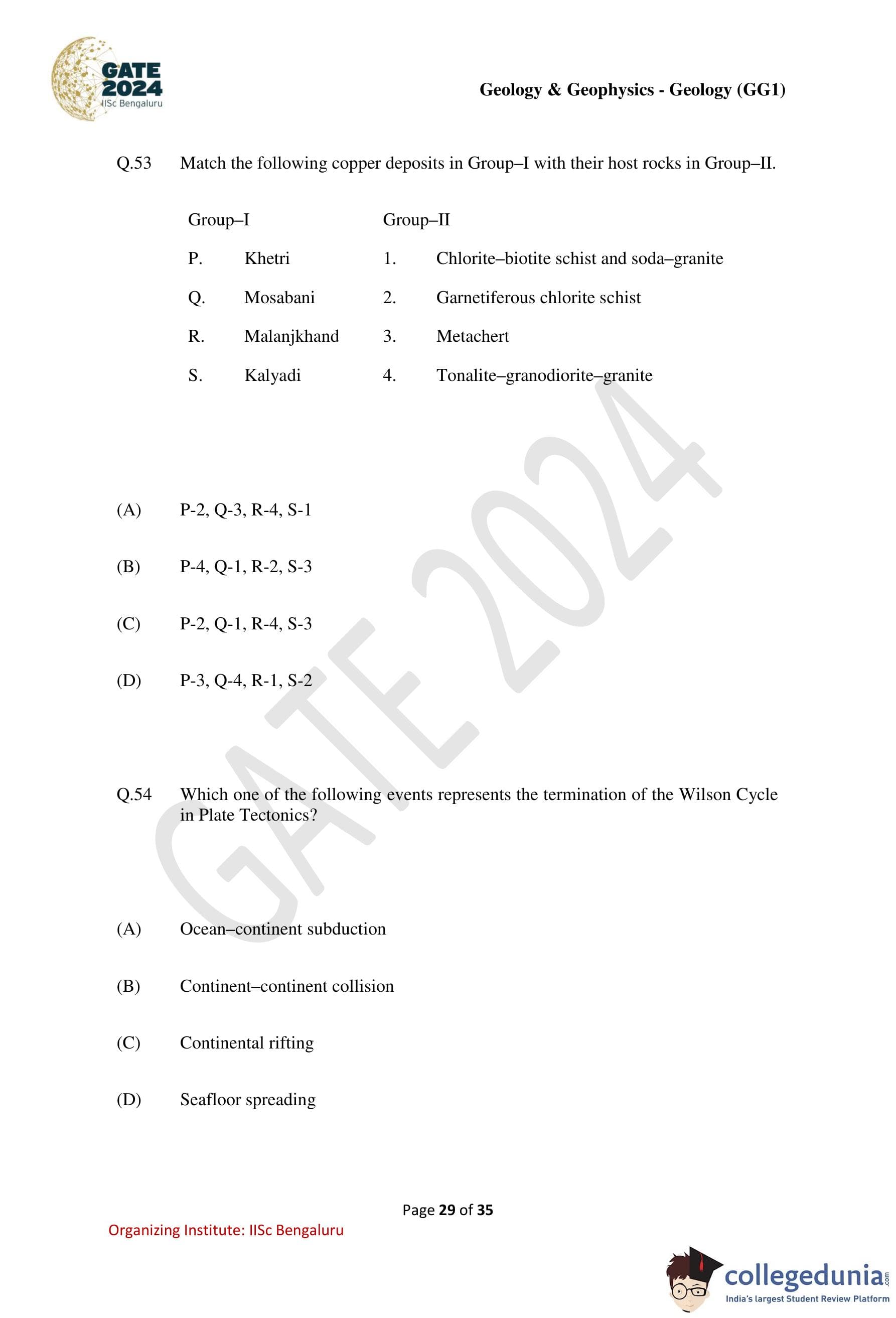
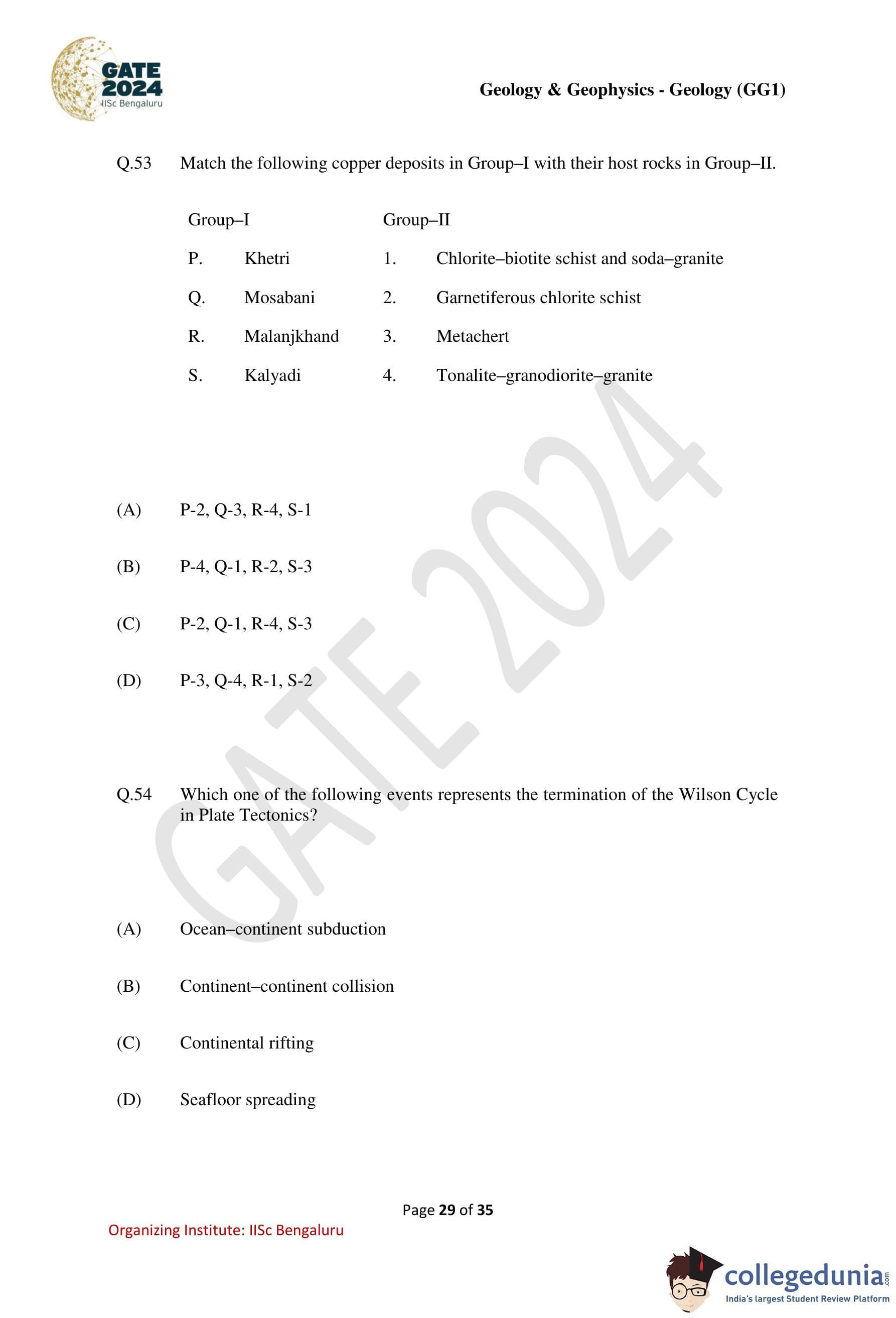
Match the following copper deposits in Group–I with their host rocks in Group–II.

View Solution
Concept:
Major copper deposits in India are associated with characteristic lithologies reflecting their tectono-magmatic settings.
Step 1: Recall the host rocks of the given deposits.
Khetri: hosted in chlorite–biotite schist with soda–granite association
Mosabani: copper mineralization associated with banded iron formation and metachert
Malanjkhand: porphyry copper deposit associated with tonalite–granodiorite–granite
Kalyadi: hosted in garnetiferous chlorite schist
Step 2: Write the correct matching.
\[ \begin{aligned} P &\rightarrow 1
Q &\rightarrow 3
R &\rightarrow 4
S &\rightarrow 2 \end{aligned} \]
Thus, the correct combination is: \[ \boxed{P-1, Q-3, R-4, S-2} \] Quick Tip: Important Indian copper deposits: Khetri \(\rightarrow\) Schist + soda granite Malanjkhand \(\rightarrow\) Porphyry Cu (granitoids) Mosabani \(\rightarrow\) Metachert association
Which one of the following events represents the termination of the Wilson Cycle in Plate Tectonics?
View Solution
Concept:
The Wilson Cycle describes the life cycle of an ocean basin, from its formation to its destruction.
Step 1: Outline the stages of the Wilson Cycle.
Continental rifting \(\rightarrow\) opening of an ocean basin
Seafloor spreading \(\rightarrow\) ocean basin expansion
Ocean–continent subduction \(\rightarrow\) ocean basin contraction
Continent–continent collision \(\rightarrow\) complete closure of the ocean basin
Step 2: Identify the terminating event.
The cycle terminates when two continents collide after complete consumption of oceanic lithosphere, leading to major orogeny (e.g., Himalaya).
Therefore, the event representing the termination of the Wilson Cycle is: \[ \boxed{Continent–continent collision} \] Quick Tip: Wilson Cycle key points: Start: Continental rifting End: Continent–continent collision
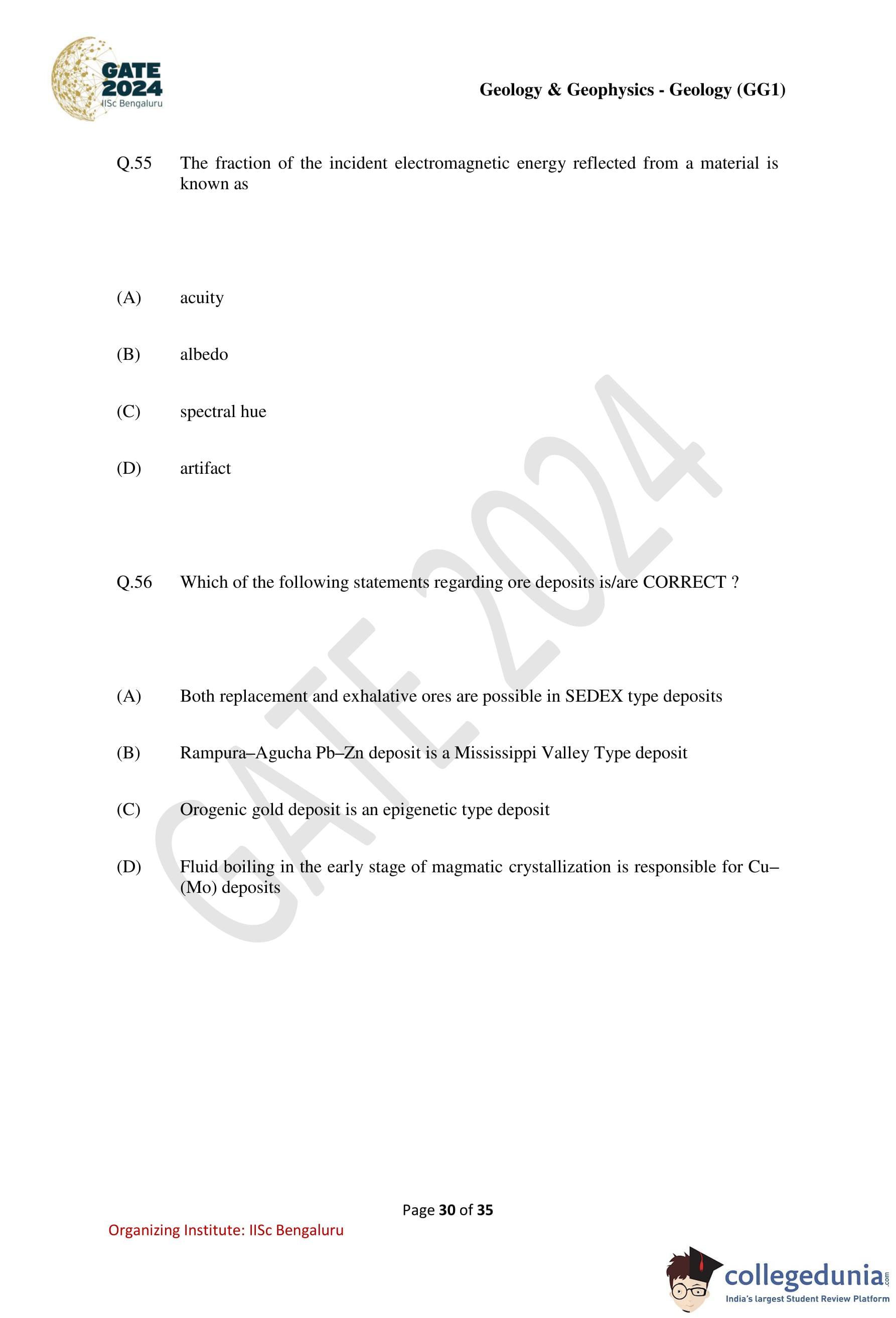
The fraction of the incident electromagnetic energy reflected from a material is known as
View Solution
Concept:
In remote sensing and optics, materials interact with incident electromagnetic radiation through reflection, absorption, and transmission.
Step 1: Define albedo.
Albedo is defined as the ratio (or fraction) of incident electromagnetic energy that is reflected by a surface.
Step 2: Evaluate other options.
Acuity: sharpness of vision or image clarity
Spectral hue: color related to wavelength
Artifact: false signal or feature in data
Thus, the correct term is: \[ \boxed{Albedo} \] Quick Tip: In remote sensing: High albedo \(\rightarrow\) more reflection (e.g., snow) Low albedo \(\rightarrow\) more absorption (e.g., water)
Which of the following statements regarding ore deposits is/are \textbf{CORRECT}?
View Solution
Concept:
Ore deposits are classified based on their genetic processes, timing relative to host rocks, and tectono-magmatic settings.
Step 1: Evaluate statement (A).
SEDEX (Sedimentary Exhalative) deposits:
Form by exhalation of metal-rich fluids onto the seafloor
Also show significant replacement of host sediments
\[ \Rightarrow Statement (A) is correct. \]
Step 2: Evaluate statement (B).
Rampura–Agucha is a world-class SEDEX-type Pb–Zn deposit, not a Mississippi Valley Type (MVT) deposit. \[ \Rightarrow Statement (B) is incorrect. \]
Step 3: Evaluate statement (C).
Orogenic gold deposits:
Form from metamorphic fluids
Are introduced after host rock formation
Thus, they are epigenetic. \[ \Rightarrow Statement (C) is correct. \]
Step 4: Evaluate statement (D).
Cu–Mo (porphyry) deposits form from magmatic–hydrothermal fluids exsolved during the late stages of magmatic crystallization, not early stages. \[ \Rightarrow Statement (D) is incorrect. \]
Therefore, the correct statements are: \[ \boxed{(A) and (C)} \] Quick Tip: Key ore-deposit associations: SEDEX \(\rightarrow\) Exhalative + replacement Orogenic gold \(\rightarrow\) Epigenetic Porphyry Cu–Mo \(\rightarrow\) Late magmatic–hydrothermal stage
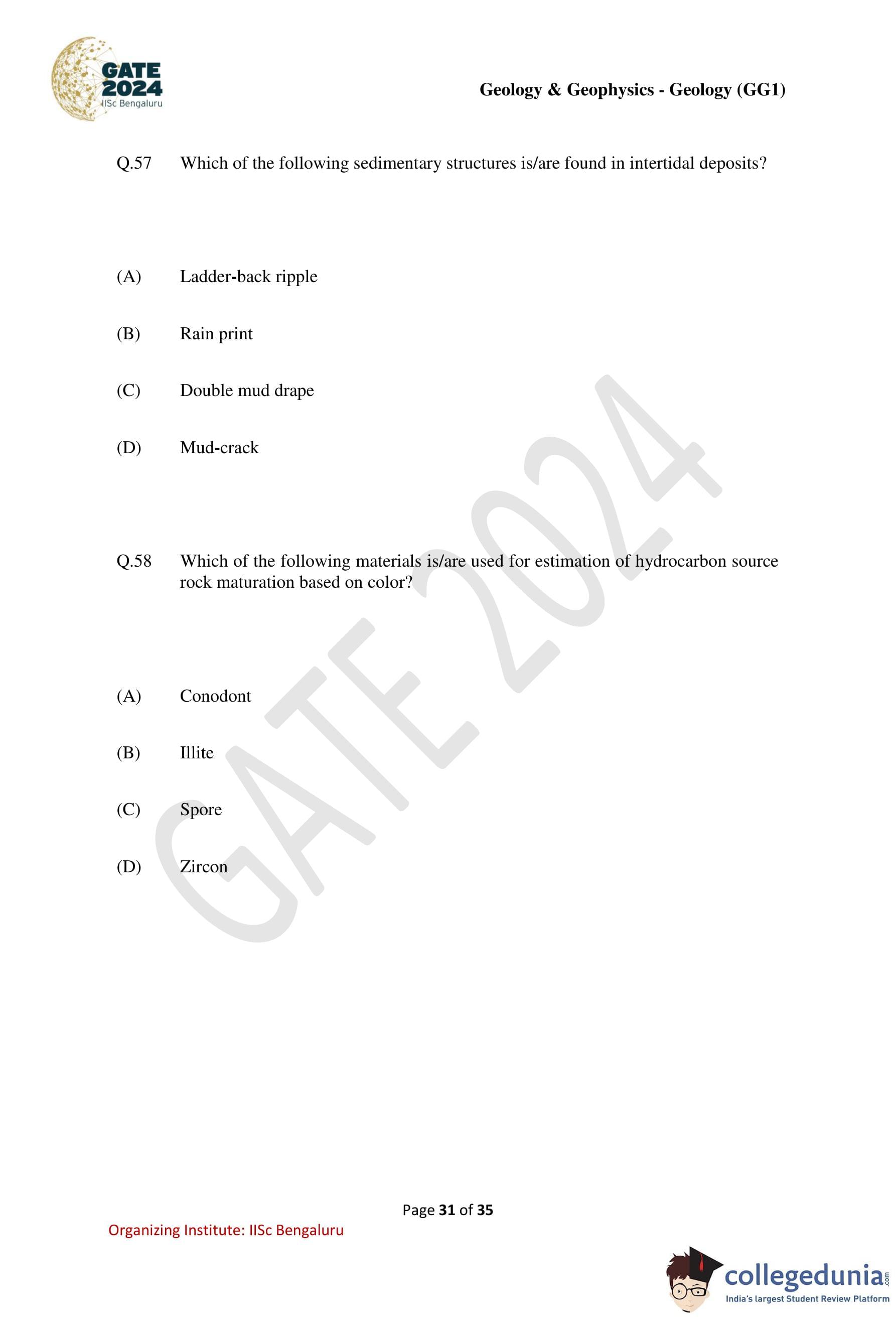
Which of the following sedimentary structures is/are found in intertidal deposits?
View Solution
Concept:
Intertidal environments are alternately submerged and exposed due to tidal fluctuations, producing diagnostic sedimentary structures related to bidirectional currents and periodic exposure.
Step 1: Evaluate each structure.
Ladder-back ripple: formed by superposition of wave ripples on current ripples; typical of tidal flats \checkmark
Rain print: forms due to raindrop impact during subaerial exposure; more characteristic of supratidal or floodplain settings
Double mud drape: alternating mud layers deposited during slack water in tidal cycles; diagnostic of tidal environments \checkmark
Mud-crack: forms due to desiccation during low tide exposure; common in intertidal flats \checkmark
Step 2: Select intertidal indicators.
Thus, the structures found in intertidal deposits are: \[ \boxed{Ladder-back ripple, Double mud drape, and Mud-crack} \] Quick Tip: Classic intertidal indicators: Ladder-back ripples Flaser, wavy, lenticular bedding Double mud drapes Mud-cracks
Which of the following materials is/are used for estimation of hydrocarbon source rock maturation based on color?
View Solution
Concept:
Thermal maturation of hydrocarbon source rocks can be estimated using color alteration indices of certain organic microfossils that respond systematically to increasing temperature.
Step 1: Identify color-based maturity indicators.
Conodont: used in the Conodont Color Alteration Index (CAI) to assess thermal maturity \checkmark
Spore: used in the Spore Color Index (SCI) for maturation studies \checkmark
Step 2: Eliminate incorrect options.
Illite: used for illite crystallinity (grade of metamorphism), not color-based hydrocarbon maturity
Zircon: used for geochronology, not maturation
Therefore, the correct materials are: \[ \boxed{Conodont and Spore} \] Quick Tip: Color-based maturity indices: CAI \(\rightarrow\) Conodont SCI \(\rightarrow\) Spore Used widely in petroleum basin analysis.
Which of the following schist belts occur(s) to the east of the Closepet Granite in southern India?
View Solution
Concept:
The Closepet Granite is a major N--S–trending granitic body in the Dharwar Craton that divides it into:
Western Dharwar Craton (WDC)
Eastern Dharwar Craton (EDC)
The schist belts on either side of the Closepet Granite are distinctly different in age and tectonic setting.
Step 1: Identify schist belts west of the Closepet Granite.
Shimoga Schist Belt \(\rightarrow\) Western Dharwar Craton
Bababudan Schist Belt \(\rightarrow\) Western Dharwar Craton
Step 2: Identify schist belts east of the Closepet Granite.
Kolar Schist Belt \(\rightarrow\) Eastern Dharwar Craton
Hutti Schist Belt \(\rightarrow\) Eastern Dharwar Craton
Step 3: Select the correct options.
Thus, the schist belts occurring to the east of the Closepet Granite are: \[ \boxed{Kolar and Hutti} \] Quick Tip: Dharwar Craton division: West of Closepet Granite \(\rightarrow\) Shimoga, Bababudan East of Closepet Granite \(\rightarrow\) Kolar, Hutti Closepet Granite marks a major crustal boundary.
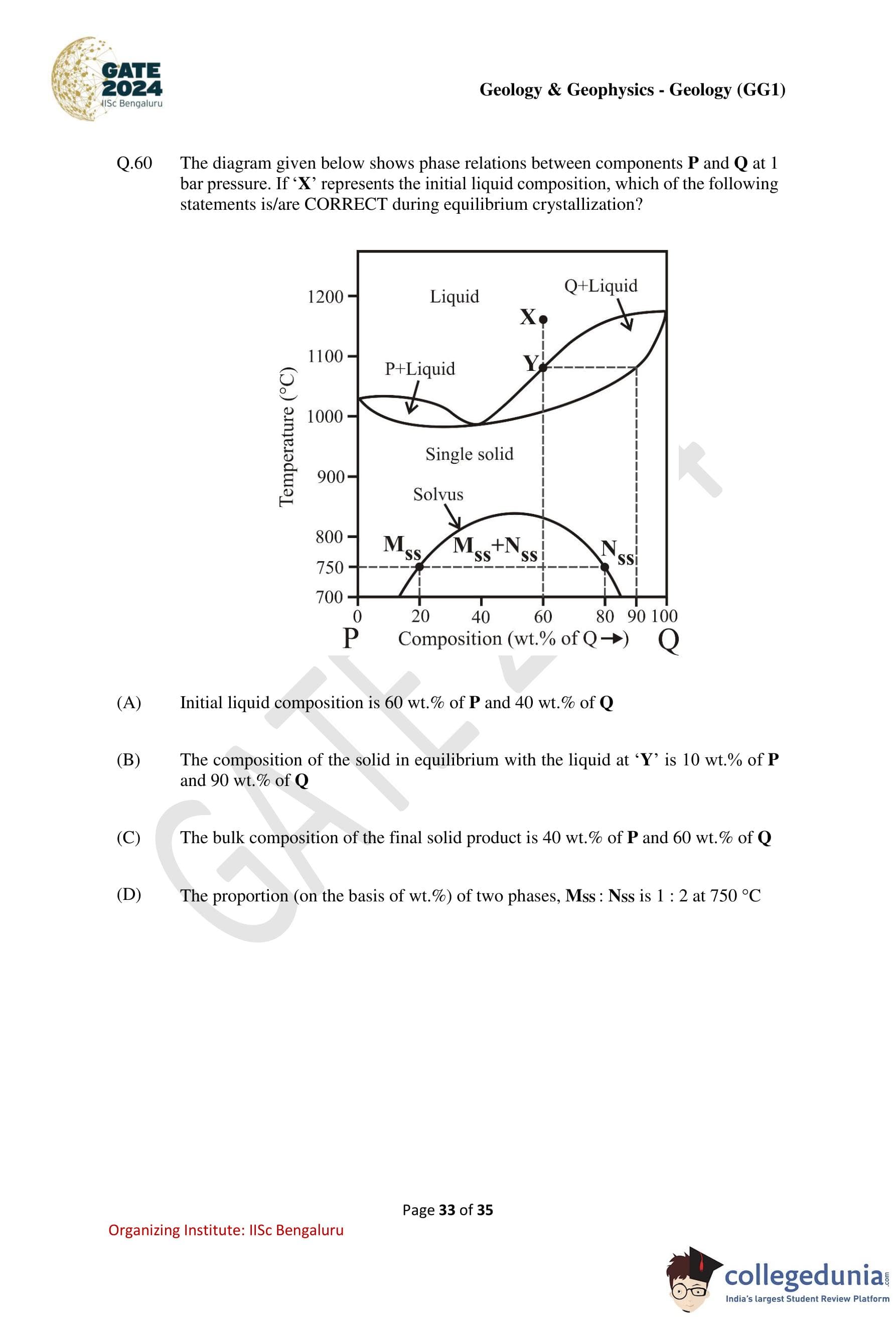
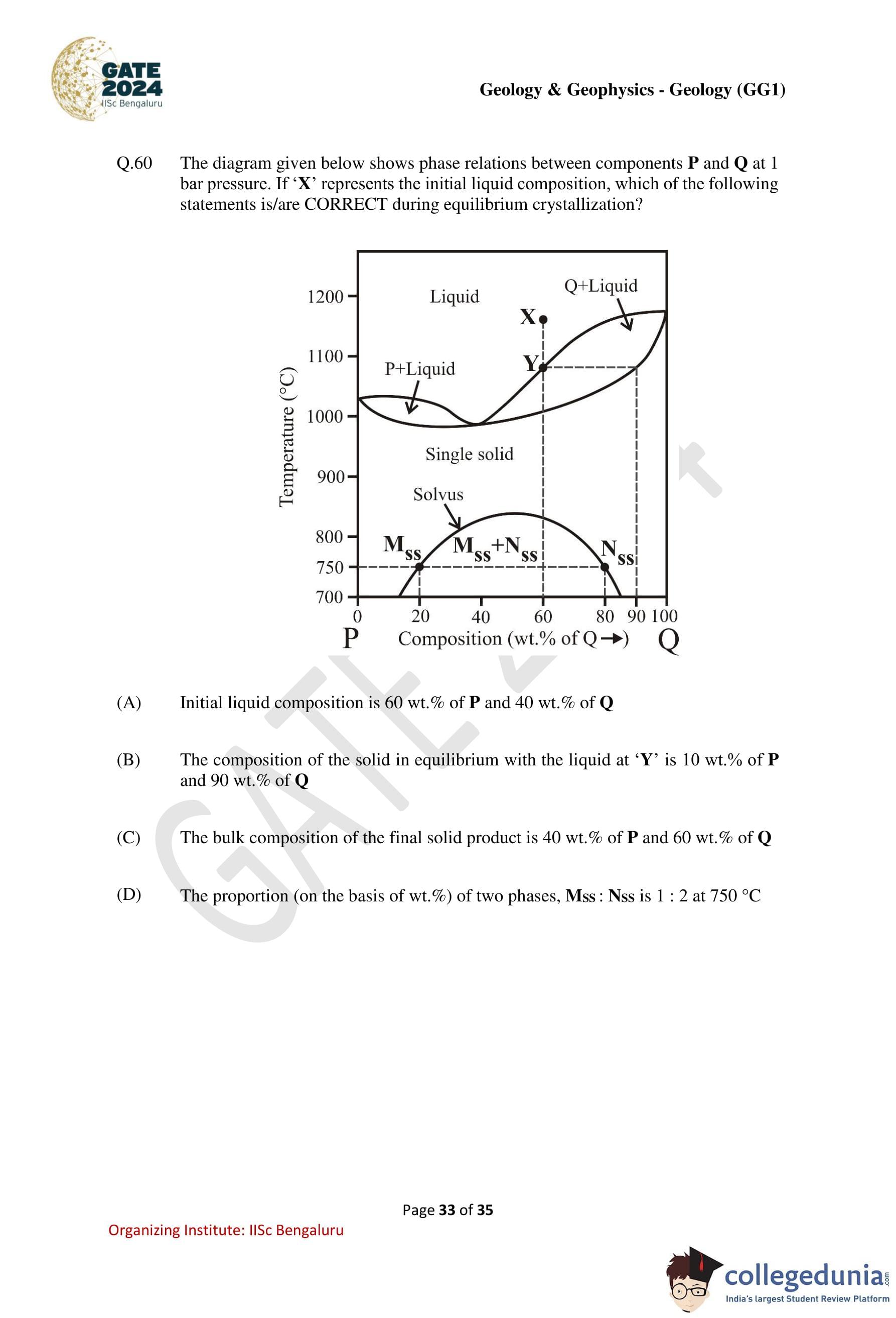
The diagram given below shows phase relations between components P and Q at 1 bar pressure. If ‘X’ represents the initial liquid composition, which of the following statements is/are \textbf{CORRECT} during equilibrium crystallization?

View Solution
Concept:
In equilibrium crystallization:
The bulk composition of the system remains constant
Phase compositions are read from phase boundaries
Phase proportions are determined using the lever rule
Step 1: Check statement (A).
From the diagram, point \(X\) lies at \(\sim 60\) wt.% Q and \(\sim 40\) wt.% P,
not 60 wt.% P and 40 wt.% Q.
\[ \Rightarrow Statement (A) is incorrect. \]
Step 2: Check statement (B).
At point \(Y\), the solid in equilibrium with the liquid lies on the Q-rich solidus,
corresponding to \(\sim 90\) wt.% Q and \(\sim 10\) wt.% P.
\[ \Rightarrow Statement (B) is correct. \]
Step 3: Check statement (C).
Under equilibrium crystallization, the final solid preserves the initial bulk composition.
Initial composition at \(X\) is \(\sim 40\) wt.% P and \(\sim 60\) wt.% Q.
\[ \Rightarrow Statement (C) is correct. \]
Step 4: Check statement (D).
At \(750^\circ\)C, the system lies in the two-solid field (Mss + Nss).
From the solvus:
Mss \(\approx 20\) wt.% Q
Nss \(\approx 80\) wt.% Q
Bulk composition \(\approx 60\) wt.% Q
Using the lever rule: \[ Mss : Nss = (80-60) : (60-20) = 20 : 40 = 1 : 2 \]
\[ \Rightarrow Statement (D) is correct. \]
Final Answer: \[ \boxed{(B), (C) and (D)} \] Quick Tip: Key rules for phase diagrams: Bulk composition is conserved in equilibrium crystallization Phase compositions come from phase boundaries Phase proportions are obtained using the lever rule
Which of the following statements is/are \textbf{CORRECT} for the M-plane of any fault?
View Solution
Concept:
In fault-slip analysis:
The M-plane (movement plane) contains the slip direction (slickenline) and the pole to the fault plane
The pole to the M-plane is therefore perpendicular to both these directions
Step 1: Evaluate statement (A).
The pole of any plane is always perpendicular to that plane, hence it cannot lie on the plane itself. \[ \Rightarrow Statement (A) is incorrect. \]
Step 2: Evaluate statement (B).
Since the slickenline lies within the M-plane, the pole to the M-plane is perpendicular to the slickenline. \[ \Rightarrow Statement (B) is correct. \]
Step 3: Evaluate statement (C).
The pole to a plane can never be parallel to any line lying in that plane. \[ \Rightarrow Statement (C) is incorrect. \]
Step 4: Evaluate statement (D).
The pole to the fault plane lies in the M-plane; therefore, the pole to the M-plane is perpendicular to the pole of the fault plane. \[ \Rightarrow Statement (D) is correct. \]
Thus, the correct statements are: \[ \boxed{(B) and (D)} \] Quick Tip: Fault-plane geometry: M-plane contains slip direction and fault-plane pole Pole to a plane is perpendicular to everything lying in that plane
Which of the following microfossils is/are foraminifera?
View Solution
Concept:
Foraminifera are unicellular protists with calcareous or agglutinated tests, widely used in biostratigraphy and paleoenvironmental analysis.
Step 1: Examine each option.
Miliammina: agglutinated benthic foraminifer \checkmark
\textit{Triceratium: a diatom (siliceous algae), not a foraminifer
\textit{Cibicides: calcareous benthic foraminifer \checkmark
\textit{Guembelitria: planktonic foraminifer \checkmark
Step 2: Select foraminifera.
Thus, the microfossils that are foraminifera are: \[ \boxed{\textit{Miliammina,\ Cibicides,\ Guembelitria} \] Quick Tip: Common microfossil groups: Foraminifera \(\rightarrow\) Cibicides, Guembelitria Diatoms \(\rightarrow\) Triceratium
The in situ stress at a point in a dry sandstone terrain is as follows: \(\sigma_1 = 12\) MPa and \(\sigma_3 = 4\) MPa. The pore water pressure (\(p_w\)) increases by the construction of a reservoir.
The failure criterion of the sandstone is given by \(\sigma_1' = 3.48\ MPa + 3\sigma_3'\),
where \(\sigma_1'\) and \(\sigma_3'\) are the effective maximum and minimum principal stresses, respectively.
Assuming that the failure occurs at peak stress, the minimum value of \(p_w\) (in MPa) that will cause the sandstone to fail \textit{in situ is ................ (rounded off to two decimal places).
View Solution
Concept:
Effective stress is defined as: \[ \sigma' = \sigma - p_w \]
Failure occurs when the effective stresses satisfy the given failure criterion.
Step 1: Write expressions for effective principal stresses.
\[ \sigma_1' = \sigma_1 - p_w = 12 - p_w \] \[ \sigma_3' = \sigma_3 - p_w = 4 - p_w \]
Step 2: Substitute into the failure criterion.
\[ 12 - p_w = 3.48 + 3(4 - p_w) \]
Step 3: Simplify the equation.
\[ 12 - p_w = 3.48 + 12 - 3p_w \] \[ 12 - p_w = 15.48 - 3p_w \]
Step 4: Solve for \(p_w\).
\[ - p_w + 3p_w = 15.48 - 12 \] \[ 2p_w = 3.48 \] \[ p_w = 1.74\ MPa \]
\[ \boxed{1.74} \] Quick Tip: Key reminders: Increasing pore pressure reduces effective stress Failure criteria are always applied to \textbf{effective stresses} Always substitute \(\sigma' = \sigma - p_w\) before solving
If the Rb–Sr isochron formed by a suite of gabbro samples has a slope of 0.0265, then the calculated age of the gabbro in million years is ................ (in integer).
[Use \(\lambda(^{87}\mathrm{Rb}) = 1.42 \times 10^{-11}\ year^{-1}\)]
View Solution
Concept:
For the Rb–Sr isochron method, the slope (\(m\)) of the isochron is related to age (\(t\)) by: \[ m = e^{\lambda t} - 1 \]
Step 1: Express age in terms of slope.
\[ t = \frac{1}{\lambda} \ln(1+m) \]
Step 2: Substitute the given values.
\[ t = \frac{1}{1.42 \times 10^{-11}} \ln(1 + 0.0265) \]
\[ \ln(1.0265) \approx 0.02615 \]
Step 3: Calculate the age.
\[ t = \frac{0.02615}{1.42 \times 10^{-11}} \approx 1.84 \times 10^{9}\ years \]
Step 4: Convert to million years.
\[ t \approx 1840\ million years \]
\[ \boxed{1840} \] Quick Tip: Rb–Sr isochron age relation: \[ Age = \frac{1}{\lambda}\ln(1+slope) \] Always convert final age into million years if required.
A soil mass comprises two horizontal layers (of equal thickness and equal width) stacked one above the other. The hydraulic conductivities of the two layers are \(5 \times 10^{-2}\) cm/s and \(3 \times 10^{-2}\) cm/s. Considering vertical flow of water and same hydraulic gradient for both layers, the effective hydraulic conductivity of the soil mass in cm/s is ................ (rounded off to two decimal places).
View Solution
Concept:
For horizontal layers with flow parallel to bedding (same hydraulic gradient), the effective hydraulic conductivity is the arithmetic mean: \[ K_{eff} = \frac{K_1 + K_2}{2} \]
when layer thicknesses are equal.
Step 1: Substitute the given values.
\[ K_{eff} = \frac{5 \times 10^{-2} + 3 \times 10^{-2}}{2} \]
\[ K_{eff} = \frac{8 \times 10^{-2}}{2} = 4 \times 10^{-2}\ cm/s \]
Step 2: Express in decimal form.
\[ K_{eff} = 0.04\ cm/s \]
\[ \boxed{0.04} \] Quick Tip: Hydraulic conductivity: Flow parallel to layers \(\rightarrow\) arithmetic mean Flow perpendicular to layers \(\rightarrow\) harmonic mean Equal thickness simplifies calculations.


Also Check:





Comments