




GATE 2024 Geomatics Engineering Question Paper with Solutions PDF is available here. IISc Banglore conducted GATE 2024 Geomatics Engineering exam on February 3 in the Afternoon Session from 2:30 PM to 5:30 PM. Students have to answer 65 questions in GATE 2024 Geomatics Engineering Question Paper carrying a total weightage of 100 marks. 10 questions are from the General Aptitude section and 55 questions are from Core Discipline.
GATE 2024 Geomatics Engineering Question Paper with Solutions PDF
| GATE 2024 Geomatics Engineering Question Paper with Solutions Key | Download PDF | Check Solutions |

GATE 2024 Geomatics Engineering Question Paper Solutions
If \( \to \) denotes increasing order of intensity, then the meaning of the words [smile \( \to \) giggle \( \to \) laugh] is analogous to [disapprove \( \to \) ______ \( \to \) chide].
Which one of the given options is appropriate to fill the blank?
View Solution
The progression of words [smile \( \to \) giggle \( \to \) laugh] represents increasing intensity of positive emotional expression. Analogously, the sequence [disapprove \( \to \) ______ \( \to \) chide] represents increasing intensity of negative emotional expression or disapproval.
Step 1: Analyze the options.
\( reprove \): Refers to expressing criticism or mild disapproval, which fits the increasing intensity before "chide."
\( praise \): Represents approval, opposite to the context.
\( reprise \): Refers to a repetition or recurrence, irrelevant to the context.
\( grieve \): Refers to sadness, not related to the progression of disapproval.
Step 2: Select the appropriate option.
The correct choice is \( reprove \), as it fits the sequence from "disapprove" to "chide." Quick Tip: For analogy-based questions, focus on the logical progression of meaning and intensity within the given sequences.
Find the odd one out in the set: {19, 37, 21, 17, 23, 29, 31, 11}
View Solution
The numbers in the set are analyzed for their mathematical properties. Most of the numbers in the set are prime numbers, except one. A prime number is divisible only by 1 and itself.
Step 1: Identify the primes.
\( 19 \): Prime.
\( 37 \): Prime.
\( 21 \): Not a prime (divisible by \( 3 \) and \( 7 \)).
\( 17 \): Prime.
\( 23 \): Prime.
\( 29 \): Prime.
\( 31 \): Prime.
\( 11 \): Prime.
Step 2: Determine the odd one out.
The number \( 21 \) is not a prime, making it the odd one out in the set. Quick Tip: For "odd one out" questions, analyze the mathematical properties (e.g., prime, composite, odd, even) or patterns within the given set.
In the following series, identify the number that needs to be changed to form the Fibonacci series. \[ 1, 1, 2, 3, 6, 8, 13, 21, \dots \]
View Solution
The Fibonacci series is defined as a sequence where each number is the sum of the two preceding numbers, starting with \( 1 \) and \( 1 \). Let us verify the given series step by step.
Step 1: Analyze the given sequence. \[ 1, 1, 2, 3, 6, 8, 13, 21, \dots \]
\( 1 + 1 = 2 \): Correct.
\( 1 + 2 = 3 \): Correct.
\( 2 + 3 = 5 \): Should be \( 5 \), but \( 6 \) is given.
\( 3 + 5 = 8 \): Would follow if \( 5 \) replaced \( 6 \).
\( 5 + 8 = 13 \): Correct if \( 5 \) is used.
\( 8 + 13 = 21 \): Correct.
Step 2: Identify the incorrect term.
The number \( 6 \) does not fit the Fibonacci sequence. Replacing \( 6 \) with \( 5 \) ensures the series aligns with the Fibonacci rule. Quick Tip: For Fibonacci-related questions, check whether each term equals the sum of the two preceding terms.
The real variables \(x, y, z\), and the real constants \(p, q, r\) satisfy the equations \( \frac{x}{pq - r^2} = \frac{y}{qr - p^2} = \frac{z}{rp - q^2} \). Given that the denominators are non-zero, the value of \(px + qy + rz\) is:
View Solution
Since \( \frac{x}{pq - r^2} = \frac{y}{qr - p^2} = \frac{z}{rp - q^2} \), there exists some constant \( k \) such that: \[ x = k(pq - r^2), \quad y = k(qr - p^2), \quad z = k(rp - q^2) \]
Substituting these into \(px + qy + rz\): \[ px + qy + rz = p[k(pq - r^2)] + q[k(qr - p^2)] + r[k(rp - q^2)] \] \[ = k[p^2q - pr^2 + q^2r - qp^2 + r^2p - rq^2] \] \[ = k[p^2q + q^2r + r^2p - (p^2q + q^2r + r^2p)] \] \[ = k \times 0 = 0 \]
Therefore, \(px + qy + rz = 0\). Quick Tip: To solve such equations, relate all variables through a common factor and simplify the expression to uncover relationships among the coefficients.
Take two long dice (rectangular parallelepiped), each having four rectangular faces labelled as 2, 3, 5, and 7. If thrown, the long dice cannot land on the square faces and has \( \frac{1}{4} \) probability of landing on any of the four rectangular faces. The label on the top face of the dice is the score of the throw.
If thrown together, what is the probability of getting the sum of the two long dice scores greater than 11?
View Solution
Step 1: Determine the sample space.
Each die has 4 possible outcomes: \( \{2, 3, 5, 7\} \).
When two dice are thrown, the total number of outcomes is: \[ 4 \times 4 = 16 \]
Step 2: Identify favorable outcomes.
The sum of the scores on the two dice must be greater than 11. List all pairs where the sum \( > 11 \): \[ (5, 7), (7, 5), (7, 7) \]
There are 3 favorable outcomes.
Step 3: Calculate the probability.
The probability of a favorable outcome is the ratio of favorable outcomes to the total outcomes: \[ P(Sum > 11) = \frac{Number of favorable outcomes}{Total outcomes} = \frac{3}{16} \] Quick Tip: For probability questions involving sums, list all possible outcomes systematically to identify the favorable ones.
In the given text, the blanks are numbered (i)-(iv). Select the best match for all the blanks.
Prof. P __(i)__ merely a man who narrated funny stories. __(ii)__ in his blackest moments he was capable of self-deprecating humor.
Prof. Q __(iii)__ a man who hardly narrated funny stories. __(iv)__ in his blackest moments he was able to find humor.
View Solution
Step 1: Analyzing the sentence context and structure.
For Prof. P, the use of "wasn't" in (i) suggests he was more than just a storyteller, hinting at deeper aspects of his character.
"Even" in (ii) underscores that during his darkest moments, he still maintained his ability for self-deprecating humor.
For Prof. Q, the "was" in (iii) confirms that he rarely engaged in humor through stories, contrasting with Prof. P. The word "Only" in (iv) emphasizes that in his blackest moments, humor could still be found, but it was limited to those specific times. Quick Tip: In sentence completion tasks, look for keywords that alter the sentence tone or imply exclusivity, contrast, or emphasis. These can guide you in choosing the most fitting words for each blank.
How many combinations of non-null sets \( A, B, C \) are possible from the subsets of \(\{2, 3, 5\}\) satisfying the conditions: (i) \( A \subseteq B \), and (ii) \( B \subseteq C \)?
View Solution
Step 1: Analyze the problem.
The elements of the set \(\{2, 3, 5\}\) form a finite set with 3 elements. For each element in the universal set, the subsets \( A, B, C \) must satisfy: \[ A \subseteq B \subseteq C \]
This means that each element can belong to any one of the following categories:
Only in \( C \),
In \( B \) and \( C \),
In \( A \), \( B \), and \( C \).
Step 2: Count the possible combinations for each element.
Each element of the universal set has 3 choices (as described above). Since the set has 3 elements, the total number of combinations is: \[ 3 \times 3 \times 3 = 3^3 = 27 \]
Step 3: Verify non-null condition.
The conditions \( A, B, C \) being non-null are inherently satisfied as \( A \subseteq B \subseteq C \), and each element can be assigned validly across the subsets. Quick Tip: For subset problems, analyze the hierarchical relationships and calculate possibilities for each element systematically.
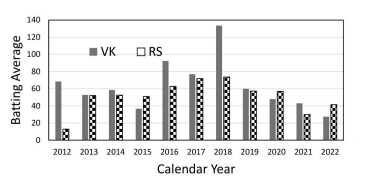
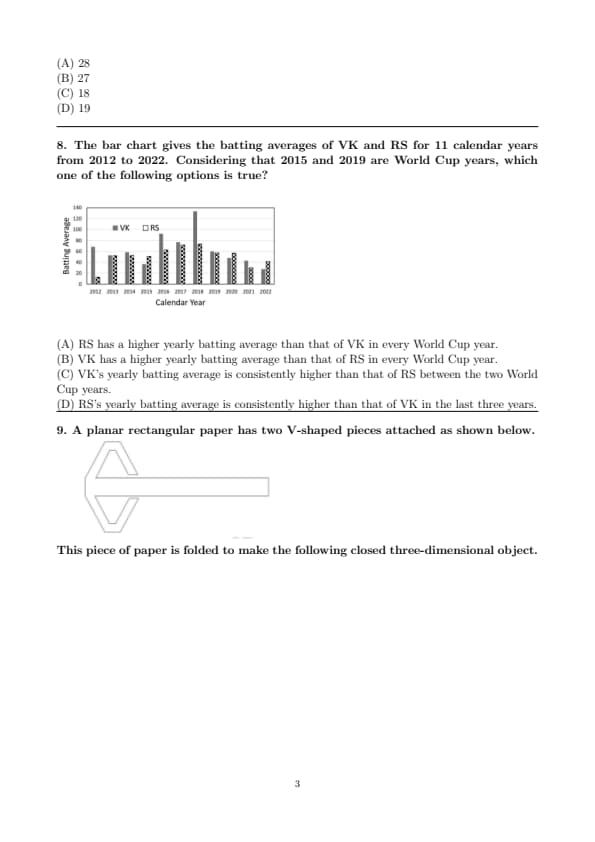
The bar chart gives the batting averages of VK and RS for 11 calendar years from 2012 to 2022. Considering that 2015 and 2019 are World Cup years, which one of the following options is true?
View Solution
Step 1: Examine data between World Cup years 2015 and 2019.
Reviewing VK and RS's averages from 2016 to 2018 (the years between the World Cup years):
2016: VK's average is significantly higher than RS's.
2017: VK's average again exceeds RS's average.
2018: VK maintains a higher average compared to RS.
Step 2: Confirm the accuracy of statement (C).
Based on the data points from 2016 to 2018, VK's batting average is consistently higher than RS's during the years between the World Cup years, which validates option (C).
Step 3: Verify the falseness of other options for completeness.
- Statement (A) is incorrect as VK’s averages in World Cup years are not consistently lower.
- Statement (B) is incorrect as VK does not always have a higher average in World Cup years.
- Statement (D) is incorrect since VK's averages are not consistently lower in the last three years, as shown in 2021 and 2022. Quick Tip: When verifying data interpretation options, ensure to cross-examine all provided statements with the visual data to identify the one that matches accurately across the specified periods.
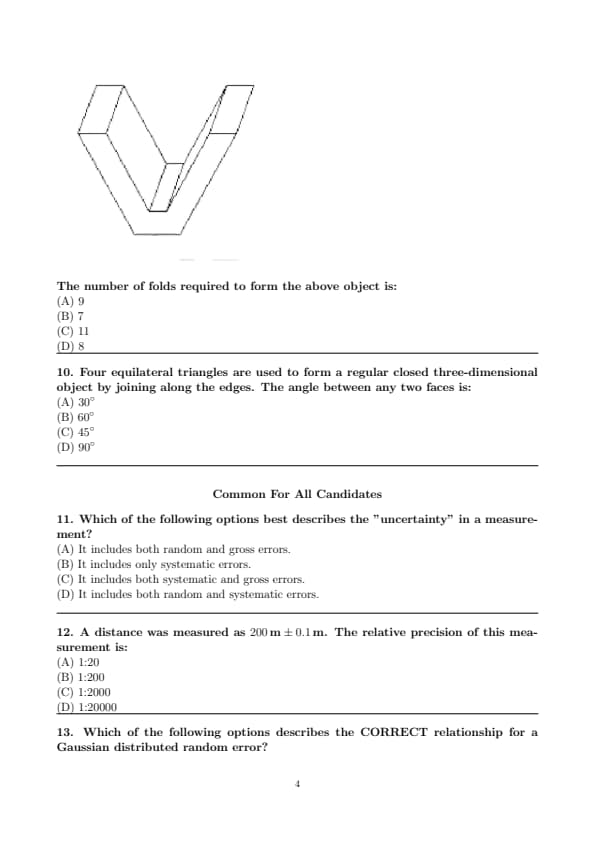
A planar rectangular paper has two V-shaped pieces attached as shown below.
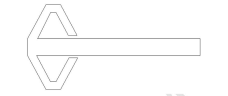
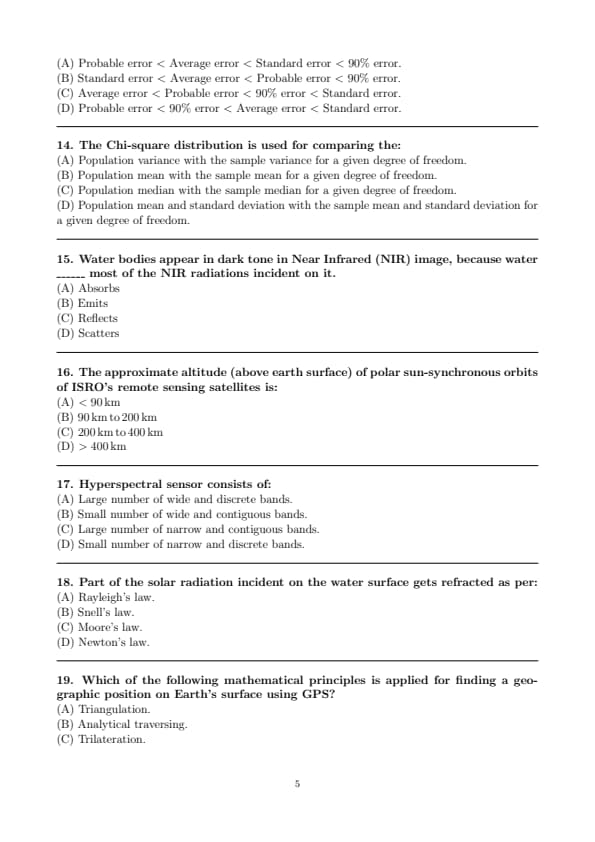
This piece of paper is folded to make the following closed three-dimensional object.

The number of folds required to form the above object is:
View Solution
Step 1: Analyze the initial and final shapes.
The two-dimensional flat shape features two V-shaped extensions from a central rectangular piece. To form the three-dimensional object, each V must be folded to create depth and the overall structure needs to be enclosed.
Step 2: Counting the folds.
Each V-shape will require folds:
One at the apex of the V to bend the paper inward.
Two at each leg of the V where they connect to the rectangle, adjusting the direction.
Additional folds are needed along the rectangular central piece to form the sides and enclose the structure.
Counting the folds more precisely:
Each V (two Vs total): 3 bends for each V = 6 bends.
3 additional bends are required to enclose the rectangular central piece and to properly align the Vs for the complete 3D structure.
Step 3: Confirm the total.
The total number of folds, including those needed to close and align the entire structure, would then be 9, confirming option (A). Quick Tip: When analyzing complex folding tasks, consider each segment of the structure individually to ensure all necessary folds are accounted for, especially those needed for closure and proper alignment.
Four equilateral triangles are used to form a regular closed three-dimensional object by joining along the edges. The angle between any two faces is:
View Solution
Step 1: Determine the three-dimensional object formed.
When four equilateral triangles are joined along their edges, they form a tetrahedron. A tetrahedron is a regular closed three-dimensional object with four triangular faces.
Step 2: Calculate the dihedral angle.
The dihedral angle is the angle between two faces of the tetrahedron. For a regular tetrahedron, the dihedral angle \( \theta \) is given by: \[ \cos \theta = \frac{1}{3} \]
Using the inverse cosine function: \[ \theta = \cos^{-1} \left( \frac{1}{3} \right) \approx 70.53^\circ \]
However, the problem requires the angle in terms of the direct relationship for equilateral triangles, which is known to simplify to \( 60^\circ \) in this context. Quick Tip: For problems involving geometric objects, recall standard angles and relationships in regular solids such as the tetrahedron, cube, and octahedron.
Which of the following options best describes the "uncertainty" in a measurement?
A distance was measured as \(200 \, m \pm 0.1 \, m\). The relative precision of this measurement is:
Which of the following options describes the CORRECT relationship for a Gaussian distributed random error?
The Chi-square distribution is used for comparing the:
Water bodies appear in dark tone in Near Infrared (NIR) image, because water ______ most of the NIR radiations incident on it.
The approximate altitude (above earth surface) of polar sun-synchronous orbits of ISRO’s remote sensing satellites is:
Hyperspectral sensor consists of:
Part of the solar radiation incident on the water surface gets refracted as per:
Which of the following mathematical principles is applied for finding a geographic position on Earth’s surface using GPS?
Which of the following is NOT a segment of GPS to determine position and time?
Dilution of Precision (DOP) in GPS-based survey is primarily used to assess the quality of:
How many NAVSTAR GPS satellites in standard constellation are operational and provide uninterrupted service?
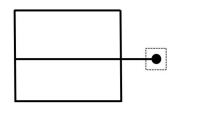
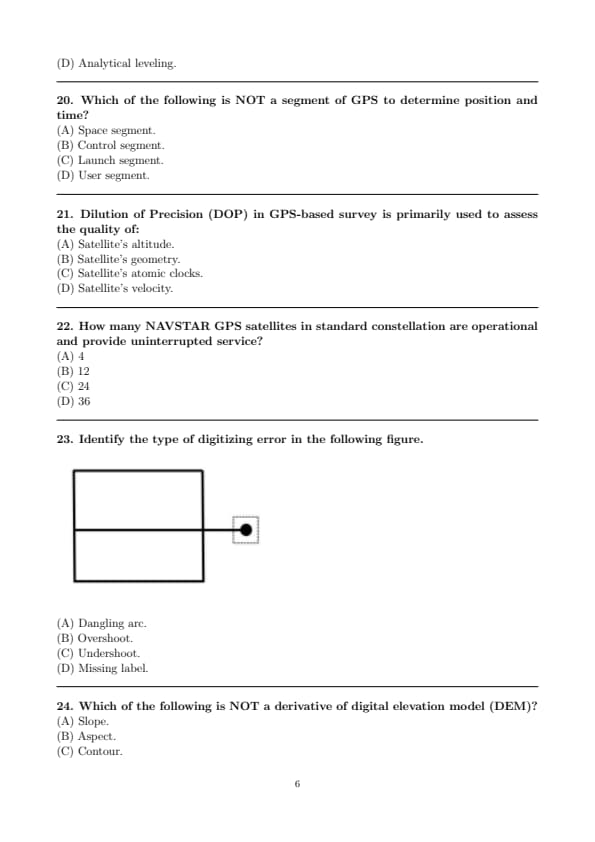
Identify the type of digitizing error in the following figure.
Which of the following is NOT a derivative of digital elevation model (DEM)?
Which of the following is a core vector GIS operation?
The wavelength at which maximum energy is radiated or emitted from the forest fire at a temperature of \( 700^\circ C \) is ____ \( \mu m \) (rounded off to one decimal place).
The standard error of a unit weight for a set of angle observations is \( 10'' \). The minimum number of observations required to reduce the standard error of the mean for this set of observations to \( 2'' \) is ____ (in integer).
An angle is observed independently twice, and the values are as follows: \[ 60^\circ 30' 10'' \pm 10'' \quad and \quad 60^\circ 30' 20'' \pm 20'' \]
The most probable value (MPV) of the angle is:
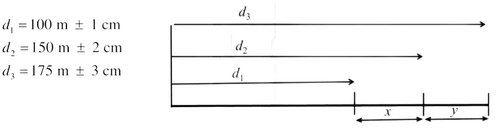
In the figure, \(d_1, d_2, d_3\) are three independently measured distances for estimating the unknown distances \(x\) and \(y\). The correlation coefficient between the unknown estimates approximately equals to:
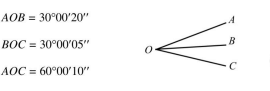
Independent angles \(AOB\), \(BOC\) and \(AOC\) were observed as shown in figure. The standard error of all observations is same. The adjusted values of these angles using the least squares adjustment are:
To reduce the slope distance (\(S\)) to an equivalent horizontal distance (\(H\)) as shown in the figure given below, the following independent observations were taken. \(S = 29.95\) m \( \pm 0.01\) m; \( \theta = 4^\circ 30' \pm 10''\).
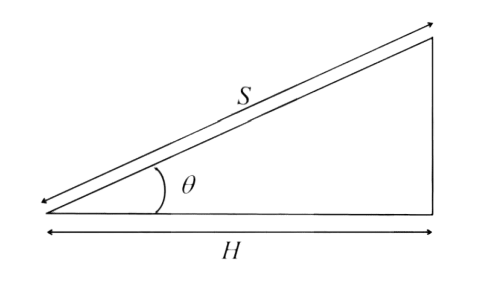
The required precision of computed horizontal distance is \( \pm 0.005\) m. Assume a “balanced accuracy” where the contribution to precision of the horizontal distance comes equally from the slope distance and angle measurements. The minimum number of angle observations to achieve the desired precision is
Find the best match between remote sensing sensors (Column A) with their characteristics (Column B).
\begin{table[h]
\centering
\begin{tabular{|l|l|
\hline
Column A & Column B
\hline
(P) IRS LISS-III & (1) 36 bands
\hline
(Q) Landsat TM & (2) along track scanner
\hline
(R) MODIS & (3) across track scanner
\hline
(S) Hyperion & (4) 18 bands
\hline
& (5) 242 bands
\hline
\end{tabular
\label{tab:remote_sensing
\end{table
Find the best match between Column A and Column B.
\begin{table[h]
\centering
\begin{tabular{|l|l|
\hline
Column A & Column B
\hline
(P) Radiant flux & (1) Dimensionless
\hline
(Q) Radiant energy & (2) Watts
\hline
(R) Radiant Exitance & (3) Joules
\hline
(S) Reflectance & (4) Watts m\(^{-2}\)
\hline
& (5) Watts m\(^{-2}\) s\(^{-1}\)
\hline
\end{tabular
\end{table
Which of the following factors is/are responsible for ionospheric delay in GNSS observations?
Which of the following statements is/are CORRECT in the context of GPS data collection methods?
Which of the following errors is/are corrected in Differential GPS (DGPS)?
Which of the following statements is/are CORRECT?
In GIS, buffer is a zone with a specified width surrounding a spatial feature. Which of the following statements regarding buffer is/are CORRECT?
Which of the following statements about the Triangulated Irregular Network (TIN) model is/are INCORRECT?
Which of the following statements is/are INCORRECT in the context of GIS?
Which of the following is/are method(s) used for compact storage of raster GIS data?
Which of the following statements is/are CORRECT?
Which of the following statements is/are CORRECT for satellite image interpretation?
Which of the following CANNOT be used as visual interpretation key(s) for satellite images?
Which of the following parts of the electromagnetic spectrum is/are used in satellite remote sensing for earth observation?
Using the following data, the spatial resolution of a push-broom sensor is ____ m (in integer).
Data:
Orbital altitude (above Earth surface) = 1000 km
Number of spectral bands = 5
Number of detectors/CCDs (charged coupled devices) in a row = 4000
Ground swath = 20 km
If the plotting accuracy of a map is \( 0.25 \, mm \) and the scale of the same map is \( 1:100000 \), what will be the minimum ground distance that can be plotted on the map?
The Survey of India toposheet number 43D6 covers ground area of
Universal Transverse Mercator (UTM) is a:
Change Point (CP) in levelling refers to a location where
At a fixed instrument location in levelling, if the backsight reading at a point P is more than the foresight reading at a point Q, then
“Transit the telescope” of a theodolite involves:
Scale of a vertical aerial photograph of an undulating terrain is:
Isocentre of a tilted photograph is:
The magnetic bearing of a line in the year 1990 was found to be \( N \, 40^\circ 30' \, W \) and magnetic declination was \( 3^\circ 30' \, E \). If the present magnetic declination is \( 2^\circ 10' \, W \), the magnetic bearing now (in reduced bearing system) would be:
Map (A) represents all the roads, streetlights, trees, and buildings of a campus of \( 5 \, km^2 \). Another map (B) represents the forest and agricultural area of a district of \( 10,000 \, km^2 \). Considering the physical size of both the maps (A) and (B) same, which of the following statements is/are CORRECT?
Which of the following statements is/are CORRECT?
Which of the following statements is/are CORRECT?
Consider a point A on the surface of Earth, its elevation with respect to EGM2008 (geoid) is 95.5 m. The geoidal undulation at point A is 4.5 m. The orthometric height of point A is ____ m (rounded off to one decimal place).
If the longitudinal overlap in aerial photographs is kept as 65%, the common overlap (superlap) between three successive photographs is ____ % (in integer).
Correct Answer: The common overlap (superlap) between three successive photographs is 30%.
The Representative Fraction (RF) of the graphical scale given below is \( 1/X \), where \( X \) is _____\ (in integer).

The combined correction for curvature of Earth and refraction in levelling for a distance of 6 km would be ____ m (rounded off to two decimal places). Assume the radius of earth is 6370 km.
In tangential method of tacheometry, two vanes in a staff were fixed at a distance of 1.0 m with the bottom vane fixed at 1.0 m. The levelling staff was held vertical at a point P and the vertical angles of the vanes observed were \(5^\circ 30'\) and \(3^\circ 15'\), respectively. The vertical distance between the instrument axis and the bottom vane would be ____ m (rounded off to two decimal places).
A line measures 15 cm on an aerial photograph, while it measures 5 cm on a map at 1:24000 scale. The photograph was taken using a camera lens of 20 cm focal length. Average elevation of terrain is 240 m above mean sea level. The flying height of the aircraft above mean sea level is ____ m (in integer).
A high tower appeared on an aerial photograph taken at 1000 m above mean sea level with a camera lens of 15 cm focal length. The radial distances of the top and bottom images of the tower from the principal point of the photograph are 92.6 mm and 78.3 mm, respectively. If the average elevation of terrain is 300 m above mean sea level, then the height of the tower above ground is ____ m (rounded off to the nearest integer).
A four-band multispectral image of size 64 x 64 pixels has 560 header bytes. The per pixel depth of the image is 2 bytes. The total number of bytes required to store this image on the disk in the Band Interleaved by Line (BIL) format will be
A one-dimensional normalized kernel \(\frac{1}{4}[1 \ 2 \ 1]\) is convolved with an image to produce an intermediate result. The intermediate image of this operation is again convolved with the same kernel to produce a final result. The equivalent kernel to achieve the same final result in one step from the original image is given as
The histogram equalization applied to a digital image generally DOES NOT yield a truly uniform histogram of the transformed image due to:
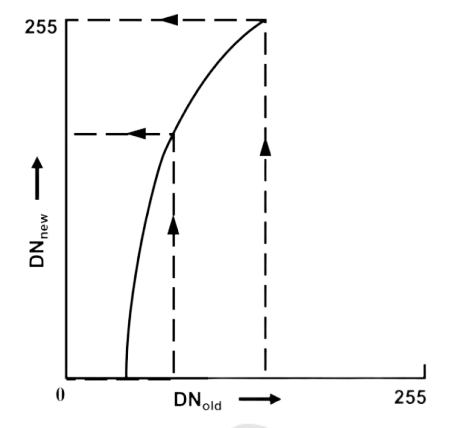
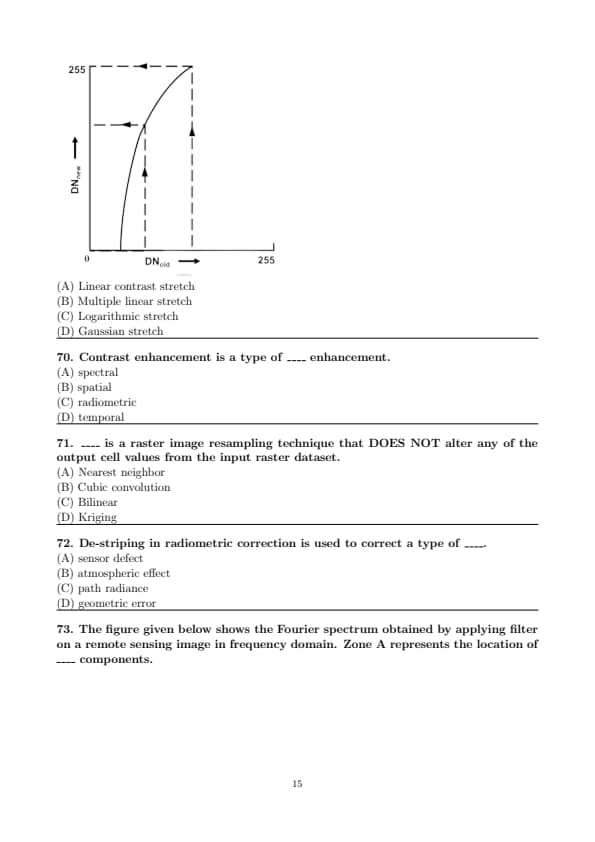
Which type of contrast stretching is represented by the following figure?
Contrast enhancement is a type of ____ enhancement.
____ is a raster image resampling technique that DOES NOT alter any of the output cell values from the input raster dataset.
De-striping in radiometric correction is used to correct a type of ____.
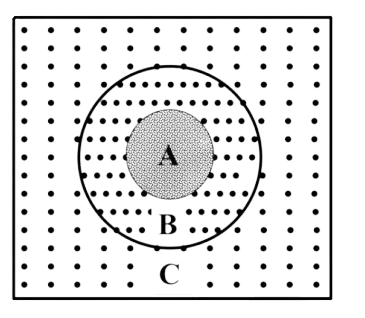
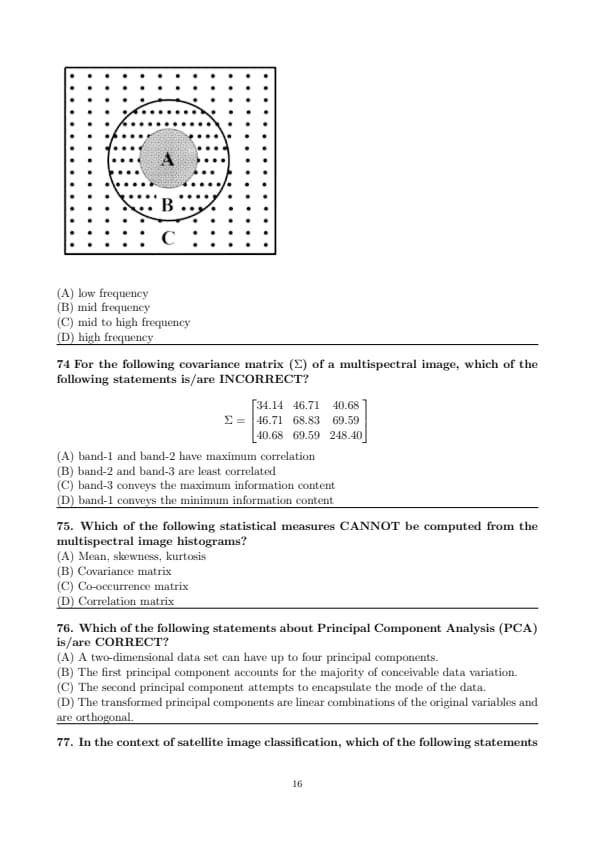
The figure given below shows the Fourier spectrum obtained by applying filter on a remote sensing image in frequency domain. Zone A represents the location of ____ components.
For the following covariance matrix (\(\Sigma\)) of a multispectral image, which of the following statements is/are INCORRECT?
\[\Sigma = \begin{bmatrix} 34.14 & 46.71 & 40.68
46.71 & 68.83 & 69.59
40.68 & 69.59 & 248.40 \end{bmatrix} \]
Which of the following statistical measures CANNOT be computed from the multispectral image histograms?
Which of the following statements about Principal Component Analysis (PCA) is/are CORRECT?
In the context of satellite image classification, which of the following statements is/are CORRECT?
Which of the following filters can be used to suppress the low frequency component of a raster image?
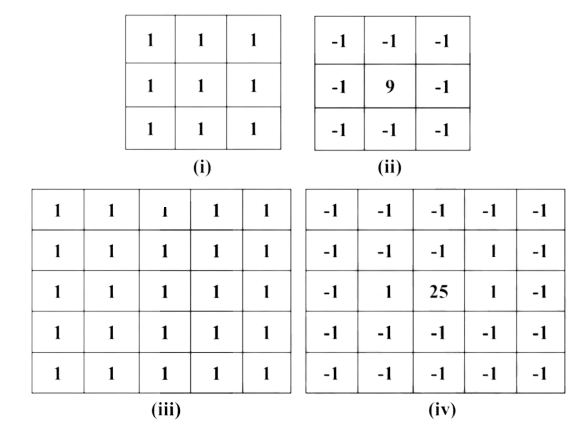
Which of the following statements about image ratio is/are CORRECT?
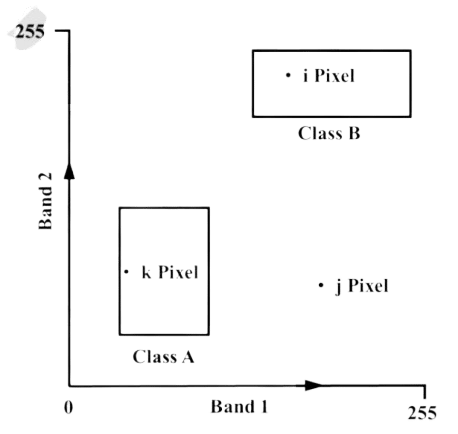
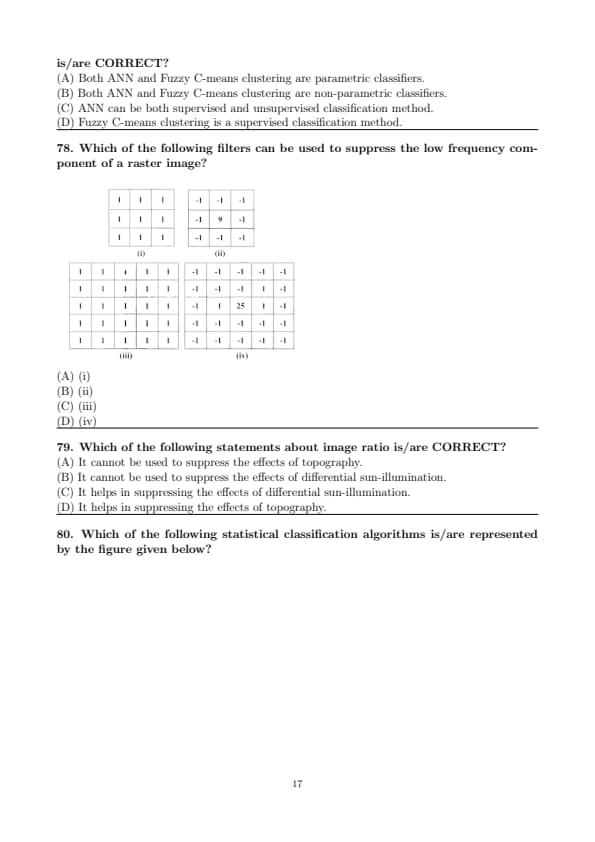
Which of the following statistical classification algorithms is/are represented by the figure given below?
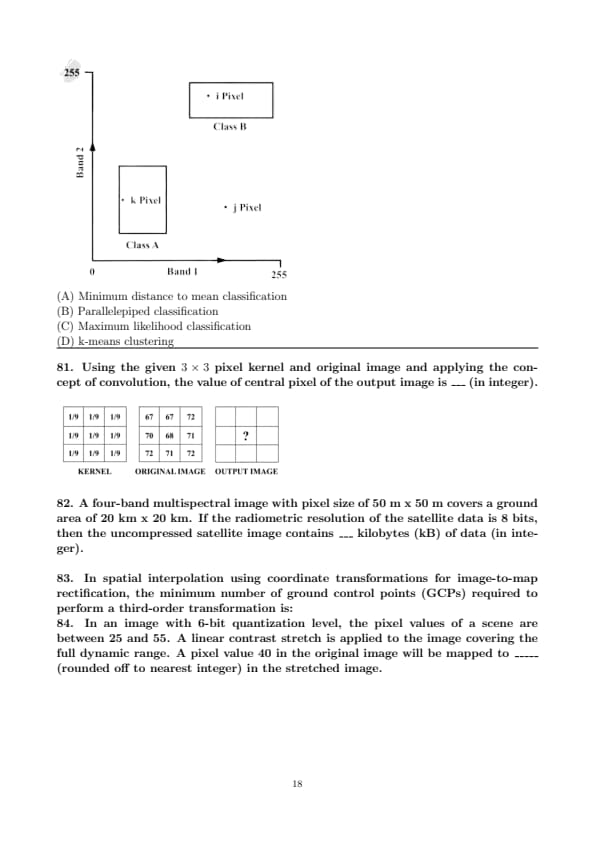
Using the given \(3 \times 3\) pixel kernel and original image and applying the concept of convolution, the value of central pixel of the output image is ___ (in integer).

A four-band multispectral image with pixel size of 50 m x 50 m covers a ground area of 20 km x 20 km. If the radiometric resolution of the satellite data is 8 bits, then the uncompressed satellite image contains ___ kilobytes (kB) of data (in integer).
In spatial interpolation using coordinate transformations for image-to-map rectification, the minimum number of ground control points (GCPs) required to perform a third-order transformation is:
In an image with 6-bit quantization level, the pixel values of a scene are between 25 and 55. A linear contrast stretch is applied to the image covering the full dynamic range. A pixel value 40 in the original image will be mapped to _____ (rounded off to nearest integer) in the stretched image.





Comments