




GATE 2024 Mathematics Question Paper PDF is available here. IISc Banglore conducted GATE 2024 Mathematics exam on February 4 in the Afternoon Session from 2:30 PM to 5:30 PM. Students have to answer 65 questions in GATE 2024 Mathematics Question Paper carrying a total weightage of 100 marks. 10 questions are from the General Aptitude section and 55 questions are from Core Discipline.
GATE 2024 Mathematics Question Paper with Solutions PDF
| GATE 2024 Mathematics Question Paper with Solutions PDF | Download PDF | Check Solutions |

GATE 2024 Mathematics Question Paper Solutions
If ‘\(\rightarrow\)’ denotes increasing order of intensity, then the meaning of the words
\(\text{[drizzle \(\rightarrow\) rain \(\rightarrow\) downpour]}\) is analogous to \(\text{[ _____ \(\rightarrow\) quarrel \(\rightarrow\) feud]}\)
Which one of the given options is appropriate to fill the blank?
Question 2:
Statements:
1. All heroes are winners.
2. All winners are lucky people.
Inferences:
I. All lucky people are heroes.
II. Some lucky people are heroes.
III. Some winners are heroes.
Which of the above inferences can be logically deduced from statements 1 and 2?
A student was supposed to multiply a positive real number \( p \) with another positive real number \( q \). Instead, the student divided \( p \) by \( q \). If the percentage error in the student’s answer is 80%, the value of \( q \) is:
If the sum of the first 20 consecutive positive odd numbers is divided by 20\(^2\), the result is:
The ratio of the number of girls to boys in class VIII is the same as the ratio of the number of boys to girls in class IX. The total number of students (boys and girls) in classes VIII and IX is 450 and 360, respectively. If the number of girls in classes VIII and IX is the same, then the number of girls in each class is:
In the given text, the blanks are numbered (i)–(iv). Select the best match for all the blanks.
Yoko Roi stands __(i)__ as an author for standing __(ii)__ as an honorary fellow, after she stood __(iii)__ her writings that stand __(iv)__ the freedom of speech.
Seven identical cylindrical chalk-sticks are fitted tightly in a cylindrical container. The figure below shows the arrangement of the chalk-sticks inside the cylinder.

The length of the container is equal to the length of the chalk-sticks. The ratio of the occupied space to the empty space of the container is.
The plot below shows the relationship between the mortality risk of cardiovascular disease and the number of steps a person walks per day. Based on the data, which of the following options is true?

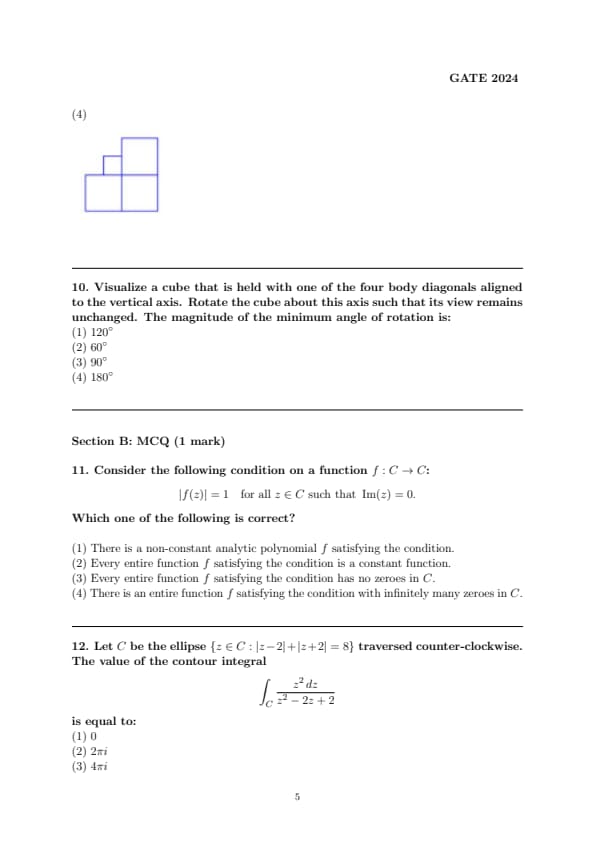
Five cubes of identical size and another smaller cube are assembled as shown in Figure A. If viewed from direction X , the planar image of the assembly appears as Figure B .

Figure A shows a stacked arrangement of five identical cubes and one smaller cube. When viewed from direction Y, the planar image needs to reflect the relative positions and visible surfaces of the cubes.
(A) 
(B) 
(C) 
(D) 
Visualize a cube that is held with one of the four body diagonals aligned to the vertical axis. Rotate the cube about this axis such that its view remains unchanged. The magnitude of the minimum angle of rotation is:
Consider the following condition on a function \( f : {C} \to {C} \): \[ |f(z)| = 1 \quad for all z \in {C} such that \operatorname{Im}(z) = 0. \]
Which one of the following is correct?
Let \( C \) be the ellipse \( \{ z \in \mathbb{C} : |z - 2| + |z + 2| = 8 \} \) traversed counter-clockwise. The value of the contour integral \[ \int_C \frac{z^2 \, dz}{z^2 - 2z + 2} \]
is equal to:
Let \( X \) be a topological space and \( A \subseteq X \). Given a subset \( S \) of \( X \), let \( int(S), \partial S, \) and \( \overline{S} \) denote the interior, boundary, and closure, respectively, of the set \( S \). Which one of the following is NOT necessarily true?
Consider the following limit: \[ \lim_{\epsilon \to 0} \frac{1}{\epsilon} \int_{0}^{\infty} e^{-x / \epsilon} \left( \cos(3x) + x^2 + \sqrt{x + 4} \right) dx. \]
Which one of the following is correct?
Let \( {R}[X^2, X^3] \) be the subring of \( {R}[X] \) generated by \( X^2 \) and \( X^3 \). Consider the following statements:
1. The ring \( {R}[X^2, X^3] \) is a unique factorization domain.
2. The ring \( {R}[X^2, X^3] \) is a principal ideal domain.
Which one of the following is correct?
Given a prime number \( p \), let \( n_p(G) \) denote the number of \( p \)-Sylow subgroups of a finite group \( G \). Which one of the following is TRUE for every group \( G \) of order \( 2024 \)?
Consider the following statements:
1. Every compact Hausdorff space is normal.
2. Every metric space is normal.
Which one of the following is correct?
Consider the topology on \( {Z} \) with basis \( S(a,b) = \{an + b : n \in {Z}\} \), where \( a, b \in {Z} \) and \( a \neq 0 \). Consider the following statements:
1. \( S(a, b) \) is both open and closed for each \( a, b \in {Z} \) with \( a \neq 0 \).
2. The only connected set containing \( x \in {Z} \) is \( \{x\} \).
Which one of the following is correct?
Let \( A \in M_2({C}) \) be given by

Let \( T: M_2({C}) \to M_2({C}) \) be the linear transformation given by \( T(B) = AB \). The characteristic polynomial of \( T \) is:
Let \( A \in M_n({C}) \) be a normal matrix. Consider the following statements:
1. If all the eigenvalues of \( A \) are real, then \( A \) is Hermitian.
2. If all the eigenvalues of \( A \) have absolute value 1, then \( A \) is unitary.
Which one of the following is correct?
Let \( A \) be a \( 3 \times 3 \) real matrix and \( b \) be a \( 3 \times 1 \) real column vector. Consider the statements:
1. The Jacobi iteration method for the system \( (A + \epsilon I_3)x = b \) converges for any initial approximation and \( \epsilon > 0 \).
2. The Gauss-Seidel iteration method for the system \( (A + \epsilon I_3)x = b \) converges for any initial approximation and \( \epsilon > 0 \).
Which one of the following is correct?
For the initial value problem \[ \frac{dy}{dx} = f(x, y), \quad y(x_0) = y_0, \]
generate approximations \( y_n \) to \( y(x_n) \) using the recursion formula \[ y_n = y_{n-1} + a k_1 + b k_2, \]
where \[ k_1 = h f(x_{n-1}, y_{n-1}), \quad k_2 = h f(x_{n-1} + \beta h, y_{n-1} + \beta k_1). \]
Which one of the following choices of \( a, b, \alpha, \beta \) gives the Runge-Kutta method of order 2?
Let \( u = u(x, t) \) be the solution of \[ \frac{\partial u}{\partial t} = \frac{\partial^2 u}{\partial x^2}, \quad 0 < x < 1, \, t > 0, \]
with boundary conditions \( u(0, t) = u(1, t) = 0 \) and initial condition \( u(x, 0) = \sin(\pi x) \). Define \[ g(t) = \int_0^1 u^2(x, t) \, dx. \]
Which one of the following is correct?
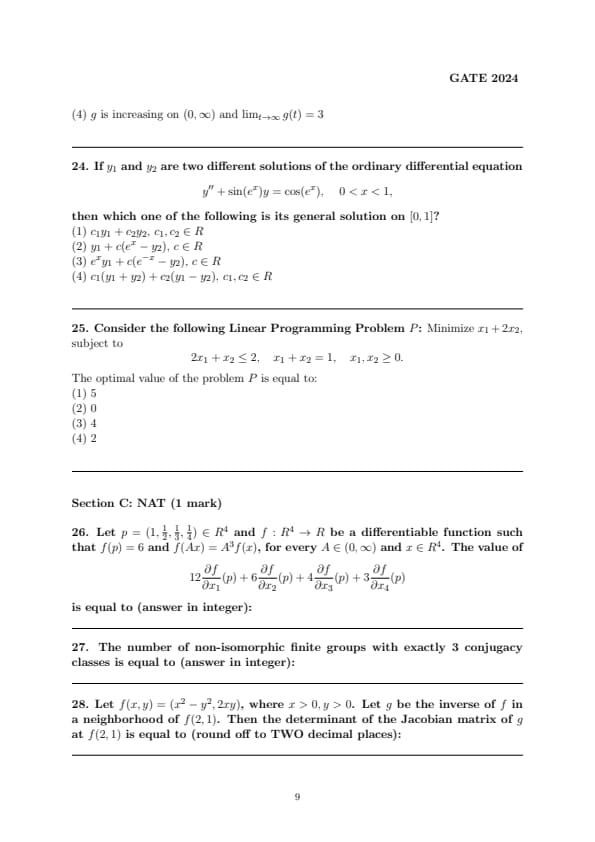
If \( y_1 \) and \( y_2 \) are two different solutions of the ordinary differential equation \[ y'' + \sin(e^x)y = \cos(e^x), \quad 0 < x < 1, \]
then which one of the following is its general solution on \( [0, 1] \)?
Consider the following Linear Programming Problem \( P \):
Minimize \( x_1 + 2x_2 \),
subject to \[ 2x_1 + x_2 \leq 2, \quad x_1 + x_2 = 1, \quad x_1, x_2 \geq 0. \]
The optimal value of the problem \( P \) is equal to:
Let \( p = (1, \frac{1}{2}, \frac{1}{3}, \frac{1}{4}) \in {R}^4 \) and \( f : {R}^4 \to {R} \) be a differentiable function such that \( f(p) = 6 \) and \( f(Ax) = A^3 f(x) \), for every \( A \in (0, \infty) \) and \( x \in {R}^4 \). The value of \[ 12 \frac{\partial f}{\partial x_1}(p) + 6 \frac{\partial f}{\partial x_2}(p) + 4 \frac{\partial f}{\partial x_3}(p) + 3 \frac{\partial f}{\partial x_4}(p) \]
is equal to (answer in integer):
The number of non-isomorphic finite groups with exactly 3 conjugacy classes is equal to (answer in integer):
Let \( f(x, y) = (x^2 - y^2, 2xy) \), where \( x > 0, y > 0 \). Let \( g \) be the inverse of \( f \) in a neighborhood of \( f(2, 1) \). Then the determinant of the Jacobian matrix of \( g \) at \( f(2, 1) \) is equal to (round off to TWO decimal places):
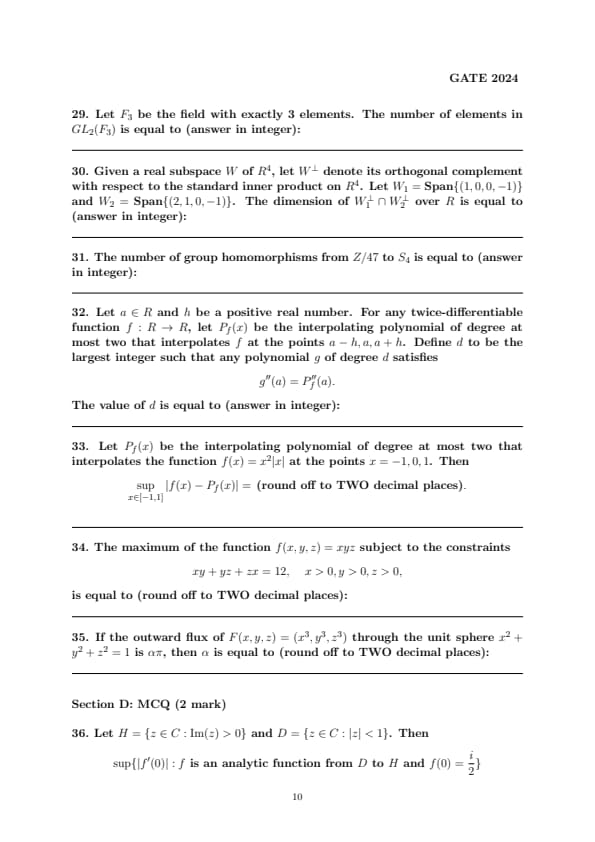
Let \( {F}_3 \) be the field with exactly 3 elements. The number of elements in \( GL_2({F}_3) \) is equal to (answer in integer):
Given a real subspace \( W \) of \( {R}^4 \), let \( W^\perp \) denote its orthogonal complement with respect to the standard inner product on \( {R}^4 \). Let \( W_1 = Span\{(1, 0, 0, -1)\} \) and \( W_2 = Span\{(2, 1, 0, -1)\} \). The dimension of \( W_1^\perp \cap W_2^\perp \) over \( {R} \) is equal to (answer in integer):
The number of group homomorphisms from \( {Z}/47 \) to \( S_4 \) is equal to (answer in integer):
Let \( a \in {R} \) and \( h \) be a positive real number. For any twice-differentiable function \( f : {R} \to {R} \), let \( P_f(x) \) be the interpolating polynomial of degree at most two that interpolates \( f \) at the points \( a - h, a, a + h \). Define \( d \) to be the largest integer such that any polynomial \( g \) of degree \( d \) satisfies \[ g''(a) = P_f''(a). \]
The value of \( d \) is equal to (answer in integer):
Let \( P_f(x) \) be the interpolating polynomial of degree at most two that interpolates the function \( f(x) = x^2|x| \) at the points \( x = -1, 0, 1 \). Then \[ \sup_{x \in [-1, 1]} |f(x) - P_f(x)| = \, (round off to TWO decimal places). \]
The maximum of the function \( f(x, y, z) = xyz \) subject to the constraints \[ xy + yz + zx = 12, \quad x > 0, y > 0, z > 0, \]
is equal to (round off to TWO decimal places):
If the outward flux of \( F(x, y, z) = (x^3, y^3, z^3) \) through the unit sphere \( x^2 + y^2 + z^2 = 1 \) is \( \alpha \pi \), then \( \alpha \) is equal to (round off to TWO decimal places):
Let \( {H} = \{ z \in {C} : \operatorname{Im}(z) > 0 \} \) and \( {D} = \{ z \in {C} : |z| < 1 \} \). Then \[ \sup \{ |f'(0)| : f is an analytic function from {D} to {H} and f(0) = \frac{i}{2} \} \]
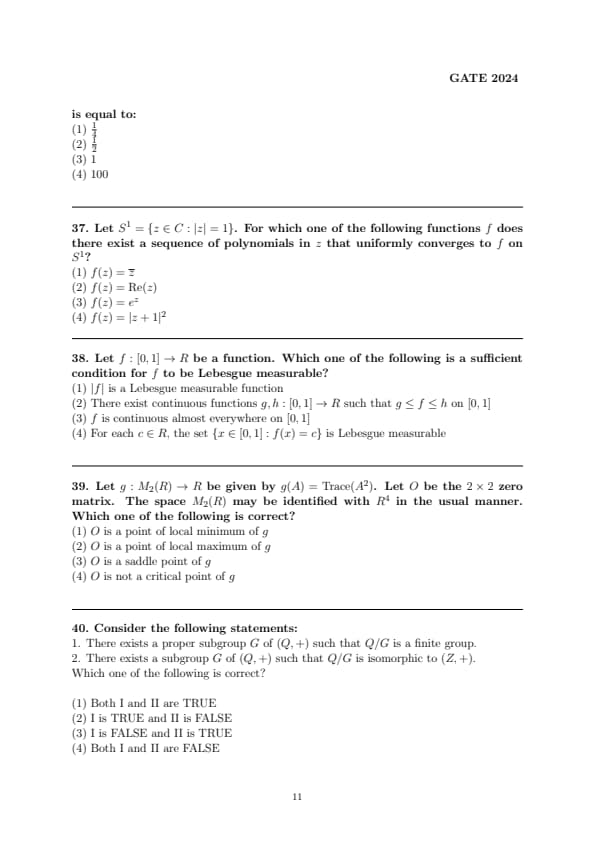
is equal to:
Let \( S^1 = \{ z \in \mathbb{C} : |z| = 1 \} \). For which one of the following functions \( f \) does there exist a sequence of polynomials in \( z \) that uniformly converges to \( f \) on \( S^1 \)?
Let \( f : [0, 1] \to {R} \) be a function. Which one of the following is a sufficient condition for \( f \) to be Lebesgue measurable?
Let \( g : M_2({R}) \to {R} \) be given by \( g(A) = \operatorname{Trace}(A^2) \). Let \( O \) be the \( 2 \times 2 \) zero matrix. The space \( M_2({R}) \) may be identified with \( {R}^4 \) in the usual manner. Which one of the following is correct?
Consider the following statements:
1. There exists a proper subgroup \( G \) of \( ({Q}, +) \) such that \( {Q}/G \) is a finite group.
2. There exists a subgroup \( G \) of \( ({Q}, +) \) such that \( {Q}/G \) is isomorphic to \( ({Z}, +) \).
Which one of the following is correct?
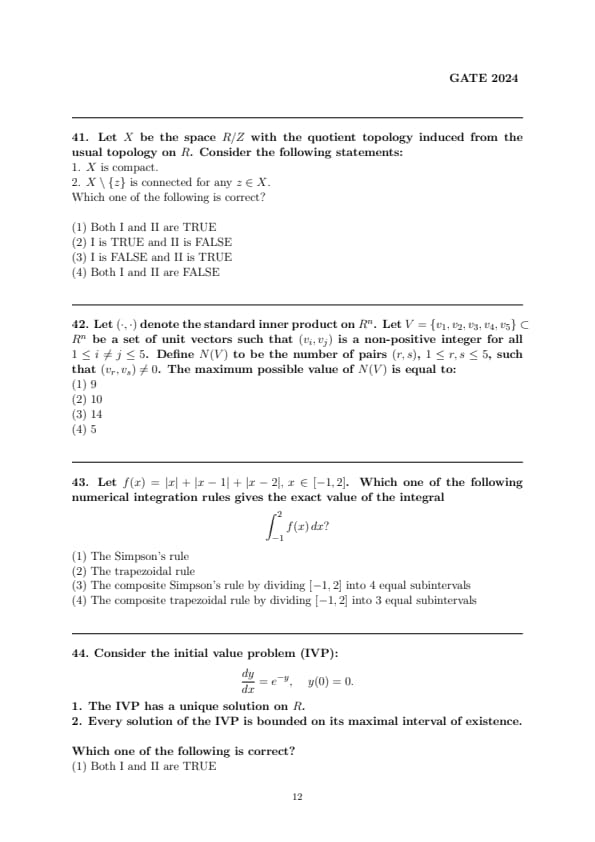
Let \( X \) be the space \( {R}/{Z} \) with the quotient topology induced from the usual topology on \( {R} \). Consider the following statements:
1. \( X \) is compact.
2. \( X \setminus \{z\} \) is connected for any \( z \in X \).
Which one of the following is correct?
Let \( (\cdot, \cdot) \) denote the standard inner product on \( {R}^n \). Let \( V = \{v_1, v_2, v_3, v_4, v_5\} \subset {R}^n \) be a set of unit vectors such that \( (v_i, v_j) \) is a non-positive integer for all \( 1 \leq i \neq j \leq 5 \). Define \( N(V) \) to be the number of pairs \( (r, s) \), \( 1 \leq r, s \leq 5 \), such that \( (v_r, v_s) \neq 0 \). The maximum possible value of \( N(V) \) is equal to:
Let \( f(x) = |x| + |x - 1| + |x - 2|, \, x \in [-1, 2] \). Which one of the following numerical integration rules gives the exact value of the integral \[ \int_{-1}^2 f(x) \, dx? \]
Consider the initial value problem (IVP): \[ \frac{dy}{dx} = e^{-y}, \quad y(0) = 0. \]
1. The IVP has a unique solution on \( {R} \).
2. Every solution of the IVP is bounded on its maximal interval of existence.
Which one of the following is correct?
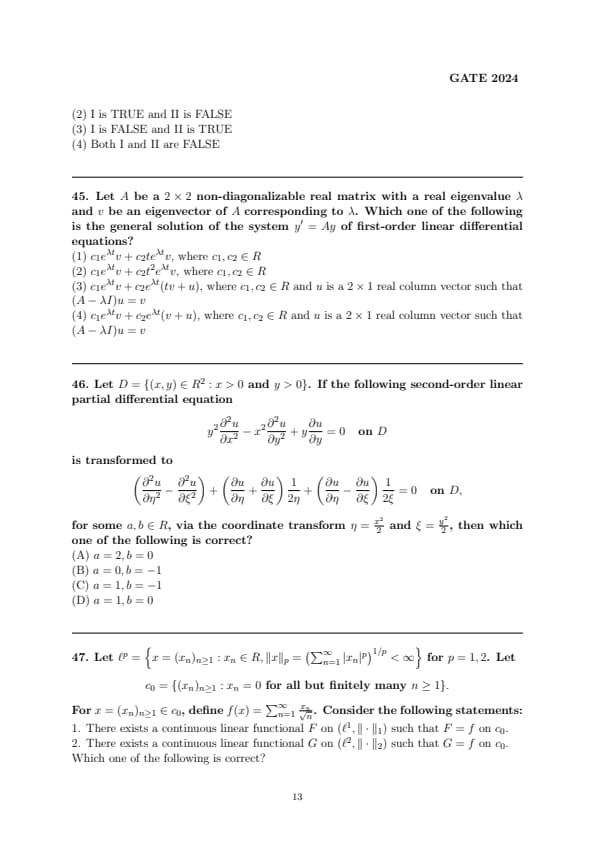
Let \( A \) be a \( 2 \times 2 \) non-diagonalizable real matrix with a real eigenvalue \( \lambda \) and \( v \) be an eigenvector of \( A \) corresponding to \( \lambda \). Which one of the following is the general solution of the system \( y' = Ay \) of first-order linear differential equations?
Let \( D = \{(x, y) \in {R}^2 : x > 0 and y > 0\} \). If the following second-order linear partial differential equation \[ y^2 \frac{\partial^2 u}{\partial x^2} - x^2 \frac{\partial^2 u}{\partial y^2} + y \frac{\partial u}{\partial y} = 0 \quad on D \]
is transformed to \[ \left( \frac{\partial^2 u}{\partial \eta^2} - \frac{\partial^2 u}{\partial \xi^2} \right) + \left( \frac{\partial u}{\partial \eta} + \frac{\partial u}{\partial \xi} \right) \frac{1}{2\eta} + \left( \frac{\partial u}{\partial \eta} - \frac{\partial u}{\partial \xi} \right) \frac{1}{2\xi} = 0 \quad on D, \]
for some \( a, b \in {R} \), via the coordinate transform \( \eta = \frac{x^2}{2} \) and \( \xi = \frac{y^2}{2} \), then which one of the following is correct?
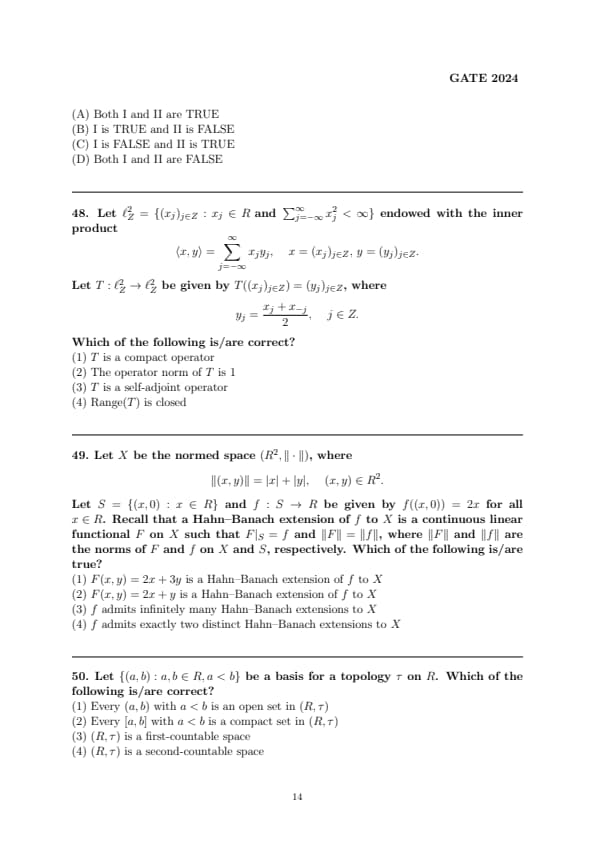
Let \( \ell^p = \left\{ x = (x_n)_{n \geq 1} : x_n \in {R}, \|x\|_p = \left( \sum_{n=1}^\infty |x_n|^p \right)^{1/p} < \infty \right\} \) for \( p = 1, 2 \). Let \[ c_0 = \{ (x_n)_{n \geq 1} : x_n = 0 for all but finitely many n \geq 1 \}. \]
For \( x = (x_n)_{n \geq 1} \in c_0 \), define \( f(x) = \sum_{n=1}^\infty \frac{x_n}{\sqrt{n}} \). Consider the following statements:
1. There exists a continuous linear functional \( F \) on \( (\ell^1, \|\cdot\|_1) \) such that \( F = f on c_0 \).
2. There exists a continuous linear functional \( G \) on \( (\ell^2, \|\cdot\|_2) \) such that \( G = f on c_0 \).
Which one of the following is correct?
Let \( \ell^2_{{Z}} = \{ (x_j)_{j \in {Z}} : x_j \in {R} and \sum_{j = -\infty}^\infty x_j^2 < \infty \} \) endowed with the inner product \[ \langle x, y \rangle = \sum_{j = -\infty}^\infty x_j y_j, \quad x = (x_j)_{j \in {Z}}, \, y = (y_j)_{j \in {Z}}. \]
Let \( T : \ell^2_{{Z}} \to \ell^2_{{Z}} \) be given by \( T((x_j)_{j \in {Z}}) = (y_j)_{j \in {Z}} \), where \[ y_j = \frac{x_j + x_{-j}}{2}, \quad j \in {Z}. \]
Which of the following is/are correct?
Let \( X \) be the normed space \( ({R}^2, \|\cdot\|) \), where \[ \| (x, y) \| = |x| + |y|, \quad (x, y) \in {R}^2. \]
Let \( S = \{ (x, 0) : x \in {R} \} \) and \( f : S \to {R} \) be given by \( f((x, 0)) = 2x \) for all \( x \in {R} \).
Recall that a Hahn–Banach extension of \( f \) to \( X \) is a continuous linear functional \( F \) on \( X \) such that \( F|_S = f \) and \( \|F\| = \|f\| \), where \( \|F\| \) and \( \|f\| \) are the norms of \( F \) and \( f \) on \( X \) and \( S \), respectively. Which of the following is/are true?
Let \( \{(a, b) : a, b \in {R}, a < b \} \) be a basis for a topology \( \tau \) on \( {R} \). Which of the following is/are correct?
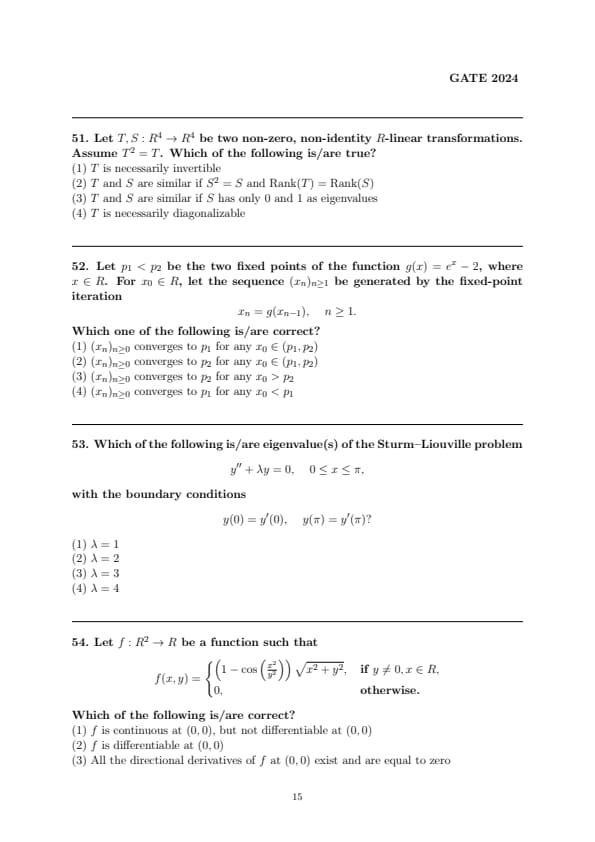
Let \( T, S : {R}^4 \to {R}^4 \) be two non-zero, non-identity \( {R} \)-linear transformations. Assume \( T^2 = T \). Which of the following is/are true?
Let \( p_1 < p_2 \) be the two fixed points of the function \( g(x) = e^x - 2 \), where \( x \in {R} \). For \( x_0 \in {R} \), let the sequence \( (x_n)_{n \geq 1} \) be generated by the fixed-point iteration \[ x_n = g(x_{n-1}), \quad n \geq 1. \]
Which one of the following is/are correct?
Which of the following is/are eigenvalue(s) of the Sturm–Liouville problem \[ y'' + \lambda y = 0, \quad 0 \leq x \leq \pi, \]
with the boundary conditions \[ y(0) = y'(0), \quad y(\pi) = y'(\pi)? \]
Let \( f : {R}^2 \to {R} \) be a function such that

Which of the following is/are correct?
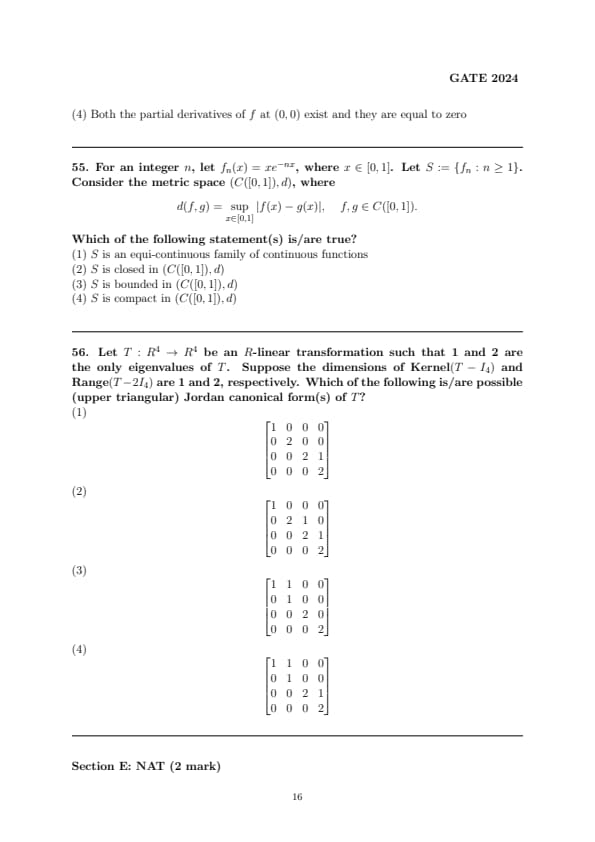
For an integer \( n \), let \( f_n(x) = xe^{-nx} \), where \( x \in [0, 1] \). Let \( S := \{f_n : n \geq 1\} \). Consider the metric space \( (C([0, 1]), d) \), where \[ d(f, g) = \sup_{x \in [0, 1]} |f(x) - g(x)|, \quad f, g \in C([0, 1]). \]
Which of the following statement(s) is/are true?
Let \( T : {R}^4 \to {R}^4 \) be an \( {R} \)-linear transformation such that 1 and 2 are the only eigenvalues of \( T \). Suppose the dimensions of \(Kernel(T - I_4)\) and \(Range(T - 2I_4)\) are 1 and 2, respectively. Which of the following is/are possible (upper triangular) Jordan canonical form(s) of \( T \)?
- (1)
![]()
- (2)
![]()
- (3)
![]()
- (4)
![]()


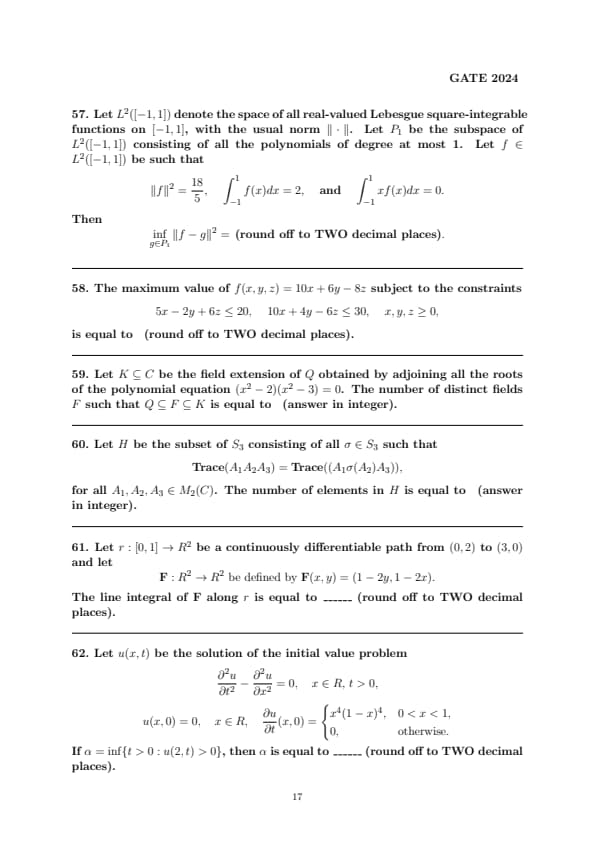
Let \( L^2([-1, 1]) \) denote the space of all real-valued Lebesgue square-integrable functions on \( [-1, 1] \), with the usual norm \( \|\cdot\| \). Let \( P_1 \) be the subspace of \( L^2([-1, 1]) \) consisting of all the polynomials of degree at most 1. Let \( f \in L^2([-1, 1]) \) be such that \[ \|f\|^2 = \frac{18}{5}, \quad \int_{-1}^1 f(x) dx = 2, \quad and \quad \int_{-1}^1 xf(x) dx = 0. \]
Then \[ \inf_{g \in P_1} \|f - g\|^2 = \, (round off to TWO decimal places). \]
The maximum value of \( f(x, y, z) = 10x + 6y - 8z \) subject to the constraints \[ 5x - 2y + 6z \leq 20, \quad 10x + 4y - 6z \leq 30, \quad x, y, z \geq 0, \]
is equal to \, (round off to TWO decimal places).
Let \( K \subseteq \mathbb{C} \) be the field extension of \( \mathbb{Q} \) obtained by adjoining all the roots of the polynomial equation \( (x^2 - 2)(x^2 - 3) = 0 \). The number of distinct fields \( F \) such that \( \mathbb{Q} \subseteq F \subseteq K \) is equal to \, (answer in integer).
Let \( H \) be the subset of \( S_3 \) consisting of all \( \sigma \in S_3 \) such that \[ Trace(A_1 A_2 A_3) = Trace((A_1 \sigma(A_2) A_3)), \]
for all \( A_1, A_2, A_3 \in M_2(\mathbb{C}) \). The number of elements in \( H \) is equal to \, (answer in integer).
Let \( r : [0,1] \to \mathbb{R}^2 \) be a continuously differentiable path from \( (0,2) \) to \( (3,0) \) and let \[ \mathbf{F} : \mathbb{R}^2 \to \mathbb{R}^2 be defined by \mathbf{F}(x, y) = (1 - 2y, 1 - 2x). \]
The line integral of \( \mathbf{F} \) along \( r \) is equal to ______ (round off to TWO decimal places).
Let \( u(x,t) \) be the solution of the initial value problem \[ \frac{\partial^2 u}{\partial t^2} - \frac{\partial^2 u}{\partial x^2} = 0, \quad x \in \mathbb{R}, \, t > 0, \]

If \( \alpha = \inf \{ t > 0 : u(2,t) > 0 \} \), then \( \alpha \) is equal to ______ (round off to TWO decimal places).
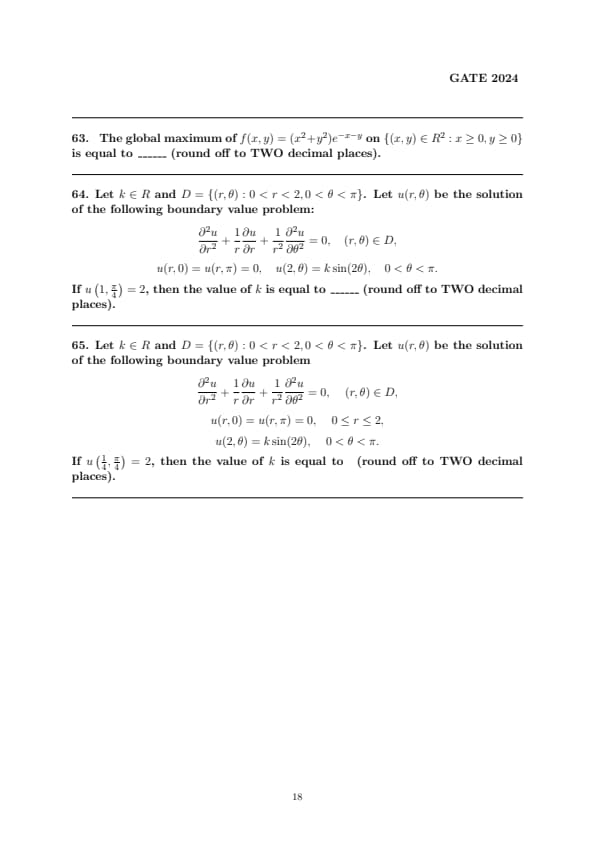
The global maximum of \( f(x, y) = (x^2 + y^2)e^{-x-y} \) on \( \{(x, y) \in \mathbb{R}^2 : x \geq 0, y \geq 0\} \) is equal to ______ (round off to TWO decimal places).
Let \( k \in \mathbb{R} \) and \( D = \{(r, \theta) : 0 < r < 2, 0 < \theta < \pi\} \). Let \( u(r, \theta) \) be the solution of the following boundary value problem: \[ \frac{\partial^2 u}{\partial r^2} + \frac{1}{r} \frac{\partial u}{\partial r} + \frac{1}{r^2} \frac{\partial^2 u}{\partial \theta^2} = 0, \quad (r, \theta) \in D, \] \[ u(r, 0) = u(r, \pi) = 0, \quad u(2, \theta) = k\sin(2\theta), \quad 0 < \theta < \pi. \]
If \( u\left(1, \frac{\pi}{4}\right) = 2 \), then the value of \( k \) is equal to ______ (round off to TWO decimal places).





Comments