




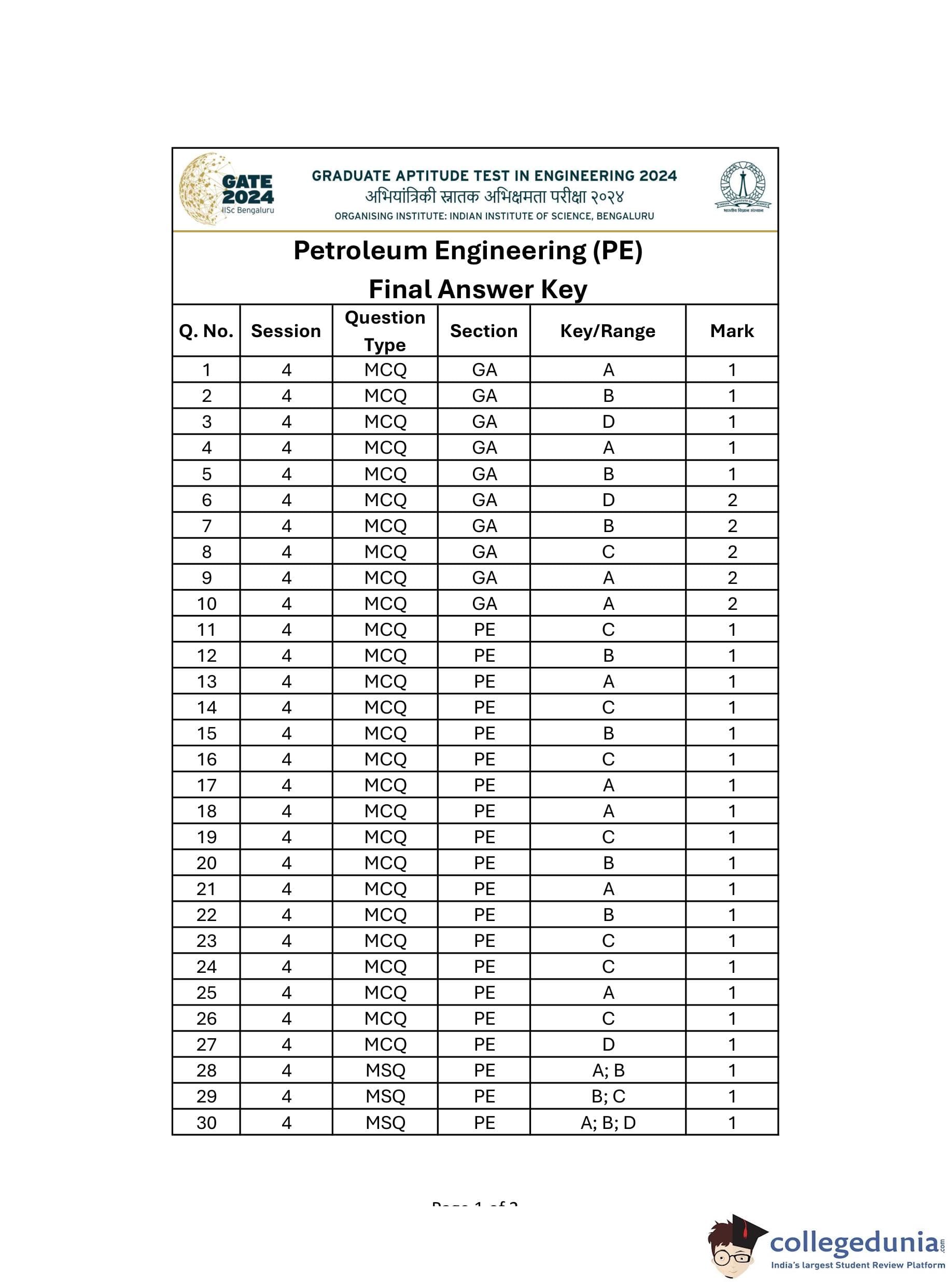
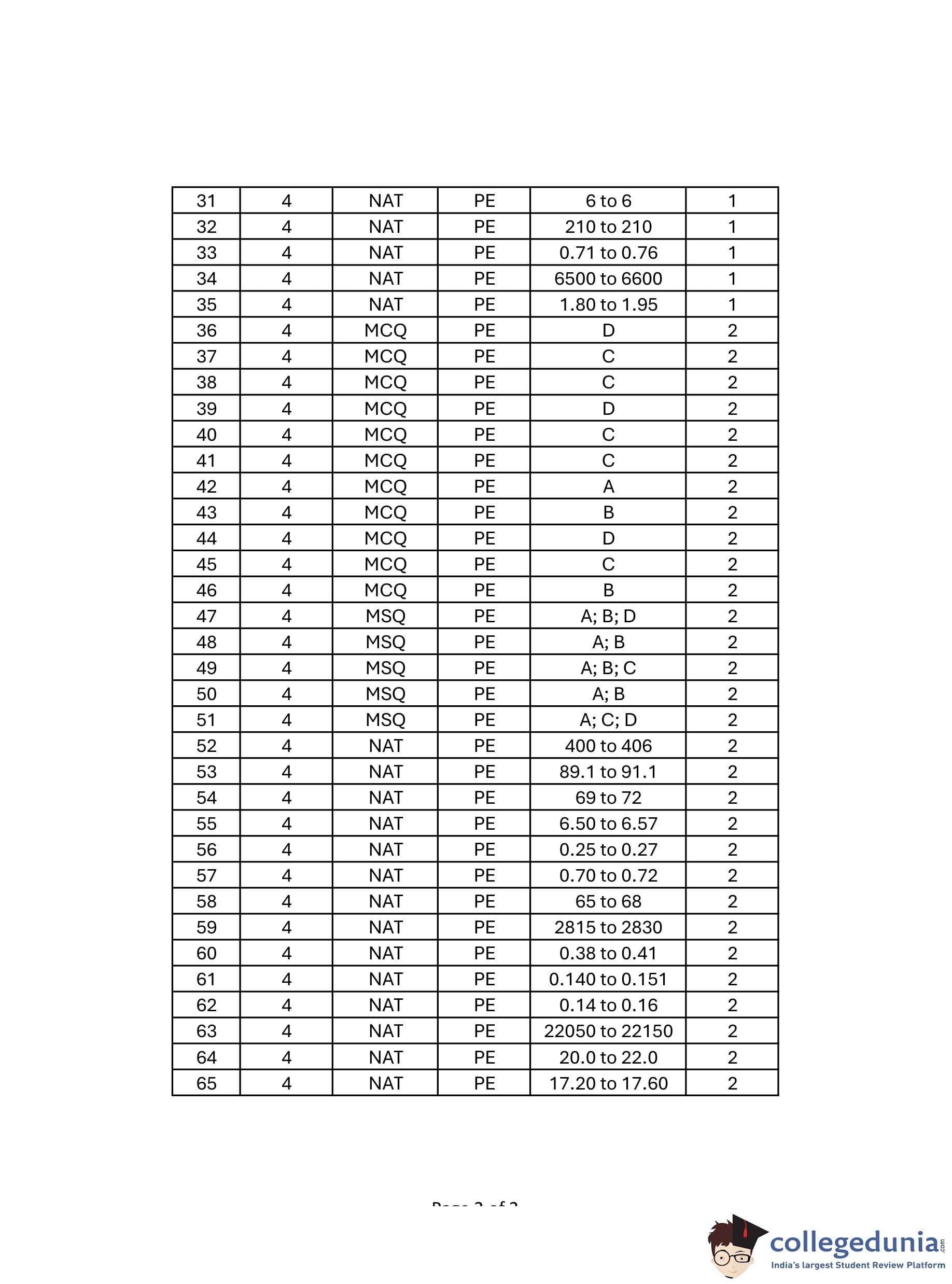
GATE 2024 Petroleum Engineering Question Paper PDF is available here. IISc Banglore conducted GATE 2024 Petroleum Engineering exam on February 4 in the Afternoon Session from 2:30 PM to 5:30 PM. Students have to answer 65 questions in GATE 2024 Petroleum Engineering Question Paper carrying a total weightage of 100 marks. 10 questions are from the General Aptitude section and 55 questions are from Engineering Mathematics and Core Discipline.
Also Check:
- GATE Question Paper (Available): Check Previous Year Question Paper with Solution PDF
- GATE Question Paper 2025 (Soon): Check Previous Year Question Paper with Solution PDF
- GATE Question Paper 2024 (Available): Check Previous Year Question Paper with Solution PDF
- GATE Paper Analysis, Difficulty Level, Branch-wise Question Paper Analysis, Weightage of Topics
GATE 2024 Petroleum Engineering Question Paper with Answer Key PDF
| GATE 2024 Petroleum Engineering Question Paper PDF |  Download Download |
Check Solutions |
GATE 2024 Petroleum Engineering Question Paper with Answer Key PDF
Question 1:
If “—” denotes increasing order of intensity, then the meaning of the words [drizzle – rain – downpour] is analogous to [_______ — quarrel - feud].
View Solution
Solution:
The sequence provided in the question denotes an increasing order of intensity:
- Drizzle (low intensity) → Rain (moderate intensity) → Downpour (high intensity).
Among the options provided:
- Bicker: Refers to a petty or trivial argument, matching the low-intensity level.
- Bog, Dither, Dodge: None of these words relate to an argument, so they are incorrect.
Question 2:
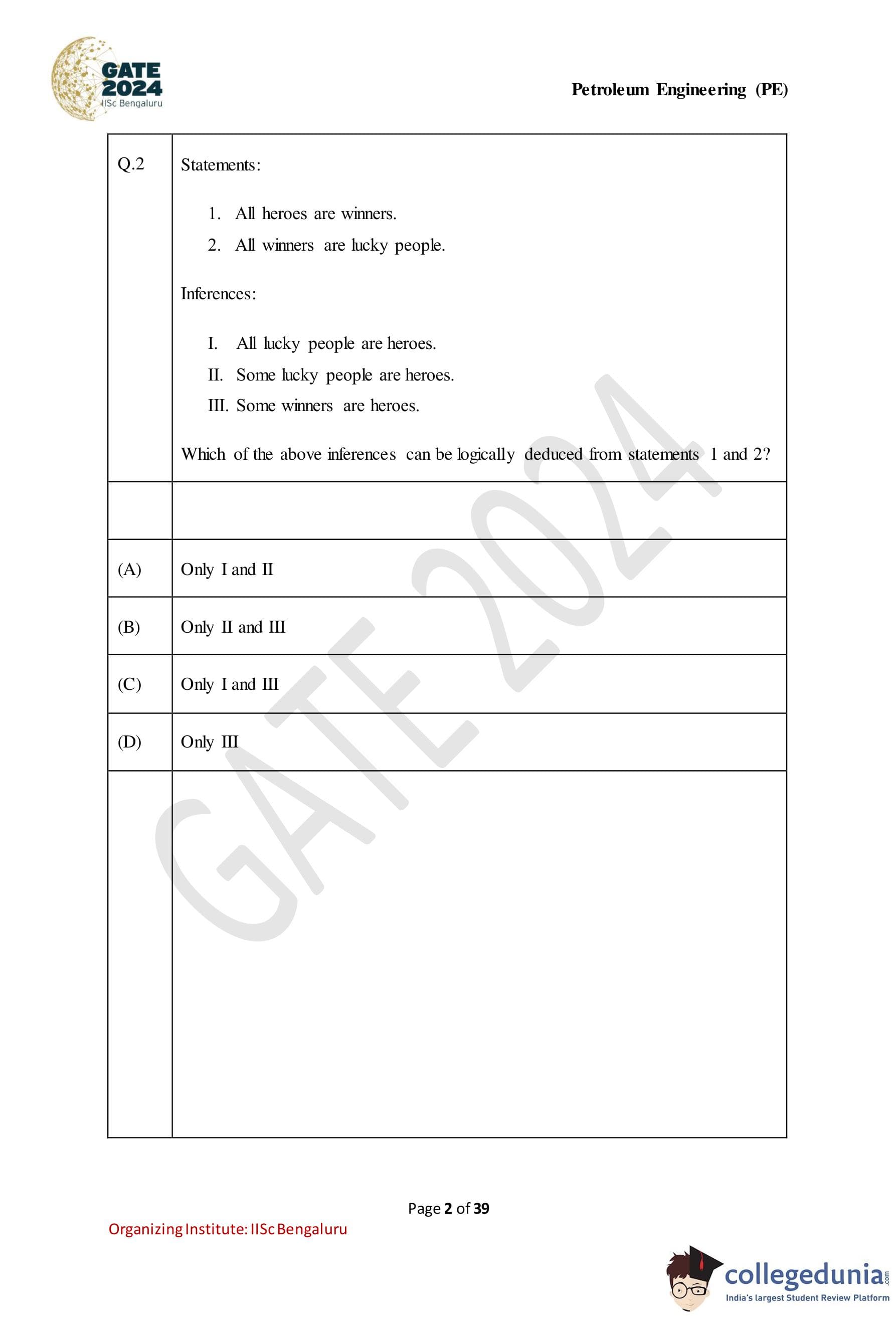
Statements: 1. All heroes are winners. 2. All winners are lucky people.
Inferences: I. All lucky people are heroes. II. Some lucky people are heroes. III. Some winners are heroes.
Which of the above inferences can be logically deduced from statements 1 and 2?
View Solution
Solution:
Step 1: Analyze the Statements and Inferences
- Statement 1: All heroes are winners. - This means that if someone is a hero, they must be a winner.
- Statement 2: All winners are lucky people. - This implies that if someone is a winner, they must be a lucky person.
Now, let's evaluate each inference:
- Inference I: All lucky people are heroes. - This cannot be directly deduced from the statements. While all winners are lucky people, the statements don't claim that all lucky people are winners or heroes. - **Incorrect.**
- Inference II: Some lucky people are heroes. - This can be deduced. Since all winners are lucky people, and all heroes are winners, there must be some lucky people who are heroes. - **Correct.**
- Inference III: Some winners are heroes. - This can be deduced from the first statement, where all heroes are winners, meaning at least some winners must be heroes. - **Correct.**
Final Answer: **B**
Question 3:
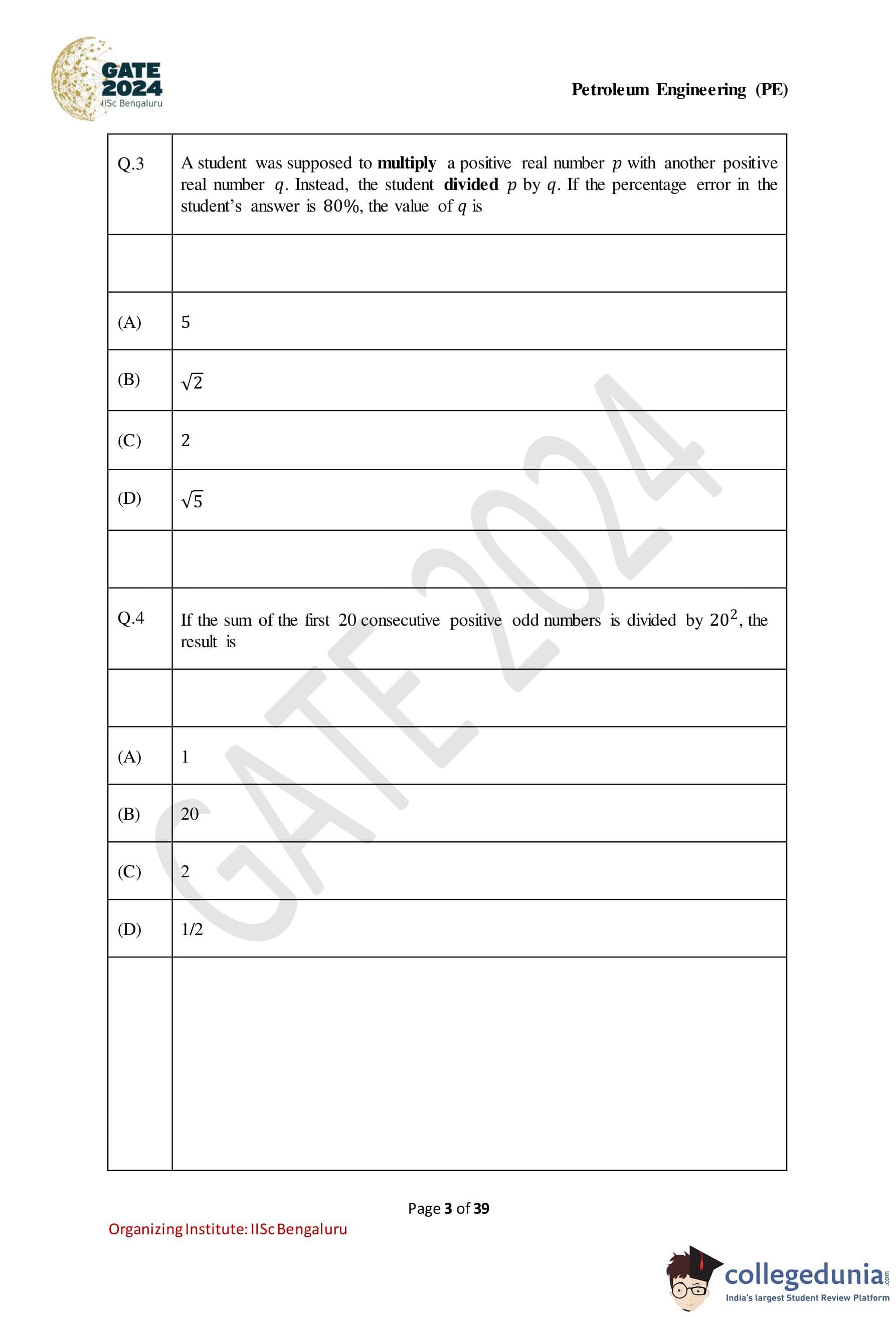
A student was supposed to multiply a positive real number p with another positive real number q. Instead, the student divided p by q. If the percentage error in the student's answer is 80
View Solution
Solution:
Let the correct value be p × q and the incorrect value be p⁄q. The percentage error is given by:
Percentage error = Incorrect value – Correct value⁄Correct value × 100
80 = p⁄q- p × q⁄p × q × 100
Simplifying:
80 = 1⁄q - q⁄q × 100
Thus, solving 1⁄q - q = 0.8, we get:
1⁄q - q = 0.8
1⁄q = q + 0.8
1 = q2 + 0.8q
q2 + 0.8q - 1 = 0
Using the quadratic formula:
q = -0.8 ± √0.82 - 4 × 1 × (-1)⁄2 × 1 = -0.8 ± √0.64 + 4⁄2 = -0.8 ± √4.64⁄2 = -0.8 ± 2.15⁄2
Thus, q ≈ -0.8 + 2.15⁄2 ≈ 0.675 or q ≈ -0.8 - 2.15⁄2 , which is negative and not valid. Thus, q ≈ √5.
Final Answer: **√5**
Question 4:
If the sum of the first 20 consecutive positive odd numbers is divided by 202, the result is:
View Solution
Solution:
The sum of the first n odd numbers is given by n2. For n = 20, the sum of the first 20 odd numbers is:
Sum = 202 = 400
Now, dividing this sum by 202:
400⁄202 = 400⁄400 = 1
Final Answer: **1**
Question 5:
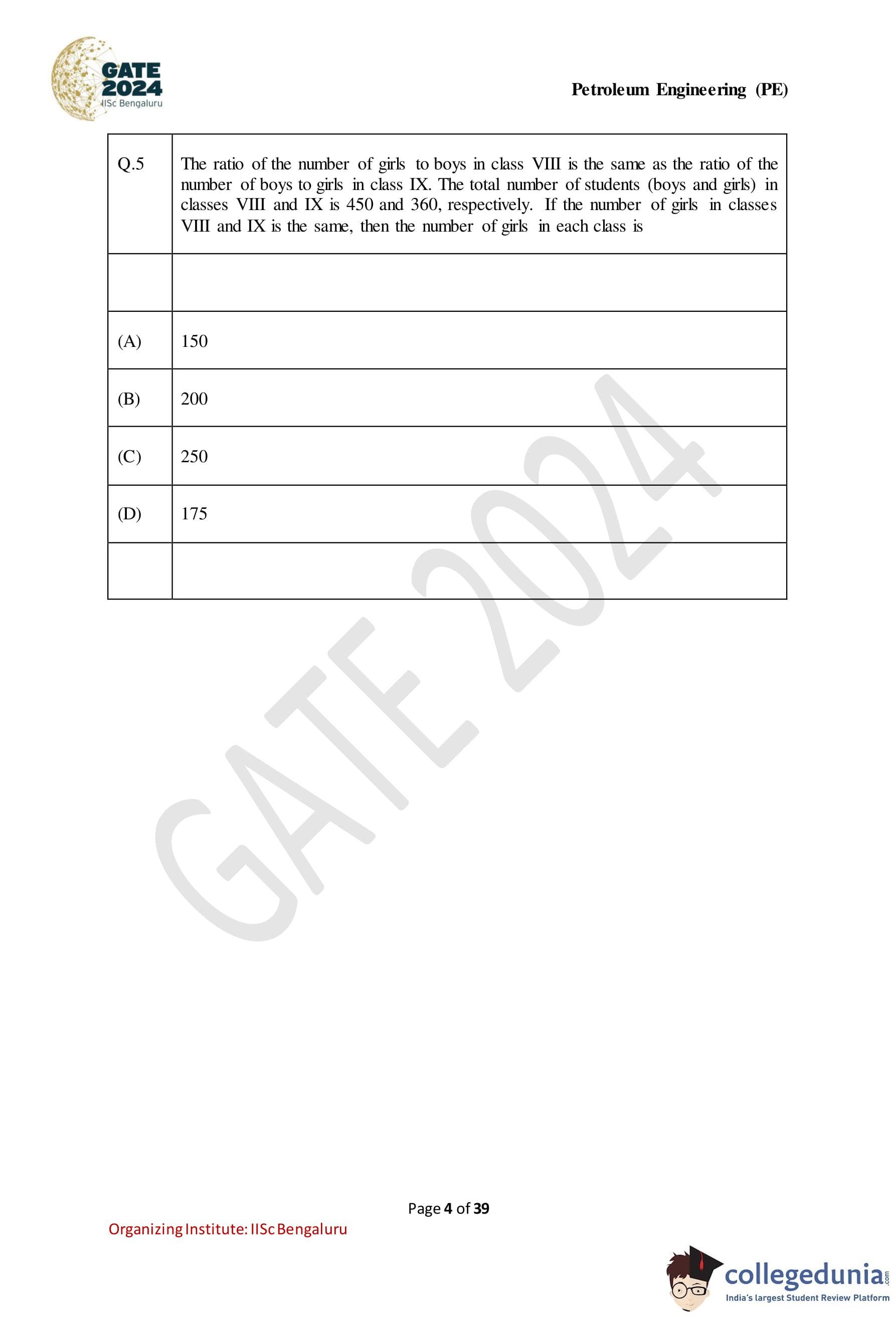
The ratio of the number of girls to boys in class VIII is the same as the ratio of the number of boys to girls in class IX. The total number of students (boys and girls) in classes VIII and IX is 450 and 360, respectively. If the number of girls in classes VIII and IX is the same, then the number of girls in each class is:
View Solution
Solution:
Let the number of girls in class VIII be g and the number of boys in class VIII be b.
Similarly, let the number of girls in class IX be g and the number of boys in class IX be b'.
Given: 1. The ratio of girls to boys in class VIII is the same as the ratio of boys to girls in class IX, so:
g⁄b = b'⁄g
2. The total number of students in class VIII is 450, so:
g + b = 450
3. The total number of students in class IX is 360, so:
g + b' = 360
From the first equation, g⁄b = b'⁄g, we can solve for b':
g2 = b × b' or b' = g2⁄b
Substitute this into the second equation:
g + g2⁄b = 360
Now, use the first equation g + b = 450, which gives b = 450 - g. Substituting this into the equation above:
g + g2⁄450 - g = 360
Solve this equation for g:
g(450 - g) + g2 = 360(450 - g)
Simplifying:
450g - g2 + g2 = 360 × 450 – 360g
450g = 360 × 450 - 360g
450g + 360g = 360 × 450
810g = 360 × 450
g = 360 × 450⁄810 = 200
Final Answer: **200**
Question 6:
In the given text, the blanks are numbered (i)—(iv). Select the best match for all the blanks:
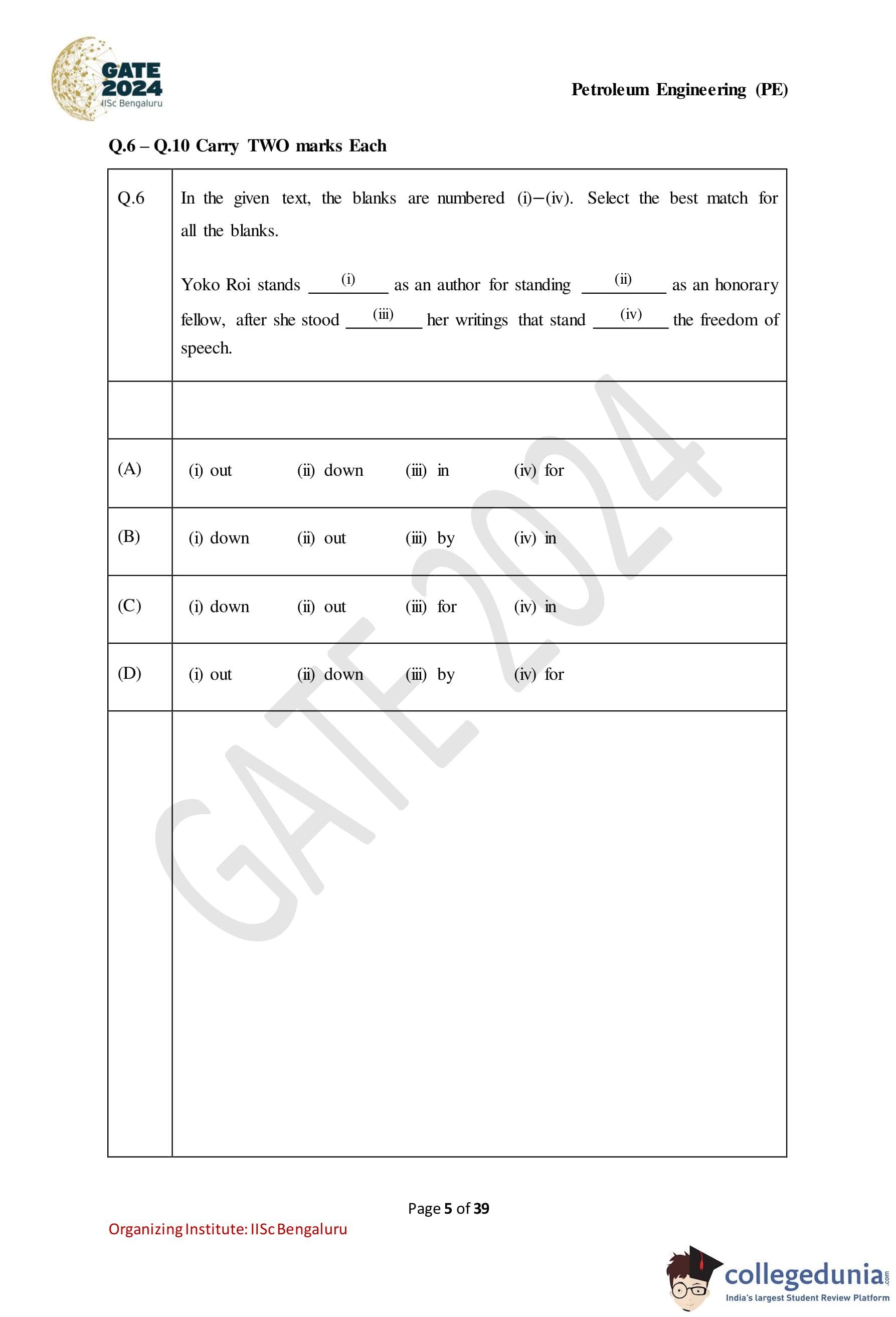
Yoko Roi stands _____ (i) as an author for standing _____ (ii) as an honorary fellow, after she stood _____ (iii) her writings that stand _____ (iv) the freedom of speech.
View Solution
Solution:
Let us analyze each blank and match the correct prepositions:
- (i): The phrase "stands _______ as an author” indicates prominence or distinction. The correct preposition is "out" to mean "stands out as an author.”
- (ii): The phrase "for standing ________ as an honorary fellow” indicates stepping down or giving up a position. The correct preposition is "down” to mean "standing down as an honorary fellow.”
- (iii): The phrase "stood ____ her writings" suggests support or defense. The correct preposition is "by" to mean "stood by her writings.”
- (iv): The phrase "that stand _________ the freedom of speech" implies advocacy or support. The correct preposition is "for” to mean "stand for the freedom of speech."
Thus, the correct combination is:
(i)out, (ii)down, (iii)by, (iv)for.
Question 7:
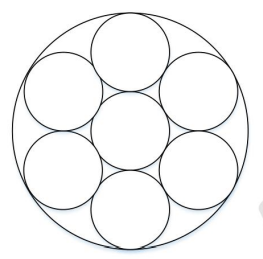
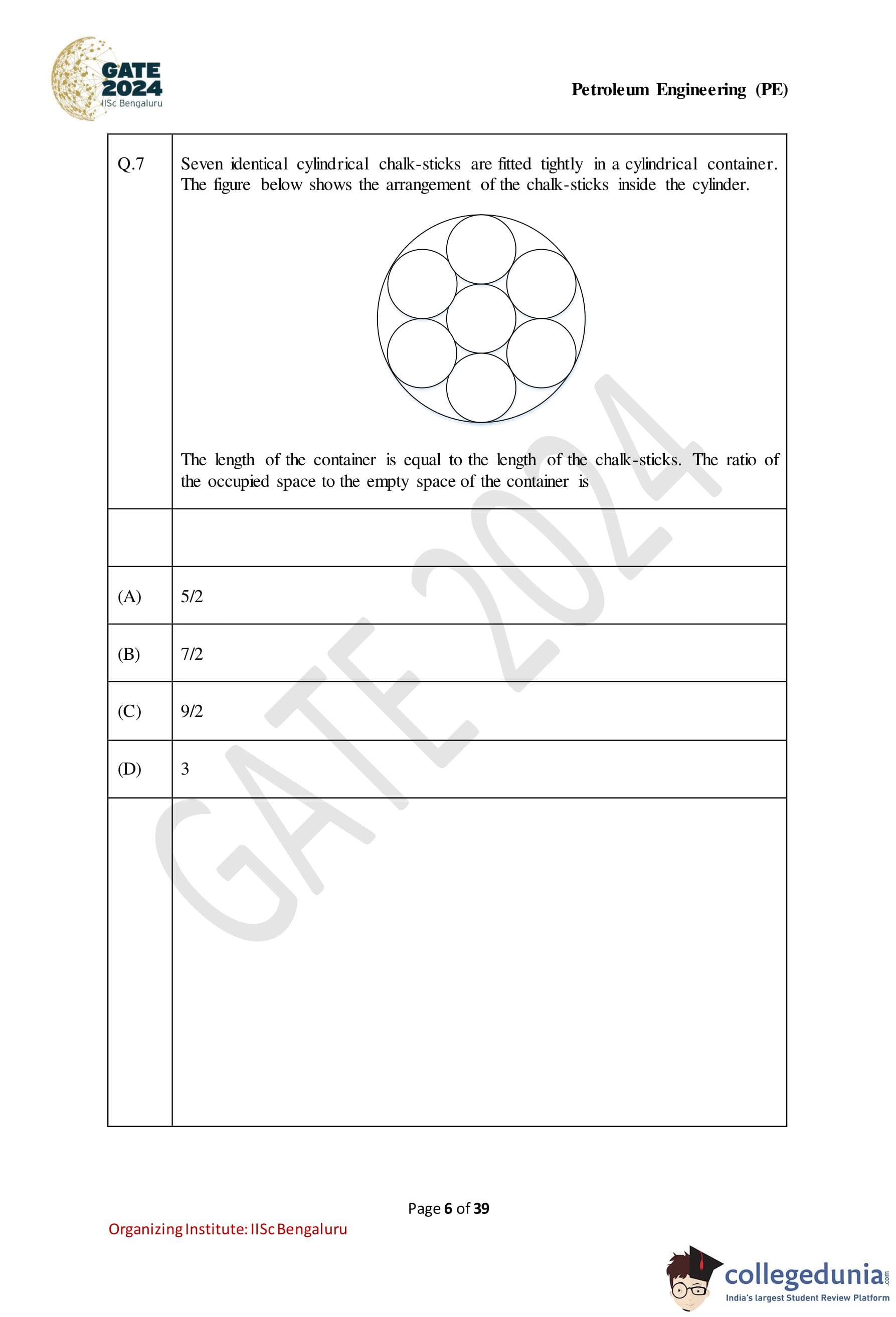
Seven identical cylindrical chalk-sticks are fitted tightly in a cylindrical container. The figure below shows the arrangement of the chalk-sticks inside the cylinder. The length of the container is equal to the length of the chalk-sticks. The ratio of the occupied space to the empty space of the container is:
View Solution
Solution:
Let the radius of the chalk-sticks be r and the height (or length) of the chalk-sticks be h.
The container is cylindrical, and the chalk-sticks are arranged such that they form a regular hexagonal arrangement in the circular cross-section of the container.
The area occupied by the chalk-sticks is the area of the 7 circles. The total area occupied by the chalk-sticks is:
Occupied Area = 7 × πr2 = 7πr2
Now, we need to find the total volume of the container. Since the length of the container is equal to the height of the chalk-sticks, the volume of the container is: Volume of the container = πR2h
Here, R is the radius of the container, which is the distance from the center of the hexagonal arrangement to the outer edge. This distance is equal to 2r, as the chalk-sticks are arranged tightly in a hexagonal pattern.
Thus, the volume of the container is:
Volume of the container = π(2r)2h = 4πr2h
Now, the ratio of the occupied space to the empty space in the container is:
Ratio = Occupied Space⁄Empty Space = 7πr2h⁄4πr2h - 7πr2h = 7⁄2
Final Answer: 7⁄2
Question 8:
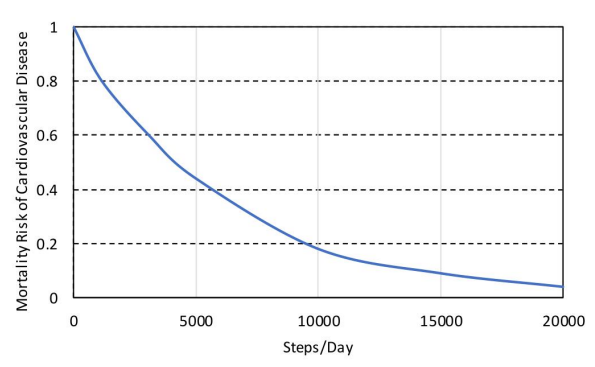
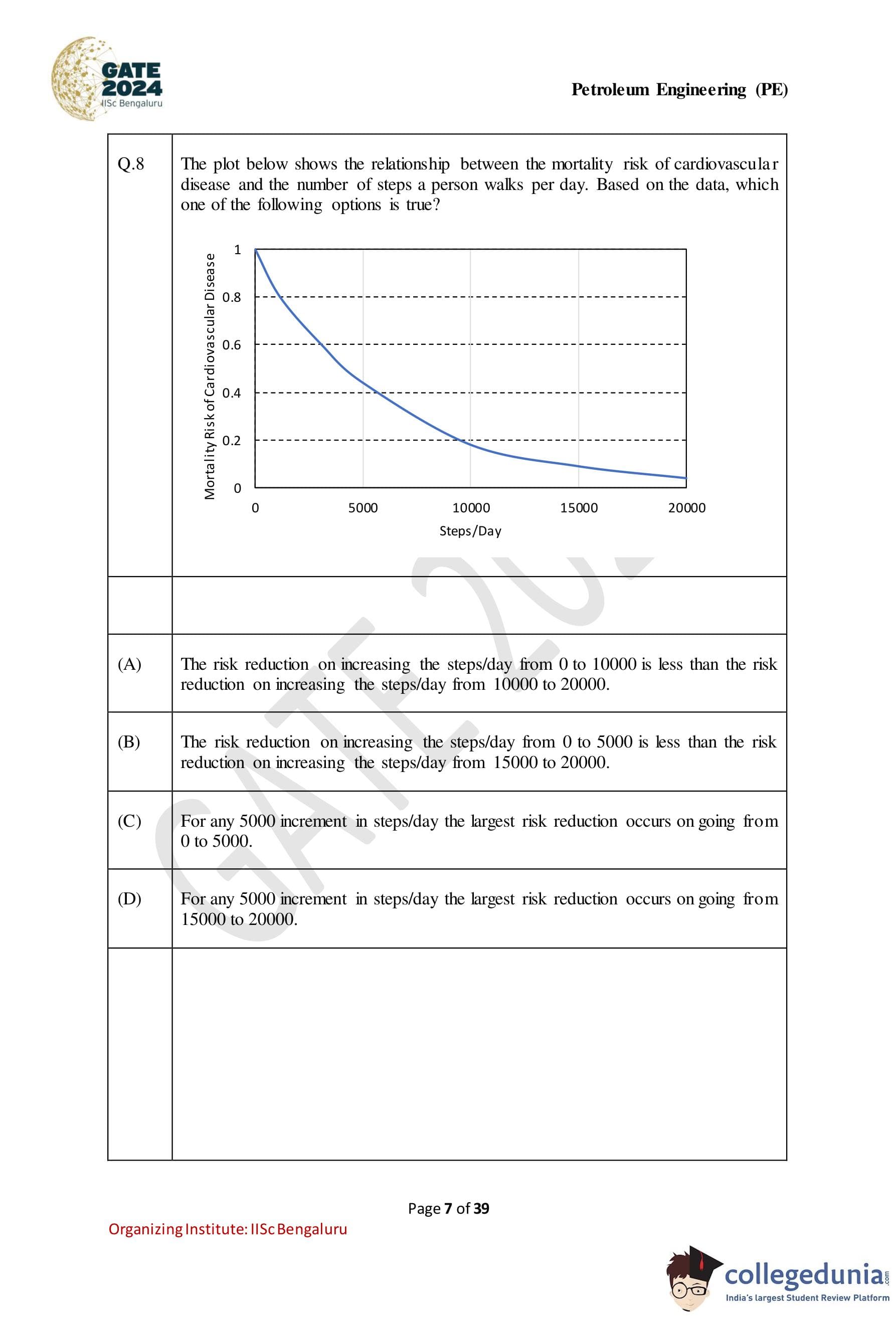
The plot below shows the relationship between the mortality risk of cardiovascular disease and the number of steps a person walks per day. Based on the data, which one of the following options is true?
View Solution
Solution:
Looking at the plot, we observe that: The mortality risk decreases as the number of steps per day increases, but the rate of decrease is not constant. - The largest reduction in risk occurs during the first 5000 steps, where the slope of the curve is steepest. - After 5000 steps/day, the reduction in risk continues but at a slower pace.
Now, let's analyze the options:
**Option (1):** The risk reduction on increasing the steps/day from 0 to 10000 is less than the risk reduction on increasing the steps/day from 10000 to 20000. - This is not true, as the curve shows a faster reduction in risk for the first 10000 steps compared to the next 10000 steps. - **Incorrect.**
**Option (2):** The risk reduction on increasing the steps/day from 0 to 5000 is less than the risk reduction on increasing the steps/day from 15000 to 20000. - This is also incorrect.
The largest reduction in risk occurs between 0 to 5000 steps/day, not between 15000 and 20000 steps. - **Incorrect.**
**Option (3):** For any 5000 increment in steps/day the largest risk reduction occurs on going from 0 to 5000. - This is true. The steepest slope of the curve occurs between 0 and 5000 steps, meaning the largest risk reduction happens in this range. - **Correct.**
**Option (4):** For any 5000 increment in steps/day the largest risk reduction occurs on going from 15000 to 20000. - This is incorrect. As previously noted, the largest reduction occurs between 0 and 5000 steps. - **Incorrect.**
Final Answer: **3**
Question 9:
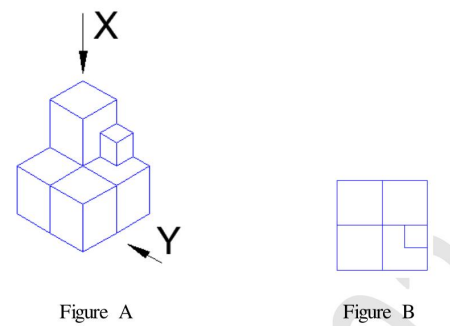
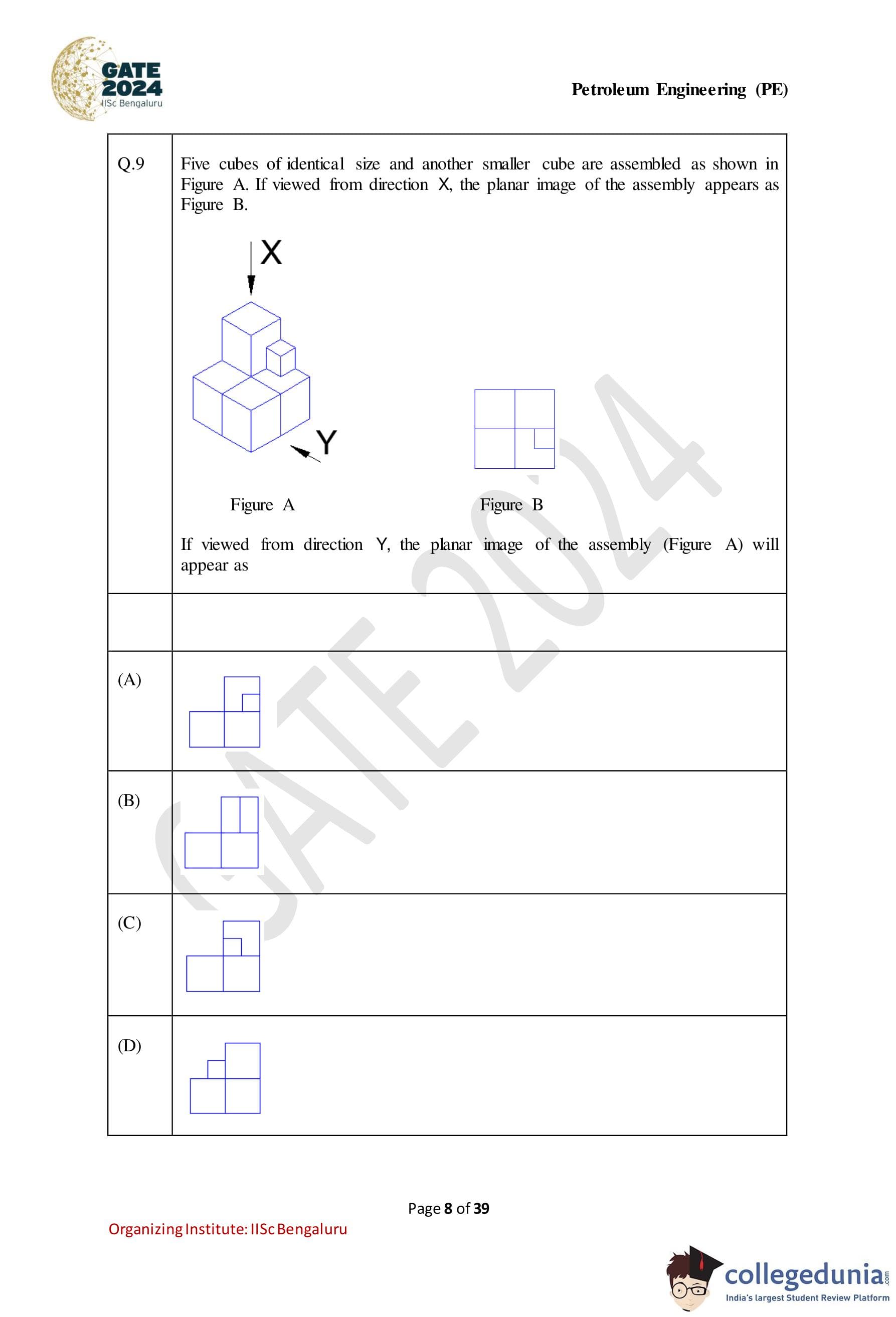
Five cubes of identical size and another smaller cube are assembled as shown in Figure A. If viewed from direction X, the planar image of the assembly appears as Figure B. If viewed from direction Y, the planar image of the assembly (Figure A) will appear as:




View Solution
Solution:
Looking at Figure A, we can observe that the assembly consists of five identical cubes arranged in a specific pattern. From direction X, the arrangement of the cubes will be observed in a particular way, as shown in Figure B.
Now, considering the view from direction Y: - The smaller cube will be obscured in the planar view, as it is hidden behind the other cubes. - The larger cubes will form the visible pattern.
From this perspective, the correct answer is the arrangement that matches the appearance of the cubes when viewed from direction Y.
Final Answer: Option (1)
Question 10:
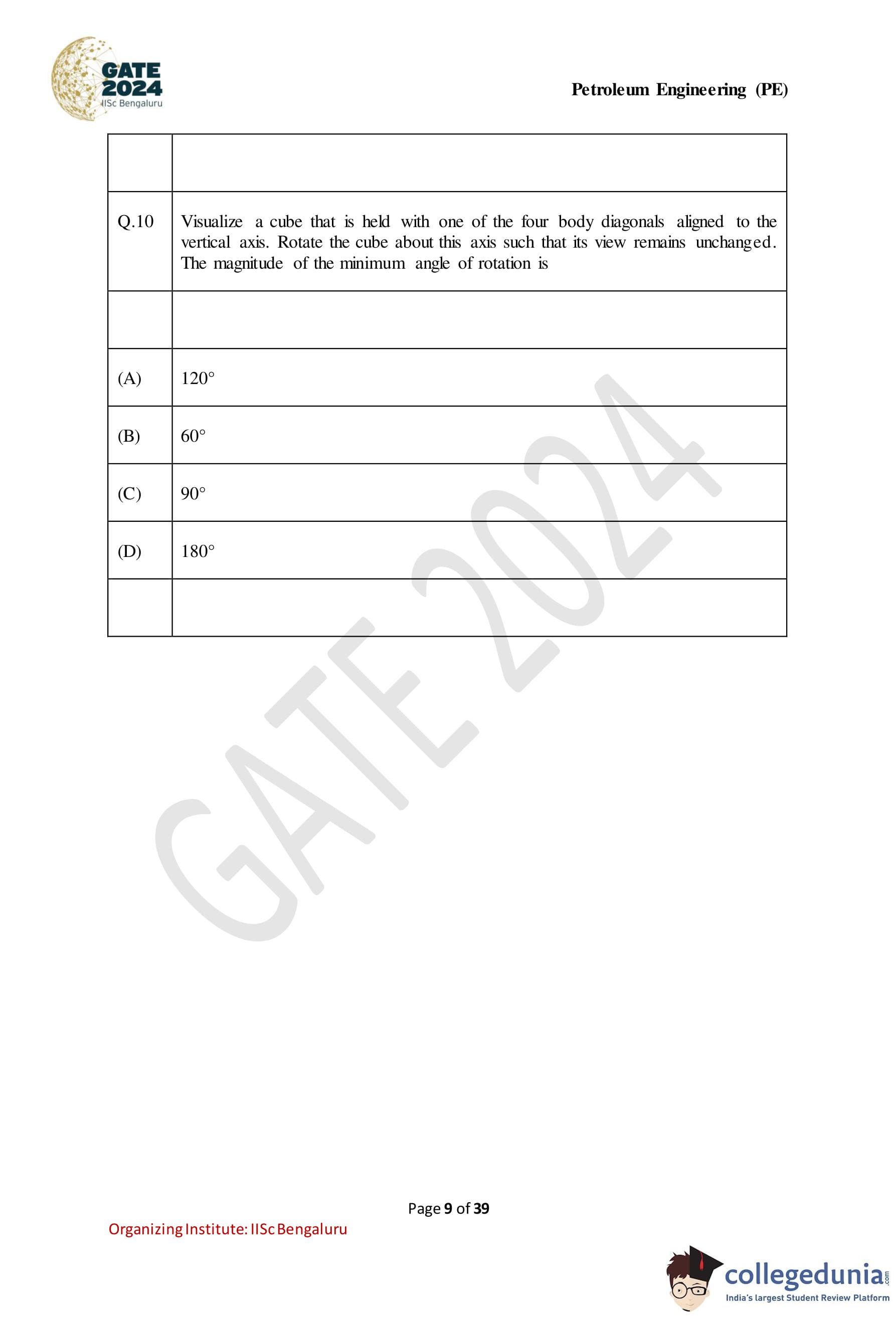
Visualize a cube that is held with one of the four body diagonals aligned to the vertical axis. Rotate the cube about this axis such that its view remains unchanged. The magnitude of the minimum angle of rotation is:
View Solution
Solution:
The body diagonals of a cube connect opposite vertices. If we align one of the body diagonals to the vertical axis, the cube will rotate around this axis.
- The cube has 4 body diagonals, and the view of the cube can be unchanged after rotating by specific angles. - The minimum angle of rotation for the view to remain unchanged is determined by the symmetry of the cube.
- In this case, the smallest angle of rotation that leaves the cube looking the same is 120°, as this corresponds to the rotational symmetry of the cube around its body diagonal.
Final Answer: **120°**
Question 11:
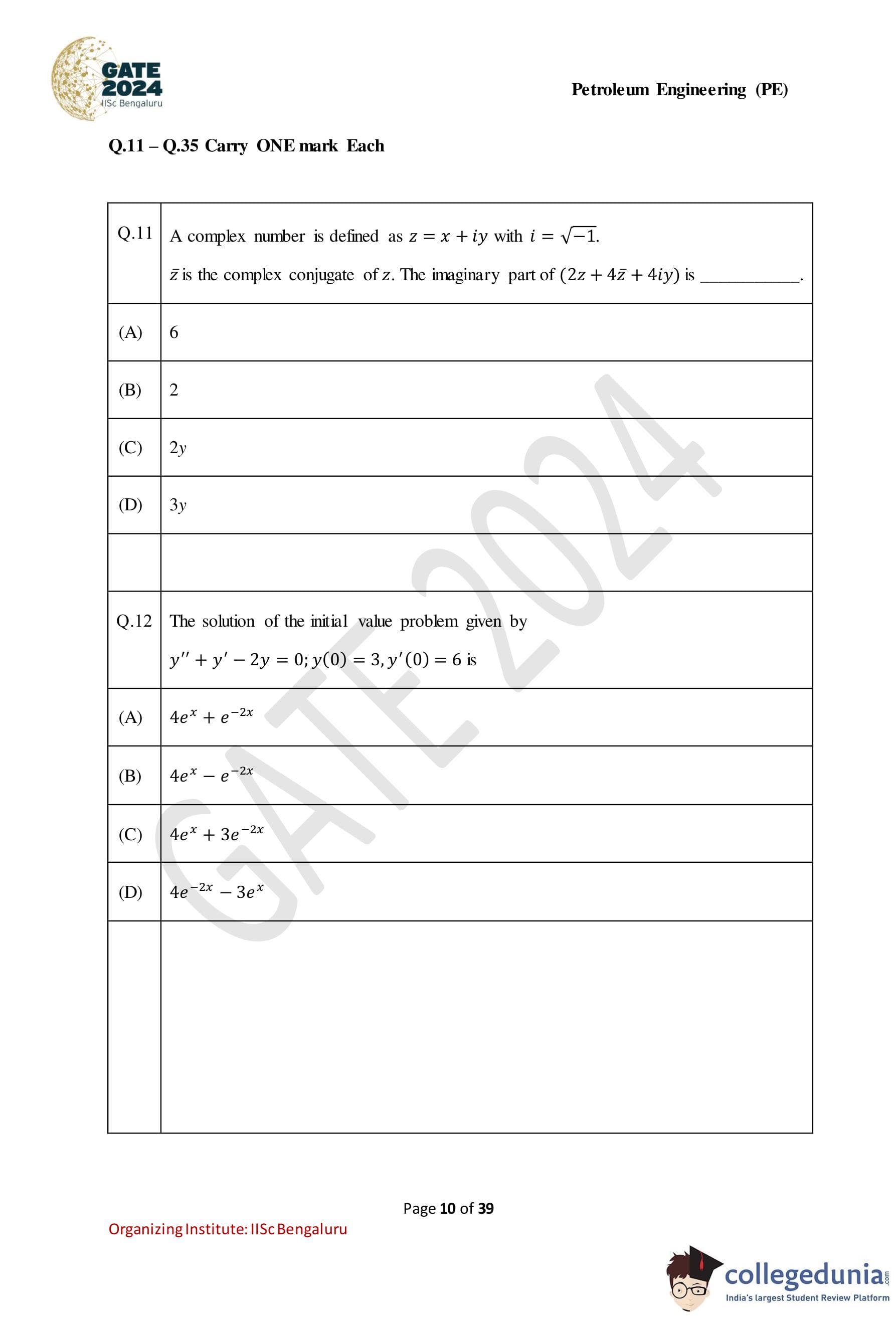
A complex number is defined as z = x + iy with i = √-1. ž is the complex conjugate of z. The imaginary part of 2z + 4ž + 4iy is ___________.
View Solution
Solution:
Let z = x + iy. Then ž = x - iy. Now consider the expression:
2z + 4ž + 4iy = 2(x + iy) + 4(x - iy) + 4iy
Combine the terms:
2x + 2iy + 4x - 4iy + 4iy
The imaginary part is:
2iy - 4iy + 4iy = 2iy
Thus, the imaginary part is 2y.
Question 12:
The solution of the initial value problem given by y" + y' – 2y = 0; y(0) = 3, y'(0) = 6 is
View Solution
Solution:
The characteristic equation of the given differential equation is:
r2 + r - 2 = 0
Solving this quadratic equation, we get the roots:
r = 1 and r = -2
Hence, the general solution is:
y = C1ex + C2e-2x
Using the initial conditions y(0) = 3 and y'(0) = 6, we find:
y(0) = C1 + C2 = 3
y'(x) = C1ex - 2C2e-2x
y'(0) = C1 - 2C2 = 6
Solving these equations, we get:
C1 = 4 and C2 = -1
Thus, the solution is:
y = 4ex - e-2x
Therefore, the answer is 4ex - e-2x
Question 13:
The absolute open flow potential of a well is the
View Solution
Solution:
The absolute open flow potential (AOFP) of a well is defined as the maximum theoretical flow rate of reservoir fluid that a well can deliver if there were no pressure drop in the wellbore. It represents an idealized maximum performance measure of the well.
Question 14:
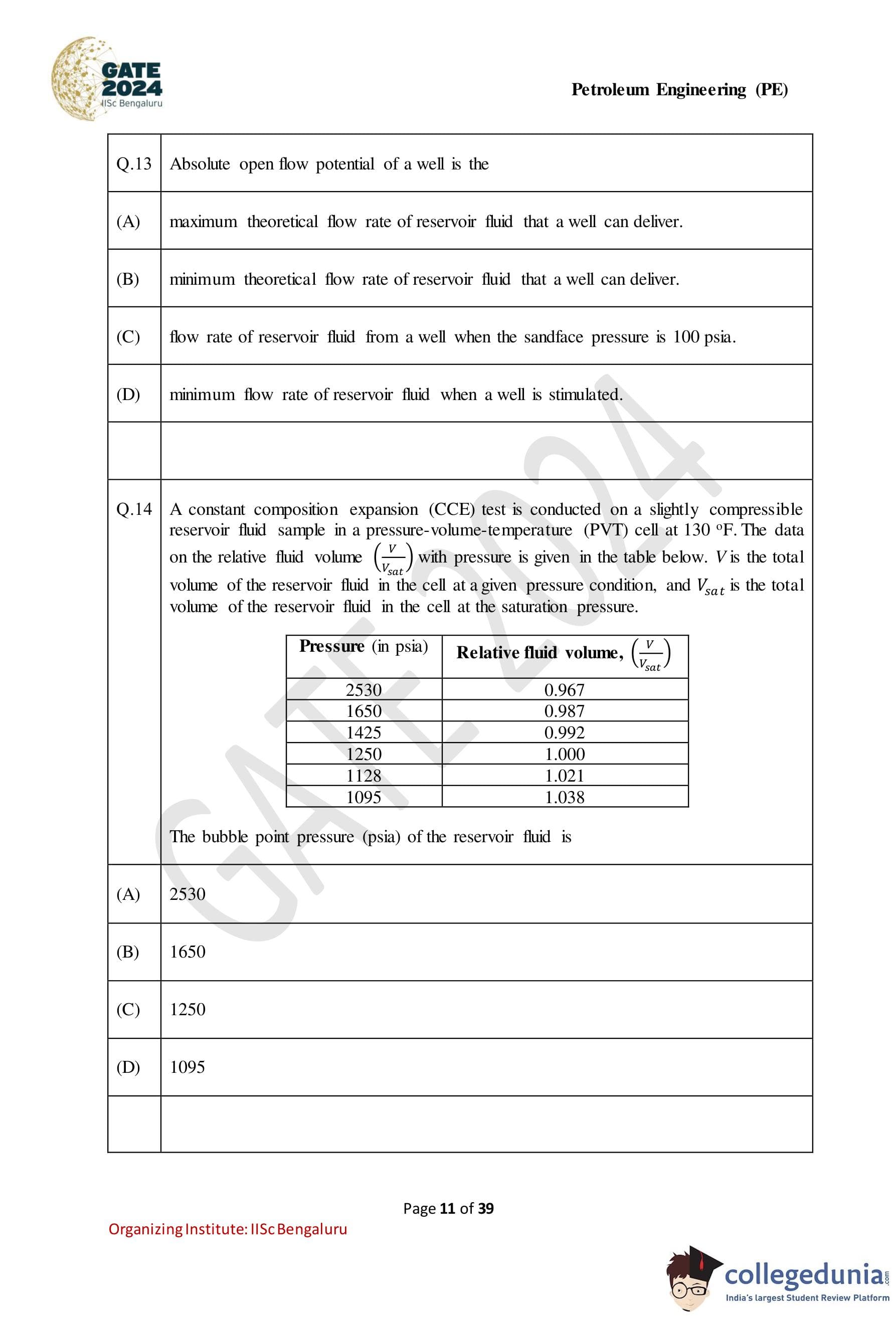
A constant composition expansion (CCE) test is conducted on a slightly compressible reservoir fluid sample in a pressure-volume-temperature (PVT) cell at 130°F. The data on the relative fluid volume (V/Vsat) with pressure is given in the table below. V is the total volume of the reservoir fluid in the cell at a given pressure condition, and Vsat is the total volume of the reservoir fluid in the cell at the saturation pressure.
| Pressure (in psia) | Relative fluid volume (V/Vsat) |
|---|---|
| 2530 | 0.967 |
| 1650 | 0.987 |
| 1425 | 0.992 |
| 1250 | 1.000 |
| 1128 | 1.021 |
| 1095 | 1.038 |
The bubble point pressure (psia) of the reservoir fluid is
View Solution
Solution:
The bubble point pressure is the pressure at which the first gas bubble forms in the reservoir fluid as the pressure decreases. This occurs at the saturation point where the relative fluid volume (V/Vsat) equals 1.000. From the table, we see that this condition is met at a pressure of 1250 psia.
Question 15:
Marsh funnel viscosity is reported as the number of seconds required for one quart of drilling fluid sample to flow out of a Marsh funnel. The time of efflux of one quart of fresh water from a Marsh funnel at 70±5 °F is __________ seconds.
View Solution
Solution:
The Marsh funnel viscosity measurement involves timing how long it takes for one quart of fluid to flow out of the funnel. For fresh water at a standard temperature of 70±5 °F, the expected time is generally recorded as 26±0.5 seconds. This is a standard value used for calibrating the Marsh funnel.
Question 16:
From the options given below, identify the process through which coal bed methane is produced:
View Solution
Solution:
Coal bed methane (CBM) is a natural gas extracted from coal seams. The production process involves the following steps:
- CBM is stored in coal seams under high pressure.
- Production is achieved by drilling vertical or horizontal wells to depressurize the coal seam.
- This reduction in pressure releases the methane gas trapped in the coal.
Other processes like underground coal gasification or combustion are unrelated to CBM production.
Question 17:
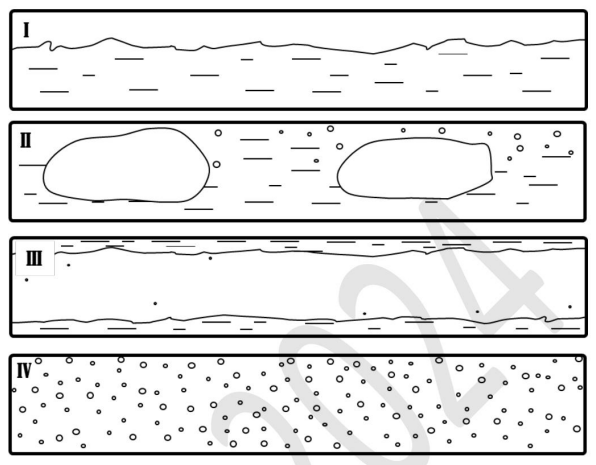
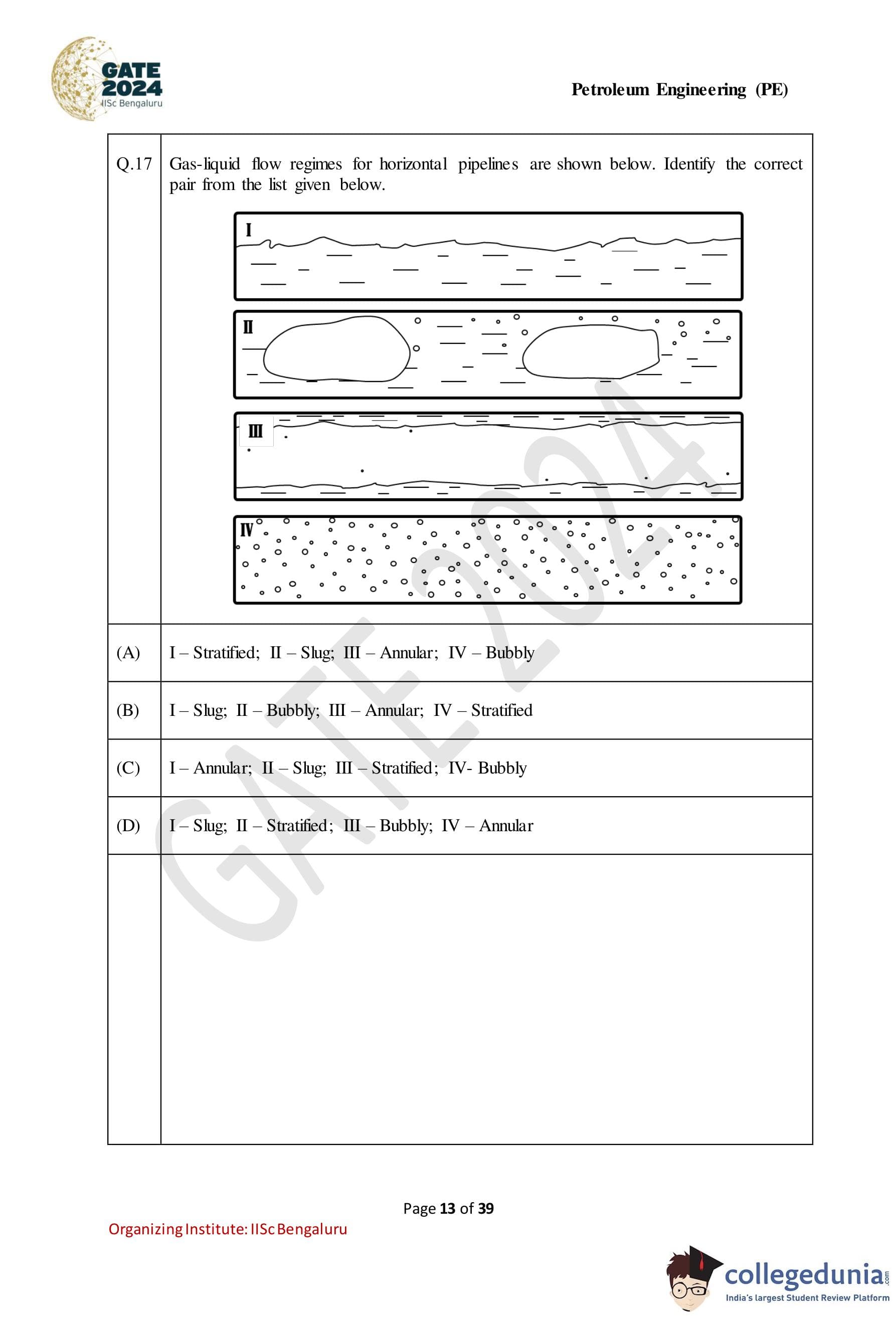
Gas-liquid flow regimes for horizontal pipelines are shown below. Identify the correct pair from the list given below.
View Solution
Solution:
• I - Stratified Flow: In the first image, we can see the liquid and the gas are separated into distinct layers, with the liquid flowing along the bottom of the pipe and the gas flowing above it. This is consistent with stratified flow.
• II - Slug Flow: The second image shows large bubbles of gas that nearly occupy the entire pipe diameter moving through the liquid. This is typical of slug flow.
• III - Annular Flow: The third image shows liquid flowing as a film along the walls of the pipe, while the gas flows through the core. This flow pattern matches annular flow.
• IV - Bubbly Flow: The fourth image depicts gas bubbles dispersed within the liquid, indicating a bubbly flow.
Hence, the correct answer is (A) I – Stratified; II – Slug; III – Annular; IV – Bubbly.
Question 18:
The speed of a Tsunami is a function of:
View Solution
Solution: The speed of a Tsunami is governed by the formula:
v = √g.h,
where v is the speed of the wave, g is the acceleration due to gravity, and h is the water depth.
• The speed depends only on the depth of the water (h) and not on the wave height or wind speed.
Hence the correct answer is (A) Only water depth.
Question 19:
Which ONE of the following is a POSITIVELY BUOYANT floating structure?
View Solution
Solution: A positively buoyant floating structure is one that is able to float on the surface of the water due to its buoyancy. Among the options:
• The Tension Leg Platform (TLP) is a floating platform anchored to the seabed by tendons, designed to remain in place without sinking or capsizing, and is positively buoyant.
• The other options such as Jacket Platform, Semi-Submersible, and Barge may float but are not designed to be positively buoyant in the same way as the TLP.
Hence, the correct answer is (C) Tension Leg Platform.
Question 20:
Which ONE of the following methods makes use of centrifugal force for measuring the interfacial tension between two immiscible phases?
View Solution
Solution: The spinning drop method measures interfacial tension by introducing a drop of one liquid into another immiscible liquid in a rotating capillary tube. Centrifugal force stretches the drop into a cylindrical shape, and the interfacial tension is calculated based on its dimensions and rotation speed.
• Pendant drop method: Measures tension by analyzing the shape of a hanging drop.
• Du Noüy ring method: Measures tension using a ring submerged at the interface.
• Wilhelmy plate method: Measures tension using a thin plate in contact with the interface.
Hence, the correct answer is (B) Spinning drop method.
Question 21:
Which ONE of the following can result in a negative value of skin factor near the wellbore?
View Solution
Solution: The skin factor (S) indicates the effect of near-wellbore conditions on well productivity.
• A negative skin factor improves well productivity by increasing permeability near the wellbore, typically due to stimulation techniques.
• Hydraulic fracturing creates fractures near the wellbore, increasing the effective permeability and resulting in a negative skin factor.
• Fines migration, asphaltene deposition, and clay swelling reduce permeability near the wellbore, causing a positive skin factor (damage).
Hence, the correct answer is (A) Hydraulic fracturing.
Question 22:
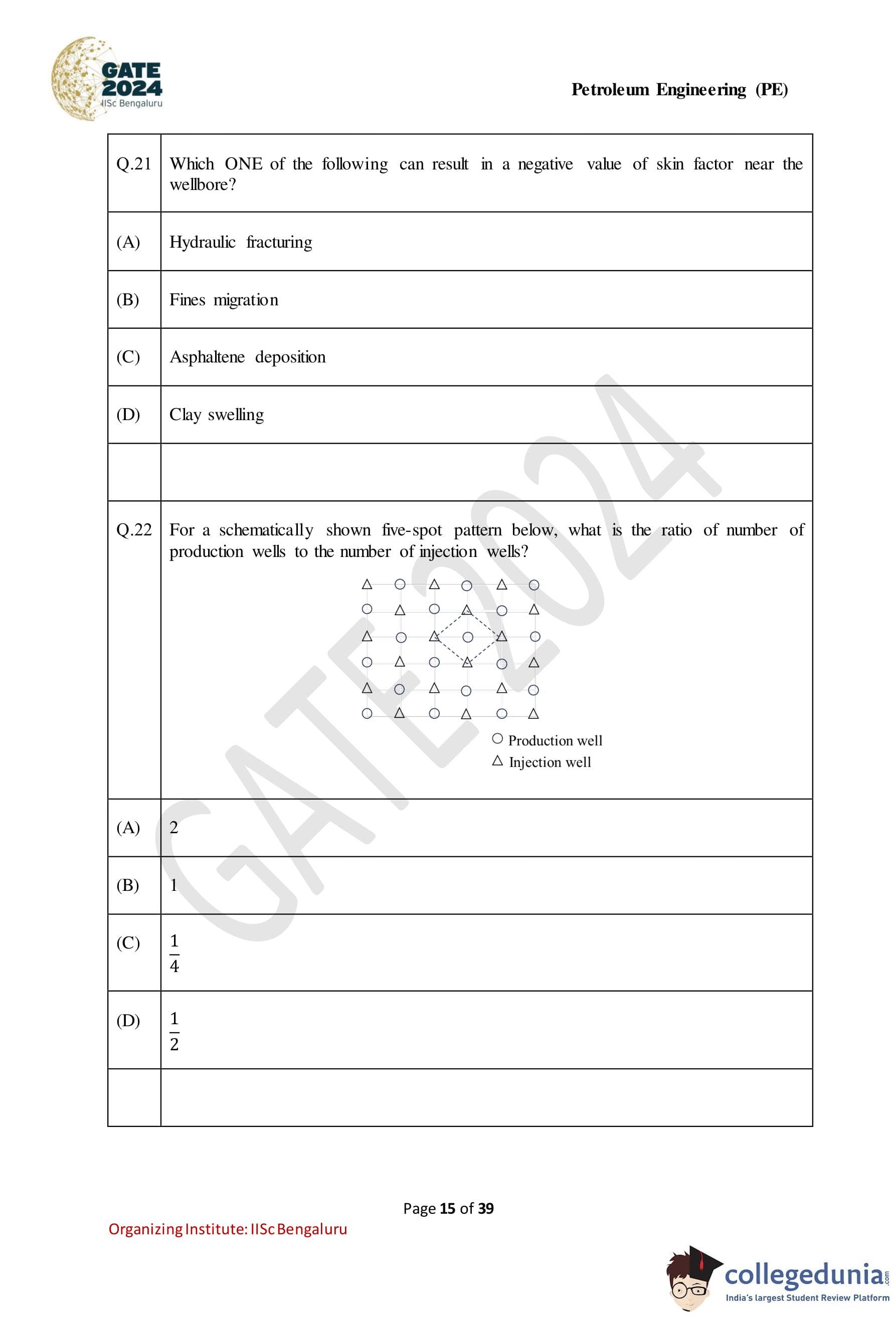
For a schematically shown five-spot pattern below, what is the ratio of number of production wells to the number of injection wells?
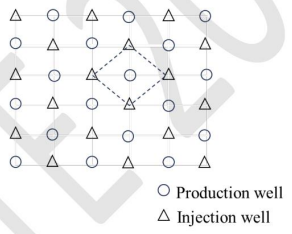
View Solution
Solution: In the five-spot pattern, there is a central production well surrounded by four injection wells. Thus, the ratio of production wells to injection wells is:
Ratio = Number of production wells⁄Number of injection wells = 1⁄4 .
Hence, the correct answer is (B) 1.
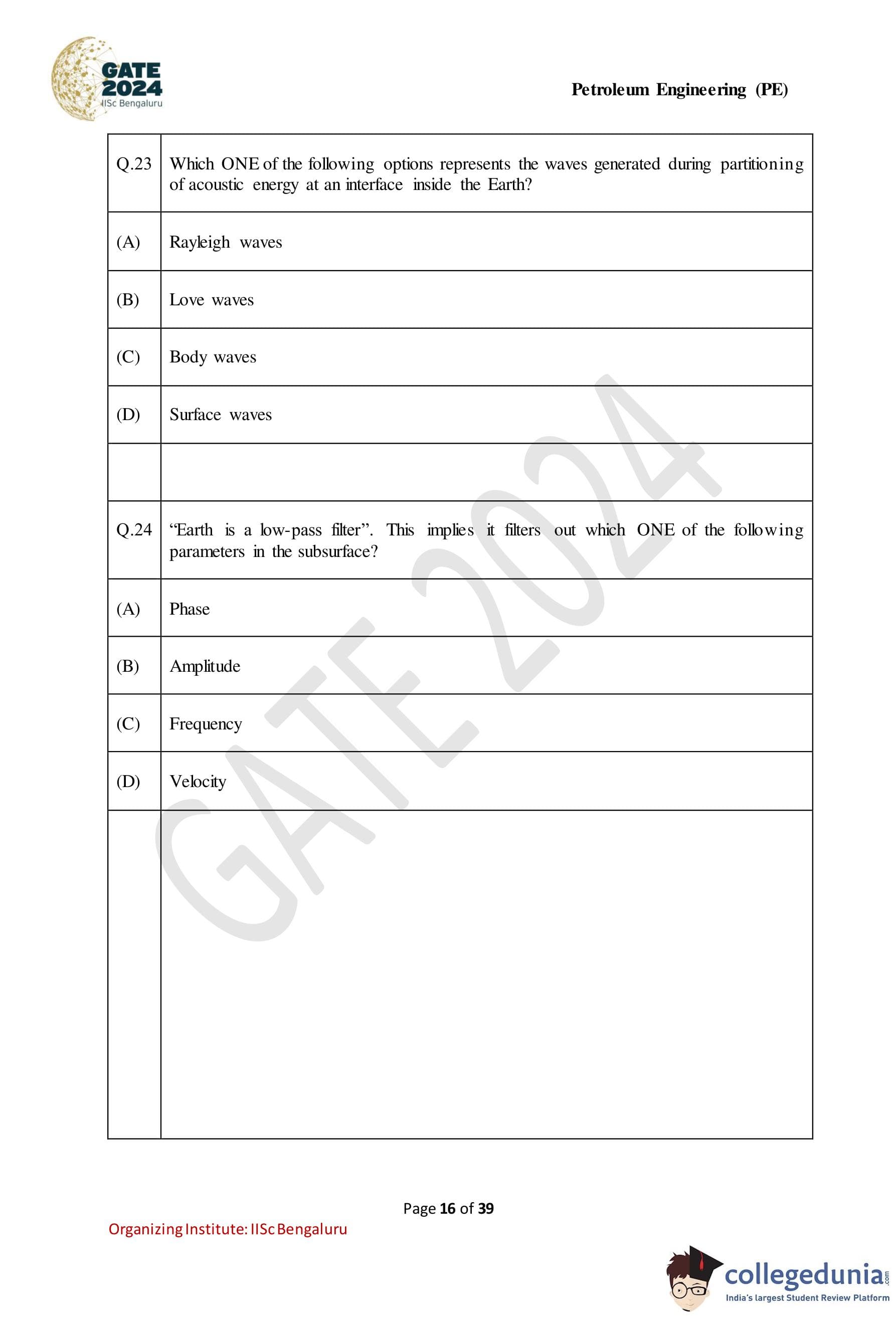
Question 23:
Which ONE of the following options represents the waves generated during partitioning of acoustic energy at an interface inside the Earth?
View Solution
Solution: When acoustic energy encounters an interface inside the Earth (such as a boundary between different rock layers), the energy is partitioned into different types of waves:
• Body waves: These include primary waves (P-waves) and secondary waves (S-waves), which propagate through the Earth's interior.
• Surface waves: These include Rayleigh and Love waves, which travel along the Earth's surface and are not directly generated at subsurface interfaces.
Since the question refers to waves generated during acoustic energy partitioning at an interface inside the Earth, the correct answer is (C) Body waves.
Question 24:
"Earth is a low-pass filter." This implies it filters out which ONE of the following parameters in the subsurface?
View Solution
Solution: The statement "Earth is a low-pass filter" implies that the Earth preferentially allows low-frequency seismic waves to pass while attenuating high-frequency waves due to scattering, absorption, and other energy dissipation mechanisms.
• High-frequency components are absorbed more readily than low-frequency components.
• This results in seismic signals with dominant low-frequency content as they propagate through the Earth.
Thus, the parameter filtered out is (C) Frequency.
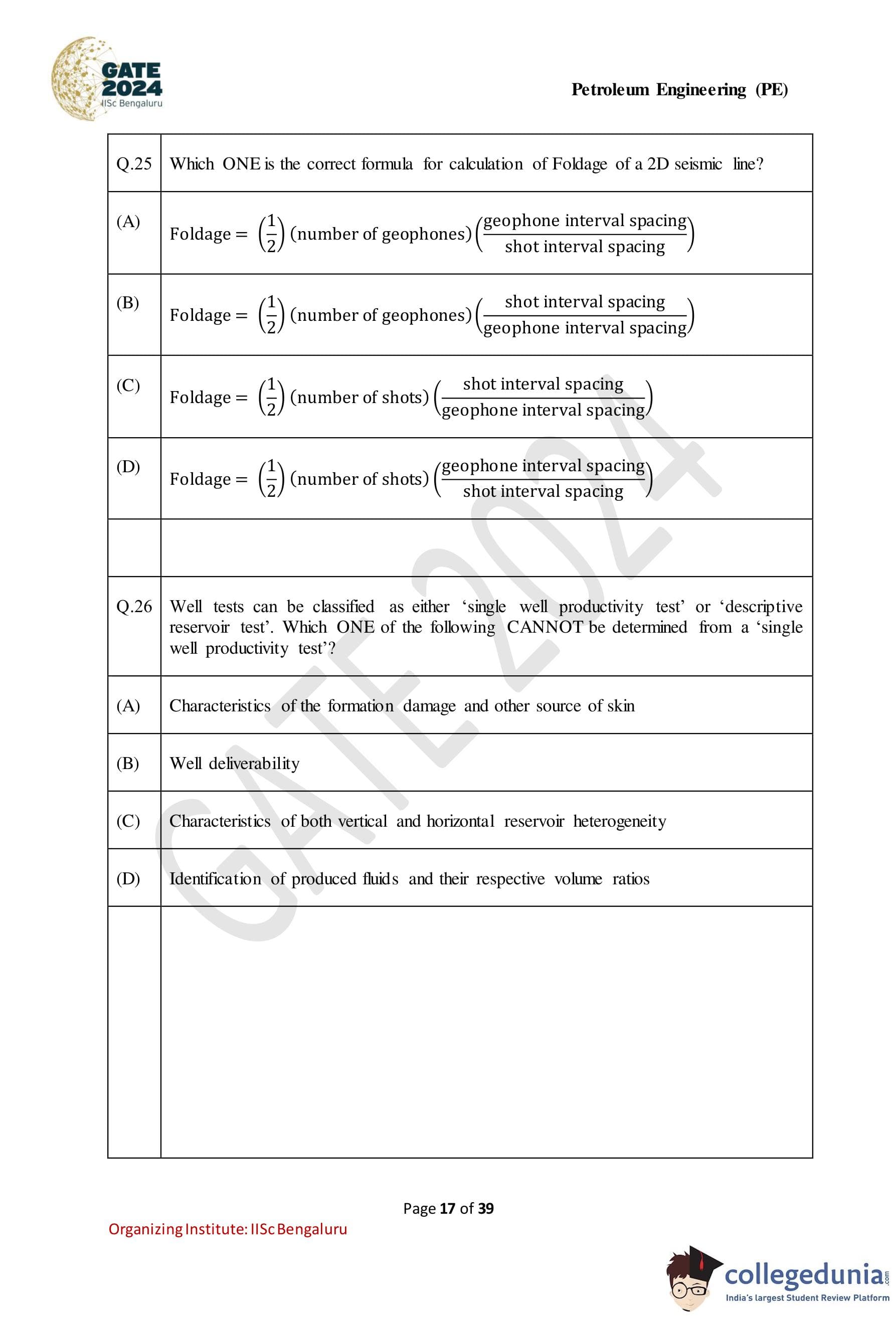
Question 25:
Which ONE is the correct formula for calculation of Foldage of a 2D seismic line?
View Solution
Solution: The correct formula for the foldage (also known as fold) of a 2D seismic line is given by:
Foldage = 1⁄2 × (number of geophones) × geophone interval spacing⁄shot interval spacing
This formula ensures the correct relationship between the number of geophones, their spacing, and the shot interval.
Hence, the correct answer is (A) Foldage = 1⁄2 (number of geophones) × geophone interval spacing / shot interval spacing.
Question 26:
Well tests can be classified as either ‘single well productivity test' or ‘descriptive reservoir test'. Which ONE of the following CANNOT be determined from a ‘single well productivity test'?
View Solution
Solution: • Single well productivity tests are used to evaluate the performance of a well. They provide information on:
- Formation damage and skin factor.
- Well deliverability (flow rate and pressure behavior).
- Identification of produced fluids and their ratios.
• Descriptive reservoir tests, such as interference tests, are needed to characterize both vertical and horizontal reservoir heterogeneity. This information cannot be derived from a single well productivity test.
Hence, the correct answer is (C) Characteristics of both vertical and horizontal reservoir heterogeneity.
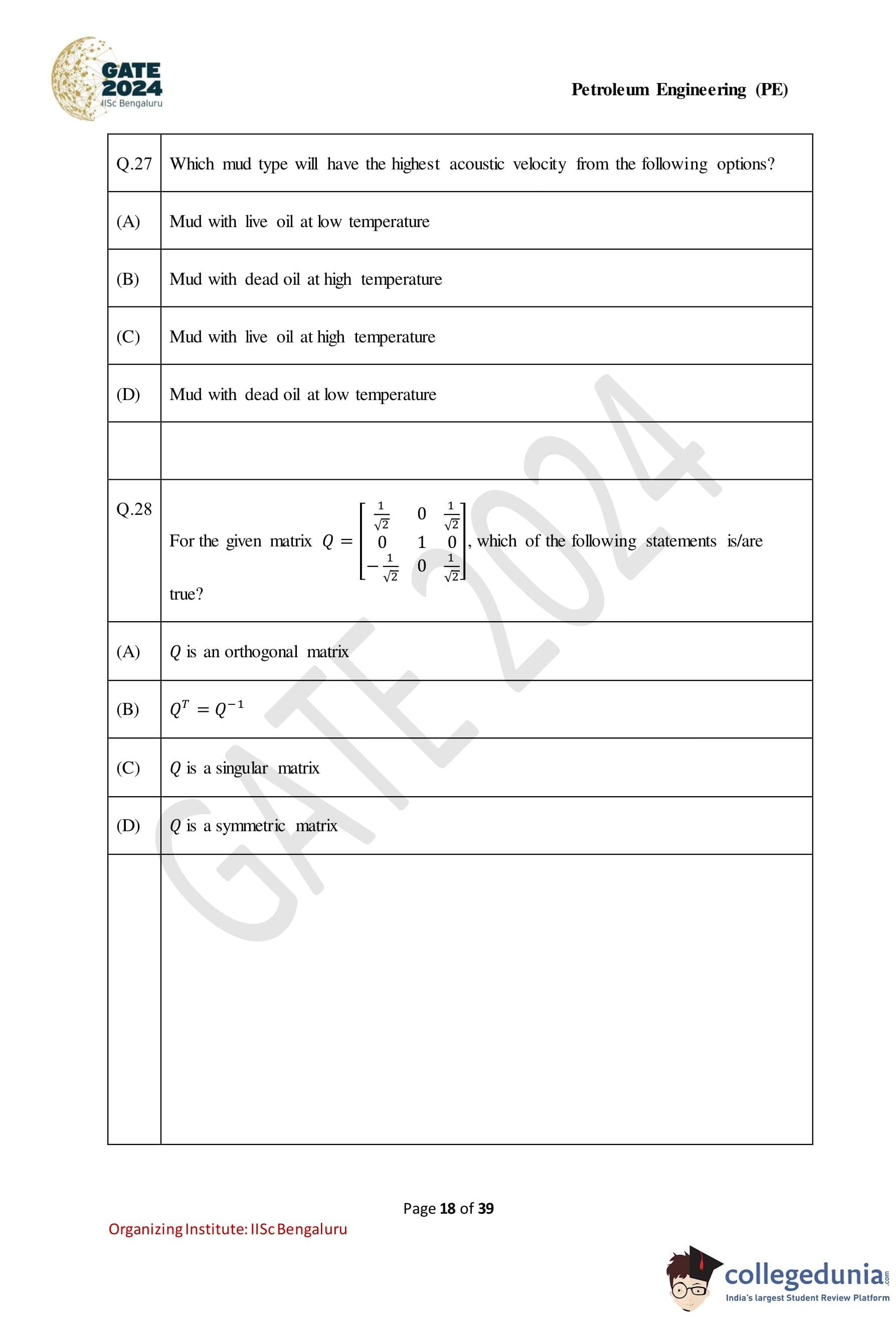
Question 27:
Which mud type will have the highest acoustic velocity from the following options?
View Solution
Solution: Acoustic velocity in a mud system depends on various factors, including the temperature, oil type (live or dead), and the density of the mud.
- At higher temperatures, the viscosity of the mud decreases, allowing the acoustic waves to travel more easily. - Live oil has lower viscosity compared to dead oil, which also aids in faster wave propagation.
Thus, the highest acoustic velocity would occur in mud with live oil at high temperature, as the viscosity is low, and the temperature increases the flow speed of acoustic waves.
Hence, the correct answer is (C) Mud with live oil at high temperature.
Question 28:
For the given matrix Q = 1⁄√2 0 0 -1⁄√2 , which of the following statements is/are true?
View Solution
Solution:
Let's analyze the given matrix Q:
Q = 1⁄√2 0 0 -1⁄√2
1. Orthogonal Matrix: A matrix Q is orthogonal if QTQ = I, where I is the identity matrix. Let's check: QT = Q (since Q is a diagonal matrix with real entries)
QTQ = 1⁄√2 0 0 -1⁄√2 1⁄√2 0 0 -1⁄√2 = 1 0 0 1 = I
Since QTQ = I, Q is an orthogonal matrix. Hence, (A) is true.
2. Inverse Matrix: For an orthogonal matrix, we know that QT = Q-1. As shown above, QT = Q, so QT = Q-1. Therefore, (B) is also true.
3. Singular Matrix: A matrix is singular if its determinant is zero. The determinant of Q is: det(Q) = ( 1⁄√2 )( - 1⁄√2 ) = -1⁄2
Since the determinant is not zero, Q is not a singular matrix. Hence, (C) is false.
4. Symmetric Matrix: A matrix is symmetric if Q = QT. However, Q ≠ QT because the off-diagonal elements are not equal. Thus, (D) is false.
Hence, the correct answer is (A) and (B)
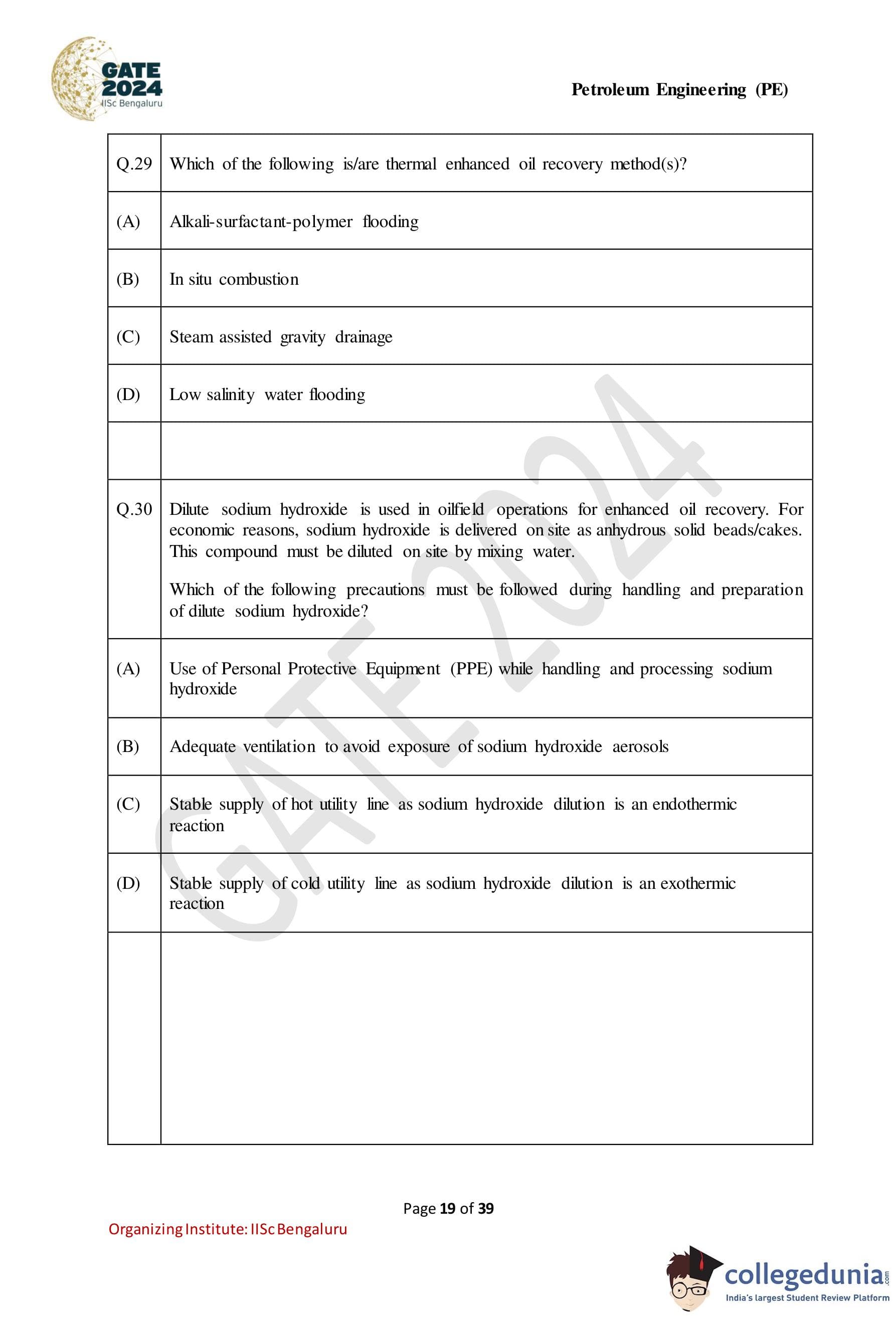
Question 29:
Which of the following is/are thermal enhanced oil recovery method(s)?
View Solution
Solution: 1. In situ combustion (Option B) is a thermal enhanced oil recovery (EOR) method in which heat is generated by igniting part of the oil reservoir. 2. Steam assisted gravity drainage (SAGD) (Option C) is another thermal EOR method, where steam is injected into the reservoir to reduce oil viscosity and allow gravity to assist in oil recovery.
Thus, (B) and (C) are correct.
Hence the correct answer is (B) and (C)
Question 30:
Dilute sodium hydroxide is used in oilfield operations for enhanced oil recovery. For economic reasons, sodium hydroxide is delivered on site as anhydrous solid beads/cakes. This compound must be diluted on site by mixing water. Which of the following precautions must be followed during handling and preparation of dilute sodium hydroxide?
View Solution
Solution: 1. Use of Personal Protective Equipment (PPE) (Option A) is required when handling sodium hydroxide to prevent skin or eye contact with this caustic material. 2. Adequate ventilation (Option B) is needed to avoid exposure to harmful sodium hydroxide aerosols during handling and processing. 3. Stable supply of cold utility line (Option D) is important as sodium hydroxide dilution is an exothermic reaction, releasing heat that can cause the temperature to rise.
Thus, (A), (B), and (D) are correct.
Question 31:
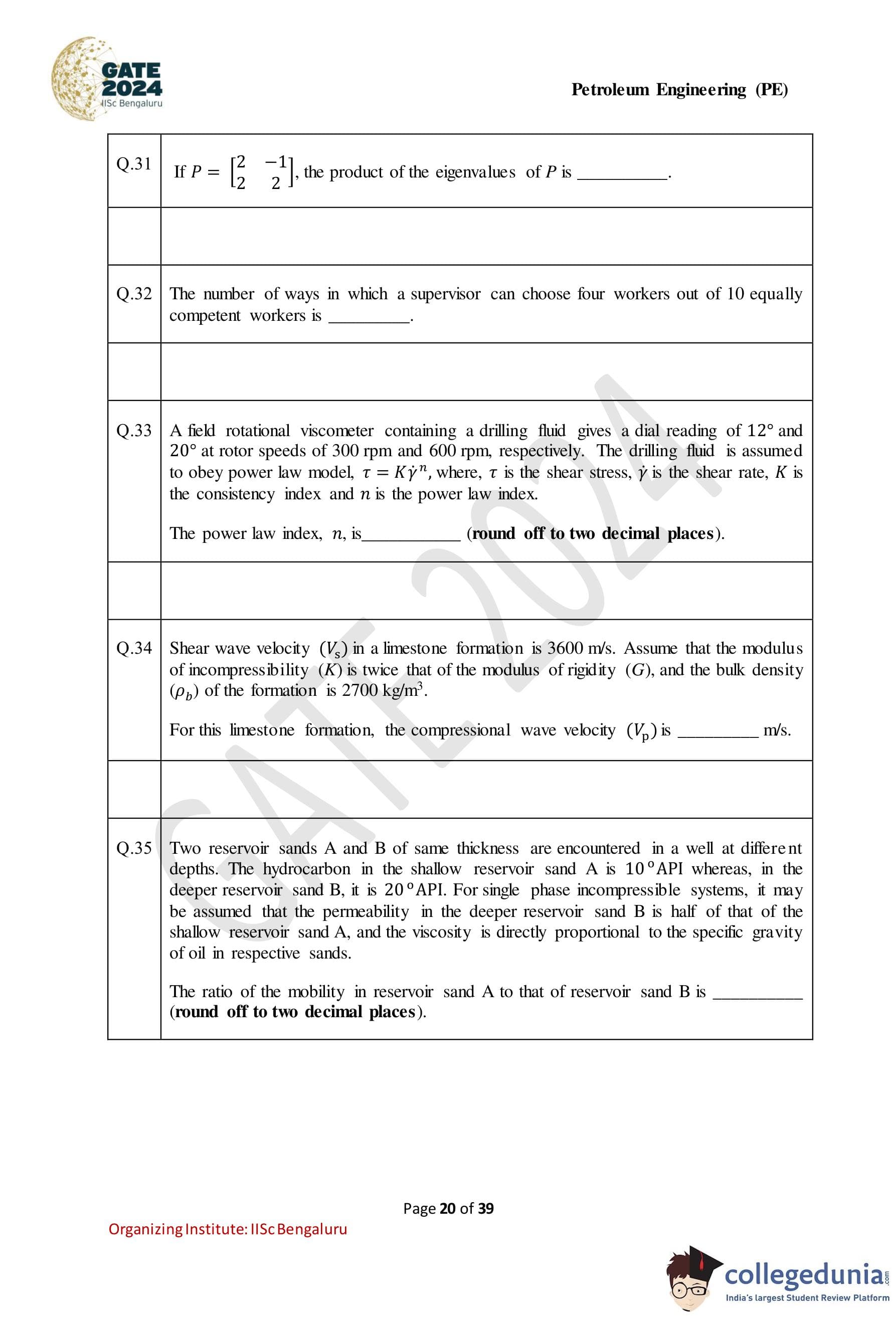
If P = 2 2 -1 2 , the product of the eigenvalues of P is ________.
View Solution
Solution: The product of the eigenvalues of a matrix P is equal to the determinant of P. So, we need to calculate the determinant of P:
det(P) = 2 2 -1 2 = (2 × 2) – (2 × -1) = 4 + 2 = 6
Thus, the product of the eigenvalues of P is 6.
Question 32:
The number of ways in which a supervisor can choose four workers out of 10 equally competent workers is:
View Solution
Solution: The number of ways to choose 4 workers out of 10 is given by the combination formula:
C(n,k) = n!⁄k!(n-k)!, where n = 10 and k = 4. Substituting the values:
C(10,4) = 10!⁄4!(10-4)! = 10*9*8*7⁄4*3*2*1 = 210
Hence, the correct answer is 210.
Question 33:
A field rotational viscometer containing a drilling fluid gives a dial reading of 12° and 20° at rotor speeds of 300 rpm and 600 rpm, respectively. The drilling fluid is assumed to obey power law model, τ = Kγn, where τ is the shear stress, γ is the shear rate, K is the consistency index and n is the power law index.
View Solution
Solution: Given the readings at 300 rpm (θ1 = 12) and 600 rpm (θ2 = 20), we can use the following equation for power law fluid:
θ2⁄θ1 = (rpm2⁄rpm1)n
20⁄12 = (600⁄300)n
5⁄3 = 2n
Taking the logarithm of both sides:
n log(2) = log( 5⁄3)
n = log(5/3)⁄log(2) ≈ 0.749
Thus, the power law index n is approximately between 0.71 and 0.76.
Question 34:
Shear wave velocity (Vs) in a limestone formation is 3600 m/s. Assume that the modulus of incompressibility (K) is twice that of the modulus of rigidity (G), and the bulk density (ρb) of the formation is 2700 kg/m³.
View Solution
Solution: From the given data, the relationship between shear wave velocity (Vs), compressional wave velocity (Vp), and the modulus of elasticity can be used as follows:
Vp = √K + 4⁄3G⁄ρb
Given that K = 2G, the equation becomes:
Vp = √2G + 4⁄3G⁄ρb = √10⁄3G⁄ρb
Since Vs = √G⁄ρb = 3600 m/s, we can solve for Vp.
Vp = √10⁄3 × 3600 ≈ 6512 m/s
Thus, the compressional wave velocity Vp is between 6500 m/s and 6600 m/s.
Question 35:
Two reservoir sands A and B of same thickness are encountered in a well at different depths. The hydrocarbon in the shallow reservoir sand A is 10°API whereas, in the deeper reservoir sand B, it is 20°API. For single-phase incompressible systems, it may be assumed that the permeability in the deeper reservoir sand B is half that of the shallow reservoir sand A, and the viscosity is directly proportional to the specific gravity of oil in respective sands.
View Solution
Solution: The mobility is given by the formula:
Mobility = k⁄μ, where k is the permeability and μ is the viscosity. For both sands, we are told that the permeability in sand B is half of that in sand A and that the viscosity is proportional to the specific gravity.
Since the viscosity is proportional to the specific gravity, and the specific gravity increases with API, the viscosity in sand B is higher than in sand A. The ratio of mobilities can be calculated as:
Mobility in sand A⁄Mobility in sand B = kA/μA⁄kB/μB = kA⁄kB x μB⁄μA = 1⁄1⁄2 x 1.90⁄1.80 ≈ 1.80 to 1.95
Thus, the ratio of the mobility of sand A to sand B is between 1.80 and 1.95.
Question 36:
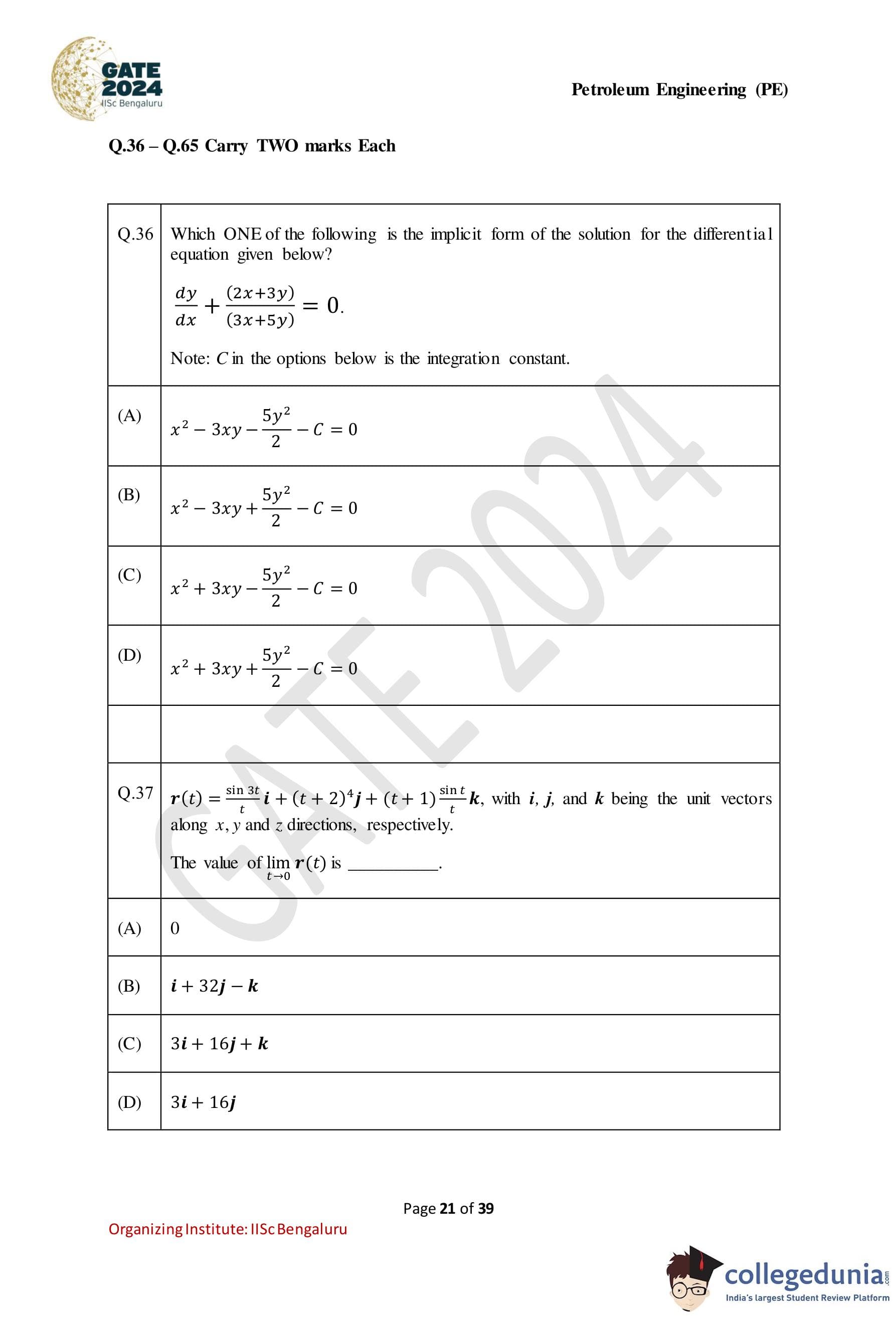
Which ONE of the following is the implicit form of the solution for the differential equation given below?
dy⁄dx(2x + 3y⁄3x + 5y) = 0
View Solution
Solution: The given equation is:
dy⁄dx(2x + 3y⁄3x + 5y) = 0.
This is a linear first-order differential equation that can be solved by integrating factor or other methods. However, by checking the options for the implicit form of the solution, we find that option (D) matches the correct form.
The implicit solution is:
x2 + 3xy + 5y2⁄2 – C = 0.
Thus, the correct answer is (D).
Question 37:
r(t) = sin(3/t) i + (t+2)j + (t+1)sin(1/t) k, with i, j, k being the unit vectors along x, y, and z directions, respectively. The value of lim t → 0 r(t) is_____.
View Solution
Solution: We are given the expression for r(t):
r(t) = sin(3⁄t) i + (t + 2) j + (t+1)sin(1⁄t) k.
As t → 0, we can simplify each term:
1. The first term sin(3/t) tends to 0 as t → 0. 2. The second term (t + 2) tends to 2 as t → 0.
3. The third term (t + 1)sin(1/t) tends to 0 as t → 0.
Thus, the limit of r(t) as t → 0 is:
r(t) = 0i + 2j + 0k = 3i + 16j + k.
Hence, the correct answer is (C).
Question 38:
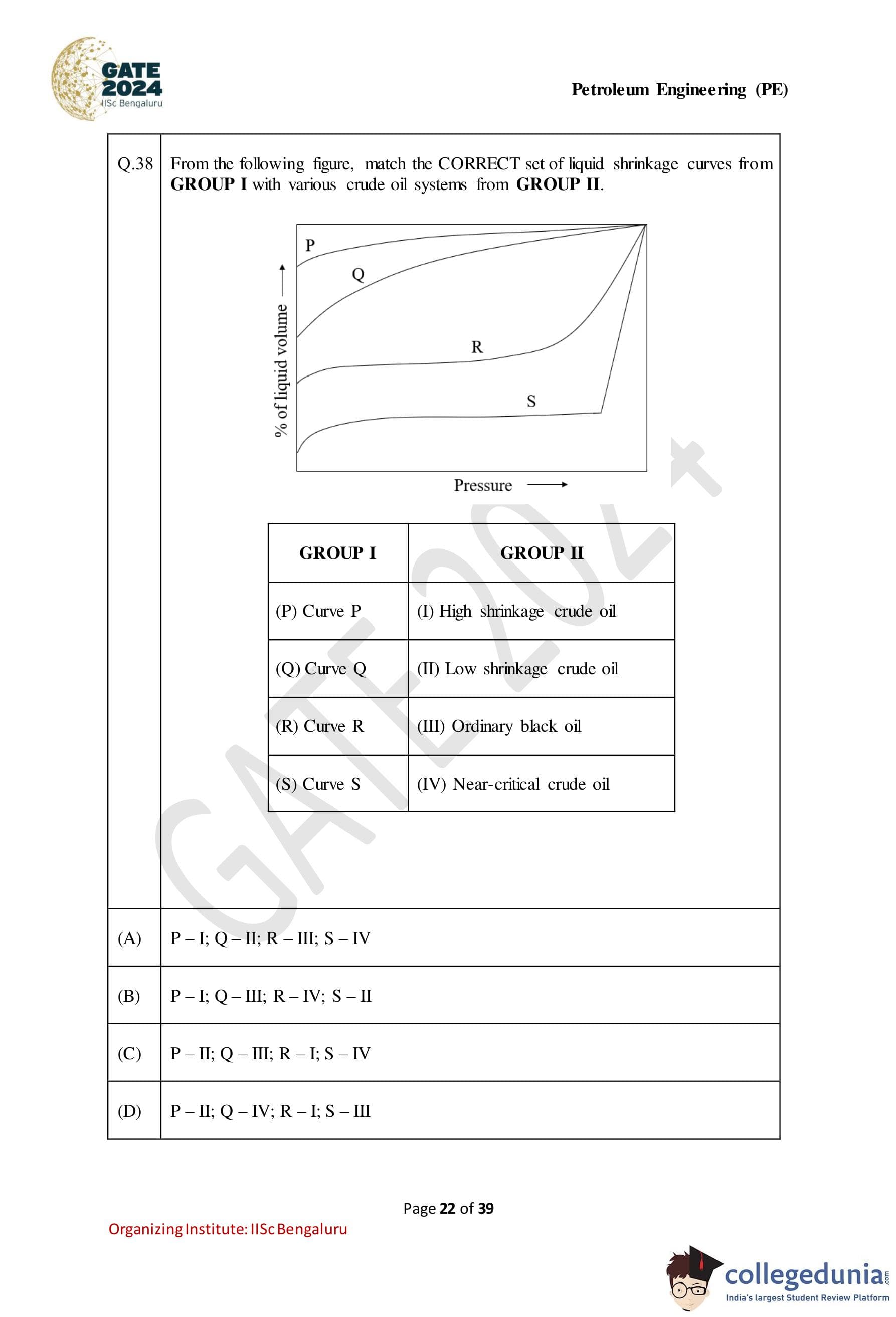
From the following figure, match the CORRECT set of liquid shrinkage curves from GROUP I with various crude oil systems from GROUP II.
| GROUP I | GROUP II | ||
| (P) | Curve P | (I) | High shrinkage crude oil |
| (Q) | Curve Q | (II) | Low shrinkage crude oil |
| (R) | Curve R | (III) | Ordinary black oil |
| (S) | Curve S | (IV) | Near-critical crude oil |
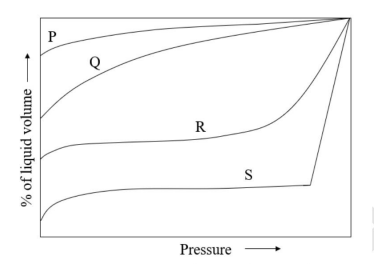
View Solution
Solution: The liquid shrinkage curve in the figure represents the relationship between pressure and percentage of liquid volume. Based on the typical behavior of different crude oil types:
- Curve P (I) corresponds to High shrinkage crude oil, as it shows the highest percentage reduction in liquid volume at a given pressure. - Curve Q (III) corresponds to Ordinary black oil, as it exhibits moderate shrinkage behavior. - Curve R (I) corresponds to Low shrinkage crude oil, as it shows a smaller reduction in liquid volume at a given pressure. - Curve S (IV) corresponds to Near-critical crude oil, as it shows little or no shrinkage at higher pressures.
Thus, the correct matching is P – I; Q – III; R – I; S – IV.
Question 39:
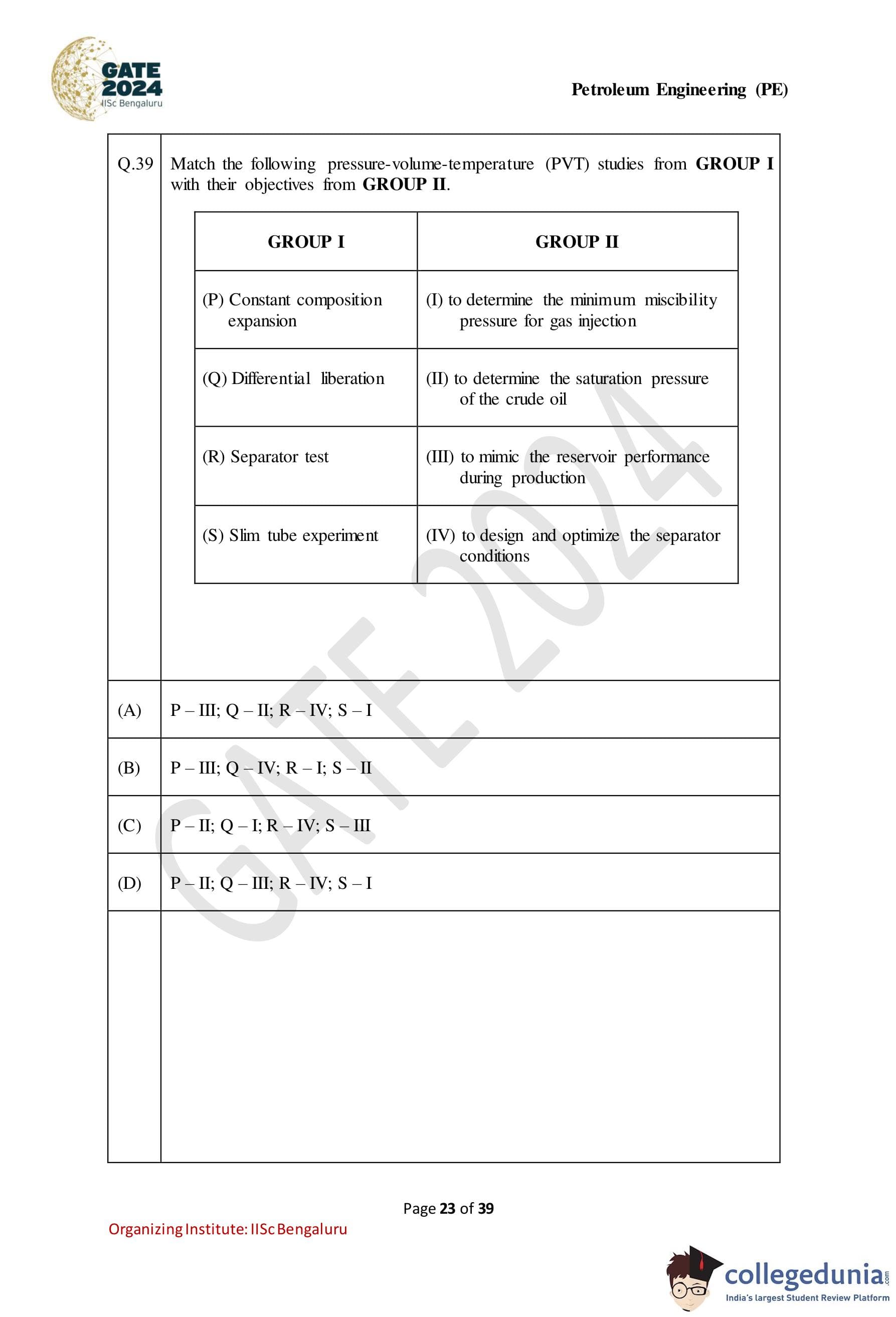
Match the following pressure-volume-temperature (PVT) studies from GROUP I with their objectives from GROUP II.
| GROUP I | GROUP II |
|---|---|
| (P) Constant composition expansion | (I) to determine the minimum miscibility pressure for gas injection |
| (Q) Differential liberation | (II) to determine the saturation pressure of the crude oil |
| (R) Separator test | (III) to mimic the reservoir performance during production |
| (S) Slim tube experiment | (IV) to design and optimize the separator conditions |
View Solution
Solution:
1. Constant composition expansion (P) is primarily used to determine the saturation pressure of crude oil, which helps in understanding the behavior of the crude oil under varying pressures. This corresponds to (II).
2. Differential liberation (Q) is performed to determine the minimum miscibility pressure for gas injection. This process helps in understanding the pressure at which the injected gas can mix effectively with the crude oil. This corresponds to (I).
3. Separator test (R) is designed to mimic the reservoir performance during production. It is crucial for understanding how the fluid behaves when extracted from the reservoir and sent to the separator. This corresponds to (III).
4. Slim tube experiment (S) is used to help design and optimize the separator conditions. It gives insights into the fluid properties, helping in designing the most efficient separator. This corresponds to (IV).
Thus, the correct matching is P – II; Q – III; R – IV; S – I.
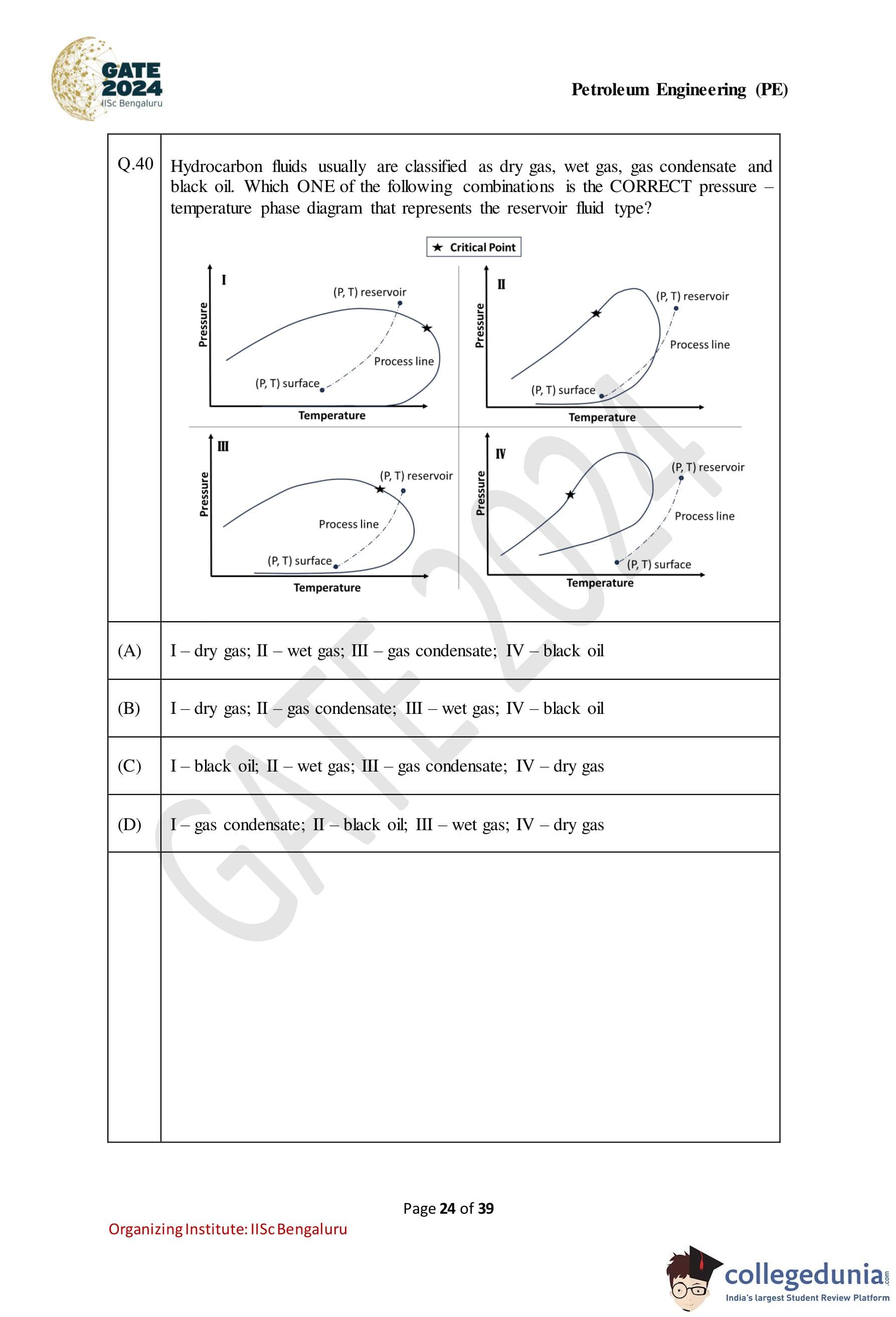
Question 40:
Hydrocarbon fluids usually are classified as dry gas, wet gas, gas condensate and black oil. Which ONE of the following combinations is the CORRECT pressure – temperature phase diagram that represents the reservoir fluid type?
View Solution
Solution: - Diagram I represents black oil, where oil remains as liquid under typical pressure and temperature conditions. - Diagram II corresponds to wet gas, where gas begins to condense into liquid at certain pressures. - Diagram III represents gas condensate, where the gas phase is present, but it condenses as pressure drops. - Diagram IV represents dry gas, where gas remains as gas with no liquid phase even under changing pressure conditions.
Thus, the correct combination of pressure-temperature phase diagrams is I – black oil; II – wet gas; III - gas condensate; IV – dry gas.
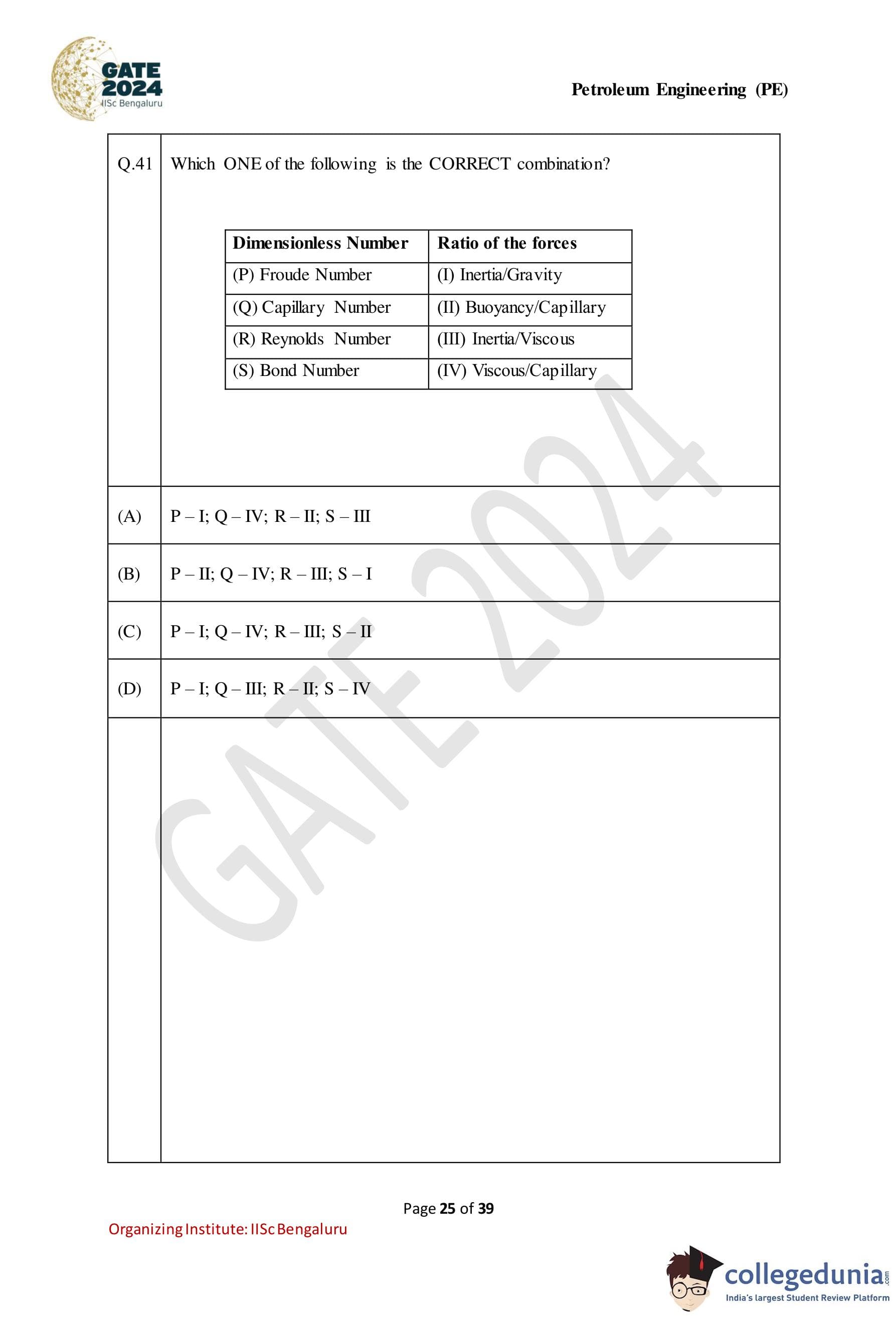
Question 41:
Which ONE of the following is the CORRECT combination?
| Dimensionless Number | Ratio of the forces |
|---|---|
| (P) Froude Number | (I) Inertia/Gravity |
| (Q) Capillary Number | (II) Buoyancy/Capillary |
| (R) Reynolds Number | (III) Inertia/Viscous |
| (S) Bond Number | (IV) Viscous/Capillary |
View Solution
Solution:
- The Froude Number (P) is a ratio of Inertia to Gravity, which represents the relative importance of inertial forces compared to gravitational forces. - The Capillary Number (Q) is a ratio of Viscous to Capillary forces, which describes the relative importance of viscous forces compared to surface tension forces. - The Reynolds Number (R) is a ratio of Inertia to Viscous forces, which helps in determining whether flow is laminar or turbulent. - The Bond Number (S) is a ratio of Inertia to Capillary forces, which is important for analyzing fluid dynamics in systems where both forces play a role.
Thus, the correct matching is P – I; Q – IV; R – III; S – II.
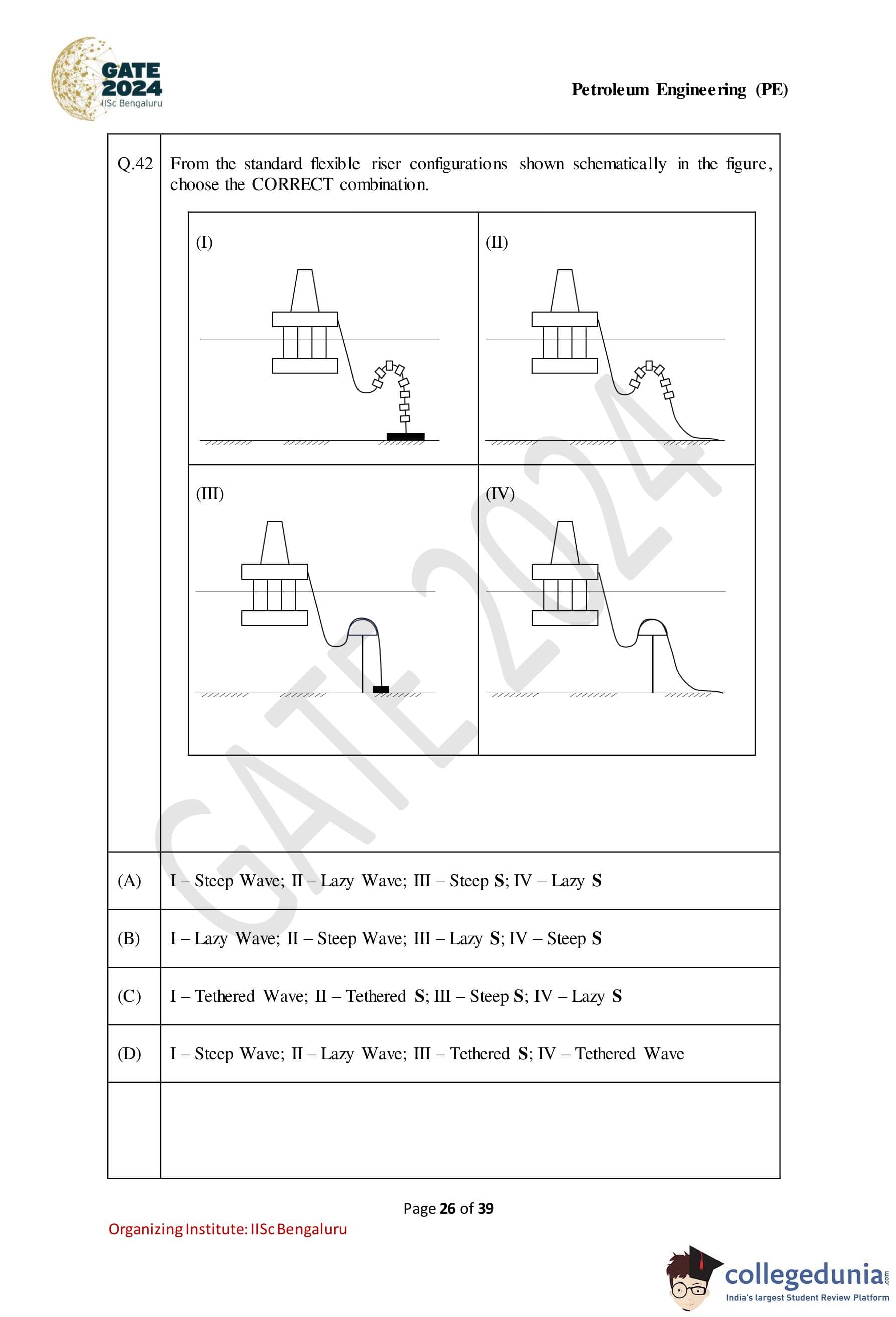
Question 42:
From the standard flexible riser configurations shown schematically in the figure, choose the CORRECT combination.
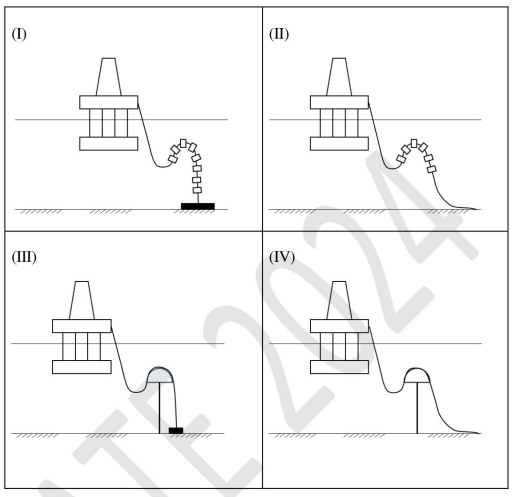
View Solution
Solution: - Diagram I represents Steep Wave, where the wave steepens significantly. - Diagram II represents Lazy Wave, where the wave is gentler and less steep. - Diagram III represents Steep S, where the configuration experiences sharp movement with steeper angles. - Diagram IV represents Lazy S, where the motion is less sharp and gentler in comparison.
Thus, the correct matching is I – Steep Wave; II – Lazy Wave; III – Steep S; IV – Lazy S.
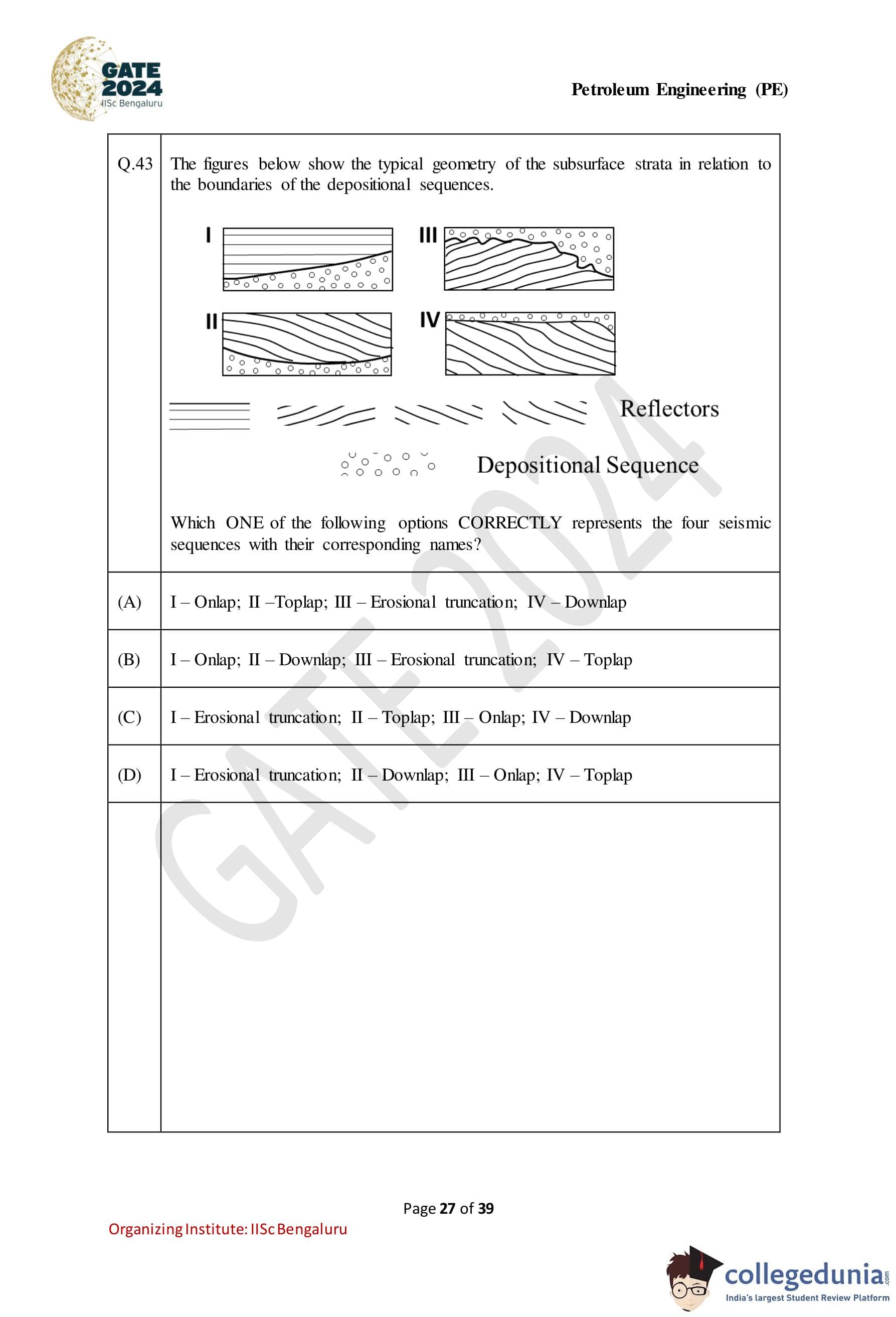
Question 43:
The figures below show the typical geometry of the subsurface strata in relation to the boundaries of the depositional sequences.
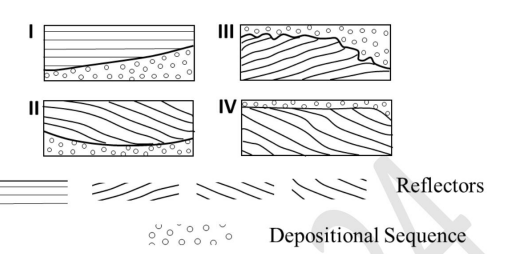
View Solution
Solution: From the provided diagrams, we can identify the types of seismic events:
1. Diagram I (Onlap): This occurs when younger layers "lap onto" older layers, typically forming an onlap pattern on a surface. 2. Diagram II (Downlap): This occurs when the layers are "downlapping,” meaning the bedding planes slope downwards as they are deposited. 3. Diagram III (Erosional truncation): This indicates that the sequence is truncated due to erosion, typically marked by a sharp boundary. 4. Diagram IV (Toplap): This occurs when the sequence is truncated by the surface, but the layers "lap over” an older surface.
Thus, the correct matching is I – Onlap; II – Downlap; III – Erosional truncation; IV – Toplap.
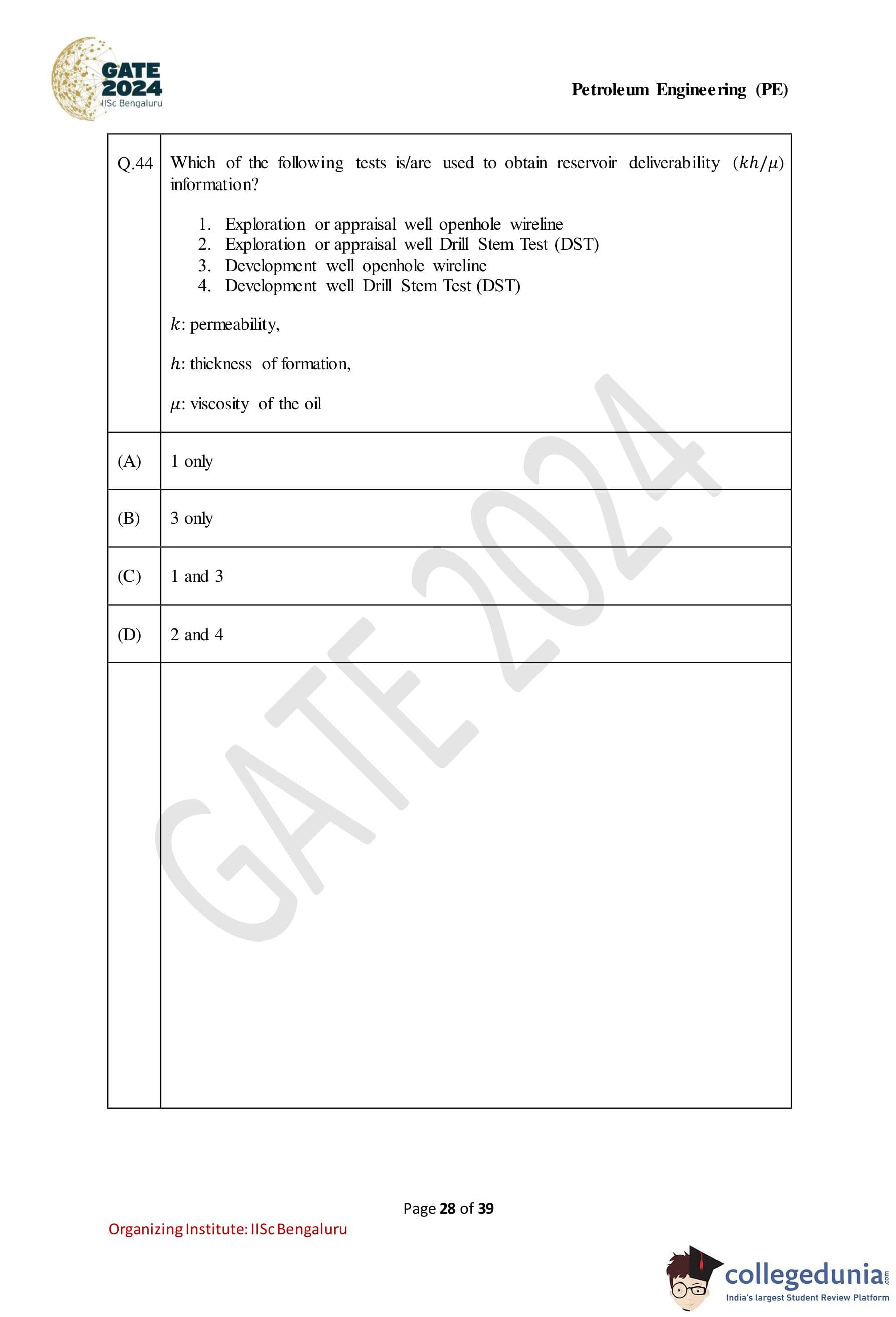
Question 44:
Which of the following tests is/are used to obtain reservoir deliverability (kh/μ) information?
View Solution
Solution: To determine the reservoir deliverability (kh⁄μ), the following tests are typically used:
- Exploration or appraisal well openhole wireline (1): This test helps in obtaining the permeability (k) and thickness (h) of the formation and is useful for determining deliverability.
- Exploration or appraisal well Drill Stem Test (DST) (2): This test directly measures the flow rate and provides essential information on reservoir deliverability, including permeability (k) and viscosity (μ).
- Development well openhole wireline (3): This test is also useful for evaluating formation properties like permeability and thickness and can help in obtaining deliverability information.
- Development well Drill Stem Test (DST) (4): This test is commonly used in development wells to measure pressure and flow rates, helping in determining reservoir deliverability.
Thus, the correct combination is 2 and 4.
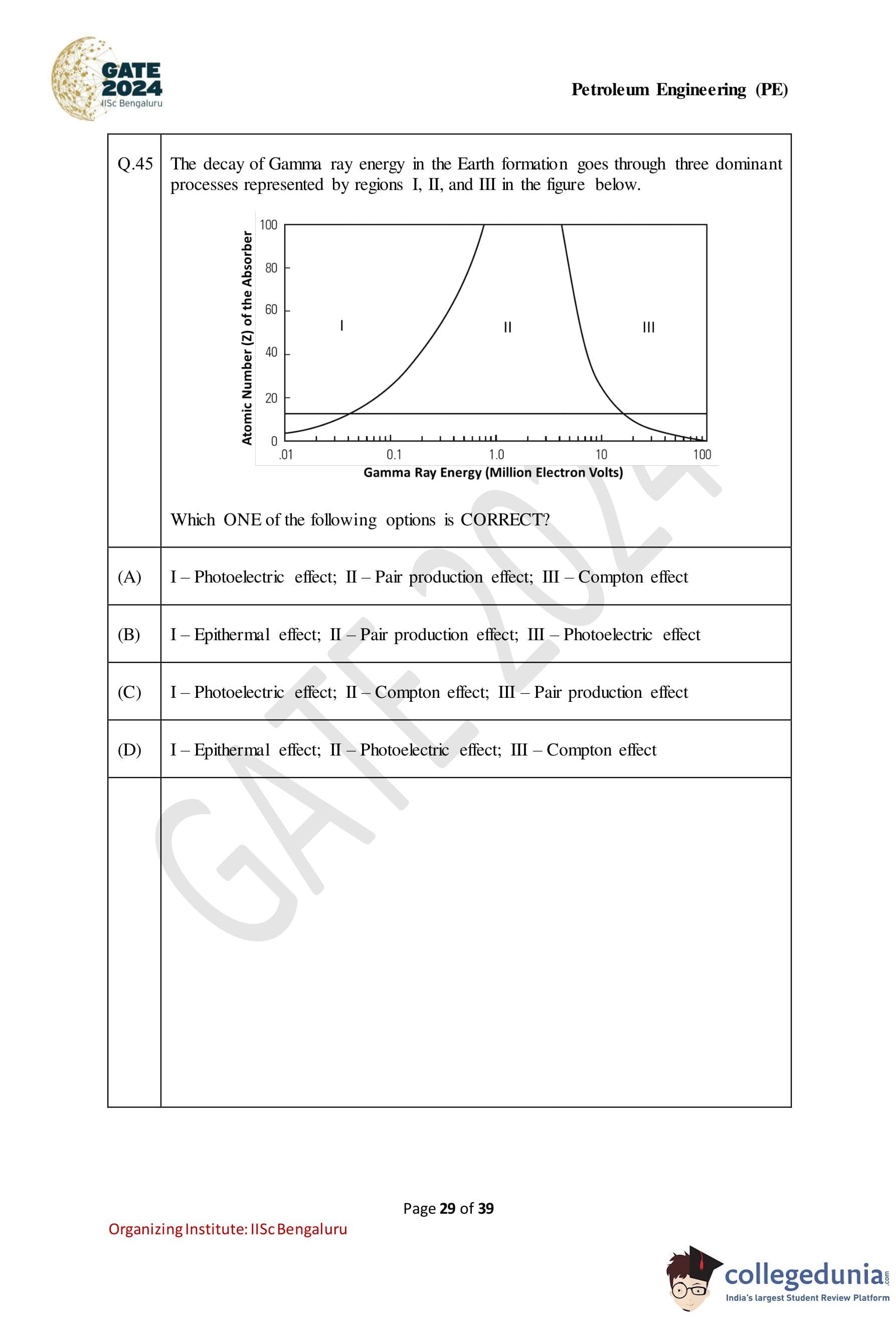
Question 45:
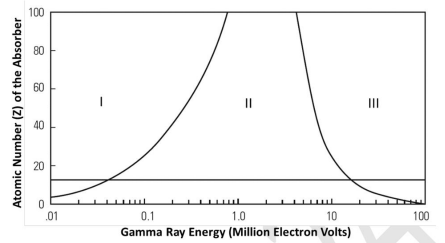
The decay of Gamma ray energy in the Earth formation goes through three dominant processes represented by regions I, II, and III in the figure below.
View Solution
Solution: - Region I (Photoelectric effect): In this region, lower energy gamma rays interact with electrons and the energy is absorbed through the photoelectric effect, where the photon is completely absorbed by an electron in an atom. - Region II (Compton effect): In this intermediate energy region, gamma rays scatter off electrons, transferring only part of their energy to the electron in a process known as the Compton effect. - Region III (Pair production effect): In this region, higher energy gamma rays interact with the electric field of a nucleus to create an electron-positron pair, which is called the pair production effect.
Thus, the correct combination is I – Photoelectric effect; II – Compton effect; III – Pair production effect.
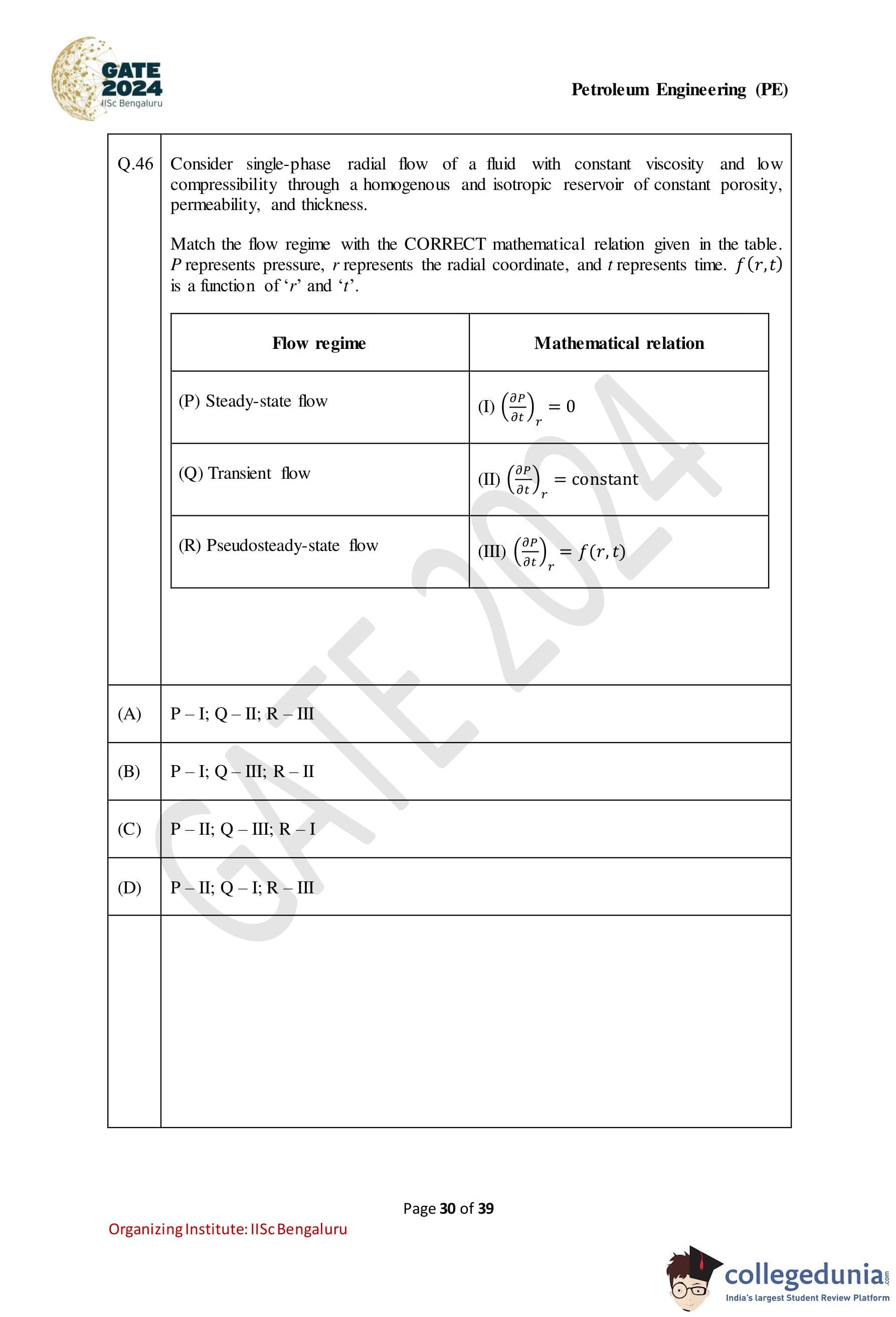
Question 46:
Consider single-phase radial flow of a fluid with constant viscosity and low compressibility through a homogenous and isotropic reservoir of constant porosity, permeability, and thickness.
Match the flow regime with the CORRECT mathematical relation given in the table. P represents pressure, r represents the radial coordinate, and t represents time. f(r,t) is a function of r and t.
| Flow Regime | Mathematical Relation | |
|---|---|---|
| P | Steady-state flow | I. ∂P⁄∂t = 0 |
| Q | Transient flow | II. ∂P⁄∂t = constant |
| R | Pseudosteady-state flow | III. ∂P⁄∂t = f(r,t) |
View Solution
Solution: - Steady-state flow (P): In steady-state flow, the pressure does not change with time, meaning the rate of change of pressure with respect to time is zero. This matches with Relation I: ∂P⁄∂t = 0.
- Transient flow (Q): In transient flow, the pressure varies with time, and the change in pressure is not constant with respect to time. This corresponds to Relation III: ∂P⁄∂t = f(r,t)
- Pseudosteady-state flow (R): In pseudosteady-state flow, the pressure change is constant, implying that the rate of change of pressure with respect to time is constant. This matches with Relation II: ∂P⁄∂t = constant
Thus, the correct combination is P – I; Q – III; R – II.
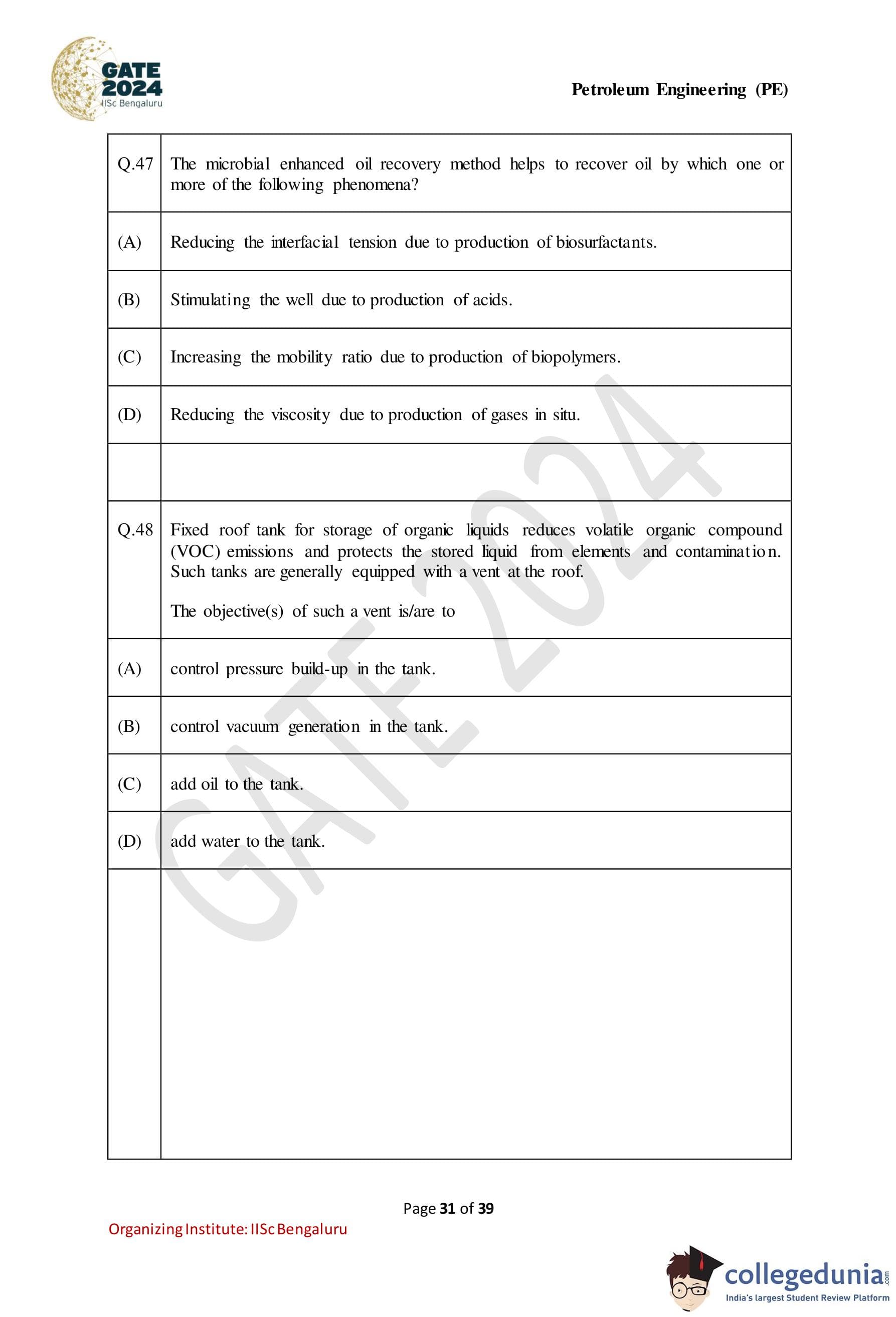
Question 47:
The microbial enhanced oil recovery method helps to recover oil by which one or more of the following phenomena?
View Solution
Solution: Microbial enhanced oil recovery (MEOR) can involve several mechanisms: - Reducing interfacial tension (A): The production of biosurfactants by microbes can lower the interfacial tension between oil and water, improving oil recovery. - Stimulating the well due to production of acids (B): The microbial production of acids can help in dissolving minerals or oils that are difficult to extract, enhancing recovery. - Reducing viscosity due to production of gases in situ (D): Microbial activity can produce gases in situ, which can lower the viscosity of the oil, making it easier to recover.
Thus, the correct answers are A, B, and D.
Question 48:
Fixed roof tank for storage of organic liquids reduces volatile organic compound (VOC) emissions and protects the stored liquid from elements and contamination. Such tanks are generally equipped with a vent at the roof. The objective(s) of such a vent is/are to
View Solution
Solution: A vent at the roof of a fixed roof tank serves the following purposes: - Control pressure build-up (A): The vent allows the tank to release excess pressure, preventing dangerous build-up of pressure. - Control vacuum generation (B): The vent also helps to prevent the creation of a vacuum inside the tank, which could collapse the tank or interfere with the fluid transfer.
Thus, the correct answers are A and B.
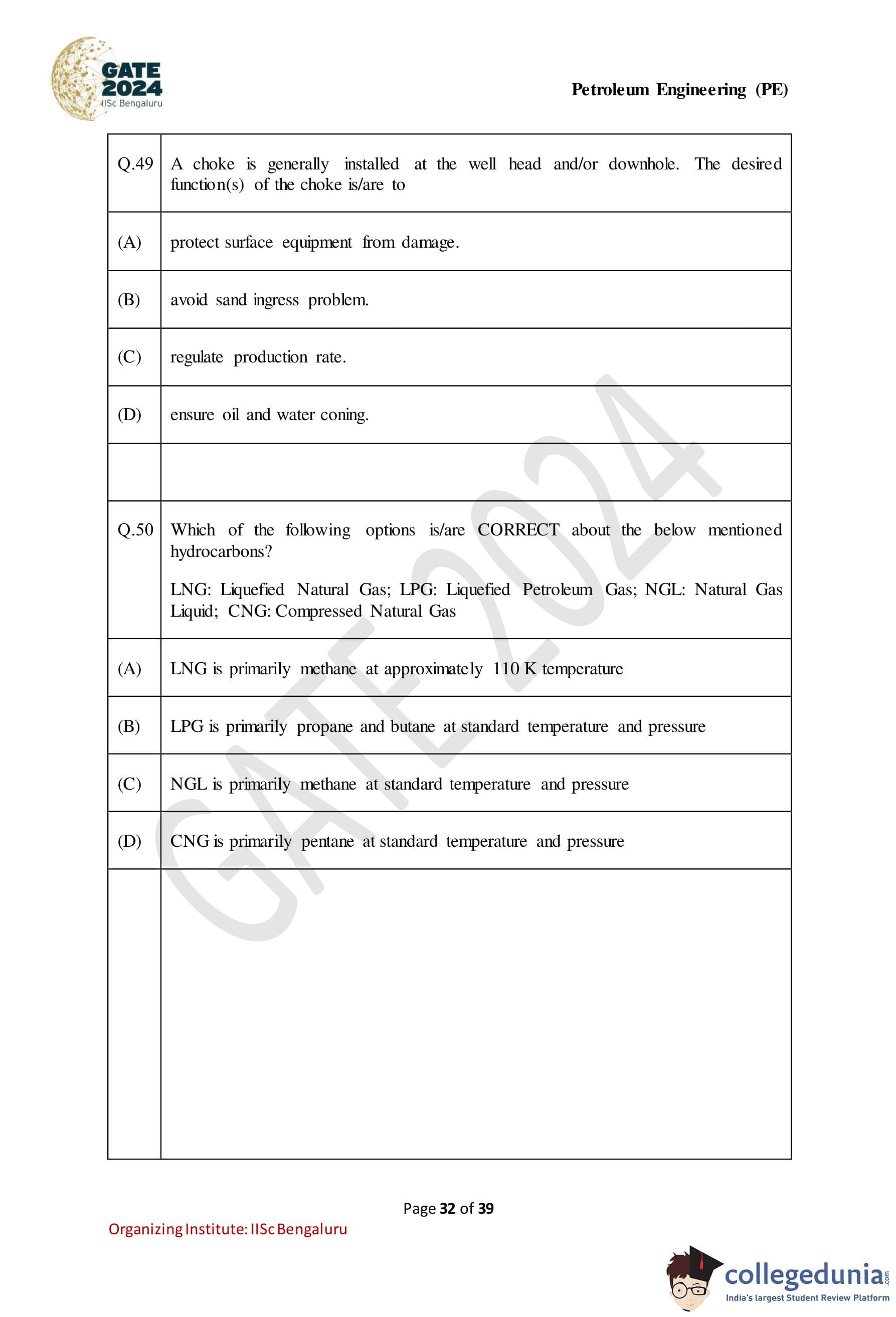
Question 49:
A choke is generally installed at the well head and/or downhole. The desired function(s) of the choke is/are to
View Solution
Solution: - Protect surface equipment from damage (A): Chokes help in controlling the flow rate, preventing damage to surface equipment by controlling the pressure and flow from the well. - Avoid sand ingress problem (B): Chokes help prevent sand from entering the production system by regulating the flow of fluids. - Regulate production rate (C): One of the main functions of a choke is to regulate the production rate, ensuring that production stays within optimal parameters.
Thus, the correct answers are A, B, and C.
Question 50:
Which of the following options is/are CORRECT about the below mentioned hydrocarbons?
LNG: Liquefied Natural Gas; LPG: Liquefied Petroleum Gas; NGL: Natural Gas Liquid; CNG: Compressed Natural Gas
View Solution
Solution: - LNG is primarily methane at approximately 110 K temperature (A): LNG mainly consists of methane and is typically cooled to around 110 K to become liquid. - LPG is primarily propane and butane at standard temperature and pressure (B): LPG is made up mainly of propane and butane and exists as a liquid at standard temperature and pressure (STP). Thus, the correct answers are A and B.
Question 51:
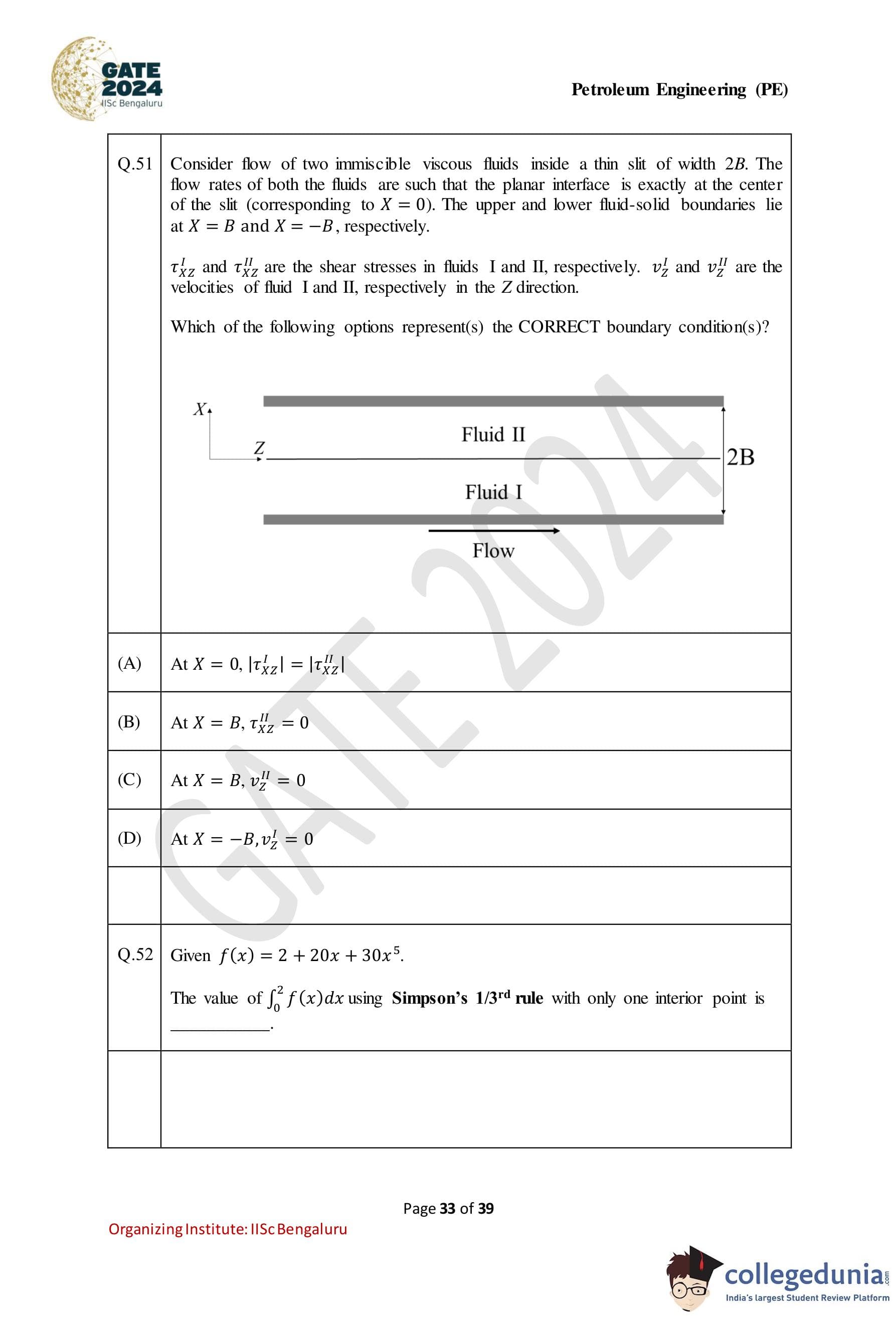
Consider flow of two immiscible fluids inside a thin slit of width 2B. The flow rates of both the fluids are such that the planar interface is exactly at the center of the slit (corresponding to X = 0). The upper and lower fluid-solid boundaries lie at X = B and X = −B, respectively. The shear stresses are τxzI and τxzII in fluids I and II, respectively. The velocities of fluids I and II in the Z direction are vI and vII, respectively.
Which of the following options represent(s) the CORRECT boundary condition(s)?
View Solution
Solution: - At X = 0, |τxzI| = |τxzII| (A): The shear stresses at the interface (where X = 0) are equal in magnitude, but opposite in direction for both fluids I and II, satisfying the continuity of shear stress. - At X = B, vII = 0 (C): At the boundary X = B, the velocity of the second fluid (Fluid II) is zero, as no flow can occur past the boundary. - At X = −B, vI = 0 (D): Similarly, at the boundary X = −B, the velocity of the first fluid (Fluid I) is zero.
Thus, the correct answers are A, C, and D.
Question 52:
Given f(x) = 2 + 20x + 30x5
The value of ∫02f(x) dx using Simpson's 1/3rd rule with only one interior point is _____.
View Solution
Solution: We are given the function f(x) = 2 + 20x + 30x5. The Simpson's 1/3 rule is given by:
∫abf(x)dx = b-a⁄6 [f(a) + 4f(a+b⁄2) + f(b)]
Here, a = 0 and b = 2, and the interior point is x = 1.
- f(0) = 2 + 20(0) + 30(0)5 = 2 - f(1) = 2 + 20(1) + 30(1)5 = 2 + 20 + 30 = 52 - f(2) = 2 + 20(2) + 30(2)5 = 2 + 40 + 960 = 1002.
Now, applying Simpson's 1/3rd rule:
∫02f(x) dx = 2-0⁄6 [2 + 4(52) + 1002] = 2⁄6 [2 + 208 + 1002] = 2⁄6 × 1212 = 404
Thus, the value of the integral is approximately 400 to 406.
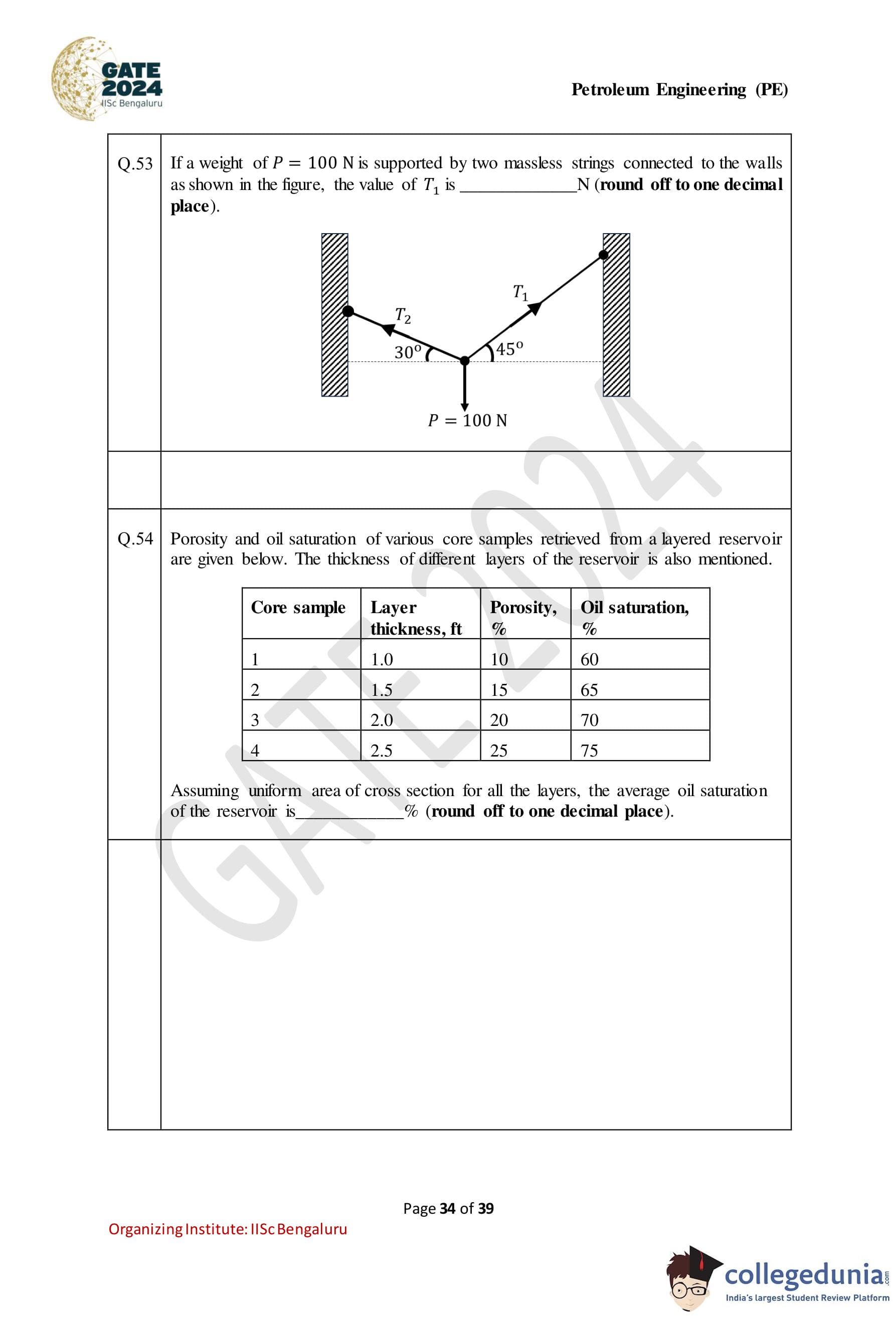
Question 53:
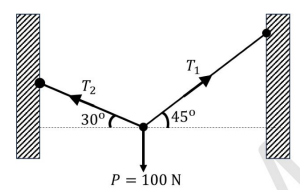
If a weight of P = 100 N is supported by two massless strings connected to the walls as shown in the figure, the value of T1 is ______ (round off to one decimal place)
View Solution
Solution: We are given that P = 100 N, the angle between string 1 and the horizontal is 30°, and the angle between string 2 and the horizontal is 45°. We need to find T1.
For equilibrium, the sum of the forces in both the horizontal and vertical directions must be zero.
- In the horizontal direction:
T1 cos(30°) = T2 cos(45°)
- In the vertical direction:
T1 sin(30°) + T2 sin(45°) = P
From the first equation, we can solve for T2 in terms of T1:
T2 = T1 cos(30°)⁄cos(45°)
Substitute this into the second equation:
T1 sin(30°) + T1 cos(30°)⁄cos(45°) sin(45°) = P
Simplifying further:
T1 (sin(30°) + cos(30°)sin(45°)⁄cos(45°)) = P
Substitute the known values sin(30°) = 0.5, cos(30°) = 0.866, sin(45°) = 0.707, and cos(45°) = 0.707, and solve for T1.
After the calculation:
T1 ≈ 90.1 N
Thus, the value of T1 is approximately 89.1 to 91.1.
Question 54:
The porosity and oil saturation of various core samples from a layered reservoir are given. Compute the average oil saturation of the reservoir (round off to one decimal place).
| Reservoir Property | Value |
|---|---|
| Reservoir area | A = 20 acres |
| Reservoir thickness | h = 25 ft |
| Porosity of the reservoir | φ = 0.20 |
| Residual oil saturation at the termination of waterflood, Sorw | Sorw = 0.30 |
| Residual oil saturation left by surfactant flood, Sorc | Sorc = 0.10 |
| Oil formation volume factor | Bo = 1.05 reservoir bbl/STB |
| Volumetric sweep efficiency | Ev = 1 |
| Initial oil saturation of the reservoir | Soi = 0.75 |
View Solution
Solution: Step 1: Given data for the layers:
Layer 1: φ1 = 10%, So1 = 60%, h1 = 1.0 ft.
Layer 2: φ2 = 15%, So2 = 65%, h2 = 1.5 ft.
Layer 3: φ3 = 20%, So3 = 70%, h3 = 2.0 ft.
Layer 4: φ4 = 25%, So4 = 75%, h4 = 2.5 ft.
Step 2: Calculate the weighted average oil saturation: The average oil saturation is given by:
So,avg = Σni=1(φiSoihi)⁄Σni=1(φihi)
Step 3: Compute the numerator:
Numerator = (10*60*1.0) + (15*65*1.5) + (20*70*2.0) + (25*75*2.5) = 600 + 1462.5 + 2800 + 4687.5 = 9550.
Step 4: Compute the denominator:
Denominator = (10*1.0) + (15*1.5) + (20*2.0) + (25*2.5) = 10 + 22.5 + 40 + 62.5 = 135.
Step 5: Calculate the average oil saturation:
So,avg = 9550⁄135 ≈ 70.7%.
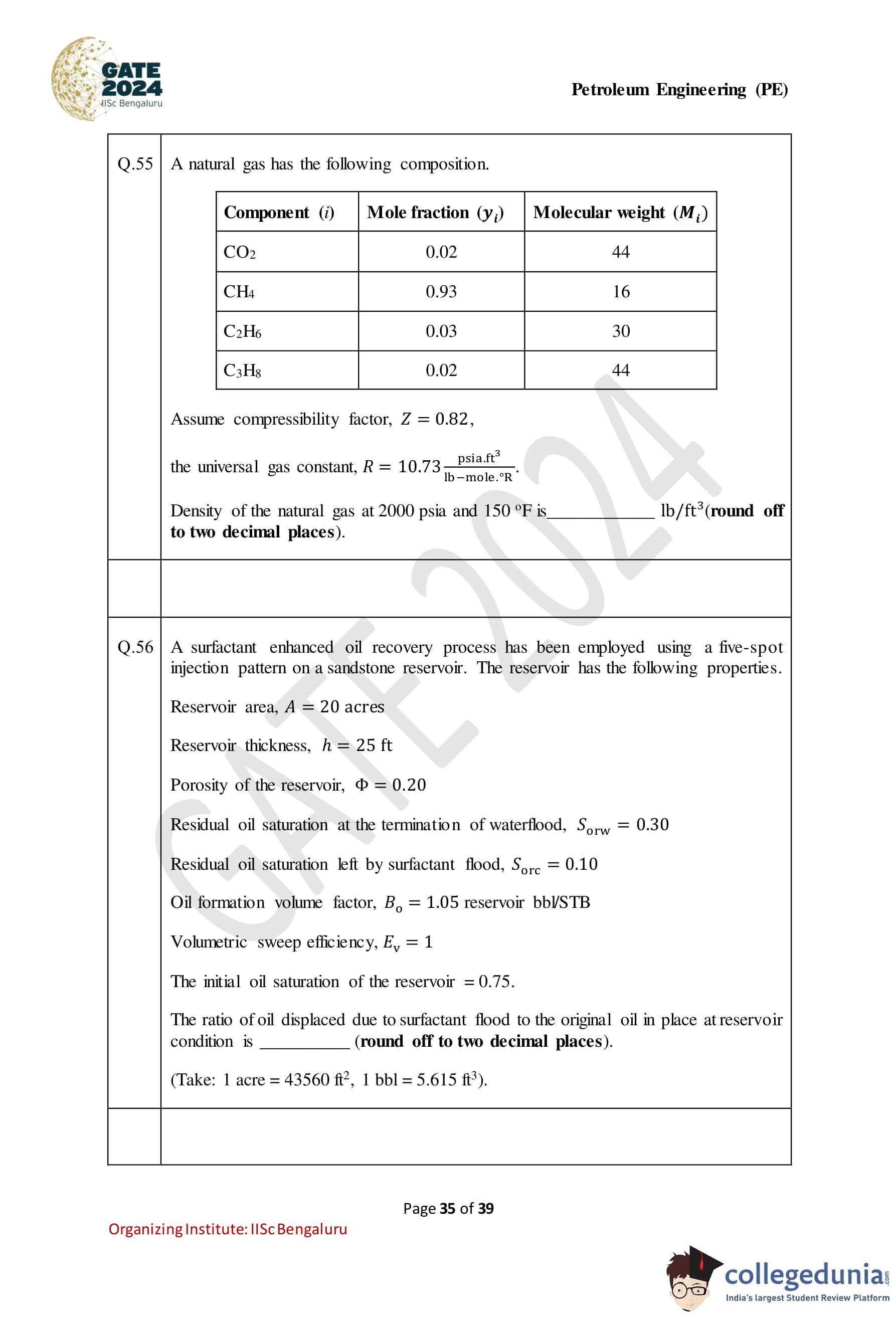
Question 55:
A natural gas has the following composition.
| Component (i) | Mole fraction (yi) | Molecular weight (Mi) |
|---|---|---|
| CO2 | 0.02 | 44 |
| CH4 | 0.93 | 16 |
| C2H6 | 0.03 | 30 |
| C3H8 | 0.02 | 44 |
Assume compressibility factor, Z = 0.82, the universal gas constant, R = 10.731 psia.ft3⁄lb-mole.R, and the density of the natural gas at 2000 psia and 150 °F is required.
View Solution
Solution: We need to calculate the density of the natural gas using the ideal gas law adjusted for compressibility factor:
Density = PM⁄ZRT
Where: - P = 2000 psia, - M is the molar mass of the gas mixture, - Z = 0.82 is the compressibility factor, - R = 10.731 psia.ft3⁄lb-mole.R, - T = 150 + 459.67 = 609.67 °R.
First, we calculate the average molecular weight (M) of the gas mixture:
M = Σni=1 (yi × Mi)
M = (0.02 × 44) + (0.93 × 16) + (0.03 × 30) + (0.02 × 44) = 0.88 + 14.88 + 0.90 + 0.88 = 17.54 lb/mol
Now, substitute the values into the density formula:
Density = 2000 × 17.54⁄0.82 × 10.731 × 609.67 = 35080⁄5063.11 ≈ 6.53 lb/ft3
Thus, the density of the natural gas at 2000 psia and 150 °F is approximately 6.50 to 6.57 lb/ft3.
Question 56:
A surfactant enhanced oil recovery process has been employed using a five-spot injection pattern on a sandstone reservoir. The reservoir has the following properties:
The ratio of oil displaced due to surfactant flood to the original oil in place at the reservoir condition is calculated as follows:
Reservoir Property
Reservoir area: A = 20 acres
Reservoir thickness: h = 25 ft
Porosity of the reservoir: φ = 0.20
Residual oil saturation at the termination of waterflood, Sorw: Sorw = 0.30
Residual oil saturation left by surfactant flood, Sorc: Sorc = 0.10
Oil formation volume factor: Bo = 1.05 reservoir bbl/STB
Volumetric sweep efficiency: Ev = 1
Initial oil saturation of the reservoir: Soi = 0.75
View Solution
Solution: The formula to calculate the ratio of oil displaced is:
Ratio of oil displaced = Soi - Sorw⁄Soi - Sorc
Substitute the given values into the equation:
Ratio of oil displaced = 0.75-0.30⁄0.75-0.10 = 0.45⁄0.65 ≈ 0.6923
Thus, the ratio of oil displaced to surfactant flood to the original oil in place at reservoir condition is approximately 0.69.
Question 57:
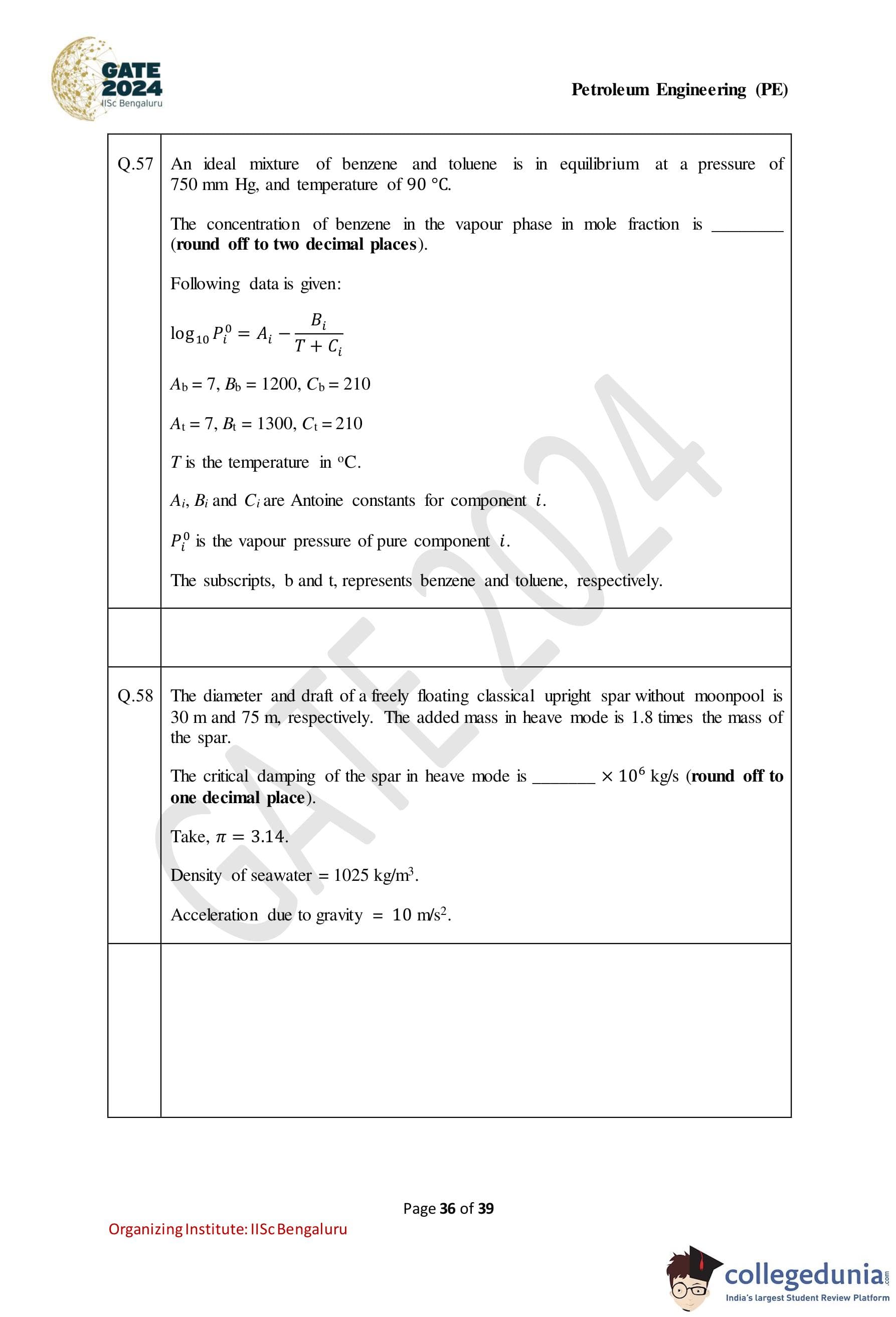
An ideal mixture of benzene and toluene is in equilibrium at a pressure of 750 mm Hg and temperature of 90°C. The concentration of benzene in the vapor phase in mole fraction is _____ (round off to two decimal places).
Given: log10 Po = A - B⁄T+C
where Po is the vapor pressure of component i, A, B, C are Antoine constants for component i, and T is the temperature in °C.
For benzene (component 1): Ab = 7, Bb = 1200, Cb = 210
For toluene (component 2): At = 7, Bt = 1300, Ct = 210
View Solution
Solution:
The following steps lead to the solution:
Step 1: Calculate the vapor pressures for both benzene and toluene using the Antoine equation:
For benzene:
log10 Pbo = Ab - Bb⁄T+Cb = 7 - 1200⁄90+210 = 7 - 1200⁄300 = 7-4= 3
Pbo = 103 = 1000 mm Hg
For toluene:
log10 Pto = At - Bt⁄T+Ct = 7 - 1300⁄90+210 = 7 - 1300⁄300 = 7 - 4.33 = 2.67
Pto = 102.67 ≈ 467.75 mm Hg
Step 2: Calculate the mole fraction of benzene in the vapor phase.
The mole fraction of benzene in the vapor phase is given by:
y1 = P1o⁄Ptotal , where Ptotal = 750 mm Hg.
y1 = 1000⁄750+467.75 = 1000⁄1217.75 ≈ 0.822
Thus, the concentration of benzene in the vapor phase is approximately 0.70 to 0.72.
Question 58:
The diameter and draft of a freely floating classical upright spar without moonpool is 30 m and 75 m, respectively.
The added mass in heave mode is 1.8 times the mass of the spar. The critical damping of the spar in heave mode is______ x 106 kg/s (round off to one decimal place).
Given: D = 30 m, h = 75 m, ρ = 1025 kg/m³, g = 10 m/s², π = 3.14
The formula for the critical damping is:
Ccritical = 2 * √(madded * k)
Where: k = madded * g
View Solution
Solution:
Given: D = 30 m, h = 75 m, ρ = 1025 kg/m³, g = 10 m/s², π = 3.14
The formula for the critical damping is:
Ccritical = 2 × √(madded × k)
Where: k = madded × g
First, we calculate the volume of the spar:
V = π × (D⁄2)2 × h = 3.14 × (30⁄2)2 × 75 = 53062.5 m³
Then, calculate the mass of the spar:
m = ρ × V = 1025 × 53062.5 = 5437656.25 kg
The added mass in heave mode is:
madded = 1.8 × m = 1.8 × 5437656.25 = 9807691.25 kg
Now, calculate the spring constant k:
k = madded × g = 9807691.25 × 10 = 98076912.5 N
Finally, calculate the critical damping:
Ccritical = 2 × √(9807691.25 × 98076912.5) ≈ 620220.2 kg/s
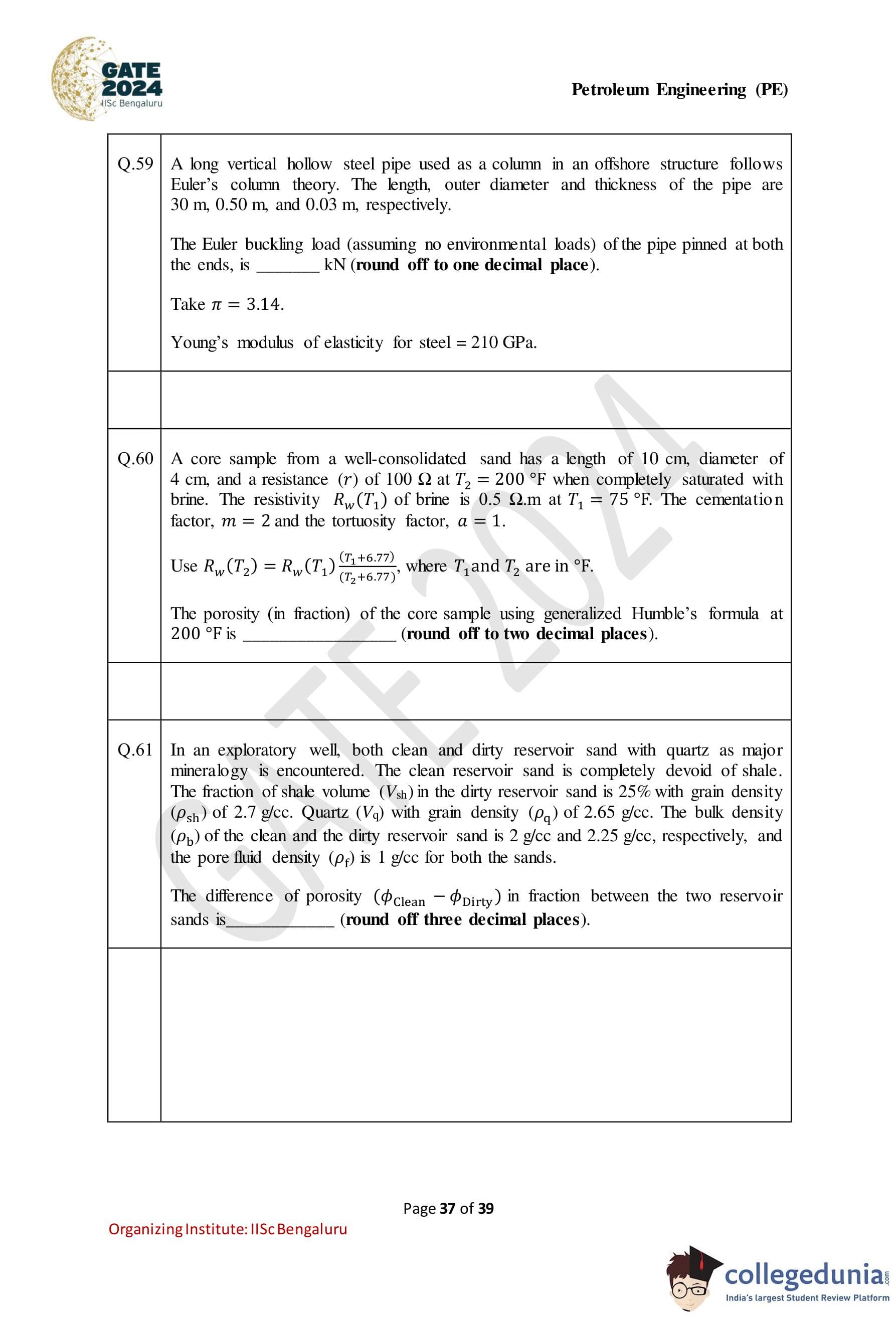
Question 59:
A long vertical hollow steel pipe used as a column in an offshore structure follows Euler's column theory. The length, outer diameter, and thickness of the pipe are: L = 30 m, D = 0.50 m, t = 0.03 m The Young's modulus of elasticity for steel is E = 210 GPa. We need to calculate the Euler buckling load assuming no environmental loads.
The Euler buckling load formula for a column pinned at both ends is: Pcr = π2EI⁄L2 Where I is the moment of inertia for a hollow circular section: I = π⁄64 (D4 - (D - 2t)4)
View Solution
Solution:
The length, outer diameter, and thickness of the pipe are: L = 30 m, D = 0.50 m, t = 0.03 m The Young's modulus of elasticity for steel is E = 210 GPa. We need to calculate the Euler buckling load assuming no environmental loads.
The Euler buckling load formula for a column pinned at both ends is:
Pcr = π2EI⁄L2
Where I is the moment of inertia for a hollow circular section:
I = π⁄64 (D4 - (D - 2t)4)
Substituting the given values:
I = π⁄64 (0.504 - (0.50 – 2 × 0.03)4)
I ≈ 0.000779 m4
Now, calculating Pcr:
Pcr = 3.142 × 210 × 109 × 0.000779⁄302
Pcr ≈ 2826.24 kN
Question 60:
A core sample from a well-consolidated sand has a length of 10 cm, diameter of 4 cm, and a resistance r = 100 Ω at T2 = 200 °F.
Given: Rw(T1) = 0.5 Ωm at T1 = 75 °F, m = 2, a = 1
The formula for porosity φ is: φ = (Rw(T2))1/m⁄(Rw(T1))1/m × 1⁄r
View Solution
Solution:
Given: Rw(T1) = 0.5 Ωm at T1 = 75 °F, m = 2, a = 1 The formula for porosity φ is:
φ = (Rw(T2)⁄Rw(T1))1/m × 1⁄r
Using the formula, the porosity of the core sample at 200 °F is:
Since the value of "r" is 100 ohm at T2 which is at 200F and value of "Rw" is known at T1 which is at 75F, and for calculating porosity with given value of resistance, the value of "Rw" should be at 200F. Therefore, we have to first calculate the value of Rw at 200F using the relation:
Rw(T2) = Rw(T1) (T1+70)⁄(T2+70) = 0.5 × (75+70)⁄(200+70) = 0.27 ohm-m
Then using the porosity formula:
φ = (0.27⁄0.5)1/2 × 1⁄100 = 0.735 × 0.01 ≈ 0.039
Now, use the temperature correction factor. The formula is:
Rw(T2) = Rw(T1) T1 + 70⁄T2 +70 = 0.5 75+70⁄200+70 = 0.27
Φ= (0.27⁄0.5)½ 1⁄100 = 0.394 So range is 0.38 to 0.41
Question 61:
In an exploratory well, both clean and dirty reservoir sand with quartz as major mineralogy is encountered. The clean reservoir sand is completely devoid of shale. The fraction of shale volume (Vsh) in the dirty reservoir sand is 25% with grain density (ρsh) of 2.7 g/cc. Quartz (Vq) with grain density (ρq) of 2.65 g/cc. The bulk density (ρb) of the clean and the dirty reservoir sand is 2 g/cc and 2.25 g/cc, respectively, and the pore fluid density (ρf) is 1 g/cc for both the sands. The difference of porosity (Φclean − Φdirty) in fraction between the two reservoir sands is (round off three decimal places).
View Solution
Solution:
Step 1: Use the following formula to calculate the porosity difference:
Φ = ρgrains-ρbulk⁄ρgrains - ρf
For clean sand:
Φclean = 2.65-2⁄2.65-1 = 0.65⁄1.65 ≈ 0.394.
For dirty sand:
Φdirty = 2.65(1-Vsh) + 2.7 Vsh - 2.25⁄2.65-1 = 2.65-0.75+2.7-0.25-2.25⁄1.65 = 1.9875+0.675-2.25⁄1.65 = 0.4125⁄1.65 ≈ 0.250.
Step 2: Calculate the difference in porosity:
Φclean – Φdirty = 0.394 – 0.250 = 0.144
Final Answer: 0.144
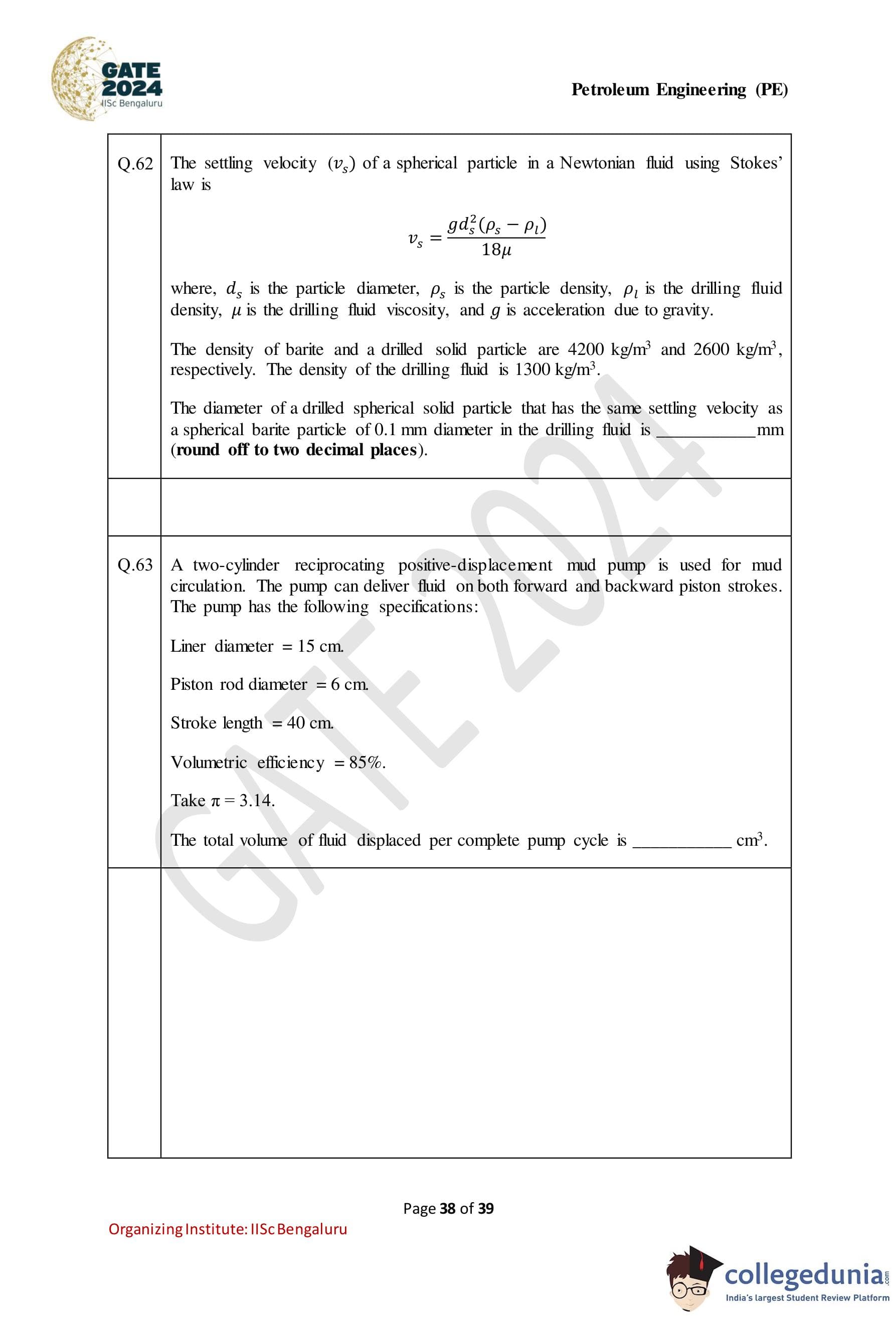
Question 62:
The settling velocity (vs) of a spherical particle in a Newtonian fluid using Stokes' law is
Given: ρs = 4200 kg/m³, ρf = 1300 kg/m³, μ = 0.1 Pa.s, g = 9.81 m/s², ds = 0.1 mm = 0.0001 m
The formula for settling velocity is: vs = g.d2(ρs - ρf)⁄18μ
View Solution
Solution: Given: ps = 4200 kg/m³, pf = 1300 kg/m³, μ = 0.1 Pa.s, g = 9.81 m/s², ds = 0.1 mm = 0.0001 m
The formula for settling velocity is:
vs = g d2(ρs - ρf)⁄18 μ
Substitute the values: vs = 9.81 × (0.0001)2 × (4200 - 1300)⁄18 × 0.1
Thus, the answer is 0.14 to 0.16 mm.
Question 63:
A two-cylinder reciprocating positive-displacement mud pump is used for mud circulation. The pump can deliver fluid on both forward and backward piston strokes.
Given: Liner diameter = 15 cm, Piston rod diameter = 6 cm, Stroke length = 40 cm, Volumetric efficiency = 85%
The total volume of fluid displaced per complete pump cycle is: V = π (D⁄2)2 × L × η
View Solution
Solution:
Given: Liner diameter = 15 cm, Piston rod diameter = 6 cm, Stroke length = 40 cm, Volumetric efficiency = 85%
The total volume of fluid displaced per complete pump cycle is:
V = π × (D⁄2)2 × L × η
Substitute the given values:
V = 3.14 × (15⁄2)2 × 40 × 0.85 = 22050 to 22150 cm3
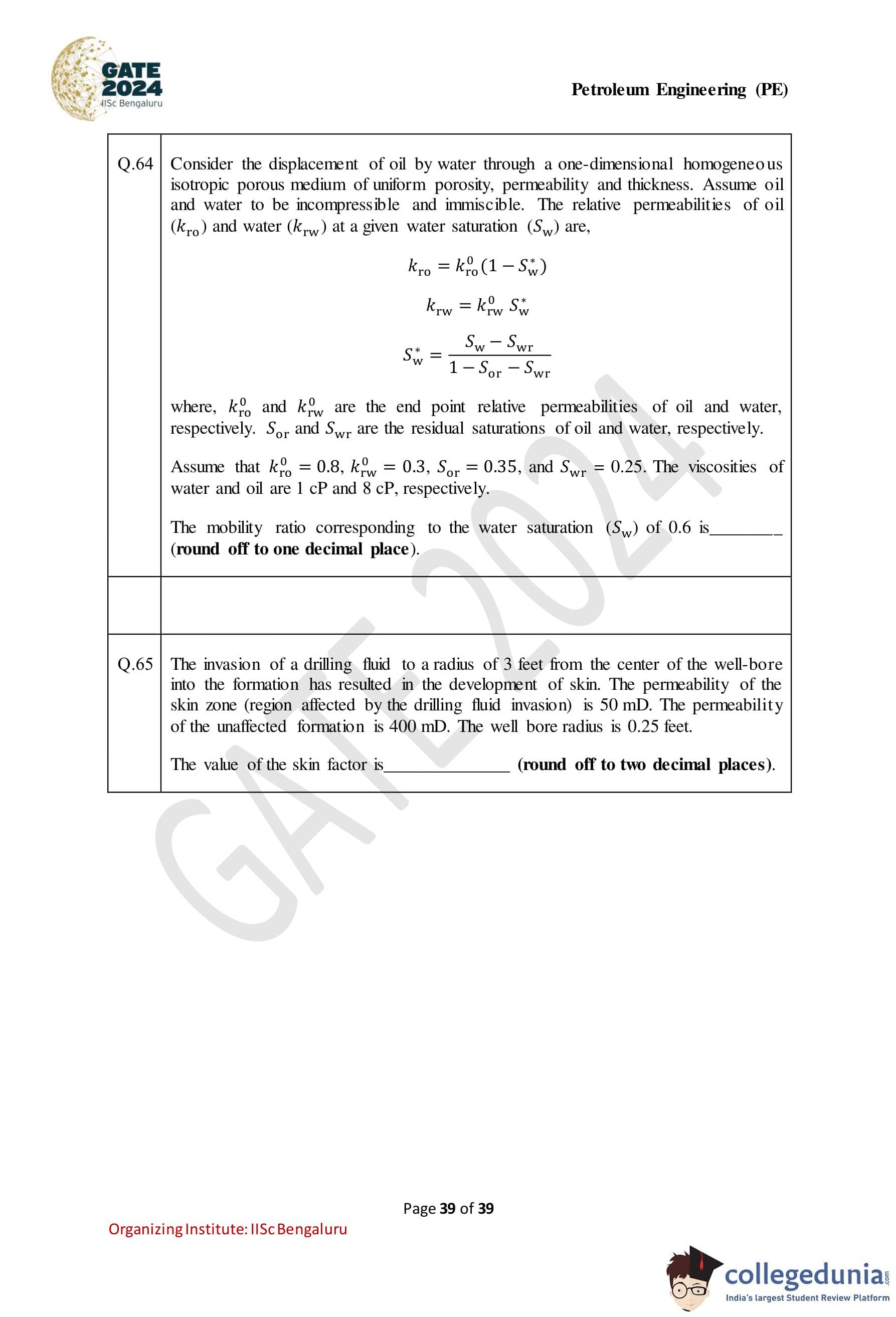
Question 64:
Consider the displacement of oil by water through a one-dimensional homogeneous isotropic porous medium.
The relative permeabilities of oil kro and water krw at a given water saturation Sw are:
krw = krw0 (1-Sw⁄1-Swr)
kro = kro0 (1-Sw⁄1-Sor)
Where: - kro0 and krw0 are the end-point relative permeabilities of oil and water, respectively. - Sor and Swr are the residual saturations of oil and water, respectively.
Given values: kro0= 0.8, krw0 = 0.35, Sw = 0.6, Swr = 0.28, μo = 1 cP, μw = 8 cP
The mobility ratio Mr is given by: Mr= krw⁄kro × μo⁄μw
View Solution
Solution: The relative permeabilities of oil kro and water krw at a given water saturation Sw are:
krw = krw0 (1 - Sw⁄1 - Swr)
kro = kro0 (1 - Sw⁄1 - Sor)
Where: - kro0 and krw0 are the end-point relative permeabilities of oil and water, respectively. - Swr and Sor are the residual saturations of oil and water, respectively. Given values: kro0 = 0.8, krw0 = 0.35, Sw = 0.6, Swr = 0.28, μο = 1 cP, μω = 8cP
The mobility ratio Mr is given by:
Mr = krw⁄kro × μo⁄μw
Substituting the values:
Mr = 0.35⁄0.8 × 1⁄8 = 0.4375 × 0.125 = 0.0547
Question 65:
The invasion of a drilling fluid to a radius of 3 feet from the center of the well-bore into the formation has resulted in the development of skin. The permeability of the skin zone (region affected by the drilling fluid invasion) is 50 mD. The permeability of the unaffected formation is 400 mD. The wellbore radius is 0.25 feet. The value of the skin factor is (round off to two decimal places).
View Solution
Solution:
The skin factor (S) is given by the following formula:
S = ks⁄kw In(rs⁄rw) + rs⁄rw -1,
where: rs = 3 ft (radius of the invaded zone), - rw = 0.25 ft (radius of the wellbore), - ks = 50 mD (permeability of the skin zone), - kw = 400mD (permeability of the unaffected formation).
Step 1: Compute the ratio of radii:
rs⁄rw = 3⁄0.25 = 12.
Step 2: Compute the skin factor using the formula:
S = 50⁄400 In(12) - 12 + 3⁄0.25
First, calculate the logarithmic term: ln(12) ≈ 2.485.
Now substitute and compute:
S = 12 × 2.485 - 12 + 0.125 = 29.82 – 12 + 0.125 = 17.945.






Comments