




GATE 2024 Philosophy (XH-C4) Question Paper PDF is available here. IISc Banglore conducted GATE 2024 Philosophy (XH-C4) exam on February 4 in the Forenoon Session from 9:30 AM to 12:30 PM. Students have to answer 65 questions in GATE 2024 Philosophy (XH-C4) Question Paper carrying a total weightage of 100 marks. 10 questions are from the General Aptitude section and 55 questions are from Core Discipline.
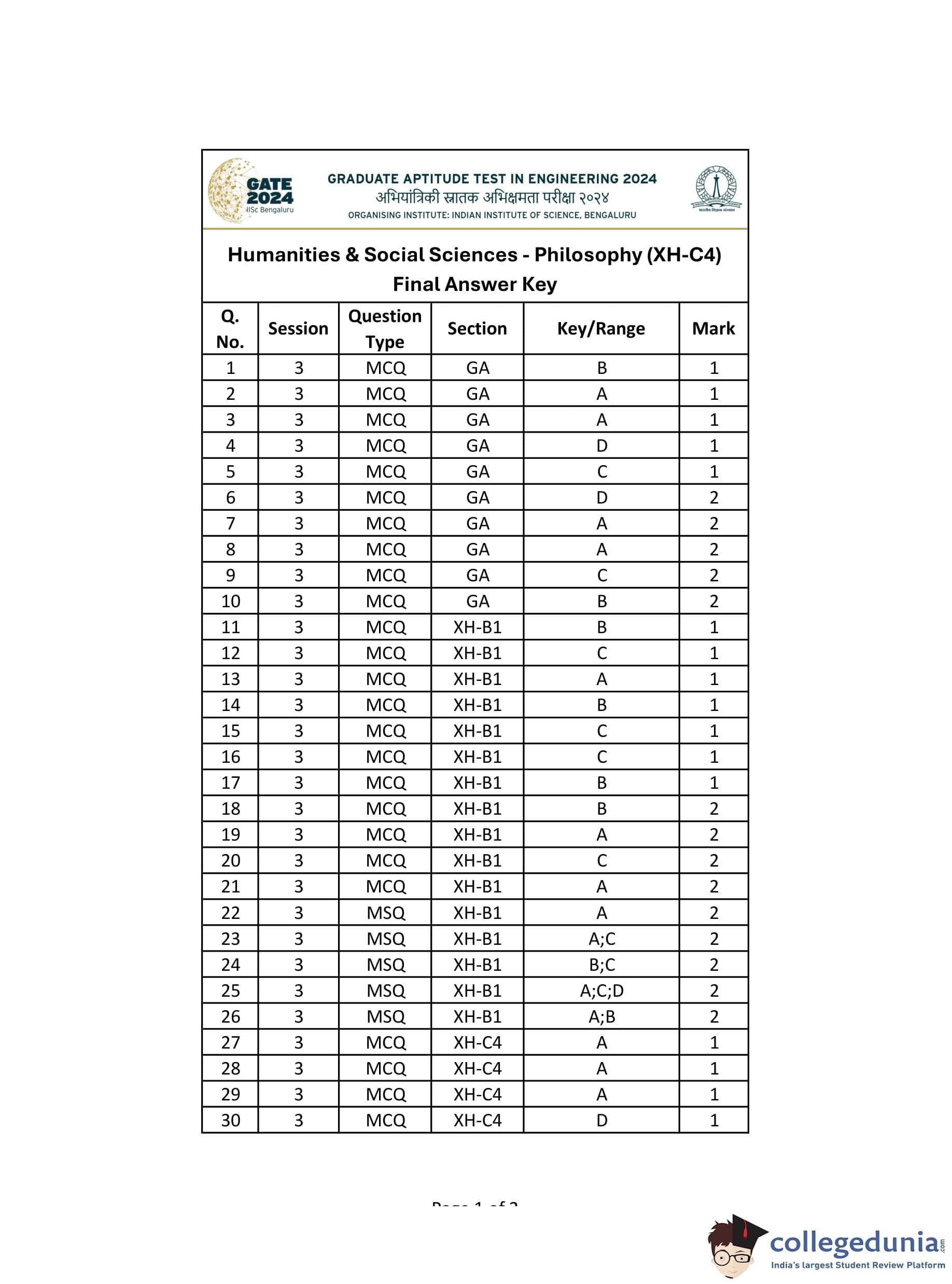
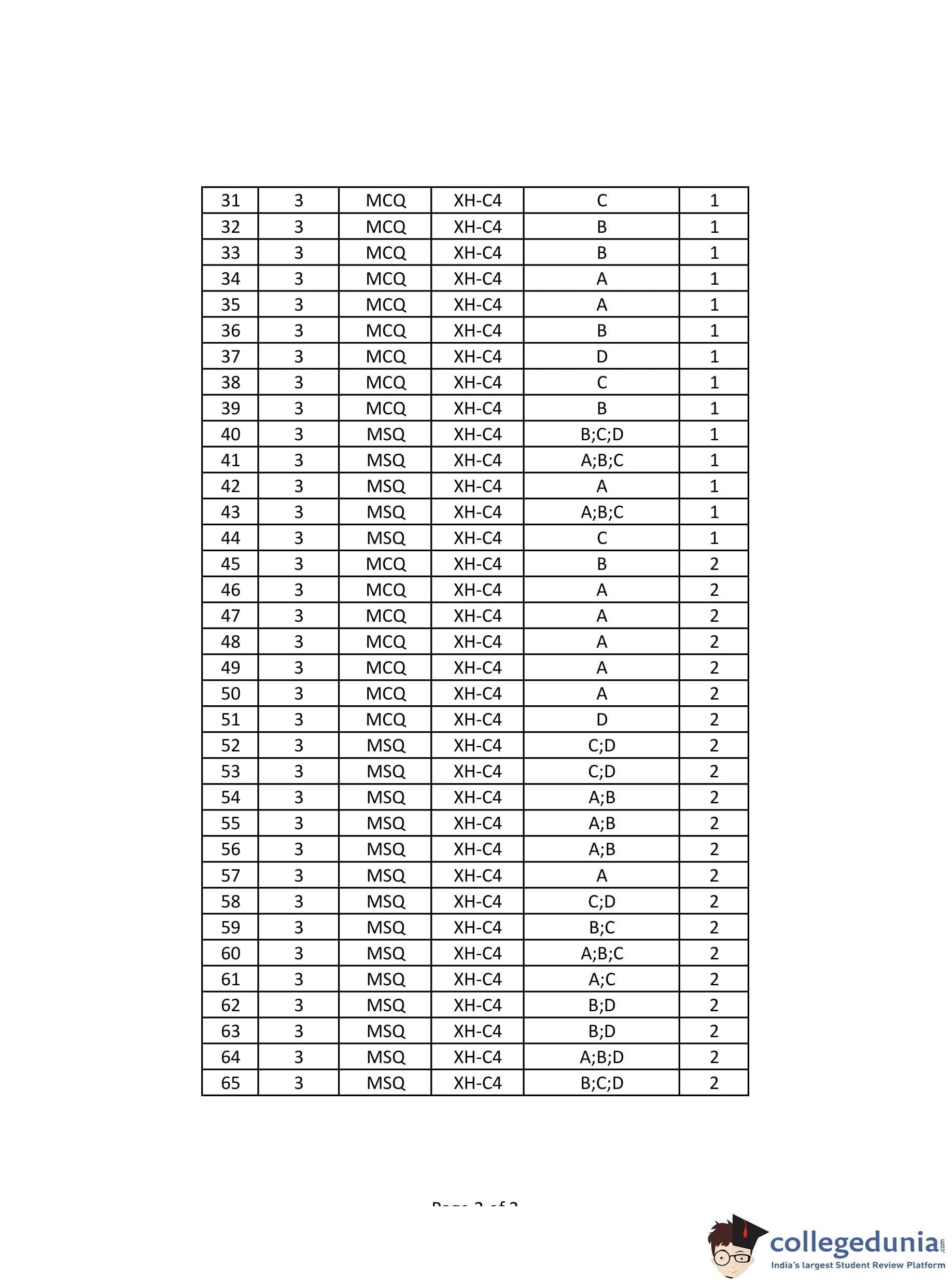
GATE 2024 Philosophy (XH-C4) Question Paper with Answer Key PDF
| GATE 2024 CSE Question Paper PDF |  Download Download |
Check Solutions |
GATE 2024 Philosophy (XH-C4) Solution
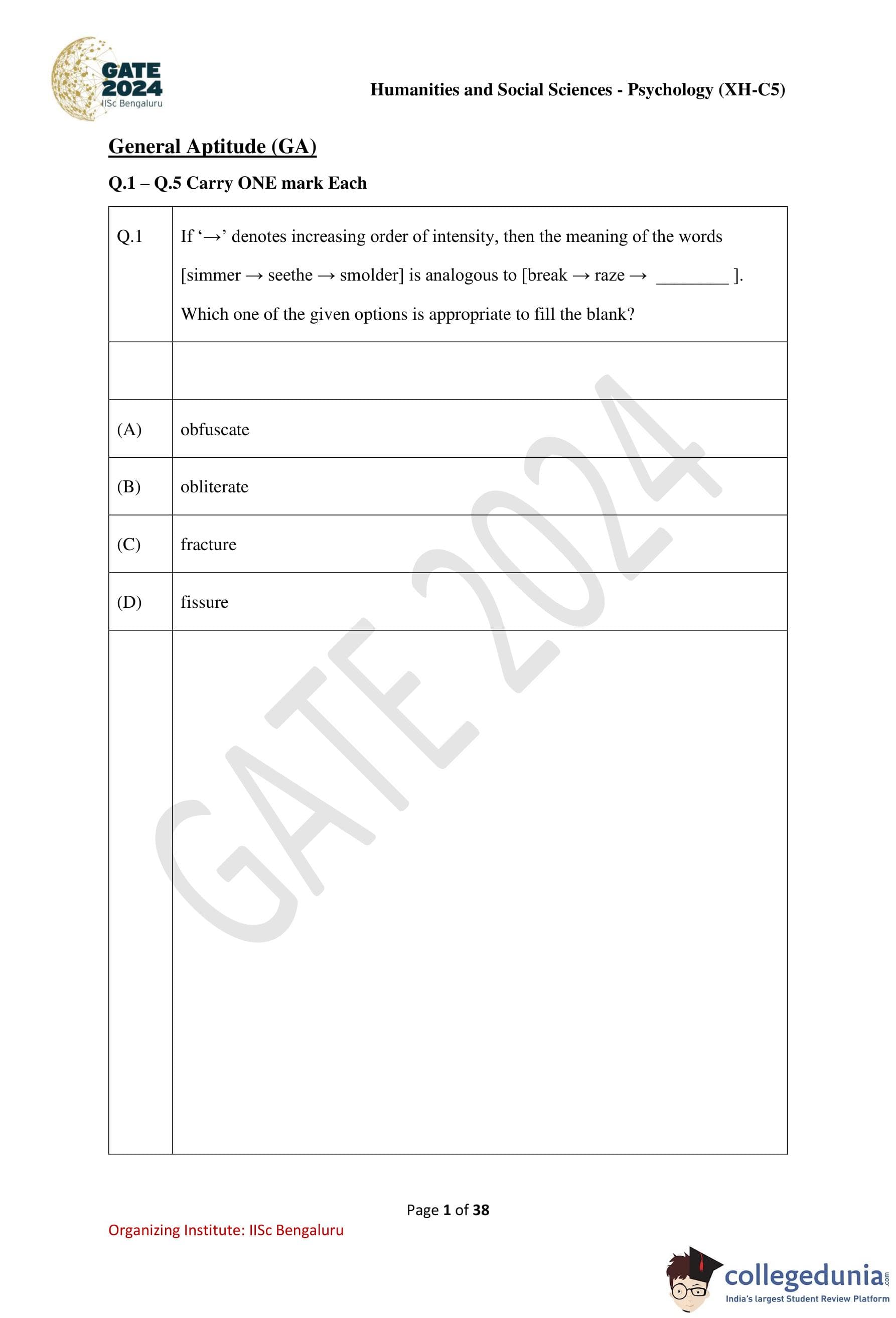
Question 1:
If “—” denotes increasing order of intensity, then the meaning of the words [simmer — seethe — smolder] is analogous to [break — raze — ]. Which one of the given options is appropriate to fill the blank?
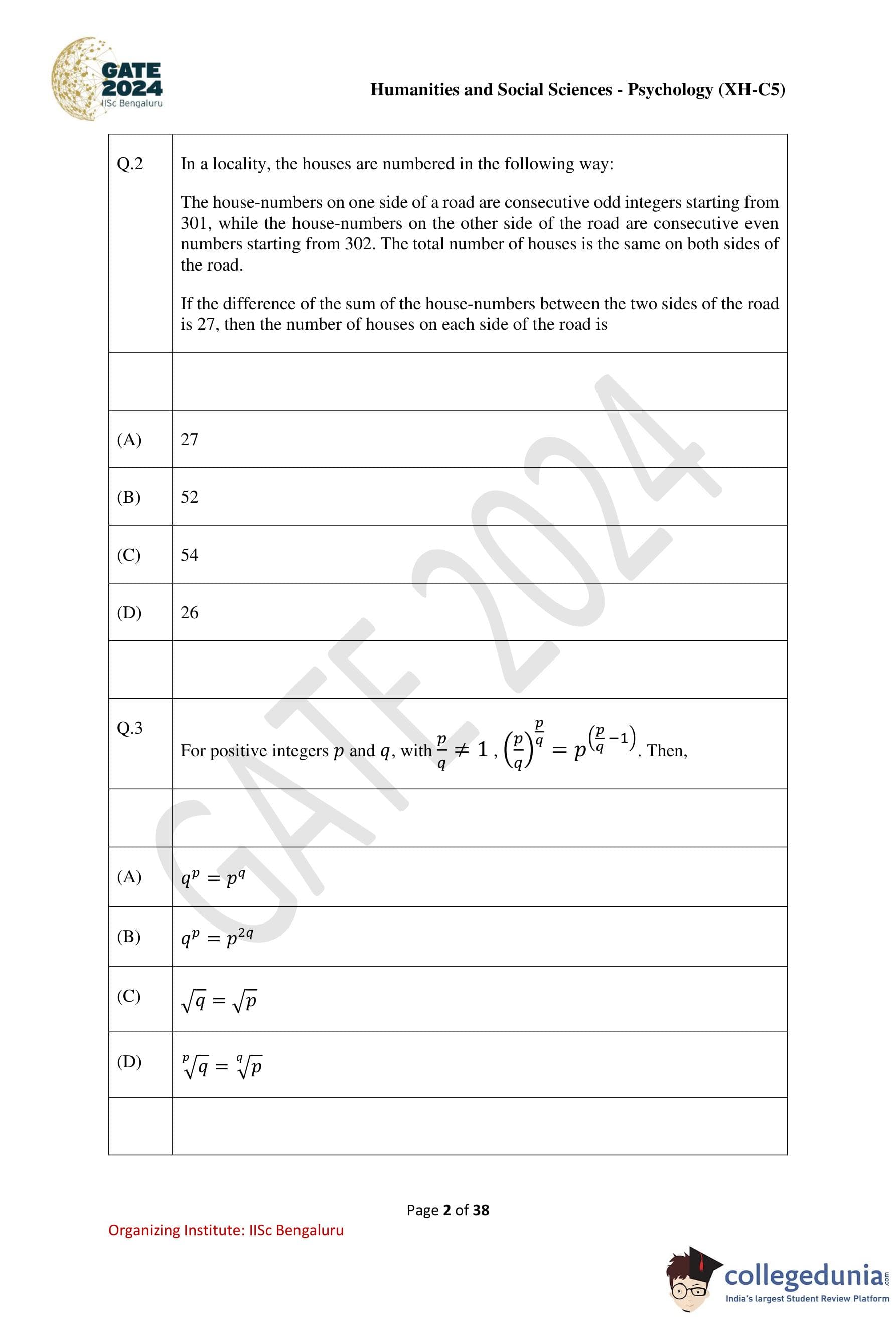
Question 2:
In a locality, the houses are numbered in the following way: The house-numbers on one side of a road are consecutive odd integers starting from 301, while the house-numbers on the other side of the road are consecutive even numbers starting from 302. The total number of houses is the same on both sides of the road. If the difference of the sum of the house-numbers between the two sides of the road is 27, then the number of houses on each side of the road is:
Question 3:
For positive integers p and q, with p/q ≠ 1,
(p/q)p/q = (p/q)(p/q - 1).
Then:
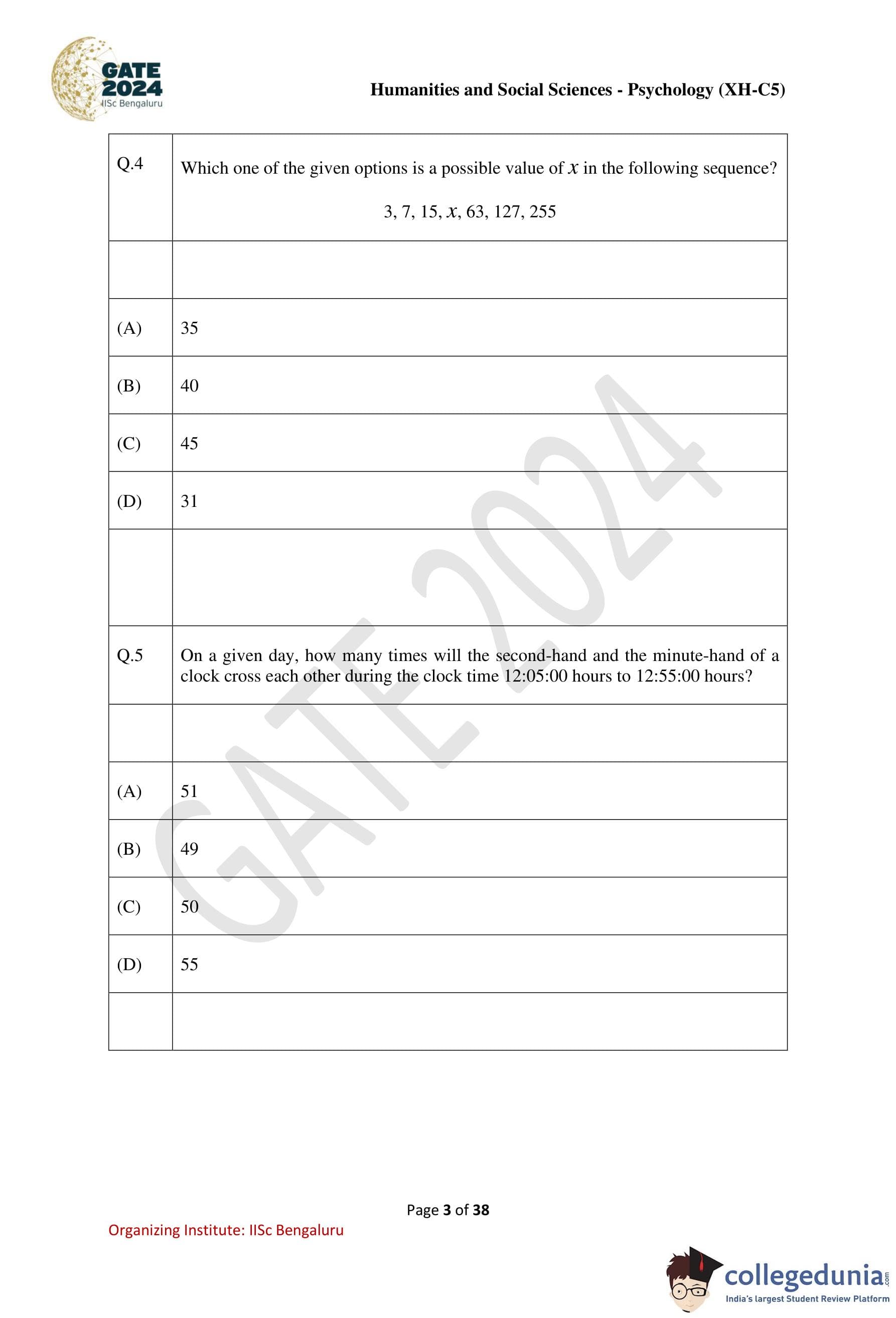
Question 4:
Which one of the given options is a possible value of X in the following sequence?
3, 7, 15, X, 63, 127, 255
Question 5:
On a given day, how many times will the second-hand and the minute-hand of a clock cross each other during the clock time 12:05:00 hours to 12:55:00 hours?
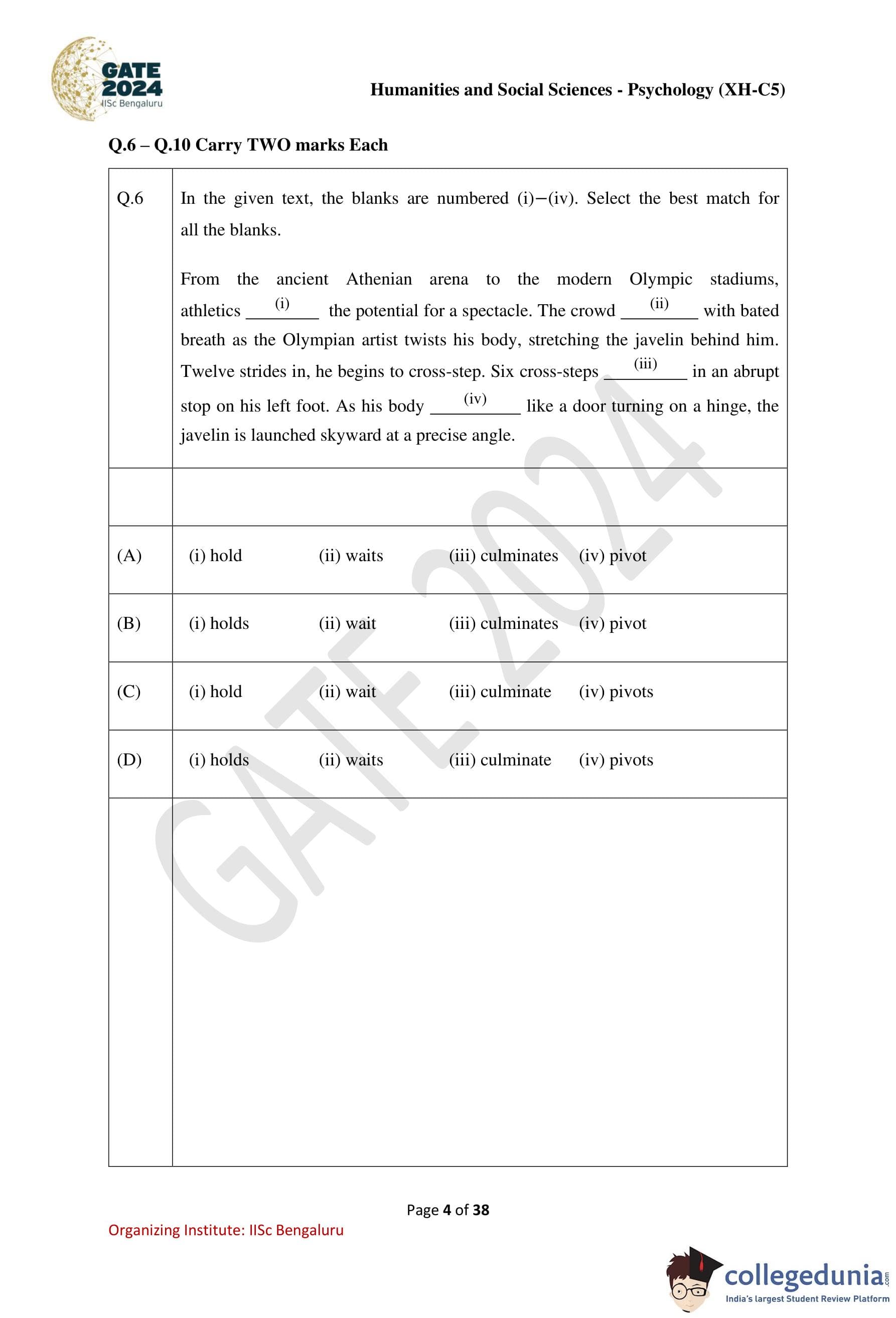
Question 6:
In the given text, the blanks are numbered (i)—(iv). Select the best match for all the blanks.
From the ancient Athenian arena to the modern Olympic stadiums, athletics (i) the potential for a spectacle. The crowd (ii) with bated breath as the Olympian artist twists his body, stretching the javelin behind him. Twelve strides in, he begins to cross-step. Six cross-steps (iii) in an abrupt stop on his left foot. As his body (iv) like a door turning on a hinge, the javelin is launched skyward at a precise angle.
Question 7:
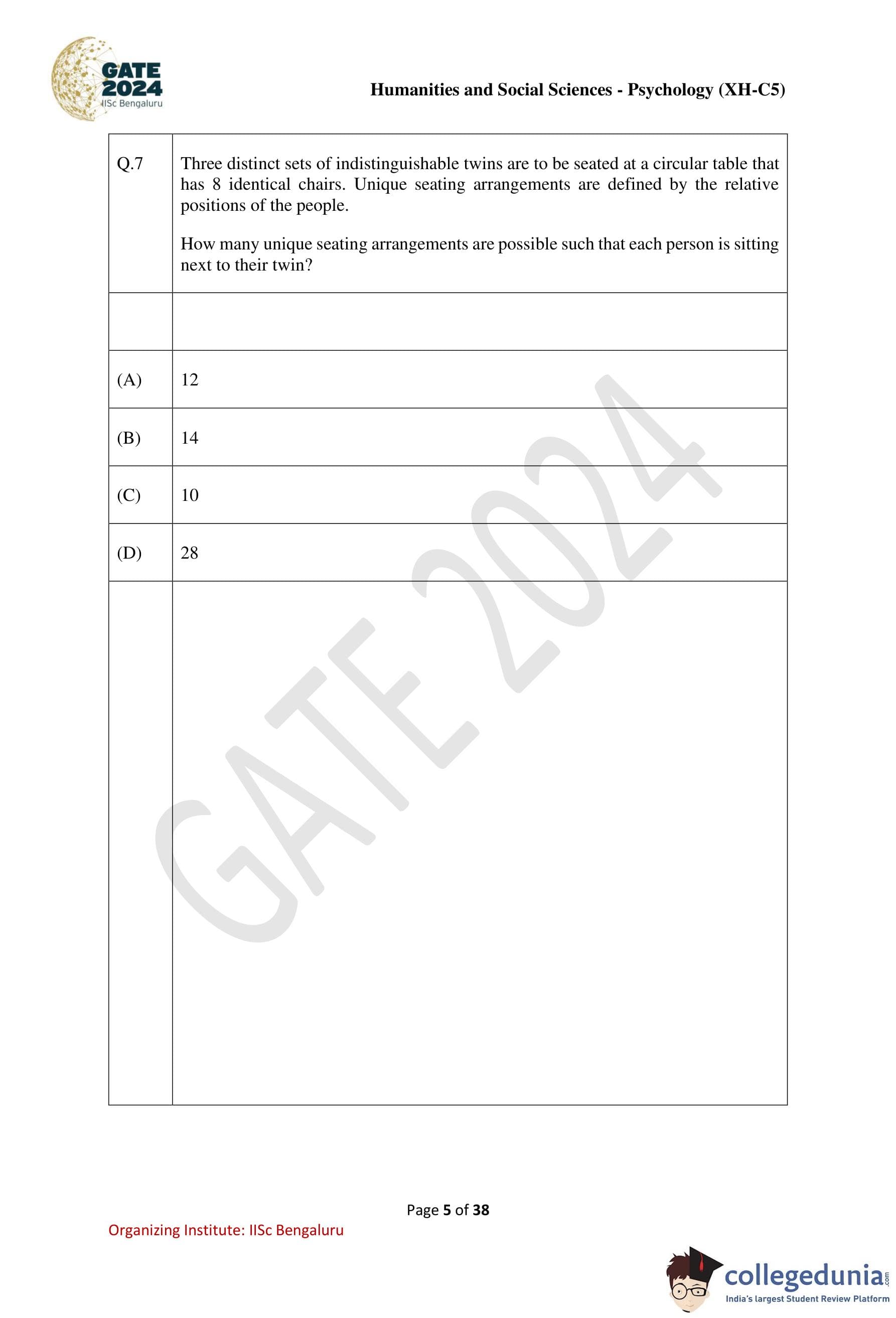
Three distinct sets of indistinguishable twins are to be seated at a circular table that has 8 identical chairs. Unique seating arrangements are defined by the relative positions of the people. How many unique seating arrangements are possible such that each person is sitting next to their twin?
Question 8:
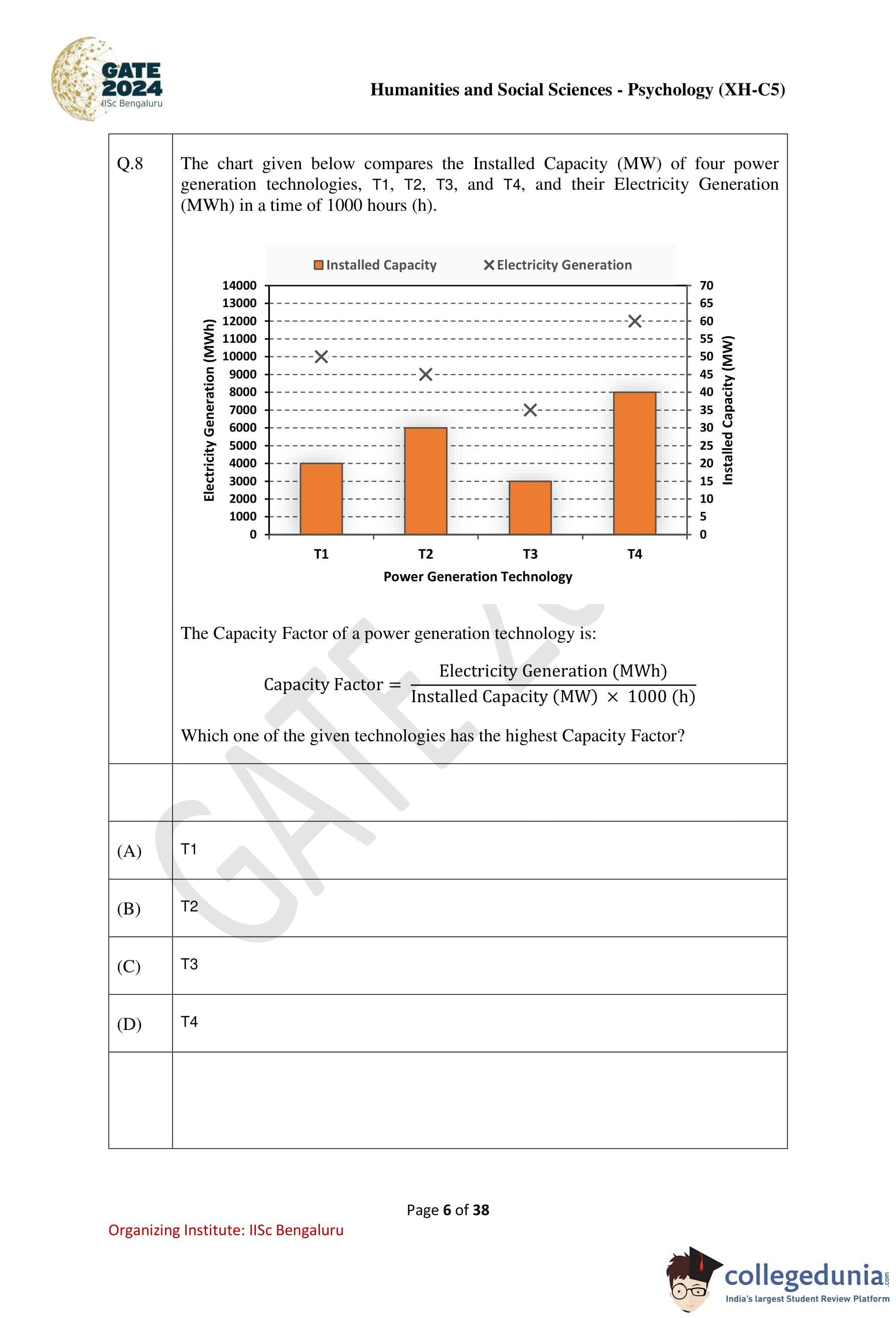
The chart given below compares the Installed Capacity (MW) of four power generation technologies, T1, T2, T3, and T4, and their Electricity Generation (MWh) in a time of 1000 hours (h). The Capacity Factor of a power generation technology is:
Capacity Factor = Electricity Generation (MWh) ÷ (Installed Capacity (MW) × 1000 (h)).
Which one of the given technologies has the highest Capacity Factor?
Question 9:
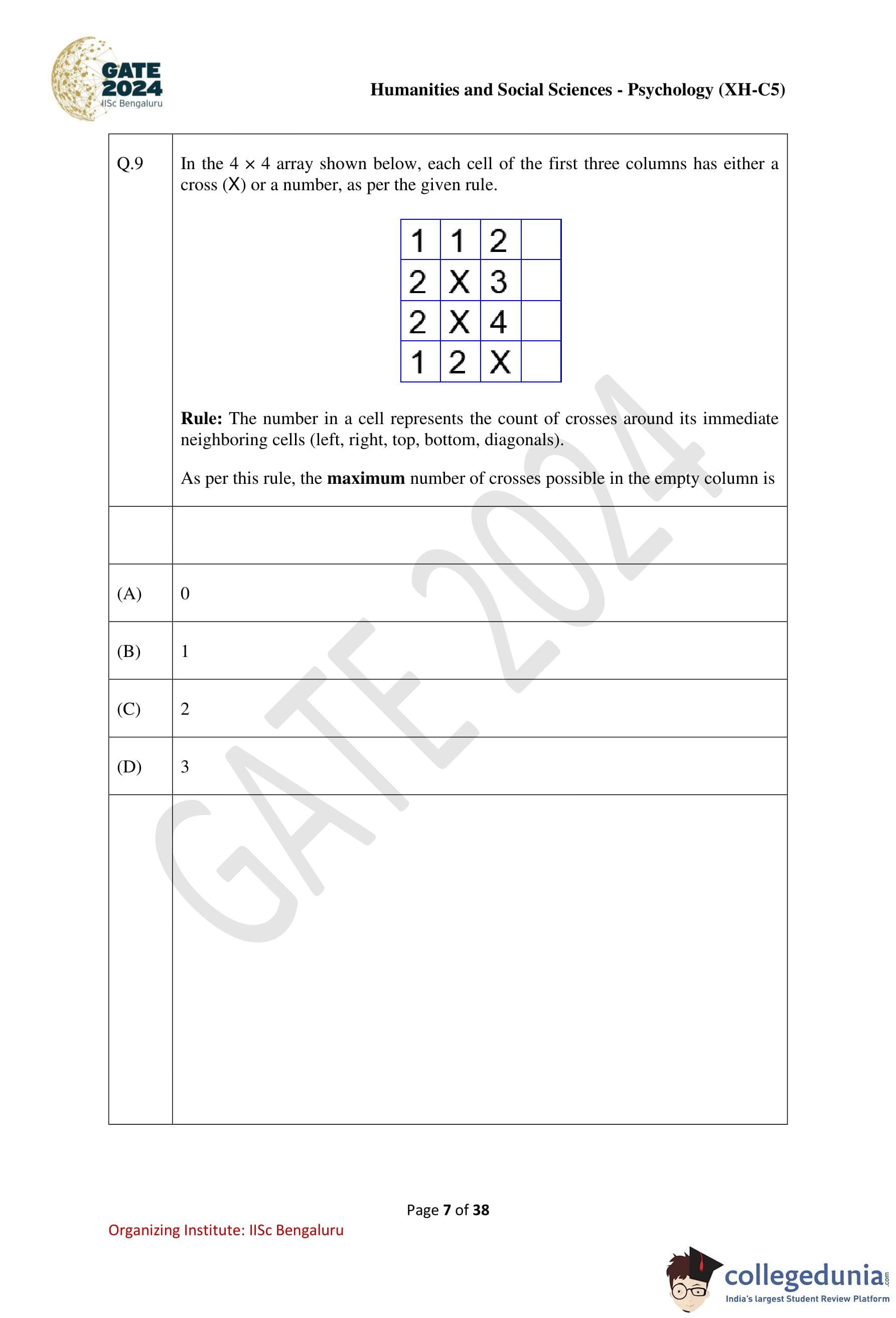
In the 4 x 4 array shown below, each cell of the first three columns has either a cross (X) or a number, as per the given rule.

Rule: The number in a cell represents the count of crosses around its immediate neighboring cells (left, right, top, bottom, diagonals).
As per this rule, the maximum number of crosses possible in the empty column is:
Question 10:
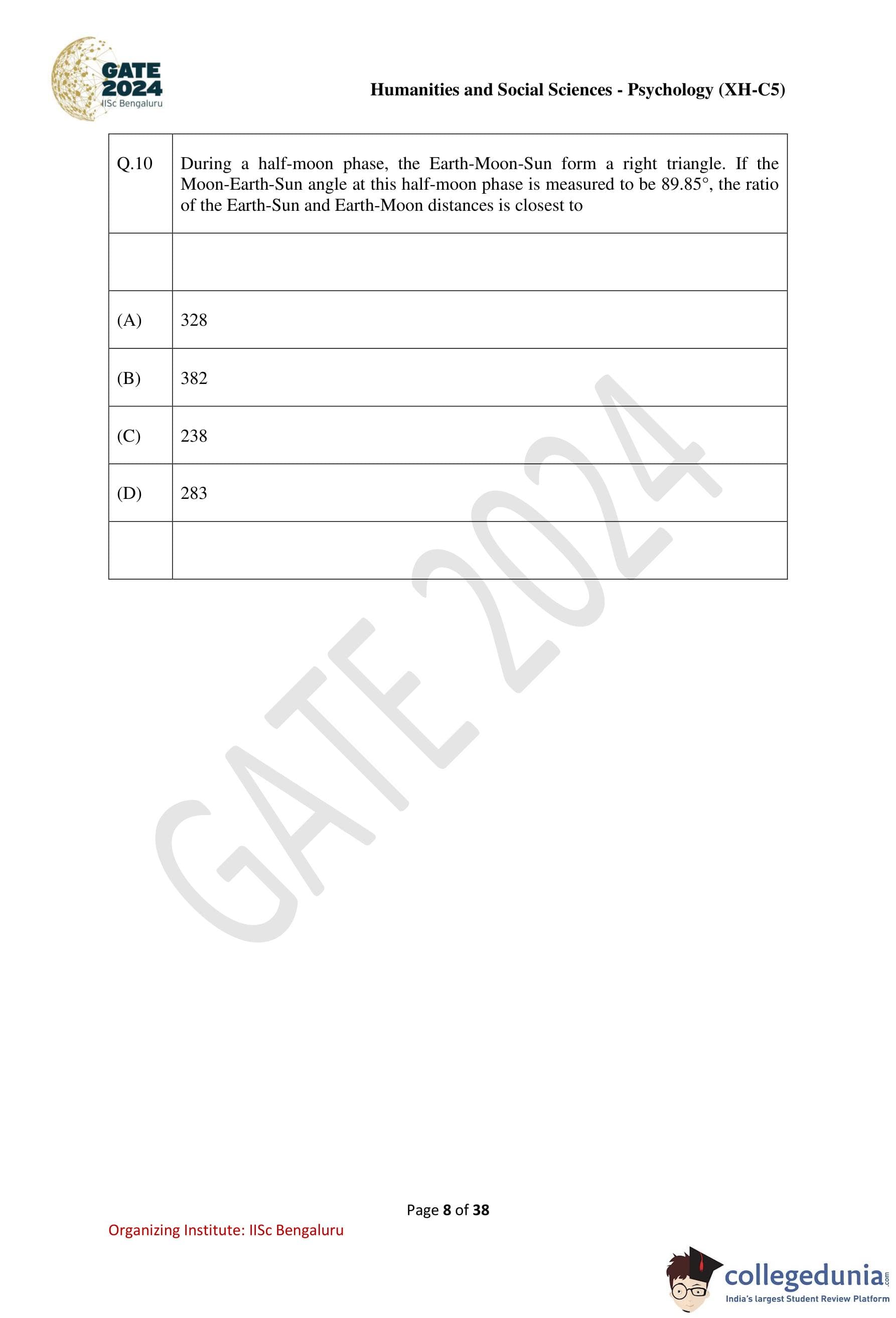
During a half-moon phase, the Earth-Moon-Sun form a right triangle. If the Moon-Earth-Sun angle at this half-moon phase is measured to be 89.85°, the ratio of the Earth-Sun and Earth-Moon distances is closest to:
Question 11:
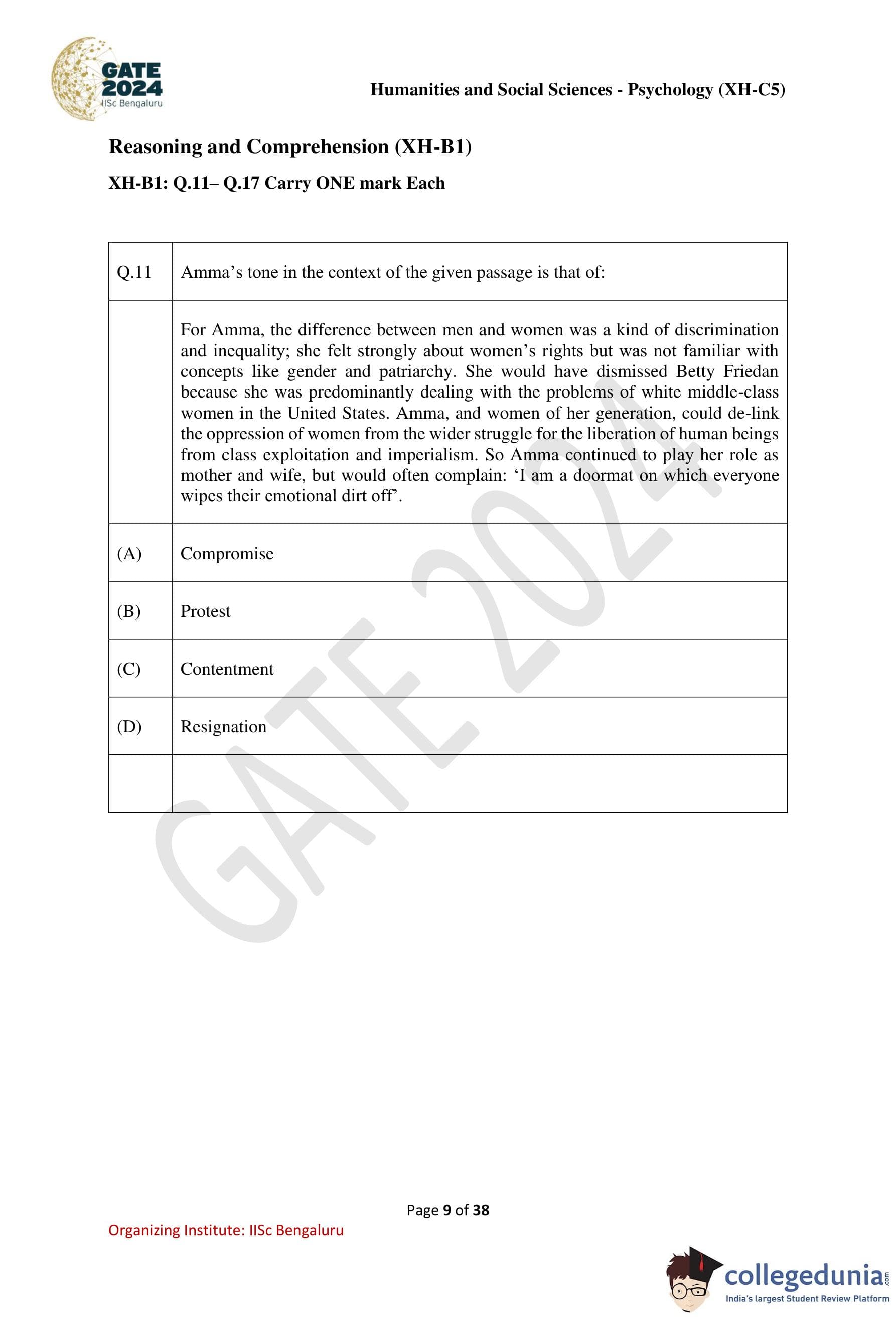
Amma’s tone in the context of the given passage is that of:
For Amma, the difference between men and women was a kind of discrimination and inequality; she felt strongly about women’s rights but was not familiar with concepts like gender and patriarchy. She would have dismissed Betty Friedan because she was predominantly dealing with the problems of white middle-class women in the United States. Amma, and women of her generation, could de-link the oppression of women from the wider struggle for the liberation of human beings from class exploitation and imperialism. So Amma continued to play her role as mother and wife, but would often complain: ‘I am a doormat on which everyone wipes their emotional dirt off.’Question 12:
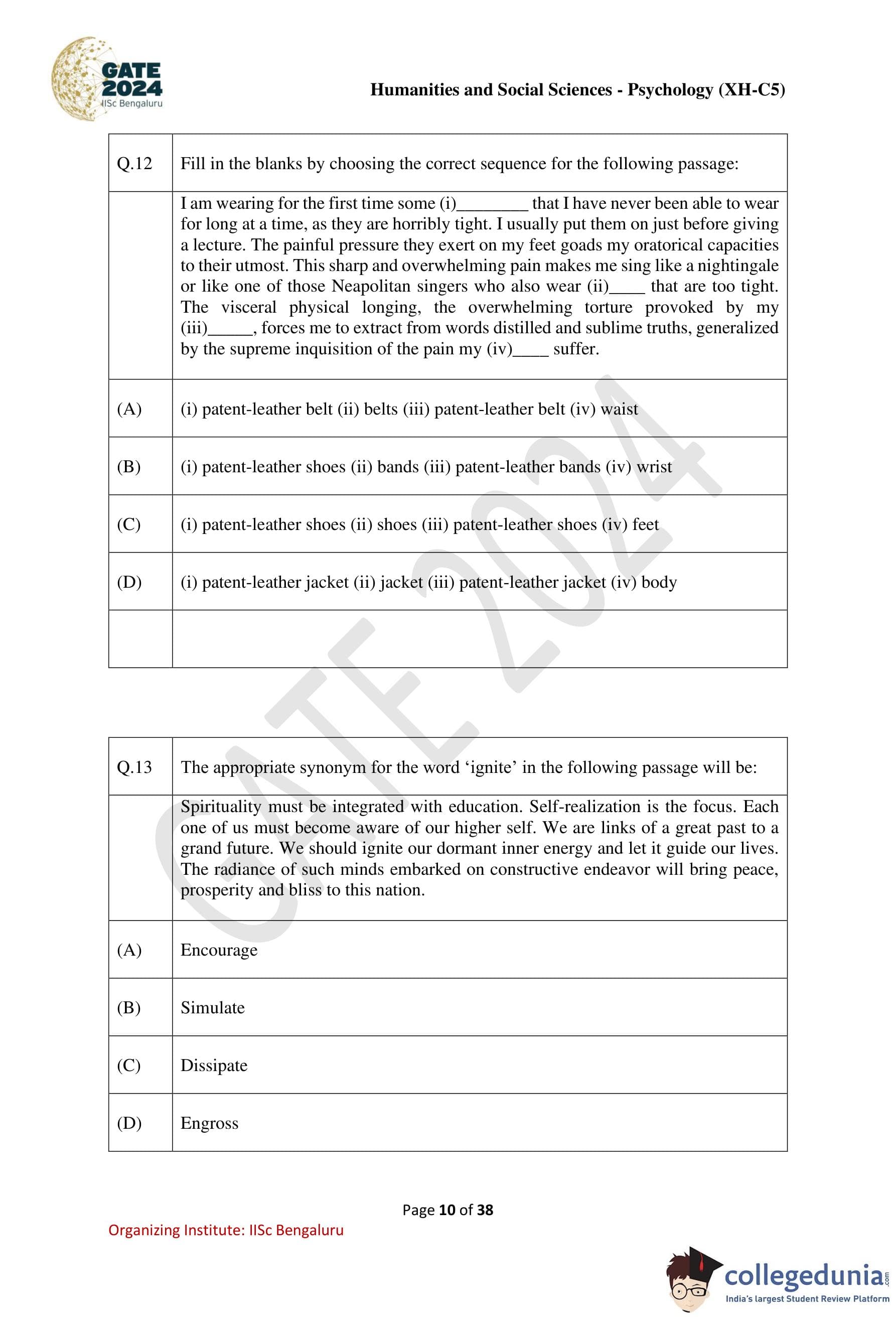
Fill in the blanks by choosing the correct sequence for the following passage:
I am wearing for the first time some (i) _______ that I have never been able to wear for long at a time, as they are horribly tight. I usually put them on just before giving a lecture. The painful pressure they exert on my feet goads my oratorical capacities to their utmost. This sharp and overwhelming pain makes me sing like a nightingale or like one of those Neapolitan singers who also wear (ii) _______ that are too tight. The visceral physical longing, the overwhelming torture provoked by my (iii) _______, forces me to extract from words distilled and sublime truths, generalized by the supreme inquisition of the pain my (iv) _______ suffer.Question 13:
The appropriate synonym for the word ‘ignite’ in the following passage will be:
Spirituality must be integrated with education. Self-realization is the focus. Each one of us must become aware of our higher self. We are links of a great past to a grand future. We should ignite our dormant inner energy and let it guide our lives. The radiance of such minds embarked on constructive endeavor will bring peace, prosperity, and bliss to this nation.Question 15:
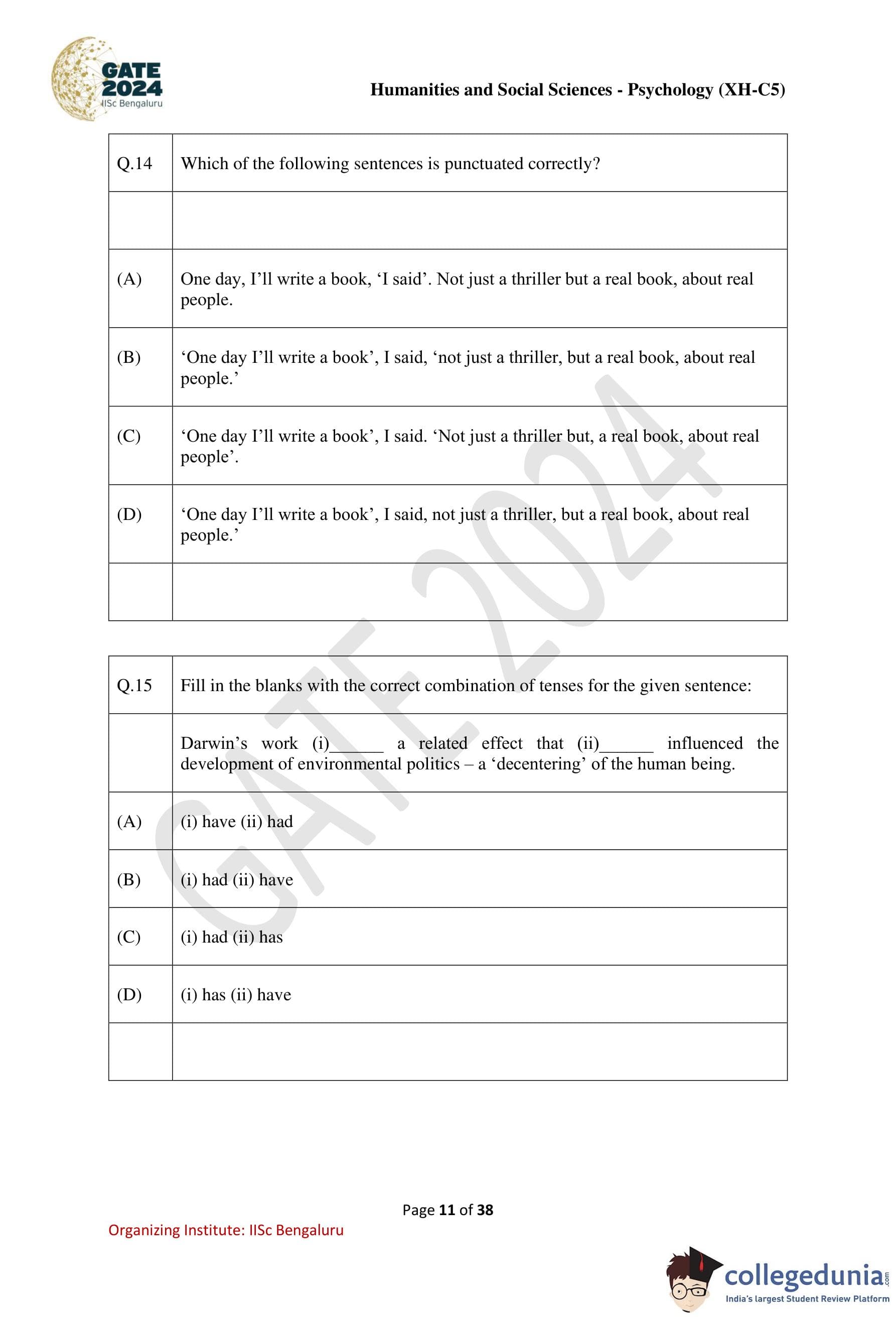
Fill in the blanks with the correct combination of tenses for the given sentence:
Darwin’s work (i) _______ a related effect that (ii) _______ influenced the development of environmental politics – a ‘decentering’ of the human being.Question 16:
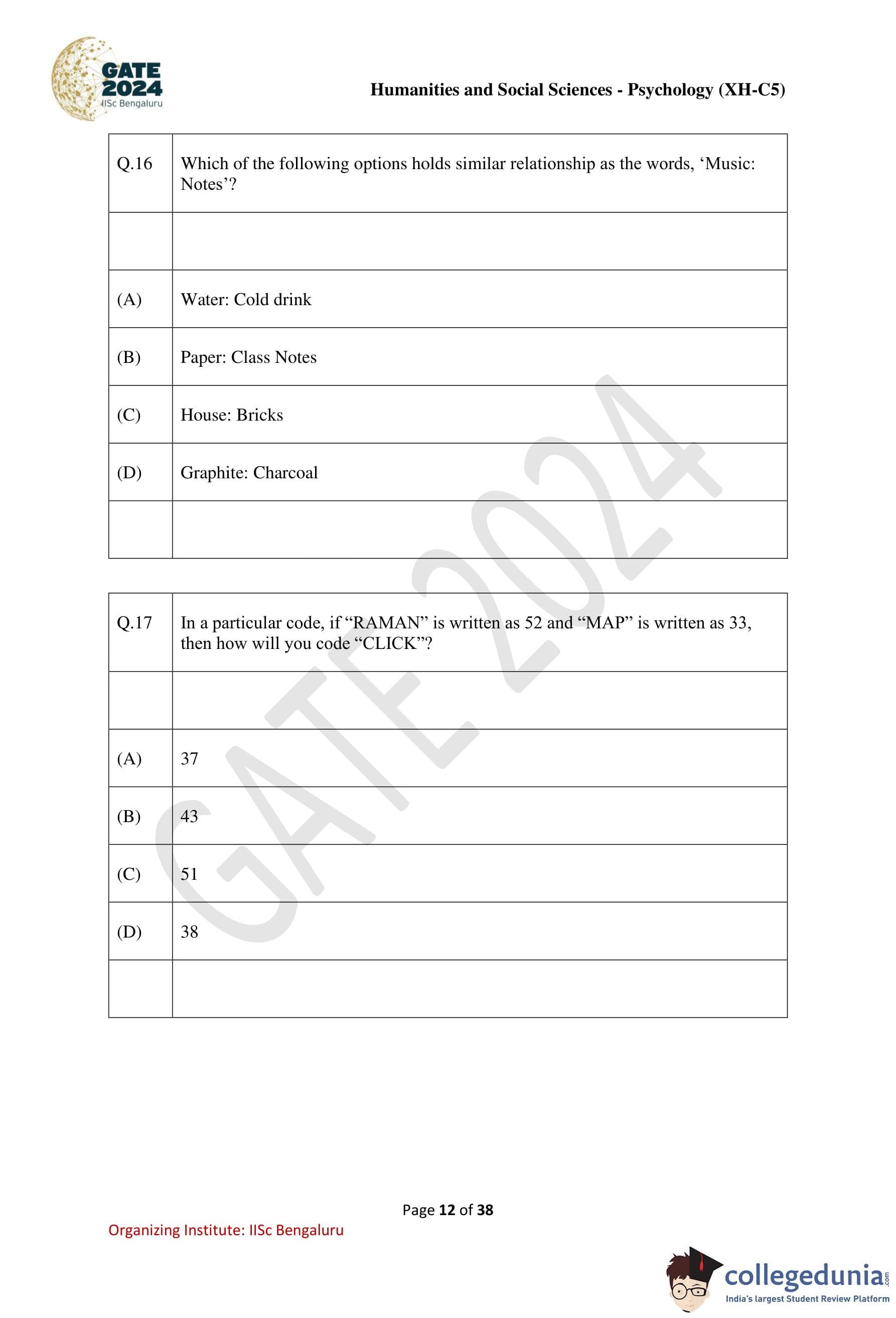
Which of the following options holds a similar relationship as the words, ‘Music: Notes’?
Question 17:
In a particular code, if “RAMAN” is written as 52 and “MAP” is written as 33, then how will you code “CLICK”?
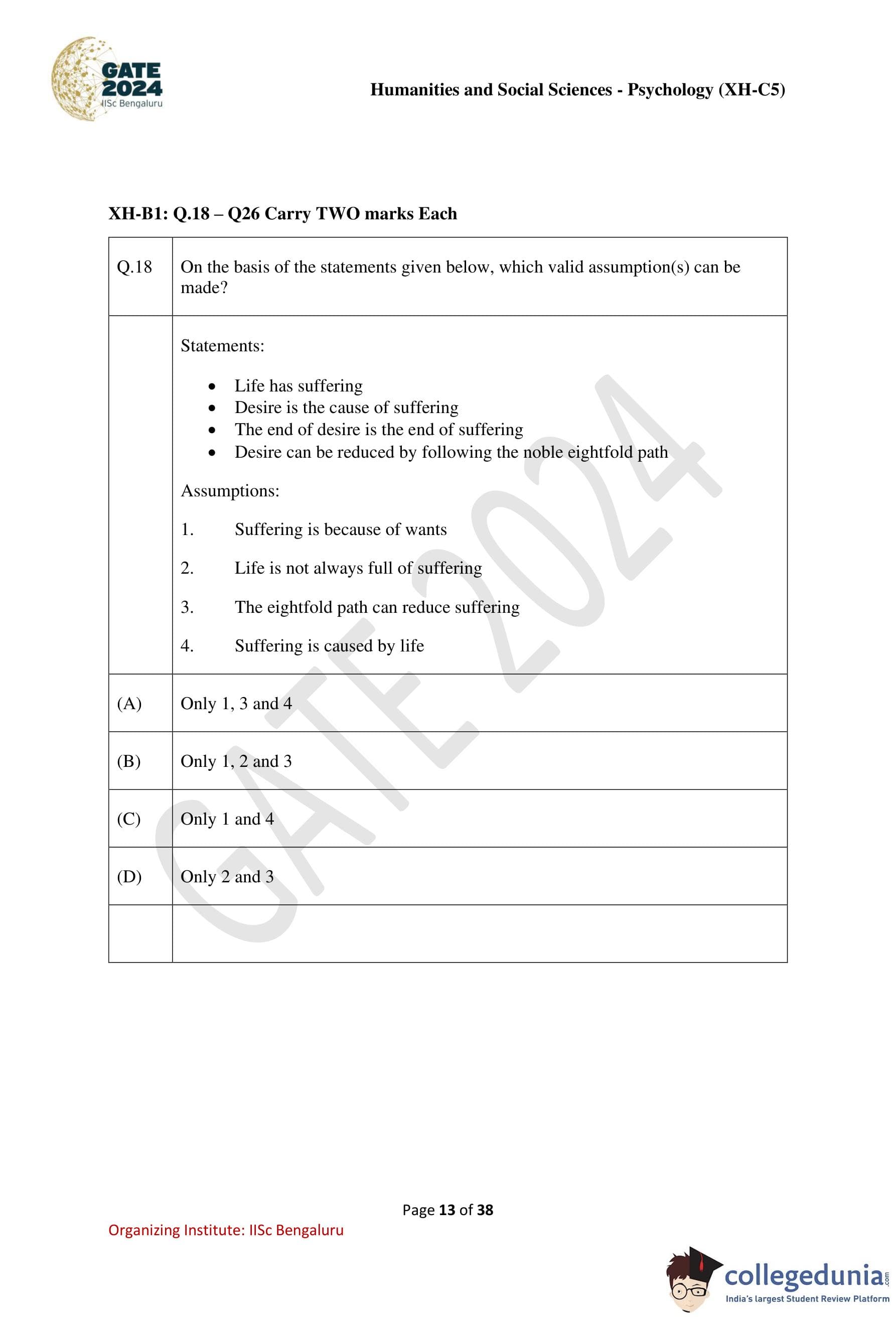
Question 18:
On the basis of the statements given below, which valid assumption(s) can be made?
Statements:
- Life has suffering.
- Desire is the cause of suffering.
- The end of desire is the end of suffering.
- Desire can be reduced by following the noble eightfold path.
Assumptions:
- 1. Suffering is because of wants.
- 2. Life is not always full of suffering.
- 3. The eightfold path can reduce suffering.
- 4. Suffering is caused by life.
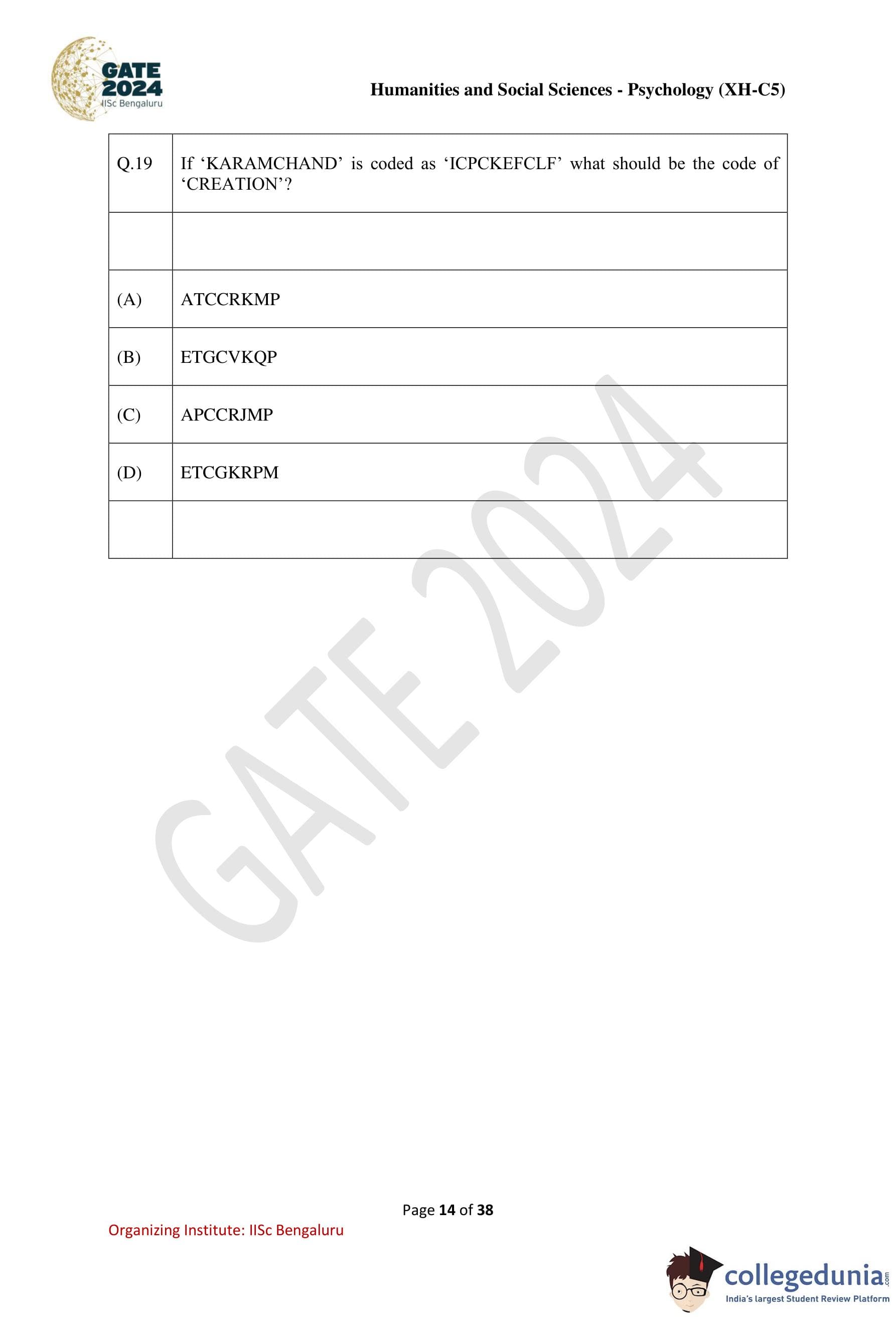
Question 19:
If 'KARAMCHAND' is coded as 'ICPCKEFCLF,' what should be the code of 'CREATION'?
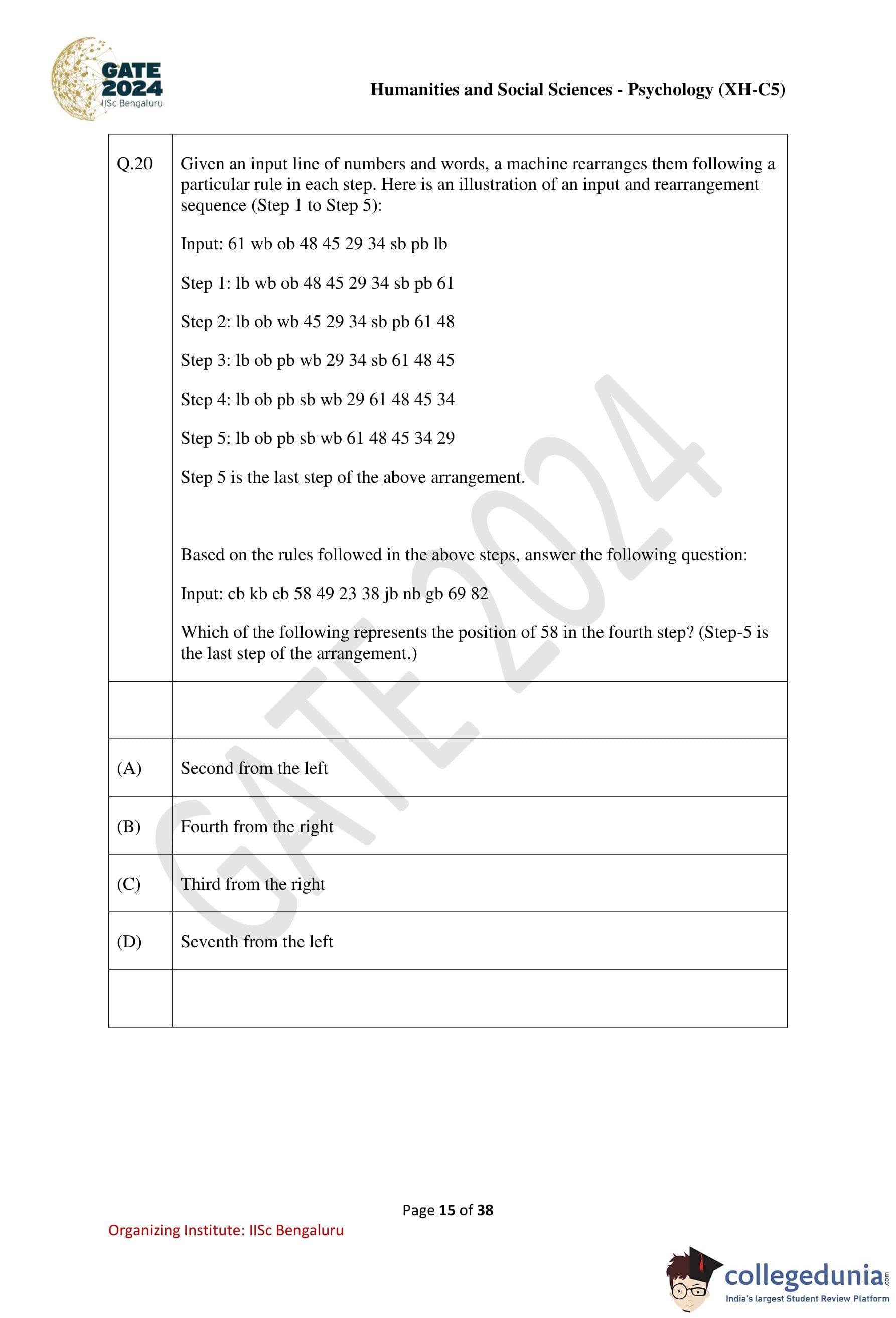
Question 20:
Given an input line of numbers and words, a machine rearranges them following a particular rule in each step. Here is an illustration of an input and rearrangement sequence (Step 1 to Step 5):
Input: 61 wb ob 48 45 29 34 sb pb lb
Step 1: lb wb ob 48 45 29 34 sb pb 61
Step 2: lb ob wb 45 29 34 sb pb 61 48
Step 3: lb ob pb wb 29 34 sb 61 48 45
Step 4: lb ob pb sb wb 61 48 45 34 29
Step 5: lb ob pb sb wb 61 48 45 34 29
Based on the rules followed in the above steps, answer the following question:
Input: cb kb eb 58 49 23 38 jb nb gb 69 82
Which of the following represents the position of 58 in the fourth step? (Step-5 is the last step of the arrangement.)
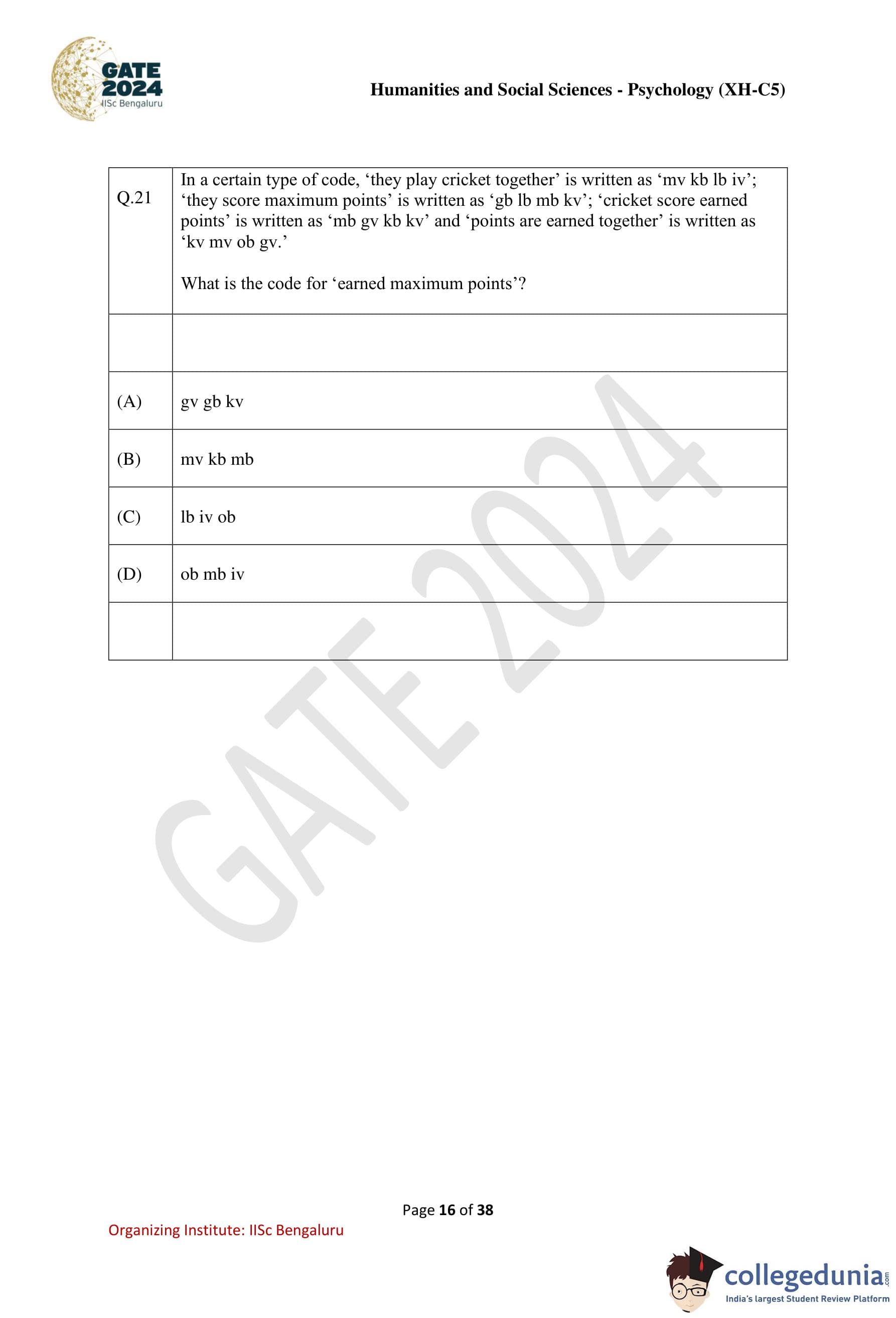
Question 21:
In a certain type of code, 'they play cricket together' is written as ‘mv kb lb iv'; 'they score maximum points' is written as 'gb lb mb kv'; ‘cricket score earned points' is written as 'mb gv kb kv' and ‘points are earned together' is written as 'kv mv ob gv.' What is the code for ‘earned maximum points’?
Question 22:
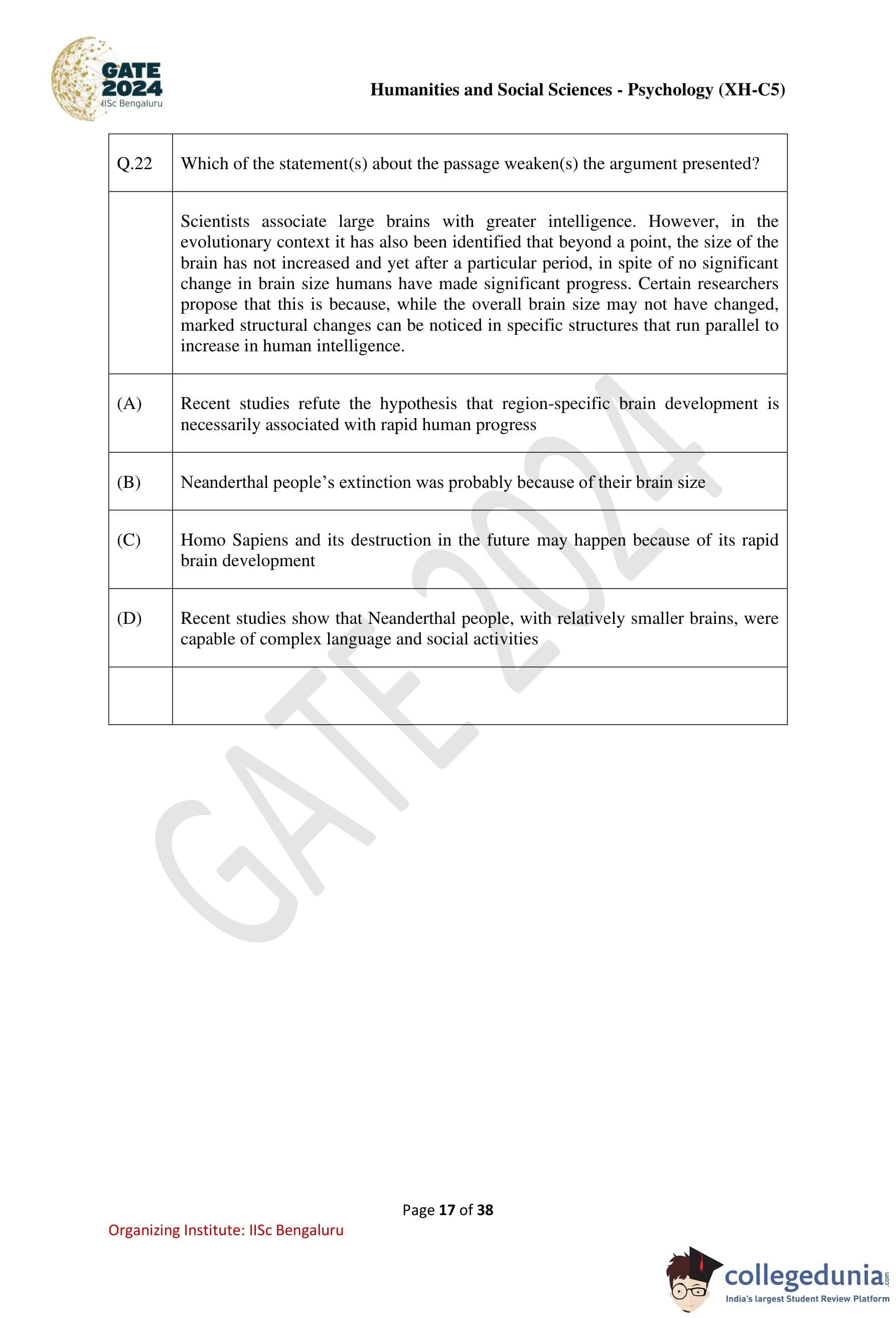
Which of the statement(s) about the passage weaken(s) the argument presented?
Scientists associate large brains with greater intelligence. However, in the evolutionary context, it has also been identified that beyond a point, the size of the brain has not increased, and yet after a particular period, in spite of no significant change in brain size, humans have made significant progress. Certain researchers propose that this is because, while the overall brain size may not have changed, marked structural changes can be noticed in specific structures that run parallel to an increase in human intelligence.Question 23:
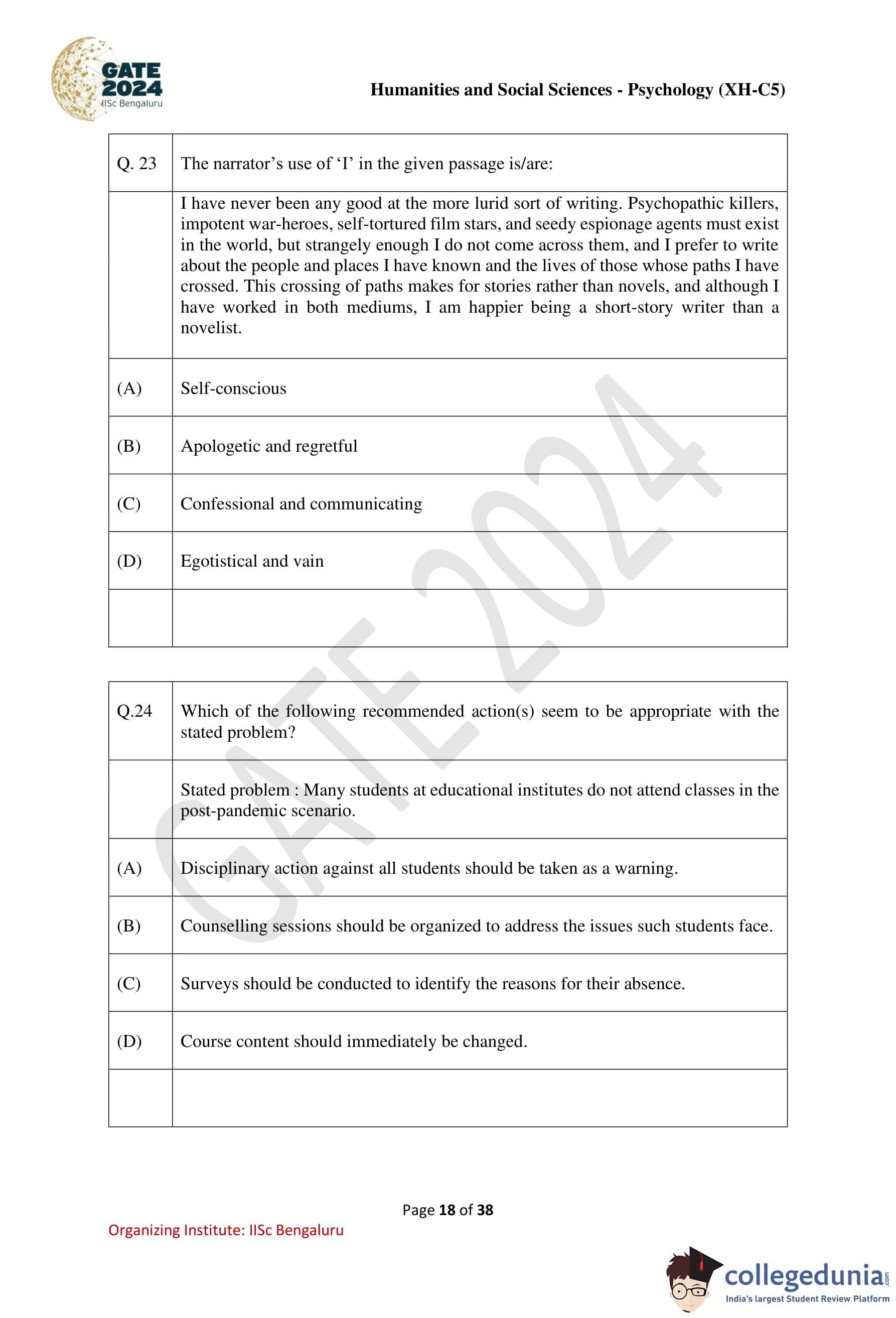
The narrator's use of 'I' in the given passage is/are:
I have never been any good at the more lurid sort of writing. Psychopathic killers, impotent war-heroes, self-tortured film stars, and seedy espionage agents must exist in the world, but strangely enough, I do not come across them, and I prefer to write about the people and places I have known and the lives of those whose paths I have crossed. This crossing of paths makes for stories rather than novels, and although I have worked in both mediums, I am happier being a short-story writer than a novelist.Question 24:
Which of the following recommended action(s) seem to be appropriate with the stated problem?
Stated Problem: Many students at educational institutes do not attend classes in the post-pandemic scenario.
Question 25:
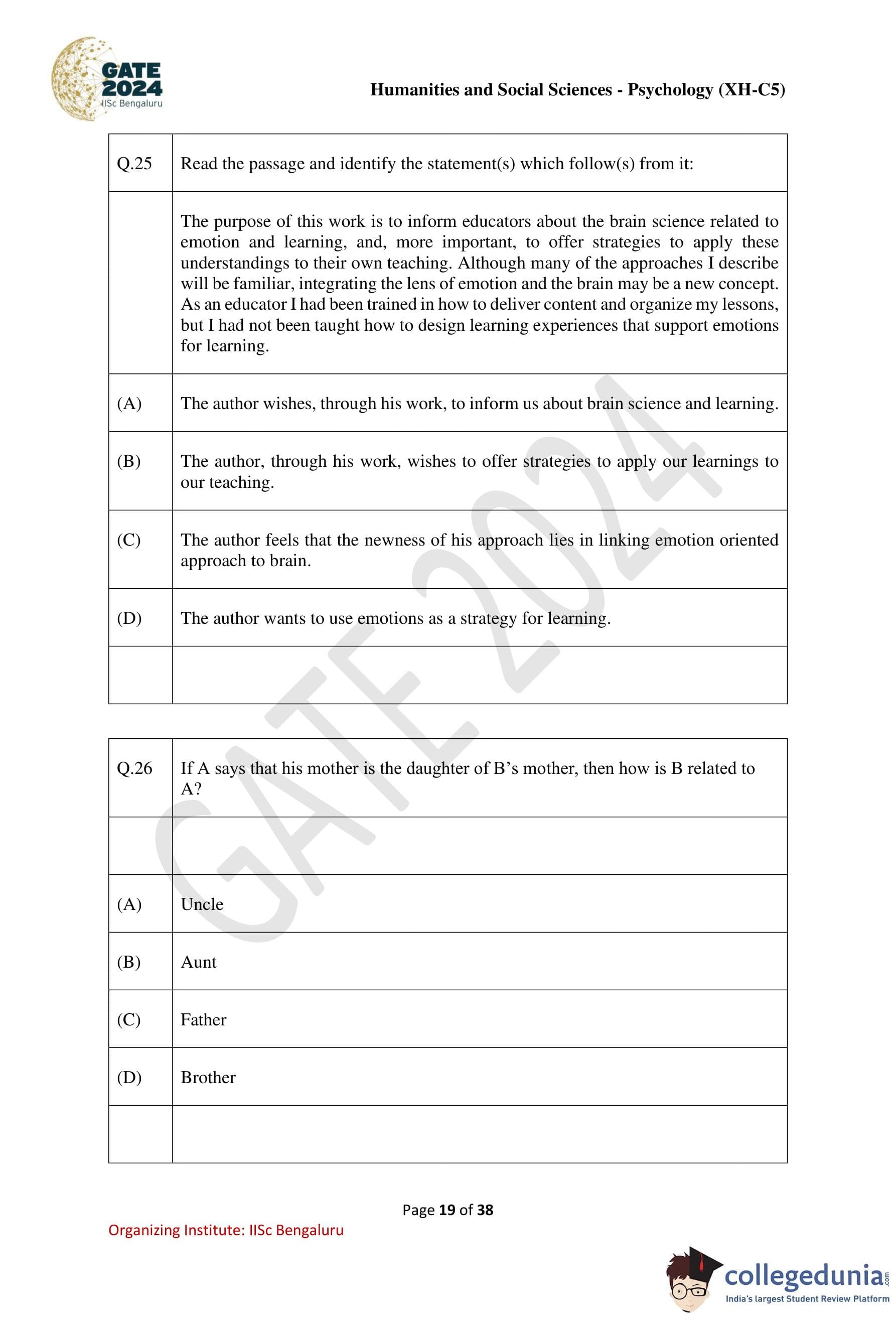
Read the passage and identify the statement(s) which follow(s) from it:
The purpose of this work is to inform educators about the brain science related to emotion and learning, and, more important, to offer strategies to apply these understandings to their own teaching. Although many of the approaches I describe will be familiar, integrating the lens of emotion and the brain may be a new concept. As an educator I had been trained in how to deliver content and organize my lessons, but I had not been taught how to design learning experiences that support emotions for learning.Question 26:
If A says that his mother is the daughter of B's mother, then how is B related to A?
Question 28:
On the theories of causation, there is disagreement among the schools of Indian thought whether the effect pre-exists in its material cause. Which one of the following theorists (vādins) answer this question in the affirmative?
Question 29:
According to Advaita Vedānta of Sankara, the Absolute (parabrahman) is unconditioned (nirupādhi), indeterminate (nirviśeṣa) and without any attribute (nirguna). The Vedāntic texts also speak of empirical and phenomenal Brahman (aparabrahman) that is conditioned (sopādhi), determinate (saviśeṣa) and with attributes (saguna). This determinate Brahman is:
Question 31:
Which one of the following philosophers is associated with Navya Nyāya (new school of Indian logic)?
Question 32:
According to the Bhagavadgītā (2:54–72), a “person of steady wisdom” is called:
Question 33:
According to which of the following theories of punishment, can capital punishment be justified?
(i) Deterrent theory of Punishment
(ii) Reformative theory of Punishment
(iii) Retributive theory of Punishment
Question 34:
“The true', to put it very briefly, is only the expedient in the way of our thinking, just as 'the right' is only the expedient in the way of our behaving. Expedient in almost any fashion; and expedient in the long run and on the whole, of course.” Which one of the following philosophers claims this?
Question 35:
Aristotle uses phronesis (practical wisdom) as a special function of reason for which one of the following?
Question 36:
How does Pythagoras theorize ‘numbers’ in order to be treated as substance?
Question 37:
Which one of the following terms does Plato use to define the conceptual relation between ‘Forms’ and ‘Particulars’?
Question 38:
Following is an argument from Aristotelian syllogism:
All moneylenders are misers.Some capitalists are misers.
Therefore, some capitalists are moneylenders.
Which one of the following fallacies does the argument commit?
Question 39:
How does the 'natural attitude' towards the experience of the world get modified to the 'phenomenological attitude' in Edmund Husserl's Phenomenology?
Question 41:
Rabindranath Tagore, in his essay “Man’s Nature,” conceptualizes that a ‘man’ can have a vision of the ‘Supreme Man’ or the ‘Spirit’ if s/he:
Question 42:
According to Ludwig Wittgenstein, which among the following does a proposition involve in order to be a representation of the reality?
Question 43:
According to Simone de Beauvoir's The Ethics of Ambiguity, which among the following will NOT hold regarding the notion of ‘subjectivity’?
Question 44:
Which among the following propositions will be the ‘sub-contrary’ of ‘Some celestial bodies are not shining entities’?
Question 45:
Rāmānuja was a staunch critic of the notion of Māyā in Advaita Vedānta. In one of his seven charges against Māyāvāda, Rāmānuja questions as to where/what is the locus of Māyā/Avidyā — it cannot reside on Brahman, for Brahman is pure consciousness and knowledge, and Avidyā means ignorance. It cannot be on Jīva, because it is the creation of Avidyā. This charge against Advaita by Rāmānuja on the locus of Māyā/Avidyā is called:
Question 46:
Which among the following is NOT an epistemological tenet of Logical Positivism?
Question 47:
Which one of the following is INCORRECT about Jiddu Krishnamurti's notion of education?
Question 48:
In the context of John Locke's distinction between ‘qualities' and 'ideas', which among the following assertions is INCORRECT?
Question 51:
The following is a logical explanation of a weather condition:
For the last 10 years, the farmers of Vidarbha have noticed that whenever there is good rainfall in the Konkan region in the month of July, they receive some rain in the month of September. This year Konkan received very little rain. Hence, it may hardly rain in Vidarbha.
Which method of J.S. Mill is used here?
Question 52:
In Indian theories of knowledge, some schools of thought uphold that there is no self-validity of knowledge (svatah-prāmāṇya), and others accept extrinsic validity of knowledge (paratah-prāmāṇya). Which of the following schools of Indian thought accept paratah-prāmāṇya?
Question 53:
Patañjali in his Yogasūtra (1:7) gives his theory of valid means of knowledge (pramāṇa). Among the following, which are NOT pramāṇa(s) according to the Yogasūtra?
Question 54:
Identify the CORRECT combinations of the Buddhist philosophical schools in Group I with their respective thinkers in Group II.
| Group I | Group II |
|---|---|
| (a) Mādhayamika | (i) Vasubandhu |
| (b) Yogācāra | (ii) Nāgārjuna |
| (c) Sarvāstivāda | (iii) Sariputta (Śāriputra) |
| (d) Sautrāntika | (iv) Ānanda |
Question 55:
According to S. Radhakrishnan, in his discourse on “Intellect and Intuition,” intuitive knowledge results in which of the following?
Question 56:
According to Sāṅkhya philosophy, which of the following is/are the external organs/instruments (bāhyakaraṇa)?
Question 57:
Sri Aurobindo refers to a 'power' of Saccidānanda that creates the world. He writes, “...out of the Supreme Being in which all is all without barrier of separative consciousness, emerges the phenomenal being in which all is in each and each is in all for the play of existence with existence, consciousness with consciousness, force with force, delight with delight.” Which among the following concepts is/are referred to as 'power' here?
Question 58:
Read the passage carefully and answer the following question:
“Those who want liberty must therefore have Dhamma. Now what is Dhamma, and why Dhamma is necessary? According to the Buddha, Dhamma consists in Prajna and Karuna. What is Prajna? And why Prajna? Prajna is understanding. The Buddha made Prajna one of the two corner-stones of His Dhamma because he did not wish to leave any room for superstition. What is Karuna? And why Karuna? Karuna is love. Because, without it, Society can neither live nor grow, that is why the Buddha made it the second corner-stone of His Dhamma. Such is the definition of the Buddha’s Dhamma. How different is this definition of Dhamma from that of Religion? So ancient, yet so modern is the definition of Dhamma given by the Buddha. So aboriginal, yet so original. Not borrowed from anyone, yet so true. A unique amalgam of Prajna and Karuna is the Dhamma of the Buddha. Such is the difference between Religion and Dhamma.”– B.R. Ambedkar, “Religion and Dhamma”
From the above passage, which among the following accurately represent Dr. B.R. Ambedkar’s view on Religion and Dhamma?
Question 59:
In differentiating ‘knowledge by description' from ‘knowledge by acquaintance', which among the following is/are Bertrand Russell's account of description?
Question 60:
Which of the following statements are TRUE with regard to ‘Cultural Relativism’ as an ethical standpoint?
Question 61:
Which of the following combinations of the idea and thinker is/are CORRECT?
Question 62:
Which among the following statements is/are TRUE of Rene Descartes' conception of 'innate ideas'?
Question 63:
Which among the following statements is/are in accordance with David Hume's description of ‘ideas’ and ‘impressions’?
Question 64:
Immanuel Kant makes an epistemological and a logical distinction between different kinds of propositions. In the light of this distinction, which among the following is/are CORRECT?
Question 65:
Which among the following is/are G.W.F. Hegel's argument(s) in claiming that Cosmic history consists in the life story of Spirit (Geist)?
Also Check:





Comments