




The GATE Ecology and Evolution paper is a subject-specific paper for candidates aspiring for careers and higher studies in ecology, evolutionary biology, and environmental science. GATE EY was welcomed by students from the streams of life sciences and biological sciences after its introduction. An important parameter determining how aspirants are prepared for the exam, along with their planning related to getting admitted, is cut-off marks, which fluctuate each year with proper considerations given to aspects like how testing is made difficult and hectic with the level of competition created, along with performances. Analyzing the trends across the years can give vital insights into the predicted patterns of cut-offs for GATE Ecology and Evolution 2025.
It is an excellent opportunity for aspirants for GATE EY 2025 to learn and understand the cut-off trends over the years and align and set realistic goals. Here, in this article, the cut-off trends about the ecology and evolution subjects of GATE over the years are explained in great detail to bring valuable data insights to candidates to help them prepare effectively.
Related Articles:
- GATE Cut off 2025: Branch-wise Cut off for IIT, NIT, IIIT
- GATE: College Predictor
- GATE 2025 Application, Check PSU Recruitment
GATE Ecology and Evolution Exam Pattern
The GATE EY exam pattern is designed to evaluate candidates' knowledge through various question types. Here’s a detailed overview of the exam structure:
| Feature | Details |
|---|---|
| Exam Duration | 3 hours |
| Total Questions | 65 questions |
| Total Marks | 100 marks |
| Question Types | Multiple Choice Questions (MCQs)Multiple Select Questions (MSQs)Numerical Answer Type (NAT) |
| Negative Marking | MCQs: 1/3 mark deducted for wrong answers (1 mark questions)2/3 mark deducted for wrong answers (2 mark questions)No negative marking for MSQs and NATs |
| General Aptitude Section | 15% of total marks (15 marks) |
| Subject-Specific Section | 85% of total marks (85 marks) |
GATE Ecology and Evolution 2025 Subject Weightage Analysis
Understanding the weightage of different sections can help candidates allocate their study time effectively. The following table provides an approximate weightage of topics based on previous years' exam patterns:
| Section | Approximate Weightage |
|---|---|
| General Ecology | 10% |
| Population Ecology | 15% |
| Community Ecology | 10% |
| Ecosystem Ecology | 10% |
| Evolutionary Biology | 15% |
| Behavioral Ecology | 10% |
| Conservation Biology | 10% |
| Genetics | 10% |
| Environmental Science | 5% |
| General Aptitude | 15% |
Insights from Weightage Analysis
- Key Focus Areas: Population Ecology and Evolutionary Biology carry more weight so one needs to be clear on these topics.
- Balanced Preparation: Though some topics in the paper have more value, not attempting topics that have low percentages may also result in losing additional marks.
- General aptitude: It is important because it carries a weightage of 15%. Candidates should not take this lightly because it will certainly impact the overall score.
Understanding the Trends in Cut-Off GATE Ecology and Evolution
The cut-off for GATE Ecology and Evolution is the minimum qualifying score that a candidate must obtain to be eligible for admission or further consideration in M.Tech, Ph.D., or other higher education programs in the ecology and evolution domains. The cut-off usually varies depending on the following parameters:
- The overall difficulty of the paper: A difficult paper generally has a low cut-off because fewer candidates attain high scores.
- Candidate Performance: Higher average scores in a year can push the cut-off.
- Candidates appearing: The more candidates appearing is likely to increase competition which may lead to an upward cut-off.
- Availability of seats in programs: The higher demand with fewer seats available in an ecology and evolution program can influence the cut-off trends.
GATE Ecology and Evolution Cut-Off Data from 2018 to 2024
Suggested Article: IIT GATE Cutoff 2025, Previous Year Category-wise Opening and Closing Ranks for IIT
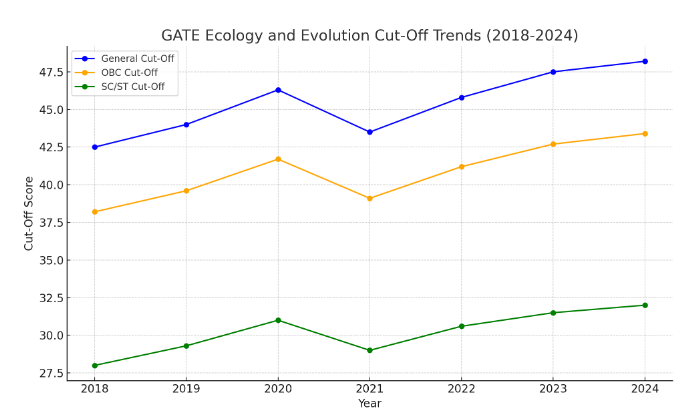
The cut-off scores for GATE Ecology and Evolution (EY) from 2018 to 2024, show trends over recent years for General, OBC (Other Backward Classes), and SC/ST (Scheduled Caste/Scheduled Tribe) categories.
| Year | General Cut-Off | OBC Cut-Off | SC/ST Cut-Off |
|---|---|---|---|
| 2018 | 42.5 | 38.2 | 28.0 |
| 2019 | 44.0 | 39.6 | 29.3 |
| 2020 | 46.3 | 41.7 | 31.0 |
| 2021 | 43.5 | 39.1 | 29.0 |
| 2022 | 45.8 | 41.2 | 30.6 |
| 2023 | 47.5 | 42.7 | 31.5 |
| 2024 | 48.2 | 43.4 | 32.0 |
Insights from Cut-Off Data (2018–2024)
Overall Trend of Increasing Cut-Offs
- Observation: The cut-offs in the General category increased by 42.5 from 2018 to 48.2 in 2024. This amounts to about an average annual increase of 1.0–1.5 points.
- Conclusion: The trend suggests that cut-offs are rising steadily because competition is improving and there is better performance by candidates. Candidates need to get higher marks to stay in the competition, especially if this pattern continues into 2025.
Relatively More Stable OBC and SC/ST Cut-Offs
- Observation: that the cut-offs of the OBC and SC/ST categories were relatively more stable compared to the General category. Though it showed slight increments every year. The cut-offs of OBC have risen from 38.2 in 2018 to 43.4 in 2024, and those of SC/ST rose from 28.0 in 2018 to 32.0 in 2024.
- Conclusion: These softer hikes tell that the competition in those particular streams is increasing at a slower pace, but they still have to do better than the cut-offs of last year to get selected.
Year-to-Year Cut-off Variations Depending upon how Tough the Exams
- Observation: Even though years like 2021 saw soft cut-offs (43.5 for General) compared to previous years due to its toughness in the exam pattern, there are years of easy question papers like that of 2023 also saw a hike (47.5 for General).
- Conclusion: Cut-offs in exams are affected by variable difficulties. Candidates need to prepare for a wide spread of question complexities so they may score well irrespective of the difficulties associated with the paper.
Comparison with Other GATE Life Sciences Papers
Suggested Article: GATE Ecology and Evolution: Question Paper
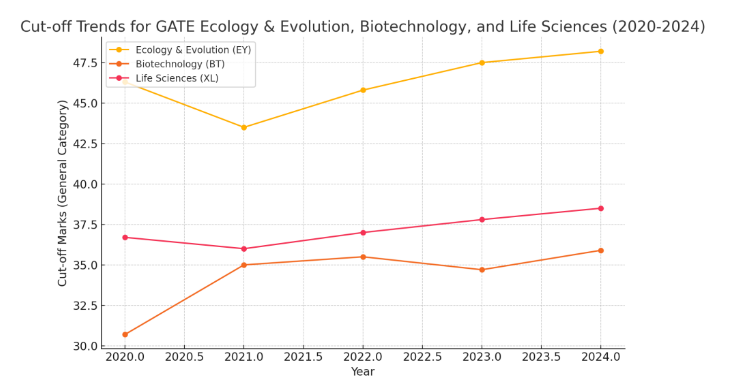
The cut-off trends for GATE EY also align in some ways with trends in other life sciences exams, like GATE Biotechnology (BT) and Life Sciences (XL):
| Year | Ecology & Evolution (EY) - General | Biotechnology (BT) - General | Life Sciences (XL) - General |
|---|---|---|---|
| 2020 | 46.3 | 30.7 | 36.7 |
| 2021 | 43.5 | 35.0 | 36.0 |
| 2022 | 45.8 | 35.5 | 37.0 |
| 2023 | 47.5 | 34.7 | 37.8 |
| 2024 | 48.2 | 35.9 | 38.5 |
Cross-Comparison Insights:
- Higher Cut-offs: Cut-offs are always higher in ecology and evolution as compared to biotechnology and life science. GATE EY is, therefore, known to be a relatively challenging exam.
- Distinct Trends: Though cut-offs at EY are generally increasing year after year, BT and XL show fluctuations, sometimes staying between the mid-30.
Factors Driving Cut-Off Trends in GATE Ecology and Evolution
- Increased Interest in Environmental Science: The fields of ecology and environmental science have become more appealing, especially in the wake of global challenges such as climate change and biodiversity loss. This has led to a 10-15% annual increase in candidates for GATE EY since 2018, thereby increasing competition and cut-offs.
- Academic and Research Opportunities: With increasing demands from various institutions and research programs aimed at ecology and evolution, there is a need to have quality candidates. These increases in cut-off scores have come hand-in-hand with increased applications since the students seek entry into those areas.
- Increased Awareness and Levels of Preparation: Students are now better preparing themselves for GATE EY. They have proper, targeted study plans in place. Even though the mean average per candidate remains the same, gradually increasing cut-offs have gone together with it.
- Online resources and mock tests: Having done mock tests on online platforms along with GATE EY courses, candidates can get an idea of how prepared they are and improve their performance. Many claim a 10-15% increase in scores through focused preparation from mock tests and online resources, which is one of the primary reasons cut-offs go up.
Also Check: GATE Mock Test 2025
Forecasting the GATE Ecology and Evolution 2025 Cut-Off
Given the upward trends observed, it is likely that the GATE EY 2025 cut-off will continue to rise. Based on past patterns and current data, the projected cut-offs are as follows:
| Category | Projected Cut-Off for 2025 |
| General | 49.0 - 50.0 |
| OBC | 44.0 - 45.0 |
| SC/ST | 32.5 - 33.5 |
Tips for Candidates: Strategies to Meet and Exceed Expected Cut-Offs
- Set Target Scores Above Projected Cut-Offs: Target at least 5 points more than the cut-off score to take into account the probability that the cut-off is a bit higher.
- High-yield topics: These should be population ecology, genetics, evolution, and then ecosystem dynamics because all this usually takes up an almighty proportion of the paper.
- Focus Core Concepts: For weak topics, revisit the basic concepts in ecology and evolution; hence, you should be able to answer direct as well as complex application-based questions.
- Keep track of past papers and question trends: Go through previous year's papers to understand what frequently asked topics and types of questions are, and prepare in a manner that focuses on these aspects.
Latest Update: GATE 2025: Mock Test Links Activated on the official website
It can clearly be said from the earlier trends of GATE Ecology and Evolution cut-offs that, with increasing candidate numbers and growing interest in academics as well as better preparation tools, qualifying marks increase steadily for every category. A candidate seeking a target at 2025 GATE EY must know about such a trend to plan and hence optimize preparation for the paper. Through strategic study, prioritization of high-yield topics, and periodic quizzing, the test taker will stay abreast of the curve, thereby ensuring a competitive score on the next exam.



Comments