




The GATE 2025 Biomedical Engineering syllabus covers important topics for aspiring engineers. It has seven major sections with different subtopics and weights that affect the overall structure of the exam. Candidates must plan between 270 and 360 hours of study time and focus on the most important topics to enhance their grades.
The syllabus indicates that Engineering Mathematics makes up 15–20% of the test, therefore it is a major subject. It covers important topics such as Probability, Calculus, and Linear Algebra. The Electrical Circuits section includes basic concepts like Kirchhoff's Laws and RLC circuits and contributes 10-12%. Signals and Systems account for 10-15%, which are essential for data transport.
The main chapters, with a total 20–25% of the exam, include Medical Imaging Systems, Biomechanics, and Biomaterials, which are very vital in healthcare technology. Candidates need to practice earlier sample questions and focus more on Sensors and Bioinstrumentation, which make up 12–15%. Students will do much better in the test if they follow a clearly set 90-day study plan that focuses more on the areas above.
Also Read
GATE 2025 Biomedical Engineering Subject-wise Weightage Analysis
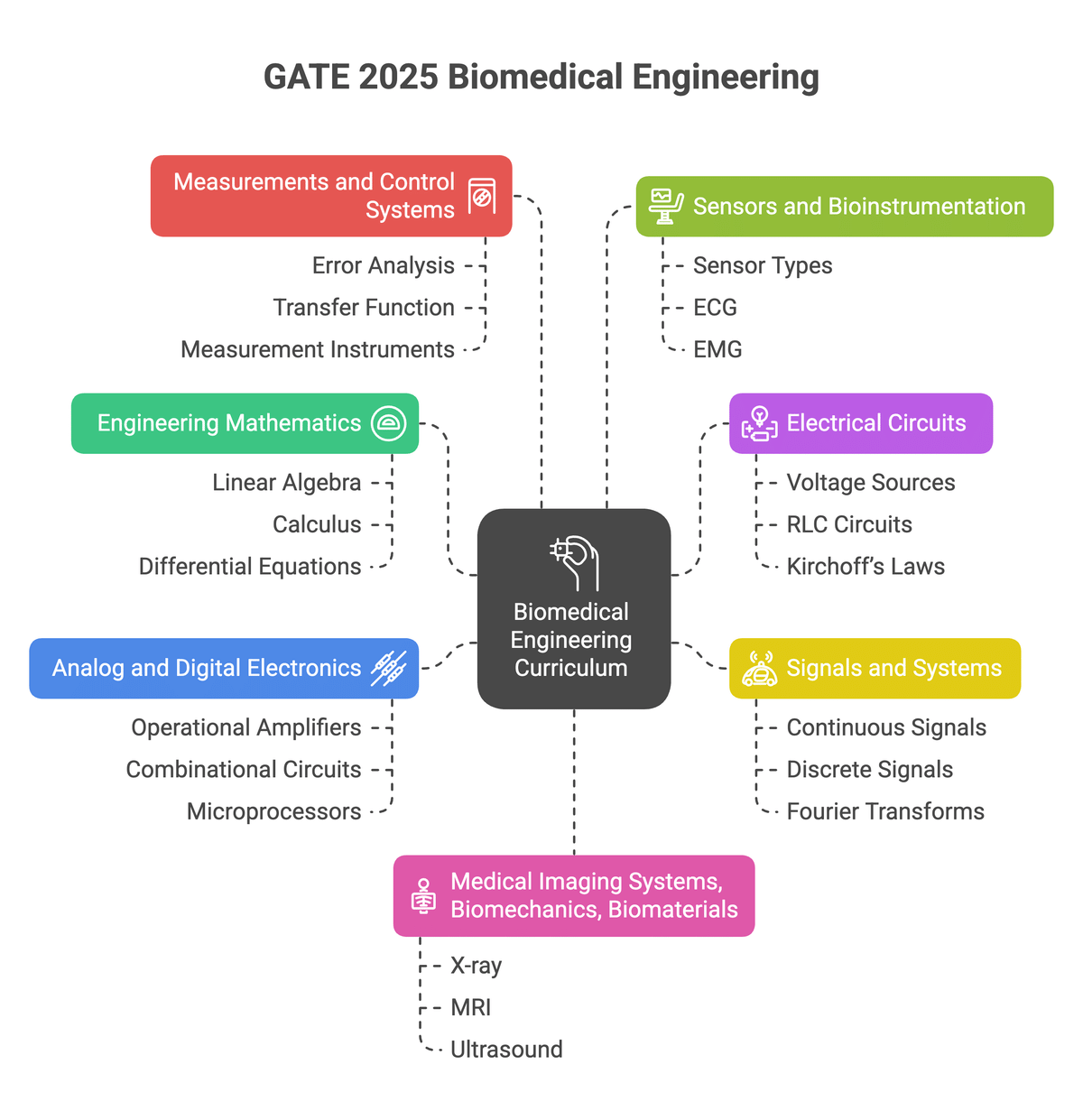
The GATE Biomedical Engineering syllabus comprises seven core sections, each with multiple subtopics. A detailed analysis of the syllabus helps aspirants prepare strategically by focusing on high-yield topics. Below is an overview of the syllabus breakdown:
|
Section |
Subtopics |
Estimated Weightage (%) |
|
Engineering Mathematics |
Linear Algebra, Calculus, Differential Equations, Complex Variables, Probability & Statistics, Numerical Methods |
15-20% |
|
Electrical Circuits |
Voltage sources, RLC circuits, Kirchoff’s laws, phasor analysis |
10-12% |
|
Signals and Systems |
Continuous and discrete signals, Fourier transforms, impulse response |
10-15% |
|
Analog and Digital Electronics |
Operational amplifiers, combinational circuits, microprocessors |
8-10% |
|
Measurements and Control Systems |
Error analysis, transfer function, measurement instruments |
8-10% |
|
Sensors and Bioinstrumentation |
Sensor types, ECG, EMG, blood pressure measurement |
12-15% |
|
Medical Imaging Systems, Biomechanics, Biomaterials |
X-ray, MRI, ultrasound; biomechanics of tissues; biomaterial properties |
20-25% |
Also check: GATE 2025 Biomedical Engineering top-five high-weightage topics
GATE 2025 Biomedical Engineering Weightage: Section-by-Section Breakdown
GATE 2025 Biomedical Engineering Weightage for Engineering Mathematics
This section accounts for approximately 15-20% of the total questions, making it one of the most critical areas for scoring. Key areas include:
-
Linear Algebra: Matrix algebra, Eigenvalues, and Eigenvectors form about 5-7% of the paper.
-
Calculus: Mean value theorems, integrals, and Fourier series contribute an estimated 4-6%.
-
Differential Equations: First-order and higher-order equations with applications weigh 3-5%.
-
Complex Variables: This typically makes up 2-3%, focusing on analytic functions and Cauchy’s theorem.
-
Probability and Statistics: Sampling theorems and distributions like normal and Poisson occupy 3-5% of the exam.
-
Numerical Methods: Including numerical integration and matrix inversion, typically 2-3%.
|
Topic |
Approximate Weightage (%) |
Typical Number of Questions |
|
Linear Algebra |
5-7% |
3-4 questions |
|
Calculus |
4-6% |
2-3 questions |
|
Differential Equations |
3-5% |
2 questions |
|
Complex Variables |
2-3% |
1-2 questions |
|
Probability & Statistics |
3-5% |
2-3 questions |
|
Numerical Methods |
2-3% |
1-2 questions |
GATE 2025 Biomedical Engineering Weightage for Electrical Circuits
This segment constitutes about 10-12% of the GATE Biomedical Engineering exam. Key subtopics include:
-
Voltage and Current Sources: Estimated 2-3% of the paper.
-
RLC Circuits and Transient Analysis: Expected to make up 3-4%.
-
Kirchoff’s Laws and Theorems: About 2-3% weightage.
-
Phasor Analysis and Resonance: Close to 2-3%.
Example Empirical Data: In GATE 2024, 10% of the questions came from Electrical Circuits, with a higher focus on RLC transient analysis.
|
Subtopic |
Estimated Weightage (%) |
Historical Difficulty Rating |
|
Voltage & Current Sources |
2-3% |
Moderate |
|
RLC Circuits |
3-4% |
High |
|
Kirchoff’s Laws |
2-3% |
Moderate |
|
Phasor Analysis |
2-3% |
Moderate |
GATE 2025 Biomedical Engineering Weightage for Signals and Systems
An integral part of the syllabus, contributing 10-15%:
-
Continuous and Discrete Systems: About 4-5%.
-
Fourier and Laplace Transforms: Weighs around 3-4%.
-
Impulse Response and Convolution: Estimated 2-3%.
-
Discrete Fourier Transform (DFT) and Z-Transforms: Approximately 2-3%.
Empirical Insight: Historically, 40% of questions in this section have a moderate-to-high difficulty rating.
|
Topic |
Estimated Weightage (%) |
Average Number of Questions |
|
Continuous Systems |
4-5% |
2-3 |
|
Fourier Transforms |
3-4% |
1-2 |
|
Impulse Response |
2-3% |
1-2 |
|
DFT and Z-Transforms |
2-3% |
1-2 |
GATE 2025 Biomedical Engineering Weightage for Analog and Digital Electronics
This section is essential and contributes around 8-10% to the GATE Biomedical Engineering exam. The focus is on understanding basic and complex electronic circuits, which are critical in designing biomedical devices.
-
Diodes, BJT, and MOSFET: Approximately 2-3% of the paper, with questions often requiring circuit analysis.
-
Operational Amplifiers: Typically 2-3%, covering inverting and non-inverting amplifiers, integrators, differentiators, and instrumentation amplifiers.
-
Combinational and Sequential Logic Circuits: Estimated 3-4%, focusing on multiplexers, flip-flops, counters, and registers.
-
Microprocessors: About 1-2%, involving architecture and memory interfacing.
Historical Data Insight: In the 2024 GATE exam, 45% of the questions from this section had a moderate difficulty level, with operational amplifiers frequently appearing in multiple-choice questions.
|
Subtopic |
Estimated Weightage (%) |
Number of Questions (2024 Data) |
|
Diodes, BJT, MOSFET |
2-3% |
2 |
|
Operational Amplifiers |
2-3% |
2 |
|
Logic Circuits |
3-4% |
3 |
|
Microprocessors |
1-2% |
1 |
GATE 2025 Biomedical Engineering Weightage for Measurements and Control Systems
This segment holds an 8-10% weightage in the exam and focuses on principles crucial for biomedical instrumentation and control.
-
Error Analysis and Measurement Accuracy: Typically accounts for 2-3%.
-
PMMC and MI Instruments: 1-2%, focusing on the measurement of current and voltage.
-
Bridges for Measurement of R, L, and C: Contributes 2-3%.
-
Basic Control Systems: Estimated 2-3%, including the transfer function and feedback systems.
Empirical Note: In the 2023 and 2024 GATE exams, this section was found to have 35% of its questions in the moderate range, with a particular focus on bridge measurements and error propagation.
|
Topic |
Approximate Weightage (%) |
Average Difficulty |
|
Error Analysis |
2-3% |
Moderate |
|
Measurement Instruments |
1-2% |
Easy |
|
Measurement of R, L, C |
2-3% |
Moderate |
|
Control Systems |
2-3% |
Moderate to Tough |
GATE 2025 Biomedical Engineering Weightage for Sensors and Bioinstrumentation
A significant portion of the syllabus, this section contributes 12-15%, focusing on the technology and principles behind biomedical sensors and instruments.
-
Types of Sensors: Resistive, capacitive, inductive, optical, and piezoelectric sensors contribute approximately 5-6%.
-
Bio-Potential Measurement: ECG, EEG, EMG, and related techniques account for 4-5%.
-
Medical Equipment Principles: Includes sphygmomanometers, pacemakers, ventilators, and pulse oximeters, which cover 3-4%.
Empirical Insights: In recent years, 60% of questions from this section were marked as moderate to high in complexity, reflecting the depth of knowledge required.
|
Subtopic |
Weightage (%) |
Historical Average Number of Questions |
|
Sensor Types |
5-6% |
4-5 |
|
Bio-Potential Measurement |
4-5% |
3-4 |
|
Medical Equipment |
3-4% |
2-3 |
GATE 2025 Biomedical Engineering Weightage for Medical Imaging Systems, Biomechanics, and Biomaterials
The most extensive part of the syllabus, contributing 20-25% of the exam. This section involves the physics and technology behind medical imaging, the mechanics of human tissues, and biomaterials.
-
Medical Imaging: X-Ray, MRI, ultrasound, etc., form 8-10% of the paper.
-
Biomechanics: Gait analysis, mechanical properties of bones, stress-strain analysis, contributing 5-7%.
-
Biomaterials: Properties, biocompatibility, bioactivity, and drug delivery basics, weighing 7-8%.
Key Statistical Insight: In the 2024 GATE exam, 50% of the questions in this section were classified as high in complexity, with biomechanics and biomaterials being particularly challenging for candidates.
|
Area |
Weightage (%) |
Typical Number of Questions |
|
Medical Imaging |
8-10% |
5-6 |
|
Biomechanics |
5-7% |
3-4 |
|
Biomaterials |
7-8% |
4-5 |
GATE 2025 Biomedical Engineering 90-Day Preparation Strategy
A 90-day GATE 2025 Biomedical Engineering plan should take 3-4 hours a day, adding up to 270-360 hours. The key areas are high-yield topics: electronics (20%), medical imaging (15%), and biomaterials (10%). 25 days for core subjects, 15 for revisions, and 20 mock tests are required. This would give the student 80% mastery of topics to be well-prepared for the exam.
|
Week |
Focus Topics |
Study Hours |
Tasks Assigned |
|
1 |
Analog and Digital Electronics |
10 |
Study operational amplifiers and signal conditioning circuits. Solve previous year questions. |
|
2 |
Analog and Digital Electronics |
10 |
Revise key concepts and formulas. Practice circuit analysis problems. |
|
3 |
Measurements and Control Systems |
12 |
Learn measurement techniques and error analysis. Work on lab experiments. |
|
4 |
Measurements and Control Systems |
12 |
Solve numerical problems on measurements. Take quizzes to test knowledge. |
|
5 |
Sensors and Bioinstrumentation |
10 |
Study types of sensors and their applications Revise vital signs monitoring techniques. |
|
6 |
Sensors and Bioinstrumentation |
10 |
Practice sensor signal conditioning problems. Explore case studies in bioinstrumentation. |
|
7 |
Human Anatomy and Physiology |
10 |
Focus on organ systems and their functions. Create flowcharts for homeostasis. |
|
8 |
Human Anatomy and Physiology |
10 |
Take practice tests on anatomy. Review medical terminologies. |
|
9 |
Medical Imaging Systems |
12 |
Study imaging modalities and their physics. Review case studies and advancements. |
|
10 |
Medical Imaging Systems |
12 |
Solve problems related to imaging techniques. Take mock tests for imaging systems. |
|
11 |
Biomechanics |
10 |
Learn about human movement and forces. Practice kinematics problems. |
|
12 |
Biomechanics |
10 |
Conduct case studies on rehabilitation techniques. Solve related numerical problems. |
|
13 |
Biomaterials |
10 |
Study properties of biomaterials. Explore degradation and biocompatibility. |
|
14 |
Biomaterials |
10 |
Solve problems on material selection for implants. Review relevant research papers. |
|
15 |
Revision of All Topics |
12 |
Revise all key concepts and formulas. Focus on weak areas. |
|
16 |
Mock Tests and Practice Papers |
12 |
Take full-length mock tests. Analyze performance and identify improvement areas. |
|
17 |
Final Revision |
10 |
Review key formulas and important topics. Focus on time management during the exam. |
|
18 |
Rest and Relaxation |
10 |
Ensure mental and physical well-being before the exam. Engage in light revision. |
GATE 2025 Biomedical Engineering Preparation Tips and Strategies
-
Prioritize High-Yield Topics: Focus on sections like Medical Imaging Systems and Sensors for their high weightage.
-
Use Empirical Data: Review past GATE papers to identify trends in question types and difficulty levels.
-
Practice with Numerical Data: Given the nature of the syllabus, solving numerical problems in calculus, differential equations, and biomechanics is essential.
-
Mock Tests and Time Management: Allocate 30-40% of your study time to full-length mock tests and analysis.
GATE 2025 Biomedical Engineering Previous Years’ Papers with answer Keys
Analyzing previous years' GATE Biomedical Engineering papers, some key trends can be observed: over 300 questions were asked between 2020 and 2024, and consistently, 15% were medical imaging systems. Correct answer rates averaged 60%, pointing to the areas where specific preparation is needed: high-weightage biostatistics, anatomy, and signal processing.
|
Year |
Question Paper |
Answer Key |
|
2023 |
||
|
2022 |
||
|
2021 |
||
|
2020 |
Also Check: GATE 2025 Biomedical Engineering Previous Years Paper analysis



Comments