




The GATE 2025 BM Question Paper PDF is now available following the exam's completion. IIT Roorkee conducted the GATE 2025 Biomedical Engineering (BM) exam on February 15, Shift 2, from 2:30 PM to 5:30 PM. In accordance with the revised exam pattern, the exam consisted of 65 questions, totaling 100 marks, which included 10 questions from the General Aptitude section and 55 questions from Biomedical Engineering subjects.
The difficulty level of the GATE 2025 BM exam was assessed as moderate.
GATE 2025 BM Question Paper with Solutions PDF
| GATE 2025 BM Question Paper with Answer Key | Download | Check Solutions |

GATE 2025 BM Question Paper with Solutions
Here are two analogous groups, Group-I and Group-II, that list words in their decreasing order of intensity. Identify the missing word in Group-II.
Abuse \( \rightarrow \) Insult \( \rightarrow \) Ridicule
________ \( \rightarrow \) Praise \( \rightarrow \) Appreciate
View Solution
Had I learnt acting as a child, I __________ a famous film star.
Select the most appropriate option to complete the above sentence.
View Solution
The 12 musical notes are given as \( C, C^\#, D, D^\#, E, F, F^\#, G, G^\#, A, A^\#, B \). Frequency of each note is \( \sqrt[12]{2} \) times the frequency of the previous note. If the frequency of the note C is 130.8 Hz, then the ratio of frequencies of notes F\# and C is:
View Solution
The following figures show three curves generated using an iterative algorithm. The total length of the curve generated after 'Iteration n' is:

View Solution
Which one of the following plots represents \( f(x) = -\frac{|x|}{x} \), where \( x \) is a non-zero real number?
Note: The figures shown are representative.
View Solution
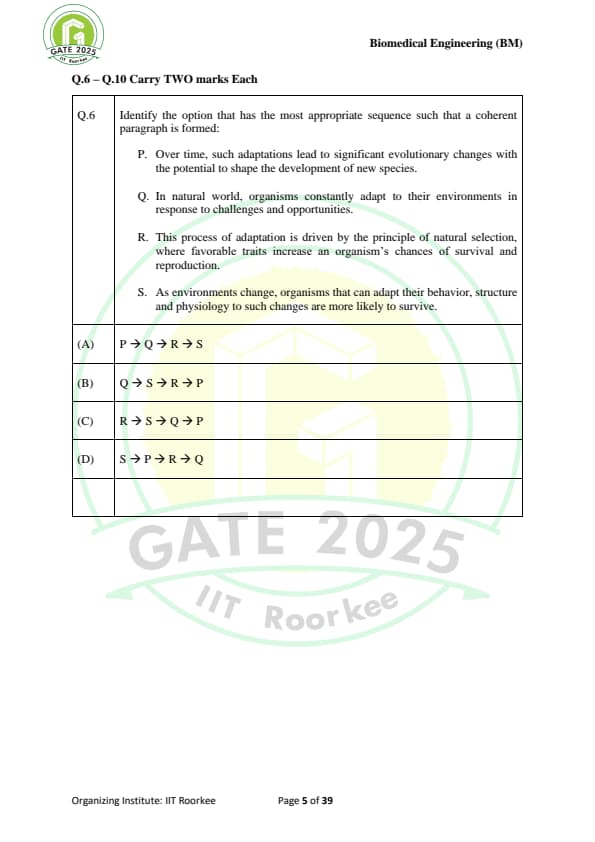
Identify the option that has the most appropriate sequence such that a coherent paragraph is formed:
P: Over time, such adaptations lead to significant evolutionary changes with the potential to shape the development of new species.
Q: In natural world, organisms constantly adapt to their environments in response to challenges and opportunities.
R: This process of adaptation is driven by the principle of natural selection, where favorable traits increase an organism’s chances of survival and reproduction.
S: As environments change, organisms that can adapt their behavior, structure, and physiology to such changes are more likely to survive.
View Solution
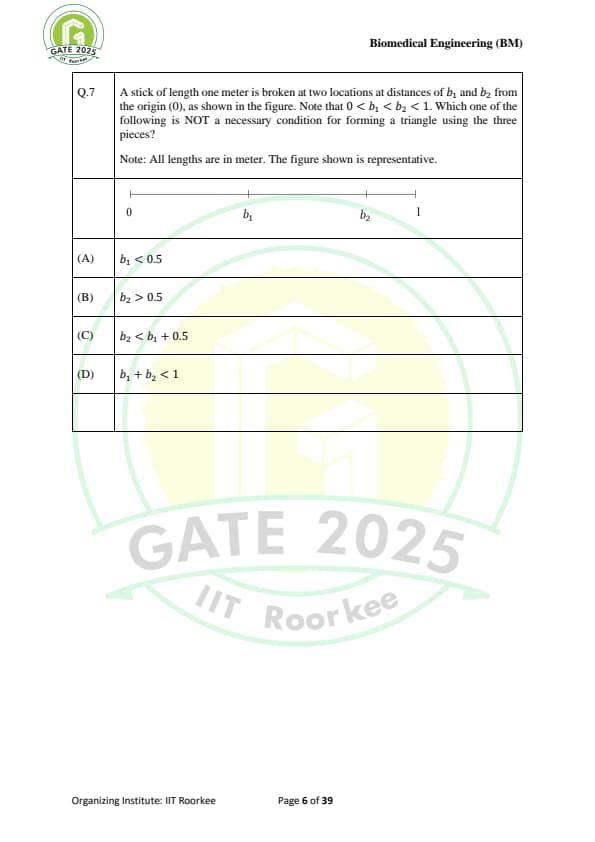
A stick of length one meter is broken at two locations at distances of \( b_1 \) and \( b_2 \) from the origin (0), as shown in the figure. Note that \( 0 < b_1 < b_2 < 1 \). Which one of the following is NOT a necessary condition for forming a triangle using the three pieces?
Note: All lengths are in meter. The figure shown is representative.

View Solution
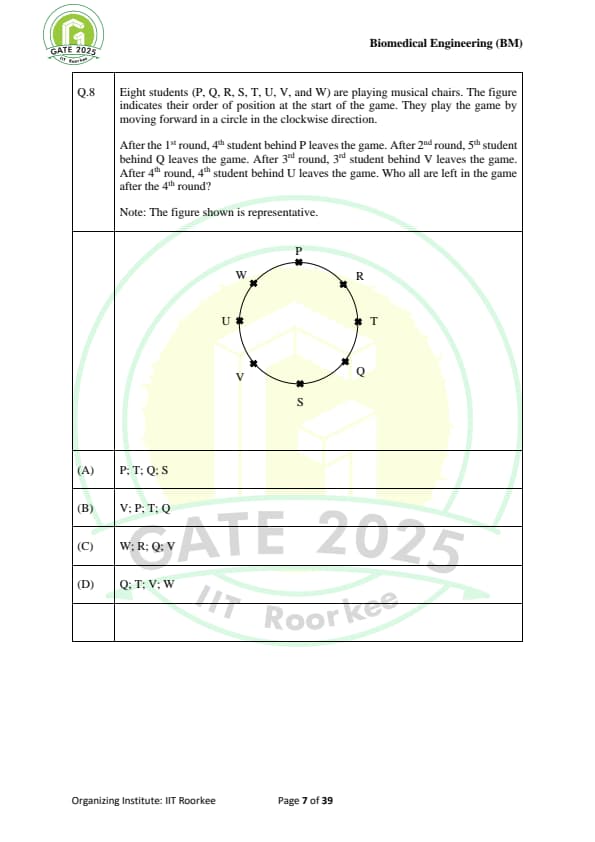
Eight students (P, Q, R, S, T, U, V, and W) are playing musical chairs. The figure indicates their order of position at the start of the game. They play the game by moving forward in a circle in the clockwise direction.
After the 1st round, 4th student behind P leaves the game. After 2nd round, 5th student behind Q leaves the game. After 3rd round, 3rd student behind V leaves the game. After 4th round, 4th student behind U leaves the game. Who all are left in the game after the 4th round?

View Solution
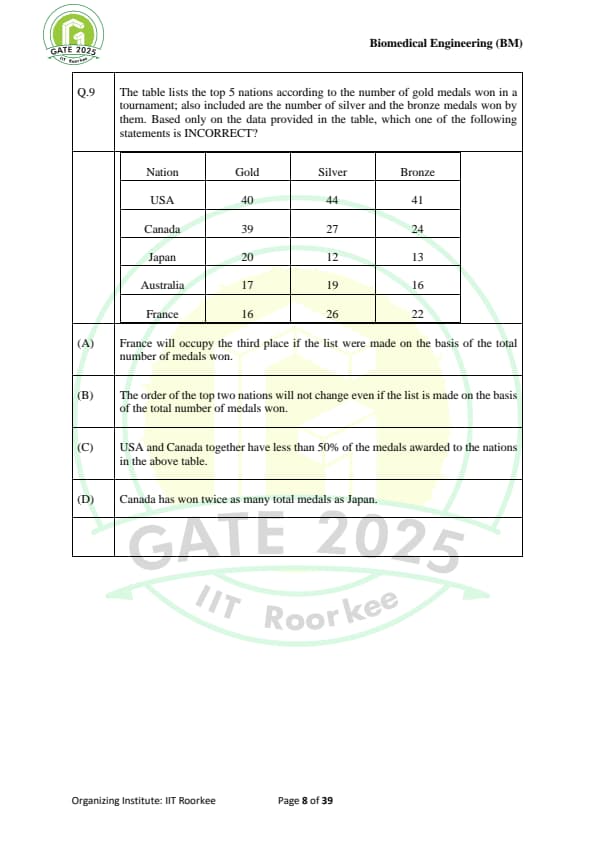
The table lists the top 5 nations according to the number of gold medals won in a tournament; also included are the number of silver and the bronze medals won by them. Based only on the data provided in the table, which one of the following statements is INCORRECT?

View Solution
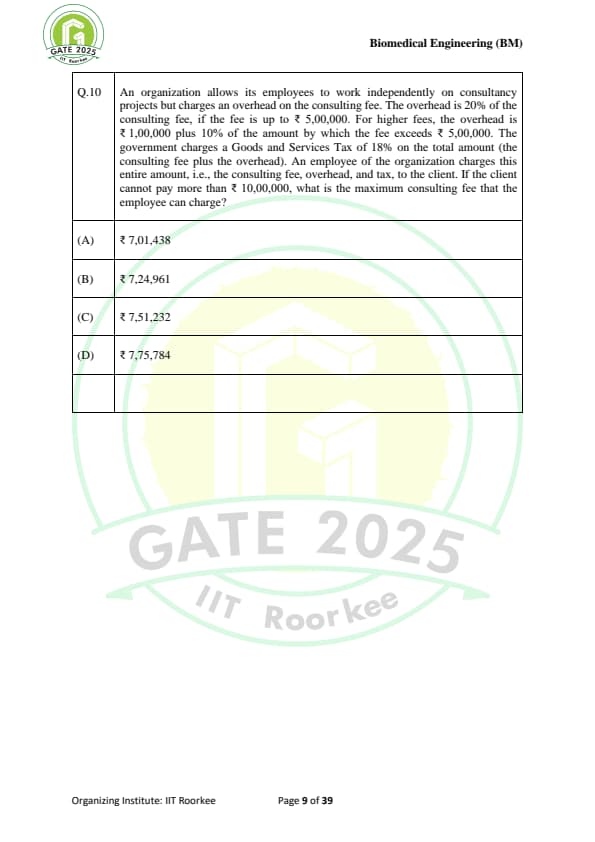
An organization allows its employees to work independently on consultancy projects but charges an overhead on the consulting fee. The overhead is 20% of the consulting fee, if the fee is up to Rs. 5,00,000. For higher fees, the overhead is Rs. 1,00,000 plus 10% of the amount by which the fee exceeds Rs. 5,00,000. The government charges a Goods and Services Tax of 18% on the total amount (the consulting fee plus the overhead). An employee of the organization charges this entire amount, i.e., the consulting fee, overhead, and tax, to the client. If the client cannot pay more than Rs. 10,00,000, what is the maximum consulting fee that the employee can charge?
View Solution
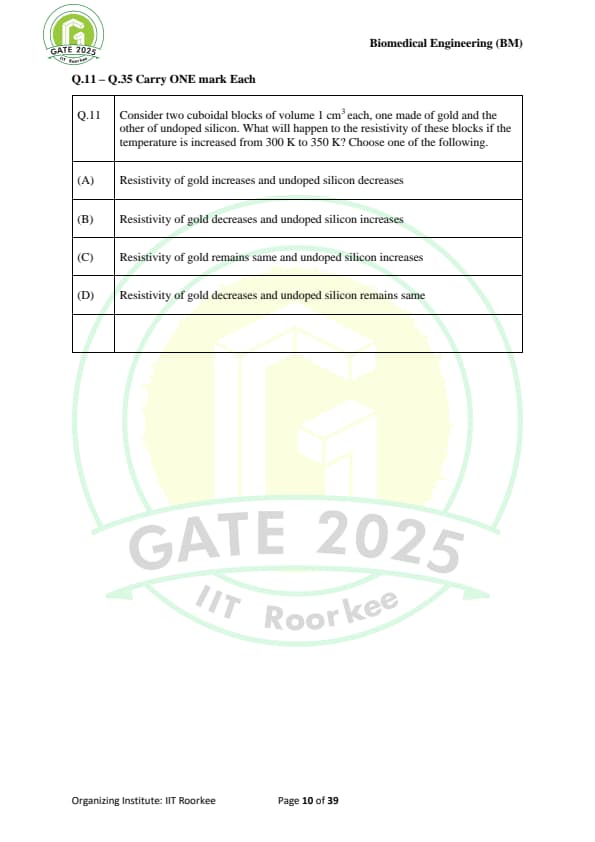
Consider two cuboidal blocks of volume 1 cm\(^3\) each, one made of gold and the other of undoped silicon. What will happen to the resistivity of these blocks if the temperature is increased from 300 K to 350 K?
View Solution
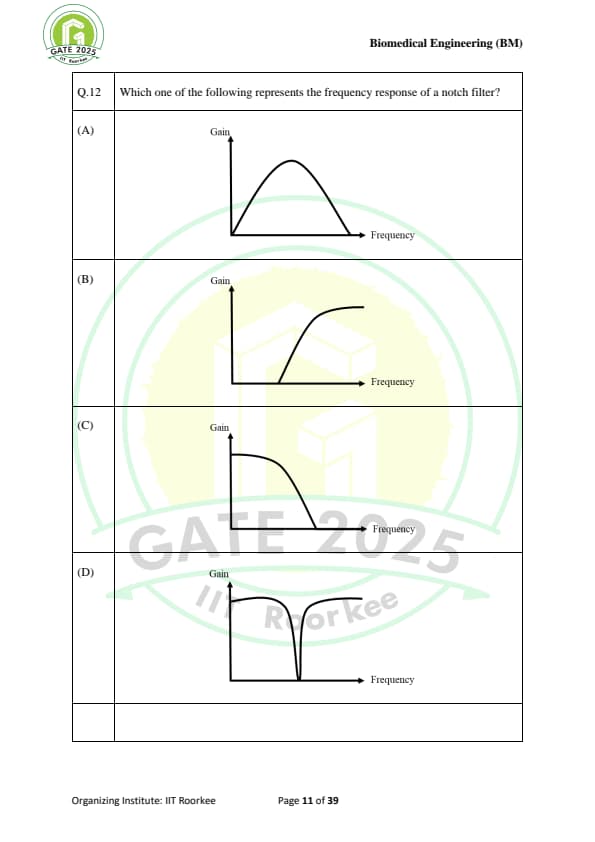
Which one of the following represents the frequency response of a notch filter?
- (A)
![]()
- (B)
![]()
- (C)
![]()
- (D)
![]()


View Solution
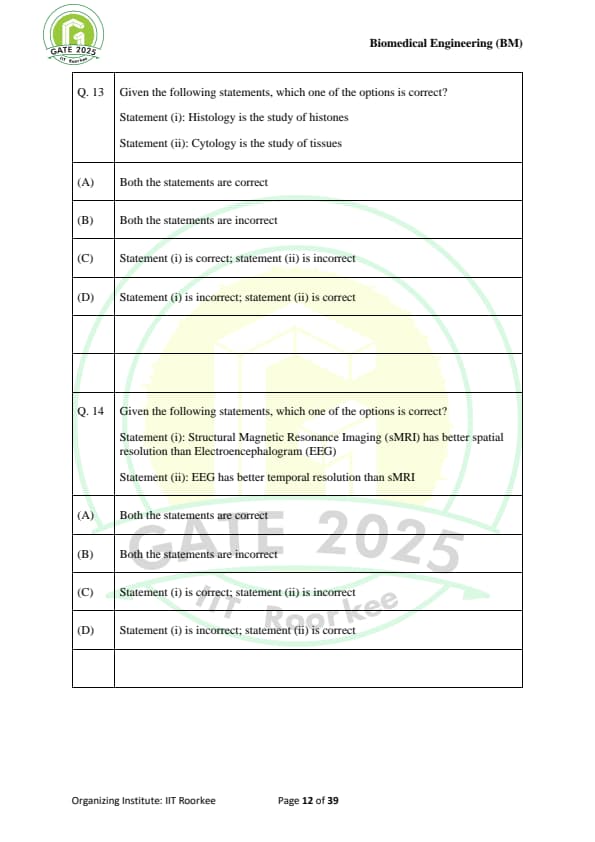
Given the following statements, which one of the options is correct?
Statement (i): Histology is the study of histones
Statement (ii): Cytology is the study of tissues
View Solution
Given the following statements, which one of the options is correct?
Statement (i): Structural Magnetic Resonance Imaging (sMRI) has better spatial resolution than Electroencephalogram (EEG)
Statement (ii): EEG has better temporal resolution than sMRI
View Solution
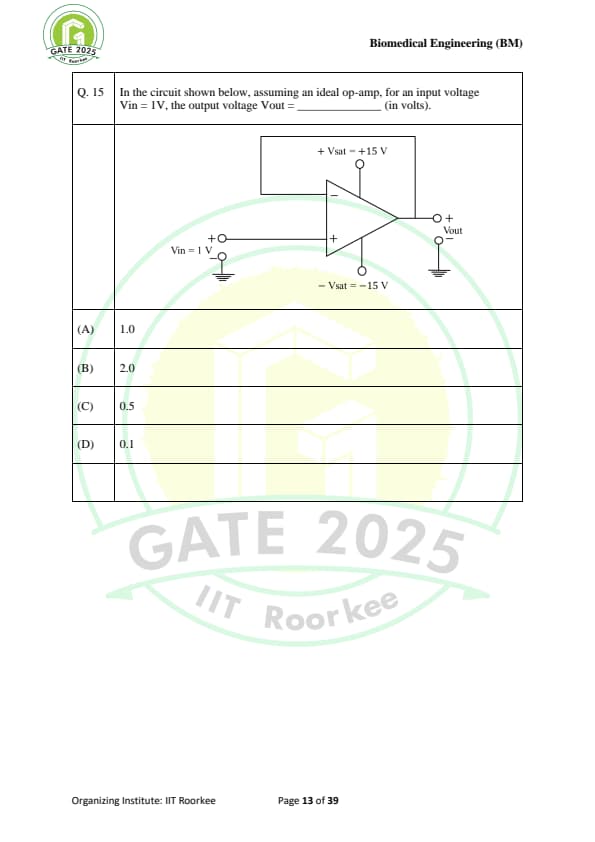
In the circuit shown below, assuming an ideal op-amp, for an input voltage \( V_{in} = 1 \, V \), the output voltage \( V_{out} = \, ? \, (in volts)\).

View Solution
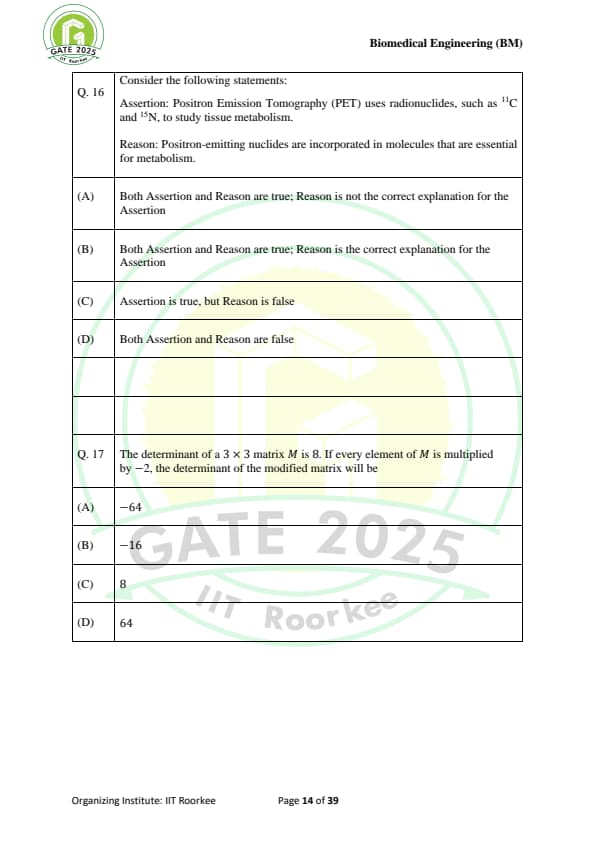
Consider the following statements:
Assertion: Positron Emission Tomography (PET) uses radionuclides, such as 11C and 15N, to study tissue metabolism.
Reason: Positron-emitting nuclides are incorporated in molecules that are essential for metabolism.
View Solution
The determinant of a 3 × 3 matrix \( M \) is 8. If every element of \( M \) is multiplied by \( -2 \), the determinant of the modified matrix will be:
View Solution
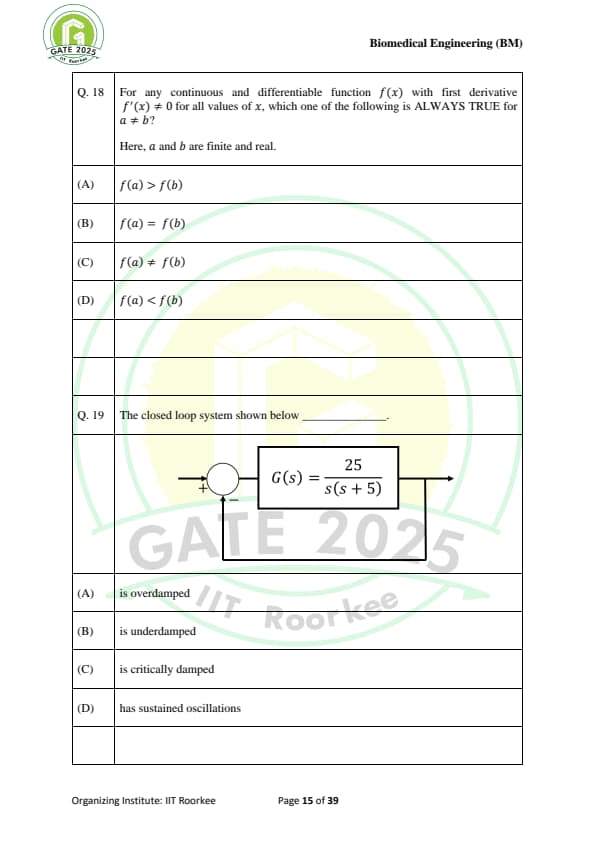
For any continuous and differentiable function \( f(x) \) with first derivative \( f'(x) \neq 0 \) for all values of \( x \), which one of the following is ALWAYS TRUE for \( a \neq b \)?
View Solution
The closed loop system shown below _______\.

\[ G(s) = \frac{25}{s(s + 5)} \]
View Solution
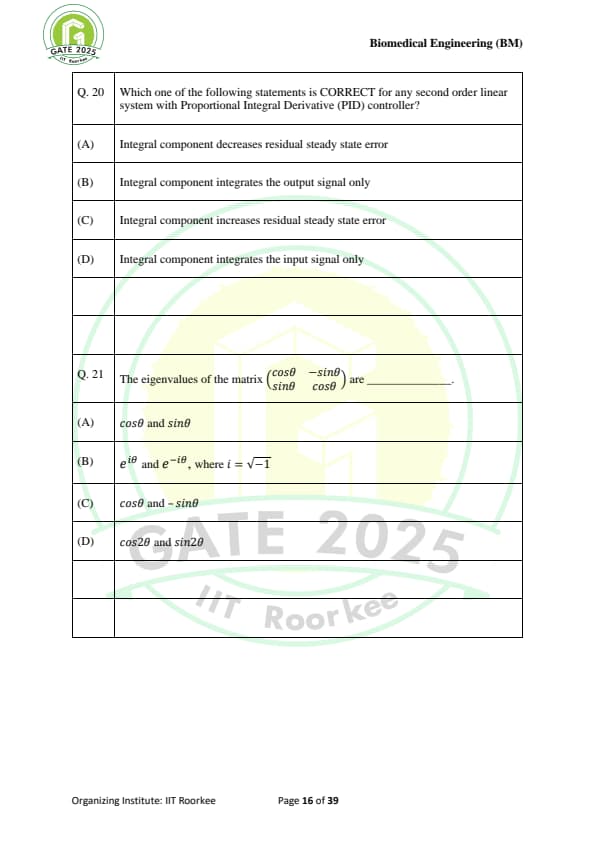
Which one of the following statements is CORRECT for any second order linear system with Proportional Integral Derivative (PID) controller?
View Solution
The eigenvalues of the matrix: \[ \begin{pmatrix} \cos\theta & -\sin\theta
\sin\theta & \cos\theta \end{pmatrix} \]
are _________\.
View Solution
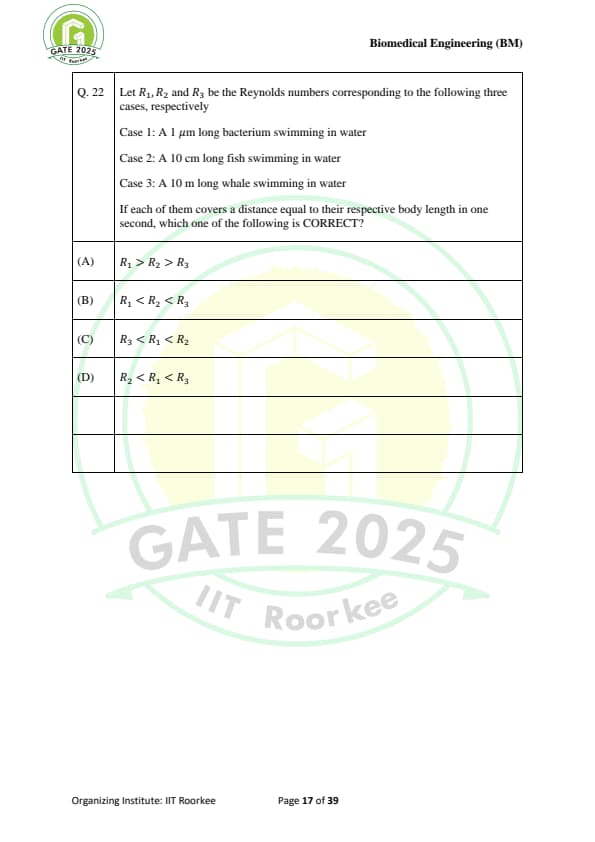
Let \( R_1, R_2 \) and \( R_3 \) be the Reynolds numbers corresponding to the following three cases, respectively:
Case 1: A 1 \(\mu\)m long bacterium swimming in water
Case 2: A 10 cm long fish swimming in water
Case 3: A 10 m long whale swimming in water
If each of them covers a distance equal to their respective body length in one second, which one of the following is CORRECT?
View Solution
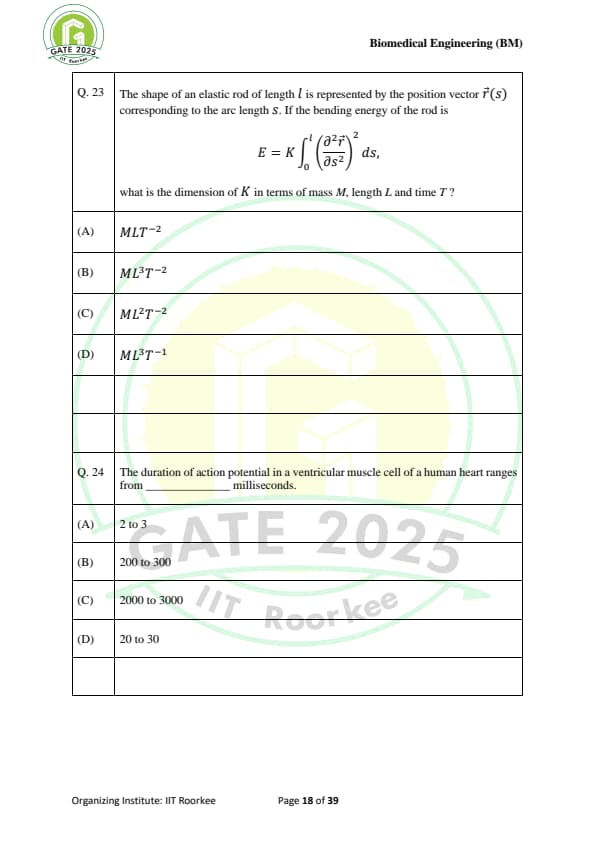
The shape of an elastic rod of length \( l \) is represented by the position vector \( \vec{r}(s) \) corresponding to the arc length \( s \). If the bending energy of the rod is \[ E = K \int_0^l \left( \frac{\partial^2 \vec{r}}{\partial s^2} \right)^2 \, ds, \]
what is the dimension of \( K \) in terms of mass \( M \), length \( L \), and time \( T \)?
View Solution
The duration of action potential in a ventricular muscle cell of a human heart ranges from ________ milliseconds.
View Solution
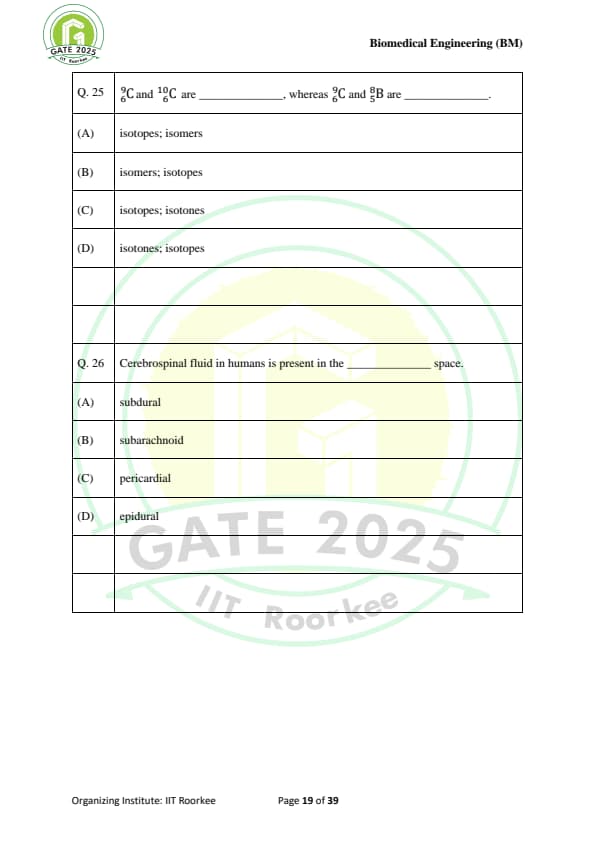
\( ^9_6C \) and \( ^{10}_6C \) are ________, whereas \( ^9_6C \) and \( ^8_5B \) are ______.
View Solution
Cerebrospinal fluid in humans is present in the ______ space.
View Solution
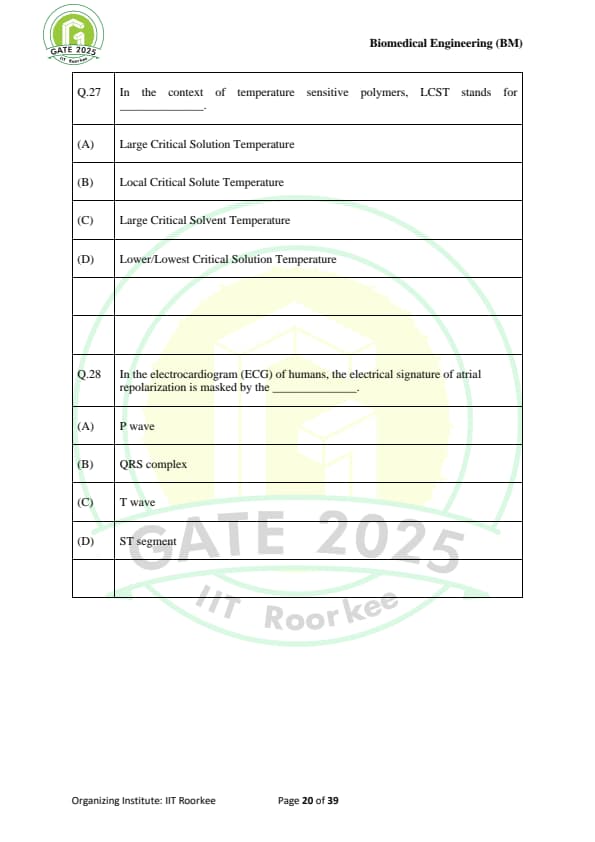
In the context of temperature sensitive polymers, LCST stands for _____.
View Solution
In the electrocardiogram (ECG) of humans, the electrical signature of atrial repolarization is masked by the _______.
View Solution
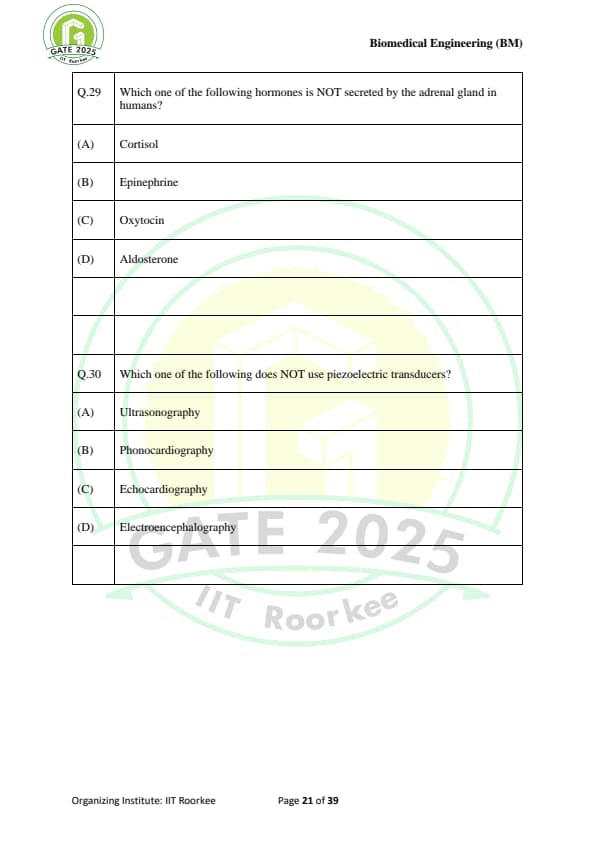
Which one of the following hormones is NOT secreted by the adrenal gland in humans?
View Solution
Which one of the following does NOT use piezoelectric transducers?
View Solution
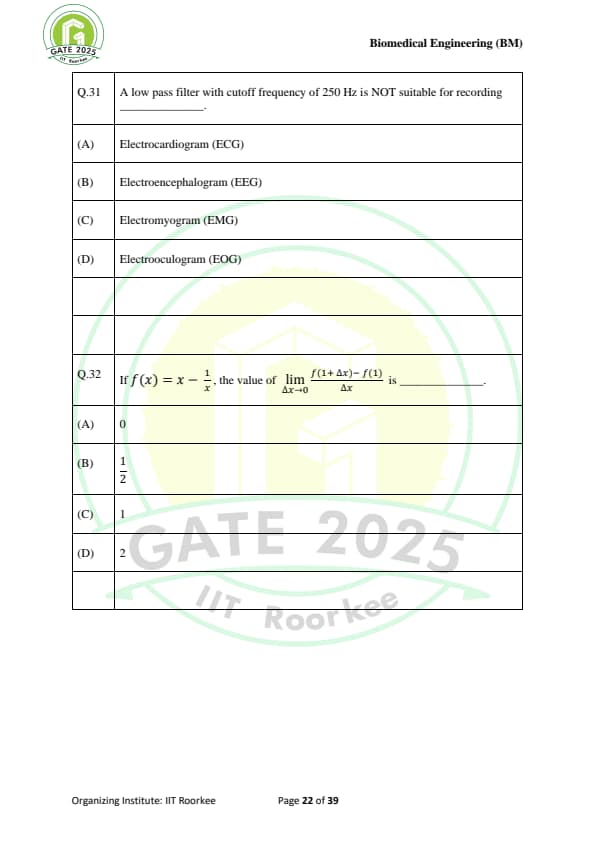
A low pass filter with cutoff frequency of 250 Hz is NOT suitable for recording _______.
View Solution
If \( f(x) = x - \frac{1}{x} \), the value of \[ \lim_{\Delta x \to 0} \frac{f(1 + \Delta x) - f(1)}{\Delta x} is \_\_\_\_\_\_\_. \]
View Solution
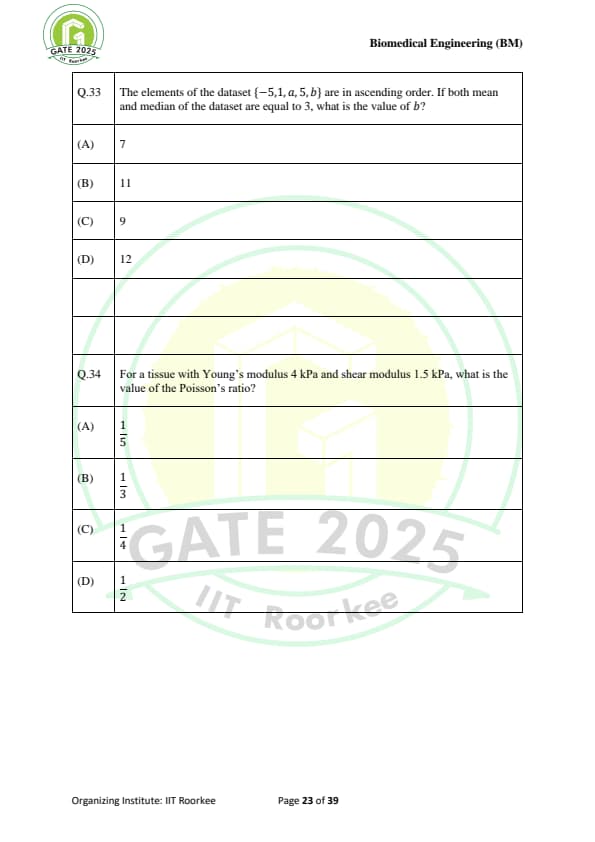
The elements of the dataset \( \{-5, 1, a, 5, b\} \) are in ascending order. If both the mean and median of the dataset are equal to 3, what is the value of \( b \)?
View Solution
For a tissue with Young’s modulus 4 kPa and shear modulus 1.5 kPa, what is the value of the Poisson’s ratio?
View Solution
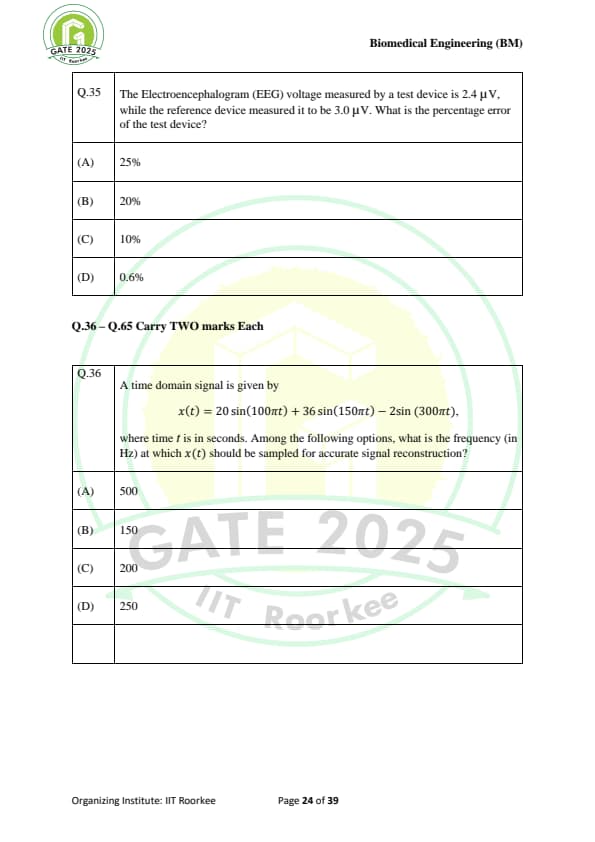
The Electroencephalogram (EEG) voltage measured by a test device is 2.4 µV, while the reference device measured it to be 3.0 µV. What is the percentage error of the test device?
View Solution
A time domain signal is given by \[ x(t) = 20 \sin(100\pi t) + 36 \sin(150\pi t) - 2 \sin(300\pi t), \]
where time \( t \) is in seconds. Among the following options, what is the frequency (in Hz) at which \( x(t) \) should be sampled for accurate signal reconstruction?
View Solution
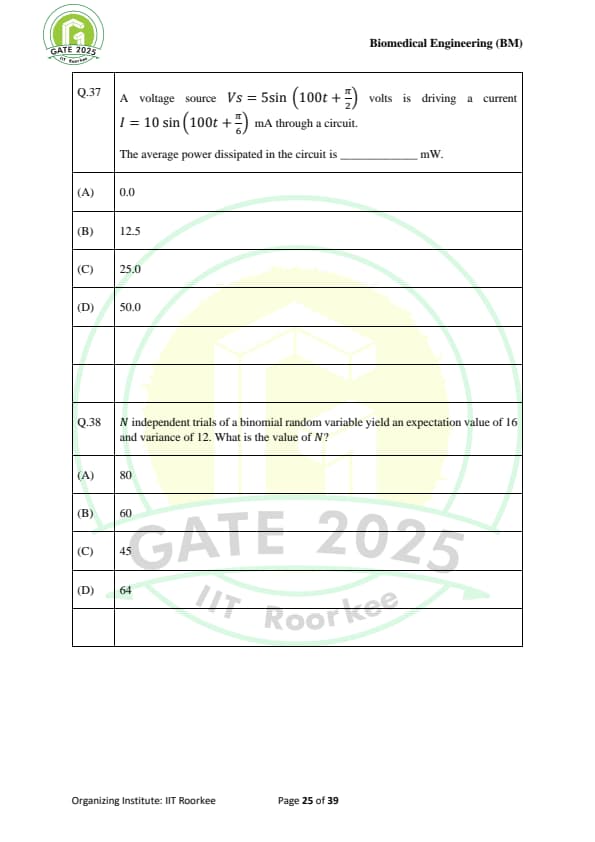
A voltage source \( V_s = 5 \sin \left( 100t + \frac{\pi}{2} \right) \) volts is driving a current \[ I = 10 \sin \left( 100t + \frac{\pi}{6} \right) \, mA \]
through a circuit. The average power dissipated in the circuit is _______ mW.
View Solution
\( N \) independent trials of a binomial random variable yield an expectation value of 16 and variance of 12. What is the value of \( N \)?
View Solution
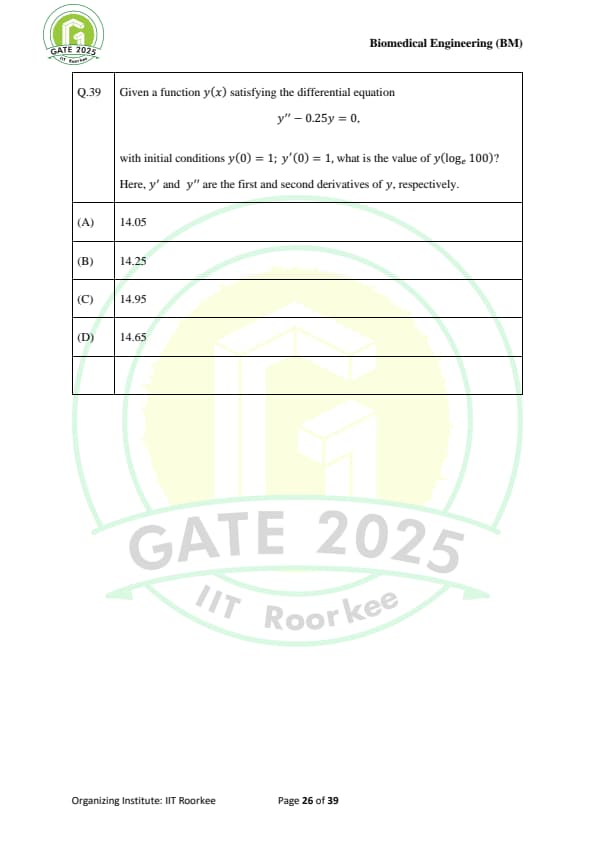
Given a function \( y(x) \) satisfying the differential equation \[ y'' - 0.25y = 0, \]
with initial conditions \( y(0) = 1 \); \( y'(0) = 1 \), what is the value of \( y(\log_e 100) \)?
{here, y' \quad \text{and \quad y'' \quad \text{are the first and second derivatives of \quad y, \text{ respectively.
View Solution
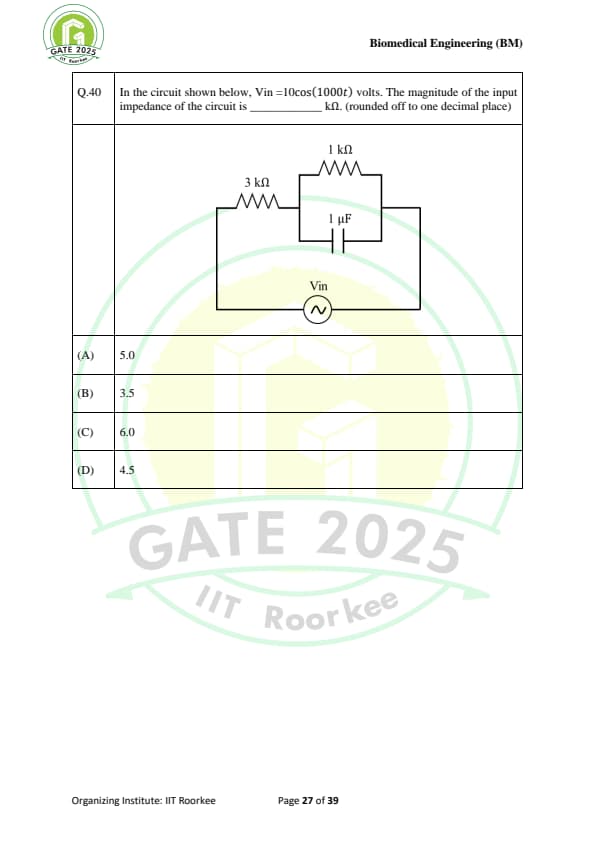
In the circuit shown below, \( V_{in} = 10 \cos(1000t) \) volts. The magnitude of the input impedance of the circuit is ______ k\(\Omega\). (rounded off to one decimal place)

View Solution
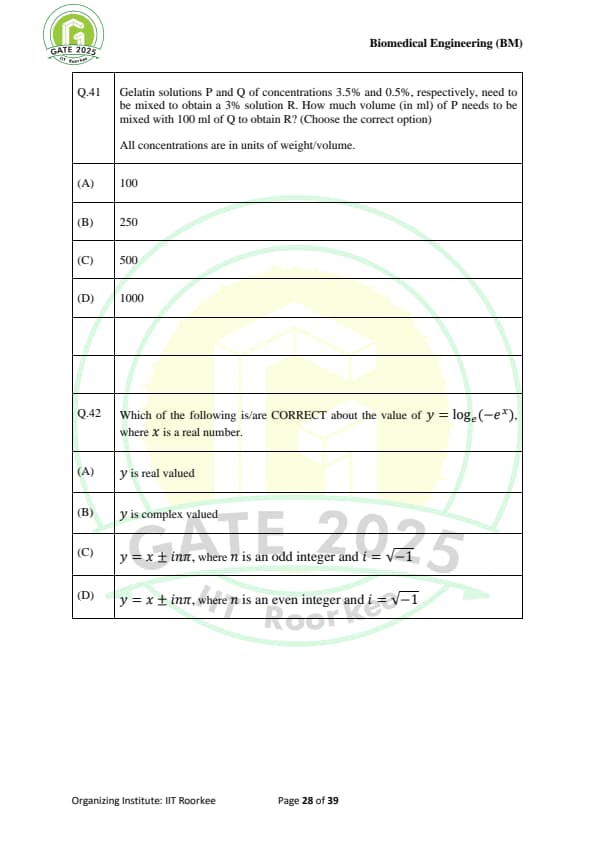
Gelatin solutions P and Q of concentrations 3.5% and 0.5%, respectively, need to be mixed to obtain a 3% solution R. How much volume (in ml) of P needs to be mixed with 100 ml of Q to obtain R? (Choose the correct option)
View Solution
Which of the following is/are CORRECT about the value of \( y = \log_e(-e^x) \), where \( x \) is a real number.
View Solution
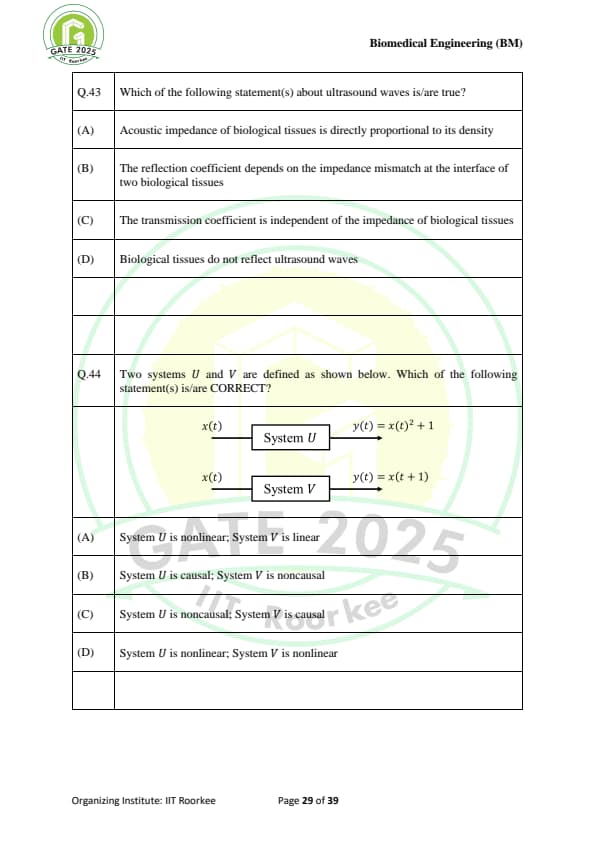
Which of the following statement(s) about ultrasound waves is/are true?
View Solution
Two systems \( U \) and \( V \) are defined as shown below. Which of the following statement(s) is/are CORRECT?
\[ x(t) \quad System \, U \quad y(t) = x(t)^2 + 1 \] \[ x(t) \quad System \, V \quad y(t) = x(t) + 1 \]
View Solution
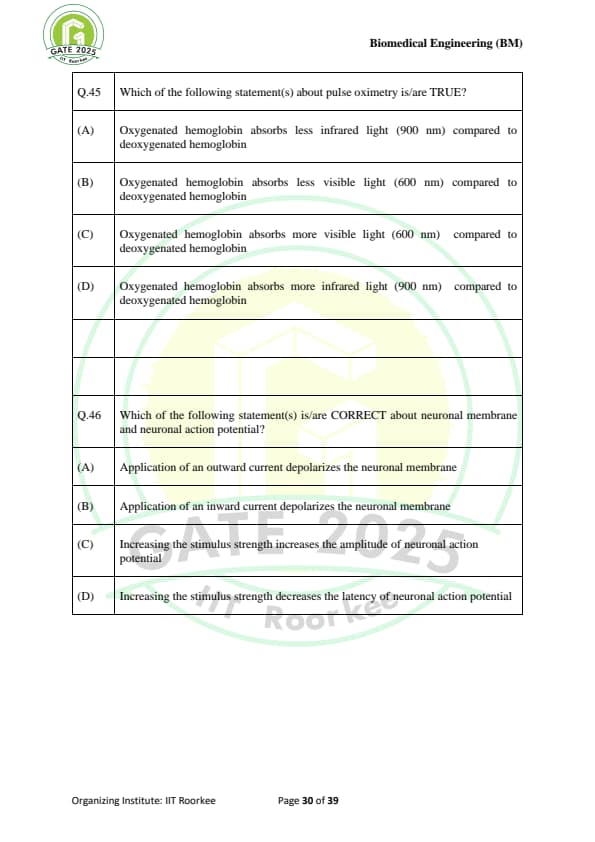
Which of the following statement(s) about pulse oximetry is/are TRUE?
View Solution
Which of the following statement(s) is/are CORRECT about neuronal membrane and neuronal action potential?
View Solution
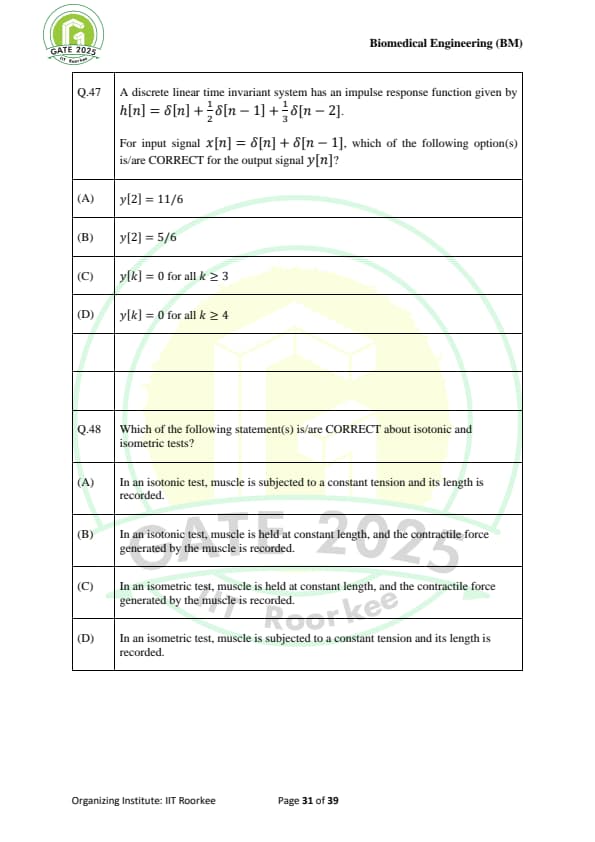
A discrete linear time invariant system has an impulse response function given by \[ h[n] = \delta[n] + \frac{1}{2}\delta[n - 1] + \frac{1}{3}\delta[n - 2]. \]
For input signal \( x[n] = \delta[n] + \delta[n - 1] \), which of the following option(s) is/are CORRECT for the output signal \( y[n] \)?
View Solution
Which of the following statement(s) is/are CORRECT about isotonic and isometric tests?
View Solution
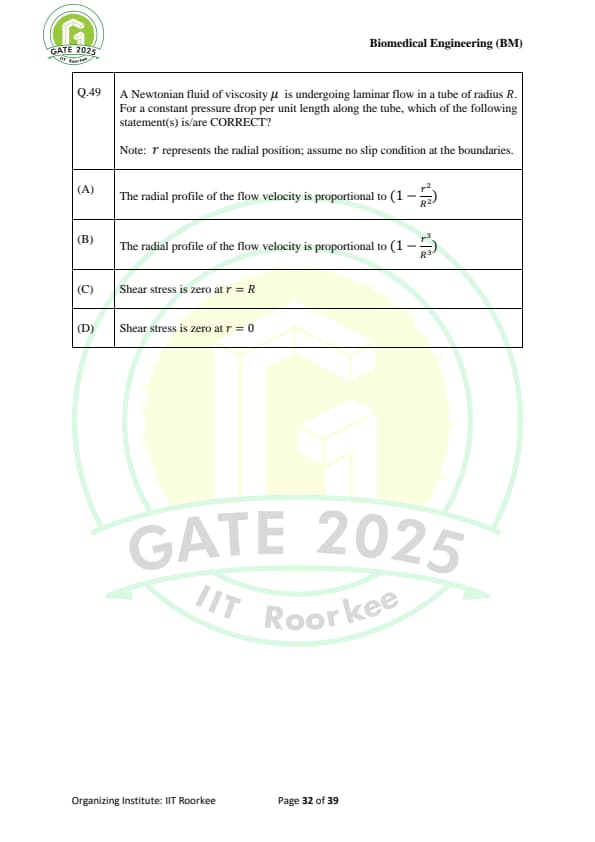
A Newtonian fluid of viscosity \( \mu \) is undergoing laminar flow in a tube of radius \( R \). For a constant pressure drop per unit length along the tube, which of the following statement(s) is/are CORRECT?
Note: \( r \) represents the radial position; assume no slip condition at the boundaries.
View Solution
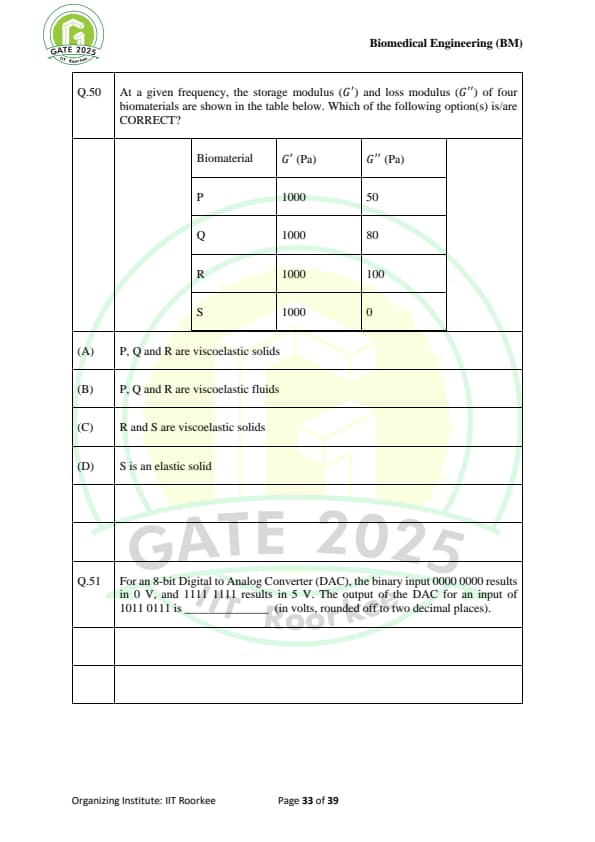
At a given frequency, the storage modulus \( G' \) and loss modulus \( G'' \) of four biomaterials are shown in the table below. Which of the following option(s) is/are CORRECT?

View Solution
For an 8-bit Digital to Analog Converter (DAC), the binary input 0000 0000 results in 0 V, and 1111 1111 results in 5 V. The output of the DAC for an input of 1011 0111 is ________ (in volts, rounded off to two decimal places).
View Solution
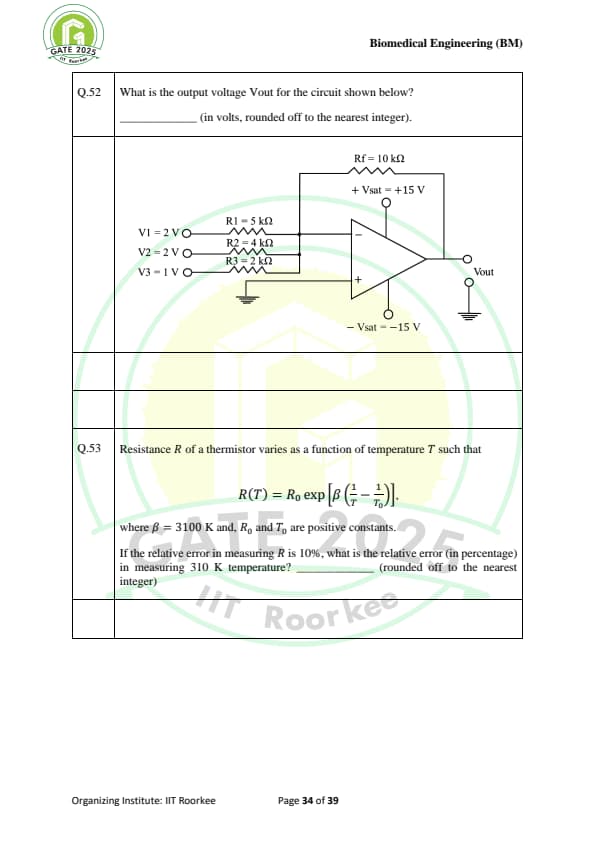
What is the output voltage \( V_{out} \) for the circuit shown below?

View Solution
Resistance \( R \) of a thermistor varies as a function of temperature \( T \) such that
\[ R(T) = R_0 \exp \left[ \beta \left( \frac{1}{T} - \frac{1}{T_0} \right) \right] \]
where \( \beta = 3100 \, K \), \( R_0 \) and \( T_0 \) are positive constants.
If the relative error in measuring \( R \) is 10%, what is the relative error (in percentage) in measuring 310 K temperature? (rounded off to the nearest integer)
View Solution
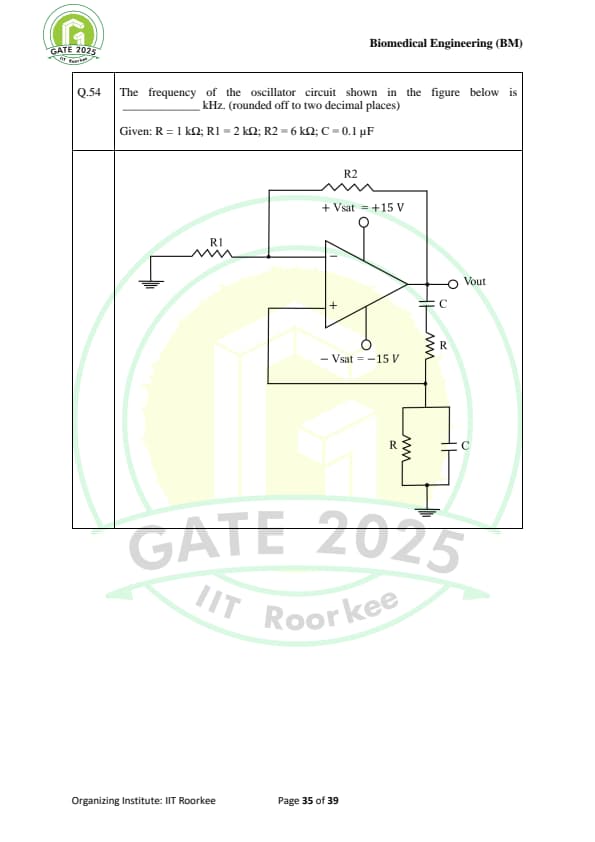
The frequency of the oscillator circuit shown in the figure below is ______ (in kHz, rounded off to two decimal places).

% Given values
Given: \( R = 1 \, k\Omega; R_1 = 2 \, k\Omega; R_2 = 6 \, k\Omega; C = 0.1 \, \mu F \)
View Solution
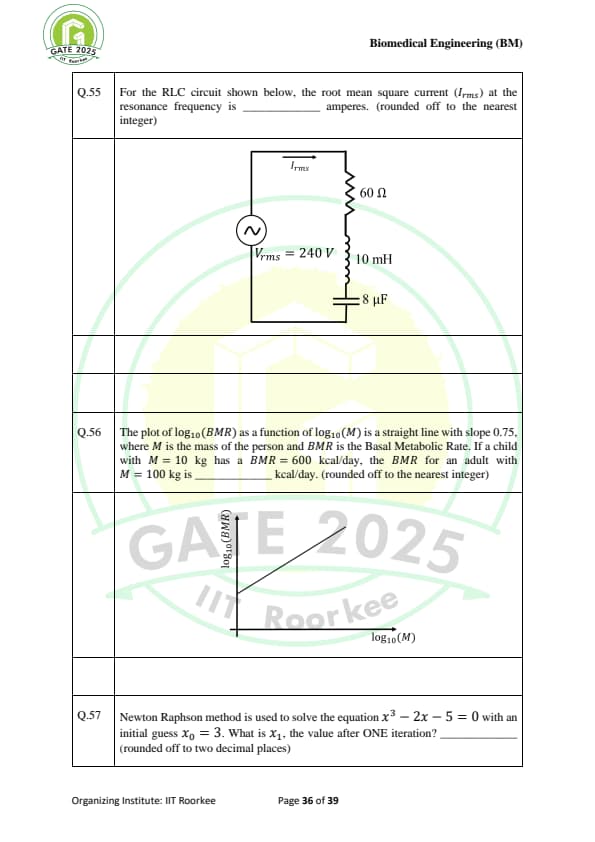
For the RLC circuit shown below, the root mean square current \( I_{rms} \) at the resonance frequency is ______ amperes. (rounded off to the nearest integer)

\[ V_{rms} = 240 \, V, \quad R = 60 \, \Omega, \quad L = 10 \, mH, \quad C = 8 \, \mu F \]
View Solution
The plot of \( \log_{10} (BMR) \) as a function of \( \log_{10} (M) \) is a straight line with slope 0.75, where \( M \) is the mass of the person and BMR is the Basal Metabolic Rate. If a child with \( M = 10 \, kg \) has a BMR = 600 kcal/day, the BMR for an adult with \( M = 100 \, kg \) is _____ kcal/day. (rounded off to the nearest integer)

View Solution
Newton Raphson method is used to solve the equation \(x^3 - 2x - 5 = 0\) with an initial guess \(x_0 = 3\). What is \(x_1\), the value after ONE iteration?
View Solution
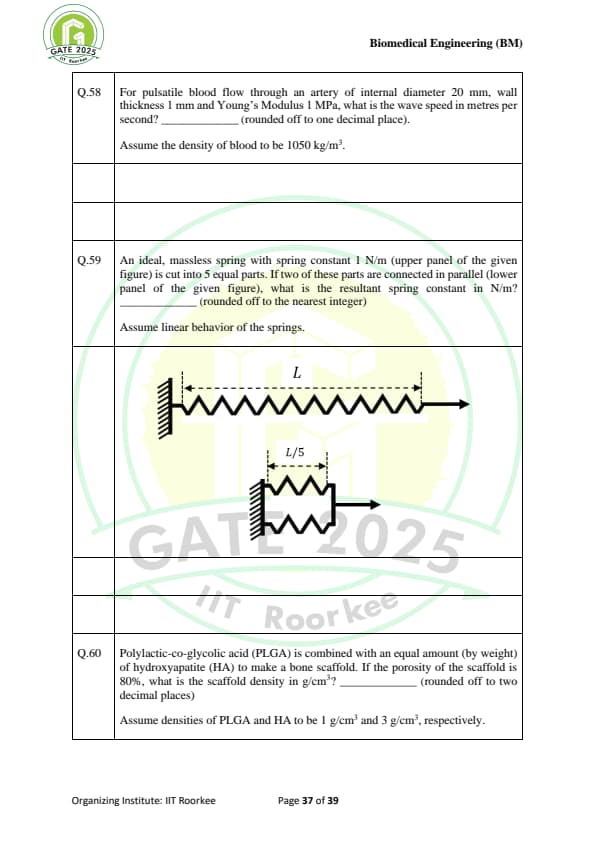
For pulsatile blood flow through an artery of internal diameter 20 mm, wall thickness 1 mm, and Young’s Modulus 1 MPa, what is the wave speed in metres per second?
(rounded off to one decimal place). Assume the density of blood to be 1050 kg/m\(^3\).
View Solution
An ideal, massless spring with spring constant 1 N/m (upper panel of the given figure) is cut into 5 equal parts. If two of these parts are connected in parallel (lower panel of the given figure), what is the resultant spring constant in N/m? (rounded off to the nearest integer)

View Solution
Polylactic-co-glycolic acid (PLGA) is combined with an equal amount (by weight) of hydroxyapatite (HA) to make a bone scaffold. If the porosity of the scaffold is 80%, what is the scaffold density in g/cm\(^3\)? (rounded off to two decimal places)
Assume densities of PLGA and HA to be 1 g/cm\(^3\) and 3 g/cm\(^3\), respectively.
View Solution
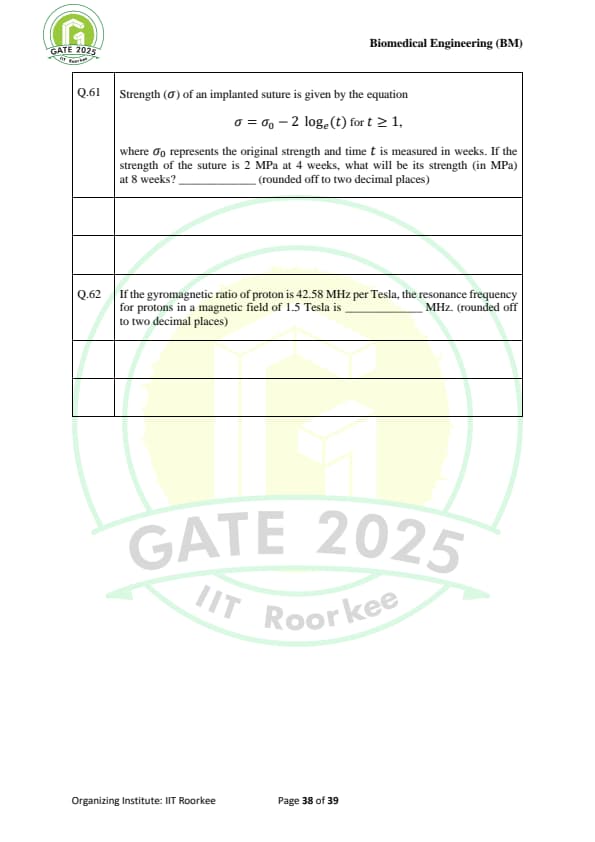
Strength (\(\sigma\)) of an implanted suture is given by the equation \[ \sigma = \sigma_0 - 2 \log_e(t) \quad for \quad t \geq 1, \]
where \(\sigma_0\) represents the original strength and time \(t\) is measured in weeks. If the strength of the suture is 2 MPa at 4 weeks, what will be its strength (in MPa) at 8 weeks? (Rounded off to two decimal places)
View Solution
If the gyromagnetic ratio of proton is 42.58 MHz per Tesla, the resonance frequency for protons in a magnetic field of 1.5 Tesla is _____ MHz. (rounded off to two decimal places)
View Solution
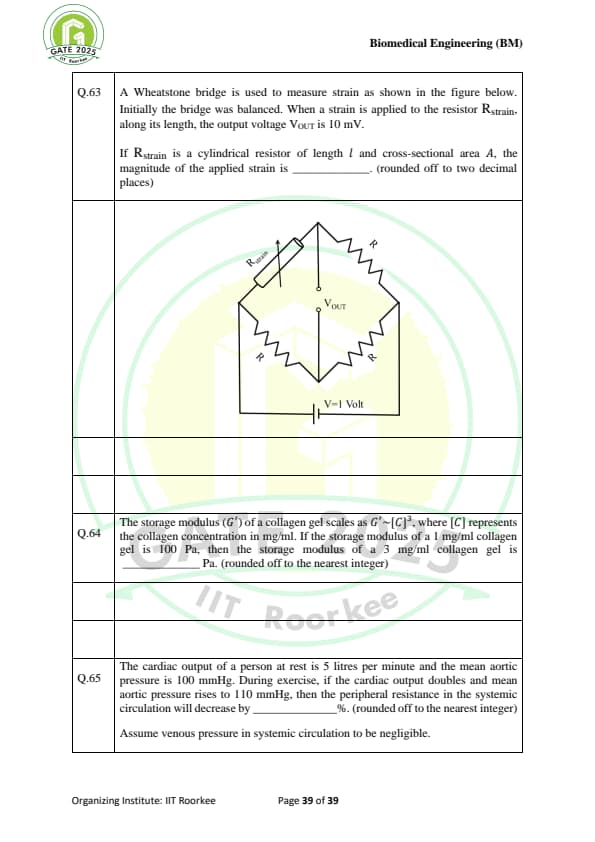
A Wheatstone bridge is used to measure strain as shown in the figure below.
Initially, the bridge was balanced. When a strain is applied to the resistor \( R_{strain} \), along its length, the output voltage \( V_{out} \) is 10 mV.
If \( R_{strain} \) is a cylindrical resistor of length \( l \) and cross-sectional area \( A \), the magnitude of the applied strain is _____.
(rounded off to two decimal places)

View Solution
The storage modulus \( G' \) of a collagen gel scales as \( G' \sim [C]^3 \), where [C] represents the collagen concentration in mg/ml. If the storage modulus of a 1 mg/ml collagen gel is 100 Pa, then the storage modulus of a 3 mg/ml collagen gel is _____\ Pa. (rounded off to the nearest integer)
View Solution
The cardiac output of a person at rest is 5 litres per minute and the mean aortic pressure is 100 mmHg.
During exercise, if the cardiac output doubles and mean aortic pressure rises to 110 mmHg, then the peripheral resistance in the systemic circulation will decrease by _____%.
(rounded off to the nearest integer). Assume venous pressure in systemic circulation to be negligible.
View Solution




Comments