



.png?h=35&w=35&mode=stretch)
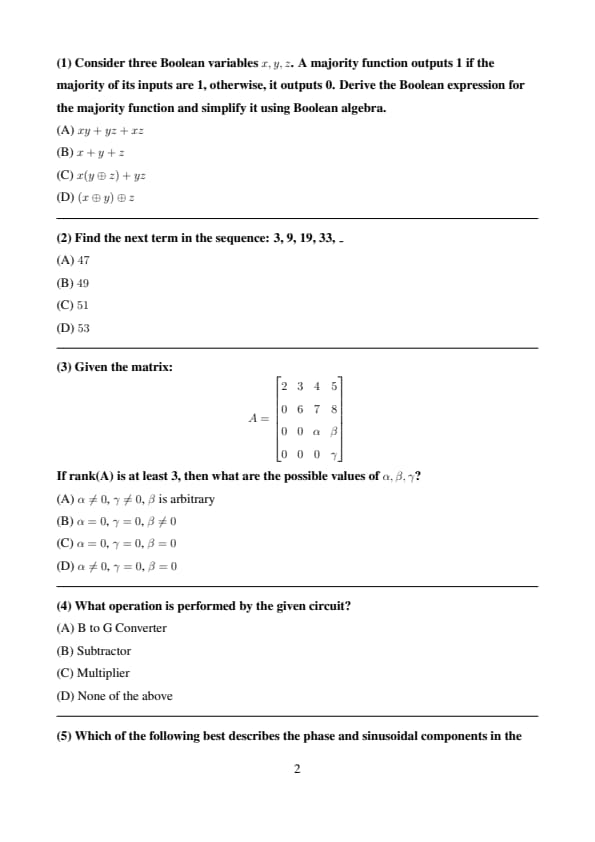
The GATE 2025 EC Question Paper PDF is available as the exam has ended. The GATE 2025 Electronics & Communication Engineering (EC) exam was organized by IIT Roorkee on February 15, Shift 2, which was scheduled from 2:30 PM to 5:30 PM. According to the revised test pattern, the test had 65 questions that made up a total of 100 marks with 10 General Aptitude and 55 Engineering Mathematics and Electronics & Communication Engineering subject questions.
The difficulty level of GATE 2025 EC was moderately difficult.
GATE 2025 EC Question Paper with Solutions PDF
| GATE 2025 EC Question Paper with Answer Key | Download | Check Solutions |

GATE 2025 EC Question Paper with Solutions
Consider three Boolean variables \( x, y, z \). A majority function outputs 1 if the majority of its inputs are 1, otherwise, it outputs 0. Derive the Boolean expression for the majority function and simplify it using Boolean algebra.
View Solution
Understanding the Majority Function.
A majority function for three variables \( x, y, z \) is defined as: \[ f(x,y,z) = 1 when at least two inputs are 1. \]
The sum of minterms where the function evaluates to 1 is: \[ \Sigma(3,5,6,7) \]
Using Boolean algebra, the canonical sum-of-products (SOP) expression for the majority function is: \[ f(x,y,z) = xy + yz + xz \]
We can also derive this using simplifications:
1. Expanding in terms of the majority condition:
\[ xy + yz + xz \]
2. Alternative simplification using XOR:
\[ f(x,y,z) = x(y \oplus z) + yz \]
Since both derivations are equivalent, the minimal expression is:
\[ xy + yz + xz \] Quick Tip: In logic circuits, the majority function is useful in voting systems and fault-tolerant computing, where outputs depend on the majority of inputs.
Find the next term in the sequence: 3, 9, 19, 33, _
View Solution
Finding the Pattern in the Sequence.
The given sequence: \[ 3, 9, 19, 33, \_ \]
Finding first-order differences: \[ 9 - 3 = 6, \quad 19 - 9 = 10, \quad 33 - 19 = 14 \]
Finding second-order differences: \[ 10 - 6 = 4, \quad 14 - 10 = 4 \]
Since the second-order difference is constant (\(4\)), the sequence follows a quadratic pattern.
The next first-order difference is: \[ 18 = 14 + 4 \]
Thus, the next term in the sequence is: \[ 33 + 18 = 51 \] Quick Tip: A constant second-order difference indicates a quadratic sequence. Use this method to predict future terms efficiently.
Given the matrix: \[ A = \begin{bmatrix} 2 & 3 & 4 & 5
0 & 6 & 7 & 8
0 & 0 & \alpha & \beta
0 & 0 & 0 & \gamma \end{bmatrix} \]
If rank(A) is at least 3, then what are the possible values of \( \alpha, \beta, \gamma \)?
View Solution
Understanding Rank in an Upper Triangular Matrix.
For a matrix in upper triangular form, its rank is equal to the number of nonzero diagonal elements.
The diagonal elements of \( A \) are: \[ 2, 6, \alpha, \gamma \]
Since rank(A) must be at least 3, we require at least three of these elements to be nonzero.
- \( 2 \) and \( 6 \) are already nonzero.
- At least one of \( \alpha \) or \( \gamma \) must be nonzero.
- \( \beta \) does not affect rank, so it can be any value.
Thus, the possible values are: \[ \alpha \neq 0 \quad or \quad \gamma \neq 0, \quad \beta is arbitrary. \] Quick Tip: For an upper triangular matrix, rank is simply the number of nonzero diagonal elements.
What operation is performed by the given circuit?
View Solution
Understanding the Circuit.
The given circuit consists of:
- A Full Adder (FA)
- An XOR gate that inverts \( y \) (i.e., \( y' = y \oplus 1 = \bar{y} \))
- A Carry-in value of 1
Binary Subtraction via Two’s Complement: \[ A - B = A + \bar{B} + 1 \]
Here:
- \( x \) is directly passed to the FA.
- \( y \) is complemented via XOR with 1.
- Carry-in = 1.
This is the standard way to perform subtraction using addition, confirming that the circuit acts as a subtractor. Quick Tip: Subtraction can be implemented using addition by converting the second operand into its Two’s Complement form (\(\bar{B} + 1\)).
Which of the following best describes the phase and sinusoidal components in the given control system plot?
View Solution
Understanding Frequency Domain Parameters.
The given diagram represents a frequency response plot, likely from Nyquist Stability Criterion or Bode Plot Analysis.
1. Sinusoidal Component \( \sin \omega_c \):
- Indicates the system's response at critical frequency \( \omega_c \).
- This often corresponds to the gain crossover frequency in a Bode plot.
2. Phase Angle \( \theta \) at \( \omega_p \):
- \( \omega_p \) is the phase crossover frequency, where phase margin is measured.
- It is a key factor in stability determination.
Thus, the correct answer is: \[ \sin \omega_c, \quad \theta is \omega_p \] Quick Tip: In control systems, the gain crossover frequency (\( \omega_c \)) and phase crossover frequency (\( \omega_p \)) help analyze stability margins using Bode and Nyquist plots.
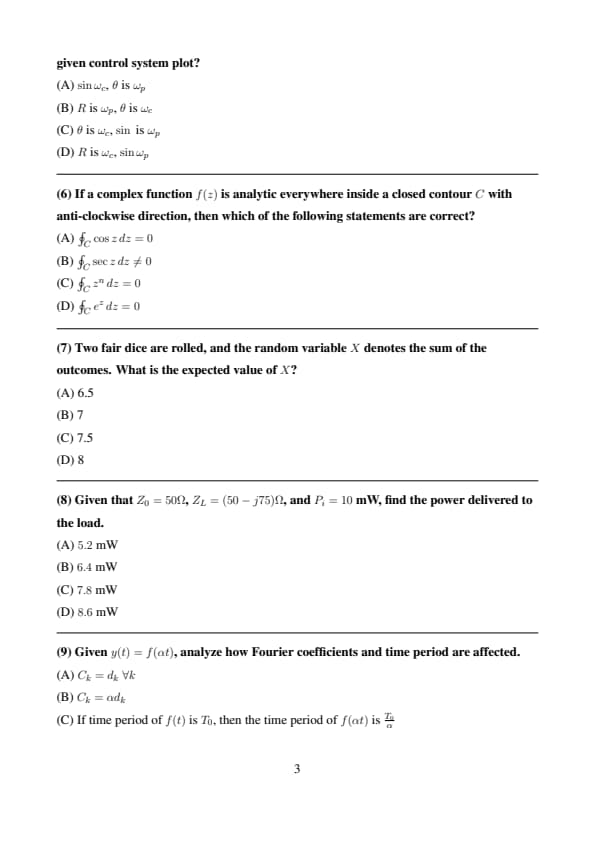
If a complex function \( f(z) \) is analytic everywhere inside a closed contour \( C \) with anti-clockwise direction, then which of the following statements are correct?
View Solution
Applying Contour Integration Theorems.
By Cauchy's Integral Theorem (CIT): \[ \oint_C f(z) dz = 0, \quad if f(z) is analytic inside and on C. \]
Checking the options:
1. \( \cos z \) is entire (analytic everywhere), so \( \oint_C \cos z dz = 0 \).
(A) is correct.
2. \( \sec z = \frac{1}{\cos z} \) has poles where \( \cos z = 0 \) (e.g., \( z = \frac{\pi}{2}, -\frac{\pi}{2} \)).
- If a pole exists inside \( C \), the integral is nonzero.
(B) is correct.
3. \( z^n \) is analytic for all \( n \neq -1 \), so \( \oint_C z^n dz = 0 \) for \( n \neq -1 \).
(C) is correct.
4. \( e^z \) is entire (analytic everywhere), so \( \oint_C e^z dz = 0 \).
(D) is correct.
Quick Tip: Cauchy's Integral Theorem states that if a function is analytic inside and on a closed contour, its integral is zero. However, if a function has poles inside the contour, then we apply Residue Theorem.
Two fair dice are rolled, and the random variable \( X \) denotes the sum of the outcomes. What is the expected value of \( X \)?
View Solution
Expectation of the Sum of Two Dice.
Let \( X_1 \) and \( X_2 \) be the outcomes of two fair six-sided dice.
The sum of outcomes is: \[ X = X_1 + X_2 \]
For a single fair die: \[ E[X_1] = E[X_2] = \frac{1+2+3+4+5+6}{6} = \frac{21}{6} = 3.5 \]
By linearity of expectation: \[ E[X] = E[X_1] + E[X_2] = 3.5 + 3.5 = 7 \]
Thus, the expected value of \( X \) is: \[ \mathbf{7} \] Quick Tip: For any two independent random variables \( X \) and \( Y \), the expectation follows the additive property: \[ E[X + Y] = E[X] + E[Y] \] This property simplifies expectation calculations in probability theory.
Given that \( Z_0 = 50\Omega \), \( Z_L = (50 - j75)\Omega \), and \( P_i = 10 \) mW, find the power delivered to the load.
View Solution
Step 1: Calculate the Reflection Coefficient.
\[ \Gamma = \frac{Z_L - Z_0}{Z_L + Z_0} \]
Substituting values: \[ \Gamma = \frac{(50 - j75) - 50}{(50 - j75) + 50} = \frac{-j75}{100 - j75} \]
Multiplying by the complex conjugate: \[ \Gamma = \frac{5625 - j7500}{15625} \]
\[ |\Gamma| = \sqrt{\left( \frac{5625}{15625} \right)^2 + \left( \frac{-7500}{15625} \right)^2} = 0.6 \]
Step 2: Compute Power Delivered to Load.
The formula for power delivered:
\[ P_L = P_i (1 - |\Gamma|^2) \]
\[ P_L = 10 (1 - 0.36) = 10 \times 0.64 = 6.4 mW \]
Thus, the final power delivered is:
\[ \mathbf{6.4 mW} \] Quick Tip: In transmission line problems, power delivered is calculated using reflection coefficient, which accounts for power loss due to mismatched impedances.
Given \( y(t) = f(\alpha t) \), analyze how Fourier coefficients and time period are affected.
View Solution
Effect of Time Scaling on Fourier Series.
Given \( y(t) = f(\alpha t) \), the Fourier series of \( f(t) \) is:
\[ f(t) = \sum_{n=-\infty}^{\infty} C_k e^{-jn\omega_0 t} \]
Applying time scaling:
\[ y(t) = f(\alpha t) = \sum_{n=-\infty}^{\infty} C_k e^{-jn\omega_0 (\alpha t)} \]
Rewriting:
\[ y(t) = \sum_{n=-\infty}^{\infty} C_k e^{-jn (\alpha \omega_0) t} \]
Comparing with the standard Fourier series form:
\[ y(t) = \sum_{n=-\infty}^{\infty} d_k e^{-jn\omega_0' t} \]
We get:
- \( \omega_0' = \alpha \omega_0 \) (frequency scales by \( \alpha \)).
- Fourier coefficients remain the same: \( d_k = C_k \).
Checking the given options:
1. \( C_k = d_k \) (Correct)
2. \( C_k = \alpha d_k \) (Incorrect)
3. Time period transformation:
\[ T' = \frac{T_0}{\alpha} \]
(Correct)
4. \( T' = \alpha T_0 \) (Incorrect).
Thus, the correct answers are (A) and (C). Quick Tip: In time-scaling \( y(t) = f(\alpha t) \), - The time period scales as \( T' = \frac{T_0}{\alpha} \). - The fundamental frequency scales as \( \omega_0' = \alpha \omega_0 \). - The Fourier coefficients remain unchanged.
What is the maximum frequency for Clk in MHz, given the flip-flop and logic gate delays?
View Solution
Step 1: Understanding the Timing Parameters.
The given timing parameters from the circuit:
- Setup Time (\( t_s \)) = 2 ns
- Hold Time (\( t_h \)) = 0 ns
- Clock-to-Q Propagation Delay (\( t_{pcq} \)) = 2 ns
- Logic Gate Propagation Delay = 1 ns
Step 2: Compute the Minimum Clock Period.
The minimum clock period for a sequential circuit is given by:
\[ T_{min} = t_{pcq} + t_{pd(logic)} + t_{setup} \]
Substituting values:
\[ T_{min} = 2 ns + 1 ns + 2 ns = 5 ns \]
Step 3: Compute the Maximum Clock Frequency.
\[ f_{max} = \frac{1}{T_{min}} = \frac{1}{5 \times 10^{-9}} Hz \]
\[ f_{max} = 200 MHz \]
Thus, the maximum clock frequency is:
\[ \mathbf{200} MHz \] Quick Tip: For a synchronous sequential circuit, the maximum clock frequency is determined by the longest combinational delay path between flip-flops plus setup time constraints.







Comments