




The GATE 2025 EY Question Paper is available as the exam is over. The GATE 2025 Ecology and Evolution (EY) examination was held by IIT Roorkee on February 15, Shift 2, from 2:30 PM and 5:30 PM. As per the recent examination pattern, the exam had 65 questions worth 100 marks, out of which 10 questions were from the General Aptitude section and 55 questions were from the Ecology and Evolution sections.
The difficulty level of GATE 2025 EY was moderate.
GATE 2025 EY Question Paper with Solutions PDF
| GATE 2025 EY Question Paper with Answer Key |  Download Download |
Check Solution |

GATE 2025 EY Question Paper with Solutions
Here are two analogous groups, Group-I and Group-II, that list words in their decreasing order of intensity. Identify the missing word in Group-II.
Abuse \( \rightarrow \) Insult \( \rightarrow \) Ridicule
________ \( \rightarrow \) Praise \( \rightarrow \) Appreciate
View Solution
Had I learnt acting as a child, I __________ a famous film star.
Select the most appropriate option to complete the above sentence.
View Solution
The 12 musical notes are given as \( C, C^\#, D, D^\#, E, F, F^\#, G, G^\#, A, A^\#, B \). Frequency of each note is \( \sqrt[12]{2} \) times the frequency of the previous note. If the frequency of the note C is 130.8 Hz, then the ratio of frequencies of notes F\# and C is:
View Solution
The following figures show three curves generated using an iterative algorithm. The total length of the curve generated after 'Iteration n' is:

View Solution
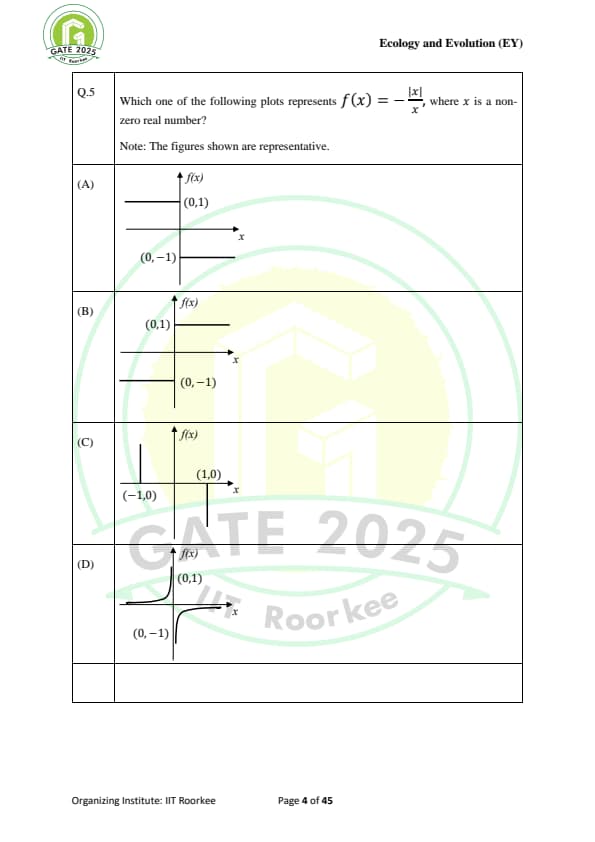
Which one of the following plots represents \( f(x) = -\frac{|x|}{x} \), where \( x \) is a non-zero real number?
Note: The figures shown are representative.
View Solution
Identify the option that has the most appropriate sequence such that a coherent paragraph is formed:
P: Over time, such adaptations lead to significant evolutionary changes with the potential to shape the development of new species.
Q: In natural world, organisms constantly adapt to their environments in response to challenges and opportunities.
R: This process of adaptation is driven by the principle of natural selection, where favorable traits increase an organism’s chances of survival and reproduction.
S: As environments change, organisms that can adapt their behavior, structure, and physiology to such changes are more likely to survive.
View Solution
A stick of length one meter is broken at two locations at distances of \( b_1 \) and \( b_2 \) from the origin (0), as shown in the figure. Note that \( 0 < b_1 < b_2 < 1 \). Which one of the following is NOT a necessary condition for forming a triangle using the three pieces?
Note: All lengths are in meter. The figure shown is representative.

View Solution
Eight students (P, Q, R, S, T, U, V, and W) are playing musical chairs. The figure indicates their order of position at the start of the game. They play the game by moving forward in a circle in the clockwise direction.
After the 1st round, 4th student behind P leaves the game. After 2nd round, 5th student behind Q leaves the game. After 3rd round, 3rd student behind V leaves the game. After 4th round, 4th student behind U leaves the game. Who all are left in the game after the 4th round?

View Solution
The table lists the top 5 nations according to the number of gold medals won in a tournament; also included are the number of silver and the bronze medals won by them. Based only on the data provided in the table, which one of the following statements is INCORRECT?

View Solution
An organization allows its employees to work independently on consultancy projects but charges an overhead on the consulting fee. The overhead is 20% of the consulting fee, if the fee is up to Rs. 5,00,000. For higher fees, the overhead is Rs. 1,00,000 plus 10% of the amount by which the fee exceeds Rs. 5,00,000. The government charges a Goods and Services Tax of 18% on the total amount (the consulting fee plus the overhead). An employee of the organization charges this entire amount, i.e., the consulting fee, overhead, and tax, to the client. If the client cannot pay more than Rs. 10,00,000, what is the maximum consulting fee that the employee can charge?
View Solution
In a linear regression, a line of best fit can be obtained by
View Solution
Fly larvae of a species feed simultaneously on a shared rotting fruit. If the density of fly larvae is high, then all the larvae grow up to be smaller sized adults than if the larval density were low. Which one of the following processes best describes this observation?
View Solution
Hosts of parasites evolve effective immune responses to infection, which in turn results in those parasites evolving increased infectiousness towards the hosts. Which one of the following processes describes this type of interaction between hosts and parasites?
View Solution
Male rhinoceros beetles have horns that they use to fight each other. Despite the competitive advantage of having large horns, horn length never exceeds two thirds of their body length. What form of selection explains why horn length is constrained?
View Solution
Lizards that produce many eggs often have a shorter lifespan than those who produce fewer eggs. Which one of the terms below describes the relationship between the number of eggs and lifespan?
View Solution
A butterfly species in a homogenous forest patch starts exhibiting assortative mating, such that spotted individuals always mate with each other and plain individuals always mate with each other. This trait is heritable, and spotted parents always produce spotted offspring and plain parents always produce plain offspring. Which one of the following forms of speciation could this prezygotic reproductive barrier most likely lead to?
View Solution
The hippocampus is a region of the brain whose size is positively correlated with navigation and spatial mapping ability in birds and mammals. Which one of the following observations would NOT be consistent with this statement?
View Solution
A bird eats two types of worms, P and Q, picking them randomly. Which one of the following describes the kind of probability distribution of the number of worms of type P eaten by the bird in a day?
View Solution
Which one of the following is an example of a cell type found only in a single phylum?
View Solution
Fossils of most of the modern animal phyla first appeared over a short period of time. In which one of the following geological time periods did this occur?
View Solution
Certain species of ibex and weevils depend on the same food source. A study finds that the removal of ibex results in an increase in the number of weevils, but the removal of weevils does not affect the ibex. Which one of the following options best describes this interaction?
View Solution
Across trophic levels, energy flows from producers to primary consumers, and from primary consumers to secondary consumers. Which one of the following options best represents the percentage of energy that is transferred from producers to secondary consumers?
View Solution
High water temperatures can cause coral bleaching, which often leads to coral death. In coral reefs that experience repeated bleaching, there can be substantial algal growth on dead coral, eventually leading to an algal dominated ecosystem. Such a transformation is known as
View Solution
The species richness of trees increases from North to South in the Western Ghats, and from South to North in the Andes. Which one of the following can be an explanation for these patterns?
View Solution
Local communities are comprised of a subset of species from the regional species pool. Which one of the following processes is LEAST likely to cause species composition of local communities to differ from one another?
View Solution
In this figure, the rectangle (P) depicts the range of temperature and rainfall in which a plant species can survive and propagate. The circle (Q) demarcates the range of temperature and rainfall in which this plant species is actually found. Which one of the following statements about P and Q is accurate for this plant species?

View Solution
Match the following geographic regions to the mammals that are native to those regions.

View Solution
Mayflies lay eggs in water. Their nymphs (immature life stage) are aquatic and adults are terrestrial. Some mayflies perceive dry, paved parking lots as waterbodies and lay eggs there that do not survive. In this situation, which one or more of these statements is/are correct?
View Solution
Fish schools in coral reefs can comprise multiple species that swim and forage together. Which one or more of the following options describe(s) potential fitness benefit(s) to individuals in a mixed-species group?
View Solution
During migration, which one or more of the following do birds use for long-distance navigation?
View Solution
Which one or more of the following functions do insects directly perform in ecosystems?
View Solution
In a lake with a large population of fish, there are 4 blue fish for every red fish. Every fish has an equal probability of being caught. If you dip a net into this lake and pick up 4 individuals at random, the probability that you will get 2 fish of each colour is:
View Solution
There are 9 different rock lizard species, each with a unique colour. Lizards of 2 different species sit on a rock at any given time. The number of possible colour combinations of rock lizards seen together on a rock is:
View Solution
In a population of 534 blue sheep, there are two alleles, P and Q, at an autosomal locus. Allele P has a frequency of 30%. The number of sheep with the QQ genotype is 262. Assuming that this population is at Hardy-Weinberg equilibrium, the expected percentage of sheep with the PQ genotype in the population is:
View Solution
Rotting leaves of mango are composed of 25% of compound P which decomposes exponentially at a rate \( k_P = 0.5 \, yr^{-1} \) and 75% of compound Q which decomposes exponentially at a rate \( k_Q = 0.1 \, yr^{-1} \). What percentage of the initial amount of compound Q remains when half of the initial amount of compound P has decomposed? Choose the closest numerical value from the options provided.
View Solution
The origin and proliferation of which one of the following organisms was responsible for the ‘Great Oxidation Event’?
View Solution
Which one of the following mechanisms is expected to generate tightly linked genes?
View Solution
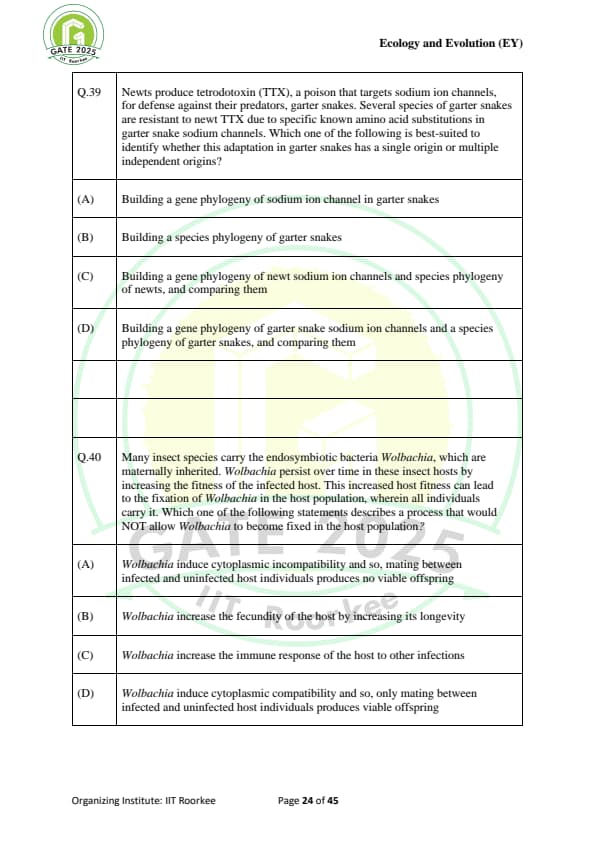
Newts produce tetrodotoxin (TTX), a poison that targets sodium ion channels, for defense against their predators, garter snakes. Several species of garter snakes are resistant to newt TTX due to specific known amino acid substitutions in garter snake sodium channels. Which one of the following is best-suited to identify whether this adaptation in garter snakes has a single origin or multiple independent origins?
View Solution
Many insect species carry the endosymbiotic bacteria Wolbachia, which are maternally inherited. Wolbachia persist over time in these insect hosts by increasing the fitness of the infected host. This increased host fitness can lead to the fixation of Wolbachia in the host population, wherein all individuals carry it. Which one of the following statements describes a process that would NOT allow Wolbachia to become fixed in the host population?
View Solution
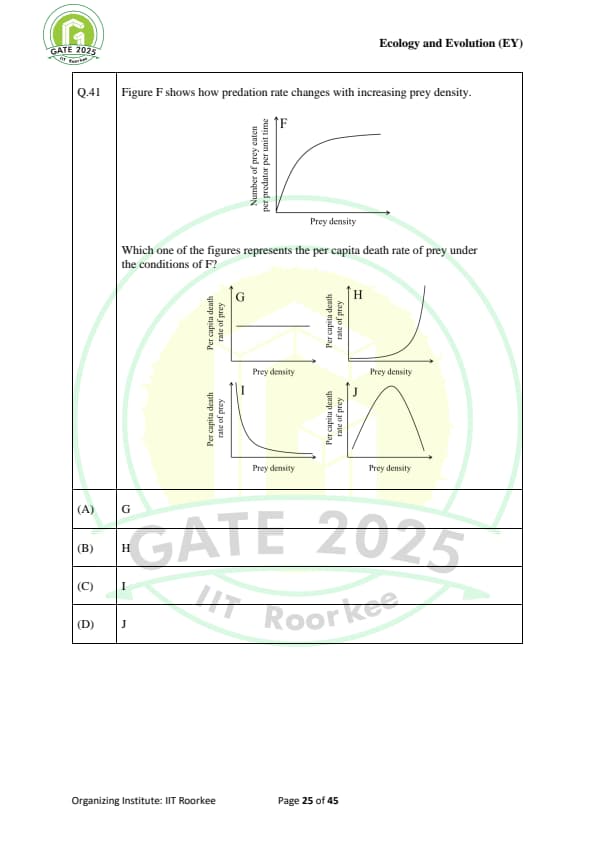
Figure F shows how predation rate changes with increasing prey density.

Which one of the figures represents the per capita death rate of prey under the conditions of F?
View Solution
Fungus S infects elm trees and fungus T infects chestnut trees, and both kill their hosts within a year of infection. A forest with equal density of elm and chestnut trees is colonized by both pathogenic fungi. A 100 years later, the elm tree population has declined and the chestnut trees have become extinct. Which one of the following mechanisms would NOT contribute to this outcome?
View Solution
The table below provides a list of study questions (P, Q, R) and statistical tests (i, ii, iii).

Which one of the following options correctly matches the study question to the most appropriate statistical test?
View Solution
A researcher wants to estimate the number of crickets in an isolated valley. They captured 56 crickets in the first session, and then marked and released them. In the second session, they captured 41 crickets of which 8 were already marked.
Assuming that there is no birth, death, immigration, or emigration in the cricket population during the study period, what is the estimated number of crickets in this valley? Match the appropriate population estimate with the data given.
View Solution
The table below lists potential environmental conditions in future climates, related to atmospheric carbon dioxide concentrations (CO2) and mean annual temperature (MAT). The table also lists potential outcomes with respect to whether conditions will favour grasses with C3 or C4 photosynthetic pathways. Assuming no other changes in environmental conditions, match the options in the two columns.

View Solution
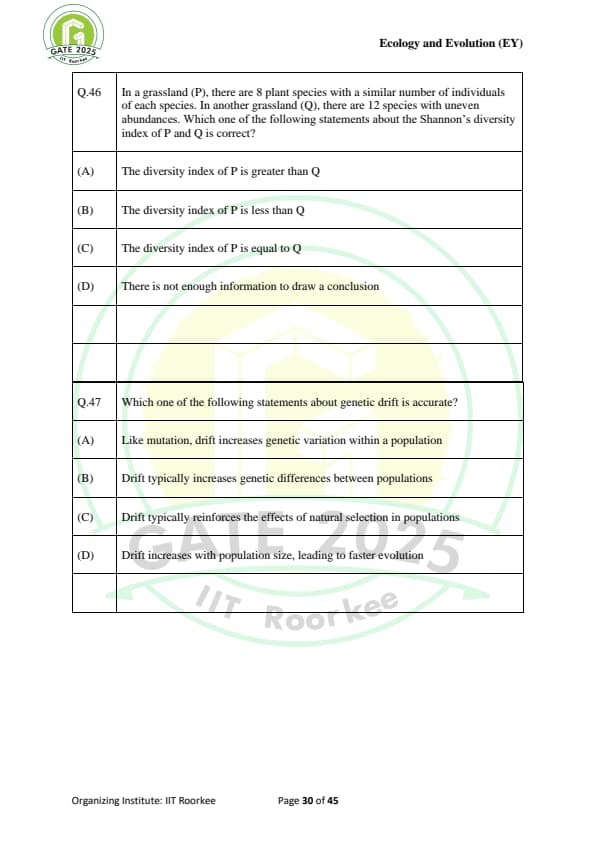
In a grassland (P), there are 8 plant species with a similar number of individuals of each species. In another grassland (Q), there are 12 species with uneven abundances. Which one of the following statements about the Shannon’s diversity index of P and Q is correct?
View Solution
Which one of the following statements about genetic drift is accurate?
View Solution
Mean global temperature since pre-industrial times has increased approximately by
View Solution
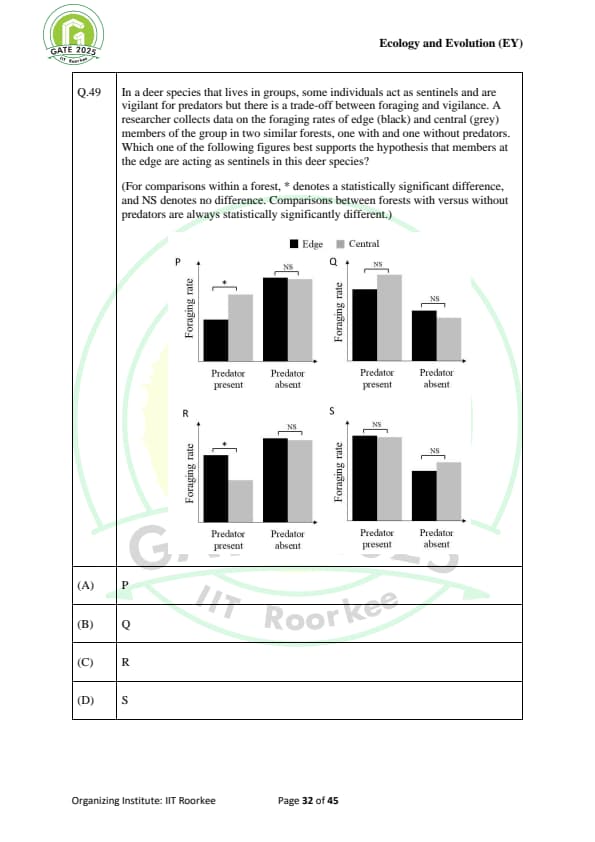
In a deer species that lives in groups, some individuals act as sentinels and are vigilant for predators but there is a trade-off between foraging and vigilance. A researcher collects data on the foraging rates of edge (black) and central (grey) members of the group in two similar forests, one with and one without predators. Which one of the following figures best supports the hypothesis that members at the edge are acting as sentinels in this deer species?

View Solution
A patch of forest (I) has been declared as a protected area. Conservationists have surveyed three other patches of forest (II, III and IV) and can only recommend one of them for protection. In the figure below, each letter denotes a different species of frog. The conservationists recommend that Patch IV should be protected. Which one of the following metrics is this decision based on?

View Solution
The numbers of rabbits (R) and their predators, foxes (F), in an ecosystem are modelled by the Lotka-Volterra equations as follows: \[ \frac{dR}{dt} = 2R - 0.01 R F \] \[ \frac{dF}{dt} = -F + 0.005 R F \]
where the time is measured in months. If there are currently 100 rabbits and 10 foxes, the number of rabbits is changing at the rate of ___ per month and the number of foxes is changing at the rate of ___ foxes per month.
View Solution
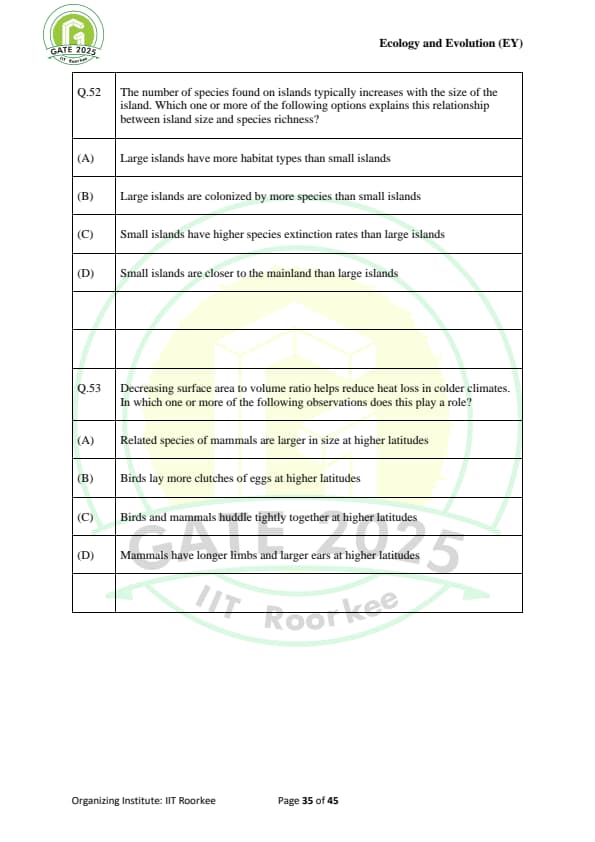
The number of species found on islands typically increases with the size of the island. Which one or more of the following options explains this relationship between island size and species richness?
View Solution
Decreasing surface area to volume ratio helps reduce heat loss in colder climates. In which one or more of the following observations does this play a role?
View Solution
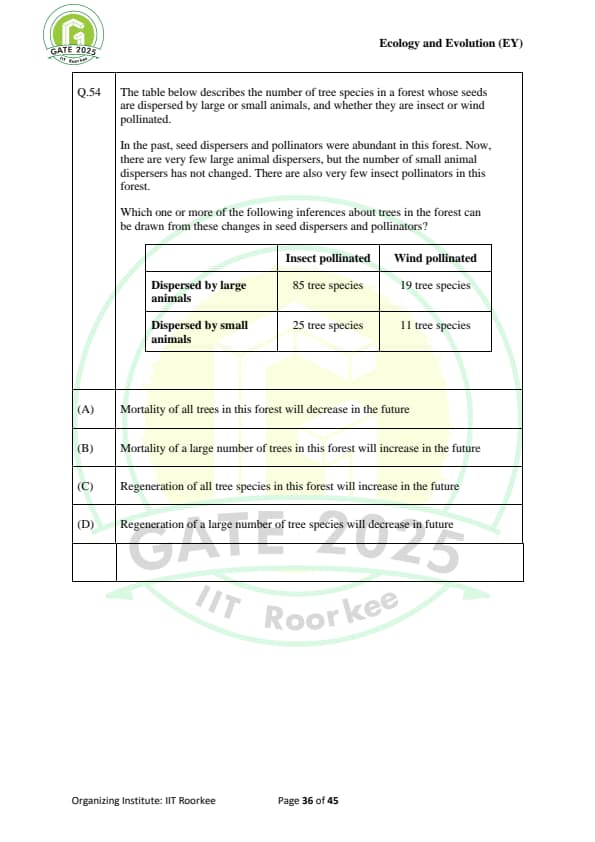
The table below describes the number of tree species in a forest whose seeds are dispersed by large or small animals, and whether they are insect or wind pollinated. In the past, seed dispersers and pollinators were abundant in this forest. Now, there are very few large animal dispersers, but the number of small animal dispersers has not changed. There are also very few insect pollinators in this forest. Which one or more of the following inferences about trees in the forest can be drawn from these changes in seed dispersers and pollinators?
View Solution
Which one or more of the following would make a plant community more susceptible to invasion by exotic plants?
View Solution
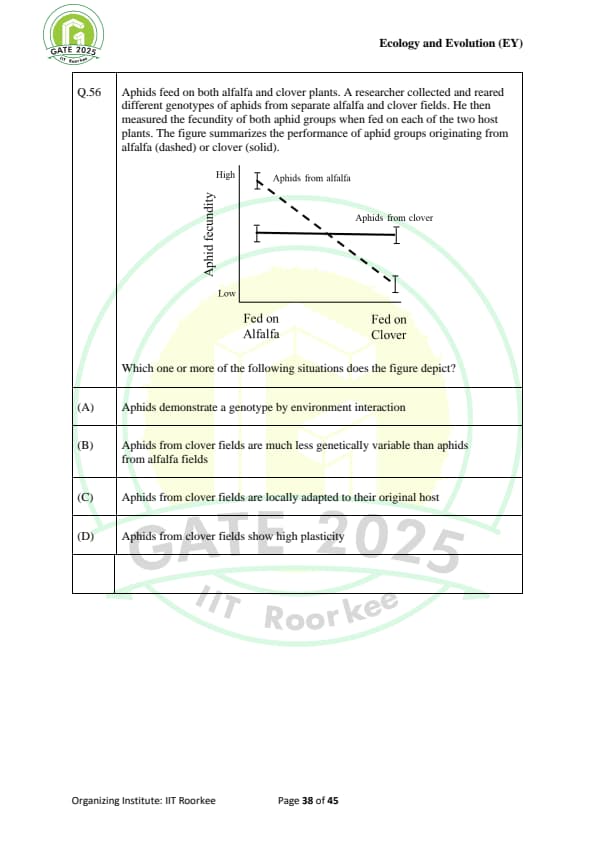
Aphids feed on both alfalfa and clover plants. A researcher collected and reared different genotypes of aphids from separate alfalfa and clover fields. He then measured the fecundity of both aphid groups when fed on each of the two host plants. The figure summarizes the performance of aphid groups originating from alfalfa (dashed) or clover (solid). Which one or more of the following situations does the figure depict?
View Solution
Aphids feed on both alfalfa and clover plants. A researcher collected and reared different genotypes of aphids from separate alfalfa and clover fields. He then measured the fecundity of both aphid groups when fed on each of the two host plants. The figure summarizes the performance of aphid groups originating from alfalfa (dashed) or clover (solid). Which one or more of the following situations does the figure depict?

View Solution
Which one or more of the following processes has/have resulted in increased greenhouse gases in the atmosphere over the last 100 years?
View Solution
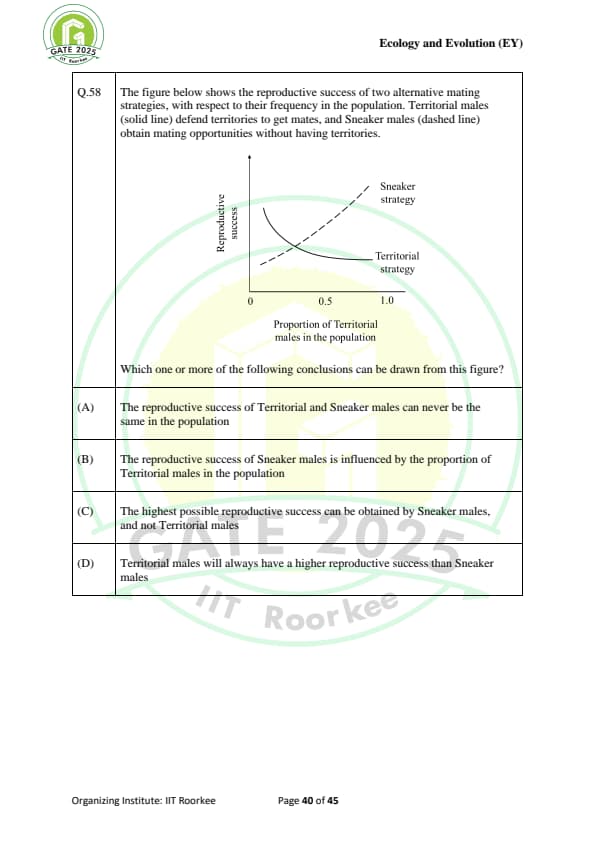
The figure below shows the reproductive success of two alternative mating strategies, with respect to their frequency in the population. Territorial males (solid line) defend territories to get mates, and Sneaker males (dashed line) obtain mating opportunities without having territories. Which one or more of the following conclusions can be drawn from this figure?

View Solution
From the table below, choose one or more of the options that match(es) the evolutionary biologists with the organisms they are well-known to have studied.

View Solution
Consider the following figure of sequence divergence over time. The dashed and solid lines represent synonymous and non-synonymous substitutions, respectively. Which one or more of the following does the figure support?

View Solution
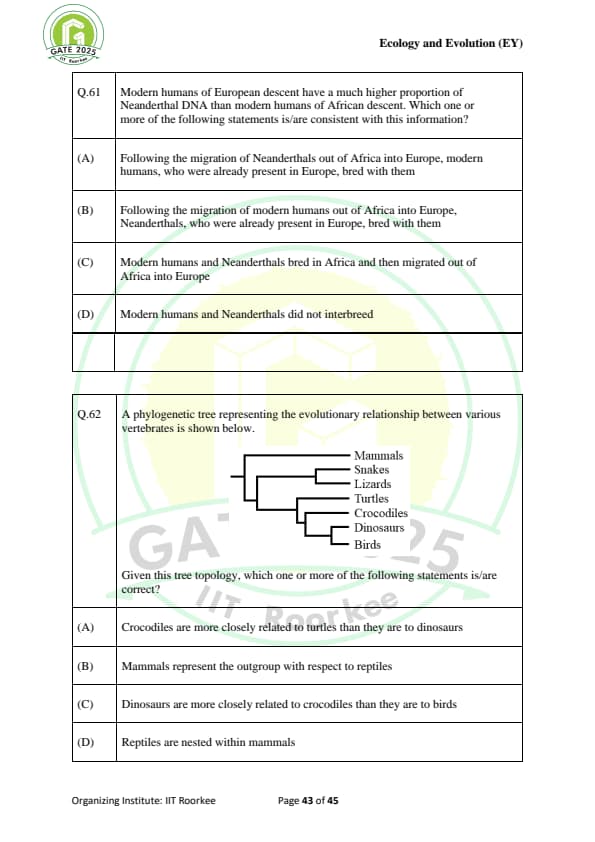
Modern humans of European descent have a much higher proportion of Neanderthal DNA than modern humans of African descent. Which one or more of the following statements is/are consistent with this information?
View Solution
A phylogenetic tree representing the evolutionary relationship between various vertebrates is shown below. Given this tree topology, which one or more of the following statements is/are correct?
View Solution
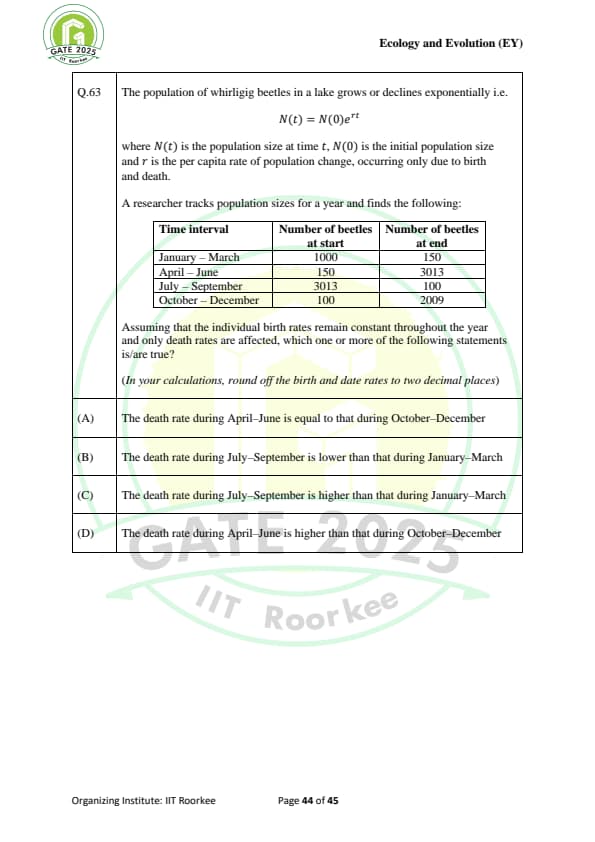
The population of whirligig beetles in a lake grows or declines exponentially i.e., \( N(t) = N(0)e^{rt} \) where \( N(t) \) is the population size at time t, \( N(0) \) is the initial population size and \( r \) is the per capita rate of population change, occurring only due to birth and death. A researcher tracks population sizes for a year and finds the following:

Assuming that the individual birth rates remain constant throughout the year and only death rates are affected, which one or more of the following statements is/are true?
View Solution
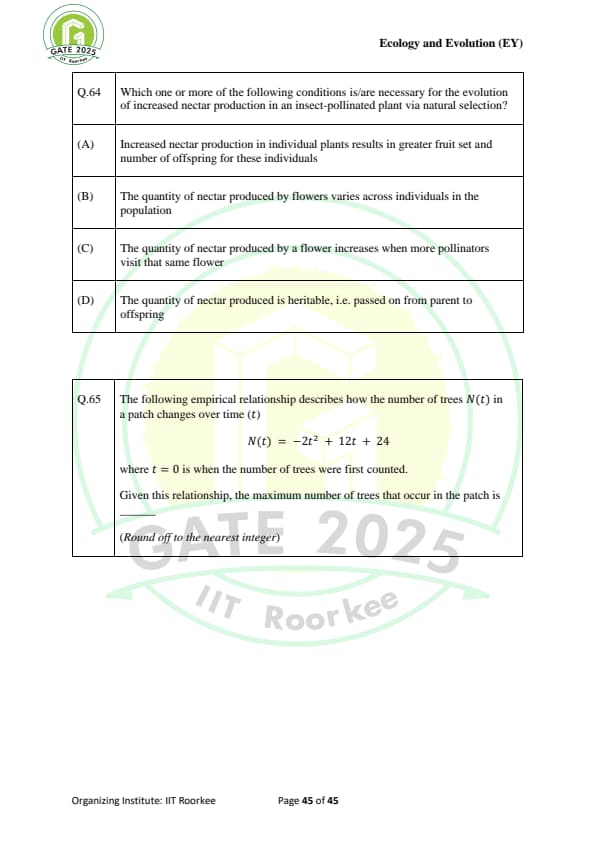
Which one or more of the following conditions is/are necessary for the evolution of increased nectar production in an insect-pollinated plant via natural selection?
View Solution
The following empirical relationship describes how the number of trees \( N(t) \) in a patch changes over time \( t \): \[ N(t) = -2t^2 + 12t + 24 \]
where \( t = 0 \) is when the number of trees were first counted.
Given this relationship, the maximum number of trees that occur in the patch is
View Solution






































Comments