




The GATE 2025 Mathematics exam is done, and the question paper with solutions PDF is available. The exam was organized by IIT Roorkee and was conducted between 9:30 AM to 12:30 PM. Following the latest exam pattern, it consisted of 65 questions for 100 marks—10 of General Aptitude and 55 of Engineering Mathematics and Civil Engineering subjects. Overall, the exam was moderately tough.
GATE 2025 Mathematics Question Paper with Solutions PDF
| GATE 2025 Mathematics Question Paper with Answer Key | Download | Check Solutions |

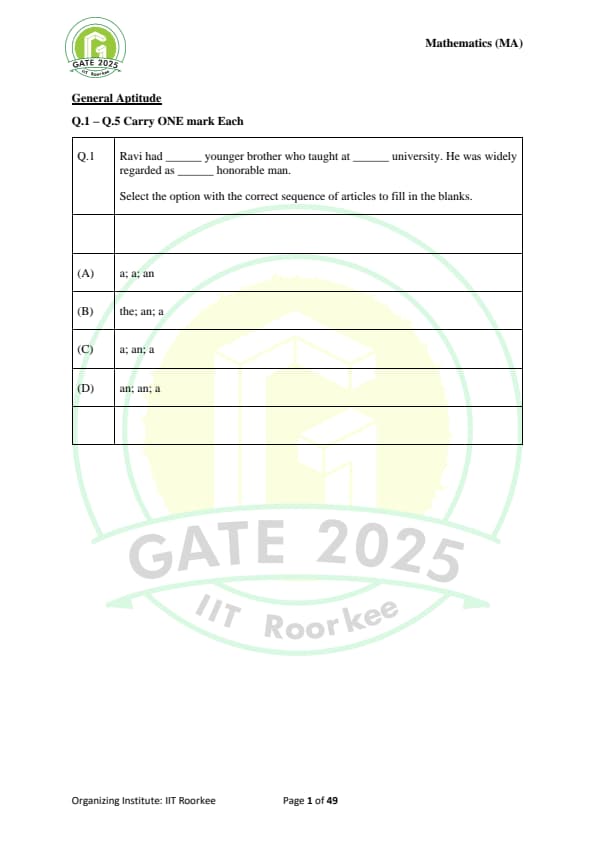
Question 1:
Ravi had ______ younger brother who taught at ______ university. He was widely regarded as _____ honorable man.
Select the option with the correct sequence of articles to fill in the blanks.
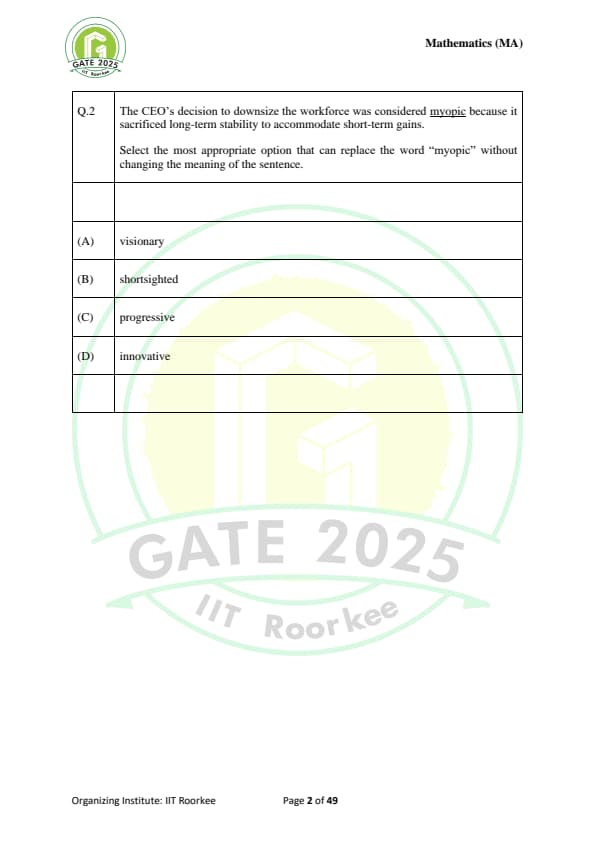
The CEO’s decision to downsize the workforce was considered myopic because it sacrificed long-term stability to accommodate short-term gains.
Select the most appropriate option that can replace the word “myopic” without changing the meaning of the sentence.
View Solution
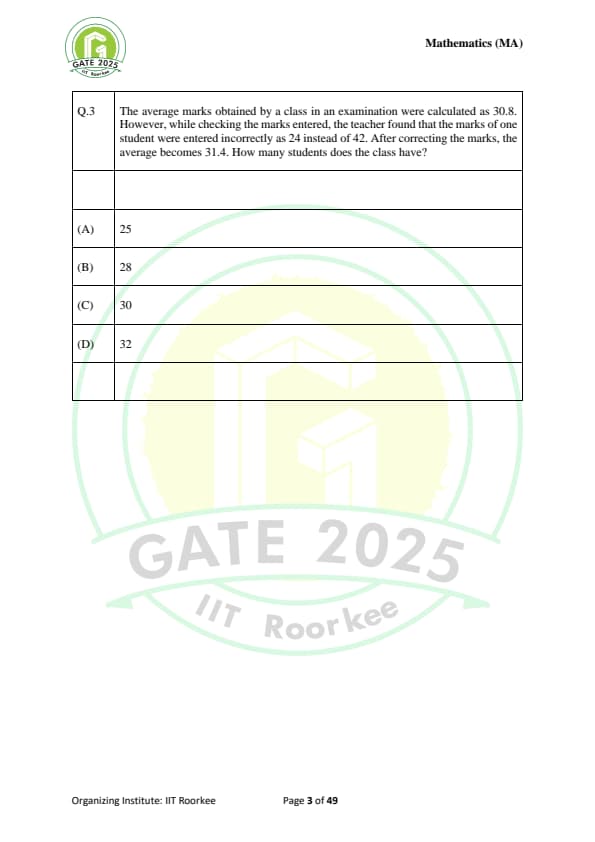
The average marks obtained by a class in an examination were calculated as 30.8. However, while checking the marks entered, the teacher found that the marks of one student were entered incorrectly as 24 instead of 42. After correcting the marks, the average becomes 31.4. How many students does the class have?
View Solution
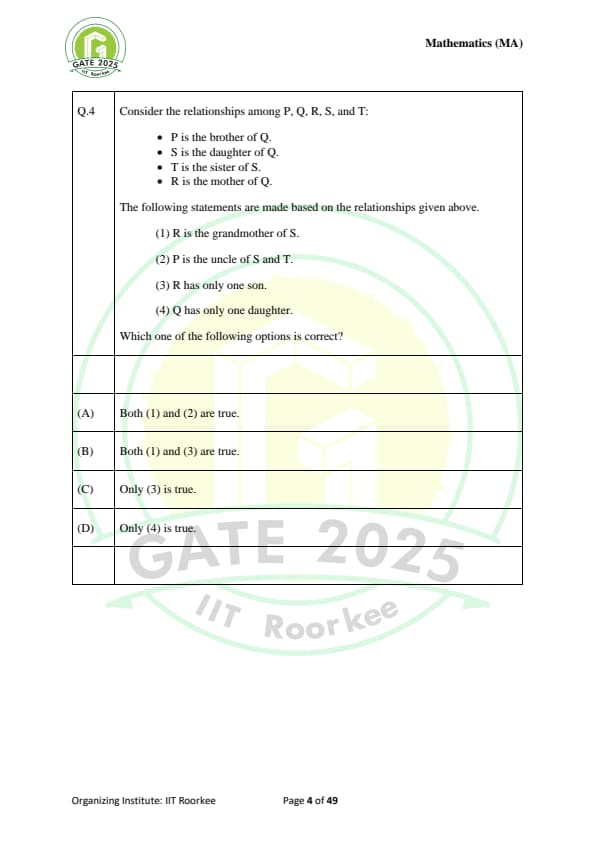
Consider the relationships among P, Q, R, S, and T:
• P is the brother of Q.
• S is the daughter of Q.
• T is the sister of S.
• R is the mother of Q.
The following statements are made based on the relationships given above.
(1) R is the grandmother of S.
(2) P is the uncle of S and T.
(3) R has only one son.
(4) Q has only one daughter.
Which one of the following options is correct?
View Solution
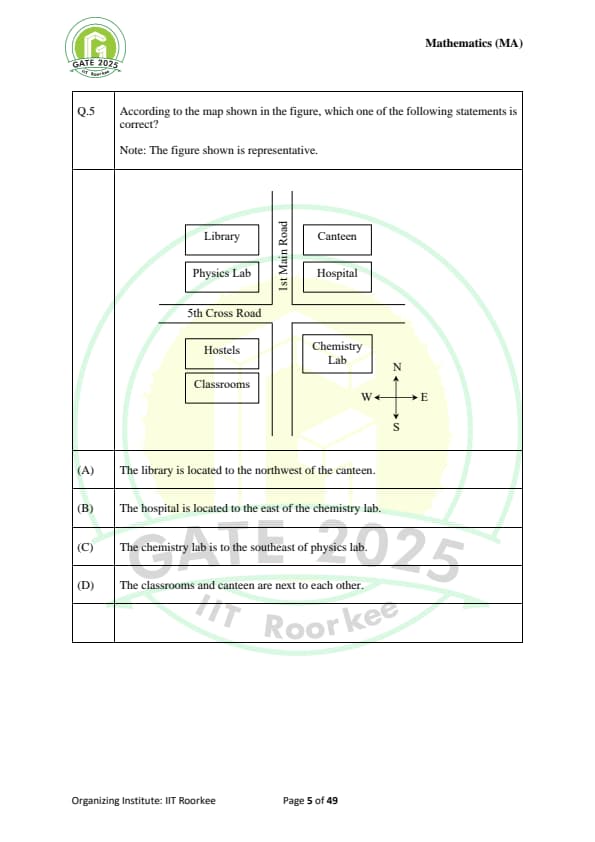
According to the map shown in the figure, which one of the following statements is correct?
\textit{Note: The figure shown is representative.
View Solution
“I put the brown paper in my pocket along with the chalks, and possibly other things.
I suppose every one must have reflected how primeval and how poetical are the
things that one carries in one’s pocket: the pocket-knife, for instance the type of all
human tools, the infant of the sword. Once I planned to write a book of poems
entirely about the things in my pocket. But I found it would be too long: and the age
of the great epics is past.”
\textit{(From G.K. Chesterton’s “A Piece of Chalk”)
Based only on the information provided in the above passage, which one of the
following statements is true?
View Solution
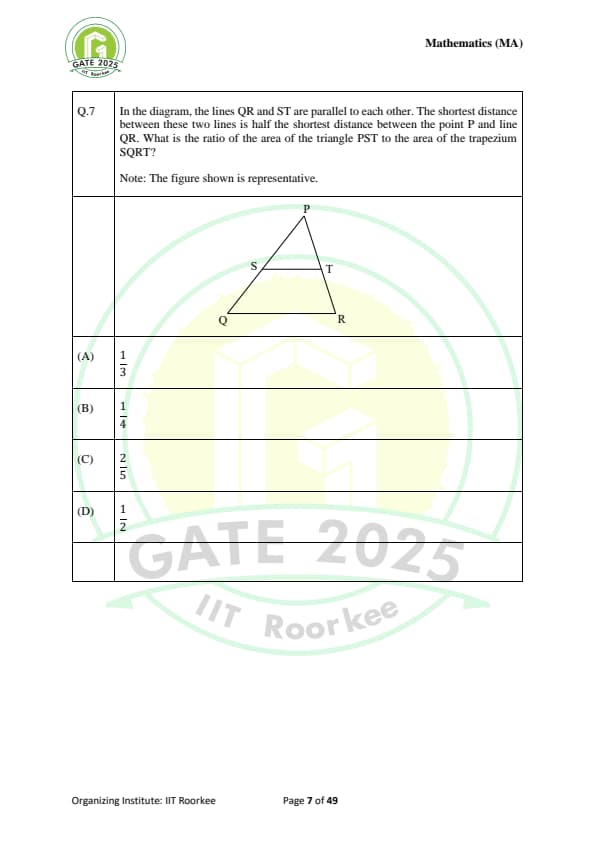
In the diagram, the lines QR and ST are parallel to each other. The shortest distance between these two lines is half the shortest distance between the point P and the line QR. What is the ratio of the area of the triangle PST to the area of the trapezium SQRT?
Note: The figure shown is representative
View Solution
A fair six-faced dice, with the faces labelled ‘1’, ‘2’, ‘3’, ‘4’, ‘5’, and ‘6’, is rolled thrice. What is the probability of rolling ‘6’ exactly once?
View Solution
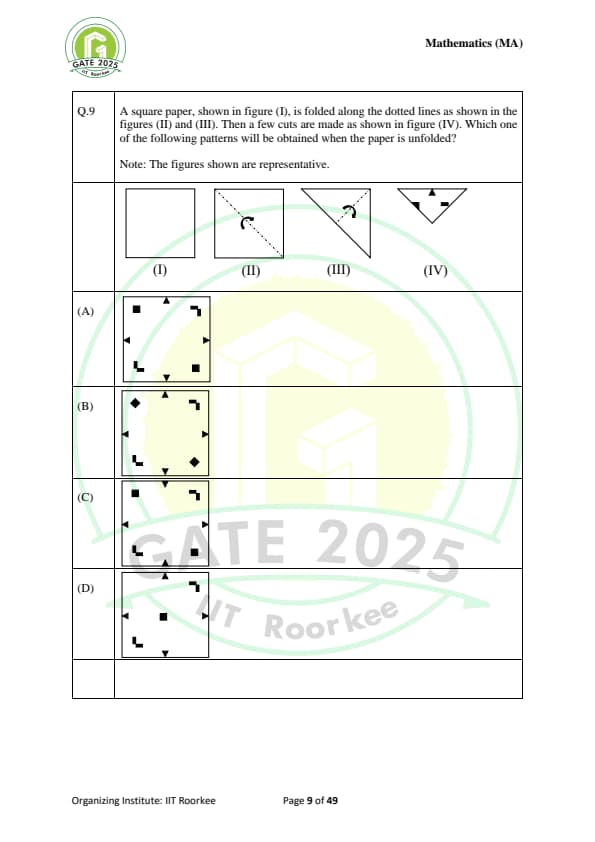
A square paper, shown in figure (I), is folded along the dotted lines as shown in figures (II) and (III). Then a few cuts are made as shown in figure (IV). Which one of the following patterns will be obtained when the paper is unfolded?
\textit{Note: The figures shown are representative.
View Solution
A shop has 4 distinct flavors of ice-cream. One can purchase any number of scoops of any flavor. The order in which the scoops are purchased is inconsequential. If one wants to purchase 3 scoops of ice-cream, in how many ways can one make that purchase?
View Solution
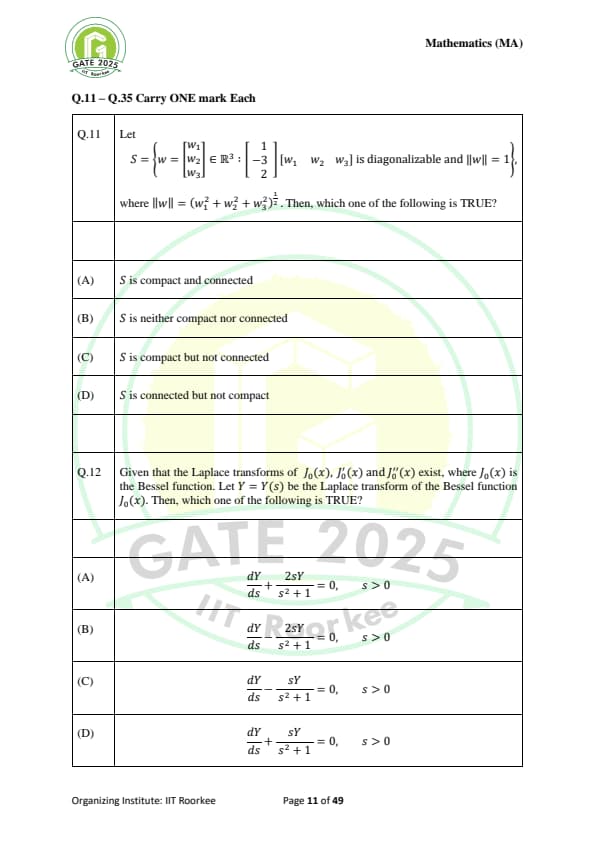
Let S = \left\{ \mathbf{w = \begin{bmatrix w_1
w_2
w_3 \end{bmatrix \in \mathbb{R^3 : \begin{bmatrix -1
3
2 & \end{bmatrix [w_1 \, w_2 \, w_3] is diagonalizable and \| \mathbf{w \| = 1 \right\,
\]
where \[ \| \mathbf{w \| = \left( w_1^2 + w_2^2 + w_3^2 \right)^{\frac{1}{2}}. \]
Then, which one of the following is TRUE?
View Solution
Given that the Laplace transforms of \( J_0(x), J_0'(x), \) and \( J_0''(x) \) exist, where \( J_0(x) \) is the Bessel function. Let \( Y = Y(s) \) be the Laplace transform of the Bessel function \( J_0(x) \). Then, which one of the following is TRUE?
View Solution
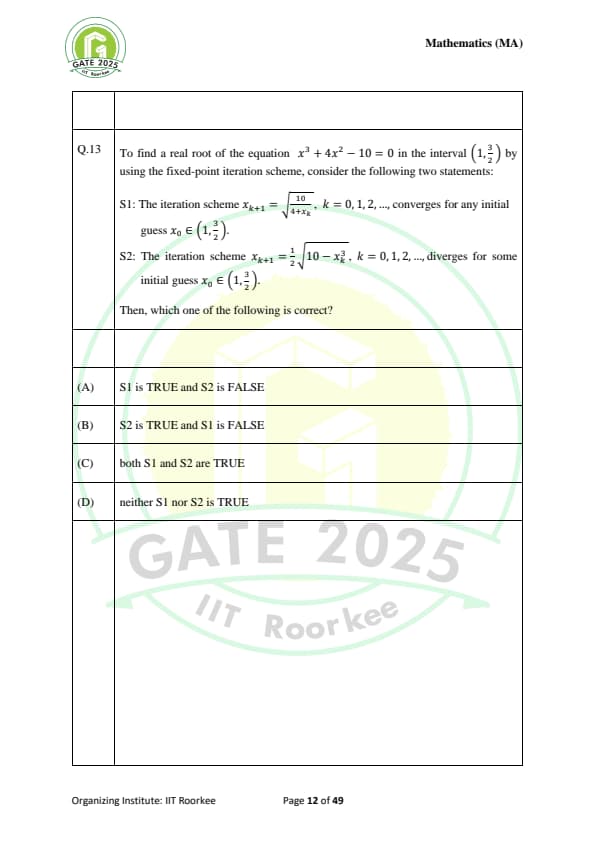
To find a real root of the equation \( x^3 + 4x^2 - 10 = 0 \) in the interval \( \left( 1, \frac{3}{2} \right) \) using the fixed-point iteration scheme, consider the following two statements:
% Statement 1
S1: The iteration scheme \( x_{k+1} = \sqrt{\frac{10}{4 + x_k}}, \, k = 0, 1, 2, \ldots \) converges for any initial guess \( x_0 \in \left( 1, \frac{3}{2} \right) \).
% Statement 2
S2: The iteration scheme \( x_{k+1} = \frac{1}{2} \sqrt{10 - x_k^3}, \, k = 0, 1, 2, \ldots \) diverges for some initial guess \( x_0 \in \left( 1, \frac{3}{2} \right) \).
View Solution
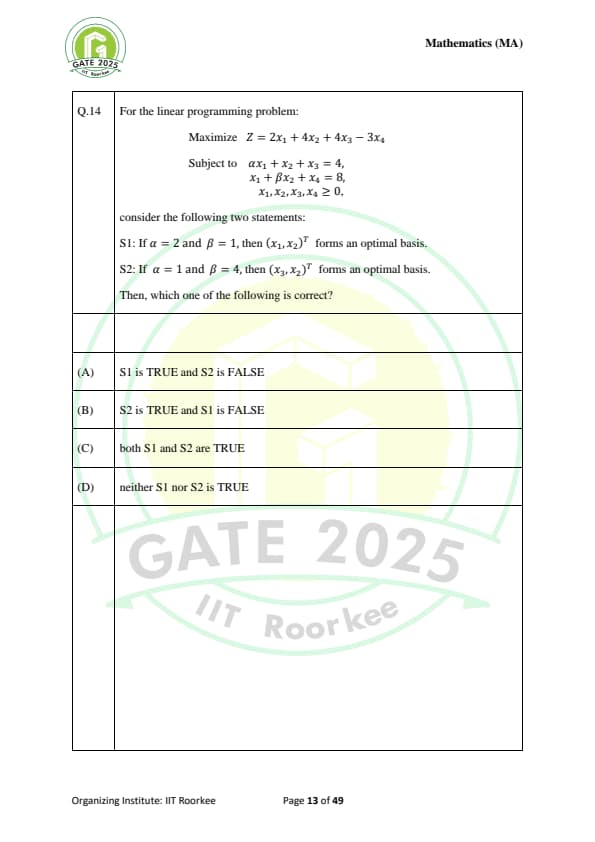
For the linear programming problem:
\[ Maximize \quad Z = 2x_1 + 4x_2 + 4x_3 - 3x_4 \]
subject to \[ \alpha x_1 + x_2 + x_3 = 4, \quad x_1 + \beta x_2 + x_4 = 8, \quad x_1, x_2, x_3, x_4 \geq 0, \]
consider the following two statements:
S1: If \( \alpha = 2 \) and \( \beta = 1 \), then \( (x_1, x_2)^T \) forms an optimal basis.
S2: If \( \alpha = 1 \) and \( \beta = 4 \), then \( (x_3, x_2)^T \) forms an optimal basis.
Then, which one of the following is correct?
View Solution
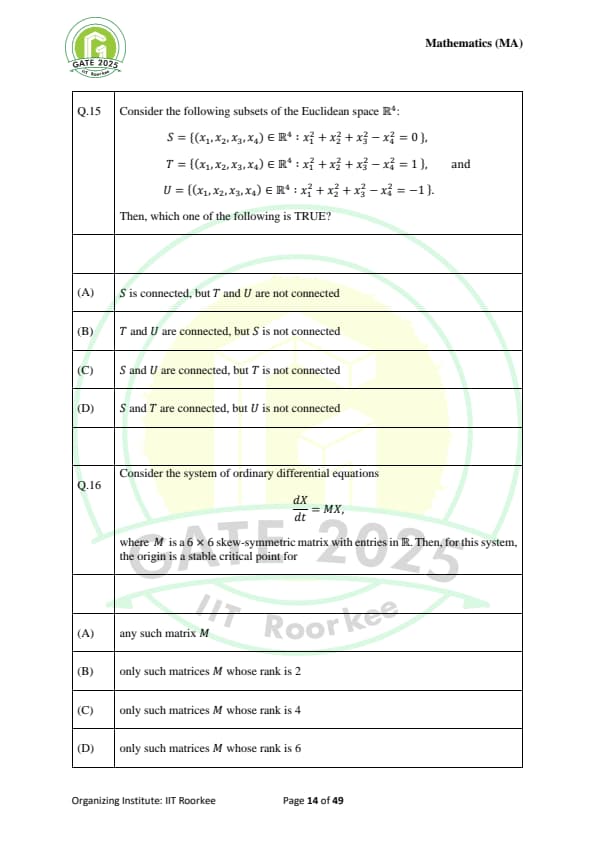
Consider the following subsets of the Euclidean space \( \mathbb{R}^4 \):
\( S = \{ (x_1, x_2, x_3, x_4) \in \mathbb{R}^4 : x_1^2 + x_2^2 + x_3^2 - x_4^2 = 0 \} \),
\( T = \{ (x_1, x_2, x_3, x_4) \in \mathbb{R}^4 : x_1^2 + x_2^2 + x_3^2 - x_4^2 = 1 \} \),
\( U = \{ (x_1, x_2, x_3, x_4) \in \mathbb{R}^4 : x_1^2 + x_2^2 + x_3^2 - x_4^2 = -1 \} \).
Then, which one of the following is TRUE?
View Solution
Consider the system of ordinary differential equations
\[ \frac{dX}{dt} = MX, \]
where \( M \) is a \( 6 \times 6 \) skew-symmetric matrix with entries in \( \mathbb{R} \). Then, for this system, the origin is a stable critical point for
View Solution
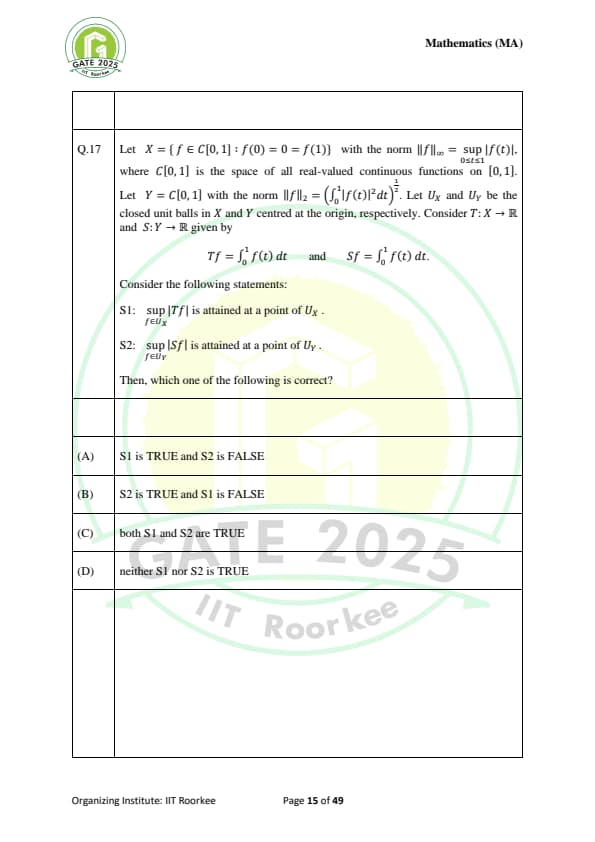
Let \( X = \{ f \in C[0,1] : f(0) = 0 = f(1) \} \) with the norm \( \|f\|_\infty = \sup_{0 \leq t \leq 1} |f(t)| \), where \( C[0,1] \) is the space of all real-valued continuous functions on \( [0,1] \).
Let \( Y = C[0,1] \) with the norm \( \|f\|_2 = \left( \int_0^1 |f(t)|^2 \, dt \right)^{\frac{1}{2}} \). Let \( U_X \) and \( U_Y \) be the closed unit balls in \( X \) and \( Y \) centered at the origin, respectively. Consider \( T: X \to \mathbb{R} \) and \( S: Y \to \mathbb{R} \) given by
\[ T(f) = \int_0^1 f(t) \, dt \quad and \quad S(f) = \int_0^1 f(t) \, dt. \]
Consider the following statements:
S1: \( \sup |T(f)| \) is attained at a point of \( U_X \).
S2: \( \sup |S(f)| \) is attained at a point of \( U_Y \).
Then, which one of the following is correct?
View Solution
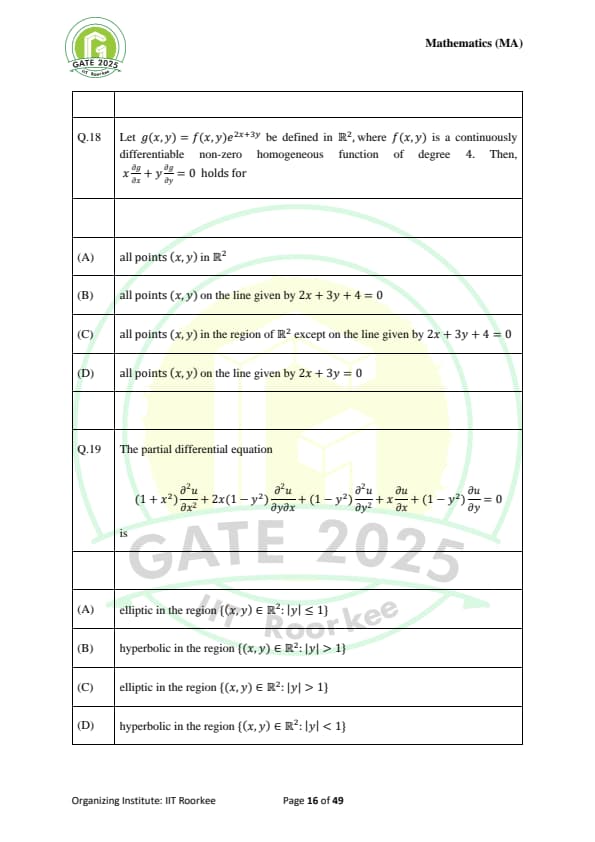
Let \( g(x, y) = f(x, y)e^{2x + 3y} \) be defined in \( \mathbb{R}^2 \), where \( f(x, y) \) is a continuously differentiable non-zero homogeneous function of degree 4. Then,
\[ x \frac{\partial g}{\partial x} + y \frac{\partial g}{\partial y} = 0 holds for \]
View Solution
The partial differential equation
\[ (1 + x^2) \frac{\partial^2 u}{\partial x^2} + 2x(1 - y^2) \frac{\partial^2 u}{\partial x \partial y} + (1 - y^2) \frac{\partial^2 u}{\partial y^2} + x \frac{\partial u}{\partial x} + (1 - y^2) \frac{\partial u}{\partial y} = 0 \]
is:
View Solution
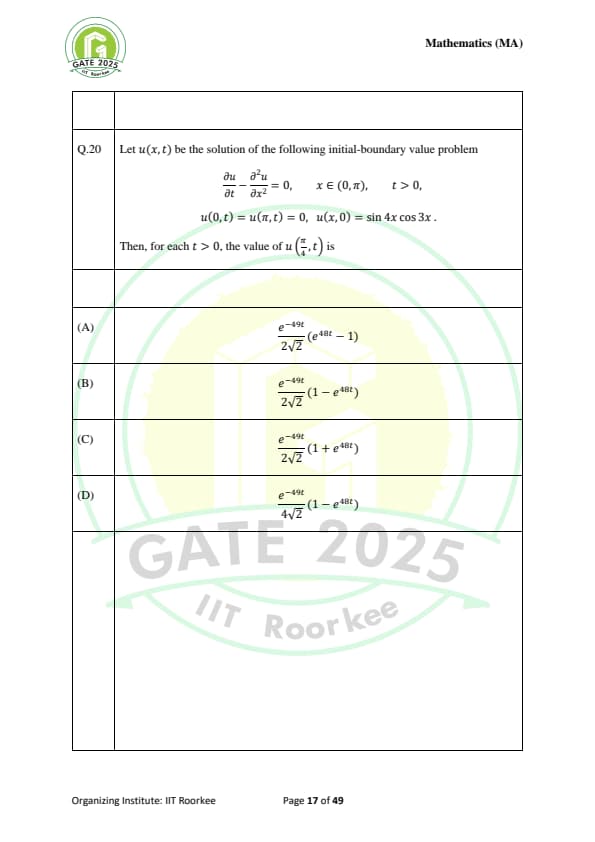
Let \( u(x, t) \) be the solution of the following initial-boundary value problem:
\[ \frac{\partial u}{\partial t} - \frac{\partial^2 u}{\partial x^2} = 0, \quad x \in (0, \pi), \quad t > 0, \]
with the boundary conditions: \[ u(0, t) = u(\pi, t) = 0, \quad u(x, 0) = \sin 4x \cos 3x. \]
Then, for each \( t > 0 \), the value of \( u\left( \frac{\pi}{4}, t \right) \) is
View Solution
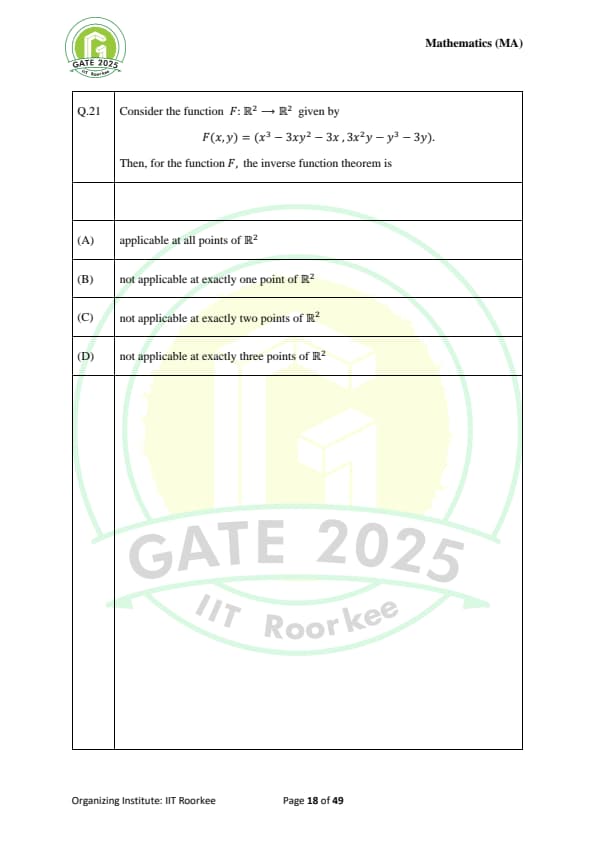
Consider the function \( F: \mathbb{R}^2 \to \mathbb{R}^2 \) given by
\[ F(x, y) = (x^3 - 3xy^2 - 3x, 3x^2y - y^3 - 3y). \]
Then, for the function \( F \), the inverse function theorem is:
View Solution
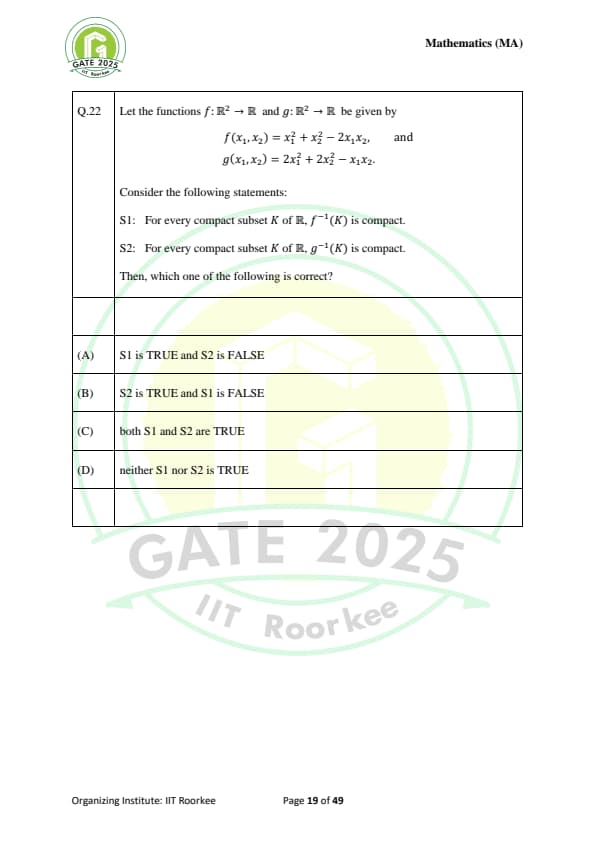
Let the functions \( f: \mathbb{R} \to \mathbb{R} \) and \( g: \mathbb{R}^2 \to \mathbb{R} \) be given by
\[ f(x_1, x_2) = x_1^2 + x_2^2 - 2x_1x_2, \quad g(x_1, x_2) = 2x_1^2 + 2x_2^2 - x_1x_2. \]
Consider the following statements:
S1: For every compact subset \( K \) of \( \mathbb{R} \), \( f^{-1}(K) \) is compact.
S2: For every compact subset \( K \) of \( \mathbb{R} \), \( g^{-1}(K) \) is compact.
Then, which one of the following is correct?
View Solution
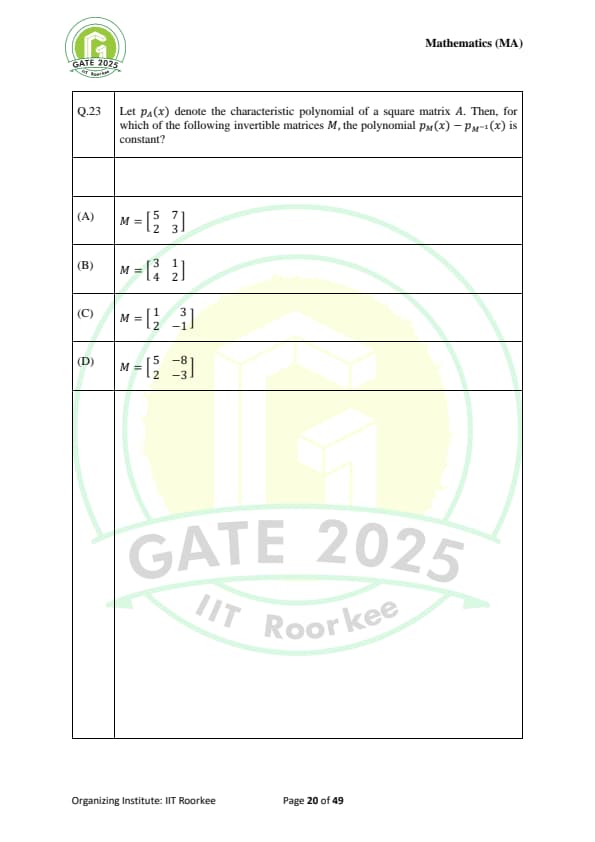
Let \( p_A(x) \) denote the characteristic polynomial of a square matrix \( A \). Then, for which of the following invertible matrices \( M \), the polynomial \( p_M(x) - p_{M^{-1}}(x) \) is constant?
2 & 3 \end{bmatrix} \)
(C) \( M = \begin{bmatrix} 1 & 2
3 & -1 \end{bmatrix} \)
(D) \( M = \begin{bmatrix} 5 & -8
2 & -3 \end{bmatrix} \)
View Solution
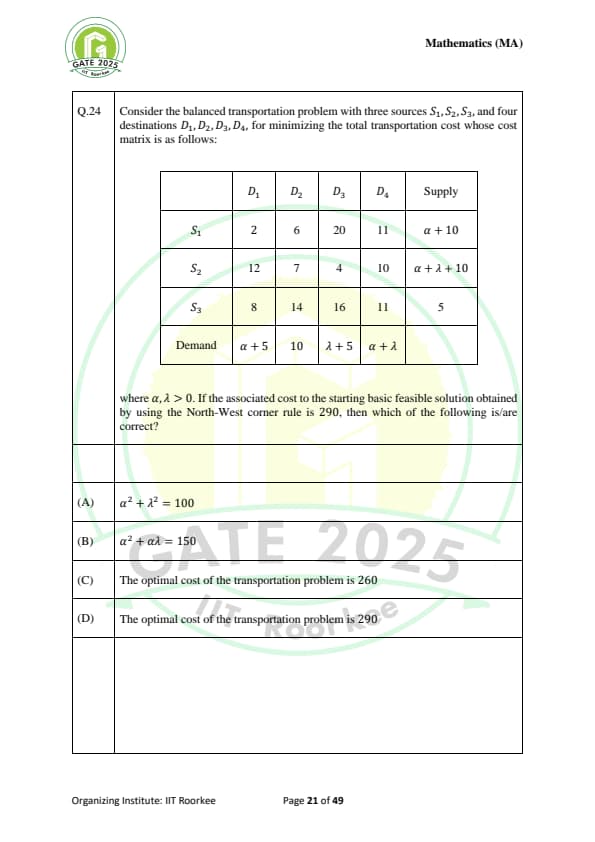
Consider the balanced transportation problem with three sources \( S_1, S_2, S_3 \), and four destinations \( D_1, D_2, D_3, D_4 \), for minimizing the total transportation cost whose cost matrix is as follows:
where \( \alpha, \lambda > 0 \). If the associated cost to the starting basic feasible solution obtained by using the North-West corner rule is 290, then which of the following is/are correct?
View Solution
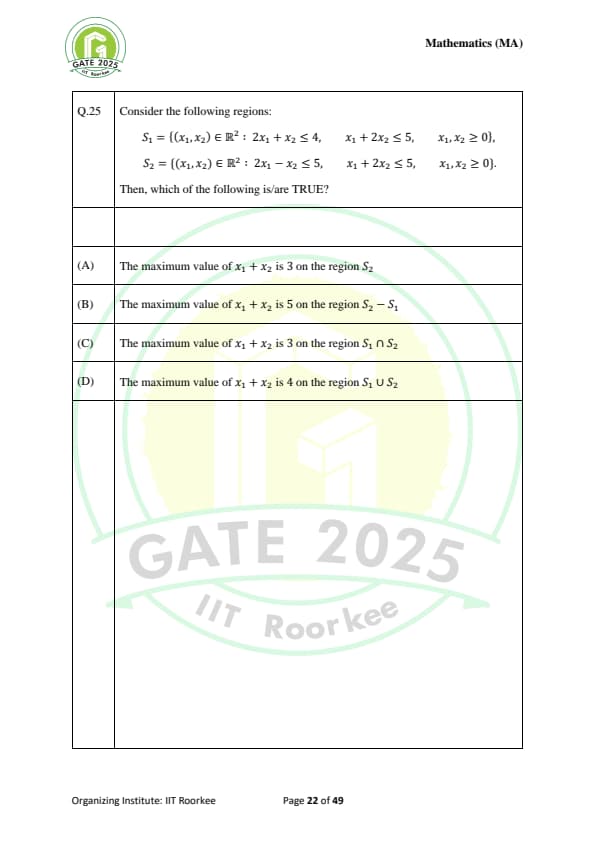
Consider the following regions:
\[ S_1 = \{(x_1, x_2) \in \mathbb{R}^2 : 2x_1 + x_2 \leq 4, \quad x_1 + 2x_2 \leq 5, \quad x_1, x_2 \geq 0\} \] \[ S_2 = \{(x_1, x_2) \in \mathbb{R}^2 : 2x_1 - x_2 \leq 5, \quad x_1 + 2x_2 \leq 5, \quad x_1, x_2 \geq 0\} \]
Then, which of the following is/are TRUE?
View Solution
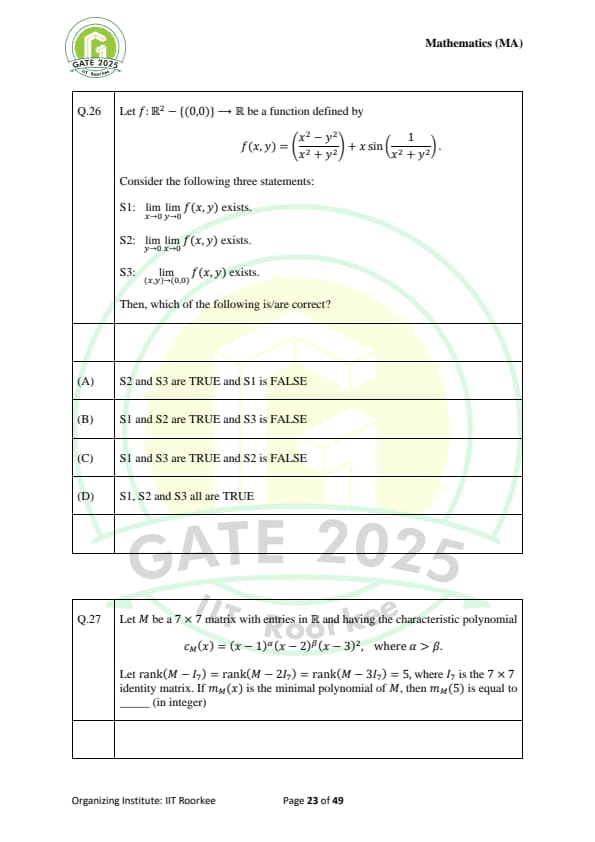
Let \( f: \mathbb{R}^2 \setminus \{(0,0)\} \to \mathbb{R} \) be a function defined by
\[ f(x, y) = \frac{x^2 - y^2}{x^2 + y^2} + x \sin \left( \frac{1}{x^2 + y^2} \right). \]
Consider the following three statements:
S1: \( \lim_{x \to 0, y \to 0} f(x, y) \) exists.
S2: \( \lim_{y \to 0} \lim_{x \to 0} f(x, y) \) exists.
S3: \( \lim_{(x, y) \to (0, 0)} f(x, y) \) exists.
Then, which of the following is/are correct?
View Solution
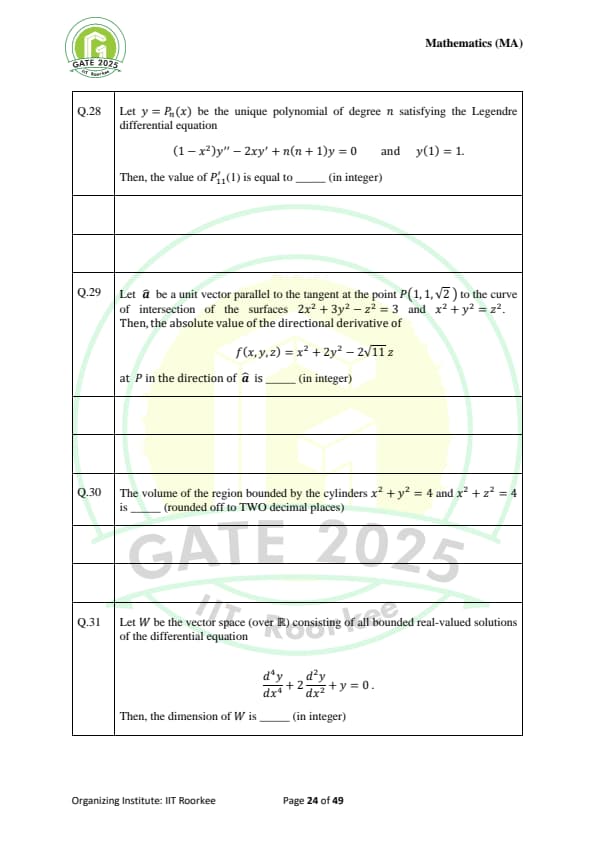
Let \( M \) be a \( 7 \times 7 \) matrix with entries in \( \mathbb{R} \) and having the characteristic polynomial
\[ c_M(x) = (x - 1)^\alpha (x - 2)^\beta (x - 3)^2, \]
where \( \alpha > \beta \).
Let \( rank(M - I_7) = rank(M - 2I_7) = rank(M - 3I_7) = 5 \), where \( I_7 \) is the \( 7 \times 7 \) identity matrix. If \( m_M(x) \) is the minimal polynomial of \( M \), then \( m_M(5) \) is equal to ____ (in integer).
View Solution
Let \( y = P_n(x) \) be the unique polynomial of degree \( n \) satisfying the Legendre differential equation
\[ (1 - x^2)y'' - 2xy' + n(n + 1)y = 0 \quad and \quad y(1) = 1. \]
Then, the value of \( P_{11}'(1) \) is equal to ______ (in integer).
View Solution
Let \( \hat{a} \) be a unit vector parallel to the tangent at the point \( P(1, 1, \sqrt{2}) \) to the curve of intersection of the surfaces \( 2x^2 + 3y^2 - z^2 = 3 \) and \( x^2 + y^2 = z^2 \). Then, the absolute value of the directional derivative of
\[ f(x, y, z) = x^2 + 2y^2 - 2\sqrt{11} z \]
at P in the direction of \( \hat{a} \) is ______ (in integer).
View Solution
The volume of the region bounded by the cylinders \( x^2 + y^2 = 4 \) and \( x^2 + z^2 = 4 \) is ______ (rounded to TWO decimal places).
View Solution
Let \( W \) be the vector space (over \( \mathbb{R} \)) consisting of all bounded real-valued solutions of the differential equation
\[ \frac{d^4y}{dx^4} + 2 \frac{d^2y}{dx^2} + y = 0. \]
Then, the dimension of \( W \) is ______ (in integer).
View Solution
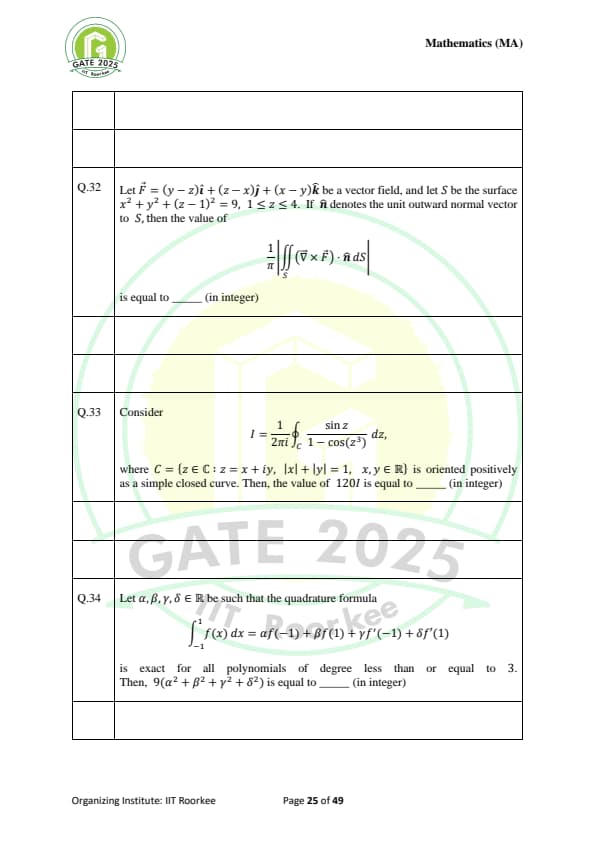
Let \( \vec{F} = (y - z)\hat{i} + (z - x)\hat{j} + (x - y)\hat{k} \) be a vector field, and let \( S \) be the surface \( x^2 + y^2 + (z - 1)^2 = 9, 1 \leq z \leq 4 \). If \( \hat{n} \) denotes the unit outward normal vector to \( S \), then the value of
\[ \frac{1}{\pi} \left| \iint_S (\vec{v} \times \vec{F}) \cdot \hat{n} \, dS \right| \]
is equal to _____ (in integer).
View Solution
Consider
\[ I = \frac{1}{2\pi i} \int_C \frac{\sin z}{1 - \cos(z^3)} \, dz, \]
where \( C = \{ z \in \mathbb{C} : z = x + iy, |x| + |y| = 1, x, y \in \mathbb{R} \} \) is oriented positively as a simple closed curve. Then, the value of \( 120I \) is equal to ______ (in integer).
View Solution
Let \( \alpha, \beta, \gamma, \delta \in \mathbb{R} \) be such that the quadrature formula
\[ \int_{-1}^{1} f(x) \, dx = \alpha f(-1) + \beta f(1) + \gamma f'(-1) + \delta f'(1) \]
is exact for all polynomials of degree less than or equal to 3. Then, \( 9(\alpha^2 + \beta^2 + \gamma^2 + \delta^2) \) is equal to (in integer):
View Solution
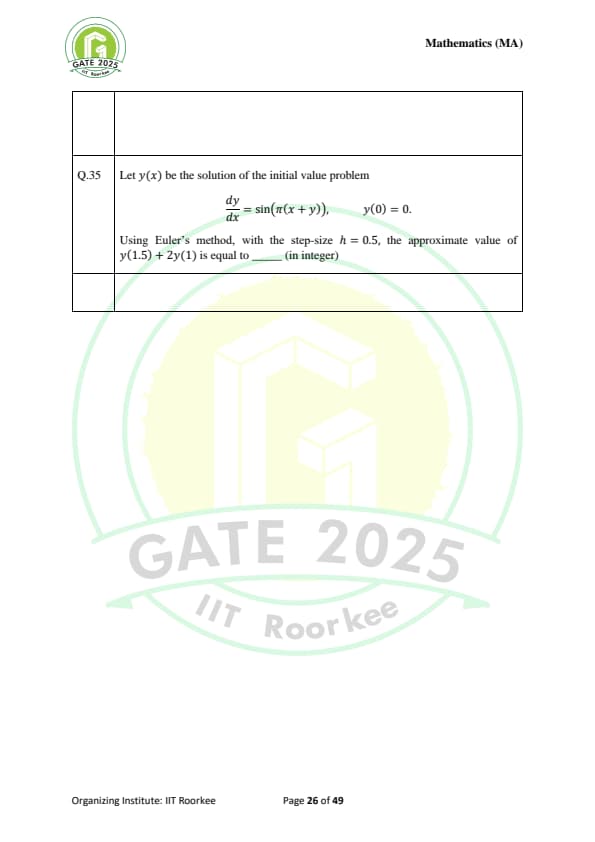
Let \( y(x) \) be the solution of the initial value problem
\[ \frac{dy}{dx} = \sin(\pi(x + y)), \quad y(0) = 0. \]
Using Euler's method, with the step-size \( h = 0.5 \), the approximate value of \( y(1.5) + 2y(1) \) is equal to (in integer):
View Solution
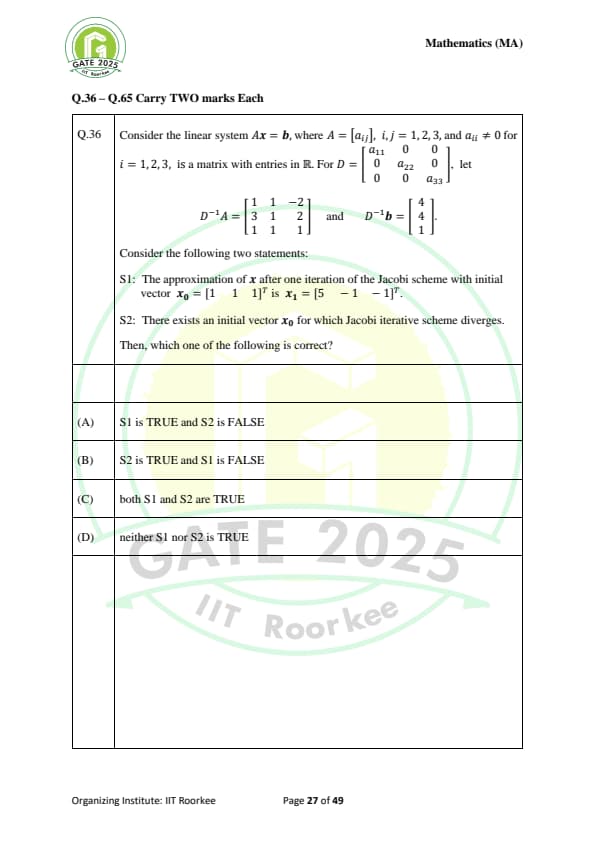
Consider the linear system \( A x = b \), where \( A = [a_{ij}] \), \( i, j = 1, 2, 3 \), and \( a_{ii} \neq 0 \) for \( i = 1, 2, 3 \), is a matrix with entries in \( \mathbb{R} \). For \( D = \begin{bmatrix} a_{11} & 0 & 0
0 & a_{22} & 0
0 & 0 & a_{33} \end{bmatrix} \), let
\[ D^{-1} A = \begin{bmatrix} 1 & 1 & -2
3 & 1 & 2
1 & 1 & 1 \end{bmatrix}, \quad D^{-1}b = \begin{bmatrix} 4
4
1 \end{bmatrix}. \]
Consider the following two statements:
% S1 formatted as per the user's input
S1: The approximation of \( x \) after one iteration of the Jacobi scheme with initial vector \( x_0 = \begin{bmatrix} 1
1
1 \end{bmatrix} \) is \( x_1 = \begin{bmatrix} 5
-1
-1 \end{bmatrix} \).
S2: There exists an initial vector \( x_0 \) for which the Jacobi iterative scheme diverges.
Then, which one of the following is correct?
View Solution
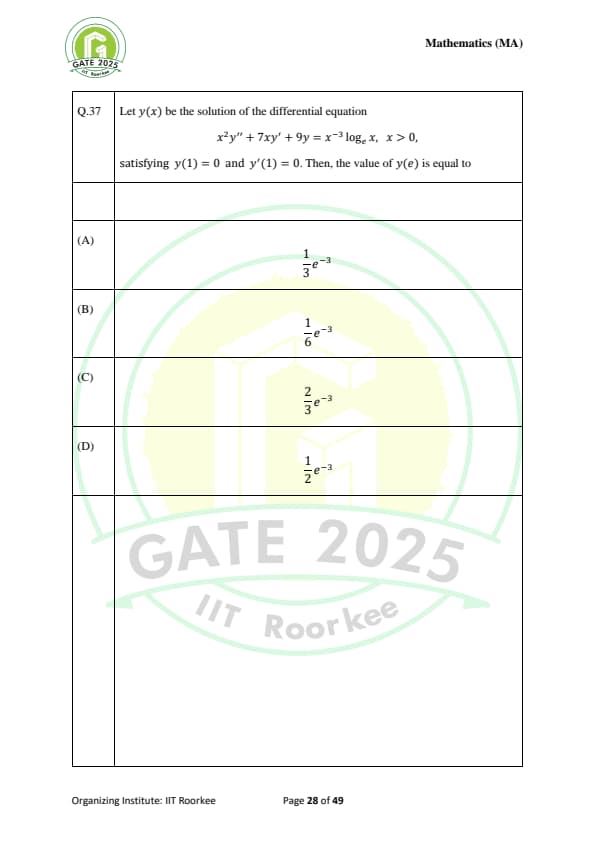
Let \( y(x) \) be the solution of the differential equation
\[ x^2 y'' + 7xy' + 9y = x^{-3} \log_e x, \quad x > 0, \]
satisfying \( y(1) = 0 \) and \( y'(1) = 0 \). Then, the value of \( y(e) \) is equal to:
View Solution
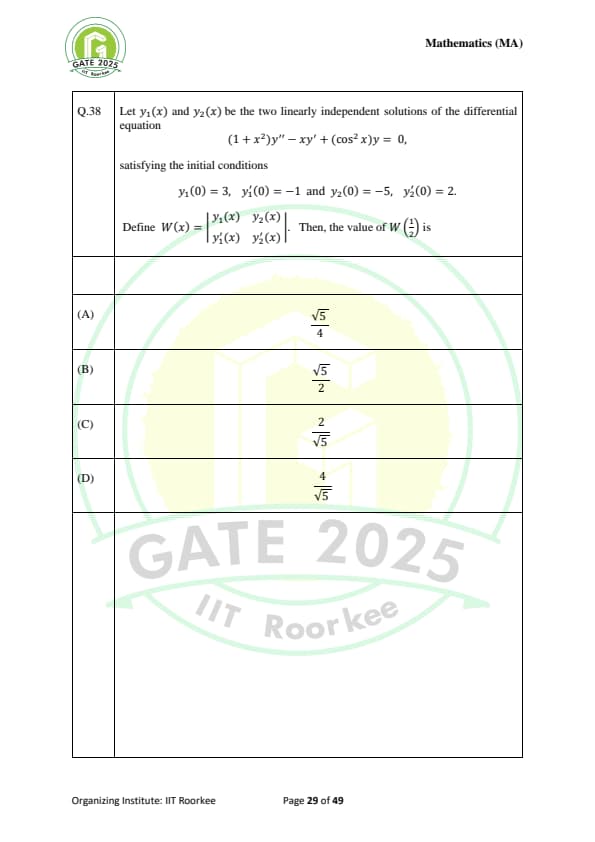
Let \( y_1(x) \) and \( y_2(x) \) be the two linearly independent solutions of the differential equation
\[ (1 + x^2) y'' - x y' + (\cos^2 x) y = 0, \]
satisfying the initial conditions
\[ y_1(0) = 3, \quad y_1'(0) = -1, \quad y_2(0) = -5, \quad y_2'(0) = 2. \]
Define
\[ W(x) = \left| \begin{array}{cc} y_1(x) & y_2(x)
y_1'(x) & y_2'(x)
\end{array} \right|. \]
Then, the value of \( W\left( \frac{1}{2} \right) \) is:
View Solution
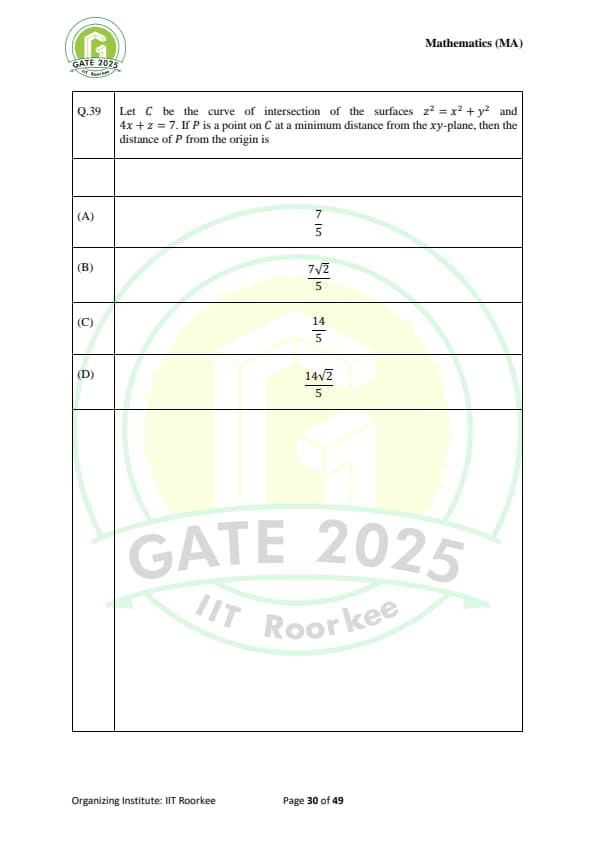
Let \( C \) be the curve of intersection of the surfaces \( z^2 = x^2 + y^2 \) and \( 4x + z = 7 \). If \( P \) is a point on \( C \) at a minimum distance from the \( xy \)-plane, then the distance of \( P \) from the origin is:
View Solution
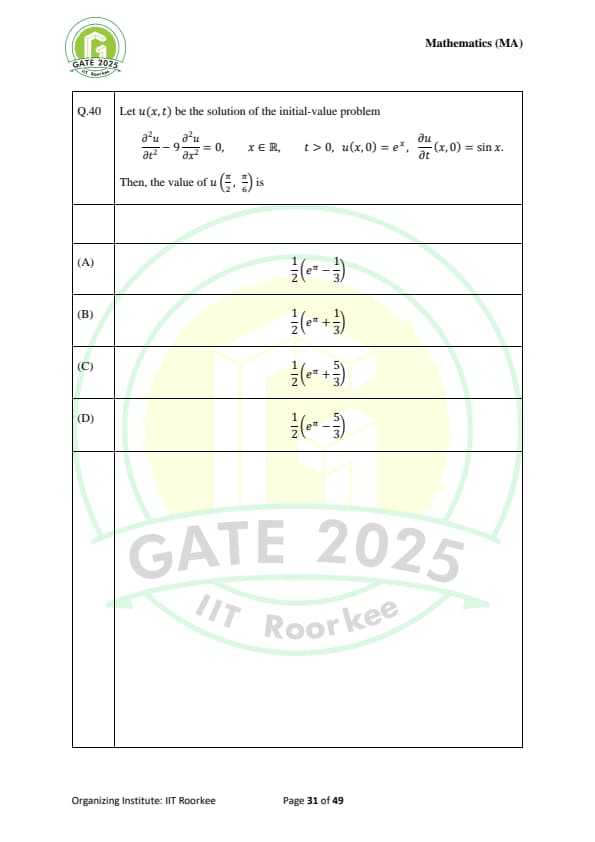
Let \( u(x,t) \) be the solution of the initial-value problem
\[ \frac{\partial^2 u}{\partial t^2} - 9 \frac{\partial^2 u}{\partial x^2} = 0, \quad x \in \mathbb{R}, \quad t > 0, \quad u(x, 0) = e^x, \quad \frac{\partial u}{\partial t}(x, 0) = \sin x. \]
Then, the value of \( u\left(\frac{\pi}{2}, \frac{\pi}{6}\right) \) is:
View Solution
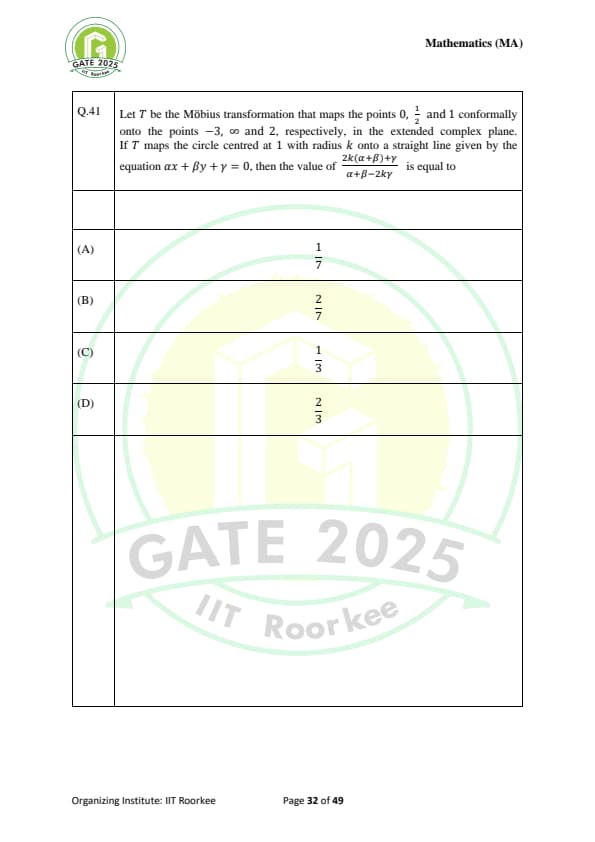
Let \( T \) be the Möbius transformation that maps the points 0, \( \frac{1}{2} \), and 1 conformally onto the points -3, \( \infty \), and 2, respectively, in the extended complex plane. If \( T \) maps the circle centered at 1 with radius \( k \) onto a straight line given by the equation \( \alpha x + \beta y + \gamma = 0 \), then the value of
\[ \frac{2k(\alpha + \beta) + \gamma}{\alpha + \beta - 2k\gamma} \]
is equal to:
View Solution
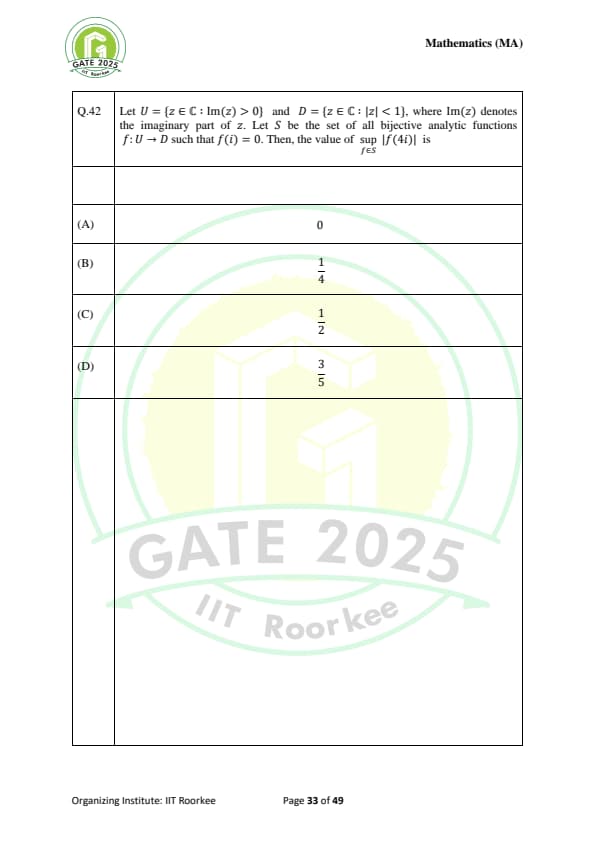
Let \( U = \{z \in \mathbb{C}: Im(z) > 0\} \) and \( D = \{z \in \mathbb{C}: |z| < 1\} \), where \( Im(z) \) denotes the imaginary part of \( z \). Let \( S \) be the set of all bijective analytic functions \( f: U \to D \) such that \( f(i) = 0 \). Then, the value of \( \sup_{f \in S} |f(4i)| \) is:
View Solution
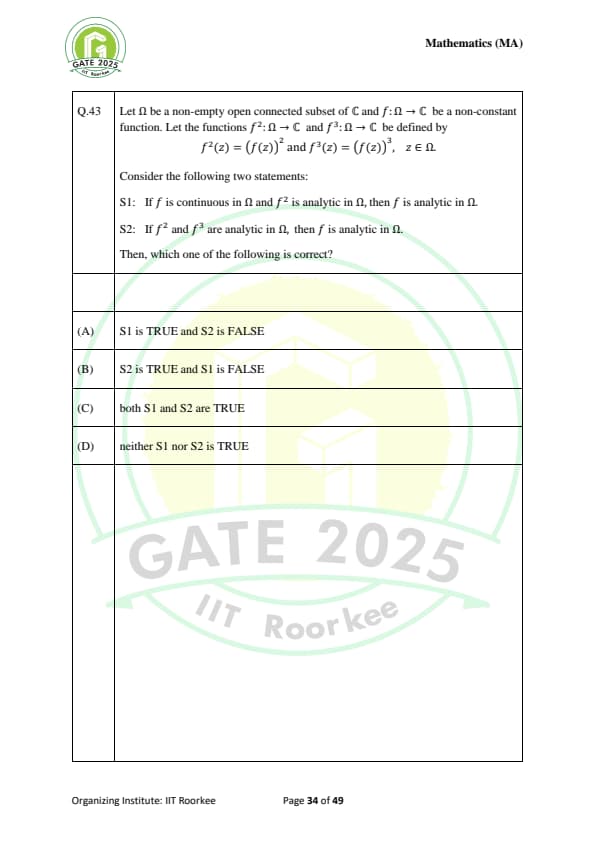
Let \( \Omega \) be a non-empty open connected subset of \( \mathbb{C} \) and \( f: \Omega \to \mathbb{C} \) be a non-constant function. Let the functions \( f^2: \Omega \to \mathbb{C} \) and \( f^3: \Omega \to \mathbb{C} \) be defined by
\[ f^2(z) = (f(z))^2 \quad and \quad f^3(z) = (f(z))^3, \quad z \in \Omega. \]
Consider the following two statements:
S1: If \( f \) is continuous in \( \Omega \) and \( f^2 \) is analytic in \( \Omega \), then \( f \) is analytic in \( \Omega \).
S2: If \( f^2 \) and \( f^3 \) are analytic in \( \Omega \), then \( f \) is analytic in \( \Omega \).
Then, which one of the following is correct?
View Solution
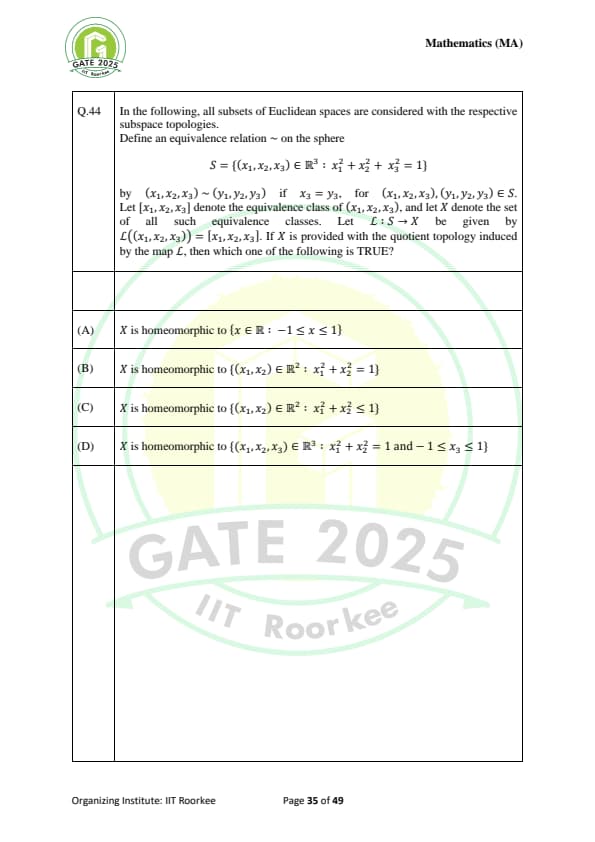
In the following, all subsets of Euclidean spaces are considered with the respective subspace topologies. Define an equivalence relation \( \sim \) on the sphere \[ S = \left\{ (x_1, x_2, x_3) \in \mathbb{R}^3 : x_1^2 + x_2^2 + x_3^2 = 1 \right\} \]
by \( (x_1, x_2, x_3) \sim (y_1, y_2, y_3) \) if \( x_3 = y_3 \), for \( (x_1, x_2, x_3), (y_1, y_2, y_3) \in S \). Let \( [x_1, x_2, x_3] \) denote the equivalence class of \( (x_1, x_2, x_3) \), and let \( X \) denote the set of all such equivalence classes. Let \( L : S \to X \) be given by \[ L\left( (x_1, x_2, x_3) \right) = [x_1, x_2, x_3]. \]
If \( X \) is provided with the quotient topology induced by the map \( L \), then which one of the following is TRUE?
View Solution
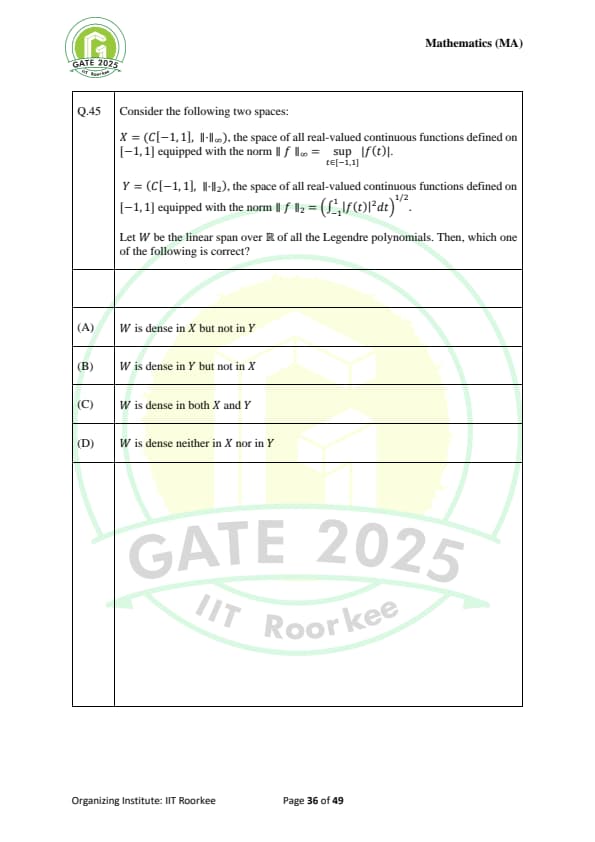
Consider the following two spaces:
\begin{align
X &= (C[-1, 1], \| \cdot \|_\infty), \quad the space of all real-valued continuous functions
&\quad \text{defined on \ [-1, 1] \text{ equipped with the norm \ \| f \|_\infty = \sup_{t \in [-1, 1] |f(t)|.
Y &= (C[-1, 1], \| \cdot \|_2), \quad \text{the space of all real-valued continuous functions
&\quad \text{defined on \ [-1, 1] \text{ equipped with the norm \ \| f \|_2 = \left( \int_{-1^1 |f(t)|^2 \, dt \right)^{1/2.
\end{align
Let \( W \) be the linear span over \( \mathbb{R \) of all the Legendre polynomials. Then, which one of the following is correct?
View Solution
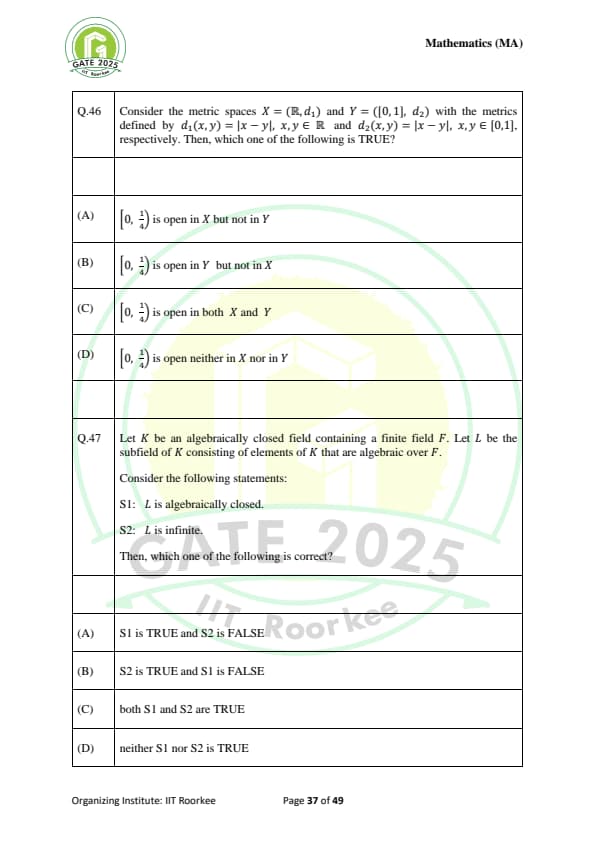
Consider the metric spaces \( X = (\mathbb{R}, d_1) \) and \( Y = ([0, 1], d_2) \) with the metrics defined by
\[ d_1(x, y) = |x - y|, \quad x, y \in \mathbb{R}, \quad and \quad d_2(x, y) = |x - y|, \quad x, y \in [0, 1], \]
respectively. Then, which one of the following is TRUE?
View Solution
Let \( K \) be an algebraically closed field containing a finite field \( F \). Let \( L \) be the subfield of \( K \) consisting of elements of \( K \) that are algebraic over \( F \).
Consider the following statements:
S1: \( L \) is algebraically closed.
S2: \( L \) is infinite.
Then, which one of the following is correct?
View Solution
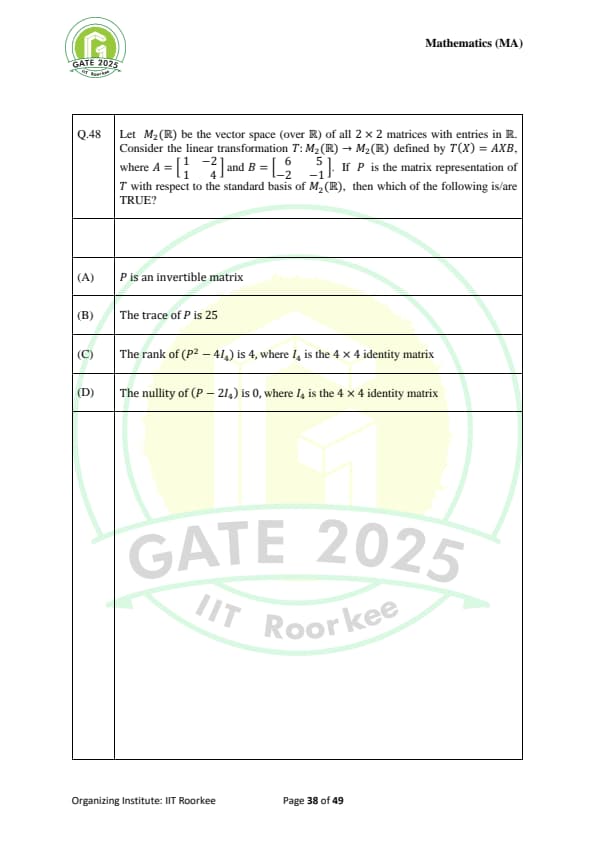
Let \( M_2(\mathbb{R}) \) be the vector space (over \( \mathbb{R} \)) of all \( 2 \times 2 \) matrices with entries in \( \mathbb{R} \). Consider the linear transformation \( T: M_2(\mathbb{R}) \to M_2(\mathbb{R}) \) defined by \( T(X) = AXB \), where \[ A = \begin{bmatrix} 1 & -2
1 & 4 \end{bmatrix} \quad and \quad B = \begin{bmatrix} 6 & 5
-2 & -1 \end{bmatrix}. \]
If \( P \) is the matrix representation of \( T \) with respect to the standard basis of \( M_2(\mathbb{R}) \), then which of the following is/are TRUE?
View Solution
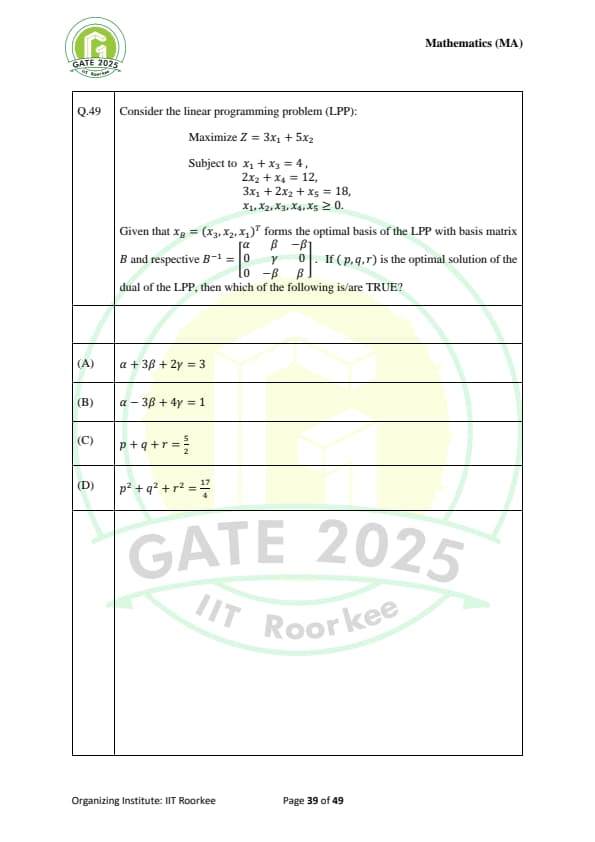
Consider the linear programming problem (LPP):
\[ Maximize Z = 3x_1 + 5x_2 \]
Subject to: \[ x_1 + x_3 = 4, \] \[ 2x_2 + x_4 = 12, \] \[ 3x_1 + 2x_2 + x_5 = 18, \] \[ x_1, x_2, x_3, x_4, x_5 \geq 0. \]
Given that \( x_B = (x_3, x_2, x_1)^T \) forms the optimal basis of the LPP with basis matrix \( B \) and respective \( B^{-1} \):
\[ B^{-1} = \begin{bmatrix} \alpha & \beta & -\beta
0 & \gamma & 0
0 & -\beta & \beta \end{bmatrix}. \]
If \( (p, q, r) \) is the optimal solution of the dual of the LPP, then which one of the following is/are TRUE?
View Solution
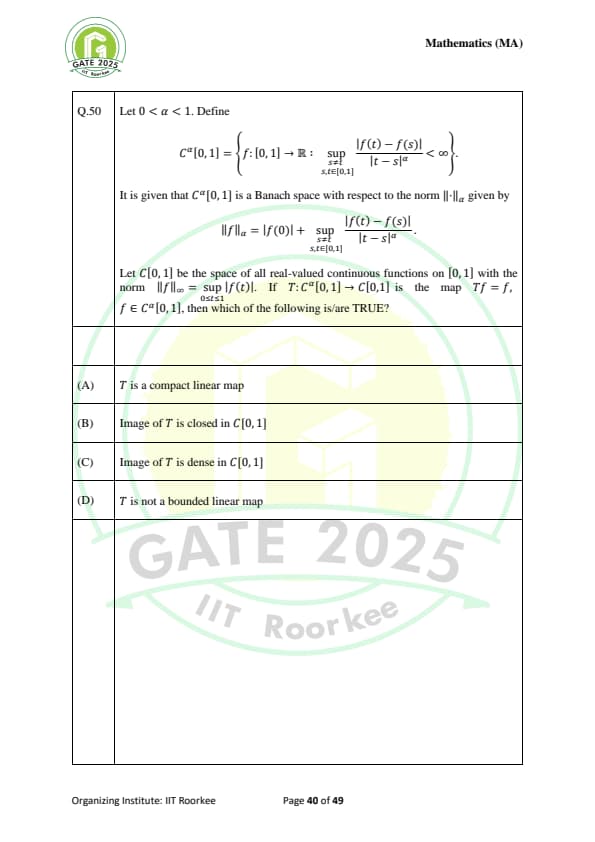
Let \( 0 < \alpha < 1 \). Define \[ C^\alpha[0, 1] = \left\{ f : [0, 1] \to \mathbb{R} \ : \ \sup_{s \neq t, \, s,t \in [0, 1]} \frac{|f(t) - f(s)|}{|t - s|^\alpha} < \infty \right\}. \]
It is given that \( C^\alpha[0, 1] \) is a Banach space with respect to the norm \( \| \cdot \|_\alpha \) given by \[ \| f \|_\alpha = |f(0)| + \sup_{s \neq t, \, s,t \in [0, 1]} \frac{|f(t) - f(s)|}{|t - s|^\alpha}. \]
Let \( C[0, 1] \) be the space of all real-valued continuous functions on \( [0, 1] \) with the norm \( \| f \|_\infty = \sup_{0 \leq t \leq 1} |f(t)| \). If \( T: C^\alpha[0, 1] \to C[0, 1] \) is the map \( T f = f \), where \( f \in C^\alpha[0, 1] \), then which one of the following is/are TRUE?
View Solution
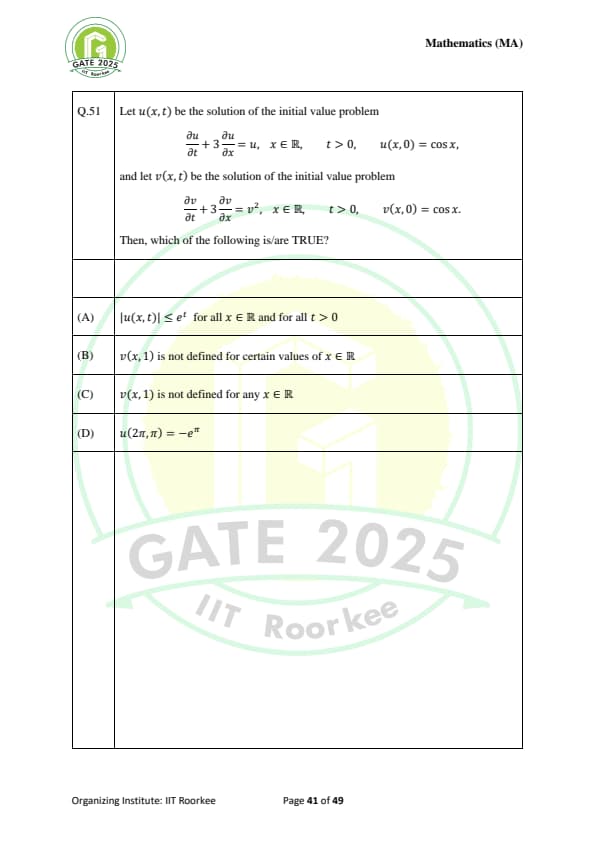
Let \( u(x, t) \) be the solution of the initial value problem
\[ \frac{\partial u}{\partial t} + 3 \frac{\partial u}{\partial x} = u, \quad x \in \mathbb{R}, \quad t > 0, \quad u(x, 0) = \cos x, \]
and let \( v(x, t) \) be the solution of the initial value problem
\[ \frac{\partial v}{\partial t} + 3 \frac{\partial v}{\partial x} = v^2, \quad x \in \mathbb{R}, \quad t > 0, \quad v(x, 0) = \cos x. \]
Then, which of the following is/are TRUE?
View Solution
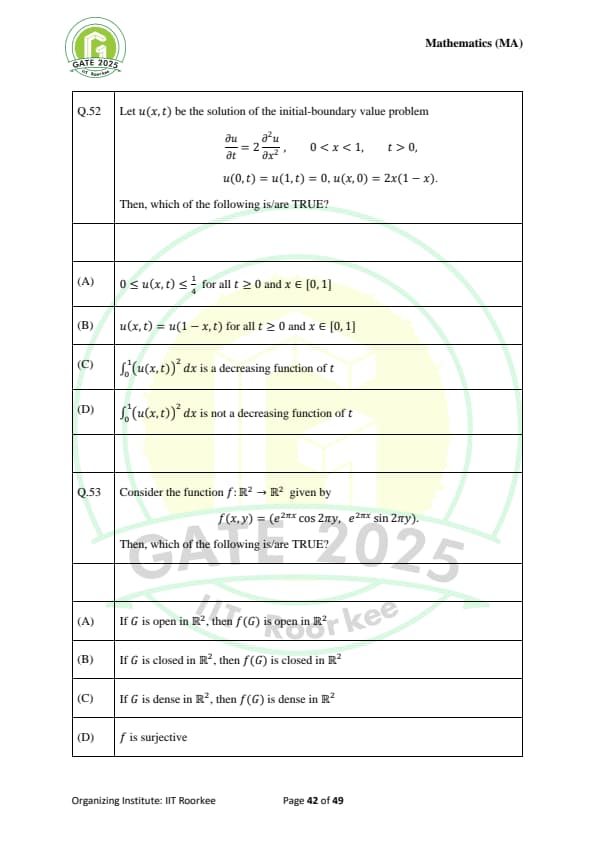
Let \( u(x, t) \) be the solution of the initial-boundary value problem
\[ \frac{\partial u}{\partial t} = 2 \frac{\partial^2 u}{\partial x^2}, \quad 0 < x < 1, \quad t > 0, \]
with the boundary conditions
\[ u(0, t) = u(1, t) = 0, \quad u(x, 0) = 2x(1 - x). \]
Then, which of the following is/are TRUE?
View Solution
Consider the function \( f : \mathbb{R}^2 \to \mathbb{R}^2 \) given by \[ f(x, y) = (e^{2\pi x} \cos 2\pi y, e^{2\pi x} \sin 2\pi y). \]
Then, which of the following is/are TRUE?
View Solution
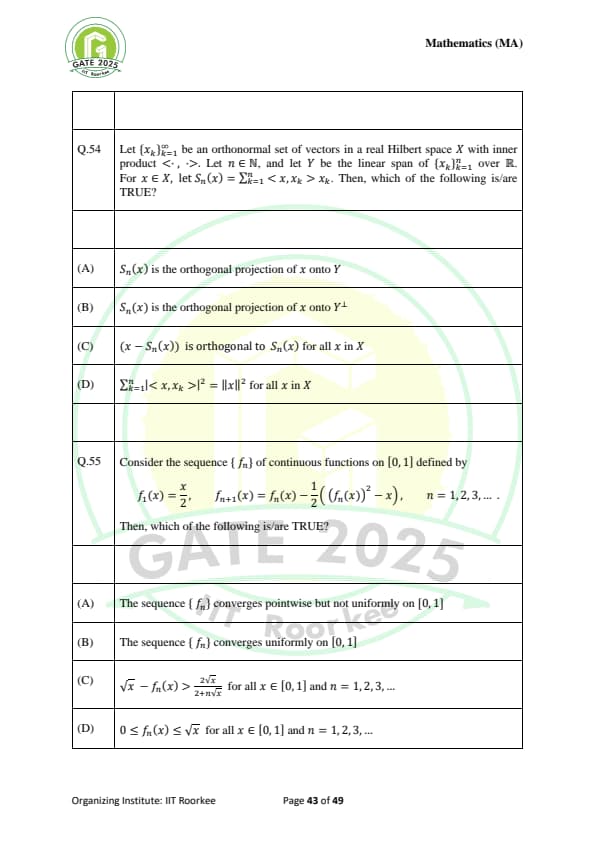
Let \( \{x_k\}_{k=1}^\infty \) be an orthonormal set of vectors in a real Hilbert space \( X \) with inner product \( \langle \cdot, \cdot \rangle \). Let \( n \in \mathbb{N} \), and let \( Y \) be the linear span of \( \{ x_k \}_{k=1}^n \) over \( \mathbb{R} \). For \( x \in X \), let \( S_n(x) = \sum_{k=1}^n \langle x, x_k \rangle x_k \). Then, which of the following is/are TRUE?
View Solution
Consider the sequence \( \{ f_n \} \) of continuous functions on \( [0, 1] \) defined by
\[ f_1(x) = \frac{x}{2}, \quad f_{n+1}(x) = f_n(x) - \frac{1}{2} \left( (f_n(x))^2 - x \right), \quad n = 1, 2, 3, \dots \]
Then, which of the following is/are TRUE?
View Solution
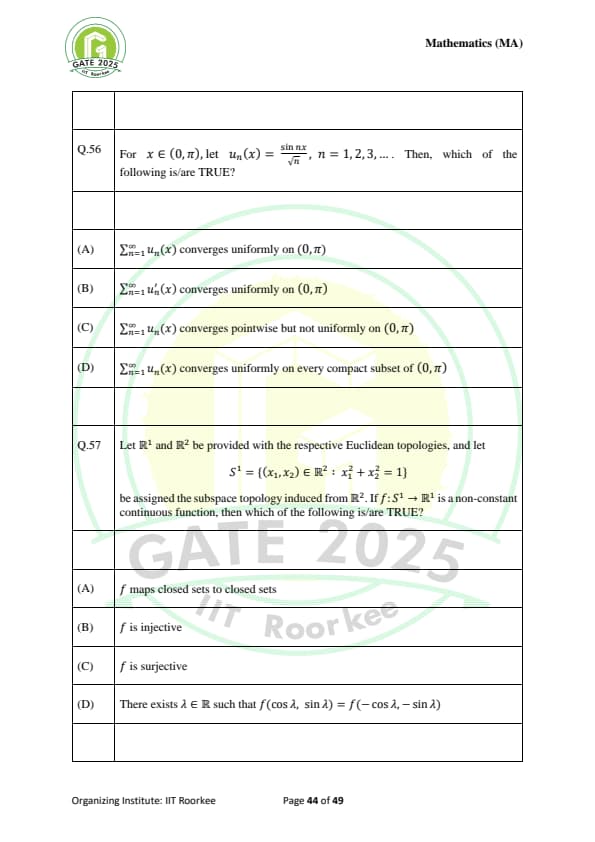
For \( x \in (0, \pi) \), let \( u_n(x) = \frac{\sin(nx)}{\sqrt{n}} \), \( n = 1, 2, 3, \dots \). Then, which of the following is TRUE?
View Solution
Let \( \mathbb{R}^1 \) and \( \mathbb{R}^2 \) be provided with the respective Euclidean topologies, and let \[ S^1 = \{ (x_1, x_2) \in \mathbb{R}^2 : x_1^2 + x_2^2 = 1 \} \]
be assigned the subspace topology induced from \( \mathbb{R}^2 \). If \( f: S^1 \to \mathbb{R}^1 \) is a non-constant continuous function, then which of the following is/are TRUE?
View Solution
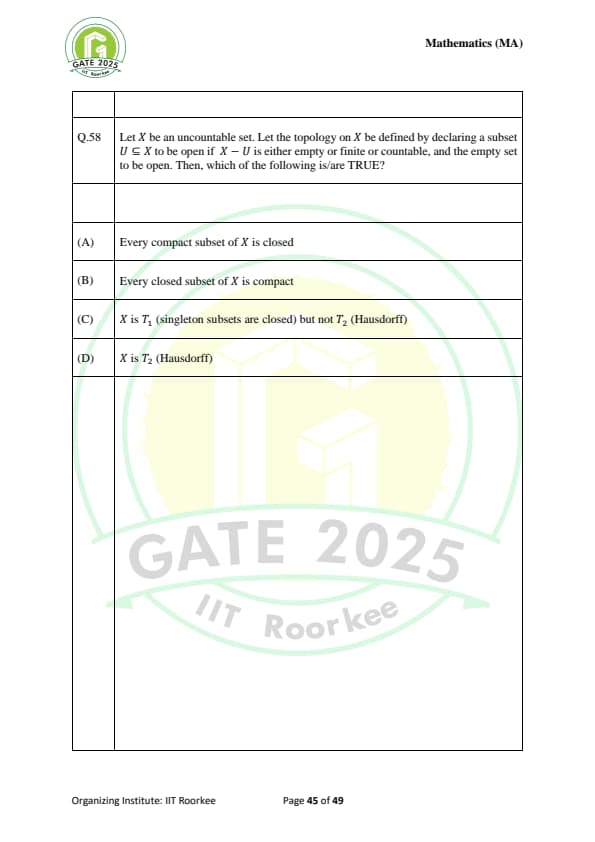
Let \( X \) be an uncountable set. Let the topology on \( X \) be defined by declaring a subset \( U \subset X \) to be open if \( X - U \) is either empty or finite or countable, and the empty set to be open. Then, which of the following is/are TRUE?
View Solution
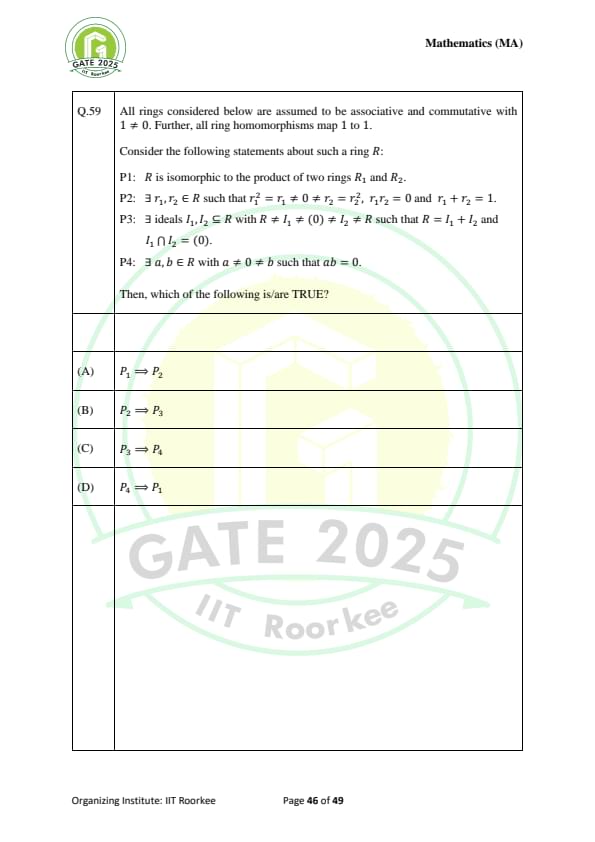
All rings considered below are assumed to be associative and commutative with \( 1 \neq 0 \). Further, all ring homomorphisms map 1 to 1.
Consider the following statements about such a ring \( R \):
P1: \( R \) is isomorphic to the product of two rings \( R_1 \) and \( R_2 \).
P2: \( \exists r_1, r_2 \in R \) such that \( r_1^2 = r_1 \neq 0 \), \( r_2^2 = 0 \), and \( r_1 + r_2 = 1 \).
P3: \( R \) has ideals \( I_1, I_2 \subset R \) with \( R \neq I_1 \), \( (0) \neq I_2 \), and \( R = I_1 + I_2 \) and \( I_1 \cap I_2 = (0) \).
P4: \( \exists a, b \in R \) with \( a \neq 0 \), \( b \neq 0 \) such that \( ab = 0 \).
Then, which of the following is/are TRUE?
\textbf{Correct Answer:} (B) \( P2 \Rightarrow P3 \)
\textbf{Correct Answer:} (C) \( P3 \Rightarrow P4 \)
View Solution
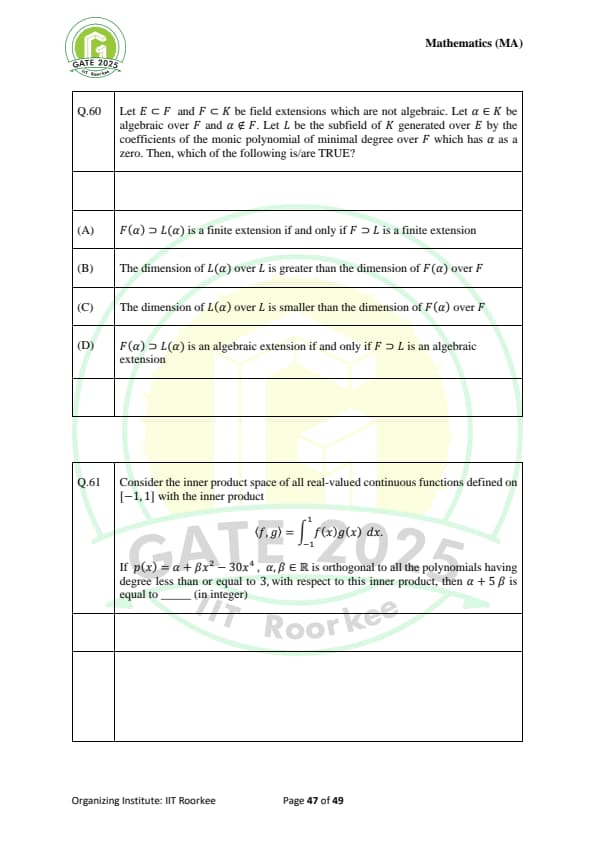
Let \( E \subset F \) and \( F \subset K \) be field extensions which are not algebraic. Let \( \alpha \in K \) be algebraic over \( F \) and \( \alpha \notin F \). Let \( L \) be the subfield of \( K \) generated over \( E \) by the coefficients of the monic polynomial of minimal degree over \( F \) which has \( \alpha \) as a zero. Then, which of the following is/are TRUE?
\textbf{Correct Answer:} (D) \( F(\alpha) \supset L(\alpha) \) is an algebraic extension if and only if \( F \supset L \) is an algebraic extension
View Solution
Consider the inner product space of all real-valued continuous functions defined on \( [-1, 1] \) with the inner product
\[ \langle f, g \rangle = \int_{-1}^{1} f(x) g(x) \, dx. \]
If \( p(x) = \alpha + \beta x^2 - 30x^4 \), where \( \alpha, \beta \in \mathbb{R} \), is orthogonal to all the polynomials having degree less than or equal to 3, with respect to this inner product, then \( \alpha + 5\beta \) is equal to (in integer).
View Solution
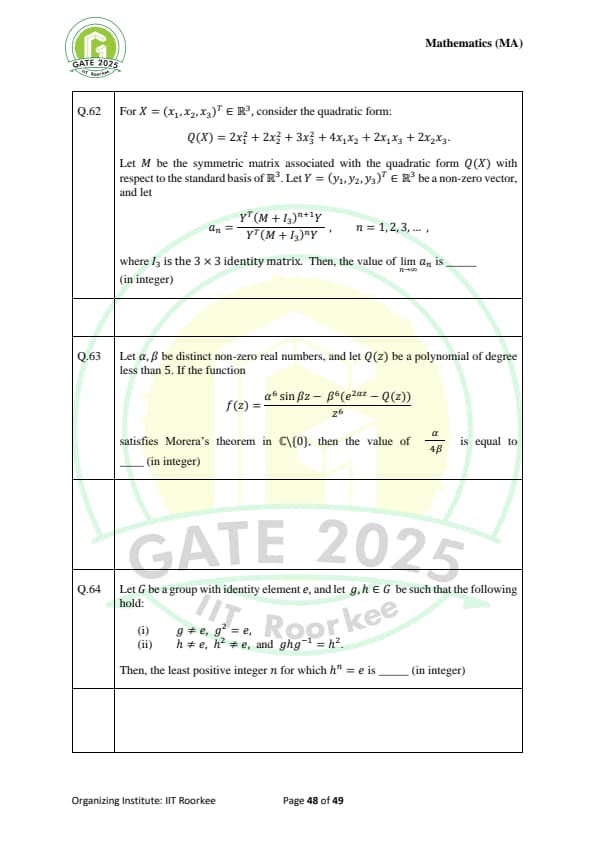
For \( X = (x_1, x_2, x_3)^T \in \mathbb{R}^3 \), consider the quadratic form:
\[ Q(X) = 2x_1^2 + 2x_2^2 + 3x_3^2 + 4x_1x_2 + 2x_1x_3 + 2x_2x_3. \]
Let \( M \) be the symmetric matrix associated with the quadratic form \( Q(X) \) with respect to the standard basis of \( \mathbb{R}^3 \). Let \( Y = (y_1, y_2, y_3)^T \in \mathbb{R}^3 \) be a non-zero vector, and let
\[ a_n = \frac{Y^T(M + I_3)^{n+1}Y}{Y^T(M + I_3)^n Y}, \quad n = 1, 2, 3, \dots \]
Then, the value of \( \lim_{n \to \infty} a_n \) is equal to (in integer).
View Solution
Let \( \alpha, \beta \) be distinct non-zero real numbers, and let \( Q(z) \) be a polynomial of degree less than 5. If the function
\[ f(z) = \frac{\alpha^6 \sin \beta z - \beta^6 (e^{2az} - Q(z))}{z^6} \]
satisfies Morera's theorem in \( \mathbb{C} \setminus \{0\} \), then the value of \( \frac{\alpha}{4\beta} \) is equal to (in integer).
View Solution
Let \( G \) be a group with identity element \( e \), and let \( g, h \in G \) be such that the following hold:
\[ g \neq e, \quad g^2 = e, \quad h \neq e, \quad h^2 \neq e, \quad and \quad ghg^{-1} = h^2. \]
Then, the least positive integer \( n \) for which \( h^n = e \) is (in integer).
View Solution
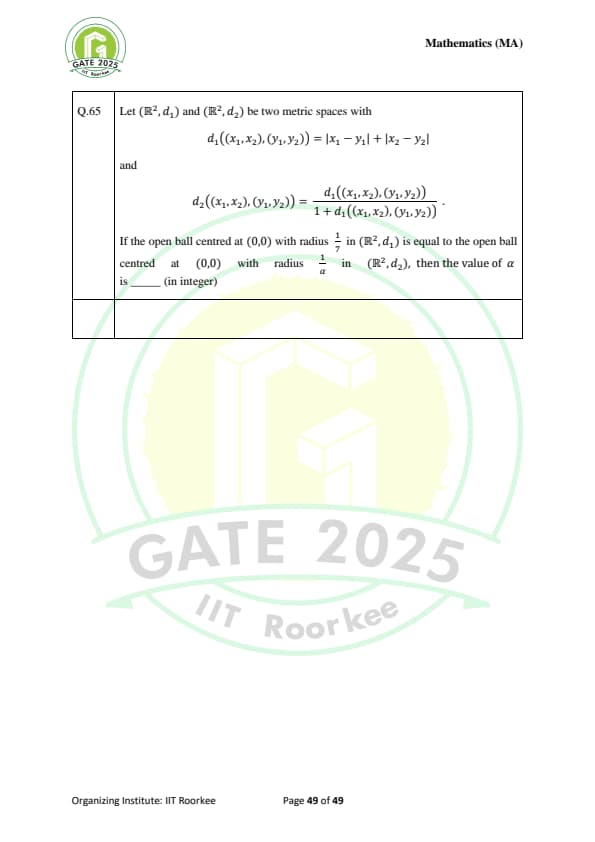
Let \( (\mathbb{R}^2, d_1) \) and \( (\mathbb{R}^2, d_2) \) be two metric spaces with
\[ d_1\left( (x_1, x_2), (y_1, y_2) \right) = |x_1 - y_1| + |x_2 - y_2| \] \[ and \quad d_2\left( (x_1, x_2), (y_1, y_2) \right) = \frac{d_1\left( (x_1, x_2), (y_1, y_2) \right)}{1 + d_1\left( (x_1, x_2), (y_1, y_2) \right)}. \]
If the open ball centered at \( (0,0) \) with radius \( \frac{1}{7} \) in \( (\mathbb{R}^2, d_1) \) is equal to the open ball centered at \( (0,0) \) with radius \( \frac{1}{\alpha} \) in \( (\mathbb{R}^2, d_2) \), then the value of \( \alpha \) is (in integer).
View Solution




Comments