




The GATE 2025 PE Question Paper PDF is available. IIT Roorkee has conducted the GATE 2025 Petroleum Engineering exam on February 2nd, Shift 1 from 9:30 AM to 12:30 PM. As per the updated exam pattern, the exam consists of 65 questions carrying a total of 100 marks, with 10 from the General Aptitude section and 55 questions from Engineering Mathematics and Core Petroleum Engineering topics.
The difficulty level of GATE 2025 PE was moderate.
GATE 2025 PE Question Paper with Solutions PDF
| GATE 2025 PE Question Paper with Solutions PDF | Download | Check Solutions |

Fish : Shoal :: Lion : ______
Select the correct option to complete the analogy.
Identify the grammatically correct sentence:
Two cars, P and Q, start from a point X in India at 10 AM. Car P travels North with a speed of 25 km/h and car Q travels East with a speed of 30 km/h. Car P travels continuously but car Q stops for some time after traveling for one hour. If both cars are at the same distance from X at 11:30 AM, for how long (in minutes) did car Q stop?
The ceiling function of a real number \( x \), denoted by \( ce(x) \), is defined as the smallest integer that is greater than or equal to \( x \). Similarly, the floor function, denoted by \( fl(x) \), is defined as the largest integer that is smaller than or equal to \( x \). Which one of the following statements is NOT correct for all possible values of \( x \)?
P and Q play chess frequently against each other. Of these matches, P has won 80% of the matches, drawn 15% of the matches, and lost 5% of the matches.
If they play 3 more matches, what is the probability of P winning exactly 2 of these 3 matches?
Identify the option that has the most appropriate sequence such that a coherent paragraph is formed:
% Statements
P. At once, without thinking much, people rushed towards the city in hordes with the sole aim of grabbing as much gold as they could.
Q. However, little did they realize about the impending hardships they would have to face on their way to the city: miles of mud, unfriendly forests, hungry beasts, and inimical local lords—all of which would reduce their chances of getting gold to almost zero.
R. All of them thought that easily they could lay their hands on gold and become wealthy overnight.
S. About a hundred years ago, the news that gold had been discovered in Kolar spread like wildfire and the whole State was in raptures.
If HIDE and CAGE are coded as 19-23-7-11 and 5-2-17-11 respectively, then what is the code for HIGH?
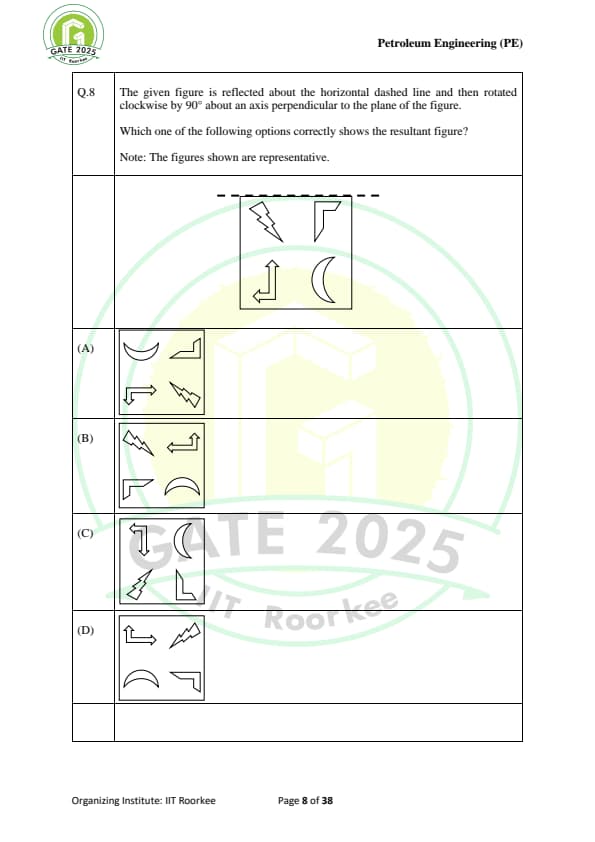
The given figure is reflected about the horizontal dashed line and then rotated clockwise by 90° about an axis perpendicular to the plane of the figure.
Which one of the following options correctly shows the resultant figure?
Note: The figures shown are representative

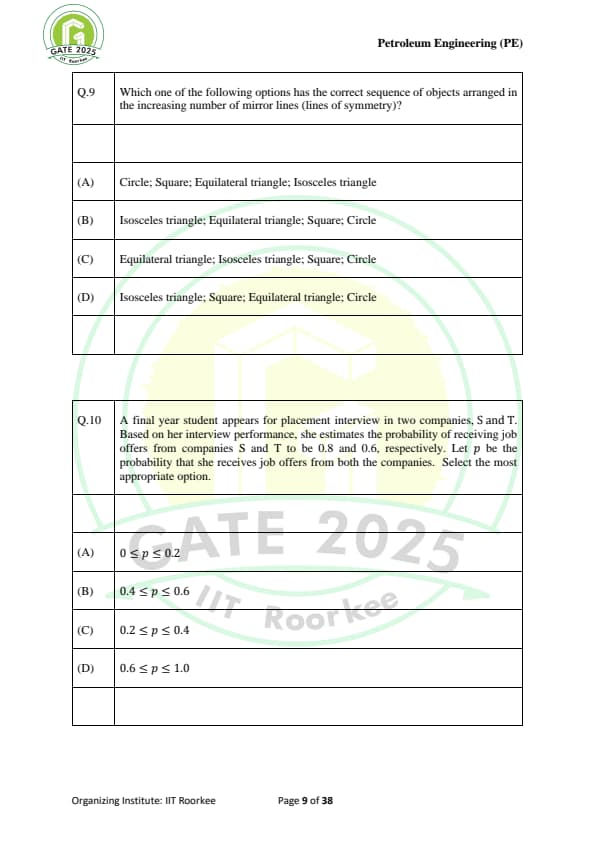
Which one of the following options has the correct sequence of objects arranged in the increasing number of mirror lines (lines of symmetry)?
A final year student appears for placement interview in two companies, S and T. Based on her interview performance, she estimates the probability of receiving job offers from companies S and T to be 0.8 and 0.6, respectively. Let \( p \) be the probability that she receives job offers from both the companies. Select the most appropriate option.
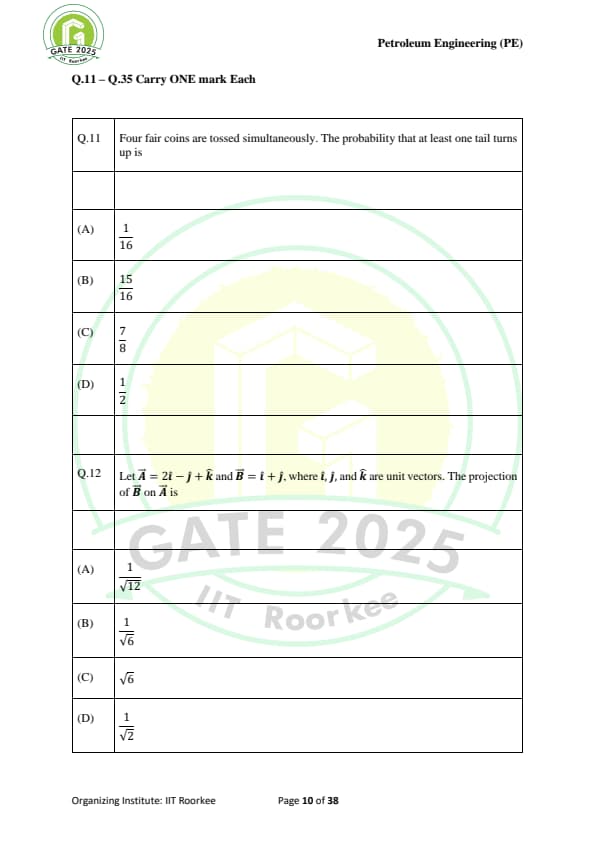
Four fair coins are tossed simultaneously. The probability that at least one tail turns up is:
Let \( \vec{A} = 2\ell - \mathbf{j} + \mathbf{k} \) and \( \vec{B} = \ell + \mathbf{f} \), where \( \ell, \mathbf{f}, \) and \( \mathbf{k} \) are unit vectors. The projection of \( \vec{B} \) on \( \vec{A} \) is:
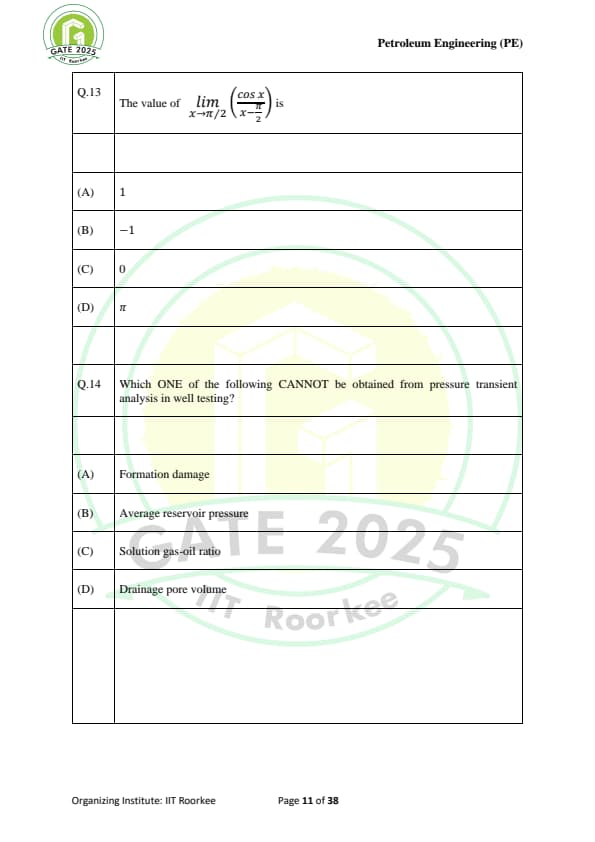
The value of \( \lim_{x \to \frac{\pi}{2}} \left( \frac{\cos x}{x - \frac{\pi}{2}} \right) \) is:
Which ONE of the following CANNOT be obtained from pressure transient analysis in well testing?
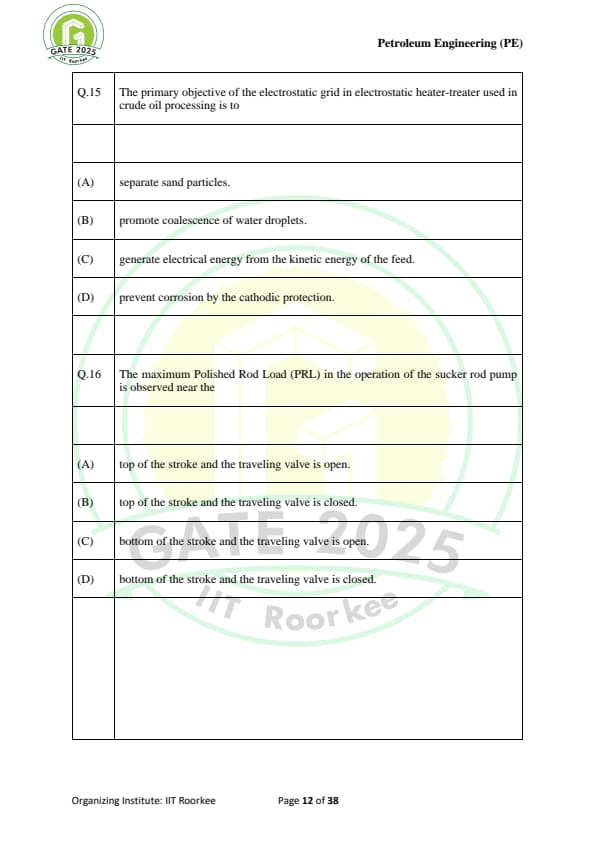
The primary objective of the electrostatic grid in electrostatic heater-treater used in crude oil processing is to
The maximum Polished Rod Load (PRL) in the operation of the sucker rod pump is observed near the
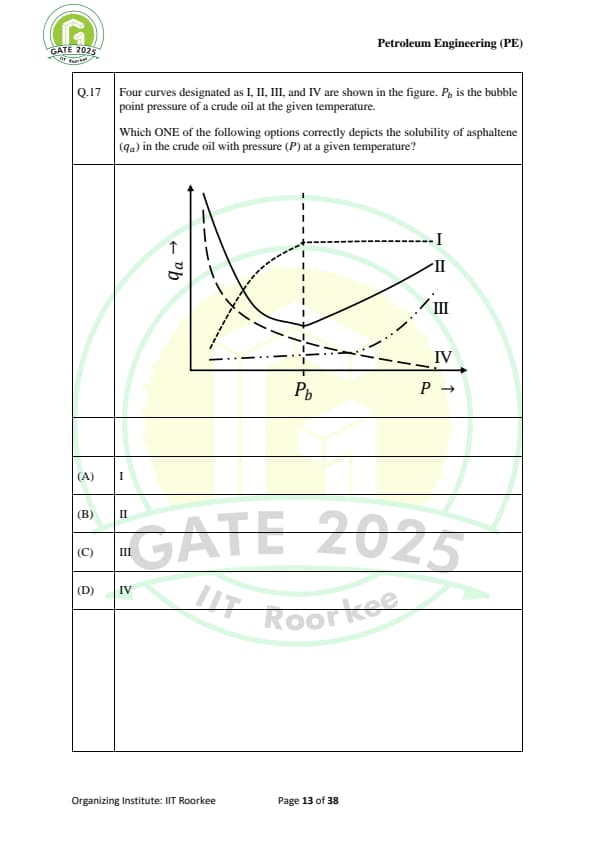
Four curves designated as I, II, III, and IV are shown in the figure. \( P_b \) is the bubble point pressure of a crude oil at the given temperature.
Which ONE of the following options correctly depicts the solubility of asphaltene (\( q_a \)) in the crude oil with pressure (\( P \)) at a given temperature?

\( C_1, C_2, \) and \( C_3 \) are the Dietz shape factors of three reservoirs with circular, square, and rectangular shape of drainage area, respectively. The well is located at the geometric center of the reservoir.
Which ONE of the following options is CORRECT about the shape factors?
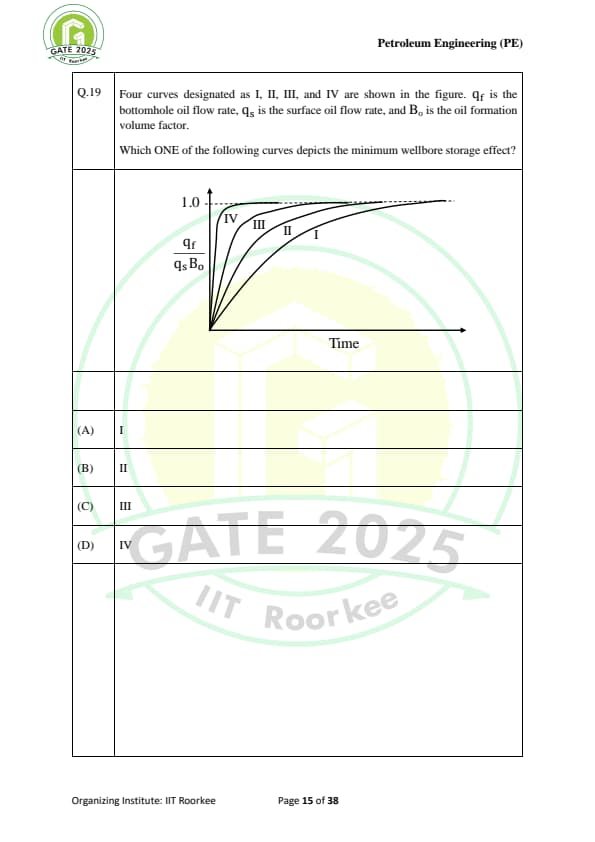
Four curves designated as I, II, III, and IV are shown in the figure. \( q_f \) is the bottomhole oil flow rate, \( q_s \) is the surface oil flow rate, and \( B_o \) is the oil formation volume factor.
Which ONE of the following curves depicts the minimum wellbore storage effect?

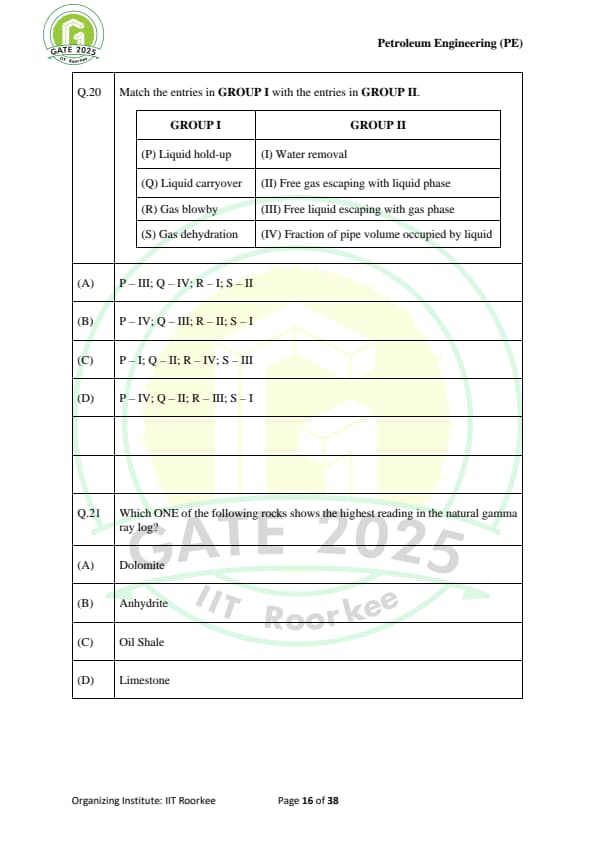
Match the entries in GROUP I with the entries in GROUP II.
(P) Liquid hold-up ; (I) Water removal
(Q) Liquid carryover ; (II) Free gas escaping with liquid phase
(R) Gas blowby ; (III) Free liquid escaping with gas phase
(S) Gas dehydration ; (IV) Fraction of pipe volume occupied by liquid
Which ONE of the following options is CORRECT?
Which ONE of the following rocks shows the highest reading in the natural gamma ray log?
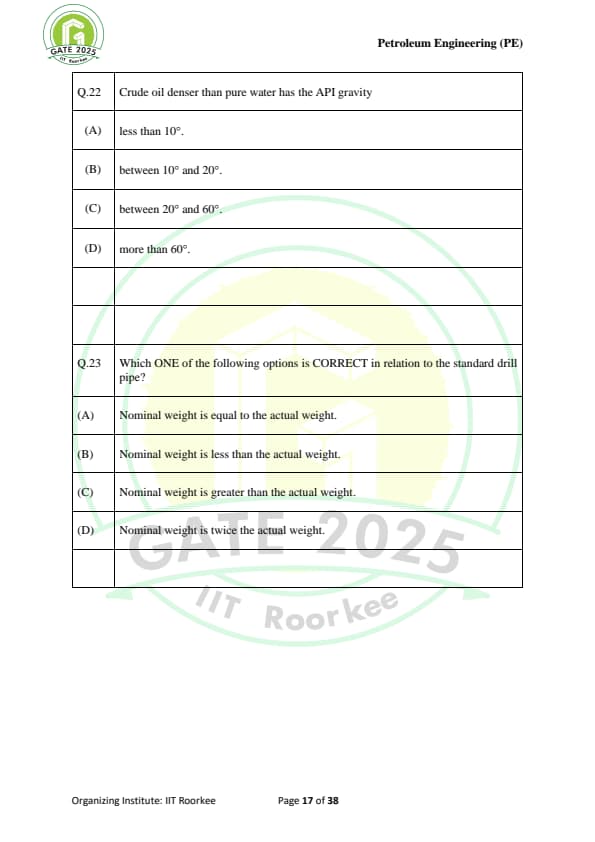
Crude oil denser than pure water has the API gravity:
Which ONE of the following options is CORRECT in relation to the standard drill pipe?
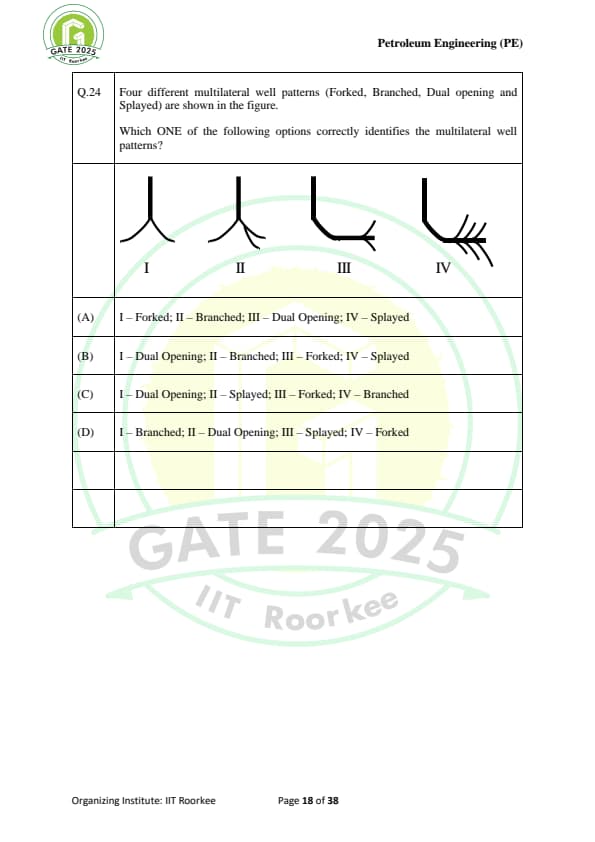
Four different multilateral well patterns (Forked, Branched, Dual opening and Splayed) are shown in the figure.
Which ONE of the following options correctly identifies the multilateral well patterns?

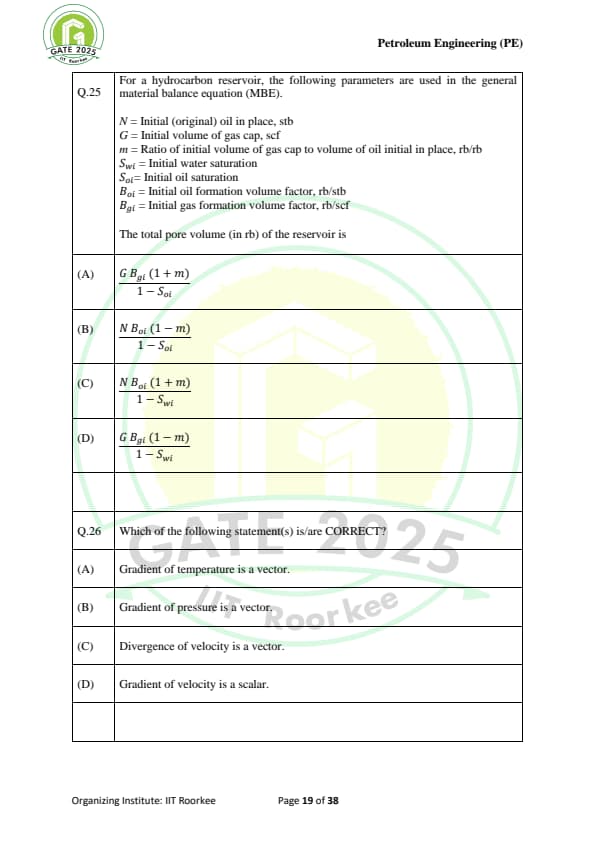
For a hydrocarbon reservoir, the following parameters are used in the general material balance equation (MBE).

The total pore volume (in rb) of the reservoir is:
Which of the following statement(s) is/are CORRECT?
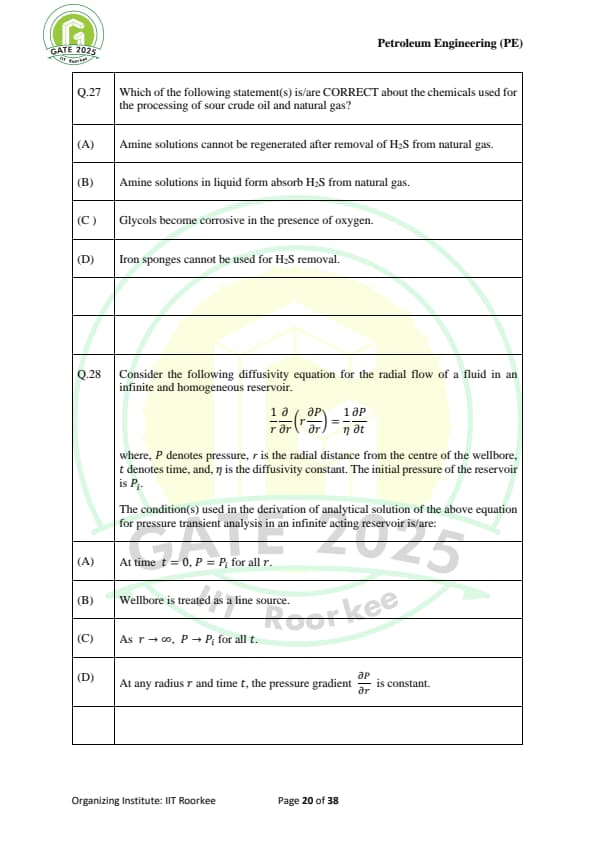
Which of the following statement(s) is/are CORRECT about the chemicals used for the processing of sour crude oil and natural gas?
Consider the following diffusivity equation for the radial flow of a fluid in an infinite and homogeneous reservoir.
\[ \frac{1}{r} \frac{\partial}{\partial r} \left( r \frac{\partial P}{\partial r} \right) = \frac{1}{\eta} \frac{\partial P}{\partial t} \]
where, \( P \) denotes pressure, \( r \) is the radial distance from the center of the wellbore, \( t \) denotes time, and \( \eta \) is the diffusivity constant. The initial pressure of the reservoir is \( P_i \).
The condition(s) used in the derivation of analytical solution of the above equation for pressure transient analysis in an infinite acting reservoir is/are:
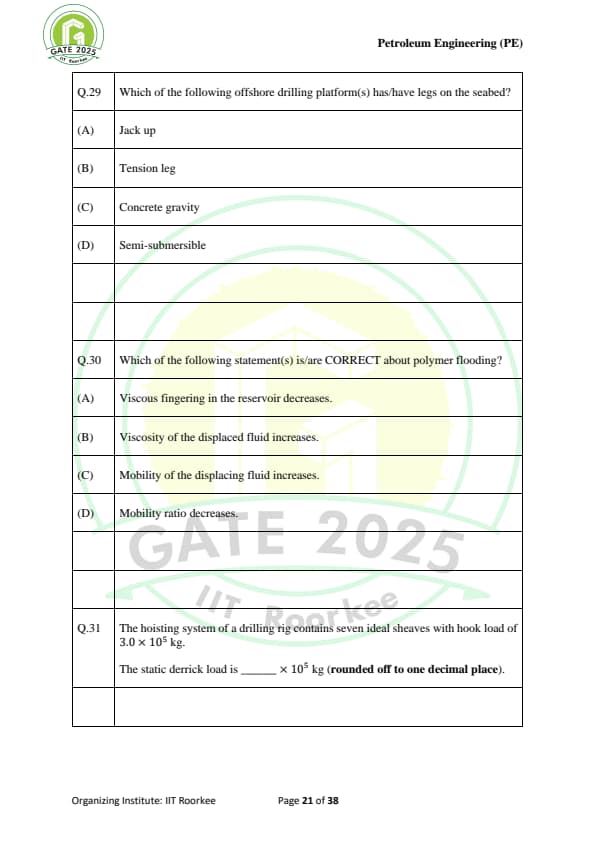
Which of the following offshore drilling platform(s) has/have legs on the seabed?
Which of the following statement(s) is/are CORRECT about polymer flooding?
The hoisting system of a drilling rig contains seven ideal sheaves with hook load of \( 3.0 \times 10^5 \) kg.
The static derrick load is .......... × \( 10^5 \) kg (rounded off to one decimal place).
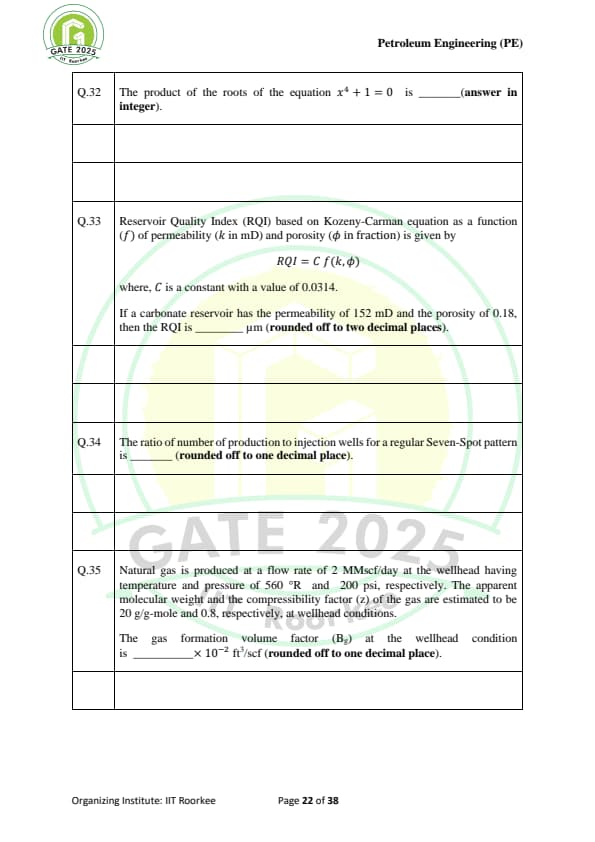
The product of the roots of the equation \( x^4 + 1 = 0 \) is ....... (answer in integer).
Reservoir Quality Index (RQI) based on Kozeny-Carman equation as a function (\( f \)) of permeability (\( k \), in mD) and porosity (\( \phi \), in fraction) is given by:
\[ RQI = C f(k, \phi) \]
where, \( C \) is a constant with a value of 0.0314.
If a carbonate reservoir has the permeability of 152 mD and the porosity of 0.18, then the RQI is ........ \(\mu m\) (rounded off to two decimal places).
The ratio of number of production to injection wells for a regular Seven-Spot pattern is ........... (rounded off to one decimal place).
Natural gas is produced at a flow rate of 2 MMscf/day at the wellhead having temperature and pressure of 560 °R and 200 psi, respectively. The apparent molecular weight and the compressibility factor (z) of the gas are estimated to be 20 g/g-mole and 0.8, respectively, at wellhead conditions.
The gas formation volume factor (\( B_g \)) at the wellhead condition is ........... × \( 10^{-2} \) ft\(^3\)/scf (rounded off to one decimal place).
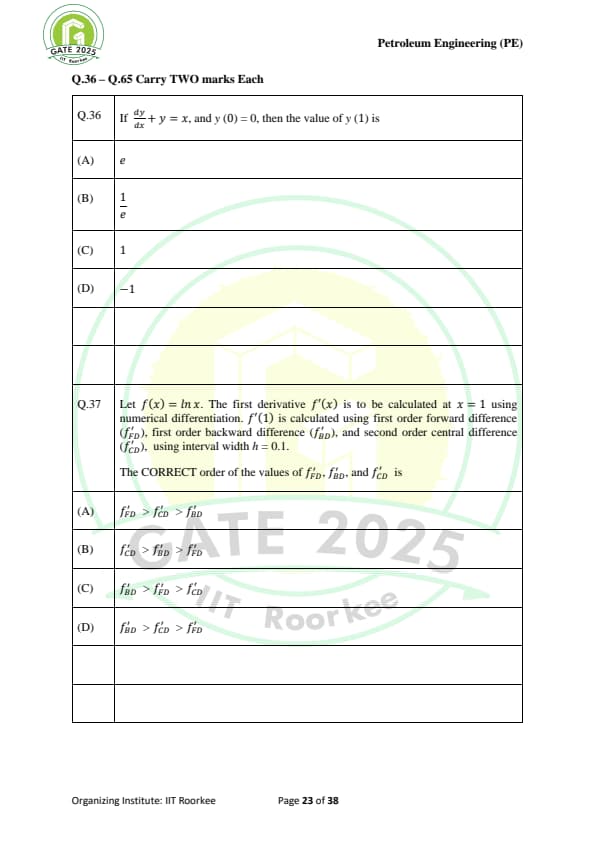
If \( \frac{dy}{dx} + y = x \), and \( y(0) = 0 \), then the value of \( y(1) \) is:
Let \( f(x) = \ln x \). The first derivative \( f'(x) \) is to be calculated at \( x = 1 \) using numerical differentiation. \( f'(1) \) is calculated using first order forward difference (\( f'_{FD} \)), first order backward difference (\( f'_{BD} \)), and second order central difference (\( f'_{CD} \)), using interval width \( h = 0.1 \).
The CORRECT order of the values of \( f'_{FD} \), \( f'_{BD} \), and \( f'_{CD} \) is:
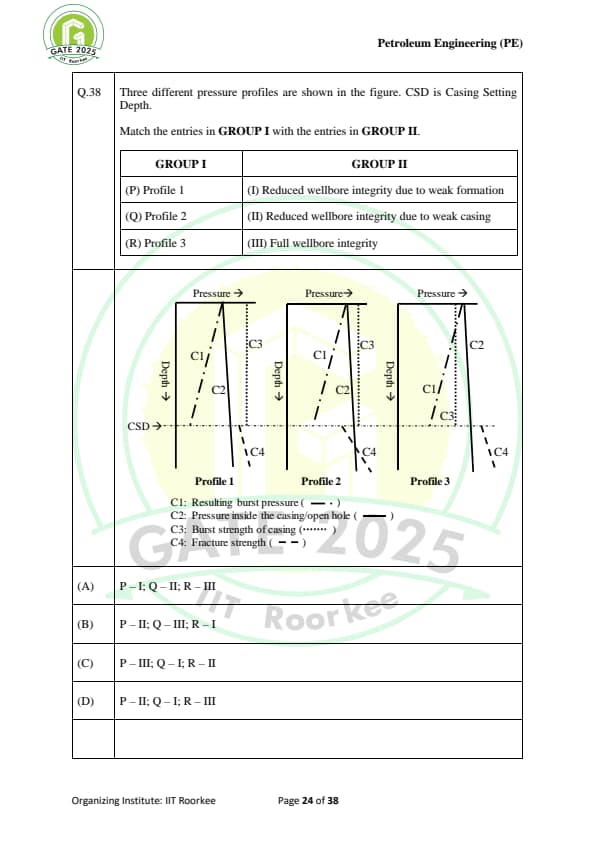
Three different pressure profiles are shown in the figure. CSD is Casing Setting Depth.
Match the entries in GROUP I with the entries in GROUP II.
GROUP I & GROUP II
(P) Profile 1 (I) Reduced wellbore integrity due to weak formation
(Q) Profile 2 (II) Reduced wellbore integrity due to weak casing
(R) Profile 3 (III) Full wellbore integrity

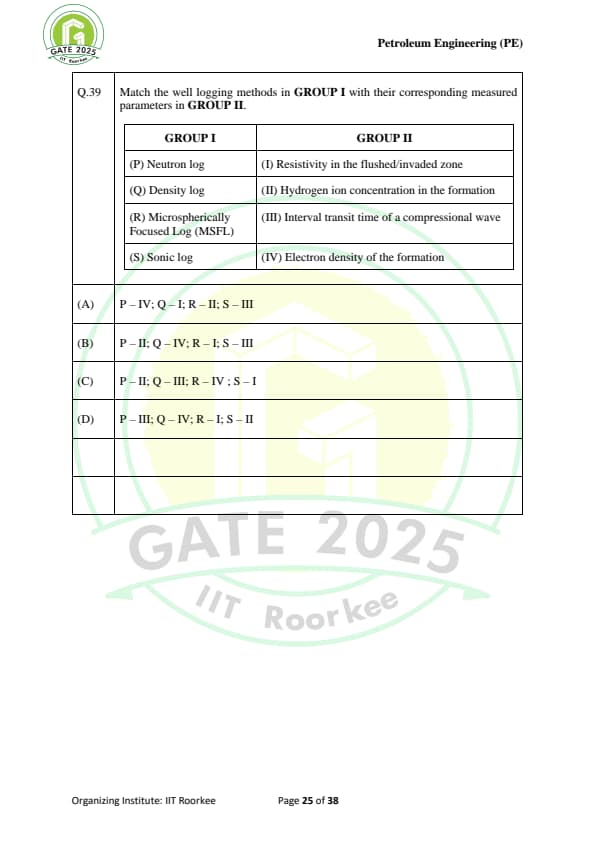
Match the well logging methods in GROUP I with their corresponding measured parameters in GROUP II:
GROUP I & GROUP II
\hline
(P) Neutron log ; (I) Resistivity in the flushed/invaded zone
(Q) Density log ; (II) Hydrogen ion concentration in the formation
(R) Microspherically Focused Log (MSFL) ; (III) Interval transit time of a compressional wave
(S) Sonic log ; (IV) Electron density of the formation
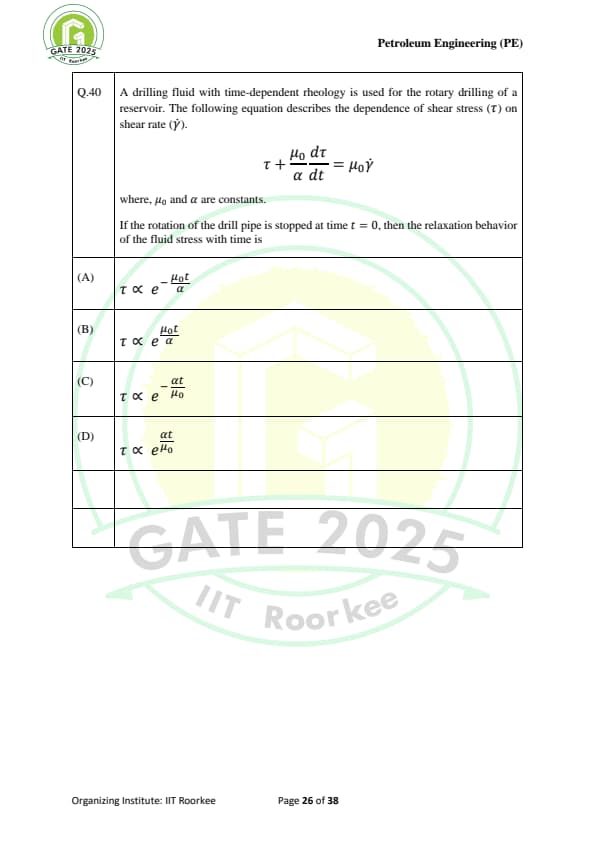
A drilling fluid with time-dependent rheology is used for the rotary drilling of a reservoir. The following equation describes the dependence of shear stress (\( \tau \)) on shear rate (\( \dot{\gamma} \)):
\[ \tau + \frac{\mu_0}{\alpha} \frac{d\tau}{dt} = \mu_0 \dot{\gamma} \]
where \( \mu_0 \) and \( \alpha \) are constants.
If the rotation of the drill pipe is stopped at time \( t = 0 \), then the relaxation behavior of the fluid stress with time is:
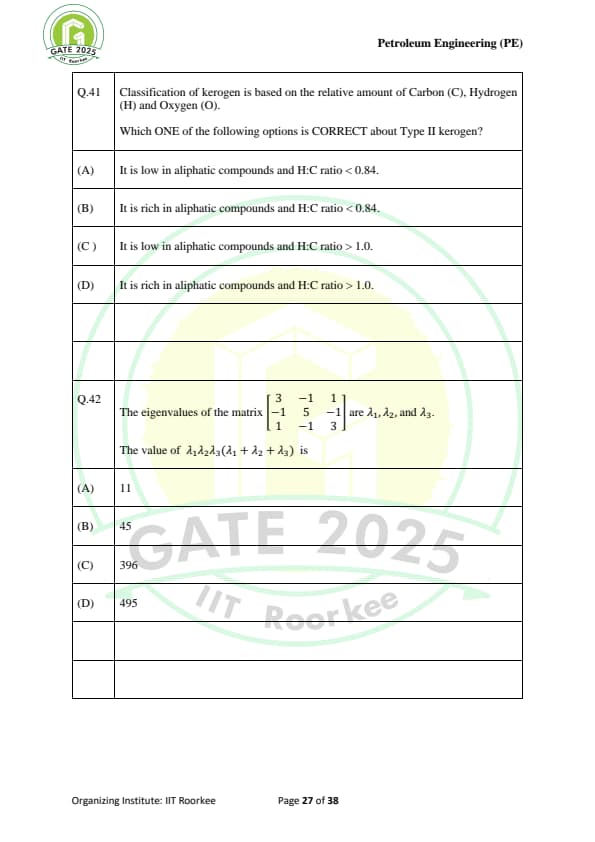
Classification of kerogen is based on the relative amount of Carbon (C), Hydrogen (H) and Oxygen (O).
Which ONE of the following options is CORRECT about Type II kerogen?
The eigenvalues of the matrix \[ \begin{bmatrix} 3 & -1 & 1
-1 & 5 & -1
1 & -1 & -3 \end{bmatrix} \]
are \( \lambda_1, \lambda_2, \lambda_3 \). The value of \( \lambda_1 \lambda_2 \lambda_3 ( \lambda_1 + \lambda_2 + \lambda_3 ) \) is:
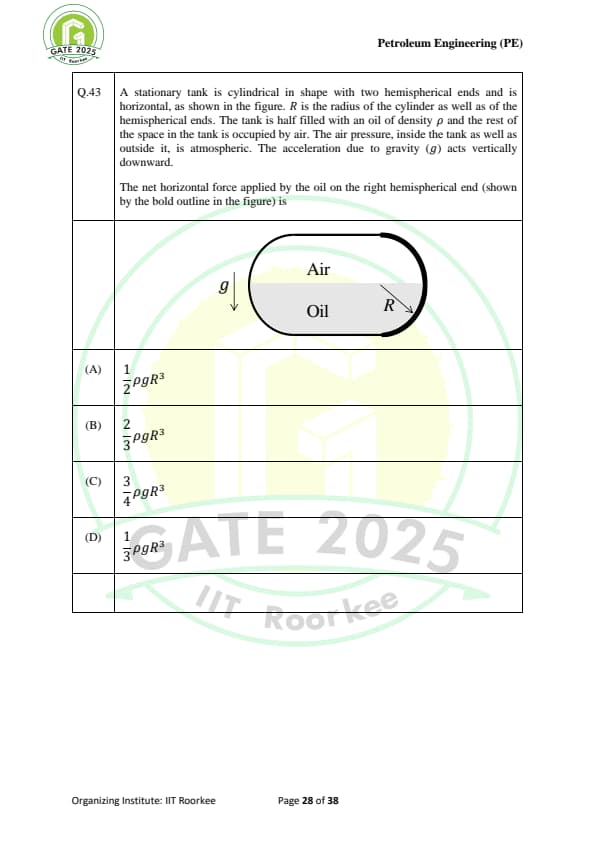
A stationary tank is cylindrical in shape with two hemispherical ends and is horizontal, as shown in the figure. \( R \) is the radius of the cylinder as well as of the hemispherical ends. The tank is half filled with an oil of density \( \rho \) and the rest of the space in the tank is occupied by air. The air pressure, inside the tank as well as outside it, is atmospheric. The acceleration due to gravity (\( g \)) acts vertically downward.
The net horizontal force applied by the oil on the right hemispherical end (shown by the bold outline in the figure) is:

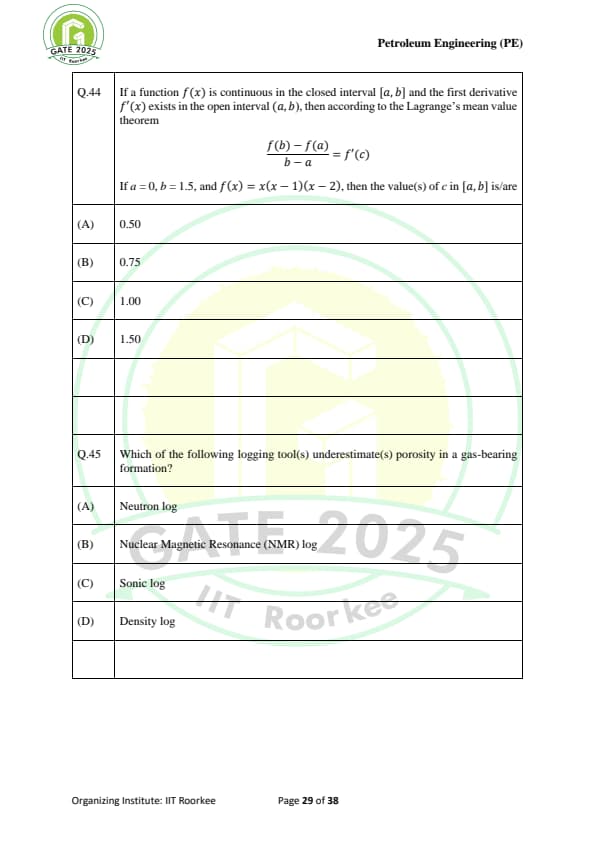
If a function \( f(x) \) is continuous in the closed interval \( [a, b] \) and the first derivative \( f'(x) \) exists in the open interval \( (a, b) \), then according to the Lagrange's mean value theorem:
\[ \frac{f(b) - f(a)}{b - a} = f'(c) \]
If \( a = 0 \), \( b = 1.5 \), and \( f(x) = x(x - 1)(x - 2) \), then the value(s) of \( c \) in \( [a, b] \) is/are:
Which of the following logging tool(s) underestimate(s) porosity in a gas-bearing formation?
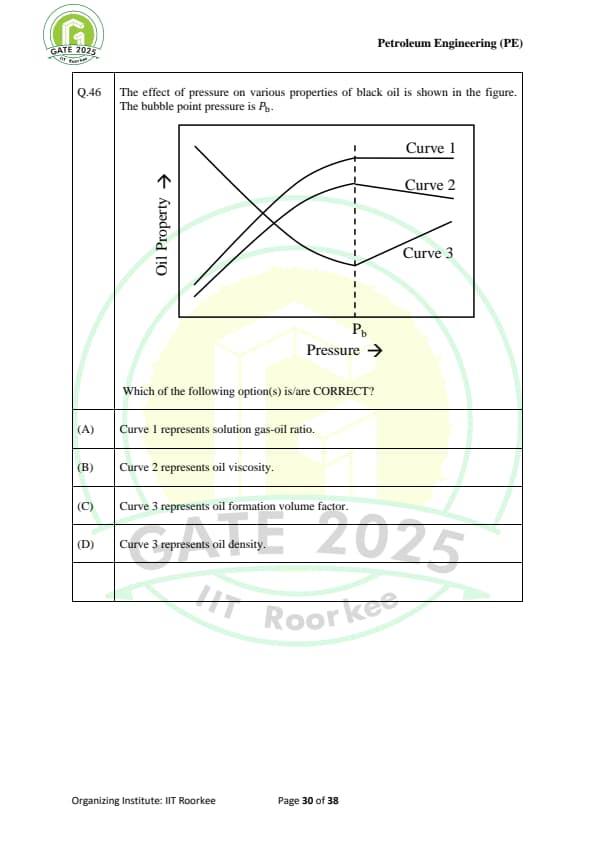
The effect of pressure on various properties of black oil is shown in the figure. The bubble point pressure is \( P_b \).

Which of the following option(s) is/are CORRECT?
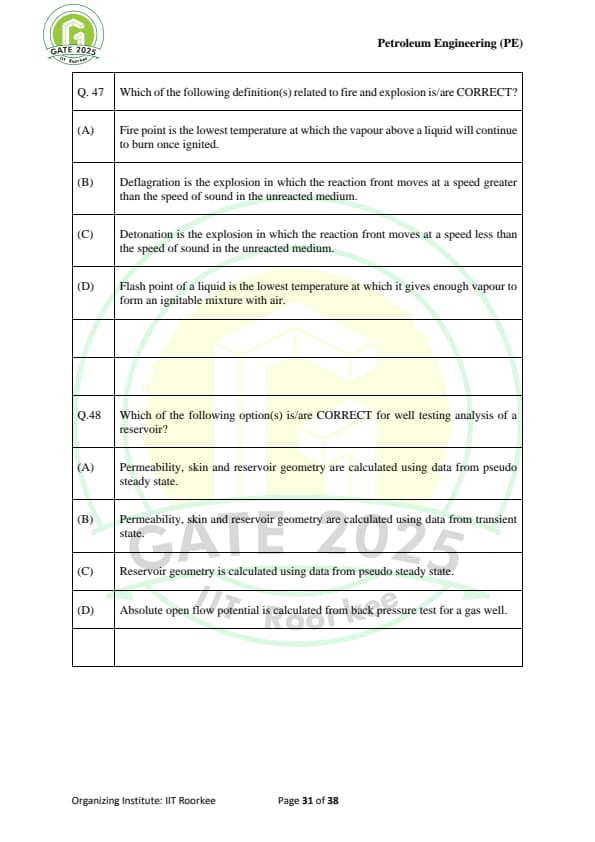
Which of the following definition(s) related to fire and explosion is/are CORRECT?
Which of the following option(s) is/are CORRECT for well testing analysis of a reservoir?
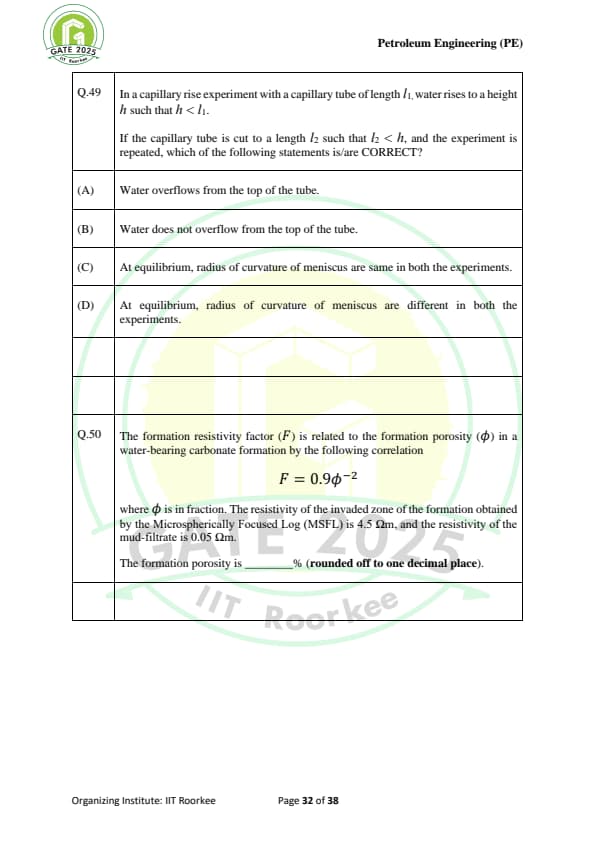
In a capillary rise experiment with a capillary tube of length \( l_1 \), water rises to a height \( h \) such that \( h < l_1 \).
If the capillary tube is cut to a length \( l_2 \) such that \( l_2 < h \), and the experiment is repeated, which of the following statements is/are CORRECT?
The formation resistivity factor (\( F \)) is related to the formation porosity (\( \phi \)) in a water-bearing carbonate formation by the following correlation:
\[ F = 0.9 \phi^{-2} \]
where \( \phi \) is in fraction. The resistivity of the invaded zone of the formation obtained by the Microspherically Focused Log (MSFL) is 4.5 \( \Omega \)m, and the resistivity of the mud-filtrate is 0.05 \( \Omega \)m. The formation porosity is .......... % (rounded off to one decimal place).
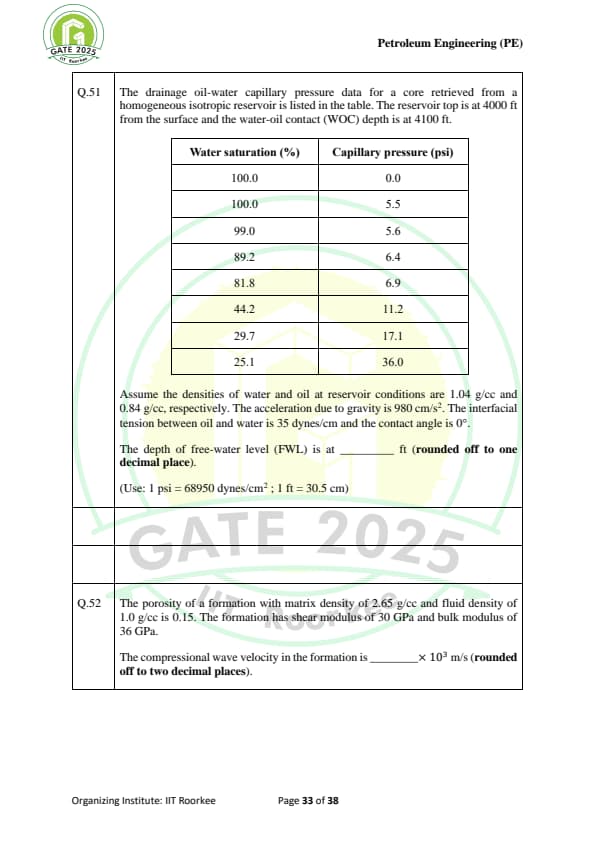
The drainage oil-water capillary pressure data for a core retrieved from a homogeneous isotropic reservoir is listed in the table. The reservoir top is at 4000 ft from the surface and the water-oil contact (WOC) depth is at 4100 ft.
100.0 ; 5.5
100.0 ; 5.6
89.2 ; 6.0
81.8 ; 6.9
44.2 ; 11.2
29.7 ; 17.1
25.1 ; 36.0
Assume the densities of water and oil at reservoir conditions are 1.04 g/cc and 0.84 g/cc, respectively. The acceleration due to gravity is 980 m/s². The interfacial tension between oil and water is 35 dynes/cm and the contact angle is 0°.
The depth of free-water level (FWL) is .......... ft (rounded off to one decimal place).
The porosity of a formation with matrix density of 2.65 g/cc and fluid density of 1.0 g/cc is 0.15. The formation has shear modulus of 30 GPa and bulk modulus of 36 GPa.
The compressional wave velocity in the formation is .......... \( \times 10^3 \) m/s (rounded off to two decimal places).
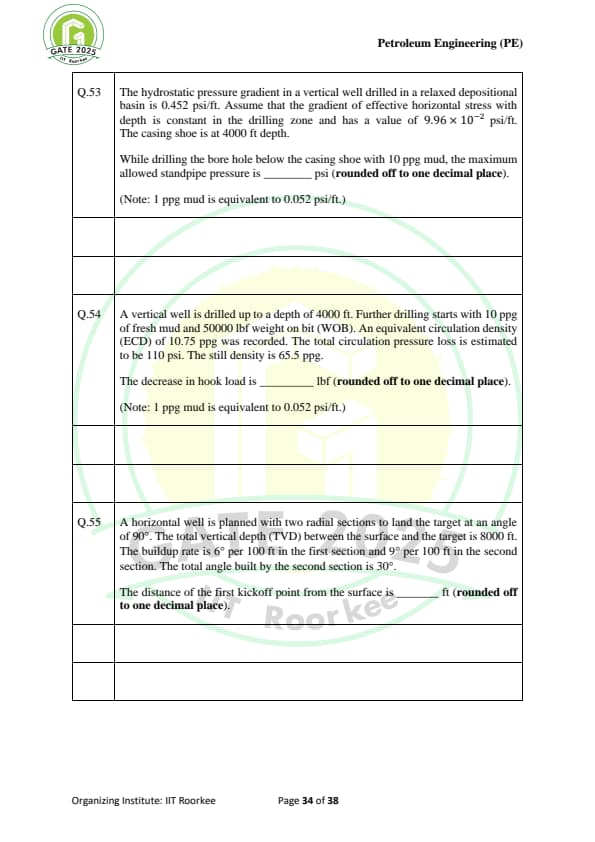
The hydrostatic pressure gradient in a vertical well drilled in a relaxed depositional basin is 0.452 psi/ft. Assume that the gradient of effective horizontal stress with depth is constant in the drilling zone and has a value of 9.96 × 10⁻² psi/ft. The casing shoe is at 4000 ft depth.
While drilling the bore hole below the casing shoe with 10 ppg mud, the maximum allowed standpipe pressure is .......... psi (rounded off to one decimal place).
A vertical well is drilled up to a depth of 4000 ft. Further drilling starts with 10 ppg of fresh mud and 50000 lbf weight on bit (WOB). An equivalent circulation density (ECD) of 10.75 ppg was recorded. The total circulation pressure loss is estimated to be 110 psi. The still density is 65.5 ppg.
The decrease in hook load is .......... lbf (rounded off to one decimal place).
A horizontal well is planned with two radial sections to land the target at an angle of 90°. The total vertical depth (TVD) between the surface and the target is 8000 ft. The buildup rate is 6° per 100 ft in the first section and 9° per 100 ft in the second section. The total angle built by the second section is 30°.
The distance of the first kickoff point from the surface is .......... ft (rounded off to one decimal place).
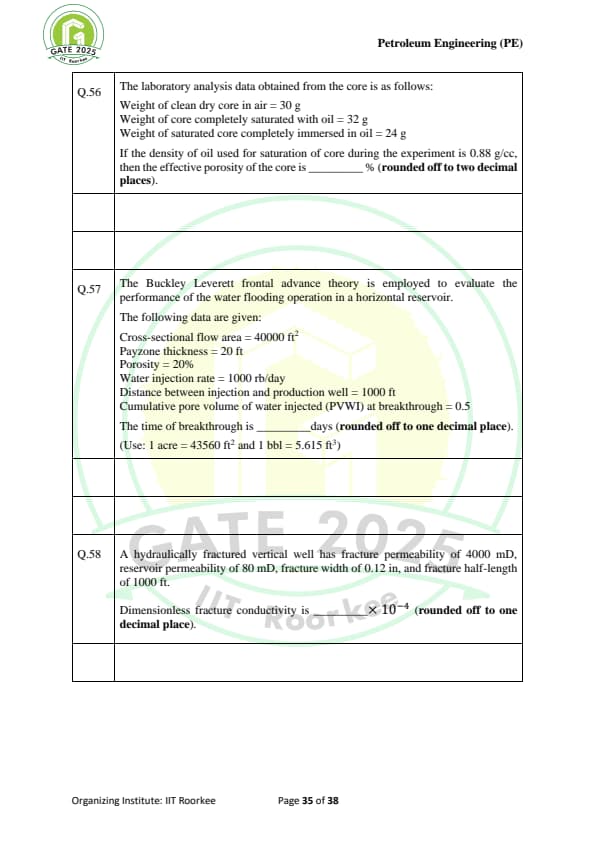
The laboratory analysis data obtained from the core is as follows:
Weight of clean dry core in air = 30 g
Weight of core completely saturated with oil = 32 g
Weight of saturated core completely immersed in oil = 24 g
If the density of oil used for saturation of core during the experiment is 0.88 g/cc, then the effective porosity of the core is .......... % (rounded off to two decimal places).
The Buckley Leverett frontal advance theory is employed to evaluate the performance of the water flooding operation in a horizontal reservoir.
The following data are given:
- Cross-sectional flow area = 40000 ft²
- Payzone thickness = 20 ft
- Porosity = 20%
- Water injection rate = 1000 rb/day
- Distance between injection and production well = 1000 ft
- Cumulative pore volume of water injected (PVWI) at breakthrough = 0.5
The time of breakthrough is .......... days (rounded off to one decimal place).
A hydraulically fractured vertical well has fracture permeability of 4000 mD, fracture width of 0.12 in, and fracture half-length of 1000 ft.
Dimensionless fracture conductivity is .......... \( \times 10^{-4} \) (rounded off to two decimal places).
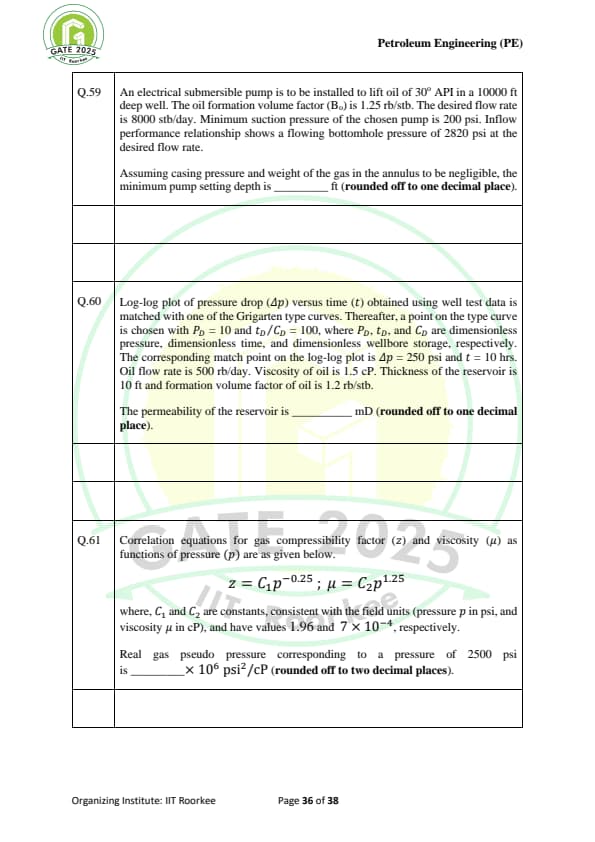
An electrical submersible pump is to be installed to lift oil of 30° API in a 10000 ft deep well. The oil formation volume factor (\( B_o \)) is 1.25 rb/stb. The desired flow rate is 8000 stb/day. Minimum suction pressure of the chosen pump is 200 psi. Inflow performance relationship shows a flowing bottomhole pressure of 2820 psi at the desired flow rate.
Assuming casing pressure and weight of the gas in the annulus to be negligible, the minimum pump setting depth is .......... ft (rounded off to one decimal place).
Log-log plot of pressure drop (\( \Delta p \)) versus time (\( t \)) obtained using well test data is matched with one of the Grigarten type curves. Thereafter, a point on the type curve is chosen with \( P_d = 10 \) and \( t_d/C_d = 100 \), where \( P_d, t_d, C_d \) are dimensionless pressure, dimensionless time, and dimensionless wellbore storage, respectively.
The corresponding match point on the log-log plot is \( \Delta p = 250 \) psi and \( t = 10 \) hrs. Oil flow rate is 500 rb/day. Viscosity of oil is 1.5 cP. Thickness of the reservoir is 10 ft and formation volume factor of oil is 1.2 rb/stb.
The permeability of the reservoir is .......... mD (rounded off to one decimal place).
Correlation equations for gas compressibility factor (\( z \)) and viscosity (\( \mu \)) as functions of pressure (\( p \)) are as given below.
\[ z = C_1 p^{-0.25}, \quad \mu = C_2 p^{1.25} \]
where \( C_1 \) and \( C_2 \) are constants, consistent with the field units (pressure in psi and viscosity \( \mu \) in cP), and have values 1.96 and \( 7 \times 10^{-4} \), respectively.
Real gas pseudo pressure corresponding to a pressure of 2500 psi is .......... \( \times 10^6 \) psi²/cP (rounded off to two decimal places).
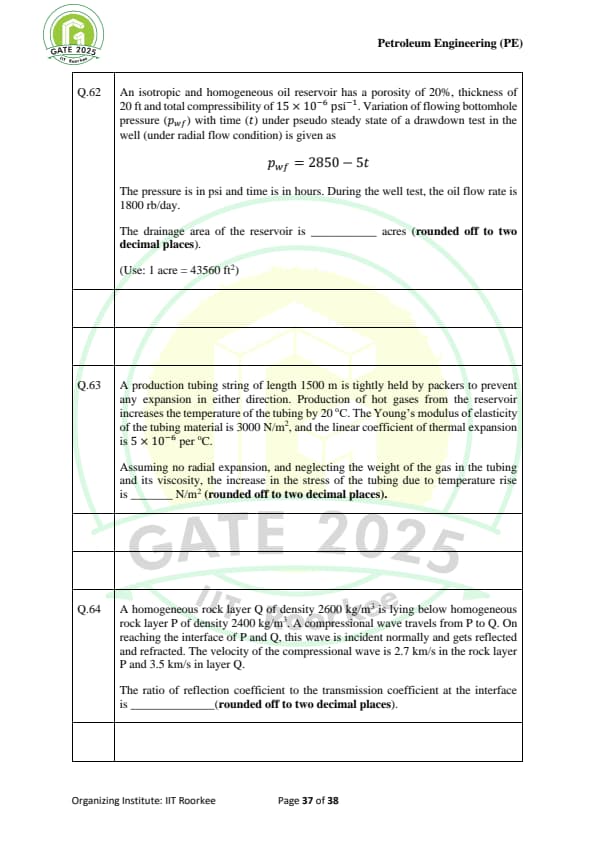
An isotropic and homogeneous oil reservoir has a porosity of 20%, thickness of 20 ft, and total compressibility of \( 15 \times 10^{-6} \) psi\(^{-1}\). Variation of flowing bottomhole pressure (\( p_{wf} \)) with time (\( t \)) under pseudo steady state of a drawdown test in the well (under radial flow condition) is given as
\[ p_{wf} = 2850 - 5t \]
The pressure is in psi and time is in hours. During the well test, the oil flow rate is 1800 rb/day.
The drainage area of the reservoir is .......... acres (rounded off to two decimal places).
A production tubing string of length 1500 m is tightly held by packers to prevent any expansion in either direction. Production of hot gases from the reservoir increases the temperature of the tubing by 20°C. The Young’s modulus of elasticity of the tubing material is 3000 N/m², and the linear coefficient of thermal expansion is \( 5 \times 10^{-6} \) per °C.
Assuming no radial expansion, and neglecting the weight of the gas in the tubing and its viscosity, the increase in the stress of the tubing due to temperature rise is .......... N/m² (rounded off to two decimal places).
A homogeneous rock layer \( Q \) of density 2600 kg/m³ is lying below homogeneous rock layer P of density 2400 kg/m³. A compressional wave travels from P to Q. On reaching the interface of P and Q, this wave is incident normally and gets reflected and refracted. The velocity of the compressional wave is 2.7 km/s in the rock layer P and 3.5 km/s in layer Q.
The ratio of reflection coefficient to the transmission coefficient at the interface is .......... (rounded off to two decimal places).
A Newtonian fluid is transported through a smooth horizontal pipe of diameter 1 m at a flow rate of 3.14 m³/s. The length of the pipe is 1 km. The viscosity of the oil is 0.02 Pa.s and its density is 800 kg/m³. Consider the Darcy friction factor (\( f \)) for turbulent flow in a smooth pipe is given as
\[ f = \frac{0.316}{Re^{0.25}} \]
where \( Re \) is the Reynolds number.
Assuming fully-developed flow in the pipe, the pressure drop due to the frictional effect is .......... kPa (rounded off to two decimal places).













Comments