




The GATE 2025 TF Question Paper PDF is available as the exam is over. IIT Roorkee is conducting the GATE 2025 Textile Engineering & Fibre Science exam. The 1st Feb shift 2, took place from 2:30 PM to 5:30 PM. As per the updated exam pattern, the exam consists of 65 questions carrying a total of 100 marks, with 10 from the General Aptitude section and 55 questions from Engineering Mathematics and Core Textile topics.
The difficulty level of GATE 2025 TF was moderate.
GATE 2025 TF Question Paper with Solutions PDF
| GATE 2025 TF Question Paper with Answer Key | Download | Check Solutions |

GATE 2025 TF Question Paper with Solutions
Despite his initial hesitation, Rehman’s ________ to contribute to the success of the project never wavered.
Bird : Nest :: Bee : _______
Select the correct option to complete the analogy.
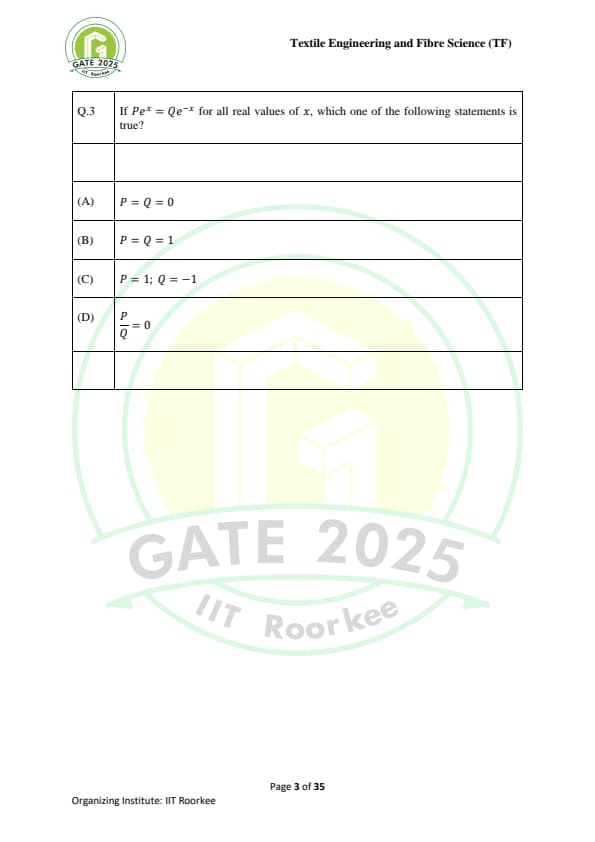
If \( P e^x = Q e^{-x} \) for all real values of \( x \), which one of the following statements is true?
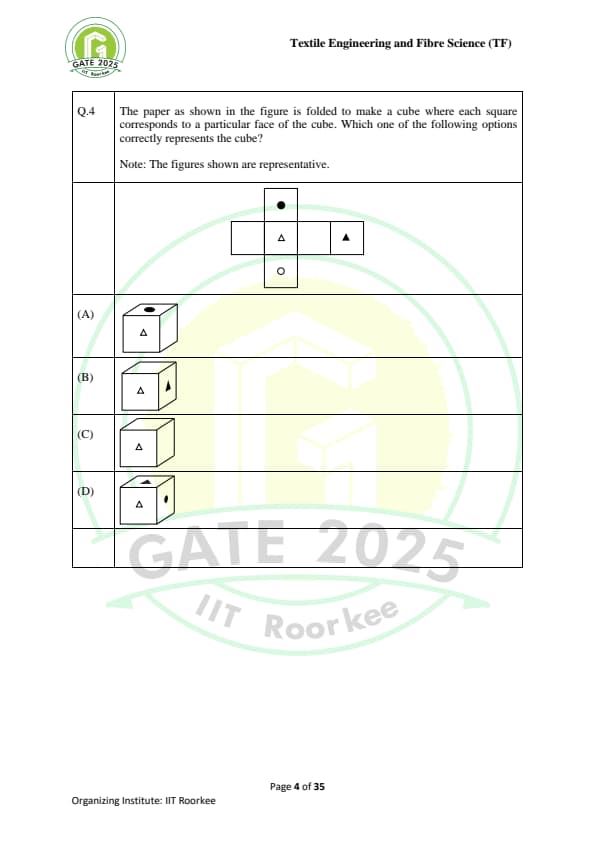
The paper as shown in the figure is folded to make a cube where each square corresponds to a particular face of the cube. Which one of the following options correctly represents the cube?
Note: The figures shown are representative.

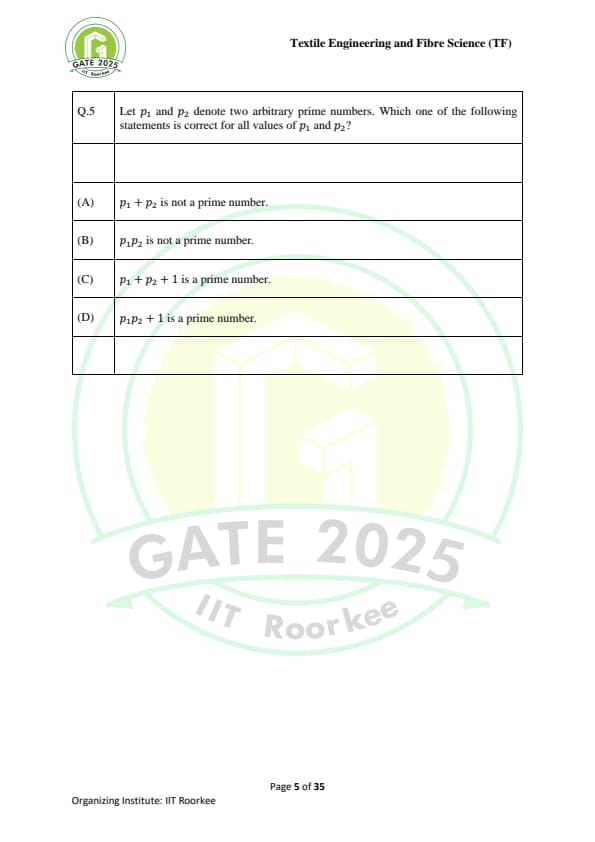
Let \( p_1 \) and \( p_2 \) denote two arbitrary prime numbers. Which one of the following statements is correct for all values of \( p_1 \) and \( p_2 \)?
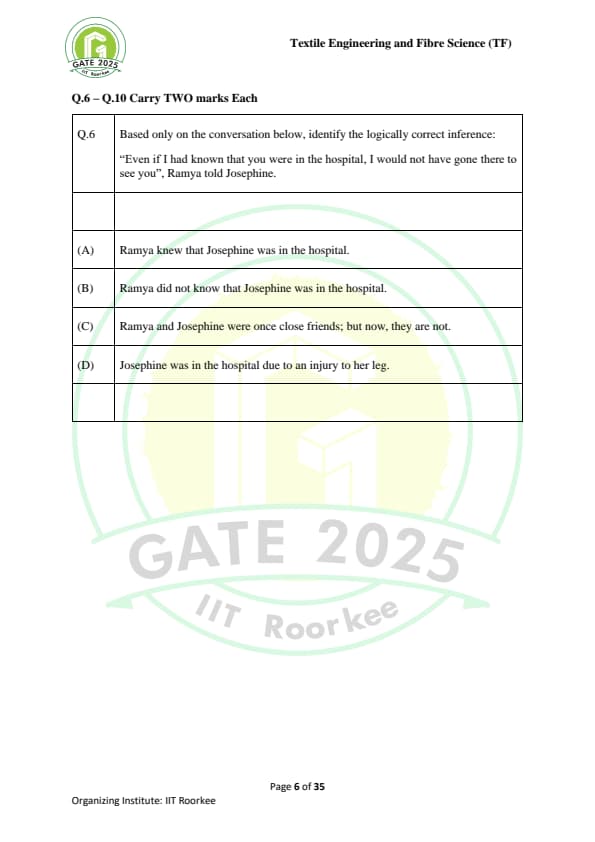
Based only on the conversation below, identify the logically correct inference:
“Even if I had known that you were in the hospital, I would not have gone there to see you”, Ramya told Josephine.
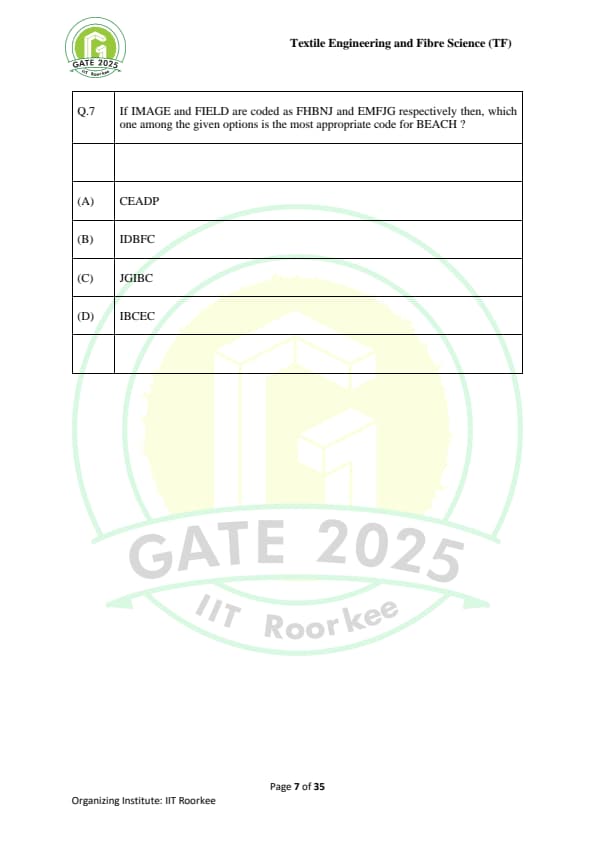
If IMAGE and FIELD are coded as FHBNJ and EMFJG respectively, then which one among the given options is the most appropriate code for BEACH?
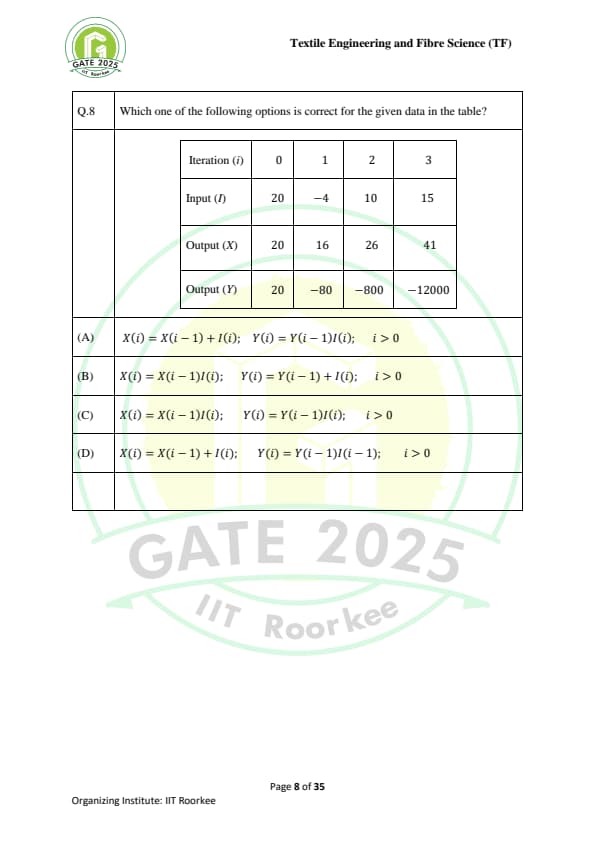
Which one of the following options is correct for the given data in the table?

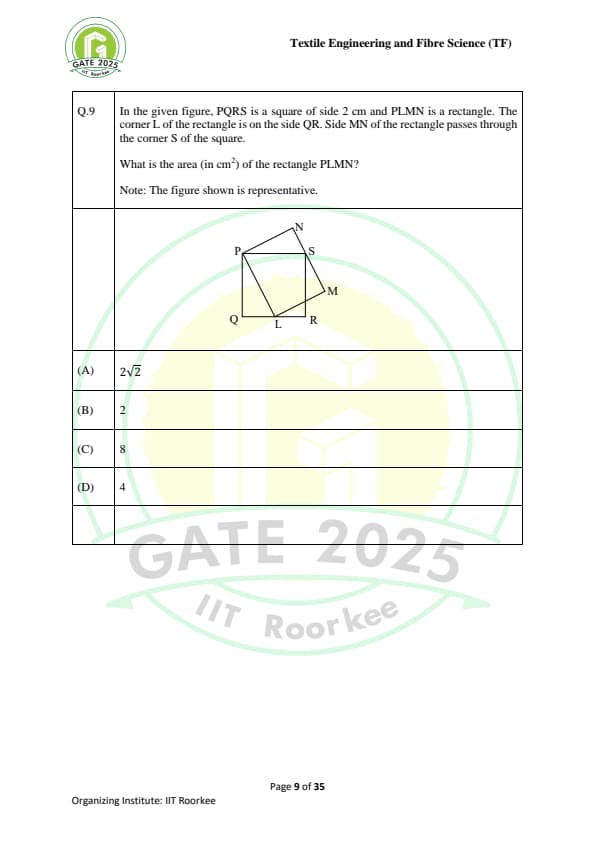
In the given figure, PQRS is a square of side 2 cm and PLMN is a rectangle. The corner L of the rectangle is on the side QR. Side MN of the rectangle passes through the corner S of the square. What is the area (in cm\(^2\)) of the rectangle PLMN?
Note: The figure shown is representative.

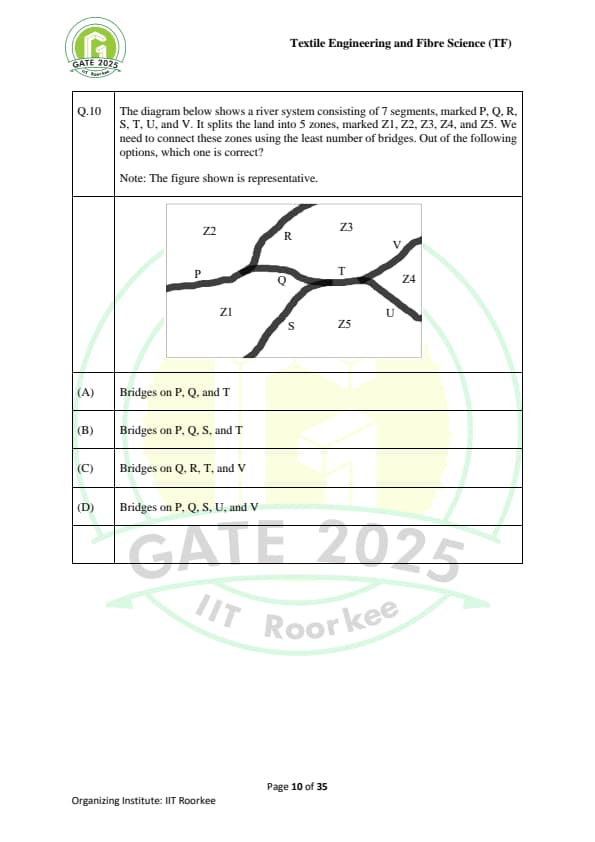
The diagram below shows a river system consisting of 7 segments, marked P, Q, R, S, T, U, and V. It splits the land into 5 zones, marked Z1, Z2, Z3, Z4, and Z5. We need to connect these zones using the least number of bridges. Out of the following options, which one is correct?
Note: The figure shown is representative.

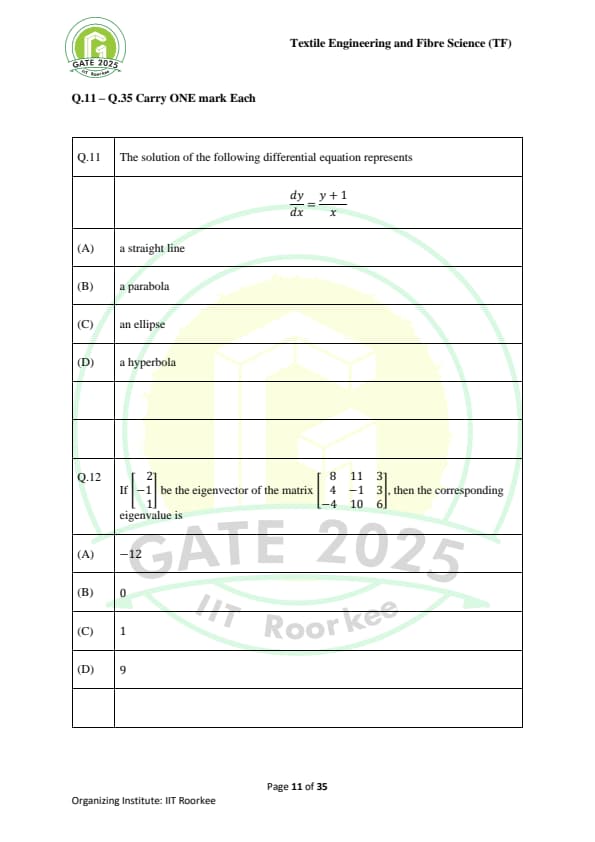
The solution of the following differential equation represents \[ \frac{dy}{dx} = \frac{y + 1}{x} \]
If \( \begin{bmatrix} 2
-1
1 \end{bmatrix} \) is the eigenvector of the matrix \( A = \begin{bmatrix} 8 & 11 & 3
4 & -1 & 3
-4 & 10 & 6 \end{bmatrix}, \)
then the corresponding eigenvalue is:
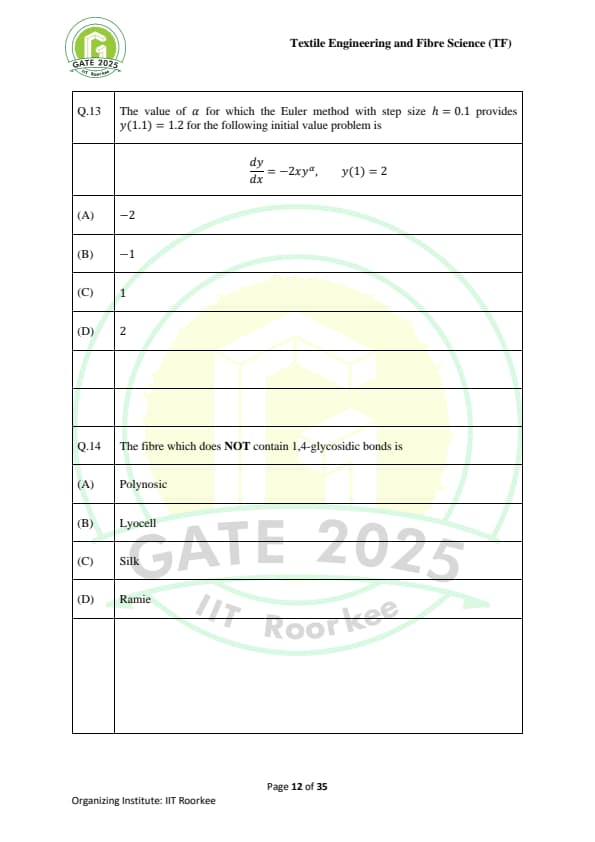
The value of \( \alpha \) for which the Euler method with step size \( h = 0.1 \) provides \( y(1.1) = 1.2 \) for the following initial value problem is \[ \frac{dy}{dx} = -2xy^\alpha, \quad y(1) = 2 \]
The fibre which does NOT contain 1,4-glycosidic bonds is
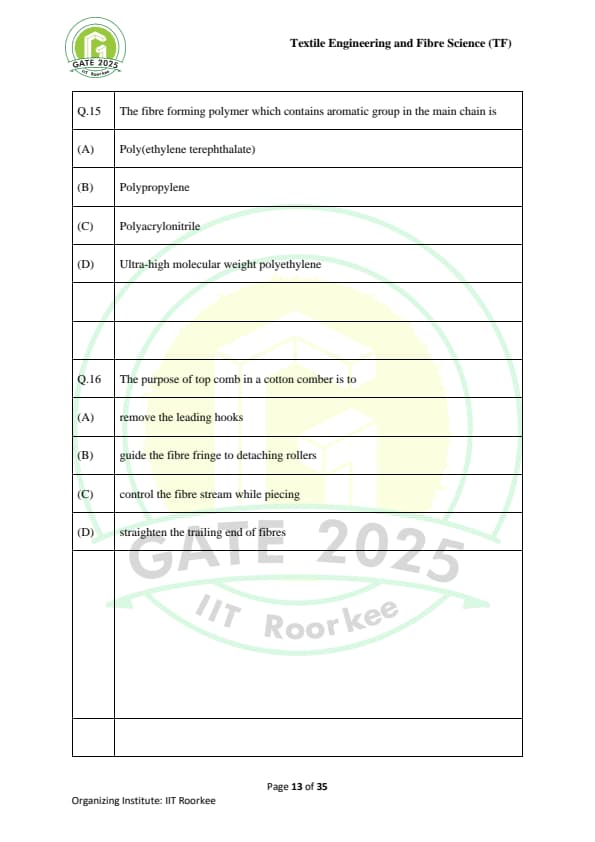
The fibre forming polymer which contains aromatic group in the main chain is:
The purpose of top comb in a cotton comber is:
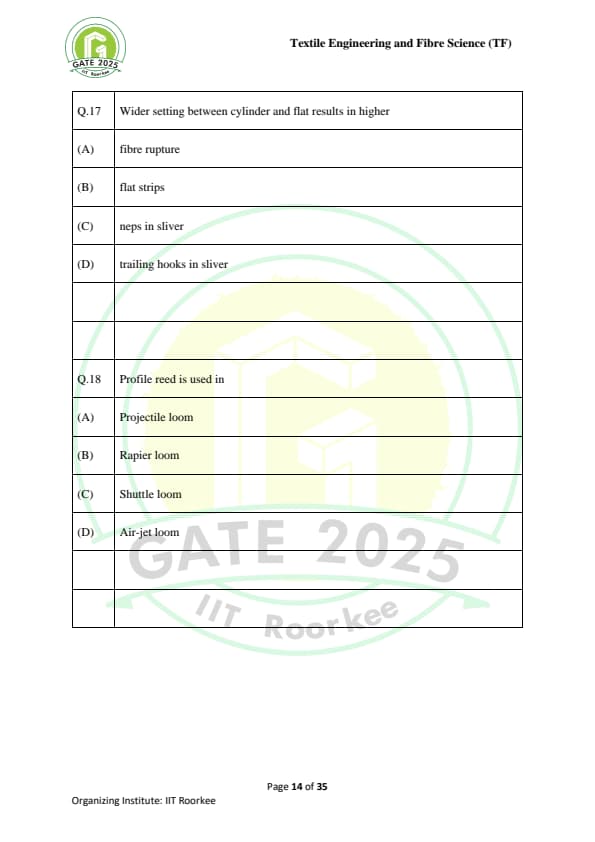
Wider setting between cylinder and flat results in higher:
Profile reed is used in:
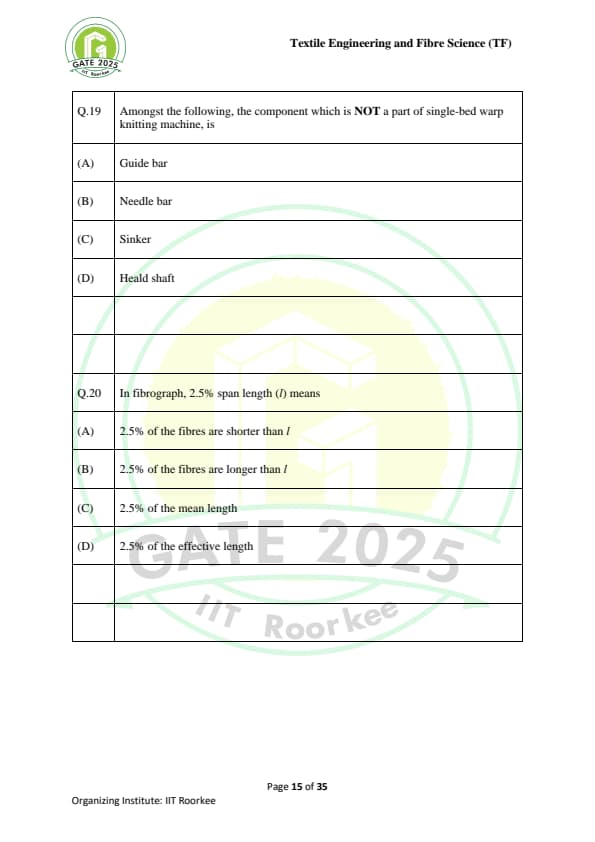
Amongst the following, the component which is NOT a part of single-bed warp knitting machine, is:
In fibrograph, 2.5% span length (l) means:
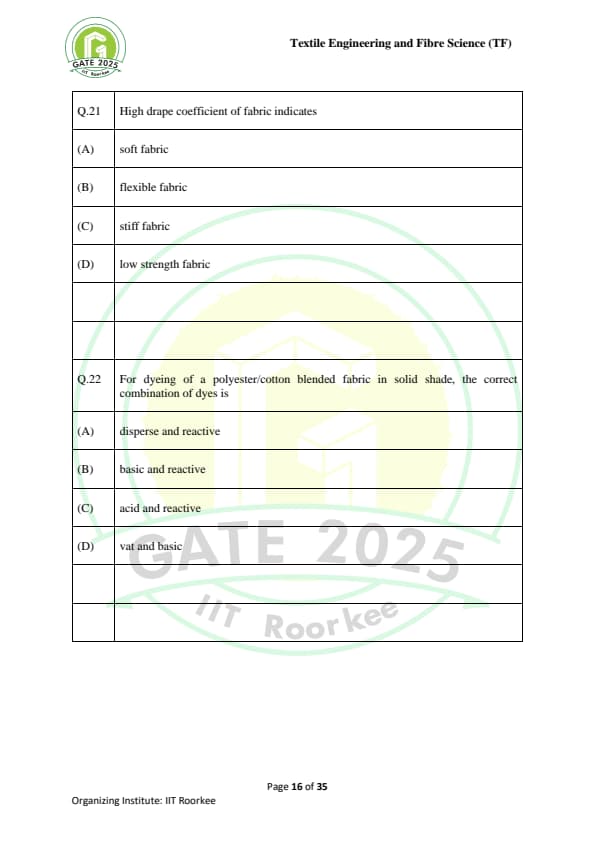
High drape coefficient of fabric indicates:
For dyeing of a polyester/cotton blended fabric in solid shade, the correct combination of dyes is:
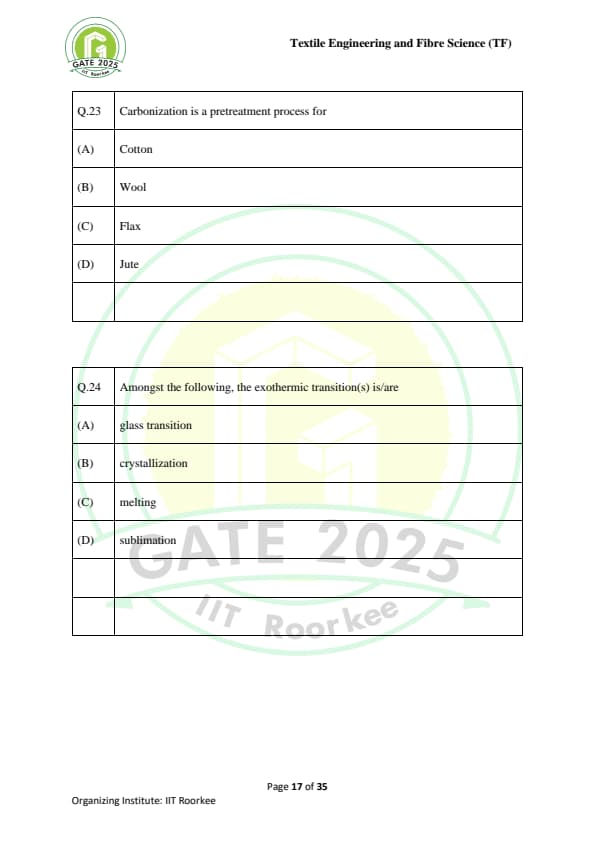
Carbonization is a pretreatment process for:
Amongst the following, the exothermic transition(s) is/are:
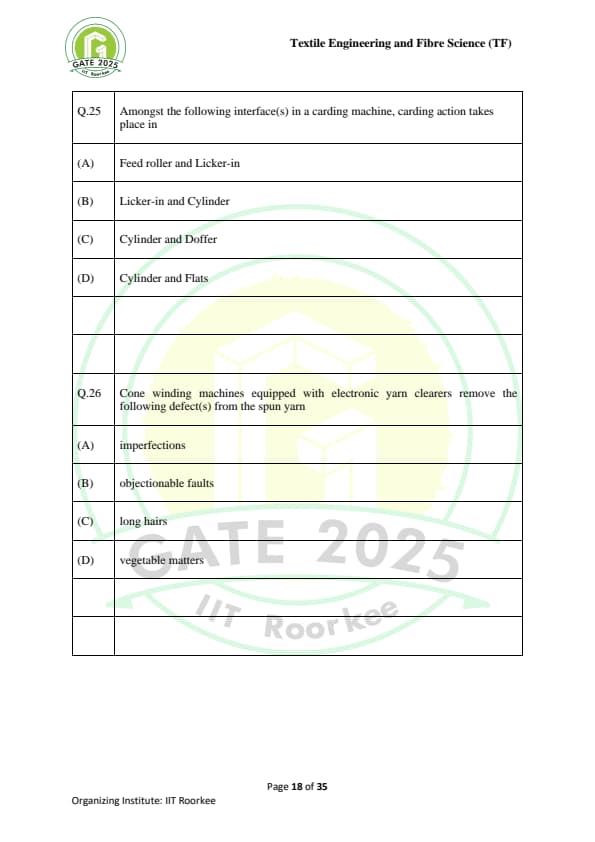
Amongst the following interface(s) in a carding machine, carding action takes place in:
Cone winding machines equipped with electronic yarn clearers remove the following defect(s) from the spun yarn:
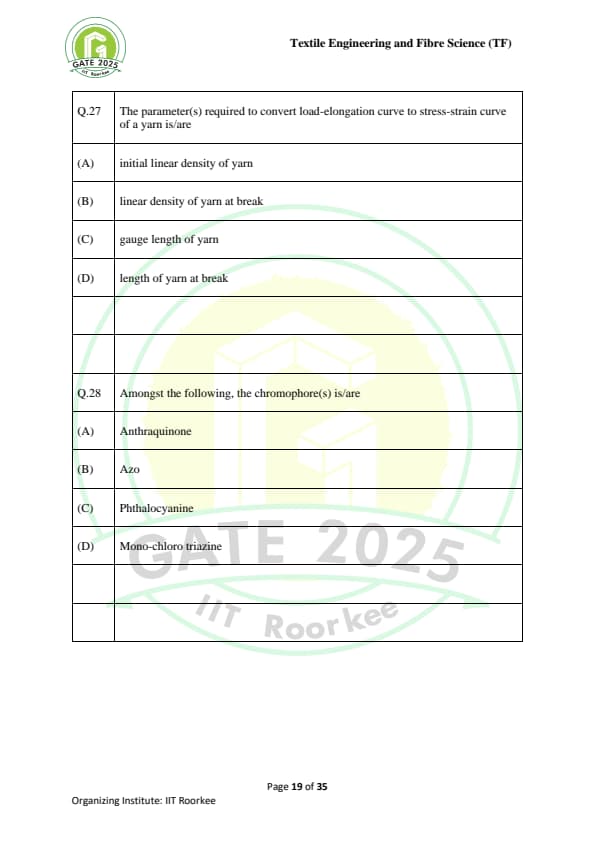
The parameter(s) required to convert load-elongation curve to stress-strain curve of a yarn is/are:
Amongst the following, the chromophore(s) is/are:
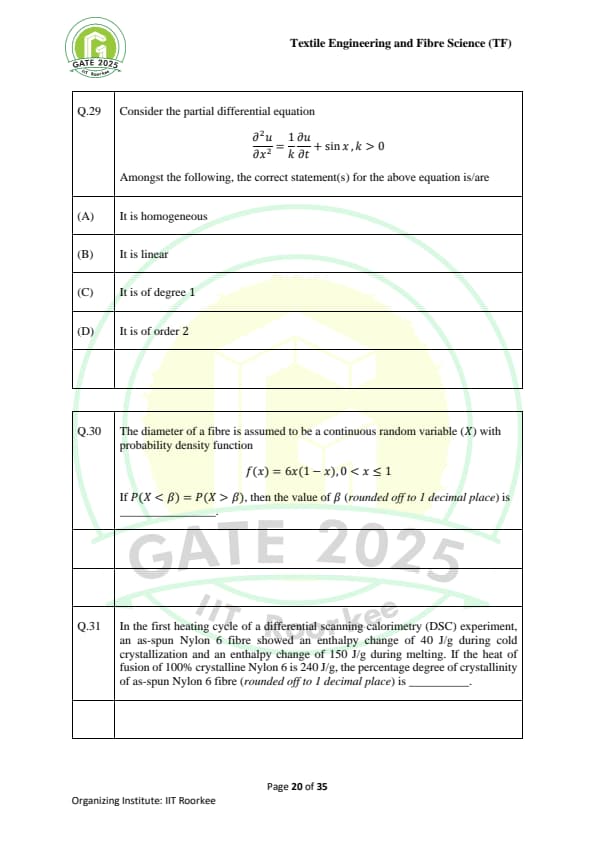
Consider the partial differential equation: \[ \frac{\partial^2 u}{\partial x^2} = \frac{1}{k} \frac{\partial u}{\partial t} + \sin x, \quad k > 0 \]
Amongst the following, the correct statement(s) for the above equation is/are:
The diameter of a fibre is assumed to be a continuous random variable \( X \) with probability density function \[ f(x) = 6x(1 - x), \quad 0 < x \leq 1 \]
If \( P(X < \beta) = P(X > \beta) \), then the value of \( \beta \) (rounded off to 1 decimal place) is ________.
In the first heating cycle of a differential scanning calorimetry (DSC) experiment, an as-spun Nylon 6 fibre showed an enthalpy change of 40 J/g during cold crystallization and an enthalpy change of 150 J/g during melting. If the heat of fusion of 100% crystalline Nylon 6 is 240 J/g, the percentage degree of crystallinity of as-spun Nylon 6 fibre (rounded off to 1 decimal place) is _______\.
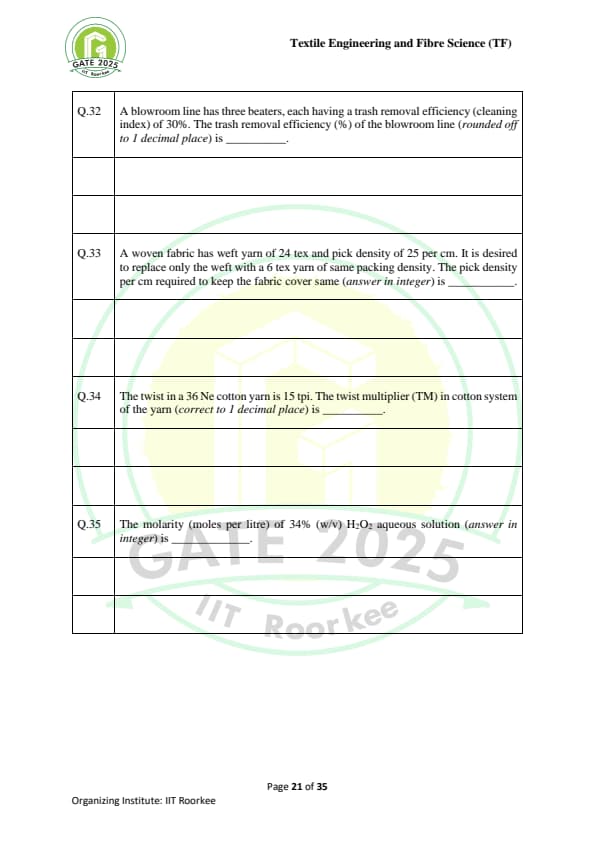
A blowroom line has three beaters, each having a trash removal efficiency (cleaning index) of 30%. The trash removal efficiency (%) of the blowroom line (rounded off to 1 decimal place) is ______\.
A woven fabric has weft yarn of 24 tex and pick density of 25 per cm. It is desired to replace only the weft with a 6 tex yarn of the same packing density. The pick density per cm required to keep the fabric cover the same (answer in integer) is __________.
The twist in a 36 Ne cotton yarn is 15 tpi. The twist multiplier (TM) in cotton system of the yarn (correct to 1 decimal place) is ________.
The molarity (moles per litre) of 34% (w/v) H\(_2\)O\(_2\) aqueous solution (answer in integer) is ________.
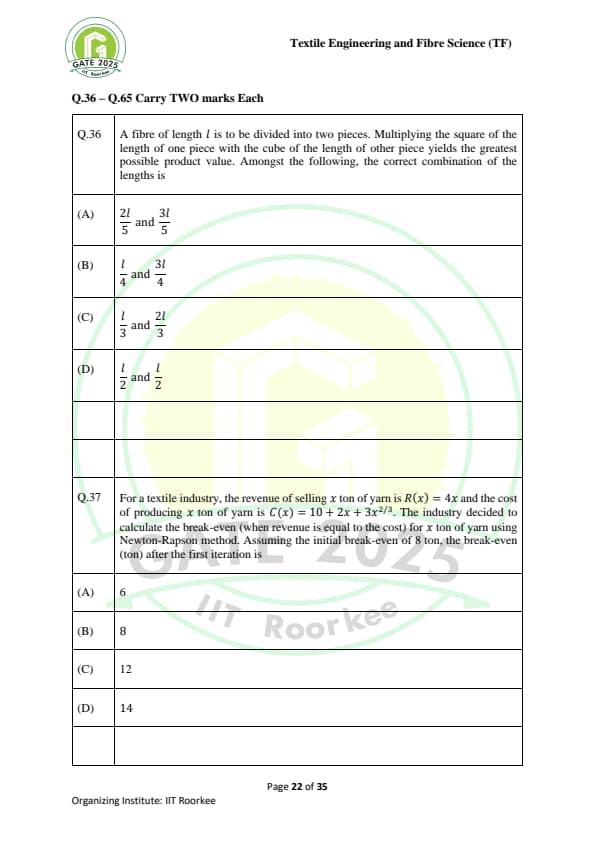
A fibre of length \( l \) is to be divided into two pieces. Multiplying the square of the length of one piece with the cube of the length of the other piece yields the greatest possible product value. Amongst the following, the correct combination of the lengths is:
For a textile industry, the revenue of selling \( x \) ton of yarn is \( R(x) = 4x \) and the cost of producing \( x \) ton of yarn is \( C(x) = 10 + 2x + 3x^{2/3} \). The industry decided to calculate the break-even (when revenue is equal to the cost) for \( x \) ton of yarn using the Newton-Raphson method. Assuming the initial break-even of 8 tons, the break-even (ton) after the first iteration is:
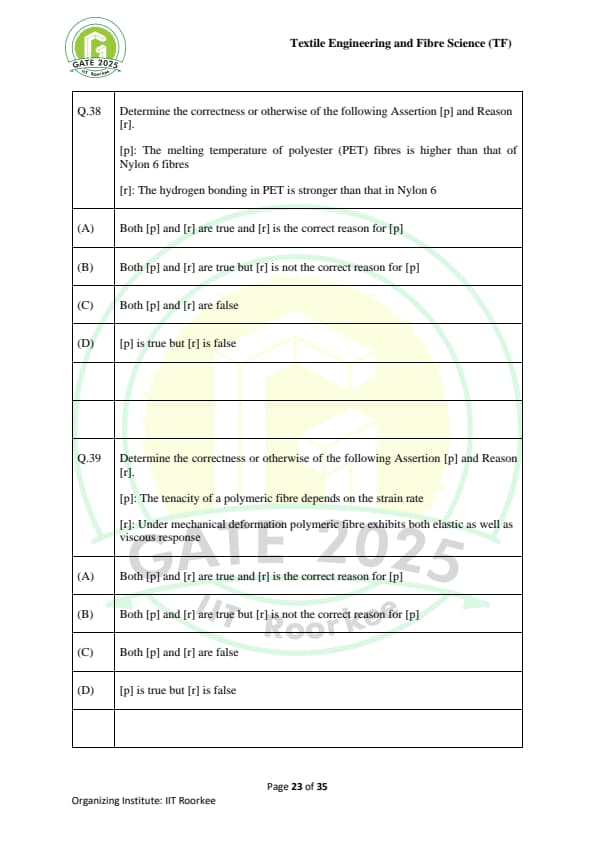
Determine the correctness or otherwise of the following Assertion [p] and Reason [r].
[p]: The melting temperature of polyester (PET) fibres is higher than that of Nylon 6 fibres
[r]: The hydrogen bonding in PET is stronger than that in Nylon 6
Determine the correctness or otherwise of the following Assertion [p] and Reason [r].
[p]: The tenacity of a polymeric fibre depends on the strain rate
[r]: Under mechanical deformation polymeric fibre exhibits both elastic as well as viscous response
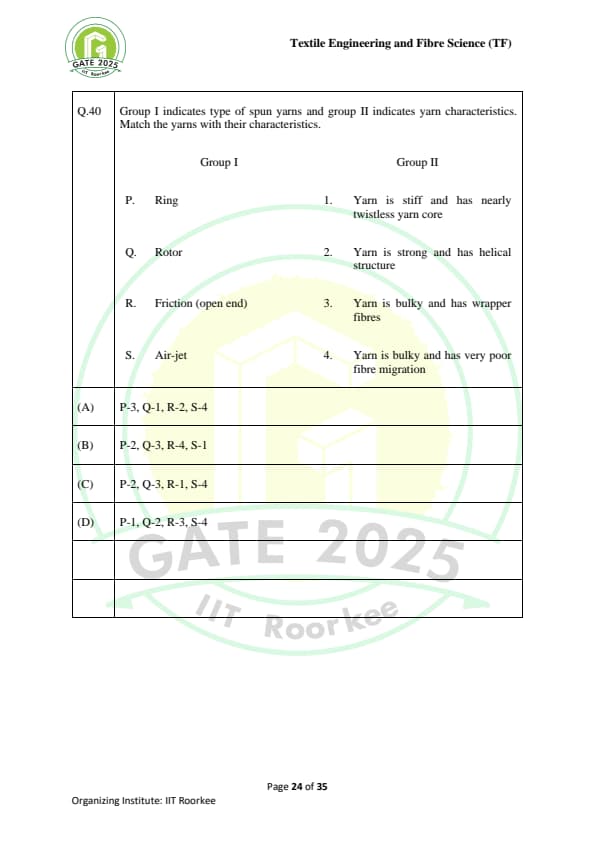
Group I indicates type of spun yarns and group II indicates yarn characteristics. Match the yarns with their characteristics.

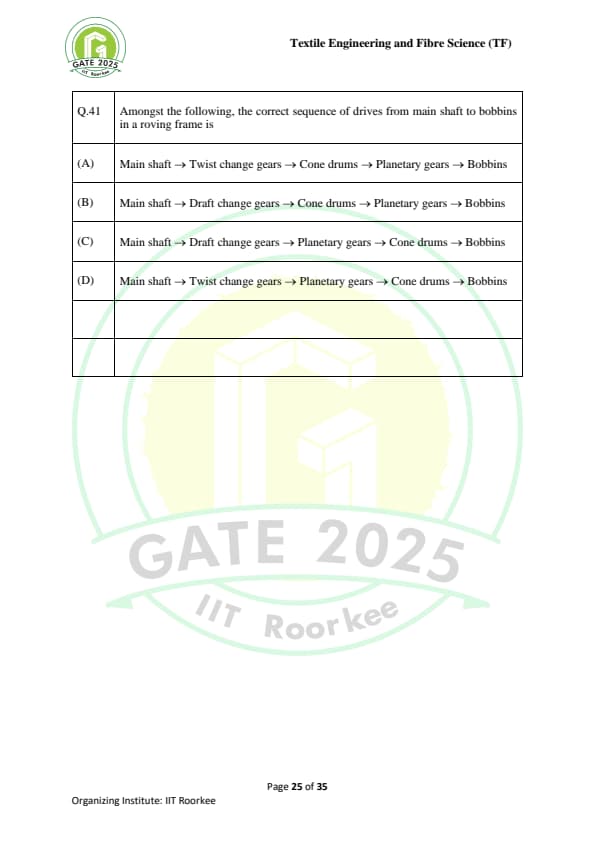
Amongst the following, the correct sequence of drives from main shaft to bobbins in a roving frame is
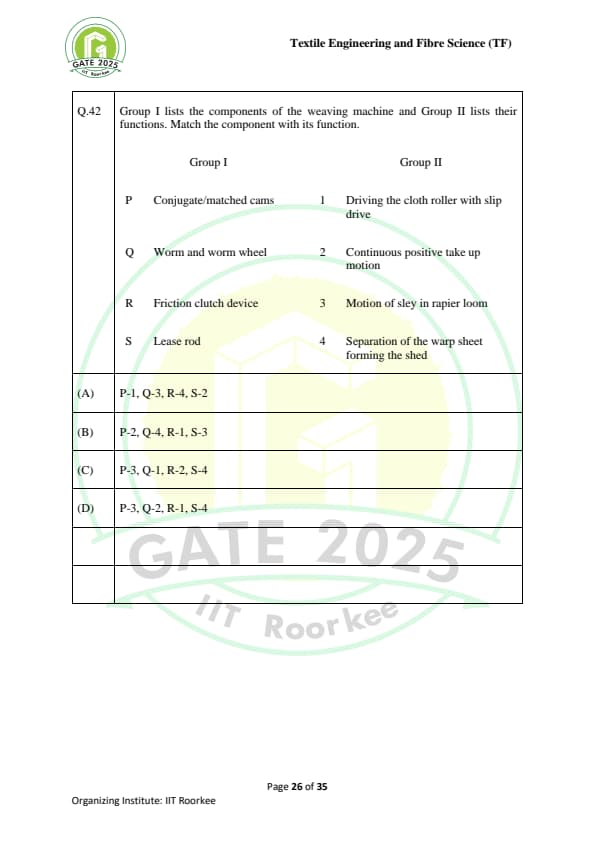
Group I lists the components of the weaving machine and Group II lists their functions. Match the component with its function.

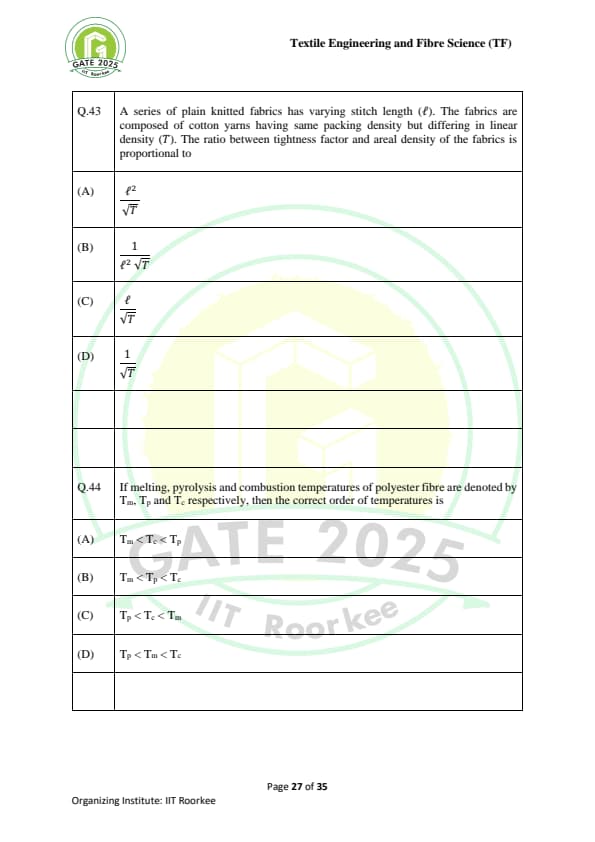
A series of plain knitted fabrics has varying stitch length (\( \ell \)). The fabrics are composed of cotton yarns having same packing density but differing in linear density (\( T \)). The ratio between tightness factor and areal density of the fabrics is proportional to
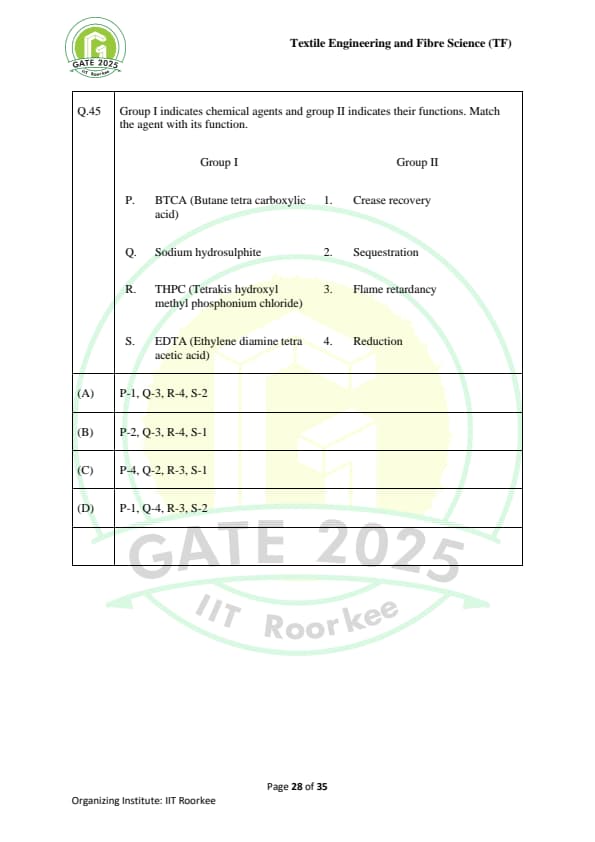
Group I indicates chemical agents and Group II indicates their functions. Match the agent with its function.

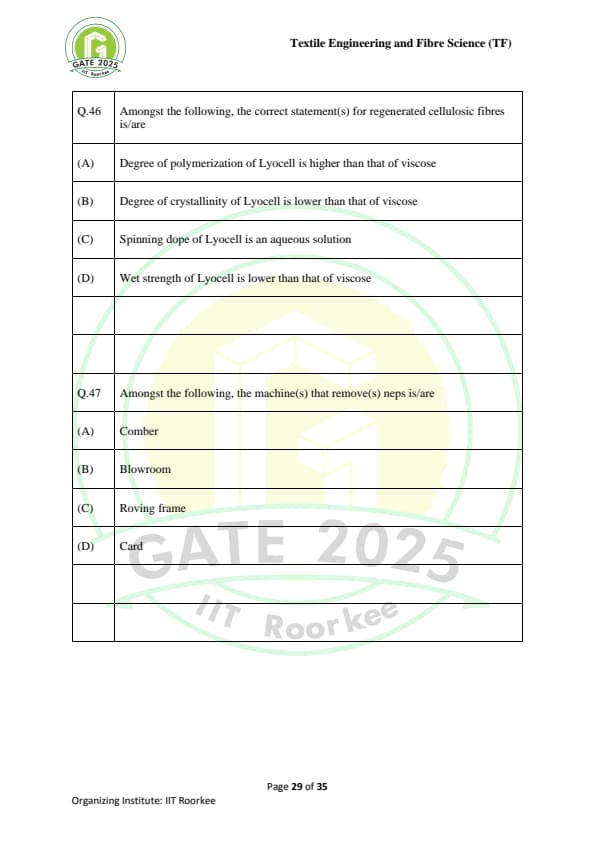
Amongst the following, the correct statement(s) for regenerated cellulosic fibres is/are:
Amongst the following, the machine(s) that remove(s) neps is/are:
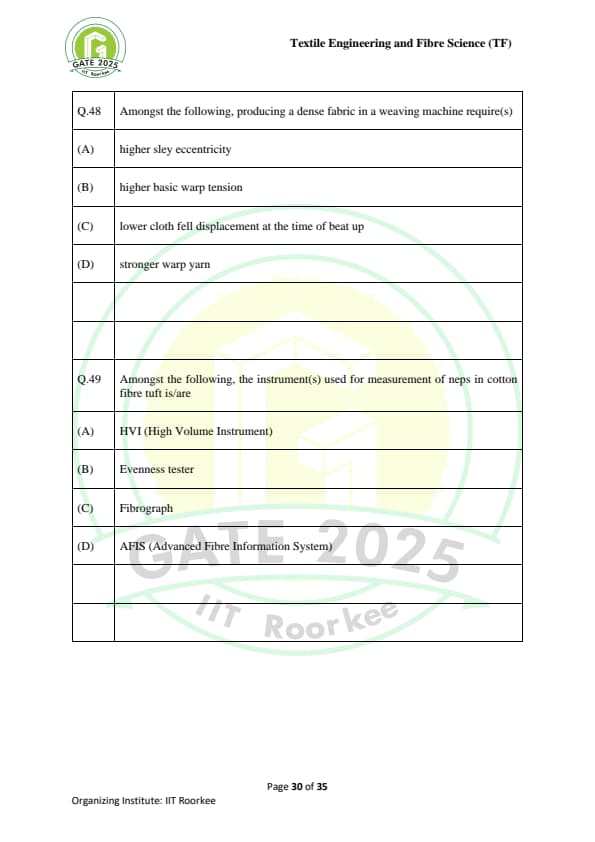
Amongst the following, producing a dense fabric in a weaving machine require(s):
Amongst the following, the instrument(s) used for measurement of neps in cotton fibre tuft is/are:
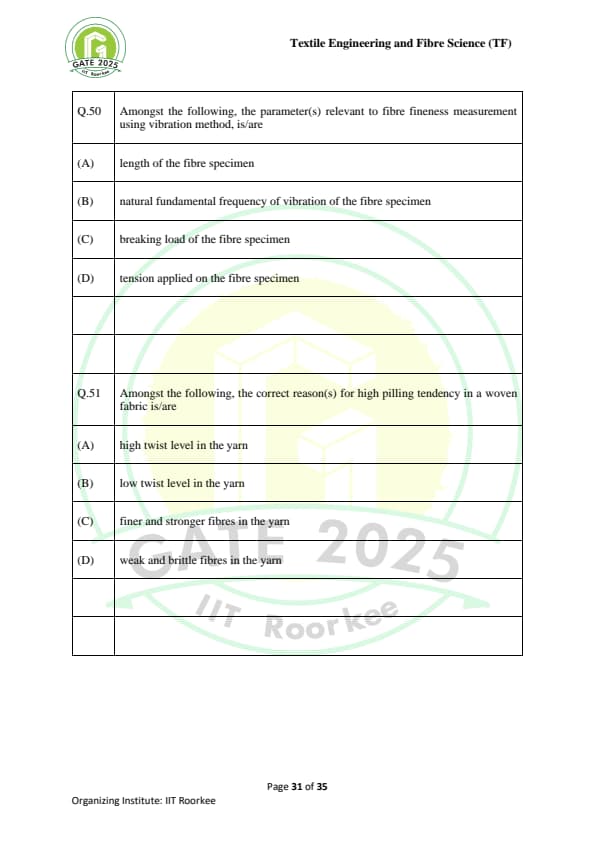
Amongst the following, the parameter(s) relevant to fibre fineness measurement using vibration method, is/are:
Amongst the following, the correct reason(s) for high pilling tendency in a woven fabric is/are:
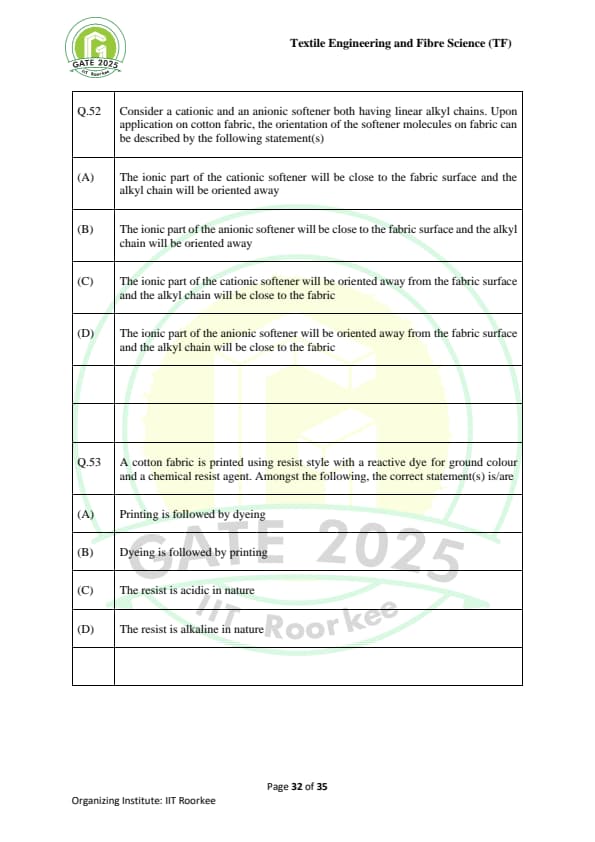
Consider a cationic and an anionic softener both having linear alkyl chains. Upon application on cotton fabric, the orientation of the softener molecules on fabric can be described by the following statement(s):
A cotton fabric is printed using resist style with a reactive dye for ground colour and a chemical resist agent. Amongst the following, the correct statement(s) is/are:
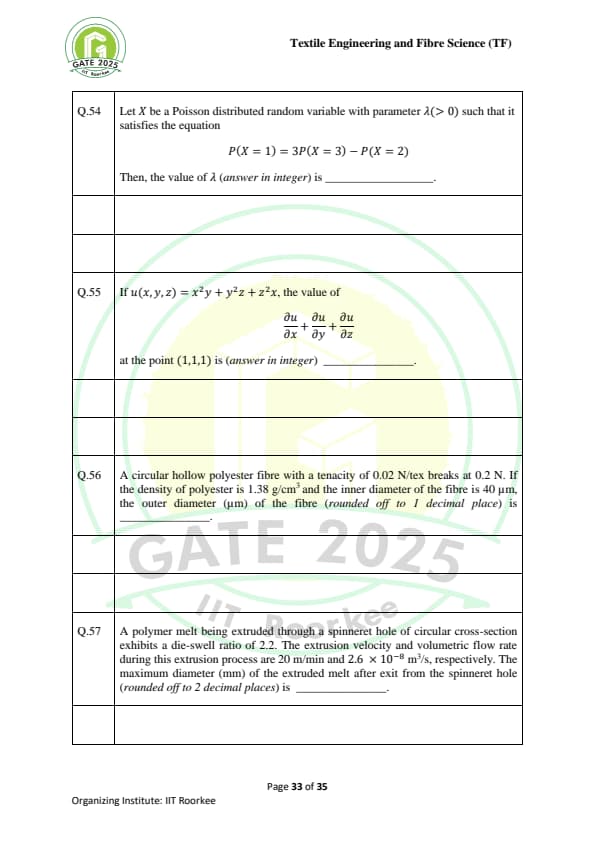
Let \( X \) be a Poisson distributed random variable with parameter \( \lambda (> 0) \) such that it satisfies the equation \[ P(X = 1) = 3P(X = 3) - P(X = 2) . Then, the value of \lambda is: \]
If \( u(x, y, z) = x^2y + y^2z + z^2x \), the value of \[ \frac{\partial u}{\partial x} + \frac{\partial u}{\partial y} + \frac{\partial u}{\partial z} at the point (1,1,1) is: \]
A circular hollow polyester fibre with a tenacity of 0.02 N/tex breaks at 0.2 N. If the density of polyester is 1.38 g/cm\(^3\) and the inner diameter of the fibre is 40 µm, the outer diameter (µm) of the fibre (rounded off to 1 decimal place) is:
A polymer melt being extruded through a spinneret hole of circular cross-section exhibits a die-swell ratio of 2.2. The extrusion velocity and volumetric flow rate during this extrusion process are 20 m/min and \(2.6 \times 10^{-8}\) m\(^3\)/s, respectively. The maximum diameter (mm) of the extruded melt after exit from the spinneret hole (rounded off to 2 decimal places) is:
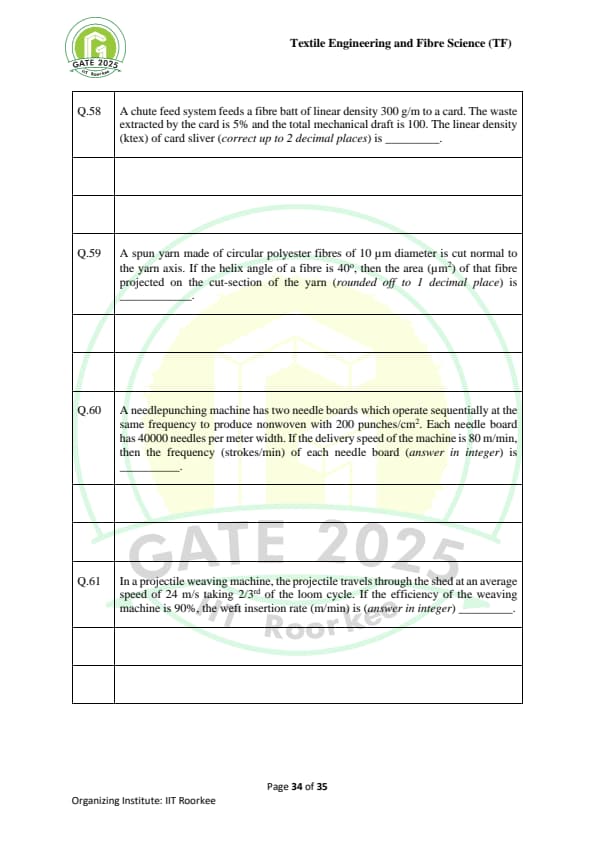
A chute feed system feeds a fibre batt of linear density 300 g/m to a card. The waste extracted by the card is 5% and the total mechanical draft is 100. The linear density (ktex) of card sliver (correct up to 2 decimal places) is:
A spun yarn made of circular polyester fibres of 10 µm diameter is cut normal to the yarn axis. If the helix angle of a fibre is \( 40^\circ \), then the area (µm\(^2\)) of that fibre projected on the cut-section of the yarn (rounded off to 1 decimal place) is:
A needlepunching machine has two needle boards which operate sequentially at the same frequency to produce nonwoven with 200 punches/cm\(^2\). Each needle board has 40000 needles per meter width. If the delivery speed of the machine is 80 m/min, then the frequency (strokes/min) of each needle board is:
In a projectile weaving machine, the projectile travels through the shed at an average speed of 24 m/s taking \( \frac{2}{3} \) of the loom cycle. If the efficiency of the weaving machine is 90%, the weft insertion rate (m/min) is:
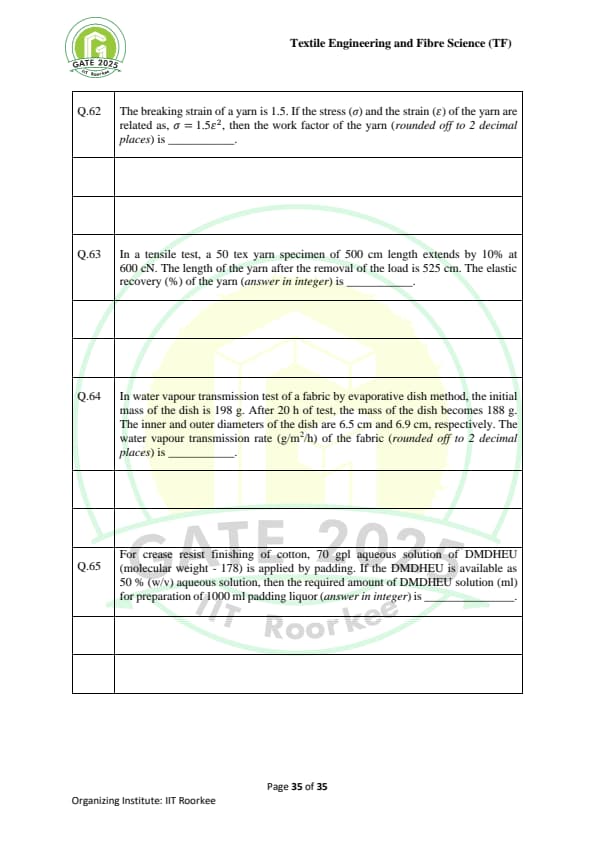
The breaking strain of a yarn is 1.5. If the stress (\( \sigma \)) and the strain (\( \epsilon \)) of the yarn are related as, \( \sigma = 1.5 \epsilon^2 \), then the work factor of the yarn (rounded off to 2 decimal places) is:
In a tensile test, a 50 tex yarn specimen of 500 cm length extends by 10% at 600 cN. The length of the yarn after the removal of the load is 525 cm. The elastic recovery (%) of the yarn is:
In a water vapour transmission test of a fabric by evaporative dish method, the initial mass of the dish is 198 g. After 20 h of test, the mass of the dish becomes 188 g. The inner and outer diameters of the dish are 6.5 cm and 6.9 cm, respectively. The water vapour transmission rate (g/m\(^2\)/h) of the fabric is:
For crease resist finishing of cotton, 70 gpl aqueous solution of DMDHEU (molecular weight - 178) is applied by padding. If the DMDHEU is available as 50% (w/v) aqueous solution, then the required amount of DMDHEU solution (ml) for preparation of 1000 ml padding liquor is:





Comments