




The question paper and solution PDF of the Ecology and Evolution paper is available here. The exam for EY paper was conducted on 8th February (2:30 PM to 5:30 PM).
The EY exam happens for 100 marks, where 15 marks come from the general aptitude section, 13 marks from Engineering mathematics. The remaining 72 marks come from core subjects.
Based on the previous year’s analysis, the EY question paper is likely lean towards moderate to tough. To rank under 1000 in Instrumentation, you need to score 55-60+ marks out of 100.
GATE 2026 Ecology and Evolution Question Paper with Solution PDF
| GATE 2026 Ecology and Evolution Question Paper with Solution PDF | Download | Check Solutions |

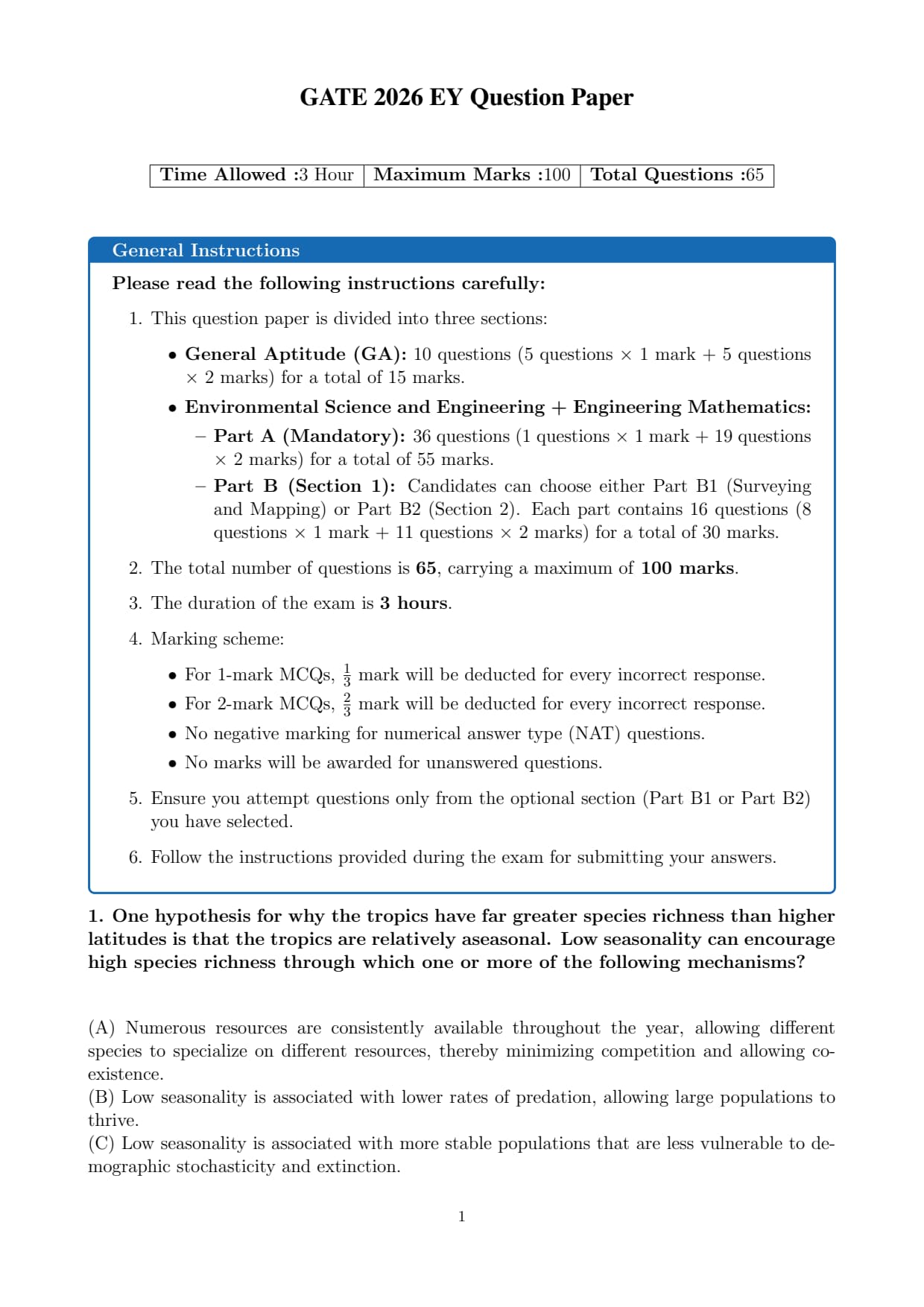
GATE 2026 Question Paper
One hypothesis for why the tropics have far greater species richness than higher latitudes is that the tropics are relatively aseasonal. Low seasonality can encourage high species richness through which one or more of the following mechanisms?
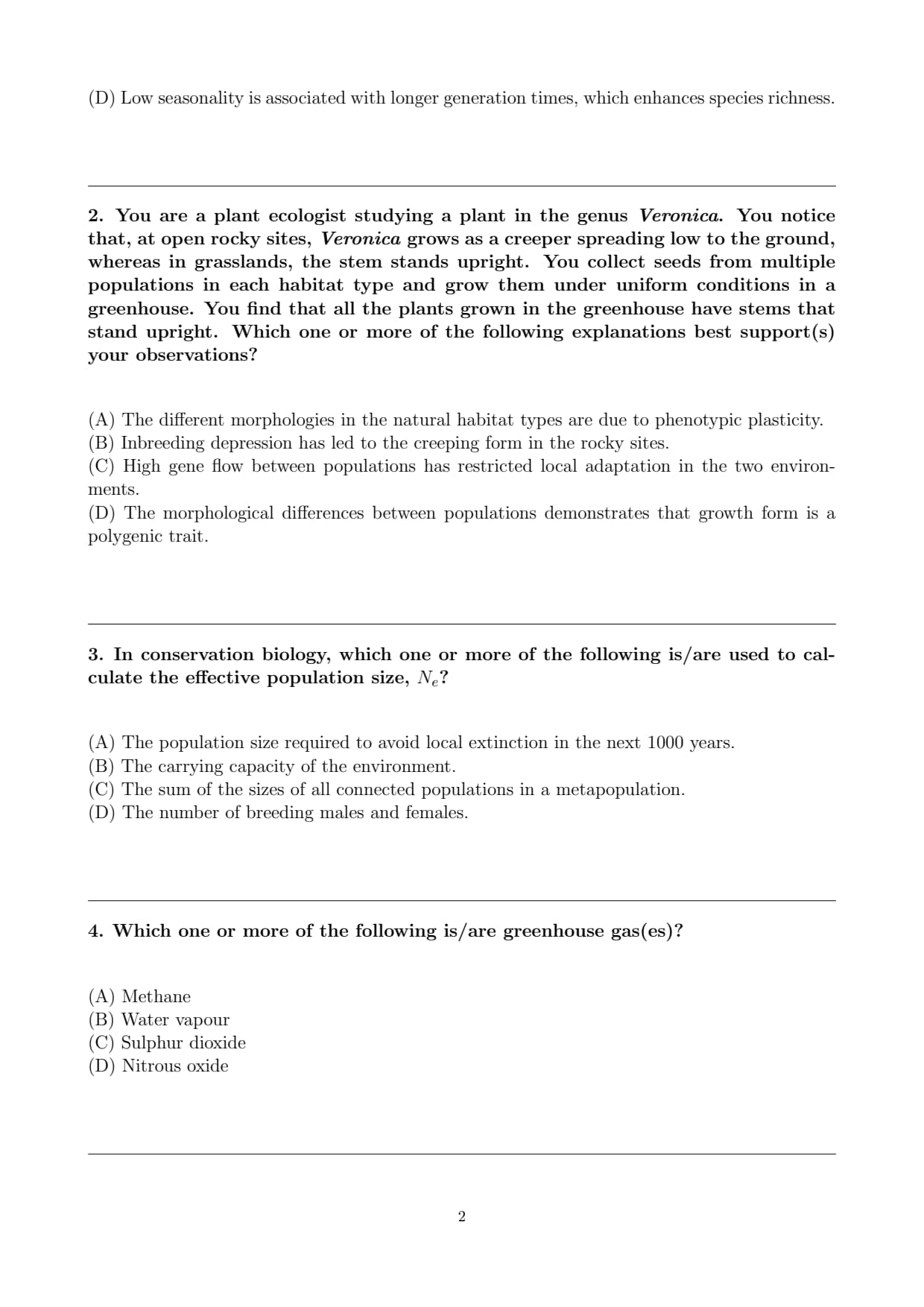
You are a plant ecologist studying a plant in the genus \emph{Veronica}. You notice that, at open rocky sites, \emph{Veronica} grows as a creeper spreading low to the ground, whereas in grasslands, the stem stands upright. You collect seeds from multiple populations in each habitat type and grow them under uniform conditions in a greenhouse. You find that all the plants grown in the greenhouse have stems that stand upright. Which one or more of the following explanations best support(s) your observations?
In conservation biology, which one or more of the following is/are used to calculate the effective population size, \(N_e\)?
Which one or more of the following is/are greenhouse gas(es)?
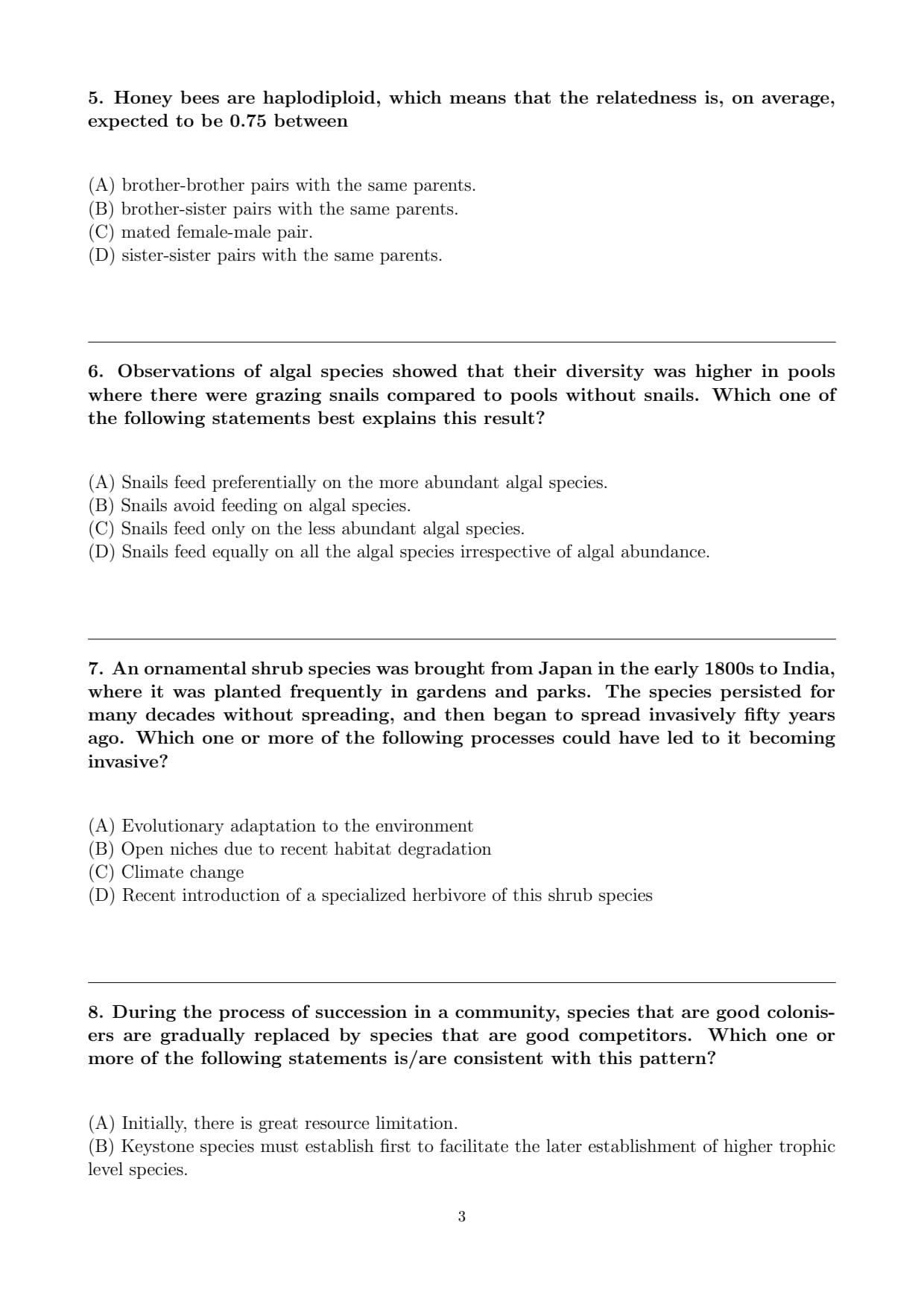
Honey bees are haplodiploid, which means that the relatedness is, on average, expected to be 0.75 between
Observations of algal species showed that their diversity was higher in pools where there were grazing snails compared to pools without snails. Which one of the following statements best explains this result?
An ornamental shrub species was brought from Japan in the early 1800s to India, where it was planted frequently in gardens and parks. The species persisted for many decades without spreading, and then began to spread invasively fifty years ago. Which one or more of the following processes could have led to it becoming invasive?
During the process of succession in a community, species that are good colonisers are gradually replaced by species that are good competitors. Which one or more of the following statements is/are consistent with this pattern?






Comments