




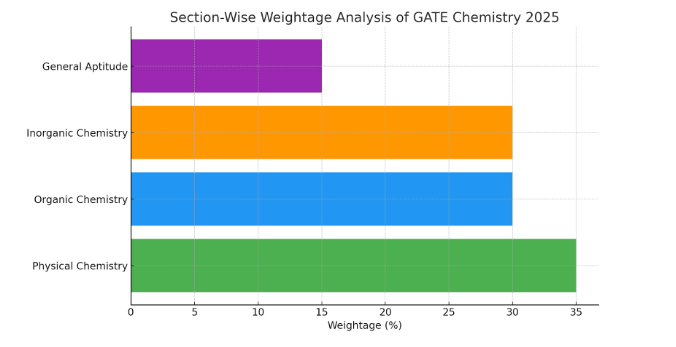
A preparation strategy is needed for achieving GATE Chemistry 2025. Trends of previous years would reveal that physical chemistry is the biggest chunk with around 35-40% weightage. Topics like thermodynamics, chemical kinetics, and quantum chemistry, of course, always have an edge because they are repetitive and high-scoring topics.
- The second comes in the form of Organic Chemistry, which weighs about 25-30%, and usually contains elaborate questions on Reaction Mechanisms, Biomolecules, and Stereochemistry.
- These can prove to be marks rich as Organic Chemistry questions typically stress the understanding of mechanisms and concepts.
- Though it carries a small weightage of 15-20%, inorganic chemistry is important for maintaining the balance of preparation with important topics like coordination chemistry and chemical bonding regularly appearing in the question paper.
Align your study plan, targeting high-weightage sections, with mastering the types of questions to ensure a focused and time-efficient preparation strategy that can maximize the scoring potential in GATE Chemistry 2025.
GATE CY 2025 Syllabus
| Syllabus | |
|---|---|
| Chemistry Syllabus | Download PDF |
| General Aptitude Syllabus | Download PDF |
Also Check: GATE 2025 Syllabus for Chemistry: Download CY Syllabus with Weightage
Understanding the GATE Chemistry Exam Pattern
Before diving into the section-wise strategy, it’s essential to understand the exam pattern:
| Particulars | Details |
|---|---|
| Total Marks | 100 |
| Total Questions | 65 |
| Sections | General Aptitude (15 Marks), Chemistry Subject (85 Marks) |
| Duration | 3 hours |
| Types of Questions | MCQs, MSQs, NATs |
Also Check: GATE Chemistry Exam Pattern 2025, Check Section Wise Topics, Important Topics Weightage, Best Books
Weightage Analysis of GATE Chemistry 2025 Subject
| Subject | Weightage (%) |
|---|---|
| Physical Chemistry | 35-40% |
| Organic Chemistry | 25-30% |
| Inorganic Chemistry | 15-20% |
| Analytical Chemistry | 10-15% |
| General Chemistry | 5-10% |
Preparation Strategies: GATE CY 2025
Suggested Article: GATE Preparation: Time Table, 6 months Study Tips, Free Resources, Books, Previous Year Question Papers
Section-Wise Preparation Strategies
Understanding the weightage of various subjects in the GATE Chemistry exam is important to strategize the study material properly. Based on previous years, one can expect the weightage as follows:
| Subject | Weightage (%) | Key Topics |
|---|---|---|
| Physical Chemistry | 35-40% | Thermodynamics, Chemical Kinetics, Quantum Chemistry, Electrochemistry |
| Organic Chemistry | 25-30% | Reaction Mechanisms, Stereochemistry, Biomolecules, Functional Groups |
| Inorganic Chemistry | 15-20% | Coordination Compounds, Chemical Bonding, Main Group Elements, Transition Metals |
| Analytical Chemistry | 10-15% | Chromatography, Spectroscopy, Titrations |
| General Chemistry | 5-10% | Basic Concepts, Periodic Table, Stoichiometry |
Section-wise Strategy for GATE Chemistry 2025
Physical Chemistry (35-40%)
- Preparation Strategy: Understand fundamental principles and derivations. Practice solving numerical problems regularly especially in Thermodynamics and Kinetics. Practice previous year's questions to get used to the type of common problems.
- Recommended Resources: Standard textbooks like Physical Chemistry by Atkins. Online video lectures for complex topics.
Organic Chemistry (25-30%)
- Preparation Strategy: Prepare a summary sheet for various reaction mechanisms and their conditions. Mechanism-based problems will increase conceptual clarity. Use flashcards for functional groups and their reactivity.
- Recommended Resources: Organic Chemistry by Morrison and Boyd. Quizzes on organic reactions on the website.
Inorganic Chemistry (15-20%)
- Preparation Strategy: Learn periodic trends and the properties of elements. Understand coordination chemistry, commonly occurring complexes, etc. Revision charts and tables, regularly.
- Recommended Resources: Concise Inorganic Chemistry by J.D. Lee. Revision guides to key topics.
Analytical Chemistry (10-15%)
- Preparation Strategy: Learn analytical techniques along with their applications. Questions based on calculations, especially titrations and chromatography. Study general methods of spectroscopy and what these methods mean.
- Recommended Reading: Quantitative Chemical Analysis by Harris.
General Chemistry (5-10%)
- Preparation Strategy: Basic concepts and definitions in this chapter lay the base for more complex material above. Do your homework problem exercises so that you fully understand these problems.
- Recommended Reading: Books on elementary chemistry or the Internet covering elementary chemistry
To achieve the best possible outcome in GATE Chemistry 2025, align your preparation strategy with the weightage of each subject. In that, give importance to high-weightage areas such as Physical and Organic Chemistry and not forget the balance to be maintained for Inorganic and Analytical Chemistry. Regular practice, concept clarity, and effective resource utilization will pave the way for achieving a high score in the exam.
Target High-Weightage Topics
Focus on high-weightage topics first to maximize score potential. The table below highlights some essential topics by section and approximate weightage:
| Section | Important Topics | Weightage (%) |
|---|---|---|
| Physical Chemistry | Thermodynamics, Electrochemistry, Chemical Kinetics | 15% |
| Quantum Chemistry, Spectroscopy | 10% | |
| Organic Chemistry | Reaction Mechanisms, Named Reactions | 20% |
| Spectroscopy, Pericyclic Reactions | 10% | |
| Inorganic Chemistry | Coordination Compounds, Organometallics | 15% |
| Bioinorganic Chemistry | 10% |
Plan a Study Schedule
Below is a 6-month study plan focusing on intensive coverage of all sections:
| Month | Focus Topics | Hours/Week | Practice Tests |
|---|---|---|---|
| 1-2 | Physical Chemistry: Thermodynamics, Quantum Mechanics | 15 | 1 per month |
| 3-4 | Organic Chemistry: Mechanisms, Named Reactions | 20 | 2 per month |
| 5 | Inorganic Chemistry: Coordination, Organometallics | 20 | 2 per month |
| 6 | Revision, Mock Tests, Weak Area Focus | 25 | 3 per month |
This plan ensures that you can cover each section thoroughly while dedicating sufficient time to practice and revision.
Analyze Previous Years' Trends
Suggested Article: GATE Question Paper for CY (Available)
Based on previous GATE Chemistry papers, let’s look at topic frequency and score distribution.
| Topic | Frequency (Last 5 Years) | Avg. Marks in Exams |
|---|---|---|
| Thermodynamics | High (Appears Every Year) | 6-8 Marks |
| Organic Reaction Mechanisms | High | 5-7 Marks |
| Coordination Chemistry | Moderate | 3-5 Marks |
| Spectroscopy | Moderate to High | 4-6 Marks |
| Chemical Kinetics | Moderate | 3-5 Marks |
GATE 2024 Question Paper with Solutions PDF
| GATE Chemistry Question Paper | Download PDF | Download PDF |
|---|
Recommended Study Materials
| Resource Type | Book/Material | Topic Focus |
|---|---|---|
| Physical Chemistry | P.W. Atkins, "Physical Chemistry" | Thermodynamics, Quantum Chemistry |
| Organic Chemistry | Morrison & Boyd, "Organic Chemistry" | Reaction Mechanisms, Named Reactions |
| Inorganic Chemistry | J.D. Lee, "Concise Inorganic Chemistry" | Coordination Chemistry, Bioinorganic |
Also Check: GATE Books 2025 PDF Download
Monthly Mock Test Analysis
Use mock tests to track your progress. Below is an example of a table you can use to log your scores and track improvement.
| Mock Test Date | Total Score | Physical | Organic | Inorganic | Accuracy (%) | Comments |
|---|---|---|---|---|---|---|
| 1st Month | 45 | 20 | 15 | 10 | 70% | Focus on Organic |
| 2nd Month | 55 | 25 | 20 | 10 | 75% | Improve Accuracy |
| 3rd Month | 65 | 28 | 25 | 12 | 80% | Consistent Revision |
Related Article: GATE Mock Test 2025- Attempt free online Branch wise
Mock Test Analysis of GATE Chemistry 2025: Insights and Trends
Mock tests are the best practice tools that will provide the students with an environment simulating the actual test scenario. The below article analyzes the performance of the mock test for GATE Chemistry 2025 in a broad manner and brings out some interesting data insights to help the student optimize their preparation strategy.
Importance of Mock Tests
Mock tests serve many important purposes in the examination preparation process:
- Understanding Exam Pattern: They introduce the students to the GATE examination structure along with the question type and the marking scheme.
- Time Management: Mock tests help students to practice the management of time effectively. This is one of the essential factors in doing well in competitive exams.
- Identification of Weak Areas: Mock tests would show how one had performed, what was weak, and what had been strong. From this point, students get a basis to channel effort more prudently.
- Confidence Building: Repeated testing in the form of test papers builds confidence and thereby decreases anxiety before an actual exam.
General Trends in Performance
Based on the mock test series taken by aspirants, GATE Chemistry trends, as seen in the graph below, follow these observations:
- Average Score: All participants who took the mock tests averaged around 55%. A few even scored above 80%.
- Standard Deviation: The scores showed a standard deviation of 12%. This indicates that the performance level of the students was very skewed.
Section-wise Performance Analysis
A detailed analysis of mock test scores by section revealed the following insights:
| Section | Weightage (%) | Average Score (%) | Top Performers’ Score (%) | Common Weak Areas |
| Physical Chemistry | 35-40% | 60 | 85 | Thermodynamics, Chemical Kinetics |
| Organic Chemistry | 25-30% | 50 | 78 | Reaction Mechanisms, Stereochemistry |
| Inorganic Chemistry | 15-20% | 55 | 80 | Coordination Chemistry |
| Analytical Chemistry | 10-15% | 65 | 90 | Chromatography techniques |
| General Chemistry | 5-10% | 70 | 88 | Basic Concepts, Stoichiometry |
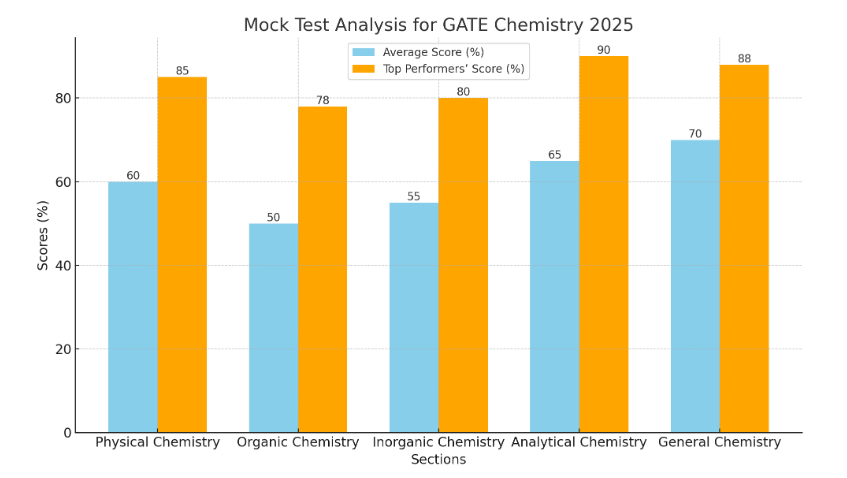
The section-wise performance analysis of mock tests highlights the following:
- Physical Chemistry (35-40% weight): Average score is 60%, with top performers reaching 85%. Focus on improving Thermodynamics and Chemical Kinetics.
- Organic Chemistry (25-30% weight): Average score is 50%, top score 78%, with weaknesses in Reaction Mechanisms and Stereochemistry.
- Inorganic Chemistry (15-20% weight): The average score is 55%, top score of 80%, especially challenging in Coordination Chemistry.
- Analytical Chemistry (10-15% weight): Stronger scores, with an average of 65% and top 90%. Chromatography techniques need attention.
- General Chemistry (5-10% weight): Highest performance, averaging 70% and top 88%, with minor gaps in Basic Concepts and Stoichiometry.
This analysis suggests focusing primarily on Organic and Physical Chemistry for better overall improvement



Comments