




GATE Chemistry 2025- Theoretical and Numerical: There will be some differences when a candidate knows about the types of theoretical and numerical questions. According to the previous years, approximately 60-65% of the paper in GATE Chemistry will comprise the theoretical questions while the rest will be comprised of all numerical problems.
The difference between the theory and the numerical problems will be the fact that generally in the theoretical problems, concepts of clarity and recalling are all prominent, while the numerical questions will judge a candidate for his analytical skill and whether he is capable of rapid calculations. Data insights reveal that students, who devote nearly half of their study time to numeric problem-solving, would ensure higher scores in the order of 10-15% as compared to theory-based candidates.
In that manner, a proper balance of study material ensures adequate preparations for both types of questions, and the candidate better prepares to attempt the paper.
Related Articles:
- GATE Chemistry 2025 Preparation Strategy: How to Score 80+ with Optimal Time Management
- GATE Question Paper for CY (Available): Download Previous Year Papers with Solution PDF
Understanding the GATE Chemistry Question Pattern
Suggested Article: GATE Chemistry Exam Pattern 2025, Check Section Wise Topics, Important Topics Weightage, Best Books
| Question Type | Approx. Weightage (%) | Average Marks per Section | Key Areas |
|---|---|---|---|
| Theoretical | 45-50% | 30-35 marks | Concepts, Reaction Mechanisms, Chemical Principles |
| Numerical | 50-55% | 35-40 marks | Calculations, Formula Applications, Problem-solving Skills |
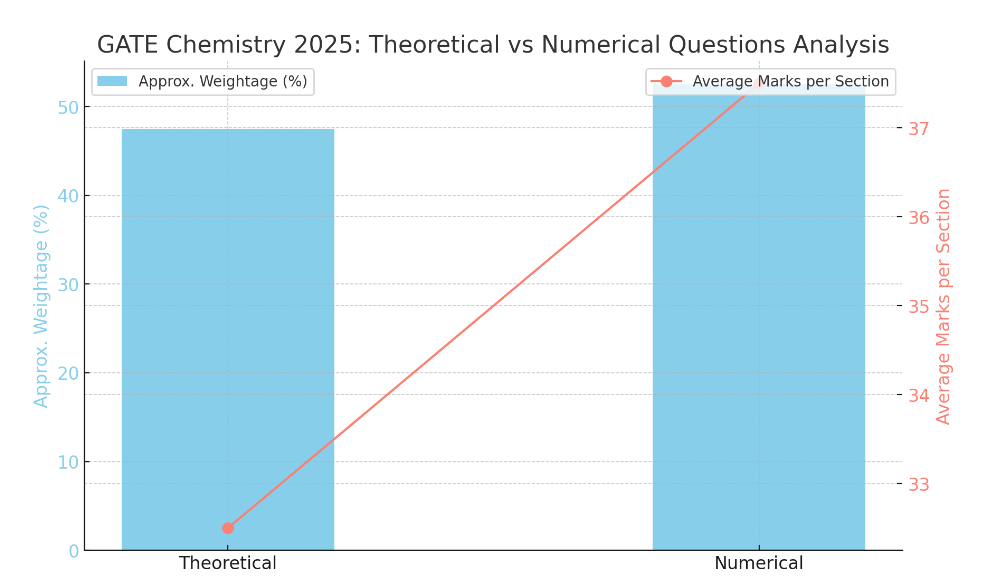
According to recent GATE Chemistry papers, around 45-50% forms the theoretical questions, whereas 50-55% is the numerical problems. Generally, highly scoring candidates will score in both, but numerically they may have some potential to score more due to the existence of several more questions.
Strategy for Theoretical Questions
GATE Chemistry has theory questions that test the understanding of basic principles and facts in the concerned discipline. Concepts are concept-oriented, based on some general principles in the area and a subject's knowledge about the interconnectedness of items.
Key Focus Areas for Theoretical Questions
Based on an analysis of past GATE Chemistry papers, here are high-weightage theoretical topics:
| Section | Key Focus Areas | Average Weightage (%) | Frequency in Papers |
|---|---|---|---|
| Physical Chemistry | Thermodynamics, Quantum Chemistry, Spectroscopy | 35-40% | Appears every year |
| Organic Chemistry | Reaction Mechanisms, Stereochemistry, Named Reactions | 30-35% | High |
| Inorganic Chemistry | Coordination Compounds, Periodic Trends, Bioinorganic Chemistry | 25-30% | Moderate-High |
Insights: Topics such as Thermodynamics and Reaction Mechanisms appear in every paper almost and carry high scores for better-prepared candidates.
Strategic Approach for Theoretical Questions
Must read: List of top Organic Chemistry Questions asked in GATE Chemistry
Conceptual Clarity
Target: Each topic should be understood as deeply as its underlying concept.
Strategy:
In Physical Chemistry, one should work very hard to understand the philosophy behind the laws of thermodynamics, quantum states, and spectroscopic methods. Develop an appreciation of how things relate between topics.
- Organic Chemistry: learn reaction mechanisms inside out. Understand what the "why" for each step is. In more complex mechanisms, use flow charts.
- In Inorganic Chemistry: work on periodic trends, and coordination compounds. Coordination compounds are often built from direct application of the theory.
Important Points to Memorize
Objective: Memorization of crucial information over a brief period
Techniques
- Mnemonics and Summaries- To recall sequences of reactions, use mnemonics and summary sheets to learn trends in the periodic table or nomenclature
- Summary Tables and Diagrams- Draw summary tables especially useful in Inorganic Chemistry: elements oxidation states, or in coordination chemistry-ligand strength.
Accelerated Recall Techniques
Objective: Improve the speed of recall of theoretical knowledge with better accuracy under time pressure.
Strategy:
- Flashcards: Flashcards should be prepared containing definitions, key points, and mechanisms for topics like Named Reactions and principles of spectroscopy.
- Practice Quizzes: Regular practice quizzing on theoretical concepts through online quizzes or revision apps helps in memorizing and builds confidence in recall speed.
Common Pitfalls and Strategic Tips
| Pitfall | Strategic Tip |
|---|---|
| Overthinking Answers | Focus on straightforward interpretation of questions; theoretical questions typically have one accurate answer based on core principles. |
| Missing Key Details | Skim questions carefully to capture specifics in Inorganic and Organic Chemistry questions, where minor details often change the answer. |
| Incorrect Choices in MCQs | Use elimination techniques to remove incorrect options, narrow down choices, and improve chances on tricky questions. |
Data Insight: Analysis shows that the successful candidates score 60-70% on questions related to theory, as the top performers have uniformly demonstrated foundational strength, predominantly in Physical and Inorganic Chemistry. This indicates how the focus on basics makes it possible to score the maximum.
Data-Driven Study Plan for Theoretical Questions
Based on average distribution and frequency from past papers, here’s a weekly study plan with a strong focus on high-weightage areas:
| Week | Key Topics | Focus Area | Hours/Week |
|---|---|---|---|
| 1-2 | Thermodynamics, Reaction Mechanisms | Physical, Organic | 10-12 |
| 3-4 | Quantum Chemistry, Periodic Trends | Physical, Inorganic | 10-12 |
| 5-6 | Coordination Compounds, Stereochemistry | Inorganic, Organic | 10-12 |
| 7-8 | Spectroscopy, Named Reactions | Physical, Organic | 10-12 |
| 9-10 | Revision of Weak Areas | Mixed | 10-12 |
Progress Tracking with Mock Test Analysis
Use mock tests to analyze your performance and identify areas for improvement. Below is a sample template for tracking your scores in theoretical sections across three mock tests.
| Mock Test Date | Physical (%) | Organic (%) | Inorganic (%) | Key Insights |
|---|---|---|---|---|
| Test 1 | 65 | 55 | 50 | Improve Inorganic Chemistry |
| Test 2 | 70 | 60 | 60 | Focus on Organic fundamentals |
| Test 3 | 75 | 65 | 70 | Maintain strengths, revise weak topics |
Insight: From this data, more time can be given to weak areas after every test. For instance, if Organic Chemistry scores are lower, then the area of reaction mechanisms and stereochemistry can be focused more.
To excel in theoretical questions in GATE Chemistry, focus on deep conceptual clarity, efficient recall techniques, and consistent revision. By aligning your preparation with data-driven insights from past exams, you can strengthen your foundation across Physical, Organic, and Inorganic Chemistry topics, helping you achieve a higher score. Regular practice through mock tests and targeted improvements based on feedback will further optimize your performance, setting you on a path to success in GATE Chemistry 2025.
Strategic Approach for Numerical Questions
Numerical questions constitute around 50-55% of the GATE Chemistry exam and thus are highly important to scoring well. The questions are designed to test the application as well as an understanding of concepts through calculations, so proper practice and strategic focus is required. This plan offers a structured approach to mastering numerical questions with data-driven insights from previous papers that target high-impact areas.
Key Focus Areas for Numerical Questions
Analyzing past GATE Chemistry papers reveals recurring numerical topics across key sections. Here’s a breakdown of high-weightage topics for numerical questions:
| Section | Key Focus Areas | Average Weightage (%) | Frequency in Papers |
|---|---|---|---|
| Physical Chemistry | Chemical Kinetics, Electrochemistry, Thermodynamics | 30-35% | High |
| Organic Chemistry | Spectroscopy (NMR, IR), Reaction Energetics | 20-25% | Moderate |
| Inorganic Chemistry | Redox Reactions, Coordination Chemistry | 10-15% | Low-Moderate |
Insight: Physical Chemistry dominates the numerical questions. More frequent topics are thermodynamics and kinetics. It will, therefore, be a high return on investment of time to focus on these high-yield areas.
Strategic Approach for Numerical Questions
Mastery of Core Formulas and Principles
Target: Recall at sight and accurately apply to the key formulas and equations.
Approach:
- Physical Chemistry: Key formulas in thermodynamics, for example in calculating Gibbs free energy, entropy, and enthalpy, chemical kinetics such as those involving rate equations, electrochemistry such as the Nernst equation, and formulas related to that.
- Organic Chemistry: Key formula for the application of spectroscopies, particularly about NMR and IR spectroscopies.
- Inorganic Chemistry: Memorized equations for oxidation states of coordination compounds, stability constant, and coordination compounds.
Dimensional Analysis and Unit Conversions
Objective: Avoid the error of wrong units in numerical problems.
Approach:
- At each step of the calculation, check for units, especially for Electrochemistry type problems where unit conversion is crucial.
- Be aware of the techniques of dimensional analysis to ensure that the final answer has the correct units; it is also a verification step.
Break down Complex Problems into Steps
Objective: Complex calculations should be broken up into smaller, more achievable steps.
Strategy:
- Understand how to break apart multi-step problems, specially for problems in Chemical Kinetics and Thermodynamics, who have very complex calculations.
- For mock tests, practice breaking these problems into steps to build confidence and make fewer careless mistakes under timed conditions.
Estimation and Approximation Techniques
Objective: Save yourself time by approximating with sufficient accuracy when the situation does not require exactitude, a useful skill, especially for timed exams.
Strategy:
- Use approximations of constants or rounding of values in long calculations so that the answers are acceptable.
- Use estimation skills on sample questions to get an estimate of whether the solution falls in the correct range.
Must Read: GATE Chemistry Books and Preparation Tips
Common Pitfalls and Strategic Tips
| Pitfall | Strategic Tip |
|---|---|
| Calculation Errors | Double-check calculations, especially in unit conversions. |
| Skipping Verification | Always verify the answer units and the reasonableness of the result. |
| Neglecting Simple Problems | Avoid spending too much time on complex problems; balance time allocation with simpler questions. |
Data Insight: Candidates scoring highly on numerical questions are observed to have spent extensive hours practicing with mock tests, and they often emphasize verifications of the answer which reduces errors, especially in heavy-weightage topics such as Physical Chemistry.
Data-Driven Study Plan for Numerical Questions
A study plan based on the practice of numerical questions can optimize efficiency. It is also recommended to devote more time to high-weightage topics, especially in Physical Chemistry, and reduce practice time as proficiency improves.
| Week | Key Topics | Focus Area | Hours/Week |
|---|---|---|---|
| 1-2 | Thermodynamics, Chemical Kinetics | Physical Chemistry | 10-12 |
| 3-4 | Electrochemistry, Reaction Energetics | Physical, Organic | 10-12 |
| 5-6 | Spectroscopy (NMR, IR), Redox Reactions | Organic, Inorganic | 10-12 |
| 7-8 | Revision of High-Yield Problems | Mixed | 10-12 |
| 9-10 | Mock Tests and Error Analysis | Mixed | 10-12 |
Progress Tracking with Mock Test Analysis
Suggested Article: GATE Mock Test Series 2025
Mock tests can reveal areas that need improvement. Here's a template to help track your scores and pinpoint weaknesses in numerical sections.
| Mock Test Date | Physical (%) | Organic (%) | Inorganic (%) | Key Insights |
| Test 1 | 60 | 55 | 50 | Improve Organic spectroscopy |
| Test 2 | 65 | 60 | 55 | Practice Inorganic calculations |
| Test 3 | 70 | 65 | 60 | Increase speed in calculations |
Insight: This data can further be used to adjust a study plan to focus on the weaker topic or improve the calculation speed, especially in Physical Chemistry and Organic spectroscopy.
Tips for Consistent Improvement
- Weekly Review: End of Every Week Review the work done and evaluate areas that need improvement. More time on difficult topics like Chemical Kinetics or Reaction Energetics.
- Mock Test Pattern: You should take a full-length test every two weeks in examination-type conditions. That enhances your time management skills. More importantly, that will give you a confidence boost as it relates to numerical-type questions.
- Review mistakes Thoroughly: Review mistakes after every mock test and classify them into, say, calculation errors and conceptual errors. This insight will help fine-tune study sessions.
Quick Read:
- List of top Questions asked in GATE Chemistry- 2024
- GATE College Predictor 2025: Predict your Admission Chances at IIT, NIT
- IIT Bombay GATE Cut off 2024, Previous Year Opening and Closing Ranks for M.Tech Admission (2023-2017)
It requires long practice, a clear understanding of core formulas, and systematic effort toward high-yield topics. Smart efforts in the study, such as focusing on Physical Chemistry and mastering unit conversions, are the pathways toward accuracy enhancement and speed development. Continuous usage of mock tests and refinement of solution techniques will lay down an excellent foundation for achieving good marks in numerical sections of GATE Chemistry 2025.
Comparison Analysis: Approach to Solving Theoretical Questions vs. Numerical Problems in GATE CY
Most of the success in GATE Chemistry depends upon a holistic approach to solving both the theoretical and numerical questions. This guide has been based on data insights generated from past year analyses and inputs from the high scorers that would enable students to define their preparation strategy accordingly, maximizing their efficiency and accuracy in solving the paper.
Key Differences in Approach
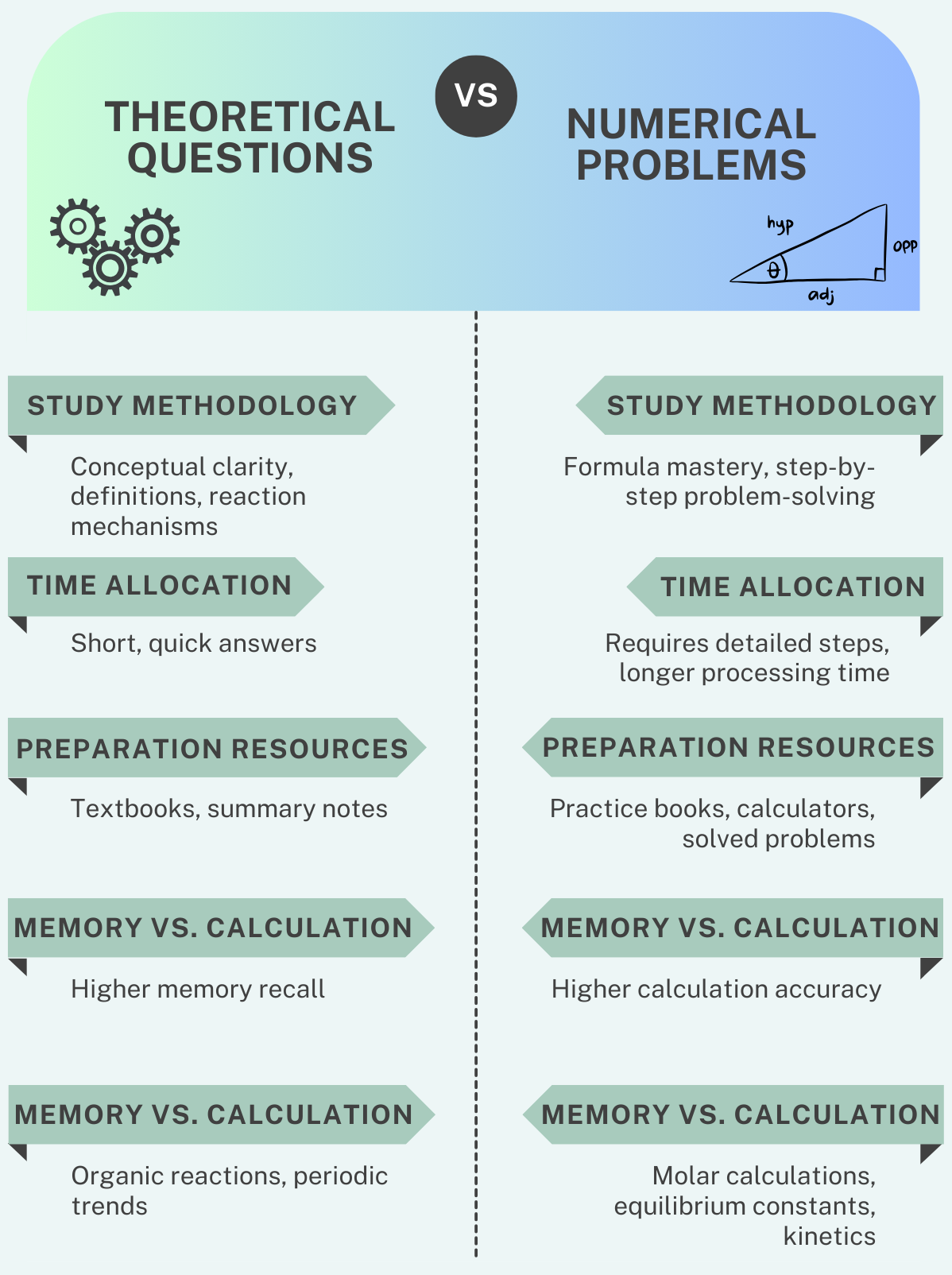
Data Analysis: Top performers have had 30% more hours of numerical problem practice in comparison with theoretical questions reflection, in part of recent patterns of physical chemistry calculations/quantitative problems in most exams.
Effective Strategies for Each Question Type
For Theoretical Questions:
- Focus on conceptual clarity with the help of memorization techniques.
- Flashcards or mnemonics could be used for periodic trends and organic reactions.
- 20-30% of the study time should be devoted to rapid revisions, summaries, and theoretical quizzes.
For Numerical Problems:
- Stress repetitive practice and formula application.
- Step up with solutions that are comprehensive and elaborate about the problem.
- Constitute for 40-50% of study time for focused time on problem-solving sessions.
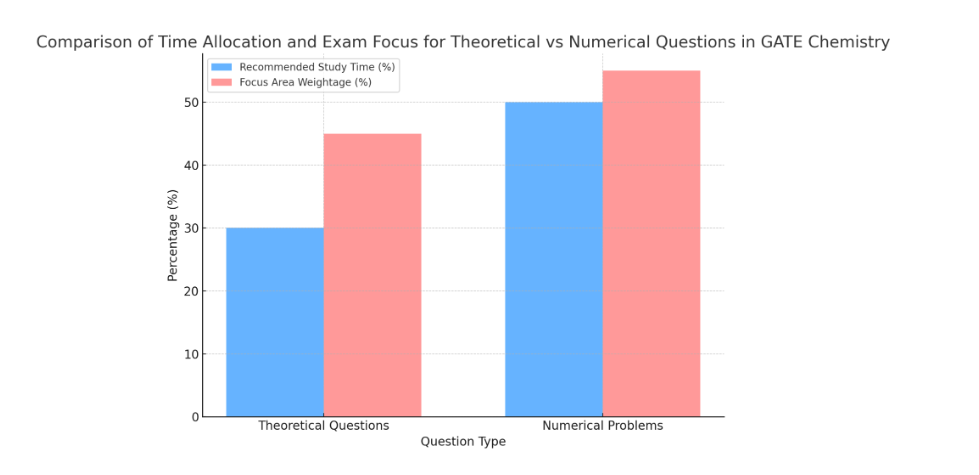
The above bar graph emphasizes the proportion of study time to be devoted to focusing on the areas weighted for theoretical questions compared to numerical problems in GATE Chemistry. From the data, there is a preference for numerical practice with 50% matching the slightly greater weightage accorded to them in the exams while 30% goes to theory for balanced preparation.



Comments