




GATE is a gateway for providing students in further advanced studies and careers with the help of engineering and science fields. GATE Chemistry aspirants need to go through their previous year's question papers and find trends and effective preparation for preparation. The number of questions remained 40 throughout the past five years, and there were a total of 100 marks. An analysis of question papers from 2019-2023 shows that, on average, Physical Chemistry is bound to carry tremendous weightage at 35%, followed closely by Organic Chemistry at 25%. The proportion of the type of questions remains stable while being around 60 percent composed of MCQs; thus aspirants would have to achieve acuities in concepts with some problems. This analysis apart from further repeating that preparations must be targeted emphasizes, moreover, a better and adequate usage of time so spent within topics relevant as a means toward dealing with those problems in GATE 2025 for the test candidates.
Related Links:
- GATE 2024 Chemistry (CY) Paper Analysis (Out), Difficulty Level, Weightage of Topics, Question Paper with Answer Key
- GATE Question Paper 2024 (Available): Check Previous Year Question Paper with Solution PDF (2023-1991)
Overview of GATE Chemistry Exam Pattern
The GATE Chemistry exam is one of the major tests that aspirant postgraduate students and professionals conduct to test a candidate's entire knowledge of the subject. It comprises multiple-choice questions and numerical answer-type questions to assess the theoretical knowledge and practical problem-solving skills of the candidate. GATE Chemistry Exam Pattern: Knowing the pattern will enable the candidates to devise appropriate strategies for preparation and thus enhance their success opportunities.
Total Marks: 100
Duration: 3 hours
Types of Questions:
- Multiple Choice Questions (MCQs)
- Numerical Answer Type (NAT) questions
- Multiple Select Questions (MSQs)
The distribution of marks typically comprises:
- Section A: General Chemistry
- Section B: Physical Chemistry
- Section C: Organic Chemistry
- Section D: Inorganic Chemistry
- Section E: Analytical Chemistry
Also, check:
- GATE Other Subjects Previous Year Analysis
- GATE Question Paper (Available): Check Previous Year Question Paper with Solution PDF (2024-1991)
Analysis of Previous Years’ Question Papers
Question Distribution by Topic
The following table summarizes the number of questions from each topic in the last five GATE Chemistry exams (2019-2023):
| Year | Physical Chemistry | Organic Chemistry | Inorganic Chemistry | Analytical Chemistry | General Chemistry | Total Questions |
|---|---|---|---|---|---|---|
| 2019 | 14 | 10 | 8 | 4 | 4 | 40 |
| 2020 | 12 | 11 | 7 | 5 | 5 | 40 |
| 2021 | 15 | 8 | 10 | 4 | 3 | 40 |
| 2022 | 11 | 9 | 9 | 6 | 5 | 40 |
| 2023 | 13 | 12 | 6 | 5 | 4 | 40 |
Insights:
- Physical Chemistry always has the largest number of questions, which speaks of its weight in the GATE syllabus.
- Organic Chemistry will differ at a high value in 2023.
- This makes Inorganic Chemistry pretty stable, while the questions for Analytical Chemistry tend to be fewer.
Question Type Distribution
The analysis of question types over the past five years reveals the following trends:
| Year | MCQs | NAT | MSQs | Total Questions |
|---|---|---|---|---|
| 2019 | 25 | 10 | 5 | 40 |
| 2020 | 26 | 8 | 6 | 40 |
| 2021 | 24 | 12 | 4 | 40 |
| 2022 | 22 | 10 | 8 | 40 |
| 2023 | 23 | 11 | 6 | 40 |
Insights:
- MCQs are predominant, but NAT and MSQs form considerable portions, which need special preparations.
- The slight fluctuations in question types suggest that there is a need to adopt a balanced approach to ensure better preparation.
Check:
| GATE 2024 CY Question Paper PDF | GATE 2024 CY Answer Key PDF |
|---|---|
| Download PDF | Download PDF |
GATE Chemistry: Weightage Analysis of Previous Years' Question Papers
A percentage-wise weightage of topics in the GATE Chemistry question papers during the last five years provides critical insights to those planning their study strategies. So, let's do it topic-wise. We will see in which sections more and more weightage takes place and which need focused preparation.
Weightage by Topic (2019-2023)
Based on data provided for each topic's question count from 2019 to 2023, here are the average percentages of weightage per topic:
| Topic | Average Weightage (%) |
|---|---|
| Physical Chemistry | 32.5% |
| Organic Chemistry | 25% |
| Inorganic Chemistry | 20% |
| Analytical Chemistry | 12.5% |
| General Chemistry | 10% |
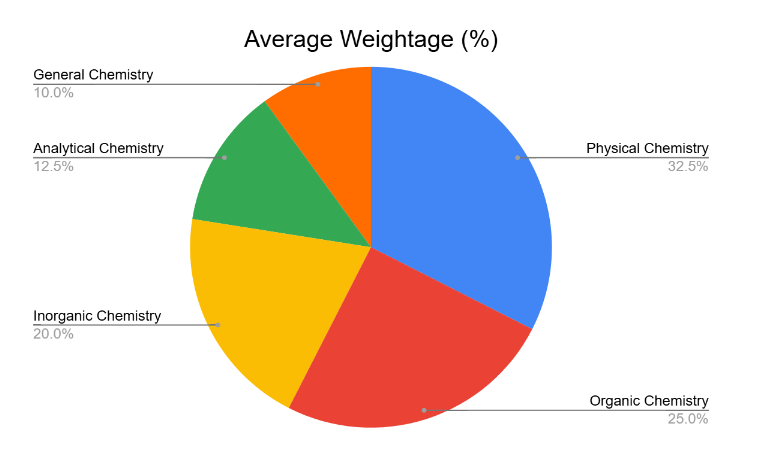
Key takeaways:
- Physical Chemistry: 32.5%. The highest weightage was consistently assigned to Physical Chemistry. Mastering the concepts in this area is crucial to getting good marks. Major emphasis areas would be on topics like thermodynamics, kinetics, and quantum chemistry.
- Organic Chemistry: 25%. The second highest weightage was on Organic Chemistry. Focused preparation on reaction mechanisms, synthesis, and organic reaction pathways would boost scores greatly.
- Inorganic Chemistry 20%: The chapter covers most of the exam. It will contain central concepts such as coordination compounds, periodic trends, and transition metal chemistry.
- Analytical Chemistry 12.5%: It is relatively small, however, but still contributes meaningfully to the exam. Once again, two center topics to be covered include spectroscopic methods, along with techniques for quantitative analysis.
- General Chemistry (10%): This carries the least weightage but can still provide some easy scoring questions. Basic concepts such as atomic structure and periodicity fall under this category and can help with overall marks.
Check:
| Exam Date | Session | Question Paper PDF |
|---|---|---|
| February 3, 2024 | Forenoon Session | Check Here |
| February 5, 2023 | Afternoon Session | Check Here |
| February 6, 2022 | Afternoon Session | Check Here |
| February 6, 2021 | Forenoon Session | Check Here |
| February 1, 2020 | Afternoon Session | Check Here |
GATE Chemistry: Preparation strategy
| Topic | Key Topics | Study Approach | Weekly Plan |
|---|---|---|---|
| Physical Chemistry (32.5%) | Thermodynamics, Kinetics, Quantum Chemistry, Electrochemistry | Master core concepts in thermodynamics and kinetics. Practice numerical questions regularly. Use textbooks like Atkins' Physical Chemistry and question banks. | 6–8 hours; 40% theory, 60% numerical practice |
| Organic Chemistry (25%) | Reaction Mechanisms, Stereochemistry, Organic Synthesis, Spectroscopy | Focus on reaction mechanisms and synthesis. Practice mechanism-based MCQs. Summarize key reagents and conditions. | 5–7 hours; prioritize reaction mechanisms |
| Inorganic Chemistry (20%) | Coordination Chemistry, Periodic Trends, Transition Metals, Organometallics | Study atomic structure and periodic trends. Memorize key compounds and properties. Emphasize conceptual understanding. | 4–6 hours; memorization and concept review |
| Analytical Chemistry (12.5%) | Spectroscopy, Chromatography, Quantitative Analysis, Data Interpretation | Focus on quantitative skills and instrument principles. Practice data interpretation from spectra/chromatograms. Use online resources and problem sets. | 3–4 hours; quantitative methods and instrumental analysis |
| General Chemistry (10%) | Atomic Structure, Bonding, Periodicity | Strengthen basics of atomic and molecular structure. Solve fundamental questions from past exams. | 2–3 hours; basics and past question review |
Additional Strategy Summary
| Task | Approach |
|---|---|
| Solve Previous Year's Papers | Identify patterns, practice time management, and understand question difficulty. |
| Use Mock Tests | Begin with topic-wise, and progress to full-length by December. Analyze mistakes post each test. |
| Time Management | Allocate ~50–60% of the time to Physical and Organic Chemistry, balancing with other topics. |
| Revision Schedule (Last Month) | Intensive revision of notes, common concepts, and focus on weaknesses. |
| Health and Consistency | Regular study breaks consistent schedule, and prioritize wellness. |
This table organizes the preparation strategy by topic, study approach, and time allocation, providing a clear roadmap for effective GATE Chemistry preparation.
Quick links:
| GATE 2024 Result | GATE 2024 Cut-off | GATE 2024 College Predictor |
| GATE 2024 Paper Analysis | GATE Cut off for Top IITs | GATE Cut off for Top NITs |
Thus, from the previous years' question papers on GATE Chemistry, some patterns have emerged that are useful for preparation. Physical Chemistry weighs the most at around 32.5%, hence, one must focus more on the topics of thermodynamics and kinetics. Organic Chemistry accounts for 25% of the weight and requires a strong understanding of mechanisms and synthesis pathways. Inorganic Chemistry (20%) offers stable and predictable content in areas like coordination chemistry and periodic trends. Analytical Chemistry (12.5%) and General Chemistry (10%) fill up the paper structure and heavily contribute to diverse assessments of skills. It is a peek into data, allowing aspirants to focus on what to study and for how long they should do so in a balanced approach that maximizes scoring potential.



Comments