




As IIT Roorkee has released the exam dates of GATE 2025 i.e, 1,2,15 and 16th Februry 2025. With aspirant candidates preparing for GATE Chemistry 2025, it should begin with knowing the weightage of the syllabus and the pattern of exams. It only checks the aptitude of a candidate pertaining to specific concepts and its applicability in practical situations.
- Past data insights would have told you that Physical Chemistry takes the major place there and usually accounts for a chunk of around 35-40% of total marks.
- Organic Chemistry is quite often associated with 25-30% weightage and frequently asked questions have been there from Reaction Mechanisms and Stereochemistry.
- In contrast, Inorganic Chemistry has often been treated lightly. However, always remember, that it takes about 15-20% of your exam. Always consider Coordination Chemistry and Chemical Bonding so that you score.
The test can be distributed in three styles: Multiple Choice Questions; Multiple Selection Questions; and Number Associates Type Questions, the latter having different methods required for solutions. This helps you plan your time and resources well, and you will be completely prepared for high-weightage topics and know what each question type requires.
GATE 2025 Syllabus for Chemistry: Download CY Syllabus PDF
Related Articles
- GATE: Cut off
- GATE Chemistry 2025 Preparation Strategy
- GATE Chemistry 2025: Approach to solve theoretical questions vs. numerical problems
GATE Chemistry (CY) 2025: Exam Pattern
Before delving into the syllabus, it’s essential to understand the GATE Chemistry exam pattern:
| Particulars | Details |
|---|---|
| Total Marks | 100 |
| Total Questions | 65 |
| Type of Questions | Multiple Choice Questions (MCQs), Numerical Answer Type (NAT), Multiple Select Questions (MSQs) |
| Duration | 3 hours |
| Sections | General Aptitude (15 Marks), Chemistry Subject (85 Marks) |
The Chemistry section has the maximum weightage of 85% in total to this examination. Therefore, concentration is mainly required in this section of your preparation. Now, here is the syllabus and percentage allocation in detail for all the sections.
GATE Chemistry 2025 syllabus
Here is the detailed GATE 2025 Chemistry Syllabus presented in a tabular format for easy reference:
| Subject Area | Topics |
|---|---|
| Physical Chemistry | Basic concepts of thermodynamics |
| The first law of thermodynamics | |
| Second law of thermodynamics | |
| Free energy and thermodynamic functions | |
| Phase equilibria | |
| Chemical kinetics | |
| Rate laws and mechanisms | |
| Electrochemistry | |
| Chemical equilibrium | |
| Solutions and colligative properties | |
| Spectroscopy (UV-Vis, IR, NMR, Mass Spectrometry) | |
| Inorganic Chemistry | Periodic properties |
| Chemical bonding and molecular structure | |
| Coordination compounds | |
| Bioinorganic chemistry | |
| Main group chemistry | |
| Transition metal chemistry | |
| Solid state chemistry | |
| Organometallic chemistry | |
| Organic Chemistry | Structure and bonding in organic molecules |
| Reaction mechanisms | |
| Functional groups and their reactions | |
| Stereochemistry | |
| Organic synthesis and synthesis strategies | |
| Spectroscopic identification of organic compounds | |
| Organometallic reactions | |
| Analytical Chemistry | Fundamentals of analytical chemistry |
| Chromatography (TLC, HPLC, GC) | |
| Spectroscopic methods (UV-Vis, IR, NMR, MS) | |
| Electroanalytical methods | |
| Qualitative and quantitative analysis | |
| General Chemistry | Atomic structure |
| Chemical reactions and stoichiometry | |
| States of Matter | |
| Chemical equilibrium and Le Chatelier’s principle | |
| Gas laws and kinetic molecular theory | |
| Properties of solutions and colligative properties | |
| Environmental Chemistry | Chemical aspects of environmental science |
| Water chemistry | |
| Air quality and pollution | |
| Soil chemistry | |
| Green chemistry | |
| Industrial Chemistry | Chemical processes in industry |
| Polymer chemistry | |
| Biochemical processes | |
| Food Chemistry |
Additional Notes
- Weightage: The syllabus, as shown above, has been so framed as to carry different weightages of the various topics in consonance with the trend of examinations of past years.
- Review of concepts: Try to solve problems in all topics, and refer to concepts so you are ready.
GATE Chemistry 2025: Section-Wise Weightage
Physical Chemistry Syllabus and Weightage
Suggested Article: Top 10 Formulae to Remember for Physical Chemistry in GATE 2025
Physical Chemistry forms an important constituent of the GATE Chemistry syllabus with approximately 35% weightage. It is the very basis of fundamental principles underlying chemical phenomena. In this respect, a candidate needs essential knowledge and skills to perform well in the competition. Let us see below what the principal topics along with their weightage and description are:
Key topics in Physical Chemistry Syllabus and Weightage.
| Physical Chemistry Topics | Weightage (%) | Description |
|---|---|---|
| Quantum Chemistry | 8-10 | Basic Principles: Concepts of wave-particle duality, Heisenberg's uncertainty principle, and the Schrödinger equation.Atomic Models: Hydrogen atom and multi-electron systems, quantum numbers, electron configuration |
| Thermodynamics and Statistical Thermodynamics | 6-8 | Laws of Thermodynamics: A general course outline of first, second, and third laws and expressions for enthalpy, entropy, and Gibbs free energy.Statistical Thermodynamics: Basic concepts in distribution functions and Boltzmann statistics; relationship between microstates and macrostates. |
| Chemical Kinetics | 5-7 | Reaction Rates: Factors that influence reaction rates, rate laws, and the approach to initial rates.Mechanisms: Elementary reactions, complex reactions, and catalysts. |
| Surface Chemistry | 3-5 | Adsorption: Physisorption and chemisorption, adsorption isotherms (Langmuir, Freundlich) and catalysis-relevant applications.Colloids: Properties of colloidal systems and some industrial applications. |
| Solid State Chemistry | 4-6 | Crystal Structures: Unit cells, crystal lattice, and types of crystal systems (cubic, tetragonal, etc.).Defects in Solids: Introduction to point defects, line defects, and their significance in changing material properties. |
| Molecular Spectroscopy | 5-7 | Types of Spectroscopy: Principles of UV-Vis, IR, and NMR spectroscopy for structural analysis.Spectral Interpretation: Skill building in spectra interpretation to deduce molecular structure and functional groups. |
Inorganic Chemistry Syllabus and Weightage
Inorganic Chemistry constitutes about 30% of the GATE Chemistry exam. Inorganic Chemistry study material focuses on properties and behavior along with applications of various inorganic compounds.
| Inorganic Chemistry Topics | Weightage (%) | Description |
|---|---|---|
| Main Group Elements and Periodicity | 5-7 | Periodic Trends: Trends in atomic size, ionization energy, and electronegativity across periods and groups. Group Characteristics: Physical and chemical properties of alkali metals, alkaline earth metals, halogens, and noble gases. |
| Transition Elements and Coordination Chemistry | 8-10 | Transition Metals: To study properties, oxidation states, and common compounds of transition metals. Coordination Compounds: Ligands, coordination number and crystal field theory, color, and magnetism in complexes.Organometallics |
| Organometallics | 6-8 | Definition and Classification: Definition of organometallic compounds, their synthesis, and classification based on the nature of the metal and type of bond used. Reactions: Reactions with organometallic compounds and its importance in organic synthesis. |
| Bioinorganic Chemistry | 3-5 | Metal Ions in Biology: Exploring the involvement of metal ions (such as Fe, Mg, Zn) in biological systems and their relevance in enzymatic functions. Metalloproteins: Understanding the structure and function of metalloproteins and its relevance in biological processes. |
| Solids and Inorganic Chains | 4-6 | Crystal Structures: Hence, let's see the various kinds of solid-state structures with ionic, covalent, and metallic along with their properties. Inorganic Polymers: Exploring the synthesis and properties of inorganic chain compounds and their applications in material science. |
Organic Chemistry Syllabus and Weightage
Organic Chemistry accounts for almost 30% of the GATE Chemistry question weights. This section specializes in the structure, properties, and reactions of organic compounds. Emphasis is paid to synthesis and analysis.
| Organic Chemistry Topics | Weightage (%) | Description |
|---|---|---|
| Reaction Mechanisms | 8-10 | Mechanisms: Applicability and Specificity of different types of reaction mechanisms: nucleophilic substitution, elimination, addition. Energy profiles: Understanding energy changes in a reaction, including transition states and intermediates. |
| Stereochemistry | 5-7 | Chirality: Chirality, definition, and significance of enantiomers and diastereomers in organic compounds. Stereoisomerism: Geometric isomers-cis/trans, conformational isomers-Newman projections, chair forms. |
| Organic Synthesis | 8-10 | Synthetic Strategies: Organic synthesis strategies: functional group transformations, multi-step synthesis. Retrosynthetic Analysis: One needs to understand the approach toward the deconstruction of complex molecules into simpler precursors for planning synthetic routes. |
| Heterocyclic Chemistry | 3-5 | Types of Heterocycles: Review the structure, properties, and reactivity of common heterocyclic compounds - pyridine, furan, thiophene, etc. Synthesis and Applications: Understanding methods for synthesizing heterocycles as well as their applications in pharmaceuticals and agrochemicals. |
| Spectroscopy in Organic Chemistry | 4-6 | NMR and IR Spectroscopy: The art of interpretation in NMR and IR for the identification of functional groups and molecular structures. Mass Spectrometry: Understanding principles and techniques related to the determination of molecular weight and structural information in mass spectrometry. |
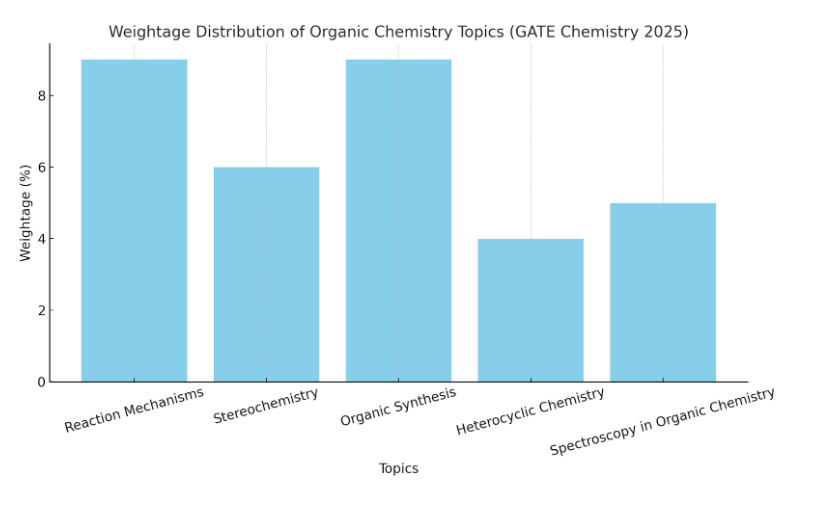
The most important topics in GATE Chemistry
Suggested Article: Mastering Difficult Questions in GATE Chemistry (CY): Proven Strategies from Top Scorers
Such examination and preparation are suitable for students of all class levels, as the materials do not look for coverage in all the areas of chemistry. If a burden of weightage has to be justified, the candidates need to pursue only those that are important for the examination. These key areas of understanding will not be curtailed or made certain to enable problem-solving abilities together with clarity of concepts. Thus here are some most crucial topics of the syllabus of GATE Chemistry.
| Subject Area | Important Topics | Description |
|---|---|---|
| Physical Chemistry | Thermodynamics | Laws of thermodynamics, enthalpy, Gibbs free energy, spontaneity of reactions. |
| Chemical Kinetics | Reaction rates, mechanisms, rate laws, and factors affecting kinetics. | |
| Quantum Chemistry | Schrödinger equation, atomic models, and molecular orbitals. | |
| Molecular Spectroscopy | Techniques like UV-Vis, IR, and NMR for structural elucidation. | |
| Inorganic Chemistry | Coordination Chemistry | Coordination compounds, ligands, and crystal field theory. |
| Transition Metals | Properties, oxidation states, and complexes of d-block elements. | |
| Main Group Elements | Periodicity, chemical properties, and reactions of s- and p-block elements. | |
| Organometallic Chemistry | Characteristics, types of organometallic compounds, and applications. | |
| Organic Chemistry | Reaction Mechanisms | SN1, SN2, E1, E2 mechanisms, and their stereochemical implications. |
| Functional Groups | Properties, reactions, and synthesis of key organic functional groups (alcohols, acids, amines). | |
| Spectroscopy | NMR, IR, and mass spectrometry for identifying organic compounds. | |
| Stereochemistry | Concepts of chirality, enantiomers, diastereomers, and optical activity. | |
| Analytical Chemistry | Chromatography | Techniques like HPLC, GC, and their applications in separation and analysis. |
| Spectroscopic Methods | Understanding UV-Vis, IR, and NMR spectroscopy for quantitative and qualitative analysis. | |
| Titration Techniques | Acid-base, redox, and complexometric titrations for quantitative analysis. | |
| Environmental Chemistry | Pollutants | Types of air and water pollutants, their sources, and effects on the environment. |
| Green Chemistry | Principles of green chemistry and their applications in sustainable practices. | |
| Biochemistry | Metabolism | Key metabolic pathways (glycolysis, Krebs cycle) and their significance. |
| Enzyme Kinetics | Understanding enzyme function, kinetics, and inhibition. | |
| Materials Science | Solid State Chemistry | Crystal structures, types of solids, and their properties. |
| Nanomaterials | Synthesis, properties, and applications of nanomaterials. |
Preparation Tip for GATE Chemistry
Suggested Article: GATE Chemistry 2025: Approach to solve theoretical questions vs. numerical problems
Preparing for GATE Chemistry
Preparing for GATE chemistry seems pretty tough, but interestingly the insights from previous toppers reveal a fantastic strategy that could be added to enhance your preparations. Find here some valuable tips based on their experiences with some data insights to guide your study plan.
Understanding of Syllabus and Weightage
Data Insight: From last year's analysis it has been found that Physical Chemistry and Inorganic Chemistry have maximum weightage which sums up to 35% and 30% respectively. These are the two most important subjects from which a maximum score can be obtained.
| Aspect | Tip | Data Insight |
|---|---|---|
| Study Plan | Plan a study schedule with proper time for all subjects and revision. | Toppers spend 4-5 hours daily on study; time distribution toward each subject relates to weightage. |
| Conceptual Clarity | Understand fundamental concepts rather than just memorizing. | 80% of toppers credited their success to a clear understanding of concepts. Flowcharts and diagrams will help to understand complex subjects. |
| Previous Years' Papers | Practice old years question papers so that one gets accustomed to the type of questions and pattern of the examination. | Around 60-70% of questions are repeating from old years. Toppers advise practicing at least 5-10 years of GATE Chemistry old papers to develop confidence as well as proper time management skills. |
| Mock Tests | Practice through mock test series so that one can know the level of preparation and what needs to be improved upon. | Mock tests increase scores by 15-20%. Top performers feel one should start at least three months before the examination. |
| Revision | Daily or weekly revision is a must as this helps in learning time and again. | Writing a topic 3-4 weeks before the exam would fetch good recall. Notes are short and flashcards have proved to be helpful tools for revision. |
| Study Groups/Forums | Utilize study groups or online forums for discussion of tricky topics and resources. | 65% of pass-outs reported that student discussion makes the concept clear and mends the knowledge. |
| Healthy Life & Stress Management | Keep both the body and mind fit during preparations. | A proper schedule with regular exercise and adequate sleep enhances concentration and cognitive ability. Moreover, it reduces stress through mindfulness techniques. |
Quick Links: Top 10 Formulae to Remember for Physical Chemistry in GATE 2025
Preparation for GATE Chemistry 2025 requires a strategic focus on key syllabus areas of high weightage. The proper understanding of the pattern of the exam along with a commitment to mastering conceptual knowledge and skills for solving practical problems enhance the opportunity for success.
Indeed, some experiences and insights from earlier toppers show structured preparation, proper techniques in revising, and emphasis on practice with mock tests and previous years' papers.
- Structured Study Schedule: Well allocate the time for study keeping in view the weightage of topics and ensuring regular revision.
- Conceptual Understanding: Try to understand concepts as opposed to memorizing them, so that when it comes to complex problems, students can handle them confidently.
- Practice Past Papers: This is where the pattern and type of questions are mainly practiced in the minds of students.
- Mock Tests Conduct mock tests to assess how they are preparing and strategizing for taking the test.
It is with these strategies in their preparation plans that GATE Chemistry aspirants shall better face the challenges that await them.
Recommended Study Materials
| Resource Type | Book/Material | Topic Focus |
|---|---|---|
| Physical Chemistry | P.W. Atkins, "Physical Chemistry" | Thermodynamics, Quantum Chemistry |
| Organic Chemistry | Morrison & Boyd, "Organic Chemistry" | Reaction Mechanisms, Named Reactions |
| Inorganic Chemistry | J.D. Lee, "Concise Inorganic Chemistry" | Coordination Chemistry, Bioinorganic |
Also Check: GATE Books 2025 PDF Download
GATE Chemistry Previous Year Question Papers
Suggested Article: GATE Chemistry: Previous Years' Question Paper Analysis
| Session | |
| 2024 | Download Question Paper |
| 2023 | Download Question Paper |
| 2022 | Download Question Paper |
| 2021 | Download Question Paper |
| 2020 | Download Question Paper |



Comments