




GATE Civil Engineering 2025 ranks among the most significant steps for aspiring engineers who go for higher studies or want career opportunities in the public and private sectors. An in-depth understanding of the syllabus will be able to ace this exam. The comprehensive guide to the GATE Civil Engineering syllabus would break it down, with detailed insights into weightage based on previous years' trends and tips provided by experts for efficacious preparation. Based on data analysis and a clear road map, you will be well-equipped to dive head-on into each section.
The GATE Civil Engineering (CE) 2025 Examination will be conducted on February 1, 2, 15 and 16, 2025. The examination will take the form of a computer-based test conducted in several sessions on the aforementioned dates. Right from core subjects such as Structural Engineering, Geotechnical Engineering, and Water Resources to General Aptitude, this course will cover everything so that no stone goes unturned in the preparation journey of an individual. Whether the topics are something heavily weighted or one needs to finalize the skills of making a solution, this course is the one-stop source for success in GATE Civil Engineering 2025!
Related Articles:
- GATE Civil Engineering Detailed Syllabus
- GATE CE: Exam Pattern 2025
- GATE Preparation: Time Table, 6 months Study Tips, Free Resources
GATE Civil Engineering 2025 Exam Pattern
- Total Marks: 100
- Duration: 3 hours
- Question Types: Multiple Choice Questions (MCQs), Multiple Select Questions (MSQs), and Numerical Answer Questions (NATs)
| Syllabus | |
|---|---|
| GATE CE Syllabus | Download PDF |
| General Aptitude Syllabus | Download PDF |
GATE Civil Engineering 2025 Syllabus Overview
The GATE syllabus for civil engineering is divided into subtopics with a focus on trending topics for easy understanding. Here is the breakdown of the syllabus of GATE CE 2025 into sections and topics.
Suggested Article: GATE Civil Engineering Syllabus
| Section | Topics |
|---|---|
| General Aptitude | Verbal Aptitude, Quantitative Aptitude, Analytical Aptitude |
| Engineering Mathematics | Linear Algebra, Calculus, Differential Equations, Numerical Methods |
| Structural Engineering | Engineering Mechanics, Solid Mechanics, Structural Analysis, Design of Concrete and Steel Structures |
| Geotechnical Engineering | Soil Mechanics, Foundation Engineering |
| Water Resources Engineering | Fluid Mechanics, Hydraulics, Hydrology, Irrigation |
| Environmental Engineering | Water Treatment, Wastewater Treatment, Air Pollution, Solid Waste Management |
| Transportation Engineering | Highway Pavements, Traffic Engineering |
| Surveying and Geomatics | Errors, Adjustments, Total Station, Remote Sensing |
| Construction Management | Project Management, Cost Estimation |
Section-Wise Weightage for GATE ECE 2025
The section-wise distribution of the GATE ECE (Electronics and Communication Engineering) 2025 exam weightage provides a brief way to prepare effectively. A trend analysis study shows that some topics tend to occupy the larger part of the examination, enabling the candidates to focus on those areas only.
The section-wise weightage of the GATE ECE 2025 syllabus, along with data insights.
| Section | Weightage (%) | Approx. Marks |
|---|---|---|
| Engineering Mathematics | 15% | 15 |
| General Aptitude | 15% | 15 |
| Core ECE Subjects | 70% | 70 |
Section-wise Weightage Analysis
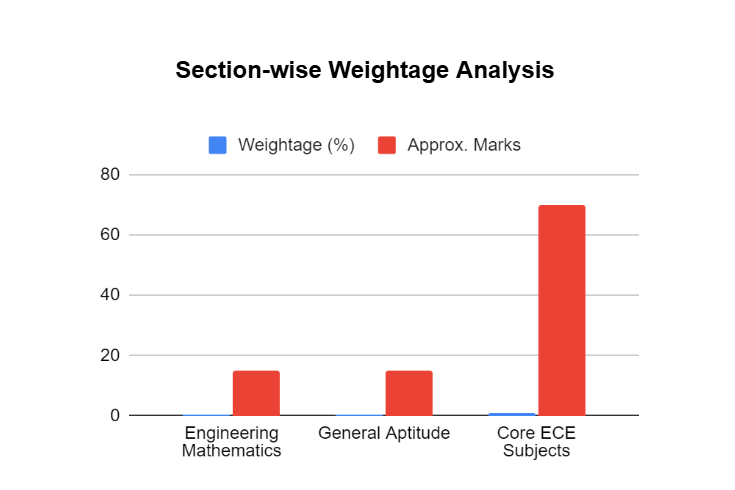
Observation
- Core Focus on Core ECE Subjects:
- Since 70% of the total marks are allocated to the Core ECE subjects, students need to put effort into this part of the preparation.
- Key topics include Analog Circuits, Digital Electronics, Signals and Systems, Control Systems, Communication Systems, etc., and so on.
- Balanced Approach for General Aptitude and Mathematics:
- For the GATE Syllabus, it has been observed that Engineering Mathematics and General Aptitude account for 15% of the total marks. This reflects the seriousness of such basic skills in the GATE examination.
- Working out Engineering Mathematics concepts enhances the overall performance in the technical sections of the exam.
Subject-Wise Weightage Analysis for GATE Civil Engineering 2025
The GATE Civil Engineering exam generally consists of several core subjects, each assigned marks. An assessment of the subject-wise weightage is provided, based on a few years' trend analysis and the 2025 syllabus as expected.
| Subject | Weightage (%) | Approx. Marks |
|---|---|---|
| Engineering Mathematics | 13 - 15% | 13 - 15 |
| General Aptitude | 15% | 15 |
| Structural Engineering | 15 - 17% | 15 - 17 |
| Geotechnical Engineering | 10 - 12% | 10 - 12 |
| Water Resources Engineering | 8 - 10% | 8 - 10 |
| Environmental Engineering | 8 - 10% | 8 - 10 |
| Transportation Engineering | 7 - 9% | 7 - 9 |
| Construction Engineering | 8 - 10% | 8 - 10 |
| Surveying | 8 - 10% | 8 - 10 |
| Project Management | 2 - 3% | 2 - 3 |
GATE ECE 2025 Subject-wise Analysis
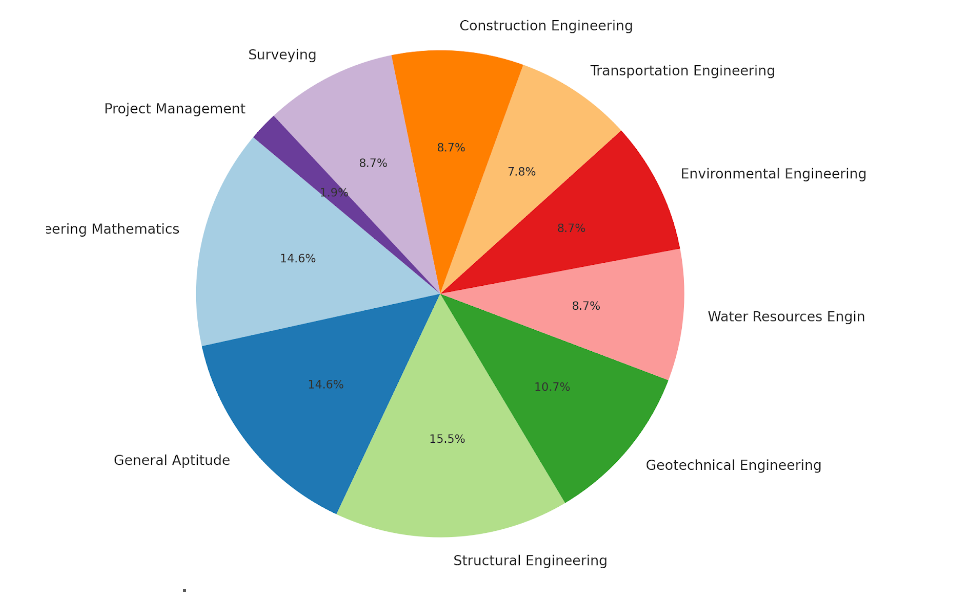
Observation
- Primary Focus: Structural Engineering and General Aptitude are the primary areas that have most of the weightage, and hence students are required to concentrate on these subjects in their preparation the most.
- Mathematics Foundation: Engineering Mathematics is still one of the subjects that one cannot afford to miss; it plays a major role in the total score. It is therefore important to understand this subject well if one is to solve other subjects easily.
- Specialized Subjects: Don’t forget the other important subjects like Geotechnical engineering, Water resources engineering, and Environmental engineering which carry a lot of weightage.
Most Important Topics GATE Civil Engineering.
In preparation for the GATE Civil Engineering exam, the candidates inculcate the important topics of the subjects which can enhance their preparation strategy significantly.
Here is the list of the most important topics for GATE CE 2025.
| Subject Area | Important Topics |
|---|---|
| Structural Engineering |
|
| Geotechnical Engineering |
|
| Water Resources Engineering |
|
| Transportation Engineering |
|
| Environmental Engineering |
|
| Construction Management |
|
| Surveying |
|
| Engineering Mathematics |
|
Commonly asked Topics and questions in GATE Civil Engineering (2020-2024)
The GATE Civil Engineering (CE) examination has questions from major areas. Here is the accumulated list of the set of questions that appeared in last year’s question paper (2020-2024) and the year they were highlighted in the GATE papers:
| Topic | Type of Question | Year(s) |
|---|---|---|
| Shear Force and Bending Moment | Numerical and conceptual questions on SFD and BMD for beams | 2020, 2022, 2024 |
| Mohr’s Circle (Stress Analysis) | Numerical on stress and strain transformation | 2020, 2023 |
| Stability of Slopes | Questions on slope stability analysis | 2021, 2024 |
| Water Distribution Networks | Numerical on Hardy Cross method and pipe flow | 2020, 2023 |
| Soil Consolidation | Questions on Terzaghi’s theory of consolidation | 2021, 2023 |
| Wastewater Treatment | Activated sludge process, trickling filters | 2021, 2024 |
| Fluid Mechanics – Hydraulic Jump | Theory and numerical on energy dissipation | 2022, 2023 |
| Traffic Engineering – Signal Design | Numerical on Webster’s method for signal timing | 2020, 2022 |
| Open Channel Flow – Specific Energy | Numerical on critical flow conditions | 2021, 2024 |
| Seepage Analysis | Numerical based on flow nets | 2021, 2024 |
Prepare a GATE 2025 CE 2025 Timetable: A Step-by-Step Guide
Suggested Article: GATE Civil Engineering 2025: Preparation Strategy
Preparing for GATE 2025 in Civil Engineering (CE) can be a difficult but rewarding journey. However, with a focused study plan and a well-structured timetable, a student can navigate through the vast syllabus efficiently.
We have formulated a detailed step-by-step guide to preparing the study timetable and focusing on the most important topics for the GATE CE exam.
Quick Links:
Step-by-Step Study Guide for GATE 2025 CE
Step 1: Know the GATE CE Syllabus
GATE Civil Engineering has three sections:
- General Aptitude (15 marks)
- Engineering Mathematics (13–15 marks)
- Civil Engineering Core Subjects (70 marks)
The core subjects are broken down into various topics. Understanding the weightage of these topics is key to success.
Step 2: Focus on Important Topics with Data Insights
Based on the analysis of past GATE Civil Engineering exams from 2020–2024, certain topics consistently carry more weightage. Here's a breakdown:
| Subjects | Topics | Weightage in Marks | Appeared Frequently | Recommended Study Time |
|---|---|---|---|---|
| Structural Engineering | Shear Force and Bending MomentSlope Deflection, Moment Distribution | 15–20 marks | 2020, 2021, 2024 | 6–8 hours/week |
| Geotechnical Engineering | Soil Mechanics, ConsolidationSlope Stability, Seepage Analysis | 12–15 marks | 2021, 2023, 2024 | 5–6 hours/week |
| Fluid Mechanics and Hydraulics | Hydraulic Machines, Open Channel Flow | 12–15 marks | 2020, 2022, 2023 | 5 hours/week |
| Environmental Engineering | Wastewater Treatment, Air Pollution | 10–12 marks | 2020, 2023, 2024 | 4 hours/week |
| Transportation Engineering | Traffic Engineering, Signal Design | 7–9 marks | 2020, 2021, 2022 | 3 hours/week |
| Engineering Mathematics | Linear Algebra, Calculus | 13–15 marks | Every year | 3–4 hours/week |
Step 3: Prioritize High-Weihtage Topics
Certain subjects carry a higher weight and should be prioritized in your study plan. Here’s how you should approach them:
- Structural Engineering (15–20 Marks)
- Shear Force and Bending Moment, Slope Deflection Method, and Moment Distribution Method.
- Spend a minimum of 6-8 hours in a week.
- Geotechnical Engineering (12–15 Marks)
- Important topics include Soil Mechanics, Consolidation, and Slope Stability.
- Concepts like Terzaghi’s theory of consolidation and Seepage analysis should be understood with conceptual clarity.
- Allocate 5–6 hours per week for this subject.
- Fluid Mechanics (12–15 Marks)
- Study for Hydraulic Machines and Open Channel Flow.
- Topics like Hydraulic Jump and Critical Flow often appear in the GATE exam.
- Dedicate 5 hours per week for problem-solving and revision.
- Environmental Engineering (10–12 Marks)
- Concentrate on Water and Wastewater Treatment, and Air Pollution Control.
- Regularly solve previous years' questions to understand the pattern.
- Allocate 4 hours per week.
- Transportation Engineering (7–9 Marks)
- Focus on Traffic Engineering and Signal Design using Webster’s method.
- Practice calculations as these are frequent in GATE.
- Dedicate 3 hours per week to this topic.
- Engineering Mathematics (13–15 Marks)
- This section is high-scoring. Focus on Linear Algebra, Calculus, and Probability.
- Regular practice with numerical problems will help you score easily.
- Spend 3–4 hours per week consistently revising mathematics.
Step 4: Create a Daily and Weekly Study Plan
Now that we have prioritized the topics based on weightage and importance, it’s time to create a study timetable. Here’s a sample:
Daily Study Plan
- Morning (7 AM – 9 AM): Mathematics/General Aptitude Practice
- Afternoon (2 PM – 5 PM): Core Subject (alternate between Structural, Geotechnical, and Fluid Mechanics)
- Evening (6 PM – 8 PM): Subjective reading (Environmental/Transportation)
Weekly Study Plan
| Day | Morning (2 hours) | Afternoon (3 hours) | Evening (2 hours) |
|---|---|---|---|
| Monday | Mathematics Practice | Structural Engineering | Environmental Engineering |
| Tuesday | General Aptitude | Geotechnical Engineering | Fluid Mechanics |
| Wednesday | Mathematics Practice | Fluid Mechanics | Transportation Engineering |
| Thursday | General Aptitude | Structural Engineering | Environmental Engineering |
| Friday | Mathematics Practice | Geotechnical Engineering | Structural Engineering |
| Saturday | Mock Test (Full-length) | Analyze and Revise Mock Test Mistakes | Topic-wise Revision |
| Sunday | Mock Test (Subject-wise) | Analyze and Revise Mistakes | Break / Light Revision |
Step 5: Use Data Insights to Adjust Your Plan
- Based on the trends from past GATE exams, Structural Engineering, Geotechnical Engineering, and Fluid Mechanics are the most important subjects. Spend more time on these areas to maximize your score.
- Plan weekly mock tests and analyze your performance. Focus on weak areas as identified in the mock tests.
Step 6: Resources and Revision
Standard Textbooks: Adhere to standard reference textbooks relevant to the subject, such as R.K. Bansal for Fluid Mechanics, B.C. Punmia for Geotechnical Engineering, and S.K. Garg for Environmental Engineering.
Previous Years Papers: Attempt the GATE sample papers of the last 10 years to get the essence of the question paper.
Online Test Series: Join a reputed preparatory online test series for regular assessment of your performance.
A timetable in accordance to the syllabus is very important for GATE 2025 CE preparation. Concentrate on the high-weightage topics which are Structural, Geotechnical and Fluid Mechanics along with regular practice and revision. Data insights from previous year exams will work to enhance your efforts and will help raise the scores. All the best!
Number of Questions in the Last 5 Years (2019–2024)
To help you gauge the importance of each section, here is an overview of the number of questions asked from each section over the past five years (2019-2024):
| Section | 2024 | 2023 | 2022 | 2021 | 2020 |
|---|---|---|---|---|---|
| General Aptitude | 10 | 10 | 10 | 10 | 10 |
| Engineering Mathematics | 8 | 8 | 7 | 9 | 8 |
| Structural Engineering | 12 | 14 | 13 | 11 | 13 |
| Geotechnical Engineering | 10 | 9 | 8 | 9 | 10 |
| Environmental Engineering | 8 | 6 | 7 | 6 | 7 |
| Transportation Engineering | 6 | 5 | 6 | 6 | 6 |
| Water Resources Engineering | 7 | 6 | 5 | 5 | 6 |
| Geomatics Engineering | 4 | 5 | 4 | 4 | 5 |
| Construction Materials & Mgmt | 3 | 4 | 3 | 3 | 3 |
| Others | 2 | 1 | 1 | 2 | 1 |
Also Check: GATE Civil Engineering Previous Year Paper Analysis: Insights and Trends for 2025 Preparation
Preparation Strategies from GATE Civil Engineering 2024 toppers
- Mock Tests and Analysis: All toppers agreed on the importance of mock tests. They helped in identifying weak areas and improving accuracy.
- Subject Weightage: High-weightage topics like Structural Engineering and Geotechnical Engineering were given priority in their preparation schedules, with about 30-40% of time allocated to these core subjects.
- Consistency: Regular study sessions (6-8 hours per day) and weekly assessments were a common theme in their strategies.
Suggested Study Material for GATE CE 2025
Suggested Article: Best Study Material and Books for GATE Civil Engineering
Here is some suggested study material for GATE Civil Engineering (CE) 2025, along with data insights based on past exam trends and recommendations from toppers.
| Subject/Topic | Recommended Books/Resources | Key Concepts to Focus On | Insights |
| Structural Engineering | Strength of Materials by R.K. BansalStructural Analysis by S.S. BhavikattiDesign of Reinforced Concrete Structures by P. C. Varghese | Shear Force and Bending MomentSlope DeflectionDesign of beams and slabs | High weightage; focus on numerical problems. Regular practice from the previous year's questions is crucial. |
| Geotechnical Engineering | Soil Mechanics by B.C. PunmiaPrinciples of Geotechnical Engineering by Braja M. Das | Soil PropertiesConsolidation and CompactionSlope Stability Analysis | Important for scoring; understand concepts deeply. Frequent mock tests improve problem-solving speed. |
| Fluid Mechanics | Fluid Mechanics by R.K. BansalHydraulics and Fluid Mechanics by P.N. Modi and S.M. Seth | Bernoulli's EquationFlow through pipesOpen Channel Flow | Regular practice of numerical problems is vital. Focus on application-based questions. |
| Environmental Engineering | Environmental Engineering by Howard S. Peavy WastewaterEngineering: Treatment and Reuse by Metcalf & Eddy | Water and Wastewater TreatmentAir Pollution Control | Understand core concepts and recent advancements in the field. |
| Transportation Engineering | Traffic Engineering by L.R. KadiyaliTransportation Engineering by C.S. Papacostas | Traffic Flow TheoryHighway Capacity Analysis | Focus on practical applications and calculations. |
| Engineering Mathematics | Higher Engineering Mathematics by B.S. GrewalAdvanced Engineering Mathematics by Erwin Kreyszig | Linear AlgebraCalculus and Differential Equations | Mathematics is high-scoring; practice problems regularly. |
| General Aptitude | Quantitative Aptitude for Competitive Examinations by R.S. Aggarwal | Numerical AbilityVerbal Ability | Often underestimated; practice is essential for securing additional marks. |
| Previous Year Question Papers | GATE's official website archivesVarious GATE preparation books | Familiarize yourself with question patternsIdentify important topics | Analyzing past papers provides insights into frequently asked questions. |
Also Check: GATE Books 2025 PDF Download for CSE, DA, Civil, Mechanical, ECE, EE
Overview of suggested study material:
Weightage Adjustment: In GATE CE subjects like Structural Engineering and Geotechnical Engineering play a major role in the total score so these subjects are given more time for preparation.
Mock Tests: Adding repetitive mock tests (one every week) is important to evaluate the levels of preparations, to help manage time effectively, and to boost concepts.
Conceptual Understanding: According to the toppers’ suggestions, one should understand the concepts well instead of learning them as is mostly done in the key papers.



Comments