




Mastering every syllabus requires the proper subject-wise approach to crack the competitive exam. Many subjects of Civil Engineering require more concentration than others and certainly proper strategic planning for scoring high marks. Some major topics, we'll cover like Structural Engineering, Geotechnical Engineering, Environmental Engineering, and Transportation.
- Structural Engineering: The most important topics you shouldn't miss are shear Forces, Bending Moments, and Load Calculations.
- Geotechnical Engineering: H/W: Soil Mechanics and Foundation carry maximum weightage.
- Environmental Engineering: Concentration on water and wastewater treatment and environmental legislation.
- Transportation Engineering: Traffic Engineering and Pavement Design are discussed to develop the underlying principles.
Such subject-wise strategies have helped streamline preparation for GATE and focus more on high-weightage topics, which may finally help in improving scores.
Related Articles:
- Best Study Material and Books for GATE Civil Engineering
- GATE Civil Engineering Previous Year Paper Analysis
- GATE Question Paper 2024 (Available)
GATE Civil Engineering 2025 Exam Pattern
- Total Marks: 100
- Duration: 65 questions, 3 hours
- Question Types: Multiple Choice Questions (MCQs), Multiple Select Questions (MSQs), and Numerical Answer Questions (NATs)
GATE Civil Engineering 2025 Syllabus Overview
Suggested Article: Understanding of GATE CE 2025 Syllabus
The GATE syllabus for the Civil Engineering paper is framed to check a candidate on a wide horde of subjects required to build up a career in civil engineering. Subjects varied, which includes core and special area subjects, together with general aptitude ensures comprehensive assessment of knowledge and skills of candidates.
| Section | Topics |
|---|---|
| General Aptitude | Verbal Aptitude, Quantitative Aptitude, Analytical Aptitude |
| Engineering Mathematics | Linear Algebra, Calculus, Differential Equations, Numerical Methods |
| Structural Engineering | Engineering Mechanics, Solid Mechanics, Structural Analysis, Design of Concrete and Steel Structures |
| Geotechnical Engineering | Soil Mechanics, Foundation Engineering |
| Water Resources Engineering | Fluid Mechanics, Hydraulics, Hydrology, Irrigation |
| Environmental Engineering | Water Treatment, Wastewater Treatment, Air Pollution, Solid Waste Management |
| Transportation Engineering | Highway Pavements, Traffic Engineering |
| Surveying and Geomatics | Errors, Adjustments, Total Station, Remote Sensing |
| Construction Management | Project Management, Cost Estimation |
Subject Wise Analysis: GATE Civil Engineering 2025
A good rank demands proper preparation, with a clear strategy for focusing on high-weightage areas and understanding the trends that the question paper follows over the years. In this article, we discuss all the topics in detail by focusing on key areas of discussion, preparation tips, and data insight based upon previous years' performance in GATE exams.
Below is a table showing typical weightage of every subject in GATE CE based on past trends (2020-2024):
| Subject | Average Weightage |
|---|---|
| Engineering Mathematics | 13% |
| Structural Engineering | 20-25% |
| Geotechnical Engineering | 15-18% |
| Environmental Engineering | 10-12% |
| Water Resources Engineering | 10-12% |
| Transportation Engineering | 7-10% |
| Geomatics Engineering | 5-7% |
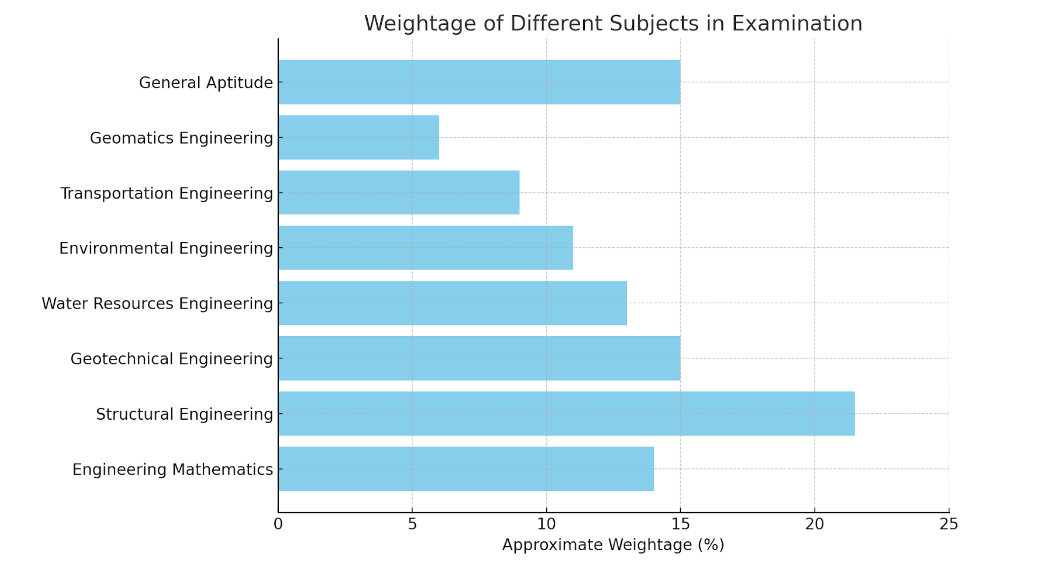
- Engineering Mathematics (13%): It constitutes approximately 13% of the total questions in the GATE CE exam.
- Structural Engineering (20-25%): This carries the highest weightage between 20-25%. This will comprise some of the core topics: Strength of Materials and Structural Analysis.
- Geotechnical Engineering: It also has a considerable weightage, from 15% to 18% of the questions. Soil Mechanics and Foundations are very highly tested and critical to do well.
- Environmental Engineering: This section contributes 10% to 12% of the overall weightage of the exam. It mainly consists of water and waste water treatment and is relatively easier to attain good marks if prepared well.
- Water Resources Engineering (10-12%): This is one other important area, contributing to 10% to 12%. Into this area fall subjects like Fluid Mechanics and Hydrology, which are commonly challenged.
- Transportation Engineering (7-10%): Generally this comes to 7% to 10% in the exam. Though its weightage is a little lesser, topics like Highway Engineering are well important and pretty straightforward.
- Geomatics Engineering (5-7%): The lowest weighting, is 5%-7%, but these are very relevant and carry significant marks if well prepared. Includes Surveying, where a good amount can be scored if one has prepared the material well.
Preparation Strategy: GATE CE 2025
Suggested Article: GATE Preparation Strategy
Phase 1: Concept Building & Learning (Month 1-2)
| Subject | Weightage (%) | Time Allocation (Hours per Day) | Weeks | Strategy |
|---|---|---|---|---|
| Engineering Mathematics | 13-15% | 1-1.5 hours | Week 1-2 | Focus on fundamental topics: linear algebra, calculus, probability, and numerical methods. Solve GATE previous year questions. |
| Structural Engineering | 20-23% | 2-2.5 hours | Week 1-2 | Study Strength of Materials and Structure Analysis. Use diagrams for better conceptual clarity. |
| Geotechnical Engineering | 14-16% | 1.5-2 hours | Week 3-4 | Focus on Soil Mechanics and Foundation Engineering. Practice problems on consolidation and soil permeability. |
| Water Resources Engineering | 12-14% | 1-1.5 hours | Week 3-4 | Cover topics like Fluid Mechanics, Open Channel Flow, and Hydrology. Solve application-based questions. |
| Environmental Engineering | 10-12% | 1-1.5 hours | Week 5-6 | Study Water Supply, Wastewater Treatment, and Solid Waste Management. Focus on both theory and numerical problems. |
| Transportation Engineering | 8-10% | 1 hour | Week 5-6 | Study Highway Engineering and Traffic Analysis. Use diagrams to understand geometric design. |
| Geomatics Engineering | 5-7% | 1 hour | Week 7-8 | Understand Surveying Techniques, GIS, and Remote Sensing basics. |
| General Aptitude | 15% | 1 hour | Week 7-8 | Focus on verbal ability, numerical reasoning, and practice with previous GATE questions. |
Total Daily Hours: 4-6 hours
Phase 2: Practice & Problem-Solving (Month 3-4)
| Subject | Weightage (%) | Time Allocation (Hours per Day) | Weeks | Strategy |
|---|---|---|---|---|
| Structural Engineering | 20-23% | 2-2.5 hours | Week 9-10 | Solve problems on Structural Design, Trusses, Beams, and Columns. Focus on accuracy. |
| Geotechnical Engineering | 14-16% | 1.5-2 hours | Week 9-10 | Practice problems on Foundation Engineering, Bearing Capacity, and Soil Properties. |
| Water Resources Engineering | 12-14% | 1-1.5 hours | Week 11-12 | Solve numerical problems on Open Channel Flow, Hydraulics, and Fluid Mechanics. |
| Environmental Engineering | 10-12% | 1-1.5 hours | Week 11-12 | Focus on problems related to Water Treatment and Air Quality. Strengthen practical application. |
| Transportation Engineering | 8-10% | 1 hour | Week 13-14 | Solve problems in Pavement Design and Traffic Analysis. Focus on time management. |
| Geomatics Engineering | 5-7% | 1 hour | Week 13-14 | Solve problems related to Surveying and Remote Sensing. Practice short-answer questions. |
| Engineering Mathematics | 13-15% | 1-1.5 hours | Week 15-16 | Solve previous years' questions, especially focusing on tricky topics like probability and differential equations. |
| General Aptitude | 15% | 1 hour | Week 15-16 | Continue practicing verbal and numerical ability questions. Take time-bound tests. |
Total Daily Hours: 5-7 hours
Phase 3: Full-Length Mock Tests & Revision (Month 5)
| Subject | Weightage (%) | Time Allocation (Hours per Day) | Weeks | Strategy |
|---|---|---|---|---|
| Structural Engineering | 20-23% | 2-2.5 hours | Week 17-18 | Revise key topics and formulas. Practice GATE-style problems. Analyze performance in mock tests. |
| Geotechnical Engineering | 14-16% | 1.5-2 hours | Week 17-18 | Review concepts of Soil Mechanics and Foundation Engineering. Focus on numerical problem-solving. |
| Environmental Engineering | 10-12% | 1-1.5 hours | Week 17-18 | Revise numerical and theoretical aspects of Water and Wastewater Treatment. |
| General Aptitude | 15% | 1 hour | Week 17-18 | Continue taking aptitude practice tests to improve speed and accuracy. |
| Water Resources Engineering | 12-14% | 1.5-2 hours | Week 19-20 | Take mock tests on Fluid Mechanics and Hydrology. Analyze mistakes and review weak areas. |
| Transportation Engineering | 8-10% | 1 hour | Week 19-20 | Focus on weak areas in Highway Engineering. Revise formulas for geometric design. |
| Engineering Mathematics | 13-15% | 1-1.5 hours | Week 19-20 | Review complex topics like probability and differential equations. |
| Geomatics Engineering | 5-7% | 1 hour | Week 19-20 | Review Surveying techniques and GIS concepts. |
Also Check: GATE Mock Test 2025- Attempt free online Branch wise, Chapter wise and Subject wise Mock Test Series
Total Daily Hours: 6-8 hours
Overall Preparation Strategy Summary:
- Phase 1: Revise all subjects, marking hours for each subject on the basis of its weightage. Spend time strictly on understanding concepts and making notes.
- Phase 2: Focus on problem-solving and application-based learning. Try to keep a tab on time while solving problems for improvement in terms of speed and accuracy.
- Phase 3: Revise and focus on full-length mock tests so that he gets a feeling of the actual GATE exam. Analyze mistakes and get strong in weaker areas.
It balances the time for each subject with an emphasis on high-weightage areas and ensures that the syllabus is covered with mock tests and revision.
Study Material for GATE CE 2025
Here’s a Suggested Study Material for GATE Civil Engineering preparation based on past years' data:
| Subject | Topics | Recommended Books / Resources |
|---|---|---|
| Structural Engineering | Theory of StructuresDesign of StructuresAnalysis of Structures | "Structural Analysis" by R.C. Hibbeler"Design of Reinforced Concrete Structures" by M.L. Ges" by S. Ramamrutham |
| Geotechnical Engineering | Soil MechanicsFoundation EngineeringGeotechnical Investigations | "Principles of Geotechnical Engineering" by Braja M. Das"Soil Mechanics" by S. S. BhavikattiNPTEL Videos on Geotechnical Engineering |
| Transportation Engineering | Highway EngineeringTraffic EngineeringRailway Engineering | "Highway Engineering" by S.K. Khanna and C.E. Justo"Traffic Engineering" by L.R. KadiyaliNPTEL Videos on Transportation Engineering |
| Water Resources Engineering | HydraulicsFluid MechanicsIrrigation Engineering | "Fluid Mechanics" by Frank M. White"Water Resources Engineering" by Larry W. MaysNPTEL Videos on Water Resources Engineering |
| Environmental Engineering | Water SupplyWastewater EngineeringAir Pollution Control | "Environmental Engineering" by Howard S. Peavy"Wastewater Engineering: Treatment and Reuse" by Metcalf & Eddy |
| Construction Management | Project Management Construction MethodsCost Estimation | "Construction Project Management" by K.K. Chitkara"Project Management: A Systems Approach to Planning, Scheduling, and Control" by Harold Kerzner |
| Engineering Mathematics | Linear AlgebraCalculusProbability and Statistics | "Higher Engineering Mathematics" by B.S. Grewal"Engineering Mathematics" by K.A. Stroud |
| General Aptitude | Verbal AbilityNumerical Ability | "Quantitative Aptitude" by R.S. Aggarwal"A Modern Approach to Verbal & Non-Verbal Reasoning" by R.S. Aggarwal |
Additional Resources:
- Previous Year GATE Question Papers: Solve the old papers to sense the pattern and time management.
- Online Courses: NPTEL, Coursera, and edX are online portals where civil engineering students may seek free resources on numerous civil issues.
- Some of the good books for GATE preparation are those books that are specifically tailored for GATE preparation.
- GATE CE Previous Years' Question Papers with Answer Key
- GATE CE Paper is one, which consists of 100 marks, and involves 65 questions, which have to be attempted in 3 hours.
Also check: GATE Books 2025 PDF Download
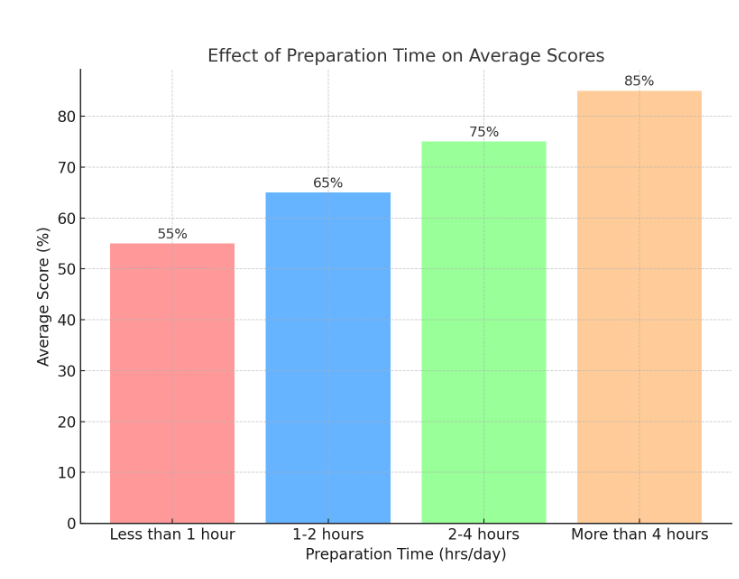
Table: Preparation Time vs. Average Scores
Here's an idea of how preparation time can influence average scores: a hypothetical distribution for four types of students depending on the time (in hours/day) spent preparing and the corresponding average scores.
| Preparation Time (hrs/day) | Average Score (%) |
|---|---|
| Less than 1 hour | 55% |
| 1-2 hours | 65% |
| 2-4 hours | 75% |
| More than 4 hours | 85% |
GATE CE Previous Years’ Question Papers with Answer Key
GATE CE Paper carries a total of 100 marks and comprises 65 questions that need to be attempted within a time frame of 3 hours. Aspirants preparing for GATE Exam can download the previous year's GATE Civil Engineering (CE) Question Paper with answer key PDFs in the article below:
| Exam Date | Session | Link |
|---|---|---|
| February 12 | Forenoon Session | Click Here |
| February 12 | Afternoon Session | Click Here |
Study Tips:
- Regular Practice: Consistently solve numerical problems and conceptual questions.
- Schedule Revision: Hold revision sessions regularly for better retention.
- Mock Tests: Regular GATE CE Mock Tests help assess their level of preparation and increase the speed and accuracy of students.
The GATE Civil Engineering 2025 exam requires strategic preparation under the concept-based approach coupled with hands-on practice. The strategy of preparation must target high-weightage subjects through a structured study plan consisting of three phases, namely concept building, problem-solving, and revision to go in for optimal preparation. Studying recommended material, previous years' question papers, and online resources will work for making the key topics stronger. This would complement consistent practice, timely revisions, and mock tests to prepare you well to tackle the exam with confidence. Thus, dedication and a strategy in place would make you a very important player in this highly competitive examination with a good chance of bringing home a top rank. Good luck for your preparation!



Comments