




GATE for Civil Engineering is one of the most competitive examinations that engineering graduates face. Every year, lakhs of students sit for the GATE CE examination for further higher education or placements in Public Sector Undertakings.
Analyzing the past years' question papers will give some kind of a brief idea as to what is changing, what kind of questions are being asked, and the weightage attached to various topics.
This article presents a comprehensive analysis of GATE Civil Engineering papers for previous years to enable aspirants to plan better for 2025 preparations.
GATE Civil Engineering (CE) Exam Analysis
Suggested Topic: GATE Exam Pater for CE
| Exam Pattern Overview | Details |
|---|---|
| Total Marks | 100 |
| Total Questions | 65 |
| Question Types | MCQs (Multiple Choice Questions), NAT (Numerical Answer Type), MSQs (Multiple Select Questions) |
| Sections | General Aptitude: 15 marksEngineering Mathematics: 15-18 marksCivil Engineering Topics: 67-70 marks |
Related Articles
- GATE Civil Engineering 2025 syllabus PDF
- GATE Civil Engineering 2025: Recommended Books
- Previous Years’ Question Paper: GATE CE
Section-Wise Weightage Analysis
Based on the analysis of GATE Civil Engineering papers from the last five years (2020-2024), the marks obtained for each main topic are as follows:
| Topic | Weightage (2020) | Weightage (2021) | Weightage (2022) | Weightage (2023) | Weightage (2024) |
|---|---|---|---|---|---|
| Environmental Engineering | 10-12 marks | 10-12 marks | 8-10 marks | 10-12 marks | 10-12 marks |
| Geotechnical Engineering | 14-16 marks | 12-14 marks | 14-16 marks | 14-16 marks | 14-16 marks |
| Structural Engineering | 15-17 marks | 16-18 marks | 16-18 marks | 15-17 marks | 16-18 marks |
| Fluid Mechanics & Hydraulics | 8-10 marks | 10-12 marks | 8-10 marks | 10-12 marks | 8-10 marks |
| Transportation Engineering | 7-8 marks | 6-8 marks | 6-8 marks | 6-8 marks | 7-8 marks |
| Engineering Mathematics | 12-15 marks | 12-15 marks | 15-18 marks | 15-18 marks | 12-15 marks |
| General Aptitude | 15 marks | 15 marks | 15 marks | 15 marks | 15 marks |
Key Trends:
- Geotechnical Engineering and Structural Engineering are the two most heavily weighted topics and contribute between 14-18 marks.
- The two major subjects, Environmental Engineering and Fluid Mechanics have always been consistent in weightage, though with minor deviations in the last few years.
- The General Aptitude section remains 15 marks every year and Engineering Mathematics can be a consistent weightage in the range of 12-18 marks.
Topic-Wise Question Distribution
The GATE syllabus for Civil Engineering is very vast and covers a lot of material with varied depth as every year progresses. Here below is a topic-wise distribution of the number of questions asked from major subjects over the past five years.
| Topic | 2020 | 2021 | 2022 | 2023 | 2024 |
|---|---|---|---|---|---|
| Environmental Engineering | 8 | 9 | 7 | 9 | 10 |
| Geotechnical Engineering | 11 | 12 | 12 | 13 | 14 |
| Structural Engineering | 12 | 13 | 14 | 13 | 15 |
| Fluid Mechanics & Hydraulics | 8 | 7 | 8 | 8 | 7 |
| Transportation Engineering | 5 | 6 | 6 | 5 | 6 |
| Engineering Mathematics | 10 | 10 | 11 | 12 | 11 |
| General Aptitude | 10 | 10 | 10 | 10 | 10 |
Key Trends:
- Geotechnical Engineering is one of the subjects, wherein the number of questions has increased from 11 to 14, thereby holding an important place in the GATE CE examination.
- Structural Engineering has consistently provided a good number of questions (12-15), which implies that the subject matter calls for thorough preparation.
- Environmental Engineering and Fluid Mechanics is providing steady contributions, though without those no good score could have been achieved.
Difficulty Level Analysis of GATE Civil Engineering Papers (Year-wise & Topic-wise)
Here’s a brief table showing the difficulty level of the GATE Civil Engineering exam over the past five years (2020-2024), categorized by easy, moderate, and difficult questions across major topics.
| Year | Topic | Easy (%) | Moderate (%) | Difficult (%) |
|---|---|---|---|---|
| 2020 | Geotechnical Engineering | 30% | 50% | 20% |
| 2021 | Structural Engineering | 25% | 55% | 20% |
| 2022 | Environmental Engineering | 20% | 60% | 20% |
| 2023 | Fluid Mechanics & Hydraulics | 25% | 50% | 25% |
| 2024 | Transportation Engineering | 22% | 58% | 20% |
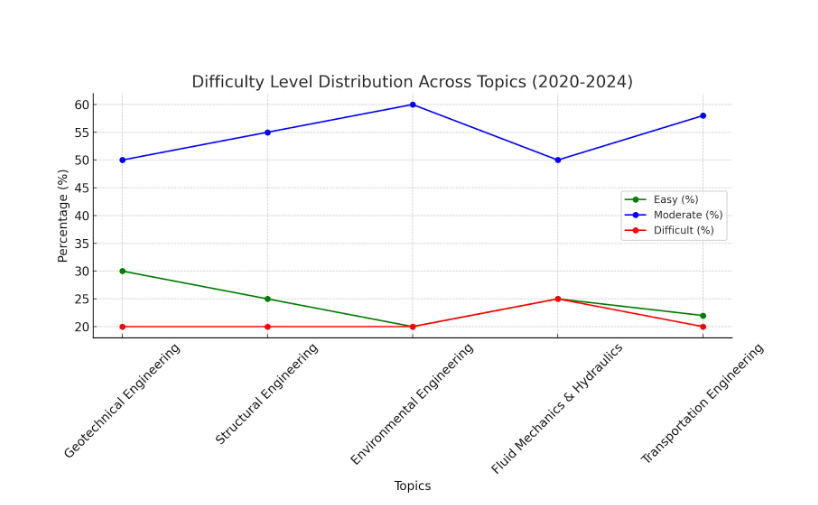
Here are the key points from the table and graph of analyzing the GATE Civil Engineering papers difficulty level 2020-2024:
Geotechnical Engineering (2020):
- Easy: 30%, Moderate: 50%, Difficult: 20%
- A significant portion of questions (50%) were of moderate difficulty, while a smaller share (20%) was challenging.
Structural Engineering (2021):
- Easy: 25%, Moderate: 55%, Difficult: 20%
- This topic had the highest percentage of moderate questions (55%), showing a heavier focus on mid-level difficulty questions.
Environmental Engineering (2022):
- Easy: 20%, Moderate: 60%, Difficult: 20%
- The majority of questions (60%) were moderate, with fewer easy questions (20%).
Fluid Mechanics & Hydraulics (2023):
- Easy: 25%, Moderate: 50%, Difficult: 25%
- A balanced difficulty distribution with equal numbers of easy and difficult questions (25% each) and 50% moderate.
Transportation Engineering (2024):
- Easy: 22%, Moderate: 58%, Difficult: 20%
- Moderate questions dominated (58%), with fewer easy questions than in previous years.
Insights of the Graph:
- Moderate-level dominance: all subjects have the greatest number of questions at the moderate level and tend to this level for testing of a middle level of understanding.
- Years differ in difficulty: Though every year has around 20-25% difficult questions, easy questions differ in numbers from year to year. For example, Environmental Engineering has fewer easy questions compared to other topics.
- Consistent tough question percentage: For all topics, there is a consistent 20-25% percentage of tough questions; this means that the challenge level GATE poses remains consistent across the years.
It allows candidates to focus more on moderate-level questions and retain a fair understanding both of the easy part and the more difficult parts.
Numerical Answer Type (NAT) vs. Multiple Choice Questions (MCQs): The GATE exam contains both MCQ and NAT questions. Here’s the distribution of these question types in the last five years:
| Question Type | 2020 | 2021 | 2022 | 2023 | 2024 |
|---|---|---|---|---|---|
| MCQs | 35 | 33 | 34 | 32 | 35 |
| NAT | 30 | 32 | 31 | 33 | 30 |
Key Takeaway:
- There is almost an equal number of MCQ and NAT questions, around 30-35 each.
- NATs are always tougher questions, especially as no option is given and the student has to calculate it with a more accurate percentage in order to solve it.
Previous Year Question Papers for GATE CE
You can upgrade your practice by strictly adhering to the previous year's question papers religiously. This will help you to have a deep insight into the subject matter and type of questions:
| Session | Question Paper PDF | Answer Key PDF |
| GATE 2024 | CE Set-1 CE Set-2 | CE Set-1 CE Set-2 |
| GATE 2023 | CE Set-1 CE Set-2 | CE Set-1 CE Set-2 |
| GATE 2022 | CE Set-1 CE Set-2 | CE Set-1 CE Set-2 |
| GATE 2021 | CE Set-1 CE Set-2 | CE Set-1 CE Set-2 |
Also Check: GATE CE 2025: Preparation Strategy
Book Recommendations Based on Topics
Suggested Article: GATE CE: Best Study Material
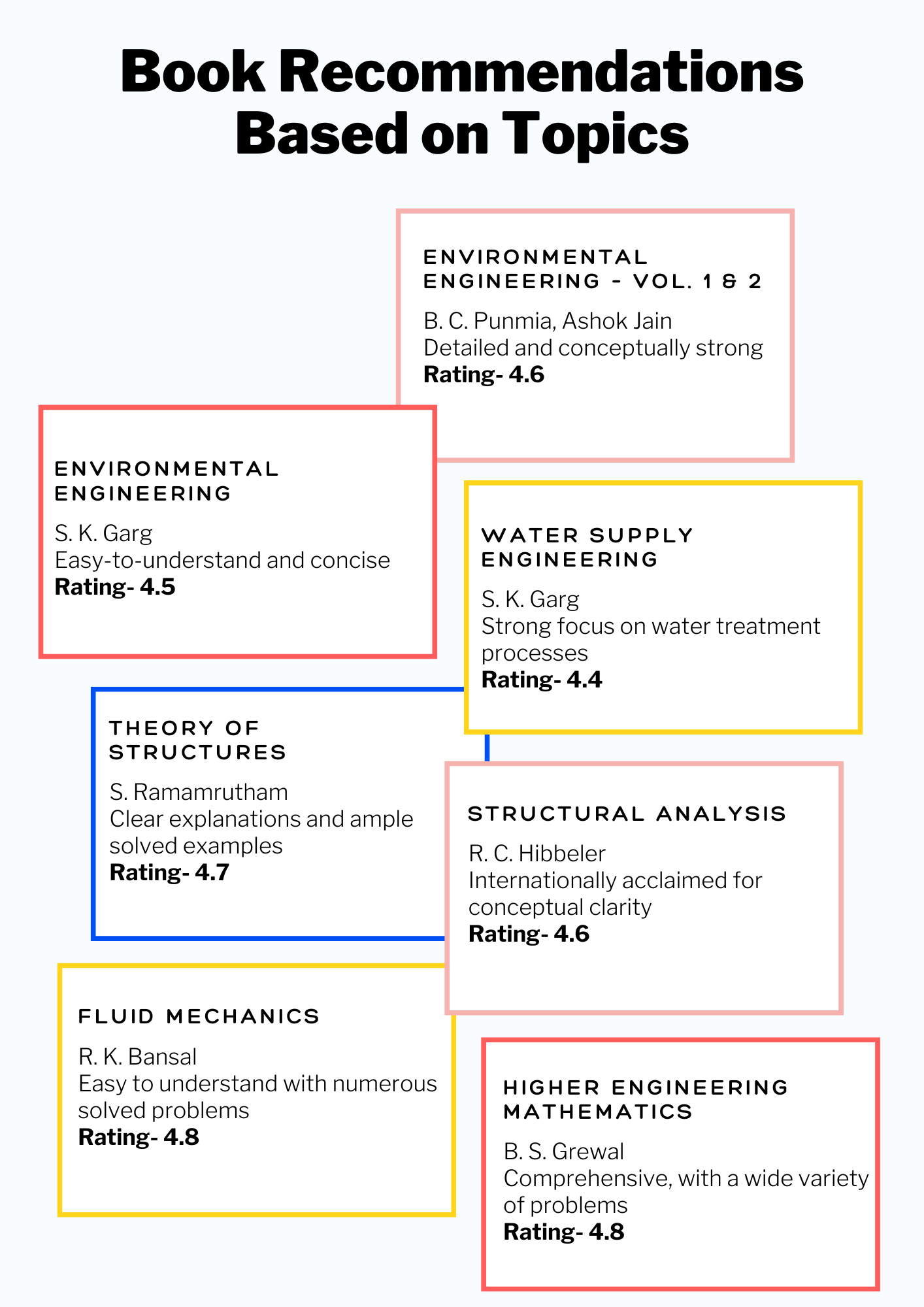
Based on the insights above, here are some recommended books with specific strengths that align with the GATE Civil Engineering syllabus.
These books provide a comprehensive resource base, covering theory and practical problems relevant to the GATE syllabus.
Based on past examination trends, the focus areas that place maximum stress on the students are Geotechnical Engineering, Structural Engineering, and Environmental Engineering. The former two consistently hold a higher weightage during the entire examination, and hence, any significant exposure to these can give extra boosts to the total score.
- Practice NATs: In a world where the proportion of NAT questions just keeps growing, resolution in an actual examination setting becomes a must in practicing these questions.
- Conceptual Understanding: Most questions are moderate, and hence strong conceptual understanding will enable us to solve more questions in less time.
- Balance the Preparation: General Aptitude and Engineering Mathematics remain scoring sections. A balanced preparation for technical and non-technical sections is recommended.
The aspirants can thus tailor their preparation in those areas that require the most attention, improve their accuracy on numerical questions, and be well-equipped to face the GATE Civil Engineering exam in 2025.



Comments