




GATE Ecology and Evolution (EY) is a unique blend that covers ecology, evolutionary biology, biodiversity, and environment science and has been designed to provide aspirants with this all-rounded arena to unveil their mastery over these science disciplines in the life domain. These topics, as they add up to 30% in ecology and 25% in evolution are at the very heart of the curriculum. Therefore, deep understanding in this area may help reach very high score levels.
- Biodiversity, Environmental Science, and Statistical Methods make up the remaining syllabus, amounting to about 20%, 15%, and 10% of the total weightage, respectively.
- Recognizing this composition can be of great use to aspiring students to distribute their studying time and give more concentration on Ecology and Evolution by honing up their skill sets in analyzing data with the help of statistical methods in ecological studies.
- It discusses every topic, which this book covers to ensure an appropriate approach to dominate the GATE EY syllabus 2025.
- The exam dates of GATE from IIT Roorkee are set on 1, 2, 15 & 16, February 2025.
Related Articles:
These core topics from the GATE Ecology and Evolution Syllabus are going to carry the weightage of around 85 percent of the total score, which becomes very crucial for students to dominate in these topics. As follows are the detailed sections of the GATE Ecology and Evolution Syllabus 2025:
- Ecology
- Evolution
- Biodiversity
- Environmental Science
- Statistical Methods in Ecology
- Field Methods in Ecology and Evolution
After a proper understanding of these sections, candidates can raise their chances to a greater extent for achieving a good score in the GATE Ecology and Evolution exam.
GATE EY 2025 Exam Pattern
| Aspect | Details |
|---|---|
| Exam Mode | Computer-Based Test (CBT) |
| Duration | 3 hours (180 minutes) |
| Total Marks | 100 marks |
| Question Types |
Multiple Choice Questions (MCQs) Numerical Answer Questions (NATs) |
| Number of Questions | Approximately 65 questions |
| Sectional Weightage |
General Aptitude: 15% (15 marks) Ecology and Evolution: 85% (85 marks) |
| Marking Scheme |
MCQs: 1 mark for correct answer (1/3 mark negative for incorrect) NATs: No negative marking |
| Syllabus Coverage | Topics from ecology, evolution, biodiversity, environmental science, and statistical methods |
| General Aptitude Topics |
Verbal Ability Numerical Ability |
Overview of GATE Ecology and Evolution
| Section | No. of Questions | Type of Questions | Marks | Duration |
|---|---|---|---|---|
| General Aptitude (GA) | 10 | Multiple Choice Questions (MCQs) | 15 | 3 hours |
| Ecology and Evolution | 55 | Multiple Choice Questions (MCQs)/Numerical Answer Type (NAT) | 85 | |
| Total | 65 | 100 |
Section-Wise Syllabus Overview for GATE Ecology and Evolution (EY) 2024
Ecology
- Fundamental Concepts: Abiotic and biotic components, Population, species, community, ecosystems, biomes, niches, and habitats
- Ecological Interactions: Mutualism, commensalism, parasitism, competition, predation, symbiosis, ecophysiology
- Population Ecology: Growth rates, age structure, density dependence, metapopulation dynamics (colonization, extinction)
- Community Ecology: Succession, species richness, diversity indices, island biogeography
- Ecosystem Ecology: Trophic levels, nutrient cycles, primary and secondary productivity
Evolution
- History of Evolutionary Thought: Lamarckism, Darwinism, Modern Synthesis
- Fundamentals: Variation, heritability, natural selection, fitness, adaptation, types of selection (stabilizing, directional, disruptive)
- Diversity of Life: Origin of life, classification (cladistics, phenetics)
- Interactions: Coevolution, predator-prey interactions, mimicry, cryptic behavior
- Population and Quantitative Genetics: Genetic variation, Hardy-Weinberg equilibrium, genetic drift, selection models, gene flow, heritability
- Macroevolution: Speciation, adaptive radiation, biogeography, phylogenetics
Mathematics and Quantitative Ecology
- Mathematical Functions: Linear, quadratic, exponential, and logarithmic functions
- Statistics: Descriptive statistics, probability distributions, hypothesis testing
- Probability: Random events, probability rules, conditional probability
Behavioral Ecology
- Animal Behavior: Decision-making, foraging theory, reproductive behavior, social behavior, altruism
- Life History Strategies: Resource allocation, reproductive strategies, trade-offs
Applied Ecology & Evolution
- Conservation Biology: Biodiversity, conservation strategies, endangered species, habitat management
- Environmental Management: Ecosystem services, climate change, sustainable resource management
General Aptitude
- Verbal Ability: Vocabulary, grammar, sentence completion, verbal analogies
- Quantitative Ability: Arithmetic, algebra, data interpretation, analytical reasoning
Each section assesses the candidate's understanding of both theoretical concepts and quantitative analysis. Emphasizing topics with high applicability, such as Population Ecology and Evolutionary Theory, will be advantageous due to their significant weightage in the exam.
GATE EY Subject: Weightage Analysis
From the recent analysis of GATE EY papers, here’s an approximate weightage distribution:
| Section | Approximate Weightage (%) |
|---|---|
| Ecology | 30% |
| Evolution | 25% |
| Mathematics and Quantitative Ecology | 20% |
| Behavioral Ecology | 15% |
| Applied Ecology & Evolution | 10% |
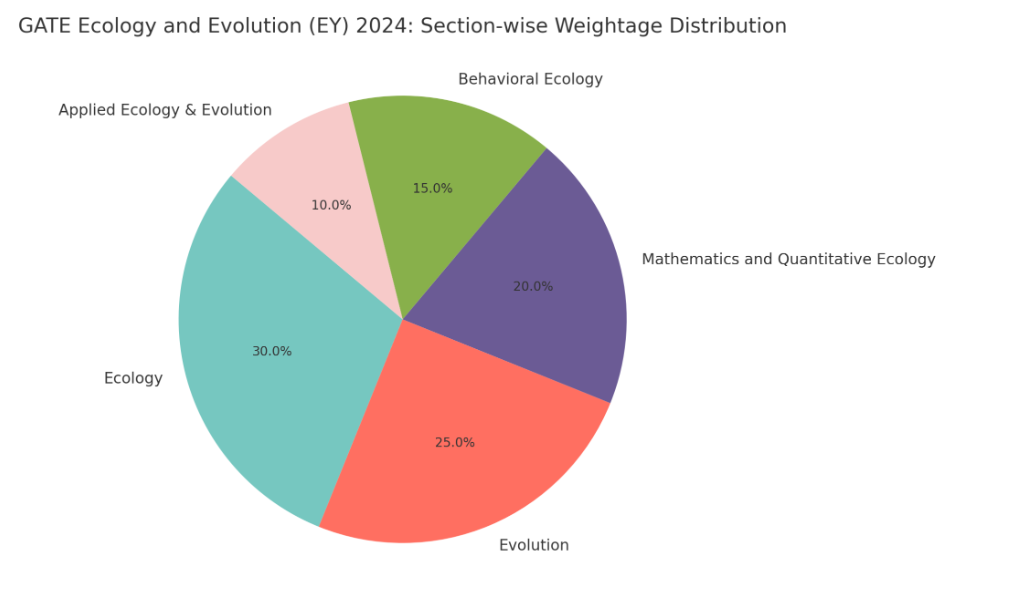
Such weightage gives a strong foothold to the foundational knowledge in Ecology and Evolution with a moderate set of quantitative skills. The General Aptitude section is another part of the paper, accounting for 15% of the total marks.
Ecology (30%)
- Key Topics: Ecosystem dynamics, Population ecology, Biogeography
- Preparing Techniques: Learn the principles of ecology and concepts using the case studies. Use diagrams and models to retain and know them.
Evolution (25%)
- Key Topics: Natural selection, Speciation, Evolutionary history
- Preparation Strategies: Understand the core concepts based on the evolutionary models and new trends of research. Try to explain these concepts to real-life situations.
Biodiversity (20%)
- Key Topics: Classification of species, Conservation biology, Ecological significance
- Preparation Strategies: Field studies and biodiversity assessments; case studies involving conservation activities and their impacts.
Environmental Science (15%)
- Key Topics: Pollution and its effects, Climate change, Sustainable development practices
- Preparation Strategies: Understanding the current environmental issues and policy issues. Engagement in applications and discussions on the topic of sustainability
Statistical Methods (10%)
- Key Topics: Data analysis techniques, Hypothesis testing, Sampling methods
- Preparation Strategies: The goal is to use data for data analysis and to learn to understand the ecological information it is presenting.
GATE Ecology and Evolution 2025: Important Topic
Suggested Article: Important Theories and Models in GATE Ecology and Evolution 2025
In addition to the complete GATE EY syllabus for 2025, aspirants are recommended to focus on the following important topics, which are crucial for effective exam preparation:
- Ecological Concepts
- Evolutionary Biology
- Population and Quantitative Genetics
- Behavioral Ecology
- Conservation Biology
- Environmental Science
- Statistical Methods in Ecology
- Mathematics for Ecological Modeling
Section-Wise Important Topics with Sample Questions and Tips
The information is organized in a table format for better clarity and reference:
| Section | Important Topics | Sample Questions | Tips |
|---|---|---|---|
| Ecology |
|
Analyze the effects of nutrient cycling on ecosystem health. Identification of factors affecting population growth. | Focus on understanding ecological principles and relationships. To visualize the concepts, Use diagrams and case studies |
| Evolution |
|
Describe the process of adaptive radiation. Explain the significance of genetic drift in small populations. | Master key evolutionary concepts through models and real-world examples. Review current research trends in evolutionary biology. |
| Biodiversity |
|
Assess the impact of habitat loss on species diversity. Compare different conservation approaches. | Engage with field studies and case studies on conservation efforts.Understand the practical implications of biodiversity assessments. |
| Environmental Science |
|
Evaluate the effectiveness of a specific pollution control measure. Discuss the challenges of implementing sustainable practices. | stay updated on current environmental policies and issues. Relate theoretical knowledge to practical applications in environmental management. |
| Statistical Methods |
|
Calculate the control limits for a control chart. Interpret data from ecological studies. | Practice using statistical tools and software for data analysis Focus on understanding and interpreting ecological data effectively |
By focusing on these important topics and employing effective preparation strategies, candidates can enhance their understanding of core concepts in Ecology and Evolution. Engaging with sample questions and practical applications will further solidify their readiness for the GATE EY 2025 exam.
Quick links:
Comparative Analysis of Core Sections
Suggested Article: Analysis of GATE Ecology and Evolution 2025 Cut-Off Trends Over the Years
As GATE EY 2025 approaches, understanding the core sections of the exam is crucial for effective preparation. Below is a comparative analysis of the key sections, focusing on their weightage, topics covered, and preparation strategies.
| Section | Weightage | Key Topics | Preparation Strategies |
|---|---|---|---|
| Ecology | 30% | Ecosystem dynamics, population ecology, biogeography | Focus on ecological principles and case studies. Use diagrams for better retention. |
| Evolution | 25% | Natural selection, speciation, evolutionary history | Understand key concepts through evolutionary models and current research trends. |
| Biodiversity | 20% | Classification, conservation biology, ecological significance | Utilize field studies and biodiversity assessments; explore case studies on conservation efforts. |
| Environmental Science | 15% | Pollution, climate change, sustainable development | Keep updated with current environmental issues and policies; engage with practical applications. |
| Statistical Methods | 10% | Data analysis, hypothesis testing, sampling techniques | Practice statistical tools and software for analysis; focus on interpreting ecological data. |
GATE EY Marks Distribution Section-wise
Here's the marks distribution by section for GATE Ecology and Evolution (EY) 2025, including estimated weightage for effective preparation:
Marks Distribution by Section for GATE EY 2025
| Section | Marks Distribution (%) | Estimated Marks |
|---|---|---|
| Ecology | 30% | 30 marks |
| Evolution | 25% | 25 marks |
| Biodiversity | 20% | 20 marks |
| Environmental Science | 15% | 15 marks |
| Statistical Methods | 10% | 10 marks |
Total Marks: 100
This distribution indicates how vital each section is to be placed within the GATE EY exam. Thus, candidates must prepare under these proportions, prepare, and give more importance to the Ecology and Evolution part due to its high weightage in the examination.
GATE Ecology and Evolution Books
The information about recommended books for GATE Ecology and Evolution (EY) 2025 is organized in a tabular format:
| Title | Author(s) | Description |
| Ecology: Concepts and Applications | Molles, M. C. | Comprehensive overview of ecological principles with real-world applications, ideal for understanding ecosystems. |
| Evolutionary Biology | Douglas J. Futuyma | A thorough introduction to evolutionary concepts, mechanisms, and theories for grasping the fundamentals of evolution. |
| Biogeochemistry: An Analysis of Global Change | Schlesinger, W. H. | Discusses biogeochemical cycles and their relevance to global ecological processes, essential for ecosystem dynamics. |
| Biodiversity | R. A. Watson, R. E. McDonald, and S. M. McGuinness | Covers aspects of biodiversity, ecological significance, and conservation strategies for a well-rounded perspective. |
| Statistical Methods in Ecology | Robert G. Dunn and S. W. W. Wong | A practical guide to statistical techniques used in ecological studies, helping analyze and interpret ecological data. |
| Environmental Science: A Global Concern | William P. Cunningham and Mary Anne Cunningham | Addresses key environmental issues, pollution, climate change, and sustainable practices relevant to the syllabus. |
| Mathematical Ecology | Robert M. May | Insight into mathematical modeling in ecology, providing tools for understanding ecological dynamics quantitatively. |
| Field Guide to the Plants of the Cape Peninsula | John M. Manning and Paul G. James | Useful for understanding local biodiversity, crucial for conservation biology, specific to a region. |
Also check: Top Resources for GATE Ecology and Evolution
These books will provide a well-rounded base for GATE Ecology and Evolution preparation as they cover the essentials in the syllabus and make the student practically understand it through different approaches.



Comments