




If you are preparing for GATE Metallurgical Engineering, the previous year's question papers can be one of the best resources. GATE question papers play a significant role in the preparation process. The optimum time to practice GATE Metallurgical Engineering Question Papers from the previous five years is one month before the exam. It will assist students in comprehending the examination pattern and the types of questions presented. The GATE MT question paper will help students understand the kind of questions posed in past years’ exams, the test format, the difficulty level, question trends, topic-wise significant chapters and their weightage, and much more.
Quick Links:
The GATE Metallurgical Engineering Previous Years Papers with Solutions have been provided in this article. This page contains Metallurgical GATE exam papers from past years. Candidates may practice and enhance their preparation by downloading GATE Metallurgical Engineering Previous Years Papers with Solutions.
Check:
| GATE 2024 MT Question Paper PDF | GATE 2024 MT Answer Key PDF |
|---|---|
| Download PDF | Download PDF |
GATE Metallurgy Exam Structure
GATE Metallurgy test questions are multiple-choice questions – MCQs, numerical answer type questions NATs, and multiple select questions – MSQs. The GATE Exam syllabus encompasses:
- Physical Metallurgy
- Materials Science
- Thermodynamics and Kinetics
- Phase Diagrams
- Special Concentration: Mechanical Properties of Materials
- More specific subject areas of interest include Materials Processing and Characterization.
- Corrosion and degradation are the natural or accidental oxidation and wear away of materials through chemical reactions, which make them unsuitable for use.
Also Check:
- GATE Other Subjects Previous Year Analysis
- Previous Year GATE Metallurgical Engineering Question Papers
It is important to have information regarding the format of the exam. It will help learners who intend to use internet-based resources and other materials in the preparation process. The GATE Exam Pattern for question formats are:
- MCQs: These question types are used to ensure that the basic concept of the students is tested with some of the options being very tricky.
- NATs: Focus on numbers and demand solutions that are to be mined from sample basic concepts.
- MSQs: These include many right choices and check the depth of knowledge.
| Question Type | Awarded Marks | Negative Marking (Reduced to) | Important Points |
|---|---|---|---|
| Multiple Choice Questions (MCQs) | Marks: 1 | Marks: 0.33 | Four choices, one of which is right |
| Marks: 2 | Marks: 0.66 | ||
| Numeric Type Question(NQTs) | Marks:1 | Marks: No negative | No optionsThe response is a real number to insert via a virtual keyboard and mouse |
Check: GATE Metallurgy Previous Year Question Papers
| Exam Date | Session | Question Paper PDF |
|---|---|---|
| February 11, 2023 | Afternoon Session | Check Here |
| February 6, 2022 | Forenoon Session | Check Here |
| February 14, 2021 | Afternoon Session | Check Here |
| February 1, 2020 | Forenoon Session | Check Here |
| February 3, 2019 | Afternoon Session | Check Here |
Trends in Previous Year Question Papers
Topic Distribution
A thorough review of past GATE question papers highlights trends in topic frequency:
- Physical Metallurgy: This is a major concentrate, and frequently posed questions dealing with crystal structures, defects, and phase transformations.
- Thermodynamics: Possible questions may involve basic concepts, numerical problems, and real-life case studies of metallurgy.
- Materials Processing: Generally, topics covered in this definition include processes of making of products and uses of the products in daily life often with examples.
- Phase Diagrams: Phase diagrams especially binary and ternary are required in depth and questions cover matters of equilibrium conditions and transformations.
- Mechanical Properties: Expect a mix of questions on stress-strain behavior, hardness testing, and fatigue analysis.
| Topic | Weightage (%) | Number of Questions |
|---|---|---|
| General Aptitude | 15 | 10 |
| Engineering Mathematics | 12 | 6 |
| Thermodynamics and Rate Processes | 15 | 8 |
| Physical Metallurgy | 20 | 10 |
| Mechanical Metallurgy | 18 | 9 |
| Manufacturing Processes | 10 | 5 |
| Extractive Metallurgy | 10 | 5 |
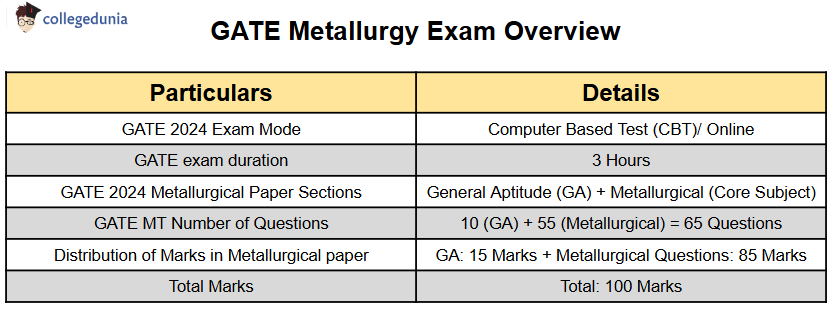
The GATE 2024 Metallurgical Engineering paper typically divides questions across the syllabus, with an overall structure that consists of 65 questions worth 100 marks: 15 marks for General Aptitude and 85 marks for subject-specific topics in metallurgy. Below is an approximate breakdown of the question weightage per key topics based on recent GATE exams:
| Topic | No of Questions | Approx. Marks |
|---|---|---|
| Engineering Mathematics | 4–5 | 13 |
| Physical Metallurgy | 6–8 | 10–12 |
| Thermodynamics | 4–5 | 6–8 |
| Transport Phenomena | 3–4 | 5–6 |
| Mechanical Metallurgy | 5–6 | 8–10 |
| Mineral Processing and Extractive Metallurgy | 5–6 | 7–9 |
| Iron and Steel Making | 4–5 | 8–10 |
| Casting and Joining Processes | 3–4 | 6–8 |
| Heat Treatment and Phase Transformations | 4–5 | 6–7 |
| Corrosion and Surface Engineering | 3–4 | 5–6 |
Difficulty Level
The difficulty of questions can vary by year. While some papers offer a mix of easy-to-moderate questions, others lean towards challenging problems. Generally, about 60% of questions are moderate to difficult, requiring strong problem-solving skills and conceptual knowledge.
Check: GATE Year-wise Exam Papers PDFs for Free Practice
| Exam Year | GATE Previous Year Question Papers with Solutions |
|---|---|
| GATE 2024 | Download Question Paper |
| GATE 2023 | Download Question Paper |
| GATE 2022 | Download Question Paper |
| GATE 2021 | Download Question Paper |
| GATE 2020 | Download Question Paper |
Benefits of Analyzing GATE Metallurgy Previous Year Question Paper
Analyzing the GATE Metallurgical Engineering question paper offers several benefits for students preparing for the exam:
- Understanding Question Patterns: The past papers enable the students to understand the kinds of questions in the GATE Metallurgy exam in terms of MCQs, MSQs, and NATs. Students must be aware of the format, and thus, can understand how to answer all questions given the time constraint during the examination.
- Identifying Key Topics and Weightage: The analysis of question papers indicates which topics have been covered more frequently in the GATE exam. First, students can realize that such topics as Thermodynamics, Physical Metallurgy, and Mechanical Metallurgy include more marks, as a rule. It also prepares them for the areas that attract more weight.
- Enhancing Problem-Solving Skills: Solving previous papers helps in increasing speed and precision. What is more important for the GATE exam is that it is time-bound. You must be easily able to recall correct methods and formulas.
- Building Confidence and Reducing Exam Anxiety: When a student is accustomed to tackling such questions they will not feel stressed because they know what they are dealing with. The more often the students work through similar tasks they become confident, and that will make them do well on tests.
- Improving Time Management: Solving one complete question paper under examination-like conditions enables the students to understand the time they will use on each section.
- Assessing Weaknesses and Progress: Solving past papers lets the students know areas that they find difficult and their progress in those areas over time. This then enables the students to easily develop a study plan where they get to cover the hard parts most often.
Incorporating previous question papers into the study plan can thus be a significant factor in achieving a high GATE score, ensuring familiarity with both the content and the format of the exam.



Comments