




GATE syllabus on Petroleum Engineering (PE) 2025 is an ultimate guidebook for those attempting to crack one of India's most competitive exams. GATE is conducted by IITs and IISc, and it evaluates the detailed understanding of the several branches of engineering. IIT Roorkee is conducting the GATE Exam 2025. GATE Petroleum Engineering Syllabus: The syllabus involves really important topics relevant to the oil industry. Topics involve drilling, reservoir engineering, well testing, production technology, and others. The student needs to know how the exam will be structured, which will help plan preparation for the GATE 2025 examination that will be held on February 1,2,15, and 16 2025
- Analyzing the data from previous years' exam trends, one could see that Reservoir Engineering, Drilling Engineering, and Production Technology always have higher weightage.
- From past trends, it has been noticed that Reservoir Engineering is the most heavily weighted section as it contributes to almost 30-35% of the total marks, whereas both Production Technology and Drilling Engineering contribute 25-30%.
- In addition, Engineering Mathematics and General Aptitude, appearing in all GATE papers, constitute about 15-20% of the total weightage, and proper balanced preparation is required here.
This guide will break down the GATE Petroleum Engineering 2025 syllabus in a very detailed manner, and based on past data and weightage analysis, give insights into what topics are important, recommended books, and tips on scoring well. Knowing the syllabus and its weight distribution is very helpful for aspirants as it helps them set their priorities right and ensures complete preparation.
Related Articles:
- GATE Petroleum Engineering 2025: Trends in Cut-Off Marks Over the Last 5 Years
- GATE Question papers
- GATE Eligibility 2025
Exam structure for GATE Petroleum Engineering (PE) 2025:
| Exam Component | Details |
|---|---|
| Exam Mode | Computer-Based Test (CBT) |
| Duration | 3 hours |
| Total Marks | 100 |
| Question Types |
|
| Sections |
|
| Number of Questions | 65 questions in total |
| Mark Distribution |
|
| Marks Per Question | 1 mark and 2 marks per question |
| Negative Marking |
|
GATE Petroleum Engineering (PE) Syllabus 2025 Overview
The GATE PE syllabus is made of different aspects of petroleum engineering, which is covered into five sections:
- Petroleum Exploration
- Drilling Engineering
- Production Engineering
- Reservoir Engineering
- Petroleum Formation Evaluation
For each of these sections, there is a subtopic and it makes the aspirant stress out on high-weightage areas. Below is the syllabus along with some of the key focus areas of the sections.
Must Read:
Section-Wise Syllabus Breakdown: GATE PE
Petroleum Exploration
- Topics: Geophysical Exploration Methods, Well Logging, Seismic Data, Geological Survey.
- Focus Area: Understanding of geological and geophysical principles, seismic interpretation, and well logging.
- Expected Weightage: 15-20%
Drilling Engineering
- Topics: Types of Drilling, Mud Circulation, Casing Design, Well Control.
- Focus Area: Drilling techniques, wellbore stability, and fluid dynamics in drilling.
- Expected Weightage: 20-25%
Production Engineering
- Topics: Well Completions, Artificial Lift Techniques, Flow Assurance, Well Stimulation.
- Focus Area: Emphasis on fluid flow, well performance analysis, and production operations.
- Expected Weightage: 20-25%
Reservoir Engineering
- Topics: Reservoir Properties, Fluid Flow, Material Balance, Enhanced Oil Recovery (EOR).
- Focus Area: Reservoir fluid characterization, recovery methods, and reservoir dynamics.
- Expected Weightage: 20-25%
Petroleum Formation Evaluation
- Topics: Petrophysics, Core Analysis, Porosity, Permeability, Water Saturation.
- Focus Area: Formation evaluation techniques, core analysis, porosity measurement.
- Expected Weightage: 10-15%
GATE PE: Detailed Weightage Analysis and Insights
With this understanding of the weightage distribution, the student can prepare more on what they want. From the previous GATE exams, it is seen that Drilling Engineering, Production Engineering, and Reservoir Engineering together take the maximum weightage that takes up nearly 65-75% of the paper. The weightage of Petroleum Exploration and Petroleum Formation Evaluation seems to be less but is important because of the marks it provides and holds for 25-35% of the paper.
Weightage Analysis Chart (Estimated Distribution)
| Section | Approximate Weightage (%) |
|---|---|
| Petroleum Exploration | 15-20 |
| Drilling Engineering | 20-25 |
| Production Engineering | 20-25 |
| Reservoir Engineering | 20-25 |
| Petroleum Formation Evaluation | 10-15 |
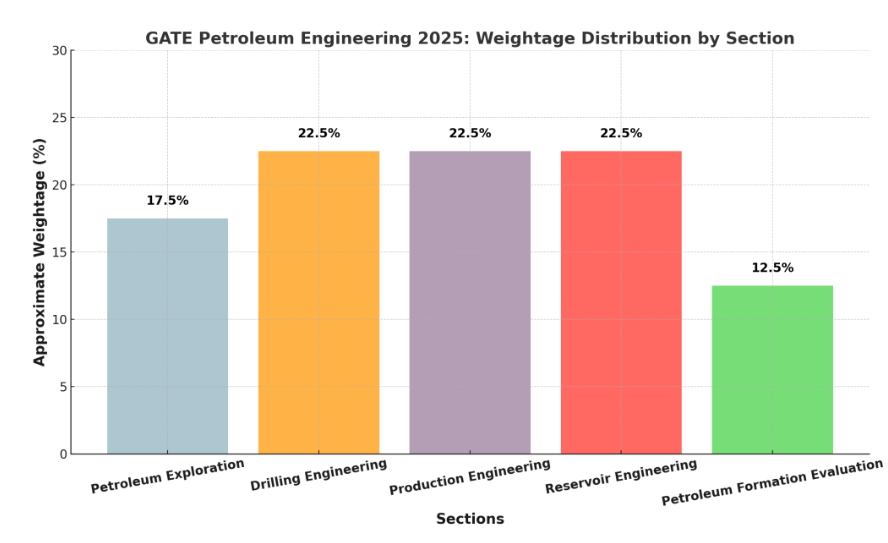
Interpretation:
The Petroleum Exploration (15-20%):
- This means candidates ought to know about what would be the main factors on exploration, though time-wise, this will go for less compared to highly marked paper areas.
- Some of the important topics are geological surveys, geophysical methods, and well logging, which aid in interpreting and locating petroleum resources.
Drilling Engineering (20-25%):
- Among all, an important one comes with high weightage so it is also one of the highly focused areas of the examination.
- The main topics are drilling techniques, mud circulation, wellbore stability, and techniques in well control.
Production Engineering (20-25%):
- As is the case with Drilling, Production Engineering is replete with fluid flow, artificial lift techniques, flow assurance, and well stimulation.
- Devote enough time to this chapter as questions could involve rather complex calculations along with realistic production scenarios.
Reservoir Engineering (20-25%):
- Reservoir Engineering is also very significant, covering fluid flow within the reservoir, material balance calculations, and methods of enhanced oil recovery.
- The majority of the questions are pertaining to reservoir dynamics and fluid properties, so this segment requires both theoretical knowledge as well as numerical problem-solving skill.
Petroleum Formation Evaluation (10-15 %)
- Formation Evaluation accounts for slightly lower weightage but remains relevant still and would perhaps require less intensive study.
- They deal with petrophysics and, consequently, the core analysis, porosity, and permeability measurements that come together to shed light upon reservoir properties.
Overall Interpretation
Summarily, then, the three areas drilled into in depth are Drilling Engineering, Production Engineering, and Reservoir Engineering. That is, each one can account for about 20-25% of your exam. Together, you will have covered 65-75% of this paper. So you could concentrate more on these as you prepare. Petroleum Exploration, on the other hand-and Petroleum Formation Evaluation, which are the two more applied subjects account for at best about 25-35% of the weightage.
Preparation Tips Based on Syllabus Weightage
Suggested Article: Common Mistakes to Avoid in Exam Preparation
- Prioritize topics of high weightage: Topics such as Drilling, Production, and Reservoir Engineering. Plan to spend at least 60% of your preparation time on these three sections to maximize scores.
- Make quality use of the right material: High-quality textbooks are "Petroleum Engineering Handbook" and "Advanced Well Control" video lectures along with good study material of top GATE coaching platforms.
- Practice and Application: There are a large number of calculation questions in the syllabus, especially in Reservoir Engineering and Production. Solved previous GATE PE papers along with NAT-type questions to help improve your problem-solving skills.
- Mock Tests and Previous Year Papers: Regular mock tests help you know your preparation levels. Pay more attention to the previous year's questions from areas like Drilling and Reservoir Engineering to know the pattern of questions.
- More preparation time should be given to high-weightage sections. During the examination, one should have a balanced approach, ensuring that all sections are allocated enough time.
Check: GATE 2024 Petroleum Engineering Question Paper with Answer Key PDF
| Paper | Question Paper PDF | Answer Key PDF |
|---|---|---|
| GATE 2024 Petroleum | Download PDF | Download PDF |
| GATE 2023 Petroleum | Download PDF | Download PDF |
| GATE 2022 Petroleum | Download PDF | Download PDF |
| GATE 2021 Petroleum | Download PDF | Download PDF |
Also Check:
- GATE Preparation: Time Table, 6 months Study Tips, Free Resources, Books, Previous Year Question Papers
- GATE Online Coaching: Institutes, Websites, and Other Resources for Self Study
GATE Petroleum Engineering (PE) Syllabus 2025: Marks Distribution by Section
| Section | Topic/Unit | Marks Weightage (%) |
|---|---|---|
| Section A: General Aptitude | Verbal Ability, Analytical Ability | 15% |
| Section B: Engineering Mathematics | Linear Algebra, Calculus, Differential Equations, Probability & Statistics, Numerical Methods. | 13% |
| Section C: Petroleum Engineering | Drilling Engineering, Reservoir Engineering, Production Technology, Well Testing, and Fluid Mechanics | 72% |
| Sub-sections of Petroleum Engineering | Drilling Engineering (Well design, Mud, Cementing) Reservoir Engineering (Reservoir Rock Properties, Fluid Flow in Porous Media) Production Technology (Artificial Lift, Pumping systems) | Drilling (15-20%)Reservoir (25%)Production (25%) |
- General Aptitude forms an important part of the paper but is scored less as compared to technical sections. However, the scores from this section can be gained easily, if prepared properly.
- Engineering Mathematics serves as a foundation for solving problems in other technical areas. More advanced courses include Differential Equations and Probability, which have gained popularity over the last decade.
- Main Focus Area: Petroleum Engineering - this forms the highest weightage of 72%. In particular, among the topics discussed in the exam, Reservoir Engineering tends to have the maximum number of questions and complexities, so proper understanding is required.
- The marks of Production Technology have been on an increasing scale year after year. Artificial Lift Systems and Pumping Systems are very practically useful topics.
Important Topics for GATE Petroleum Engineering 2025
Suggested Article: Importance of Engineering Mathematics in GATE Petroleum Engineering: Tips and Resources
In addition to the complete GATE Petroleum Engineering (PE) Syllabus 2025, the key areas in which aspirants are recommended to focus on some of the important topics for effective exam preparation are:
- Engineering Mathematics
- Petroleum Geology and Reservoir Engineering
- Drilling and Well Control
- Production Technology
- Well Testing and Analysis
- Fluid Mechanics and Thermodynamics
- Environmental and Safety Engineering
- Industrial and Operations Management
- Materials Science and Engineering
- Engineering Mechanics and Applied Mechanics
Section-Wise Important Topics for GATE Petroleum Engineering 2025:
| Section | Important Topics | Sample Questions | Preparation Tips |
|---|---|---|---|
| Drilling Engineering | Well Design, Drilling Fluids, Cementing, Blowout Prevention, Directional Drilling | Identify causes of drilling mud losses, calculate casing design parameters | Practice well design calculations, study properties of drilling mud, focus on well control operations |
| Reservoir Engineering | Reservoir Properties, Fluid Flow in Porous Media, Material Balance, Enhanced Oil Recovery (EOR), Reservoir Simulation | Calculate permeability, interpret pressure transient tests, estimate reservoir capacity and recovery factor | Study key reservoir rock properties, solve fluid flow problems using Darcy’s law, focus on EOR techniques |
| Production Technology | Artificial Lift, Well Testing, Production Logging, Surface Production Systems, Reservoir Fluid Behavior | Calculate pump performance, interpret production test data, identify production system limitations | Focus on artificial lift design, practice well test interpretation, understand production logging techniques |
| Well Testing and Fluid Mechanics | Pressure Transient Analysis, Fluid Flow through Porous Media, Thermodynamics of Reservoir Fluids, PVT Data Interpretation | Solve pressure drawdown problems, calculate material balance, interpret PVT data | Practice well testing calculations, study the effects of different reservoir fluids and phase behavior |
| Environmental and Safety | Pollution Control, Safety Protocols, Hazardous Materials Handling | Identify appropriate safety measures for oil and gas production, analyze environmental impact of drilling operations | Understand the safety and environmental regulations in place for petroleum extraction |
Recommended Books for GATE Petroleum Engineering 2025
The list of books suggested for GATE Petroleum Engineering (PE) 2025 along with data insights of the contents and their approximated prices is provided in the table below. These books include major subjects such as drilling, reservoir engineering, production technology, well testing, etc. All of these are based on theory and practice, and an aspirant can easily prepare for the exam by taking the books.
| Book Title | Author(s) | Topics Covered | Approximate Price |
|---|---|---|---|
| GATE Petroleum Engineering | Arihant Experts | Complete coverage of the GATE PE syllabus, with topic-wise practice problems, previous years’ questions, and solutions. | ₹350 - ₹450 |
| Petroleum Engineering: Principles and Practice | Dr. J. P. Kumar | Detailed exploration of the principles of petroleum engineering, covering drilling, production, reservoir engineering, well testing, and environmental aspects. | ₹1,200 - ₹1,500 |
| GATE Petroleum Engineering (PE) Chapterwise Topicwise Solved Papers | GK Publications | Collection of previous years’ GATE questions, with solutions categorized by topic for a focused and effective revision. | ₹350 - ₹450 |
| Fundamentals of Reservoir Engineering | L.P. Dake | In-depth discussion on reservoir engineering topics like fluid dynamics, material balance, reservoir drive mechanisms, and enhanced oil recovery methods. | ₹1,200 - ₹1,400 |
| Drilling Engineering: A Complete Well Planning Handbook | J. M. H. Kitzmann | Comprehensive guide to drilling engineering, focusing on well design, drilling fluid, cementing, blowout prevention, and drilling operation management. | ₹900 - ₹1,200 |
| Reservoir Engineering Handbook | Tarek H. Al-Sahhaf | Covers reservoir rock properties, fluid flow in porous media, material balance, and well test analysis, ideal for aspirants seeking deep insights into reservoir engineering. | ₹1,800 - ₹2,200 |
| Oil & Gas Production Systems | Boyun Guo | Focuses on surface facilities, well testing, artificial lift systems, and production logging techniques—key for mastering production technology. | ₹1,500 - ₹1,800 |
| Fundamentals of Petroleum Reservoir Engineering | Nasser K. Al-Sayyed | Covers the essentials of reservoir fluid properties, flow, and drive mechanisms, ideal for understanding basic concepts and advanced techniques in reservoir management. | ₹1,200 - ₹1,500 |
| Well Testing | Berkley R. Clark | Detailed explanations of pressure transient analysis, well test data interpretation, and methods to calculate reservoir properties from well tests. | ₹1,500 - ₹1,800 |
| Production Operations Volume 1 and Volume 2 | Robert F. Mitchell | Covers artificial lift systems, wellbore maintenance, production logging, and equipment used in petroleum production operations. | ₹1,800 - ₹2,200 |
| Applied Petroleum Reservoir Engineering | W. P. O. O’Conner | Focus on applied engineering methods in petroleum reservoirs, covering fluid flow, reservoir behavior, and computational techniques. | ₹2,000 - ₹2,500 |
| Introduction to Petroleum Engineering | David A. Wood | Covers basics of petroleum exploration and production, ideal for beginners who need a solid foundation in petroleum engineering concepts. | ₹600 - ₹800 |
| Engineering Mathematics for GATE | B.S. Grewal | Essential for preparing for engineering mathematics, this book helps with topics like differential equations, probability, linear algebra, and numerical methods. | ₹300 - ₹400 |
Key Insights for Book Selection:
- Comprehensive Coverage: These books by Arihant Experts and GK Publications are known for chapterwise topicwise coverage of previous years' questions, providing brief theory and practice questions for quick revision.
- In-Depth Understanding: The books that are best suited for the aspirants looking for a deep technical understanding and advanced concepts in reservoir engineering are Reservoir Engineering Handbook by Tarek H. Al-Sahhaf and Fundamentals of Petroleum Reservoir Engineering by L.P. Dake.
- Practical Approach: Berkley R. Clark's Well Testing and Oil & Gas Production Systems by Boyun Guo is very practical, industry-oriented knowledge that can help students face real-world problem-solving scenarios in well testing and production.
- Engineering Mathematics: B.S. Grewal's book is of great value in preparing engineering mathematics, which has considerable weight in the GATE Petroleum Engineering syllabus.
- Price Insights: The price range varies significantly based on the depth of the content:
- Good cheap ones are GK Publications and Arihant which is a good book for practice and revision.
- Mid range like Drilling Engineering and Production Operations, which would do justice to theory and its application, and for adequate preparation.
- High-range (₹1,800-₹2,500) books will serve as a source for good technical knowledge and advance subjects that is a real treasure for students who desire ranks at the top end of the spectrum.



Comments