




Clearing GATE in the first attempt is one of the toughest challenges that you might face. Every year nearly 10 lakh students appear for this particular exam and among those, only 16-18% qualify. These statistics would help you to get an actual idea of the level of the GATE exam. To crack GATE in 1st attempt, you will require.
- Unwavering dedication
- Knowing the GATE Physics exam in and out
- Right skills for the test
- Effective strategy
- Time Management Skills
- Cracking GATE Exam in 1st Attempt
1.1 Know the GATE Physics Exam Structure
1.2 Craft an Effective Study Plan
1.3 Use Study Resources for Preparation
1.5 Consistent Practice is Key
1.6 Schedule Regular Revisions
1.8 Don’t Hesitate to Seek Help
1.9 Stay Positive and Motivated
- Tips to Clear GATE Physics in 1st Attempt
Cracking GATE Exam in 1st Attempt
Most students often wonder how to crack GATE on 1st attempt, as appearing for the examination multiple times can be overwhelming. So, prior to going into the best strategies to follow in order to crack GATE on 1st attempt, aspirants should have a solid understanding of the GATE examination and related details. Check out the table presented below to learn what the GATE exam is.
| GATE Exam Overview | |
|---|---|
| GATE Full Form | Graduate Aptitude Test in Engineering |
| GATE Conducting Authority | Jointly Conducted by 7 IITs and IISc on Rotational Basis |
| Purpose of Examination | Offering Admission to M.E./ M.Tech/ and Ph.D. Courses and PSU Recruitments |
| Application Mode | Online |
| Exam Mode | Computer-Based-Test (CBT) |
| Duration of Exam | 180 Minutes (3 Hours) |
| Number Of Questions | 65 |
| Total Marks | 100 |
| Exam Frequency | Once a Year |
| Validity of GATE Score | 3 Years |
| Negative Marking | Applicable to MSQs Only |
| Language Options | English |
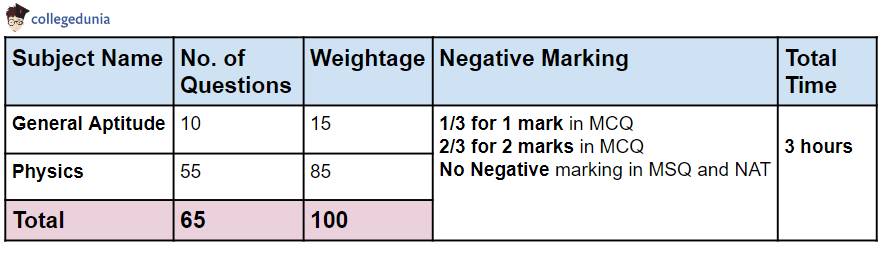
Know the GATE Physics Exam Structure
Understanding the GATE exam pattern is crucial. You must know the topics included in GATE Physics exam. The exam includes multiple-choice questions (MCQs), numerical answer type (NAT) questions, and more. You must familiarize yourself with these formats to reduce surprises on exam day.
Craft an Effective Study Plan
A well-organized study plan is essential for success. Start your preparation 6-12 months in advance. Break the syllabus into manageable segments and create a Daily Study Routine. Set aside dedicated hours each day for focused study, mixing concept learning with problem-solving and regular revision. We have provided a 90-day study plan here.
| Week | Days | Topics | Daily Study Time | Tips | Activities |
|---|---|---|---|---|---|
| 1 | 1-7 | Classical Mechanics | 2-3 hours | Focus on key concepts like Newton's Laws.Draw free-body diagrams. | Solve problems related to motion, and forces. |
| 2 | 8-14 | Electromagnetism | 2-3 hours | Understand Maxwell’s Equations.Use visual aids for electric/magnetic fields. | Practice solving circuit problems and field concepts. |
| 3 | 15-21 | Thermodynamics | 2-3 hours | Master the laws of thermodynamics.Work on heat engine cycles. | Solve problems on heat transfer and laws. |
| 4 | 22-28 | Quantum Mechanics | 2-3 hours | Focus on Schrödinger's Equation and uncertainty principle.Use real-world examples. | Solve conceptual problems and numerical questions. |
| 5 | 29-35 | Modern Physics | 2-3 hours | Study key concepts like relativity and quantum theory.Relate topics to current technology. | Engage with documentary resources on modern physics. |
| 6 | 36-42 | Optics | 2-3 hours | Understand both ray and wave optics.Use diagrams for lens and mirror equations. | Solve numerical problems related to lenses and optics. |
| 7 | 43-49 | Statistical Mechanics | 2-3 hours | Master probability distributions and ensembles.Visualize concepts with graphs. | Solve problems on thermodynamic systems and entropy. |
| 8 | 50-56 | Mathematical Methods in Physics | 2-3 hours | Focus on differential equations and linear algebra.Apply methods to physical problems. | Practice solving mathematical models in physics. |
| 9 | 57-63 | Solid State Physics | 2-3 hours | Understand crystal structures and band theory.Relate concepts to semiconductor applications. | Solve problems related to materials and properties. |
| 10 | 64-70 | Revision Week | 3-4 hours | Revise all topics studied.Focus on difficult areas. | Take practice tests on all topics covered. |
| 11 | 71-77 | Mock Tests & Problem Solving | 3-4 hours | Simulate exam conditions during tests.Review mistakes thoroughly. | Take at least 3 full-length mock tests. |
| 12 | 78-84 | Advanced Topics | 2-3 hours | Explore specialized areas of interest.Focus on integrating concepts. | Research recent developments in physics. |
| 13 | 85-90 | Final Revision | 3-4 hours | Quick revision of formulas and key concepts.Practice relaxation techniques. | Review flashcards, and take quick quizzes. |
Use Study Resources for Preparation
Choosing the right study materials can boost your preparation. These resources might include:
- GATE Textbooks: Use renowned textbooks specific to your subject area. NCERT books can be particularly helpful for foundational concepts.
- Online Learning: Leverage platforms like NPTEL and YouTube for supplementary lectures and tutorials.
- Coaching Options: If you prefer structured learning, consider enrolling in a reputable coaching institute that offers a GATE preparation program.
Master Core Concepts
Focus on building a strong foundation in core subjects:
- Conceptual Clarity: Prioritize understanding over memorization. GATE tests your grasp of fundamental principles.
- Practical Application: Solve real-world problems using theoretical knowledge to enhance analytical skills.
Consistent Practice is Key
Regular practice is vital for GATE success. You must take mock tests, practice previous year question papers and so on:
- Previous Year Papers: Analyze and solve past GATE papers to grasp the exam format and identify frequently asked topics.
- Mock Tests: Take full-length mock tests to improve time management and build exam stamina. Review your performance to pinpoint weak areas.
- Topic-wise Tests: After completing each subject, take focused tests to reinforce your understanding.
Schedule Regular Revisions
Revising is essential for retention:
- Plan Revision Sessions: Set aside specific times for revisiting topics to strengthen your memory.
- Create Quick Reference Notes: Compile key formulas and concepts for last-minute revisions as the exam approaches.
Effective Time Management
Time management is crucial during both preparation and the exam:
- Prioritize Your Study: Focus more on high-weightage topics while ensuring comprehensive coverage of the syllabus.
- Exam Strategy: During the exam, allocate time wisely for each question. If you’re stuck, move on and revisit later if time allows.
Don’t Hesitate to Seek Help
Reach out for support when needed:
- Join Study Groups: Collaborating with peers can foster a supportive learning environment. Teaching others can also reinforce your own understanding.
- Mentorship: Connect with mentors or educators who can provide guidance and encouragement throughout your preparation.
Stay Positive and Motivated
A positive mindset is crucial:
- Use Positive Affirmations: Cultivating self-belief can enhance your confidence as you prepare.
- Stay Inspired: Keep reminding yourself of your long-term goals and the benefits of clearing GATE. Celebrate small milestones to maintain motivation.
Tips to Clear GATE Physics in 1st Attempt
A few tips to clear GATE in 1st attempt include types of questions and how to solve them. We have included tips from toppers also.
| Question Type | Tips to Solve | Tricks from Toppers |
|---|---|---|
| Multiple Choice Questions (MCQs) | Read the questions and options carefully.Eliminate obviously incorrect answers first.Look for keywords that may guide you. | Mark questions that seem difficult for later review.Use a systematic approach to eliminate options. |
| Numerical Answer Type (NAT) | Break the problem into smaller, manageable parts.Ensure you understand the units being used.Always double-check calculations for accuracy. | Identify common numerical patterns in past papers.Keep track of significant figures to avoid mistakes. |
| True/False Questions | Focus on the core concept behind each statement.If unsure, think about the fundamental principles that apply. | Quickly formulate a rationale for your choice to reinforce memory.Discuss concepts with peers for clarification. |
| Fill-in-the-Blank Questions | Recall definitions and important equations relevant to the context.Use clues from surrounding questions to guide your answers. | Create flashcards for key equations and definitions to improve recall.Practice with similar formats from past papers. |
| Match the Following | Establish connections between concepts or terms.Use elimination strategies to narrow down matches. | Practice with matching questions from previous years to build familiarity.Visual aids like charts can help in retention. |
| Conceptual Questions | Ensure a deep understanding of core concepts.Use diagrams or sketches to visualize problems. | Discuss complex topics in study groups to deepen understanding.Teach concepts to others to reinforce your own knowledge. |
Additional Tips for GATE
- Weekly Review: Dedicate one day each week to revisit previously studied topics.
- Regular Problem Solving: Aim to solve 20-30 problems daily, covering a mix of concepts and difficulty levels.
- Mock Exams: Integrate regular full-length mock tests (bi-weekly or monthly) to assess your readiness.
- Health and Well-Being: Include breaks, physical activity, and relaxation techniques to help manage stress.
By adhering to these detailed timetables, you can systematically prepare for the GATE Physics exam and improve your chances of success!



Comments