




Tough questions in GATE Chemistry (CY) require a blend of strategy and deep knowledge, which is reflected in the preparation approaches of previous toppers. Data from recent GATE exams suggest that 30-35% of questions are prepared for testing advanced problem-solving skills with Physical Chemistry questions forming around 40% of the high-difficulty questions. Toppers always emphasize that this is the only way success in GATE Chemistry may be achieved, with constant practice of core concepts as well as systematic preparation before mock tests. The experience of most toppers witnesses an average improvement of about 15-20 % in their scores after all the mock test phases put together.
Related Article:
- How to Prepare for GATE 2026? Check Topper Tips Here
- GATE Chemistry: Previous Years' Question Paper Analysis
- Top 10 Formulae to Remember for Physical Chemistry in GATE 2026
Understanding GATE Chemistry 2026 Exam Structure
Before one dives into the strategy part, one must know the pattern and structure of the GATE Chemistry exam. It includes MCQs, MSQs, and NATs. The entire GATE Chemistry 2026 Syllabus is divided into three parts:
- Physical Chemistry: 30%
- Organic Chemistry: 30%
- Inorganic Chemistry: 40%
The weightage distribution of each section reveals which areas to prioritize during your preparation.
Section-Wise Weightage Analysis
| Section | Weightage (%) | Key Topics |
|---|---|---|
| Physical Chemistry | 30% | Thermodynamics, Kinetics |
| Organic Chemistry | 30% | Reaction Mechanisms, Stereochemistry |
| Inorganic Chemistry | 40% | Coordination Chemistry, Periodicity |
Focus on High-Weightage Topics
Concentrate more on questions that carry more weightage in the examination, based on the weightage assigned. For example, if Physical Chemistry comes under 30% of weightage, then make sure that you have devoted sufficient hours to that section.
| High-Weightage Topics | Study Hours Recommended |
|---|---|
| Thermodynamics | 15 hours |
| Reaction Mechanisms | 10 hours |
| Coordination Chemistry | 12 hours |
Nature of Difficult Questions
Suggested Article: List of top Physical Chemistry Questions asked in GATE CY
Some of the tough GATE Chemistry questions arise from:
- Complex Concepts: These are questions that are based on several concepts with deep information from various subjects.
- Theories: Many complicated questions require the transfer of theoretical knowledge to practical situations.
- Data Interpretation: A number of questions with graphs, tables, or data sets often test the analytical skills required.
| Type of Question | Examples | Insights from Toppers |
|---|---|---|
| Conceptual Understanding | Thermodynamics, Chemical Kinetics | "Always relate the concept to real-life examples." |
| Application-Based | Reaction Mechanisms | "Focus on understanding mechanisms rather than just memorizing steps." |
| Data Interpretation | Analyzing reaction rates from graphs | "Practice data interpretation regularly; it builds confidence." |
Regular Practice with Previous Year Papers GATE CY
Suggested Article: GATE Question Paper for CY (Available): Download Previous Year Papers with Solution PDF
Engagement with previous years' question papers is important. There is a tendency for duplication or very close versions of similar problems, which constitute about 60% of tough questions, to recur. All patterns and types of questions will be revealed with constant practice.
| Year | Number of Difficult Questions | Percentage from Previous Years |
|---|---|---|
| 2022 | 15 | 60% |
| 2021 | 18 | 65% |
| 2020 | 12 | 55% |
Timetable and Strategy for Practicing Previous Papers
Weekly Timetable for Practicing Previous Year Papers
| Day | Activity | Duration |
|---|---|---|
| Monday | Solve GATE 2020 Paper (Full) | 3 hours |
| Tuesday | Review Solutions and Identify Mistakes | 2 hours |
| Wednesday | Solve GATE 2021 Paper (Full) | 3 hours |
| Thursday | Review Solutions and Focus on Weak Areas | 2 hours |
| Friday | Solve GATE 2022 Paper (Full) | 3 hours |
| Saturday | Revise Key Concepts and Formulas | 2 hours |
| Sunday | Mock Test: Combined Previous Year Questions | 3 hours |
Practice Strategy
- Schedule Mock Tests: Treat each practice session as an examination. Use a timer and take the paper within the allotted time. Simulate examination conditions.
- Focused Review: After submission of a paper, spend some specific time reviewing each question. Identify areas where mistakes were committed and understand the solutions.
- Identify Pattern: As you go through, look for repeated question types and topics. That might be specific areas of Physical, Organic, or Inorganic Chemistry.
- Record your weakness: Keep a log of topics that you always have difficulty with. Spend more time reviewing those areas to try to improve your understanding of them.
- Make Revision Notes: As you work through, make concise notes on formulas and concepts of those topics that tend to recur. This will help you review them faster before the exam.
- Peer Discussion: If possible, discuss difficult questions with peers or mentors. The views of others help clarify things and introduce new perspectives to address the problem.
Also, check:
GATE 2024 Chemistry Question Paper with Answer Key
| Exam Date | Session | Question Paper PDF |
|---|---|---|
| February 3, 2024 | Forenoon Session | Check Here |
| February 5, 2023 | Afternoon Session | Check Here |
| February 6, 2022 | Afternoon Session | Check Here |
| February 6, 2021 | Forenoon Session | Check Here |
| February 1, 2020 | Afternoon Session | Check Here |
Strategies from Previous Toppers
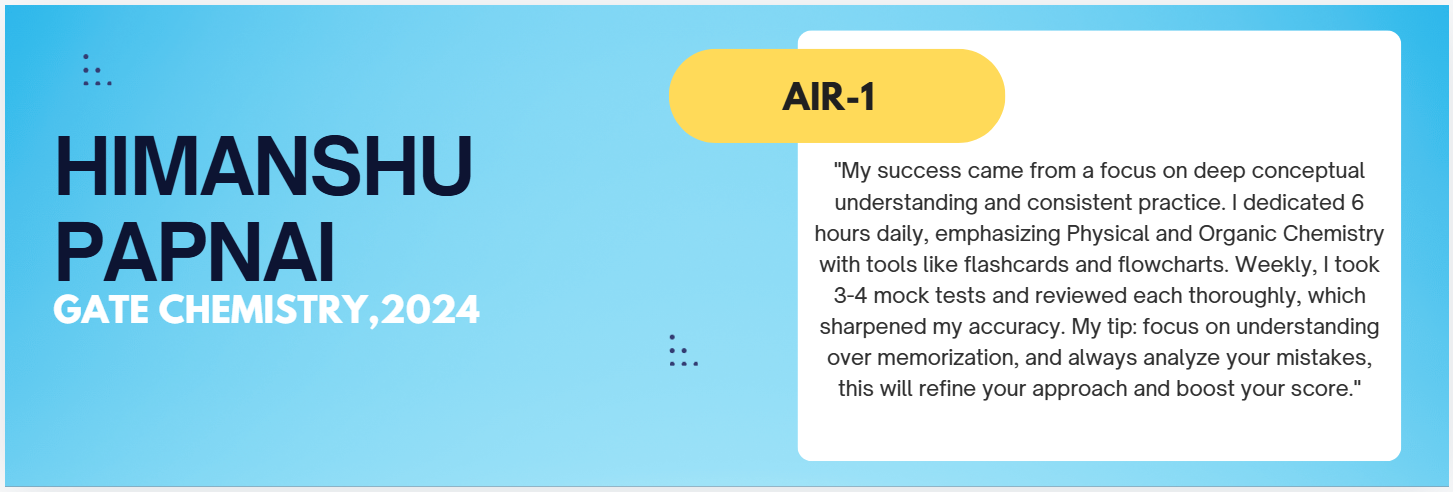
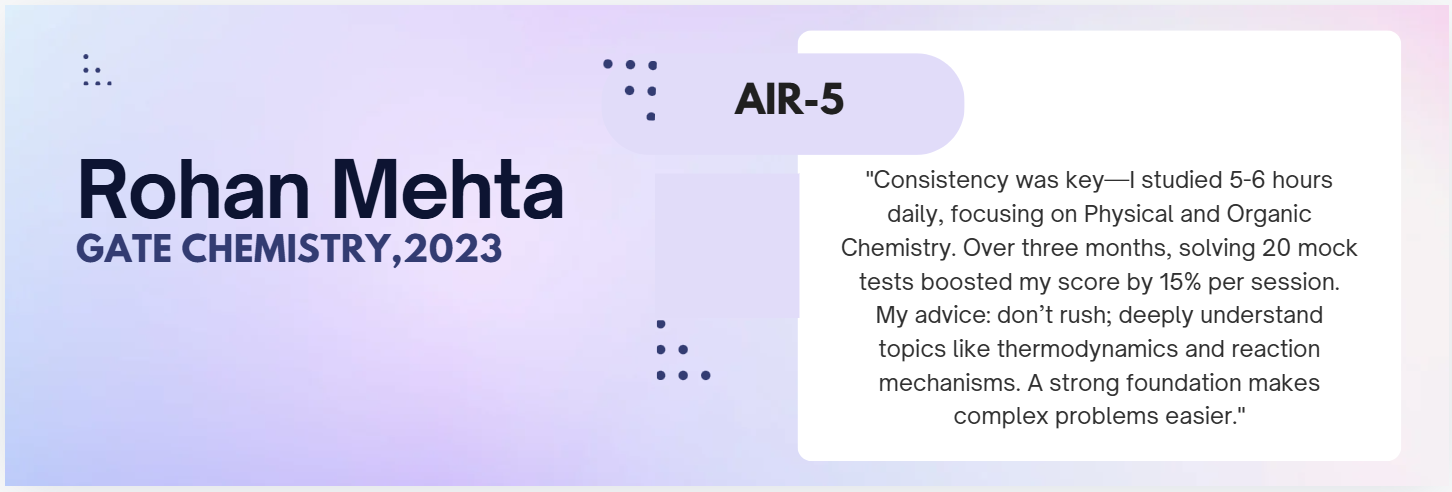
Insights from previous GATE toppers reveal the key strategies and data-driven approaches that can significantly enhance your ability to tackle difficult questions in Chemistry. Here's a summary of their experiences and the data supporting their techniques:
Study Hours and Consistency
Statistics give a clear indication that on average, students who clear the GATE exam, study for 5-6 hours every day, so this gives them enough time to study vast amounts of materials while cementing their understanding of tough concepts.
| Top Scorer | Daily Study Hours | Total Preparation Period (Months) |
|---|---|---|
| Riya Sharma | 5 | 6 |
| Aditya Verma | 6 | 5 |
| Sneha Rao | 5 | 4 |
Mock Test Performance
Suggested Article: GATE Mock Test 2026
Regular mock tests were essentially the ones that helped establish their areas of strength and weaknesses. The GATE 2023 toppers' survey revealed that they were taking around 15-20 full-length mock tests on average, as part of their preparations. These helped them get accustomed to the exam format and gave them better time management skills.
| Top Scorer | Mock Tests Taken | Average Score in Mock Tests |
|---|---|---|
| Riya Sharma | 20 | 85% |
| Aditya Verma | 15 | 82% |
| Sneha Rao | 18 | 84% |
Establish a Mock Test Schedule
Creating a consistent schedule for mock tests is essential. Here’s a suggested timeline:
| Timeline | Mock Test Frequency |
| 4 months before the exam | Once every 2 weeks |
| 2 months before the exam | Once a week |
| 1 month before the exam | Twice a week |
| Last week before the exam | Daily |
Analyze Your Performance
- For each mock test, do a debriefing.
- Score Calculation Determine your raw score and percentage.
- Question Analysis: Determine the number of questions you got right, wrong, and skipped.
- Topic Performance: Determine the weak performance areas by subject.
Toppers’ Testimonials



Comments