




If you want to prepare for GATE Metallurgy Engineering 2025, then it can be quite challenging. However, if you know what to do then it shouldn’t be a problem for you. About 6 months to one year is the preparation time most students make when preparing for GATE. Hence, you must start early. In order to prepare for GATE 2025 many students attend online classes, coaching, and other related materials. You will have plenty of online and Offline material which includes mock tests, and question papers in preparation for GATE. 3858 students registered for the GATE examination for Metallurgical Engineering in the year 2024. Out of these students, 3111 came for the test.
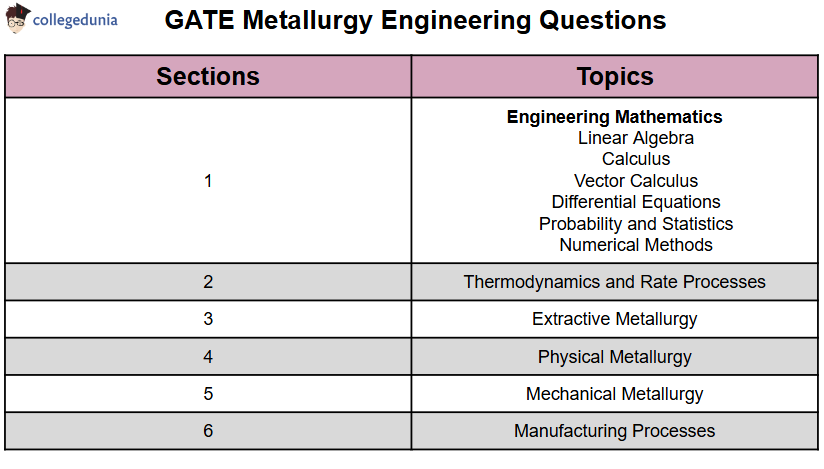
The first and foremost thing to do is understand the exam pattern. You have to answer 65 questions in GATE Metallurgical Engineering Question Paper carrying a total weightage of 100 marks. 10 questions are from the General Aptitude section and 55 questions are from Engineering Mathematics and Core Discipline. The topics covered in GATE Metallurgy Engineering syllabus include:
Check:
| GATE 2024 MT Question Paper PDF | GATE 2024 MT Answer Key PDF |
|---|---|
| Download PDF | Download PDF |
Know the GATE Exam Pattern
You must first understand the GATE exam format. This is the first step in your preparation. Understanding the exam pattern includes knowing the number of questions, question types, marking scheme, etc. :
- GATE Metallurgy Question Pattern: Procedures in the exam contain multiple choice questions (MCQs), multiple select questions (MSQs) and numerical answer questions (NATs).
- Total Marks: The exam is a 100-mark exam which means every question is valuable.
- Key Topics: The main areas of interest are Material Science, Thermodynamics in Metallurgical Engineering, Mechanical characteristics, Phase diagrams, and Metallurgical processes.
| Question Type | Awarded Marks | Negative Marking (Reduced to) | Important Points |
|---|---|---|---|
| Multiple Choice Questions (MCQs) | Marks: 1 | Marks: 0.33 | Have four choices, one of which is right |
| Marks: 2 | Marks: 0.66 | ||
| Numeric Type Question(NQTs) | Marks:1 | Marks: No negative | No optionsThe response is a real number to insert via virtual keyboard and mouse |
Check:
GATE Metallurgy Engineering Study Materials
Choosing the right study materials can make all the difference. You must choose the study materials wisely. Suppose you are a beginner and you are selecting the study materials of an expert. This will cause you more damage than help in preparation:
- Recommended Textbooks: Spend money on critically important books to prepare for GATE: One textbook is required during the study session, "Physical Metallurgy” by Raghavan, “Materials Science and Engineering” by Callister, and “Principles of Materials Science and Engineering” by W.F Smith
- GATE Preparation Books: Specific course study materials adapted for GATE exams are available and should be preferred, especially those containing past papers.
- Online Learning Resources: Online classes can be used to access video lectures, while YouTube can be used to access video lectures on Metallurgy Engineering topics.
Also Check:
Create a GATE Metallurgy Engineering Study Plan
Study Plans are very important and pave the roadway for GATE preparation. Creating and following a personalized study plan can help you stay focused during the GATE Metallurgy Engineering preparation. A structured study plan is crucial for effective preparation:
- Daily Study Schedule: Dedicate specific hours daily to various topics, ensuring a balanced approach.
- Weekly Study Goals: Set realistic weekly targets to cover different chapters and concepts.
- Revision Time: Regularly review your notes to reinforce knowledge retention.
6-Month Study Plan
| Month | Week | Topics | Study Time (Hours/Week) | Activities |
|---|---|---|---|---|
| 1 | 1-2 | GATE Exam Structure, Syllabus Overview | 10-12 | Gather resources, plan study schedule |
| 3-4 | Basic Concepts of Materials Science | 10-12 | Study atomic structure, crystallography, defects | |
| 2 | 5-6 | Mechanical Properties of Materials | 10-12 | Stress-strain curves, toughness, hardness |
| 7-8 | Phase Diagrams and Phase Transformations | 10-12 | Binary phase diagrams, eutectic reactions | |
| 3 | 9-10 | Thermodynamics in Metallurgy | 10-12 | Laws of thermodynamics, Gibbs free energy |
| 11-12 | Kinetics of Metallurgical Processes | 10-12 | Diffusion, reaction rates, nucleation | |
| 4 | 13-14 | Metal Extraction Processes | 10-12 | Pyrometallurgy, hydrometallurgy, electrometallurgy |
| 15-16 | Material Processing Techniques | 10-12 | Casting, welding, forming, machining | |
| 5 | 17-18 | Failure Mechanisms in Materials | 10-12 | Fracture, fatigue, creep |
| 19-20 | Corrosion and Protection Methods | 10-12 | Types of corrosion, prevention techniques | |
| 6 | 21-22 | Revision of Key Topics | 10-12 | Create summary notes, concept maps |
| 23-24 | Mock Tests and Performance Analysis | 10-12 | Take full-length mock tests, review weak areas |
Check GATE Metallurgy Engineering's Previous Papers
| Exam Date | Session | Question Paper PDF |
|---|---|---|
| February 11, 2023 | Afternoon Session | Check Here |
| February 6, 2022 | Forenoon Session | Check Here |
| February 14, 2021 | Afternoon Session | Check Here |
| February 1, 2020 | Forenoon Session | Check Here |
3-Month Study Plan
| Month | Week | Topics | Study Time (Hours/Week) | Activities |
|---|---|---|---|---|
| 1 | 1 | GATE Exam Structure, Resource Gathering | 10-12 | Familiarize with the syllabus |
| 2 | Basic Concepts of Materials Science | 10-12 | Study atomic structure, crystallography | |
| 3 | Mechanical Properties of Materials | 10-12 | Stress-strain curves, toughness, hardness | |
| 4 | Phase Diagrams | 10-12 | Binary phase diagrams, eutectic reactions | |
| 2 | 5 | Thermodynamics in Metallurgy | 10-12 | Laws of thermodynamics, phase equilibrium |
| 6 | Kinetics of Metallurgical Processes | 10-12 | Diffusion, reaction rates | |
| 7 | Metal Extraction Processes | 10-12 | Pyrometallurgy, hydrometallurgy | |
| 8 | Material Processing Techniques | 10-12 | Casting, welding | |
| 3 | 9 | Failure Mechanisms in Materials | 10-12 | Fracture, fatigue |
| 10 | Corrosion and Protection | 10-12 | Types of corrosion, prevention techniques | |
| 11 | Revision of All Topics | 10-12 | Create summary notes, revise important formulas | |
| 12 | Mock Tests and Performance Analysis | 10-12 | Take full-length mock tests, review mistakes |
Focus on High-Weightage Topics
Concentrate on topics that carry significant marks in the GATE exam:
- Core Areas: Master Materials Science, Thermodynamics in Metallurgy, Mechanical Properties, and Phase Equilibria.
- Problem-Solving: Develop a strong grasp of numerical problems related to Metallurgy.
Check: List of Top questions asked in GATE Metallurgy
| Topic | Weightage % | No. of Questions (Last 5 Years) |
|---|---|---|
| Physical Metallurgy | 15 | 10 |
| Thermodynamics of Materials | 10 | 8 |
| Mechanical Behavior of Materials | 15 | 12 |
| Materials Processing | 15 | 9 |
| Phase Equilibrium | 10 | 7 |
| Powder Metallurgy | 5 | 3 |
| Welding and Joining | 5 | 4 |
| Corrosion and Degradation | 5 | 3 |
| Composite Materials | 5 | 3 |
| Material Characterization | 5 | 4 |
| Materials Selection and Design | 5 | 2 |
Regular Practice and Mock Tests
Practice will make you understand the types of questions and patterns to solve them. Taking timed GATE mock tests will help you get a real feel of the GATE Exam. Consistent practice is vital for exam readiness:
- Solve Previous Years’ Papers: You must familiarize yourself and understand the exam format and frequently asked questions.
- Full-Length Mock Tests: Take timed mock tests to build endurance and improve time management.
- Numerical Problem Practice: Focus on solving various numerical problems, as these are key for scoring well.
Check: List of top Questions asked in GATE Metallurgy Engineering- 2024
Stay Informed and Updated
Keep yourself informed about any changes to the GATE exam:
- Official Resources: To find out new updates or any notifications related to the GATE exam, it is advisable to visit the official website of GATE quite frequently.
- Online Forums: Go through Quora or specific GATE groups in social media for tips and details.
Develop GATE Metallurgy Engineering Strategy
Maximizing performance is another important factor in pre-exam preparations that forms the last component of exam preparation. Having a strategy can help you tackle the exam more confidently:
- Time Management Skills: Time management should also be applied during mock tests in order to increase work productivity.
- Question Selection: Prefer questions that may take some time to answer and as you answer them the chances of mastering them increase.
- Understanding Negative Marking: The candidate should not gamble while answering the MCQs since some questions might attract deductions.
| Category | Details |
|---|---|
| Preparation Tips | Start Early: As per toppers, the preparation should ideally start 6-8 months before the date of examination. |
| Conceptual Clarity: Don’t memorize answers but learn all the content that is in a given curriculum. | |
| Daily Study Routine: It is advised to set aside a particular time of the working day only for the Metallurgy topics as this way you are to advance gradually. | |
| Revise Regularly: Weekly changes also serve as repetition, which is used in training to make sure that the information learned is brought to the fore. | |
| Solve Previous Year Papers: Solve past papers of the GATE test as this will help to understand the types of questions that are normally set. | |
| Helpful Resources | Textbooks: |
| "Physical Metallurgy" by Raghavan | |
| "Materials Science and Engineering" by Callister | |
| Online Platforms: | |
| NPTEL (National Program on Technology Enhanced Learning) | |
| Platforms providing Online courses | |
| YouTube channels focusing on Metallurgy concepts | |
| Mock Test Series: Enroll in a good online mock test series specifically for GATE Metallurgy. | |
| Important Questions | Material Properties: Explain the factors affecting the mechanical properties of materials. |
| Thermodynamics: Describe the laws of thermodynamics and their application in metallurgical processes. | |
| Phase Diagrams: Interpret and analyze phase diagrams of binary alloys. | |
| Metal Extraction: Discuss various metal extraction processes (pyrometallurgy, hydrometallurgy). | |
| Failure Mechanisms: Explain different types of material failures (fatigue, creep, fracture). | |
| Heat Treatment: Describe the different heat treatment processes and their effects on material properties. | |
| Alloy Design: Discuss principles of alloy design and their applications in engineering materials. | |
| Corrosion: Explain the mechanisms of corrosion and methods for corrosion prevention. |
This structured approach will ensure you cover all necessary topics for GATE Metallurgical Engineering and prepare effectively for the exam. Preparing for the GATE Exam will require hard work, a strict timeline, and dedication. Only proper preparation and dedication toward your study plan can help you make your dream come true.



Comments