




Safe Marks in GATE 2026 vary among different universities, but a score of 900 is considered safe for top IITs and PSUs and 600-700 for NITs. Safe Marks in GATE 2026 are the minimum marks that you must score to get into universities like IIT, NIT, or PSU, as the cutoffs differ by branch and category.
- For General category candidates, you should aim for around 720-750 out of 1000.
- For OBC and reserved category candidates, a 550-600 score is the safe score
- You should always keep a buffer of 20-30 marks above the highest previous cutoff, as it helps ensure better chances.
Also Read

Key Summary
- The Safe Marks in GATE 2026 are not fixed cutoffs. Instead, they help secure target scores above the highest trends.
- To secure admissions in core and competitive branches like CS, EE, and EC, you should achieve a safe mark that can be as high as 850-900.
- For less competitive branches like Civil or Chemical, the Safe Marks in GATE 2026 may be around 650-700.
- Reserved categories candidates generally require lower safe marks, but adding a buffer is also essential for you.
What are the Safe Marks in GATE 2026?
Safe Marks in GATE 2026 always refer to a target score that is above the average cutoffs of many top universities. The concept is simple for you. Instead of just achieving marks above the cutoff, you should always target to score higher. This will help build a safety margin.
As per some analysis, we get to know that 750+ is considered to be a safe mark in the GATE 2026 exam.
| Category | Marks Out of 100 | GATE Score out of 1000 |
|---|---|---|
| Very Good Score | 85+ | 750+ |
| Good Score | 75+ | 550+ |
| Average Score | 65+ | 400 |
| Low Score | Below 40 | Below 300 |
Also Read
GATE 2026 Score ValidityFactors Affecting Safe Marks in GATE 2026
Discipline-Specific Trends
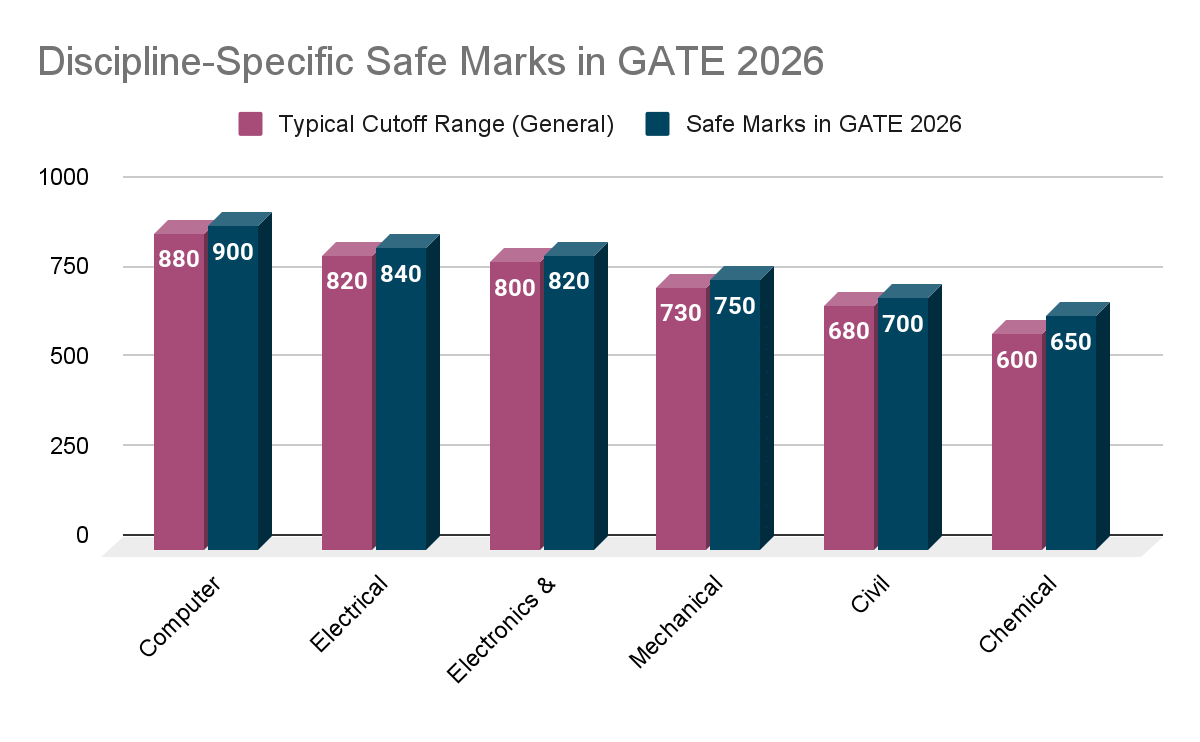
In the table mentioned below, safe marks for each discipline are mentioned as per the General category students. For a high-demand discipline like Computer Science, you need to score around 900+, which is considered a safe score for this discipline.
| Discipline | Typical Cutoff Range (General) | Safe Marks in GATE 2026 |
|---|---|---|
| Computer Science (CS) | 800–880 | ≥ 900 |
| Electrical Engineering (EE) | 780–820 | ≥ 840 |
| Electronics & Communication (EC) | 750–800 | ≥ 820 |
| Mechanical Engineering (ME) | 680–730 | ≥ 750 |
| Civil Engineering (CE) | 600–680 | ≥ 700 |
| Chemical Engineering (CH) | 550–600 | ≥ 650 |
Category-Wise Variations
In the table, safe marks vary by reservation category candidates. As an example, for Civil Engineering, safe marks vary depending on the category.
| Category | Average Cutoff | Safe Marks in GATE 2026 |
|---|---|---|
| General | 650 | ≥ 700 |
| OBC NCL | 500 | ≥ 550 |
| SC/ST/PwD | 400 | ≥ 450 |
Reserved categories candidates also enjoy relaxed cutoffs, but following the same buffer approach will ensure more safety.
Also Read
Yearly Fluctuations
There is a chance that cutoffs varied on y-o-y due to paper difficulty, competition, and the number of seats. On average:
● The more easy is the exam, the higher the chance cutoff will increase as a larger students will score higher marks. This will also increase the bar for you for Safe Marks in GATE 2026.
Safe Marks in GATE 2026: Branch-Wise Insights
Mechanical Engineering (ME)
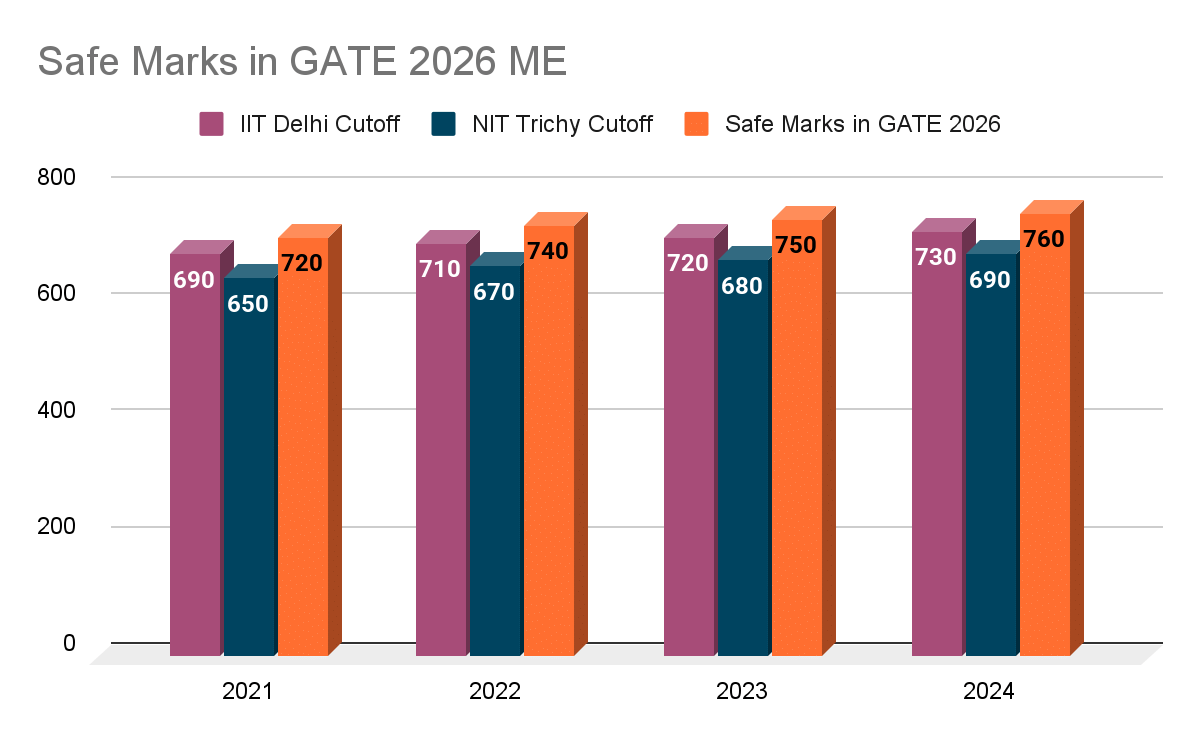
Mechanical Engineering cutoffs are moderately competitive, but its cutoffs are widespread among the candidates. The table below displays the same:
| Year | IIT Delhi Cutoff | NIT Trichy Cutoff | Safe Marks in GATE 2026 |
|---|---|---|---|
| 2021 | 690 | 650 | ≥ 720 |
| 2022 | 710 | 670 | ≥ 740 |
| 2023 | 720 | 680 | ≥ 750 |
| 2024 | 730 | 690 | ≥ 760 |
Safe Marks in GATE 2026 for Mechanical is equal to 750-760.
Computer Science (CS)
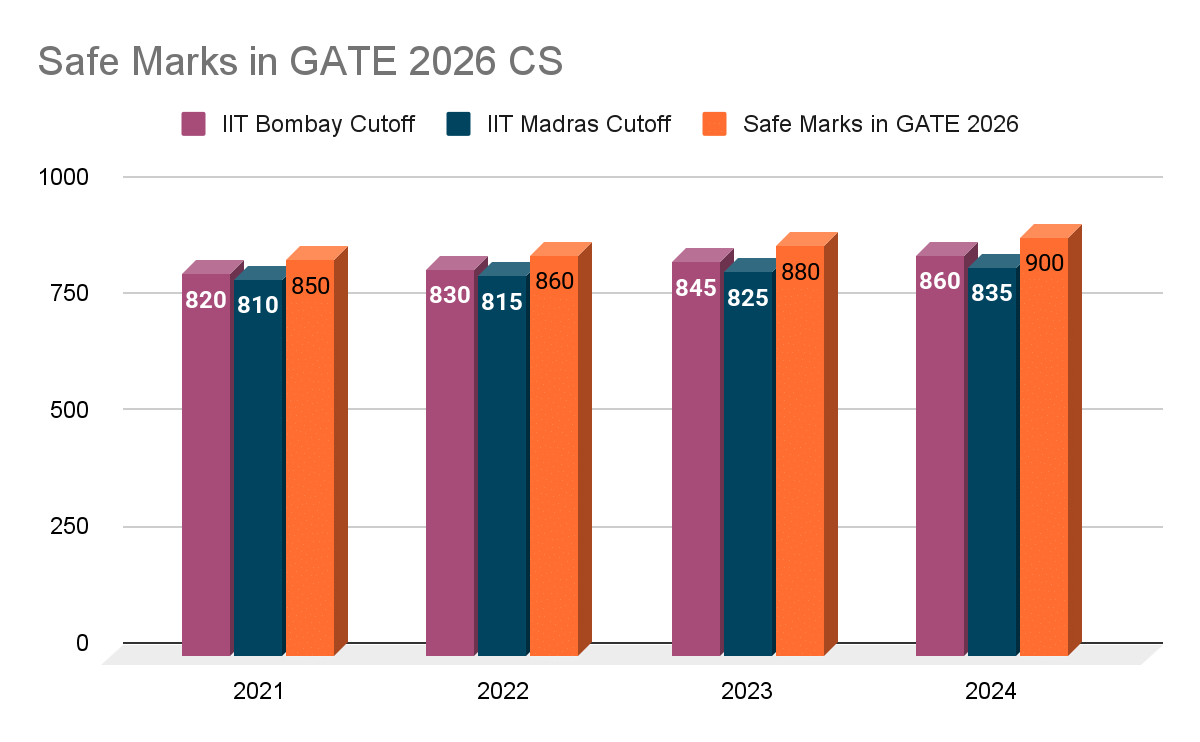
Computer Science remains one of the toughest to crack because of PSU demand and IIT competition. The table below displays the same:
| Year | IIT Bombay Cutoff | IIT Madras Cutoff | Safe Marks in GATE 2026 |
|---|---|---|---|
| 2021 | 820 | 810 | ≥ 850 |
| 2022 | 830 | 815 | ≥ 860 |
| 2023 | 845 | 825 | ≥ 880 |
| 2024 | 860 | 835 | ≥ 900 |
Safe Marks in GATE 2026 for CS are less than or equal to 900.
Electrical Engineering (EE)
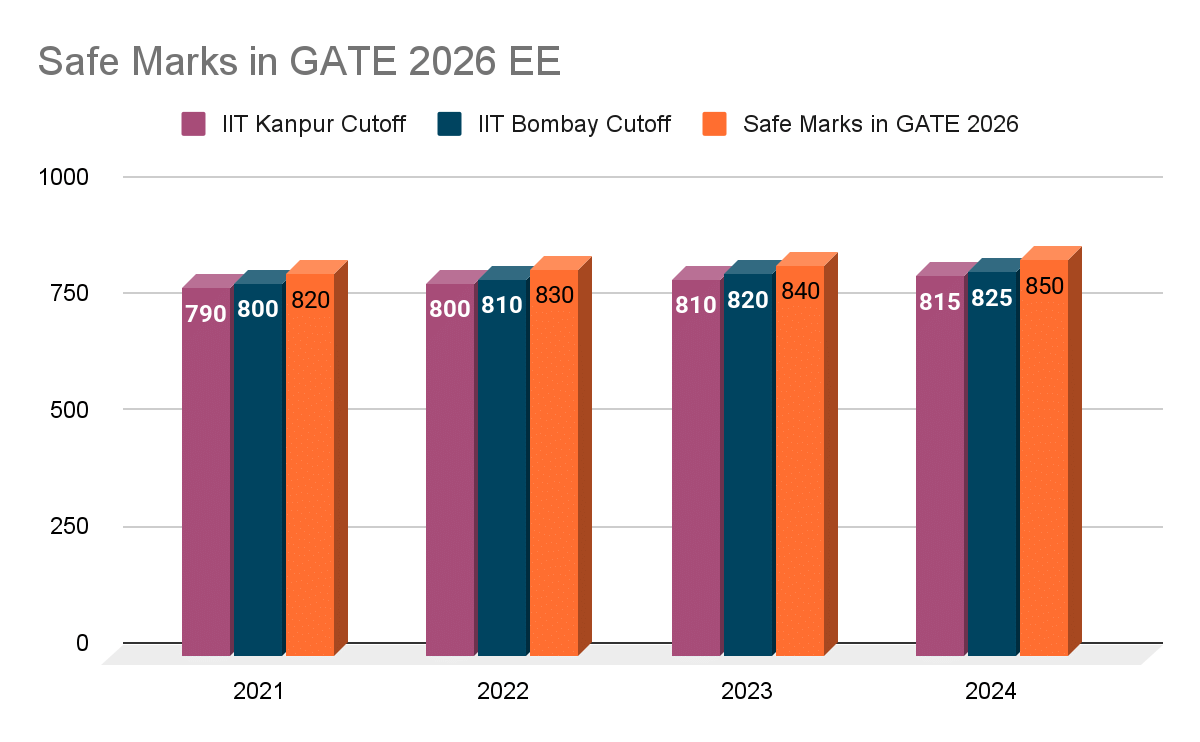
Electrical Engineering cutoffs have remained consistently high due to various PSU opportunities. The table below mentions the same:
| Year | IIT Kanpur Cutoff | IIT Bombay Cutoff | Safe Marks in GATE 2026 |
|---|---|---|---|
| 2021 | 790 | 800 | ≥ 820 |
| 2022 | 800 | 810 | ≥ 830 |
| 2023 | 810 | 820 | ≥ 840 |
| 2024 | 815 | 825 | ≥ 850 |
Safe Marks in GATE 2026 for EE are less than or equal to 840-850.
Also Read
How to Get 85+ Marks in GATE 2026What is the safe marks in GATE 2026 for PSU?
| PSU | Good GATE Score for PSU ( Out of 100) | Discipline |
|---|---|---|
| NTPC | 70+ | Mechanical, Electrical, Electronics |
| IOCL | 65+ | Civil Engineering, Mechanical Engineering, Electrical Engineering, Instrumentation Engineering, Computer Science & IT Engineering |
| BARC | 80+ | Mechanical, Civil, Electrical, Electronics |
| BHEL | 70+ | HR, Electrical, Civil |
| ONGC | 80+ | Civil, Electronics, Mechanical, Electrical |
| DRDO | 75+ | Civil, Electronics, Mechanical, Electrical, Instrumentation |
GATE Marks vs Rank
| Rank | Mechanical | CSE | Civil | Electrical |
|---|---|---|---|---|
| 1- 10 | 92+ | 80+ | 90+ | 91+ |
| 10- 50 | 87- 92 | 75- 80 | 85- 90 | 87- 91 |
| 50- 100 | 85- 87 | 72- 75 | 78- 85 | 84- 87 |
| 100- 200 | 82- 85 | 68- 72 | 74- 78 | 81- 84 |
| 200- 500 | 79- 82 | 62- 68 | 70- 74 | 77- 81 |
| 500- 1000 | 75- 79 | 56- 62 | 64- 70 | 72- 77 |
| 1000- 2000 | 71- 75 | 50- 56 | 57- 64 | 66- 72 |
| 2000- 5000 | 63- 71 | 40- 50 | 50- 57 | 57- 66 |
| 5000- 10000 | 51- 63 | 32- 40 | 40- 50 | 46- 57 |
Also Read
Strategy to Achieve Safe Marks in GATE 2026
There are some strategies that you should follow to achieve safe marks in GATE 2026:
- Understand Weightage
○ The combination of Engineering Mathematics and Aptitude questions carries a total of 30% weightage.
○ The core subjects carry the remaining weightage of 70%.
- Set Higher Targets
If your target cutoff is 700, it is advisable to achieve around 730-750 as your Safe Marks in the GATE 2026 exam.
- Use Mock Tests Effectively
You should always try mock tests and check if your scores are reaching the safe range or not.
| GATE Mock Test 2026- Attempt free online Branch wise, Chapter wise and Subject wise Mock Test Series |
- Prioritise Strong Areas
You need to master topics with higher weightage in your discipline before moving to niche areas.
- Track Yearly Cutoffs
It is important for you to always review the past 5 years' questions in order to estimate fluctuations and adjust your safe marks accordingly.
Also Read
Do PYQ Repeat in GATESafe Marks in GATE 2026 FAQS
Ques. What does achieving Safe Marks in the GATE 2026 exam mean for you?
Ans. Achieving Safe Marks in the GATE 2026 exam is the target score which are set by you above the average cutoffs. When scoring these marks, it will ensure better chances of admission to universities in IIT, NIT, or even PSU recruitment without going through any risk.
Ques. Are Safe Marks in the GATE 2026 exam the same for all branches?
Ans. No, the safe marks always vary by branch. The highly competitive branches, such as CS and EE, may need 850+ scores, while branches like Civil or Chemical can be secured by you while achieving around 650-700 scores. It always depends on yearly cutoff trends.
Ques. How are Safe Marks in GATE 2026 calculated?
Ans Safe marks are always calculated by analysing the highest cutoff marks in previous years for a particular branch. You are then required to add a buffer of at least 20-30 marks to stay comfortably above the expected cutoff range.
Ques. Do reserved category candidates have lower safe marks?
Ans. Yes, reserved categories such as OBC, SC, ST, and PwD generally require lower safe marks. It is often 100-150 marks below the General category candidates. However, the idea of adding a buffer still applies to ensure further safety.
Ques. Is scoring Safe Marks in GATE 2026 enough for PSU recruitment?
Ans. Yes. If you have aimed to score above safe marks, it is enough for you to get PSU shortlisting. However, top PSUs such as ONGC, IOCL, or HPCL may require higher scores, especially in different courses like CS, EE, and ME.
Ques. Should I aim only for Safe Marks in the GATE 2026 exam?
Ans. No. If you are only aiming for scoring safe marks, it might be risky due to the fluctuations in the difficulty of the questions. As a result, you should always aim higher, as you will give yourself greater flexibility for admissions and PSU opportunities.
Also Read



Comments