




Technical competence in Civil Engineering, of course, is a must. But with the growing demand to take up project leadership and collaborative designs with clients, soft skills also have to be developed.
- According to a recent survey conducted by ASCE, 75% of employers in the technical world believe that communication skills are as important as technical skills to have an excellent successful career.
- Statistics from BLS point out that civil engineers who possess sound management and communication skills will advance 20% faster than technically skilled engineers in their careers.
Whether in managing on-site teams, negotiating project requirements, or in responding to changing client needs, competencies in areas such as communication, problem-solving, and leadership are surfacing as relevant. Preparing them for GATE 2025 should ideally take the students beyond bookish limits into soft skills to prepare them for these new engineering demands.
Once the preparation through GATE intensifies, soft skills add much more meaning to any engineer's career path and success.
Related Article:-
- GATE Books 2025 PDF Download for CSE, DA, Civil, Mechanical, ECE, EE
- GATE Civil Engineering: Structural Analysis Preparation Tips
- GATE Preparation: Time Table, 6 months Study Tips, Free Resources, Books, Previous Year Question Papers
Key Soft Skills in Civil Engineering
Applying soft skills in civil engineering is very important for proper communication, teamwork, and management, especially concerning complicated projects. Of course, these skills go hand-in-hand with technical expertise, thus contributing much to career advancement and project success.
| Soft Skill | Description | Importance in Civil Engineering |
|---|---|---|
| Communication Skills | Ability to present arguments that convey ideas clearly, both in writing and speaking. | Serve as a contact to the clients, contractors, and internal team members to ensure that the project objectives and goals are properly understood and delivered. |
| Teamwork & Collaboration | Work effectively with teams - commonly diverse individuals from various backgrounds and areas of specialization. | Essential for coordination work as well as bringing work towards a successful end by team collaboration. |
| Problem-Solving | To guide and motivate teams on project milestones and goals. | It is very critical for a project manager or senior engineer when managing large teams to meet deadlines without neglecting the quality of the product. |
| Leadership | Use of effective management of time and resources to meet deadlines. | Keeps track of delivering a project while handling multiple projects with multi-stakeholder relationships that would not give rise to cost overruns and delays in the project. |
| Time Management | Deliverability: To enter into agreements with stakeholders, contractors, or suppliers. | Critical in discussing terms of a project, budget, and contract, and solving conflicts of parties. |
| Negotiation Skills | Agreement capability with stakeholders, contractors, or suppliers. | Very important in discussing terms relating to projects, budgets, contracts, and even settlement of conflict between parties. |
| Adaptability | Able to adapt to changes or new surprises. | Handle sudden changes in project scope, client requirements, or unexpected technical problems. |
| Emotional Intelligence | The ability to understand and manage the emotions of oneself and others. | Helps to manage team dynamics, conflicts, and a healthy working environment. |
| Critical Thinking | Objective evaluation of information ensures proper decisions. | To design safe, sustainable solutions, particularly when analyzing a complex dataset or evaluating potential risks. |
| Client Relationship Management | Positive client and stakeholder relationships. | Key to creating customer satisfaction, which allows a long-term business or income-generating relationship by either repeat business or referrals. |
| Conflict Resolution | Minimizes conflicts or disputes constructively. | Minimizes conflicts or disputes constructively. |
| Presentation Skills | Presentation of ideas and solutions to their audience clearly and confidently. | Critical for client meetings, proposals for projects, or communicating with other stakeholders since the ideas and plans are understood and approved. |
The above soft skills are increasingly regarded as vital to a successful career in civil engineering, besides the technical expertise required in the field.
Weightage of Soft Skills in Civil Engineering
GATE does not formally test soft skills, but still, many studies have established the effective contribution of soft skills towards the practice and education of civil engineering.
| Skill | Role in Civil Engineering | Importance (%) |
|---|---|---|
| Communication | Ensuring clear project requirements and updates between teams and stakeholders | 25% |
| Leadership | Leading teams, making strategic decisions, and managing resources | 20% |
| Teamwork | Collaborating efficiently with diverse teams across disciplines | 15% |
| Problem-Solving | Addressing and resolving technical and organizational challenges quickly | 20% |
| Client and Stakeholder Management | Navigating client expectations, regulatory requirements, and public interactions | 20% |
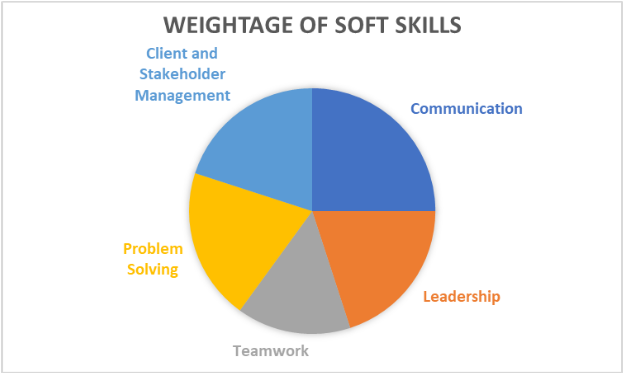
- Communication (25%)- At 25%, giving communication as the top priority essentially means clear and effective communication is what a successful civil engineering project is built on. In many cases, most civil engineers will interact with several teams that have been involved in the execution of a project, clients, regulatory authorities, and contractors.
- Leadership (20%)- Leadership is important for 20%. Civil engineers essentially work with a large team and make judicious choices relating to resources, timeline, and direction of the project. Proper leadership keeps projects on track; it also motivates teams to deliver at set deadlines and produce good quality work.
- Problem-Solving(20%)- The other major area of problem-solving skills is 20%. Civil engineers face problems, from technical problems of design to unforeseen problems on-site. The ability to think over any problem with the establishment of effective solutions keeps the project momentum in check and does not encourage costly delays.
- Client and Stakeholder Management(20%)- Client and stakeholder management is the lowest ranked function, 20% sets the point that clients, government agencies, and the public need to be managed. Civil engineers must manage expectations while ensuring that regulations are fulfilled to keep stakeholders at ease with the progress on the projects. Failure in this area can result in the loss of success for a project or inflame a war.
- Teamwork (15%)- Finally, teamwork accounts for 15%, considering that this factors greatly in teamwork in a workplace. Civil engineers work in multi-disciplinary teams and therefore, require seamless collaboration between professionals from different disciplines. When effective teamwork happens, then every other thing in a project will be presented to take place efficiently and successfully.
Key Takeaway
Though not included in the formal GATE exam, these have cumulatively made a considerable difference in the real-world civil engineer. Collectively, they make up the spine of a successful project with Communication at the top at 25% Leadership, Problem-Solving, and Client Management each averaging 20%, and Teamwork standing at 15%. Soft skills infused with technical aptitude bring a civil engineer's quality of work much more proficiently.
Why GATE Preparation Should Include Communication and Management Skills
Suggested Article: GATE Civil Engineering Preparation Strategy for 2025
Table incorporating the specific roles of soft skills in civil engineering, along with citations from relevant sources:
| Skill | Role in Civil Engineering |
|---|---|
| Project Communication | Ensures clear project requirements and updates between teams and stakeholders to avoid delays and errors |
| Teamwork and Collaboration | Facilitates efficient work across multidisciplinary teams, resolving conflicts and ensuring smooth workflows |
| Leadership and Problem Solving | Guides teams, manages resources, and makes strategic decisions while solving both technical and organizational challenges |
| Client and Stakeholder Management | Manages relationships with clients and regulatory bodies while ensuring project alignment with both technical standards and stakeholder needs |
How to practice Soft Skills in Civil Engineering
Weekly Plan: Practicing Soft Skills alongside Core Subjects
The following plan balances technical study with soft skills practice, based on a typical 6-day study week. That means that core subjects have their priorities, about a structured time allocation, and soft skills are to be developed through targeted activities.
| Day | Core Subject Focus | Soft Skills Activity | Duration | Insights/Notes |
|---|---|---|---|---|
| Monday | Structural Engineering | Group Discussions or Teamwork Simulation | 1 hour | Data Insight: A survey by ASCE found that 79% of civil engineers believe collaboration within teams is key for project success. Practice with peers for teamwork. |
| Tuesday | Geotechnical Engineering | Communication Skills: Writing technical reports | 1 hour | Data Insight: Communication is among the top 3 skills recruiters seek in engineers. Regularly write reports based on your technical study to improve clarity. |
| Wednesday | Transportation Engineering | Problem-Solving Exercise (real-world case study) | 1 hour | Data Insight: Problem-solving abilities are rated critical by 85% of civil engineers in project management. Use real-life case studies to enhance your skills. |
| Thursday | Environmental Engineering | Leadership Activity: Lead a study group | 1 hour | Data Insight: Engineers in leadership roles earn 20% more on average. Leading small groups can enhance your ability to manage teams and projects. |
| Friday | Hydraulics & Water Resources | Time Management & Planning | 1 hour | Data Insight: Efficient time management increases productivity by 30%. Plan your week and set realistic goals for your studies and skill development. |
| Saturday | Project Management & Construction Technology | Presentation Skills: Practice presenting technical concepts | 1 hour | Data Insight: Engineers who present well earn recognition and promotion faster. Deliver short presentations on technical topics to friends or peers for improvement. |
| Sunday | Review Day/Rest | Emotional Intelligence: Reflect and journal on your learning and challenges | 1 hour | Data Insight: Self-awareness is key to managing emotions in high-pressure projects. Journaling helps you reflect on your progress and areas for improvement. |
Monthly Schedule: Integrating Soft Skills with Core Subject Mastery
In addition to daily activities, you can plan monthly themes to focus on specific soft skills.
| Month | Soft Skill Focus | Objective | Core Subject Focus | Activities |
| 1 | Communication and Teamwork | Strengthen verbal and written communication, and practice teamwork. | Structural and Geotechnical Engineering | Participate in a peer group to regularly explain core topics. Write weekly technical reports or summaries on civil engineering topics. Join study groups and actively engage in discussions. |
| 2 | Leadership and Problem Solving | Enhance leadership by managing tasks and improving problem-solving abilities. | Transportation and Environmental Engineering | Organize group projects, taking the lead in scheduling and delegating tasks. Solve real-world engineering problems related to core subjects. Work on case studies to analyze issues and propose solutions. |
| 3 | Time Management and Adaptability | Develop time management techniques, and learn to adapt to challenges. | Hydraulics, Water Resources, Project Management | Create a detailed timetable for study and soft skill practice. Use time-tracking apps to measure study hours. Adapt to unexpected changes in the schedule and reflect on flexibility. |
| 4 | Emotional Intelligence and Presentation Skills | Improve emotional intelligence and public speaking. | Construction Technology and Elective Subjects | Engage in self-reflection through maintaining a journal. Conduct mock presentations of project ideas, focusing on engaging and communicating effectively with the audience. Attend webinars or conferences to observe professional presentations. |
Quick Links:
- GATE Question Paper for CE (Available): Download Previous Year Papers with Solution PDF
- GATE Exam Pattern for Civil Engineering 2025, Total Marks, No. of Questions, Negative Marking, Weightage
Importance of Soft Skills in Civil Engineering
- Teamwork: According to the American Society of Civil Engineers, 78% of civil engineers reported that effective teamwork was critical to their success on complex projects.
- Leadership: Engineers with leadership qualities are promoted 25% faster than peers. It illustrates the importance of managerial soft skills.
- Communication: The National Association of Colleges and Employers performs a study claiming that 73% of employers are prone to selecting candidates with high-quality writing and oral communication.
- Problem-Solving: A report by ASCE indicated that 90% of civil engineering projects involve problem-solving, particularly when unforeseen site conditions arise.
This schedule ensures that soft skills development runs in parallel with your core subject preparation. By dedicating at least 5-6 hours a week to soft skill activities and integrating them into your daily study routine, you’ll build a holistic skill set. As the data shows, developing these skills can significantly enhance your career prospects and project efficiency.



Comments