




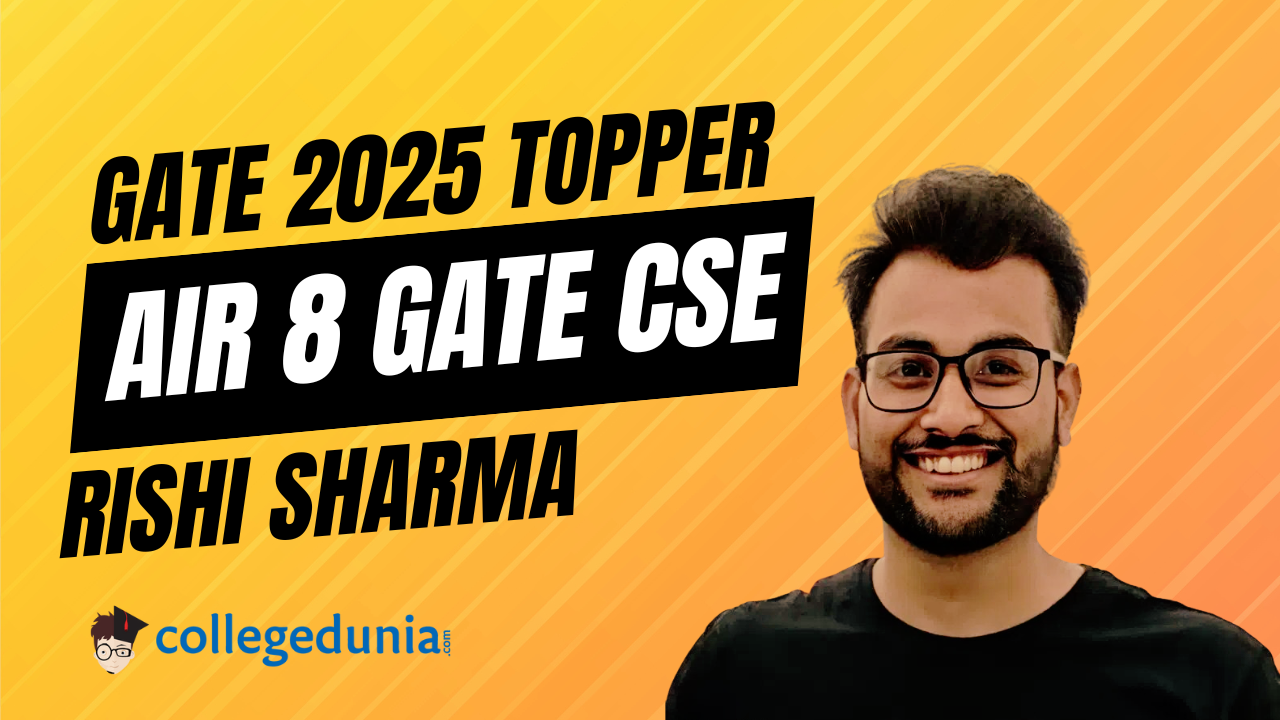
Rishi is a former software engineer at Cisco and Palo Alto Networks, with offers from Amazon, Oracle, and Nykaa. He has aslo cleared both JEE Main and JEE Advanced in his first attempt and completed his B.Tech CSE from NIT Karnataka, one of India’s top engineering colleges.
Despite a strong corporate background, he decided to work in the government sector and currently works as a District Information Officer (DIO) at NIC.
He has given many competitive exams and secured top ranks in the majority of the exams:
- AIR 8 – GATE CSE 2025
- AIR 1 – NIELIT & BARC
- AIR 2 – NIC Scientist-B
Rishi chose GATE not for M.Tech, but to unlock top central government tech roles like DRDO and NIC. His disciplined strategy, mock test rigor (40–50 full-lengths), and career clarity now inspire GATE aspirants, especially working professionals aiming for high-impact, stable careers.
In this article, we have discussed topper Rishi Sharma’s preparation strategies for GATE and how he has managed his preparation for GATE while working full-time.
Also Read
Ques. What inspired you to switch from a top corporate career to government jobs and prepare for GATE CSE 2025?
Ans. I worked with tech companies like Cisco and Palo Alto Networks, and I had multiple offers from top companies like Google, Amazon, Oracle, and Nykaa. However, when Google revoked their offer, despite clearing all rounds, it was a huge shock, and I was very demotivated. That’s when I thought of starting my career in the government sector, so I started exploring government exams. I first looked at NIELIT, then moved on to BARC and NIC.
My motivation for giving GATE wasn't M.Tech—it was because many central govt. Tech jobs (like in NIC or DRDO) now accept GATE scores. Since I was already preparing for other government. exams, it made sense to prepare for GATE too.
Ques. GATE CSE has a vast syllabus. How did you design your preparation strategy to cover it all effectively?
Ans. I started preparing for the GATE by focusing on the major 3 steps: understanding the syllabus thoroughly, focusing on the content, and starting to practice.
- Understanding the syllabus: I thoroughly understood the GATE CSE 2025 syllabus and compared it with topics from NIC, NIELIT, and BARC. It was easy to understand because I have cleared the JEE Main and JEE Advanced, so the maths in GATE is comparatively easy from JEE Advanced.
- Focused Content Coverage: I didn’t read everything from scratch. I prioritized the subjects I was weak in and skipped some topics I was confident about, like Engineering Mathematics and Programming Logic, and focused more on the theory subjects.
- Extensive Practice: I took test series from 4–5 coaching (e.g., Made Easy, ACE, Ravindra Babu Ravula, etc.), although i have not to finished all tests, but to cover variety in question patterns. My goal was to attempt every kind of question I might face in the actual exam.
This helped me ensure that every question in the real GATE exam felt familiar, either in concept or structure.
Ques. How did you balance GATE 2025 preparation while working full-time? What was your daily schedule like?
Ans. Balancing work and prep was tough. I was working full-time from 10 AM to 4–5 PM and had meetings again from 9 PM to 11 PM due to my US-based team. So, my main study window was 11 PM to 4 AM, when there were no distractions.
I adjusted my sleep pattern, I used to sleep for 5–6 hours either late morning or early evening. I also utilized office breaks to nap and weekends for revision and mock tests. I planned long weekends by taking Friday or Monday off, giving me blocks of 3–4 days for focused study.
Tip for Working Aspirants: Use your leaves smartly, find your most productive time (for me it was night), and stay consistent—even 4 hours daily can take you to AIR 8.
Ques. How many full-length mock tests should a serious GATE CSE aspirant give? What was your number?
Ans. I gave around 15 All India Mock Tests (AIMTs), specifically, 3 AIMTs each from five different coaching institutes. In total, I attempted 40 to 50 full-length mock tests, excluding the subject-wise and topic-wise tests. They helped me practice time management effectively, which is one of the most important skills while taking the GATE. They helped me in practicing time management efficiently, which is the most important skill for taking the GATE. The mock tests also helped me in developing the stamina required to maintain concentration during a 3-hour test. With time, I started noticing patterns in the types of questions that repeatedly showed up. The GATE exam just felt like another mock test.
Ques. What were the toughest subjects in GATE CSE for you, and how did you overcome those challenges?
Ans. I found Computer Organization and Architecture (COA) the toughest subjects while preparing for the GATE 2025. The COA has topic like Hardware-centric, which is more theoretical, with lots of overlapping concepts, and it is time-consuming to revise.
I covered only 30-40% of the COA by breaking the subject into 6–7 units, covered one unit per month along with the other easier subjects, and used YouTube lectures at 2x speed for fast revision.
Ques. How long should a student prepare for GATE CSE 2025 if starting from scratch?
Ans. As per I, if your B.Tech fundamentals are strong in 2–3 core subjects (like DS, Algo, Maths), 8–10 months are enough to prepare for GATE. But if you're starting from scratch or from a Tier-3 college, you should start preparing 12–14 months before the exam.
For me, since I already studied for JEE Advanced and worked in product-based companies, I only needed to revise the unfamiliar theoretical subjects in detail.
Ques. Many aspirants collect materials from multiple coaching. What is your advice on study material and coaching?
Ans. I would suggest sticking to the one standard coaching and prefer the test series. I recommend using multiple test series. I enrolled in 4–5 coaching test series, including those from Made Easy, ACE Academy, Ravindra Babu Ravula, and a few others. This gave me exposure to a variety of question patterns and levels of difficulty.
I think that coaching contributes only about 30% to the preparation, and the remaining 70% depends entirely on the self-study and your consistency, your discipline, and your mindset. Even if someone doesn’t have the means to afford a premium coaching program, they can still crack GATE with the right mix of YouTube, quality test series, and focused self-study.
Ques. What methods did you use to revise the vast GATE syllabus, especially theory-heavy subjects?
Ans. My revision was mostly based on a method called Active Recall. I didn’t just passively read notes again and again. Instead, I would write down the chapter names of a subject, for example, say "Pipeline, Cache Memory, Virtual Memory" from Computer Organization, and then try to recall every concept and formula from memory without looking at my notes.
Only when I couldn’t recall something, then I would quickly refer back to my notes. This method saved a lot of time and helped lock things into long-term memory.
Apart from that, I was very active in WhatsApp doubt-solving groups. I wasn’t just there to ask questions—I would regularly answer other people’s doubts, and that turned out to be a great revision tool. When someone asked a tricky question in Computer Organization (COA), it would often lead me to revise related concepts in Operating Systems or Compilers. When I was solving a doubt on instruction cycles in COA, it made me switch on the OS and intermediate code generation in Compilers. So, just by helping others, I was also revising across multiple subjects without even realizing it.
Ques. How should working professionals approach GATE 2025 differently from full-time students?
Ans. If you’re a working professional preparing for GATE, the first thing you need is clarity on your "why." I always say—use your current salary as motivation. For example, if you're earning ₹6–8 LPA now, you might expect to reach ₹12–15 LPA in the next few years with regular private job growth. But with GATE + an M.Tech from a top IIT, your starting package itself could be around ₹25–30 LPA, and the next jump could easily be to ₹50+ LPA. That’s a massive return on one year of focused effort.
Also, don’t underestimate the power of the IIT brand. Once you get in, you become part of an elite IIT alumni network, which helps you with referrals, switches, startups, or even future government projects. It’s not just about the degree—it’s about unlocking access to a different ecosystem altogether.
From a practical standpoint, working professionals must be very strategic with time. You can’t study like a college student who has full days off. What I suggest is:
- Pick your most productive hours—for some, that’s early morning; for others, late evening after work.
- Plan your weekends ahead, block them strictly for GATE revision and test-taking.
- If possible, use paid leaves wisely—for example, before full-length mock tests or in the last 1–2 months before the exam.
I was working at top companies like Cisco and Palo Alto Networks, and still managed to prepare by making smart adjustments to my schedule. It’s hard, but the ROI is worth it.
Ques. Many students lose motivation if they fail GATE once. What would you say to repeaters?
Ans. GATE is not just an exam; it’s a shortcut to career clarity. If you didn’t succeed last time, analyze your mistakes properly. Was it a lack of practice, weak revision, or a flawed strategy? Don’t repeat the same pattern. Start small and stay consistent. For me, consistency is the key to cracking the GATE. The GATE is predictable; if you get the concepts and test-taking strategy right, you’ll crack it eventually.
Also, remember—off-campus job hunting is slow and uncertain. One year of focused GATE prep can open doors to IITs, PSUs, and ₹25+ LPA packages. That’s worth trying again.
Key Takeaways for GATE 2025 Aspirants:
“You’ll get bored with the process—same study cycle, same mock tests. But that boredom is proof will lead to a successful future, and it will be worth it.”
- Hours: Focused 4–5 hrs/day (11 PM–4 AM) are enough for working professionals.
- Preparation Duration: In 8–10 months with used strong concepts of B.Tech to cut down on time.
- Mock Tests: Attempted 40–50 full-length tests + 15 AIMTs on 5 coaching platforms for exposure and time management.
- Coaching Strategy: No complete coaching; utilized YouTube + test series for diversity of content.
- Toughest Subject: COA (Computer Organization & Architecture); overcome through active recall and revision through peer doubts.
- Key Technique: Active Recall + WhatsApp doubt groups for intelligent revision and connected subject learning.
- Repeater Tips: Emphasize consistency rather than perfection, and alter strategy if earlier attempts did not work.
| Area | Rishi’s Approach |
| Study Time | 4–5 hours/day (11 PM to 4 AM) |
| Mock Tests | 40–50 full-length + 15 AIMTs |
| Toughest Subject | Computer Organization & Architecture |
| Coaching | No full coaching; used test series & YouTube |
| Preparation Time | 8–10 months (with strong B.Tech base) |
| Key Strategy | Active Recall + Doubt-Solving Groups |
| Advice for Repeaters | Consistency, not perfection; analyze failures |



Comments