




CBSE successfully conducted the Class 12 Economics Exam 2026. The CBSE Board Class 12 Economics Set 3 Question Paper with Solution PDF is now available for download.
The CBSE Class 12 Economics Set 3 question paper is of 70 marks, divided into sections to assess both theoretical knowledge and practical application. The marking scheme included 20 marks for short answers, 30 marks for long answers, and 20 marks for essays and problem-solving questions. The paper was of moderate difficulty, with an emphasis on concepts, numerical problems, and diagram-based questions.
CBSE Class 12 2026 Economics Question Paper with Solution PDF Set 3
| CBSE Class 12 Economics Set 3 Question Paper 2026 | Download PDF | Check Solution |
Identify that function of money which has effectively solved the problem of ‘double coincidence of wants’ in transactions.
Income generated from Aircrafts of Air India operating between Canada and England would be added to the domestic income (NDPFC) of ____________.
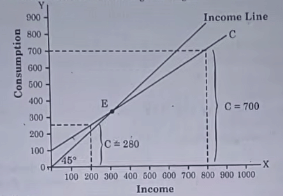
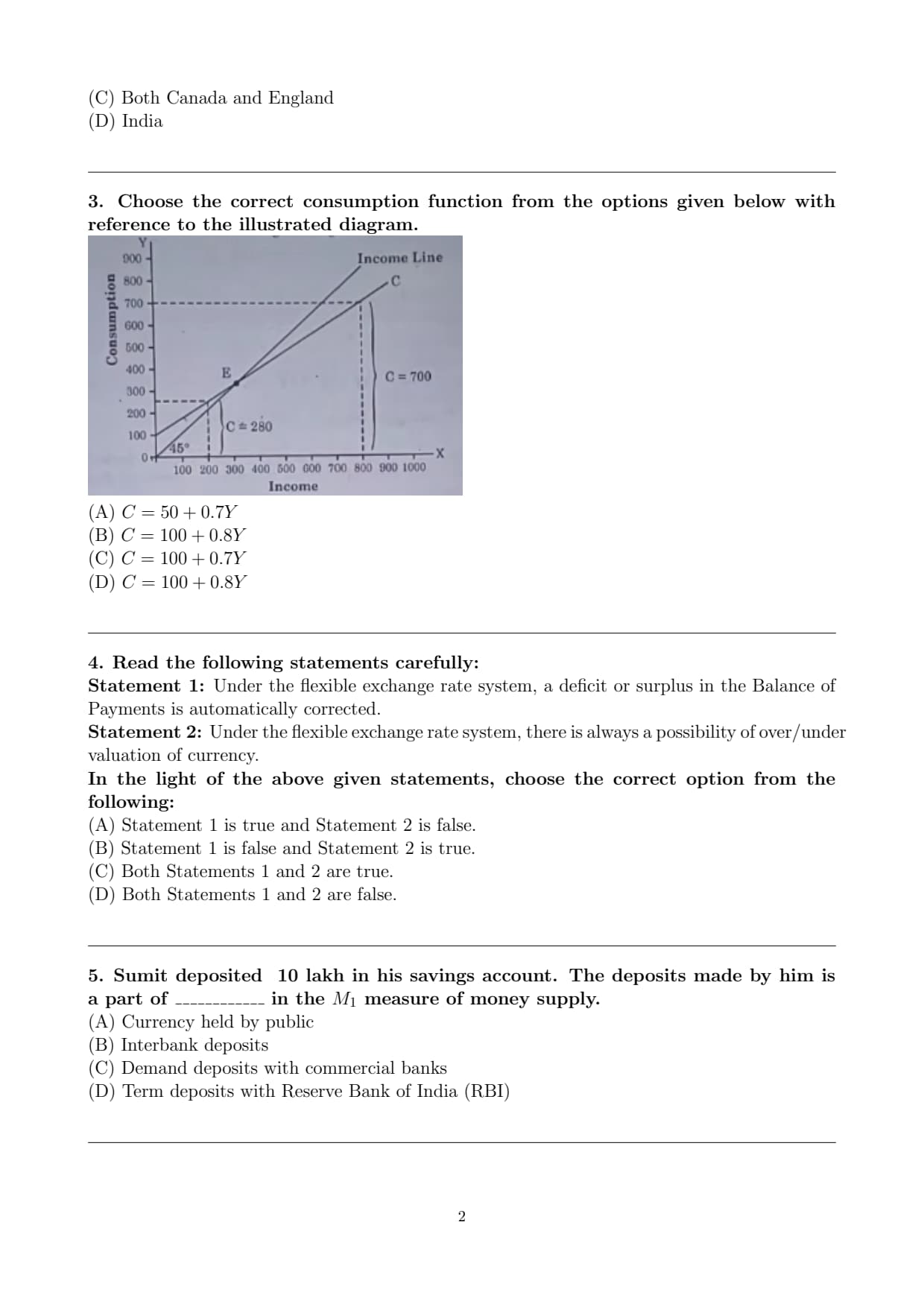
Choose the correct consumption function from the options given below with reference to the illustrated diagram.
Read the following statements carefully:
Statement 1: Under the flexible exchange rate system, a deficit or surplus in the Balance of Payments is automatically corrected.
Statement 2: Under the flexible exchange rate system, there is always a possibility of over/under valuation of currency.
In the light of the above given statements, choose the correct option from the following:
Sumit deposited ₹ 10 lakh in his savings account. The deposits made by him is a part of ____________ in the \(M_1\) measure of money supply.
Read the following statements – Assertion (A) and Reason (R). Choose the correct option from those given below:
Assertion (A): Increase in exchange rate implies that the price of foreign currency in terms of domestic currency has increased.
Reason (R): Balance of trade records the inflows and outflows of goods.
Identify, which one of the following is not a function of Reserve Bank of India as a bank, agent and advisor to the government.
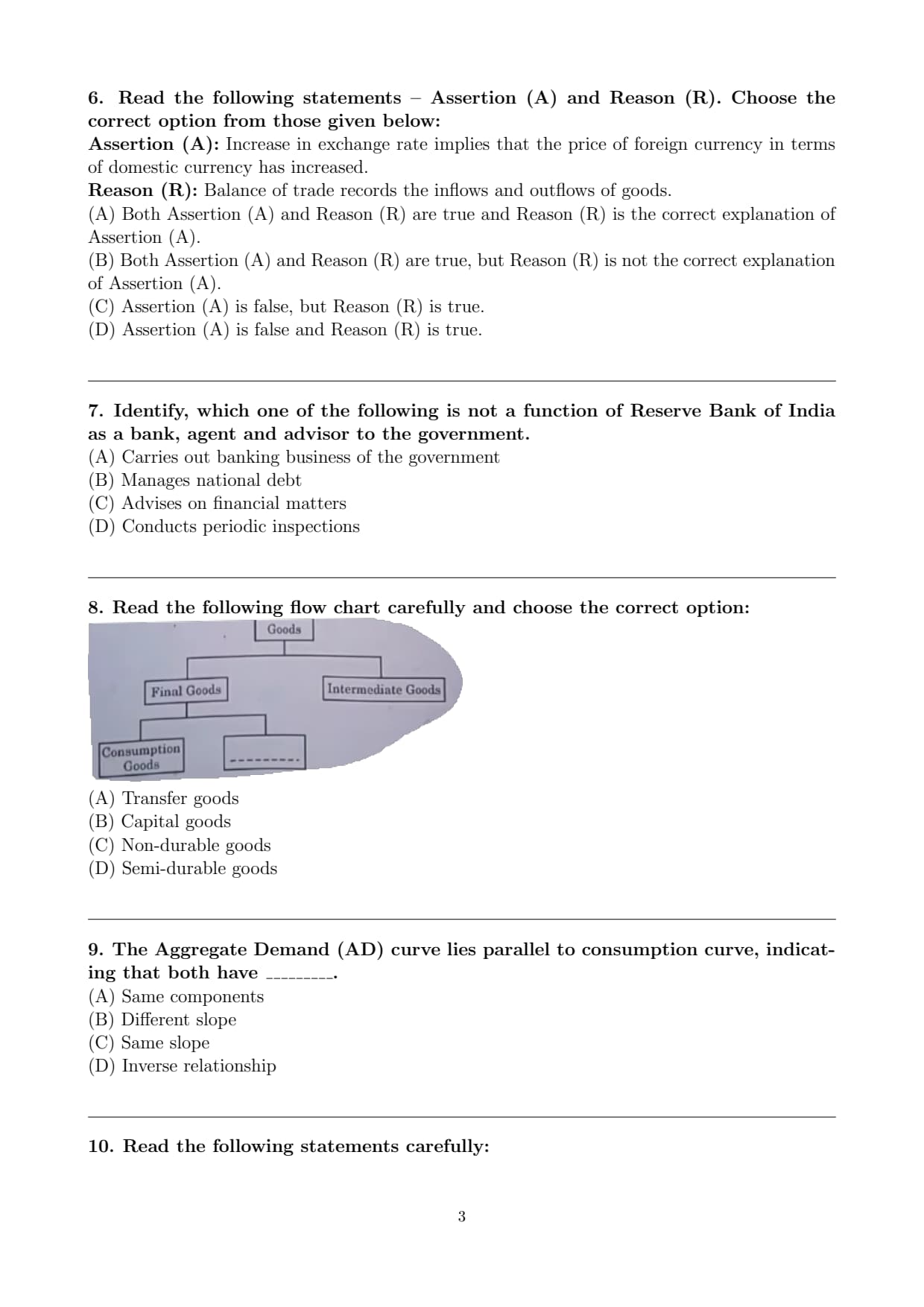
Read the following flow chart carefully and choose the correct option:

The Aggregate Demand (AD) curve lies parallel to consumption curve, indicating that both have _________.
Read the following statements carefully:
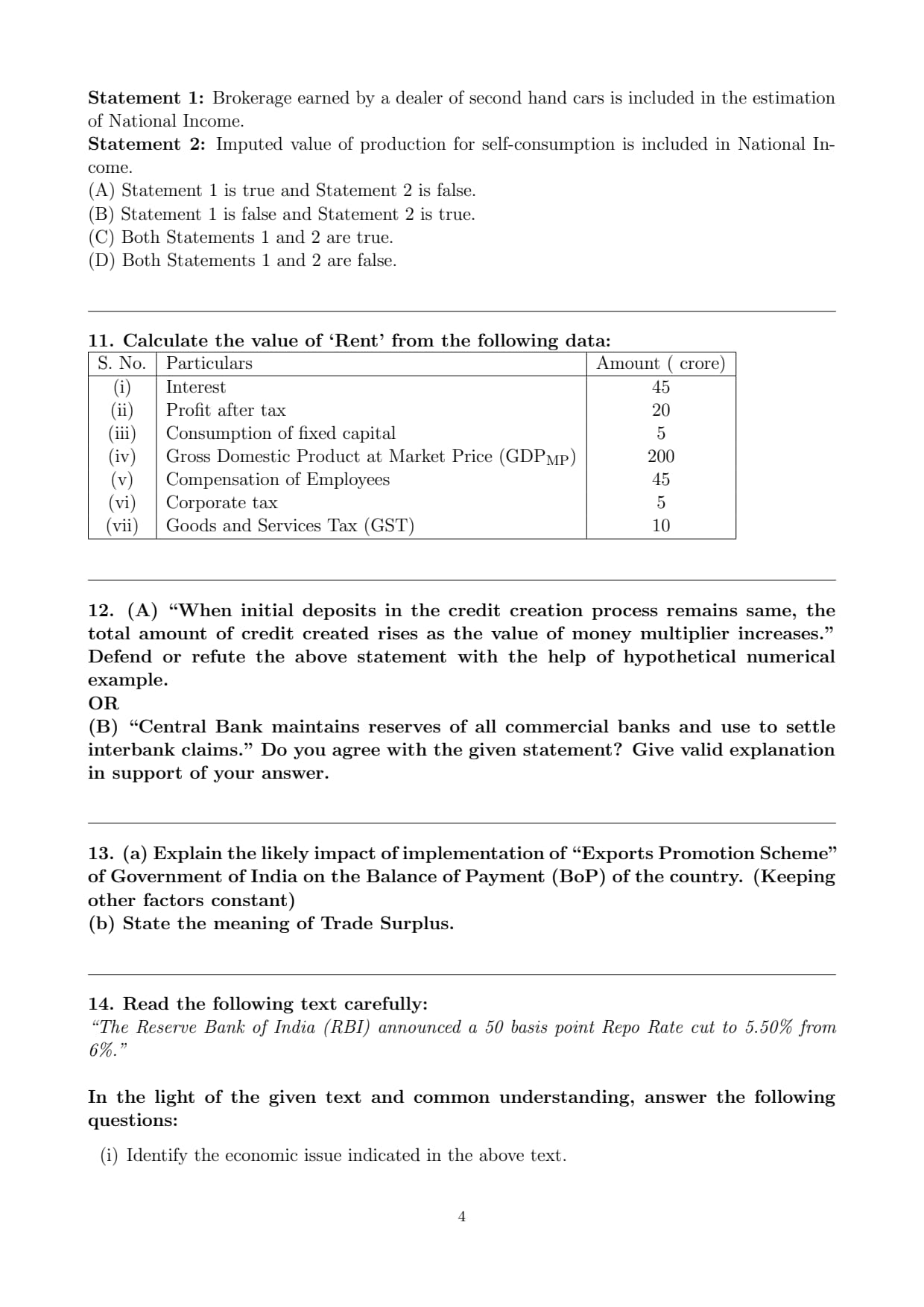
Statement 1: Brokerage earned by a dealer of second hand cars is included in the estimation of National Income.
Statement 2: Imputed value of production for self-consumption is included in National Income.
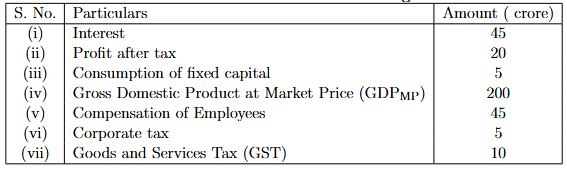
Calculate the value of ‘Rent’ from the following data:
(A) “When initial deposits in the credit creation process remains same, the total amount of credit created rises as the value of money multiplier increases.” Defend or refute the above statement with the help of hypothetical numerical example.
OR
(B) “Central Bank maintains reserves of all commercial banks and use to settle interbank claims.” Do you agree with the given statement? Give valid explanation in support of your answer.
(a) Explain the likely impact of implementation of “Exports Promotion Scheme” of Government of India on the Balance of Payment (BoP) of the country. (Keeping other factors constant)
(b) State the meaning of Trade Surplus.
Read the following text carefully:
“The Reserve Bank of India (RBI) announced a 50 basis point Repo Rate cut to 5.50% from 6%.”
In the light of the given text and common understanding, answer the following questions:
(i) Identify the economic issue indicated in the above text.
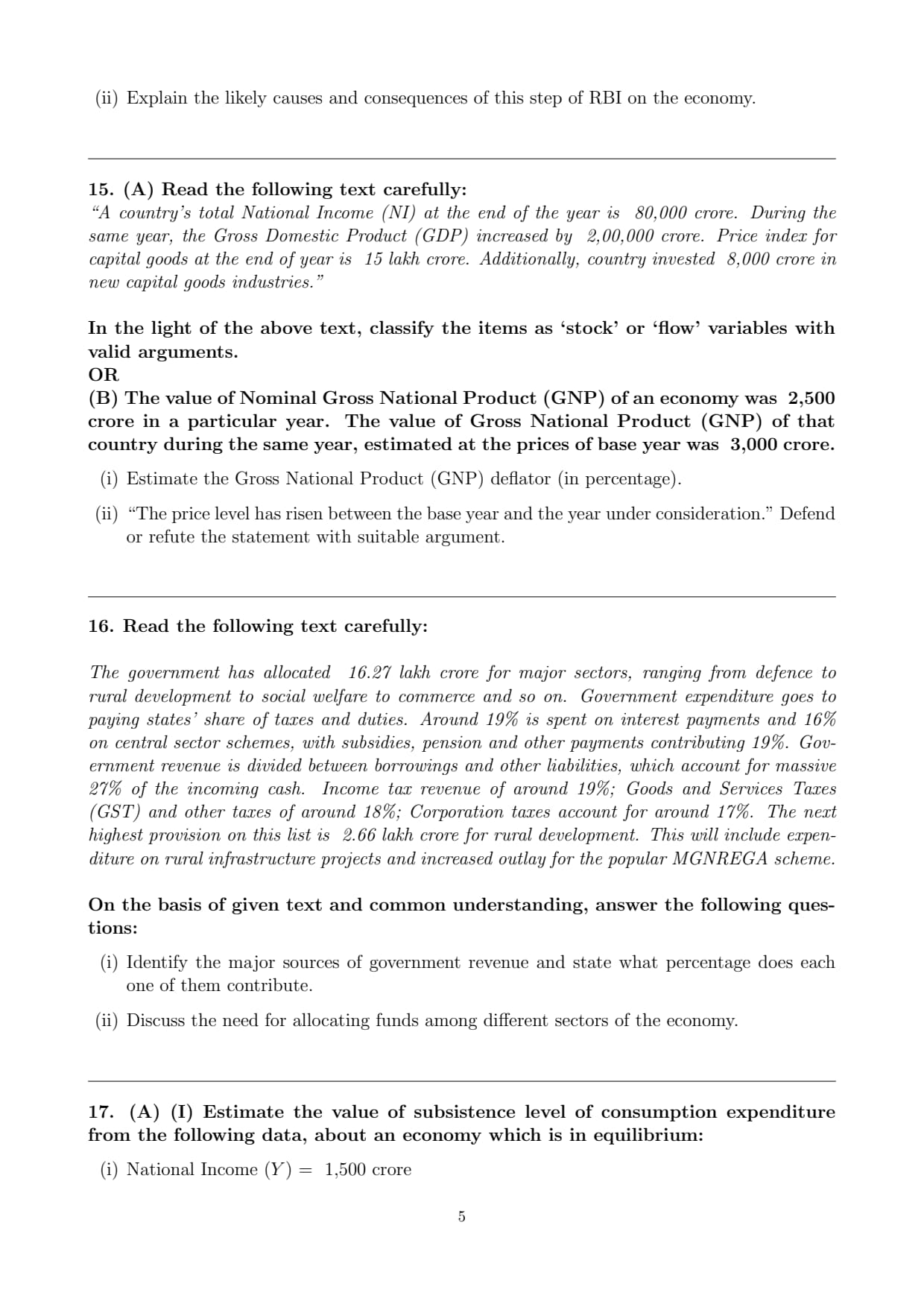
(ii) Explain the likely causes and consequences of this step of RBI on the economy.
(A) Read the following text carefully:
“A country’s total National Income (NI) at the end of the year is ₹ 80,000 crore. During the same year, the Gross Domestic Product (GDP) increased by ₹ 2,00,000 crore. Price index for capital goods at the end of year is ₹ 15 lakh crore. Additionally, country invested ₹ 8,000 crore in new capital goods industries.”
In the light of the above text, classify the items as ‘stock’ or ‘flow’ variables with valid arguments.
OR
(B) The value of Nominal Gross National Product (GNP) of an economy was ₹ 2,500 crore in a particular year. The value of Gross National Product (GNP) of that country during the same year, estimated at the prices of base year was ₹ 3,000 crore.
(i) Estimate the Gross National Product (GNP) deflator (in percentage).
(ii) “The price level has risen between the base year and the year under consideration.” Defend or refute the statement with suitable argument.
Read the following text carefully:
The government has allocated ₹ 16.27 lakh crore for major sectors, ranging from defence to rural development to social welfare to commerce and so on. Government expenditure goes to paying states' share of taxes and duties. Around 19% is spent on interest payments and 16% on central sector schemes, with subsidies, pension and other payments contributing 19%. Government revenue is divided between borrowings and other liabilities, which account for massive 27% of the incoming cash. Income tax revenue of around 19%; Goods and Services Taxes (GST) and other taxes of around 18%; Corporation taxes account for around 17%. The next highest provision on this list is ₹ 2.66 lakh crore for rural development. This will include expenditure on rural infrastructure projects and increased outlay for the popular MGNREGA scheme.
On the basis of given text and common understanding, answer the following questions:
(i) Identify the major sources of government revenue and state what percentage does each one of them contribute.
(ii) Discuss the need for allocating funds among different sectors of the economy.
(A) (I) Estimate the value of subsistence level of consumption expenditure from the following data, about an economy which is in equilibrium:
(i) National Income (\(Y\)) = ₹ 1,500 crore
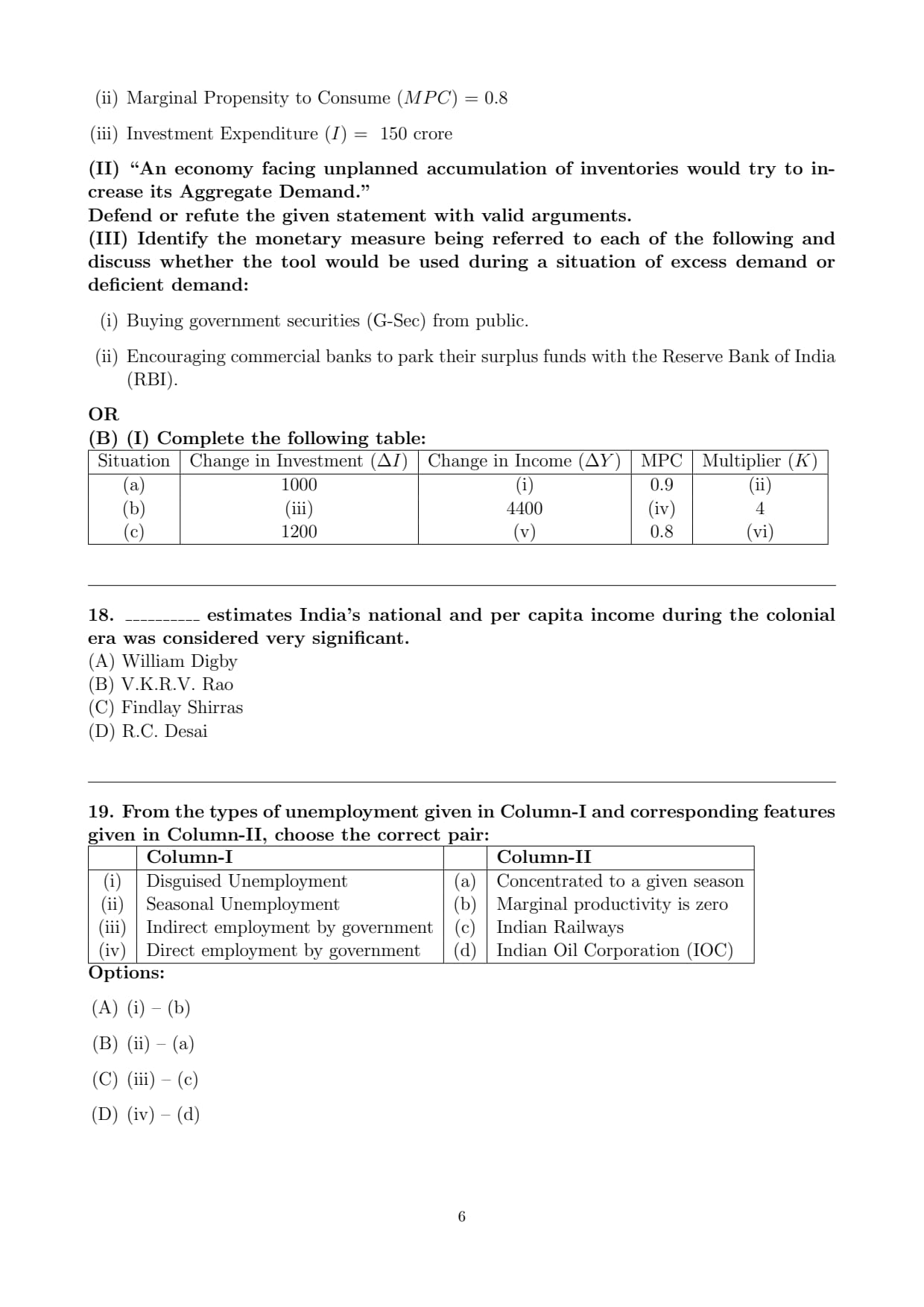
(ii) Marginal Propensity to Consume (\(MPC\)) = 0.8
(iii) Investment Expenditure (\(I\)) = ₹ 150 crore
(II) “An economy facing unplanned accumulation of inventories would try to increase its Aggregate Demand.”
Defend or refute the given statement with valid arguments.
(III) Identify the monetary measure being referred to each of the following and discuss whether the tool would be used during a situation of excess demand or deficient demand:
(i) Buying government securities (G-Sec) from public.
(ii) Encouraging commercial banks to park their surplus funds with the Reserve Bank of India (RBI).
OR
(B) (I) Complete the following table:

__________ estimates India's national and per capita income during the colonial era was considered very significant.
From the types of unemployment given in Column-I and corresponding features given in Column-II, choose the correct pair:

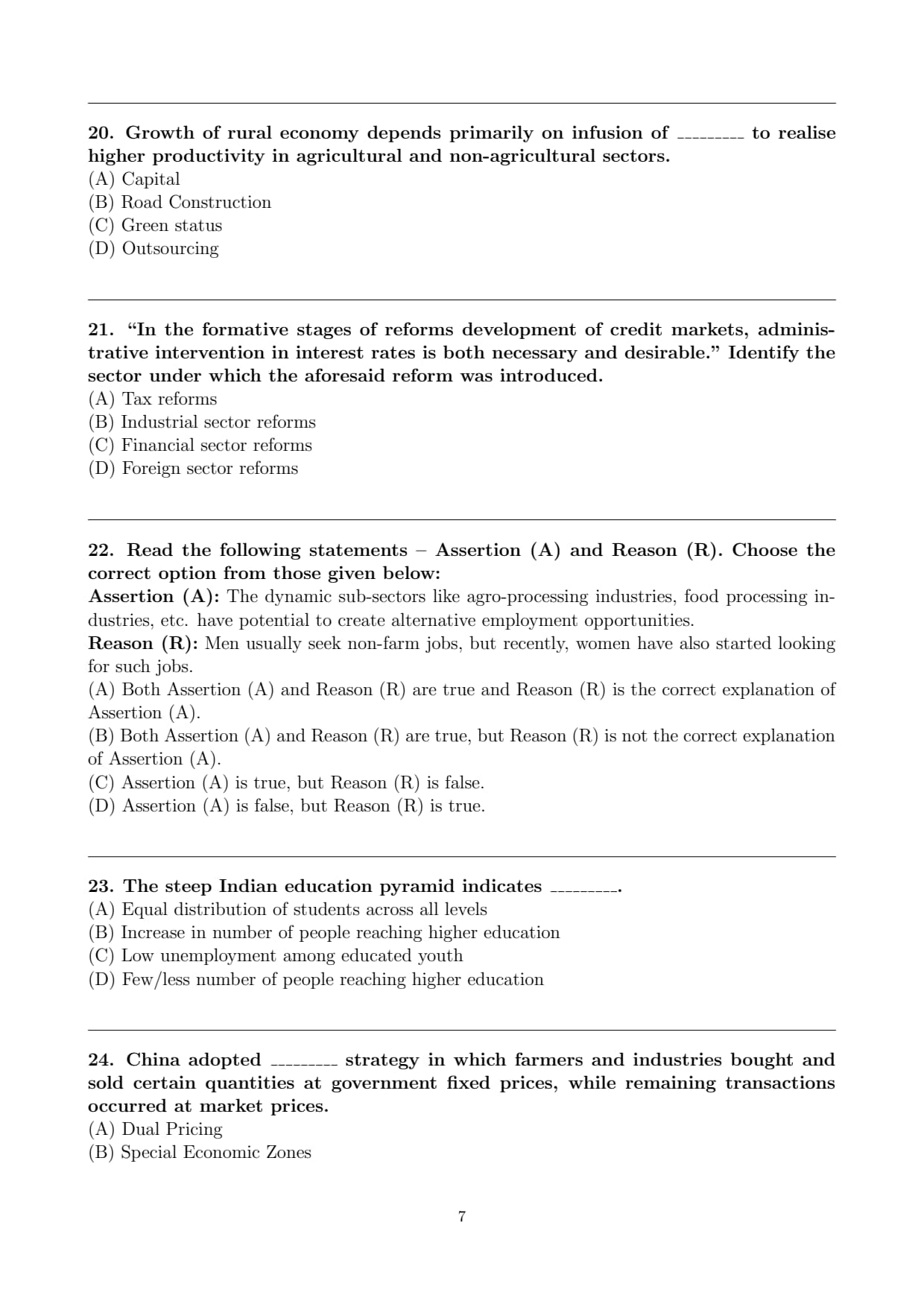
Growth of rural economy depends primarily on infusion of _________ to realise higher productivity in agricultural and non-agricultural sectors.
“In the formative stages of reforms development of credit markets, administrative intervention in interest rates is both necessary and desirable.” Identify the sector under which the aforesaid reform was introduced.
Read the following statements – Assertion (A) and Reason (R). Choose the correct option from those given below:
Assertion (A): The dynamic sub-sectors like agro-processing industries, food processing industries, etc. have potential to create alternative employment opportunities.
Reason (R): Men usually seek non-farm jobs, but recently, women have also started looking for such jobs.
The steep Indian education pyramid indicates _________.
China adopted _________ strategy in which farmers and industries bought and sold certain quantities at government fixed prices, while remaining transactions occurred at market prices.
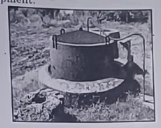
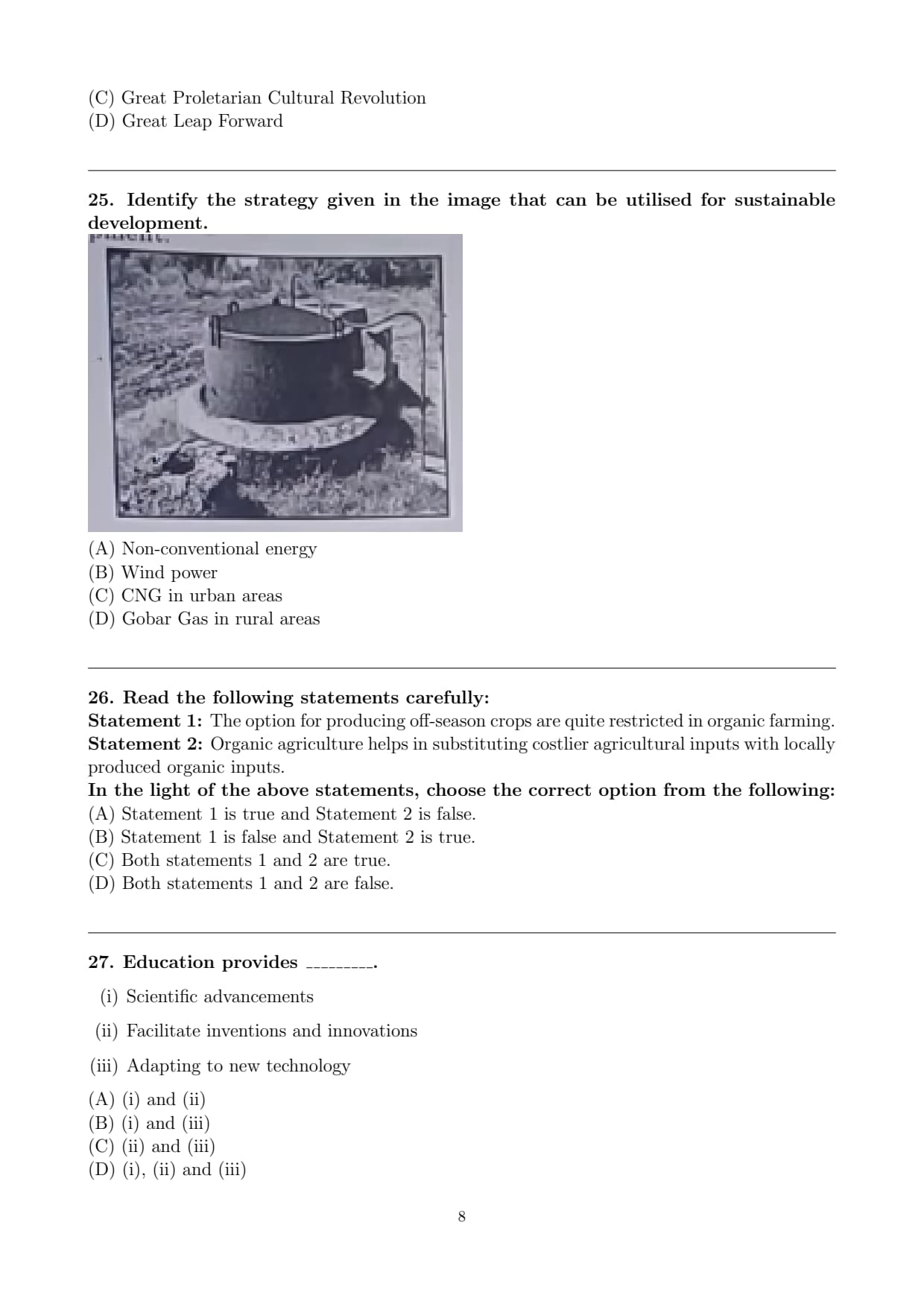
Identify the strategy given in the image that can be utilised for sustainable development.
Read the following statements carefully:
Statement 1: The option for producing off-season crops are quite restricted in organic farming.
Statement 2: Organic agriculture helps in substituting costlier agricultural inputs with locally produced organic inputs.
In the light of the above statements, choose the correct option from the following:
Education provides _________.
(i) Scientific advancements
(ii) Facilitate inventions and innovations
(iii) Adapting to new technology
Explain the Great Leap Forward (GLF) campaign of China.
(A) Distinguish between formal and informal sector of employment with the help of suitable examples.
OR
(B) Discuss the long term implications of increased demand for environmental resources exceeding their natural regenerative capacity.
(a) Refer the given image carefully: Distribution of Employment by Gender.
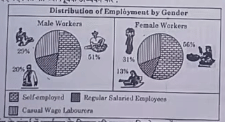
Compare and analyse the distribution of workforce with respect to gender.
(A) "The Restrictive policies under the colonial government adversely affected the structure, composition and volume of India's foreign trade." Justify the above statement with valid explanation.
OR
(B) Explain the main objectives and impacts of land settlement policies implemented under the British government rule.
(i) State the meaning of Special Economic Zone (SEZ).
(ii) Discuss the 'One Child Policy' adopted by China.
Read the following text carefully:
The Union Budget 2025-26 proposed a significant package for rural India allocating ₹ 1.88 lakh crore to drive comprehensive development. The budget emphasises on boosting employment, women employment, education and infrastructure in rural areas, reflecting the government's commitment for a stronger, self-reliant rural economy. The extension of Jal-Jeevan Mission until 2028, with focus on achieving 100% rural water supply coverage and enhancing infrastructure maintenance. Broadband connectivity is set to expand under the Bharatnet project, providing internet access to all rural government secondary schools and primary health care centres.
Also, the budget highlights major rural schemes like the Pradhan Mantri Gram Sadak Yojana which has provided all-weather roads to rural areas. The Pradhan Mantri Grameen Awaas Yojana, which has delivered housing to economically weaker sections. The Mahatma Gandhi National Rural Employment Guarantee Scheme (MGNREGS) continues to secure rural livelihoods with an allocation of ₹ 86,000 crore in FY 2024-25.
On the basis of the above text and common understanding, answer the following questions:
(i) Explain the significance of rural development.
(ii) Discuss any two policies initiated by Government of India for rural development.
(A) Read the following text carefully and answer the questions given below:
“This organisation replaced General Agreement on Trade and Tariff (GATT) as global trade organisation.”
(i) Identify the organisation which is known as the successor of GATT.
(ii) In which year was this new organisation established?
(iii) Explain any two objectives of the new organisation.
OR
(B) Read the following text carefully and answer the questions given below:
“It is an arrangement in which a firm hires some specialized firm(s) to carry out some of its activities (which were earlier being performed by itself). These service hirings could be from local / international markets.”
(i) Identify the indicated outcome of the globalisation process.
(ii) State any two factors responsible for making India as an important source of these activities.
(iii) Explain examples of services that have expanded due to advancements in information technology.
CBSE 2026 Class 12 Economics Exam Pattern - Set 3
| Section | Description | Marks |
|---|---|---|
| Section A | Short Answer Questions | 20 marks |
| Section B | Long Answer Questions | 30 marks |
| Section C | Case-Based and Application Questions | 20 marks |
| Section D | Diagram and Data Interpretation | 10 marks |




Comments