




The CBSE Board conducted Class 12 History Set 1 Exam on March 30, 2026. Class 12 History Set 1 Question Paper with Solution PDF is available here for download.
The CBSE Class 12 History Set 1 paper covers important topics from ancient, medieval, and modern Indian History Set 1, including themes like the Harappan civilization, Mughal period, colonial rule, and the freedom struggle. Students should focus on understanding key events, analyzing sources, and practicing structured answer writing with relevant examples. The exam is typically marked out of 100 marks, with 80 marks for the theory paper and 20 marks for internal assessment.
CBSE Class 12 2026 History Set 1 Question Paper with Solution PDF
| CBSE Class 12 History Set 1 Question Paper 2026 | Download PDF | Check Solution |
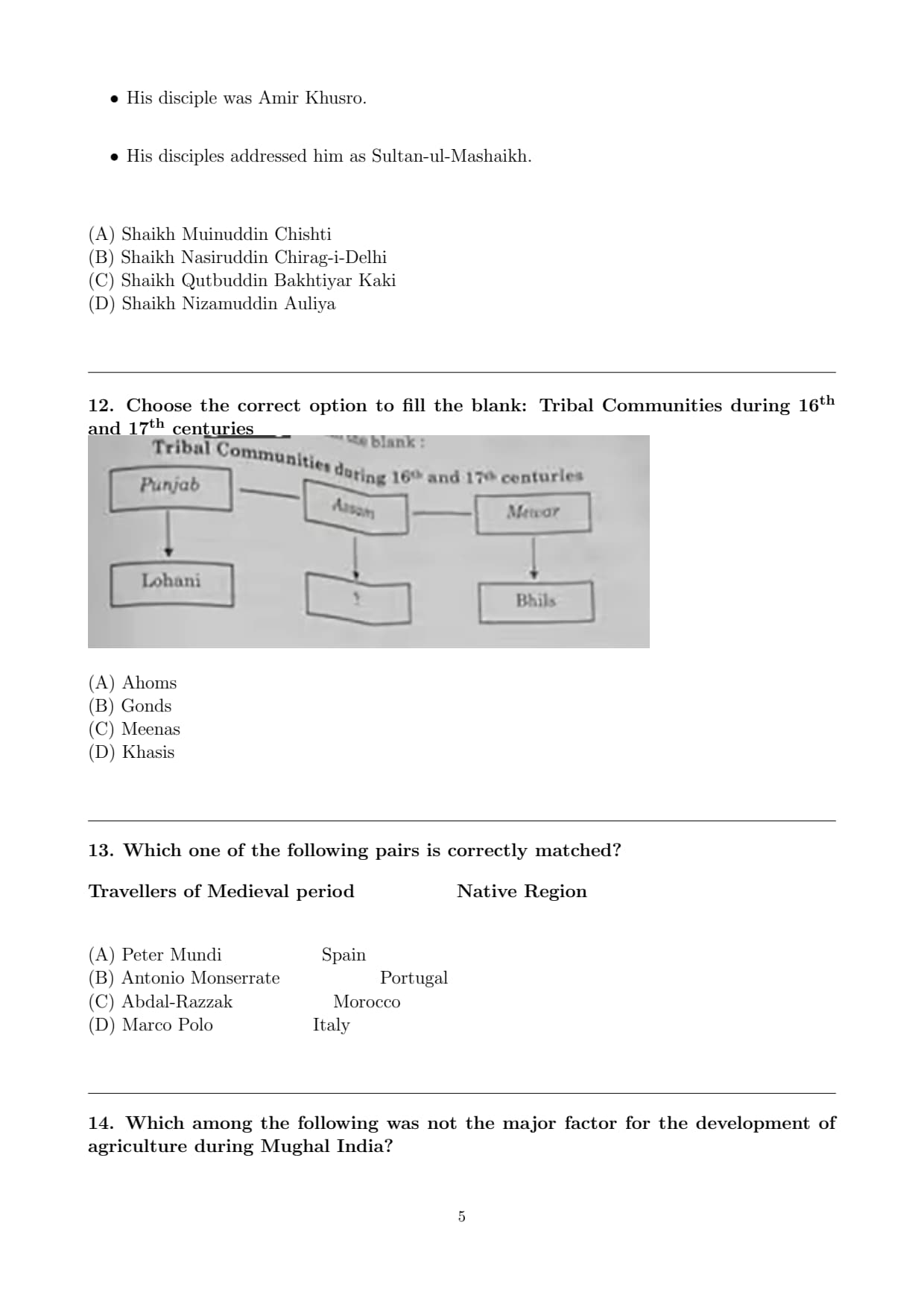
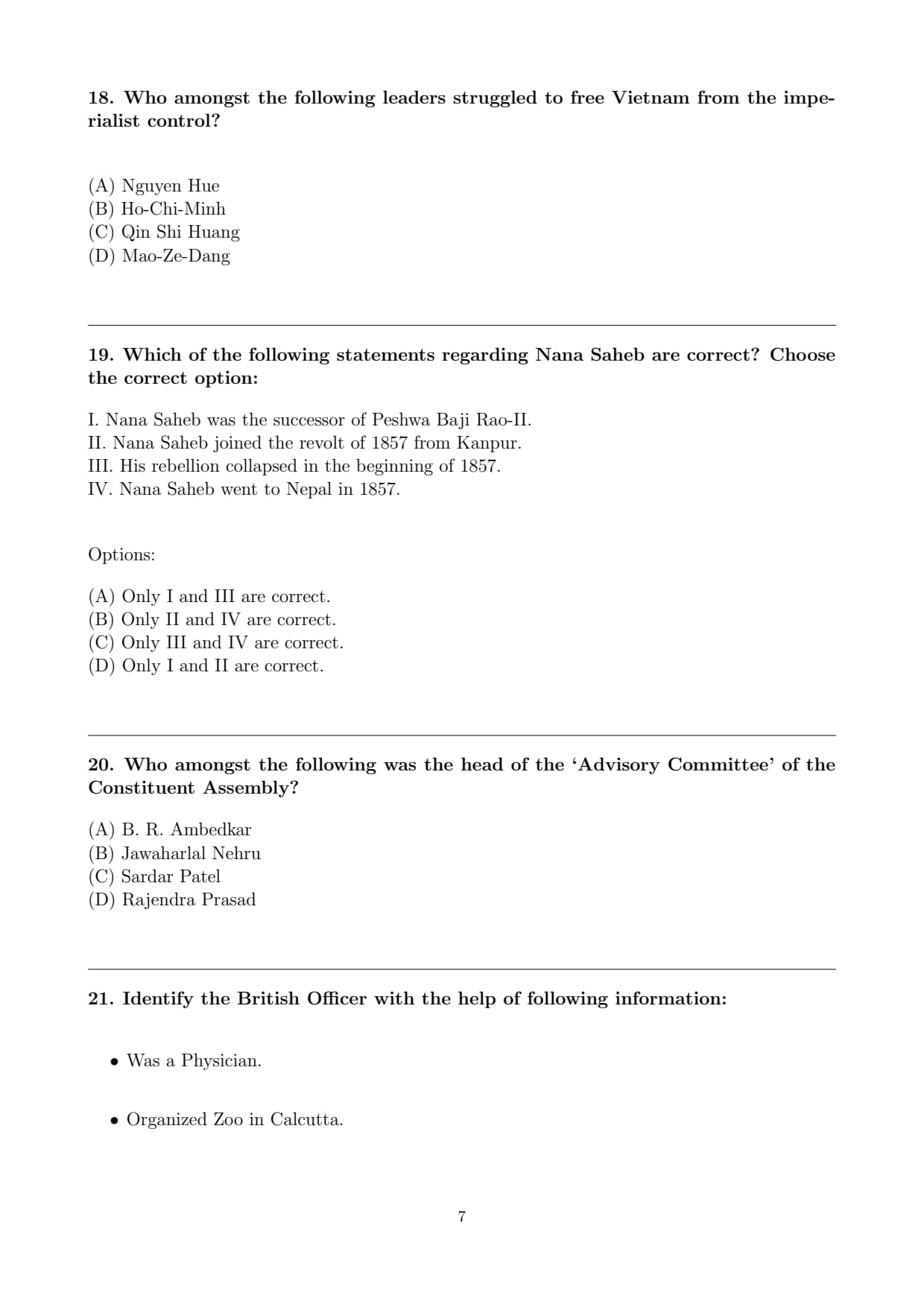
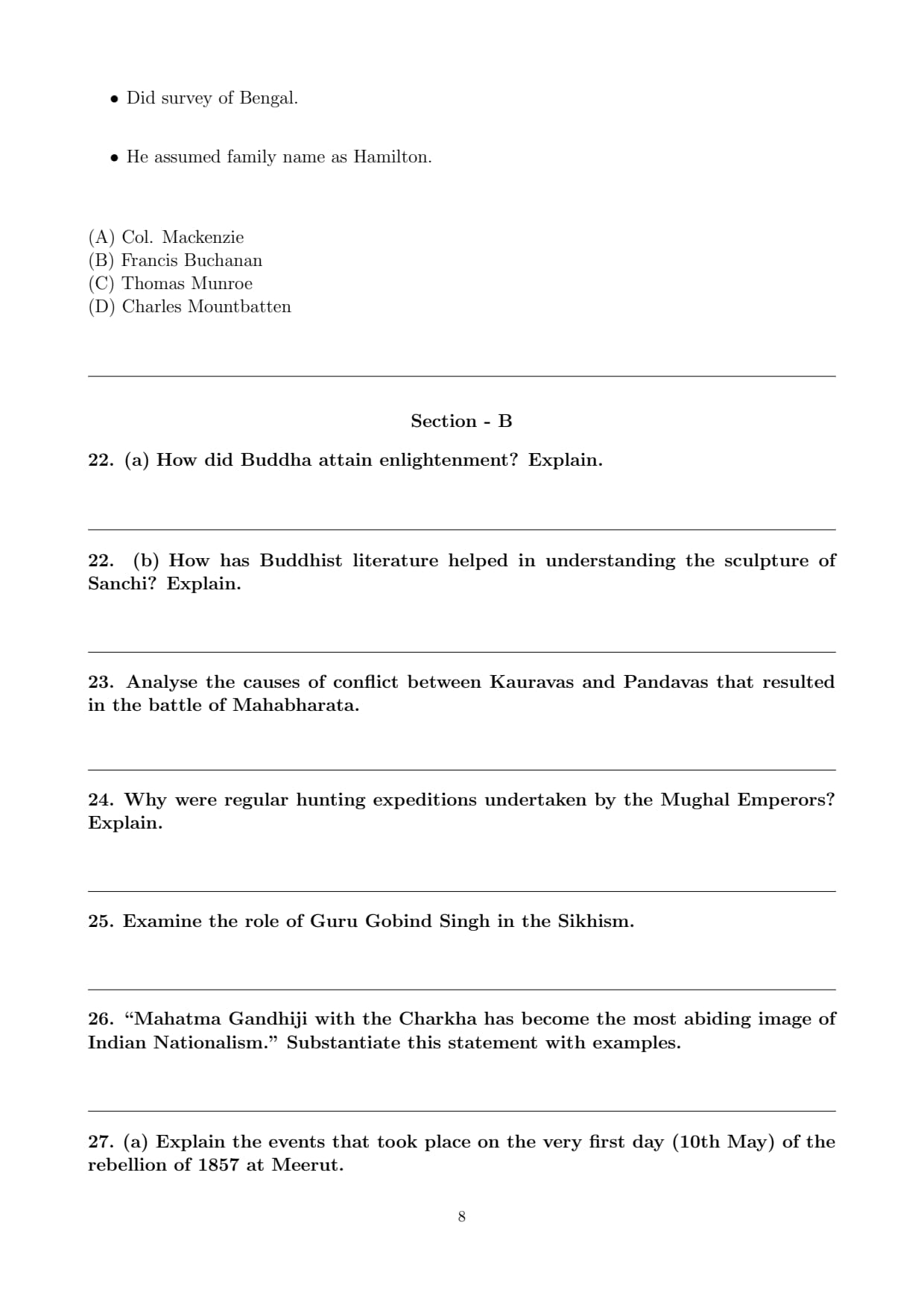
Question 1:
Who among the following rulers issued the first gold coins?
View Solution
Step 1: Understand early coinage in India.
In ancient India, different dynasties issued coins made of various metals such as copper, silver, and gold. Gold coins were especially significant as they indicated strong economic prosperity and extensive trade.
Step 2: Identify the first issuers of gold coins.
The Kushana rulers, especially King Kanishka, were the first to issue a large number of gold coins in India. These coins were influenced by Roman coinage and reflected strong trade links with the Roman Empire.
Step 3: Analyze other options.
(A) Vakataka rulers: Not known for issuing the earliest gold coins.
(B) Mauryan rulers: Mainly issued punch-marked coins, mostly of silver.
(C) Gupta rulers: Famous for gold coins, but they came after the Kushanas.
(D) Kushana rulers: Correct. They were the first to issue gold coins extensively.
Step 4: Conclusion.
Hence, the first rulers to issue gold coins in India were the Kushana rulers.
Final Answer: Kushana rulers. Quick Tip: Kushanas = First gold coins, Guptas = Maximum gold coins. This is a common exam trick.
Which one of the following statements is correct regarding Raja Gotmi Puta Siri Satakani?
View Solution
Step 1: Identify the ruler.
Gautamiputra Satakarni was a prominent ruler of the Satavahana dynasty. He is known from inscriptions such as the Nasik inscription of his mother Gautami Balashri.
Step 2: Understand his policies.
He is known for upholding the varna system and maintaining social order. Historical records suggest that he opposed intermixing of varnas and worked to preserve traditional social divisions.
Step 3: Analyze the options.
(A) Incorrect. He was not a ruler of the Shaka dynasty.
(B) Correct. He emphasized maintaining purity of varna system and discouraged intermarriage.
(C) Incorrect. There is no evidence of such alliance with Gupta rulers.
(D) Incorrect. Sudarshan lake was rebuilt by Rudradaman, not Gautamiputra Satakarni.
Step 4: Conclusion.
Therefore, the correct statement regarding Gautamiputra Satakarni is that he ensured no intermarriage among the four varnas.
Final Answer: He ensured no intermarriage amongst members of the four varnas. Quick Tip: Gautamiputra Satakarni = Satavahana ruler known for restoring Brahmanical social order and defeating Shakas.
Given below are two statements as Assertion (A) and Reason (R). Read them carefully and answer the question by choosing correct options:
Assertion (A): Like Buddhism, Jainism also spread to many parts of India.
Reason (R): Jaina scholars produced literature in various languages like Tamil, Prakrit and Sanskrit etc.
View Solution
Step 1: Understanding Assertion (A).
Jainism, like Buddhism, spread widely across different regions of India. It gained followers in various parts such as Gujarat, Rajasthan, Karnataka, and Tamil Nadu. Hence, the assertion is correct.
Step 2: Understanding Reason (R).
Jaina scholars contributed significantly to literature in multiple regional and classical languages such as Prakrit, Sanskrit, and Tamil. This made Jain teachings accessible to a wider population across different regions. Hence, the reason is also correct.
Step 3: Linking Assertion and Reason.
The spread of Jainism was greatly supported by the availability of religious texts and teachings in different languages. This helped in reaching people of diverse linguistic backgrounds, thereby facilitating its expansion across India.
Step 4: Conclusion.
Thus, both Assertion and Reason are correct, and the Reason correctly explains the Assertion.
Final Answer: Both (A) and (R) are correct and (R) is the correct explanation of (A).
Quick Tip: Religions spread faster when their teachings are available in local languages, making them accessible to common people.
Read the following statements regarding Buddhism teaching and choose the correct option:
I. The world is transient and constantly changing.
II. It is soulless and there is nothing eternal in it.
III. Sorrows and sufferings are intrinsic to human existence.
IV. Renouncing the world is essential for living.
Codes:
View Solution
Step 1: Understanding Buddhist teachings.
Buddhism is based on key doctrines such as impermanence (Anicca), non-self (Anatta), and suffering (Dukkha). These teachings explain the nature of life and existence.
Step 2: Analyze statement I.
The idea that the world is constantly changing is called Anicca (impermanence). This is a core Buddhist principle. Hence, statement I is correct.
Step 3: Analyze statement II.
Buddhism rejects the concept of a permanent soul (Atman). This concept is known as Anatta. Hence, statement II is correct.
Step 4: Analyze statement III.
Buddhism teaches that life involves suffering (Dukkha), which is one of the Four Noble Truths. Hence, statement III is correct.
Step 5: Analyze statement IV.
Buddhism does not say that renouncing the world is essential for all. Instead, it teaches the Middle Path, avoiding both extreme asceticism and indulgence. Hence, statement IV is incorrect.
Step 6: Conclusion.
Therefore, only statements I, II, and III are correct.
Final Answer: I, II, III are correct.
Quick Tip: Remember the three key Buddhist concepts: Anicca (impermanence), Anatta (no soul), and Dukkha (suffering).
Match Column-I with Column-II and choose the correct option:
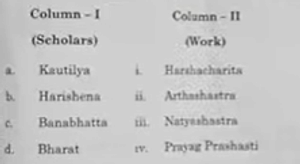
View Solution
Step 1: Identify Kautilya.
Kautilya (Chanakya) is the author of the famous political treatise Arthashastra. So, a-ii.
Step 2: Identify Harishena.
Harishena was the court poet of Samudragupta and composed the Prayag Prashasti. So, b-iv.
Step 3: Identify Banabhatta.
Banabhatta was a court poet of Harshavardhana and wrote Harshacharita. So, c-i.
Step 4: Identify Bharat.
Bharata Muni is the author of Natyashastra, a classical text on performing arts. So, d-iii.
Step 5: Conclusion.
Thus, the correct matching is a-ii, b-iv, c-i, d-iii.
Final Answer: a-ii, b-iv, c-i, d-iii.
Quick Tip: Remember key pairs: Kautilya–Arthashastra, Banabhatta–Harshacharita, Bharata–Natyashastra, Harishena–Prayag Prashasti.
Which of the following is a correct statement regarding Eklavya?
View Solution
Step 1: Understanding the story of Eklavya.
Eklavya was a tribal boy who wanted to learn archery from Guru Dronacharya. However, Drona refused to teach him because he was not from a royal lineage.
Step 2: Self-learning and dedication.
Despite being rejected, Eklavya made a statue of Drona and practiced archery in front of it with great dedication. He became a highly skilled archer through self-learning.
Step 3: Guru Dakshina incident.
When Drona saw Eklavya’s skill, he asked for Guru Dakshina. Eklavya, considering Drona as his guru, offered his right thumb without hesitation, which affected his archery ability.
Step 4: Analysis of options.
(A) Incorrect — He was not Drona’s favourite student.
(B) Incorrect — He did not belong to Kuru lineage.
(C) Correct — He offered his right thumb as Guru Dakshina.
(D) Incorrect — He was not a co-student or friend of Arjuna.
Step 5: Conclusion.
Thus, the correct statement is option (C).
Final Answer: Eklavya offered his right thumb to Drona as Guru Dakshina.
Quick Tip: Eklavya is remembered for his dedication, self-learning, and supreme sacrifice for his guru.
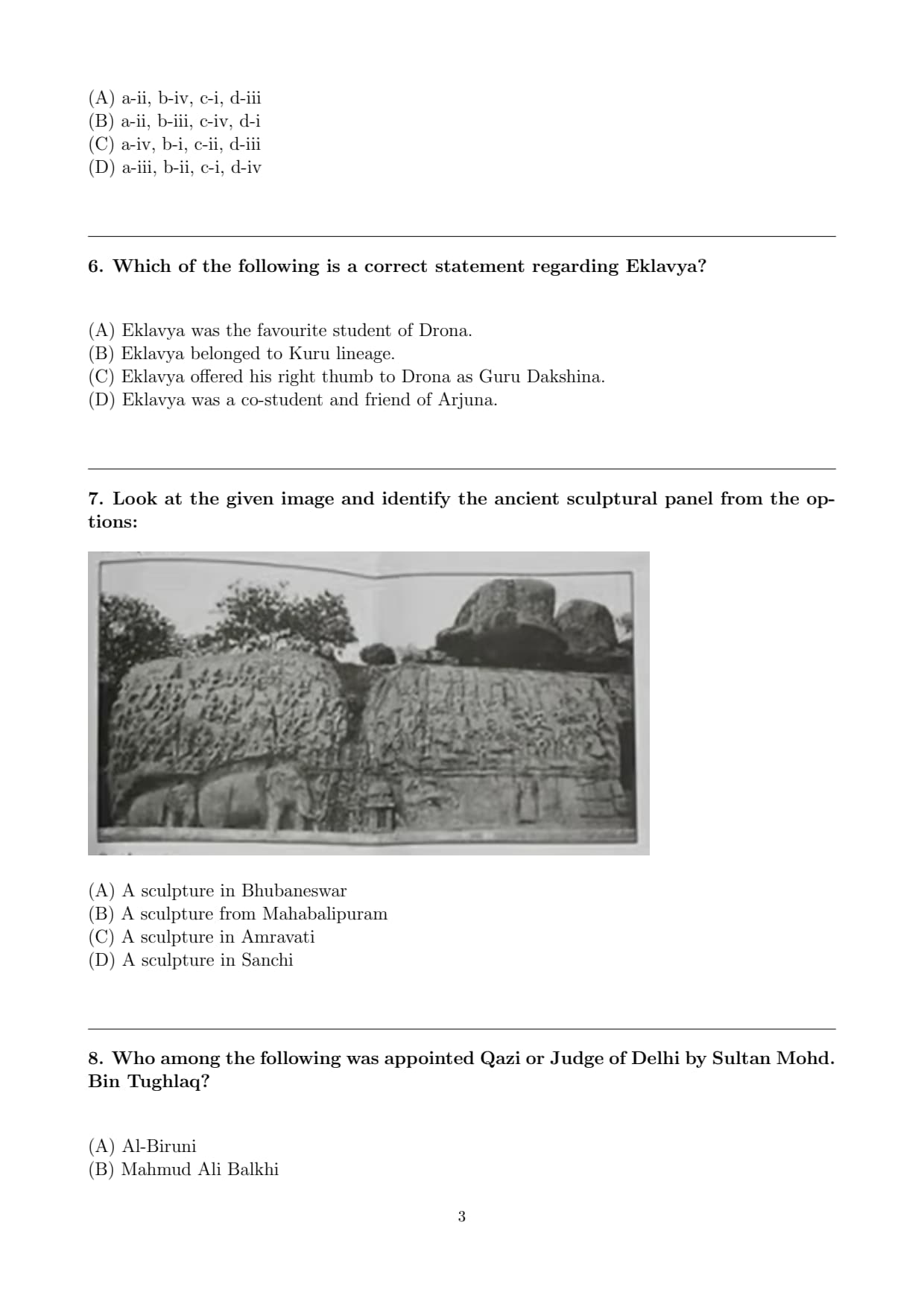
Look at the given image and identify the ancient sculptural panel from the options:
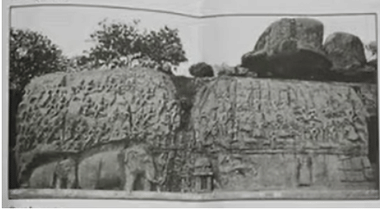
View Solution
Step 1: Observing the image.
The image shows a large rock-cut relief with multiple human and animal figures carved on a massive stone surface. It appears to be an open-air sculptural panel rather than a temple or stupa decoration.
Step 2: Identifying key features.
Such large monolithic rock carvings with detailed narrative scenes are characteristic of the famous "Descent of the Ganges" or "Arjuna’s Penance" panel located at Mahabalipuram in Tamil Nadu.
Step 3: Comparing with other options.
(A) Bhubaneswar — Known for temples, not such large open rock panels.
(B) Mahabalipuram — Famous for massive rock-cut relief sculptures.
(C) Amravati — Known for stupa railings and reliefs, not this type.
(D) Sanchi — Known for stupas and gateways, not large rock panels.
Step 4: Conclusion.
Hence, the given sculptural panel belongs to Mahabalipuram.
Final Answer: A sculpture from Mahabalipuram.
Quick Tip: Mahabalipuram is famous for its rock-cut architecture, especially the "Descent of the Ganges" relief.
Who among the following was appointed Qazi or Judge of Delhi by Sultan Mohd. Bin Tughlaq?
View Solution
Step 1: Understanding the historical context.
Muhammad Bin Tughlaq was a ruler of the Delhi Sultanate known for his administrative experiments and openness to foreign scholars and travelers.
Step 2: Identifying Ibn Battuta.
Ibn Battuta was a famous Moroccan traveler who visited India during the reign of Muhammad Bin Tughlaq. He stayed in India for several years and documented his experiences in his famous travel account.
Step 3: Role assigned by the Sultan.
Muhammad Bin Tughlaq was impressed by Ibn Battuta and appointed him as the Qazi (judge) of Delhi. This position involved administering justice according to Islamic law.
Step 4: Analysis of other options.
(A) Al-Biruni — A scholar who lived much earlier during Mahmud of Ghazni's time.
(B) Mahmud Ali Balkhi — Not associated with this appointment.
(D) Sayyid Ali Reis — An Ottoman admiral and traveler, not related to Delhi Sultanate judiciary.
Step 5: Conclusion.
Thus, Ibn Battuta was appointed as the Qazi of Delhi by Muhammad Bin Tughlaq.
Final Answer: Ibn Battuta.
Quick Tip: Ibn Battuta was a famous traveler whose writings give valuable insights into the Delhi Sultanate under Muhammad Bin Tughlaq.
Identify the correct statements regarding the early Bhakti movement in South India:
I. Alvars and Nayanars travelled from place to place singing hymns in Tamil.
II. One of the major anthologies of compositions by the Alvars, Amuktamalyada, described as Tamil Vedas.
III. Karaikkal Ammaiyar and Andal were the women devotees of Nayanar and Alvar tradition.
IV. Both Nayanars and Alvar saints were revered by the Vellalas peasants.
Options:
View Solution
Step 1: Analyze statement I.
Alvars and Nayanars were Bhakti saints who spread devotion through hymns in Tamil and travelled across regions. Hence, statement I is correct.
Step 2: Analyze statement II.
The major anthology of Alvars is Nalayira Divya Prabandham, not Amuktamalyada. Amuktamalyada is a Telugu work by Krishnadevaraya. Hence, statement II is incorrect.
Step 3: Analyze statement III.
Karaikkal Ammaiyar (a Nayanar saint) and Andal (an Alvar saint) were important women devotees in Bhakti tradition. Hence, statement III is correct.
Step 4: Analyze statement IV.
Both Alvars and Nayanars were popular among common people, including Vellalas (peasants), and were widely revered. Hence, statement IV is correct.
Step 5: Conclusion.
Thus, statements I, III, and IV are correct.
Final Answer: I, III and IV are correct.
Quick Tip: Alvars = Vishnu devotees, Nayanars = Shiva devotees. Their hymns were in Tamil and aimed at common people.
Arrange the following dynasties in chronological order and choose the correct option:
I. Saluva dynasty
II. Sangama dynasty
III. Aravidu dynasty
IV. Tuluva dynasty
Options:
View Solution
Step 1: Identify the dynasties.
These dynasties belong to the Vijayanagara Empire, which had four main ruling dynasties over time.
Step 2: Arrange in chronological order.
The correct chronological sequence is:
Sangama dynasty (founders of Vijayanagara Empire)
Saluva dynasty
Tuluva dynasty (Krishnadevaraya belonged to this)
Aravidu dynasty
Step 3: Match with given options.
Thus, the correct order is:
\[ II \rightarrow I \rightarrow IV \rightarrow III \]
Step 4: Conclusion.
Hence, the correct answer is option (D).
Final Answer: II, I, IV, III.
Quick Tip: Vijayanagara dynasties order: Sangama → Saluva → Tuluva → Aravidu.
Identify the Sufi Saint with the help of following information and select the correct option:
His Hospice was on the bank of river Yamuna in Delhi.
His disciple was Amir Khusro.
His disciples addressed him as Sultan-ul-Mashaikh.
View Solution
Step 1: Understanding the clues.
The question provides three key clues: location of hospice near Yamuna in Delhi, association with Amir Khusro, and the title Sultan-ul-Mashaikh. These are strong identifiers of a prominent Sufi saint.
Step 2: Role of Amir Khusro.
Amir Khusro was a famous poet, musician, and disciple of Shaikh Nizamuddin Auliya. This clue directly points towards Nizamuddin Auliya among the given options.
Step 3: Title Sultan-ul-Mashaikh.
Shaikh Nizamuddin Auliya was popularly known as Sultan-ul-Mashaikh, meaning “king among spiritual guides.” This title is specifically associated with him.
Step 4: Location verification.
His khanqah (hospice) was located near the Yamuna river in Delhi, which further confirms his identity.
Step 5: Conclusion.
Thus, all the given clues clearly match Shaikh Nizamuddin Auliya.
Final Answer: Shaikh Nizamuddin Auliya.
Quick Tip: Remember: Amir Khusro was the famous disciple of Nizamuddin Auliya, and this is a commonly asked exam fact.
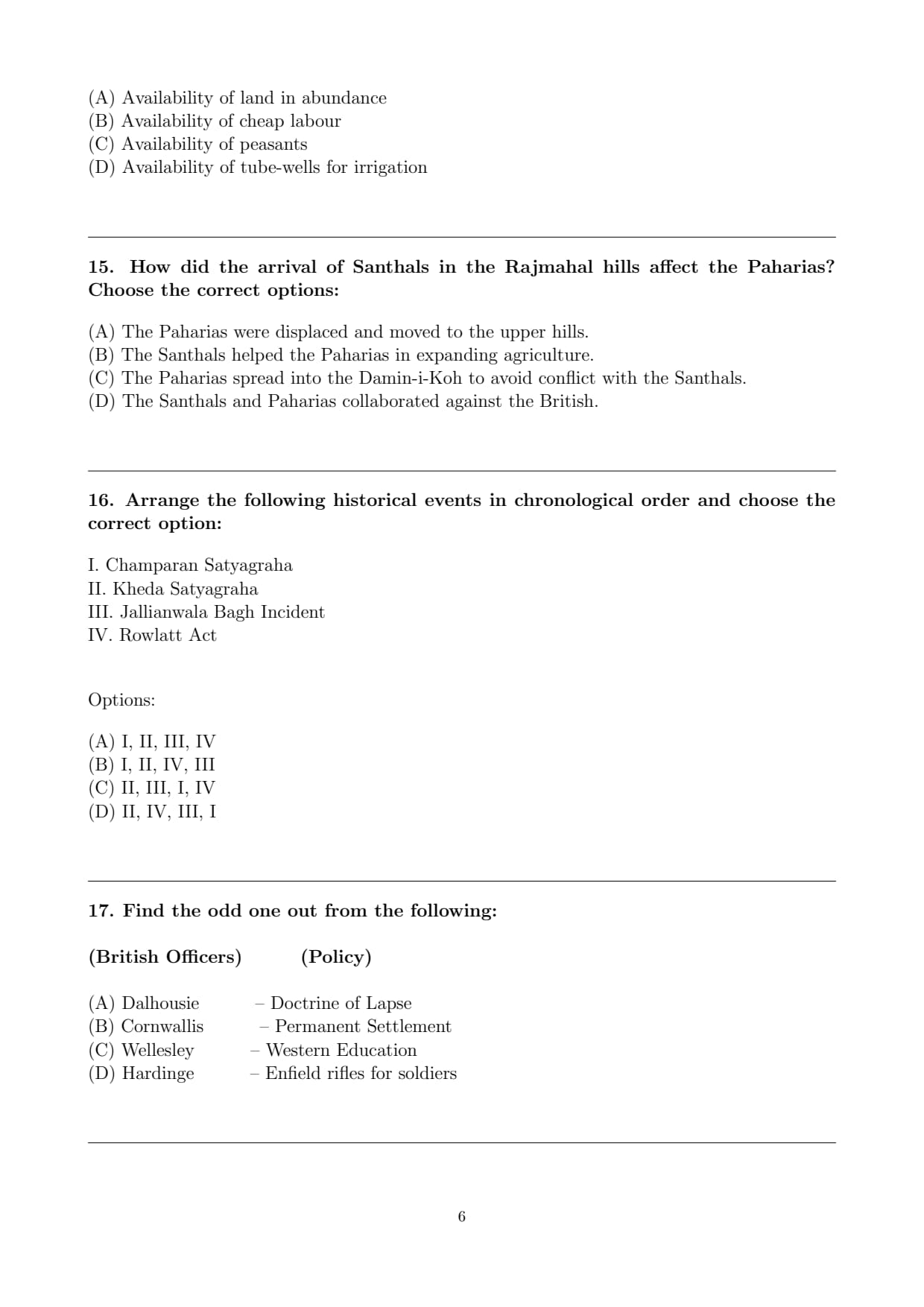
Choose the correct option to fill the blank: Tribal Communities during 16th and 17th centuries
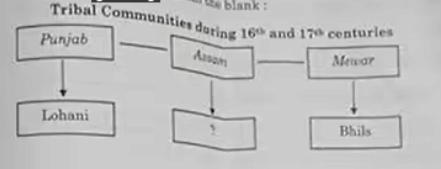
View Solution
Step 1: Understand the regional tribes.
Different regions of India had distinct tribal communities during the medieval period. These tribes were closely associated with specific geographical areas.
Step 2: Analyze given matches.
Punjab is correctly matched with Lohani, and Mewar with Bhils. Now we need to identify the tribe associated with Assam.
Step 3: Identify tribe of Assam.
The Ahoms were a prominent tribal community in Assam. They established a powerful kingdom and ruled Assam for several centuries.
Step 4: Eliminate incorrect options.
Gonds were mainly in Central India.
Meenas were found in Rajasthan.
Khasis were from Meghalaya region.
Step 5: Conclusion.
Thus, the correct tribe for Assam is Ahoms.
Final Answer: Ahoms.
Quick Tip: Remember regional tribes: Assam = Ahoms, Rajasthan = Meenas/Bhils, Central India = Gonds.
Which one of the following pairs is correctly matched?
Travellers of Medieval period \hspace{2cm} Native Region
View Solution
Step 1: Identify each traveller.
To solve this, we need to recall the origin of famous medieval travellers who visited India or wrote about it.
Step 2: Analyze options.
Peter Mundi: He was from England, not Spain. Hence incorrect.
Antonio Monserrate: He was a Spanish Jesuit, not Portuguese. Hence incorrect.
Abdal-Razzak: He was from Persia (Iran), not Morocco. Hence incorrect.
Marco Polo: He was a famous traveller from Italy. Hence correct.
Step 3: Conclusion.
Thus, the correctly matched pair is Marco Polo -- Italy.
Final Answer: Marco Polo -- Italy.
Quick Tip: Remember famous travellers: Marco Polo (Italy), Ibn Battuta (Morocco), Abdur Razzaq (Persia).
Which among the following was not the major factor for the development of agriculture during Mughal India?
View Solution
Step 1: Understanding Mughal agriculture.
During the Mughal period, agriculture was the backbone of the economy. Its development depended on natural resources and human labour rather than modern technology.
Step 2: Identify actual contributing factors.
There was abundance of cultivable land, and a large number of peasants were available to work on this land. Labour was also relatively cheap, which helped in expanding agricultural production.
Step 3: Analyse irrigation methods.
In Mughal India, irrigation was mainly done through wells, canals, tanks, and rivers. Modern irrigation techniques like tube-wells were not available during that period.
Step 4: Evaluate options.
(A) Correct factor — land was available in abundance.
(B) Correct factor — cheap labour supported agriculture.
(C) Correct factor — peasants were available.
(D) Incorrect factor — tube-wells are a modern development, not used in Mughal India.
Step 5: Conclusion.
Thus, the option that was not a major factor in Mughal agricultural development is availability of tube-wells.
Final Answer: Availability of tube-wells for irrigation.
Quick Tip: Modern irrigation methods like tube-wells came much later; Mughal agriculture depended mainly on wells, canals, and rainfall.
How did the arrival of Santhals in the Rajmahal hills affect the Paharias? Choose the correct options:
View Solution
Step 1: Understand the historical context.
The Santhals were settled by the British in the Rajmahal hills region (Damin-i-Koh) to expand cultivation and revenue. Their arrival had a major impact on the existing tribal population, especially the Paharias.
Step 2: Impact on Paharias.
The Santhals cleared forests and expanded agriculture, which gradually reduced the area available to the Paharias. As a result, the Paharias were pushed away from fertile lands.
Step 3: Analyze options.
(A) Correct. The Paharias were displaced and forced to move into higher hills.
(B) Incorrect. The Santhals did not assist Paharias; rather they replaced them in cultivated areas.
(C) Incorrect. It was the Santhals who were settled in Damin-i-Koh, not the Paharias moving there.
(D) Incorrect. There was no such collaboration; rather tensions existed.
Step 4: Conclusion.
Thus, the correct effect was displacement of Paharias to upper hills.
Final Answer: The Paharias were displaced and moved to the upper hills.
Quick Tip: Santhals = settled agriculturists, Paharias = forest dwellers pushed into hills after Santhal settlement.
Arrange the following historical events in chronological order and choose the correct option:
I. Champaran Satyagraha
II. Kheda Satyagraha
III. Jallianwala Bagh Incident
IV. Rowlatt Act
Options:
View Solution
Step 1: Identify dates of events.
To arrange chronologically, we must recall the years in which these events occurred.
Step 2: List events with years.
Champaran Satyagraha -- 1917
Kheda Satyagraha -- 1918
Rowlatt Act -- 1919
Jallianwala Bagh Incident -- 1919 (after Rowlatt Act)
Step 3: Arrange in order.
\[ Champaran \rightarrow Kheda \rightarrow Rowlatt Act \rightarrow Jallianwala Bagh \]
Step 4: Match with options.
This corresponds to:
\[ I \rightarrow II \rightarrow IV \rightarrow III \]
Step 5: Conclusion.
Hence, the correct chronological order is option (B).
Final Answer: I, II, IV, III.
Quick Tip: Sequence to remember: Champaran (1917) → Kheda (1918) → Rowlatt Act (1919) → Jallianwala Bagh (1919).
Find the odd one out from the following:
(British Officers) -- (Policy)
(A) Dalhousie – Doctrine of Lapse
(B) Cornwallis – Permanent Settlement
(C) Wellesley – Western Education
(D) Hardinge – Enfield rifles for soldiers
View Solution
Step 1: Analyse each pair carefully.
Each option matches a British official with a policy or reform associated with them.
Step 2: Check correct associations.
Dalhousie is correctly associated with Doctrine of Lapse.
Cornwallis is correctly associated with Permanent Settlement.
Hardinge is linked with military developments like the introduction of Enfield rifles (contextually associated with British rule).
Step 3: Identify incorrect pairing.
Wellesley is actually known for Subsidiary Alliance, not Western Education. Western Education is mainly associated with Lord Macaulay and later British educational reforms.
Step 4: Conclusion.
Thus, option (C) is the odd one out because the pairing is incorrect.
Final Answer: Wellesley – Western Education
Quick Tip: Always remember: Wellesley → Subsidiary Alliance, Dalhousie → Doctrine of Lapse, Cornwallis → Permanent Settlement.
Who amongst the following leaders struggled to free Vietnam from the imperialist control?
View Solution
Step 1: Understand the question.
The question asks about the leader who played a major role in freeing Vietnam from imperialist rule, particularly French and later American influence.
Step 2: Identify Ho Chi Minh.
Ho Chi Minh was the leader of the Vietnamese independence movement. He led the Viet Minh against French colonial rule and later played a key role in the struggle against American intervention.
Step 3: Analyse other options.
Nguyen Hue was an earlier Vietnamese ruler, not related to modern anti-imperialist struggle.
Qin Shi Huang was the first emperor of China.
Mao Zedong was the leader of China, not Vietnam.
Step 4: Conclusion.
Therefore, Ho Chi Minh is the correct answer as he led Vietnam’s struggle for independence.
Final Answer: Ho-Chi-Minh
Quick Tip: Ho Chi Minh is known as the father of modern Vietnam and led the independence movement against colonial powers.
Which of the following statements regarding Nana Saheb are correct? Choose the correct option:
I. Nana Saheb was the successor of Peshwa Baji Rao-II.
II. Nana Saheb joined the revolt of 1857 from Kanpur.
III. His rebellion collapsed in the beginning of 1857.
IV. Nana Saheb went to Nepal in 1857.
Options:
View Solution
Step 1: Analyze statement I.
Nana Saheb was the adopted son of Peshwa Baji Rao II but was not officially recognized as his successor by the British. Hence, statement I is incorrect.
Step 2: Analyze statement II.
Nana Saheb played a major role in the Revolt of 1857 and led the uprising at Kanpur. Hence, statement II is correct.
Step 3: Analyze statement III.
The rebellion of Nana Saheb did not collapse at the beginning of 1857; rather, it continued for some time during the revolt. Hence, statement III is incorrect.
Step 4: Analyze statement IV.
After the failure of the revolt, Nana Saheb is believed to have escaped to Nepal. Hence, statement IV is correct.
Step 5: Conclusion.
Thus, only statements II and IV are correct.
Final Answer: Only II and IV are correct.
Quick Tip: Nana Saheb = Leader of Kanpur revolt, adopted son of Baji Rao II, later escaped to Nepal.
Who amongst the following was the head of the ‘Advisory Committee’ of the Constituent Assembly?
View Solution
Step 1: Understand the Constituent Assembly committees.
The Constituent Assembly of India had several important committees to draft different parts of the Constitution. Each committee was headed by prominent leaders.
Step 2: Identify the Advisory Committee.
The Advisory Committee on Fundamental Rights, Minorities, and Tribal Areas was one of the most important committees.
Step 3: Identify its chairman.
This committee was chaired by Sardar Vallabhbhai Patel, who played a crucial role in shaping provisions related to fundamental rights and minority safeguards.
Step 4: Analyze other options.
B. R. Ambedkar: Chairman of Drafting Committee.
Jawaharlal Nehru: Head of Union Powers Committee.
Rajendra Prasad: President of Constituent Assembly.
Step 5: Conclusion.
Hence, the head of the Advisory Committee was Sardar Patel.
Final Answer: Sardar Patel.
Quick Tip: Key roles: Ambedkar = Drafting Committee, Nehru = Union Powers, Patel = Advisory Committee.
Identify the British Officer with the help of following information:
Was a Physician.
Organized Zoo in Calcutta.
Did survey of Bengal.
He assumed family name as Hamilton.
View Solution
Step 1: Analyse the clues.
The person mentioned was a physician, conducted surveys in Bengal, and later adopted the surname Hamilton. These are strong historical identifiers.
Step 2: Identify Francis Buchanan.
Francis Buchanan was a Scottish physician who worked in India under the British East India Company. He carried out extensive surveys in Bengal and other regions.
Step 3: Name change and contributions.
He later adopted the name Buchanan-Hamilton after inheriting property. He is also known for his contributions to zoology and is associated with early efforts related to zoological collections in Calcutta.
Step 4: Eliminate other options.
Col. Mackenzie was a surveyor but not a physician.
Thomas Munroe was an administrator.
Charles Mountbatten was a later British figure (20th century).
Step 5: Conclusion.
Thus, the correct answer is Francis Buchanan.
Final Answer: Francis Buchanan
Quick Tip: Francis Buchanan-Hamilton was both a physician and a surveyor, and is often asked in exams for his work in Bengal surveys.
How did Buddha attain enlightenment? Explain.
View Solution
Step 1: Early life and search for truth.
Gautama Buddha, born as Siddhartha, renounced his royal life in search of truth and a solution to human suffering. He practiced severe penance and austerities for several years.
Step 2: Adoption of Middle Path.
After realizing that extreme austerities were not effective, he followed the Middle Path, avoiding both luxury and severe self-denial.
Step 3: Meditation under Bodhi tree.
He meditated deeply under the Bodhi tree at Bodh Gaya with determination to find the truth.
Step 4: Realization of truth.
During meditation, he gained insight into the causes of suffering and discovered the Four Noble Truths and the Eightfold Path.
Step 5: Conclusion.
Thus, Buddha attained enlightenment through deep meditation, self-discipline, and realization of truth, becoming the “Enlightened One”.
Quick Tip: Buddha attained enlightenment under the Bodhi tree by following the Middle Path and deep meditation.
How has Buddhist literature helped in understanding the sculpture of Sanchi? Explain.
View Solution
Step 1: Understanding Buddhist literature.
Buddhist literature, especially the Tripitakas, contains teachings, events, and symbolic representations related to the life of Buddha.
Step 2: Role in interpreting symbols.
The sculptures at Sanchi Stupa are mostly symbolic and do not depict Buddha in human form. Instead, symbols like the Bodhi tree, wheel (Dharmachakra), and empty throne are used.
Step 3: Linking texts with sculptures.
Buddhist texts help historians and scholars understand the meaning of these symbols and relate them to specific events in Buddha’s life and teachings.
Step 4: Historical and cultural understanding.
They also provide context about the beliefs, practices, and artistic styles of that period, helping in better interpretation of the sculptures.
Step 5: Conclusion.
Thus, Buddhist literature acts as an important source for decoding and understanding the symbolic sculptures at Sanchi.
Quick Tip: Buddhist texts help interpret symbols like Bodhi tree and Dharmachakra used in Sanchi sculptures.
Analyse the causes of conflict between Kauravas and Pandavas that resulted in the battle of Mahabharata.
View Solution
Step 1: Rivalry for throne.
The main cause of conflict was the rivalry for the throne of Hastinapur. Both Kauravas and Pandavas were rightful heirs, leading to jealousy and power struggle.
Step 2: Jealousy and hatred of Duryodhana.
Duryodhana, the leader of the Kauravas, was extremely jealous of the Pandavas due to their popularity, strength, and support from people. This intensified the conflict.
Step 3: Game of dice (Dyut Sabha).
A major turning point was the game of dice, where Yudhishthira was tricked into losing his kingdom, wealth, brothers, and even Draupadi. This humiliation deepened hostility.
Step 4: Refusal to return kingdom.
After completing their exile, the Pandavas requested the return of their kingdom. However, Duryodhana refused even to give them a small portion of land, making war inevitable.
Step 5: Failure of peace efforts.
Lord Krishna attempted to mediate peace between both sides, but his efforts failed due to the stubbornness of the Kauravas, leading to the Mahabharata war.
Quick Tip: Remember: The Mahabharata war was mainly caused by greed for power, jealousy, and failure of peaceful negotiation.
Why were regular hunting expeditions undertaken by the Mughal Emperors? Explain.
View Solution
Step 1: Training in warfare.
Hunting expeditions helped Mughal emperors and soldiers to develop military skills such as archery, horse riding, and use of weapons.
Step 2: Display of power and bravery.
It was also a way to demonstrate the strength, courage, and authority of the emperor over nature and his subjects.
Step 3: Administrative purpose.
During hunting trips, emperors travelled across their empire, allowing them to inspect administration and maintain control over distant regions.
Step 4: Recreation and leisure.
Hunting was also a form of entertainment and relaxation for Mughal rulers.
Step 5: Control of wild animals.
It helped in controlling dangerous animals that could harm people and crops.
Quick Tip: Remember: Mughal hunting was not just for fun, but also for military training, administration, and showing royal power.
Examine the role of Guru Gobind Singh in the Sikhism.
View Solution
Step 1: Introduction to Guru Gobind Singh.
Guru Gobind Singh was the tenth and last Guru of the Sikhs. He played a crucial role in shaping Sikhism into a strong and organized religion.
Step 2: Formation of Khalsa.
In 1699, he established the Khalsa, a community of initiated Sikhs committed to equality, courage, and discipline. He introduced the Five Ks as symbols of Sikh identity.
Step 3: Military organization.
He transformed Sikhs into a warrior community to defend their faith and fight against injustice and oppression.
Step 4: Religious contributions.
He declared the Guru Granth Sahib as the eternal Guru of the Sikhs, ending the line of human Gurus.
Step 5: Conclusion.
Thus, Guru Gobind Singh strengthened Sikhism by giving it a distinct identity, promoting equality, and ensuring its survival through both spiritual and military reforms.
Quick Tip: Guru Gobind Singh founded the Khalsa and made Guru Granth Sahib the eternal Guru of Sikhs.
“Mahatma Gandhiji with the Charkha has become the most abiding image of Indian Nationalism.” Substantiate this statement with examples.
View Solution
Step 1: Symbol of self-reliance.
The Charkha (spinning wheel) became a symbol of self-reliance and economic independence during the freedom struggle. Gandhi promoted spinning khadi to reduce dependence on British goods.
Step 2: Boycott of foreign goods.
Gandhi encouraged people to boycott foreign cloth and adopt khadi. This united people across the country in the Swadeshi Movement.
Step 3: Mass participation.
The Charkha became a simple tool through which even common people could participate in the freedom movement by spinning thread at home.
Step 4: National unity and identity.
It symbolized unity, dignity of labour, and resistance against colonial rule, becoming a powerful image of Indian nationalism.
Step 5: Conclusion.
Thus, Gandhi with the Charkha represented self-reliance, unity, and resistance, making it an enduring symbol of Indian nationalism.
Quick Tip: Charkha symbolized Swadeshi, self-reliance, and mass participation in India’s freedom struggle.
Explain the events that took place on the very first day (10th May) of the rebellion of 1857 at Meerut.
View Solution
Step 1: Background of the revolt.
The revolt began due to growing dissatisfaction among Indian soldiers because of low salaries, racial discrimination, and the introduction of greased cartridges believed to contain cow and pig fat.
Step 2: Immediate cause at Meerut.
The soldiers who refused to use the cartridges were punished and imprisoned. This harsh punishment created anger among other soldiers.
Step 3: Outbreak of revolt.
On 10th May 1857, the soldiers at Meerut revolted. They attacked British officers, set fire to buildings, and released the imprisoned soldiers.
Step 4: Spread of rebellion.
After the revolt, the soldiers decided to march towards Delhi to seek support and expand the rebellion.
Step 5: Significance.
This marked the beginning of the Revolt of 1857, which soon spread to other parts of northern India.
Quick Tip: Remember: Meerut (10 May 1857) is known as the starting point of the Revolt of 1857.
Explain the events that took place on 11th May of the rebellion of 1857 at Red Fort of Delhi.
View Solution
Step 1: Arrival of rebels in Delhi.
After the revolt at Meerut, the rebel soldiers marched towards Delhi and reached there on 11th May 1857.
Step 2: Capture of Delhi.
The rebels attacked and captured important areas of Delhi, overpowering British forces stationed there.
Step 3: Role of Red Fort.
The rebels entered the Red Fort and approached the Mughal emperor Bahadur Shah Zafar for leadership.
Step 4: Declaration of leadership.
Bahadur Shah Zafar was declared the Emperor of India, giving the revolt a strong political and symbolic identity.
Step 5: Importance of the event.
This event unified the rebels and turned the uprising into a widespread movement against British rule.
Quick Tip: Remember: Delhi (11 May 1857) gave leadership to the revolt under Bahadur Shah Zafar.
Examine the characteristic features of architecture of urban centres of Mohenjodaro.
View Solution
Step 1: Planned city layout.
Mohenjodaro was a well-planned city with a grid pattern of streets. The roads were straight and intersected at right angles, dividing the city into blocks.
Step 2: Use of baked bricks.
Buildings were constructed using uniform baked bricks, showing advanced knowledge of construction techniques and standardization.
Step 3: Drainage system.
The city had an advanced drainage system with covered drains along the streets, ensuring proper sanitation and waste disposal.
Step 4: Public structures.
Important public buildings such as the Great Bath, granaries, and assembly halls indicate organized civic life and social activities.
Step 5: Residential houses.
Houses were well-planned with rooms arranged around a courtyard, and most houses had access to private wells and bathrooms.
Step 6: Conclusion.
Thus, the architecture of Mohenjodaro reflects advanced urban planning, efficient sanitation, and a high level of civic organization.
Quick Tip: Mohenjodaro is known for its grid planning, drainage system, Great Bath, and standardized brick construction.
Examine the causes and the evidences of the collapse of the Harappan civilization.
View Solution
Step 1: Environmental causes.
One major cause was climatic change, including drying up of rivers like the Saraswati and reduction in rainfall, which affected agriculture.
Step 2: Natural disasters.
Frequent floods and possible earthquakes may have destroyed settlements and forced people to migrate.
Step 3: Decline in trade.
The decline of trade relations with Mesopotamia reduced economic stability, weakening the civilization.
Step 4: Evidence of collapse.
Archaeological evidence shows abandoned cities, poorly built houses in later phases, and reduction in urban planning standards.
Step 5: Cultural changes.
There was a shift from urban to rural life, indicating gradual decline rather than sudden destruction.
Step 6: Conclusion.
Thus, the collapse of the Harappan civilization was due to a combination of environmental, economic, and social factors supported by archaeological evidence.
Quick Tip: Harappan decline was gradual, caused by climate change, river shifts, floods, and decline in trade.
Vijayanagara Kingdom flourished under conditions of unparalleled peace and prosperity during the rule of Krishnadeva Raya but after his death Vijayanagara declined. Substantiate the statement with examples.
View Solution
Step 1: Prosperity under Krishnadeva Raya.
Krishnadeva Raya was one of the greatest rulers of the Vijayanagara Empire. During his reign, the kingdom witnessed political stability, economic prosperity, and cultural development.
Step 2: Military and administrative strength.
He strengthened the empire through successful military campaigns against neighbouring kingdoms. His efficient administration ensured peace and proper governance across the empire.
Step 3: Economic and cultural development.
Agriculture flourished due to irrigation projects, trade expanded with foreign countries, and art and literature developed greatly. The empire became rich and powerful.
Step 4: Decline after his death.
After Krishnadeva Raya’s death, weak successors could not maintain control. Internal conflicts and power struggles weakened the empire.
Step 5: External invasions and fall.
The combined forces of the Deccan Sultanates defeated Vijayanagara in the Battle of Talikota (1565), leading to its rapid decline and destruction.
Quick Tip: Remember: Strong leadership brought prosperity, while weak successors and external attacks led to the fall of Vijayanagara.
The fortification of Vijayanagara was impressive in the medieval India. Substantiate the statement with examples.
View Solution
Step 1: Strong defensive structure.
The city of Vijayanagara was surrounded by massive stone walls and strong fortifications, making it one of the most secure cities in medieval India.
Step 2: Multiple layers of protection.
There were multiple concentric fort walls with gates, watchtowers, and bastions, providing layered security against enemy attacks.
Step 3: Use of natural features.
Natural features like hills, rivers, and rocky terrain were strategically used to strengthen the defence system and make invasion difficult.
Step 4: Guarded gateways and roads.
The entrances were heavily guarded with strong gates and checkpoints. Roads inside the fort were well planned for movement of troops.
Step 5: Evidence from travellers.
Foreign travellers like Nicolo Conti and Domingo Paes described the fortifications as grand and nearly impregnable, highlighting its strength and planning.
Quick Tip: Remember: Vijayanagara’s strength lay in its multi-layered fort walls and use of natural geography for defence.
Describe the events that shaped the vision of the Constitution of India.
View Solution
Step 1: Impact of colonial rule.
The experience of British colonial rule and its oppressive policies influenced the framers to ensure justice, equality, and freedom in the Constitution.
Step 2: National movement.
The Indian National Movement played a major role in shaping the vision. Leaders like Gandhi, Nehru, and Ambedkar emphasized democracy, rights, and inclusive governance.
Step 3: Nehru Report and Objectives Resolution.
The Nehru Report (1928) and Objectives Resolution (1946) laid down the framework for fundamental rights, federalism, and sovereignty.
Step 4: Influence of global events.
Events like the French Revolution, American Constitution, and World Wars inspired ideas of liberty, equality, and fraternity.
Step 5: Partition of India.
The trauma of Partition highlighted the need for unity, secularism, and protection of minority rights.
Step 6: Conclusion.
Thus, historical struggles, global influences, and national aspirations collectively shaped the vision of the Indian Constitution.
Quick Tip: Indian Constitution reflects freedom struggle values like justice, equality, secularism, and democracy.
Describe the arguments given in the Constituent Assembly against the creation of separate electorates.
View Solution
Step 1: Threat to national unity.
Separate electorates were opposed because they could divide the nation on the basis of religion and community, weakening national unity.
Step 2: Experience of partition.
The Partition of India had already shown the dangers of communal divisions, so leaders wanted to avoid further separation.
Step 3: Promotion of integration.
The Constituent Assembly believed in promoting political integration by encouraging joint electorates where all citizens vote together.
Step 4: Equality among citizens.
Separate electorates were seen as contradictory to the principle of equality and democracy, as they would treat citizens differently based on religion.
Step 5: Alternative safeguards.
Instead of separate electorates, provisions like reservation of seats were suggested to protect minority interests without dividing the electorate.
Step 6: Conclusion.
Thus, separate electorates were rejected to ensure unity, equality, and democratic integration in independent India.
Quick Tip: Separate electorates divide society; joint electorates promote unity and democracy.
Question 36:
Read the source given below carefully and answer the question given below :
The Malabar Coast
(Present Day Kerala)}
Here is an excerpt from \textit{Periplus of the Erythraean Sea}, composed by an anonymous Greek sailor (First century CE):
They (i.e. traders from abroad) send large ships to these market-towns on account of the great quantity and bulk of pepper and malabathrum (possibly cinnamon, produced in these regions). There are imported here, in the first place, a great quantity of coin; topaz, antimony, coral, lead and a colouring substance, coral, crude glass, copper, tin and iron. There is exported pepper, which is produced in quantity in only one region near these markets. There are exported great quantities of fine pearls, ivory, silk cloth, transparent stones of all kinds, diamonds and sapphires, and tortoise shell.
Archaeological evidence of a bead-making industry, using precious and semi-precious stones, has been found in Kodumanal (Tamil Nadu). It is likely that local traders brought the stones mentioned in the \textit{Periplus} from sites such as these to the coastal ports
Mention the role of rivers in the promotion of trade.
View Solution
Step 1: Rivers as transport routes.
Rivers acted as natural waterways, making it easier and cheaper to transport goods from inland regions to coastal ports.
Step 2: Connectivity with trade centres.
They connected production centres (like pepper-growing regions) with market towns and ports, facilitating smooth trade.
Step 3: Promotion of large-scale trade.
Due to easy transport, large quantities of goods such as spices, ivory, and textiles could be moved efficiently, boosting trade activities.
Step 4: Conclusion.
Thus, rivers played a crucial role in promoting trade by acting as efficient and economical transport routes.
Quick Tip: Rivers = natural highways that connect inland production areas with ports for trade.
Why were large number of goods traded between India and other countries?
View Solution
Step 1: Availability of valuable goods.
India produced valuable goods like spices (pepper, cinnamon), ivory, gemstones, and textiles, which were in high demand in foreign markets.
Step 2: Demand for imported goods.
India also imported goods such as gold, silver, wine, and glassware, increasing trade exchanges.
Step 3: Well-developed trade networks.
The presence of ports, rivers, and market towns facilitated international trade with regions like the Roman Empire.
Step 4: Conclusion.
Thus, the exchange of diverse goods and strong trade networks led to large-scale trade between India and other countries.
Quick Tip: India’s rich resources and global demand for spices and luxury goods boosted international trade.
Give reasons for the development of bead-making industry at Kodumanal.
View Solution
Step 1: Availability of raw materials.
Kodumanal had access to semi-precious stones, which were essential for bead-making.
Step 2: Skilled craftsmanship.
Archaeological evidence suggests the presence of skilled artisans who specialized in bead-making techniques.
Step 3: Trade connections.
The location was connected to trade routes, allowing easy export of beads to coastal ports and foreign markets.
Step 4: High demand.
Beads were in great demand both in India and abroad, encouraging the growth of this industry.
Step 5: Conclusion.
Thus, availability of resources, skilled labour, and trade links led to the development of bead-making industry at Kodumanal.
Quick Tip: Industries grow where raw materials, skilled labour, and trade routes are available.
Question 39:
Read the given source carefully and answer the questions that follow:
A warning for Europe
Bernier warned that if European kings followed the Mughal model:
Their kingdoms would be very far from being well cultivated and peopled, so well built, so rich, so polite and flourishing as we see them. Our kings are otherwise rich and powerful; and we must own that they are much better and more royally served. They would soon be kings of deserts and solitudes, of beggars and barbarians, such as those are whom I have been representing (the Mughals).
We should find the great Cities and the great Burroughs (boroughs) rendered uninhabitable because of ill air, and to fall to ruin (ruin) without any bodies (anybody) taking care of repairing them; the hillocks abandoned; and the fields overspread with bushes, or filled with pestilential marshes (marshes), as hath been already intimated.
Why did Bernier warn the European kings against following Mughal model of kingship?
View Solution
Step 1: Understanding Bernier’s view.
Bernier believed that the Mughal system concentrated all land ownership in the hands of the emperor, leaving little incentive for individuals to invest in land improvement.
Step 2: Effects on economy and society.
He argued that such a system would lead to decline in agriculture, poor cultivation, and lack of development in cities and towns.
Step 3: Warning to European kings.
Bernier warned that if European rulers adopted this model, their kingdoms would become poor, uncultivated, and depopulated.
Step 4: Conclusion.
Thus, he advised against adopting the Mughal model as it could harm economic growth and prosperity.
Quick Tip: Bernier criticized Mughal land system for discouraging private ownership and economic development.
Mention any one difference between Mughal \& European land-ownership.
View Solution
Step 1: Mughal land system.
In the Mughal system, all land was considered to be owned by the emperor, and peasants did not have absolute ownership rights.
Step 2: European land system.
In Europe, land was generally privately owned, and landowners had secure property rights.
Step 3: Conclusion.
Thus, Mughal land ownership was centralized under the ruler, whereas European land ownership was based on private property.
Quick Tip: Mughal system = state ownership; European system = private ownership of land.
How did Bernier’s description influence the western theorists from 18th century onwards? Explain.
View Solution
Step 1: Spread of Bernier’s ideas.
Bernier’s writings were widely read in Europe and shaped European understanding of Asian societies, especially India.
Step 2: Influence on western theorists.
His description led western thinkers to believe that Asian societies lacked private property and were economically backward.
Step 3: Formation of stereotypes.
This contributed to the idea of “Oriental Despotism”, where rulers were seen as absolute owners of land and people.
Step 4: Impact on policies.
Such views later influenced colonial policies and attitudes towards Indian economy and governance.
Step 5: Conclusion.
Thus, Bernier’s accounts had a long-lasting impact on western theories about Asian societies and governance.
Quick Tip: Bernier’s writings shaped European views about India as a land without private property, influencing colonial thought.
Question 42:
Read the given source carefully and answer the questions that follow:
On clearance and settled cultivation
Passing through one village in the lower Rajmahal hills, Buchanan wrote:
The view of the country is exceedingly fine, the cultivation, especially the narrow valleys of rice winding in all directions, the cleared lands with scattered trees, and the rocky hills are in perfection; and that is wanted is some appearance of progress in the arts and a vastly extended and improved cultivation, of which the country is highly susceptible. Plantations of Asan and Salai, for Tussar silk worms and Lac, should occupy the place of woods to a great extent as the demand will admit; the remainder might be all cleared, and the greater part cultivated, while what is not fit for the purpose, might rear Palmirra (palmyra) and Mowa (mahua).
How was the landscape described regarding cultivation?
View Solution
Step 1: Description of land.
The landscape was described as extremely fine with widespread cultivation and narrow valleys filled with fields.
Step 2: Condition of cultivation.
The cultivated lands appeared well-maintained and fertile, showing signs of proper agricultural practices.
Step 3: Presence of unused land.
However, there were also patches of land that were uncleared, scattered with trees, and not fully utilized for cultivation.
Step 4: Conclusion.
Thus, the landscape showed a mix of well-developed agricultural land along with some uncultivated areas.
Quick Tip: The landscape had both fertile cultivated land and unused areas suitable for further agricultural expansion.
Which crops were recommended for expanding agriculture?
View Solution
Step 1: Identification of crops.
Buchanan recommended crops that had high demand and economic value.
Step 2: Examples from the source.
The crops suggested were cotton, indigo, and sugarcane.
Step 3: Reason for recommendation.
These crops were profitable and could support trade and economic growth.
Step 4: Conclusion.
Thus, commercial crops like cotton, indigo, and sugarcane were encouraged for expanding agriculture.
Quick Tip: Commercial crops like cotton, indigo, and sugarcane were promoted during colonial times for trade.
Explain the proposal given by Buchanan for utilizing the land for economic development.
View Solution
Step 1: Use of uncultivated land.
Buchanan suggested that the uncultivated and forested lands should be cleared and brought under cultivation.
Step 2: Promotion of plantations.
He recommended establishing plantations of commercial crops like cotton and indigo to increase production.
Step 3: Utilization of forest resources.
He proposed that valuable trees such as palm and mahua should be used for economic purposes instead of being left unused.
Step 4: Economic benefits.
These measures would increase agricultural output, promote trade, and contribute to economic development.
Step 5: Conclusion.
Thus, Buchanan proposed systematic utilization of land and resources to boost economic growth.
Quick Tip: Clearing forests and growing commercial crops was a key colonial strategy for economic development.
On the given political outline map of India, locate and label the following places with appropriate signs or symbols:
(i) Banawali – a mature Harappan site
(ii) Kannauj – An important town from early states
(iii) (a) Ajmer – A city under Mughals
OR
(iii) (b) Bidar – A medieval town
View Solution
Step 1: Locating Banawali.
Banawali is located in present-day Haryana. It was an important site of the Harappan Civilization.
Step 2: Locating Kannauj.
Kannauj is situated in Uttar Pradesh along the Ganga river and was an important centre in early medieval India.
Step 3: Locating Ajmer.
Ajmer is located in Rajasthan and was a significant city during the Mughal period.
Step 4: Locating Bidar (alternative).
Bidar is situated in Karnataka and was an important medieval town under the Bahmani Sultanate.
Step 5: Conclusion.
Thus, these places should be correctly marked on the political map of India at their respective state locations.
Quick Tip: Remember key locations: Banawali (Haryana), Kannauj (UP), Ajmer (Rajasthan), Bidar (Karnataka).
On the same political map of India, two places have been marked as A and B as the centres of Indian National Movement. Identify them and write their correct name on the line drawn near them.
View Solution
Step 1: Understand the question.
The question asks to identify two important centres of the Indian National Movement marked on a political map of India. These places are usually associated with major historical events.
Step 2: Identify common centres.
Such map-based questions commonly refer to places linked with key movements like the Non-Cooperation Movement, Civil Disobedience Movement, or Revolt of 1857.
Step 3: Likely identified locations.
The two major centres often asked are:
- Champaran (Bihar) – associated with the Champaran Satyagraha led by Mahatma Gandhi
- Dandi (Gujarat) – associated with the Salt March (Dandi March) led by Mahatma Gandhi
Step 4: Final identification.
Thus, the correct names of the marked places are:
A – Champaran
B – Dandi
Quick Tip: Remember: Dandi = Salt March, Champaran = First Satyagraha of Gandhi in India.
On the same political map of India, two places have been marked as A and B as the centres of Indian National Movement. Identify them and write their correct name on the line drawn near them.
View Solution
Step 1: Understand the question.
The question asks to identify two important centres of the Indian National Movement marked on a political map of India. These places are usually associated with major historical events.
Step 2: Identify common centres.
Such map-based questions commonly refer to places linked with key movements like the Non-Cooperation Movement, Civil Disobedience Movement, or Revolt of 1857.
Step 3: Likely identified locations.
The two major centres often asked are:
- Champaran (Bihar) – associated with the Champaran Satyagraha led by Mahatma Gandhi
- Dandi (Gujarat) – associated with the Salt March (Dandi March) led by Mahatma Gandhi
Step 4: Final identification.
Thus, the correct names of the marked places are:
A – Champaran
B – Dandi
Quick Tip: Remember: Dandi = Salt March, Champaran = First Satyagraha of Gandhi in India.
Mention any one Harappan site from the present state of Haryana.
View Solution
Step 1: Understanding the question.
The question asks for any one Harappan site located in present-day Haryana.
Step 2: Identification of site.
One well-known Harappan site in Haryana is Banawali.
Step 3: Conclusion.
Thus, Banawali is a correct example of a Harappan site in Haryana.
Quick Tip: Important Harappan sites in Haryana include Banawali and Rakhigarhi.
Name any one town which was under the rule of Babur.
View Solution
Step 1: Understanding Babur’s rule.
Babur was the founder of the Mughal Empire and ruled several towns in North India.
Step 2: Example of town.
One important town under Babur’s rule was Agra.
Step 3: Conclusion.
Thus, Agra is a correct answer.
Quick Tip: Babur established Mughal rule in India after the First Battle of Panipat (1526).
Mention any one medieval town.
View Solution
Step 1: Understanding medieval towns.
Medieval towns developed during the medieval period as centres of administration, trade, and culture.
Step 2: Example of town.
One example of a medieval town is Bidar.
Step 3: Conclusion.
Thus, Bidar is a correct example of a medieval town.
Quick Tip: Examples of medieval towns include Delhi, Agra, Ajmer, and Bidar.
Name any two centres of Indian National Movement.
View Solution
Step 1: Understanding the question.
The question asks for any two important centres associated with the Indian National Movement.
Step 2: Examples of centres.
Two important centres are Champaran and Dandi.
Step 3: Explanation.
Champaran is associated with the Indigo Movement, while Dandi is known for the Salt March led by Mahatma Gandhi.
Step 4: Conclusion.
Thus, Champaran and Dandi are correct examples of centres of the Indian National Movement.
Quick Tip: Important centres include Champaran, Dandi, Ahmedabad, and Bardoli.



Comments