




The CBSE Board conducted Class 12 History Set 3 Exam on March 30, 2026. Class 12 History Set 3 Question Paper with Solution PDF is available here for download.
The CBSE Class 12 History Set 3 paper covers important topics from ancient, medieval, and modern Indian History Set 3, including themes like the Harappan civilization, Mughal period, colonial rule, and the freedom struggle. Students should focus on understanding key events, analyzing sources, and practicing structured answer writing with relevant examples. The exam is typically marked out of 100 marks, with 80 marks for the theory paper and 20 marks for internal assessment.
CBSE Class 12 2026 History Set 3 Question Paper with Solution PDF
| CBSE Class 12 History Set 3 Question Paper 2026 | Download PDF | Check Solution |


Which of the following is a correct statement regarding Eklavya?
View Solution
Concept:
Eklavya is a character from the epic Mahabharata. He was the son of the Nishada chief Hiranyadhanu. Although he wished to learn archery from Guru Dronacharya, Drona refused to teach him. Despite this, Eklavya practiced archery by making a clay idol of Drona and considering him his guru. His dedication made him an exceptionally skilled archer.
Eklavya was not formally accepted as a student by Dronacharya.
He belonged to the Nishada tribe, not the Kuru lineage.
When Drona discovered his skill, he asked Eklavya for Guru Dakshina.
Eklavya willingly offered his right thumb as Guru Dakshina.
Step 1: Check option (A).
Eklavya was not Drona's favourite student. In fact, Drona did not accept him as a formal student. Hence, this statement is incorrect.
Step 2: Check option (B).
Eklavya belonged to the Nishada tribe and not to the Kuru lineage. Hence, this statement is incorrect.
Step 3: Check option (C).
According to the \textit{Mahabharata, when Dronacharya asked for Guru Dakshina, Eklavya cut off and offered his right thumb. This statement is correct.
Step 4: Check option (D).
Eklavya never studied together with Arjuna and therefore was not his co-student or friend. Hence, this statement is incorrect.
Thus, the correct statement is option (C). Quick Tip: Eklavya is remembered as a symbol of dedication and respect for the teacher. His story highlights extreme devotion to one's guru in the epic \textit{Mahabharata.
Match Column-I with Column-II and choose the correct option:
Column-I (Scholars)
a. Kautilya
b. Harishena
c. Banabhatta
d. Bharat
Column-II (Works)
i. Harshacharita
ii. Arthashastra
iii. Natyashastra
iv. Prayag Prashasti
Options:
& a & b & c & d
(A) & iii & ii & i & iv
(B) & ii & iii & iv & i
(C) & ii & iv & i & iii
(D) & iii & ii & iv & i
View Solution
Concept:
Many ancient Indian scholars authored important literary, political, and cultural works. Matching scholars with their famous works helps understand India's classical literature and historical sources.
Kautilya (Chanakya) wrote the famous political treatise Arthashastra.
Harishena was the court poet of Samudragupta and composed the \textit{Prayag Prashasti.
Banabhatta was the court poet of Harshavardhana and wrote the biography \textit{Harshacharita.
Bharata Muni authored the classical treatise on performing arts called \textit{Natyashastra.
Step 1: Match Kautilya.
Kautilya (Chanakya) authored the famous political treatise \textit{Arthashastra.
Thus, \( a \rightarrow ii \).
Step 2: Match Harishena.
Harishena composed the \textit{Prayag Prashasti, an inscription praising Samudragupta.
Thus, \( b \rightarrow iv \).
Step 3: Match Banabhatta.
Banabhatta wrote the historical biography \textit{Harshacharita describing the life of King Harsha.
Thus, \( c \rightarrow i \).
Step 4: Match Bharat.
Bharata Muni authored the famous treatise on drama and performing arts called \textit{Natyashastra.
Thus, \( d \rightarrow iii \).
Hence, the correct matching is:
\[ a \rightarrow ii, \quad b \rightarrow iv, \quad c \rightarrow i, \quad d \rightarrow iii \]
Therefore, the correct option is (C). Quick Tip: Important classical works to remember: \textit{Arthashastra — Kautilya (politics and administration) Harshacharita — Banabhatta (biography of Harsha) Natyashastra — Bharata Muni (dramatic arts) Prayag Prashasti — Harishena (inscription of Samudragupta)
Who among the following was appointed Qazi or Judge of Delhi by Sultan Mohd. Bin Tughlaq?
View Solution
Concept:
During the Delhi Sultanate period, several scholars, travelers, and administrators visited India. One of the most famous among them was Ibn Battuta, a Moroccan traveler who came to India during the reign of Sultan Muhammad Bin Tughlaq. Due to his scholarship in Islamic law, the Sultan appointed him as the Qazi (judge) of Delhi.
Ibn Battuta was a Moroccan traveler who visited India in the 14th century.
Sultan Muhammad Bin Tughlaq appointed him as the Qazi of Delhi.
Ibn Battuta later recorded his experiences in the famous travel account \textit{Rihla.
Step 1: Check option (A): Al-Biruni.
Al-Biruni was a Persian scholar who visited India during the reign of Mahmud of Ghazni and wrote the book \textit{Kitab-ul-Hind. He was not appointed as Qazi by Muhammad Bin Tughlaq. Hence, this option is incorrect.
Step 2: Check option (B): Mahmud Ali Balkhi.
Mahmud Ali Balkhi was not known to have been appointed as the Qazi of Delhi by Muhammad Bin Tughlaq. Hence, this option is incorrect.
Step 3: Check option (C): Ibn Batuta.
Ibn Battuta, the famous Moroccan traveler, was appointed as the Qazi (judge) of Delhi by Sultan Muhammad Bin Tughlaq because of his knowledge of Islamic law. Hence, this option is correct.
Step 4: Check option (D): Seydi Ali Reis.
Seydi Ali Reis was an Ottoman admiral and traveler who visited India much later during the 16th century. Hence, this option is incorrect.
Thus, the correct answer is option (C). Quick Tip: Ibn Battuta was a famous Moroccan traveler who visited India during the reign of Muhammad Bin Tughlaq and served as the Qazi of Delhi. His travel account \textit{Rihla provides valuable information about medieval India.
Who among the following rulers issued the first gold coins?
View Solution
Concept:
Coinage played an important role in the economic history of ancient India. Different dynasties issued various types of coins made of metals such as copper, silver, and gold. The introduction of gold coinage marked a significant development in trade and economy.
The Kushana rulers were the first in India to issue extensive gold coinage.
Their coins were influenced by Greek and Roman styles.
The most famous Kushana ruler associated with gold coins was Kanishka.
Later, the Gupta rulers also issued large numbers of gold coins, but they were not the first.
Step 1: Check Mauryan rulers.
Mauryan rulers mainly issued punch-marked coins made mostly of silver and copper. Hence, this option is incorrect.
Step 2: Check Vakataka rulers.
The Vakatakas did not introduce the first gold coinage in India. Hence, this option is incorrect.
Step 3: Check Gupta rulers.
Gupta rulers issued famous gold coins, but they were influenced by the earlier coinage of the Kushanas. Hence, they were not the first. This option is incorrect.
Step 4: Check Kushana rulers.
The Kushana rulers introduced the first large-scale gold coinage in ancient India. Hence, this statement is correct.
Thus, the correct answer is option (D). Quick Tip: Kushana rulers introduced the first large-scale gold coins in India. Later, Gupta rulers issued many beautifully designed gold coins, often called the golden age of Indian coinage.
Which one of the following statements is correct regarding Raja Gotmi Puta Siri Satakani?
View Solution
Concept:
Gautamiputra Satakarni was one of the greatest rulers of the Satavahana dynasty. His achievements and administration are described in the Nasik inscription of his mother Gautami Balashri.
He defeated the Shakas, Yavanas, and Pahlavas.
He restored the social order of the four varnas.
The Nasik inscription states that he prevented intermixture among the varnas.
Step 1: Check option (A).
Gautamiputra Satakarni belonged to the Satavahana dynasty, not the Shaka dynasty. Hence, this statement is incorrect.
Step 2: Check option (B).
According to the Nasik inscription, Gautamiputra Satakarni maintained the purity of the four varnas and prevented intermarriage among them. Hence, this statement is correct.
Step 3: Check option (C).
There is no historical evidence that he had a marriage alliance with the Gupta rulers. Hence, this statement is incorrect.
Step 4: Check option (D).
The rebuilding of the Sudarshan lake is associated with the rulers of the Western Kshatrapas, not Gautamiputra Satakarni. Hence, this option is incorrect.
Thus, the correct answer is option (B). Quick Tip: Gautamiputra Satakarni was the greatest Satavahana ruler. The Nasik inscription of his mother Gautami Balashri describes him as the destroyer of Shakas, Yavanas, and Pahlavas.
Read the following statements regarding Buddhism teaching and choose the correct option:
I. The world is transient and constantly changing.
II. It is soulless and there is nothing eternal in it.
III. Sorrows and sufferings are intrinsic to human existence.
IV. Renouncing the world is essential for living.
Codes:
View Solution
Concept:
The teachings of Buddhism are based on fundamental philosophical principles explained by Gautama Buddha. These include the ideas of impermanence (Anicca), non-self (\textit{Anatta), and suffering (\textit{Dukkha). These doctrines form the basis of Buddhist philosophy and are closely connected with the Four Noble Truths.
Anicca (Impermanence): Everything in the world is temporary and constantly changing.
Anatta (Non-self): There is no permanent soul or eternal self.
Dukkha (Suffering): Human life is full of suffering and dissatisfaction.
Step 1: Examine Statement I.
Buddhism teaches the concept of \textit{impermanence (Anicca), which states that the world is transient and constantly changing. Hence, Statement I is correct.
Step 2: Examine Statement II.
The doctrine of \textit{Anatta explains that there is no permanent soul or eternal self. Therefore, Statement II is correct.
Step 3: Examine Statement III.
According to the First Noble Truth, life involves suffering (\textit{Dukkha). Thus, sorrows and sufferings are intrinsic to human existence. Hence, Statement III is correct.
Step 4: Examine Statement IV.
Buddhism does not insist that renouncing the world is essential for everyone. Instead, it advocates the \textit{Middle Path between extreme asceticism and worldly indulgence. Therefore, Statement IV is incorrect.
Thus, the correct statements are I, II, and III.
Hence, the correct answer is option (A). Quick Tip: The three key doctrines of Buddhism are: \textbf{Anicca — Impermanence \textbf{Anatta} — Non-self (no permanent soul) \textbf{Dukkha} — Suffering These ideas are closely related to the Four Noble Truths taught by Gautama Buddha.
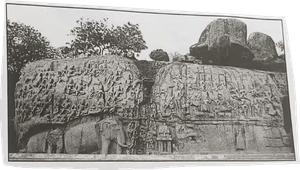
Look at the given image and identify the ancient sculptural panel from the options:
View Solution
Concept:
Mahabalipuram (also known as Mamallapuram) in Tamil Nadu is famous for its magnificent rock-cut temples and large sculptural panels created during the Pallava period. One of the most celebrated monuments is the massive open-air bas-relief known as Arjuna's Penance or \textit{Descent of the Ganga.
The sculpture is carved on two large granite boulders.
It depicts numerous figures including gods, sages, animals, and celestial beings.
The panel represents either Arjuna performing penance or the descent of the sacred river Ganga from heaven to earth.
It is considered one of the largest rock relief sculptures in the world.
Step 1: Identify the style of sculpture.
The image shows a large open-air rock relief carved on a massive rock surface with many human and animal figures, which is characteristic of the famous relief at Mahabalipuram.
Step 2: Eliminate incorrect options.
Brihadeshwara temple is known for Chola architecture and temple structures, not this type of rock relief panel.
Amaravati sculptures are mainly Buddhist reliefs found on stupa railings and panels.
Sanchi is famous for its stupas and toranas rather than large open-air rock carvings.
Step 3: Identify the correct monument.
The sculptural panel closely resembles the famous \textit{Arjuna's Penance relief at Mahabalipuram built during the Pallava period.
Therefore, the correct answer is option (B). Quick Tip: The famous open-air rock relief \textit{Arjuna's Penance at Mahabalipuram is one of the largest bas-relief sculptures in the world and was created during the Pallava dynasty.
Given below are two statements as Assertion (A) and Reason (R). Read them carefully and answer the question by choosing the correct option:
Assertion (A): Like Buddhism, Jainism also spread to many parts of India.
Reason (R): Jaina scholars produced literature in various languages like Tamil, Prakrit and Sanskrit etc.
Options:
View Solution
Concept:
Jainism was one of the major religious movements in ancient India. Similar to Buddhism, it spread widely across different regions due to the efforts of teachers, monks, and scholars who promoted its philosophy and teachings.
Jain monks and scholars actively propagated the religion in various regions.
They composed religious and philosophical texts in regional as well as classical languages.
Literature written in languages such as Prakrit, Tamil, and Sanskrit helped the teachings reach a wider audience.
Step 1: Examine Assertion (A).
Jainism spread to many parts of India including regions such as Gujarat, Rajasthan, Karnataka, and Tamil Nadu. Hence, the assertion is correct.
Step 2: Examine Reason (R).
Jaina scholars produced literature in languages like Prakrit, Tamil, and Sanskrit. This made Jain teachings accessible to different communities and contributed to the spread of the religion. Hence, the reason is correct.
Step 3: Check the relationship between (A) and (R).
The production of literature in multiple languages helped spread Jain teachings to wider populations, which explains why Jainism spread to many parts of India.
Therefore, both the assertion and reason are correct, and the reason correctly explains the assertion.
Thus, the correct answer is option (A). Quick Tip: Many Jain texts were written in Prakrit and later in Sanskrit and regional languages. This played an important role in spreading Jain philosophy across different regions of India.
Arrange the following dynasties in chronological order and choose the correct option:
I. Saluva dynasty
II. Sangama dynasty
III. Aravidu dynasty
IV. Tuluva dynasty
Options:
View Solution
Concept:
The Vijayanagara Empire was ruled by four major dynasties in succession. These dynasties governed the empire from the 14th century to the 17th century and played an important role in South Indian history.
Sangama Dynasty — Founded the Vijayanagara Empire in 1336 by Harihara and Bukka.
Saluva Dynasty — Came to power after the decline of the Sangama rulers.
Tuluva Dynasty — One of the most powerful dynasties, including the famous ruler Krishnadevaraya.
Aravidu Dynasty — The last ruling dynasty of the Vijayanagara Empire.
Step 1: Identify the first dynasty.
The Vijayanagara Empire was founded by the Sangama dynasty.
Thus, the first in chronological order is \( II \).
Step 2: Identify the second dynasty.
After the decline of the Sangama rulers, the Saluva dynasty came to power.
Thus, the second is \( I \).
Step 3: Identify the third dynasty.
The Tuluva dynasty succeeded the Saluva rulers and produced powerful rulers like Krishnadevaraya.
Thus, the third is \( IV \).
Step 4: Identify the last dynasty.
The Aravidu dynasty was the last ruling dynasty of the Vijayanagara Empire.
Thus, the fourth is \( III \).
Therefore, the correct chronological order is:
\[ II \rightarrow I \rightarrow IV \rightarrow III \]
Hence, the correct answer is option (D). Quick Tip: The four dynasties of the Vijayanagara Empire in chronological order are: Sangama Saluva Tuluva Aravidu Krishnadevaraya, the greatest ruler of Vijayanagara, belonged to the Tuluva dynasty.
Identify the Sufi Saint with the help of the following information and select the correct option:
His Hospice was on the bank of river Yamuna in Delhi.
His disciple was Amir Khusro.
His disciples addressed him as Sultan-ul-Mashaikh.
View Solution
Concept:
The Chishti order was one of the most influential Sufi orders in medieval India. Its saints emphasized love, tolerance, devotion to God, and service to humanity. Among them, Shaikh Nizamuddin Auliya was one of the most famous Sufi saints of the Delhi Sultanate period.
Shaikh Nizamuddin Auliya belonged to the Chishti Sufi order.
His khanqah (hospice) was located near the river Yamuna in Delhi.
The famous poet and musician Amir Khusro was his devoted disciple.
His followers respectfully addressed him as Sultan-ul-Mashaikh (Leader of the Saints).
Step 1: Identify the Sufi saint with a hospice near the Yamuna.
Shaikh Nizamuddin Auliya had his khanqah in Delhi near the banks of the Yamuna.
Step 2: Identify the teacher of Amir Khusro.
The famous poet Amir Khusro was a devoted disciple of Shaikh Nizamuddin Auliya.
Step 3: Identify the title Sultan-ul-Mashaikh.
Shaikh Nizamuddin Auliya was honored with the title \textit{Sultan-ul-Mashaikh, meaning the leader of the saints.
Thus, all the given clues clearly indicate Shaikh Nizamuddin Auliya.
Hence, the correct answer is option (D). Quick Tip: Shaikh Nizamuddin Auliya was the most famous Chishti Sufi saint of Delhi. His disciple Amir Khusro was a renowned poet and musician who contributed greatly to Indo-Persian culture.
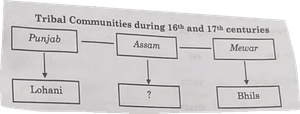
Choose the correct option to fill the blank:
View Solution
Concept:
Different regions of India during the 16th and 17th centuries were inhabited by various tribal communities. These communities played an important role in regional politics, culture, and administration.
In Punjab, the Lohani tribe was prominent.
In Assam, the Ahoms were a powerful tribal community who established a strong kingdom.
In Mewar, the Bhils were an important tribal group known for their association with Rajput rulers.
Step 1: Identify the tribe related to Assam.
The Ahoms were a prominent tribal group who migrated from Southeast Asia and established the Ahom kingdom in Assam.
Step 2: Eliminate incorrect options.
Gonds were mainly found in central India.
Meenas were primarily located in Rajasthan.
Khasis were mainly found in present-day Meghalaya.
Step 3: Select the correct match.
Thus, the correct tribal community associated with Assam is the Ahoms.
Hence, the correct answer is option (A). Quick Tip: The Ahoms ruled Assam for nearly 600 years (1228–1826). They successfully resisted Mughal expansion and played an important role in the history of Northeast India.
Identify the correct statements regarding the early Bhakti movement in South India:
I. Alvars and Nayanars travelled from place to place singing hymns in Tamil.
II. One of the major anthologies of compositions by the Alvars, ‘Amuktamalyada’, described as Tamil Vedas.
III. Karaikkal Ammaiyar and Andal were the women devotees of Nayanar and Alvar Tradition.
IV. Both Nayanars and Alvar saints were revered by the Vellala peasants.
Options:
View Solution
Concept:
The Bhakti movement in South India was strongly influenced by the devotional traditions of the Alvars (devotees of Vishnu) and the Nayanars (devotees of Shiva). These saints expressed deep devotion through hymns composed in the Tamil language and played an important role in spreading devotional worship.
The Alvars were Vaishnavite saints devoted to Lord Vishnu.
The Nayanars were Shaivite saints devoted to Lord Shiva.
Their devotional hymns were sung in Tamil and later compiled into sacred anthologies.
Step 1: Examine Statement I.
The Alvars and Nayanars travelled from place to place singing devotional hymns in Tamil and spreading the message of Bhakti. Hence, Statement I is correct.
Step 2: Examine Statement II.
The main anthology of the Alvars’ hymns is the Nalayira Divya Prabandham, often referred to as the Tamil Veda. \textit{Amuktamalyada is a Telugu work composed by Krishnadevaraya. Hence, Statement II is incorrect.
Step 3: Examine Statement III.
Karaikkal Ammaiyar was a famous woman saint among the Nayanars, and Andal was a prominent woman saint among the Alvars. Hence, Statement III is correct.
Step 4: Examine Statement IV.
The Bhakti saints were widely revered by various social groups, including the Vellala peasants in South India. Hence, Statement IV is correct.
Thus, the correct statements are I, III and IV.
Therefore, the correct answer is option (D). Quick Tip: The \textit{Nalayira Divya Prabandham is the main collection of hymns composed by the Alvars and is often referred to as the "Tamil Veda" in the Vaishnavite tradition.
Which among the following was not the major factor for the development of agriculture during Mughal India?
View Solution
Concept:
Agriculture formed the backbone of the Mughal economy. Several factors contributed to the expansion and development of agriculture during the Mughal period. These included the availability of cultivable land, the presence of labour, and the movement of peasants to new lands for cultivation.
Large tracts of fertile land were available for cultivation.
There was abundant supply of labour for agricultural activities.
Peasants often moved from one place to another in search of better opportunities.
Irrigation methods mainly included wells, tanks, canals, and Persian wheels.
Step 1: Check option (A).
The availability of large areas of cultivable land helped expand agricultural production. Hence, this was an important factor.
Step 2: Check option (B).
The availability of cheap labour supported agricultural activities and cultivation. Hence, this was also a factor.
Step 3: Check option (C).
Peasant mobility allowed cultivation of new lands and contributed to agricultural growth. Hence, this was another factor.
Step 4: Check option (D).
Tube-wells are a modern irrigation technology and were not used during the Mughal period. Irrigation mainly relied on wells, canals, and Persian wheels.
Thus, the factor that was not responsible for the development of agriculture during Mughal India is the availability of tube-wells.
Hence, the correct answer is option (D). Quick Tip: During the Mughal period, irrigation methods included wells, canals, tanks, and Persian wheels. Modern tube-well irrigation developed much later in India.
Which one of the following pairs is correctly matched?
Travellers of Medieval period \hspace{2cm} Native Region
View Solution
Concept:
Several foreign travellers visited India during the medieval period and left valuable accounts describing Indian society, culture, administration, and trade. Their travel records are important historical sources.
Peter Mundy was an English traveller and merchant associated with the East India Company.
Antonio Monserrate was a Spanish Jesuit missionary who visited the Mughal court of Akbar.
Abdal-Razzak was a Persian ambassador from Herat who visited the Vijayanagara Empire.
Marco Polo was a famous Venetian traveller from Italy who visited parts of India during the 13th century.
Step 1: Check option (A).
Peter Mundy was from England, not Spain. Hence, this pair is incorrect.
Step 2: Check option (B).
Antonio Monserrate was actually from Spain, not Portugal. Hence, this pair is incorrect.
Step 3: Check option (C).
Abdal-Razzak was from Persia (Iran), not Morocco. Hence, this pair is incorrect.
Step 4: Check option (D).
Marco Polo was a Venetian traveller from Italy. Hence, this pair is correctly matched.
Thus, the correct answer is option (D). Quick Tip: Marco Polo was a Venetian traveller from Italy who visited India in the 13th century and described the wealth and trade of South India in his travel accounts.
Which of the following statements regarding Nana Saheb are correct? Choose the correct option:
I. Nana Saheb was the successor of Peshwa Baji Rao-II.
II. Nana Saheb joined the revolt of 1857 from Kanpur.
III. His rebellion collapsed in the beginning of 1857.
IV. Nana Saheb went to Nepal in 1857.
Options:
View Solution
Concept:
Nana Saheb (Dhondu Pant) was one of the important leaders of the Revolt of 1857. He was the adopted son of Peshwa Baji Rao II and played a significant role in the uprising at Kanpur against British rule.
Nana Saheb was denied the pension of his adoptive father by the British, which created resentment.
He became one of the leaders of the Revolt of 1857 in Kanpur.
After the failure of the revolt, he is believed to have escaped to Nepal.
Step 1: Examine Statement I.
Although Nana Saheb was the adopted son of Peshwa Baji Rao II, he was not officially recognized by the British as his successor. Hence, this statement is incorrect.
Step 2: Examine Statement II.
Nana Saheb actively participated in the Revolt of 1857 and led the uprising from Kanpur. Hence, this statement is correct.
Step 3: Examine Statement III.
The revolt began in May 1857 and continued for some time; it did not collapse at the beginning of 1857. Hence, this statement is incorrect.
Step 4: Examine Statement IV.
After the suppression of the revolt, Nana Saheb is believed to have fled to Nepal. Hence, this statement is correct.
Thus, the correct statements are II and IV.
Therefore, the correct answer is option (B). Quick Tip: Nana Saheb was one of the prominent leaders of the Revolt of 1857 at Kanpur. His associate Tantia Tope continued resistance against the British even after the revolt weakened.
Who amongst the following leaders struggled to free Vietnam from the imperialist control?
View Solution
Concept:
Vietnam struggled for independence against French colonial rule and later against foreign domination during the 20th century. The Vietnamese nationalist and communist leader Ho Chi Minh played a central role in leading this struggle.
Ho Chi Minh founded the Viet Minh organization.
He led the movement against French colonial rule in Vietnam.
Under his leadership, Vietnam declared independence in 1945.
Step 1: Check option (A).
Nguyen Hue was a Vietnamese emperor of the 18th century and not associated with the modern anti-imperialist struggle. Hence, this option is incorrect.
Step 2: Check option (B).
Ho Chi Minh was the leader who organized and led the Vietnamese struggle against imperialist control, especially against the French and later the United States. Hence, this option is correct.
Step 3: Check option (C).
Qin Shi Huang was the first emperor of unified China and not related to Vietnam’s independence movement. Hence, this option is incorrect.
Step 4: Check option (D).
Mao Zedong was the leader of the Chinese Communist Revolution and not the leader of Vietnam's freedom struggle. Hence, this option is incorrect.
Thus, the correct answer is option (B). Quick Tip: Ho Chi Minh was the most prominent leader of Vietnam’s independence movement and later became the first President of North Vietnam.
Who amongst the following was the head of the 'Advisory Committee' of the Constituent Assembly?
View Solution
Concept:
The Constituent Assembly of India formed several important committees to draft and frame the Constitution. One of these was the Advisory Committee on Fundamental Rights, Minorities and Tribal Areas.
The Advisory Committee was responsible for examining issues related to fundamental rights, minority rights, and tribal areas.
Sardar Vallabhbhai Patel was appointed as the chairman of this committee.
The committee played an important role in shaping the provisions of fundamental rights in the Constitution.
Step 1: Check option (A).
B.R. Ambedkar was the Chairman of the Drafting Committee of the Constituent Assembly, not the Advisory Committee.
Step 2: Check option (B).
Jawaharlal Nehru headed the Union Powers Committee and the Union Constitution Committee, not the Advisory Committee.
Step 3: Check option (C).
Sardar Patel was the Chairman of the Advisory Committee on Fundamental Rights, Minorities, and Tribal Areas. Hence, this option is correct.
Step 4: Check option (D).
Dr. Rajendra Prasad was the President of the Constituent Assembly, not the chairman of the Advisory Committee.
Thus, the correct answer is option (C). Quick Tip: Important committees of the Constituent Assembly: Drafting Committee — B.R. Ambedkar Advisory Committee on Fundamental Rights — Sardar Patel Union Constitution Committee — Jawaharlal Nehru
Arrange the following historical events in chronological order and choose the correct option:
I. Champaran Satyagraha
II. Kheda Satyagraha
III. Jallianwala Bagh Incident
IV. Rowlatt Act
Options:
View Solution
Concept:
Several important events during the Indian freedom struggle occurred in the early 20th century under the leadership of Mahatma Gandhi. Understanding their chronological order helps in tracing the development of the national movement.
Champaran Satyagraha (1917) — Gandhi’s first major satyagraha in India against indigo planters in Bihar.
Kheda Satyagraha (1918) — A peasant movement in Gujarat demanding tax relief during crop failure.
Rowlatt Act (1919) — A repressive law allowing detention without trial.
Jallianwala Bagh Massacre (1919) — British troops fired on a peaceful gathering in Amritsar.
Step 1: Identify the earliest event.
Champaran Satyagraha occurred in 1917. Thus, it comes first.
Step 2: Identify the second event.
Kheda Satyagraha occurred in 1918. Thus, it comes next.
Step 3: Identify the third event.
The Rowlatt Act was passed in early 1919.
Step 4: Identify the final event.
The Jallianwala Bagh massacre occurred on 13 April 1919 after protests against the Rowlatt Act.
Therefore, the correct chronological order is:
\[ I \rightarrow II \rightarrow IV \rightarrow III \]
Hence, the correct answer is option (B). Quick Tip: Chronology of early Gandhian movements: Champaran Satyagraha — 1917 Kheda Satyagraha — 1918 Rowlatt Act — 1919 Jallianwala Bagh Massacre — 1919
How did the arrival of Santhals in the Raj Mahal hills affect the Paharias? Choose the correct option:
View Solution
Concept:
During the late 18th and early 19th centuries, the British encouraged the migration of the Santhal tribe into the Rajmahal Hills region to expand cultivation and increase revenue. The area called Damin-i-Koh was set aside for the Santhals. This migration had a major impact on the existing tribal community, the Paharias.
The Paharias originally lived in the Rajmahal Hills and practiced shifting cultivation.
When the Santhals were settled in the region, forests were cleared for agriculture.
This expansion of cultivation pushed the Paharias away from their traditional lands.
Step 1: Examine option (A).
With the arrival of the Santhals and the expansion of settled agriculture, the Paharias were gradually pushed out of the fertile areas and moved into the higher hills. Hence, this statement is correct.
Step 2: Examine option (B).
The Santhals did not assist the Paharias in expanding agriculture; rather, their settlement led to competition for land. Hence, this statement is incorrect.
Step 3: Examine option (C).
The Damin-i-Koh region was actually the area allocated by the British for Santhal settlement, not where the Paharias moved to avoid conflict. Hence, this statement is incorrect.
Step 4: Examine option (D).
There was no major collaboration between the Santhals and Paharias against the British at that time. Hence, this statement is incorrect.
Thus, the correct answer is option (A). Quick Tip: The British settled the Santhals in the \textit{Damin-i-Koh region to expand agriculture. This displaced the Paharias, who retreated to the higher hills of the Rajmahal region.
Identify the British Officer with the help of the following information:
Was a Physician.
Organized Zoo in Calcutta.
Did survey of Bengal.
He assumed family name as Hamilton.
View Solution
Concept:
Francis Buchanan was a Scottish physician, geographer, and naturalist who worked for the British East India Company. He conducted extensive surveys in different parts of India and made significant contributions to the study of natural history and regional geography.
Francis Buchanan was trained as a physician.
He conducted detailed surveys of Bengal and other regions of India.
He was associated with the establishment and organization of the zoological collection in Calcutta.
Later, he adopted the surname Hamilton and became known as Francis Buchanan-Hamilton.
Step 1: Identify the physician.
Francis Buchanan was a trained physician who later worked as a naturalist and surveyor in India.
Step 2: Identify the surveyor of Bengal.
He conducted extensive surveys of Bengal and other regions for the British East India Company.
Step 3: Check the surname Hamilton.
Francis Buchanan later adopted the surname Hamilton and became known as Francis Buchanan-Hamilton.
Step 4: Eliminate incorrect options.
Col. Mackenzie was known for archaeological surveys, not for being a physician.
Thomas Munro was a British administrator and governor of Madras.
Charles Metcalfe was a British civil servant and governor-general.
Thus, the correct answer is Francis Buchanan.
Hence, the correct option is (B). Quick Tip: Francis Buchanan-Hamilton was a Scottish physician and naturalist who conducted important surveys of Bengal and contributed significantly to the documentation of India’s geography, flora, and fauna.
Find the odd one out from the following:
(British Officers) \hspace{3cm} (Policy)
View Solution
Concept:
Several British administrators introduced important policies during colonial rule in India. Some policies were closely associated with specific governors or governor-generals.
Lord Dalhousie introduced the \textit{Doctrine of Lapse, which allowed the British to annex princely states without a natural heir.
Lord Cornwallis introduced the \textit{Permanent Settlement in Bengal in 1793.
Lord Hardinge was associated with military reforms, and the issue of \textit{Enfield rifles later became a cause of the Revolt of 1857.
The policy of Western Education in India was mainly associated with Lord William Bentinck and Thomas Macaulay, not with Lord Wellesley.
Step 1: Check option (A).
Dalhousie is correctly associated with the Doctrine of Lapse.
Step 2: Check option (B).
Cornwallis is correctly associated with the Permanent Settlement.
Step 3: Check option (C).
Wellesley is known for introducing the Subsidiary Alliance system, not Western Education. Hence, this pair is incorrectly matched.
Step 4: Check option (D).
The introduction of the Enfield rifle during British rule later became a major cause of the Revolt of 1857.
Thus, the incorrectly matched pair (odd one out) is option (C). Quick Tip: Important British policies to remember: Doctrine of Lapse — Lord Dalhousie Permanent Settlement — Lord Cornwallis Subsidiary Alliance — Lord Wellesley Western Education policy — Lord William Bentinck (influenced by Macaulay)
How did Buddha attain enlightenment? Explain.
View Solution
Concept:
Enlightenment (Bodhi) refers to the realization of ultimate truth and liberation from the cycle of birth and death. Gautama Buddha attained enlightenment after years of spiritual quest and meditation.
Step 1: Early Life and Renunciation.
Siddhartha Gautama was born as a prince in Lumbini. Despite living in luxury, he was deeply disturbed by the suffering of people after witnessing old age, sickness, and death. At the age of 29, he renounced his royal life in search of truth.
Step 2: Years of Ascetic Practices.
Siddhartha practiced severe austerities and meditation with several teachers. However, he realized that extreme self-denial was not the path to true knowledge.
Step 3: Adoption of the Middle Path.
He adopted the Middle Path, avoiding both luxury and extreme austerity. This balanced approach became the foundation of his spiritual practice.
Step 4: Meditation under the Bodhi Tree.
Siddhartha meditated under a peepal tree at Bodh Gaya. After deep meditation and contemplation, he attained enlightenment and realized the Four Noble Truths about suffering and its cessation.
Step 5: Becoming the Buddha.
After attaining enlightenment, Siddhartha Gautama came to be known as the Buddha, meaning “the enlightened one,” and began spreading his teachings to others. Quick Tip: Buddha attained enlightenment at \textbf{Bodh Gaya under the \textbf{Bodhi Tree}. His realization of the \textbf{Four Noble Truths} and the \textbf{Middle Path} became the foundation of Buddhist philosophy.
How has Buddhist literature helped in understanding the sculpture of Sanchi? Explain.
View Solution
Concept:
Buddhist literature, especially the Jataka tales and other texts, provides valuable insights into the themes and symbols represented in the sculptures of ancient Buddhist monuments such as the Sanchi Stupa.
Step 1: Understanding Symbolism.
Early Buddhist art avoided direct representation of the Buddha in human form. Instead, symbols such as the Bodhi tree, footprints, empty throne, and the wheel of Dharma were used. Buddhist literature explains the meaning of these symbols.
Step 2: Depiction of Jataka Tales.
Many sculptures at Sanchi depict scenes from the \textit{Jataka stories, which narrate the previous births of the Buddha. These stories illustrate moral lessons and acts of compassion.
Step 3: Historical and Religious Context.
Texts like the Tripitaka and other Buddhist writings describe events in the life of Buddha and the spread of Buddhism. These narratives help historians interpret the scenes carved on the gateways (toranas) of the Sanchi Stupa.
Step 4: Identification of Sculptural Themes.
By comparing literary descriptions with the sculptural panels, historians can identify stories, rituals, and important events depicted in the carvings.
Thus, Buddhist literature serves as an essential source for understanding the symbolism, stories, and cultural significance of the sculptures at Sanchi. Quick Tip: The sculptures at Sanchi often depict \textbf{Jataka tales and symbolic representations of the Buddha. Buddhist texts such as the Tripitaka help historians interpret these artistic representations.
“Several important ruling lineages had different origins.” Substantiate the statement in the context of ancient India.
View Solution
Concept:
In ancient India, ruling dynasties emerged from diverse social, regional, and cultural backgrounds. Their origins were not uniform; some belonged to traditional Kshatriya lineages, while others rose to power from different social groups or tribal communities.
Step 1: Traditional Kshatriya Lineages.
Some ruling dynasties claimed descent from ancient Kshatriya families mentioned in epics and Puranas. For example, the rulers of the solar (Suryavanshi) and lunar (Chandravanshi) lineages traced their ancestry to mythological kings.
Step 2: Rise of New Dynasties from Different Social Groups.
Many rulers did not originally belong to traditional Kshatriya families but later adopted Kshatriya status to legitimize their rule. The Guptas, for instance, rose to power from relatively modest beginnings.
Step 3: Tribal and Regional Origins.
Some ruling families emerged from tribal groups or local communities. Over time, they gained political authority and established powerful kingdoms.
Step 4: Use of Titles and Rituals for Legitimacy.
Rulers performed grand rituals such as the Ashvamedha (horse sacrifice) to assert their authority and claim high social status.
Thus, ancient Indian ruling lineages had varied origins, reflecting the dynamic and evolving nature of political power. Quick Tip: Many rulers in ancient India adopted prestigious titles and performed rituals such as the \textit{Ashvamedha to legitimize their authority and claim Kshatriya status.
Explain why “Ain-a-Akbari” is considered a mine of information about the rule of Mughals.
View Solution
Concept:
Ain-i-Akbari is an important historical document written by Abul Fazl, the court historian of Emperor Akbar. It forms the third volume of the \textit{Akbarnama and provides detailed information about the administration and society of the Mughal Empire.
Step 1: Administrative Details.
The text provides extensive information about the administrative structure of Akbar’s empire, including the organization of provinces, officials, and departments.
Step 2: Revenue and Economic System.
It explains the land revenue system, methods of tax collection, agricultural production, and economic conditions under Mughal rule.
Step 3: Military and Mansabdari System.
The \textit{Ain-i-Akbari describes the \textit{Mansabdari system, which was the backbone of Mughal military and administrative organization.
Step 4: Social and Cultural Information.
It also includes valuable information about the customs, traditions, religion, festivals, and lifestyle of the people during Akbar’s reign.
Thus, because of its detailed description of administration, economy, society, and culture, \textit{Ain-i-Akbari is regarded as a rich source of information about the Mughal Empire. Quick Tip: \textit{Ain-i-Akbari, written by Abul Fazl, is the third part of the Akbarnama. It provides detailed information about Akbar’s administration, revenue system, and the social life of Mughal India.
Why is Meera Bai considered one of the great saints of the Bhakti Movement? Explain.
View Solution
Concept:
The Bhakti Movement emphasized devotion to God, equality, and the rejection of rigid social barriers. Meera Bai was one of the most prominent saints of this movement and is remembered for her intense devotion to Lord Krishna.
Step 1: Deep Devotion to Lord Krishna.
Meera Bai was a Rajput princess of Mewar who devoted her entire life to the worship of Lord Krishna. She considered Krishna as her divine husband and expressed her devotion through devotional songs and poems.
Step 2: Contribution to Bhakti Literature.
She composed numerous devotional hymns (bhajans) in simple language, which became popular among the common people and helped spread the message of Bhakti.
Step 3: Challenge to Social Norms.
Meera Bai rejected social restrictions and traditions that limited women's freedom. Her devotion and spiritual independence inspired many followers.
Step 4: Promotion of Equality and Devotion.
Like other Bhakti saints, she emphasized love, devotion, and equality before God rather than rituals and caste distinctions.
Thus, because of her deep devotion, spiritual poetry, and challenge to social conventions, Meera Bai is regarded as one of the great saints of the Bhakti Movement. Quick Tip: Meera Bai was a famous devotee of \textbf{Lord Krishna}. Her devotional songs (bhajans) remain popular and are an important part of Bhakti literature in India.
“Gandhiji is also regarded as a social worker.” Explain the statement with examples.
View Solution
Concept:
Mahatma Gandhi is widely known as a leader of India's freedom struggle, but he also played a major role as a social reformer. He worked for the upliftment of society and addressed various social issues affecting the people of India.
Step 1: Campaign Against Untouchability.
Gandhiji strongly opposed the practice of untouchability. He called the untouchables \textit{Harijans (children of God) and worked to improve their social conditions.
Step 2: Promotion of Rural Development.
Gandhiji emphasized the development of villages. He encouraged self-reliance, cottage industries, and the use of the spinning wheel (charkha) to support rural livelihoods.
Step 3: Advocacy of Social Equality.
He promoted equality among people irrespective of caste, religion, or gender and encouraged communal harmony.
Step 4: Support for Education and Sanitation.
Gandhiji stressed the importance of basic education and cleanliness in society. He promoted the idea of \textit{Nai Talim, a system of education based on practical work.
Thus, through his efforts to remove social inequalities, promote rural welfare, and improve education and sanitation, Gandhiji is rightly regarded as a great social worker. Quick Tip: Apart from leading the freedom struggle, Mahatma Gandhi worked for social reforms such as the abolition of untouchability, promotion of village industries, and encouragement of communal harmony.
Explain the role of imageries in spreading the feeling of nationalism during 1857 in India.
View Solution
Concept:
During the Revolt of 1857 and later phases of the freedom movement, visual symbols and images played an important role in spreading nationalist ideas among the people. These imageries helped unite people and inspire them to fight against British rule.
Step 1: Use of Symbolic Images.
Nationalist leaders and artists used symbolic images to represent the nation and its people. These images helped convey the idea of unity and shared identity.
Step 2: Representation of Bharat Mata.
The image of Bharat Mata (Mother India) became a powerful symbol of the nation. It inspired people to view their country as a sacred mother who needed protection from foreign rule.
Step 3: Spread of Patriotic Sentiments.
Paintings, posters, and illustrations circulated among the people and helped spread patriotic feelings and the spirit of resistance against colonial rule.
Step 4: Unity among People.
These images created a sense of collective identity among Indians from different regions, religions, and communities, encouraging them to unite in the struggle for freedom.
Thus, imageries played an important role in spreading nationalism by inspiring unity, pride, and resistance against British rule. Quick Tip: The image of \textbf{Bharat Mata became a powerful symbol of Indian nationalism and helped inspire people to fight for independence.
Explain the provisions of Subsidiary Alliance System.
View Solution
Concept:
The Subsidiary Alliance System was a political strategy introduced by Lord Wellesley, the Governor-General of India, in the late 18th century. It was used by the British to expand their control over Indian princely states.
Step 1: Stationing of British Troops.
Under this system, the ruler of an Indian state had to accept the presence of British troops within his territory.
Step 2: Payment for Maintenance of Troops.
The ruler had to bear the expenses for maintaining the British army stationed in his state, either by paying money or by ceding part of his territory.
Step 3: Restriction on Foreign Relations.
The ruler was not allowed to enter into alliances or agreements with other states without the permission of the British.
Step 4: Acceptance of British Resident.
A British Resident was appointed in the court of the ruler to supervise and influence the administration.
Step 5: Loss of Political Independence.
Although the ruler retained nominal authority, real control gradually shifted to the British.
Thus, the Subsidiary Alliance System helped the British expand their political power and control over many Indian states. Quick Tip: The \textbf{Subsidiary Alliance System} was introduced by \textbf{Lord Wellesley}. It forced Indian rulers to accept British troops and restricted their political independence.
Describe the events that shaped the vision of the Constitution of India.
View Solution
Concept:
The vision of the Indian Constitution was shaped by several historical experiences during the colonial period and the national movement. These events influenced the leaders of the freedom struggle to design a Constitution that would ensure justice, equality and democracy.
Step 1: Experience of Colonial Rule.
Under British rule, Indians faced political oppression, economic exploitation and lack of civil rights. These experiences made the leaders realize the need for a Constitution that would guarantee fundamental rights and democratic governance.
Step 2: National Movement and Demand for Rights.
The Indian national movement demanded civil liberties, equality before law and responsible government. Resolutions such as the Karachi Resolution of 1931 emphasized fundamental rights and social justice, which later influenced the Constitution.
Step 3: Influence of Global Democratic Ideals.
Ideas of liberty, equality and fraternity from revolutions such as the American and French Revolutions also inspired Indian leaders. These principles became important foundations of the Constitution.
Step 4: Government of India Acts and Administrative Experience.
The Government of India Acts, especially the Act of 1935, provided administrative experience in governance. Some institutional structures from these acts influenced the constitutional framework.
Step 5: Partition and Need for Unity.
The partition of India in 1947 highlighted the importance of unity, secularism and protection of minority rights, which were incorporated into the Constitution.
Thus, the vision of the Indian Constitution was shaped by the struggle against colonial rule, the aspirations of the national movement and the influence of democratic ideals. Quick Tip: The ideals of the Indian Constitution were strongly influenced by the \textbf{national movement, the \textbf{Karachi Resolution (1931)}, and global democratic principles such as liberty, equality and justice.
Describe the arguments given in the Constituent Assembly against the creation of separate electorates.
View Solution
Concept:
Separate electorates allowed members of a particular religious community to vote only for candidates from their own community. This system had been introduced by the British during colonial rule. Many leaders in the Constituent Assembly opposed it while framing the Constitution of India.
Step 1: Threat to National Unity.
Members of the Constituent Assembly argued that separate electorates would divide the nation along religious lines and weaken national unity.
Step 2: Experience of Partition.
The partition of India had already caused communal tensions and violence. Leaders believed that continuing separate electorates would further deepen divisions.
Step 3: Promotion of Secular Democracy.
The Constitution aimed to establish a secular and democratic state where citizens would vote as individuals rather than as members of religious communities.
Step 4: Encouraging Political Integration.
Joint electorates were seen as a way to encourage cooperation and political integration among different communities.
Thus, the Constituent Assembly rejected the system of separate electorates in order to promote unity, equality and a secular democratic system. Quick Tip: Separate electorates were first introduced by the British in the \textbf{Morley–Minto Reforms of 1909}. The Constituent Assembly rejected this system to strengthen national unity and secular democracy.
“The royal centre of Vijayanagar had two of the most impressive platforms usually called as ‘audience hall’ and mahanavami dibba.” Examine the significance of two platforms.
View Solution
Concept:
The Vijayanagara Empire developed a grand capital city with impressive architecture and royal complexes. The royal centre contained important ceremonial platforms such as the Audience Hall and the \textit{Mahanavami Dibba, which were used for royal ceremonies and public functions.
Step 1: Audience Hall.
The Audience Hall was a large platform where the king met his officials, nobles, and representatives. Important administrative discussions and royal meetings were held here.
Step 2: Symbol of Royal Authority.
The hall displayed the grandeur and power of the Vijayanagara rulers. It was a place where the king appeared before his subjects, reinforcing his authority and prestige.
Step 3: Mahanavami Dibba.
The Mahanavami Dibba was a massive stone platform used during the \textit{Mahanavami festival (Dussehra). The king watched grand celebrations, military parades, and cultural performances from this platform.
Step 4: Ceremonial and Cultural Importance.
These platforms played a significant role in public ceremonies and festivals, reflecting the cultural and political importance of the Vijayanagara court.
Thus, the Audience Hall and Mahanavami Dibba were important architectural structures that symbolized the administrative power and ceremonial grandeur of the Vijayanagara Empire. Quick Tip: The \textbf{Mahanavami Dibba at Vijayanagara was used during the Dussehra festival for royal ceremonies, military displays, and public celebrations.
Examine the architectural features of Virupaksha and Vitthala temples located in the sacred centre of Vijayanagara.
View Solution
Concept:
The sacred centre of Vijayanagara contained several important temples that reflected the rich architectural traditions of South India. Among them, the Virupaksha Temple and the Vitthala Temple are notable for their artistic and architectural brilliance.
Step 1: Virupaksha Temple.
The Virupaksha Temple is one of the oldest and most important temples in Vijayanagara. It is dedicated to Lord Shiva and features a tall gopuram (gateway tower), pillared halls, and intricate carvings.
Step 2: Dravidian Architectural Style.
The temple follows the Dravidian style of architecture with massive gateways, spacious courtyards, and elaborate sculptures.
Step 3: Vitthala Temple.
The Vitthala Temple is famous for its impressive stone chariot and musical pillars. The temple complex includes large halls and beautifully carved pillars depicting various mythological scenes.
Step 4: Artistic and Cultural Significance.
Both temples reflect the prosperity, artistic excellence, and religious devotion of the Vijayanagara Empire.
Thus, the Virupaksha and Vitthala temples stand as remarkable examples of Vijayanagara architecture and religious culture. Quick Tip: The \textbf{Vitthala Temple at Vijayanagara is famous for its \textbf{stone chariot} and \textbf{musical pillars}, which produce musical notes when tapped.
Examine the characteristic features of architecture of urban centres of Mohenjodaro.
View Solution
Concept:
Mohenjodaro was one of the most important urban centres of the Indus Valley Civilization. The city displayed advanced planning, architectural techniques, and civic amenities, reflecting a highly organized urban society.
Step 1: Well-Planned City Layout.
The city was carefully planned with streets laid out in a grid pattern. The roads intersected each other at right angles, dividing the city into blocks.
Step 2: Division into Citadel and Lower Town.
Mohenjodaro was divided into two main sections: the citadel and the lower town. The citadel was built on a raised platform and contained important public buildings.
Step 3: Use of Baked Bricks.
Most buildings were constructed using standardized baked bricks, indicating advanced construction techniques and uniformity in architecture.
Step 4: Advanced Drainage System.
The city had a highly developed drainage system with covered drains along the streets and well-built sewage channels connected to houses.
Step 5: Public Buildings and Structures.
Important public structures included the Great Bath, granaries, and assembly halls, which suggest the importance of public life and organized administration.
Thus, the architecture of Mohenjodaro reflects advanced urban planning, efficient civic management, and sophisticated building techniques. Quick Tip: The \textbf{Great Bath of Mohenjodaro is one of the most remarkable structures of the Indus Valley Civilization and is believed to have been used for ritual bathing.
Examine the causes and the evidences of the collapse of the Harappan civilisation.
View Solution
Concept:
The Harappan or Indus Valley Civilization declined around 1900 BCE. Historians and archaeologists have suggested several reasons for its decline based on archaeological evidence.
Step 1: Environmental Changes.
Changes in climate and decreasing rainfall may have affected agriculture and reduced food production in the region.
Step 2: River Changes and Floods.
Shifts in river courses, such as the drying up of the Ghaggar-Hakra river system and repeated flooding in cities like Mohenjodaro, may have contributed to the decline of settlements.
Step 3: Decline in Trade.
The collapse of long-distance trade networks with regions such as Mesopotamia weakened the Harappan economy.
Step 4: Evidence from Archaeological Findings.
Archaeological evidence such as abandoned cities, reduction in urban construction, and decline in craft production indicates a gradual decline of the civilization.
Step 5: Migration and Ruralization.
People gradually migrated from large cities to smaller rural settlements, indicating the end of urban life in the Harappan civilization.
Thus, environmental changes, shifting rivers, decline in trade, and archaeological evidence together suggest the gradual collapse of the Harappan civilization. Quick Tip: The decline of the Harappan Civilization was gradual rather than sudden and was likely caused by environmental changes, river shifts, and economic decline.
Read the given source carefully and answer the questions that follow:
On clearance and settled cultivation
Passing through one village in the lower Rajmahal hills, Buchanan wrote:
The view of the country is exceedingly fine, the cultivation, especially in the narrow valleys of rice winding in all directions, the cleared lands with scattered trees, and the rocky hills are in perfection; all that is wanted is some appearance of progress in the area and a vastly extended and improved cultivation, of which the country is highly susceptible. Plantations of Asan and Palas, for Tessar (Tassar silk worms) and Lac, should occupy the place of woods to as great an extent as the demand will admit; the remainder might be all cleared, and the greater part cultivated, while what is not fit for the purpose, might rear Plamira (palmyra) and Mowa (mahua).
31.1 How was the landscape described regarding cultivation?
31.2 Which crops were recommended for expanding agriculture?
31.3 Explain the proposal given by Buchanan for utilizing the land for economic development.
View Solution
31.1 Explanation:
Buchanan described the landscape as fertile and suitable for agriculture. He mentioned that the narrow valleys were cultivated with rice, cleared lands had scattered trees, and rocky hills surrounded the cultivated areas. According to him, the region had good potential for expanding cultivation.
31.2 Explanation:
Buchanan recommended the cultivation of plants such as Asan and Palas for producing Tassar silk worms and Lac. He also suggested growing Palmyra and Mahua in areas not suitable for other crops.
31.3 Explanation:
Buchanan proposed clearing forests and expanding cultivation to increase agricultural production. He suggested using the land for plantations like Asan and Palas for silk and lac production, while other areas could be cultivated or used for growing Palmyra and Mahua. His proposal aimed at improving economic development by utilizing the natural resources of the region effectively. Quick Tip: Francis Buchanan suggested \textbf{forest clearance and plantation crops like Asan and Palas} to expand cultivation and improve the economy of the Rajmahal hills region.
Read the source given below carefully and answer the questions that follow:
The Malabar Coast (Present-day Kerala)
Here is an excerpt from \textit{Periplus of the Erythraean Sea, composed by an anonymous Greek sailor (First century CE):
They (i.e., traders from abroad) send large ships to these market-towns on account of the great quantity and bulk of pepper and malabathrum (possibly cinnamon), produced in these regions. There are imported in the first place, a great quantity of coin; topaz, antimony (a mineral used as a colouring substance), coral, crude glass, copper, tin, lead … There is exported pepper, which is produced in quantity in only one region near these markets … Besides this there are exported great quantities of fine pearls, ivory, silk cloth, transparent stones of all kinds, diamonds and sapphires, and tortoise shell.
Archaeological evidence of a bead-making industry, using precious and semi-precious stones, has been found in Kodumanal (Tamil Nadu). It is likely that local traders brought the stones mentioned in the \textit{Periplus from sites such as these to the coastal ports.
32.1 Mention the role of rivers in the promotion of trade.
32.2 Why were large numbers of goods traded between India and other countries?
32.3 Give reasons for the development of bead-making industry at Kodumanal.
View Solution
32.1 Explanation:
Rivers played an important role in promoting trade by providing easy and convenient routes for transportation. They connected inland regions with coastal ports, allowing goods to be transported quickly and economically to trading centers.
32.2 Explanation:
Large quantities of goods were traded between India and other countries because India produced valuable commodities such as pepper, spices, pearls, ivory, precious stones, and silk cloth. These goods were in high demand in foreign markets, which encouraged extensive trade.
32.3 Explanation:
The bead-making industry developed at Kodumanal because the region had access to precious and semi-precious stones. Skilled craftsmen processed these stones into beads, which were then transported by traders to coastal ports for export. The growing demand for such luxury items in international trade also supported this industry. Quick Tip: Ancient Indian trade flourished due to \textbf{river transport, valuable export goods like spices and precious stones, and specialized industries such as bead-making}.
Read the given source carefully and answer the questions that follow:
A Warning for Europe
Bernier warned that if European kings followed the Mughal model: their kingdoms would be very far from being well cultivated and peopled, so well built, so rich, so polite and flourishing as we see them. Our kings are otherwise rich and powerful; and we must avow that they are much better and more royally served. They would soon be kings of deserts and solitudes, of beggars and barbarians, such as those are whom I have been representing (the Mughals).
We should find the great Cities and the great Boroughs rendered uninhabitable because of ill air, and to fall to ruin without anybody taking care of repairing them; the hillocks abandoned, and the fields overspread with bushes, or filled with pestilential marshes.
33.1 Why did Bernier warn their European kings against following the Mughal model of kingship?
33.2 Mention any one difference between Mughal and European land-ownership.
33.3 How did Bernier's description influence the Western theorists from the 18th century onwards? Explain.
View Solution
33.1 Explanation:
Bernier believed that in the Mughal Empire all land belonged to the emperor. According to him, this system discouraged private ownership and investment in agriculture. He thought that if European kings adopted a similar system, it would result in decline of cultivation, prosperity, and development. Therefore, he warned European rulers not to follow the Mughal model of kingship.
33.2 Explanation:
One major difference between Mughal and European land ownership was that in the Mughal Empire land was considered to be owned by the emperor, whereas in Europe land was largely owned by private individuals or landlords who had hereditary rights over it.
33.3 Explanation:
Bernier's writings influenced Western thinkers and historians from the 18th century onwards. His description led them to believe that Asian societies were despotic and economically backward because of the absence of private property in land. This interpretation shaped the theory of “Oriental Despotism,” which portrayed Asian rulers as absolute monarchs with complete control over land and resources. Quick Tip: Francois Bernier's travel accounts influenced the Western idea of \textbf{“Oriental Despotism,”} which suggested that Asian rulers had absolute control over land and resources.
34.1 (a) On the given political outline map of India, locate and label the following places with appropriate signs or symbols:
Banawali – a mature Harappan site
Kannauj – an important town from early states
Ajmer – a city under Mughals
OR
(b) Bidar – a medieval town
34.2 On the same political map of India, two places have been marked as A and B as the centres of Indian National Movement. Identify them and write their correct names on the lines drawn near them.
View Solution
34.1 Explanation:
Banawali should be located in present-day Haryana, as it was an important Harappan site.
Kannauj should be marked in Uttar Pradesh, as it was a prominent centre during early medieval India.
Ajmer should be located in Rajasthan, which was an important Mughal city.
OR
Bidar should be marked in Karnataka, known as an important medieval town under the Bahmani rulers.
34.2 Explanation:
The two important centres of the Indian National Movement generally marked on the map are:
Champaran – associated with the Champaran Satyagraha led by Mahatma Gandhi.
Dandi – associated with the Salt March (Dandi March) led by Mahatma Gandhi.
Final Answer:
Mark and label the respective locations correctly on the map as per their geographical positions. Quick Tip: For map work, remember key locations: \textbf{Harappan sites (Haryana/Gujarat), Mughal cities (Rajasthan/UP), and National Movement centres like Champaran and Dandi}.




Comments