




CBSE Class 12 Biology Set 2 Question Paper PDF 57-4-2 is available for download. CBSE conducted the Class 12 Biology examination on March 25, 2025. The question paper consists of 33 questions carrying a total of 70 marks. Section A includes 16 MCQs for 1 mark each, Section B contains 5 very short-answer questions for 2 marks each, Section C comprises 7 short-answer questions for 3 marks each, Section D comprises 2 Case-based questions carries 4 marks each and Section E comprises 3 long-answer questions carries 5 marks each.
CBSE Class 12 2025 Biology Question Paper 57-4-2 with Answer Key
| CBSE Class 12 2025 Biology Question Paper with Answer Key | Download PDF | Check Solution |

In its extended 'beads-on-string' form of chromatin, the 'beads' are composed of:
View Solution
Given below are few statements with respect to the process of oogenesis in a human ovary:
(i) Each granulosa cell gets surrounded by a primary oocyte to form the primary follicle.
(ii) A couple of million of oogonia are formed within each fetal ovary during the embryonic development.
(iii) Tertiary follicle is characterised by antrum and theca layers.
(iv) Secondary follicles form a zona pellucida layer around it.
(v) Mature graafian follicle ruptures to release the secondary oocyte from the ovary.
Choose the option with all true statements from the given options:
View Solution
The simplest definition of a gene in eukaryotes is --- A unit of DNA that has information to mainly specify the synthesis of:
View Solution
A colourblind man marries a woman with normal sight who has no history of colourblindness in her family. What is the probability of their son being colourblind?
View Solution
The type of antibodies produced during an immune response to allergens as dust and pollen grains in a person is:
View Solution
Select the statements that are true for a typical megasporangium of flowering plants:
(i) It is attached to the placenta by hilum.
(ii) It has a chalaza end that represents the basal part of the ovule.
(iii) It has nucellus enclosed by integuments.
(iv) Its micropylar end is known as chalaza.
Choose the correct answer:
View Solution
The primates that probably lived in East Africa grasslands about two mya were:
View Solution
Use the given information to select the amino acid attached to the 3' end of the tRNA during the process of translation, if the coding strand of the structural gene being transcribed has the nucleotide sequence 'ATA'.
Codons for the amino acids:
UAU -- Tyrosine
AUG -- Methionine
AUA -- Isoleucine
AGU -- Serine
View Solution
Early detection of HIV in suspected AIDS patients can be done using the diagnostic technique of:
View Solution
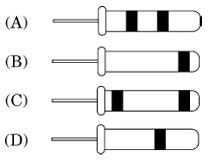
The correct depiction of the experiment performed by Matthew Meselson and Franklin Stahl to prove that DNA replicates semi-conservatively on separation of DNA by centrifugation after 40 minutes is:
View Solution
Large holes in 'Swiss cheese' are formed by the activity of microbes:
View Solution
In pea plant (Pisum sativum) axial flower position is dominant over terminal flower position. The expected ratio of phenotypes of the offspring in a cross between both the parents with heterozygous axial flower will be:
View Solution
Assertion (A): ‘Saheli’, an oral contraceptive inhibits ovulation and increases phagocytosis of sperms.
Reason (R): It is a non-steroidal preparation.
View Solution
Assertion (A): The meristems are grown \textit{‘in vitro’ to obtain virus-free plants from an infected plant.
Reason (R): If the plant is infected with a virus, the roots and the stems are free of virus.
View Solution
Assertion (A): ABO blood grouping in humans is an example of multiple allelism.
Reason (R): More than two genes in a population govern the same character in ABO blood grouping in humans.
View Solution
Assertion (A): A person infected with malaria suffers from chill and high fever, recurring every three or four days.
Reason (R): The parasite attacks the RBC resulting in their rupture and release of haemozoin.
View Solution
The basic scheme of the essential steps involved in the process of recombinant DNA technology is summarized below in the form of a flow diagram. Study the given flow diagram and answer the questions that follow.
Step-1: Vector DNA (cut using Restriction Enzyme EcoR I) + Alien DNA (cut using Restriction Enzyme EcoR I)
↓ Enzyme A
Step-2: Recombinant DNA molecule
Step-3: Transfer of recombinant DNA molecule in E. coli (Host)
Step-4: Replication of recombinant DNA molecule in E. coli
Name the enzyme used in Step-1 to join the cut plasmid and alien DNA.
State the technical term used for Step-3.
Justify the use of same Restriction Enzyme EcoR I to cut both the vector DNA and the alien DNA.
Student to attempt either option (A) or (B):
(A) Explain how the interaction between sea anemone and clownfish is one of the best examples of commensalism in nature.
OR
(B) Correctly depict (also indicate the trophic level) and describe the ecological pyramid of biomass in sea with 40 standing crop of phytoplankton supporting 90 standing crop of zooplankton which further supports 120 small fishes.
Assume that the given mRNA (start site is not depicted) is theoretically translated in two reading frames.
Translation starting from the first nucleotide (Reading frame 1)
Translation starting from the second nucleotide (Reading frame 2)
5'--CUCGCUUUGCCGAUCAAGGGUUA--3'
5'--GUGGCACUCAGUCCUUAAUGGCG--3'
Answer the following question:
How many amino acids will be specified in case (a) and case (b) on translation? Justify your answer.
Student to attempt either option (A) or (B):
(A) Explain how the immunity of a person is affected if there is atrophy (degeneration) of the thymus gland at an early stage of life.
OR
(B) (i) What are interferons? Explain their role in providing immunity to a person.
(ii) Which category of innate immunity defence barrier can interferons be classified into?
Student to attempt either option (A) or (B):
(A) Write two features of an ideal contraceptive. Explain any one natural contraceptive method that makes the chances of conception almost nil.
OR
(B) Explain GIFT and ICSI.
Explain the biological treatment of primary effluent when passed into the large aeration tanks in a sewage treatment plant (STP).
Given below is a flower with its characteristic features specialised for the most common type of abiotic pollination.

Answer the following questions based on the above diagram:
(a) Name the mode of abiotic pollination that will be adopted by the given plant species in the above picture.
(b) State the need of exposed large feathery stigmas for the flower.
(c) What will be the two important adaptations in the pollen grains of the flowers pollinated by the above mode of pollination?
(d) What could be the probable reason for the petals being small and non-green?
Enlist one advantage and two disadvantages of Green Revolution.
Study the given below single strand of deoxyribonucleic acid depicted in the form of a ``stick'' diagram with 5′–3′ end directionality, sugars as vertical lines and bases as single letter abbreviations and answer the questions that follow.

(a) Name the covalent bonds depicted as (a) and (b) in the form of slanting lines in the diagram.
(b) How many purines are present in the given ``stick'' diagram?
(c) Draw the chemical structure of the given polynucleotide chain of DNA.
Thomas Hunt Morgan carried out several dihybrid crosses in Drosophila melanogaster to study genes that were sex linked.
(a) Give four major reasons for using the tiny fruit flies by Morgan for his experiments.
(b) How did Morgan and his group explain the physical association of the two genes on a chromosome to the frequency of recombination between gene pairs on the same chromosome?
Explain the process of formation of placenta in a human female after the implantation of the blastocyst in the endometrium of the uterus.
According to a recent wildlife report, the biggest threat to the tiger’s survival in Mudumalai Tiger Reserve (MTR) was found to be a small, beautiful flower, Lantana camara, a tropical American shrub, that invaded 40% of India’s tiger range. Tamil Nadu department’s Lantana weed eradication drive helped to restore the dying MTR thereby also reducing human-wildlife conflicts. MTR is home to 25 species of grasses and legumes.
Answer the given questions based on the information given above.
(a) Explain how did the removal of \textit{Lantana help in restoring the dying Mudumalai Tiger Reserve.
(b) Why is the invasion of \textit{Lantana camara a cause of concern in MTR?
Read the following passage and answer the questions that follow.
Deaths related to the use of drugs were estimated at about 5,00,000 in 2019, 17.5 percent more than in 2009. Liver diseases attributed to Hepatitis B are a major cause of drug-related deaths, according to UNODC, accounting for more than half of the total number of deaths attributed to the use of drugs. Drug overdoses account for a quarter of drug-related deaths.
Opioids contribute to account for the most severe drug-related harm, including fatal overdoses, when used non-medically. At the global level, two-thirds of direct drug-related deaths are due to opioids, and in some sub-regions the proportion can be as high as three-quarters of such deaths.
(i) Why are people taking opioids more prone to liver diseases attributed to Hepatitis B?
(ii) What is meant by direct drug-related disease?
[(i)] What is the scientific name of the plant from which the opioids are derived and from which part of the plant is it extracted?
OR
[(ii)] State two common warning signs of drug abuse among the youth.
Read the following passage and answer the questions that follow.
The most convincing evidence to trace evolutionary relationships between humans and different groups of animals comes from the basic similarities seen at the molecular level. Study the table given below that depicts the number of amino acid differences between the haemoglobin polypeptide of a few animals with that of humans and answer the questions that follow.

To which category of evolution (Divergent or Convergent) do the following evolutionary relationships belong:
[(i)] Humans and Macaque
[(ii)] Humans and Frog
What do the biochemical similarities in haemoglobin suggest about the evolutionary relationship between humans, frog, and lamprey?
[(i)] Which one of the two – lampreys’ or macaques’ evolution is more closely related to humans and why?
OR
[(ii)] Which one of the two – frogs’ or dogs’ evolution is more closely related to humans and why?
Answer either option-(A) or (B):
(A) Describe the population growth curve applicable in a population of any species in nature that has limited resources at its disposal.
Give the equation of this growth curve.
Name the growth curve and depict a graphical plot for this type of population growth.
OR
(B) Explain the Species-Area relationship within a natural forest and also predict the nature of graph when species richness is plotted against the area for a wide variety of taxa.
Depict the graphical relationship between species richness and area.
Give the equation of the Species-Area relationship for a wide variety of taxa on a logarithmic scale.
Answer either option-(A) or (B):
(A) Explain how double fertilisation takes place in a flowering plant.
Write the fate of the products of double fertilisation in these plants.
OR
(B) Explain the structure of testicular lobules in human male reproductive system. Name the two types of cells present in the seminiferous tubules and state their role.
Describe the role of hypothalamic hormone GnRH in spermatogenesis.
Answer either option-(A) or (B):
(A) Name the two genes encoding for the Bt toxin protein used in biotechnology for the control of cotton bollworms.
How does the expression of Bt toxin gene in Bt cotton plant help in providing resistance to cotton bollworms? Explain.
OR
(B) Explain the given methods of introducing the alien DNA in the host cells:
(I) Biolistics
(II) Microinjection
How is E. coli made 'competent' to take up a recombinant plasmid or DNA?



Comments