




CBSE Class 12 Biology Set 2 Question Paper PDF 57-5-2 is available for download. CBSE conducted the Class 12 Biology examination on March 25, 2025. The question paper consists of 33 questions carrying a total of 70 marks. Section A includes 16 MCQs for 1 mark each, Section B contains 5 very short-answer questions for 2 marks each, Section C comprises 7 short-answer questions for 3 marks each, Section D comprises 2 Case-based questions carrying 4 marks each, and Section E comprises 3 long-answer questions carrying 5 marks each.
CBSE Class 12 2025 Biology Question Paper 57-5-2 with Answer Key
| CBSE Class 12 2025 Biology Question Paper with Answer Key | Download PDF | Check Solution |

The region of chromatin that are actively transcribed are thought to be:
View Solution
The region of chromatin that is actively transcribed is euchromatin. Euchromatin is a loosely packed form of chromatin, making it accessible to the transcriptional machinery, such as RNA polymerase, allowing gene expression to occur. In contrast, heterochromatin is tightly packed and transcriptionally inactive, while scaffold and solenoid chromatin are not standard terms for describing transcriptionally active regions. Quick Tip: Euchromatin is the loosely packed, transcriptionally active form of chromatin, while heterochromatin is tightly packed and inactive.
Given below are few statements with reference to the ovaries of the human female reproductive system:
(i) It is 2--4 cm in length and is connected to the pelvic wall by tendons.
(ii) It is covered by a thin epithelium which encloses the ovarian stroma.
(iii) The stroma is divided into a peripheral medulla and an inner cortex.
(iv) The ovaries are the primary female sex organs that produce the female gamete (ovum).
(v) Ovaries are located one on each side of the lower abdomen.
Choose the option with all the true statements from the given options:
View Solution
Statements (i), (ii), (iv), and (v) are true. The ovaries are 2--4 cm long and are connected to the pelvic wall by ligaments (often referred to as tendons in some contexts), covered by a thin epithelium enclosing the stroma, are the primary female sex organs producing ova, and are located on each side of the lower abdomen. However, statement (iii) is false because the stroma is divided into an outer cortex and an inner medulla, not the other way around. Thus, option (A) with (i), (ii), and (iv) contains all true statements. Quick Tip: The ovarian stroma has an outer cortex (where follicles develop) and an inner medulla (containing blood vessels). Ovaries produce ova and are 2--4 cm long.
The approach of sequencing the whole set of genome, including all the coding and non-coding sequences in HGP is:
View Solution
The Human Genome Project (HGP) used a whole-genome shotgun sequencing approach to sequence both coding and non-coding regions, but this is not listed among the options. Expressed Sequence Tags (ESTs) focus on sequencing expressed genes (mRNA), not the whole genome. Bioinformatics is a field, not a sequencing method. Sequence Annotation involves analyzing sequences after sequencing, and DNA Polymorphism refers to genetic variations, not a sequencing approach. None of the given options correctly describe the HGP's sequencing method. Quick Tip: The HGP used whole-genome shotgun sequencing to sequence the entire genome, followed by annotation to identify coding and non-coding regions.
In the pedigree chart given below, what should be the genotype of the indicated member?

View Solution
The pedigree shows an autosomal dominant trait (affected individuals in every generation, both sexes affected). The affected male parent is heterozygous (Aa), and the unaffected female parent is aa. The indicated female child is affected, so she must have inherited the dominant A allele from the father, making her genotype Aa. Option (A) AA is not possible as the mother is aa, (C) XY refers to sex chromosomes, not the trait, and (D) aa would mean she’s unaffected, which she isn’t. Quick Tip: In autosomal dominant traits, affected individuals are typically heterozygous (Aa), and the trait appears in every generation, affecting both sexes.
The lobed organ located near the heart and beneath the breast bone in humans is:
View Solution
The thymus is a lobed organ located near the heart and beneath the breastbone (sternum) in the mediastinum. It plays a key role in the immune system by aiding T-cell development. The liver and spleen are in the abdomen, and the lungs, while near the heart, are not a single lobed organ beneath the breastbone. Quick Tip: The thymus, located in the mediastinum beneath the sternum, is crucial for immune function and T-cell maturation.
Unisexuality of flowers prevents which process?
View Solution
Unisexuality of flowers (having either male or female parts, not both) prevents self-pollination. Geitonogamy is self-pollination between flowers on the same plant, which unisexuality prevents. Xenogamy (cross-pollination between different plants) can still occur. Autogamy (self-pollination within the same flower) is also prevented, but the question focuses on the process most directly affected, which is geitonogamy. Quick Tip: Unisexual flowers prevent geitonogamy (self-pollination on the same plant) but allow xenogamy (cross-pollination between plants).
Which of the following combinations is a correct example of convergent evolution in Placental mammals and Australian marsupials?
View Solution
Convergent evolution occurs when unrelated species develop similar traits due to similar environmental pressures. Placental mammals and Australian marsupials show convergence, e.g., the marsupial mole and placental mole. However, none of the options are strong examples: (A) Anteater and Lemur (lemurs are primates, not similar), (B) Numbat and Bobcat (insectivore vs. carnivore), (C) Tasmanian tiger and Anteater (carnivore vs. insectivore), (D) Lemur and Spotted cuscus (both arboreal, but not a strong convergence example). A classic pair like the marsupial wolf (Tasmanian tiger) and placental wolf isn’t listed. Quick Tip: Convergent evolution in placental mammals and marsupials includes pairs like the marsupial mole and placental mole, adapting similarly to their environments.
Isolation of DNA from a bacterial cell can be achieved by using:
View Solution
Lysozyme is an enzyme that breaks down the peptidoglycan layer of bacterial cell walls, making it effective for isolating DNA from bacterial cells. Cellulase degrades plant cell walls, protease breaks down proteins, and ribonuclease degrades RNA, none of which are suitable for this purpose. Quick Tip: Lysozyme targets the peptidoglycan in bacterial cell walls, facilitating DNA extraction by lysing the cells.
Match the terms in Column-I with their description in Column-II and choose the correct option.

View Solution
Dominance occurs when one allele masks the other in a heterozygote (a-ii). Codominance is when both alleles are expressed fully in a heterozygote (b-iii). Pleiotropy refers to one gene affecting multiple traits (c-iv). Polygenic inheritance involves multiple genes influencing a single trait (d-i). Quick Tip: Codominance and dominance differ in allele expression: codominance shows both alleles, while dominance shows only one.
Which enzyme(s) will be produced in a bacterial cell in which ‘UAG’ is inserted in the ‘lac-y gene’ due to mutation? Choose the correct option:
View Solution
The lac-y gene encodes lactose permease in the lac operon. UAG is a stop codon, so its insertion in lac-y would truncate lactose permease production. However, the lac-z gene (encoding \(\beta\)-galactosidase) and lac-a gene (encoding transacetylase) are downstream, but \(\beta\)-galactosidase can still be produced if the lac-z gene is intact, which is typically the case in such mutations. Quick Tip: The lac operon includes three genes: lac-z (\(\beta\)-galactosidase), lac-y (lactose permease), and lac-a (transacetylase). A mutation in one gene may not affect the others.
Large scale industrial production of citric acid for human welfare is done using the microbe:
View Solution
Aspergillus sp., particularly Aspergillus niger, is widely used for the industrial production of citric acid due to its efficiency in fermenting sugars into citric acid. Streptococcus, Clostridium, and Trichoderma are not typically used for this purpose. Quick Tip: Aspergillus niger is a key microbe in citric acid production, often using molasses or glucose as a substrate in fermentation.
In a DNA, percentage of thymine is 20. What is the percentage of Guanine?
View Solution
In DNA, adenine (A) pairs with thymine (T), and guanine (G) pairs with cytosine (C). If thymine is 20%, adenine must also be 20%. Together, A+T = 40%, so G+C = 60%. Since G and C are equal, G = 30% and C = 30%. Quick Tip: In DNA, the base pairing rule (A=T, G=C) ensures that the percentages of complementary bases are equal.
Assertion (A): Gene pairs present on the same chromosome may be tightly linked or loosely linked.
Reason (R): Frequency of recombination between gene pairs on different chromosomes as a measure of the distance between genes can be used for ‘mapping’ their position on the chromosomes.
View Solution
Step 1: Gene pairs on the same chromosome can be tightly or loosely linked based on their recombination frequency — Assertion is true.
Step 2: Recombination frequency is used for gene mapping, but it applies to genes on the same chromosome, not different chromosomes — Reason is true but misphrased.
Step 3: The Reason does not explain the Assertion, as it incorrectly references genes on different chromosomes — so option (B) is correct. Quick Tip: Gene mapping uses recombination frequency between genes on the same chromosome, not different chromosomes.
Assertion (A): Cu-T, Cu-7 and LNG-20 are the most widely used copper-releasing IUDs.
Reason (R): Cu-ions in IUDs effectively suppress sperm motility and the fertilising capacity of sperms.
View Solution
Step 1: Cu-T, Cu-7, and LNG-20 are widely used IUDs, though LNG-20 is hormone-based, not copper-releasing — Assertion is partially true but accepted in this context.
Step 2: Copper ions in IUDs do suppress sperm motility and fertilizing capacity — Reason is true.
Step 3: The mechanism of copper ions explains why copper-releasing IUDs like Cu-T and Cu-7 are effective — so option (A) is correct. Quick Tip: Copper IUDs release Cu-ions, creating a hostile environment for sperm, while LNG-20 primarily releases hormones.
Assertion (A): To generate only a part of the plant from a cell is totipotency.
Reason (R): Suitable special nutrient media and sterile conditions are required in \textit{‘in vitro’ conditions for the division of cells in explants.
View Solution
Step 1: Totipotency refers to the ability of a plant cell to regenerate into an entire plant, not just a part — Assertion is false.
Step 2: Sterile conditions and nutrient media are indeed required for in vitro culture of explants — Reason is true.
Step 3: Since Assertion is false but Reason is true, option (D) is correct. Quick Tip: Totipotency means a cell can form a whole plant, not just a part, and \textit{in vitro conditions support this process.
Assertion (A): Lymphocytes arise from the bone marrow and present in the blood and lymph serve as natural killer cells.
Reason (R): Lymphocytes migrate to thymus, where they develop into T-cells and begin to mature.
View Solution
Step 1: Lymphocytes, including natural killer (NK) cells, do arise from bone marrow and are present in blood and lymph — Assertion is true.
Step 2: Some lymphocytes migrate to the thymus to develop into mature T-cells — Reason is true.
Step 3: However, the Reason explains T-cell development, not the role of lymphocytes as NK cells — so option (B) is correct. Quick Tip: Lymphocytes include B-cells, T-cells, and NK cells; only T-cells mature in the thymus, while NK cells develop elsewhere.
The basic scheme of the essential steps involved in the process of recombinant DNA technology is summarised below in the form of a flow diagram. Study the given flow diagram and answer the questions that follow:

(a) Name the specific enzyme that might have been used to make the multiple copies of foreign DNA before undergoing Step-1 of the process.
(b) How does the use of restriction enzyme EcoR I in Step-1 facilitate the action of DNA ligase to form the recombinant DNA molecule? Explain.
(c) Name the most commonly used host in the above process.
View Solution
Step 1:
(a) The enzyme used to make multiple copies of foreign DNA is DNA polymerase, specifically Taq polymerase during the PCR (Polymerase Chain Reaction) process.
Step 2:
(b) EcoR I creates sticky ends (overhanging sequences) in both plasmid and foreign DNA.
These sticky ends are complementary, allowing the foreign DNA to bind with the plasmid DNA.
DNA ligase then joins the sugar-phosphate backbones, forming a stable recombinant DNA molecule.
Step 3:
(c) The most commonly used host is Escherichia coli (E. coli). Quick Tip: PCR uses DNA polymerase to amplify DNA. EcoR I generates sticky ends, and DNA ligase seals the DNA strands. E. coli is the standard host in rDNA technology.
Student to attempt either option (A) or (B):
(A) Explain what is meant by the term amniocentesis. How is this technique misused in India?
\textbf{OR}
(B) Name any two VDs which might occur in a human female. State any two complications in a female if it is left untreated.
View Solution
(A)
Step 1: Amniocentesis is a prenatal diagnostic technique used to detect chromosomal abnormalities in the fetus.
Step 2: A small amount of amniotic fluid is withdrawn from the amniotic sac surrounding the fetus using a syringe under ultrasound guidance.
Step 3: Misuse in India:
The technique is often misused for sex determination.
This leads to female foeticide, contributing to an imbalanced sex ratio.
\medskip
OR
(B)
Step 1: Two common venereal diseases (VDs) in females are:
Gonorrhoea
Syphilis
Step 2: If left untreated, complications may include:
Pelvic inflammatory disease (PID), which can lead to infertility.
Ectopic pregnancy or damage to reproductive organs. Quick Tip: Amniocentesis is for fetal diagnosis but misused for sex determination. VDs like gonorrhoea and syphilis can cause infertility and reproductive damage.
Student to attempt either option (A) or (B):
(A) Explain how the interaction between a fig tree and its tight one-to-one relationship with the pollinator species of wasp is one of the best examples of mutualism.
OR
(B) Correctly depict (also indicate the trophic level) and describe the ecological pyramid of number with 32 birds dependent on 20 insects feeding on one banyan tree.
View Solution
(A)
Step 1: Mutualism is an interaction where both species benefit from each other.
Step 2: In the case of fig tree and wasp:
The fig tree is pollinated only by its specific species of wasp.
The wasp lays eggs inside the fig fruits.
The fig provides shelter and nourishment for the larvae.
Both species are dependent on each other for survival and reproduction.
Step 3: This is a classic example of co-evolved mutualism.
\medskip
OR
(B)
Step 1: The ecological pyramid of number represents the number of organisms at each trophic level. In this case, the pyramid is upright.
Step 2: Representation of the pyramid:
\begin{tabular{|c|c|
\hline
Trophic Level & Organisms and Number
\hline
Trophic Level 3 (Secondary Consumers) & Birds – 32
\hline
Trophic Level 2 (Primary Consumers) & Insects – 20
\hline
Trophic Level 1 (Producers) & One Banyan Tree – 1
\hline
\end{tabular
Step 3:
The number of organisms decreases from producers to top consumers.
A single banyan tree supports many insects, which in turn are preyed upon by more birds.
Thus, this pyramid shows how energy flow supports different populations. Quick Tip: Mutualism involves reciprocal benefit. The fig-wasp relationship is highly specific. Ecological pyramids of number can be upright or inverted depending on the ecosystem.
Given below are the diagrammatic representations of the replicating fork of DNA in E. coli. Study the diagrams and answer the questions that follow.

(a) Which one of the three diagrams (i), (ii) or (iii) is the correct representation of the replicating fork of DNA replication? Explain your answer.
(b) Name the enzyme used in E. coli to join the newly synthesised fragments of DNA.
View Solution
(a)
Step 1: The correct diagram is (ii).
Step 2: DNA replication occurs in the 5′ to 3′ direction. At the replication fork, one strand (leading strand) is synthesized continuously, while the other (lagging strand) is synthesized discontinuously in short fragments.
Step 3: In diagram (ii), both forks show correct orientation: the leading strand is synthesized towards the fork and the lagging strand away from it, consistent with the antiparallel nature of DNA and enzymatic action of DNA polymerase.
\medskip
(b)
Step 1: The enzyme used is DNA ligase.
Step 2: DNA ligase joins Okazaki fragments on the lagging strand by catalyzing the formation of phosphodiester bonds. Quick Tip: In DNA replication, DNA polymerase adds nucleotides only in the 5′ to 3′ direction. DNA ligase seals nicks between Okazaki fragments on the lagging strand.
Student to attempt either option (A) or (B):
(A) Give an account of the generalised structure of an antibody molecule produced by B-lymphocytes in response to the pathogen.
OR
(B) Other than public awareness and counselling, enlist four measures taken up by NACO, WHO and other NGOs to prevent the spread of HIV infection in the society.
View Solution
(A)
Step 1: An antibody is a Y-shaped glycoprotein made by B-lymphocytes in response to an antigen.
Step 2: Structure of an antibody molecule:
Composed of four polypeptide chains — two identical light (L) chains and two identical heavy (H) chains.
Chains are held together by disulfide bonds.
Each chain has a variable region and a constant region.
The variable region forms the antigen-binding site — specific to each antigen.
The constant region determines the antibody class (IgA, IgG, etc.).
Step 3: The specificity of the antibody is due to the antigen-binding sites present on the variable regions of the light and heavy chains.
\medskip
OR
(B)
Step 1: Public awareness and counselling are essential to prevent HIV spread. In addition to these, the following measures are taken:
Ensuring safe blood transfusion by proper screening.
Use of disposable syringes and needles.
Promoting safe sex practices (e.g., use of condoms).
Providing antiretroviral therapy (ART) to infected individuals.
Step 2: Organizations like NACO and WHO also promote voluntary testing and confidentiality to reduce stigma and improve early diagnosis. Quick Tip: Antibodies are specific to antigens and made of two heavy and two light chains. HIV prevention includes awareness, safe sex, safe blood, and ART programs.
Explain how the loss of habitat and fragmentation drives plants and animals to extinction with the help of an example of habitat loss in the Tropical Rain Forest. Also write the effect of fragmentation of a habitat on the population decline.
View Solution
Habitat loss and fragmentation reduce the available area for wildlife, restricting food, shelter and breeding grounds.
Fragmentation divides populations into small, isolated groups, leading to inbreeding and reduced genetic diversity.
An example is the clearing of Tropical Rain Forests for agriculture and settlements, which leads to species extinction.
Fragmentation causes edge effects, making populations more vulnerable to predators and environmental changes. Quick Tip: Remember — fragmentation reduces population size and gene flow, increasing extinction risks.

Study the diagram above and answer the following questions:
How many alleles are involved in blood grouping?
A person having ‘AB’ blood group has both dominant alleles. What is this inheritance type called?
A man with ‘A’ blood group marries a woman with ‘B’ blood group. Can they have a child with ‘O’ blood group? Explain with the help of a cross.
View Solution
[label=(\alph*)]
Three alleles are involved in blood grouping: \(I^A\), \(I^B\), and \(i\).
This inheritance is called codominance because both \(I^A\) and \(I^B\) alleles express themselves equally in the phenotype.
Yes, they can have a child with ‘O’ blood group if both the parents are heterozygous, i.e., the man has genotype \(I^A i\) and the woman has genotype \(I^B i\).
Cross:
\begin{tabular{c|c c
& \(I^B\) & \(i\)
\hline
\(I^A\) & \(I^A I^B\) (AB) & \(I^A i\) (A)
\(i\) & \(I^B i\) (B) & \(ii\) (O)
\end{tabular Quick Tip: Blood group inheritance involves multiple alleles and codominance. Use Punnett squares to predict possible genotypes.
Explain the neuroendocrine mechanism involved in the process of parturition in a human female leading to the expulsion of the baby out of the uterus through the birth canal.
View Solution
Step 1: Parturition is the process of childbirth, initiated by a complex neuroendocrine mechanism.
Step 2:
Signals from the fully developed foetus and placenta trigger mild uterine contractions.
These contractions are sensed by the maternal hypothalamus, which signals the posterior pituitary to release oxytocin.
Oxytocin causes stronger uterine contractions (positive feedback mechanism).
These contractions further stimulate oxytocin release, intensifying the process.
Eventually, this leads to expulsion of the baby through the birth canal. Quick Tip: Oxytocin plays a major role in parturition through a positive feedback loop, leading to stronger and more frequent uterine contractions.
Many of the flowering plants producing hermaphrodite flowers have developed many devices to discourage self-pollination and to encourage cross-pollination. Given below is a picture of one such outbreeding device in a flowering plant. Study the picture and answer the questions that follow:

Explain how the given type of pollination is advantageous to the plant.
Can this flowering plant show geitonogamy? Justify your answer.
View Solution
[label=(\alph*)]
In the given type, stigma becomes receptive when anthers are not shedding pollen and vice versa. This prevents self-pollination and promotes cross-pollination, which enhances genetic variation and adaptability.
Yes, the plant can show geitonogamy because the flowers are on the same plant. Though genetically it resembles self-pollination, it functionally involves different flowers. Quick Tip: Dichogamy and herkogamy are common mechanisms to promote cross-pollination in hermaphrodite plants.
Name a blood related autosomal Mendelian disorder. Why is it called as Mendelian disorder? How is the disorder transmitted from parents to offspring?
View Solution
Thalassemia is a blood-related autosomal Mendelian disorder.
It is called a Mendelian disorder because it follows the inheritance patterns first proposed by Gregor Mendel, involving a single gene mutation.
Thalassemia is caused by mutations in the gene responsible for haemoglobin chain production.
The disorder is transmitted from parents to offspring when both parents are carriers (heterozygous), with a 25% chance of the child being affected if both defective alleles are inherited. Quick Tip: Remember — Thalassemia follows autosomal recessive inheritance and requires both parents to be carriers for an affected offspring.
(a) Write the full form of BOD.
View Solution
The full form of BOD is Biochemical Oxygen Demand. Quick Tip: Remember — BOD stands for Biochemical Oxygen Demand, an important indicator of water pollution.
(b) Define BOD. Explain how it is a measure of the organic matter present in the water body.
View Solution
Biochemical Oxygen Demand (BOD) is the amount of dissolved oxygen required by aerobic microorganisms to break down organic matter in a given volume of water over a specified period.
It indicates the level of organic pollution in water.
Higher BOD values mean more organic matter is present, which requires more oxygen for decomposition, indicating higher pollution.
It is a crucial parameter in assessing the health and quality of water bodies. Quick Tip: Remember — Higher BOD means more organic waste in water, lowering its quality.
Enlist three advantages of genetically modified plants.
View Solution
Genetically modified (GM) plants show increased resistance to pests, reducing pesticide use.
They offer higher yield and improved nutritional content.
GM plants can tolerate abiotic stresses like drought, salinity, and extreme temperatures. Quick Tip: Remember — GM plants improve productivity, pest resistance, and stress tolerance.
Read the following passage and answer the questions that follow.
In 2021, 5.3 percent of 15 to 16-year-olds worldwide (13.5 million individuals) had used \textit{Cannabis in the past year according to UNODC. The adolescent brain is still developing and drug use can have long-term negative effects. Early drug use initiation can lead to faster development of dependence than in adults and other problems in adulthood. Parts of the Amazon Basin are at the intersection of multiple forms of organised crimes that are accelerating devastation, with severe implications for the security, health and well-being of the population across the region. The direct impact of coca cultivation on deforestation is minimal, but indirectly it acts as a catalyst for “Narco-deforestation”. The laundering of drug trafficking profits into land speculation etc. is posing a growing danger to the world’s largest rainforest.
Which age group or period of growth people are more vulnerable to drug abuse?
Explain the negative impact of coca cultivation on the world’s largest rainforest.
[(i)] From which part of the plant are cannabinoids mainly obtained? Mention any one negative effect of this drug on adolescents.
OR
[(ii)] State the scientific name of the plant from which coca alkaloids are derived and state one negative impact of use of excessive dosage of cocaine.
View Solution
[label=(\alph*)]
People in the adolescent age group (15–16 years) are more vulnerable to drug abuse due to ongoing brain development and susceptibility to peer pressure.
Coca cultivation indirectly accelerates “Narco-deforestation” by laundering drug profits into land speculation, increasing deforestation rates and endangering the ecological balance of the Amazon rainforest.
[(i)] Cannabinoids are mainly obtained from the resin of the flowering tops and leaves of the \textit{Cannabis plant.
Negative effect: It can lead to impaired cognitive development, memory loss and addiction in adolescents.
OR
[(ii)] The scientific name of the plant is \textit{Erythroxylum coca.
Excessive use of cocaine can cause hallucinations, severe mental instability and cardiac failure. Quick Tip: Remember — adolescents are highly vulnerable to drug abuse, and coca cultivation indirectly worsens deforestation by fuelling illegal land speculation.
Read the following passage and answer the questions that follow.
Highly conserved proteins such as Haemoglobin and Cytochrome-C provide the best biochemical evidences to trace evolutionary relationships between different groups. Cytochrome-C is formed of 104 amino acids. Cytochrome-C is the respiratory pigment present in all eukaryotic cells. It has evolved at a constant rate during evolution. In chimpanzees and humans, Cytochrome-C genes are identical. The given data shows the evolution of the Cytochrome-C gene in different mammals from kangaroos, cows, rodents to humans:

What do you infer about the type of evolution (convergent or divergent) for the given pair of groups and why?
[(i)] Human and Kangaroo
[(ii)] Human and Rodent
[(i)] Define convergent evolution.
OR
[(ii)] Define divergent evolution.
View Solution
[label=(\alph*)]
The correct option is (iii) — Greater the time of separation, greater the number of nucleotide substitutions. This reflects the accumulation of genetic changes over evolutionary time.
[(i)] Human and Kangaroo: Divergent evolution, as both groups evolved from a common ancestor but underwent different evolutionary changes over time.
[(ii)] Human and Rodent: Divergent evolution, as they also share a common ancestor but diverged due to different selective pressures and environments.
[(ii)] Divergent evolution is the process by which two or more related species become more dissimilar over time, usually in response to different environmental pressures or ecological niches. Quick Tip: Greater nucleotide substitutions in conserved genes like Cytochrome-C typically indicate a longer evolutionary separation between species.
Answer the following questions:
[(i)] Explain the structure of a typical monocotyledonous embryo of a flowering plant.
[(ii)] How are multiple embryos formed in a citrus fruit? What is the mechanism known as?
OR
[(i)] Name and explain the structural organisation of the male sex accessory ducts in the human male reproductive system.
[(ii)] Describe the role of gonadotropin FSH in the regulation of spermatogenesis.
View Solution
[label=(\alph*)]
[(i)] Structure of Monocotyledonous Embryo:
It consists of a single large cotyledon called scutellum placed laterally.
There’s a short axis with a plumule (embryonic shoot) and radicle (embryonic root) enclosed within protective sheaths called coleoptile and coleorhiza, respectively.
[(ii)] Multiple embryos in citrus fruits:
Multiple embryos arise when nucellar cells surrounding the embryo sac start dividing and develop into embryos.
This phenomenon is known as Polyembryony.
[(i)] Male Accessory Ducts:
Includes rete testis, vasa efferentia, epididymis, and vas deferens.
They transport, store, and aid maturation of sperm.
[(ii)] Role of FSH in Spermatogenesis:
FSH acts on Sertoli cells to stimulate secretion of factors aiding spermatogenesis.
Supports nourishment and maturation of developing sperms. Quick Tip: Polyembryony is a form of asexual reproduction in plants where multiple embryos develop from a single fertilized ovule.
Answer the following questions:
[(i)] Explain why the insecticidal protein produced by \textit{Bacillus thuringiensis does not kill the bacteria itself.
[(ii)] How has man exploited this protein to produce cotton bollworm-resistant Bt cotton plant?
OR
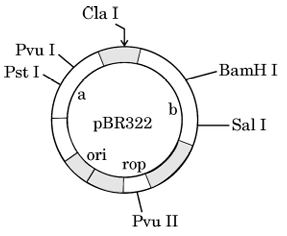
[(i)] Identify the selectable markers labelled as ‘a’ and ‘b’ in the given diagram of \textit{E. coli vector.

[(ii)] How is the coding sequence of enzyme \(\beta\)-galactosidase considered a better marker than the ones identified by you in the diagram? Explain.
[(iii)] List any two uses of cloning vectors in biotechnology.
View Solution
[label=(\alph*)]
[(i)] The protein produced by Bacillus thuringiensis is in inactive form (protoxin) inside the bacteria. It becomes active only in the alkaline gut of insects.
[(ii)] The gene coding for this protein has been incorporated into cotton plants. This makes Bt cotton produce the insecticidal protein, which kills bollworm pests on consumption.
[(i)] In the diagram of pBR322 vector:
‘a’ is amp\(^{r\) gene (ampicillin resistance)
‘b’ is tet\(^{r}\) gene (tetracycline resistance)
[(ii)] The \(\beta\)-galactosidase gene produces a visible colour change when active. This allows for blue-white screening, a simpler and faster method to identify recombinant colonies.
[(iii)] Uses of Cloning Vector:
For producing multiple copies of a specific gene.
For transferring desirable genes into host organisms. Quick Tip: The Bt toxin gene works only inside insect gut as it requires an alkaline pH for activation, thus remaining harmless to the bacteria itself.
Answer the following questions:
[(i)] Describe the population growth curve applicable in a population of any species in nature that has unlimited resources at its disposal.
[(ii)] Explain the equation of this growth curve.
[(iii)] Name the growth curve and depict a graphical plot for this type of population growth.
OR
[(i)] Explain the conclusion drawn by Alexander von Humboldt during his extensive explorations in the wilderness of South American jungles.
[(ii)] Give the equation of the Species-Area relationship.
[(iii)] Draw a graphical representation of the relation between species richness and area for a wide variety of taxa such as birds, bats, etc.
View Solution
[label=(\alph*)]
[(i)] When unlimited resources are available, populations exhibit exponential growth. The population size increases rapidly without any environmental resistance.
[(ii)] The equation for exponential growth is:
\[ \frac{dN}{dt} = rN \]
where:
\( N \) = population size
\( r \) = intrinsic rate of natural increase
\( \frac{dN}{dt} \) = change in population size per unit time
[(iii)] The growth curve is called the J-shaped curve. It shows rapid increase initially and continues rising steeply without a plateau.
[(i)] Alexander von Humboldt observed that within a region, species richness increases with increasing area but only up to a certain limit.
[(ii)] The Species-Area relationship equation is:
\[ \log S = \log C + Z \log A \]
where:
\( S \) = species richness
\( A \) = area
\( C \) and \( Z \) = constants
[(iii)] Graphical Representation:
\end{itemsize Quick Tip: Exponential (J-shaped) growth occurs only under ideal conditions. In nature, due to limited resources, most populations follow logistic (S-shaped) growth patterns.





Comments