




CBSE Class 12 Biology Set 3 Question Paper PDF 57-5-3 is available for download. CBSE conducted the Class 12 Biology examination on March 25, 2025. The question paper consists of 33 questions carrying a total of 70 marks. Section A includes 16 MCQs for 1 mark each, Section B contains 5 very short-answer questions for 2 marks each, Section C comprises 7 short-answer questions for 3 marks each, Section D comprises 2 Case-based questions carrying 4 marks each, and Section E comprises 3 long-answer questions carrying 5 marks each.
CBSE Class 12 2025 Biology Question Paper 57-5-3 with Answer Key
| CBSE Class 12 2025 Biology Question Paper with Answer Key | Download PDF | Check Solution |

In E. coli, a DNA sequence that specifies where RNA polymerase will bind and initiate transcription of a gene is:
View Solution
Given below are few statements with reference to the major events in the menstrual cycle of a human female:
During the follicular phase, the primary follicles grow to become a Graafian follicle.
Gonadotropins FSH and progesterone stimulate follicular development during the follicular phase.
LH surge induces rupture of Graafian follicle thereby releasing the corpus luteum.
Progesterone released by corpus luteum is essential for maintenance of endometrium.
Both LH and progesterone attain a peak level in the middle of the cycle.
Choose the option with all true statements from the given options:
View Solution
The approach used in HGP of identifying all the genes that are expressed as RNA is referred to as:
View Solution
Study the pedigree chart of a family showing the inheritance of myotonic dystrophy:

The trait under study is:
View Solution
The large bean-shaped organ acting as a filter of the blood in humans is:
View Solution
Select the following statements that are true for insect pollinated flowers from the given options.
Majority of these flowers are large, colourful and rich in nectar.
Nectars and seeds are usual floral rewards to attract insects for pollination.
Pollen grains of these flowers are generally mucilaginous so as to stick to the body of the insects.
A foul odour is emitted by some flowers to attract flies and beetles.
Choose the correct answer:
View Solution
Which of the following combinations is a correct example of convergent evolution in Australian marsupials and Placental mammals?

View Solution
\textquotedblleft AGGTATCGCAT\textquotedblright\ is a sequence from the coding strand of a gene. What will be the corresponding sequence of the transcribed mRNA?
View Solution
Removal of RNA polymerase-III from nucleoplasm of a eukaryotic cell will affect the transcription of which of the following?
View Solution
Large scale industrial production of streptokinase for human welfare is done using the microbe:
View Solution
Isolation of DNA from a plant cell can be achieved by using:
View Solution
In a pea plant (Pisum sativum), green pod colour is dominant over yellow pod colour. The expected ratio of the phenotypes of the offsprings (F\(_1\)) in a cross between parents with heterozygous green pod colour and homozygous yellow pod will be:
View Solution
Assertion (A): Biogas plants are more often built in rural areas.
Reason (R): The excreta or gobar of cattle is rich in Methanobacterium.
View Solution
Assertion (A): Mode of action of pills and implants/injectables is similar.
Reason (R): The effective period of pills is much longer as compared to implants/injectables.
View Solution
Assertion (A): To generate only a part of the plant from a cell is totipotency.
Reason (R): Suitable special nutrient media and sterile conditions are required in \textit{in vitro conditions for the division of cells in explants.
View Solution
Assertion (A): Gene pairs present on the same chromosome may be tightly linked or loosely linked.
Reason (R): Frequency of recombination between gene pairs on different chromosomes as a measure of the distance between genes can be used for 'mapping' their position on the chromosomes.
View Solution
Given below are the diagrammatic representations of the replicating fork of DNA in E. coli. Study the diagrams and answer the questions that follow.

(a) Which one of the three diagrams (i), (ii) or (iii) is the correct representation of the replicating fork of DNA replication? Explain your answer.
(b) Name the enzyme used in \textit{E. coli to join the newly synthesised fragments of DNA.
The basic scheme of the essential steps involved in the process of recombinant DNA technology is summarised below in the form of a flow diagram. Study the given flow diagram and answer the questions that follow:
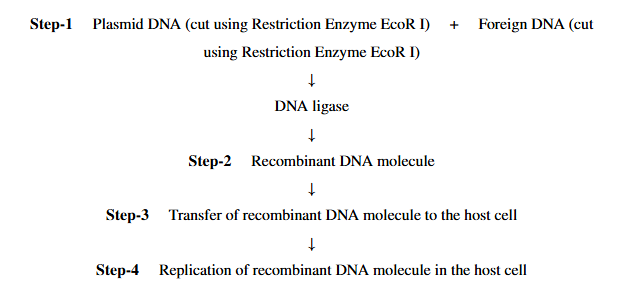
(a) Name the specific enzyme that might have been used to make the multiple copies of foreign DNA before undergoing Step-1 of the process.
(b) How does the use of restriction enzyme EcoR I in Step-1 facilitate the action of DNA ligase to form the recombinant DNA molecule? Explain.
(c) Name the most commonly used host in the above process.
View Solution
Student to attempt either option (A) or (B):
(A) Explain how the interaction between a fig tree and its tight one-to-one relationship with the pollinator species of wasp is one of the best examples of mutualism.
OR
(B) Correctly depict (also indicate the trophic level) and describe the ecological pyramid of number with 32 birds dependent on 20 insects feeding on one banyan tree.
Student to attempt either option (A) or (B):
(A) Explain what is meant by the term amniocentesis. How is this technique misused in India?
OR
(B) Name any two VDs which might occur in a human female. State any two complications in a female if it is left untreated.
Student to attempt either option (A) or (B):
(A) Give an account of the generalised structure of an antibody molecule produced by B-lymphocytes in response to the pathogen.
OR
(B) Other than public awareness and counselling, enlist four measures taken up by NACO, WHO and other NGOs to prevent the spread of HIV infection in the society.
Many of the flowering plants producing hermaphrodite flowers have developed many devices to discourage self-pollination and to encourage cross-pollination. Given below is a picture of one such outbreeding device in a flowering plant. Study the picture and answer the questions that follow:

Explain how the given type of pollination is advantageous to the plant.
Can this flowering plant show geitonogamy? Justify your answer.
Enlist three advantages of genetically modified plants.
Explain the neuroendocrine mechanism involved in the process of parturition in a human female leading to the expulsion of the baby out of the uterus through the birth canal.
Name one commonly occurring genetic disorder in humans which is caused due to monosomy (one chromosome less than the normal number of chromosomes) of sex chromosome. Give its two symptoms.
Explain how the loss of habitat and fragmentation drives plants and animals to extinction with the help of an example of habitat loss in the Tropical Rain Forest. Also write the effect of fragmentation of a habitat on the population decline.
(a) Write the full form of BOD.
(b) Define BOD. Explain how it is a measure of the organic matter present in the water body.

Study the diagram above and answer the following questions:
How many alleles are involved in blood grouping?
A person having ‘AB’ blood group has both dominant alleles. What is this inheritance type called?
A man with ‘A’ blood group marries a woman with ‘B’ blood group. Can they have a child with ‘O’ blood group? Explain with the help of a cross.
Read the following passage and answer the questions that follow.
Highly conserved proteins such as Haemoglobin and Cytochrome-C provide the best biochemical evidences to trace evolutionary relationships between different groups. Cytochrome-C is formed of 104 amino acids. Cytochrome-C is the respiratory pigment present in all eukaryotic cells. It has evolved at a constant rate during evolution. In chimpanzees and humans, Cytochrome-C genes are identical. The given data shows the evolution of the Cytochrome-C gene in different mammals from kangaroos, cows, rodents to humans:

Select the correct option for the time of separation of two groups and the number of nucleotide substitutions in the gene of Cytochrome-C:

What do you infer about the type of evolution (convergent or divergent) for the given pair of groups and why?
[(i)] Human and Kangaroo
[(ii)] Human and Rodent
[(i)] Define convergent evolution.
OR
(ii) Define divergent evolution.
Read the following passage and answer the questions that follow.
In 2021, 5.3 percent of 15 to 16-year-olds worldwide (13.5 million individuals) had used \textit{Cannabis in the past year according to UNODC. The adolescent brain is still developing and drug use can have long-term negative effects. Early drug use initiation can lead to faster development of dependence than in adults and other problems in adulthood. Parts of the Amazon Basin are at the intersection of multiple forms of organised crimes that are accelerating devastation, with severe implications for the security, health and well-being of the population across the region. The direct impact of coca cultivation on deforestation is minimal, but indirectly it acts as a catalyst for “Narco-deforestation”. The laundering of drug trafficking profits into land speculation etc. is posing a growing danger to the world’s largest rainforest.
Which age group or period of growth people are more vulnerable to drug abuse?
Explain the negative impact of coca cultivation on the world’s largest rainforest.
[(i)] From which part of the plant are cannabinoids mainly obtained? Mention any one negative effect of this drug on adolescents.
OR
[(ii)] State the scientific name of the plant from which coca alkaloids are derived and state one negative impact of use of excessive dosage of cocaine.
Answer the following questions:
[(i)] Describe the population growth curve applicable in a population of any species in nature that has unlimited resources at its disposal.
[(ii)] Explain the equation of this growth curve.
[(iii)] Name the growth curve and depict a graphical plot for this type of population growth.
OR
[(i)] Explain the conclusion drawn by Alexander von Humboldt during his extensive explorations in the wilderness of South American jungles.
[(ii)] Give the equation of the Species-Area relationship.
[(iii)] Draw a graphical representation of the relation between species richness and area for a wide variety of taxa such as birds, bats, etc.
Answer the following questions:
Explain how the process of RNA interference technology is used effectively to prevent infestation of the roots of tobacco plant by the nematode Meloidogyne incognita.
OR
Explain how more than a billion copies of a fragment of DNA are formed using the technique of PCR.
Answer the following questions:
[(i)] Explain the structure of a typical monocotyledonous embryo of a flowering plant.
[(ii)] How are multiple embryos formed in a citrus fruit? What is the mechanism known as?
OR
[(i)] Name and explain the structural organisation of the male sex accessory ducts in the human male reproductive system.
[(ii)] Describe the role of gonadotropin FSH in the regulation of spermatogenesis.




Comments