




CBSE Class 12 Biology Set 1 Question Paper PDF 57-7-1 is available for download. CBSE conducted the Class 12 Biology examination on March 25, 2025. The question paper consists of 33 questions carrying a total of 70 marks. Section A includes 16 MCQs for 1 mark each, Section B contains 5 very short-answer questions for 2 marks each, Section C comprises 7 short-answer questions for 3 marks each, Section D comprises 2 Case-based questions carrying 4 marks each, and Section E comprises 3 long-answer questions carrying 5 marks each.
CBSE Class 12 2025 Biology Question Paper 57-7-1 with Answer Key
| CBSE Class 12 2025 Biology Question Paper with Answer Key | Download PDF | Check Solution |

What are minisatellites?
View Solution
Identify the incorrect statement regarding PCR.
View Solution
The following information is about drugs and tobacco. Select the correct statement from the options given below.
View Solution
Given below are the events that are observed in an artificial hybridisation programme. Arrange them in the correct sequential order and select the correct option.
(i) Re-bagging
(ii) Selection of parents
(iii) Bagging
(iv) Dusting the pollens on stigma
(v) Emasculation
(vi) Collection of pollens from male parent
View Solution
Which of the following conditions correctly describes the manner of determining the sex in the given options?
View Solution
Choose the option that correctly describes the gynoecium of Michelia:
View Solution
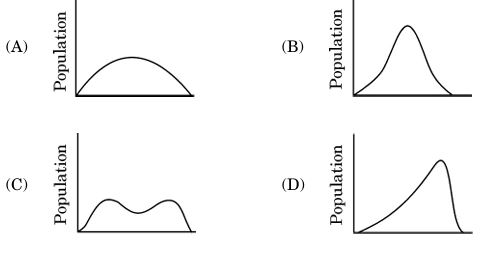
The given graph shows the range of variation among population members, for a trait determined by multiple genes. If this population is subjected to disruptive selection for several generations, which of the following distributions is most likely to result?

View Solution
Which one of the following immune system components does not correctly match with its respective role?
View Solution
Which one of the following is not the product of transgenic experiments?
View Solution
A biologist studied the population of rats in a granary. He found the average natality was 280, average mortality was 200, immigration was 40 and emigration was 50. The net increase in population is:
View Solution
India has only 2.4% of the world's land area but its share of the global species diversity is:
View Solution
Out of the following, select the correct match:
View Solution
Assertion (A): Swiss cheese is characterized by large holes due to CO\textsubscript{2 production.
Reason (R): It is ripened by growing a specific fungi.
View Solution
Assertion (A): Replication of DNA takes place in S phase of the cell cycle.
Reason (R): DNA replication and cell division cycle should be highly coordinated.
View Solution
Assertion (A): A male individual always inherits haemophilia from his mother.
Reason (R): The gene for haemophilia lies on X-chromosome.
View Solution
Assertion (A): A piece of DNA inserted into an alien organism generally does not replicate, if not inserted into a chromosome.
Reason (R): Chromosomes have specific sequences called ‘ori’ region, where DNA replication is initiated.
View Solution
Student to attempt either option (A) or (B):
(A) Name the Indian crop variety for which, in 1997, an American company got patent rights through the US Patent and Trademark Office. This is considered a case of Biopiracy. Justify.
OR
(B) State two purposes for which the Indian Government has set up GEAC (Genetic Engineering Approval Committee).
View Solution
Student to attempt either option (A) or (B):
(A) “A fully developed foetus initiates its delivery from the mother’s womb.” Explain.
OR
(B) Give reasons for the following:
Why can a woman generally not conceive a child after 50 years of age?
Polar bodies are formed during oogenesis and not during spermatogenesis.
A few stages and their respective time period in the evolutionary history of human beings are mentioned in the flowchart given below:
15 mya — Primates walking like gorillas and chimpanzees existed.
3–4 mya — Man-like primates walked in Eastern Africa. Fossils of their bones were discovered.
2 mya — This ancestor lived in the East African grasslands and ate fruits.
1.5 mya — This hominid had a brain size of 900 cc and probably ate meat.
Based on the above information, answer the following questions:
[(a)] Name one primate about 15 mya.
[(b)] Name one place where fossils of primates were discovered in Eastern Africa.
[(c)] Name the ancestor that lived in the East African grasslands about 2 mya.
[(d)] Name the hominid that was found around 1.5 mya.
Student to attempt either option (A) or (B):
(A) How does a human body respond when vaccine is introduced into it? It is said that vaccinations are a must for a healthy society. Justify.
OR
(B) Humans have innate immunity for protection against pathogens that may enter the gut along with food. What are the two barriers in our body that protect it from such pathogens?
A karyotype of a human suffering from a certain disorder is given below:

Answer the following:
[(a)] Identify the disorder.
[(b)] Write the symptoms of the disorder.
[(c)] Give reason for such a disorder.
A village health worker was taking a session with women. She tells them that one has to be careful while using oral pills as a method of birth control. Wrong usage can actually promote conception.
(A) Analyse the statement — oral pills need careful usage, as wrong usage can promote conception. Compare merits and demerits of using oral pills and surgical methods of birth control.
(B) Village women are confused as to how a thin metallic copper loop can prevent pregnancy. Explain the mode of action of IUDs. Give two points.
(a) "The process of evolution of different species in a given geographical area starts from a point and literally radiates to other geographical areas." Explain it with an example.
(b) Cite an example where more than one adaptive radiation has occurred in an isolated geographical area. Name the type of evolution your example depicts.
A segment of DNA, ‘TTG AGG GGG ATG’ was translated into an oligopeptide with the amino acids, Lysine - Serine - Proline - Tyrosine.
[(a)] Write the codons in correct sequence for the four amino acids.
[(b)] If first adenine in DNA is substituted by guanine, what will be the sequence of amino acids in the new oligopeptide?
[(c)] Write the anticodons for these amino acids.
A person is suffering from high grade fever. Which symptoms will help to identify if he/she is suffering from Typhoid, Pneumonia or Malaria?
(a) Why are transgenic animals so called?
(b) With the help of an example each, explain the role of transgenic animals in the following:
[(i)] Vaccine safety
[(ii)] Biological products
(a) Mention any two advantages of micropropagation techniques.
(b) Write in brief how the process is carried out in the laboratory.
(c) Name any two important food plants grown commercially by this method.
Name the type of food chains responsible for the flow of larger fraction of energy in an aquatic ecosystem and a terrestrial ecosystem, respectively. Mention any two differences between the two food chains.
Study the figure given below and answer the questions that follow.

Identify the figure and state its importance.
Why is air diffused into the aerator tank? Explain.
[(i)] What changes take place in the settling tank?
OR
[(ii)] How is BOD related to organic matter present in the water?
The following question is based on pollination. Study the figures carefully and answer the questions that follow.

Give the scientific terms for the processes taking place in Figures A and B respectively.
Mention two conditions necessary for the process occurring in Figure B.
[(i)] State one advantage and one disadvantage of the process occurring in Figure B.
OR
[(ii)] Name one plant where, in some flowers only, the process in Figure B takes place and give the reason responsible for it.
Student to attempt either option-(A) or (B):
(A) Write the features a molecule should have to act as a genetic material. In the light of the above features, evaluate and justify the suitability of the molecule that is preferred as an ideal genetic material.
OR
(B) Differentiate between the following:
[(i)] Polygenic Inheritance and Pleiotropy
[(ii)] Dominance, Codominance and Incomplete dominance
Student to attempt either option-(A) or (B):
(A) Study the given diagram showing the sectional view of a seminiferous tubule.

Answer the following questions:
[(i)] Label A, B, C and D in the figure.
[(ii)] What will be the number of chromosomes in secondary spermatocyte and spermatid respectively?
[(iii)] Explain the terms — Spermiogenesis and Spermiation.
OR
(B) Study the figures given below showing initial stages in the formation of female gametophyte and answer the questions that follow.

[(i)] Identify (P) and (Q).
[(ii)]
[I.] What kind of division does cell (P) undergo to form (Q)?
[II.] How many (Q) cells form the embryo sac? What is the name given to such kind of development?
[III.] How many free nuclear mitotic divisions will the functional megaspore undergo to form the embryo sac?
[IV.] Describe the structure of a mature female gametophyte.
View Solution
Student to attempt either option-(A) or (B):
(A)[(i)] How does alien species invasion cause a decline in biodiversity? Explain.
How have the following contributed to biodiversity loss?
I. Nile Perch
II. Lantana and Eichhornia
III. Clarias gariepinus
[(ii)] Why have certain regions been declared as biodiversity hotspots by environmentalists of the world? Name any two such regions in India.
OR
(B)
[(i)] Write an equation for Verhulst-Pearl Logistic Growth Curve where:
N = Population density at time ‘t’
r = Intrinsic rate of natural increase
[(ii)] Draw a graph for a population whose population density has reached carrying capacity.
[(iii)] Draw a growth curve where resources are non-limiting to growth of population.
[(iv)] Which growth curve is considered more realistic and why? Explain.




Comments