




CBSE Class 12 Biology Set 2 Question Paper PDF 57-7-2 is available for download. CBSE conducted the Class 12 Biology examination on March 25, 2025. The question paper consists of 33 questions carrying a total of 70 marks. Section A includes 16 MCQs for 1 mark each, Section B contains 5 very short-answer questions for 2 marks each, Section C comprises 7 short-answer questions for 3 marks each, Section D comprises 2 Case-based questions carrying 4 marks each, and Section E comprises 3 long-answer questions carrying 5 marks each.
CBSE Class 12 2025 Biology Question Paper 57-7-2 with Answer Key
| CBSE Class 12 2025 Biology Question Paper with Answer Key | Download PDF | Check Solution |

pBR which is frequently used as a vector for cloning gene in E. coli is a/an:
View Solution
pBR is a plasmid vector that has been genetically engineered for use in molecular cloning, particularly in \textit{E. coli. It is not an original bacterial plasmid but a modified version that includes antibiotic resistance genes and origin of replication to facilitate the insertion and replication of foreign DNA in host cells. Quick Tip: Modified plasmids like pBR322 are widely used as cloning vectors due to features such as selectable markers and multiple cloning sites.
The given graph shows the range of variation among population members, for a trait determined by multiple genes. If this population is subjected to disruptive selection for several generations, which of the following distributions is most likely to result?

View Solution
Disruptive selection favors individuals at both extremes of a trait distribution and selects against the intermediate types. Over several generations, this leads to a bimodal distribution, like the one shown in option (C), where individuals at both ends of the range increase in frequency. Quick Tip: Disruptive selection produces two peaks — favoring extremes and reducing intermediates.
Which one of the following immune system components does not correctly match with its respective role?
View Solution
Option (B) is incorrect because macrophages are not mucus-secreting cells. They are phagocytic white blood cells that engulf and digest pathogens and dead cells. Mucus-secreting cells are epithelial in nature and help trap pathogens, but they are not macrophages. Quick Tip: Macrophages = phagocytosis; Mucus secretion is done by epithelial cells, not macrophages.
During the process of oogenesis in human female, the primary oocyte results in the formation of which of the following?
Choose the correct option.
View Solution
During oogenesis, meiosis in the primary oocyte results in an unequal division of cytoplasm, producing a larger haploid secondary oocyte and a smaller haploid polar body. This ensures that the oocyte retains most of the cytoplasmic content for future embryonic development. Quick Tip: Oogenesis involves unequal cell divisions to conserve cytoplasm in the developing egg.
A dwarf pea plant was treated with gibberellic acid and it becomes as tall as a tall pea plant. If these treated pea plants are crossed with pure tall pea plants, the phenotypic ratio in F\textsubscript{1} generation will be:
View Solution
The dwarf plant treated with gibberellic acid does not undergo a genetic change—it remains genetically dwarf. If it is crossed with a pure tall plant (TT), the offspring would all be heterozygous (Tt), and phenotypically tall. Hence, all tall offspring are produced in F\textsubscript{1 generation. Quick Tip: Gibberellic acid induces tall phenotype without altering the genotype.
Out of the following, select the correct match:
View Solution
ELISA (Enzyme-Linked Immunosorbent Assay) is based on antigen-antibody interaction, used widely for diagnostics like HIV detection. Other options are mismatches: for example, Cry genes are used in transgenic crops like cotton, not in corn borer insects. Quick Tip: ELISA uses antibody-antigen specificity to detect infections and diseases.
The following information is about drugs and tobacco. Select the correct statement from the options given below.
View Solution
Morphine is a strong opioid analgesic used to relieve severe pain, such as post-surgical pain. The other options are false: cocaine is an addictive stimulant and not used post-surgery, tobacco increases blood pressure, and barbiturates are depressants—not truth serums. Quick Tip: Morphine is a potent painkiller; barbiturates and stimulants have different clinical uses and abuse risks.
India has only 2.4% of the world’s land area but its share of the global species diversity is:
View Solution
Although India occupies only 2.4% of the global land area, it accounts for about 5–8% of the world’s biodiversity. The most widely accepted estimate for its species richness is approximately 5.1%. Quick Tip: India is one of the 12 mega biodiversity countries in the world, contributing 5.1% to global species diversity.
Name the microbe that is used as biocontrol agent for controlling pest butterfly caterpillars:
View Solution
\textit{Bacillus thuringiensis (Bt) produces insecticidal crystal proteins toxic to larval stages of insects like butterfly caterpillars. It is used as a biocontrol agent in both spray and transgenic crop forms to naturally manage pest populations. Quick Tip: Bt = Biocontrol bacteria that kills insect larvae by damaging their gut lining.
Study the table given below showing the relationship between organism, its trophic level and kind of food chain it belongs to.
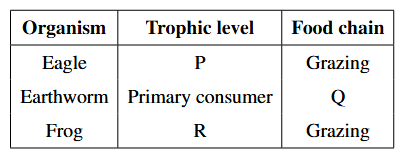
Select the option that correctly identifies P, Q and R in the table given below:
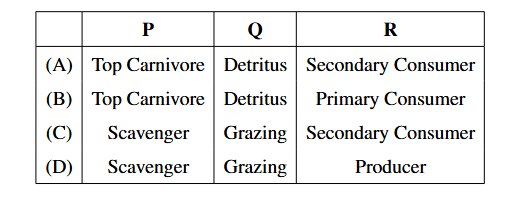
View Solution
Eagle is a top carnivore in a grazing food chain. Earthworm is a primary consumer in the detritus food chain as it feeds on decomposing organic matter. Frog, being a carnivore that feeds on primary consumers like insects, acts as a secondary consumer in the grazing food chain. Quick Tip: Top carnivores occupy the highest trophic level; earthworms operate in the detritus food chain; frogs are secondary consumers.
What are minisatellites?
View Solution
Minisatellites are short, tandemly repeated DNA sequences usually found in non-coding regions. They range from 10–60 base pairs and are highly variable between individuals, making them ideal for DNA fingerprinting and other genetic studies. Quick Tip: Minisatellites are non-coding, highly variable repetitive sequences useful in DNA fingerprinting.
Choose the option that correctly describes the gynoecium of Michelia:
View Solution
In \textit{Michelia, the gynoecium is composed of multiple free carpels, making it multicarpellary and apocarpous. Each carpel is distinct and not fused with others, characteristic of primitive angiosperms. Quick Tip: Apocarpous = free carpels; Syncarpous = fused carpels.
Assertion (A): A piece of DNA inserted into an alien organism generally does not replicate, if not inserted into a chromosome.
Reason (R): \textit{Chromosomes have specific sequences called ‘ori’ region, where DNA replication is initiated.
View Solution
DNA replication in any organism starts at the origin of replication (ori). If a DNA fragment lacks this sequence and is not incorporated into the host chromosome (which contains the ori), it cannot replicate independently. Hence, both the assertion and reason are true, and the reason correctly explains the assertion. Quick Tip: For replication, foreign DNA must have an ‘ori’ or integrate into host DNA that already has it.
Assertion (A): Swiss cheese is characterized by large holes due to CO\textsubscript{2 production.
Reason (R): It is ripened by growing a specific fungi.
View Solution
Swiss cheese develops holes due to CO\textsubscript{2 production by \textit{Propionibacterium shermanii, a bacterium—not a fungus. Therefore, the assertion is correct, but the reason is incorrect. Quick Tip: Remember: Swiss cheese is made using bacteria, not fungi.
Assertion (A): Human male is referred to as heterogametic.
Reason (R): The male produces millions of sperms of the same kind.
View Solution
Human males are heterogametic because they produce two types of gametes: sperm carrying X chromosome and sperm carrying Y chromosome. Hence, they do not produce only one kind of sperm. Assertion is true, but the reason is false. Quick Tip: Heterogametic = Produces different types of gametes (X and Y).
Assertion (A): Replication of DNA takes place in S phase of the cell cycle.
Reason (R): DNA replication and cell division cycle should be highly coordinated.
View Solution
DNA replication occurs during the S phase (synthesis phase) of the cell cycle. This process must be precisely coordinated with the cell cycle to ensure accurate transmission of genetic material. Therefore, both statements are true, and the reason explains the assertion correctly. Quick Tip: S phase = DNA synthesis; proper timing is essential for cell division fidelity.
Student to attempt either option (A) or (B):
(A) Biotechnology has helped farmers to get pest-resistant cotton plants. Explain the technique adopted along with its mode of action.
OR
(B) Explain any two molecular diagnostic techniques that help to detect pathogens from suspected patient.
View Solution
(A)
Step 1: The technique involves the use of Bt cotton, a genetically modified crop.
Step 2: It contains genes from \textit{Bacillus thuringiensis that produce Cry proteins.
Step 3: When ingested by insect larvae, Cry proteins form pores in their midgut epithelium, causing cell lysis and death.
Conclusion: This makes the cotton plant pest-resistant and reduces pesticide use.
\medskip
OR
(B)
Two molecular diagnostic techniques:
PCR (Polymerase Chain Reaction): Detects the presence of pathogen DNA by amplifying it from minute quantities.
ELISA (Enzyme-Linked Immunosorbent Assay): Detects antigens or antibodies using antigen-antibody interaction and enzyme-linked indicators. Quick Tip: Bt cotton contains bacterial genes for pest resistance. PCR and ELISA are reliable tools for molecular diagnostics.
Student to attempt either option (A) or (B):
(A) How does a human body respond when vaccine is introduced into it? It is said that vaccinations are a must for a healthy society. Justify.
OR
(B) Humans have innate immunity for protection against pathogens that may enter the gut along with food. What are the two barriers in our body that protect it from such pathogens?
View Solution
(A)
Step 1: Vaccines introduce antigens from pathogens into the body without causing disease.
Step 2: The immune system produces memory B-cells and antibodies in response.
Step 3: On subsequent exposure, the immune response is rapid and strong.
Conclusion: Vaccinations build immunity and reduce disease spread, supporting public health.
\medskip
OR
(B)
Two barriers involved in innate immunity:
Mucosal barrier: Mucus secreted in the gut traps microbes and prevents entry.
HCl barrier: Hydrochloric acid in the stomach kills many pathogens that enter with food. Quick Tip: Vaccines train the immune system. Innate immunity includes physical and chemical barriers like mucus and stomach acid.
Student to attempt either option (A) or (B):
(A) “A fully developed foetus initiates its delivery from the mother’s womb.” Explain.
OR
(B) Give reasons for the following:
Why can a woman generally not conceive a child after 50 years of age?
Polar bodies are formed during oogenesis and not during spermatogenesis.
View Solution
(A)
Step 1: A fully developed foetus sends signals to the maternal system through hormones.
Step 2: Foetal ejection reflex is triggered by mild uterine contractions.
Step 3: This stimulates the release of oxytocin from the maternal pituitary.
Step 4: Oxytocin enhances uterine contractions in a positive feedback loop until delivery occurs.
\medskip
OR
(B)
(i)
After 50 years of age, a woman usually undergoes menopause, where the ovaries stop releasing eggs and hormonal support for conception ceases.
(ii)
During oogenesis, unequal cytoplasmic division occurs to preserve maximum cytoplasm in the ovum. The small, non-functional cells produced alongside are called polar bodies. In spermatogenesis, equal division produces four functional sperms, hence no polar bodies form. Quick Tip: Delivery is triggered by oxytocin via foetal signals. Polar bodies form in oogenesis due to unequal divisions, unlike spermatogenesis.
A few stages and their respective time period in the evolutionary history of human beings are mentioned in the flowchart given below:
15 mya — Primates walking like gorillas and chimpanzees existed.
3–4 mya — Man-like primates walked in Eastern Africa. Fossils of their bones were discovered.
2 mya — This ancestor lived in the East African grasslands and ate fruits.
1.5 mya — This hominid had a brain size of 900 cc and probably ate meat.
Based on the above information, answer the following questions:
[(a)] Name one primate about 15 mya.
[(b)] Name one place where fossils of primates were discovered in Eastern Africa.
[(c)] Name the ancestor that lived in the East African grasslands about 2 mya.
[(d)] Name the hominid that was found around 1.5 mya.
View Solution
[(a)] Dryopithecus or Ramapithecus.
[(b)] Ethiopia or Tanzania.
[(c)] Australopithecus.
[(d)] Homo erectus. Quick Tip: Dryopithecus and Ramapithecus are ancient primates from 15 mya. Homo erectus had a 900 cc brain and used tools.
Answer the following questions:
Write the scientific name of the fruit fly.
Why did Morgan prefer to work with fruit flies for his experiments? State two reasons.
View Solution
[label=(\alph*)]
The scientific name of the fruit fly is Drosophila melanogaster.
Morgan preferred fruit flies for the following reasons:
They have a short life cycle and reproduce quickly.
They produce a large number of offspring and show clear genetic variations. Quick Tip: Drosophila melanogaster is a model organism in genetics due to its short life cycle and ease of maintenance.
Name the type of food chains responsible for the flow of larger fraction of energy in an aquatic ecosystem and a terrestrial ecosystem, respectively. Mention any two differences between the two food chains.
View Solution
In aquatic ecosystems: Grazing food chain.
In terrestrial ecosystems: Detritus food chain.
Differences:
In the grazing food chain, energy flow begins from producers (phytoplankton or plants), while in detritus food chain, it begins from dead organic matter.
The grazing food chain is the major energy flow route in aquatic systems, whereas detritus food chain dominates in terrestrial systems. Quick Tip: Energy in aquatic ecosystems flows mainly through grazing food chains, while detritus chains dominate terrestrial ecosystems.
Name the process involved in the production of nematode-resistant tobacco plants, using genetic engineering. Explain the strategy adopted to develop such plants.
View Solution
Process Name: RNA interference (RNAi)
Strategy Adopted:
RNA interference is a gene-silencing method that involves the introduction of double-stranded RNA (dsRNA) that is complementary to the mRNA of the target gene.
In the case of nematode-resistant tobacco, a gene coding for a nematode protein is inserted into the plant in such a way that it produces both sense and antisense RNA strands.
These strands form dsRNA, which triggers the RNAi mechanism, degrading the nematode's mRNA when it infects the plant.
As a result, the nematode fails to survive due to the lack of synthesis of vital proteins. Quick Tip: RNA interference (RNAi) uses dsRNA to silence specific genes — a powerful tool in developing pest- or pathogen-resistant crops.
The base sequence in one of the strands of DNA is: ‘TAGCATGAT
Give the base sequence of its complementary strand.
How are these base pairs held together in DNA molecule?
Explain the base complementarity rule. Name the scientist who framed this rule.
View Solution
[label=(\alph*)]
The complementary strand of \texttt{TAGCATGAT is: ATCGTACTA
These base pairs are held together by hydrogen bonds — adenine (A) pairs with thymine (T) via 2 hydrogen bonds, and cytosine (C) pairs with guanine (G) via 3 hydrogen bonds.
The base complementarity rule states that A pairs with T and C pairs with G in DNA. This rule was framed by the scientist Erwin Chargaff. Quick Tip: A–T have 2 hydrogen bonds, C–G have 3. Chargaff's rule explains DNA base pairing.
A village health worker was taking a session with women. She tells them that one has to be careful while using oral pills as a method of birth control. Wrong usage can actually promote conception.
(A) Analyse the statement — oral pills need careful usage, as wrong usage can promote conception. Compare merits and demerits of using oral pills and surgical methods of birth control.
(B) Village women are confused as to how a thin metallic copper loop can prevent pregnancy. Explain the mode of action of IUDs. Give two points.
View Solution
(A)
Analysis:
Oral pills should be taken regularly and at the prescribed time. Missed doses reduce effectiveness, increasing chances of conception.
Merits of oral pills:
Easy to administer.
Reversible contraceptive method.
Demerits:
Must be taken regularly without fail.
Possible side effects like nausea and hormonal imbalances.
Merits of surgical methods:
Permanent and highly effective.
No need for daily management.
Demerits:
Irreversible in most cases.
Requires hospitalization and medical procedure.
(B)
Mode of action of copper IUDs:
Release of copper ions reduces sperm motility and viability, preventing fertilisation.
Induces changes in the uterine lining, making it unsuitable for implantation. Quick Tip: Regularity is key for oral pills. IUDs work by affecting sperm and uterine lining to prevent pregnancy.
(a) Mention any two advantages of micropropagation techniques.
(b) Write in brief how the process is carried out in the laboratory.
(c) Name any two important food plants grown commercially by this method.
View Solution
[(a)]
Large number of genetically identical plants can be produced rapidly.
Disease-free plants can be developed.
[(b)]
Explants (small plant tissue pieces) are cultured in nutrient medium under sterile conditions.
Plant hormones stimulate cell division to form callus.
Callus differentiates into plantlets, which are later transferred to soil.
[(c)]
Banana
Sugarcane Quick Tip: Micropropagation is a tissue culture technique useful for mass-producing uniform, disease-free plants.
(a) "The process of evolution of different species in a given geographical area starts from a point and literally radiates to other geographical areas." Explain it with an example.
(b) Cite an example where more than one adaptive radiation has occurred in an isolated geographical area. Name the type of evolution your example depicts.
View Solution
[(a)] The given statement explains adaptive radiation, where organisms diversify rapidly into new forms to adapt to different ecological niches.
Example: Darwin’s finches on the Galápagos Islands. From a single ancestral species, many species evolved with different types of beaks suited to different kinds of food.
[(b)] An example is the marsupials in Australia, where many species evolved from a common ancestor in isolated geographical areas.
This depicts convergent evolution, where organisms evolve similar adaptations independently. Quick Tip: Adaptive radiation leads to diversification from a common ancestor. Australia’s marsupials are a textbook example.
A person is suffering from high grade fever. Which symptoms will help to identify if he/she is suffering from Typhoid, Pneumonia or Malaria?
View Solution
Typhoid:
Sustained high fever.
Weakness.
Stomach pain and constipation.
Pneumonia:
Fever with chills.
Cough.
Difficulty in breathing and chest pain.
Malaria:
Recurrent high fever with chills.
Headache.
Muscle pain.
Sweating after fever subsides. Quick Tip: Pattern of fever and associated symptoms are important clues in diagnosing infectious diseases like Typhoid, Pneumonia, and Malaria.
The following question is based on pollination. Study the figures carefully and answer the questions that follow.

Give the scientific terms for the processes taking place in Figures A and B respectively.
Mention two conditions necessary for the process occurring in Figure B.
[(i)] State one advantage and one disadvantage of the process occurring in Figure B.
OR
[(ii)] Name one plant where, in some flowers only, the process in Figure B takes place and give the reason responsible for it.
View Solution
[label=(\alph*)]
The scientific terms are:
Figure A — Cross-pollination
Figure B — Autogamy (a type of self-pollination)
Two conditions necessary for autogamy:
(i) Anther and stigma must mature simultaneously (synchronous maturation).
(ii) Anther and stigma must be positioned closely to facilitate transfer of pollen grains.
[(i)]
Advantage: Maintains genetic purity of the species.
Disadvantage: Leads to reduced genetic variation, which may limit adaptability.
OR
[(ii)] One such plant is Viola (commonly known as pansy).
\textit{Reason: It shows cleistogamy, where some flowers do not open and ensure autogamy as the only mode of pollination. Quick Tip: Cross-pollination promotes genetic diversity, while autogamy ensures reproductive assurance, especially in isolated environments.
Study the figure given below and answer the questions that follow.

Identify the figure and state its importance.
Why is air diffused into the aerator tank? Explain.
[(i)] What changes take place in the settling tank?
OR
[(ii)] How is BOD related to organic matter present in the water?
View Solution
[label=(\alph*)]
The figure represents the Secondary Treatment or Biological Treatment in a Sewage Treatment Plant.
\textit{Importance: This stage helps in removing the biodegradable organic matter from the wastewater using aerobic microorganisms.
Air is diffused into the aerator tank to provide oxygen to aerobic bacteria and microbes. These microbes utilize the oxygen to break down organic matter in the sewage efficiently, reducing the Biochemical Oxygen Demand (BOD) of the water.
[(i)] In the settling tank, the activated sludge settles down at the bottom due to gravity. The clear water or effluent is then separated from the top. A portion of the activated sludge is returned to the aeration tank (Return Activated Sludge - RAS), while the rest is removed as Waste Activated Sludge (WAS).
OR
[(ii)] BOD (Biochemical Oxygen Demand) is directly proportional to the amount of organic matter present in water. The more the organic content, the more oxygen is required by aerobic bacteria to break it down, leading to a higher BOD value. Quick Tip: The secondary treatment in sewage involves aerobic microbes that degrade organic waste. High BOD means more organic pollution in water.
Answer the following questions:
[(i)] What is a test cross? How can we find out the zygosity of a plant by the use of test cross?
[(ii)] Why are human females rarely haemophilic? Explain with the help of a cross. Under what conditions can a haemophilic female be born? How do haemophilic patients suffer?
OR
Name the two events ‘a’ and ‘c’ shown in the diagram below.

[(i)] Mention where in the cell these events take place.
[(ii)] Explain the changes taking place during event ‘b’ and mention why these are needed.
View Solution
(a)
[(i)] A test cross is a cross between an individual of unknown genotype with a homozygous recessive individual to determine the genotype (zygosity). If the progeny shows all dominant traits, the test plant is homozygous dominant; if a 1:1 ratio of dominant and recessive traits appears, it is heterozygous.
[(ii)] Human females are rarely haemophilic because the disorder is X-linked recessive. For a female to be haemophilic, she must inherit the defective gene from both parents (i.e., mother must be carrier and father must be haemophilic). Haemophilic individuals suffer from defective blood clotting due to absence of clotting factors, resulting in prolonged bleeding.
OR
(b)
Event a: Transcription
Event c: Translation
[(i)] These events take place in the nucleus (transcription and splicing) and cytoplasm (translation).
[(ii)] Event b is RNA splicing, where introns (non-coding sequences) are removed and exons (coding sequences) are joined. This process is necessary to produce a functional mRNA transcript that can be translated into a proper protein. Quick Tip: Test cross helps identify zygosity. Haemophilia is X-linked recessive. Splicing removes introns; translation builds proteins.
Student to attempt either option-(A) or (B):
(A) [(i)] How does alien species invasion cause a decline in biodiversity? Explain.
How have the following contributed to biodiversity loss?
I. Nile Perch
II. Lantana and \textit{Eichhornia
III. Clarias gariepinus
[(ii)] Why have certain regions been declared as biodiversity hotspots by environmentalists of the world? Name any two such regions in India.
OR
(B)[(i)] Write an equation for Verhulst-Pearl Logistic Growth Curve where:
N = Population density at time ‘t’
r = Intrinsic rate of natural increase
[(ii)] Draw a graph for a population whose population density has reached carrying capacity.
[(iii)] Draw a growth curve where resources are non-limiting to growth of population.
[(iv)] Which growth curve is considered more realistic and why? Explain.
View Solution
(A)
[(i)] Alien species invasion causes biodiversity loss by outcompeting native species for resources, altering habitats, or introducing new diseases.
Nile Perch: Introduced in Lake Victoria, it caused the extinction of over 200 native cichlid fish species.
\textit{Lantana and \textit{Eichhornia: These invasive plants choke native vegetation and water bodies, respectively, altering ecosystem structure.
\textit{Clarias gariepinus: An exotic African catfish introduced in Indian waters that threatens indigenous fish diversity by predation and competition.
[(ii)] Regions rich in endemic species and facing severe threats are declared as biodiversity hotspots. These areas are prioritized for conservation.
Two biodiversity hotspots in India:
Western Ghats
Indo-Burma region
OR
(B)
[(i)] The equation for Verhulst-Pearl Logistic Growth is:
\[ \frac{dN{dt} = rN\left(\frac{K - N}{K}\right) \]
Where:
\( N \) = Population density at time \( t \)
\( r \) = Intrinsic rate of natural increase
\( K \) = Carrying capacity
[(ii)] % Logistic Growth Curve Graph
\textit{(Draw an S-shaped sigmoid curve showing slow start, exponential growth, and leveling off at K)
[(iii)] % Exponential Growth Curve Graph
\textit{(Draw a J-shaped curve showing continuous rise in population size)
[(iv)] The logistic growth curve is considered more realistic because:
It takes into account limited resources and environmental resistance.
It reflects the natural population growth trend where growth slows as resources become scarce and population approaches carrying capacity. Quick Tip: Invasive species disrupt native ecosystems. Logistic growth models real-world population trends, considering environmental limits.
Student to attempt either option-(A) or (B):
(A) Study the given diagram showing the sectional view of a seminiferous tubule.

Answer the following questions:
[(i)] Label A, B, C and D in the figure.
[(ii)] What will be the number of chromosomes in secondary spermatocyte and spermatid respectively?
[(iii)] Explain the terms — Spermiogenesis and Spermiation.
OR
(B) Study the figures given below showing initial stages in the formation of female gametophyte and answer the questions that follow.

[(i)] Identify (P) and (Q).
[(ii)]
[I.] What kind of division does cell (P) undergo to form (Q)?
[II.] How many (Q) cells form the embryo sac? What is the name given to such kind of development?
[III.] How many free nuclear mitotic divisions will the functional megaspore undergo to form the embryo sac?
[IV.] Describe the structure of a mature female gametophyte.
View Solution
(A)
[(i)] Labels:
A — Spermatozoa
B — Secondary spermatocyte
C — Primary spermatocyte
D — Spermatogonia
[(ii)] Secondary spermatocyte: n = 23 chromosomes, \quad Spermatid: n = 23 chromosomes
[(iii)]
Spermiogenesis: Process by which spermatids transform into mature spermatozoa.
Spermiation: Release of mature spermatozoa from Sertoli cells into the lumen of seminiferous tubules.
OR
(B)
[(i)]
(P) — Megaspore mother cell
(Q) — Functional megaspore
[(ii)]
[I.] Cell (P) undergoes meiosis to form cell (Q).
[II.] Only one functional (Q) cell develops into the embryo sac. This is called monosporic development.
[III.] The functional megaspore undergoes three free nuclear mitotic divisions.
[IV.] The mature female gametophyte (embryo sac) is 7-celled and 8-nucleated, consisting of:
1 egg cell and 2 synergids at the micropylar end,
3 antipodal cells at the chalazal end,
1 central cell with 2 polar nuclei. Quick Tip: Spermiogenesis transforms spermatids into sperm, while spermiation releases them. In female gametophyte development, monosporic development forms the embryo sac from one megaspore.



Comments